



Abstract
The positive role of secure attachment in reducing intergroup biases has been suggested in prior studies. We extend this work by testing the effects of secure attachment primes on negative emotions and aggressive behaviors toward outgroup members across four experiments. Results from Studies 1A and 1B reveal that secure attachment prime, relative to neutral, can reduce negative outgroup emotions. In addition, Studies 1B and 3 results rule out positive mood increase as an alternative explanation for the observed effects. Results from Studies 2 and 3 reveal that secure attachment primes can reduce aggressive behavior toward an outgroup member. The effect of secure attachment primes on outgroup harm was found to be fully mediated by negative emotions in Studies 2 and 3. An interaction between secure attachment primes and ingroup identification in Study 2 indicated that the positive effects of secure attachment in reducing outgroup harm may be especially beneficial for highly identified ingroup members.
Although escalation of conflict and hostility between groups is the form of intergroup relations of most concern in the real world, for a long time, social-psychological research on intergroup conflict focused mostly on evaluative and cognitive manifestations of bias (see Brewer, 2010; Paluck & Green, 2009; Yzerbyt & Demoulin, 2010, for reviews). Not surprisingly, conflict interventions followed, focusing mostly on reducing stereotyping and negative attitudes toward outgroups. More recently, however, scholars have called for research on the emotional underpinnings and behavioral consequences of intergroup strife (Lickel, Miller, Stenstrom, Denson, & Schmader, 2006; Littman & Paluck, 2015; Yzerbyt & Demoulin, 2010; Yzerbyt, Dumont, Wigboldus, & Gordijn, 2003). Here, we respond to this call in the context of a relatively understudied intergroup intervention approach: increasing attachment security.
The current studies explore the role of secure attachment primes in reducing negative emotions and aggressive behaviors toward outgroup members. We further explore the mediating role of negative emotions in understanding the effects of secure attachment primes on behavioral indices of outgroup harm.
Theoretical Overview
From Intergroup Bias to Outgroup Harm
According to social identity theory (Tajfel & Turner, 1986), individuals have personal identities that differentiate the self from others, as well as social identities, which represent categorization of self into inclusive social units, essentially changing I to we. This categorization often leads individuals to identify their personal attributes with those of groups they belong to (ingroups), differentiate their ingroup from groups of which they are not members (outgroups), and consider their ingroup to be superior to outgroups. This preferential evaluation or treatment of the ingroup over the outgroup is referred to as intergroup bias (Hewstone, Rubin, & Willis, 2002).
Intergroup bias in the form of ingroup preference does not necessarily lead to or arise from intent to harm the outgroup (Brewer, 2010). Ingroup bias may reflect positive sentiments (trust, empathy, cooperation) toward the ingroup, which are withheld from the outgroup, but outgroup harm often entails hostility, derogation, and intent to harm the outgroup (Brewer, 2010). Indeed, studies reveal that most forms of intergroup bias occur with the primary motivation to benefit the ingroup rather than harm the outgroup (Mummendey & Otten, 1998). However, these constraints disappear in light of actual or perceived conflict (Stephan & Stephan, 2000), or when outgroups are viewed with hatred or contempt—emotions that justify outgroup harm above and beyond ingroup benefit (Mackie, Devos, & Smith, 2000). This emotional component is key to differentiating ingroup love from outgroup hate (Brewer, 2010; Doosje, Branscombe, Spears, & Manstead, 1998; Mackie et al., 2000; Mummendey & Otten, 1998).
Although beliefs and emotions toward outgroups are correlated, these components are conceptually and empirically distinct (Dovidio, Brigham, Johnson, & Gaertner, 1996; Esses, Haddock, & Zanna, 1993). Prejudice is typically conceptualized as a category-based evaluative response to a group and its members, whereas stereotyping involves perceptions of group members’ shared characteristics (Amodio & Devine, 2006). Historically, social-psychological research on intergroup attitudes has focused on the cognitive components; however, in the last three decades, several scholars have highlighted the important role of emotions in better predicting discriminatory intent and behaviors (Fiske, 2002). Indeed, several meta-analyses have found that prejudice predicts discrimination better than stereotypes (Dovidio et al., 1996; Stangor, Sullivan, & Ford, 1991; Talaska, Fiske, & Chaiken, 2008).
Intergroup emotions theory (IET; Mackie et al., 2000; Mackie & Smith, 2014) made an important theoretical advance by highlighting the role that negative emotions play in influencing outgroup harm. Specifically, research stemming from IET suggests that group members’ experience of intergroup emotions, especially anger, is often related to desire for outgroup harm (Mackie et al., 2000; Mackie & Smith, 2014). More recently, the behaviors from intergroup affect and stereotypes (BIAS) map has highlighted disgust and envy as important predictors of willingness to subject outgroup members to harm (Cuddy, Fiske, & Glick, 2007). Strong negative emotions such as anger and disgust are often used to justify overt discrimination against outgroups and their members (Brewer, 2001); for example, propaganda demonizing the Jews in Europe and the Tutsi in Rwanda and antimiscegenation laws in Nazi Germany and Apartheid South Africa.
Mounting evidence reinforces the importance of specifically targeting negative emotions in interventions aimed at mitigating intergroup conflict (Bar-Tal & Halperin, 2011). For example, Halperin, Porat, Tamir, and Gross (2013) trained Israeli participants in cognitive reappraisal strategies by instructing them to respond to anger-inducing stimuli in a cold and detached manner. Note that the anger-inducing stimuli were unrelated to the Israel–Palestine conflict. Participants then read about the conflict and reported their opinions. Those who had received reappraisal training (compared with controls who received no training) were more supportive of conciliatory policies and less supportive of aggressive policies (Halperin et al., 2013).
A limitation of past work is that confrontation or aggression against outgroups was assessed through behavioral intentions, rather than actual behaviors. Although behavioral intentions may predict actual behaviors, several intervening factors strengthen or weaken this link (Eagly & Chaiken, 1998). Indeed, actual behaviors are more constrained by situational factors than are impulses or intentions. In the present article, we use a behavioral paradigm, which theoretically and conceptually maps onto outgroup hurting behavior. In addition, previous research suggests that the more direct the behavior measured, the more robust the effect of emotions in predicting it (Talaska et al., 2008). In this article, we explore the effects of attachment primes on both negative emotions and aggressive behavior toward outgroups.
Attachment Theory
Attachment behaviors (e.g., crying, proximity seeking) serve an evolutionary function. According to Bowlby (1969), the function of the attachment system is to protect a person from danger by assuring that he or she maintains proximity to caring and supportive others (attachment figures). Attachment systems are also activated when exploring new environments or faced with unknown stimuli as these situations are likely to arouse threat and fear (Bowlby, 1969). In response to threat and fear, individuals are motivated to seek proximity to attachment figures, whose availability and supportiveness can alleviate fear reactions.
Attachment schemas and priming manipulations
Although attachment security is formed during early interactions with primary caregivers, every meaningful interaction between self and others influences one’s attachment schemas (Bretherton & Munholland, 2008). Like other cognitive networks, attachment schemas and their associated responses are automatically activated in relevant situations. For example, secure attachment schemas can be contextually activated by actual or imagined encounters with significant others, even among persons who are insecurely attached (Baldwin, 1997). Secure attachment primes may remind people of similar experiences stored in memory, inhibit incongruent memories of attachment insecurity, and bring to mind schemas that are congruent with attachment security. Indeed, studies reveal that secure attachment primes increase people’s short-term sense of security, authenticity, honesty, empathy, and prosocial behaviors, and decrease short-term anxious and avoidant forms of insecurity and defensive reactions (Gillath, Hart, Noftle, & Stockdale, 2009; Gillath, Sesko, Shaver, & Chun, 2010; Mikulincer & Shaver, 2001; Mikulincer, Shaver, Gillath, & Nitzberg, 2005). Importantly, the effects of secure attachment primes are unique from the effects of positive mood or self-affirmation (Carnelley & Rowe, 2010; Gillath et al., 2010; Mikulincer & Shaver, 2001) and remain statistically significant even when dispositional neuroticism and self-esteem are controlled (Mikulincer, Hirschberger, Nachmias, & Gillath, 2001).
Attachment and intergroup biases
Recently scholars have extended the application of attachment theory from interpersonal to intergroup contexts (e.g., Boag & Carnelley, 2012; Mikulincer & Shaver, 2001, 2007, 2011). Attachment theory suggests that secure attachment (chronic or situational) might make individuals relatively immune to perceptions of threat within intergroup contexts and thereby render unnecessary the standard defensive reaction to derogate outgroup members (Mikulincer & Shaver, 2001, 2007). Across five studies, using different priming techniques, outgroups, and samples, Mikulincer and Shaver (2001) found support for their hypotheses. First, higher scores on trait measures of attachment anxiety, but not attachment avoidance, were associated with more hostile responses to a variety of outgroups. Second, priming attachment security eliminated differential reactions involving willingness to interact with an ingroup versus an outgroup member, as well as differential negative responses to outgroups. Third, these effects were mediated by threat appraisals and were found even when participants’ sense of personal value was threatened or their ingroup had been insulted by an outgroup member. Fourth, secure attachment priming had no significant effect on reactions to ingroup members. Thus, the alternative explanation that perhaps secure attachment priming improves perceptions of everyone by inducing positive models (Bartholomew & Horowitz, 1991) was contradicted. In another unpublished study, Mikulincer and Shaver (2007) found that priming Israeli Jewish participants with attachment security, relative to neutral primes, reduced the amount of hot sauce allocated to an outgroup member who does not like spicy food (Israeli Arabs). In addition, participants scoring higher on trait attachment anxiety gave more hot sauce to the outgroup member than to the ingroup member. Thus, participants who are either dispositionally secure or primed to feel secure displayed a lower tendency to exhibit outgroup harm than their insecure counterparts. Other scholars found that secure attachment primes, relative to neutral, increased self-reported preference for an outgroup housemate and willingness to sit closer to an outgroup member (Boag & Carnelley, 2012). Finally, correlational and longitudinal evidence suggests that securely attached individuals are more tolerant of immigrants (Hofstra, van Oudenhoven, & Buunk, 2005; Van Oudenhoven & Hofstra, 2006).
Advantages of attachment-based interventions aimed at reducing prejudice
Interventions aimed at increasing attachment security may be potentially more advantageous than other prejudice-reduction strategies for several reasons. Prejudice-reduction strategies that attempt to deemphasize or manipulate categories are often problematic given the strong motivation of human beings to form social groups and derive their identities and self-esteem from those group memberships (Park & Judd, 2005). Indeed, scholars suggest that “attempts to manipulate group categorizations can sometimes backfire by threatening group distinctiveness” (Spears, Doosje, & Ellemers, 1997, p. 545). Moreover, approaches that do improve intergroup attitudes (e.g., emphasizing commonality) can sometimes have the unintended consequence of reducing social-change motivations among members of disadvantaged groups (e.g., Saguy, Tausch, Dovidio, & Pratto, 2009). Although the contact hypothesis has received tremendous empirical support in reducing intergroup bias (Pettigrew & Tropp, 2006), there are several contexts in which ameliorative contact might not be possible due to segregation or realistic or perceived threat. Indeed, even in multicultural contexts, contact may not necessarily improve intergroup attitudes as people are often more likely to interact with similar others (Graham & Cohen, 1997). Most importantly, achieving a positive experience with an outgroup member is not entirely dependent on self; it involves efforts from both individuals (self and outgroup member). Certainly there are situations in which the behavior of the outgroup member might not be positive (conflict-related or threatening situations) and this negative experience can create intergroup anxiety and lead to negative attitudes toward the entire outgroup in question (Tropp, 2003).
The positive effects of attachment security in reducing intergroup biases are unique as they involve self-based strategies. Activation of a secure attachment schema facilitates the use of constructive emotion-regulation strategies that alleviate distress, fear, and threat while increasing a sense of love-worthiness, self-efficacy, optimism, cognitive flexibility, tolerance, and confidence in solving conflicts successfully (Mikulincer & Shaver, 2007). Furthermore, intergroup contexts often involve real or perceived threat (Stephan & Stephan, 2000), and threat is known to activate attachment schemas (Mikulincer, Gillath, & Shaver, 2002). In previous studies, secure attachment primes successfully reduced negative outgroup beliefs when participants were threatened personally or based on their ingroup membership (Mikulincer & Shaver, 2001). Thus, attachment security might make individuals relatively immune to perceptions of threat within intergroup contexts and thereby render unnecessary the standard defensive reaction to derogate outgroup members (Mikulincer & Shaver, 2001, 2007).
Gaps in knowledge
Although the studies highlighted earlier were important in establishing the link between attachment security and intergroup bias, several questions remain unanswered. Specifically, Mikulincer and Shaver (2001) assessed intergroup bias by asking participants to (a) rate outgroup members on a set of positive and negative traits (Studies 1, 3, 5), (b) rate their willingness to interact with outgroup members (Studies 2, 4), and rate outgroup threat appraisal (Study 3). As noted earlier, although assessing beliefs toward outgroup members is important, several theoretical and empirical reviews suggest that emotions are better predictors of discriminatory behaviors, especially the more serious and blatant forms of discrimination. Thus, it is important to explore whether secure attachment can reduce negative emotions that are ultimately predictive of outgroup harm. Importantly, attachment theory proposes that the attachment-behavioral system plays a role in regulating a broad range of negative emotions (Bowlby, 1969; Mikulincer & Shaver, 2007, 2011). Thus, in the present research, we tested the effects of secure attachment primes on global negative emotions toward outgroup members.
Another limitation of previous literature on attachment and intergroup biases is that it relied on assessments of behavioral intentions toward outgroup members rather than actual behaviors. It is important to move beyond behavioral intentions and assess attachment security effects on actual behavior toward outgroup members. Boag and Carnelley (2012) assessed direct behavior using a social distance task, however, social distance is not necessarily indicative of intentional outgroup harm. With the exception of the unpublished study discussed in Mikulincer and Shaver’s (2007) article, there are no studies addressing the effects of attachment security on outgroup harm using a behavioral paradigm.
Finally, most prior studies testing the effects of attachment security on intergroup bias have been conducted using an Israeli sample (cf. Boag & Carnelley, 2012; Mikulincer & Shaver, 2001, 2007). It is important to test the generalizability and robustness of these effects by using different samples, social groups, and behavioral paradigms.
Overview of Current Studies
In the present studies, we explored the effects of secure attachment primes on negative outgroup emotions and outgroup harm. We used behavioral measures that go beyond discrimination (mere preferential treatment of the ingroup) and assessed aggressive behavior toward the outgroup. Across all studies, ingroup identification was included to understand whether the observed effects of attachment primes on outgroup harm are due to a motivation for ingroup preference or outgroup harm. Finally, to explore the short-term and long-term effects of secure attachment, trait attachment differences were assessed in Studies 1A, 1B, and 2.
Studies 1A and 1B
The main goal for these studies was to test the effects of secure attachment primes on negative outgroup emotions using two different priming techniques. Study 1A tested the effect of secure attachment versus neutral prime on negative emotions toward Arabs. Study 1B tested for the alternative explanation that the observed effects are due to increased positive mood by including a positive affect, in addition to a secure attachment and neutral, prime condition. Across both studies, we predicted that participants in the secure attachment, relative to neutral, prime condition would display less negative outgroup emotions. For Study 1B, we further predicted that this effect would remain even after controlling for mood. In addition, in Study 1B, we expected the positive affect condition to fall between the secure attachment and neutral prime conditions.
Study 1A
Participants
Two hundred seventy-eight participants (180 males; 86% Caucasian; M age = 19.37, SD = 1.36) were recruited from the participant pool at a Midwestern university. Two participants self-identified as Arab, and their data were discarded.
Preexperimental measures
Trait attachment
The Experiences in Close Relationships–Revised (ECR-R; Fraley, Waller, & Brennan, 2000) questionnaire assessed attachment anxiety (M = 3.15, SD = 1.03, α = .90) and attachment avoidance (M = 2.72, SD = 1.04, α = .92). Individuals who score low on both of these scales are considered to be high on trait attachment security. Participants rated their agreement with statements (I often worry that my partner doesn’t really love me) on a 1 (strongly disagree) to 7 (strongly agree) rating scale.
Ingroup identification
Ingroup identification was measured using a four-item scale (Doosje, Ellemers, & Spears, 1995). Participants responded to statements (I feel strong ties with fellow Americans) on a 1 (do not agree at all) to 7 (agree completely) rating scale, M = 6.22, SD = 0.87, alpha = .90.
Demographic
Participants’ gender, age, race, political orientation (1 = strongly liberal, 7 = strongly conservative), and religious affiliation were assessed. 1
Experimental conditions
Imagination task
The guided imagination task was used to prime participants (Mikulincer & Shaver, 2001). Participants were randomly assigned to imagine either a scenario with a close other or a trip to the grocery store. 2 In both conditions, participants rated the vividness and clarity of their visualization on 7-point scales ranging from 1 (not at all) to 7 (very much). The two conditions did not significantly differ in the vividness and clarity ratings, F < 2.00, p > .20.
Negative outgroup emotions
A shortened 10-item scale was adapted from Mackie et al. (2000). Participants rated the extent to which they felt angry, disgusted, happy (reverse coded), pride (reverse coded), fear, hostility, threat, uneasy, irritated, and furious toward Arabs on a 1 (not at all) to 5 (extremely) rating scale, M = 2.34, SD = 0.76, alpha = .85.
Procedure
The cover story was that we were interested in understanding the effects of imagination on political opinions. After consenting, participants answered questions assessing their trait attachment, ingroup identification, and demographic information. Then, participants were randomly assigned to receive a secure attachment or neutral prime using the imagination task. Next, participants answered a “political opinions” questionnaires designed to assess negative emotions toward Arabs. Finally, participants were probed for suspicion of the hypotheses, fully debriefed, and dismissed.
Main analyses
As predicted, an ANCOVA with trait attachment, ingroup identification, and political orientation as covariates revealed that the prime manipulation significantly influenced negative emotions toward Arabs, F(1, 270) = 9.48, p < .01, d = .37, η2 = .03. 3 The means [95% confidence interval, CI] for the secure attachment and neutral prime conditions were 2.22 [2.10, 2.34] and 2.49 [2.36, 2.62], respectively. In addition, ingroup identification and political conservatism yielded significant positive effects, Fs(1, 270) = 9.30, 9.61, bs = 0.14, 0.14, ps < .05. Trait attachment anxiety and avoidance did not yield significant effects (bs = 0.06, 0.04, ps > .10).
In sum, a secure attachment, relative to a neutral, prime successfully reduced negative outgroup emotions. Consistent with previous literature, both ingroup identification and political conservatism were positively associated with prejudice toward Arabs (e.g., Sidanius, Pratto, Van Laar, & Levin, 2004). Surprisingly, attachment anxiety did not yield a significant effect as in other studies (e.g., Mikulincer & Shaver, 2001), though it was positively associated with negative outgroup emotions.
It is possible that the observed effect of secure attachment prime on negative outgroup emotions can be due to an increase in positive mood. Previous studies using attachment primes reveal that the effects of secure attachment primes are unique from the effects of a positive mood of self-affirmation (Carnelley & Rowe, 2010; Gillath et al., 2010; Mikulincer & Shaver, 2001). Nevertheless, Study 1B directly tested for this by including a positive affect prime condition.
Study 1B
Participants
One hundred eighty-six participants (92 males; 79% Caucasian; M age = 39.31, SD = 12.95) from Amazon MTurk completed the study for US$1.00. None of the participants self-identified as Muslim.
Preexperimental measures
Demographic information, trait attachment, and ingroup identification were assessed using the same items used in Study 1A. The means and standard deviations for trait attachment anxiety and avoidance and ingroup identification were Ms = 2.83, 2.77, 5.59, SDs = 1.40, 1.28, 1.30, respectively).
Experimental conditions
Recall task
As in previous studies (Gillath et al., 2010; Mikulincer & Shaver, 2007), participants in the secure attachment condition (n = 61) recalled a time when someone close to them was available, supportive, and loving. Participants in the neutral condition (n = 61) recalled a time when they went to the grocery store. In the positive mood condition (n = 61), participants recalled a time when they accomplished a meaningful goal.
Postexperimental measures
Brief Positive and Negative Affect Scale
Participants reported the extent to which they felt upset, hostile, alert, ashamed, inspired, nervous, determined, active, and afraid on a 1 (not at all) to 5 (extremely) rating scale (Watson, Clark, & Tellegen, 1988). The means, standard deviations, and alphas for the positive and negative mood subscales were Ms = 3.16, 1.23, SDs = 0.98, 0.55, alpha = .83, .90.
Negative outgroup emotions
The same scale used in Study 1A was used to assess negative emotions toward Muslims on a 1 (not at all) to 5 (extremely) scale, M = 1.81, SD = 1.02, alpha = .97.
Procedure
The cover story was that we were interested in understanding the effects of visualization on political opinions. After consenting, participants answered questions assessing their trait attachment, ingroup identification, and demographic information. Then, participants randomly received a secure attachment, neutral, or positive affect prime. Next, participants answered questions assessing state mood and negative emotions toward Muslims. Finally, participants were debriefed and thanked for their participation.
Results and discussion
Preliminary analyses
Mood
A 3 (Prime: secure attachment/neutral/positive affect) × 2 (Affect: positive/negative) ANOVA, with affect as a repeated measure, revealed a significant effect of mood, F(1, 183) = 492.47, p < .001. Participants reported more positive rather than negative mood, Ms = 3.16, 1.23, respectively. Neither the main effect of prime, nor the Prime × Mood interaction was significant, Fs < 2.10, ps > .10. Thus, these mood ratings were dropped from main analyses. 4
The main effect of each preexperimental measure and the interaction with the priming manipulation were tested separately. Only, sex, age, and political orientation significantly influenced negative emotions toward Muslims and thus were included in the main analyses.
Main analyses
As predicted, an ANCOVA with trait attachment, ingroup identification, sex, age, and political orientation as covariates revealed that the primes significantly influenced negative emotions toward Muslims, F(2, 182) = 4.87, p < .05, η2 = .03. The means for the secure attachment, positive affect, and neutral prime conditions were Ms [95% CI] = 1.53 [1.31, 1.75], 1.83 [1.61, 2.05], 2.02 [1.80, 2.24], respectively. Participants in the secure attachment, relative to neutral, prime condition reported less negative emotions toward Muslims F(1, 182) = 9.62, p < .01, d = .46, η2 = .05. The difference between the positive affect and secure attachment prime conditions was marginal, F(1, 182) = 3.60, p = .06, d = .28, η2 = .02; the positive affect and neutral prime conditions were not significantly different, F < 2, p > .10.
As predicted, an ANCOVA with trait attachment, ingroup identification, sex, age, and political orientation as covariates revealed that the primes significantly influenced negative emotions toward Muslims, F(2, 182) = 4.87, p < .05, η2 = .03. The means for the secure attachment, positive affect, and neutral prime conditions were Ms [95% CI] = 1.53 [1.31, 1.75], 1.83 [1.61, 2.05], 2.02 [1.80, 2.24], respectively. Participants in the secure attachment, relative to neutral, prime condition reported less negative emotions toward Muslims F(1, 182) = 9.62, p < .01, d = .46, η2 = .05. The difference between the positive affect and secure attachment prime conditions was marginal, F(1, 182) = 3.60, p = .06, d = .28, η2 = .02; the positive affect and neutral prime conditions were not significantly different, F < 2, p > .10.
In sum, priming individuals with attachment security reduced negative outgroup emotions, and this effect was not due to increased positive mood (cf. Carnelley & Rowe, 2010; Gillath et al., 2010; Mikulincer & Shaver, 2001). Given the strong relationship between negative outgroup emotions and outgroup harm found in prior research, results from Studies 1A and 1B suggest that individuals who are primed to feel secure may be less likely to display outgroup harm. Studies 2 and 3 directly test this prediction.
Age, political conservatism, and trait attachment anxiety yielded significant positive effects on negative emotions toward Muslims, Fs(1, 182) = 7.47, 36.16, 4.70, bs = 0.20, 0.41, 0.18, ps < .05, respectively. Attachment avoidance and ingroup identification did not yield significant effects. Consistent with previous studies, among people who are insecurely attached, anxious individuals are more likely than avoidant individuals to display intergroup bias (Mikulincer & Shaver, 2001). Importantly, in both, Studies 1A and 1B, trait attachment styles did not significantly interact with the attachment prime manipulation, consistent with prior studies showing nonsignificant moderation effects (Mikulincer & Shaver, 2001; Rowe & Carnelley, 2003). Thus, priming secure attachment attenuates negative reactions to outgroups irrespective of trait attachment differences. This finding suggests that the priming effect is quite general, perhaps because it affects a universal aspect of the attachment-behavioral system. In other words, a person’s responses can be temporarily biased in accordance with the activated attachment schema even if this schema is inconsistent with one’s usual attachment style.
Study 2
There were two main goals of Study 2: (a) to test the effects of secure attachment prime on outgroup harm using a behavioral measure and (b) to explore the mediating role of negative outgroup emotions. We expected that the positive effect of secure attachment prime in reducing outgroup harm would be mediated by negative outgroup emotions. These hypotheses were tested in the context of college rivalries between the University of Michigan and Ohio State University.
Participants
Three hundred seven participants were recruited from the participant pool at the University of Michigan and the University of Michigan-Dearborn. Twenty-nine participants were rated as highly suspicious during the debriefing questionnaire and thus were excluded 5 from the main analysis. Two hundred seventy-eight participants remained (110 males; M age = 19.32, SD = 1.65).
Measures
Preexperimental measures
Trait attachment anxiety and avoidance (Ms = 2.93, 3.15, SDs = 1.19, 0.91), ingroup identification (Michigan student; M = 5.78, SD = 1.19), and demographic information were measured using the same materials used in previous studies.
Experimental conditions
Visualization task
As in previous studies (Mikulincer & Shaver, 2001), participants in the secure attachment condition were asked to visualize a person “who accepts and loves you and helps you in times of need.” Participants in the neutral condition were asked to visualize a person “who lives in your neighborhood, but you do not know well.” Participants wrote down a description of this person.
Postexperimental measures
Negative emotions
Participants reported the extent to which they felt angry, disgusted, happy (reverse scored), furious, irritation, threat, and uneasiness toward Ohio State University sports fans, M = 2.71, SD = 0.85, alpha = .85.
Outgroup harm
Outgroup harm was assessed through the tangram task, which has been successfully used in the past to assess aggressive behaviors (Gentile et al., 2009; Saleem, Anderson, & Barlett, 2015; Saleem, Anderson, & Gentile, 2012). Tangram puzzles are based on seven differently shaped pieces used to form outline shapes. Outlines that require more shapes (>6 pieces) are harder and more time-consuming than those requiring fewer shapes. Participants assigned 11 tangram puzzles from a tangram assignment table to an Ohio State University student to whom they believed they were remotely connected. Participants chose from an online tangram assignment table that contained 30 puzzles: 10 easy, 10 medium, 10 hard. Participants were told that if the other participant completed the assigned puzzles within 10 min, the other participant would win a US$25 gift card. Hence, participants could hurt the other participant by assigning them several difficult puzzles. This is consistent with Brewer’s conceptualization of outgroup hate where behavior “is actively directed at harming or disadvantaging members of the outgroup, whether or not any personal benefit is gained in the process” (Brewer, 2007, p. 696). Similar to previous research (Saleem et al., 2015; Saleem et al., 2012), harm was defined as the number of hard puzzles chosen, M = 4.16, SD = 2.90.
Procedure
The objective of the study was “to understand the effects of visualization on college students’ performance on a puzzle task.” After consenting, participants were told that they would be remotely interacting with another college student from a different campus. Participants received standardized tangram instructions and a practice packet. Next, participants completed questionnaires assessing their trait attachment, ingroup identification, and demographic information. Participants were then randomly assigned to complete the secure attachment or neutral prime. Then, participants answered questions assessing their negative emotions toward Ohio State University sports fans and chose 11 tangrams to assign to an Ohio State University student from the tangram assignment table. Finally, participants were probed for suspicion of hypotheses, fully debriefed, and dismissed. Data from participants who were suspicious of their being another student were discarded (n = 29).
Results and Discussion
Preliminary analyses
Among the demographic variables, participant sex and age had a significant effect on the outcome measures and thus were included as covariates. The interaction between all preexperimental measures and the prime were tested separately. Only the Ingroup identification × Prime interaction was significant; thus, the other interaction terms were dropped from the main analyses.
Main analyses
Negative emotions
An ANCOVA with ingroup identification, trait attachment, sex, and age as covariates revealed that the prime manipulation significantly influenced negative emotions toward Ohio State University fans, F(1, 270) = 5.94, p < .05, d = .30, η2 = .02. Means [95% CI] for the secure and neutral prime conditions were Ms = 2.64 [2.51, 2.78], 2.88 [2.74, 3.02], respectively. Although the main effect of ingroup identification was nonsignificant, F(1, 270) = 3.10, b = 0.09, p > .05, there was a significant two-way interaction between attachment primes and ingroup identification, F(1, 270) = 5.75, p < .05 (Figure 1). In the neutral prime condition, ingroup identification was positively associated with negative outgroup emotions, F(1, 138) = 4.02, b = 0.12, p = .05; in the secure prime condition, ingroup identification was not significantly associated with negative outgroup emotions, F(1, 137) = 0.13, b = −0.03, p > .05. In addition, the prime effect was significant at +1 SD on ingroup identification, F(1, 270) = 11.52, p < .01, but was nonsignificant at −1 SD on ingroup identification, F(1, 270) = 0.00, p > .20. These results suggest that priming attachment security for those who strongly identify with their ingroup could reduce these individuals’ intergroup biases.
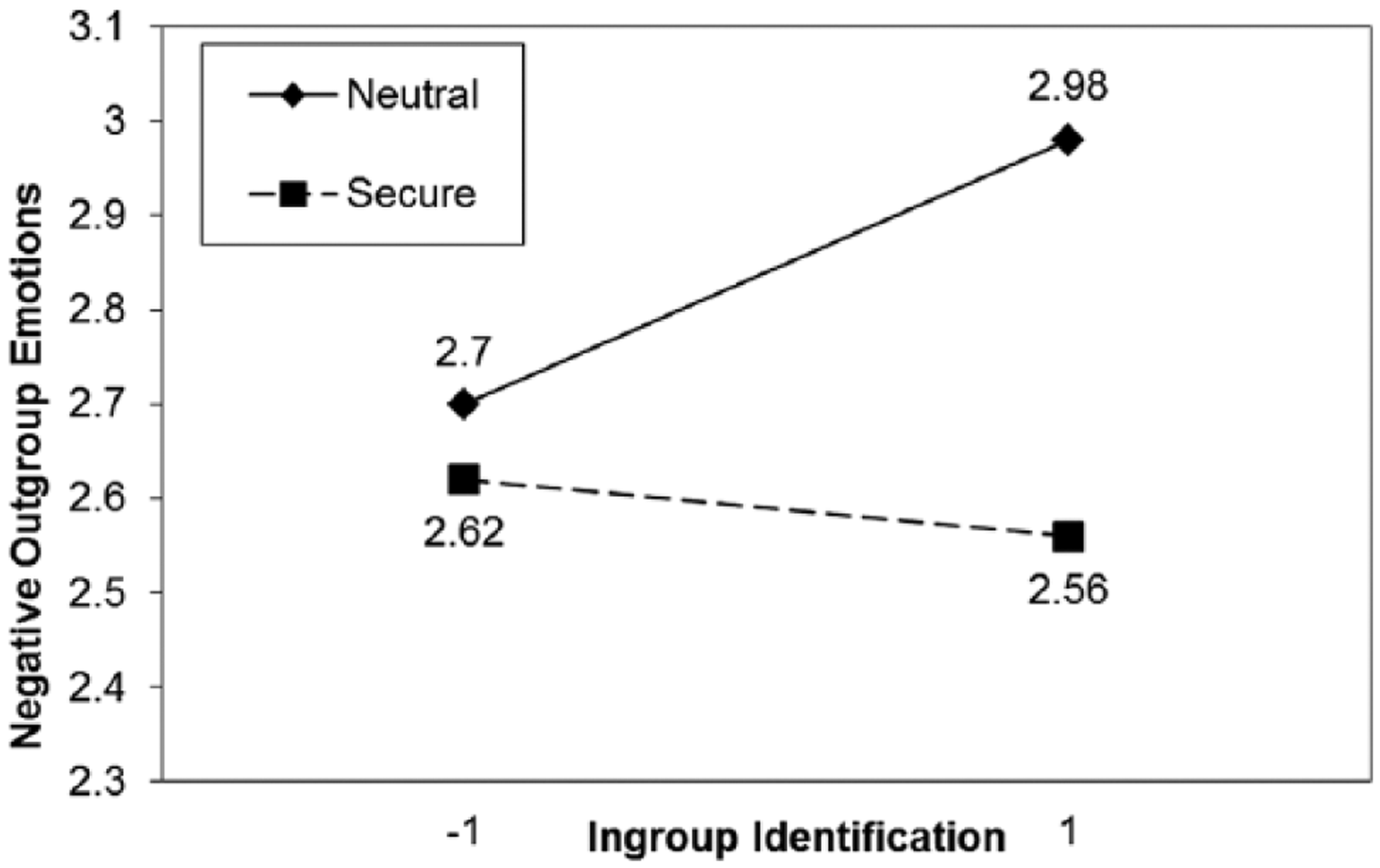
Negative emotions toward Ohio State University fans as a function of ingroup identification and attachment primes in Study 2.
In addition to these hypothesized effects, participant sex yielded a significant effect, F(1, 270) = 15.13, p < .01, d = .47, η2 = .05. Not surprisingly, 6 males, relative to females, reported higher negative emotions toward Ohio State University sports fans (Ms = 2.95, 2.57, respectively). Finally, there was an unexpected negative effect of participant age, F(1, 270) = 5.37, p < .05, b = −0.11, d = .28, η2 = .02. Perhaps students in their first or second year were especially likely to feel attached and identified with their universities and in turn perceive greater threat from rival colleges or universities. Although positively associated with negative outgroup emotions, trait attachment anxiety and avoidance were nonsignificant, Fs < 3.00, ps > .10.
Outgroup harm
An ANCOVA with ingroup identification, trait attachment, sex, and age as covariates revealed that the prime manipulation significantly influenced assignment of hard puzzles to the outgroup member, F(1, 270) = 6.15, p < .05, d = .30, η2 = .02. Means [95% CI] for the secure and neutral prime conditions were Ms = 3.75 [3.28, 4.22], 4.59 [4.11, 5.06], respectively. These findings suggest that priming individuals with attachment security can reduce likelihood of harming outgroup members. Unlike other paradigms where the decision to hurt the outgroup is within a zero-sum paradigm (e.g., gain for self or the ingroup), the decision to assign hard puzzles to another participant is less likely to have self-serving or ingroup love motivation because the participant is in no way affected by the assignment of tangram puzzles to the outgroup participant.
In addition to the priming effect, there was a significant main effect of ingroup identification, F(1, 270) = 4.50, b = 0.36, p < .05, d = .26, and a significant two-way interaction between the attachment prime manipulation and ingroup identification, F(1, 270) = 7.36, p < .05 (Figure 2). In the neutral condition, ingroup identification was positively associated with outgroup harm, F(1, 138) = 4.02, b = 0.69, p = .05, whereas in the secure prime condition ingroup identification was unassociated with outgroup harm, F(1, 137) = 0.06, b = 0.05, p > .20. In addition, the attachment prime effect was significant at +1 SD on ingroup identification, F(1, 270) = 10.03, p < .01, but was nonsignificant at −1 SD on ingroup identification, F(1, 270) = 0.12, p > .20. These results are consistent with those observed for negative outgroup emotions and suggest that secure attachment primes might attenuate highly identified ingroup members’ tendency to display outgroup derogation.

Assignment of hard tangram puzzles for an Ohio State University student as a function of ingroup identification and attachment primes in Study 2.
There was a significant positive effect of trait attachment anxiety on outgroup harm, F(1, 270) = 11.03, b = 0.59, p < .05, d = .40, η2 = .04. Also similar to previous studies, this finding suggests that both trait attachment and primed attachment can have simultaneous main effects without necessarily interacting with each other (Mikulincer & Shaver, 2001; Rowe & Carnelley, 2003). Age and sex were nonsignificant in these analyses.
Mediation test
The Preacher and Hayes (2008) approach was used to test the mediational hypothesis. Negative outgroup emotions significantly mediated the prime effect (dummy coded 0 = neutral; 1 = secure) on outgroup harm (95% CI = [−0.67, −0.06]). A significant negative effect of the priming manipulation on outgroup harm emerged (Figure 3). Participants in the secure, relative to neutral, prime condition displayed less outgroup harm. In addition, there was a significant negative effect of the priming manipulation on negative outgroup emotions indicating that participants in the secure prime condition reported lower negative outgroup emotions. Finally, there was a significant positive effect of negative outgroup emotions on outgroup harm while controlling for the priming manipulation. The effect of the priming manipulation became nonsignificant, b = −0.50, SE = 0.32, t(270) = −1.60, p > .05, suggesting full mediation.
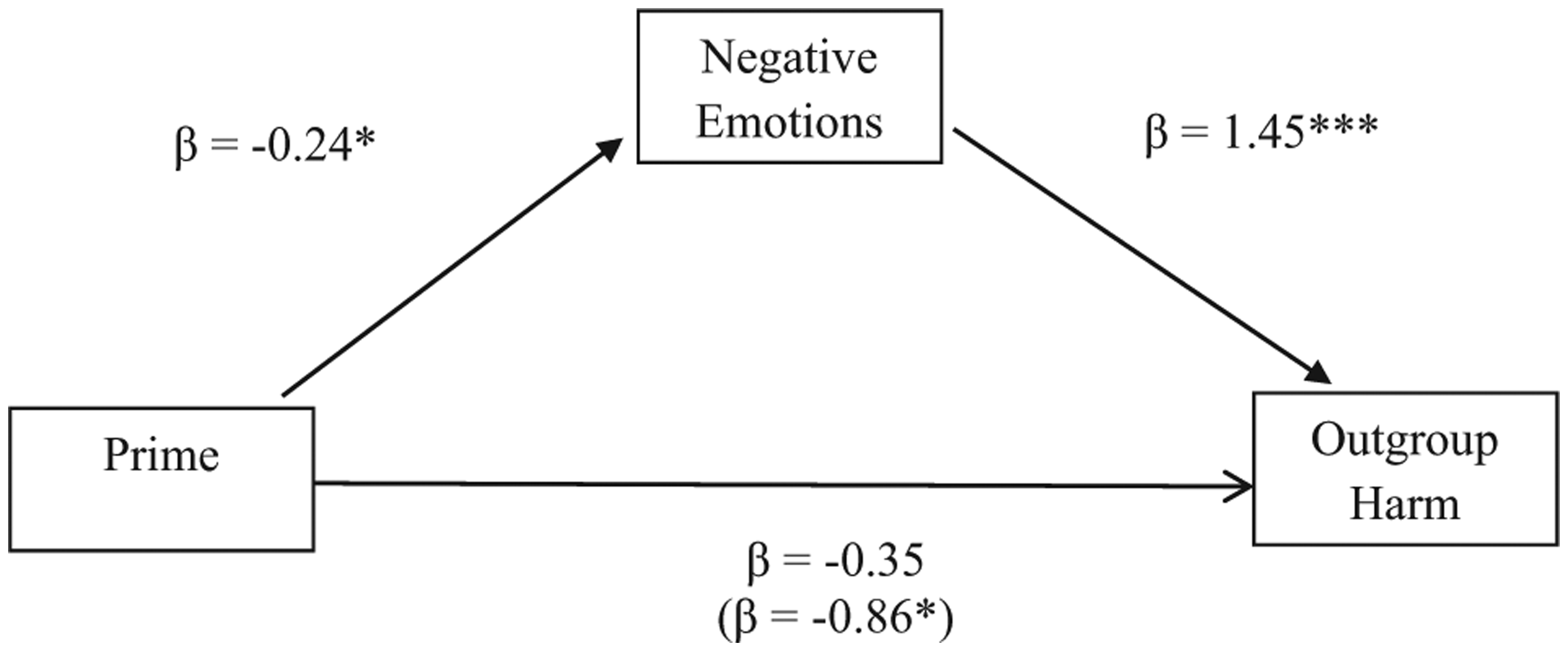
Test of the mediation model in Study 2 (N = 279).
In sum, the effect of secure attachment prime on outgroup harm was fully mediated by negative outgroup emotions. Specifically, participants in the secure attachment, relative to neutral, prime condition are less likely to feel negative outgroup emotions and in turn engage in outgroup harm.
Study 3
There were two main goals for Study 3. First, provide an additional test of the alternative hypothesis that the effects of secure attachment prime on negative emotions and aggressive behaviors are due to an increase in positive mood. Although a positive affect prime was included in Study 1B, participants in this condition did not report significantly higher positive mood than participants in the neutral condition. Second, test the role of additional theoretically relevant mediators (outgroup beliefs) in understanding the effects of secure attachment prime on outgroup harm. Given that negative emotions, relative to negative beliefs, toward outgroups are better predictors of outgroup aggression (e.g., Brewer, 2010), we predicted that negative emotions, and not beliefs, would fully mediate the effect of secure attachment on outgroup harm.
Participants
Two hundred seventy-eight participants completed the survey through Amazon MTurk for US$1.00. Fourteen participants did not follow the directions for the priming task and thus were excluded. 7 Two hundred sixty-four participants remained (130 males; M age = 37.27, SD = 12.06).
Measures
Preexperimental measures
Due to space constraints, only ingroup identification (American; M = 5.41, SD = 1.30) and demographic information were measured using the same materials as in previous studies.
Experimental conditions
Recall task
Participants in the secure attachment condition (n = 88) recalled a time when someone close to them was available, supportive, and loving. Participants in the neutral condition (n = 88) recalled a typical, uneventful workday. In the positive mood condition (n = 88), participants recalled a time when they accomplished a meaningful goal.
Postexperimental measures
Mood
Participants indicated their mood using the affect grid (Russell, Weiss, & Mendelsohn, 1989), which permits participants to express their emotional experience on a nine-by-nine matrix varying along the dimensions of valence and arousal, Ms = 5.09, 4.96, SDs = 2.93, 3.00, respectively. The valence ratings were of primary interest in the present study; thus, the arousal ratings were not analyzed.
Negative emotions
Participants reported to what extent they felt angry, disgusted, fearful, furious, irritation, threat, anxious, hostile, afraid, uneasy, displeased, worried, annoyed, and hatred toward ISIS (terrorist organization) members using a 1 (not at all) to 5 (extremely) rating scale, M = 3.41, SD = 1.10, alpha = .95.
Negative stereotypes
Participants rated their agreement to 10 statements (e.g., The typical ISIS member is violent) using a 1 (strongly disagree) to 5 (strongly agree) rating scale, M = 4.26, SD = 0.68, alpha = .91.
Outgroup harm
Outgroup harm was assessed through two indices (Kteily, Bruneau, Waytz, & Cotterill, 2015). First, participants indicated their support for 10 militaristic and aggressive policies intended to counter terrorism (e.g., “To put an end to terrorist acts by ISIS, I think it is OK to bomb an entire country if it is known to harbor ISIS terrorists”) using a 1 (strongly disagree) to 5 (strongly agree) rating scale. Two items were negatively correlated with other items and thus were excluded, resulting in an eight-item scale, M = 3.07, SD = 1.10, alpha = .92. Second, participants indicated their support for four petitions aggressively targeting ISIS members (e.g., “Increase the military budget allotted to combating with the ISIS threat”). Specifically, participants were told that the petition sponsors had agreed to use MTurk IDs as a proxy for a name because MTurk IDs are uniquely assigned to individuals. Participants could indicate, for each petition, whether they would like their MTurk ID added to it (coded as 1), whether they would like their MTurk ID added to a petition opposing that proposition (coded as −1), or if they would not like their MTurk ID added to either petition (coded as 0). The scores for all four petitions were summed together, M = 0.43, SD = 1.86, alpha = .84.
Procedure
The cover story was similar to Study 1B. After consenting, participants answered questions assessing their ingroup identification and demographic information. Then, participants randomly received a secure attachment, neutral, or positive affect prime. Next, participants indicated their mood using the affect grid. Then, participants answered questions assessing negative emotions and stereotypes of ISIS members (counterbalanced). Next, they indicated their support for militaristic and aggressive policies toward ISIS and signed petitions targeting ISIS (counterbalanced). Finally, participants were debriefed and thanked for their participation.
Results and Discussion
Preliminary analyses
Mood
A one-way (prime: secure attachment/neutral/positive affect) ANOVA revealed a marginally significant effect, F(2, 2408) = 3.65, p < .05. Planned contrasts revealed that participants in the positive affect condition (M = 5.78) reported more pleasure than participants in the neutral (M = 4.69) or secure conditions (M = 4.76), Fs(1, 240) = 5.69, 5.17, ps < .05. The latter two were not significantly different, F < 1.00, p > .10. These results indicate that (a) the positive affect condition successfully induced positive affect, and (b) the secure attachment prime did not significantly increase positive affect relative to the neutral condition.
Ingroup identification and its interaction with the prime were included in the analyses for all outcome variables.
Main analyses
Negative stereotypes
An ANCOVA with ingroup identification and its interaction with the prime as covariates revealed that the prime manipulation significantly influenced negative stereotypes of ISIS members, F(2, 258) = 5.12, p < .05, η2 = .02 (Figure 4). The means for the secure attachment, positive affect, and neutral conditions were Ms [95% CI] = 4.06 [3.92, 4.20], 4.36 [4.23, 4.50], 4.29 [4.15, 4.44], respectively. Planned contrasts revealed that participants exposed to the secure attachment prime reported lower negative stereotypes of ISIS members than participants in the positive affect or neutral conditions, Fs(1, 258) = 8.11, 4.47, ps < .05, ds = .35, .26, η2s = .03, .02. The latter two were not significantly different, F < 1.00, p > .10. Ingroup identification yielded a significant and positive effect, F(1, 258) = 9.26, b = .12, p < .05, but did not significantly interact with the prime manipulation. 9
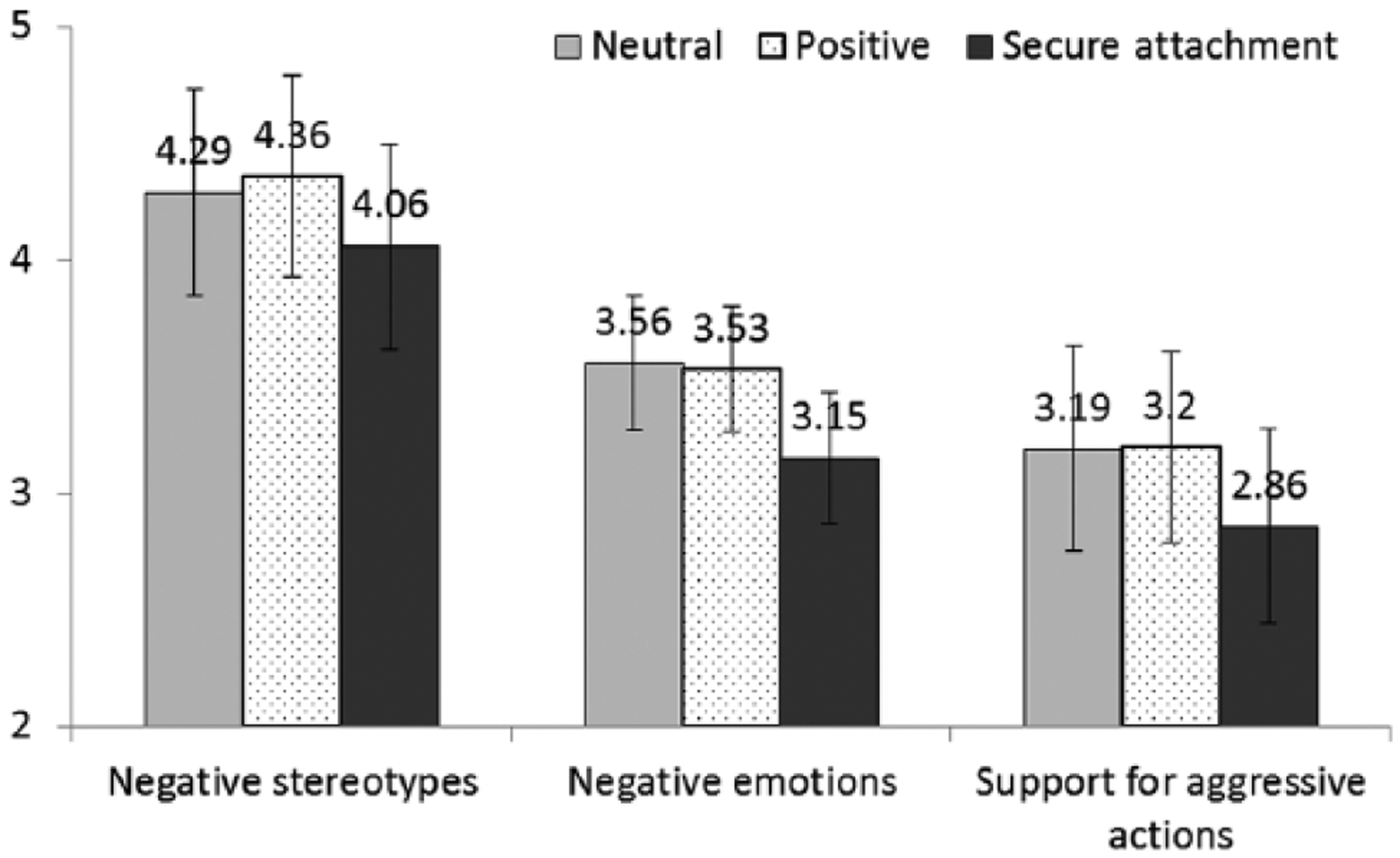
The effect of prime (secure attachment, positive affect, neutral) on negative stereotypes, negative emotions, and support for aggressive actions targeting ISIS members.
Negative emotions
An ANCOVA with ingroup identification and its interaction with the prime as covariates revealed that the prime manipulation significantly influenced negative emotions toward ISIS members, F(2, 258) = 4.13, p < .05, η2 = .02 (Figure 4). The means for the secure attachment, positive affect, and neutral conditions were Ms [95% CI] = 3.15 [2.93, 3.37], 3.53 [3.31, 3.74], 3.56 [3.34, 3.78], respectively. Planned contrasts revealed that participants exposed to the secure attachment prime reported lower negative emotions toward ISIS members than participants in the positive affect and neutral conditions, Fs(1, 258) = 5.80, 6.60, ps < .05, ds = .30, .32, η2s = .02, respectively. The latter two were not significantly different, F < 1.00, p > .10. Ingroup identification yielded a significant and positive main effect, F(1, 258) = 34.65, b = 0.38, p < .001, but did not significantly interact with the prime manipulation, F < 1.00, p > .10.
Support for aggressive and militaristic actions
An ANCOVA with ingroup identification and its interaction with the prime as covariates revealed a significant effect of the priming manipulation, F(2, 258) = 3.15, p < .05, η2 = .01 (Figure 4). The means for the secure attachment, positive affect, and neutral conditions were Ms [95% CI] = 2.86 [2.65, 3.07], 3.20 [2.99, 3.40], 3.19 [2.97, 3.41], respectively. Planned contrasts revealed that participants exposed to a secure attachment were less likely to support military and aggressive measures against ISIS members compared with those in the positive affect and neutral conditions, Fs(1, 258) = 4.93, 4.53, ps < .05, ds = .28, .27, η2s = .02. The latter two were not significantly different, F < 1.00, p > .10. Finally, ingroup identification yielded a significant and positive main effect, F(1, 258) = 51.36, b = 0.27, p < .001, but did not significantly interact with the prime manipulations.
Signing anti-ISIS petitions
An ANCOVA with ingroup identification and its interaction with the prime as covariates revealed a significant effect of the priming manipulation, F(2, 258) = 4.02, p < .05, η2 = .02. The means for the secure attachment, positive affect, and neutral conditions were Ms [95% CI] = −0.19 [−0.61, 0.24], 0.61 [0.19, 1.02], 0.51 [0.08, 0.94], respectively. Planned contrasts revealed that participants exposed to a secure attachment were less likely to support military and aggressive measures against ISIS members compared with those in the positive affect and neutral conditions, Fs(1, 258) = 6.87, 5.08, ps < .05, ds = .33, .28, η2s = .03, .02. The latter two were not significantly different, F < 2.00, p > .10. Finally, ingroup identification yielded a significant and positive main effect, F(1, 258) = 25.80, b = 0.32, p < .001, but did not significantly interact with the prime manipulations.
Mediation test
To test the mediating role of negative stereotypes and negative emotions in understanding the effects of secure attachment priming on support for aggressive and militaristic tactics, path analyses were conducted with Mplus 6.1 (Muthén & Muthén, 2010). Experimental conditions were incorporated into the model as categorical variables with the control condition as the reference category. Negative emotions and negative stereotypes were entered into the model as mediators and support for aggressive and militaristic tactics and petitions for anti-ISIS policies were entered as outcomes (Figure 5). The secure attachment prime significantly decreased both support for aggressive and militaristic tactics and petitions for anti-ISIS policies. The effect of secure attachment prime on support for aggressive and militaristic tactics was fully mediated by negative emotions (standardized effect = −0.11, p < .01) but not negative stereotypes (standardized effect = −0.03, p > .05). The secure attachment prime had both a direct effect on petitions for anti-ISIS policies (standardized effect = −0.14, p < .01) and an indirect effect through negative emotions (standardized effect = −0.05, p < .01) but not through negative stereotypes (standardized effect = −0.03, p > .05). Positive mood prime did not significantly influence any of the mediators or the outcomes (all ps > .05).
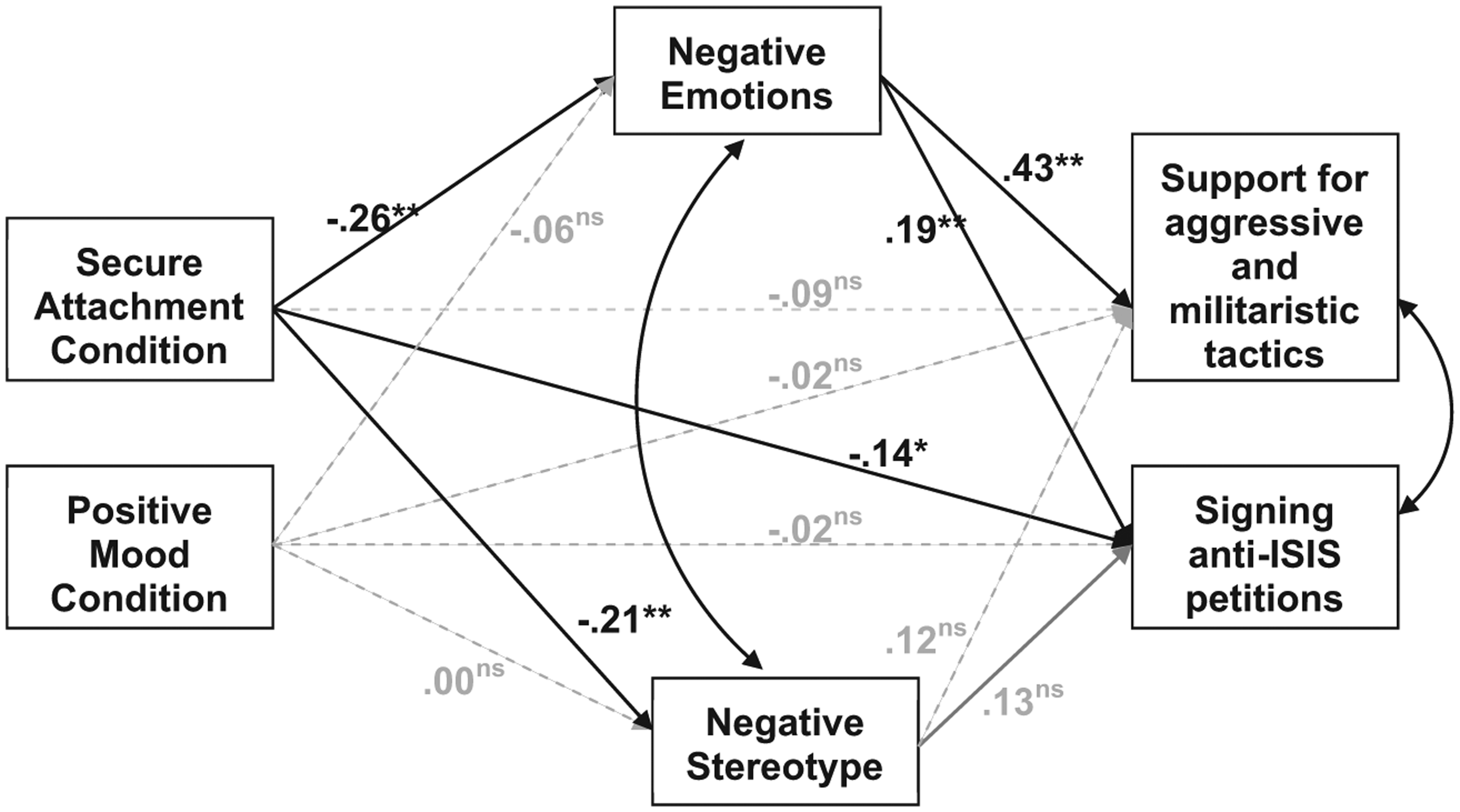
Path model examining effects of secure attachment prime (vs. neutral) and positive mood prime (vs. neutral) on support for outgroup harm mediated by negative emotions and stereotypes.
In sum, the secure attachment prime significantly reduced negative stereotypes, negative emotions, and support for aggressive and military actions targeting ISIS members compared with the positive affect and neutral conditions. These results are consistent with Study 1B and previous studies which suggest that the positive effects of the secure attachment prime on intergroup biases cannot be attributed to an increase in positive mood. Mediation analyses revealed that the effect of the secure attachment prime on outgroup harm is mediated by negative emotions (as in Study 2) but not negative stereotypes.
Although ingroup identification positively influenced all outcomes, the Ingroup identification × Prime interaction was significant only for negative stereotypes toward ISIS members. We suspect this is due to Americans’ current heightened threat and hostility toward ISIS members and their supporters (Kteily et al., in press). It is possible that secure attachment primes mitigate the effects of ingroup identification on negative emotions and outgroup harm only for outgroups that do not pose an immediate threat. Future research can better address these questions.
General Discussion
The goal of the present studies was to explore the effects of secure attachment primes on negative outgroup emotions and outgroup harm. Across four studies several important findings emerged. Studies 1A and 1B revealed that participants in the secure attachment, relative to neutral, prime condition displayed lower negative outgroup emotions. In addition, Study 1B results revealed that these effects were not an artifact of increased positive mood but were specific to the activation of a secure attachment schema. Study 2 revealed that participants in the secure attachment, relative to neutral, prime condition were less likely to display outgroup harm. This effect was fully mediated by reduced negative outgroup emotions. Study 3 provided additional evidence that (a) the effects of secure attachment primes on negative emotions and outgroup harm cannot be attributed to positive mood, and (b) negative emotions and not negative beliefs fully mediate the effects of secure attachment primes on outgroup harm.
These studies are the first to examine the role of secure attachment primes in reducing negative outgroup emotions and outgroup harm assessed through direct measures. 10 Furthermore, the effect of secure attachment prime in reducing outgroup harm was fully mediated by negative emotions but not negative beliefs of outgroup members. This is consistent with previous literature that highlights the role of negative emotions, but not necessarily negative beliefs, in predicting outgroup harm (Brewer, 2010; Mackie et al., 2000). Importantly, these effects were observed while taking into account individual differences in trait attachment styles and ingroup identification. 11 Finally, these effects were found in college student and online sample using different priming techniques.
These findings are important as few interventions to date have successfully reduced severe components of intergroup biases such as negative emotions and outgroup harm (see Paluck & Green, 2009, for review). Prejudice reducing interventions based on attachment security may be more advantageous than other interventions in certain contexts as they focus on the self rather than the outgroup in question. Indeed, the effectiveness of many other prejudice reducing strategies is dependent on the attitudes and behaviors of the other group, specifically their acceptance and tolerance toward the ingroup. Activation of a secure attachment schema, however, facilitates the use of constructive emotion-regulation strategies, especially in threatening situations, while increasing one’s self-efficacy and confidence to successfully solve the conflict at hand (Mikulincer et al., 2001; Mikulincer & Shaver, 2007)
An unexpected interesting finding was the significant interaction observed between the priming manipulation and ingroup identification in Study 2. Specifically, highly identified participants in the neutral prime conditions displayed the standard intergroup bias; however, this relationship was nonsignificant in the secure prime condition. The priming manipulation was found to be significant for highly identified ingroup members but not those who were lower on ingroup identification. These results have significant implications as it is often the highly identified individuals who are most likely to (a) perceive threat within intergroup contexts (Stephan & Stephan, 2000); (b) experience group-based emotions (Mackie et al., 2000); (c) derogate, discriminate, and/or aggress against outgroup members (Brewer, 2010; Struch & Schwartz, 1989); and (d) perceive aggression against an outgroup to be justified (Maitner, Mackie, & Smith, 2007). However, caution should be taken in attributed this mitigating effect solely to the secure attachment prime. Indeed, Study 3 revealed that although ingroup identification was associated with negative beliefs in the neutral condition, this relationship was nonsignificant for both, positive affect and secure attachment, primes. Thus, secure attachment primes may be one of many strategies useful for mitigating the effect of ingroup identification on intergroup biases.
Limitations and Future Research
Two inconsistent findings deserve special attention in future studies exploring the effects of secure attachment primes on intergroup biases and conflict. First, as mentioned above, the moderating effect of ingroup identification was not consistent across the four studies. It is possible that ingroup identification moderates the effect of secure attachment on prejudice toward some outgroups but not others. Differential effects may be influenced by the extent to which ingroup members perceive a particular outgroup to differ on important dimensions such as power, perceived threat, or societal norms of prejudice. Future research can explore these questions by experimentally manipulating identification levels and testing the effects of attachment primes on intergroup biases toward groups that vary on these important dimensions. Similarly, attachment anxiety was positively and significantly associated with negative emotions in Study 1B but not Studies 1A or 2. Previous studies suggest that attachment anxiety but not necessarily attachment avoidance is positively associated with intergroup biases (e.g., Mikulincer & Shaver, 2001, 2007, 2011). Scholars suggest this difference is likely due to anxiously attached individuals’ heightened sense of threat and rejection (Mikulincer & Shaver, 2007). Avoidant individuals, however, distance themselves from sources of distress rather than adopting a hypervigilant attitude toward threat (Fraley, Garner, & Shaver, 2000). The inconsistent effects of attachment anxiety observed in the present studies is surprising and may be an artifact of differences in priming techniques or the different outgroups used across the four studies. Indeed, important contextual differences in priming techniques and/or perceived threat can influence anxiously attached individuals’ cognitive and emotional reactions (e.g., Mikulincer et al., 2001). Future studies can directly test under what conditions attachment anxiety predicts prejudice toward some outgroups but not others.
The present studies reveal that secure attachment primes can reduce intergroup biases. An important follow-up question is to what extent these secure attachment primes produce long-term changes in an individual? Recent research suggests that repeatedly activating secure attachment schemas has long-term positive effects such as positive views of self and relationships, positive mood, increased compassion, lowered exam-related anxiety, and improved performance at work (Gillath, Selcuk, & Shaver, 2008). Although encouraging, it is unclear how long the security priming effects last. Current research has varied in finding significant effects from 2 days after the last prime (Carnelley & Rowe, 2007) to 1 week after prime (Gillath & Shaver, 2007) and even 4 months after the last prime (Sohlberg & Birgegard, 2003). Demonstrating the long-term effects of attachment primes on intergroup biases is an important next step for this research.
Although the results from this article and previous studies suggest that chronic and contextually induced secure attachment can reduce intergroup biases and outgroup harm, there is a critical need to “broaden and build” this line of work to better understand its limitations, generalizability, and underlying mediators and moderators (Mallinckrodt, 2007; Schaller, 2007). In addition, it is important to identify who benefits most and whether there may be unintended negative consequences for some individuals. For example, toward the end of their article, Mikulincer and Shaver (2007) briefly mentioned a study in which securely attached Palestinians in Israel-occupied territories were more, rather than less, hostile toward Israeli Jews and more accepting of violence toward them. These authors suggested that security and pacifism are not synonymous. Other researchers suggest that perhaps secure attachment and its primes lead one to act toward others in culturally endorsed ways (Peterson & Park, 2007). Thus, if outgroup derogation is acceptable in one’s culture, secure attachment primes might increase the endorsement of such attitudes. Therefore, future research needs to explore the effects of attachment primes in diverse samples and intergroup dynamics.
Footnotes
Declaration of Conflicting Interests
The author(s) declared no potential conflicts of interest with respect to the research, authorship, and/or publication of this article.
Funding
The author(s) received no financial support for the research, authorship, and/or publication of this article.

Notes
References
Supplementary Material
Please find the following supplemental material available below.
For Open Access articles published under a Creative Commons License, all supplemental material carries the same license as the article it is associated with.
For non-Open Access articles published, all supplemental material carries a non-exclusive license, and permission requests for re-use of supplemental material or any part of supplemental material shall be sent directly to the copyright owner as specified in the copyright notice associated with the article.
