



Abstract
Research on interethnic relations has focused on two ideologies, asking whether it is best to de-emphasize social-category differences (colorblind) or emphasize and celebrate differences (multicultural). We argue each of these can manifest with negative outgroup evaluations: Assimilationism demands that subordinate groups adopt dominant group norms to minimize group distinctions; segregationism holds that groups should occupy separate spheres. Parallel versions can be identified for intergender relations. Scales to measure all four ideologies are developed both for ethnicity (Studies 1 and 2) and gender (Studies 3 and 4). Results demonstrate that the ideologies can be reliably measured, that the hypothesized four-factor models are superior to alternative models with fewer factors, and that the ideologies relate as predicted to the importance ascribed to group distinctions, subordinate group evaluations, and solution preferences for intergroup conflict scenarios. We argue that this fourfold model can help clarify theory and measurement, allowing a more nuanced assessment of ideological attitudes.
Recent work in social psychology has shown extensive interest in the “intergroup ideologies” of multiculturalism (MC) and colorblindness (CB; Park & Judd, 2005; Plaut, 2010; Verkuyten, 2005; Wolsko, Park, Judd, & Wittenbrink, 2000). The CB and MC approaches to ameliorating intergroup relations differ in prescriptive beliefs about how much attention should be paid to intergroup differences. A CB ideology maintains that the best way to avoid intergroup conflict lies in moving beyond group boundaries and treating everyone as individuals rather than as group or category members. The set of beliefs that underlies this ideology is at the core of the American Dream, which in theory maintains that everyone, regardless of their racial or ethnic membership, ought to have the same opportunities for advancement and well-being, as enshrined in the Equal Protection Clause of the Fourteenth Amendment of the U.S. Constitution (U.S. Constitution, n.d.).
An MC ideology, however, maintains that different ethnic and cultural heritages provide a richness and diversity that strengthen society. In contrast to denying or overlooking group differences, an MC ideological viewpoint recognizes and values the divergent viewpoints and cultures that different groups contribute. Most prominently, MC has been enshrined as the official policy of Canada under its Multiculturalism Act, which argues that it is the responsibility of the government to respect and preserve cultural and ethnic diversity within society (Canadian Multiculturalism Act, 1988, c. 31).
Wolsko et al. (2000) demonstrated that both of these perspectives could result in more positive intergroup attitudes, relative to a baseline condition. Short messages primed participants to either think that the best way to achieve intergroup harmony was by “recognizing our sameness” and focusing on equality and individuality beyond differences (CB message), or by recognizing group differences as enriching (MC message). Instantiated in this way, both of these ideologies resulted in greater expressed warmth toward ethnic outgroups, and the MC message produced stronger relative endorsement of group stereotypes by White participants, relative to a neutral baseline control condition.
Although each of these ideological perspectives has the ostensible goal of improving intergroup relations, each has been the subject of criticism. The CB perspective has been championed as a means for achieving equality by looking beyond categories, a sentiment echoed by Martin Luther King who dreamed that individuals may one day be judged “not by the color of their skin but by the content of their character.” Yet CB as an ideology has also been faulted for creating a demand for assimilation of minority groups to dominant group norms, reinforcing the status quo and enabling dominant groups to perpetuate inequalities (e.g., Knowles, Lowery, Hogan, & Chow, 2009). In research involving nearly 5,000 members of a large U.S. health care organization, Plaut, Thomas, and Goren (2009) found that as White employees’ endorsement of CB increased, minority employees’ reported work engagement decreased, and their perception of bias increased. Problematically, however, Plaut et al.’s items measuring CB were adapted from Wolsko, Park, and Judd (2006), where they were identified as measuring an “assimilationist” perspective (AS, e.g., “The organization should encourage racial and ethnic minorities to adapt to mainstream ways.”). Wolsko et al. make a distinction between AS and CB ideologies, noting that the latter emphasizes similarities among all humans and the importance of treating others as individuals, whereas the former prescribes that the means for arriving at these shared similarities is by subordinate groups adopting the norms and behaviors of the dominant group. Failing to recognize this distinction, we suggest, has resulted in contradictory findings in the literature wherein a CB strategy appears at times to promote intergroup harmony, but at other times, to foster a sense of exclusion among minority group members (Plaut et al., 2009). Researchers have continued debating whether AS is a form of CB, or should be seen as an ideology that is entirely separate from CB (e.g., Rosenthal & Levy, 2012).
MC has also been criticized as a means for achieving intergroup harmony, most prominently in societal debates around the efficacy of immigration policies in Europe (e.g., “State Multiculturalism Has Failed,” 2011; Verkuyten, 2005; for summaries, see Hahn, Judd, & Park, 2010; as well as Vertovec & Wessendorf, 2010). That is, the propagation of MC ideals has been problematic for some European countries in that the emphasis on differences between immigrant minority groups and the dominant majority culture of the host society can lead to cultural isolation of minority immigrant group members from the majority society, often resulting in more segregation (SEG) than integration of immigrant groups (Hahn et al., 2010; “State Multiculturalism Has Failed,” 2011; Verkuyten, 2005). Thus, the concept of “emphasizing group distinctions” is perceived by some as an ideology of appreciation of diversity as a strength for society, but by others as a perspective that emphasizes that different groups in society are so different that integration of all group into a larger whole might be difficult. And, as with CB, debates revolve around whether MC itself creates “separate societies” ("State Multiculturalism Has Failed", 2011), or whether divisive beliefs that encourage groups to live separately should be seen as a distinct ideological perspective (Hahn et al., 2010).
These criticisms and confusions about the definitions of both the CB and MC ideological viewpoints indicate that a more nuanced and complete definition is needed, and specifically an explicit recognition of the potential negative or “dark” sides of both of these. Thus, in addition to the dimension of “emphasis on group distinctions” that distinguishes MC (high emphasis on distinctions) from CB (low emphasis), a second important dimension in the conceptualization of intergroup ideology is evaluations of subordinate group members. Note that we conceptualize intergroup ideology as social perceivers’ beliefs about how a smoothly functioning society may best be achieved, not necessarily about how positive intergroup regard may be realized.
Defining the Four Ideologies
Crossing these two dimensions gives rise to the fourfold definition of intergroup ideologies (see Figure 1; below, we also describe the extension of the model to gender). The CB ideology is defined by the desire to avoid category distinctions, to move beyond ethnicity, and to treat individuals as individuals rather than as members of their ethnic categories. But importantly, it is also defined as an ideology where subordinate group members are responded to positively and benevolently. The AS ideology is a hegemonic ideological viewpoint, arguing that “we are all the same,” but that sameness is defined by the superordinate group’s norms. Subordinate members will be treated fairly and without reference to their category membership only if they are willing to fully assimilate to the dominant group’s culture.
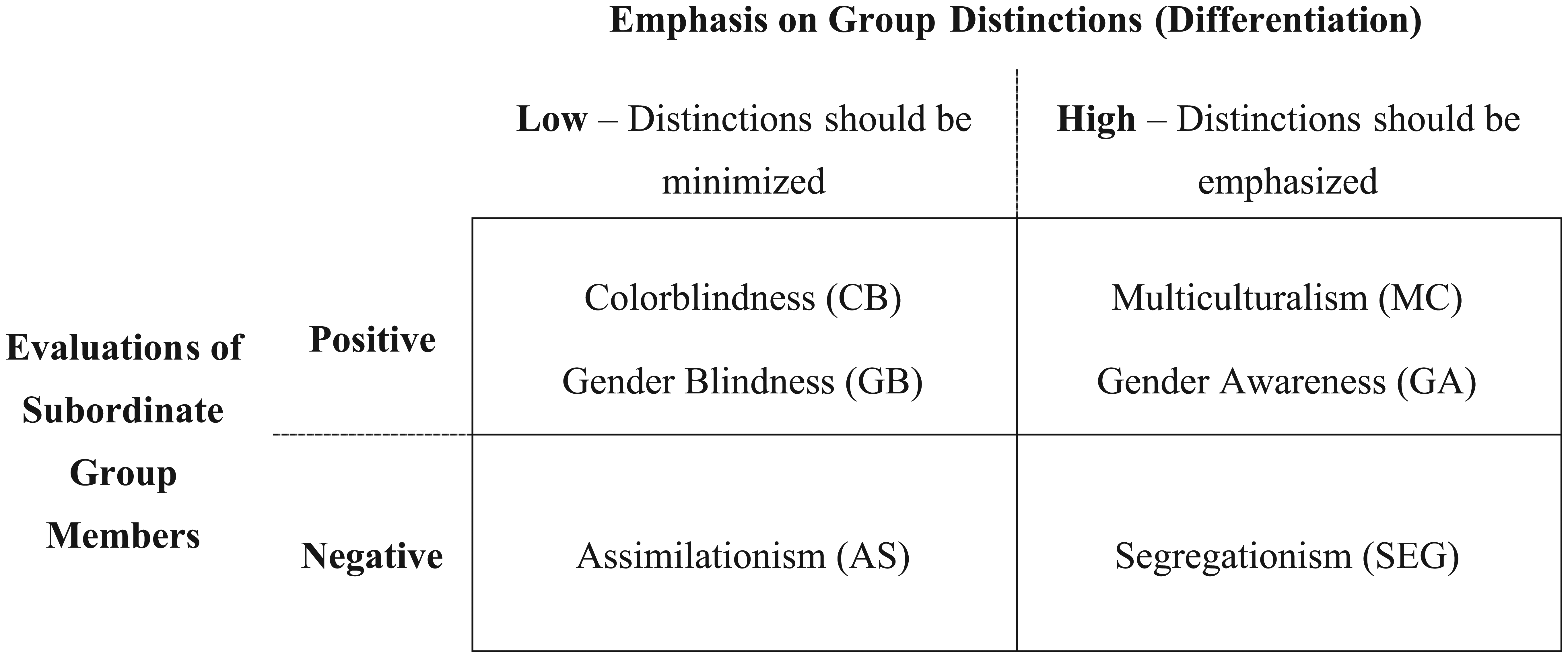
Crossing “emphasis on group distinctions (differentiation)” with “evaluations of subordinate group members” produces four perspectives on intergroup ideology.
The MC ideological viewpoint is defined by positive regard toward outgroups coupled with the recognition of category distinctions and a desire to preserve these distinctions to build a strong MC society. However, to the extent that subordinate group members are not evaluated positively, a SEG ideology argues that the group differences are so large that society would function more smoothly if different cultural groups remained separate from each other and occupied separate spheres.
The Present Research
The first goal of our research was to validate the model presented in Figure 1. We chose 16 items (4 items each) intended to capture the full breadth of the ideologies as discussed in political debates and in the social-psychological literature. Specifically, we chose 4 of the 6 MC items and 3 of the 6 AS items that Wolsko et al. (2006) created (adaptations of the AS items were also used by Plaut et al., 2009, to measure “colorblindness”), and added another AS item. We then created 4 CB items intended to express similarly positive intentions as the MC items, but with a distinct focus on seeing beyond ethnicity rather than respecting group boundaries. Finally, we created 4 SEG items designed to express a similarly pragmatic tone as the AS items, but focused on emphasizing differences rather than overlooking them (2 of these items were inspired by Wolsko, 2002). All 16 items are presented in Appendix A. We consciously designed the scales to be as short as possible (4 items each) to enable researchers to simultaneously measure all four ideologies without overwhelming respondents, and also tried to broadly capture each perspective rather than narrowly focusing on a specific component (e.g., CB advocates both treating each person as a distinct individual and finding communalities). This focus on both brevity and breadth will likely result in somewhat lower internal consistencies, so a critical test is whether the scales are sufficiently reliable to predict important outcomes (Judd & McClelland, 1998).
To validate these items, we evaluated (a) the model fit of a four-factor solution, (b) their relationships with global judgments of outgroup evaluations and the importance ascribed to ethnic category distinctions, as well as (c) their relationships with agreement with conflict resolution strategies in concrete intergroup conflicts and political orientation.
The second aim of this article was to examine the applicability of this typology more generally by exploring a second instantiation of intergroup relations, that of gender. Gender relations diverge strongly from interethnic relations in terms of the nature of expected interactions, cooperation, and intimacy (see Koenig & Richeson, 2010). But here too scholars have debated how much emphasis should be put on gender distinctions (Eagly, 1995; Kimball, Rothblum, & Cole, 1995; Wood & Eagly, 2012). In the quest for gender equality, is it best to recognize and emphasize gender distinctions, or to argue such differences are not meaningful and we should instead be blind to them? As discussed below, articulating the four ideologies depicted in Figure 1 as they apply to gender provides useful insights regarding the treatment of women in male-dominated work environments, and women’s feelings of belonging versus exclusion in these.
We present four studies to accomplish our goals. Studies 1 and 2 focus on the assessment of the four ideologies in interethnic relations using a large undergraduate sample (Study 1), and then validating the results with participants recruited from Amazon’s Mechanical Turk (MTurk; Study 2). Studies 3 and 4 utilize parallel samples to examine gender ideologies.
Studies 1 and 2
Undergraduate participants (Study 1, S1) and participants recruited from MTurk (Study 2, S2) completed questions about their (a) endorsement of the different interethnic ideologies, (b) evaluations of minority group members relative to majority group members, (c) judgments of the importance of category distinctions, (d) demographic information, and (e) political orientation. We hypothesized that the four ideologies would show theory-consistent relationships with evaluations of minorities and the importance ascribed to ethnic category distinctions (see Figure 1): MC and CB would both show positive relationships with positive evaluations of outgroups, whereas AS and SEG should show negative relationships. On the other hand, variables measuring the importance ascribed to ethnic category distinctions would differentiate the ideological perspectives along the horizontal axis of Figure 1. In addition, we assessed whether endorsement of the ideological perspectives would predict preferences for corresponding solutions to conflict situations measured about 6 weeks later.
Method
Participants
Study 1
At the beginning of three separate semesters, 2,002 undergraduates from the University of Colorado Boulder were given the option to complete as few or as many of a series of measures submitted by different psychology researchers before participating in the semester subject pool. Out of 1,793 American citizens who completed all 16 ideology items, 321 (15.7%) self-reported different ethnic minority backgrounds (4 participants did not answer this question). In line with previous research on interethnic ideology (e.g., Correll, Park, & Smith, 2008; Richeson & Nussbaum, 2004; Wolsko et al., 2000), only White participants were retained for the analyses presented here (N = 1,468; 36.5% male; median age = 18, range = 17-36; see Supplemental Materials Section A for a description of the results including ethnic minority participants for both Studies 1 and 2). Degrees of freedom vary somewhat across measures due to missing responses.
Study 2
A total of 404 participants were recruited via MTurk and compensated $0.75. Of these, 295 who identified as White, had U.S. citizenship, and passed attention check items were retained as the final sample (41.4% male; median age = 23.5, range = 18-88; 43.4% reported a completed university degree, 49.5% some college education, and 7.1% no higher education).
Measures
Interethnic ideology
The 16 Interethnic ideology items are presented in Appendix A. Participants rated their agreement on scales ranging from 1 = “strongly disagree” to 7 = “strongly agree.” By averaging the appropriate items, we constructed scales for MC (α = .76/.80 in S1/S2, respectively), CB (α = .61/.70), SEG (S1: α = .46/.53), and AS (α = .78/.83).
Evaluations of minority group members
In Study 1, participants rated “African Americans,” “Asian Americans,” “Mexican Immigrants,” “Hispanic Americans in general,” and “White Americans” on 11-point thermometer rating scales ranging from 0 = “I feel very coolly toward this group” to 10 = “I feel very warmly toward this group.” As filler items, they also rated “men in general” and “women in general.” In Study 2, MTurk participants were asked to rate the same minority groups, as well as Arab Americans, using continuous thermometer ratings (spanning from 0 = very coldly to 100 = very warmly, filler items: business executives and politicians).
Ratings for the minority groups were averaged into a single score (α = .90/.88 for S1/S2), and ratings for “White Americans” were subtracted from this to create a measure of relative positivity toward ethnic minority outgroups. To the extent that the framework in Figure 1 accurately portrays interethnic ideologies, this measure should covary positively with MC and CB, and negatively with SEG and AS.
Importance ascribed to category distinctions
The importance people ascribe to ethnic categories was operationalized with three separate components, all rated on 7-point scales where higher numbers indicated greater meaning or importance: (a) importance in general (“Humans divide the world into different categories (e.g., race or gender) because there are different categories of humans in the world. Group differences are real and meaningful”), (b) importance for social interactions (“Knowing about a person’s ethnic/cultural background tells you a lot about them”), and (c) importance to self (“When you think about yourself, how important is your ethnic group membership to your sense of who you are?”). Responses to these items were averaged into a single measure of global importance ascribed to ethnic distinctions (α = .45/.70 for S1/S2). In Study 1, only N = 928 participants rated these questions (only the second and third semesters). Given the framework in Figure 1, MC and SEG should be positively related to this measure of category importance, and CB should be negatively related to it. Initially, we also expected a negative relationship for AS. Further reflection, however, suggested greater complexity for the relationship between AS and category importance: Although AS advocates minimizing group distinctions through assimilation, the need for assimilation is predicated on the recognition of existing group distinctions.
Demographics
In addition to questions about their citizenship, ethnic background, age, and gender, participants indicated their political orientation (from 0 = “extremely liberal” to 10 = “extremely conservative” in Study 1, and on a 7-point scale with the same anchors in Study 2). We included this item simply to explore its association with the different ideologies.
Conflict resolution
To examine whether agreement with the abstract interethnic ideologies predicted more concrete and specific judgments, a subset of 213 participants from two semesters in Study 1 were invited back into the lab between 2 and 8 weeks after administration of the pretest battery (median lag = 6.9 weeks). They were not informed of any connection between specific measures in the pretest and the follow-up lab session. We were able to match fully completed data between the pretest and the lab session for 149 White American citizens. Demographic characteristics of this final sample (35.6% female, Ages = 18-35, median = 19) were similar to the full pretest sample. 1
Participants read six vignettes describing six different conflicts between recent Mexican immigrants and White Americans. For each conflict, participants wrote about possible ways to resolve the conflict. They then rated four possible solutions to the problem on 7-point scales ranging from 1 = “not a good solution for [the protagonist]’s situation” to 7 = “very good solution for [the protagonist]’s situation.” These solutions were written to capture the four ideological perspectives (MC, CB, SEG, and AS). That is, the MC solution emphasized that all parties should take this “cultural” conflict as an opportunity to learn about a new perspective. The CB solution argued that rather than focusing on ethnic or cultural differences, the protagonists should focus on individual strengths to solve the problems. The SEG solution suggested that the protagonists go their separate ways, that their differences were simply too great to be reconciled. Last, the AS solution advocated that the immigrant more whole-heartedly embrace American behavioral norms to fit in better. The four solutions were presented in one different random order for each vignette. The full set of six vignettes is available in the methodology appendix. Only three of the five vignettes were administered in Study 2, where they were presented at the same time as all other measures.
Responses to each solution type were averaged across the vignettes to create an average rating of the quality of the solutions (for S1/S2: MC: α = .58/.52, CB: α = .55/.48, SEG: α = .68/.48, AS: α = .69/.54). To the extent that one’s stance on the interethnic ideologies is brought to bear on social judgments, agreement with a given solution should be best predicted by variation in endorsement of that same ideological perspective.
Procedures
In Study 1, all questions except the conflict vignettes were embedded within a larger pretest battery and the first three blocks of questions: (1) Ideology, (2) evaluations, and (3) importance of distinctions were always presented in the same order. The items within the three blocks were presented in orders that were individually randomized for each participant. 2
In Study 2, the order of the tasks was counterbalanced such that participants were randomly assigned to either complete (1) the vignettes first, and (2) the ideology, category importance, and evaluation measures second, or vice versa. The three question blocks within (2) were also counterbalanced. Items within each block of questions were furthermore individually randomized for each participant. Two attention checks (e.g., “. . . please select strongly agree for this question”) were embedded within the 16 ideology items. After participants completed all scales, they responded to demographic questions, including political orientation.
Results
Factor structure
Model fit for the four-factor model and model comparisons
A confirmatory factor analysis (CFA) was conducted on the 16 ideology items (see Figure 2). Factor variances were constrained to 1 to identify and standardize the model. Fit indices showed acceptable fit (see Table 1), and the loadings of all items on their hypothesized ideology factors were significant in both studies. Comparison of the values in Figure 2 (for Study 1/Study 2) shows the remarkable similarity of the solutions across the undergraduate and MTurk samples.
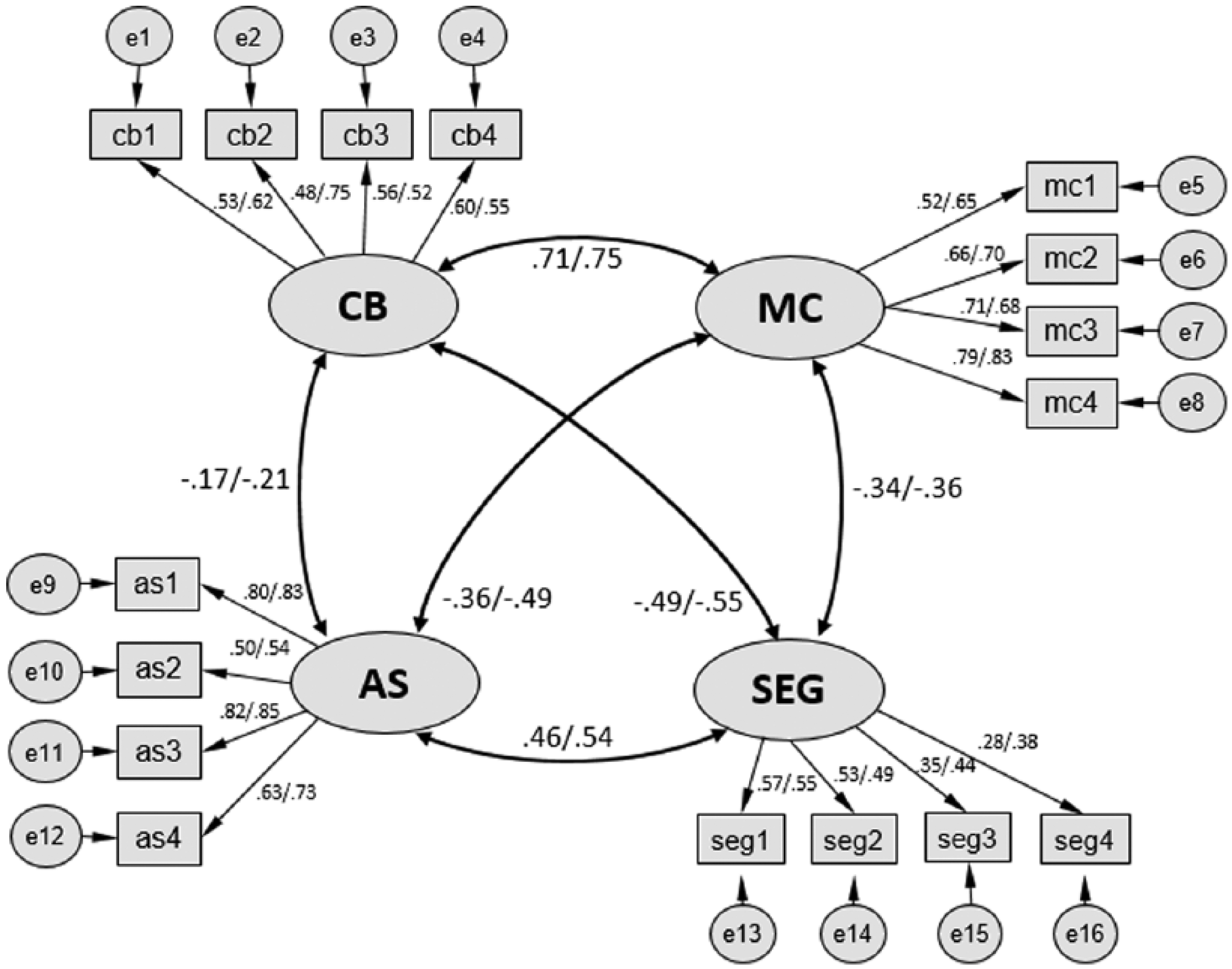
Confirmatory factor analysis for the 16 interethnic ideology items, values from Study 1/Study 2 (Study 1, undergraduate sample, Study 2: MTurk sample).
Confirmatory Factor Analysis Fit Indices for Studies 1 and 2.
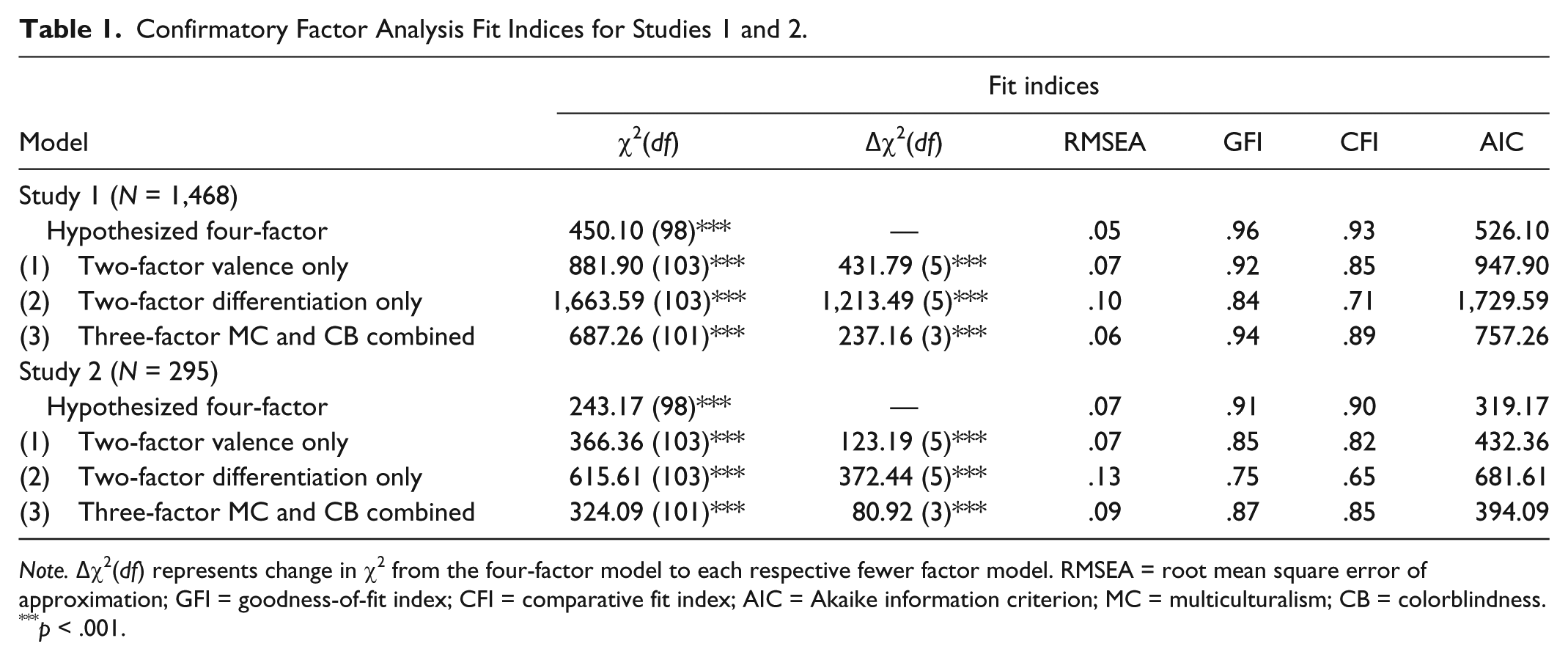
Note. Δχ2(df) represents change in χ2 from the four-factor model to each respective fewer factor model. RMSEA = root mean square error of approximation; GFI = goodness-of-fit index; CFI = comparative fit index; AIC = Akaike information criterion; MC = multiculturalism; CB = colorblindness.
p < .001.
To test the robustness of the models, we compared them with three alternative models with fewer factors: (a) Given the high relationships among factors that share similar evaluations of subordinate group members, we compared the four-factor model with a two-factor model that collapsed across the category differentiation dimension (i.e., one factor with all MC and CB items, and another factor with all SEG and AS items). This model tests whether ideological perspectives about group differentiation matter, or whether it is sufficient simply to distinguish positive from negative perspectives. (b) A second model collapsed across the valence dimension, grouping all MC and SEG items, as well as all CB and AS items, together. This model captures how intergroup ideology has often been treated in the literature, focusing only on emphasizing versus de-emphasizing group differences, independent of the positive or negative intentions behind these perspectives (e.g., Plaut et al., 2009). (c) Finally, given the strong relationship between MC and CB, a three-factor model was estimated in which the items from these two scales were allowed to load on a single latent factor. All three of these models led to highly significant deteriorations in fit compared with the four-factor models (see Table 1). Thus, all four factors were needed to describe intergroup ideology.
Relations among the four ideologies
Looking at the double-headed arrows that reflect correlations disattenuated from error in Figure 2, it is clear that agreement with the ideologies was strongly driven by valence, such that the ideologies that shared the same evaluations of subordinate group members showed strong positive relationships. The correlations between the various pairs of positive with negative ideologies were all slightly to moderately negative. The weakest relationship was between CB and AS, which is striking in part because these two ideologies have often been discussed as instantiations of one ideology in the past literature (e.g., Plaut et al., 2009).
To further examine the relationship of each ideology with the others, four separate path models were estimated. In these, rather than examining zero-order correlations between the latent variables of Figure 2, each latent ideology was treated as the endogenous variable, predicted by the other three latent ideologies (i.e., the double-headed arrows were replaced with single-headed arrows). This allowed us to see the relationship of each ideology with each other ideology over and above the influence of the remaining two ideologies (the goodness-of-fit of these models is necessarily identical to those already reported). Table 2 presents the standardized partial coefficients for each ideology predicted by the other three. Notably, in both Studies 1 and 2, the relationship between CB and AS became positive once endorsement of the other perspectives was controlled, as did the relationship between MC and SEG. In other words, once the shared valence of MC and CB was controlled for, each ideology showed a positive relationship with its more negative counterpart. At the same time, relations between pairs of positive and negative ideologies that share the same pole on the differentiation dimension (i.e., MC and CB, as well as SEG and AS) remained positive. Thus, only ideologies that differed on both the differentiation and evaluation dimensions remained negatively related. These results validate that intergroup ideologies are driven both by beliefs about group differentiation and evaluations of subordinate group members.
Unique Relationships Among the Interethnic Ideologies: Standardized Partial Coefficients From SEM Path Models in Which Each Ideology Is Treated as the Outcome of the Other Three Ideologies (Studies 1 and 2).

Note. Each column represents an SEM path model in which the ideology perspective presented on top was treated as the simultaneous outcome of the other three ideologies. Study 1: Undergraduate sample with N = 1,468. Study 2: MTurk sample with N = 295. SEM = structural equation modeling; MTurk = Mechanical Turk; MC = multiculturalism; CB = colorblindness; SEG = segregationism; AS = assimilationism.
p < .05. ***p < .001.
Mean levels of ideology endorsement
Participants’ mean levels of agreement with the four interethnic ideologies appear in Figure 3. As can be seen, participants in both studies strongly preferred the positive over the negative ideologies, Study 1: F(1, 1,467) = 3,352.18, p < .001,

Mean endorsement of interethnic ideology perspectives for Study 1 (UG sample) and Study 2 (MTurk sample).
Relations with other constructs
Given the high correlations between endorsements of the different ideologies, all of the remaining analyses were conducted via regressions in which the relationship between each outcome measure and each ideology was evaluated, whereas endorsement of the other ideologies was controlled. Table 3 presents the standardized regression coefficients from analyses predicting the different outcomes from all four ideologies simultaneously.
Standardized Partial Regression Coefficients From Models Predicting Outcome Judgments From the Four Interethnic Ideologies (Studies 1 and 2).
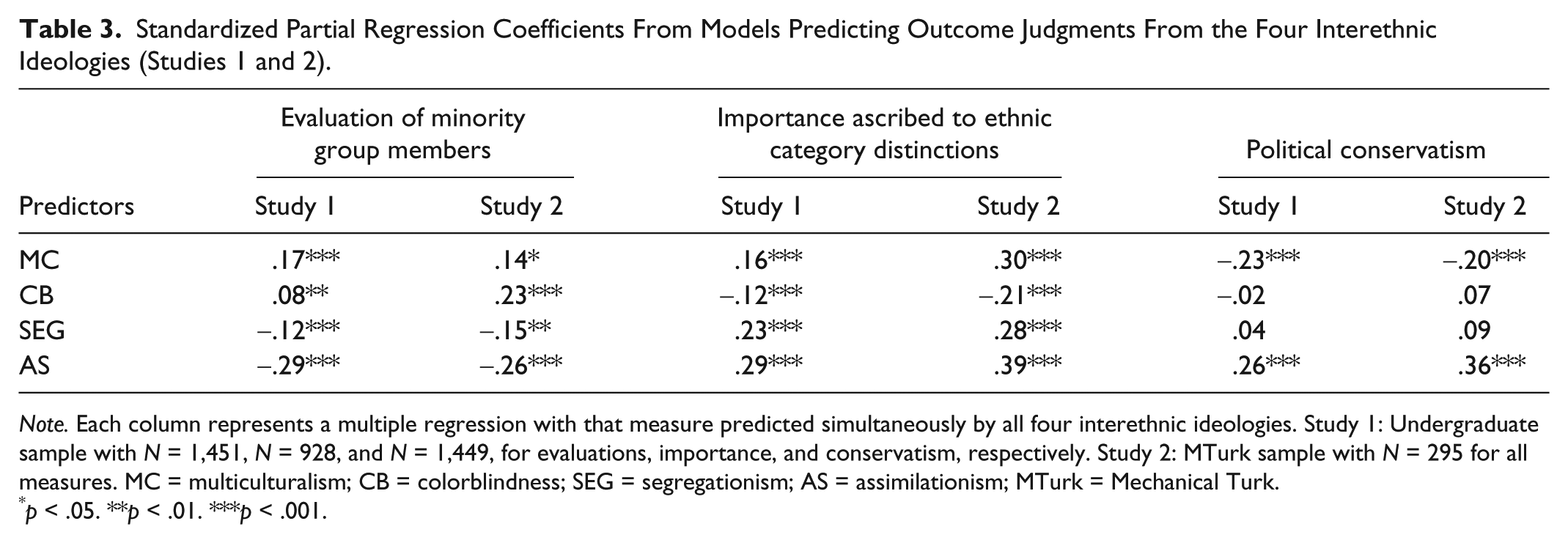
Note. Each column represents a multiple regression with that measure predicted simultaneously by all four interethnic ideologies. Study 1: Undergraduate sample with N = 1,451, N = 928, and N = 1,449, for evaluations, importance, and conservatism, respectively. Study 2: MTurk sample with N = 295 for all measures. MC = multiculturalism; CB = colorblindness; SEG = segregationism; AS = assimilationism; MTurk = Mechanical Turk.
p < .05. **p < .01. ***p < .001.
Evaluations of minority group members
As predicted, the two positive ideologies (MC and CB) were both significantly positively related with relative warmth toward ethnic minority groups, whereas the two negative perspectives (AS and SEG) were significantly negatively related with this measure in both samples.
Importance ascribed to category distinctions
Consistent with Figure 1, importance of category distinctions was positively related to both MC and SEG in both samples, and CB was negatively related to this index. Endorsement of the AS perspective showed positive relationships. The AS ideology prescriptively suggests that category distinctions should be overcome by outgroups assimilating to the norms of the dominant ingroup. Thus, it is perhaps not surprising that those who endorse it see that category distinctions do exist and are meaningful (and therefore important to overcome via AS).
Conflict vignettes
As described, 2 to 8 weeks after completing the ideology scales, some participants from Study 1 came to the lab and read vignettes describing conflicts faced by an immigrant and rated the quality of four proposed solutions, one matching each of the four ideologies. Average endorsements of the solutions matching each ideology (MC, CB, SEG, and AS) were separately regressed onto agreement with the four interethnic ideologies. The results from these analyses were remarkably consistent with predictions (see Table 4). In Study 1, the best (and only significant) predictor of endorsement of every solution type was agreement with the corresponding abstract ideology, rated weeks earlier. 3 Study 2 replicated these findings, although here a second ideology at times also predicted endorsement of the solution.
Standardized Partial Regression Coefficients Predicting Endorsement of Solutions to the Vignette Conflicts of Each Type (Columns) From the Interethnic Ideologies (Rows)—Studies 1 and 2.
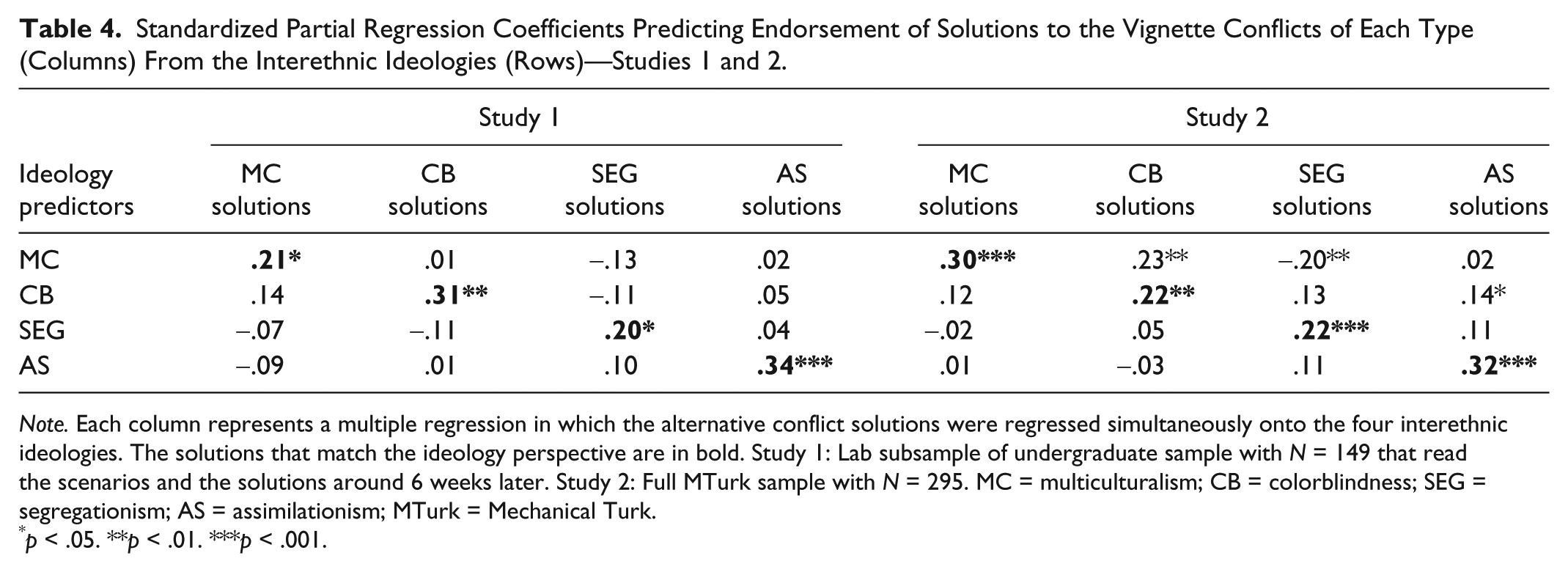
Note. Each column represents a multiple regression in which the alternative conflict solutions were regressed simultaneously onto the four interethnic ideologies. The solutions that match the ideology perspective are in bold. Study 1: Lab subsample of undergraduate sample with N = 149 that read the scenarios and the solutions around 6 weeks later. Study 2: Full MTurk sample with N = 295. MC = multiculturalism; CB = colorblindness; SEG = segregationism; AS = assimilationism; MTurk = Mechanical Turk.
p < .05. **p < .01. ***p < .001.
Political orientation
As Table 3 shows, those who endorsed an MC perspective were more likely to self-report as politically liberal, whereas those who endorsed an AS perspective were more politically conservative. Neither CB nor SEG showed significant relationships with political orientation over and above the other ideologies, all four Fs < 2.5, all ps > .1.
Discussion
The purpose of Studies 1 and 2 was to validate the fourfold model of interethnic ideology depicted in Figure 1, first using a large undergraduate sample and second a more heterogeneous nonstudent sample. Results were remarkably consistent across the two samples and with our predictions. In both samples, CFAs confirmed that treating all four factors as separate ideological perspectives provided a substantially better fit to the data than collapsing across either the evaluation or differentiation dimensions. Thus, it is clear that four, not just two, underlying factors are needed to completely capture important differences in these ideologies.
Furthermore, in path models predicting each ideology from the remaining three, ideologies that shared the same valence or the same pole on the differentiation dimension were positively related. Only those that differed on both were negatively related. This again supports our argument that both the valence and differentiation dimensions depicted in Figure 1 are needed to adequately characterize the full spectrum of intergroup ideologies.
Global judgments that parallel the two dimensions in Figure 1—the relative positivity of ethnic minority evaluations and the importance ascribed to category distinctions—were each related to the four interethnic ideologies in the predicted manner: MC and CB perspectives predicted greater positivity toward ethnic minority groups, whereas AS and SEG perspectives predicted greater negativity. Similarly, MC and SEG predicted seeing ethnic category distinctions as meaningful and important, whereas CB predicted seeing them as less important. AS was positively related to seeing ethnic category distinctions as important. This somewhat unexpected finding demonstrates an important distinction between the CB and AS ideologies—although AS and CB beliefs share the intention of overcoming ethnic category distinctions (see positive relationships in Table 2), they advocate arriving at this end differently. A CB ideology advocates seeing beyond ethnic category distinctions because they are considered unimportant. The AS ideology, on the other hand, advocates overcoming distinctions by the assimilation of minority group members to dominant group norms. It hence recognizes that important distinctions do exist in society, but these differences are considered disruptive and should be done away with.
Endorsement of the four abstract ideologies also predicted judgments of how best to resolve concrete conflict situations. Those who endorsed a given ideology were most likely to advocate solutions to these conflicts that matched the underlying sentiment in that ideological perspective (e.g., to ignore ethnicity, or to embrace the opportunity to learn about cultural differences). These results were particularly striking given the time separation between the two measures in Study 1. They suggest that variation in endorsement of the ideologies matters in thinking about how to approach interethnic conflict, and likely shapes support or opposition for relevant social policies.
In both samples, self-identified conservatives were less likely to endorse an MC ideological perspective and more likely to endorse the AS perspective. Both CB and SEG showed no unique relationship with political ideology. We suggest this pattern reflects current American political debates in that MC and AS align with different political ideals on how to best deal with the ethnic diversity currently present in the United States. Whereas an ideal of cultural tolerance and openness to diversity (MC) seems to be a more liberal standpoint, the conservative perspective seems to be largely one of expecting ethnic minorities to assimilate to dominant group norms. CB ideals are often used by both sides of the political divide to argue for their respective policies (e.g., in favor of affirmative action to guarantee equality of outcomes for all individuals beyond backgrounds, or against affirmative action because race should not matter in hiring or admission decisions; Knowles et al., 2009), resulting in no consistent relationship with political orientation. Finally, SEG policies are largely rejected by all of American society today, partly as a result of the civil rights movement (e.g., Plaut, 2010), also leading to no particular relationship with political orientation.
These results make an important contribution to the debate regarding overlap in the CB and AS ideologies: Whereas CB is related to positive evaluations of minorities and less importance ascribed to ethnic distinctions, AS showed the opposite relationship with these variables, and a negative relationship with CB ideals on a zero-order level. This supports research that has treated CB and AS as distinct perspectives (e.g., Levin et al., 2012; Rosenthal & Levy, 2012). At the same time, CB and AS were positively related once MC and SEG were controlled (in part because this analysis controls for the evaluative distinction between AS and CB), reflecting their shared de-emphasis of ethnic category distinctions. These findings are consistent with our argument that conceptualizing variation in the ideologies on both dimensions is critical for understanding contradictory findings in the literature.
Studies 3 and 4
In Studies 3 and 4, the fourfold model in Figure 1 was applied to gender. We believe this is important for at least three reasons. In social psychology, gender and ethnicity represent two of the most heavily studied dimensions of intergroup categorization, in part because of their importance for person perception. Notably, however, although both involve a dominant and a subordinate group, interethnic relations are often marked by conflict and threat, whereas interactions between the genders often involve codependence and compatible relationships. It thus appears important to examine the generalizability of our typology by examining it in a different and important domain.
Second, because of the ease with which we can collect data from both men and women, gender affords us the opportunity to test the fit of the proposed typology to the viewpoints of not only the dominant group (as in Studies 1 and 2) but the subordinate group as well. Last, despite one notable exception (Koenig & Richeson, 2010), to our knowledge, social-psychological research regarding ideological perspectives on category differentiation has focused on ethnicity, despite the discussion’s clear relevance to gender. Indeed, the fourfold framework in Figure 1 readily applies to gender: A gender blind (GB) perspective stresses ignoring gender categories, and valuing individuals beyond their gender. A gender aware (GA) perspective instead emphasizes differences between men and women, explicitly noting that although different, they have equally valued abilities. An AS perspective advocates minimizing differences between men and women but in this case implies that uniformity is achieved through one group assimilating to the norms established by the other. Because social discourse has primarily focused on inclusion and acceptance of women in traditionally male-dominated domains, AS in this model is formulated as women achieving success by assimilating to male norms. Finally, a SEG perspective highlights differences between men and women and uses this to justify keeping the genders separated, which under the status quo implies keeping women in lower status or less desirable positions.
Drawing on existing work on ethnic ideologies, Koenig and Richeson (2010) developed a scale to measure individual differences in endorsement of what they term a sex-aware versus sex-blind perspective on one single scale. Results showed that respondents were more likely to endorse a sex-blind perspective than a sex-aware perspective when imagining workplace contexts, but were equally likely to endorse both when imagining social settings.
In the present work, we assess the four-factor model described in Figure 1 with respect to gender categories. Using parallel samples (Study 3: undergraduates, Study 4: MTurk) and parallel items, we hypothesize that beliefs about gender relations can be characterized along the same two dimensions, with four resulting gender ideologies or perspectives. Although we anticipated mean differences in endorsement for men and women (with women more likely than men to endorse both positive ideologies, and less likely to endorse both negative ideologies), we hypothesized that the organization and structure of the four-factor model would be the same for men and women (i.e., that there is gender invariance).
In Study 4 (MTurk), we assessed parallel validation measures as in Studies 1 and 2, namely, men’s relative evaluations of women, the importance participants place on gender distinctions, participants’ ratings of solutions to concrete conflicts involving gender, and political orientation. In addition, we also assessed the Gender Theory Questionnaire (GTQ; Coleman & Hong, 2008), which measures the extent to which participants believe that gender differences are biological versus social in nature. Beliefs concerning the origins of gender differences are theoretically distinct from our scale, which captures whether or not emphasis should be prescriptively put on gender category distinctions. For example, one could believe that gender differences are rooted in biological differences, but still believe that women can and should try to change if they want to participate in the workforce (i.e., AS perspective). Assessing the GTQ will thus allow further validation of our scale.
Method
Participants
Study 3
We embedded the questions for Study 3 in different pretest batteries from Study 1 across three semesters. Of the initial N = 1,924 students who were given the option to participate, 1,618 (89.04%) participants completed all of the gender ideology items (median age = 19, range = 17-36; 61.7% female). Most participants were White (79.2%), followed by Asian (8.4%), Hispanic (7.1%), Other (3.1%), African American (1.6%), and Native American (0.6%).
Study 4
A total of 410 people were recruited from MTurk (compensation: $0.75). We again retained all participants with full data on the ideology scales who passed the attention check items (N = 403; 43.9% male, 56.1% female; 81.1% White, 8.4% Asian, 7.2% Black, 2% Native American, and 1.5% Other; median age = 30, range = 18-75); 44.2% of the sample indicated holding a university degree, 40.0% had some college education, and 15.9% reported no higher education.
Gender ideology items administered in both studies
We rewrote the 16 interethnic ideology items to apply to gender (see Appendix B), and added two additional items, one for GA and one for SEG (internal consistencies in Studies 3/4: GA: α = .77/.64, GB: α = .63/.50, SEG: α = .69/.61, and AS: α = .83/.78).
Additional measures and procedure of Study 4
After completing the ideology items, the MTurk participants completed (1) reactions to a gender-related workplace conflict, (2) evaluations of women, (3) importance ascribed to gender category distinctions, (4) the GTQ, and (5) demographic information, including political orientation (1 = extremely liberal, 7 = extremely conservative). Blocks (2) and (3) were presented in counterbalanced order; all others were presented in the fixed order described above. We expected to see similar relationships between all of those constructs and the ideology scales as in the ethnicity domain.
Conflict resolution vignette
Participants read a vignette reflecting a typical obstacle women face in male-dominated domains—feeling as though they do not belong in part because of their femininity (Pronin, Steele, & Ross, 2004; Rhoton, 2011; see methodology appendix for the full vignette). They then rated the quality of four possible solutions, one representing each ideology, in a randomized order (1 = “not a good solution for Karen’s situation” to 7 = “very good solution for Karen’s situation”). 4
Evaluations of women
Participants next rated their feelings toward men and women, embedded among other filler groups (e.g., Asian Americans, Arab Americans, Business Executives, Mexican immigrants) on a thermometer scale labeled from 0 (very coolly) to 100 (very warmly), presented in a randomized order. To examine relative evaluation of women, we subtracted warmth toward men from warmth toward women.
Importance ascribed to category distinctions
Participants completed a similar scale as the one used in Studies 1 and 2 measuring the importance participants ascribe to (gender) category distinctions in general, for interactions with others, and for self. The general-importance item was identical to that in Studies 1 and 2, whereas the other items were adapted to apply to gender (i.e., importance for interactions: “Knowing a person’s gender tells you a lot about them,” as well as for self: “When you think about yourself, how important is your gender group membership to your sense of who you are?”). The three items were averaged together (α = .60).
GTQ
Next, participants completed eight items from the GTQ (Coleman & Hong, 2008), which assesses separately whether people believe gender differences are biological and inherent (e.g., “To a large extent, a person’s gender biologically determines his or her abilities and traits”; α = .78) or socialized (e.g., “Gender is not set in stone and can be changed”; α = .73), with four items each (1 = “strongly disagree” to 7 = “strongly agree”). Whereas GB should be related to beliefs in social origins, SEG (and potentially GA) should be related to beliefs in biological origins. If our reasoning in Studies 1 and 2 is correct, AS should show unique positive relationships with both of these scales, demonstrating that an AS ideology stems from a belief that gender is largely biological (and thus important and meaningful), but that it is also social (i.e., one can change such roles too). 5
Results
Model fit and comparisons
A CFA found support for the four-factor model (see Table 5), and the loadings of all items on their hypothesized ideology factors were significant (see Figure 4). As with interethnic ideology, two-factor models that (1) neglect differentiation, (2) neglect evaluation, or (3) a three-factor model collapsing only across the two most highly correlated factors, in this case SEG and AS, yielded highly significant deteriorations in fit. These analyses thus again confirmed that all four factors were necessary to describe intergender ideologies.
Confirmatory Factor Analysis Fit Indices for Studies 3 and 4.
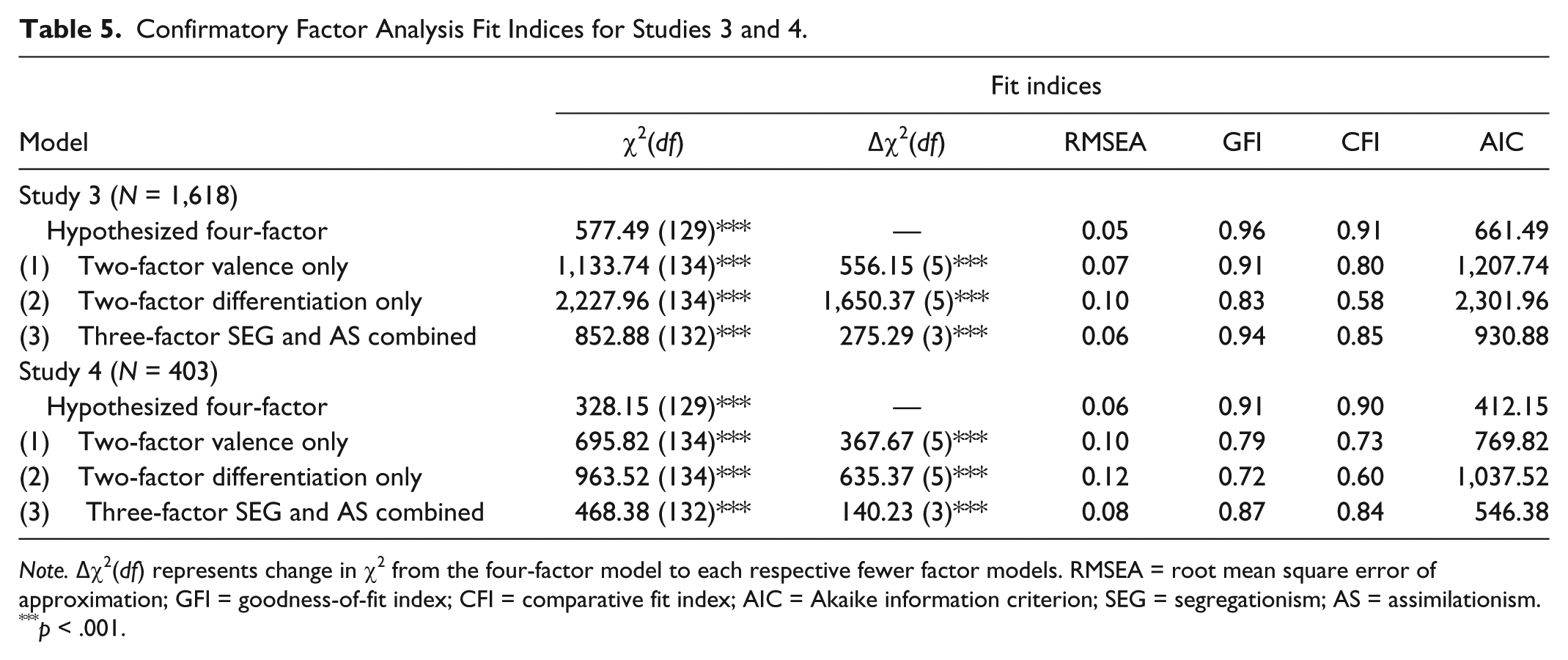
Note. Δχ2(df) represents change in χ2 from the four-factor model to each respective fewer factor models. RMSEA = root mean square error of approximation; GFI = goodness-of-fit index; CFI = comparative fit index; AIC = Akaike information criterion; SEG = segregationism; AS = assimilationism.
p < .001.

Confirmatory factor analysis for the 18 gender ideology items, values from Study 3/Study 4 (Study 3: Undergraduate sample, Study 4: MTurk sample).
Furthermore, we examined whether the model fit was invariant across gender, that is, whether the model fit equally well for male and female participants. To do so, we estimated a model in which we allowed loadings, factor variances, and factor covariance to vary between genders. To assess invariance, we then successively constrained (a) all loadings of items on the factors, (b) the variances of the factors, and (c) the covariances of the factors of the model to be equal across participant gender. The question was whether imposing these constraints resulted in a significant deterioration of model fit, suggesting gender differences in the underlying model. In both studies (see Table 6), the ΔCFI (comparative fit index) and ΔRMSEA (root mean square error of approximation) values remained at or below .001 as these constraints were added, suggesting equivalent models (loadings, factor variances, and covariances) across gender (Cheung & Rensvold, 2002). 6
Model Fits Testing Invariance of the Model Between the Two Genders.
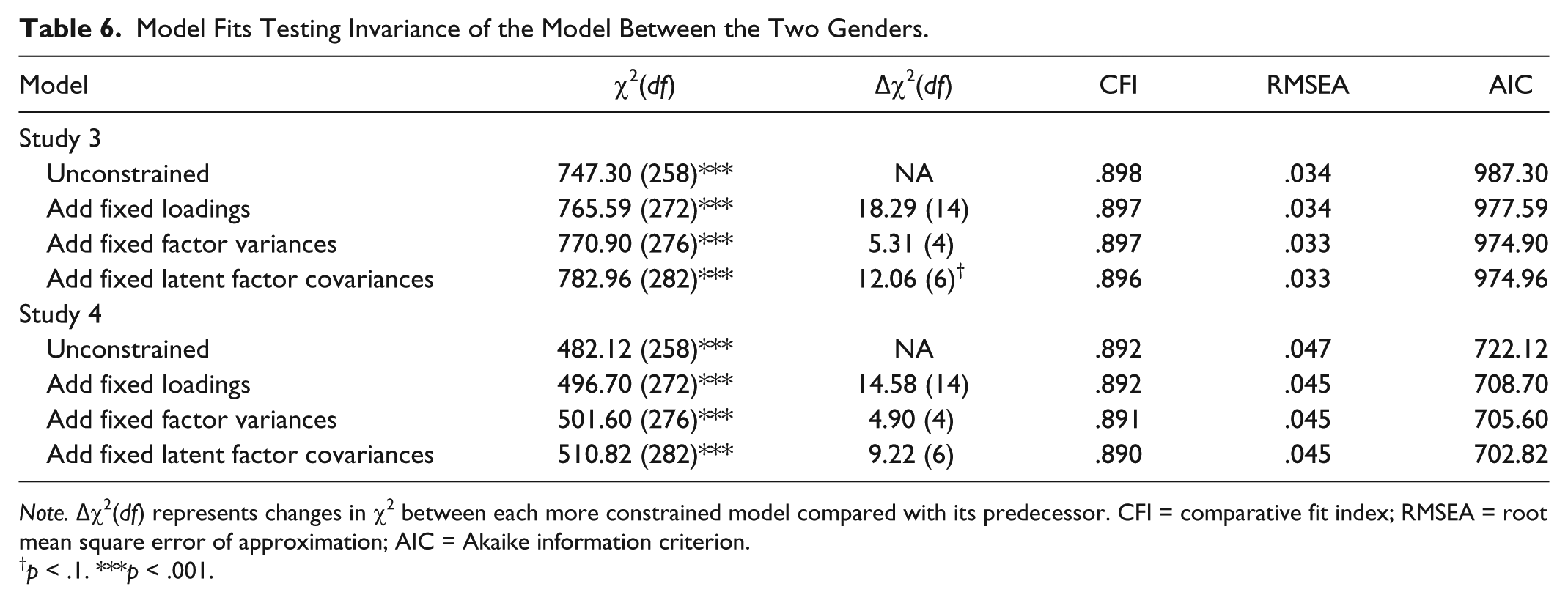
Note. Δχ2(df) represents changes in χ2 between each more constrained model compared with its predecessor. CFI = comparative fit index; RMSEA = root mean square error of approximation; AIC = Akaike information criterion.
p < .1. ***p < .001.
Relations among the factors
As can be seen in Figure 4, and as in the ethnicity data, the intercorrelations between factors sharing the same evaluation were strongly positive, whereas factors that differed on both dimensions were again negatively related. We again examined the unique relationships between each pair of ideologies over and above the others with structural equation modeling (SEM) path analyses as in Studies 1 and 2 (the fit is the same as the CFA). This resulted in positive relationships between ideologies that share the same position on the differentiation dimension of the model, and positive relationships between ideologies that share the same position on evaluation (see Table 7). Again only relationships between ideologies that differ on both evaluation and differentiation remained negative, validating that both the evaluation and the differentiation dimensions characterize intergender ideologies.
Unique Relationships Among the Intergender Ideologies: Standardized Partial Path Coefficients From SEM Path Models in Which Each Ideology Is Treated as the Outcome of the Other Three Ideologies Simultaneously (Studies 3 and 4).
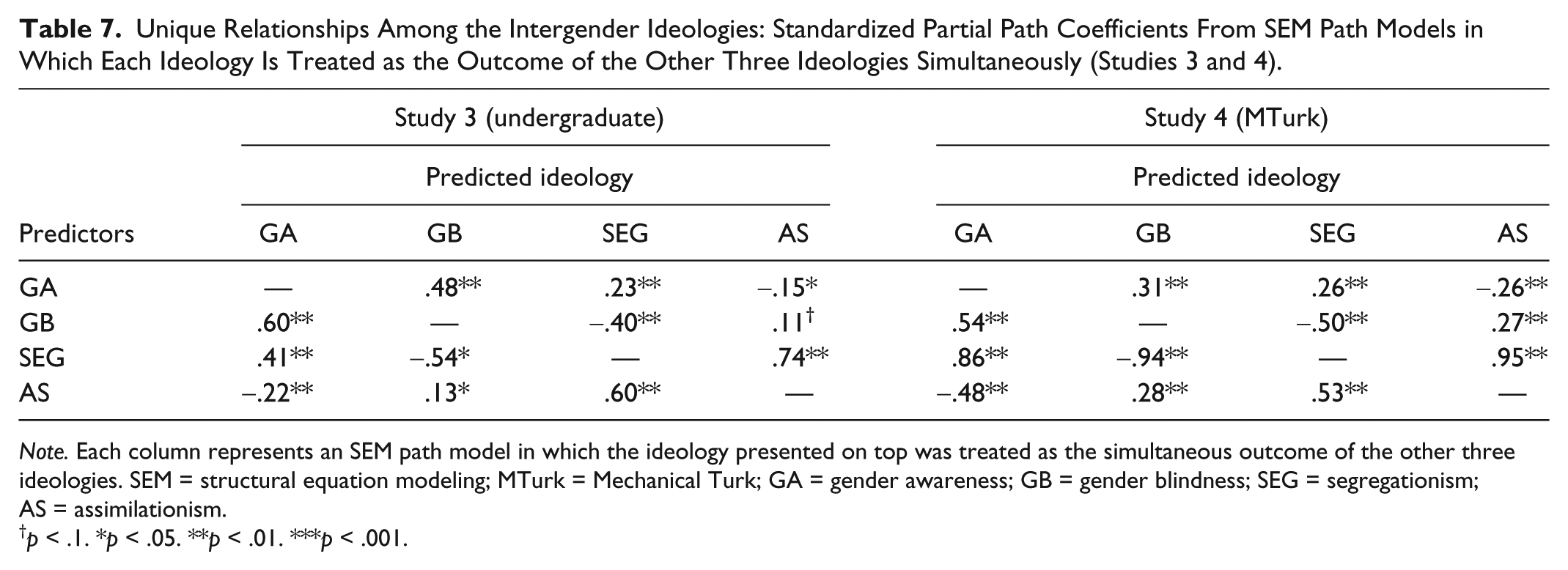
Note. Each column represents an SEM path model in which the ideology presented on top was treated as the simultaneous outcome of the other three ideologies. SEM = structural equation modeling; MTurk = Mechanical Turk; GA = gender awareness; GB = gender blindness; SEG = segregationism; AS = assimilationism.
p < .1. *p < .05. **p < .01. ***p < .001.
Mean levels of ideology endorsement
As in the ethnicity domain, Figure 5 shows that participants in both studies preferred the positive (GA and GB) over the negative (SEG and AS) ideologies—Study 3: F(1, 1,616) = 7,600.35, p < .001,
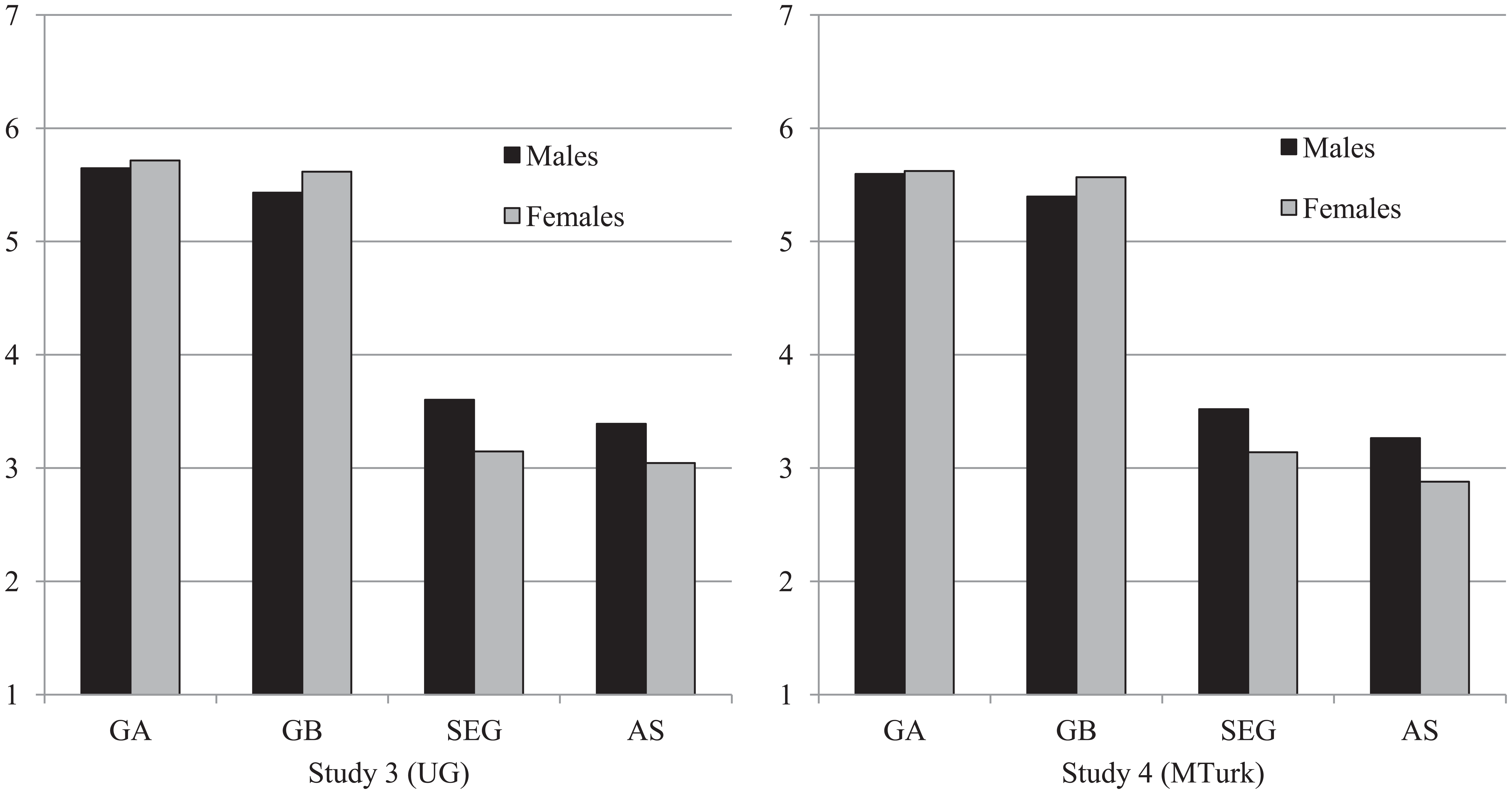
Mean endorsement of gender ideology perspectives for Study 3 (UG sample) and Study 4 (MTurk sample).
All participants also agreed with ideologies that emphasize gender distinctions (i.e., GA and SEG) more than with those that do not (i.e., GB and AS)—Study 3: F(1, 1,616) = 76.04, p < .001,
Relationships with other constructs
Evaluations of women
In a manner parallel to the ethnicity analyses, we examined men’s (dominant group) relative warmth toward women (subordinate group) as a function of their gender ideology. While our hypotheses were largely supported (see Table 8), SEG was uncorrelated (rather than negatively correlated) with men’s reported warmth toward women. As would be expected given the content of the scales, gender ideology did not relate to feelings toward men (relative to women) for female participants, all Fs(1, 221) < 1.5, ps > .22.
Standardized Partial Regression Coefficients From Models Predicting Evaluation of Women, Importance Ascribed to Gender Category, Political Conservatism, and the GTQ From the Four Ideologies (Study 4).
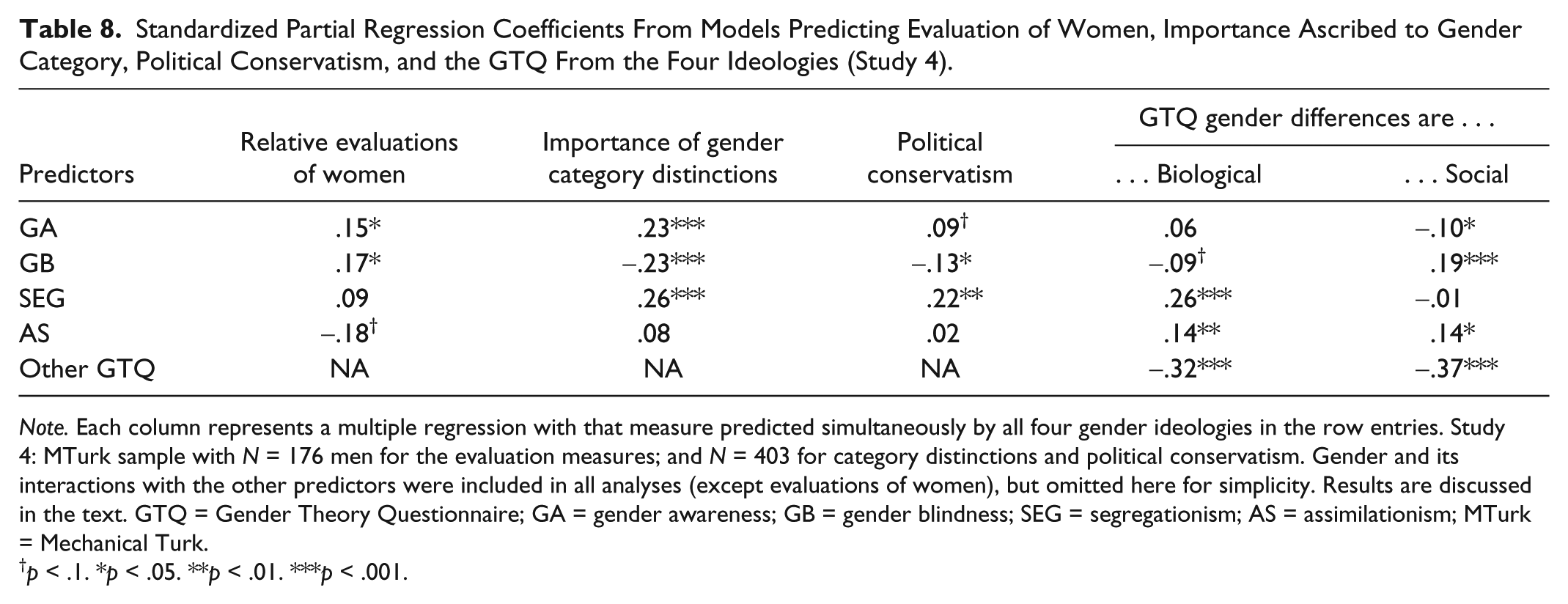
Note. Each column represents a multiple regression with that measure predicted simultaneously by all four gender ideologies in the row entries. Study 4: MTurk sample with N = 176 men for the evaluation measures; and N = 403 for category distinctions and political conservatism. Gender and its interactions with the other predictors were included in all analyses (except evaluations of women), but omitted here for simplicity. Results are discussed in the text. GTQ = Gender Theory Questionnaire; GA = gender awareness; GB = gender blindness; SEG = segregationism; AS = assimilationism; MTurk = Mechanical Turk.
p < .1. *p < .05. **p < .01. ***p < .001.
Importance ascribed to the gender category distinction
As Table 8 shows, judgments of category importance followed the exact same patterns obtained in Studies 1 and 2: GA and SEG were both significantly positively correlated with viewing category distinctions as meaningful, whereas GB was significantly negatively related to the index. AS was again positively related to this index, albeit not significantly. There were no significant differences in these relations as a function of participant gender, all Fs < 2.92, all ps ≥ .10.
GTQ
Each subscale of the GTQ was regressed onto the four ideologies, the other GTQ subscale, as well as gender and all interactions of gender with the other predictors simultaneously (see Table 8). This analysis revealed a significant relationship of the AS perspective with both the belief that gender differences are biological in nature, and that they have social origins, indicating that agreement with an AS perspective entails believing that category distinctions are real and meaningful (i.e., have an essential root in biology), but that they can also be shaped through social forces.
Furthermore, although both GA and SEG share the belief that emphasis be put on gender distinctions, only SEG was positively related to viewing gender as biological, whereas GA was negatively related to viewing gender as social in origin, perhaps indicating that the GA ideology is less concerned with whether or not gender differences are biological, but instead driven by a belief that society cannot, and maybe should not, ask women to behave like men. The GB ideology showed both a positive relationship with the belief that gender differences are socialized, as well as a marginal negative relationship with biological beliefs about gender differences. The only meaningful effect of participant gender in all analyses involving the GTQ indicated that women showed a marginal tendency to agree more with the idea that gender differences are socialized than men, standardized b = .09, t(391) = 1.94, p = .053. 7
Conflict resolution
Analyses of each possible conflict resolution option with the four ideologies, participant gender, and their interactions showed that gender ideology aligned as predicted with the solutions (see Table 9). For all four solution types, the best predictor of endorsement of that solution was agreement with the corresponding ideology, and again, this did not depend on participant gender—all four interactions with gender, Fs(1, 393) < 1. Participant gender was only related to agreement with two of the solutions in the form of main effects. Women were more likely than men to endorse the GA solution, standardized b = .13, F(1, 393) = 7.56, p = .006, and marginally less likely than men to endorse the AS solution, standardized b = .08, F(1, 393) = 3.31, p = .07. There were no differences for the GB and the SEG solutions, standardized bs < .06, Fs(1, 393) < 1.49, ps > .22. 8 Notably, endorsement of AS predicted not only agreement with the AS solution but also disagreement with both the GA and GB solution, the two positive ideology solutions.
Standardized Partial Regression Coefficients Predicting Endorsement of Solutions of Each Type to the Vignette Conflicts (Columns) From the Gender Ideologies (Rows) Simultaneously (Study 4).
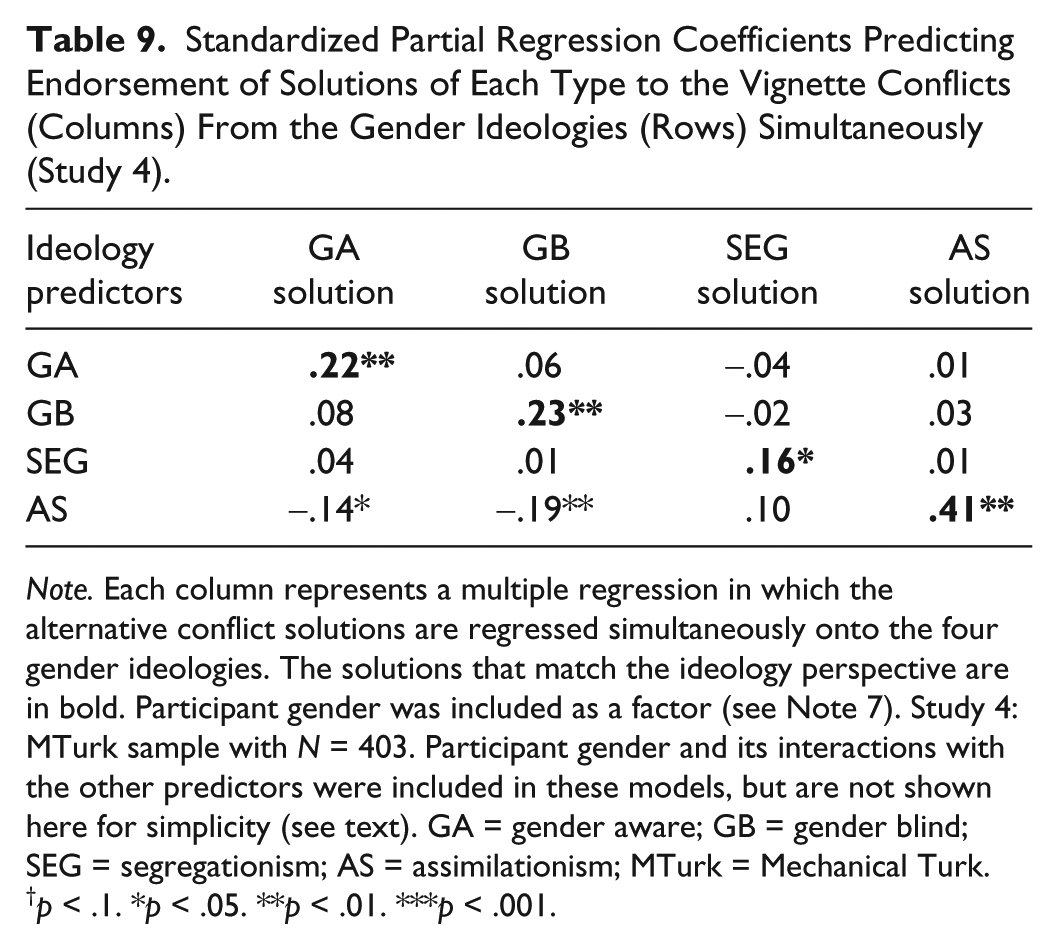
Note. Each column represents a multiple regression in which the alternative conflict solutions are regressed simultaneously onto the four gender ideologies. The solutions that match the ideology perspective are in bold. Participant gender was included as a factor (see Note 7). Study 4: MTurk sample with N = 403. Participant gender and its interactions with the other predictors were included in these models, but are not shown here for simplicity (see text). GA = gender aware; GB = gender blind; SEG = segregationism; AS = assimilationism; MTurk = Mechanical Turk.
p < .1. *p < .05. **p < .01. ***p < .001.
Political orientation
Although liberals advocated attending to group differences in the ethnicity domain (endorsing the MC perspective), being blind with respect to gender is often promoted as a means for overcoming gender bias in work settings (and was preferred in Koenig & Richeson, 2010, in such settings). It seemed likely that political orientation would thus show a different pattern of relations with the ideologies for gender than for ethnicity. Political conservatism was regressed onto agreement with the four gender ideologies, participant gender, and their interactions (see Table 8). The two emphasize distinctions ideologies were positively related to conservatism, whereas GB was negatively related to conservatism. AS was not related to political orientation. There were no main effects or interactions involving participant gender, all Fs(1, 393) < .41.
Discussion
The purpose of Studies 3 and 4 was to validate that the fourfold model of ideology applied to gender. Using both a large undergraduate sample (Study 3) and an MTurk sample (Study 4), CFAs indicated that the fourfold model had good fit that was superior to alternative models. As with ethnicity, path models examining the relationships among pairs of ideologies controlling for the remaining two indicated that if the pair shared either the valence pole or the differentiation pole, they were positively related. Only if they differed on both were they negatively related. Importantly, although women endorsed the positive ideologies more, and the negative ideologies less than men, invariance tests showed that the latent model (with identical loadings and factor variances and covariances) fit the two genders equally well, and the relationships of the ideologies with other measures were also independent of participant gender.
Mirroring results from the ethnicity domain, male participants’ evaluations of women supported the evaluation dimension of our model, and an index measuring the importance participants ascribe to category distinctions showed positive relationships with GA and SEG, and directionally with AS, but a negative relationship with GB. Last, ratings of solutions to a real-life gender conflict were best predicted by ratings on the corresponding ideological perspective.
In addition to these measures, the GTQ assessed the extent to which participants believe the origins of gender differences are biological and/or social (Study 4). The AS ideology was related both to beliefs that gender differences have a biological component, but also that they can be changed, confirming our earlier interpretation of the relationship between AS and the importance ascribed to social categories. GB was also related to beliefs that the origins of gender differences are largely social, and negatively to biological interpretations. Finally, whereas the SEG ideology was related to beliefs that gender is biological in nature, GA was not. Rather, the GA ideology was associated with a disbelief that the origins of gender differences can be shaped by social forces.
Finally, a conservative political stance was positively related to endorsement of the two ideologies that emphasize gender category distinctions, while a politically liberal perspective was related to endorsement of the GB perspective. Thus, political conservatism was the one measure that showed strikingly divergent results from the ethnic domain (see below).
General Discussion
Four studies tested the validity of a fourfold model of intergroup ideology for both ethnicity and gender. Extending work on MC and CB (e.g., Park & Judd, 2005; Wolsko et al., 2000), an evaluative dimension was crossed with the traditional question of how much emphasis should be put on group distinctions. The resulting fourfold framework, depicted in Figure 1, results in four different ideological perspectives that apply to both interethnic and gender relations: CB/GB and AS share a belief that distinctions should be de-emphasized, but differ in how positively subordinate group members are evaluated. However, MC/GA and SEG share the belief that distinctions should be emphasized, but again differ on the evaluative dimension.
Across four studies (N = 3,784) with both undergraduates and MTurk workers, the four-factor model fit the data well and was superior to alternative models. Not surprisingly, in both domains and for both samples, participants were more likely to agree with the positive than negative perspectives.
Additional questions were included to establish that the scales were related to various other constructs in the expected manner. Importantly, all analyses were conducted controlling for endorsement of the other ideological perspectives, thus testing whether the perspectives each made unique contributions to the outcome measures and were not redundant with one another. For ethnicity, the positive ideologies were significantly related to greater positive evaluations of subordinate groups (relative to the dominant ingroup of Whites), whereas the negative ideologies were related to negative evaluations. Parallel analyses for gender focused on men’s relative warmth toward women (collected only in Study 4). Although largely consistent with the predictions of the model, the effects were not as strong as for ethnicity, perhaps because women tend to be evaluated very positively compared with men (Eagly & Mladinic, 1994). Participants’ agreement with the ideologies also predicted the strategies they endorsed for resolving hypothetical conflicts individuals faced that involved ethnic or gender issues, even many weeks removed (Study 1).
Three items broadly captured the importance ascribed to categories. These items showed positive relationships with the emphasize-difference ideologies (MC/GA and SEG) and negative relationships with the blind ideologies (CB/GB) in both domains. Interestingly, they were positively related to AS. We argued that the category importance measure asked whether these distinctions are descriptively important, whereas the AS ideology maintains that one should de-emphasize them prescriptively. Results from the GTQ (Study 4) supported this interpretation. Specifically, AS beliefs were related to beliefs that gender differences are biological and also to beliefs that gender differences can be shaped through social forces, confirming our interpretation that an AS ideology relates to perceiving group distinctions as meaningful, but stresses that subordinate group members can (and should) nevertheless work to change and adhere to dominant group norms.
Endorsement of the ideologies was differentially related to political conservatism for ethnicity and gender. Although political conservatives were generally more likely to endorse negative ideologies (AS in the case of ethnicity, SEG in the case of gender), and liberals were more likely to endorse positive ideologies (MC in the case of ethnicity, and GB in the case of gender), distinctly different patterns emerged by domain in terms of the differentiation dimension. For ethnicity, conservatives aligned with de-emphasizing distinctions (AS) and liberals with emphasizing distinctions (MC), whereas for gender, conservatives agreed with emphasizing distinctions (SEG, and marginally GA) and liberals with de-emphasizing them (GB). This is especially striking as the items used in the different domains were almost identical with the exception of the social category they referred to (compare Appendices A and B). Thus, endorsement of ideology varies both as a function of political beliefs and the specific social groups considered, and might thus align differently again for yet other categories. Additional research could focus on the determinants that lead societies and individuals to espouse certain ideologies over others.
In line with previous research (e.g., Correll et al., 2008; Richeson & Nussbaum, 2004; Wolsko et al., 2000), we focused the presentations of our results in the ethnicity domain on White participants. A look at minority participants (see Supplemental Materials Section A) showed few differences in the pattern of their results compared with Whites when all minority participants were grouped together, particularly with respect to the fit of the fourfold model. Importantly, while we would expect, and obtained, differences in mean levels of endorsement of the ideologies for Whites and various ethnic group (who themselves differ from one another; see also Wolsko et al., 2006), we do not expect (nor did we find for gender or for the ethnic minority groups examined in the supplemental materials) meaningful differences in the structure of the model or the pattern of interrelationships among the ideological perspectives. The ethnic minority samples presented in Supplemental Materials Section A are increasingly small when broken up into different ethnic minority groups, but the overall results do confirm these predictions. Thus, the model depicted in Figure 1 should broadly characterize the perspectives both majority and minority group members communicate.
Relations to Other Research
Berry (1997) has delineated the choices a person has to make when entering a new culture, and some of his framework might appear related to our model. Aligning this “acculturation process” by intended contact with the majority host group and desire to preserve one’s background culture, Berry describes that immigrants can choose to separate (high preservation of background, low intended host culture contact), assimilate (low preservation of background, high intended host culture contact), integrate (high on both), or marginalize (low on both). Hence, Berry’s model specifically describes the perspective of people who wander between cultures (such as immigrants).
Importantly, we believe that processes of acculturation are theoretically distinct from prescriptive beliefs about how people ought to behave to achieve positive intergroup relations within one society. That is, whereas SEG demands separation of new immigrants, and AS demands an assimilation strategy, CB is essentially agnostic to an immigrant’s chosen acculturation strategy. For instance, an immigrant might prescriptively believe that his or her background should not matter for hiring decisions (endorse a CB ideology), but choose to place more importance on his or her background culture and language in his or her personal life (i.e., choose separation as his or her preferred acculturation strategy, see also Navas et al., 2005). As such, we believe that our work on prescriptive ideological perspectives held by all members of a society is complementary to Berry’s work on acculturation strategies chosen by immigrants. Exploring the relations between socially dominant ideologies and immigrants’ acculturation strategies is a topic for future research.
For the purpose of the current article, we defined the second dimension (along the y-axis of Figure 1) as “evaluation of subordinate group members.” Other ways to differentiate AS and SEG from MC/GA and CB/GB are possible. For instance, both our “positive” ideologies (MC/GA and CB/GB) have the declared goal of advancing equality of all groups (as defined in our items, see Appendices A and B), whereas SEG and AS seem to have the goal to preserve the status quo in which some groups are dominant and others are subordinate. Indeed, Levin et al. (2012) found that social dominance orientation was negatively related to MC and CB, but positively to AS. Thus, another interpretation of our second dimension (other than evaluation of subordinate group members) might be preference for equality versus preserving the status quo. Future research is needed to clearly delineate the different motivations, goals, and general correlates of the different ideologies.
This research does not address the difficult question of which ideology is “best” for fostering positive intergroup relations. The answer to this question is likely complex, depending on a number of individual and social factors. Indeed, the positive ideologies can have unintended negative consequences. For example, schoolchildren primed with a CB approach to avoid seeing racial differences have been shown to become less sensitive to instances of overt racial discrimination (Apfelbaum, Pauker, Sommers, & Ambady, 2010). An MC prime has been shown to lead to more negative evaluations of minority group members who do not meet the dominant group’s cultural stereotype of the minority group, as opposed to individuals who exhibit behavior that is stereotype-consistent (Gutiérrez & Unzueta, 2010). In another study, the ethnic makeup of an organization shaped whether minorities preferred that the organization espouse CB or MC (Purdie-Vaughns, Steele, Davies, Ditlmann, & Crosby, 2008). Importantly, these questions about the factors that may make one positive ideology be more beneficial than another are theoretically distinct from our point that both ideologies have both positive and negative instantiations. Our hope is that organizing ideological viewpoints on category differentiation by the additional dimension of evaluation will help in gaining a better understanding of the different forms ideologies about category differentiation can take and thus help clarify theory and measurement.
That is, a lot of research on MC and CB has used different definitions of the constructs, with researchers debating whether AS is a form of CB (Levy & Rosenthal, 2012; Plaut, 2010), and others treating AS and CB as synonymous (e.g., Plaut et al., 2009). Similarly, many public debates have faulted MC as a divisive ideology that creates separate societies (Hahn et al., 2010; “State Multiculturalism Has Failed,” 2011; Verkuyten, 2005; Vertovec & Wessendorf, 2010). In trying to disentangle the many different consequences these ideologies may have, we have argued that one needs to differentiate ideologies by evaluation of outgroups in addition to the emphasis they put on group differences, and this may help resolve some of the contradictory findings in the literature.
The high correlation of ideologies of the same valence furthermore suggests that to see their unique effects, they may have to be considered simultaneously. That is, a result may look as if a certain outcome is uniquely related to an MC ideology, but in fact be simply related to positive intentions toward minorities in general, and uniquely to a CB ideology. Only analyses that consider several perspectives simultaneously can show clearly which perspectives are in fact uniquely related to different outcomes.
Both stressing our unity, ostensibly in the name of CB or GB, and emphasizing our diversity, ostensibly in the name of MC or GA, can be coupled with positive or negative evaluations of subordinate group members. Understanding how these ideologies can also be coupled with negative appraisals of subordinate group members is critical if we are to accurately characterize the motivations of those who espouse these strategies as solutions for social and intergroup conflict.
Footnotes
Appendix
Gender Ideology Items.
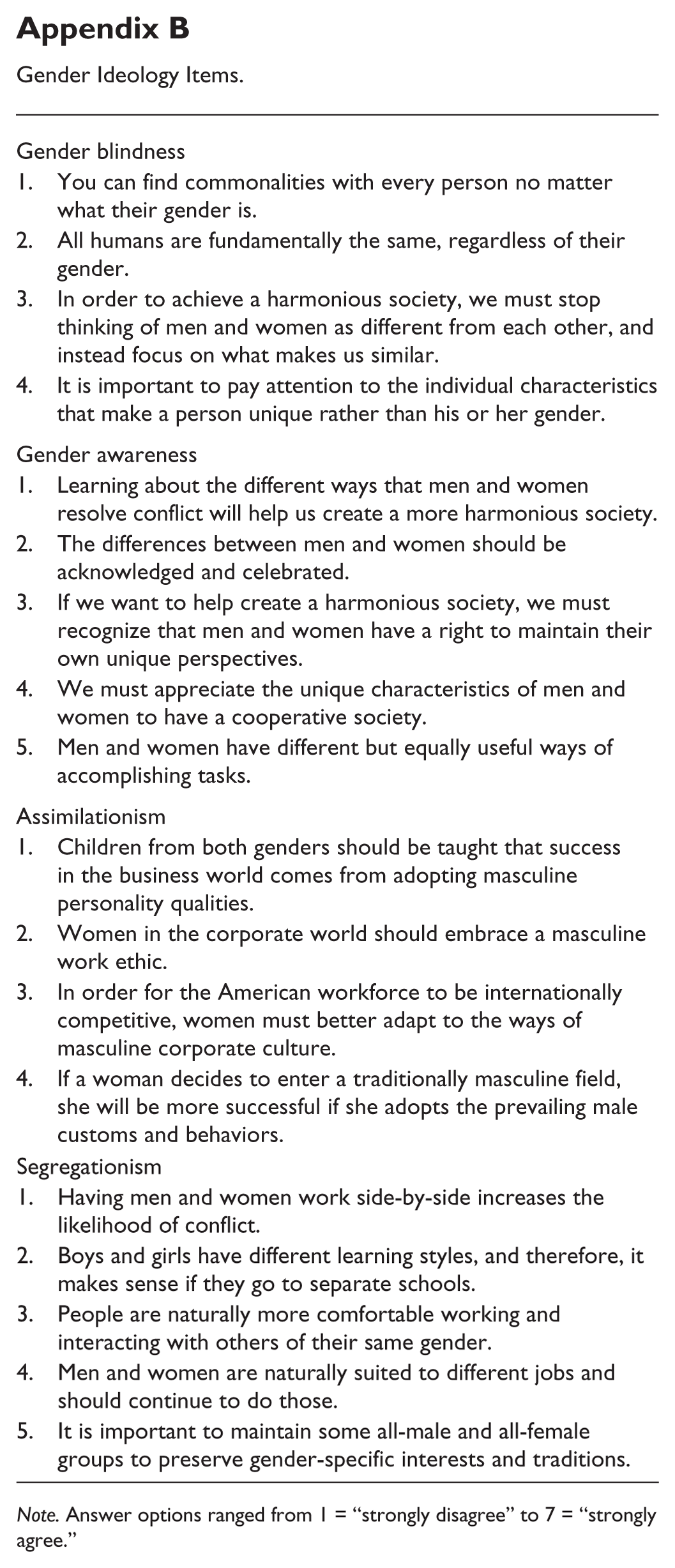
| Gender blindness |
| 1. You can find commonalities with every person no matter what their gender is. |
| 2. All humans are fundamentally the same, regardless of their gender. |
| 3. In order to achieve a harmonious society, we must stop thinking of men and women as different from each other, and instead focus on what makes us similar. |
| 4. It is important to pay attention to the individual characteristics that make a person unique rather than his or her gender. |
| Gender awareness |
| 1. Learning about the different ways that men and women resolve conflict will help us create a more harmonious society. |
| 2. The differences between men and women should be acknowledged and celebrated. |
| 3. If we want to help create a harmonious society, we must recognize that men and women have a right to maintain their own unique perspectives. |
| 4. We must appreciate the unique characteristics of men and women to have a cooperative society. |
| 5. Men and women have different but equally useful ways of accomplishing tasks. |
| Assimilationism |
| 1. Children from both genders should be taught that success in the business world comes from adopting masculine personality qualities. |
| 2. Women in the corporate world should embrace a masculine work ethic. |
| 3. In order for the American workforce to be internationally competitive, women must better adapt to the ways of masculine corporate culture. |
| 4. If a woman decides to enter a traditionally masculine field, she will be more successful if she adopts the prevailing male customs and behaviors. |
| Segregationism |
| 1. Having men and women work side-by-side increases the likelihood of conflict. |
| 2. Boys and girls have different learning styles, and therefore, it makes sense if they go to separate schools. |
| 3. People are naturally more comfortable working and interacting with others of their same gender. |
| 4. Men and women are naturally suited to different jobs and should continue to do those. |
| 5. It is important to maintain some all-male and all-female groups to preserve gender-specific interests and traditions. |
Note. Answer options ranged from 1 = “strongly disagree” to 7 = “strongly agree.”
Declaration of Conflicting Interests
The author(s) declared no potential conflicts of interest with respect to the research, authorship, and/or publication of this article.
Funding
The author(s) disclosed receipt of the following financial support for the research, authorship, and/or publication of this article: Adam Hahn was partly supported by a PhD scholarship of the German National Merit Foundation (ERP-Stipendium der Studienstiftung des Deutschen Volkes) throughout the initial stages of this research project.

Notes
References
Supplementary Material
Please find the following supplemental material available below.
For Open Access articles published under a Creative Commons License, all supplemental material carries the same license as the article it is associated with.
For non-Open Access articles published, all supplemental material carries a non-exclusive license, and permission requests for re-use of supplemental material or any part of supplemental material shall be sent directly to the copyright owner as specified in the copyright notice associated with the article.
