



Abstract
Mate preference research has focused on traits people desire in partners (i.e., dealmakers) rather than what traits they avoid (i.e., dealbreakers), but mate preferences calibrate to both maximize benefits and minimize costs. Across six studies (N > 6,500), we identified and examined relationship dealbreakers, and how they function across relationship contexts. Dealbreakers were associated with undesirable personality traits; unhealthy lifestyles in sexual, romantic, and friendship contexts; and divergent mating strategies in sexual and romantic contexts. Dealbreakers were stronger in long-term (vs. short-term) relationship contexts, and stronger in women (vs. men) in short-term contexts. People with higher mate value reported more dealbreakers; people with less-restricted mating strategies reported fewer dealbreakers. Consistent with prospect and error management theories, people weighed dealbreakers more negatively than they weighed dealmakers positively; this effect was stronger for women (vs. men) and people in committed relationships. These findings support adaptive attentional biases in human social cognition.
Poets, playwrights, philosophers, and professors have spent considerable time and effort trying to understand why people chose one romantic or sexual partner over another. We contend that most research has focused on the positive or desirable end of the continuum when examining mate preferences (i.e., relationship dealmakers; Kenrick, Groth, Trost, & Sadalla, 1993; Li, Bailey, Kenrick, & Linsenmeier, 2002) while putting less emphasis on the negative undesirable end of the same continuum (i.e., relationship dealbreakers; Buss & Schmitt, 1993; Zebrowitz, Fellous, Mignault, & Andreoletti, 2003; Zebrowitz & Rhodes, 2004). Researchers have assumed a linear utility function when evaluating mate preferences; but given that losses loom larger than gains (Kahneman & Tversky, 1979) and evolved systems to avoid losses in mate choice (Haselton & Buss, 2000), it seems unlikely that decisions regarding high- and low-quality mates are equivalent. For romantic relationships, taking on a bad partner may be costlier than foregoing a good partner; thus, traits signaling a bad partner may have evolved to be more salient and important than positive traits, especially during the initial stages of attraction and relationship formation.
We present evidence from six studies to contribute a more holistic view of relationship partner choice by examining relationship dealbreakers. We draw on evolutionary psychological and behavioral economics research, including preferences for romantic and sexual partners. We begin by documenting what the primary dealbreakers are in samples of college students and online daters. We examine how people’s preferences for—and assessments of—specific dealbreakers may be adaptively tuned to key individual differences and contextual variables. We propose that learning negative information about a potential relationship partner will result in a greater reduction in the perceiver’s likelihood to form a relationship (i.e., dealbreaking) than an equivalent unit of positive information will result in an increase in relationship formation (i.e., dealmaking; Figure 1). In short, when evaluating potential mates, people will weigh negative traits more than positive traits.
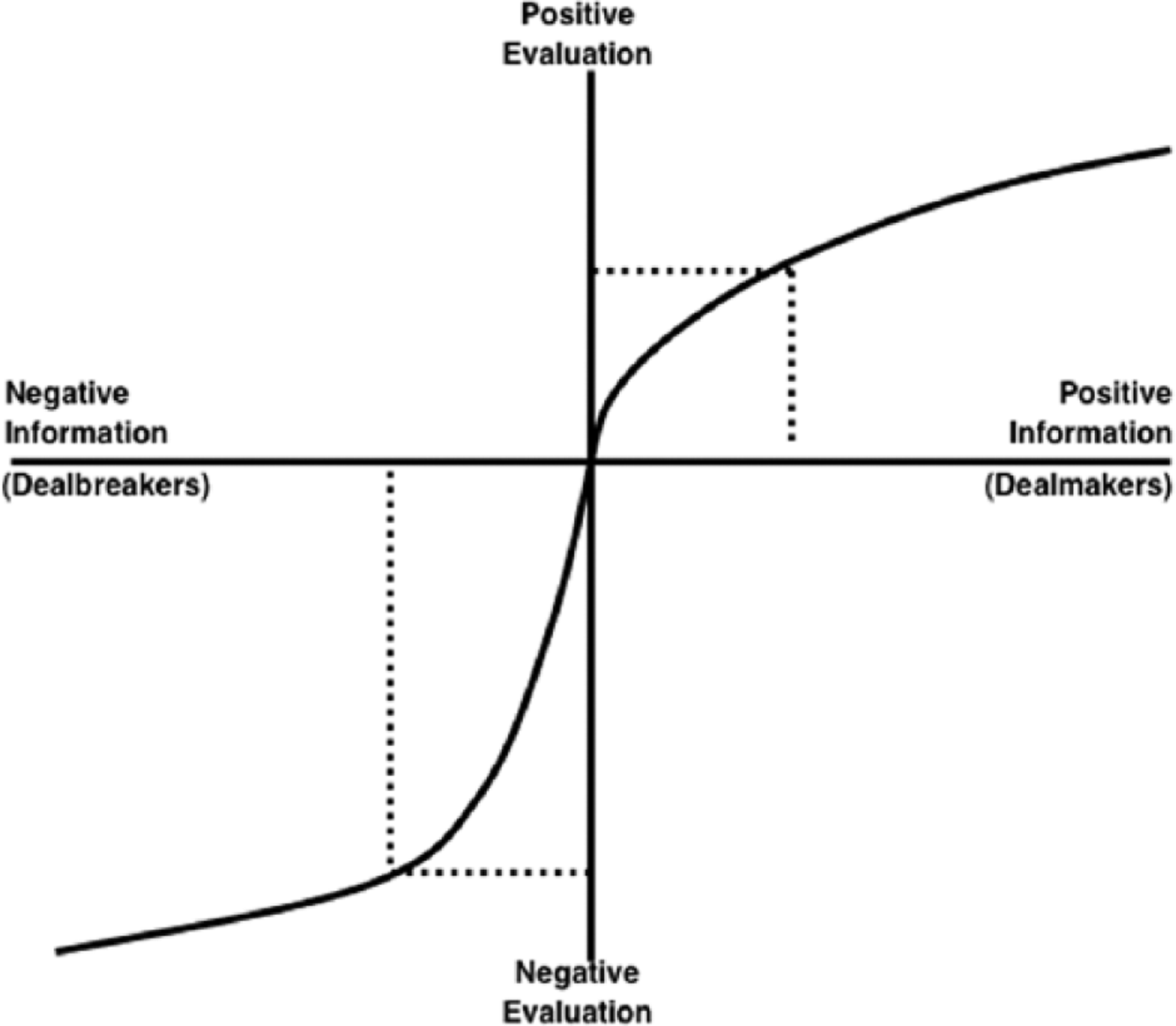
A prospect theory of the effect of learning of positive (dealmakers) or negative (dealbreakers) information on people’s evaluation of a target for a potential relationship.
Mate Preference Research Overlooks Negative Traits
Researchers have studied mate preferences for decades, finding preferences for kindness and intelligence, and men’s greater preferences for physical attractiveness, and women’s greater preferences for dominance and social status (Bryan, Webster, & Mahaffey, 2011; Shackelford, Schmitt, & Buss, 2005; Symons, 1979). From an evolutionary perspective, these traits indicate abilities to contribute to reproductive fitness. Men may desire physical attractiveness in women because it is an honest cue to health and fertility; and women may desire social status in men because it signals their ability to provide resources critical for offspring survival (Buss & Schmitt, 1993). However, recent work suggests undesirable traits may play important roles in mate choice. For example, ovulating women may sometimes prefer men higher in subclinical psychopathy and narcissism (i.e., cads or bad boys; Durante, Griskevicius, Simpson, Cantú, & Li, 2012; Jonason, Valentine, Li, & Harbeson, 2011).
Researchers know less about mate aversions (vs. preferences), or how people process negative information about undesirable traits in a mate. Nevertheless, research suggests that people have minimum criteria (Kenrick, Sadalla, Groth, & Trost, 1990), thresholds (Townsend & Levy, 1990), and priorities (Li et al., 2002) when considering potential mates and choosing mates (Li et al., 2013), which suggests that people have evolved to seek sufficiency in key characteristics. However, there may be more to mate preferences than avoiding the low end of desirable traits—people may also have evolved to specifically avoid negative traits. Furthermore, although positive traits—dealmakers—reflect characteristic that may improve reproductive fitness, the presence of negative traits—dealbreakers—may represent even greater reproductive fitness costs. Because of this cost–benefit asymmetry, people may be primarily sensitive to mating cost information and secondarily sensitive to mating benefit information.
Adaptive Significance of Dealbreakers
We view mate choice as composed of two complementary strategies; one focused on acquiring desirable traits, the other focused on avoiding undesirable traits. Over time, natural selection likely shaped mate preference mechanisms that are sensitive to both strategies, because people who made mate choices based on both positive and negative preferences would have benefited over those with a less nuanced process of mate selection. For example, the benefits of avoiding unhealthy potential mates likely exceed those of approaching healthy ones. By adopting two parallel mate-choice strategies, natural selection would have created a more successful mate-selection process.
Contextual Sex Differences
In evolutionary models, partner choice is influenced by psychological mechanisms evolved to direct human survival and reproduction. When the sexes faced different, recurrent adaptive challenges, they likely evolved sex-specific preferences. According to Parental Investment Theory (Trivers, 1972), women (vs. men) are biologically obligated to expend a higher minimum investment in offspring (i.e., initial gametic investment, protracted gestation, lactation). As such, women are likely to be more selective about their relationship partners to avoid costly impregnation by low-quality mates (Buss & Schmitt, 1993; Haselton & Buss, 2000). We hypothesize this cost asymmetry would make women more likely to attend to negative or aversive traits in potential mates. Specifically, women (vs. men) should perceive more—or have lower tolerance for—dealbreakers in potential partners (H1).
In mate selection research, there are important distinctions in relationship duration and commitment level (Buss & Schmitt, 1993; Kenrick et al., 1993). People’s motivations for engaging in long-term, committed relationships (marriage) and short-term, uncommitted ones (one-night stands) often differ. People enter serious romantic relationships for socioemotional support as well as economic, social, and reproductive reasons (Brunell & Webster, 2013), but the motivation for casual sex is more likely to be for sexual gratification (Jonason, 2013). From a reproductive standpoint, long-term romantic relationships—but not necessarily short-term sexual relationships—satisfy the human desire for romantic attachment and promote joint care of ensuing offspring (Gray & Garcia, 2013). Given greater mutual investment and interdependence in long-term relationships (Kenrick et al., 1993; Li et al., 2002), there is a greater premium on making quality choices for one’s long-term mate. Thus, we hypothesize that people will express more dealbreakers in committed, long-term (vs. uncommitted, short-term) relationship contexts (H2).
Because both sexes invest significantly in long-term relationships, both have evolved to be choosy about long-term partners. However, because of biological sex differences in minimal reproductive investment, men are likely to be less selective about their short-term, uncommitted partners (Buss & Schmitt, 1993). Thus, in short-term relationship contexts, we expect women’s sensitivity to dealbreakers to be greater than men’s (H3).
Sociosexuality and Mate Value
Sociosexuality—one’s openness to engage in uncommitted sexual activity (Simpson & Gangestad, 1991)—also relates to mate preferences. People who adopt more unrestricted sociosexual strategies (i.e., more sexually permissive) can access a larger pool of potential partners. Thus, sociosexuality should be negatively correlated with the degree to which various features are rated as dealbreakers (H4), an effect that should be stronger in short-term (vs. long-term) mating contexts (H4a).
According to an economic exchange view of romantic relationships (Baumeister & Vohs, 2004; Pawlowski & Dunbar, 1999; Symons, 1979), people transact in mating markets by offering their own mate value while seeking to acquire mate value from potential partners. This model specifies that people who have more desirable characteristics have greater mate value, and thus control more demand in mating markets. Such people can afford to be choosier regarding both positive and negative mate information. In contrast, people with lower mate value (e.g., unhealthy, unattractive, no resources) have fewer mating options and less ability to be discriminating (Buss & Shackelford, 2008). Thus, we expect mate value to be adaptively calibrated such that people with lower (vs. higher) mate value will perceive fewer—or have a higher tolerance for—relationship dealbreakers (H5).
Trait Content
What negative traits do people avoid in potential mates? If people are predisposed to both maximize reproductive benefits and minimize reproductive losses (Zebrowitz et al., 2003; Zebrowitz & Rhodes, 2004), and if this dual process is meant to capture desirable and undesirable aspects of important mate selection criteria, then people should attempt to avoid undesirable personality traits (Buss & Shackelford, 1997), indicators of questionable health (Perilloux, Webster, & Gaulin, 2010; Thornhill & Gangestad, 1994), and people primarily pursuing short-term sexual strategies (O’Sullivan, 1995; H6).
Romantic Relationship Specificity
Although negative traits are undesirable for most relationships, dealbreakers should display some adaptive context specificity. Unhealthy behaviors and disagreeable dispositions impose costs on all social affiliates regardless of relationship type, but although mating strategies can influence friendships and general social behavior (Vrangalova, Bukberg, & Rieger, 2014), this has different valence relative to potential mates’ mating strategies. We hypothesize that general traits (i.e., poor health, aversive personality traits) will be undesirable across all three relationship contexts (H7). In addition, we expect mating-orientated dealbreakers to be more important in short-term/sexual and long-term/romantic relationship contexts, than in platonic/friendship relationship contexts (H8).
Mechanisms for Positive Versus Negative Trait Preferences
Although much research has examined how positive mate preference mechanisms function, comparatively little has examined negative or mate aversion mechanisms. However, as people become acquainted in relationships, they gather both favorable and unfavorable information that aids in their decision to develop or terminate a partnership. This process likely contributes to the pattern in which some uncommitted, short-term, sexual encounters develop into committed, romantic relationships (Garcia & Fisher, 2015), whereas others dissolve (Jonason, Li, & Cason, 2009). Thus, we expect that when people learn dealbreaker information about a partner, this potential partner becomes less appealing to them, and the converse should be so for dealmaker information (H9).
However, because losses loom larger than gains (Kahneman & Tversky, 1979), we contend that people will weigh dealbreaker information more heavily than dealmaker information (Figure 1). Consistent with error management theory (Haselton & Buss, 2000), over evolutionary time, this cost asymmetry likely oriented people to be more sensitive to information indicating mating costs and risks (vs. gains and benefits). That is, the costs of misidentifying a bad relationship partner as a good one (i.e., a false positive) are likely costlier error than passing up a good relationship (i.e., a false negative). Thus, we expect information about dealbreakers (vs. dealmakers) to be more influential in shaping people’s perceptions of their likelihood to form relationships (H10), and this effect will be stronger (a) in women than in men (Haselton & Buss, 2000; H10a), and (b) for people who have a stable (vs. unstable or nonexistent) partner contexts (Li et al., 2002; Li et al., 2013; H10b).
Overview
We propose that people simultaneously process positive and negative information to make social choices, and that because of biologically based cost asymmetries, they weigh negative information (i.e., dealbreakers) more heavily than positive information (i.e., dealmakers). Across six studies, we investigate multiple aspects of an evolved psychology of dealbreakers, including their content, how they differ from positive trait preferences, and key sex differences and contextual factors (i.e., relationship duration, sociosexuality, mate value). To our knowledge, these studies are the first systematic and comprehensive attempt to understand the traits that people avoid in their partners. We begin by defining and describing dealbreakers and proceed to examine the negative traits that people avoid. Finally, we show how our findings support prospect theory and advance error management theory.
Study 1: What Are Dealbreakers?
Study 1 used an act-nomination format (Buss & Craik, 1983) to see what men and women consider relationship dealbreakers. College students were asked to list their dealbreakers when considering short-term and long-term relationships. We examine sex differences in the number of dealbreakers participants provided.
Method
Participants
Participants were 92 undergraduate students (24 men) aged 18 to 53 years (M = 23.97, SD = 8.36) from a community college in southwestern United States. Participants received extra credit for completing an online survey about relationship dealbreakers.
Procedure
Participants were asked, “What would make you reject someone as a potential short-term, casual sex partner?” and “What would make you reject someone as a potential long-term, committed partner?” Participants were then asked to list all the dealbreakers they regarded as essential in both contexts. Two research assistants compiled the dealbreakers into a single list and eliminated redundant items (e.g., “the person smokes cigarettes” and “the person smokes”). The final list contained 49 dealbreakers.
Results and Discussion
We conducted a mixed-design 2 × 2 ANOVA on the number of dealbreakers participants reported, with relationship context (long-term, short-term) as a within-person factor and participant’s sex (male, female) as a between-person factor. There was a main effect of relationship context, F(1, 87) = 33.19, p < .01,
Study 2: Individual Differences in Dealbreakers
To better understand people’s attitudes toward various dealbreakers, we next conducted an act-frequency study (Buss & Craik, 1983). In Study 2, we took the qualitative data from Study 1 and asked an independent sample of participants to rate the extent to which each item was a dealbreaker. We examine sex differences in people’s ratings of negative traits and the associations among dealbreakers, mate value, and sociosexuality.
Method
Participants
Participants were 285 undergraduate students (115 men) aged 18 to 55 years (M = 22.35, SD = 6.27) from a university in southwestern United States who received extra credit for completing an online survey on dealbreakers and individual differences. Among participants, 50% were in a committed partnership, 95% were heterosexual, and 61% identified as European Americans.
Procedure
We directed participants to an online survey, where we defined dealbreakers as “bits of information you learn about a person that might make you lose interest in this potential partner.” Participants were shown the 49 dealbreakers from Study 1 (Table 1) and were asked to rate the likelihood (1 = not at all; 5 = very much) that each item would be a dealbreaker, both when considering a short-term, casual sex relationship and a long-term, committed relationship. We placed measures of self-perceived mate value and sociosexuality between the dealbreaker items to reduce possible carryover effects.
Study 2: Top 10 Dealbreakers for Long-Term and Short-Term Relationships.
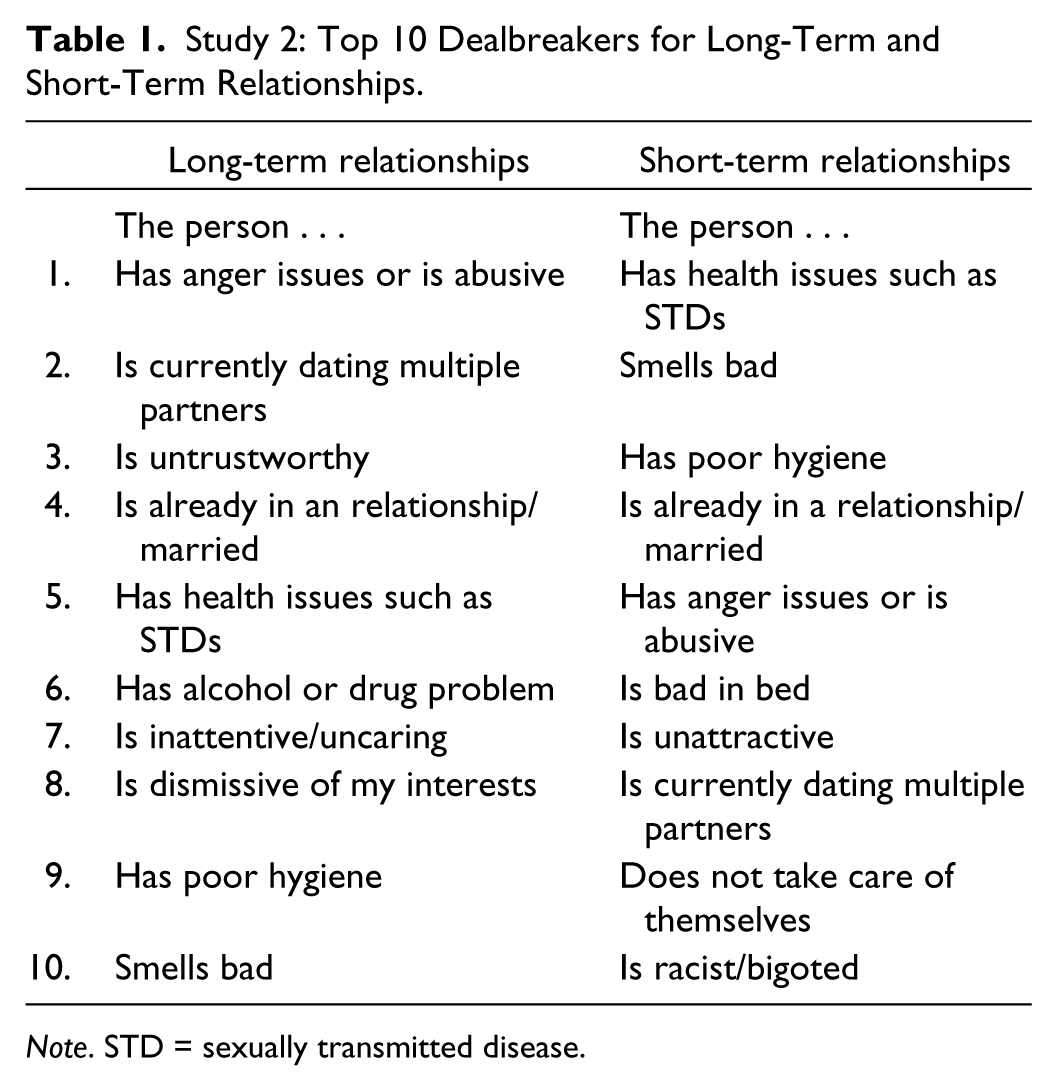
Note. STD = sexually transmitted disease.
Measures
The 22-item Mate Value Inventory (MVI; Kirsner, Figueredo, & Jacobs, 2003) was used to measure self-perceived mate value. Participants were asked to agree with items such as “I am a person with a good sense of humor” (1 = not at all; 5 = very much). Items were averaged to create a mate value index (α = .81).
Participants’ sexual strategies were assessed using the seven-item Sociosexuality Orientation Index (SOI; Simpson & Gangestad, 1991). Participants responded to questions such as “I can imagine myself being comfortable and enjoying casual sex with different partners.” Items were standardized (z-scored) before being averaged to create a composite (α = .75).
Results and Discussion
Exploratory factor analyses (with various rotations) of participants’ ratings of each dealbreaker indicated that for both short- and long-term relationship contexts, items loaded on a global factor. Thus, we formed two composite variables consisting of all item ratings for short- and long-term relationships (both αs = .97). A mixed-model ANOVA of the item ratings revealed a Sex (men vs. women, between-persons) × Duration (short- vs. long-term, within-persons) interaction, F(1, 282) = 21.16, p < .01,
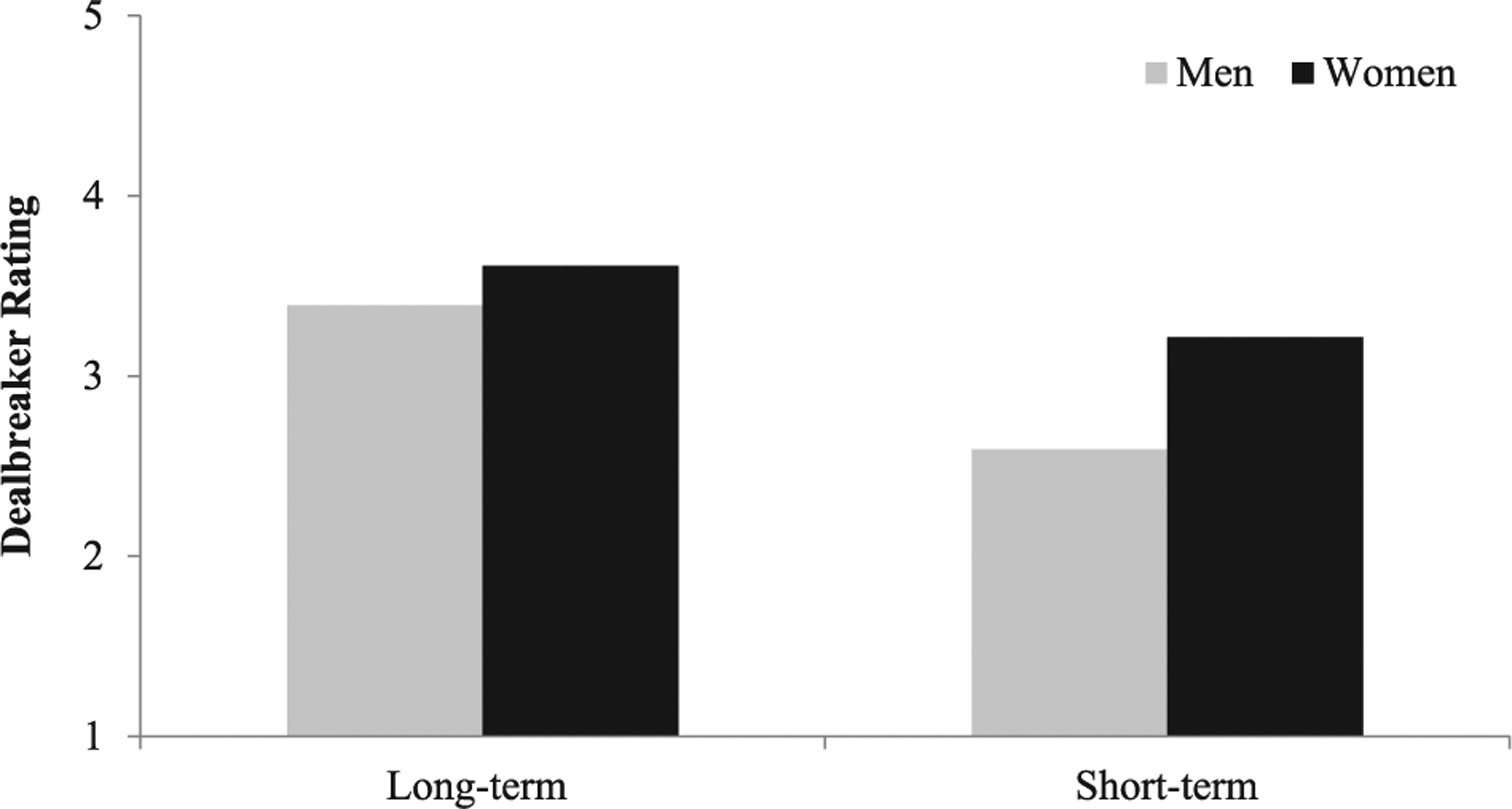
Study 2: Ratings of negative traits as dealbreakers as a function of participant sex and relationship context.
Next, we entered SOI and MVI scores (which were uncorrelated, r = −.09) as covariates in a mixed-model ANCOVA. The Sex × Duration interaction remained significant, F(1, 280) = 16.75, p < .01,
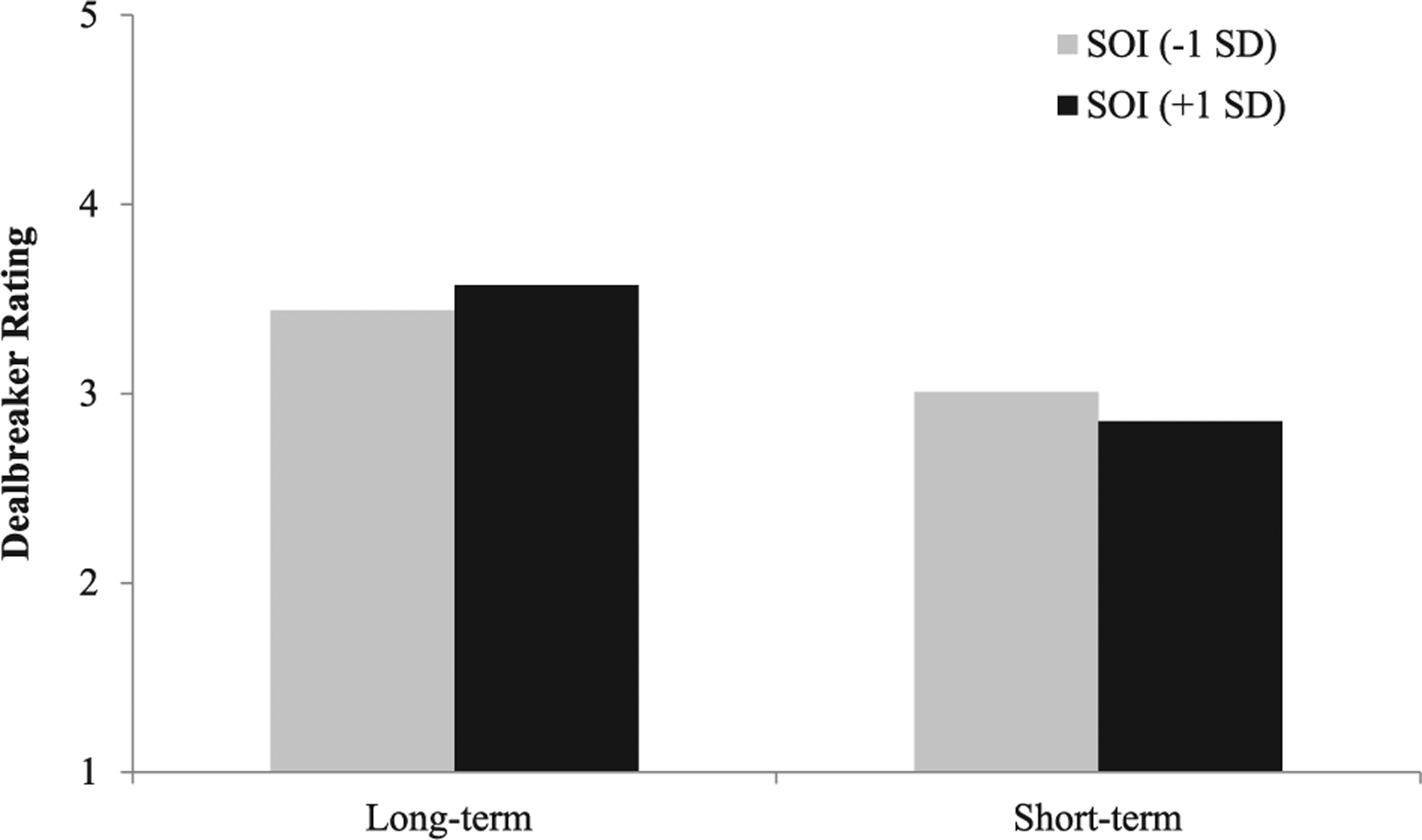
Study 2: Ratings of negative traits as dealbreakers as a function of sociosexuality (SOI) and relationship context.
Table 1 contains the top 10 dealbreaker items for both short- and long-term relationships. Consistent with H6, the top 10 items centered on health (e.g., sexually transmitted diseases, bad odors), sexual strategies, and undesirable personality traits (e.g., racist, abusive). Being “bad in bed” was in the top 10 items for short-term relationships only; prior research has shown that perceived quality of sexual performance mitigates regret following short-term uncommitted sexual encounters (Fisher, Worth, Garcia, & Meredith, 2012), perhaps fitting when the context of a short-term relationship is more explicitly sexual than emotionally intimate. In addition, long-term (vs. short-term) relationship dealbreakers covered a wider range of mating criteria. These results are consistent with research showing that people elevate their standards when considering long-term (vs. short-term) partnerships (Li et al., 2002).
To avoid item-level analyses (recall the single-factor solution noted above), we created face-valid categories using a modified thematic analysis (Jonason & Buss, 2012). Three raters (the first author and two research assistants) independently sorted the dealbreaker items into face-valid groups (Bulmer, 1979). The three raters met in person to asses internal consistency (αs = .63 to .95), resulting in seven final categories—unattractiveness, unhealthy lifestyle, undesirable personality traits, differing religious beliefs, limited social status, divergent mating psychologies, and differing relationship goals. In long-term (vs. short-term) contexts, the categories were stronger dealbreakers (ts = 5.76 to 12.63, ps < .01, Cohen’s ds = 0.24 to 0.86) with the exception of unattractiveness. Women, especially in short-term sexual contexts, rated dealbreakers more strongly than men did in almost all cases (Table 2). Consistent with H4, people who were more disposed to engaging in short-term partnering regarded various negative traits as less likely to be dealbreakers when considering a short-term relationship. Also, those with higher mate value (H5) had higher standards regarding dealbreakers (Table 3).
Study 2: Sex Differences and Similarities in Dealbreakers Across Mating Durations.
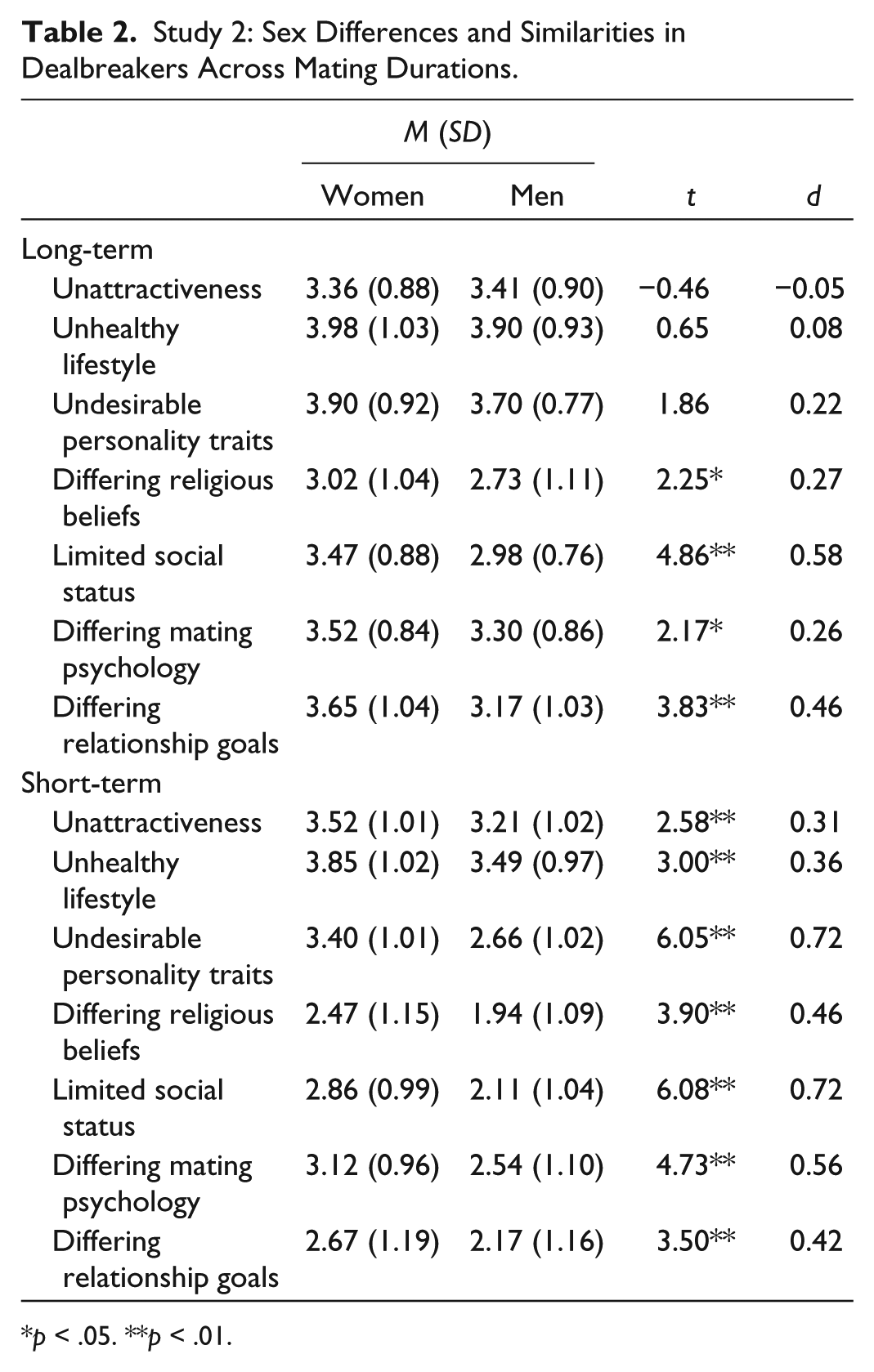
p < .05. **p < .01.
Study 2: Correlations Between Dealbreakers for Each Mating Duration and Sociosexuality (SOI) and Mate Value (MVI).

Note. SOI = Sociosexuality Orientation Index; MVI = Mate Value Inventory.
p < .05. **p < .01.
Study 3: Dealbreakers Among Single Americans
Like most research on mate preferences, Studies 1 and 2 used heterosexual college-student samples, which might be problematic (Henrich, Heine, & Norenzayan, 2010), especially for understanding patterns of romantic and sexual preferences and behaviors at large (Gray & Garcia, 2013). It is possible that older (vs. younger) people have different specific dealbreakers, or a different number of dealbreakers. For instance, older men and women may have acquired more (particularly negative) relationship experiences, rendering them more selective; an effect that may be stronger in women than in men (H1). Alternatively, older people may be faced with unique dealbreakers that college students are less likely to have faced, such as their potential partners having children. To address these considerations, Study 3 examined dealbreakers among participants in a nationally representative sample of singles in the United States.
Method
Participants
Data were drawn from 5,541 participants (2,744 men) aged 21 to 76+ years (M = 46.72, SD = 15.57) from a nationally representative sample of single Americans (including those currently separated, divorced, or widowed). The modal participant identified as heterosexual (91%) and “White” (83%).
Procedure
Data were collected in 2011 as part of an annual study called Singles in America (SIA) sponsored by Match.com but not using members of this site. Participants were recruited by MarketTools® (San Francisco, California, the United States), using independent Internet research panels for population-based cross-sectional survey. 1 MarketTools® draws panelists from their diverse pool of established participants who have been continuously recruited over several years from multiple venues, including paper and electronic mailings, referrals, corporate partnerships, and Internet recruitment. Nationally representative research panels are compiled based on demographic distributions reflected in the most recent Current Population Survey, conducted by the U.S. Census Bureau. However, the current study also includes augmented oversampling of certain demographic categories, specifically homosexual men and women. All data were collected over the Internet (see www.markettools.com).
To ensure data quality, research panelists were required to verify their identity through the TrueSample™ certification process, which uses validation technologies in real time to identify and screen out fake, duplicate, unengaged, and unqualified respondents who may attempt to take a survey (www.truesample.com). Panelists are also screened to ensure survey engagement, with those straight-lining responses or moving too quickly through panels removed.
Measures
Participants were asked, “When considering a committed relationship with someone, which of the following would be dealbreakers to you? (select all that apply).” Options were randomized to prevent order effects. The questionnaire provided participants with 17 potential dealbreakers (Table 4), with no limit on number of choices made.
Study 3: Dealbreakers When Considering a Long-Term, Committed Relationship From a Nationally Representative Sample of Single Americans.
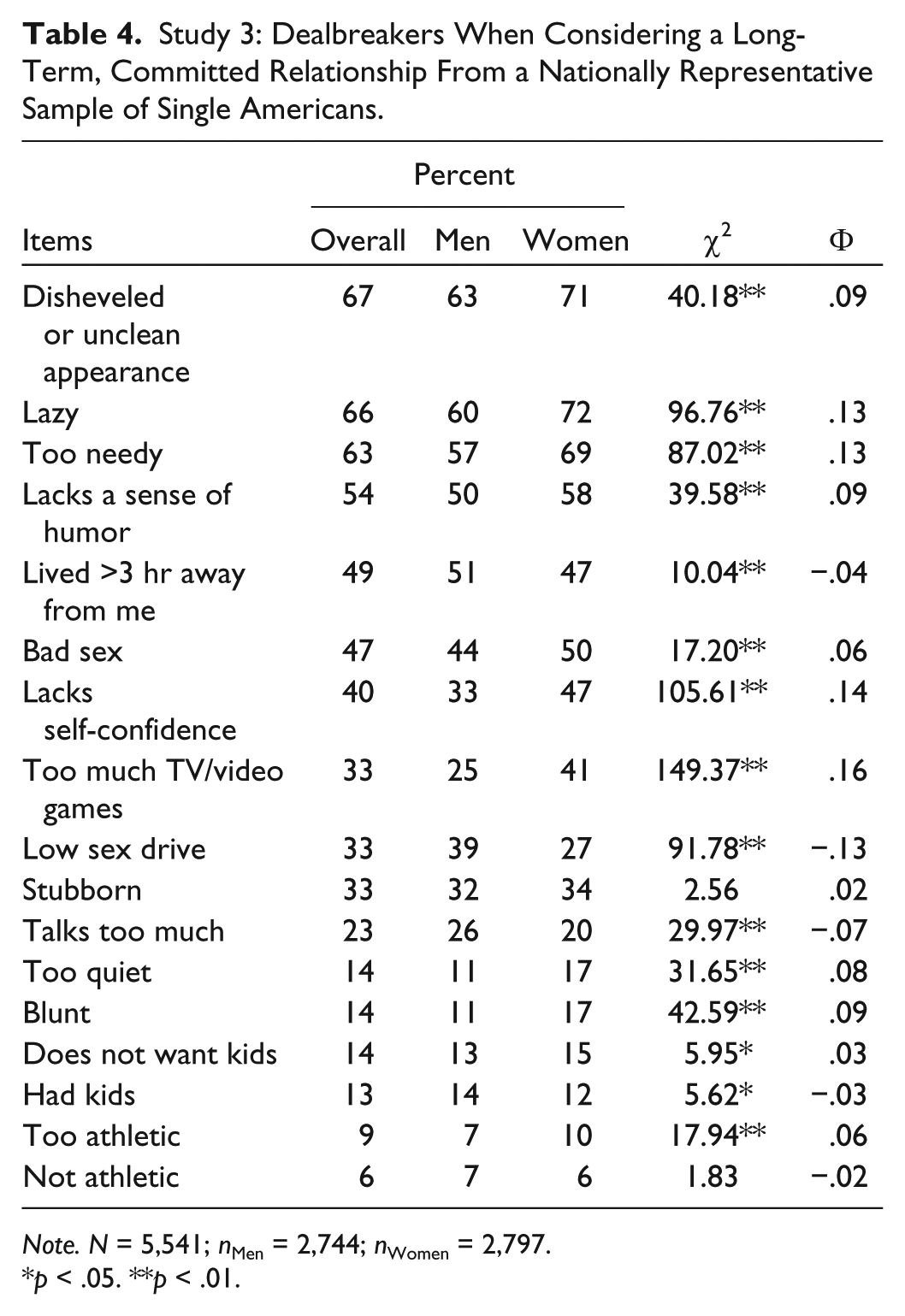
Note. N = 5,541; nMen = 2,744; nWomen = 2,797.
p < .05. **p < .01.
Results and Discussion
Participants reported an average of six relationship dealbreakers (M = 5.76, SD = 2.98), but women reported more dealbreakers (M = 6.10, SD = 2.96) than men (M = 5.41, SD = 2.96), t(5,539) = −8.66, p < .01, d = −0.23, consistent with H1. Age was positively correlated with number of dealbreakers, r(5,539) = .15, p < .01. We examined whether sex (men = 0.5, women = −0.5) moderated the age–dealbreakers relationship, using multiple regression (see Aiken & West, 1991). Main effects emerged for both sex (b = −0.67), t(5,537) = −8.49, p < .01, d = −0.23, and (mean-centered) age (b = 0.03), t(5,537) = 10.88, p < .01, rp = .14, and these were qualified by a significant—albeit small—Sex × Age interaction (b = −0.01), t(5,537) = −2.70, p < .01, rp = −.04, d = 0.07 (Figure 4). Simple effects tests (Aiken & West, 1991) showed that the simple age–dealbreaker slope for women (b = 0.04), t(5,537) = 9.77, p < .01, rp = .13, was larger than that for men (b = 0.02), t(5537) = 5.69, p < .01, rp = .076. The simple sex difference in dealbreakers (women listing more than men) was significant starting at age 21 years (b = −0.32), t(5,537) = −2.07, p < .05, d = −0.06, and every age thereafter.
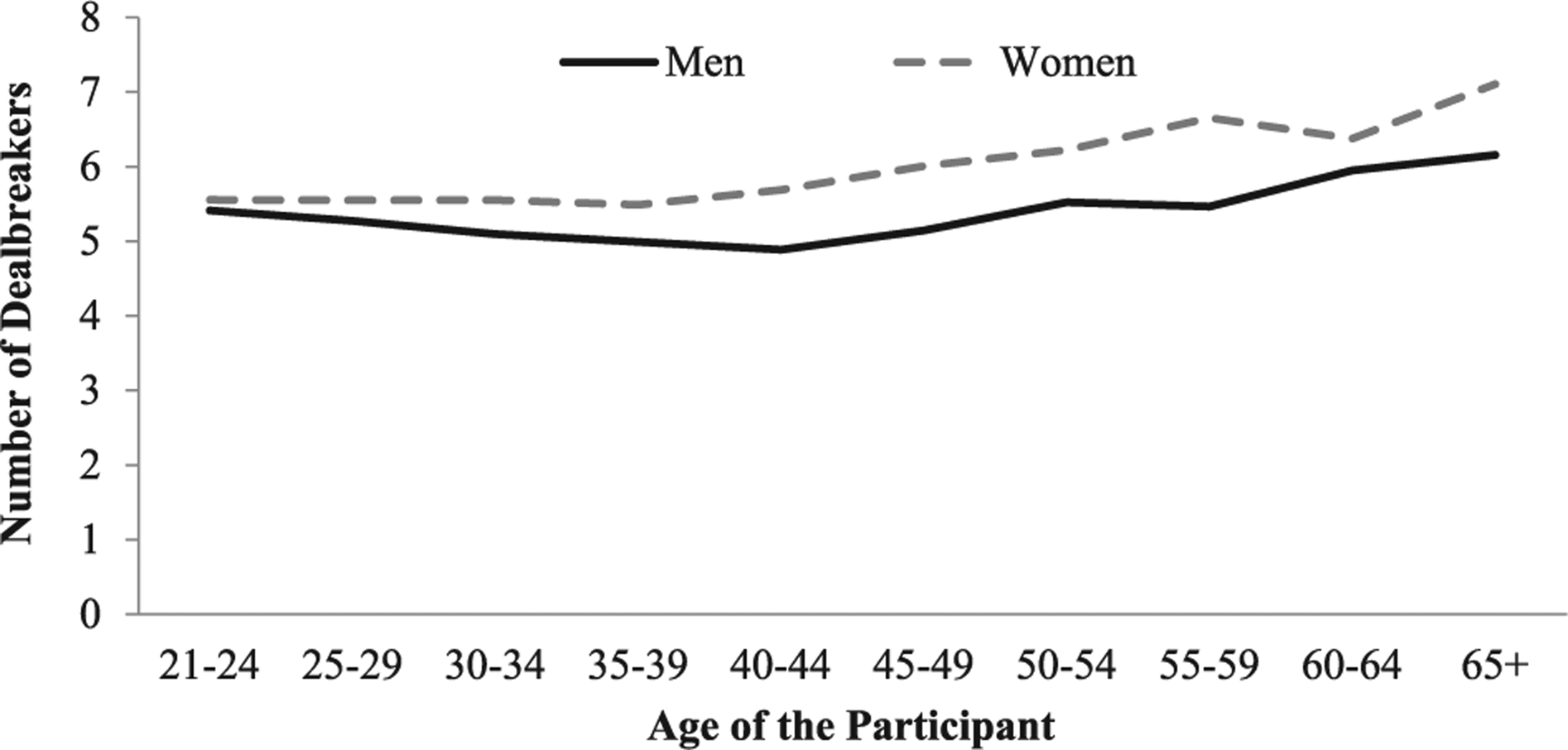
Study 3: Sex differences in the number of dealbreakers as a function of participant’s age.
Table 4 shows how often a given dealbreaker was chosen overall, as well as sex differences in the frequency that each dealbreaker was selected. These findings were consistent with the literature and with our hypotheses (H3; H6). In addition, having kids, living too far away, talks too much, and a low sex drive were dealbreakers more for men than women, which may reflect men’s greater concerns about resource investment in partners (and their families) and men’s somewhat higher interest in casual sex. In contrast, women (vs. men) were more likely to report lacking self-confidence, being too lazy, being too needy, and engaging too often in television/playing video games as dealbreakers, consistent with prior work showing that women desire mates who are dominant, ambitious, and status-driven (Bryan et al., 2011).
In addition, although Study 1 participants rated bad in bed as a dealbreaker for short-term—but not long-term—relationships, nearly half of Study 2 participants identified bad sex as a long-term relationship dealbreaker. Moreover, women were more likely than men to report bad sex as a dealbreaker. This may be consistent with the idea that sexual satisfaction plays a role in long-term relationship satisfaction and stability (Brunell & Webster, 2013), along with research highlighting the role of sexual behavior across the life span (Gray & Garcia, 2013).
Study 4: Context Specificity of Dealbreakers
A major advantage of evolutionary models is their context specificity (Buss & Schmitt, 1993). In Study 4, we examined the degree to which people’s interest shifts when they learn dealbreaker information in sexual, romantic, and platonic contexts. We predicted that personality- and health-related dealbreakers would occur in all three close relationship contexts (H7), but mating-related dealbreakers would be stronger in short-term/sexual and long-term/romantic relationship contexts (H8).
Method
Participants
We solicited 132 (30 men) heterosexual participants aged 17 to 68 years (M = 27.75, SD = 10.20) via socialpsychology.org to complete an anonymous online survey. Most participants were involved in a committed relationship (55%) and self-identified as European American (72%).
Procedure
We directed participants to an online survey that asked them to identify as either male or female, which allowed us to direct them to a sex-specific questionnaire. Participants next saw profiles of four physically attractive, socially successful, opposite-sex people. The photos were pre-rated as physically attractive, and the accompanying information about the targets’ social dominance was used in prior mate-preference studies (see Gutierres, Kenrick, & Partch, 1999). After participants viewed each profile, they were asked for their agreement (1 = strongly disagree; 7 = strongly agree) with three statements to establish their baseline interest in the target: “I would consider dating this person for a serious romantic relationship,” “I would consider having a purely sexual relationship with this person,” and “I would consider being friends with this person.” Next, in a randomized order, we informed participants that the target person had (a) an unhealthy lifestyle, (b) undesirable personality traits, (c) was interested in a casual sexual relationship, whereas the participant was only interested in a serious romantic relationship, or (d) was interested in a serious romantic relationship, whereas the participant was only interested in a casual sex relationship. We then asked participants to respond to the same three statements above to assess the extent to which dealbreakers shifted their interest.
Results and Discussion
Dealbreakers functioned differently to change people’s minds (Figure 5) across the three contexts of romantic partners, F(3, 127) = 37.23, p < .01,

Study 4: Change in interest as a function of learning different dealbreakers for potential mates to form romantic relationship, sexual relationship, and friendships with targets.
Using difference scores, we examined sex differences (H1). We observed a sex difference in change when exposed to the undesirable personality dealbreakers, F(1, 128) = 3.84, p < .05,
Study 5: Dealbreakers Versus Dealmakers
Studies 1 to 4 examined dealbreakers in the absence of dealmakers or positive mate qualities. In Study 5, we examine the relative change in interest in targets when they learn positive or negative information about that target. We also inspect the moderating role of mate value in these changes.
Method
Participants and procedure
Participants were 193 (57 men) people aged 18 to 68 years (M = 27.75, SD = 10.20) who volunteered for an anonymous online study. Participants were invited to take part in an unpaid study about interpersonal dynamics through The Kinsey Institute’s (at Indiana University) Twitter and Facebook accounts. For the current analyses, we included participants who self-identified as heterosexual men or women. 2 Of the sample, 77% were of European descent, and 55% were involved in a committed relationship. 3
Measures
Participants were asked to imagine they had met someone new that they were getting to know. We then asked them how learning different bits of positive or negative information—five dealbreakers and five dealmakers—would lead them to accept or reject the target person, respectively, as a long-term or short-term partner (order randomized). All 10 items used the stem “You learn/find out that this person . . . ” The five dealbreaker items were as follows: (a) has poor hygiene, (b) is short-tempered, (c) has a sexually transmitted infection, (d) is sexually promiscuous, and (e) frequently drinks excessively. The five dealmaker items were as follows: (a) appears to be physically attractive, (b) is kind, (c) has a good career, (d) has a good sense of humor, and (e) seems intelligent. Participants rated the likelihood (1 = very unlikely; 7 = very likely) that learning each bit of information would lead them to accept or reject a person for both relationship contexts. We averaged across specific items within information classification (i.e., dealmaker vs. dealbreaker) and relationship context (long-term vs. short-term), creating four composites for analyses (αs = .74 to .86).
Because we wished to examine whether self-perceived mate value moderated the effects of interest, we asked participants, “How much does the opposite sex want to have sex with you?” and “How much does the opposite sex want to be in a committed relationship with you?” (0 = not at all; 6 = very much). We chose these face-valid items to offset potential idiosyncrasies in the mate value measure used above.
Results and Discussion
We ran the regression analog of a mixed-model 2 (Information: Dealmaker vs. dealbreaker) × 2 (Duration: Long-term vs. short-term) × 2 (Sex of participant) ANCOVA, with both short- and long-term mate value (mean-centered) as moderating covariates (see Judd, McClelland, & Ryan, 2009). Table 5 shows the results for the full model, including all three between-person effects (sex, short-term, and long-term mate values). Although Information was significantly moderated by both sex (H1) and short-term mate value (H5), both effects were marginally qualified (ps < .10) by their respective three-way interactions with Duration (H3): (a) Information × Duration × Sex and (b) Information × Duration × Short-Term Mate Value.
Study 5: Mixed ANCOVA Interaction Model Results.

Note. Indented variables are between-person moderators of within-person effects.
p < .05. **p < .01.
We decomposed the Information × Duration × Sex interaction by examining the simple two-way Information × Duration interaction within each sex. The Information × Duration interaction was significant for women (b = 0.61), t(189) = 3.86, p < .01, d = 0.56, but not for men (b = 0.09), t(189) = 0.36, p = .72, d = 0.01. Further decomposing this two-way interaction, women rated long-term items higher than short-term ones in the dealmaker condition (b = 0.81), t(189) = 7.28, p < .01, d = 1.06, but not in the dealbreaker condition (b = 0.14), t(189) = 1.33, p = .18, d = −0.19, consistent with H3. Dealbreakers created a greater decrease in interest than dealmakers increased interest (H10), suggesting that losses loom larger than gains, and people weigh negative (vs. positive) mate-relevant information more.
We decomposed the Information × Duration × Short-Term Mate Value interaction by examining the simple two-way Information × Duration interaction at 1 SD above and below the short-term mate value mean, respectively. For people at 1 SD above the mean, the Information × Duration interaction was non-significant (b = 0.10), t(189) = 0.50, p = .62, d = 0.07. In contrast, for people at 1 SD below the mean, the Information × Duration interaction was significant (b = 0.59), t(189) = 2.96, p < .01, d = 0.43. Further decomposing this two-way interaction, people with low short-term mate value rated dealmaker items higher than dealbreaker items in the long-term condition (b = 0.61), t(189) = 4.03, p < .01, d = 0.59, but not in the short-term condition (b = −0.08), t(189) = −0.39, p = .70, d = −0.06. This suggests that people with low short-term mate value have stronger dealmakers than dealbreakers in the short-term context. It may be that those with low value on the short-term mating market focus their efforts in the long-term mating domain making them more discriminating in this context. That is, they are more concerned with finding a long-term mate, and thus have stronger preferences in that context.
Study 6: Prospect Theory of Dealbreakers and Dealmakers
Prospect theory (Kahneman & Tversky, 1979) suggests that people should weigh losses and negative information more than gains and positive information. We expect that people should weigh dealbreakers more than dealmakers when evaluating potential relationship partners (friends, sexual and romantic partners). In Study 6, we experimentally varied the number of dealbreakers and dealmakers participants saw in a target, and assessed their interest in the target. We predicted an S-shaped cubic function (Figure 1), whereby dealbreakers would result in locally steeper preference slopes than dealmakers (H10). Specifically, the cubic function’s inflection point should be on the dealbreaker end, and its lower critical point should be more negative than its upper critical point should be positive. Regarding moderation, we also predicted that the function should be steeper (more linear) or more pronounced (more cubic) for (a) women than men because females in most species are the choosier sex because of biological asymmetries in minimal parental investment (Trivers, 1972; H10a) and (b) people in committed relationship (vs. those who are not) because they already have a partner and can afford to be more discriminating in their relationship choices (H10b).
Method
Participants
Participants were 271 people recruited online (94% from Amazon’s Mechanical Turk [Mturk], 6% from Facebook). Prior to analyses, we excluded 9 participants (3 duplicate entries, 1 under 18 years old, and 5 who selected “other” for relationship type). The remaining 262 participants (142 men) were aged 18 to 75 years (M = 31.94, SD = 10.80). The sample was mostly (88%) heterosexual/straight and White/European (77%). Participants also indicated their present relationship status: 35% were single, 5% were casually dating, 31% were seriously dating one person, and 29% were married.
Measures and procedure
We randomly assigned participants to one of seven conditions with varying dealmaker-to-dealbreaker ratios: 0:5, 1:5, 2:4, 3:3, 4:2, 5:1, 5:0. In each condition, participants read the stem, “Your potential romantic partner has: x DEALMAKERS and y DEALBREAKERS. How likely (−5 = not at all likely; 5 = extremely likely) are you to z this person?” where x and y were integers (0-5) and z was 1 of 5 relationship types: “be just friends with,” “casually date,” “seriously date,” “have a sexual relationship with,” and “have a committed relationship with.”
Results and Discussion
Preliminary analyses
We first standardized participants’ responses to each of the five relationship types (α = .75) and then averaged them (M = 0.00, SD = 0.71). We re-coded the dealmaker-to-dealbreaker ratios as proportion of dealmakers (i.e., 0.00, 0.20, 0.33, 0.50, 0.67, 0.80, and 1.00) and then centered this variable by subtracting 0.50. To test the prospect theory effect, we squared and cubed this variable to create its quadratic and cubic terms. We coded participant’s sex using contrast codes (−0.5 = women, 0.5 = men). Because we wished to compare participants in committed relationships (60%) with those who were not (40%), we also used a contrast code for relationship status (−0.5 = single, −0.5 = causally dating, 0.5 = seriously dating one person, and 0.5 = married). Because these relationship status data were categorical (vs. continuous), this grouping was not a median-split.
Testing prospect theory
Table 6 and Figure 6 show the results of testing a prospect theory of dealbreakers and dealmakers. Findings supported expectations. A strong positive linear effect showed that, unsurprisingly, people were more likely to form relationships with targets described as having a greater proportion of dealmakers to dealbreakers. Nevertheless, a cubic effect qualified the linear one, suggesting an S-shaped curve characteristic of prospect theory, with steeper slopes per increment for dealbreakers than dealmakers (H10). Simple slope tests at the intermediate points added further support (slopes tangent to the curve in Figure 6 at −.30, −.17, .17, and .30): Simple slopes on the dealbreaker end (1.09, 1.54) were steeper than their respective simple slopes on the dealmaker end (0.54, 1.24; Table 6). The inflection point of this cubic function—where the simple slope is the steepest—was on the dealbreaker end (−0.05), and the two critical points—where the simple slope equals 0 (diminishing returns)—were more extreme on the dealbreaker end (−0.74) than they were on the dealmaker end (0.38; Table 7).
Study 6 Regression Results: Likelihood to Form a Relationship (z) as a Cubic Function of Proportion of Dealmakers (vs. Dealbreakers): Main Model and Simple Linear Slopes.
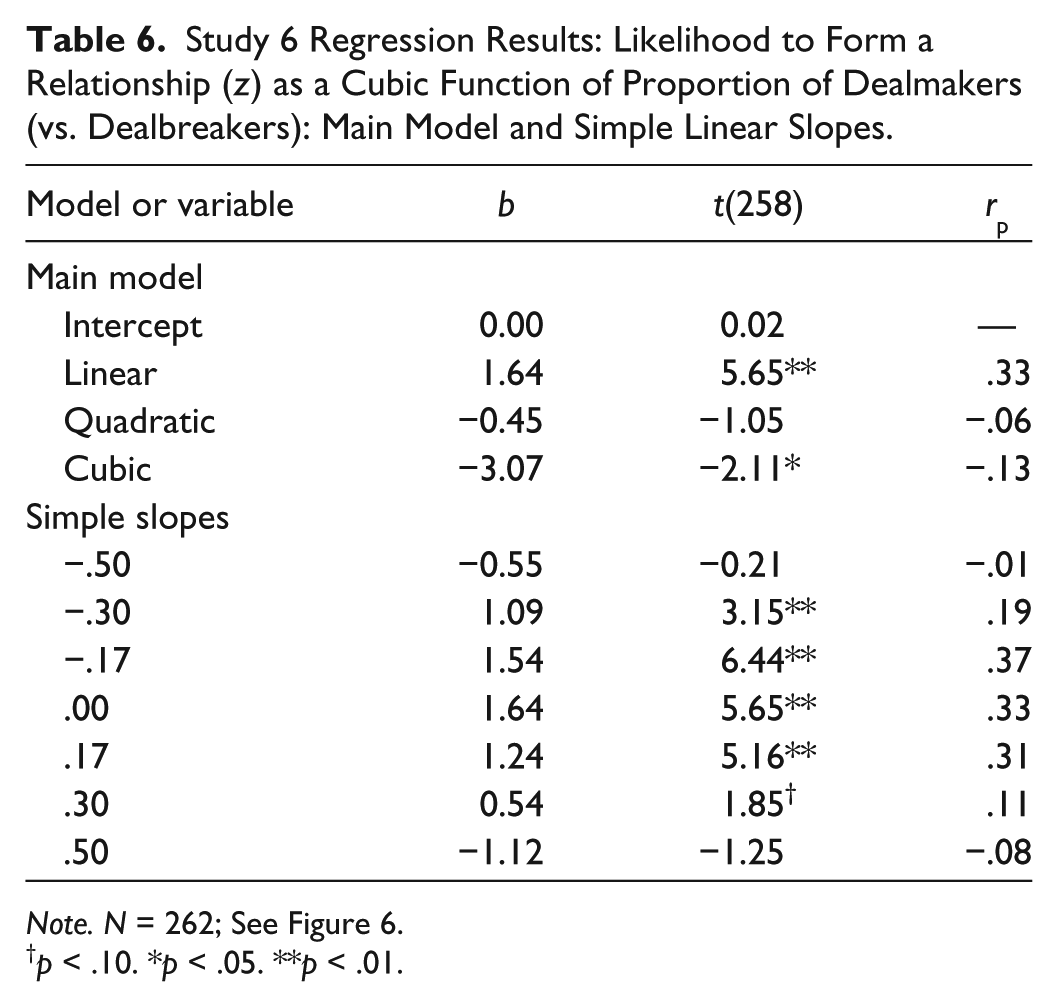
Note. N = 262; See Figure 6.
p < .10. *p < .05. **p < .01.

Study 6: Likelihood to form a relationship (z) as a function of proportion of dealmakers: Scatterplot with cubic function (top) predicted scores from cubic function (bottom).
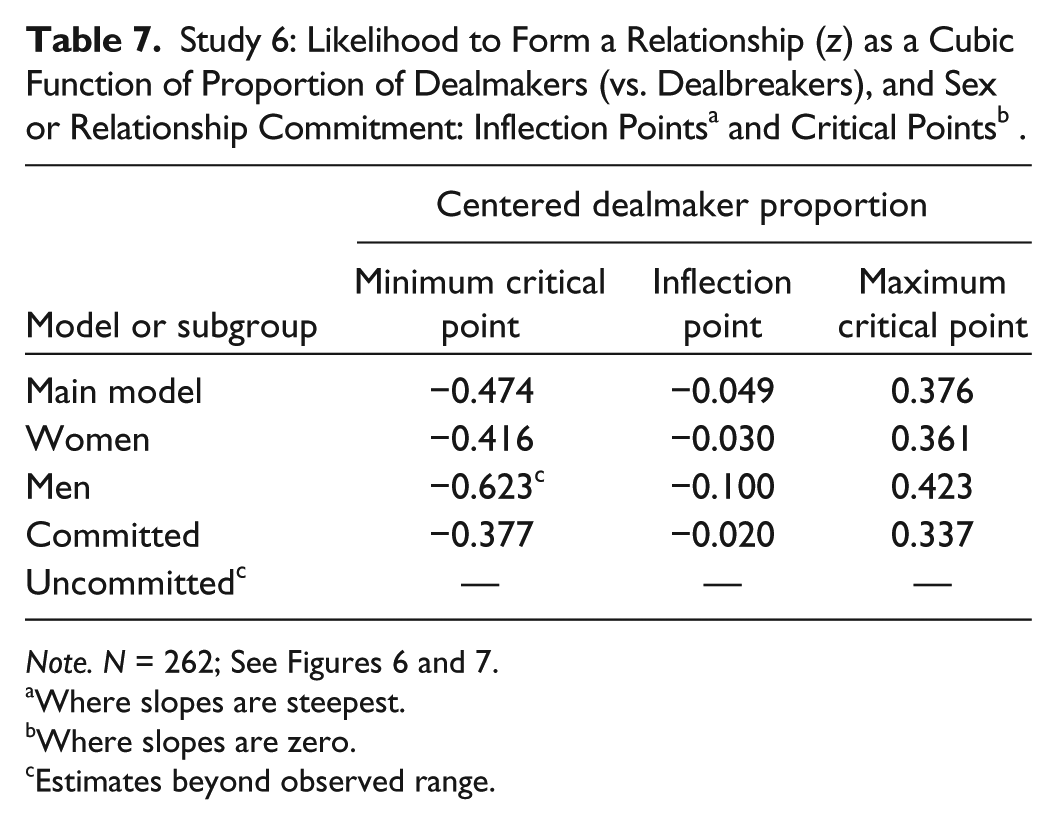
Where slopes are steepest.
Where slopes are zero.
Estimates beyond observed range.
Moderation
Sex marginally moderated the linear effect of proportion of dealmakers on likelihood to form relationships with targets (at the .50 proportion level; Table 8, top, leftmost columns; Figure 7, top; H10a). We decomposed this interaction to test simple effects (Aiken & West, 1991). For women, both the linear and cubic effects were significant; however, for men, only the linear effect was significant (Table 8, top, middle, and rightmost columns). We also examined the simple linear slopes for men and women (the slopes tangent to the curves in Figure 7, top, at −.30, −.17, .17, and .30; Table 9, top). For women, simple slopes at intermediate points on the dealbreaker end (1.11, 1.90) were steeper than their respective simple slopes on the dealmaker end (0.63, 1.63). For men, the pattern was less pronounced than for women, but similar; simple slopes at intermediate points on the dealbreaker end (1.02, 1.17) were steeper than their respective simple slopes on the dealmaker end (0.88, 0.49). The inflection points of this cubic function were on the dealbreaker end for women (−0.03) and men (−0.10), and their respective critical points were more extreme on the dealbreaker (−0.42, −0.62) than dealmaker (0.36, 0.42) end (Table 7). Consistent with the fact that women carry higher minimum reproductive costs, they tended to be more discriminating (steeper intermediate linear slopes) and adhered more closely to a prospect theory model (better cubic fit) than men.
Study 6 Regression Results: Likelihood to Form a Relationship (z) as Functions of Cubic Proportion of Dealmakers (vs. Dealbreakers), Sex or Relationship Commitment, and Interactions.
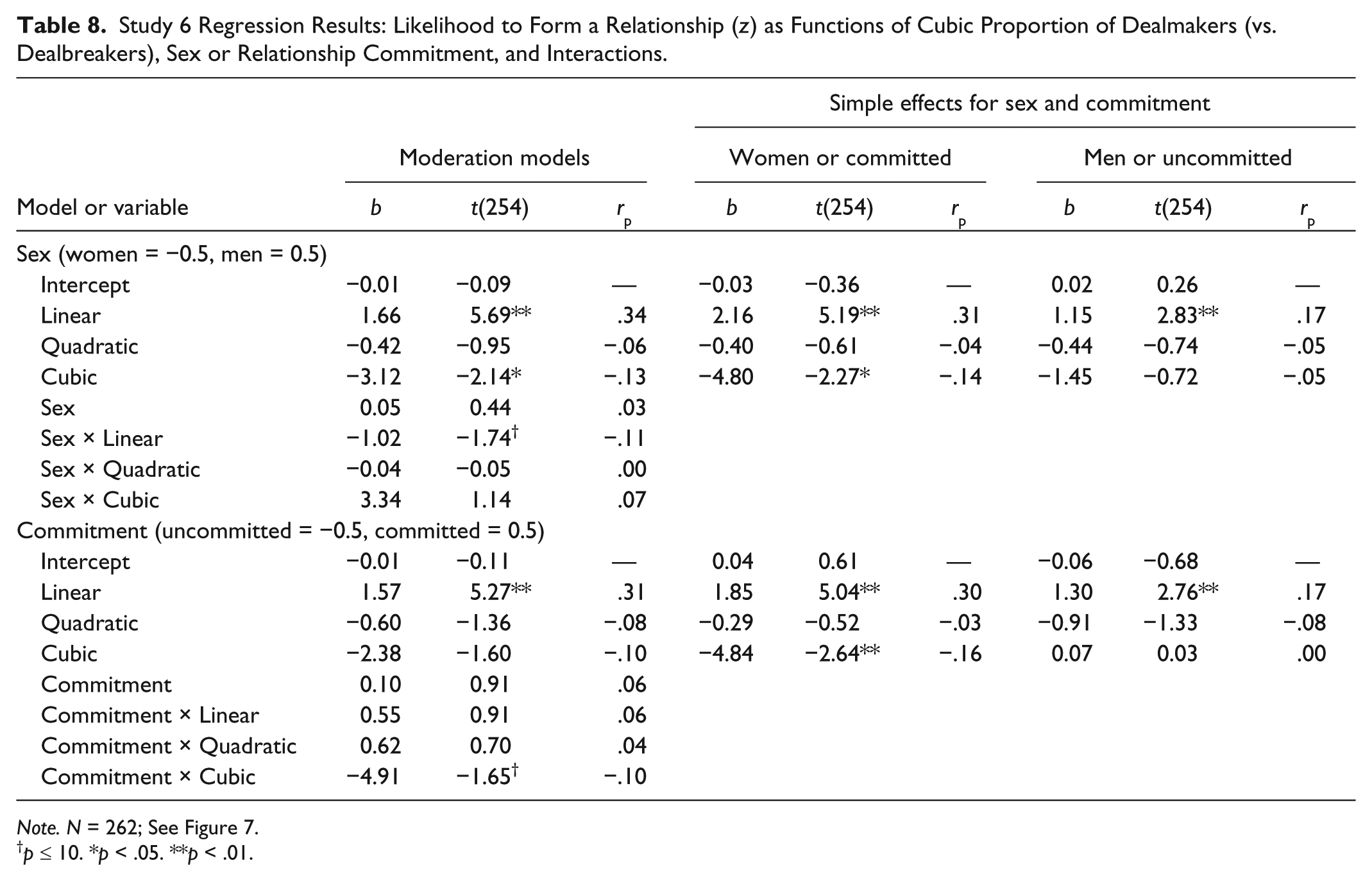
Note. N = 262; See Figure 7.
p ≤ 10. *p < .05. **p < .01.
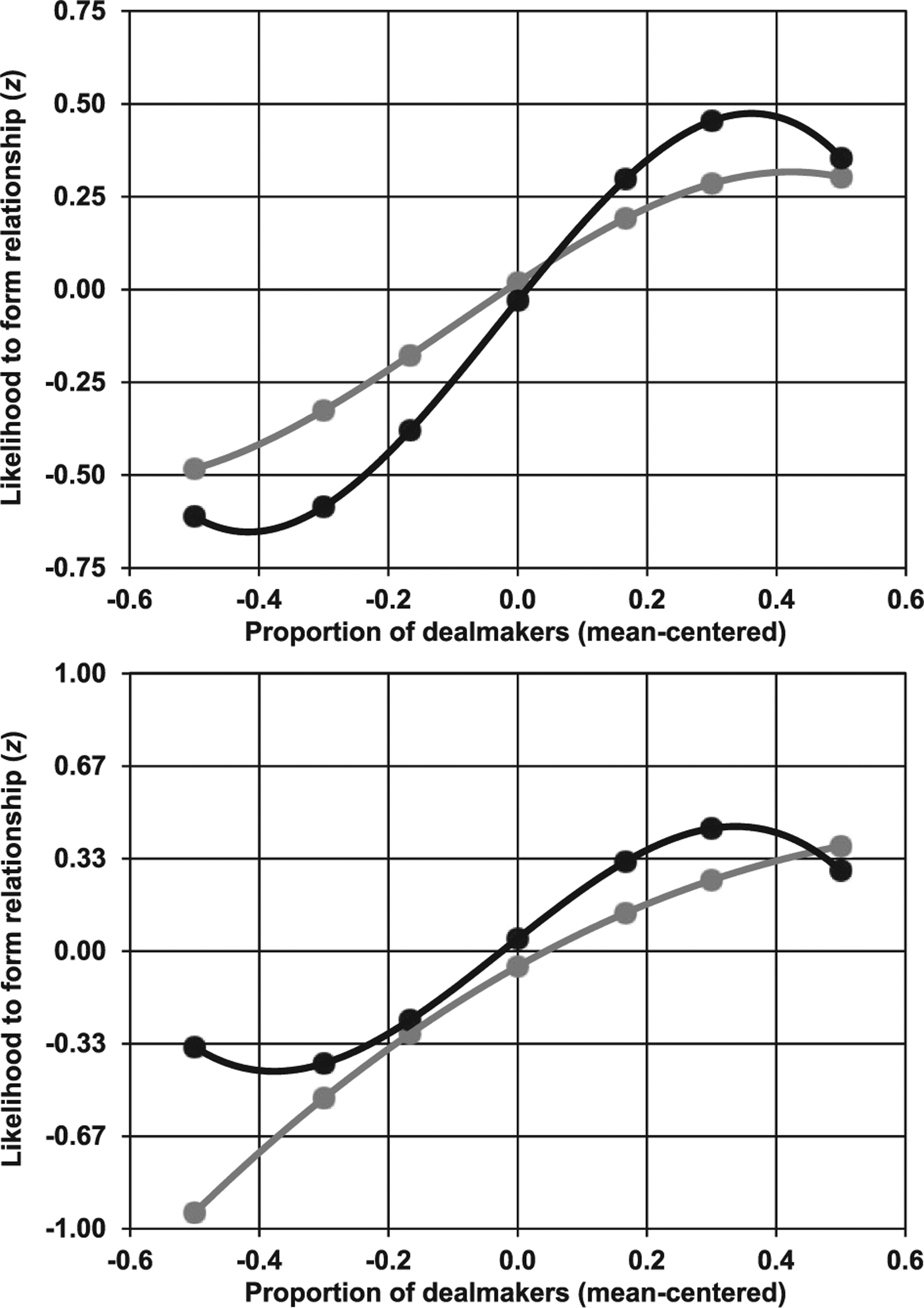
Study 6: Likelihood to form a relationship (z) as functions of proportion of dealmakers and sex (top) or commitment (bottom).
Study 6 Simple Linear Slopes: Likelihood to Form a Relationship (z) as Functions of Cubic Proportion of Dealmakers (vs. Dealbreakers), Sex or Relationship Commitment, and Interactions.
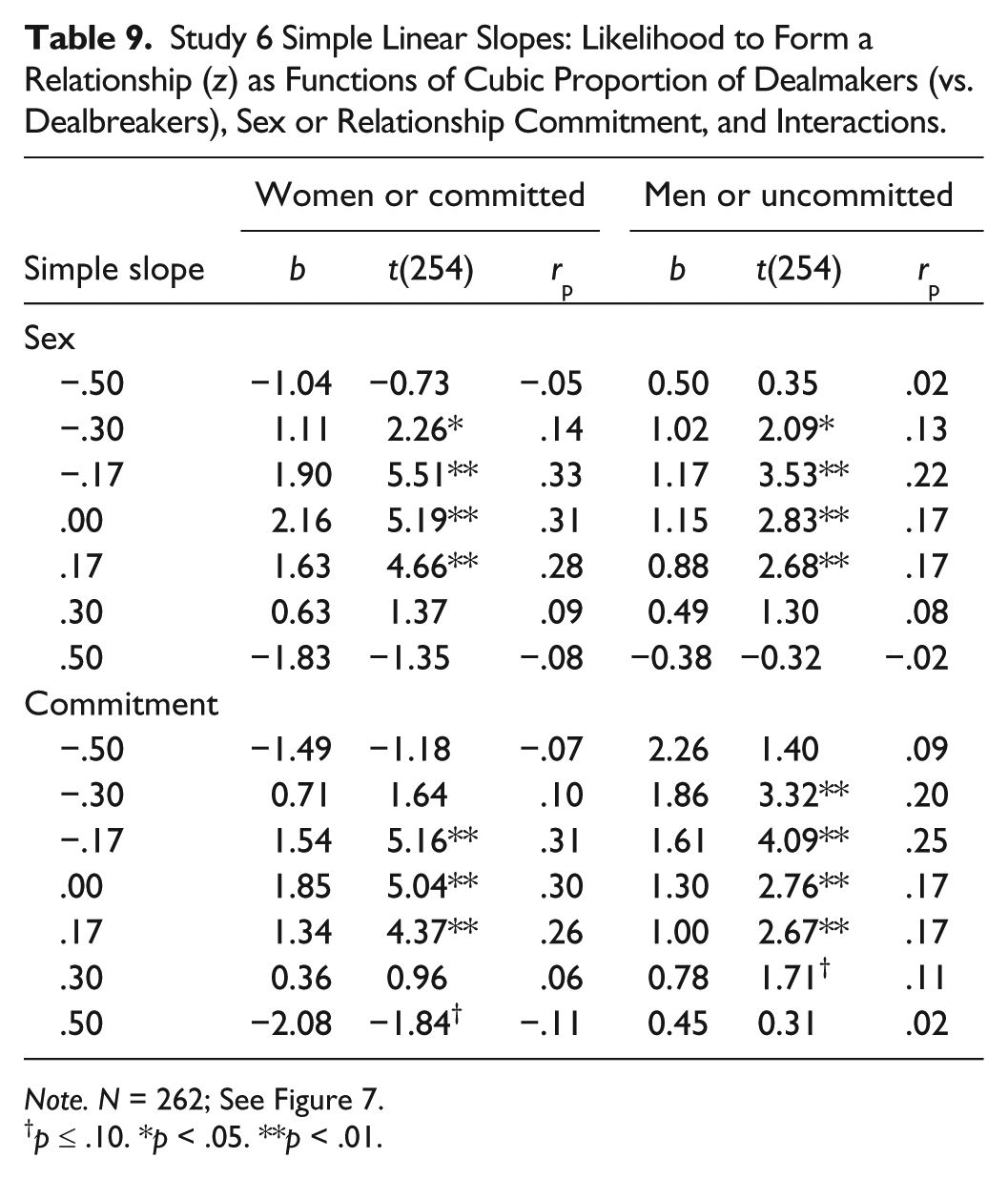
Note. N = 262; See Figure 7.
p ≤ .10. *p < .05. **p < .01.
Relationship commitment marginally moderated the cubic effect of proportion of dealmakers on likelihood to form relationships with targets (Table 8, bottom, leftmost columns; Figure 7, bottom; H10b). We decomposed this interaction to test simple effects. For people in committed relationships, both the linear and cubic effects were significant; however, for people who were not, only the linear effect was significant (Table 8, bottom, middle, and rightmost columns). We also examined the simple linear slopes for people in committed relationships and those who were not (the slopes tangent to the curves in Figure 7, bottom, at −.30, −.17, .17, and .30; see Table 9, bottom). For people in committed relationships, simple slopes at intermediate points on the dealbreaker end (0.71, 1.54) were steeper than their respective simple slopes on the dealmaker end (0.36, 1.34). For people not in committed relationships, simple slopes at intermediate points on the dealbreaker end (1.86, 1.61) were steeper than their respective simple slopes on the dealmaker end (0.78, 1.00). For people in committed relationships, the inflection point of their cubic function was on the dealbreaker end (−0.02), and its critical points were more extreme on the dealbreaker (−0.38) than dealmaker (0.34) end (Table 7). Because the function for people not in committed relationships was more linear and quadratic than cubic (Table 8, bottom, leftmost columns), examining inflection and critical points returned values that were beyond the observed range. This is consistent with our prediction that people in committed relationships (vs. those who are not) should adhere more closely to a prospect theory model (better cubic fit) received some support. We hold that people in committed relationships can afford to be more discriminating because they already have a partner; those who are not can be less discriminating.
General Discussion
Collectively, our findings were consistent with both prospect theory (Kahneman & Tversky, 1979) and error management theory (Haselton & Buss, 2000), suggesting that people have distinct traits they avoid in partners—dealbreakers—and that people weigh negative information more than positive information when evaluating potential relationship partners. Positive information might activate approach mechanisms, whereas negative information might activate avoidance mechanisms (Carver & White, 1994), or in extreme cases, disgust systems (Oaten, Stevenson, & Case, 2009). Such reactions are likely adaptive because they help people choose healthy, fecund mates, while avoiding unhealthy mates who may threaten one’s own health and that of one’s future offspring. The factors that activate relationship repulsion appear to be poor health, negative personality traits, and having an undesirable sexual/romantic strategy. People view poor health and bad personality traits in potential partners as dealbreakers across all relationship contexts, albeit to a lesser extent in friendships.
Although we detected some sex differences, they were modest, which may be unsurprising given that men and women are more alike than different (Hyde, 2014). Unlike many mate preferences, which tend to show sex differences, the traits associated with avoiding low-quality mates appear to be relatively similar between the sexes. Nevertheless, women may pay an even higher premium than men do for errors in mate choice because of biological differences in minimal reproductive costs (Trivers, 1972). Women often reported more dealbreakers than men—an effect that was relatively stable across ages and stronger in long-term mating contexts. Although these findings corroborate evolutionary models of partner choice (Buss & Schmitt, 1993; Kenrick et al., 1993), they do not address sociocultural factors that also play key roles. For instance, failure to adopt particular cultural practices—diet, music, fashion, religion—might act as dealbreakers because they signal lack of conforming to local social norms.
Limitations and Conclusion
The present research had multiple limitations. Because all studies relied on self-reports, acquiescence bias and socially desirable responding are important concerns (Paulhus & Vazire, 2007). Studies 1 and 2 were largely exploratory and limited by results from a qualitative study. Study 3 focused solely on long-term mate preferences and could not rule out cohort effects because it used cross-sectional data. Study 4 used a simple, person-perception paradigm and may be subject to anchor effects. Although Study 5 had a comparatively smaller sample, it still has adequate power (>.80) to detect the average effect size in social and personality psychology (r ≈ .20; Richard, Bond, & Stokes-Zoota, 2003). Although Study 6 experimentally supported prospect theory, people imagined their own dealmakers and dealbreakers rather than using concrete examples. Last, we relied on primarily WEIRD samples (i.e., Western, educated, industrialized, rich, and democratic; Henrich et al., 2010). Future research should examine dealbreaker thresholds using economic games, necessities-versus-luxuries trade-offs (Li et al., 2002; Li & Kenrick, 2006), and behavioral (vs. self-report) measures, and with more diverse samples. Future studies could identify the traits that act as hysteresis points in decision-making. For example, future work could address whether specific dealbreakers, such as having a chronic disease or infection, outweigh otherwise positive information.
In summary, we showed that information about negative traits was adaptively differentiated by context, sex, and other individual differences such as sociosexuality and mate value. Supporting both prospect (Kahneman & Tversky, 1979) and error management (Haselton & Buss, 2000) theories, the average dealbreaker damaged a potential mate’s evaluation more than the average dealmaker helped it. This evidence suggests that natural selection has punished mating mistakes more harshly (i.e., death, disease, infertility) than it has rewarded quality mating choices (i.e., living incrementally longer, having incrementally healthier offspring). Collectively, the present research provides theoretically broader and more nuanced perspectives on how positive and negative information about potential mates differentially affect perceivers’ evaluations. It is likely that dealbreakers function as efficient, cost-sensitive cognitive mechanisms designed to cull inappropriate potential partners, allowing mating preferences to operate within a reduced target population of desirable mates.
Footnotes
Acknowledgements
The authors thank research assistants Ashley Rotolo and Tara Raulston.
Declaration of Conflicting Interests
The author(s) declared no potential conflicts of interest with respect to the research, authorship, and/or publication of this article.
Funding

Notes
References
Supplementary Material
Please find the following supplemental material available below.
For Open Access articles published under a Creative Commons License, all supplemental material carries the same license as the article it is associated with.
For non-Open Access articles published, all supplemental material carries a non-exclusive license, and permission requests for re-use of supplemental material or any part of supplemental material shall be sent directly to the copyright owner as specified in the copyright notice associated with the article.
