




Abstract
A preference for “naturals” over “strivers” in performance judgments was investigated to test whether the effect is generalizable across domains, as well as to ascertain any costs imposed on decision quality by favoring naturals. Despite being presented with entrepreneurs equal in achievement, participants judged the natural and his business proposal to be superior to the striver and his proposal on multiple dimensions of performance and success (Study 1a and Study 1b). These findings were extended in Study 2, which quantified the costs of the naturalness bias using conjoint analysis to measure specific decision tradeoffs. Together, these three studies show that people tend to pass over better-qualified individuals in favor of apparent naturals.
Beliefs about where talent and achievement come from shape decisions in all domains of accomplishment, from the arts and intellectual pursuits to sports, business, and all forms of ordinary work in organizations. These beliefs can affect individuals’ decisions about what goals they pursue, how they pursue them, and even their eventual performance outcomes (Dweck, Chiu, & Hong, 1995; Grant & Dweck, 2003). Beliefs about achievement can also have significant consequences for organizations, affecting the allocation of resources and assessments such as hiring and promotion decisions (Tsay & Banaji, 2011).
Achievement in all domains is assumed to emanate from two distinct origins. First, there exists the belief that certain achievements cannot be explained solely by perseverance and hard work—that natural talent plays a role, and some “have it” and others do not (Benbow & Lubinski, 1993; Davies, 1994; Eysenck & Barrett, 1993; Feldman, 1988; Knauber, 1931). Second, there is the complementary belief that extraordinary expressions of achievement cannot materialize without intensive and consistent effort (Duckworth, Kirby, Tsukayama, Berstein, & Ericsson, 2010; Duckworth, Peterson, Matthews, & Kelly, 2007; Ericsson & Charness, 1994, 1995; Ericsson, Krampe, & Tesch-Römer, 1993; Sloboda, Davidson, & Howe, 1994a, 1994b; Weber, 1958).
An even more broadly shared belief holds that expressions of achievement arise from a combination of natural talent that constitutes core ability and the striving and motivation to apply that talent (Amabile, 2001; Bloom, 1985; Howe, Davidson, & Sloboda, 1998; Schneider, 2000). This belief is supported by data on managerial success, for example, which associates the combination of general cognitive ability and motivation with career outcomes such as job offers, salaries, and promotions (O’Reilly & Chatman, 1994).
If we believe that talent and striving together contribute to achievement, do we also make attributions that are opposite in causal direction? That is, if we know how skills and achievements came to be—whether through natural talent or striving—do we regard them to be more extraordinary than when we lack that knowledge? If so, would such inclination lead to biases in judgment, and what costs would these biases entail?
Beliefs About Naturalness Versus Striving
“If people knew how hard I had to work to gain my mastery,” Michelangelo is alleged to have once said, “it would not seem so wonderful at all.” The intuition embedded in this quote may transcend time and culture. For example, the observation that contemporary American society privileges natural talent and ascribes superior achievement to the naturally gifted is complemented by work from childhood education that identifies interest and investment in youthful prodigies (Pfeiffer, 2002; Richards, Encel, & Shute, 2003; Terry & Bohnenberger, 2003). Many found sprinter Usain Bolt’s recent Olympic and world records particularly captivating given the seeming effortlessness behind them; athletes and spectators alike marveled at how Bolt celebrated well before the finish line, shoelaces untied. Less discussed and less recognized was the grueling training that made this achievement possible. The celebration of natural talent may arise from our preference for potential over demonstrated achievement (Tormala, Jia, & Norton, 2012), even when actual achievement is associated with strenuous work and effort (Duckworth et al., 2010; Duckworth et al., 2007; Ericsson et al., 1993). Such observations inspired initial empirical explorations of whether naturals and strivers are differentially treated (Tsay & Banaji, 2011), namely whether achievement is deemed more authentic or admirable when it appears to result from natural, inborn talent rather than from striving and dedicated application.
When achievement motivation, dedication to success, and standards for performance are at relatively high and invariant levels, as they are for many professionals, the truly gifted may be regarded as having a greater advantage over others because of their inalterable genetic endowment, and visible differences in success may be more likely to be attributed to stable internal characteristics. Essentialism can motivate such attitudes (Medin, 1989), and natural talent, rather than striving and grit, may be perceived as an immutable, more authentic, and more certain path to success.
Furthermore, if strivers are perceived as having less potential because their current level of achievement is attributed primarily to hard work, they may be perceived as having fewer other resources to call upon in the future. In such cases, a preference for natural achievement may be adaptive; if talent is less malleable and less contingent on effort, then it makes sense to invest in natural talent, rather than in a striver who may or may not persist in the future. Alternatively, if long horizons are associated with challenging paths, then strivers may be perceived to have better track records than naturals in persevering despite adversity.
In decisions not about multiple highly accomplished individuals and top achievement, but rather about options in which risks and failure are more salient when past performance is available for evaluation, it remains unclear whether naturalness or time-tested candidates would be preferred. We may perceive “naturals” as more risky choices with more variable consequences; the semi-instantaneous trajectory of idealized naturals calls to mind the inconsistencies of market bubbles and scams. At the same time, does our preference for naturals lead us not only to over-reward their successes, but also to be more willing to forgive their failures and overlook subpar objective performance? Do we recognize how naturalness affects our judgments of achievement and the possible outcomes of any inclinations toward naturalness? These questions prompted the current investigation, which aims not only to make broader contributions to the recent literature about the perception of achievement, but also to offer good external validity and relevance for real-world contexts.
Recent research has found that observers’ beliefs about the apparent primary contributor to musicians’ achievement—naturalness or striving—influenced judgments of quality (Tsay & Banaji, 2011). A dissociation between stated and observed preferences of what matters in the creation of achievement and actual judgments of achievement was also observed. While expert musicians reported that hard work (striving) is the more important variable, accounting for musical success at the highest levels, in their actual choices, they held an implicit preference for natural talent, selecting the natural over the striver despite equivalent levels of actual achievement. Explicit beliefs, at least, were in line with evidence regarding career outcomes for musicians and other professionals, which point to the importance of hard work and striving for success and achievement (Duckworth et al., 2010; Duckworth et al., 2007; Ericsson et al., 1993).
Although Tsay and Banaji (2011) found some evidence for a naturalness bias, or the tendency to rank innate sources over earned sources of achievement, this nascent stream of research leaves many important aspects unanswered. First, it is unknown whether the findings are limited to the single domain studied, which involved specialized skills accompanied by an assumption of strong innate ability (Davies, 1994; Radford, 1990; Sloboda, 1985). Second, it remains unclear how robust this bias is and whether it would hold in the presence of more objective measures of accomplishment. Most importantly, although the earlier work suggests that our inclination toward naturalness may lead to bias, the full implications of this inclination are not yet understood and necessitate empirical investigation. That is, what does our inclination toward naturalness mean? Beyond the possible generalizability and non-conscious nature of such a tendency—in themselves worthy questions as we delve into the characteristics of the naturalness bias—what are the potential consequences of such bias? These open questions underlie the main motivation for the current set of three studies.
The Costs and Robustness of the Naturalness Bias
In the current article, the naturalness bias is investigated in a very different domain of achievement—entrepreneurship—than that previously studied to determine its costs and generalizability. More importantly, a relatively underutilized method was implemented to measure the mental tradeoffs, perhaps made unconsciously, that lead people to overlook objective indicators of achievement to favor a person with extraordinary natural talent or motivation.
The generalizability of the naturalness bias was first tested by exploring several domains in an initial survey and then by studying entrepreneurship more deeply. Musical ability, the focus of previous work (Tsay & Banaji, 2011), could be unique; naturals may be favored simply because music is believed to be an inherent skill with a significant heritable component (Davies, 1994; Radford, 1990; Shuter-Dyson & Gabriel, 1981; Sloboda, 1985). In a preliminary survey (N = 67), a general sample of participants was recruited for an hour-long set of studies in a computer lab on a large university campus in the northeastern United States in exchange for $15. Participants completed the survey at computer terminals and then engaged in a set of unrelated studies. They were asked to identify for a variety of fields of achievement the degree to which natural talent was a stronger contributor than striving. The most frequently mentioned field was music, with 47% of participants citing that field as the one most requiring strong talent. So, it is possible that the results obtained in the previous work were limited to the domain of music and may not generalize to fields less viewed to tap a heritable ability.
In the same pilot survey, participants were also asked to identify fields in which striving and hard work are believed to be more important than natural talent. The most frequently mentioned field was business and entrepreneurship, with 46% of participants citing it as the one in which striving and hard work are central to achievement. Participants were significantly more likely to attribute entrepreneurial achievement, rather than musical achievement, to striving and motivation, t(66) = 3.92, p < .001, and to regard entrepreneurial achievement itself as emerging significantly more from striving and motivation, than from natural talent, t(66) = 3.87, p < .001. When the domains of music and entrepreneurship were specifically pitted against each other, and participants were asked which of the two domains is more likely to be associated with a specific brain region, 90% selected musical talent, χ2(1, N = 67) = 41.93, p < .001.
These data complement the existing literature pointing to how effort and experience are explicitly valued in management domains (Latham & Pinder, 2005; Locke & Latham, 2002; Staw & Barsade, 1993) and specifically in entrepreneurship (Fried & Hisrich, 1994; Tyebjee & Bruno, 1984). The “Horatio Alger” archetype of the self-made entrepreneur who rises with great effort to lead a corporation predominates American society. Lay and expert theories favor striving as an explanation for entrepreneurial success, with genetics long neglected as an explanatory factor for why people engage in entrepreneurial activity (Nicolaou, Shane, Cherkas, & Spector, 2009).
The current research aims to elucidate how our biographical narratives of naturalness or striving can shape how performance is perceived and how such information may impact experts in distinguishing among multiple well-qualified candidates, rather than how naturalness or striving actually contributes to performance. Through a clearer awareness of potential discrepancies between perceived and actual levels of achievement, we may be better positioned to understand how an inclination toward naturalness may lead to real and calculable costs to decision making. The domain of entrepreneurship offers the opportunity to investigate the possibility of the naturalness bias in a setting in which much greater explicit value is placed upon perseverance and effort, and in which expertise is cultivated and sought for wiser judgments. At the same time, extremely competitive conditions and pressures upon selection decisions exist in the domain in the presence of large information asymmetries (Elsbach & Kramer, 2003; Stevens & Kristoff, 1995). With frequent evaluations looming before access to critical opportunities and resources, will “natural-born” entrepreneurs be favored over those who are perceived to get ahead primarily through hard work?
Overview of Studies
The naturalness bias was explored in entrepreneurial achievement (Study 1a, Study 1b), a domain in which heritable components are relatively overlooked, unlike in music, and in which both novices and experts believe hard work, striving, and experience to be quite important (Bhide, 2000; Chen, Yao, & Kotha, 2009). Across domains, our non-conscious preference for the natural may lead to the perception of higher levels of achievement when that performance is attributed to natural talent and to the perception of lower levels of achievement when the identical performance is attributed to striving and hard work.
To assess the costs and robustness of the naturalness bias, conjoint analysis was introduced to test the objective dimensions of achievement that people trade off to select the natural rather than the striver. In Study 2, conjoint analysis (Green, Krieger, & Wind, 2001; Luce & Tukey, 1964; Orme, 2006) was used to directly test decisions during selection (Shepherd & Zacharakis, 1999). A relatively underutilized method, conjoint analysis was implemented to measure the tradeoffs, perhaps made unconsciously, that lead people to overlook objective indicators of achievement in favor of a person with natural talent or motivation. In particular, the analysis tested how many units of actual achievement were traded off to favor the natural or striver in entrepreneurship. If the preference for natural talent observed in music applies here, a perceiver should trade objective dimensions of achievement (such as previous capital raised and level of management success) in favor of the natural over the striver. In the previous work, only the apparent basis of achievement differentiated between target individuals, whereas the current work tests choices with multiple metrics of achievement, which have greater practical relevance.
The set of three studies tests the hypothesis that while abstract, propositionally represented values about accomplishment may genuinely favor a strong work ethic over natural talent, individuals’ specific choices along these dimensions will reveal a preference for the natural. Even when a strong work ethic is endorsed, such values might not translate into evaluations of particular individuals who appear to be equal in most respects except for the origin of their accomplishment. This set of studies thus tests whether our choices will reveal a preference for the natural, even against more objective performance metrics and when we clearly favor a strong work ethic over natural talent.
Study 1a: The Generalizability of the Naturalness Bias
While natural talent is prominently acknowledged and nurtured in the domain of music, it is unclear whether the naturalness bias would emerge in domains where hard work and effort are recognized by consensus as the hallmarks of greatness. In particular, the literature notes the critical role that striving and experience hold for entrepreneurs (Fried & Hisrich, 1994; Tyebjee & Bruno, 1984). In this domain, where striving and motivation are believed to outstrip natural talent, will the naturalness bias hold in evaluations of a natural versus a striver entrepreneur? In Study 1a, explicit beliefs about entrepreneurial success were compared with choices and preferences about target individuals and their business proposals.
Method
Participants
Two hundred twelve participants (Mage = 21.52, SD = 4.59; 60 male, 55 female 1 ) were recruited from a community sample and included those with varying levels of experience with entrepreneurship, from little or no experience to professional experience, such as founding start-up companies. Those who indicated no experience with entrepreneurship were categorized as novices (44.3%), whereas those with higher levels of experience with entrepreneurship were collapsed into the expert category (55.7%). These levels were tested for external validity; in a separate pretest conducted on a national online sample (N = 64), participants were asked to categorize themselves into one of the four levels of expertise and also to indicate the number of years of experience they had in entrepreneurship. These two items were highly correlated, r(64) = .74, p < .001. Furthermore, t tests indicated that participants in the upper levels of experience had significantly more years of experience (M = 8.75, SD = 6.75) than those in the lower levels (M = 0.31, SD = 0.80), t(62) = 8.62, p < .001, d = 1.76. Participants with a range of different levels of experience were targeted so that (a) level of expertise may be tested as a potential moderator of the naturalness bias and (b) the findings may be more generalizable to the profession.
All participants were involved in an hour-long set of studies in a computer lab on a university campus in the northeastern United States in exchange for $20. Participants completed the survey and then participated in a set of other, unrelated studies. They were drawn from an existing citywide general participant pool organized by a university in the northeastern United States; they volunteered in response to email messages about study sessions. Recruitment excluded people who did not have access to or were unable to use computers, and was set to end when the sample included a reasonable number of those with expertise in the domain, as in earlier research (Tsay & Banaji, 2011). Participants were informed that they would be evaluating entrepreneurs through a series of questions.
Procedure
In a between-subjects design, participants were randomly presented with a profile of either a “natural” or “striver” entrepreneur. Four phrases highlighting the entrepreneur’s entry into and progress in the field differed between the profiles. Given that the key distinction between the “natural” and the “striver” is the perception that individual achievement is attributed to the former’s inborn ability and the latter’s effort, hard work, and experience, the apparent source of achievement captures several internal factors central to individual achievement: ability, effort/work, and experience. Otherwise, the two profiles are identical and demonstrate the same level of achievement (see online Appendix).
In a separate pretest conducted on a national online sample (N = 83), the profiles were tested in a manipulation check and also assessed for potential effects on affect. When participants were asked with a forced choice item (1 = innate ability, 2 = hard work and effort) to what they would attribute the entrepreneur’s (same) achievements, those who had read about the “natural” were more likely to attribute them to innate ability (M = 1.59, SD = 0.50), whereas those who had read about the “striver” were more likely to attribute them to hard work and effort (M = 1.82, SD = 0.39), t(81) = −2.34, p = .022, d = −.51. This confirmed that participants understood the apparent source of achievement from the profiles.
A check of the valence of the profiles was performed through two items: “How positive is your impression of this entrepreneur?” and “How negative is your impression of this entrepreneur?” The descriptions conveyed the positive elements of being a natural to a degree that was not significantly different from the degree to which the positive elements of being a striver were conveyed, t(82) = −0.27, p > .05. Similarly, any negative elements of being a natural were not perceived more readily than the potential negative elements of being a striver, t(82) = 0.04, p > .05. As such, these data suggest that despite the subtlety of the manipulations, they adequately capture the natural versus striving entrepreneur without portraying either prototype in a more positive or negative way.
Participants then received a 1-min audio recording of the entrepreneur’s business proposal. The recording used for both the natural and striver entrepreneur was identical and included the same proposal, excerpted from the MIT Entrepreneurship Competition. This procedure ensured that the quality of the business idea associated with either entrepreneur was identical, like the identical level of achievement described in the profile. So that the audio proposal would not be immediately recognizable or identifiable, a non-winning pitch delivered by a male, native English speaker was chosen. These recordings are available in the public domain.
Finally, participants evaluated the entrepreneur on several dimensions on a 9-point scale: perceived talent, likelihood of success, and the participant’s willingness to hire the entrepreneur. Additional evaluation items assessing the current business idea were also included: the likability of the proposal, the skill demonstrated in the pitch, the likelihood of success for the start-up, and participants’ willingness to invest in the company.
Results and Discussion
A principal components analysis was conducted on the items measuring perceptions of achievement and performance evaluation. A two-factor solution emerged, accounting for 78.22% of the item variance (Table 1). One factor included items about the individual entrepreneur: talent, success, and hirability (α = .91); a second included items about the business proposal, capturing the evaluation of the investor pitch (Baron & Brush, 1999; Baron & Markman, 2000; Clark, 2008; Maxwell, Jeffrey, & Levesque, 2009) as well as the predicted future performance of the business: likability, skill, participants’ willingness to invest, and the likelihood of success (α = .87). Accordingly, the talent, likelihood of success, and willingness to hire scores were averaged to form an index of perceived achievement (Helmreich, Sawin, & Carsrud, 1986; Kuncel & Hezlett, 2010; Ones, Viswesvaran, & Dilchert, 2005), and the remaining items to form an index of performance evaluation. For each, there was a main effect of source of achievement, F(1, 206) = 7.71, p = .006, d = .39; F(1, 198) = 8.14, p = .005, d = .41. This reflects an overall tendency for participants to prefer the natural over the striver, Ms = 7.36 and 6.82, 95% confidence intervals [CIs] [7.11, 7.60], [6.54, 7.09], respectively, and to rate the business proposal attributed to natural talent as of a higher quality than the same business proposal attributed to effortful training, Ms = 5.48 and 4.81, 95% CIs [5.15, 5.81], [4.48, 5.13], respectively (Figure 1).
Summary of the Principal Component Analysis With Varimax Rotation in Study 1a.

Note. Factor loadings over .60 appear in bold.
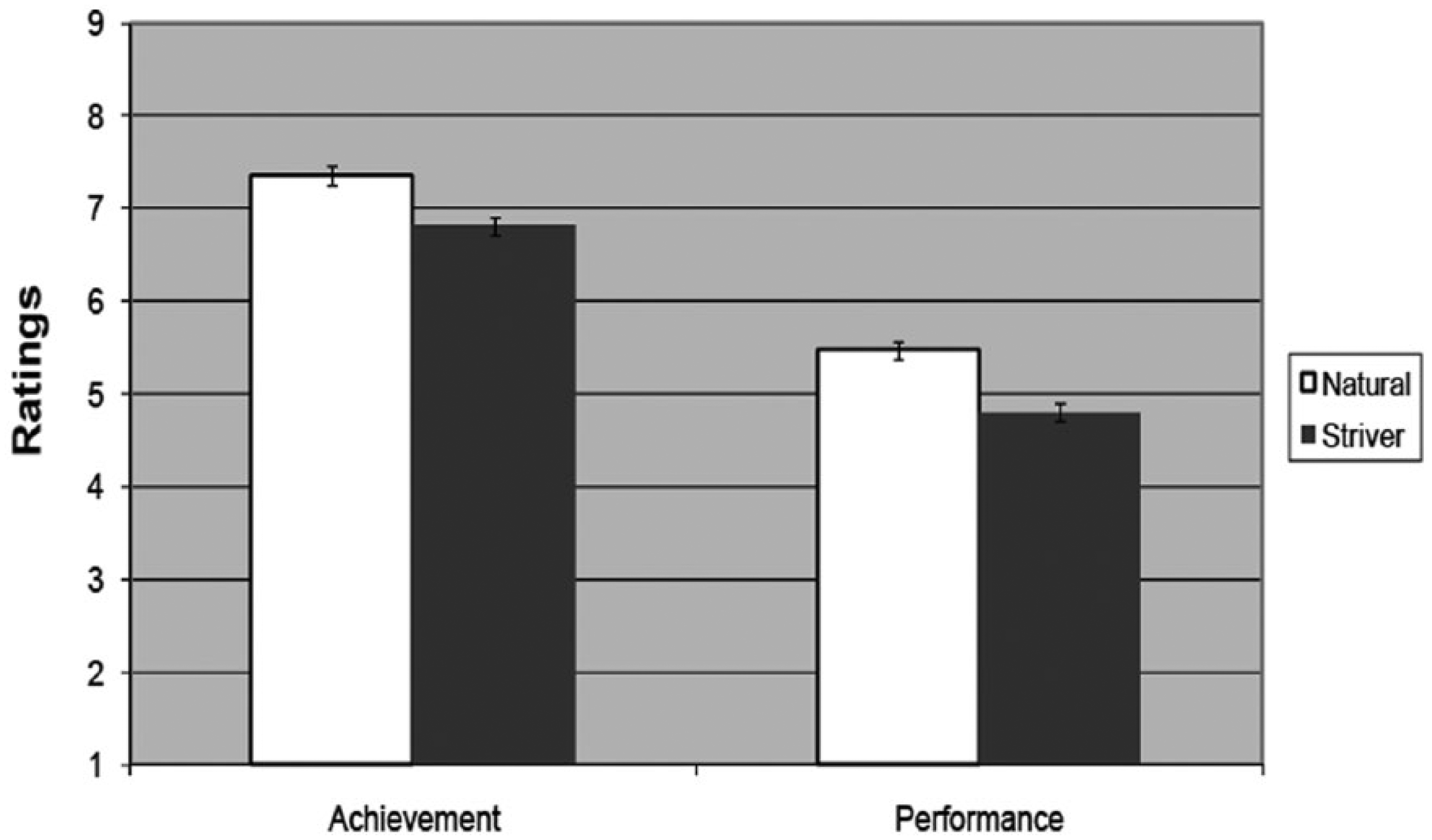
Participants’ evaluations of entrepreneurs and their business ideas depending on whether the entrepreneurs were identified as a Natural or a Striver (Study 1a).
Expertise in entrepreneurship did not attenuate the naturalness bias. A Participant Experience × Source of Achievement (natural, striver) analysis of variance (ANOVA) was conducted on the perceived achievement and performance evaluation indices, which yielded as significant only the main effect of source of achievement, F(1, 108) = 6.21, p = .014, d = .47; F(1, 104) = 13.32, p < .001, d = .68. 2 However, the levels of experience in Study 1a were more broadly defined and did not examine the type or nature of experience in entrepreneurship.
Study 1b: The Naturalness Bias in Entrepreneurs
Study 1b was conducted to address limitations of Study 1a. Three hundred eighty-three participants (Mage = 37.46, SD = 12.48; 199 male, 184 female) were recruited from a nationwide sample to include those with varying types of experience with entrepreneurship (founders, those who have worked with entrepreneurial firms in lower positions, investors, novices, and any other self-reported categories). The procedure replicated that of Study 1a.
Participants who indicated no or novice experience with entrepreneurship were categorized as novices (62.7%), whereas those with all other types of experience in entrepreneurship were collapsed into the expert category (37.3%). The levels of expertise and the number of years of experience in entrepreneurship were highly correlated, r(383) = .88, p < .001. Furthermore, t tests indicated that participants in the expert category had significantly more years of experience (M = 5.65, SD = 5.54) than those in the novice category (M = 0.83, SD = 2.07), t(381) = 4.82, p < .001, d = 1.15.
A Participant Experience × Source of Achievement (natural, striver) ANOVA was conducted on the perceived achievement and performance evaluation indices, which yielded as significant the main effect of level of expertise on performance evaluation, F(1, 379) = 13.34, p < .001, d = .40, and as marginally significant the main effect of source of achievement F(1, 379) = 3.00, p = .084, d = .17. For novices, who comprised the majority of the sample, there was no significant effect of source of achievement on perceived achievement or performance evaluation, F(1, 238) = 0.01, p > .05; F(1, 238) = 0.11, p > .05. 3 However, for experts, the main effect of source of achievement emerged again for both perceived achievement and performance evaluation, F(1, 141) = 3.06, p = .082, d = .29; F(1, 141) = 4.09, p = .045, d = .33. This reflects an overall tendency for experts to prefer the natural over the striving entrepreneur, Ms = 7.29 and 6.94, 95% CIs [7.06, 7.52], [6.59, 7.29], respectively, and to rate the business proposal attributed to natural talent as being of higher quality than the same business proposal attributed to effortful training, Ms = 6.75 and 6.22, 95% CIs [6.45, 7.06], [5.77, 6.67], respectively. These results suggest that not only may expertise not protect against the naturalness bias, but experts may even be at greater risk for an inclination toward the natural.
Entrepreneurs who have served as founders or investors generally favor naturals. Furthermore, those who have worked with entrepreneurial firms may be particularly susceptible to the naturalness bias. The main effect of source of achievement surfaced for these participants for perceived achievement and performance evaluation, F(1, 52) = 5.13, p = .028, d = .62; F(1, 52) = 3.42, p = .070, d = .50. Experts with this type of experience in entrepreneurship prefer the natural over the striver, Ms = 7.31 and 6.57, 95% CIs [6.92, 7.70], [6.02, 7.13], respectively, and perceived the business proposal attributed to natural talent as being of higher quality than the same business proposal attributed to effortful training, Ms = 6.88 and 6.10, 95% CIs [6.35, 7.41], [5.39, 6.81], respectively.
When participants were asked through a free-response item in a supplementary study (N = 383) to describe how they made their decisions about the target entrepreneur, they identified a range of factors as contributing to their conscious evaluation. These included the biographical information about and impression of the target individual (competence, confidence, passion, potential, talent, track record and experience, trustworthiness), the presentation, the business proposal, the industry and market, and the evaluators’ own intuition. A basic content analysis coded all independent mentions of the source of achievement and revealed that only 7.3% of participants explicitly recognized that they were factoring in the source of achievement in their evaluations of the target entrepreneur. More specifically, with respect to the particular source of achievement, significantly more participants made reference to striving than to naturalness, χ2 = 5.83, p = .016, d = 1.00. This complements the earlier findings highlighting a discrepancy between the striving we consciously value and the naturalness that we actually privilege.
Overall, the findings from Study 1a and Study 1b suggest that upon reading about entrepreneurs with equivalent levels of achievement and hearing identical business proposals, participants judged the natural as more talented, more likely to succeed, and more hirable. These initial results may not seem as surprising for those who perceive that someone with natural ability can more easily develop the capacity to work harder, while someone who has worked hard cannot easily gain natural talent. This assumes that the eventual achievement of the natural may be more malleable than that of the striver; if these two individuals have arrived at the same level of achievement thus far, an even better outcome could later be achieved by the natural through additional effort. For example, some work suggested that the natural is likely to be perceived as having more potential for progress than the striver (Tsay & Banaji, 2011), and other recent work suggests that mere potential, such as that of the natural, could be valued more than actual achievement (Tormala et al., 2012). Similarly, if a better start and a steeper initial trajectory might more easily lead to a higher level of performance in certain basic skills (Stafford & Dewar, 2014), it seems reasonable to privilege the natural. However, the perspective that favors the potential and uncertainty associated with the natural does not account for the more innate aspects of striving (Duckworth et al., 2010; Duckworth et al., 2007).
Furthermore, the effects of the naturalness bias emerge in the evaluation not only of individuals but also of their demonstrated current output. The same business proposal was liked better and judged as being more skilled when it was attributed to the natural rather than the striver. Participants evaluated the seemingly naturally talented individual’s proposal as more likely to succeed than that of the striver and were more willing to invest in the natural’s proposal. This study demonstrates a preference for the natural even in a domain in which it is widely believed that striving and hard work are responsible for success, and even when the evaluations concern aspects about current performance and not potential future performance. When we judge people or performance output through the lens of naturalness, we are likely to inflate our evaluations.
Study 2: Quantifying the Costs of the Naturalness Bias
Will an entrepreneur be passed over in favor of one who has achieved less but who is believed to be a natural? When the decision concerns two individuals who differ on multiple dimensions, tradeoffs made during the selection process can reveal where a decision maker places greater emphasis. Specifically, how many units of objective quality in the striver might be sacrificed in favor of the natural? Originally developed by mathematical psychologist Duncan Luce and statistician John Tukey, conjoint analysis mathematically teases apart which attributes matter most in preferences and decisions (Priem, 1992).
Conjoint analysis involves selecting a particular set of attributes that signal the quality of each choice or individual (Green et al., 2001; Luce & Tukey, 1964; Orme, 2006). Traditionally, researchers present participants with one or two individuals at a time, each described along several variables. For each, participants give a preference rating based on a single overall variable, such as willingness to hire. When choosing among entrepreneurs who vary on different dimensions (leadership experience, IQ, and capital raised for previous ventures, for example), we may be unable to easily identify which attribute matters the most.
In contrast, conjoint design uses relatively short descriptions to represent various levels within attributes, expressed as numerical figures or short phrases and categories. For example, we might express the importance of one attribute in terms of the importance of others, such as how many IQ points we might “trade” to hire an entrepreneur with more years of leadership experience. This presentation mimics the complexity of real-life choices and can help identify which attributes matter most to the decision maker and which he or she is willing to give up for others. The deduction of such tradeoffs may reveal surprising costs that participants incur due to their intrinsic preferences.
For example, recent work using conjoint analysis in social cognition found that participants were willing to give up more than $3,000 of their future salary to have a male boss (Rahnev, 2007), a finding with important implications for the study of the impact of biases in employment. Other work has also begun to explore the value of conjoint analysis as an implicit measure of attitudes. For example, Caruso, Rahnev, and Banaji (2009) tested the impact of dimensions that participants explicitly categorize as relevant versus those they recognize as irrelevant. While people reported that body weight has little relevance for how they would choose prospective teammates in a trivia contest, weight actually accounted for more than 25% of the variance in their choices and revealed preferences. Moreover, conjoint analysis allowed the quantification of the costs of such hidden preferences; in this case, for example, participants in effect gave up 11 IQ points to have a teammate who was thin rather than overweight.
Building upon the nascent research using conjoint analysis as a tool for detecting and quantifying social costs of covert attitudes, Study 2 focused on the tradeoffs that result from the naturalness bias. A strong test of the bias would pit perceived naturalness against theoretically derived, more objective metrics of achievement and success. This study tested the degree to which objective attributes such as leadership experience, IQ, and accrued capital would be traded off in favor of subjective attributes such as the source of achievement.
Method
Two hundred ninety-four participants with a range of entrepreneurship experience (Mage = 21.48, SD = 3.237; 151[51.5%] male 4 ) were recruited from a community sample to participate in an hour-long set of studies in a computer lab on a university campus in the northeastern United States in exchange for $20. Participants completed the survey at computer terminals and then participated in a set of other unrelated studies. As in Study 1a, those with no experience with entrepreneurship were categorized as novices (65.6%), whereas those with higher levels of experience with entrepreneurship were collapsed into the expert category (34.4%).
Using a software package designed for conjoint analysis studies (Sawtooth Software, 2006), a balanced and orthogonal set was randomly generated that included 18 pairs of target individuals who differed on five attributes (see Online Appendix). This set of profiles was balanced by including examples in which each level of each attribute appeared an equal number of times, and orthogonal in that each level of each attribute appeared together with each level of each other attribute about the same number of times (Caruso et al., 2009). Conjoint analysis allows for the computation of the importance of each attribute through the ratings of at least a minimum number of profiles, based on the total number of levels and attributes included.
Four of the attributes were presented as more objective indicators of performance (Petty & Gruber, 2011; Zott & Huy, 2007): leadership experience (2, 5, 8 years), management skills (70th, 80th, 90th percentile), IQ (100, 130, 160 points), and investor capital raised previously ($50,000; $100,000; $150,000). The ranges for the attributes were pretested on a separate group of participants, such that the intervals represented comparable changes in value to performance. 5
Finally, the critical dimension of the apparent source of achievement, naturalness versus striving, was included. The category terms were selected for their representativeness of the concepts tested and their accessibility and familiarity to the general population (Arsenault, Dolan, & van Ameringen, 1991; Gray & Plucker, 2010; Kammrath & Peetz, 2011; Nicholas, Stepick, & Stepick, 2008; Schevitz, 1967). These terms were also pretested on a different sample to determine how participants would interpret these brief and abstract concepts. The striver was significantly more likely to be selected as the individual who works hard and persists to reach success in a field, χ2(1, N = 84) = 17.19, p < .001; the natural was significantly more likely to be selected as the one who achieves success through innate talent, χ2(1, N = 84) = 6.86, p = .009. The data suggest that the category terms were representative of the concepts tested and accessible to the general population.
Participants were asked to choose which of each pair of entrepreneurs they would invest in for a new business. They were then asked to complete explicit ratings of how important each of the attributes was in their decisions. At no point were the profiles identical. As the profiles had been randomly generated, there was no systematic loading of objective achievement onto either the natural or the striver. As such, any potential alignment between more objective metrics with the natural or the striver, such as naturalness with higher IQ or striving with experience, would have emerged by chance.
Results and Discussion
Analysis
Ordinary Least Squares (OLS) regression was used to analyze the evaluations of the profiles, which produced part-worth utilities (beta scores) for each level of each attribute (Table 2). Within each attribute, the more positive the value for an individual level, the greater the preference was for that level. Likewise, the greater the value for an individual attribute, the greater proportion of the variance in preference that attribute explained and the more important that attribute was to participants. For novices, choices were accounted for in the following ways: 9.99% by source of achievement, 13.41% by leadership experience, 24.78% by management skills, 19.87% by IQ, and 31.95% by investor capital. For experts, choices were accounted for in the following ways: 10.83% by source of achievement, 14.36% by leadership experience, 24.19% by management skills, 22.96% by IQ, and 27.66% by investor capital.
Relative Importance Between and Within Attributes in Study 2.
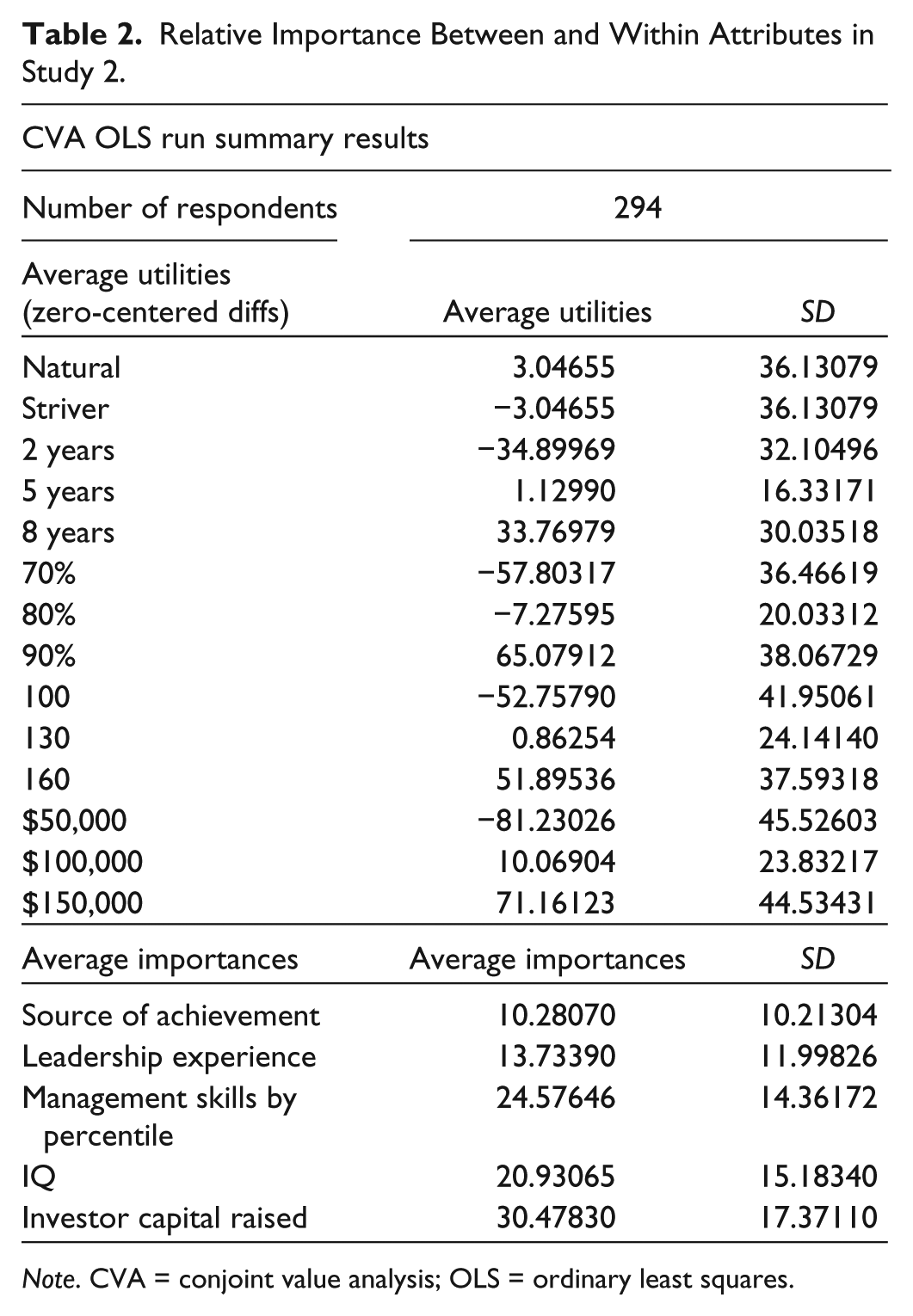
Note. CVA = conjoint value analysis; OLS = ordinary least squares.
Revealed importance of the attributes
Participants’ choices revealed that more objective attributes were clearly involved in judging achievement. The analyses suggested that participants recognized that the more objective attributes reflected the quality of the entrepreneur, such that entrepreneurs with more leadership experience or a better track record of raising investor capital were more likely to be favored. Participants were able to discriminate among the different levels of each attribute (Figure 2).

Preference in attributes by level (Study 2).
The impact of sources of achievement was measured, revealing that the natural/striver distinction accounted for about 10% of the variance explained in preferences (Figure 3). Furthermore, 58% of participants preferred the natural over the striver entrepreneur (χ2 = 4.36, p = .037). Yet in the earlier pretest, participants did not consciously view naturalness as necessarily a better tradeoff; in fact, they were significantly more likely to identify motivation and hard work alone, rather than innate talent alone, as the most important ingredient for achievement in entrepreneurship, t(83) = −3.70, p < .001, d = −.81. The contrast in responses to explicit versus implicit measures suggests that we hold an implicit bias toward the natural when information about the apparent source of achievement is available. Even when entrepreneurs who are described as strivers possess qualities that indicate a higher likelihood of success, a significant preference for the natural remains.
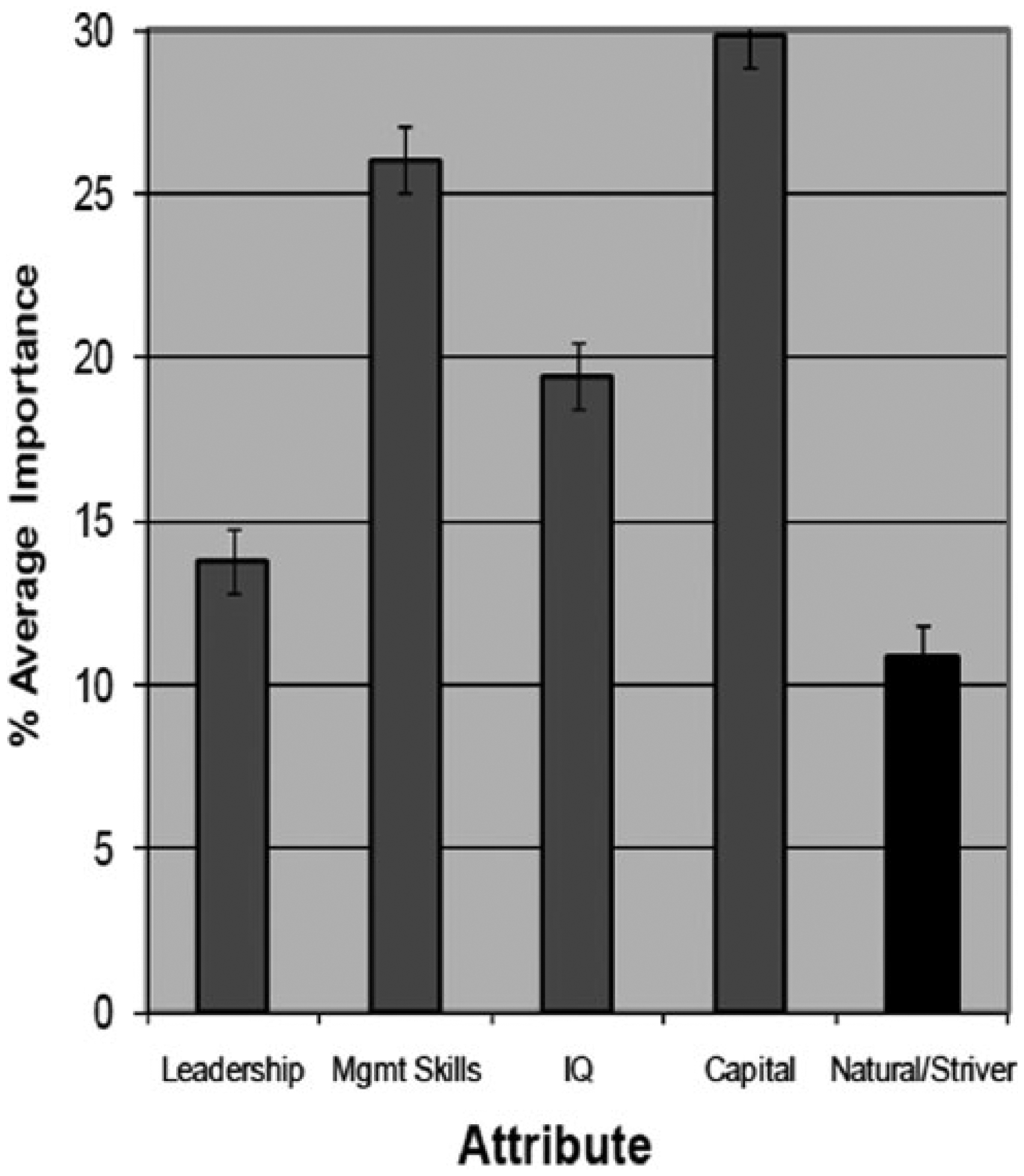
Revealed importance of the attributes (Study 2).
Quantifying the bias
As conjoint analysis is a relative measure that yields beta weights for each level within each attribute, these weights may be used to compare the relative importance of different attributes (Caruso et al., 2009). Participants were willing to make a substantial tradeoff in objective achievement, and they were more willing to select the natural even if it results in costs to themselves through the hiring of a less-qualified individual.
Although it may seem that participants placed less importance on the source of achievement than the other indicators of performance, even small effects of tradeoffs people are willing to make may be magnified in the form of consequences with real costs. Using the relative importance participants placed upon the set of attributes, the relative costs of the preference for the natural were calculated by dividing the importance of the source of achievement by the importance of each of the other four attributes and multiplying these figures by the numerical range of each of the four respective attributes. Novices were willing to give up 4.47 years of leadership experience, 8.07% in management skills, 30.17 points in IQ, and $31,279 in accrued capital to invest in a “natural” entrepreneur. Similarly, experts were willing to give up 4.52 years of leadership experience, 8.95% in management skills, 28.30 points in IQ, and $39,143 in accrued capital to invest in an entrepreneur who was identified as a natural. This is consistent with the findings in Study 1a and Study 1b, which suggested that experts are also vulnerable to the naturalness bias and are still at risk for privileging the natural.
General Discussion
Across professional fields, individual experts are trained and societal institutions are set up to identify, develop, and reward the highest levels of achievement. Regardless of the area of achievement, experts believe they can judge performance through their specialized knowledge (Chi, Glaser, & Farr, 1988; Shanteau & Stewart, 1992; Ward et al., 2003) and identify true talent.
Deepening our understanding of the naturalness bias, this set of three studies demonstrated that not only does the bias operate at an implicit level, but also that it is robust across different domains and even in the presence of objective information about the quality of achievement. With little awareness of such bias, people sacrifice objective qualifications to hire the natural. These findings are consistent with work that has demonstrated how people use shifting criteria to justify their instinctive preferences (Phelan, Moss-Racusin, & Rudman, 2008; Uhlmann & Cohen, 2007).
The impact of information about the source of achievement cannot be underestimated; both quantitative and qualitative data suggest that we do not recognize how much this information affects our judgment and evaluation of others and their performance. Furthermore, because expertise and experience in entrepreneurship do not appear to buffer against the effects of the naturalness bias, novices and experts are both vulnerable to it. We need to call particular attention to its influence on experts, as their role as decision makers positions them to be at greatest risk for incurring the costs of the naturalness bias, while also positioning them to have the greatest promise for attenuating the effects and costs of the bias.
Contrary to people’s perceptions, the persevering striver is more likely to be high achieving than the natural (Duckworth et al., 2010; Duckworth et al., 2007; Ericsson et al., 1993). Indeed, although common intuition may lead us to bet on the hare to win the race, the outcome of the fable reflects the empirical findings regarding the value of effort: It may well be the consistent and persevering tortoise who crosses the finish line first. Of course, although outside the scope of this current article, many factors altogether external to individuals themselves also significantly contribute to the achievements of highly accomplished performers (Groysberg & Lee, 2009; Groysberg, Lee, & Nanda, 2008).
There are several limitations of the current work. One main issue is that due to the confidential and relatively anonymous nature of participant recruitment for these studies, the information collected about level of experience in entrepreneurship is based solely on self-reported data and cannot be independently verified. Although the analyses suggest that the categories participants selected were appropriate, given the strong relationship found between levels of expertise and years of experience in entrepreneurship, it is critical for future research to include different recruitment processes to ensure that those who identify as having particular expertise do in fact possess it. The findings thus far suggest that experts may show an even higher level of the naturalness bias than novices do and that there may be particular types of experience in entrepreneurship that lead people to be more or less affected by such bias. Further investigations into the nature of experience that moderates the naturalness bias are warranted so that more specific solutions can be identified and prioritized based on where the costs of the bias are more likely to accrue.
In addition, the design of the current studies relied on biographical sketches, audio presentations, and simplified representations of achievement. There are thus outstanding questions about the external validity of findings that emerge from such designs. In most cases where entrepreneurs are being evaluated, judging panels have access to visuals, among other rich information available about the presenters. Would having such information reduce reliance on cues about the source of achievement? Or would the visuals themselves somehow reflect naturalness versus striving and in turn magnify the naturalness bias?
An exploration of the contexts in which the naturalness bias may be most and least likely to be elicited would be promising. There are many possible moderators of the effect. For example, the current set of studies was limited to the evaluation of a male target entrepreneur. How might the naturalness bias be affected by the instance of female entrepreneurs or by other cases in which targets are evaluated in the context of gendered occupations?
Another caveat regarding the current research involves the manipulation of the source of the performers’ achievement. In a way, it assumed that, given an equal level of achievement, participants would perceive a negative correlation between hard work and innate ability. Future research could, while holding achievement constant, systematically vary both individual effort and innate ability in a more ambitious 2 × 2 between-participants design involving high and low effort and ability to determine whether, for example, differences in apparent dedication and effort moderate the naturalness bias for targets with high innate ability.
Presumably, participants would attribute the success of the low-effort/low-innate-ability performer to external factors, such as good fortune or personal or family connections. How would people evaluate the achievement of individuals who appear to succeed through such means, such as the student who “buys” a high SAT score by taking an expensive preparatory course that his family was able to afford? How would we evaluate the politician or CEO whose inherited surname ensures a ready advantage in public recognition? Such individuals may be seen as less talented than those who worked hard to achieve success because their development of skills and abilities was less necessary. If so, what would this imply about perceptions of inborn talent, which is itself determined by a lottery of sorts—the chance workings of genetics?
Future work must pinpoint the factors that allow experts to remain vulnerable to the naturalness bias, particularly because they are often the key decision makers and gatekeepers in pathways through organizations and careers. Are experts more confident of their choices, and do they set a lower threshold for judging talent when naturalness is a feature of the decision set? Do experts merely state that strivers are most likely to succeed, but implicitly have a “natural is best” theory of talent? How might top managers make better staffing decisions? Measures of the implicit association (Greenwald, McGhee, & Schwartz, 1998) of talent with naturalness and predictions of preferences and choices from such measures will be useful to include in future studies of this topic. Future research could also explore the extent to which a naturalness bias affects one’s own striving as an expert in highly competitive environments, and when it is most likely to emerge.
These and other aspects of expertise (including newly developed domains) should be explored in future research given results suggesting that experts are vulnerable to the naturalness bias. Future research on the naturalness bias also could explore whether expertise in a particular field affects one’s susceptibility to the bias when judging the achievement of individuals in an unrelated field. This may be especially likely if acclimation to a highly competitive environment makes one more skeptical about the extent to which working harder than one’s highly competent and motivated peers is a plausible and effective way to outperform them. This skepticism presumably could generalize to one’s perceptions of achievement in other highly competitive fields, but may not if lack of knowledge or egocentrism tethers one’s skepticism to one’s own realm of endeavor.
One aspect of this research that serves as a subsequent challenge is the question of why there is a naturalness bias at all. We know little about this issue, given that on self-report measures, professionals and novices alike report support for and belief in strivers. It may be that people see the performance of naturals as qualitatively better than that of others in some mysterious and perhaps even immeasurable way that sets them apart and merits them more favorable evaluations, regardless of whether naturals apply themselves. While this may be a case of implicit bias overriding explicit beliefs, what drives the preference for naturals could also reflect lay people’s theories about striving and motivation in this domain. Entrepreneurs are often associated with risk-taking (Wu & Knott, 2006), a quality that may be perceived as, at its core, an inherited one. Although entrepreneurs are risk averse, in that they prefer certain over uncertain payoffs (Wu & Knott, 2006), they may take risks anyway because they are overconfident about their own abilities and consequently underweight objective predictors of success (Cooper, Woo, & Dunkelberg, 1988; Salamouris, 2013). People may recognize the need for overconfidence in risk-taking, and overconfidence may be regarded as inherited. It may also be that entrepreneurial tendency and opportunity recognition (Nicolaou et al., 2009), characteristics that are commonly associated with entrepreneurship, are believed to be primarily heritable qualities.
In addition, perhaps lay theory is anchored upon what leads to better decisions for the evaluation of the development of routine or basic skills (Stafford & Dewar, 2014). Those who have that initial starting advantage are often afforded many further advantages and resources that others do not gain, which contribute to the downstream levels of performance. Perhaps a naturalness inclination is rooted in the initial advantage–achievement association—and, given the advantages initially reaped by the naturals, we need to carefully consider the power of striving, given its strong association with achievement (Duckworth et al., 2010; Duckworth et al., 2007; Ericsson et al., 1993). When applied to the more complex fields, our initial associations among better launch, steeper trajectory, and higher overall performance become more likely to lead to bias.
At least two existing individual-differences scales could be used to promote better understanding of the naturalness bias. Using a measure of the “Protestant work ethic” (Katz & Hass, 1988), it would be interesting to examine if those who are inclined to attribute a lack of success to laziness and moral laxity, and a surfeit of success to ethical fortitude and individual effort, would be less likely to fall prey to the naturalness bias. Perhaps professionals would be more likely to endorse this ethic for fields other than their own. Another relevant instrument is Dweck’s measure of individual differences in endorsement of an “entity” versus “incremental” theory of ability and intelligence (Dweck et al., 1995). Some people see various elements of human nature and potential as relatively fixed and invariant, whereas others tend to see them as more malleable and changeable. Future research could examine whether people who are stronger “entity theorists” would place even greater value on inborn talent than others because they implicitly doubt that ability can be changed or modified substantially. Such investigations would also be amenable to study through cross-cultural samples.
No matter whether our inclination toward the natural leads to wiser choices or instead to biased mispredictions, it would be valuable to consider ways for novices and experts alike to become more aware of the influence of the source of achievement and how cues about how achievement came about can powerfully impact our preferences and choices in any context that calls for the evaluation of others. Allowing ourselves the chance to gradually reduce the strong associations we have between genes and talent, and between the environment and effort, may be one first step. Our intuition gravitates toward genetic talent versus environmentally determined effort, but recent work suggests that we should also better understand genetically determined effort and environmentally determined talent. By creating opportunities for people to reflect upon the more versus less intuitive associations in our discussions of achievement, we may be better able to initiate the process through which the naturalness bias could be minimized.
Further work would be necessary to reveal more specific levers through which we may attenuate the effects of the naturalness bias. If the way in which this bias functions overlaps with those of more established biases, we may consider several possible solutions at the point of performance evaluation. These solutions might include ensuring more precise and tangible metrics of assessment, confronting evaluators with highly achieving exemplars of both naturalness and striving, allowing evaluators to have the time and cognitive resources to fully consider the metrics that are important and valued for actual performance, or simply filtering out any candidate application materials that reference sources of achievement.
There are several implications of this work for our understanding of any context that involves the evaluation of achievement and talent. Whether it is the routine hiring of employees in business settings, the early identification of talent in primary and secondary education, or the assessment of the moral character of a judge or jury member, we must consider the impact of the naturalness bias in those who make these critical decisions. A systematic method is needed to categorize contexts in a way that better predicts how the naturalness bias and the effects of expertise may operate in efforts to reform decision making about achievement. Naturalness may be a built-in bias from our evolutionary past that sneaks into decisions even in the presence of a genuine and conscious belief in the importance of striving. It is for this reason that the effects of the naturalness bias may go unnoticed and uncorrected, and that behavioral science research has a role to play in demystifying the decision processes for judging talent and achievement.
Footnotes
Acknowledgements
The author thanks Mahzarin Banaji for her contributions to the work, and Max Bazerman, Angela Duckworth, Katie Shonk, and the UCL School of Management reading group for their helpful feedback on earlier drafts. This research was supported by Harvard University and the UCL School of Management.
Declaration of Conflicting Interests
The author(s) declared no potential conflicts of interest with respect to the research, authorship, and/or publication of this article.
Funding
The author(s) received no financial support for the research, authorship, and/or publication of this article.

Notes
References
Supplementary Material
Please find the following supplemental material available below.
For Open Access articles published under a Creative Commons License, all supplemental material carries the same license as the article it is associated with.
For non-Open Access articles published, all supplemental material carries a non-exclusive license, and permission requests for re-use of supplemental material or any part of supplemental material shall be sent directly to the copyright owner as specified in the copyright notice associated with the article.
