



Abstract
People tend to overestimate the steepness of slopes, especially when they appraise the effort necessary to ascend them as greater. Recent studies, however, suggest the way individuals perceive visual stimuli may rely heavily on their personal motivations. In four studies (N = 517), purpose in life was tested as a motivational framework influencing how appraised effort relates to slope perception. Studies 1 and 2 found the amount of effort participants appraised necessary to ascend several virtual slopes was related to greater overestimation of their steepness. Yet, this relationship was attenuated by purpose assessed both as a disposition and experimental manipulation. Studies 3 and 4 replicated these findings using actual hills, again showing links between the amount of effort thought required to ascend them and their perceived angle were diminished by greater purpose. The discussion addresses implications of purpose as a broad motivational framework that shapes how individuals see their environment.
“The heights charm us, but the steps do not; with the mountain in our view we love to walk the plains.”
Some mountains seem too steep to climb. Whether we believe the effort necessary to ascend them is too great or their degree of elevation too daunting, as Goethe noted, sometimes we simply prefer the plains. An intriguing aspect of this preference is that our perceptions of inclines are often inaccurate, exaggerated upward toward seeing slopes as steeper than they actually are. Numerous experiments demonstrate that people overestimate geometric slant when viewing natural hills (Bhalla & Proffitt, 1999; Schnall, Zadra, & Proffitt, 2010), staircases (Shaffer & Flint, 2011), and even virtual slopes displayed on computer screens (Creem-Regehr, Gooch, Sahm, & Thompson, 2004; Proffitt, Creem, & Zosh, 2001). One account for this bias is that it reflects the potential for action in the physical world; as the amount of effort thought necessary to ascend a slope increases, so too does the magnitude of overestimation of its steepness. Indeed, several studies demonstrate that encumbering individuals with physical burdens, such as rigorous exercise (Proffitt, Bhalla, Gossweiler, & Midgett, 1995) and heavy backpacks (Bhalla & Proffitt, 1999), or psychological burdens, such as reminding them of the secrets they harbor (Slepian, Masicampo, Toosi, & Ambady, 2012), inflates their ratings of a slope’s steepness. Thus, when reaching the top is considered arduous, even molehills may appear as mountains.
Contrasting empirical evidence also exists, however, suggesting that greater appraisals of effort may not always correspond to perceptions of steepness. For instance, individuals make similar overestimations of the steepness of staircases as for escalators, despite discernible differences in the amount of effort needed to ascend the two (Shaffer & Flint, 2011). In addition, the same hill can look less steep even to observers encumbered with physical burdens (e.g., heavy backpacks) if they are first offered a sensible explanation for why they are donning the extra weight (Durgin et al., 2009) or if they are given the chance to divulge personal secrets instead of keeping them (Slepian, Masicampo, & Ambady, 2013). Moreover, Witt, Proffitt, and Epstein (2004) clarified that it is effort associated specifically with intended actions that is most strongly linked with visual perceptions. For example, when primed to believe that walking would require substantial effort, individuals reported that a target was further away when they anticipated walking to it, relative to those individuals who anticipated throwing a ball to the same target. Thus, links between effort and perceptions of the physical world appear mutable and may be particularly susceptible to influences that alter one’s sense of difficulty or challenge when acting in specific ways within it (Firestone, 2013; Woods, Philbeck, & Danoff, 2009).
The Case for Motivated Perception
If how we see the world is not fixed, but is partially contingent on the effort we appraise as necessary to act within our environments, then the extent to which we are personally motivated to carry out those actions may guide what we ultimately perceive. Indeed, a rich theoretical framework and several studies by Balcetis and colleagues (e.g., Balcetis & Dunning, 2006, 2007; Balcetis & Lassiter, 2010) suggest that individuals see their environment in ways that are consistent with their personal motivations. For example, motivated observers tend to visualize ambiguous stimuli (e.g., a figure that could be seen as either the letter ‘B’ or the number ‘13’) in ways that are most favorable for preferred outcomes in a given situation (Balcetis & Dunning, 2006), and tend to see desirable objects as being physically closer than undesirable ones (Balcetis & Dunning, 2010). Importantly, personal motivations need not be directly related to the task at hand to influence how individuals perceive their environment. For example, when individuals are highly motivated to reduce cognitive dissonance caused by choosing to do something uncomfortable (e.g., wear an embarrassing costume in public), they tend to perceive distances as shorter and inclines as less steep to make their environment appear less aversive (Balcetis & Dunning, 2007). Guiding such motivated perceptions, according to these researchers, are cognitive processes that bias observers’ visualizations toward favored actions within their environment. That is, motivations energize individuals to persist toward desired aims by altering their perceptions of stimuli as being more actionable—even when such actions may be seen as requiring substantial effort.
But precisely under what conditions would individuals perceive a hill as steep yet perhaps no more effortful to climb? One answer may be when they are equipped with resources that motivate their persistence in the face of hardship. A potential, but as of yet untested, source of motivation that may fundamentally shape the world we see is having a sense of purpose 1 in life. Defined as a “self-organizing life aim that organizes and stimulates goals, manages behaviors, and provides a sense of meaning” (McKnight & Kashdan, 2009, p. 242), purpose is widely recognized as a psychological resource that contributes to greater health and well-being (Boyle, Barnes, Buchman, & Bennett, 2009; Burrow & Hill, 2011; Ryff & Keyes, 1995), and even longevity (Hill & Turiano, 2014). Purpose is an appetitive and approach-oriented source of motivation (McKnight & Kashdan, 2009) that promotes well-being by fostering active persistence toward valued goals even in the face of obstacles. For example, purposeful individuals exhibit less reactivity to stressful stimuli (Burrow & Hill, 2013; Smith & Zautra, 2004), potentially because they are able to interpret the challenges encountered within the broader and more personally meaningful context of their life aims (Baumeister & Vohs, 2002; Burrow, Sumner, & Ong, 2014). This ability is further suggested by the nomological network of purpose, including emotional positivity and goal-directed thinking. Studies have linked purpose with a more positive affective balance and broadened mind-set (Fredrickson & Losada, 2005; Hicks & King, 2007) as well as greater hope or belief in one’s ability to successfully navigate obstacles and achieve one’s goals (Feldman & Snyder, 2005).
Further substantiating the aims of the current research, purpose is thought to provide a basis for optimally allocating resources that are necessary to overcome difficult tasks. McKnight and Kashdan (2009) contend that purpose “may provide the causal force for efficient resource allocation; people living with a purpose tend to shift resources (i.e., physical, biochemical, neural, and cognitive) according to the greatest need” (p. 246). Thus, the appraised difficulty of a task is an important and determining factor in predicting when a purpose should serve as a vital resource. When tasks are easily surmountable, whether or not one is guided by an overarching life aim may fail to distinguish between individuals’ outcomes. However, when people are confronted with a challenge, having a strong sense of purpose may attenuate how strongly the effort believed necessary to accomplish it influences their perception of the task at hand. This decoupling may prove valuable insofar that it allows them to more accurately appraise whether they are capable of attending to the challenge. Although this capacity has, to date, received limited empirical attention, the established association between effort appraisals and perceptions of geographic incline provides a rich template for investigating this differential resource allocation hypothesis. Deriving evidence that the beneficial effects of purpose are most prominent, or are extracted, when effort is appraised as greater would make a novel contribution to the existing purpose literature.
Whether purpose serves as a motivational framework capable of decoupling links between the slopes we perceive and the amount of effort deemed necessary to ascend them awaits empirical testing. Yet, this precise influence would be wholly consistent with the resources and perception model (Harber, Yeung, & Iacovelli, 2011). According to this model, psychosocial resources dampen negative arousal to aversive and challenging stimuli by making them appear less extreme. In support, participants with greater resources (e.g., self-worth) report a lesser distance to the ground when standing on a 5-story ledge without handrails than those lower in this resource (Harber, Yeung, & Iacovelli, 2011). Notably, self-worth did not reduce height estimations among participants who were allowed to hold onto handrails, suggesting the benefit of resources may not be present across all situations, particularly those that may be construed as lacking challenge or requiring minimal effort. Thus, to the extent that purpose is a resource similarly capable of shaping how individuals perceive slopes, it would be expected to exert the greatest influence when appraisals of effort are highest.
The known associations between perceptions of geographic slants and the amount of effort deemed necessary to ascend them provides a meaningful framework for testing the claim that having a purpose can influence one’s perception of challenges. Using this generic framework is particularly valuable as it is unlikely that the task of ascending experimentally presented slopes is uniquely relevant to any individual’s overarching life aim, but instead provides a more general and testable challenge for all individuals. Importantly, investigating purpose as a moderator of the appraised effort, perceived environment relationship would advance our understanding of perception beyond simply identifying another factor that directly predicts estimates of incline (e.g., backpacks and self-worth), and instead potentially underscores a self-regulatory resource that is capable of separating the tight link between how actionable we appraise the world to be and our view of it.
Overview of the Current Research
In the current research, we investigated the relationship between appraisals of effort and perceptions of steepness, and examined the role of purpose in this relationship. In Studies 1 and 2, participants viewed several virtual inclines and estimated the angle and amount of effort walking to the top of each would require. In Studies 3 and 4, similar estimations of angle and effort were made in the presence of actual hills. Across studies, we hypothesized participants would overestimate the angles of slopes more when they appraised the effort to ascend them as greater. However, based on studies suggesting that greater effort appraisals may not lead to perceiving steeper slopes when individuals are motivated to surmount obstacles (Balcetis & Dunning, 2007), we examined purpose in life as a moderator of this relationship. We predicted that when present or made salient, purpose would attenuate the association between effort and perceived angle. Moreover, we accounted for known correlates of purpose (e.g., personality traits, emotional positivity, and goal-directed thinking) in our analyses so to better identify any unique influence purpose has on individuals’ perceptions of inclines. Finally, we wish to note that including an array of both virtual and actual hills is important because it provides a broader testing of these relationships than has typically been conducted in past research. Evidence that purpose might serve to weaken the angle–effort relationship in both virtual and actual settings would situate it as a more valuable asset than if it did so in either setting alone.
Study 1
Method
Participants
Online questionnaires were completed by 270 adults (54% female, M age = 34.29 years) recruited from Amazon’s Mturk. All participants lived in the United States and received $0.50 for participating.
Materials and procedure
Participants reported their age, gender, and frequency of exercise per week, as physical fitness has been shown to correlate with perceptions of incline (Proffitt et al., 1995). Purpose was assessed using nine items from the Ryff Scales of Psychological Well-Being (Ryff, 1989; α = .86), capturing one’s sense of directedness and intentionality in life (e.g., “I am an active person in carrying out the plans I have set for myself”). Responses ranged from 1 (strongly disagree) to 7 (strongly agree). The Big Five personality dimensions were measured with the 20-item Mini-IPIP (Donnellan, Oswald, Baird, & Lucas, 2006). Participants rated how accurately the items reflected them from 1 (very inaccurate) to 5 (very accurate): extraversion (α = .83), agreeableness (α = .84), conscientiousness (α = .74), neuroticism (α = .79), and openness (α = .79). Finally, to control for the effects of the broadened affective state accompanying purpose, we derived a measure of emotional positivity using the Positive and Negative Affect Schedule (Watson, Clark, & Tellegen, 1988). To create this index, participants rated the extent to which they generally felt 10 positive moods (α = .91) and 10 negative moods (α = .89) from 1 (very slightly or not at all) to 5 (extremely), and we divided positive by negative scores.
Next, participants viewed an instructional page showing what 0, 45, and 90 degree angles look like. Then, on subsequent screens, they were shown seven different slopes (displayed at 5, 10, 15, 20, 30, 45, and 50 degrees), and told to presume each slope represented a hill that is 100 ft in length. Each slope was presented on a chart with fixed dimensions, such that the relative angle of the slope remained the same regardless of the size monitor displaying it. Participants were then asked to imagine themselves walking from the bottom of each hill to the top. For each slope, participants reported the amount of effort they thought ascending to the top would require from 1 (no effort) to 5 (extreme effort), and to estimate its angle in degrees.
Analytic strategy
Using the 1,798 assessments nested within 257 participants, hypotheses were tested using Hierarchical Linear Modeling (HLM) version 6.34 g (Bryk & Congdon, 2008). The advantage of HLM is that it allows for the simultaneous modeling of both within- (Level 1) and between-person (Level 2) effects on outcomes. At Level 1, the dependent variable was the amount of overestimation of a given angle and the predictor was the person-centered amount of appraised effort required to ascend it. Level 2 variables (i.e., demographics, personality traits, emotional positivity, purpose, average effort appraisals, and the interaction between purpose and effort) were grand-mean centered and entered as predictors of both the Level 1 intercept and slope. The intercept and slope were modeled as random effects.
Results and Discussion
On average, participants overestimated slopes by 7.64 degrees (SD = 6.42), a pattern that differed significantly from zero, t(256) = 19.72, p < .001. They also appraised slopes as requiring a moderate amount of effort to ascend (M = 2.89, SD = .54). Consistent with previous studies, the magnitude of overestimation increased with the actual steepness of the slopes displayed on the computer screens (within-person r = .13, p < .001). Between participants, bivariate correlations revealed that effort appraisal was positively associated with angle overestimation (r = .27, p < .001), but both estimations were unrelated to purpose. In addition, we confirmed that there was sufficient variability in the magnitude of overestimation and effort appraised to proceed with the multilevel analysis by conducting an unconditional model for each separately (both p values < .001). Results showed that 26% of the variance in overestimation was located between-people and 74% was within-people. For appraised effort, 10% of the variance was between-people and 90% was within-people.
Table 1 shows the estimates from the HLM analyses. 2 As hypothesized, participants perceived slopes to be steeper when they also appraised ascending them as requiring more effort, (γ10), b = 2.25, SE = 0.94, p = .018. Also as expected, individual differences in purpose moderated these within-person associations between appraised effort and slope overestimation (γ111), b = −.74, SE = 0.33, p = .026. Simple slopes tests revealed that the positive association between appraised effort and overestimation was only evident for participants low in purpose (−1 SD), b = 2.33, SE = 0.77, p = .004. For participants high in purpose (+1 SD), appraised effort and degree of overestimation were unrelated, b = −.36, SE = 1.41, p = .80. This interaction is illustrated in Panel A of Figure 1. Notably, these results emerged even when including personality traits and emotional positivity as covariates, suggesting they did not account for the demonstrated influence of purpose.
Model Estimates for Predicting Magnitude of Angle Overestimation in Study 1.
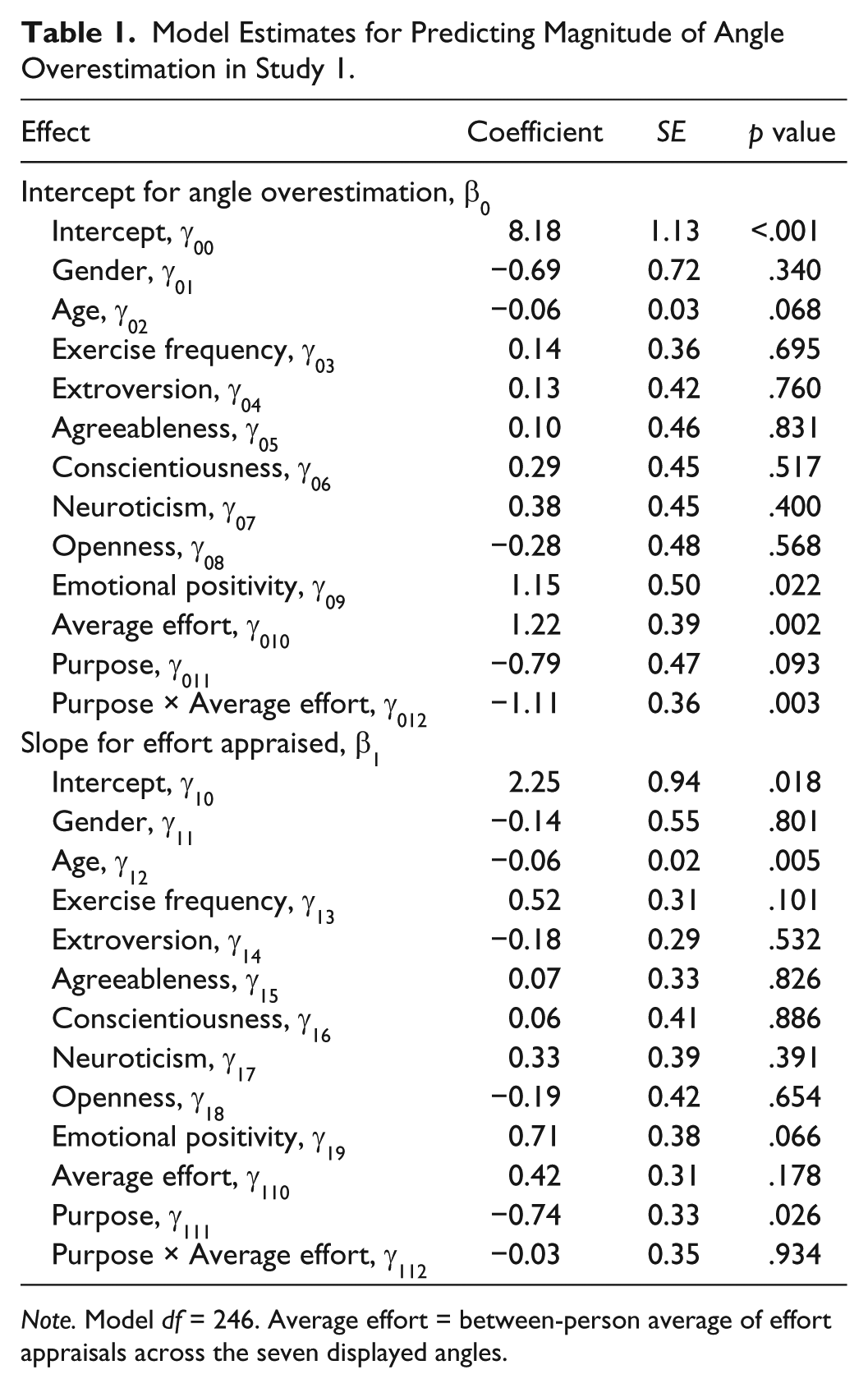
Note. Model df = 246. Average effort = between-person average of effort appraisals across the seven displayed angles.
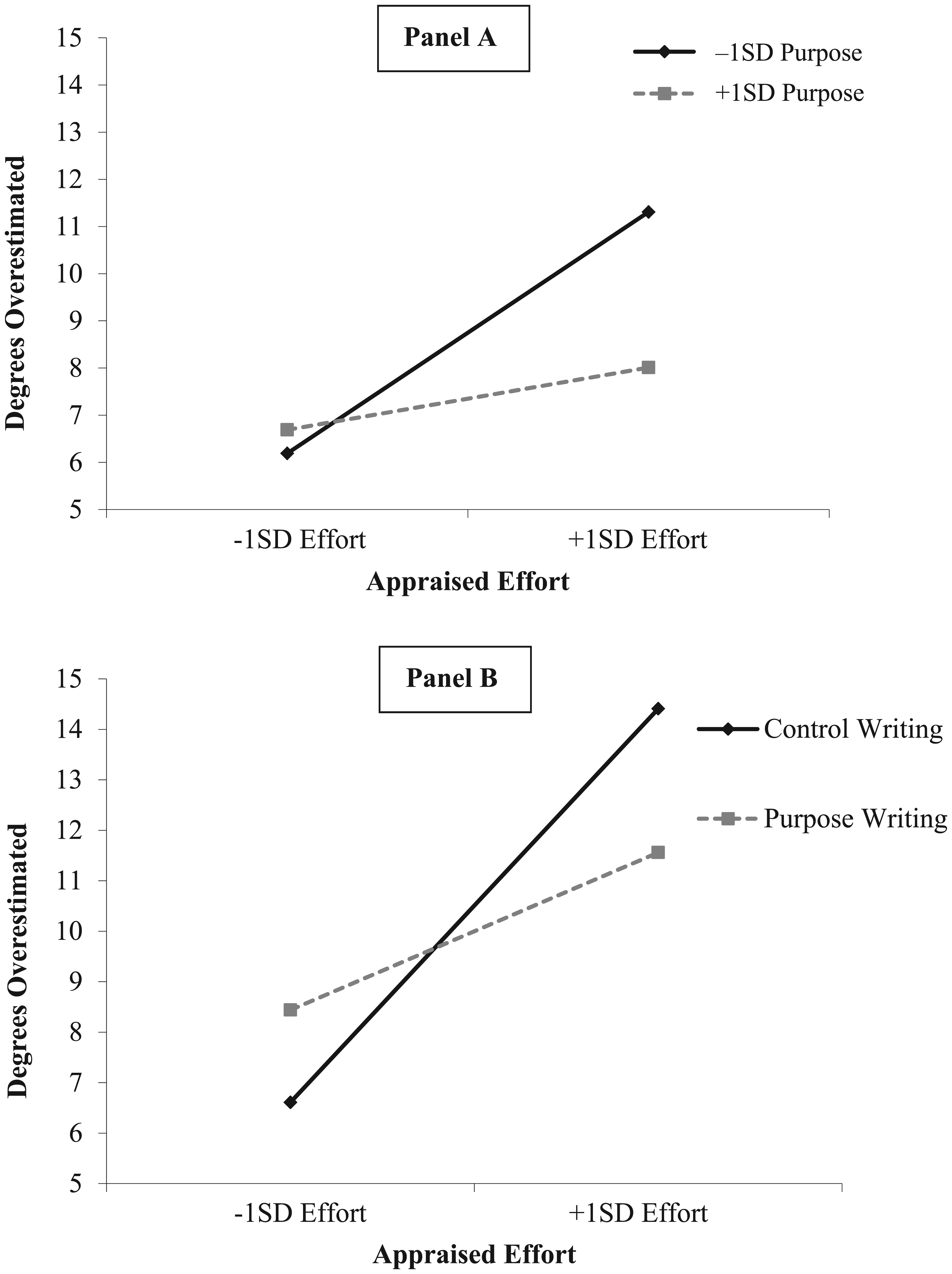
Within-person relationships between appraised effort (at −1 and +1 SDs) and magnitude of angle overestimation as a function of level of dispositional (Study 1, Panel A) and manipulated (Study 2, Panel B) purpose.
At the between-person level, the average amount of effort participants appraised necessary to ascend the slopes they viewed was positively related to the degree to which they overestimated their angles, (γ011), b = 1.22, SE = 0.39, p = .002. Also, purpose moderated this effect, (γ10), b = −1.11, SE = 0.36, p = .003. Identical to the within-person analyses, simple slopes tests revealed a positive link between appraised effort and overestimation for participants low in purpose, b = 4.08, SE = 1.91, p = .005, but no such association for those high in purpose, b = 2.37, SE = 2.03, p = .20. Together, these results suggest that individual differences in purpose similarly diminish within-person and between-person relationships between perceptions of effort and the magnitude by which the steepness of slopes are overestimated.
Supplemental analyses
Having supported our hypothesis, we next tested an alternative model wherein our theorized predictor and outcome were reversed. Specifically, we used participants’ self-reported steepness (i.e., degree of incline) for the displayed slopes to predict the amount of effort they thought necessary to ascend them. A multilevel model, conducted with the same covariates used in the analyses described above, showed positive within-person (b = .05, SE = 0.00, p < .001) and between-person (b = .02, SE = 0.01, p = .006) effects of perceived angle on appraised effort. However, individual differences in purpose failed to moderate either effect (both p values > .45). This null finding may suggest that effort appraisals are more likely to be conditioned by one’s sense of purpose than are their perceptions of geographic slant. While the amount of effort a person feels they spent completing a task is entirely personally determined, angle estimates that fall within a more quantifiable and prescribed range thus may be less influenced by other characteristics within an individual.
Study 2
Study 2 sought to replicate and extend the previous findings in two important ways. First, to examine the causal influence of purpose, its salience was experimentally manipulated by having some participants briefly write about it prior to completing the slope perception task. The potential benefit of engaging with one’s sense of purpose in this manner is suggested by recent work demonstrating that writing about important values (via self-affirmation tasks) reduced the effects of physiological burden on individuals’ estimates of distance (e.g., Harber et al., 2011). Second, we tested whether purpose exerted an influence in the effort–perception relationship over and above two indices of hope (agency and pathways). Because future-oriented character strengths have shown strong ties to purpose (Bronk, Hill, Lapsley, Talib, & Finch, 2009; Feldman & Snyder, 2005; Peterson & Seligman, 2004), including measures of hope–agency (“the will”) and hope–pathways (“the way”) in our analyses would provide an opportunity to distinguish the motivational influence of having purpose in life from other types of goal-directed thinking.
Method
Participants
Participants were 80 adults (60% female, M age = 34.32 years) living in the United States; each received $0.50 for completing an online survey.
Materials and procedure
Participants reported the same demographic information as in Study 1. Next, participants were randomly assigned to one of two brief writing conditions. In the purpose condition (n = 39), participants were asked to “write a few sentences describing your purpose in life. If you do not have a purpose, describe what it would mean to have a sense of purpose.” The control condition (n = 41) was asked to “write a few sentences describing the last movie you saw.” One participant from each condition was excluded for leaving the writing prompt blank. Following the writing assignment, all participants completed Snyder et al.’s (1991) measure of dispositional hope, including four items assessing pathways (e.g., “there are lots of ways around any problem”; α = .67) and four items assessing agency (e.g., “I meet the goals I set for myself”; α = .77). The response format ranged from 1 (definitely false) to 4 (definitely true). Next, participants proceeded to the same slope perception task used in Study 1.
Results and Discussion
Participants overestimated slopes by an average of 11.08 degrees (SD = 10.40), and did so even more as the actual angle of the slope displayed increased (within-person r = .20, p < .001). The average participant estimated needing a moderate amount of effort to ascend the slopes they viewed (M = 3.04, SD = .57). Across participants, appraised effort was associated with slope overestimation (r = .20, p < .001). Neither effort nor magnitude of slope overestimation differed between writing conditions.
For comparisons in our multilevel models, the purpose condition was coded as 1 and the control condition was coded as 0. Within-person estimates of effort were person-centered and between-person variables were grand-mean centered. As shown in Table 2, results were consistent with hypotheses: Appraised effort covaried positively with slope overestimation within-persons, (γ10), b = 3.91, SE = 0.85, p < .001, but this association was qualified by writing condition, (γ14), b = −2.33, SE = 1.12, p < .05. Simple slope tests indicated that appraised effort correlated with overestimation for the control condition, b = 3.21, SE = 1.00, p < .01, but not for the purpose condition, b = 1.37, SE = 0.82, p = .10 (see Panel B of Figure 1). At the between-person level, average effort deemed necessary to ascend the slopes displayed was not statistically related to the magnitude by which participants overestimate angles, nor was this lack of association moderated by writing condition (see Note 2).
Multilevel Model Estimates Predicting Magnitude of Angle Overestimation in Study 2.
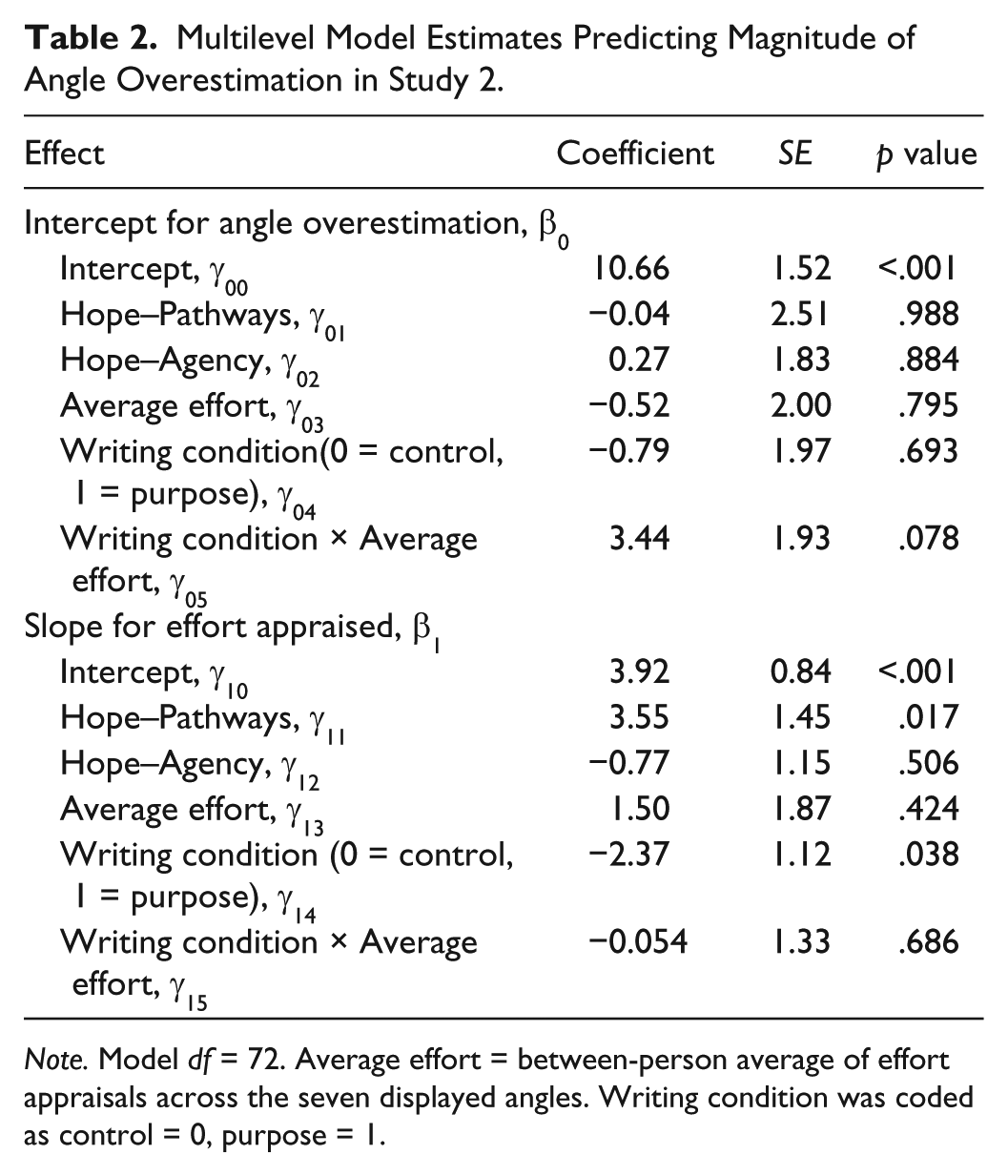
Note. Model df = 72. Average effort = between-person average of effort appraisals across the seven displayed angles. Writing condition was coded as control = 0, purpose = 1.
In addition, levels of hope–pathways and hope–agency did not differ between writing conditions (both ps > .30). Including these variables in the multilevel analyses did not reduce the impact of purpose on the within-person effort-perceived slope relationship. Together, these results support a unique causal influence of purpose on how effort relates to slope perception within-persons; an influence that is not explained by of levels of hope–pathways or –agency.
Study 3
Thus far, we have shown evidence that purpose attenuates associations between perceptions of slopes displayed on computer screens and the amount of effort individuals deemed necessary to ascend them. On this basis, one might argue that the virtual stimuli used in Studies 1 and 2 failed to capture the essential nature of effort because they precluded any potential of being acted upon. In Study 3, we sought to assuage concerns over the ecological validity of our visual perception task by conducting the study on an actual hill. By walking up its slope, participants would have the opportunity to base their perceptions of angle and effort on actual experience.
Method
Participants
Participants were 85 college students (51% female, M age = 20.62, SD = 5.33) who happened to be standing or walking within close proximity to the hill where the study was conducted. All participants were offered $1.00 in compensation.
Materials and procedure
Potential participants (students who were walking nearby) were approached by a member of the research team at the base of a large hill (known as “the slope” to many students on the campus). The slope is a visually imposing feature on the campus because it geographically separates several dormitories and dining halls from the main campus classrooms; it is entirely grass-covered with the exception of a few paved pathways for traversing it. The specific pathway utilized in the current study was approximately 75 ft in length and had an incline of 12 degrees. After agreeing to participate, students were asked to indicate their age, gender, frequency of exercise per week, and level of purpose in life (α = .70) using the same materials from Study 1.
Next, they were asked to walk from a specified starting spot at the base of the slope to the top where they would be met by a second member of the research team (who also stood at a specified spot). Once they reached the top, participants were handed a piece of paper that contained two questions. The first question was “What was the angle of the slope you just walked up?”. Participants were given the same example degrees used in the previous studies. The second question asked, “How much effort did it take you to walk from the bottom to the top of this slope?” They were instructed to respond to this question by placing an “X” anywhere along a 12 cm line that was anchored by “no effort at all” on the far left and “an extreme amount of effort” on the right. Responses were later quantified by counting the number of centimeters the placement of the “X” was from the left anchor, such that higher scores equal greater appraised effort.
Results and Discussion
On average, participants overestimated the 12-degree slope by 22 degrees (average estimate given was 34.12, SD = 14.79), which differed significantly from zero, t(82) = 17.16, p < .001. The magnitude of overestimation was positively associated with the amount of effort deemed necessary to reach the top (r = .31, p < .001). Purpose was statistically unrelated to estimations of both angle (r = −.11, p = .33) and effort (r = .00, p = .97).
An ordinary least squares regression (OLS) analysis was conducted to assess the influence of effort, purpose, and their interaction on the magnitude of overestimation. 3 As shown in Table 3, results indicated that after accounting for control variables, effort remained positively associated with magnitude of overestimation, B = 4.63, SE = 1.63, p < .01. However, this effect was qualified by its significant interaction with purpose, B = −3.15, SE = 1.53, p < .05. Simple slopes tests indicated that appraised effort was positively associated with overestimation for participants scoring low (−1 SD) on purpose, B = 8.77, SE = 2.01, p < .01, while no significant association emerged for those scoring high (+1 SD) on purpose, B = 1.97, SE = 2.25, p = .41 (see Figure 2). Thus, even in the context of an actual hill, reporting greater effort to ascend it does not correspond with systematic overestimations of its steepness among individuals with greater levels of purpose in life.
Hierarchical Regression Estimates Predicting Perceived Angle in Study 3.
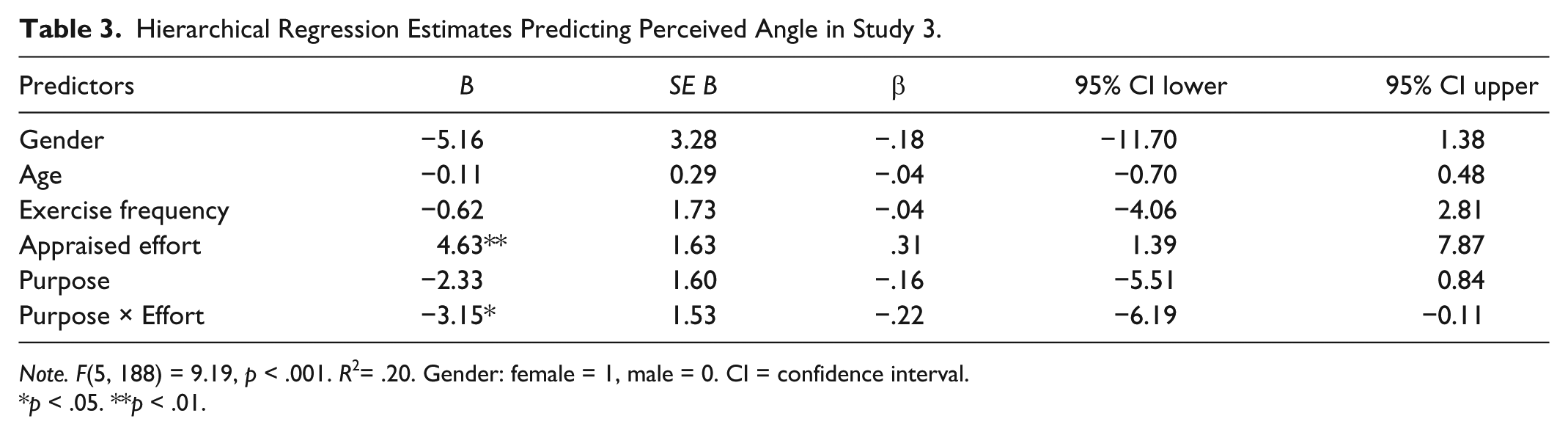
Note. F(5, 188) = 9.19, p < .001. R2= .20. Gender: female = 1, male = 0. CI = confidence interval.
p < .05. **p < .01.

Relationship between appraised effort (at −1 and +1 SDs) and degree of slope overestimation as a function of level of dispositional purpose in Study 3.
Study 4
While the pattern of findings in the studies above provides consistent support for our hypothesis, we have not ruled out the possibility that the moderating effect of purpose may simply reflect a benefit of engaging in any type of prospective thinking. Might relations between perceptions of angle and appraised effort be attenuated even among individuals who consider an immediate goal (e.g., completing a homework assignment or planning to attend a party tomorrow night)? If so, we may have overestimated the need for possessing an overarching and prospective sense such as a purpose in life to influence the appraisal-perception process. Indeed, distinguishing between purpose and proximal goals represents both an important methodological and conceptual exercise. McKnight and Kashdan (2009) contend that while both are characteristically prospective, goals emphasize the attainment of precise endpoints, whereas purpose does not require specific attainments, but instead motivates individuals to be perpetually goal-oriented. Though potentially motivating, opportunities to consider a specific goal can induce a myopic view of where one must allocate their personal resources (Ordóñez, Schweitzer, Galinsky, & Bazerman, 2009) and may even require disengagement from other tasks believed to be too costly (Rasmussen, Wrosch, Scheier, & Carver, 2006). Yet, because purpose should orient individuals toward broadly framing experiences as generally achievable, and situate them to optimally allocate resources necessary to accomplish it, considering purpose should promote adaptive persistence. We explore this possibility in Study 4 by including an additional experimental condition in which participants were prompted to consider an immediate goal they hoped to accomplish.
Method
Participants and procedure
Participants were 82 adults (37% female, M age = 22.57, SD = 5.17), who happened to be standing or walking within close proximity to the hill where the study was conducted. All participants received $1.00 in compensation.
The hill featured a 110-ft paved surface with an average incline of 5 degrees. After consenting to participate, individuals were asked to provide the same demographic information obtained in Study 1. Next, participants were randomly assigned to one of three writing conditions: the purpose (n = 26) and control (n = 29) conditions employed the same prompts described in Study 2. Those in the third condition (goals; n = 27) were prompted to “write a few sentences about a goal you hope to accomplish today.” After completing the writing task, participants stood next to an experimenter at the base of the hill. From this point, participants were instructed to walk to the top of the hill where they would be met by a second experimenter. From there, participants reported both the amount of effort they exerted to reach the top as well as their estimate of the angle of the hill with the same measures used in Study 3.
Results and Discussion
On average, participants overestimated the 5-degree hill by 15.60 degrees (SD = 10.82), and reported a moderate amount of effort to reach the top (M = 4.91, SD = 2.33). Consistent with findings in the three previous studies, appraised effort was positively associated with slope overestimation (r = .26, p < .05). One-way ANOVAs confirmed that neither the amount of overestimation (p = .65) nor effort (p = .10) varied by writing condition.
To test our hypotheses, a linear regression analysis was conducted with main effects entered for effort and writing condition (the control condition used as the reference for both purpose and goals). Writing condition significantly moderated the relationship between effort and slope overestimation, B = −4.59 (95% confidence interval [CI] [−7.68, −1.51]), SE = 1.55, p < .01. Simple slopes tests indicated that appraised effort correlated positively with overestimation for the control condition, B = 5.73 (95% CI [3.03, 8.38]), SE = 1.29, p < .001, but no such relationship emerged for the purpose condition, B = −3.46 (95% CI [−9.34, 2.42]), SE = 2.84, p = .24. It is also noteworthy that control condition did not statistically differ from the goals condition. In addition, when using the goal condition as the reference group to enable direct comparisons with purpose, the purpose condition experienced a significantly weaker relationship between effort and slope overestimation than the goal condition, B = −6.92 (95% CI [−6.55, −.37]), SE = 3.10, p < .05.
General Discussion
The four studies presented here corroborated past theory and findings that when the effort to ascend was appraised to be greater, participants more drastically overestimated the steepness of slopes. Novel in these studies, however, was evidence that greater levels of dispositional purpose (Studies 1 and 3) and even a brief consideration of purpose (Studies 2 and 4) lessened the link between effort and slope overestimation, leading to more accurate perceptions of steepness even when effort was appraised to be high. These effects emerged in the context of actual hills as well as slopes presented virtually. Namely, our participants had both the visual and physical cues for assessing the slope of the hill and the effort entailed, and yet purpose still influenced their estimates. Purpose thus may shape our perceptions of inclines by decoupling individuals’ beliefs about how much effort is required to ascend a slope from their view of how steep it appears. The overall pattern of findings is consistent with theoretical notions of motivated perception, with purpose providing a broad motivational resource that shapes how individuals see stimuli by mitigating the role that appraised effort plays in the perception process. These results also add to decades of research positioning purpose in life as a fundamental strength and source of motivation to persist in the face of challenge (Frankl, 1959; Maslow, 1971), and are the first to extend it to visual perceptions of physical challenges.
Corroborating the correlational data in Studies 1 and 3, the experimental findings in Studies 2 and 4 hint at an inherent potency associated with considering one’s sense of purpose. Evidence that even briefly writing about purpose produces benefits that are similar to having a dispositional life aim is intriguing. The results of Study 4, in particular, suggest that purpose reflects more than “just” goal-setting. Purpose may be more akin to the salutogenic concept of sense of coherence (Antonovsky, 1979; Eriksson & Lindström, 2007), which enables people to manage their life in the face of hardship by identifying and allocating resources available to them appropriately. While this should not shift attention away from the recognized benefits of goal-setting for well-being (King, 2001), it may underscore purpose as a more enduring resource that, when cultivated, facilitates a more robust source of motivation to surmount challenges than is provided by considering a specific goal. This supports and extends recent studies showing that affirming important values can reduce the effects of personal burden on visual estimates of distance (Shea & Masicampo, 2014). Furthermore, the influence of purpose did not appear reducible to individual differences in mood or hope, despite past empirical evidence that these factors covary with purpose. Instead, our findings suggest that purpose may be uniquely equipped to operate as a system that enables individuals to more accurately assess challenges and find their way through.
It is important to note that when we tested an alternative model, purpose did not significantly interact with perceived angle to predict appraised effort. This lack of an effect hints at the possibility that purpose more readily influences our purely subjective appraisals about our own resources (such as how much effort was expended), than our perceptions that may be more strongly constrained by some objective limitations (such as the angle of specific slope). Thus, one role of purpose that may have emerged in our studies, that is also consistent with our original hypothesis, is that it might serve to temper our internal appraisals of external stimuli. This would be particularly beneficial under nearly any condition in which appraising large amounts of effort would deter individuals from proceeding with otherwise constructive experiences. For example, imagine a student deciding whether or not to attend a 4-year university. A purposeful student may be more likely to significantly downplay the amount of effort they will have to expend over the next 4 years than they are to imagine significantly reducing the number of years at which they will need to expend high amounts of effort.
In light of the contributions of the present findings, it is also important to acknowledge some limitations that might inspire future work on the role of purpose and perceptions of slopes specifically, and broader challenges more generally. First, our analyses were limited only to perceptions of geographic incline expressed explicitly. A notable caveat in some previous studies is that relative to verbal measures, haptic measures (or those involving more tactile estimation of incline) are generally more accurate, and thus maybe less susceptible to external manipulation (Proffitt, 2006). Thus, future work might explore the extent to which purpose influences a broader range of assessing individuals’ perception of visual stimuli. Second, an additional next step is to extend such investigations beyond perceptions of geographic slant toward determining how this differentiation between effort and perception influences the way purposeful individuals behave in everyday life. For instance, are purposeful people more likely to take on challenges because they are able to decouple their judgments of effort from their visual perceptions of a variety of obstacles they face?
Likewise, are they more likely to walk up and over a hill, regardless of its size, than to walk around its base? Related to this point is whether purpose always influences perceptions in ways that motivationally orient individuals to approach stimuli. That is, when stimuli are considered dangerous, such as descending a steep slope (Stefanucci, Gagnon, Tompkins, & Bullock, 2012), does a sense of purpose leave intact the connection between appraisal of effort and perception, which in turn motivates avoidance? An alternative question concerns whether people only act upon their perceptions of effort, or does purpose actually motivate people toward action by attenuating the biases in task perception that come from viewing it as effortful? Questions such as these are interesting and answering them would serve to further broaden the implications of effort–perception studies to real-world outcomes. Third, future work might also explore the role of purpose in other challenges, such as completing difficult homework or job assignments to determine if purposeful people are less deterred by important tasks common in everyday life thought to be very effortful. To the extent that purpose does afford such situational plasticity, it is likely that purposeful individuals enjoy a view of their world that extends well beyond the mountains they see.
Footnotes
Declaration of Conflicting Interests
The author(s) declared no potential conflicts of interest with respect to the research, authorship, and/or publication of this article.
Funding
The author(s) received no financial support for the research, authorship, and/or publication of this article.

Notes
References
Supplementary Material
Please find the following supplemental material available below.
For Open Access articles published under a Creative Commons License, all supplemental material carries the same license as the article it is associated with.
For non-Open Access articles published, all supplemental material carries a non-exclusive license, and permission requests for re-use of supplemental material or any part of supplemental material shall be sent directly to the copyright owner as specified in the copyright notice associated with the article.
