



Abstract
Who is willing to expose himself or herself to narcissists on a long-term basis? Studies that address the interactions of narcissists focus mainly on their interactions with strangers. Hence, the aim of the present study was to investigate the extent to which two best friends’ similarity in narcissism would influence their similarities in other personality profiles. A total of 290 best friends’ dyads filled out measurements of the whole Dark Triad as well as the Big Five. For each personality domain, profile similarity and its dependence on the similarity in the Dark Triad were determined. Results showed that the friends’ similarity in narcissism significantly predicted similarity in all Big Five domains. For the general Big Five similarity as well as extraversion, the effect of narcissism similarity was stronger for male than female or mixed friends. Similarity in psychopathy and Machiavellianism significantly predicted all domains except for openness and extraversion, respectively.
Have you ever wondered whether your narcissistic boss has friends or what kind of people would spend time with such a person at all? The term narcissism has been used to describe subclinical phenomena in personality psychology for a long time. Research on subclinical narcissism, together with psychopathy (high impulsivity, sensation seeking, low empathy, low anxiety; Paulhus & Williams, 2002) and Machiavellianism (manipulative behaviors, emotional coldness; Christie & Geis, 1970) as part of the so-called Dark Triad (Paulhus & Williams, 2002), has already contributed a great deal to the understanding of these rather objectionable traits of the human personality. Narcissists 1 are mainly characterized by exaggerated self-esteem, fantasies about unlimited success, a striving for admiration, a tendency to exploit others, and a feeling of grandiosity (Raskin, Novacek, & Hogan, 1991). Sooner or later, partners and friends will get angry about the manipulative, aggressive (Bushman & Baumeister, 1998), and controlling behavior expressed by narcissists (Campbell, Foster, & Finkel, 2002). Who is willing to expose himself or herself to such interactions on a long-term basis? This question has so far attracted little research attention, and therefore, it was chosen as the subject of the current study. More precisely, the aim of the current study was to shed light onto several aspects of friendships with narcissists: First, are two best friends’ personality traits similar with respect to their personality profiles (i.e., the shape and deviation of Big Five profiles from norm)? Second, does the friends’ similarity in narcissism predict the degrees of personality similarity (i.e., Big Five similarity)? Last but not least, does the gender composition of the dyad (two women, two men, one man, and one woman) moderate these relationships?
Theoretical Framework: Narcissism in Social Interactions
Underlying Motives
Theories from clinical psychology point to the interactional problems that result from pathological narcissistic behaviors. For example, the double action regulation model (Sachse, 1999) supports the idea that pathological feelings of grandiosity result from compensating negative self-concepts. A negative self-concept includes the belief that one is not acceptable. However, acceptance is the central motive of pathological narcissistic personalities. To resolve this discrepancy between central motives and a negative self-concept, pathological narcissists strive for admiration, manipulation, and entitlement.
Self-Regulation
During the past decades, personality psychologists developed models that try to explain the paradox presented by the interactional behaviors of subclinical narcissists based on self-regulatory processes, for example, the dynamic self-regulatory processing model (Morf & Rhodewalt, 2001), the agency model of narcissism (Campbell, Brunell, & Finkel, 2006), the contextual reinforcement model (Campbell & Campbell, 2009), or the admiration–rivalry concept (Back et al., 2013). The self-regulatory model (Morf & Rhodewalt, 2001) includes the idea of an underlying vulnerable self-concept that leads to (counterproductive) efforts of self-confirmation. Similarly, the agency model (Campbell et al., 2006) proposes that narcissists use interpersonal relationships to regulate self-related processes. They affirm their self by seeking the attention of others, boasting, talking about themselves, or devaluing others who criticize them. All self-regulatory models have in common that narcissism leads to interactional problems not necessarily in the short but in the long run.
To Make Contact With Others
Because there are different phases in the development of friendships (Fehr, 2012), the negative consequences of the narcissistic self-regulation strategies evolve over time. This idea is supported by the admiration–rivalry concept of narcissism (Back et al., 2013), which differentiates between two dimensions of narcissism, that is, admiration (self-promotion) and rivalry (self-defense). Although positive consequences in zero and short-term acquaintance contexts (e.g., dating; getting to know strangers) might be primarily due to admiration . . . it might be rivalry that causes the negative consequences in long-term acquaintance contexts (e.g., romantic relationships, friendships). (p. 38)
Indeed, with respect to the formation process of a friendship, subclinical narcissists cultivate helpful traits to get into contact with others. They are extraverted and are perceived as attractive (Back, Schmuckle, & Egloff, 2010; Paulhus & Williams, 2002; Rauthmann & Kolar, 2013). Furthermore, they create a humorous aura by using clever jokes while enjoying putting on a show (Back et al., 2010). Indeed, subclinical narcissists are evaluated as charming, popular, and liked at first sight (Back et al., 2010; Foster, Shrira, & Campbell, 2006).
To Maintain Contact With Others
This picture, however, is transformed relatively quickly into an arrogant and hostile image (Back et al., 2010; Paulhus, 1998; Wink, 1991). In the long term, narcissistic people do not invest in factors that are important for maintaining a friendship (i.e., self-disclosure and support). Because of their self-orientation, they tend to avoid emotional intimacy in relationships (Campbell, 1999). Instead, they focus on the promotion of positive and on the avoidance of negative outcomes with friends: They want to have fun and do not care about offending someone (Foster, Misra, & Reidy, 2009). Thus, in accordance with the contextual reinforcement model (Campbell & Campbell, 2009), narcissism is advantageous in short-term contexts with strangers and within the formation phase of relationships but disadvantageous in continuing relationships. This model predicts that narcissists will cyclically return to formation phases with new friends over and over again.
Long-Term Interactions
Against this background, one question stands out: Who is friends with a narcissist? Although the above-mentioned models describe the negative social outcomes of narcissism, most studies so far have focused on narcissistic interactions with strangers or romantic partners only (e.g., Rauthmann & Kolar, 2013). Only few studies have yet considered dark personalities with respect to long-term friends. Jonason and Schmitt (2012), for example, focused on reasons why members of the Dark Triad would contract a friendship with someone. The current study, instead, was aimed at contributing to that topic by comparing the personalities of sports science students and their long-term friends. The idea was that the degree to which friends share similar dark personality traits could play an important role for the long-term relationship with a narcissist. Hence, the focus of the present study lies in comparing personality profiles of long-term friends as a function of similarity in subclinical narcissism.
Hypothesis 1: Narcissists Share Similar Personality Profiles With Their Friends
Evidence From the Self-Orientation Model
As already mentioned, several theories state that narcissists tend to “use their relationships in the service of the self” (Campbell & Foster, 2007, p. 118). Similar friends might fulfill this expectation because they would behave similarly and pursue the same goals, unlike people who have personalities that are different from the narcissist’s. For example, Campbell (1999) found that narcissists avoid people who are caring and offer the potential for intimacy. The author summarizes this effect in the so-called self-orientation model: Narcissists are attracted to mating partners who offer the potential for self-enhancement, either by admiring the narcissist or by being highly positive and thereby providing a platform for identification. Narcissists’ degree of commitment in friendships might be comparable with the commitments they make in romantic relationships insofar as both depend on the narcissist’s subjective benefits (Foster et al., 2006).
Evidence From the Agency Model
According to the agency model, narcissists are strongly approach-oriented and, thus, motivated by reward (Campbell et al., 2006; Campbell & Foster, 2007). Hence, they consistently pursue friendship goals such as having fun and making good impressions (Foster et al., 2009). However, they do not avoid upsetting friends (Foster et al., 2009), which should not help them to maintain friendships with other people.
Evidence From the Evolutionary Perspective
Also, theories from evolutionary psychology support the assumption that narcissists may only get along with similar others. For example, twin studies showed that “people are genetically inclined to choose as social partners those who resemble themselves at a genetic level” (Rushton & Bons, 2005, p. 555). According to Jonason and Schmitt (2012), narcissists follow a life strategy that is selfish, competitive, risk-seeking, and fast-paced. Such a strategy usually entails conflicts or disruption of friendships (see Fehr, 2012). To avoid all these consequences in friendships, narcissists might be especially reliant on friends accepting their strategy and values or at least in not punishing this strategy. Presumably, friends who also share these traits are more likely to measure up to a narcissist’s values and expectations than are people who do not.
Summing up, there is good reason to believe that narcissists of a feather flock together. They may have fun only with personalities that are similar to their own, because narcissists all share the same approach motivation in friendships: self-regulation through self-promotion, avoiding intimacy, and accepting a selfish life strategy.
Hypothesis 2: Narcissists Share Different Personality Profiles With Their Friends
Evidence From the Similarity Literature
However, research that has addressed personality similarities within friendships has found only zero to small correlation coefficients (Fehr, 2012; Fuhrman & Funder, 1995; Funder, Kolar, & Blackman, 1995; Kammann, Smith, Martin, & McQueen, 1984; Watson, Hubbard, & Wiese, 2000). Also, results indicated that friends seem no more similar to a target person than do randomly selected strangers. The reasons that people initiate friendships are manifold and do not necessarily result from a search for similarities. For example, Jonason and Schmitt (2012) stated that although narcissists look for “similar interests” (β = .36, p < .01) in same-sex friends, they are also interested in friends who are thoughtful and sensitive (β = .23, p < .05). These findings may suggest that narcissists will not solely be interested in non-empathetic and reckless friends.
Evidence From the Clinical Perspective
From a clinical point of view, some theorists have stated that a person who tends to admire people is probably attracted to a person who likes to be admired and vice versa (e.g., Willi, 2012). Thus, someone who is friends with a narcissist over a longer period of time may not necessarily have a similar personality but should admire the narcissist to keep the relationship alive.
In brief, general results from friendship research, including descriptions of the variety of motivations for initiating friendships and the need for admiration, are good arguments against the notion that narcissists of a feather flock together.
Summary of the Hypotheses
In sum, the existing literature on the above-posed question of who is friends with a narcissist is not clearly conclusive. Based on existing theory and empirical findings, two competing hypotheses regarding the influence of narcissism on the personality pattern similarity of close friends can be drawn: (a) People with an increased degree of similarity in narcissism have friends with similar personalities. (b) Similarity in narcissism is not associated with the similarity of two friends’ personalities. The following study will address this issue.
Gender Differences
Morf and Rhodewalt (2001) stated that “narcissistic concerns might manifest differently in each gender due to gender differences in development and socialization” (p. 191). For example, some studies have found that men act out more stereotypical narcissistic behaviors and manifest traits of exploitation and entitlement more strongly than women (Tschanz, Morf, & Turner, 1998). Narcissistic women have to affirm their self within the boundaries of their more subtle social role (Morf & Rhodewalt, 2001). As a consequence, they might still prefer a communal orientation (the motivation to get along with others), although narcissism in general is associated with a rather agentic orientation, that is, a motivation to get ahead of others (e.g., Campbell, Rudich, & Sedikides, 2002). Bearing this idea in mind, it seems to be important to take gender differences into consideration when addressing the influence of narcissism on friendships.
Similarity in Machiavellianism and Psychopathy
Although the main focus of this study is on narcissism, its overlap with the other two Dark Triad traits will not be neglected. Because all dark traits facilitate the use of others to promote their own interests (Furnham, Richards, & Paulhus, 2013; Güroğlu et al., 2008; McHoskey, 1999), the relationships that will be found for narcissism might be the same for the whole Dark Triad. However, it is also possible to assume that different patterns will emerge: Although psychopaths prefer friends who are less kind or trustworthy, Machiavellianism is not associated with these features in friends but with physically attractive friends (Jonason & Schmitt, 2012). Unfortunately, the literature on this topic is not exhausting or conclusive. Hence, we pursue an exploratory view at the effects of similarities in Machiavellianism and psychopathy.
Aims of the Current Study
The aim of the present study was to shed light onto the associations between two friends’ personality similarities depending on their similarity in narcissism. The research questions were as follows: (a) Are the friends’ personality profiles similar to each other (i.e., do they deviate from the norm in the same direction and amount)? (b) Does the friends’ similarity in narcissism predict similarities in their Big Five profiles? (c) Does the gender composition of a friendship moderate these relationships? The study concentrates on the similarity in narcissism while controlling for similarities in psychopathy and Machiavellianism. Only when controlling for the overlap with one of the other two Dark Triad traits, the specific effect of narcissism can be interpreted distinctively (Jones & Paulhus, 2014).
Method
Sample and Procedure
The sample consisted of 290 sports science students and their best friends. Subjects were recruited in the beginning of a semester as part of a course. All participants completed the measures at home and named their best friends. One requirement was that the recruited friends must have been within a friendship with the sports student for at least 2 years. All participants named a best friend who agreed in participating in the study and completed all measures at home as well. Hence, there was no sports student who was unable to recruit a friend. On average, the sports students were 21.44 (SD = 1.81) years old, whereas their friends were 22.85 (SD = 4.54) years old. The sports student group contained slightly more women than men (160 vs. 125), whereas the friend group consisted of more men than women (144 vs. 138). Five and seven participants, respectively, did not report their gender. Missing values (less than 5% of the complete data) were imputed using the Multivariate Imputations by Chained Equations (MICE) algorithm. Afterward, the sports student group included 127 men and 163 women, whereas the friend group consisted of 148 men and 142 women. Male sports students had significantly more male friends (59.1%) than did female sport students (44.8%), χ2(1) = 5.26, p = .02, odds ratio = 1.77. All participants rated their own personality with respect to the Big Five and the Dark Triad.
Variables and Instruments
The Big Five were assessed with the German version of the NEO-PI-R (Ostendorf & Angleitner, 2004). This 240-item inventory measures the personality domains neuroticism, extraversion, agreeableness, conscientiousness, and openness to experience. Each domain comprises six facets. A German translation of the Machiavellianism Scale (MACH-IV; Christie & Geis, 1970) was used to examine the degree of Machiavellianism with 20 items. To assess subclinical forms of psychopathy, test takers had to fill out the German translation of the Self-Report Psychopathy Scale–III (SRP-III, 64 items; Hare, 1985). On all those measurements, test takers indicated their confirmation on a 5-point Likert-type scale ranging from 1 (strongly disagree) to 5 (strongly agree). Last but not least, the German version of the 40 forced-choice items from the Narcissistic Personality Inventory (NPI; Schuetz, Marcus, & Sellin, 2004) was used to measure subclinical narcissism.
Statistical Analysis
All calculations were done using R Studio (R Core Team, 2012). All similarity indices were determined at item level using the raw scores rather than reverse coded scores. Throughout all fields of psychology, researchers have been studying the similarity of personality profiles, for example, of self- and other ratings (e.g., Funder et al., 1995; Watson et al., 2000), wives and husbands (e.g., Gaunt, 2006; Luo & Klohnen, 2005), the stability of profiles (e.g., Bleidorn, Kandler, Riemann, Angleitner, & Spinath, 2012), and cross-situational consistency of behavior (e.g., Furr & Funder, 2004). Methods for determining the similarity include procedures such as calculating difference scores (e.g., Gaunt, 2006), intraclass correlations (ICCs; for example, Watson et al., 2000), covariance scores (e.g., Dilchert, Ones, Davis, & Rostow, 2007), and Pearson correlations (e.g., Gaunt, 2006; Watson et al., 2000). However, similarity indices are prone to biases from response sets, assumed similarity effects (Cronbach, 1955), and normativeness (Furr, 2008). The determination of profile similarity in the present study is therefore based on two approaches. The framework presented by Furr and Wood (2013), which specifically takes the so-called normativeness problem into account, was chosen for the similarities on the Big Five, psychopathy and Machiavellianism profiles. This approach is sophisticated for handling continuous variables; however, because the NPI is build on dichotomous items, another method for the estimation of similarity on narcissism was needed. Here, we calculated a multilevel analysis for binary responses. 2 Both approaches are described in the following.
Profile similarity for the Big Five, psychopathy and Machiavellianism
When dealing with similarities, one has to be aware of normativeness within the data, which can bias simple correlation coefficients. Normativeness reflects a person’s psychological adjustment, adaption to environment, or socially desirable responding. It is often operationalized as the association between an individual’s profile and the average profile of the sample. This is further detailed in the following. If the Big Five personality profile of a subject is strongly associated with a friends’ personality profile, it may be interpreted to mean that both share the same personality trait standings. However, if the subject’s profile similarity to the average person is high as well, it would be quite normative (or ordinary). Hence, a high similarity would simply reflect the subject’s psychological adaption or, in other words, it would show how average the subject’s profile is. Normativeness also poses a problem for the interpretation of similarity indices on a group level. High normative associations within the sample might bias the similarity between all profiles in that any given subject’s profile will likely be similar to any given friends’ profile. Thus, making unambiguous conclusions about the actual amount of similarity between friends would not be possible. Last but not least, the concept of normativeness questions the use of simple correlations (i.e., between the means of the profiles) as an index for profile similarity. For example, a positive correlation between extraversion and the subject-friend-similarity could be understood to mean that increasing degrees of extraversion go along with increasing degrees of similarity. Because this similarity might be biased by normativeness, the positive correlation could, however, also indicate that social, outgoing, and talkative people are well-adjusted. One simple correlation score usually is not controlled for this degree of adjustment. In his framework, Furr and Wood (2013) try to overcome such influences by decomposing similarity into elements of normativeness and distinctiveness. Thus, they recommend determining several similarity components to get a profound understanding of the associations within a sample. The normative components represent the averageness of a certain similarity, and the distinctive components reflect the deviation from this average. The first index suggested by Furr and Wood, Overall Similarity (OS), represents the covariance of two raw profiles

where
Profile similarity for narcissism
We used a multilevel-model approach for binary responses to estimate the similarity on narcissism. Although Furr and Wood’s approach is a reasonable method for continuous variables, it does not cover dichotomous variables. Hence, the idea was to use the clustering within the data to determine the similarity in narcissism, that is, the dichotomous NPI items (Level 1) were nested in dyads of friends (Level 2). The question was whether Friend B’s responses predicted Friend A’s responses on the NPI items. Modeling binary responses requires the application of non-linear relationships. Thus, the dependent variable was not modeled directly but indirectly through a probability function: The probability for Friend A to choose the narcissistic expression on one item, p(Yij = 1), over the non-narcissistic expression, p(Yij = 0), was predicted by Friend B’s choice on the same item. Due to dealing with probabilities, the equation was based on an exponential function known as the logit. The underlying propensity, η
ij
, can vary across Friends j and Items i (Equation 2) and is composed of an intercept γ00, the within-subject difference in Friend B’s answer,



To take normativeness into consideration for this analysis, too, all Level 1 variables were grand mean centered. We specified three models (Table 1): (a) the null model where people are not allowed to differ in their intercept, (b) the random-intercept model with inter-individual differences in narcissism level, and last but not least (c) the random-intercept random-slope model, where it is possible that people differ in their narcissism level as well as that dyads differ in the slopes between the friends’ answers. These analyses were repeated for the influence of Friend B to Friend A’s answers. Afterward, the random regression coefficients from the best fitting models were averaged and used as an indicator for similarity on narcissism between the two friends. The obtained random coefficients can be interpreted as the log odds for the one friend choosing the narcissistic response when the other friend’s choice changes from non-narcissistic to narcissistic. These coefficients were used as predictors in hierarchical regression analyses as well as the meta-analytical evaluation of these (described in the next section).
Parameter Estimates for Multilevel Model of Friend A’s (B’s) NPI Scores as a Function of Friend B’s (A’s) NPI Scores.
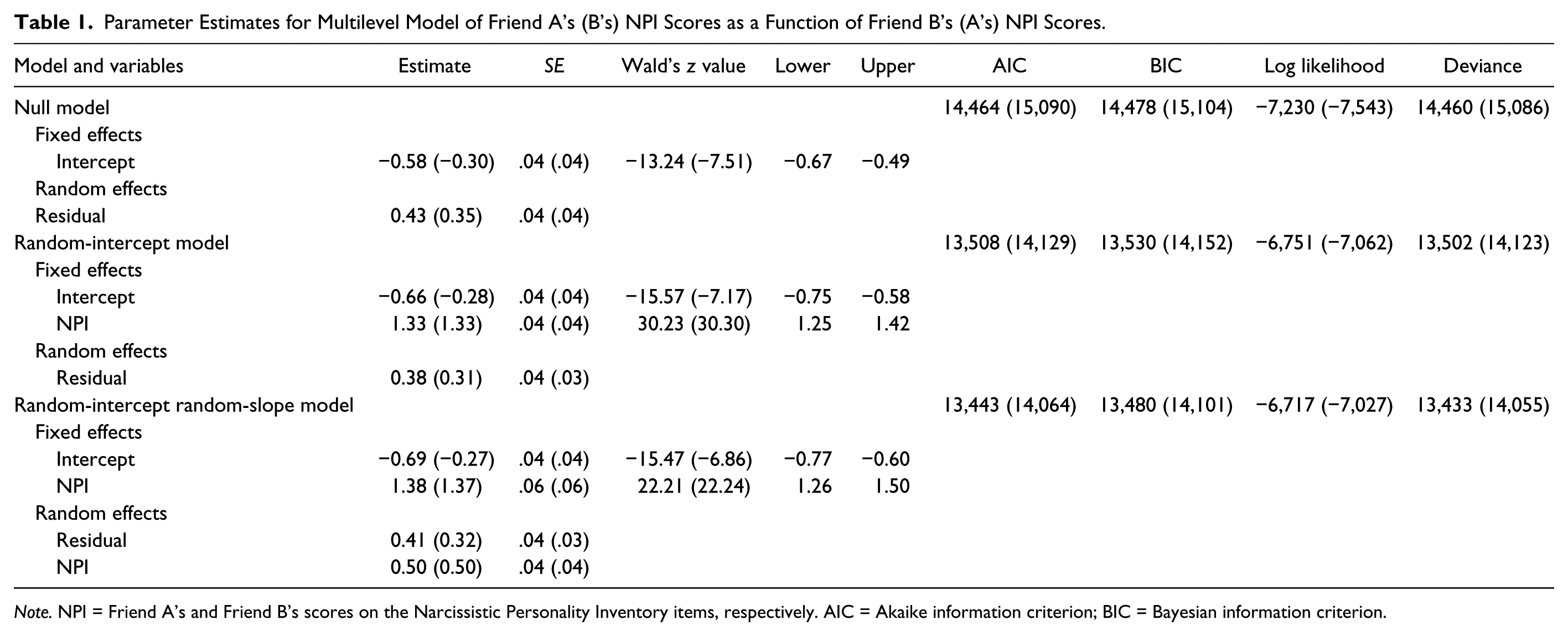
Note. NPI = Friend A’s and Friend B’s scores on the Narcissistic Personality Inventory items, respectively. AIC = Akaike information criterion; BIC = Bayesian information criterion.
Hierarchical regression analysis
The current analysis determined distinctive similarity indices (DS) for the Big Five in general along with its domains, and the Dark Triad variables. We used similarity on narcissism (DSNarc)—the random coefficients from the multilevel analysis—as predictor (Does the friends’ similarity in narcissism predict similarities in the Big Five profiles? Does the gender composition of a friendship moderate these relationships?). The DS coefficients of the Big Five were used as dependent variables in hierarchical regression analyses because they are adjusted for normative influences and provide a measure of mutual deviations from the norm. Hence, higher DS coefficients provide information about the similarity to extreme (above and below average, respectively) scores.
In a first regression block (Model 1), the Fisher’s z-transformed DS coefficients of each Big Five domain were regressed on the distinctive similarities in psychopathy (DSPsych), Machiavellianism (DSMach) and narcissism (DSNarc), the mean across both friends’ narcissism sum scores (Narc), and the gender composition within a friendship. Narc was included to get a more profound understanding of the associations within the data. It is possible that dyads with high DS coefficients do not necessarily have the highest mean levels of narcissism. High DS coefficients show that two friends have both high and low distinctive profiles (i.e., share unusually high or low traits). However, it does not show whether both friends have the same degree of deviation from the norm. Thus, the inclusion of the mean tests whether dyads with higher average narcissism scores are also more similar on the Big Five traits. The gender composition could either consist of two men, one man and one woman, or two women. Thus, this variable was dummy coded and described the change in personality similarity (a) from a solely male friendship to a mixed one (Mixed) and (b) from a solely male friendship to a solely female one (Female).
Meta-analytical evaluation of the specific effect of similarity in narcissism 2
In a last step, the question whether similarity in the Big Five might be driven by similarity in narcissism in particular or whether it is the other way around was addressed (i.e., that friends are just more similar when being similar in one of the Big Five domains). In other words, we provided a test yielding evidence pertaining to the main hypothesis that similar narcissists will be more similar to each other on the Big Five and that this is not due to similarity on the other measures of the Big Five. For this purpose, we first calculated a series of multiple regressions with DSNarc being the moderator and the similarity in two of the Big Five domains being another predictor and the criterion, respectively. Because there are five Big Five domains, there will be 10 combinations of the Big Five (i.e., 10 multiple regressions). Equation 5 gives an example for the extraversion–agreeableness pair. In a next step, additional 10 regression models were examined, which included DSNarc as the dependent variable and similarity in two of the Big Five domains as predictors (see Equation 6 for an example for the extraversion–agreeableness pair). To answer the research question, the regression weight b3 has to be compared. As there are 10 such weights from each series of a regression, two meta-analyses were conducted. The hypothesis would be supported when the meta-analyzed effect size for similarity in narcissism as a moderator would be significantly different from the meta-analyzed effect size for similarity in the other Big Five domains (i.e., their confidence intervals [CIs] would not overlap).
All predictors were z-standardized before extracting the b3 coefficients to use them in the meta-analyses (Kim, 2011). The R package metafor (Viechtbauer, 2010) was applied to specify a random-effects model for the meta-analyses of the 2 × 10 regressions. There are dependencies between the dependent variables (similarity in the Big Five) for the models with similarity in narcissism as moderator. To control for that, the variance–covariance matrix of the b3 coefficients was calculated after all models had been estimated using bootstrapping (W. Viechtbauer, personal communication, November 11, 2015).


Results
Are Best Friends’ Personality Profiles Similar to Each Other (i.e., Do They Deviate From the Norm in the Same Direction)?
Intraclass correlations
With respect to a general dependency within two friends’ personality profiles ICCs for each of the personality traits were calculated. The question was to what extent friendship dyads were more similar on each of the traits than random pairings of individuals? A positive ICC shows that two friends are more similar to each other than to friends of other dyads. If the similarity between dyads would be higher than within them, the ICC would be negative. As can be seen in Table 2, the medians of ICCs vary between .51 (narcissism) and .79 (psychopathy). Hence, it was quite likely that two friends rated their personalities in a similar way.
Descriptive Statistics for Big Five Domains, the Dark Triad Traits in the Sports Student Group and Friend Group, and the Similarity Indices.
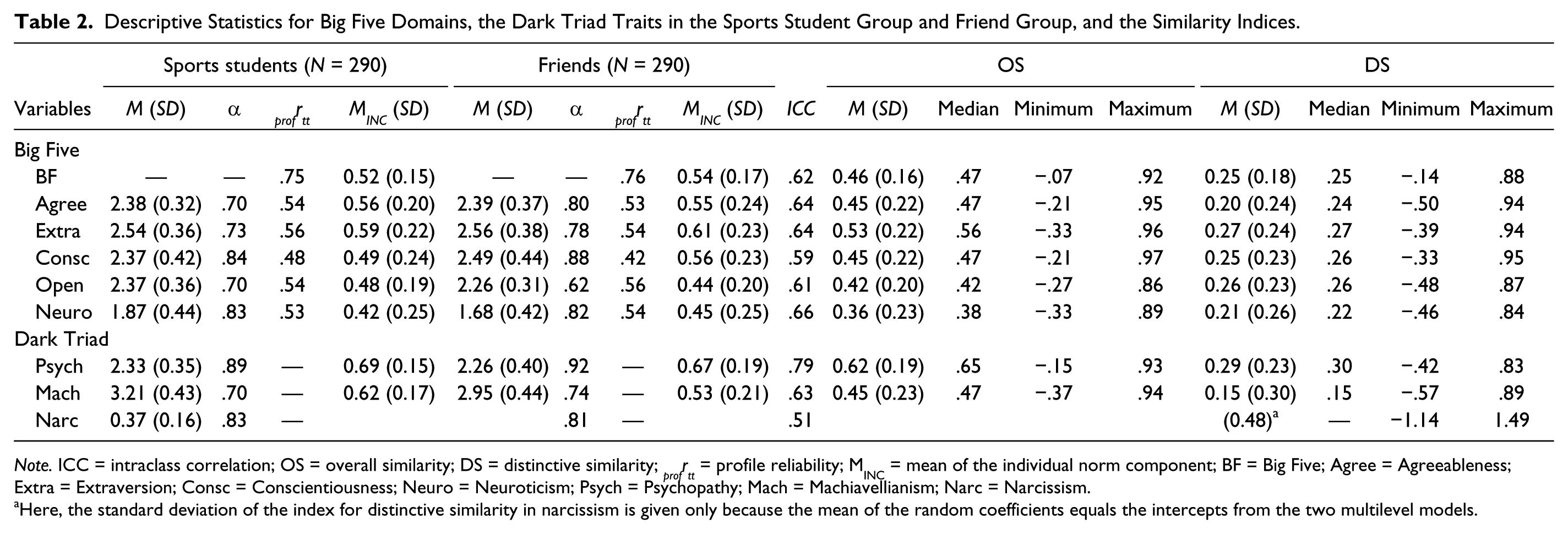
Note. ICC = intraclass correlation; OS = overall similarity; DS = distinctive similarity; profrtt = profile reliability; MINC = mean of the individual norm component; BF = Big Five; Agree = Agreeableness; Extra = Extraversion; Consc = Conscientiousness; Neuro = Neuroticism; Psych = Psychopathy; Mach = Machiavellianism; Narc = Narcissism.
Here, the standard deviation of the index for distinctive similarity in narcissism is given only because the mean of the random coefficients equals the intercepts from the two multilevel models.
Descriptive statistics for DS coefficients
Table 2 also provides an overview of descriptive statistics for INC, OS, DS, and DSNarc. Overall, the friends were fairly similar to each other: For all variables, the OS coefficients were moderate (from .36 to .62), indicating that, on average, friends had relative similar personality profiles on all variables. Also, the INC coefficients were moderate for all variables (from .42 to .69) indicating that each participant’s profile resembled the average profile within the sample to a moderate to high degree. With respect to above- or below-average aspects of two profiles, the ranges of the DS coefficients showed that there were friends who almost perfectly shared unusually high and low Big Five trait levels (see Figure 1). However, there were also dyads that had relatively contradicting profiles. Thus, on average, the DS coefficients were small (.15) to moderate (.29). Because it is generally expected for DS to be lower than OS (Furr & Wood, 2013), the DS coefficients obtained here appear rather large and indicate a moderate degree of similarity in terms of the non-normative aspects of friends’ personalities. The highest average for DS could be found for the psychopathy profile (DSPsych = .29). There was a great variance in all DS ranges within the sample (between −0.57 and 0.95). Interestingly, the random coefficients for narcissism varied similarly (between −1.16 and 1.50). Nonetheless, the mean coefficient was almost zero, indicating that, on average, the friends were not very similar with respect to their narcissism profiles. To explain the large variance in similarities within the sample, hierarchical regression analyses were conducted.
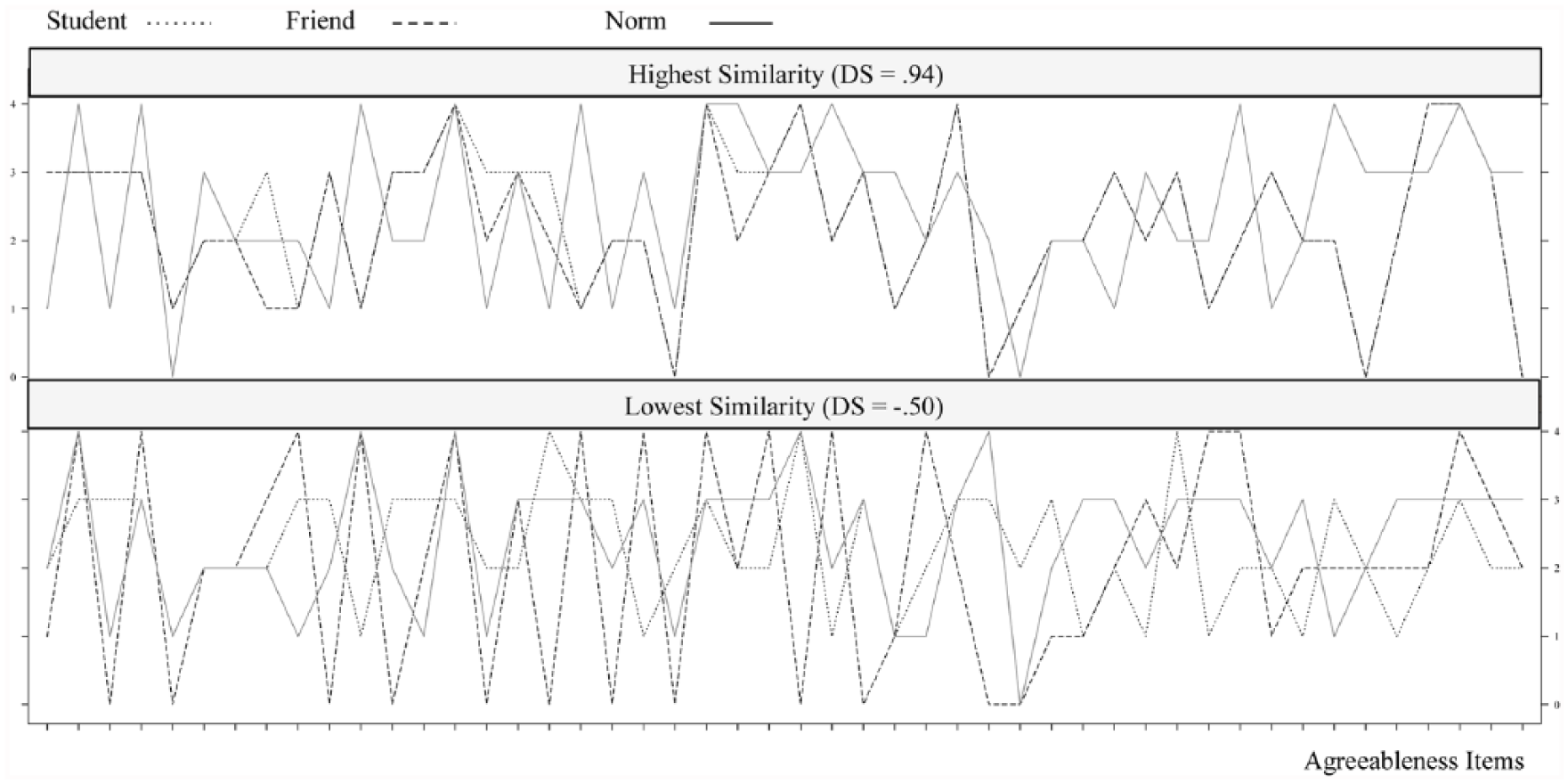
Agreeableness profiles for two best friends with the highest and lowest distinctive similarity coefficients.
Correlation between variables
Pearson correlations for all variables included in the regression analyses can be found in Table 3. All DS coefficients were significantly associated with each other. However, the mean level of two friends’ narcissism correlated with DSAgree and DSConsc only, indicating that higher levels of narcissism within a dyad go along with higher similarity in agreeableness and conscientiousness. The dyads’ mean level of narcissism was not significantly associated with similarity in narcissism.
Correlation for All Variables Included in the Hierarchical Regression Models.
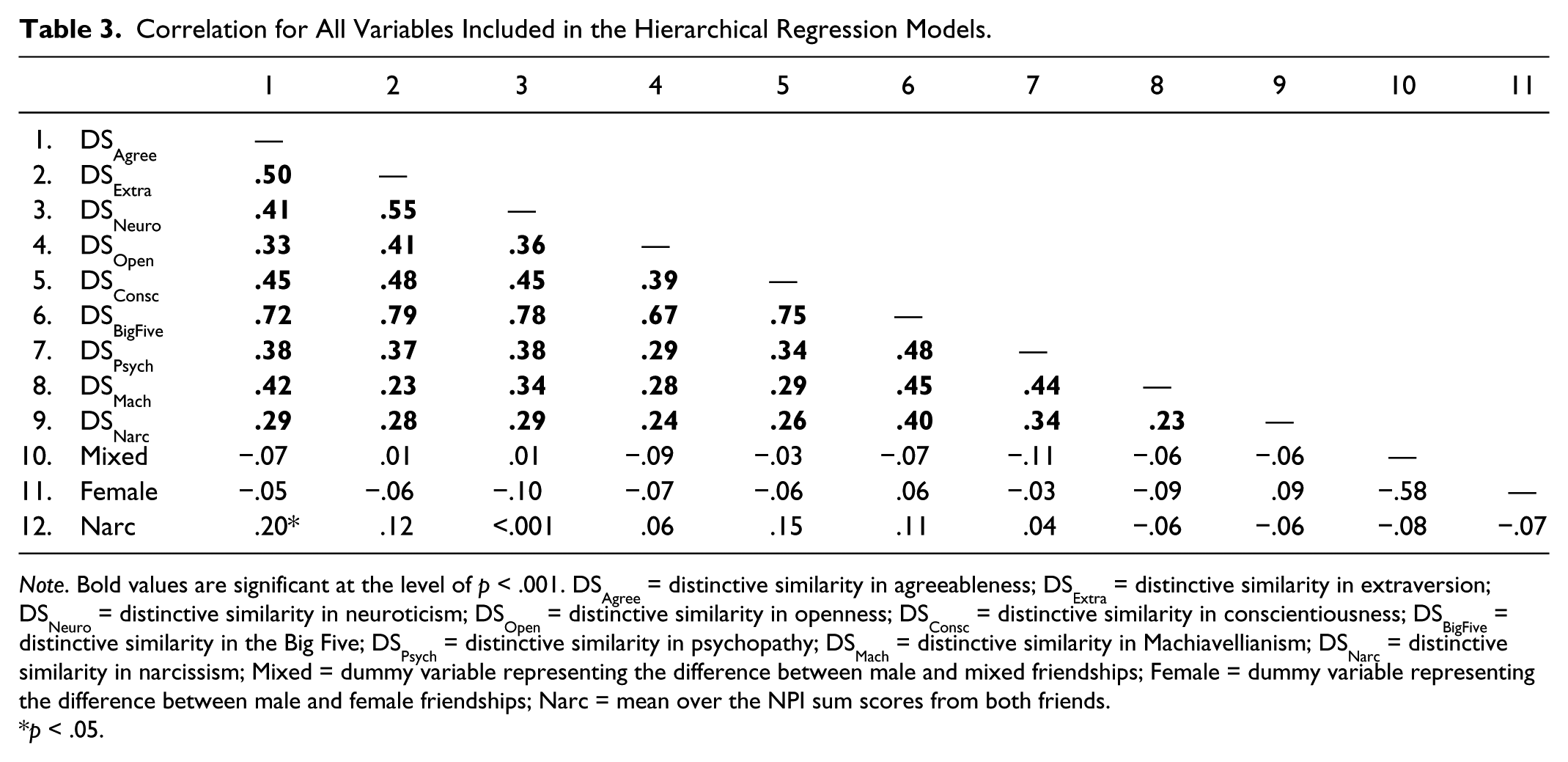
Note. Bold values are significant at the level of p < .001. DSAgree = distinctive similarity in agreeableness; DSExtra = distinctive similarity in extraversion; DSNeuro = distinctive similarity in neuroticism; DSOpen = distinctive similarity in openness; DSConsc = distinctive similarity in conscientiousness; DSBigFive = distinctive similarity in the Big Five; DSPsych = distinctive similarity in psychopathy; DSMach = distinctive similarity in Machiavellianism; DSNarc = distinctive similarity in narcissism; Mixed = dummy variable representing the difference between male and mixed friendships; Female = dummy variable representing the difference between male and female friendships; Narc = mean over the NPI sum scores from both friends.
p < .05.
Does the Friends’ Similarity in Narcissism Predict Similarities in the Big Five Profiles?
Hierarchical regression analysis
Model 1 included the DS of the Dark Triad scores as predictors of similarities in the Big Five. Results are displayed in Tables 4 and 5. DSPsych and DSMach significantly predicted DS in all Big Five variables except for openness and extraversion. Similarly, DSNarc had effects on all DS coefficients except for neuroticism. The mean of two friends’ narcissism scores (Narc) positively predicted DS in agreeableness, conscientiousness, the Big Five overall profile, and marginally in extraversion.
Hierarchical Regression Analysis for Distinctive Similarities of Agreeableness, Extraversion, and Neuroticism (N = 290).

Note. r = zero-order correlation; β1 = standardized regression weight from Model 1, β2 = standardized regression weight from Model 2; DSAgree = Distinctive similarity in agreeableness; DSExtra = distinctive similarity in extraversion; DSNeuro = distinctive similarity in neuroticism; DSPsych = distinctive similarity in psychopathy; DSMach = distinctive similarity in Machiavellianism; DSNarc = similarity in narcissism; Mixed = dummy variable representing the difference between male and mixed friendships; Female = dummy variable representing the difference between male and female friendships; Narc = mean over the sum scores from both friends; Int1 = Interaction between Mixed and DSNarc; Int2 = Interaction between Female and DSNarc; CI = confidence interval.
p < .10. *p < .05. **p < .01. ***p < .001.
Hierarchical Regression Analysis for Distinctive Similarities of Conscientiousness, Openness, and the General Big Five (N = 290).
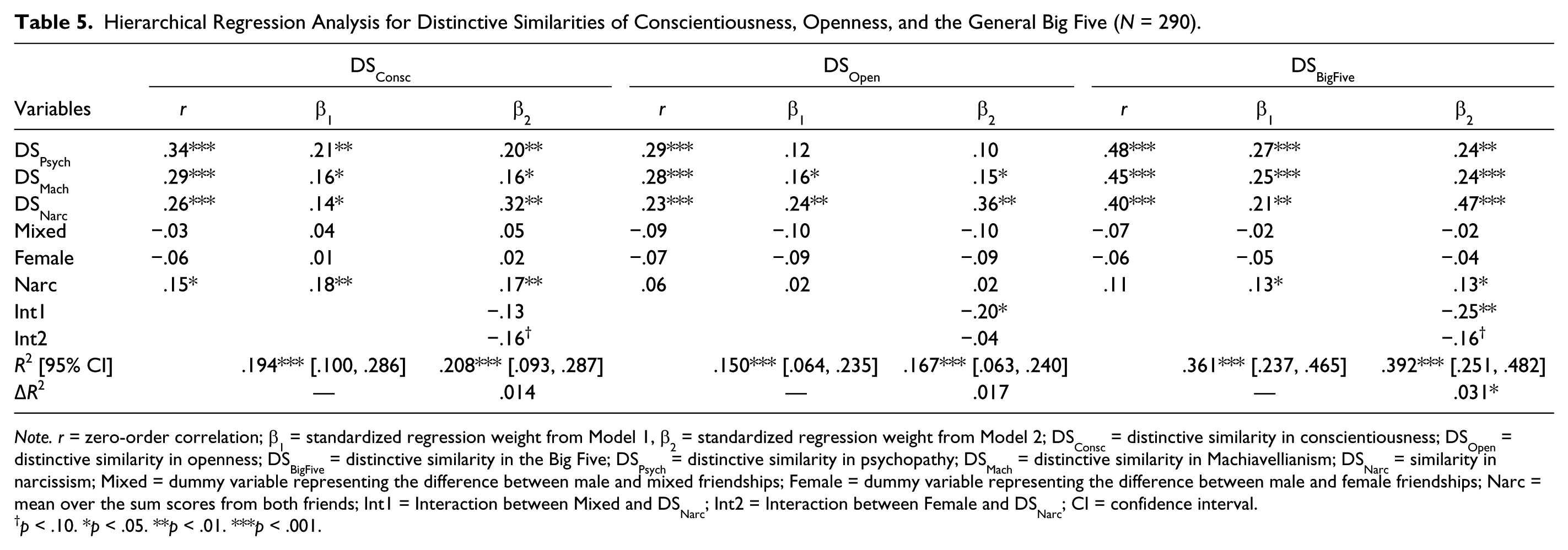
Note. r = zero-order correlation; β1 = standardized regression weight from Model 1, β2 = standardized regression weight from Model 2; DSConsc = distinctive similarity in conscientiousness; DSOpen = distinctive similarity in openness; DSBigFive = distinctive similarity in the Big Five; DSPsych = distinctive similarity in psychopathy; DSMach = distinctive similarity in Machiavellianism; DSNarc = similarity in narcissism; Mixed = dummy variable representing the difference between male and mixed friendships; Female = dummy variable representing the difference between male and female friendships; Narc = mean over the sum scores from both friends; Int1 = Interaction between Mixed and DSNarc; Int2 = Interaction between Female and DSNarc; CI = confidence interval.
p < .10. *p < .05. **p < .01. ***p < .001.
Meta-analytical evaluation of the specific effect of similarity in narcissism
The results of the two series of 10 regression models can be found in Appendix B. The average standardized regression coefficient was β = .11 (SD = .04) for the models with DSNarc as moderator. When DSNarc was the dependent variable, the mean regression coefficient for the interaction terms between two Big Five predictors was β = .004 (SD = .01). The Q statistics, Q(9) = 9.98, p = .35, and Q(9) = 3.61, p = .94, for the models with DSNarc as moderator and for the models with DSNarc as dependent variable, respectively, showed that there was no significant heterogeneity within the effects. The effect of DSNarc as moderator on the prediction of Big Five similarity was significant: β = .10 (95% CI = [.04, .17], p < .01). In contrast, the estimate for the effect of similarity in the Big Five domains predicting DSNarc was nonsignificant (β = .001, 95% CI = [−.01, .01], p = .83). Consequently, the influence from similarity in narcissism on similarity in the other Big Five domains was stronger than the other way around.
Does the Gender Composition of a Friendship Moderate These Relationships?
In Model 2, Mixed and Female as well as the interaction terms between these and DSNarc were added. As can be seen in Tables 4 and 5, only Model 2 for extraversion and the overall Big Five profile made an incremental contribution to the explanation of any of the Big Five DS. In all Models, the main effect of DSNarc remained significant. Although there was no significant main effect of the gender composition (i.e., mixed vs. male friendship and female vs. male friendship, respectively), there was a significant interaction with DSNarc in the prediction of DSExtra and DSBigFive: The effect of DSNarc was especially higher for male (than for female or mixed) friendships (see Figure 2). In general, up to 39% of the variance in the DS of the Big Five could be explained by all the variables in Model 2.
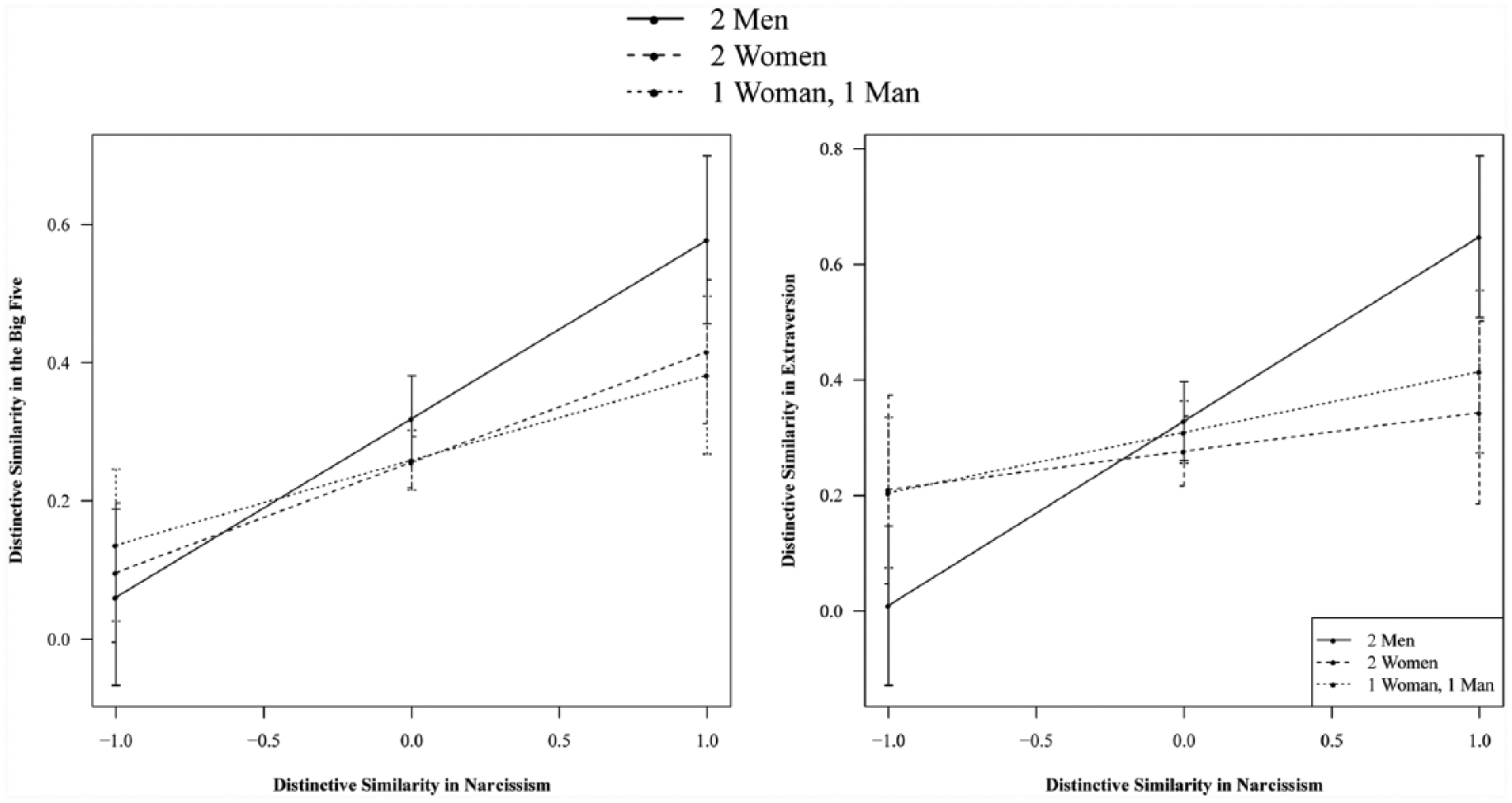
Interaction between gender and distinctive similarity in narcissism for the distinctive similarity in the general Big Five and extraversion, respectively.
Discussion
The current study examined the associations between two friends’ personality profiles depending on their similarities 3 in narcissism (controlling for similarity in the other Dark Triad traits) and the gender composition of the dyad. With respect to narcissism research, this approach is new in two ways: First, it contains data from long-term friends rather than from strangers or short-term acquaintances. Second, the methods used to analyze profile similarities are sophisticated in that they control for effects of normativeness. In the introduction, we wondered who might be willing to expose himself or herself to narcissists on a long-term basis. Our data support the conclusion that someone with a similar personality is willing to be friends with a narcissist. We will consider the role of the other two Dark Triad traits later.
Friends with similar degrees of narcissism have similar standings on the Big Five traits (Hypothesis 1), indicating that it is likely that narcissists of a feather flock together. Summarizing, the data show that similarity in narcissism goes along with similarities in the Big Five profile in general, and in all of its domains (marginally for neuroticism). There was no main effect for the gender composition of the dyad but it moderated the impact of similarity in narcissism on similarity in the general Big Five and extraversion profiles: Male friends were less similar at low levels of narcissism similarity but more similar at high levels of narcissism similarity than females or mixed friendships.
Are the Friends’ Personality Profiles Similar to Each Other?
All similarity coefficients showed small to moderately high mean associations between the personality profiles of friends (between DS = .15 and DS = .29). This contradicts findings from previous studies that found low correlation coefficients ranging between r = .01 and r = .21 (Fuhrman & Funder, 1995; Funder et al., 1995; Kammann et al., 1984; Watson et al., 2000). Because those authors used either simple correlations of traits or profiles without differentiating at the distinctive profile level, our results point to the usefulness of controlling similarity coefficients for the effects of normativeness to get an understanding of the real strength of associations. This approach is well received in other areas such as assumed distinctive similarity and self–other accuracy, as well (e.g., Human & Biesanz, 2012). Future studies should, however, engage more in comparing directly the effects of personality similarity with different techniques and analyses and thereby put more attention to the conceptualization of “similarity.”
Furthermore, the results indicated that the Big Five profiles of sports students and their friends differed quite similarly from the sample’s norm. Nonetheless, there was a great variability within the similarity coefficients: There were dyads with almost identical profiles and dyads with quite opposite profiles. Consequently, we need to trace those factors influencing the amount of similarity.
Does the Similarity in Narcissism Predict These Similarities in Personality?
Results of the present study suggest the important role of similarity in narcissism for the personality similarity of friends. This similarity was related to similarity in the general Big Five as well as in all domains, even when controlling for similarities in the other Dark Triad traits. Hence, one factor for the friends’ personality similarity was the dyadic narcissism similarity.
Narcissists like what they have
It is reasonable to assume that people with similar narcissism profiles are most likely to establish long-term relationships. There is evidence that narcissists (vs. non-narcissists) are even more tolerant of others’ narcissistic traits (e.g., bossy aggressive, arrogant, selfish) when they possess these characteristics themselves (Hart & Adams, 2014). Hart and Adams explain this effect with the similarity-liking principle (Klohnen & Mendelsohn, 1998), based on their positive self-view and tendency to be less repelled by narcissistic traits.
Similarity as a function of self-regulation
The current study assumes self-regulatory mechanisms to lay the groundwork for the formation of friendships with similar others. Although “self-regulation is presumed to steer the narcissist away from ego-threatening people and situations” (Hart & Adams, 2014, p. 166), two narcissistic best friends will probably not threaten each other’s egos. Self-regulation might work on a dyadic friendship level by enhancing each other’s self-worth through in-group and out-group effects. Narcissistic friendships function because they build one unit (in-group) in which their socially disapproved sides are directed against the outside (out-group) and not each other. As long as this pattern is assured, the friendship is maintained. Similarity in all Big Five domains is more likely to guarantee this stability. As described earlier, self-regulatory models of narcissism assume that narcissists use their social interactions purposefully to regulate negative or vulnerable intrapersonal traits. Similar narcissistic friends might help each other to achieve such a rapport by respecting the same life strategy, avoiding conflicts, sharing the same mating behavior and preferences for competition, and displaying the same non-caring attitudes.
Advantages of similarity
Sharing the same deviations from the agreeableness norm, for example, might reduce interactional problems related to narcissism, as both friends would tend to accept a selfish life strategy and would rather focus on benefits than on losses within their relationship. Furthermore, extraversion might be a clear hint that a person is suitable to be a “wingman” or “wingwoman,” because extraversion is associated with a larger number of sexual partners and promiscuity (e.g., Cooper, Agocha, & Sheldon, 2000; Nettle & Clegg, 2008; Schmitt & Shackelford, 2008). In accordance with recent symbolic interactionism approaches, a wingman or wingwoman might be useful for narcissists in several ways (Grazien, 2007). First, they facilitate meeting suitable sexual partners. Second, the wingman or wingwoman can confirm and memorize the other’s success as triumph, which, in turn, enhances mutual self-esteem and meets the need for admiration. Third, this cooperation might serve as a mutual “strategy of impression management and mobilizing masculinity” (Grazien, 2007, p. 238). Self-regulatory mechanisms lead to a striving for social feedback and demonstration of abilities (Morf & Rhodewalt, 2001; Raskin et al., 1991). Consequently, being friends with a similarly narcissistic person seems to reinforce a shared preference for conscientiousness and thereby competition. In addition, a highly neurotic friend would tend to worry, panic easily, and behave more impulsively. Thus, neuroticism contradicts narcissists’ regulation strategies and agentic goals (e.g., Campbell et al., 2006, 2002; Foster et al., 2009). Hence, similarity in neuroticism could be important for narcissists because less neurotic friends would not offer the potential for intimacy and care. In our sample, narcissists are less open than a representative norm. 4 Hence, similarity in openness would probably have the advantage of sharing or avoiding the same interests and activities (e.g., not to visit the museum, not to be attentive to inner feelings) to defend the unit of the friendship against new and open-minded ideas or threats from the outside.
Does the Gender Composition of a Friendship Moderate These Relationships?
Considering the gender composition of a dyad, the above-described effects did not differ for male, mixed, and female friendships on the domain level given the power of the current sample. Replication of results given a larger sample size is therefore needed. However, there was a significant interaction for the general Big Five and extraversion profiles. For all gender compositions, there was a significant positive relationship between the similarities in narcissism and the Big Five. However, a man and his best male friend who are similarly narcissistic were likely to have more similar Big Five profiles than women or mixed friendships. The effect of high similarity in narcissism might be stronger for men, because of a different socialization of men and women. Men are allowed to express more stereotypical narcissistic behavior than women (Morf & Rhodewalt, 2001). Self-centeredness, self-enhancement, less empathy, and preference for interpersonal competition are examples of such stereotypical narcissistic behaviors that correspond to the agreeableness, extraversion, or conscientiousness domains of the Big Five (Morf & Rhodewalt, 2001). In this view, similarity in the general Big Five profile is more associated with male friendships.
Similarity in Machiavellianism and Psychopathy
The data showed that similarities in psychopathy and Machiavellianism also go along with similarities in the Big Five profile in general and in all of its domains except for openness and extraversion, respectively. For narcissism, we argued that similar friends would offer the main advantage to prevent from interactional problems (i.e., for being disagreeable and less conscientious). However, some Big Five traits might match this function better than others. Although psychopaths are seen as more malevolent than the other two (Rauthmann, 2012), similarity in openness might not be that important, because such friends might not be such a “strong” unit that would have to be defended by open-minded ideas from the outside (as narcissists may do). Adding to that, research has not provided a consistent picture of the strength of associations between psychopathy and openness (e.g., Jonason, Li, & Teicher, 2010; Lee & Ashton, 2005; Paulhus & Williams, 2002). In contrast, similarity in extraversion might not be that beneficial for similar Machiavellians, because they are not that interested in having a wingman as narcissists might be. Supporting this idea, Jonason and Schmitt (2012) found that Machiavellians do not wish for sociable friends or friends who help finding mates.
Despite these issues, similarity in Machiavellianism and psychopathy were also strong predictors of similarity in the Big Five. It could be concluded that a similarity in those two traits also requires similar personalities to reduce the risk of losing a friend. More importantly, these effects all occurred after controlling for the general overlap between the dark triad traits. Thus, there are specific effects at work for each of the three dark traits. Without further research, no concrete hypotheses regarding these effects can be drawn here.
Implications for the Study of Similarity in Friendships
The results here suggest that with an increasing narcissism score, it becomes more important to have friends with personalities similar on the deviating-from-the-norm parts. It is therefore plausible to hypothesize that being higher in narcissism might lead people to choose their friends more diligently. Of course, there might be other personality traits that require such careful friend selection as well. In general, assortative friendships that are based on personality similarity might especially be important in the area of norm-deviant traits. As can be seen with adolescents, some people form themselves around others with similar delinquent behaviors (e.g., Young, Rebellon, Barnes, & Weerman, 2014). For this reason, considering distinctive personality similarity would also contribute to the homophily literature (i.e., more similar people interact more often than less similar ones; McPherson, Smith-Lovin, & Cook, 2001), which mostly has focused less on personality traits and more on demographic variables such as race, ethnicity, religion, education, and attitudes.
Limitations and Future Research
There are some limitations that future studies should address. First, there might be the possibility of range restriction within the data. The variances of Narc within the two friend groups did not significantly differ between men and women, F(162, 126) = 1.28 for both groups. With respect to DSNarc, there was a significant difference only in one group F(161, 125) = 1.54, p < .01, respectively. Such range restriction would mean that the reported findings are conservative estimates of the effects. Second, it would be interesting to examine the unique effects of a person’s narcissism on the Big Five traits in dependence of the unique friends’ narcissism scores. Differentiating actor and partner effects (i.e., by using the Actor-Partner-Interdependence-Model; Kenny & Kashy, 2000) would shed additional light on the effects of narcissism in friendships. For instance, there is evidence that narcissism is associated with negative perceptions of (not) well-known people (Back et al., 2013; Wood, Harms, & Vazire, 2010). This might apply for friends as well. Third, future study designs could include friendship satisfaction within their analyses as well as it should be controlled for self-esteem when dealing with narcissism (Paulhus, 2001; Sedikides, Rudich, Gregg, Kumashiro, & Rusbult, 2004). Last but not least, the focus in this analysis was similarity in narcissism. Results, however, suggest an important role of the similarities in Machiavellianism and psychopathy as well. A more comprehensive theory for the differential effects of the Dark Triad is needed here.
Conclusion
The current study demonstrated that the distinctive similarity in the Dark Triad influences the distinctive personality similarity of good friends. Especially with increasing distinctive similarity in narcissism, the two friends’ distinctive similarity in the Big Five increases. Although the results indicate that the effect of narcissism similarity was stronger for male friends, there is conclusive evidence showing that all narcissists of a feather flock together.
Footnotes
Appendix A
Appendix B
Appendix C
Declaration of Conflicting Interests
The author(s) declared no potential conflicts of interest with respect to the research, authorship, and/or publication of this article.
Funding
The author(s) received no financial support for the research, authorship, and/or publication of this article.

Notes
References
Supplementary Material
Please find the following supplemental material available below.
For Open Access articles published under a Creative Commons License, all supplemental material carries the same license as the article it is associated with.
For non-Open Access articles published, all supplemental material carries a non-exclusive license, and permission requests for re-use of supplemental material or any part of supplemental material shall be sent directly to the copyright owner as specified in the copyright notice associated with the article.
