



Abstract
How much should people ask of their relationships? Whereas several perspectives suggest high standards should make actual outcomes feel worse by comparison and thus harm relationships, other perspectives suggest high standards should motivate people to exert the effort necessary to cultivate quality partnerships. The current 4-year longitudinal study of newlywed couples reconciled these competing perspectives by testing a prediction implicit in Finkel, Hui, Carswell, and Larson’s suffocation model of marriage—that spouses’ standards interact with factors reflective of their abilities to meet those standards to predict subsequent satisfaction. Among spouses who either reported less severe problems or were in marriages observed to be characterized by lower levels of destructive behavior, standards were positively associated with satisfaction over time; among spouses who reported more severe problems or were in marriages characterized by higher levels of destructive behavior, in contrast, standards were negatively associated with satisfaction over time.
Which is the best psychological strategy for achieving a personally fulfilling relationship: Should intimates demand a lot from their relationships, or should they demand only a little? At its core, this question addresses the psychological implications of interpersonal standards, and there are different theoretical perspectives on how such standards should affect relationship functioning.
Several interpersonal perspectives suggest intimates may benefit from having lower interpersonal standards. Specifically, both interdependence theory (Thibaut & Kelley, 1959) and the ideals standards model (Fletcher & Simpson, 2000; Simpson, Fletcher, & Campbell, 2001) suggest that people should be more satisfied with their relationships to the extent that they perceive that their relational experiences meet or exceed their interpersonal standards. Consistent with both theories, prior research indicates that greater consistency between intimates’ interpersonal perceptions and standards is positively associated with concurrent relationship satisfaction (Campbell, Simpson, Kashy, & Fletcher, 2001; Fletcher, Simpson, & Thomas, 2000; Fletcher, Simpson, Thomas, & Giles, 1999; Overall, Fletcher, & Simpson, 2006) and negatively associated with relationship dissolution (Fletcher et al., 2000). Given that lower standards are logically easier to meet than are higher ones, this work could be interpreted to suggest that lower interpersonal standards should be more interpersonally adaptive.
Nevertheless, a separate body of work provides reason to expect that higher interpersonal standards should benefit relationships. Specifically, a large body of work outside the domain of relationships posits that higher standards motivate people to exert the higher levels of effort required to achieve more optimal outcomes (e.g., Atkinson, 1964; Bandura, 2001; Feather, 1992; Lewin, 1938; Lewin, Dembo, Festinger, & Sears, 1944; Locke, Shaw, Saari, & Latham, 1981; Wigfield & Eccles, 2000). Work in support of expectancy-value theory, for example, indicates that placing a higher value on outcomes motivates people to work harder to achieve those outcomes (e.g., Atkinson, 1964; Feather, 1992; Wigfield & Eccles, 2000). Cultivating a high-quality, long-term partnership requires great effort, and these theoretical perspectives suggest that people who have higher standards for their relationships should be more likely to exert that effort.
How can we reconcile these contrasting predictions? One way may come from considering a more nuanced perspective—Finkel, Hui, Carswell, and Larson’s (2014) recent suffocation model of marriage. Drawing on Maslow’s (1943) hierarchy of needs, Finkel et al. argue that modern spouses are demanding that their marriages fulfill more of their esteem and self-actualization needs, what Finkel et al. call “higher-altitude” needs, than did spouses in earlier eras. At the same time, argue Finkel et al., modern spouses face numerous constraints that make meeting such high standards difficult, which has resulted in a larger gap between their interpersonal standards and perceived outcomes. Consistent with interdependence theory and the ideal standards model, Finkel et al. directly link this growing gap between standards and perceived outcomes to the increased levels of marital dysfunction that have occurred in recent history. Accordingly, consistent with the risks associated with high standards, Finkel et al. note that one way modern spouses can reduce the gap between their standards and perceived outcomes and thus improve their marriages is by lowering their standards. Nevertheless, Finkel et al. also note that an alternative way spouses can reduce this gap is by engaging in more and/or better relationship maintenance behaviors. In fact, consistent with the potential benefits of high standards, they explicitly state that spouses who find ways to meet extensive high-altitude standards may benefit by “reaching heights that few could have attained in previous eras” (p. 16).
This nuanced perspective is insightful because it suggests that the implications of intimates’ interpersonal standards depend on not only whether those standards are high versus low but also the broader context of the relationship (for related discussion, see McNulty, in press)—specifically whether those standards are compatible with qualities of the relationship itself. Although high standards may motivate intimates to work to improve or maintain their relationships, as suggested by expectancy-value and related theories, the suffocation model highlights the fact that various constraints prevent some spouses from meeting higher standards despite even the highest motivations; indeed, some relationships face larger obstacles to success than do others (e.g., stress, interpersonal problems, intrapersonal vulnerabilities), and some spouses possess more and better interpersonal skills than do others (e.g., adaptive supportive and problem-solving behaviors, adaptive cognitions; see Karney & Bradbury, 1995). Thus, although high standards may lead to more motivation and thus more attempts at relationship maintenance on average, whether such attempts are successful in producing better outcomes, and thus whether higher standards ultimately result in higher satisfaction, should depend on intimates’ abilities to meet such standards. Intimates who possess the skills and abilities required to meet higher standards should be most likely to exploit such skills and thus achieve higher levels of satisfaction when motivated to do so, and high standards should provide that motivation; relatively lower standards should be a liability for such intimates because they should prevent them from fully realizing their interpersonal potential. Intimates who lack the skills and/or abilities required to meet higher standards, in contrast, should be less likely to meet such standards, regardless of their motivation, and thus high standards should merely create greater discrepancies between demands and outcomes among such intimates, ultimately leading to less satisfaction; relatively lower standards should allow such intimates to strike a better balance between their demands and outcomes.
Prior work has not directly addressed this possibility. Most prior work on the implications of interpersonal standards has examined the implications of intimates’ perceptions that they are currently meeting their standards, rather than the absolute level of the standards themselves (Campbell et al., 2001; Fletcher et al., 2000; Fletcher et al., 1999; Overall et al., 2006). Moreover, one exception (Fletcher et al., 2000) revealed that the absolute level of intimates’ standards were unrelated to intimates’ subsequent relationship evaluations. One interpretation of this null effect is that everyone should simply lower their interpersonal standards to achieve greater consistency between their standards and their perceptions—after all, the level of the standards themselves does not appear to ultimately matter. Nevertheless, a very different interpretation of this null main effect is that it masks the two important simple effects that can be predicted based on the suffocation model; that is, high standards have benefits for intimates who have the ability to meet them but costs for intimates who do not, and these costs and benefits average out to appear as a null main effect when the moderating role of ability is ignored.
Research on the role of probabilistic expectancies has provided some indirect evidence for this predicted interaction. Specifically, McNulty and Karney (2004) demonstrated that spouses who expected more positive interpersonal outcomes from their marriages in the future experienced more stable levels of marital satisfaction over the subsequent 4 years of those marriages when they possessed the cognitive and behavioral skills necessary to meet such expectancies but steeper declines in satisfaction when they did not. Those authors predicted such effects based on reasoning similar to the reasoning laid out by Finkel et al. (2014)—positive expectancies can help spouses create and perceive better interpersonal outcomes through processes of expectancy confirmation, but they do so at the risk of creating counterfactuals that make outcomes look worse by comparison.
Nevertheless, this support is indirect because, although probabilistic expectancies and standards likely share empirical variance, they are conceptually unique (Olson, Roese, & Zanna, 1998). Whereas probabilistic expectancies are predictions regarding the likelihood of future outcomes (“I believe my partner will be attractive to me in the future”), standards are values placed on those outcomes (“It is important that my partner is attractive to me”). Accordingly, unlike probabilistic expectancies, standards necessarily involve values, which are likely to be more strongly associated with desires, or motivations, to perceive the relationship in a particular light, and a long history of research on social cognition indicates that such motivated beliefs can shape interpersonal conclusions in ways that more probabilistic beliefs do not (Kunda, 1990). Accordingly, any implications of high standards associated with the desire to see the relationship in a more positive light may lead standards to have effects that are different from the effects of probabilistic expectancies observed by McNulty and Karney (2004). For example, prior research indicates that motivations can lead people to perceive their partners in a more positive light (Lemay & Clark, 2015; Murray, Holmes, Dolderman, & Griffin, 2000), and thus high standards may prevent people from even noticing whether their partners and relationships fail to meet their standards.
Overview of the Current Study
The current longitudinal study had one primary goal and one secondary goal. The primary goal was to provide an empirical test of Finkel et al.’s (2014) suffocation of marriage model. Spouses completed two measures indicating their tendencies to hold elevated “high-altitude” interpersonal standards, two measures reflective of their abilities to confirm such standards, and two measures of marital satisfaction at baseline, and then continued to report their marital satisfaction every 6 months for 4 years. Analyses tested whether spouses’ abilities to meet their standards moderated the implications of those standards for the trajectory of their relationship satisfaction. The secondary goal was to examine whether any interactive effects of interpersonal standards were independent of corresponding interactive effects of spouses’ probabilistic expectancies. Spouses also completed measures of probabilistic expectancies similar to those assessed by McNulty and Karney (2004), and analyses examined whether the interactive effects of standards and abilities emerged independent of the interactive effects of expectancies and abilities.
Method
Participants
Participants were 135 newlywed couples living in eastern Tennessee. The study was limited to 135 couples because they were those who completed the baseline portion of the study within the 1-year recruitment time frame. A post hoc power analysis that accounted for the repeated assessments, as well as nonindependence of those assessments and the dyadic nature of the data, using equations provided by Snijders and Bosker (2011) and Kenny, Kashy, and Cook (2006; see Finkel, Eastwick, & Reis, 2015), indicated that the power to detect the average effect was .80. Couples were recruited using two methods. The first was to place advertisements in community newspapers and bridal shops offering payment to couples willing to participate in a longitudinal study of newlyweds. The second was to send invitations to eligible couples who had completed marriage license applications in nearby counties. All couples responding to either method of solicitation were screened for eligibility in an initial telephone interview. Inclusion required that (a) this was the first marriage for each partner, (b) the couple had been married less than 6 months, (c) each partner was at least 18 years of age, (d) each partner spoke English and had completed at least 10 years of education (to ensure comprehension of the questionnaires), and (e) couples did not yet have children and wives were not older than 35 (to allow a similar probability of transitioning to first parenthood for all couples, as part of broader aims of the study).
On average, husbands were 25.9 years old (SD = 4.6) and had completed 15.8 years (SD = 2.5) of education. Seventy percent were employed full time, and 26% were full-time students. Wives were 24.2 years old (SD = 3.6) and had completed 18.9 years (SD = 2.3) of education. Fifty-six percent were employed full time, and 28% were full-time students. The average combined income of couples was less than US$40,000. The majority of husbands (91%) and wives (93%) identified as Caucasian.
Procedure
Before an initial laboratory session, spouses completed a packet of questionnaires that contained a consent form approved by the local human subjects review board, self-report measures of relationship standards, interpersonal expectancies, the severity of relationship problems, marital satisfaction, and a letter instructing couples to complete all questionnaires independently of one another and to bring their completed questionnaires to the upcoming session. Upon arriving to that session, each spouse identified an area of difficulty in the marriage, and then, both spouses participated in two 10-min videotaped discussions in which they were left alone to “work toward some resolution or agreement” for each area of difficulty. The behaviors exhibited during these discussions served as one measure of spouses’ abilities to meet high standards. The order of the two interactions was determined through a coin flip. If both spouses chose the same topic, they first discussed that topic and then discussed a second topic chosen by the spouse whose topic was designated to be discussed second. After completing their interactions, couples were paid US$80 for participating in this phase of each study.
At approximately 6- to 8-month intervals subsequent to the initial assessment, couples were recontacted by phone and again mailed measures of marital satisfaction and marital problems, along with postage-paid return envelopes and a letter of instruction reminding couples to complete the surveys independently of one another. After completing each follow-up phase, couples were mailed a US$50 check for participating. One exception is that the sixth assessment also contained a laboratory session similar to the one that occurred at baseline. Two couples did not complete any follow-up assessments and thus are not included in any of the primary analyses. Ten couples divorced over the course of the study, but they provided multiple reports prior to divorce and are thus included in all analyses.
Measures
Standards
To ensure that any observed effects were not unique to a specific measurement, psychological standards were assessed using two different measures. For this first test of predictions derived from the suffocation model, I relied on an existing measure of relationship standards and a measure derived from an existing measure of relationship qualities. Given these measures were developed rather recently, both focus almost exclusively on “high-altitude” standards (love, esteem, caring, etc.). The first was based on the two relationship subscales of the Short Version of the Partner and Relationship Ideal Scales (Fletcher et al., 1999). Specifically, spouses responded to the question stem “how important is it to you that your relationship be characterized by” with respect to 12 characteristics: honesty, commitment, caring, trust, support, respect, excitement, challenge, humor, fun, independence, and passion. Participants responded on a scale from 1 = not at all to 7 = completely. Scores were averaged to form an index of relationship standards referred to as Standards Measure 1. Internal consistency was adequate (for husbands, α = .86; for wives, α = .80).
The second measure of standards was a modified version of the Inventory of Marital Problems (IMP; Geiss & O’Leary, 1981). Spouses read the stem “indicate how important each of the relationship dimensions listed below is to you” and then viewed 17 relationship domains (e.g., communication, showing affection, money management, sex, trust, independence) that they rated on a scale from 1 = not at all important to 5 = extremely important. Spouses’ ratings of each item were averaged to form a second index of relationship standards referred to as Standards Measure 2. Internal consistency was adequate (for husbands, α = .85; for wives, α = .85).
Ability factors
Observed negative behavior
In the absence of established criteria for assessing spouses’ ability to meet their standards, the current research operationalized this broad construct with two different proxies. Given that the most basic building block of any relationship is the behaviors partners exchange (Kelley et al., 1983) and, further, given that the ability to resolve problems is crucial to remaining satisfied (McNulty, O’Mara, & Karney, 2008), the first was the behaviors partners exchanged during observed problem-solving discussions (see McNulty, 2008; McNulty & Karney, 2004). Indeed, such behaviors have been long considered skills that some intimates possess, whereas others do not (e.g., Bradbury & Karney, 2004; Halford, Markman, & Stanley, 2008; Jacobson, 1977; Jacobson & Margolin, 1979; Stanley, Blumberg, & Markman, 1999). Although a recent work has challenged which skills are adaptive over time by showing that direct confrontational strategies (e.g., blaming, demanding) can be adaptive over time for some couples, that work has also shown that indirect hostility appears to be relatively universally maladaptive (see McNulty & Russell, 2010; Overall, Fletcher, Simpson, & Sibley, 2009). In an effort to examine the moderating implications of behaviors that were most destructive, the current analyses relied on only codes of their indirect hostility using the Verbal Tactics Coding Scheme (Sillars, 1986; Sillars, Coletti, Parry, & Rogers, 1982). Each speaking turn by each spouse was coded, and a speaker received an Indirect Negative code for speaking turns that indirectly blamed, commanded, or rejected the partner through presumptive attributions (e.g., “I know how you really feel about this.”), hostile questions (e.g., “Well, who’s idea was that?”), avoiding responsibility (e.g., “I can’t stop.”), and sarcasm (e.g., “Yeah, that’s a good idea.”). To most clearly assess destructive communication, if the same speaking turn also contained more direct confrontational statements, such as blames, commands, or rejections, the speaking turn received a direct negative code rather than an indirect negative code (see McNulty & Russell, 2010). Because we were interested in the total frequency with which each spouse tended to exhibit indirect hostility, we computed a total proportion indirect hostile behavior exhibited by each spouse in each conversation by dividing the number of indirect hostile codes for each spouse in each conversation by the total number of speaking turns for that spouse in that conversation. Given our hypotheses did not distinguish between husbands’ and wives’ topics but rather were best tested using the behaviors exchanged during these discussions as a proxy for spouses’ tendencies toward exchanging negative behaviors during problem-solving discussions generally, we collapsed across the two conversations to form an index of the average tendency for each spouse to exhibit indirect hostility across both conversations. Furthermore, given that both partners’ communication skills are important to relationship outcomes (Heyman, 2001), we averaged across the indices of both partners to arrive at an average tendency for the couple to exhibit indirect hostility.
To determine the reliability of our coding, we randomly chose approximately 20% of the discussions to be coded by a second rater. Given our analyses were based on the total proportions of each behavior observed during each conversation, agreement between coders was assessed by calculating intraclass correlation coefficients (ICC) between the proportions of speaking turns given the same code by each coder (see Shrout & Fleiss, 1979). Reliability was adequate, ICC = .88). Two couples refused to be recorded, and both conversations from a third couple were damaged, leaving only 130 couples for analyses involving this measure of ability.
Severity of relationship problems
In an effort to be thorough, I also examined a different indicator of spouses’ ability to meet their standards. Whereas hostile behavior is a direct assessment of spouses’ behavioral skills and abilities, the other index of spouses’ ability to meet their standards was an indirect global proxy of the extent to which spouses appeared to be capable of achieving relatively desirable outcomes at each wave of measurement—spouses’ self-reports of the severity of the problems they experienced in their relationships (see McNulty et al., 2008; McNulty & Russell, 2010). Although perceived problem severity may also be the result of unmet standards, analyses examined the extent to which initial problems moderated the implications of standards for subsequent satisfaction. Problem severity was assessed every 6 months using a version of the IMP (Geiss & O’Leary, 1981). This version lists 17 potential problem areas in a marriage (e.g., money management, trust, making decisions, in-laws, sex, showing affection, drugs and alcohol) and asks participants to rate each item on a scale from 1 = not a problem to 11 = major problem. Spouses’ ratings of each item were averaged to form an index of average problem severity that could range from 1 to 11. Given that the problem of one spouse may not indicate an inability of the other spouse to meet his or her standards, we did not use the average of both spouses’ problems.
Marital satisfaction
Marital satisfaction was also assessed with two different measures at every wave of measurement. The first measure was the quality marriage index (QMI; Norton, 1983). The QMI contains five items that ask spouses the extent to which they agree or disagree with general statements about their marriage (e.g., “We have a good relationship,” “My relationship with my partner makes me happy”) on a scale from 1 = very strong disagreement to 7 = very strong agreement and one item that asks spouses to answer the question “All things considered, how happy are you with your marriage?” on a scale from 1 = very unhappy to 10 = perfectly happy. Thus the scores on the QMI could range from 6 to 45, with higher scores indicating greater marital satisfaction. Internal consistency of this measure was adequate. (Across phases and partners, α was above .85.)
The second measure of global satisfaction was a semantic differential (SMD; Osgood, Suci, & Tannenbaum, 1957). This version of the SMD asks spouses to rate their perceptions of their relationship on 7-point scales between 15 pairs of opposing adjectives (e.g., “bad–good,” “dissatisfied–satisfied,” “unpleasant–pleasant”). Thus, this version of the SMD yields scores from 15 to 105, with higher scores reflecting more satisfaction with the relationship. Internal consistency of this measure was high across all phases of the study (across phases and partners, alpha was above .90).
Covariates
As noted earlier, a secondary goal was to examine whether any interactive effects of standards were independent of interactive effects of expectancies demonstrated in prior research by McNulty and Karney (2004). Although those authors used a different sample than the current sample, the current study also contained two measures of expectancies. The first measure of expectancies was a version of the QMI reworded to ask spouses to report how satisfied they expected to be in the future with their marriage, which approximated McNulty and Karney’s (2004) expectations for the relationship variable. Specifically, this measure asked spouses to “Please indicate how well the following statements describe your expectations for your new marriage,” in which the first five items were preceded by the stem “I expect . . .” and the last item read “All things considered, how happy do you expect to be in your marriage?” The scale for each item was the same as the one used for the current satisfaction version of the QMI, and thus scores could range from 6 to 45, with higher scores indicating more positive expectations. Reliability was high (for husbands, α = .86; for wives, α = .83).
The second measure was derived from the interpersonal qualities scale (see Murray, Holmes, & Griffin, 1996). Spouses were presented with 36 behaviors (e.g., be supportive, be considerate, be kind) and were asked to respond to the stem “to what extent do you expect your new partner to:” using a scale from 1 = not at all to 7 = completely. Reliability was high (for husbands, α = .88; for wives, α = .82). I controlled for interactions involving these measures and two contextual moderators in supplemental analyses.
Results
Descriptive Statistics and Preliminary Analyses
Descriptive statistics of the variables assessed at baseline appear in Table 1. As is to be expected of newlyweds, husbands and wives reported being relatively satisfied with their marriages according to both measures of satisfaction and having relatively minor problems on average. Nevertheless, there was substantial variability in these reports, indicating that some couples were less happy and faced more severe problems than others. Similarly, spouses were observed to have engaged in relatively low levels of indirect hostility on average, yet there was substantial variability in these reports as well. Not surprisingly, given the novelty of the marriages, spouses also appeared to have relatively positive expectancies for the future of their relationships. Finally, consistent with Finkel et al.’s (2014) argument that modern spouses tend to have relatively extensive high-altitude standards, spouses’ reports of their standards were quite high according to both measures, though variability in these reports suggested some spouses demanded more from their relationships than others.
Descriptive Statistics Among Variables at Baseline.
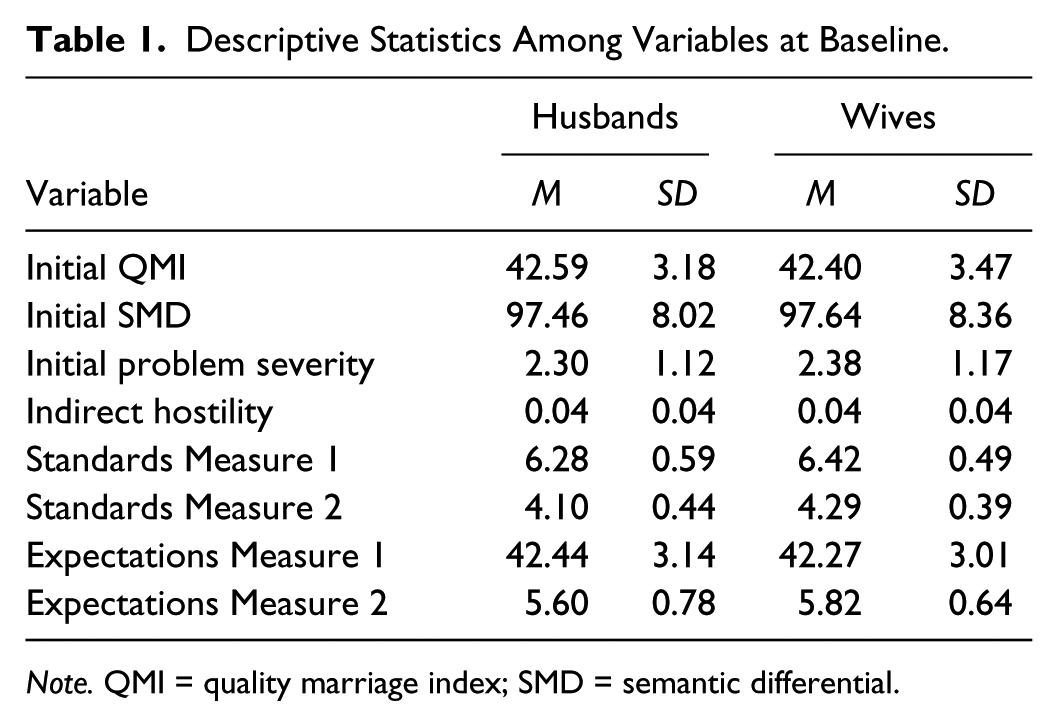
Note. QMI = quality marriage index; SMD = semantic differential.
Correlations among variables assessed at baseline appear in Table 2. As can be seen, husbands’ and wives’ reports were correlated on all variables. In addition, the two marital satisfaction measures were highly correlated with one another among both husbands and wives. Both measures of satisfaction were also strongly negatively associated with the severity of marital problems and weakly negatively correlated with indirect hostility among both husbands and wives. The two contextual variables, problem severity and indirect hostility, demonstrated strong empirical independence among both husbands and wives, suggesting that they would serve as independent tests of the same hypothesis. The two standards measures, in contrast, were moderately positively associated with one another, which is to be expected, given they measured a more-specific construct. Interestingly, standards were positively associated with relationship satisfaction among both husbands and wives on average. However, this association ignores the role of time and context, which was the goal of the primary analyses. Finally, each standards measure was moderately correlated with each expectancies measure, suggesting that these measures shared some empirical similarities that suggest it is important to control for expectancies and their interactions with abilities in supplemental analyses. Nevertheless, a confirmatory factor analysis confirmed that a two-factor model in which expectancies and standards were treated as distinct factors fits the data better than a one-factor model in which they were treated as one factor—for husbands, χ2 diff (1) = 356.95, p < .001; for wives, χ2 diff (1) = 225.24, p < .001. Thus, it is possible that standards and expectancies operate on relationship outcomes in different ways.
Correlations Among Variables at Baseline.

Note. Wives’ correlations are above the diagonal, husbands’ correlations are below the diagonal, and correlations between husbands and wives are on the diagonal. QMI = quality marriage index; SMD = semantic differential.
p < .10. *p < .05. **p < .01.
Did Indirect Hostility Moderate the Association Between Relationship Standards and Marital Satisfaction?
The first set of primary analyses used a series of three-level growth curve analyses to test the prediction that the level of indirect hostility observed during couples’ problem-solving interactions would moderate the association between their standards and their marital satisfaction. In each analysis, reports of marital satisfaction were regressed onto time in the first level of the model, and then, between-person estimates of the intercept and slope parameters were regressed onto the following main predictor variables in the second level of the model: each standardized measure of standards, standardized indirect hostility scores, and the crucial Standards × Indirect Hostility interaction. All intercepts included random effects at Levels 2 and 3, thereby accounting for the nonindependence of individuals’ and couples’ reports. Six versions of this analysis were conducted, one for each of the two measures of standards using each of the two measures of satisfaction, and one for each measure of standards using the average of the two measures of satisfaction (formed from standardized versions of each satisfaction measure).
The results of those analyses appear in Table 3. As can be seen, the Time × Standards × Indirect Hostility interaction was negative and traditionally significant in four of the six analyses and negative and marginally significant in the other two analyses, indicating that the extent to which standards were associated with changes in satisfaction over time depended on the couples’ tendencies to engage in indirect hostility. Plots of the interaction that emerged for each standards measure on the single index of satisfaction appear in the top two panels of Figure 1, where the predicted changes in marital satisfaction are plotted for people who were 1 SD above and below the mean on indirect hostility and each standard. As can be seen, consistent with predictions, each measure of standards appeared to be negatively associated with changes in marital satisfaction among people in relationships characterized by more hostility but positively associated with marital satisfaction among people in relationships characterized by less indirect hostility. Rather than testing the simple effects of standards at such arbitrary values, however, we followed the recommendations of Preacher, Curran, and Bauer (2006) to use the Johnson-Neyman method (Johnson & Neyman, 1936) to identify the exact levels of indirect hostility at which each standard demonstrated significant associations with changes in satisfaction—that is, the regions of significance of the simple effects of standards. This procedure offers a more complete description of the pattern of effects of standards at all levels of indirect hostility.
Standards and Behavior Interacting to Predict the Trajectory of Marital Satisfaction.

Note. Intercept, df = 129; all else, df = 253. QMI = quality marriage index; SMD = semantic differential; r = effect size.
p < .10. *p < .05. **p < .01. ***p < .001.

Standards and behavior interacting to predict marital satisfaction.
Results appear in the top section of Table 4. As can be seen in the second and fourth columns, standards were negatively associated with changes in marital satisfaction in all six analyses. In fact, the upper bound was around 0 SDs in all six analyses, indicating that standards were negatively associated with change in satisfaction for people around and above the mean on indirect hostility. As can be seen in the first column, in contrast, standards as assessed by standards Measure 1 were positively associated with changes in satisfaction among people less than approximately 1.5 SDs below the mean on indirect hostility. The lower bound of the simple effects of the standards assessed by standards Measure 2 was more than 3 SDs below the mean in all three analyses, however, indicating that those standards were not positively associated with changes in marital satisfaction at any levels of indirect hostility that were meaningful in this sample.
Regions of Significance Tests of Simple Effects of Standards at Varying Levels of Indirect Hostility.
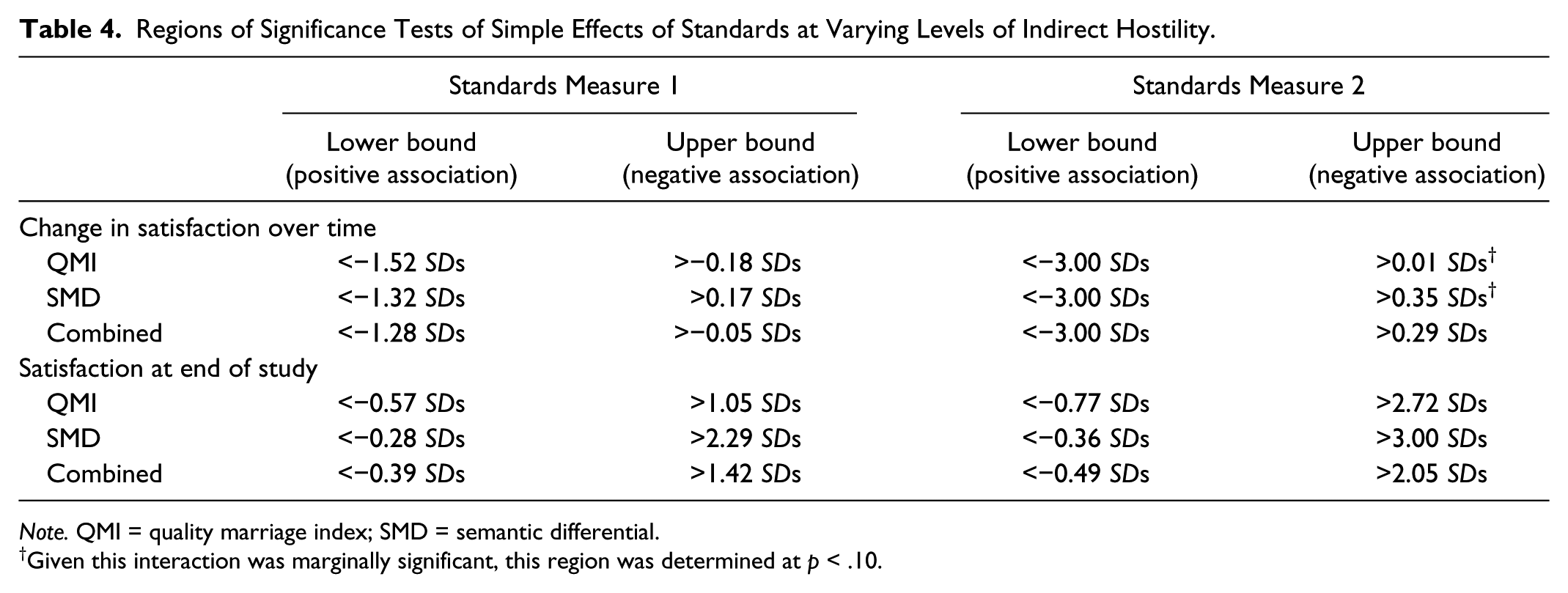
Note. QMI = quality marriage index; SMD = semantic differential.
Given this interaction was marginally significant, this region was determined at p < .10.
Of course, as can be seen in Table 3, standards were also positively associated with initial levels of satisfaction in all six analyses, and this association was not moderated by indirect hostility. Although the interactive effects of standards and indirect hostility on changes in satisfaction are theoretically interesting, these positive associations between standards and initial satisfaction are practically important because they suggest higher standards may have initial benefits that outlast and, thus, offset any negative implications. To address this possibility, the six models were reestimated using a recentered time variable, such that time 8 = 0, making the intercepts represent the predicted mean level of satisfaction at the end of the study.
The results of these analyses are reported in Table 5, where the effects involving time are not reproduced because they are identical to those presented in Table 3. Consistent with the idea that initial standards and initial indirect hostility interact to predict the ultimate levels of satisfaction people experience 4 years into their marriages, all six Standards × Indirect Hostility interactions were negative and significant. The interactive effects of indirect hostility and each standard on the single index of satisfaction are plotted in the bottom two panels of Figure 1. As can be seen, each measure of standards appeared positively associated with satisfaction at the end of the study among spouses in marriages characterized by less indirect hostility but negatively associated with relationship satisfaction among spouses in marriages characterized by more indirect hostility. Indeed, as can be seen in the bottom section of Table 4, regions of significance tests confirmed that psychological standards were significantly positively associated with satisfaction among people less than approximately 0.5 SDs below the mean on indirect hostility but positively associated with satisfaction among people more than approximately 1 or more SDs above the mean on indirect hostility.
Standards and Behavior Interacting to Predict Satisfaction at End of Study.
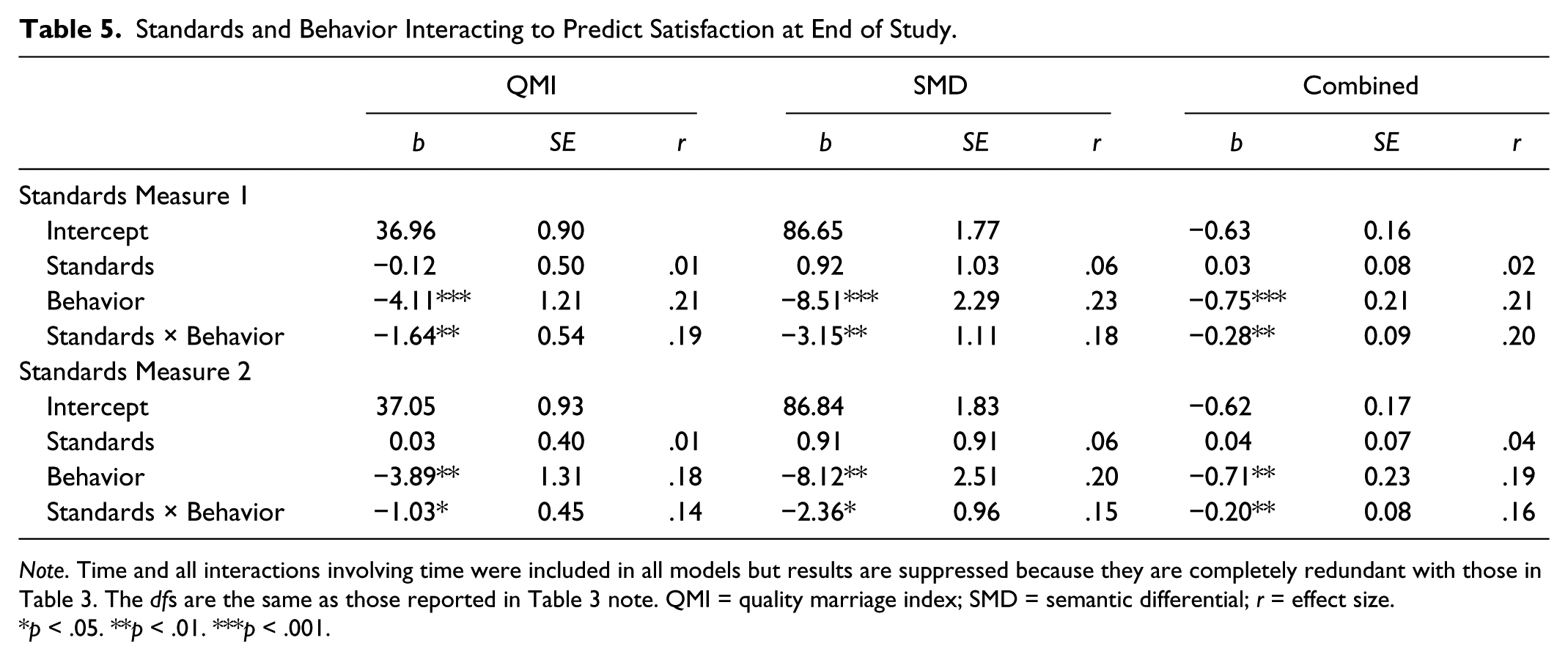
Note. Time and all interactions involving time were included in all models but results are suppressed because they are completely redundant with those in Table 3. The dfs are the same as those reported in Table 3 note. QMI = quality marriage index; SMD = semantic differential; r = effect size.
p < .05. **p < .01. ***p < .001.
Did Problem Severity Moderate the Association Between Relationship Standards and Marital Satisfaction?
The next set of analyses examined whether each standard interacted with the severity of problems to predict changes in satisfaction. Given that reports of problem severity were available at every assessment, these analyses capitalized on the repeated nature of these reports in a lagged three-level model. Specifically, marital satisfaction reported at the next assessment was regressed onto reports of problem severity reported at the previous assessment in the first level of the model, controlling for time and satisfaction reported at the previous assessment. In the second level of the model, between-person estimates of the intercept and the problem severity slope parameters were then regressed onto standardized version of each measure of standards. Thus, the cross-level Standards × Problem Severity interactions estimate the extent to which standards and problem severity interacted to predict changes in satisfaction from each wave to the next. All predictor variables were centered around the sample mean, and all Level 2 and Level 3 intercepts included random effects. As was the case for indirect hostility, this model was estimated 6 times.
Results are reported in Table 6. As can be seen, the Standards × Problem Severity interaction was negative and traditionally significant in five of the six analyses and negative and marginally significant in the other analysis, indicating that the extent to which standards at Baseline were associated with changes in satisfaction from one wave to the next depended on spouses’ reports of the severity of the problems they experienced at the previous assessment.
Standards and Problem Severity Interacting to Predict Next-Wave Marital Satisfaction.
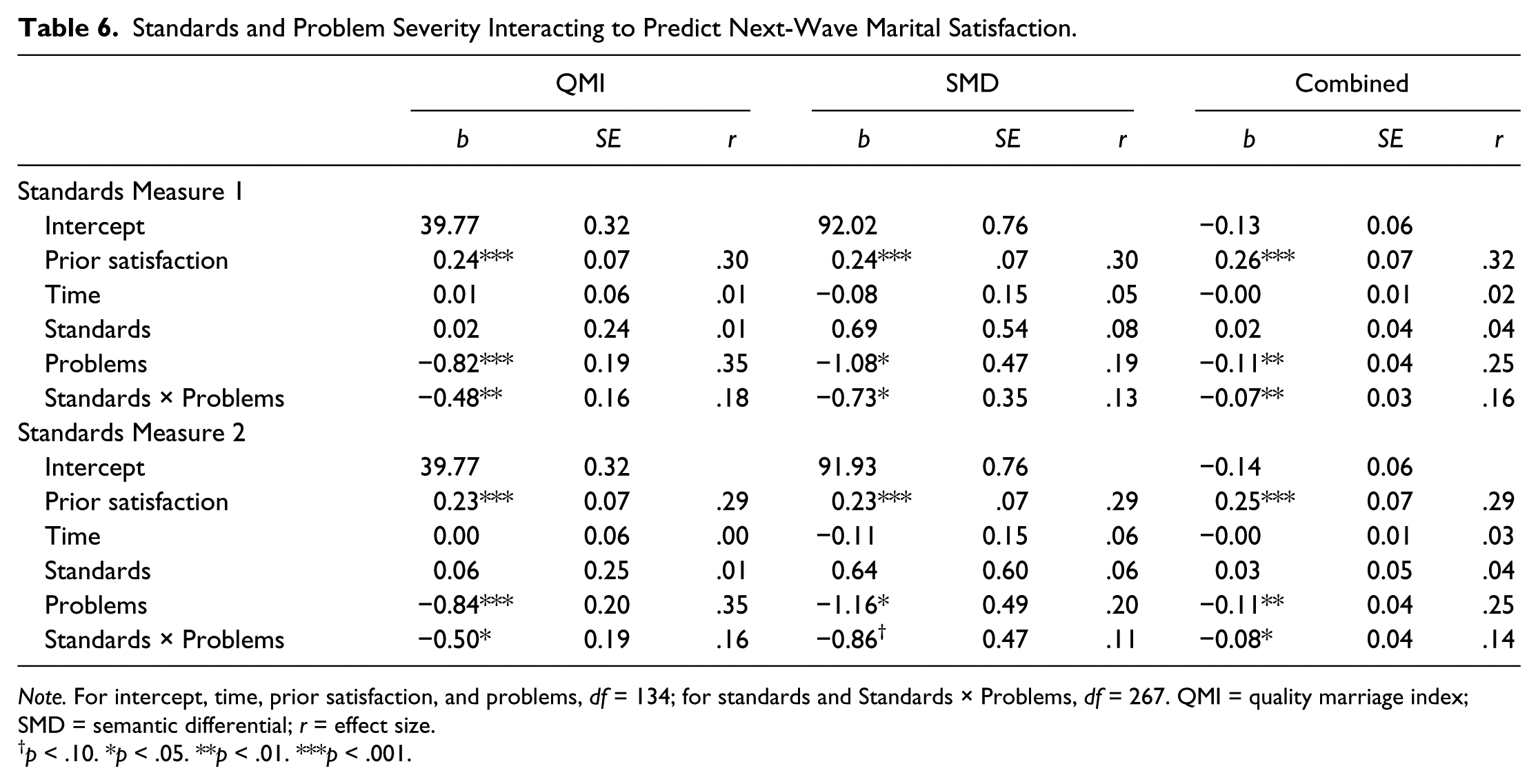
Note. For intercept, time, prior satisfaction, and problems, df = 134; for standards and Standards × Problems, df = 267. QMI = quality marriage index; SMD = semantic differential; r = effect size.
p < .10. *p < .05. **p < .01. ***p < .001.
Plots of the interaction that emerged for each measure of standards on the single index of satisfaction appear in the top two panels of Figure 2, where the predicted levels of marital satisfaction are plotted for people who were 1 SD above and below the mean on problem severity and each standards measure. As can be seen, consistent with predictions, each measure of standards appeared negatively associated with next-wave marital satisfaction among people in relationships characterized by more severe problems but positively associated with marital satisfaction among people in relationships characterized by less severe problems.

Standards and problem severity interacting to predict marital satisfaction.
Once again, regions of significance tests were used to identify the exact levels of problem severity at which each standard demonstrated a significant association with next-wave satisfaction. Results appear in the top half of Table 7. As can be seen in the first and third columns, standards were positively associated with next-wave marital satisfaction in all six analyses. In fact, the lower bound was around −0.75 SDs in all six analyses, indicating standards were positively associated with change in satisfaction for people less than between 0.5 and 1 SD below the mean on problem severity. As can be seen in the second and fourth columns, in contrast, standards were only negatively associated with changes in satisfaction among people with extremely severe problems, most of which were not meaningful in this sample.
Regions of Significance Tests of Simple Effects of Standards at Varying Levels of Problem Severity.
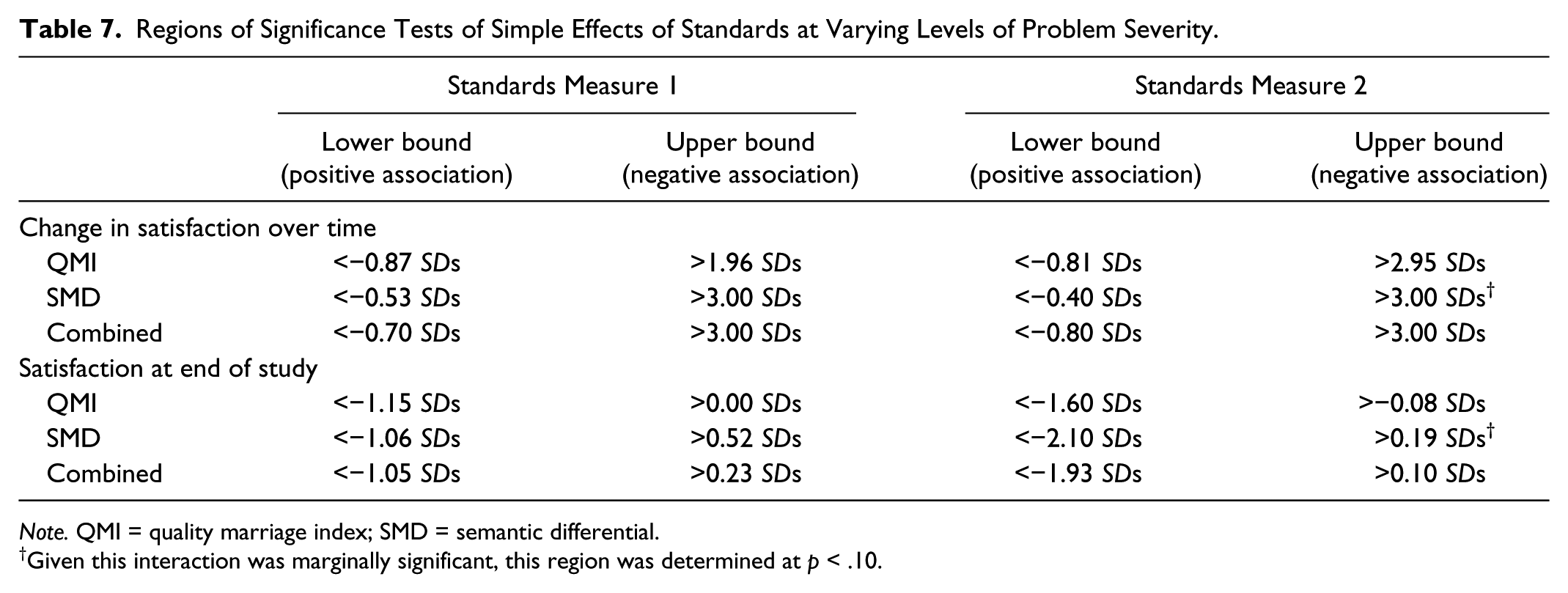
Note. QMI = quality marriage index; SMD = semantic differential.
Given this interaction was marginally significant, this region was determined at p < .10.
Nevertheless, these analyses are also vague on the interactive effects of standards and problem severity on satisfaction at the end of the study. To address this issue, a set of growth curve analyses was conducted to examine the interactive effects of standards and problem severity on satisfaction at the end of the study, using the average level of problem severity reported by each spouse across the study. That is, marital satisfaction was regressed onto time (where time 8 = 0) in the first level of a three-level model, and between-person estimates of the intercept and slope parameters were regressed onto mean-centered average problem severity scores, each standard, and the Standards × Problem Severity interaction.
The results of these analyses are reported in Table 8. Consistent with the idea that initial standards and problem severity interact to predict the ultimate levels of satisfaction people experience 4 years into their marriages, five of the six Standards × Indirect Hostility interactions were negative and traditionally significant, and the other was negative and marginally significant. The interactive effects of problem severity and each standard on the single index of satisfaction are plotted in the bottom two panels of Figure 2. As can be seen, each standard appeared positively associated with satisfaction at the end of the study among spouses in marriages characterized by less severe problems but negatively associated with relationship satisfaction at the end of the study among spouses in marriages characterized by more severe problems. Indeed, as can be seen in the bottom section of Table 7, regions of significance tests confirmed that standards were significantly positively associated with satisfaction among people less than 1 to 2 SDs below the mean on problem severity but negatively associated with satisfaction among people more than approximately 0 to 0.5 SDs above the mean on problem severity.
Standards and Average Problem Severity Interacting to Predict Satisfaction at End of Study.
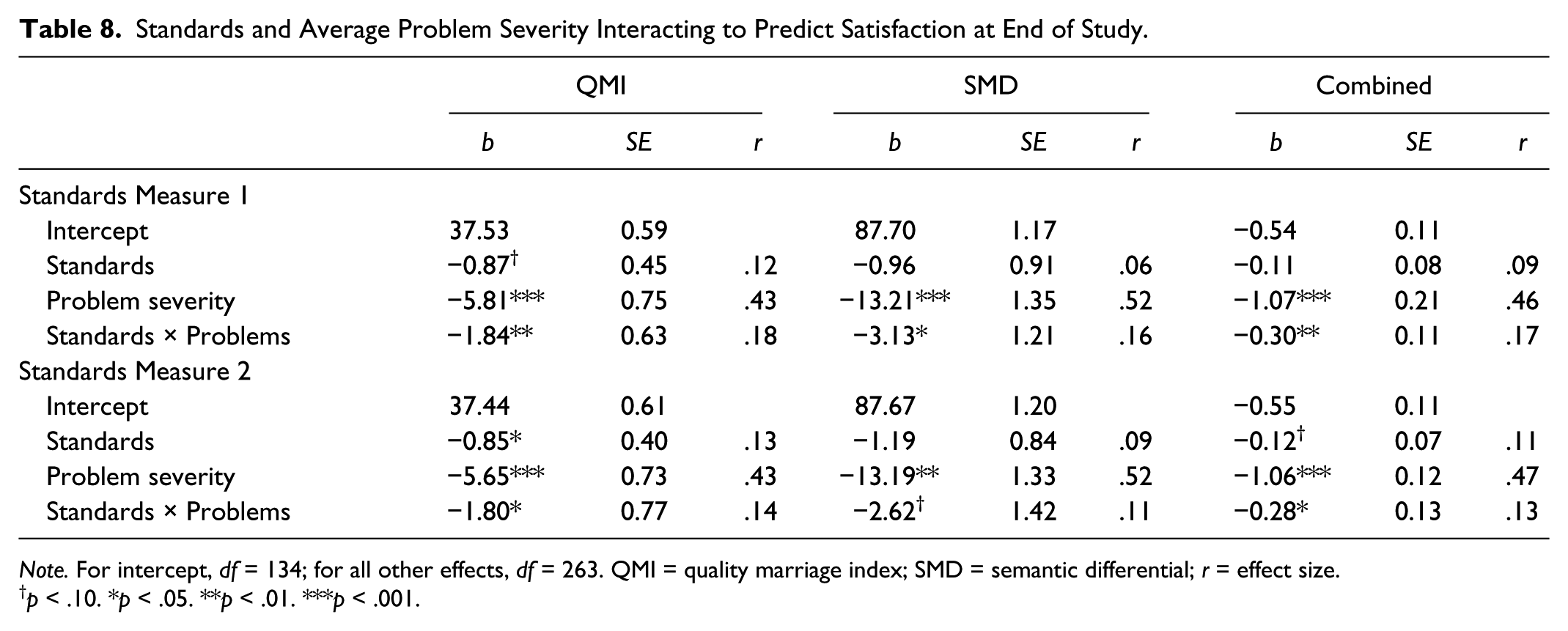
Note. For intercept, df = 134; for all other effects, df = 263. QMI = quality marriage index; SMD = semantic differential; r = effect size.
p < .10. *p < .05. **p < .01. ***p < .001.
Were the Interactive Effects of Standards Independent of the Interactive Effects of Expectancies?
Finally, I addressed the secondary goal of the current study. Thus far, analyses offer a conceptual replication of McNulty and Karney’s (2004) work on probabilistic expectancies. Nevertheless, it remains unclear whether these interactive effects are empirically distinct from those associated with expectancies. To address this issue, I replicated all primary analyses except this time controlled for the corresponding Expectancies × Ability interactions. All Standards 1 × Behavior interactions remained traditionally or marginally significant controlling for each Expectancies × Behavior interaction. Furthermore, all Standards 2 × Behavior interactions remained traditionally or marginally significant controlling for each Expectancies × Behavior interaction, with the exception that the Standards 2 × Behavior interaction was no longer significantly associated with changes in satisfaction on the SMD controlling for the Partner Expectancies × Behavior interaction, b = −.25, SE = .17, t(248) = −1.46, p = .146, effect size r = .09. Likewise, all Standards 1 × Problem Severity interactions remained traditionally significant controlling for each Expectancies × Problem Severity interaction, with the exception that the Standards 1 × Problem Severity interaction was no longer significantly associated with changes in satisfaction on the SMD controlling for the Expectancies for Global Satisfaction × Problem Severity interaction, b = −.77, SE = .47, t(265) = −1.64, p = .10, effect size r = .10. Furthermore, all Standards 2 × Problem Severity interactions remained traditionally or marginally significant controlling for each measure of Expectancies × Problem Severity interaction.
Discussion
The current longitudinal study provided consistent evidence that the implications of interpersonal standards depend on factors that limit couples’ abilities to meet those standards. In every primary analysis—using two measures of relationship standards, two operationalizations of couples’ abilities to meet their standards, and two measures of marital satisfaction—relationship standards interacted with spouses’ abilities to meet those standards to predict satisfaction. Although the exact point at which each simple effect was statistically significant varied somewhat, each relationship standard was positively associated with satisfaction among spouses who had the ability to meet their high demands but negatively associated with relationship satisfaction among spouses who did not have the ability to meet such demands. Furthermore, the current analyses also provided evidence that these effects were mostly independent of interactive effects of spouses’ probabilistic interpersonal expectancies, which have been shown to interact with abilities in similar ways (McNulty & Karney, 2004).
These findings have several implications. First, they show how considering broader aspects of the relationship can help reconcile two perspectives on the implications of psychological standards for well-being (for related discussions, see McNulty, 2010, in press; McNulty & Fincham, 2012). According to expectancy-value and similar theories (e.g., Bandura, 2001; Feather, 1992), high standards should be associated with better well-being by motivating people to invest the effort necessary to achieve the outcomes they demand. According to interdependence theory (Thibaut & Kelley, 1959) and the ideals standards model (Fletcher & Simpson, 2000; Simpson et al., 2001), in contrast, high standards should be associated with poorer well-being by creating larger discrepancies between what people want and what they achieve, thereby undercutting how they evaluate their achievements. The current research was the first to demonstrate that how standards ultimately determine well-being depends on people’s abilities to meet them such that people benefit from high standards if they have the ability to meet them but suffer from such standards if they do not. Although this process was demonstrated in a somewhat specific context, relationships, it likely generalizes to other domains. The implications of standards are critical in academic settings (Wigfield & Eccles, 2000), for example, but whether people benefit from high standards in that domain may also depend on their abilities to meet those standards; intellectually gifted students may benefit from very high standards that motivate them to exploit their intellectual skills, whereas less gifted students may benefit from lower standards that are less likely to create large discrepancies between those standards and outcomes. In sum, athletes, employees, entrepreneurs, artists, and others may ultimately benefit from setting goals that are matched to their own levels of skills; standards may be most beneficial in all domains to the extent that they are realistically calibrated to people’s abilities in those domains.
Second, these findings may also have implications for practitioners attempting to help spouses manage their relationships. Finkel et al.’s (2014) suffocation model of marriage is a normative one in that it describes the challenges associated with cultivating a satisfying marriage in the context of cultural norms that ascribe greater importance to interpersonal needs that are increasingly harder to attain. Nevertheless, the authors conclude with several recommendations for couples who are struggling to strike the right balance. Consistent with the idea that some couples may benefit from lowering their standards, intimates who faced larger obstacles to relationship quality benefited from having lower interpersonal standards. But consistent with the idea that high standards may allow other intimates to flourish, intimates who faced fewer obstacles benefited from higher standards. In other words, there are at least two ways couples can strike a better balance between their standards and their outcomes—they can lower their standards or strengthen their abilities to meet high standards.
Finally, by showing that the primary effects remained mostly significant controlling for corresponding interactions involving abilities and probabilistic expectancies, the current findings suggest that value-laden cognitions, such as standards, contribute to long-term interpersonal outcomes in ways not captured by those associated with more schema-driven processes, such as probabilistic expectancies. Indeed, a primary difference between the interpersonal standards and probabilistic expectancies examined here is that the standards likely involve the motivation to see the relationship in a positive light (see Karney, McNulty, & Bradbury, 2001). Accordingly, the fact the primary effects held controlling for the implications of the more probabilistic predictions suggests there may be something about the motivational nature of standards that leads them to interact with abilities to predict long-term outcomes. Indeed, one of the primary theoretical bases for the current predictions involved expectancy-value theory, which highlights the motivational implications of values for behaviors. Thus, standards may interact with spouses’ abilities to meet them in the manner shown here because they motivate spouses to use and capitalize on such abilities. Future research may benefit from directly examining this possibility as well as from more directly exploring other different mechanisms through which probabilistic expectancies and standards shape subsequent outcomes.
Of course, several limitations of this research should be considered when evaluating these conclusions. First, although the current study was longitudinal, thus increasing confidence in the causal direction of the associations that emerged, the associations are correlational, and thus third variables may account for these interactive effects. Only experimental research can identify the casual effects of standards and abilities on relationship outcomes. Second, although the findings consistently emerged across two different measures of standards, abilities, and satisfaction, they were limited to one study. Replicating these effects in another sample would provide more confidence that these effects did not represent Type I errors. Third, although the research relied on two different measures of spouses’ abilities to meet high-altitude standards, both measures were rather broad, making it difficult to draw conclusions regarding exactly what abilities are most important for meeting such standards. Future research may benefit from examining the implications of more-specific ability factors as well as any independent role of intimates’ perceptions of the extent to which they meet their high-altitude standards. Fourth, although predictions were made based on the idea that high standards should motivate people with the ability to meet them but serve as contrasts for people who do not, these mechanisms were not tested. Future research may benefit from directly evaluating the process through which the interactive effects of standards and abilities emerge. Finally, whereas the current research focused on the implications of high-altitude standards, the most complete test of the suffocation model would consider variance in both the extent and altitude of intimates’ standards (see Finkel, Larson, Carswell, & Hui, 2014). Future research may benefit from examining the implications of both sources of variance.
Footnotes
Acknowledgements
The author thanks Anastasia Makhanova for her assistance with the confirmatory factor analysis.
Author’s Note
Although several published reports have described other measures obtained from the sample described in the current report, none have described associations involving the interpersonal standards measures examined here. Please contact the author for a complete list of publications involving this sample.
Declaration of Conflicting Interests
The author(s) declared no potential conflicts of interest with respect to the research, authorship, and/or publication of this article.
Funding
The author(s) disclosed receipt of the following financial support for the research, authorship, and/or publication of this article: Preparation for this article was supported by grants HD058314 and BCS1251520, both to James K. McNulty.

References
Supplementary Material
Please find the following supplemental material available below.
For Open Access articles published under a Creative Commons License, all supplemental material carries the same license as the article it is associated with.
For non-Open Access articles published, all supplemental material carries a non-exclusive license, and permission requests for re-use of supplemental material or any part of supplemental material shall be sent directly to the copyright owner as specified in the copyright notice associated with the article.
