



Abstract
Research shows that people experience a motivational state of agitation known as reactance when they perceive restrictions to their freedoms. However, research has yet to show whether people experience reactance if they merely observe the restriction of another person’s freedom. In Study 1, we activated realistic vicarious reactance in the laboratory. In Study 2, we compared people’s responses with their own and others’ restrictions and found the same levels of experienced reactance and behavioral intentions as well as aggressive tendencies. We did, however, find differences in physiological arousal: Physiological arousal increased quickly after participants imagined their own freedom being restricted, but arousal in response to imagining a friend’s freedom being threatened was weaker and delayed. In line with the physiological data, Study 3’s results showed that self-restrictions aroused more emotional thoughts than vicarious restrictions, which induced more cognitive responses. Furthermore, in Study 4a, a cognitive task affected only the cognitive process behind vicarious reactance. In contrast, in Study 4b, an emotional task affected self-reactance but not vicarious reactance. We propose a process model explaining the emotional and cognitive processes of self- and vicarious reactance.
In daily life, people often feel restricted in specific freedoms, such as not being allowed to smoke in restaurants or having to wear a school uniform, and experience reactance; but do people also experience reactance just by observing the restriction of another person, without being personally involved? What happens when people observe the restriction of another person? Do different feelings or cognitions arise when experiencing reactance on behalf of another person than when people are restricted themselves?
(Vicarious) Reactance
Reactance theory (J. W. Brehm, 1966; S. S. Brehm & Brehm, 1981) describes how individuals respond to social influence. Psychological reactance occurs as a consequence of perceived threats to specific behavioral freedoms. J. W. Brehm (1966, 1972) suggested that if an individual feels that his or her behavioral freedom is being threatened or eliminated, the individual will experience a motivational state called “reactance” and will desire to protect or restore that freedom. Reactance theory does not suggest people seek freedom in all situations but rather that they perceive themselves as having specific freedoms. The amount of reactance experienced when a freedom is restricted depends on the intensity and importance of the restricted freedom (J. W. Brehm, 1966; S. S. Brehm & Brehm, 1981).
In their review, Miron and Brehm (2006) asked whether reactance could be experienced on behalf of another person whose freedom of choice was threatened, so-called “vicarious reactance.” We found only one empirical study that investigated vicarious reactance (Andreoli, Worchel, & Folger, 1974). 1 Here, participants showed vicarious reactance in the form of attractiveness changes. However, Andreoli et al. (1974) did not investigate the underlying process, that is, whether participants really experienced reactance when confronted with the restriction of another person. We wanted to shed light on the phenomenon of vicarious reactance and increase understanding of how it might differ from self-reactance, that is, the response to restrictions of one’s own freedom.
Process Models Explaining Reactance Processes
An interesting approach to investigating the underlying processes involved in reactance phenomena in the persuasion context is the reactance model tested by Dillard and Shen (2005). They described reactance as an intertwined process of cognitive and affective components, a so-called “intertwined process cognitive-affective model” (p. 150). Reactance seems to have both an emotional and a cognitive component. Dillard and Shen found that reactance contains anger (i.e., feeling irritated, angry, annoyed, and aggravated) as an emotional reaction as well as negative cognitions (e.g., disagreement with the restriction). Dillard and Shen as well as Rains (2013) found that this intertwined cognitive-affective model better predicted their data than a dual-process model that distinguished between a more automatic and controlled process (for an overview, see Gawronski & Creighton, 2013). However, research on reactance from other areas interestingly suggests that people sometimes react to freedom threats in an impulsive manner (e.g., when the freedom was threatened at the end of a persuasive message; Silvia, 2006) and other times in a more cognitive, reflective way (e.g., when the freedom occurred at the beginning of a message) where they tried to counterargue against the threatening information (Silvia, 2006; for review, see Steindl, Jonas, Sittenthaler, Traut-Mattausch, & Greenberg, 2015). Similarly, Laurin, Kay, Proudfoot, and Fitzsimons (2013) suggested that only people with sufficient cognitive resources express a negative attitude toward a restriction. Given these findings, we believe dual-process models might also help elucidate people’s responses to freedom threats—their own and others’. In other research areas besides persuasion, a model that distinguishes between a reflective system and an impulsive system, such as Strack and Deutsch’s (2004) reflective-impulsive model (RIM) of social behavior, might also help distinguish between different processes underlying how people react to threats to their freedom. RIM argues that social behavior is controlled by two interacting systems: The reflective system generates behavioral decisions that are based on knowledge about facts and values and operates slowly (i.e., in a more cognitive and controlled fashion), whereas the impulsive system elicits behavior mainly through motivational orientations and operates faster (i.e., in a more emotional and affective way).
Yet, in a recent study, Sittenthaler, Steindl, and Jonas (2015) found empirical evidence suggesting that in the context of reactance research, both the dual- and intertwined-process model approaches might play an important role in understanding threat reactions. Looking at the physiological responses to different kinds of freedom restrictions, Sittenthaler, Steindl, and Jonas (2015) suggested that illegitimate restrictions (unexpected and inappropriate) engage a more emotional process leading to fast physiological arousal, whereas legitimate restrictions (unexpected but appropriate) might induce people to first reflect on the threat before getting into an arousal state (dual process). Nevertheless, both processes seem to be related to anger and counterarguing (intertwined process), as in both restriction conditions participants showed reactance and behavioral intentions.
Building on these results, we propose that self-reactance might be part of a fast affective process; if the impulsive system is activated by a threat, people should react quickly to the restriction. More precisely, self-reactance should be driven more by spontaneously activated affective reactions because one is directly and personally involved in the restrictions. In such cases, people should express and experience negative emotions (anger, pressure, loss of freedom, etc.) and a physiological arousal without a time lag. In contrast, in vicarious reactance, we should observe a delayed, “slow” physiological response, as well as more cognitive responses overall, suggesting that people first have to “reflect” on the situation. We further assume that an emotional task should more strongly influence direct reactance effects, whereas a more cognitive task should instead impact vicarious reactance. We therefore propose the model depicted in Figure 1.
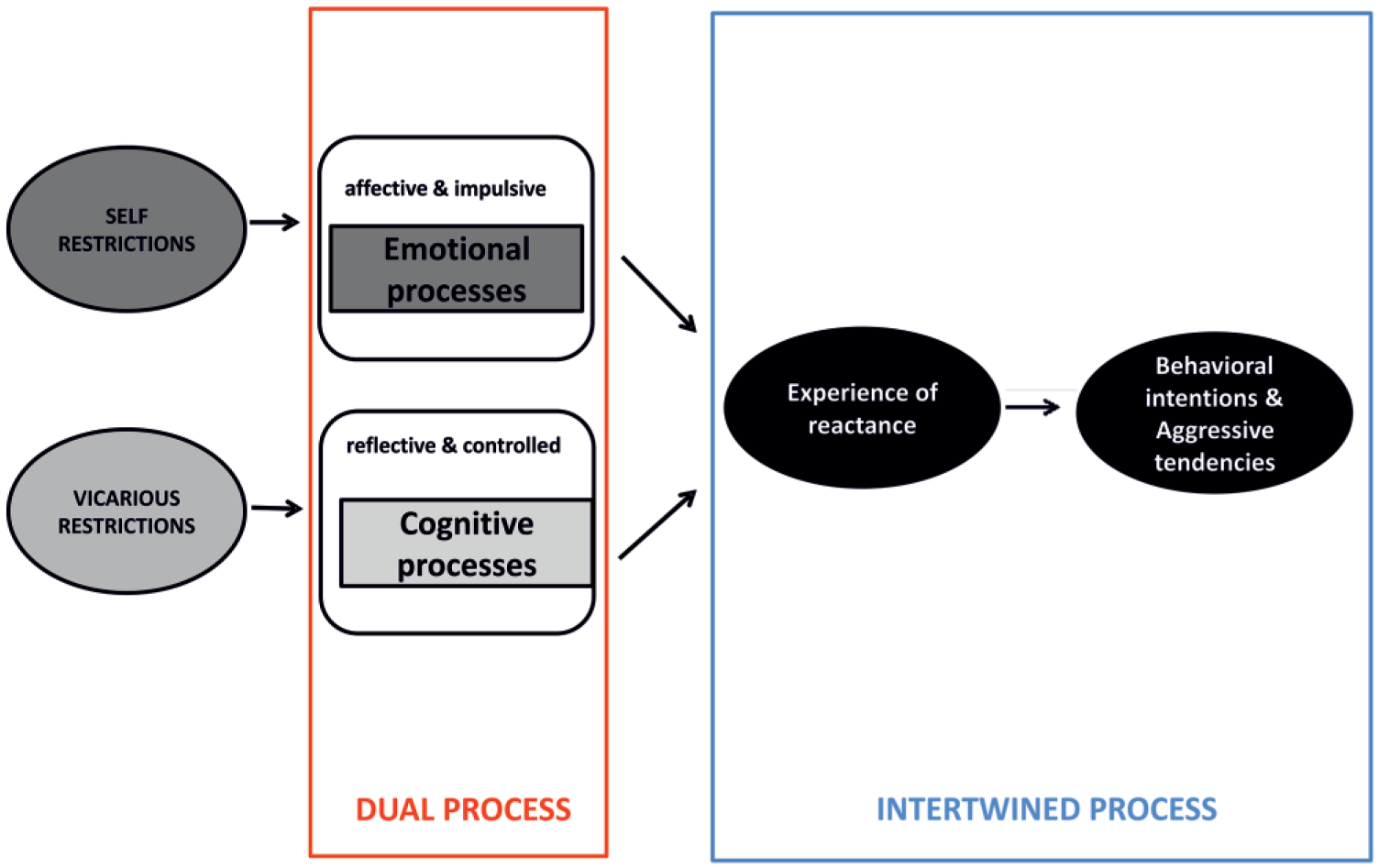
Illustration of our proposed process model to explain self- and vicarious reactance.
The Present Research
In five studies, we investigated the proposed model explaining the phenomenon of vicarious reactance. In Study 1, we tested whether vicarious reactance can be spontaneously activated by observing that someone else’s freedom is restricted. Do observers themselves experience aversive feelings such as anger, pressure, or feelings of being restricted in their freedom? In Study 2, we used a physiological approach to compare experiences of reactance, behavioral intentions, aggressive tendencies, and physiological arousal when imagining a restriction on personal freedom versus imagining a friend’s freedom being threatened. We found the same amount of self-reported reactance but differences in physiological arousal. As this points to different processes behind self- and vicarious reactance, in Studies 3 and 4, we tried to elucidate the underlying process by using a “free thought” paradigm and adding a more cognitive (vs. emotional) task to the experimental conditions.
Study 1
We wanted to investigate whether vicarious reactance can be spontaneously activated by observing that someone else is restricted in his or her freedom and tried to get a better idea of what the observer experiences while observing another person’s freedom being restricted.
Method
Participants and design
Seventy-eight students (64 female and 14 male) with a mean age of 22.67 years (SD = 4.49 years) from the University of Salzburg, Austria, participated in this laboratory study. We employed a three-condition (vicarious-illegitimate-restriction vs. vicarious-legitimate-restriction vs. no-restriction) design. Participants were randomly assigned to the experimental conditions.
Experimental procedure
Participants were asked to participate in a laboratory study for approximately 20 min. The students were asked to complete all questions honestly and silently and were informed about the voluntary nature of participation as well as confidential use of data. In the vicarious-illegitimate-restriction condition, participants watched another “student” arriving at the laboratory to get study credit. This male student was a confederate of the male experimenter. The experimenter explained that he had lost several questionnaires on the bus, and was thus unable to track the student’s participation in this experiment. Hence, the student could not receive participation credit. In the vicarious-legitimate-restriction condition, the observed student was told that he would not get the study credit because he only partially completed the questionnaire. In the no-restriction condition, the observed student was not restricted in his freedom and received the study credit. In their questionnaires, participants were asked to indicate their experience of reactance (i.e., anger, pressure, etc.) and behavioral intentions (i.e., aggressions, complaints, etc.) concerning the behavior of the experimenter. We used seven experience of reactance items (α = .92) and six behavioral intentions items (α = .86, adapted from Jonas et al., 2009) to measure experienced reactance. 2 All items were measured on a 5-point scale from 1 (not at all) to 5 (very much).
Results and Discussion
Experience of reactance
ANOVA revealed that participants experienced more vicarious reactance when witnessing a vicarious-illegitimate-restriction (M = 2.76, SD = 0.87) compared with a vicarious-legitimate-restriction (M = 2.01, SD = 0.76) and no-restriction (M = 1.20, SD = 0.28), F(2, 75) = 29.36, p < .001, η2 = .44. Simple-effects analyses explaining the main effect were all highly significant, p < .001.
Behavioral intentions
Participants in the vicarious-illegitimate-restriction condition (M = 2.60, SD = 0.82) showed more behavioral intentions than those in the vicarious-legitimate-restriction (M = 2.25, SD = 0.72) and no-restriction (M = 1.63, SD = 0.18) conditions, F(2, 75) = 13.01, p < .001, η2 = .26. Simple-effects analyses showed highly significant differences between the vicarious-illegitimate-restriction and no-restriction conditions, p < .001; significant differences between the vicarious-legitimate-restriction and no-restriction conditions, p = .002; and marginal differences between the vicarious-legitimate-restriction and vicarious-illegitimate-restriction conditions, p = .055.
We conclude that people do indeed experience “real” vicarious reactance and show behavioral intentions when observing others’ restrictions. With these results in mind, we wanted to further investigate the differences between self- and vicarious reactance effects, as we focused only on vicarious restrictions in Study 1.
Study 2
Do people experience more, less, or the same amount of self compared with vicarious reactance? If they experience the same amount of reactance, as predicted, are different processes involved? We developed a vignette study to explore these questions. We hypothesized that we would find the same level of experienced reactance and behavioral intentions in people experiencing self- and vicarious restrictions but variations in the physiological arousal, indicating different underlying processes.
We used a physiological approach. In the area of emotion research, numerous physiological studies have been conducted and researchers have been able to assess well-studied experiences by collecting physiological data with biofeedback instruments and using various blood parameters (e.g., hormones or sugar values). Measurements of heart rate (HR) and skin conductance (SC) have proven particularly promising methods for showing physiological arousal in humans (e.g., M. L. Brehm, Back, & Bogdonoff, 1964; Butler, Lee, & Gross, 2009; Harmon-Jones, Brehm, Greenberg, Simon, & Nelson, 1996). Where reactance processes are concerned, only a few physiological studies have been published. Baum, Fleming, and Reddy (1986) conducted a “control expectancy study.” Using physiological measures, they found evidence for motivational arousal by showing that norepinephrine and epinephrine (hormones related to stress levels) in the urine increased when people were restricted in their freedom. On the basis of this research, we suggest that physiological measures might help further distinguish between self- and vicarious reactance processes for our new (vicarious) reactance model.
Method
Participants and design
We had to exclude six participants who revealed they knew what the experiment was about (i.e., reactance). Thus, the final sample consisted of 129 students (69 female and 60 male) with a mean age of 23 years (M = 22.72 years, SD = 5.63 years) from the University of Salzburg, Austria, who voluntarily participated in this laboratory study. 3 The students were recruited in several psychology and biology lectures. We used a three-condition (self-restriction vs. vicarious-restriction vs. no-restriction) design. Participants were randomly assigned to the experimental conditions.
Experimental procedure
Students were asked to participate in a 30-min paper-and-pencil laboratory study including physiological measurements. Participants were tested individually. The experimenter explained that she was interested in what happens physiologically when students read about typical situations in daily student life. The students were asked to complete all questions honestly and silently. The questionnaire started with general questions about sex, age, and field of study. Thereafter, the experimenter attached three “sensors” to the participants’ fingers to measure SC and HR. Extreme care was taken to ensure that participants would not become anxious as a result of the physiological recording procedures, to avoid bias in our results. The experimenter washed the participants’ fingers with alcohol before attaching NeXus 10 sensors (two measuring SC fixed with Velcro strips and one finger clip measuring HR) on the first three fingers of the participants’ nondominant hand. Participants were told to try to hold their hand still while completing the questionnaire.
After a 3-min baseline period (two digital markers were pasted into the biofeedback software by the experimenter at the beginning and end of the baseline measurement), the participants were given 3 min to read and imagine the reactance-arousing scenario and told to continue the questionnaire after the 3-min period (next digital marker was pasted). In the self-restriction condition, they were asked to imagine they were going to start studying at the University in Salzburg the following semester and were looking for an apartment near the university. In an advertisement, they found an appropriate one-room apartment downtown. They called the landlord about viewing the apartment. When the landlord asked them about their profession, they stated they would be a student in Salzburg next semester. Before they could say anything else, the landlord interrupted them and said, “No, you’re a student, you won’t get this apartment” and broke off the call. In the no-restriction condition, the students were asked to imagine that they were able to rent the apartment without experiencing any restrictions.
In the vicarious-restriction condition the volunteers were asked to think about a former classmate experiencing the situation described above. After participants had read the scenario, we assessed participants’ feeling of reactance. As Miron and Brehm (2006) recommended the use of purer affective measures of reactance in future research, asking people what they feel, including feelings such as anger, frustration, and injustice, when their freedom is threatened, we concentrated on the experience of reactance and behavioral intentions/aggressive tendencies as our main dependent variables in this study series. The items were arranged into three scales: experience of reactance (α = .88, seven items, for example, “To what extent do you perceive the reaction of the landlord as a restriction of freedom?” and “How much pressure do you feel as a result of his reaction?” adapted from Jonas et al., 2009), behavioral intentions (α = .84, five items, for example, “To what extent would you describe this man as incompetent to other students?”), and aggressive tendencies (α = .70, five items). 4 Answers were given on a 5-point Likert-type scale from 1 (not at all) to 5 (very much). The last digital marker was pasted after participants had finished all reactance items in the questionnaire.
Our second dependent variable in this study was the set of physiological measures of SC (in micromhos) and HR (in beats per minute). Here, we differentiated a fast response to the threat of freedom while reading the scenario (prescribed 3-min time period) and a slow response while answering the reactance items (no prescribed time period), which followed the scenario. After 3 min, participants were asked to turn the page of the questionnaire. For the fast response, the experimenter pasted two digital markers, one at the beginning and one at the end of the 3-min period. For the slow response, two markers were pasted when the participants turned the page. We used the difference values between both (a) the mean fast response and the mean baseline measure and (b) the mean slow response and the mean baseline measure for further calculations. These difference values served as our measures of physiological arousal. At the end of the study, participants were debriefed and thanked for their participation and received a candy bar or course credit.
Results and Discussion
Reactance measures
To test our prediction that participants in the self-restriction and vicarious-restriction conditions would show the same amount of experienced reactance and behavioral intentions, we conducted separate univariate ANOVAs for the experience of reactance, behavioral intentions, and aggressive tendencies measures.
Experience of reactance
Participants in the self-restriction (M = 3.74, SD = 0.59) and vicarious-restriction (M = 3.49, SD = 0.89) conditions showed higher scores on the experience of reactance measure than participants in the no-restriction condition (M = 2.13, SD = 0.68), F(2, 126) = 59.26, p < .001, η2 = .49. Subsequent post hoc analyses showed significant differences between the no-restriction condition and both the self-restriction and the vicarious-restriction conditions (p < .001). In addition, there was no significant difference between the self-restriction and the vicarious-restriction conditions (p = .107).
Behavioral intentions
Moreover, participants in the self-restriction (M = 3.74, SD = 0.67) and vicarious-restriction (M = 3.72, SD = 0.73) conditions had higher scores on the behavioral intentions measure than participants in the no-restriction condition (M = 2.08, SD = 0.80), F(2, 126) = 69.82, p < .001, η2 = .53. Subsequent post hoc analyses showed significant differences between both the no-restriction condition and both the self-restriction and the vicarious-restriction (p < .001) conditions. There was also no significant difference between the self-restriction and vicarious-restriction conditions (p = .908).
Aggressive tendencies
Participants in the self-restriction (M = 2.84, SD = 0.73) and vicarious-restriction (M = 2.78, SD = 0.72) conditions had higher scores on the aggressive tendencies measure than participants in the no-restriction condition (M = 2.39, SD = 0.78), F(2, 126) = 4.70, p = .011, η2 = .07. Subsequent post hoc analyses showed significant differences between the no-restriction condition and both the self-restriction (p = .005) and the vicarious-restriction (p = .015) conditions. There was no significant difference between the self-restriction and vicarious-restriction conditions (p = .709). The correlations between the three scales were all highly significant, p < .001. 5
Physiological Measures 6
To test our prediction regarding physiological differences (e.g., arousal onset), that is, whether self-restrictions lead to a fast physiological response whereas vicarious restrictions lead only to a slow physiological response, we conducted a mixed-model ANOVA using the fast and slow response as two points of measure (in a within-subject design sorted by type of restriction).
Results revealed a marginally significant main effect for arousal onset, F(1, 123) = 3.04, p = .084, η2 = .02, indicating that participants showed higher HR values at the slow physiological response time (M = 2.72, SD = 3.94) than at the fast physiological response time (M = 2.31, SD = 3.32) in tendency. More important, we found the predicted significant interaction effect between restriction and arousal onset, F(2, 123) = 3.56, p = .031, η2 = .06. Simple-effect analyses showed that participants in the vicarious-restriction condition showed less physiological arousal for the fast physiological response (M = 1.74, SD = 2.77) than for the slow physiological response (M = 3.02, SD = 3.36), F(1, 123) = 7.31, p = .008, η2 = .06. No effects were found for the no-restriction condition, F(1, 123) < 1, p = .334, η2 = .01, or the self-restriction condition, F(1, 123) = 1.13, p = .289, η2 = .01. For the fast physiological response, participants showed about the same level of physiological arousal in the vicarious-restriction and no-restriction conditions, p = .850. Participants in the self-restriction condition displayed more physiological arousal than participants in the no-restriction (p = .045) and vicarious-restriction (p = .027) conditions. At the time of the slow physiological response, participants in the self-restriction and vicarious-restriction conditions displayed the same level of physiological arousal, p = .780. Participants in the self-restriction (p = .594) and vicarious-restriction (p = .419) conditions displayed the same level of physiological arousal as participants in the no-restriction condition. Means and standard deviations/errors are displayed in Table A in the supplementary materials and illustrated in Figure 2. Furthermore, the fast and slow physiological responses were strongly correlated, r(127) = .625, p < .001.

Study 2: Physiological responses in the three experimental conditions.
The first question we wanted to investigate in Study 2 was whether people do, in fact, experience the same amount of reactance—vicariously—when confronted with a situation in which another person experiences a restriction of freedom. The results illustrate that the participants experienced vicarious reactance and showed vicarious reactance behavioral intentions and aggressive tendencies when imagining the restriction of a former classmate. These findings suggest that people do not have to be personally involved in a situation but need only to observe the restriction of freedom to respond with reactance. As predicted, participants in this condition showed almost the same degree of reactance as when they imagined being affected themselves. Although we used fictional scenarios, we were able to evoke both forms of reactance, self and vicarious, as in our “real” laboratory Study 1. More interestingly, we evoked physiological differences using these scenarios. As our model predicts, self-restrictions seemed to lead to more emotional responses than vicarious restrictions. Self-restrictions led to a fast physiological response (change in HR), suggesting that when personal freedoms are restricted, people react quickly and do not first reflect on the situation. Observing the restrictions of another person, in contrast, seemed to lead to a different experience of reactance. Perhaps in this situation, participants had to first think about the situation and its reasons for occurring or had to assume the perspective of the restricted person. Accordingly, participants showed only a slow physiological response. Perhaps experiencing vicarious restrictions does not lead as quickly to a physiological arousal as self-restrictions do. To get a better sense of people’s inner experience during situations of self- and vicarious restrictions, we conducted a “free-association” study.
Study 3
We wanted to show that people’s thoughts are different when they themselves are being restricted as opposed to another being restricted. The purpose of this study was to explore what was in the minds of our participants while experiencing restriction themselves or on behalf of another person. We expected people to express more emotions and fewer cognitions when restricted themselves and more cognitions and fewer emotions when restricted vicariously.
Method
Participants and design
Forty students (31 female and 9 male) with a mean age of 26 years (M = 25.75 years, SD = 6.44 years) at the University of Salzburg, Austria, voluntarily participated in this study. The students were recruited in several psychology lectures. They were randomly assigned to the experimental conditions (self-restriction vs. vicarious-restriction).
Experimental procedure
Participants were asked to take part in a 10-min paper-and-pencil study. The experimenter explained that she was interested in students’ daily life experiences. As in the previous study, the questionnaire started with general questions about sex, age, and field of study. Next, participants were asked to reflect on the apartment-search scenario described in Study 2, in which they had to imagine either a personal experience (self-restriction condition, n = 21) or a former classmate’s experience (vicarious-restriction condition, n = 19). First, they were asked to read the scenario carefully. They then wrote down their feelings and thoughts while experiencing self- or vicarious reactance (following the procedure used by Dillard & Shen, 2005).
Two independent raters assessed students’ responses and grouped their complete answers into three categories: emotional answers (e.g., annoyed, emotionally aroused, or excited), cognitive answers (e.g., the landlord’s reasons for not renting the apartment to students: loud parties, dirty apartments, etc., and general prejudices concerning students), and no answers. The inter-rater reliability analysis using the kappa statistic suggests consistency among raters with κ = 1.00 (p < .001, 95% CI = [1.00, 1.00]).
Results and Discussion
As expected, more students in the self-restriction condition answered emotionally (14 responses) than in the vicarious-restriction condition (three responses). Also following our expectations, the responses of 16 students from the vicarious-restriction condition were rated cognitive, compared with only six in the self-restriction condition. Frequencies are displayed in Table 1. The restriction condition was significantly related to the answer category, χ2(2) = 12.60, p = .002. The findings of our free-association study show that self-restrictions seem to lead to a more emotional process and vicarious restrictions to a more cognitive process.
Frequencies for the Answer Categories Depending on the Experimental Manipulation in Study 3.
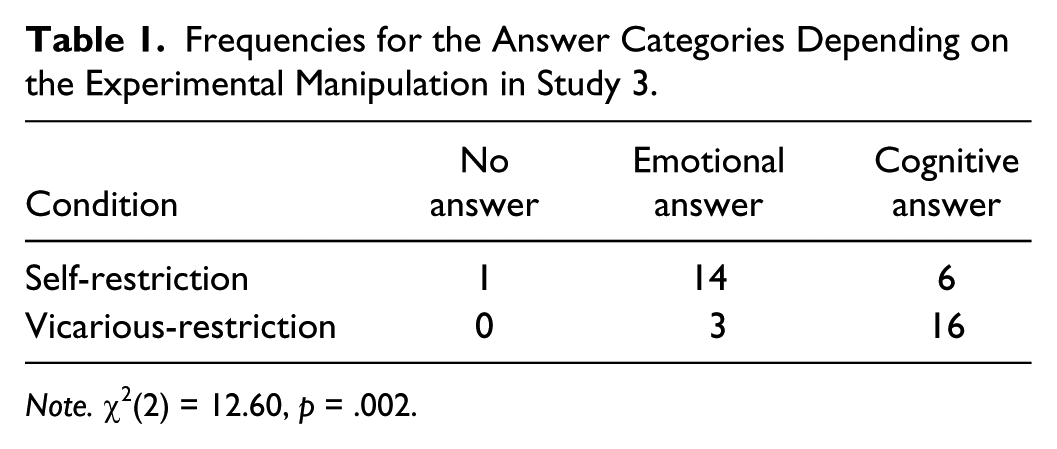
Note. χ2(2) = 12.60, p = .002.
In sum, experiencing restrictions to one’s own or another’s freedom seems to activate different processes; thus, different forms of manipulations are needed to reduce reactance in each of these situations. In Studies 4a and 4b, we conducted two different moderation studies to verify our findings that vicarious reactance reflects a more cognitive, and self-reactance a more emotional, process.
Study 4a
In Study 4a, we used a cognitive-load task to affect reactance. The general idea behind this method is that if the causal chain leading to an effect requires cognitive processing, then this effect should not occur among people who cannot engage in processing due to cognitive load. Research has shown, for example, that a cognitive-load task eliminates the differential testing of consistent and inconsistent information. By blocking cognitive resources, the cognitive-load task prevented people from processing other cognitive tasks. Being cognitively busy, they were less able to critically test inconsistent information (Ditto & Lopez, 1992; Ditto, Scepansky, Munro, Apanovitch, & Lockhart, 1998). Consequently, in our paradigm, we wanted to use a cognitive-load task to block the participants’ cognition (thinking about the restriction), and thus reduce reactance in the vicarious-restriction condition (under the assumption that vicarious reactance is a more cognitive process). According to our proposed model, the cognitive task should not have a reactance-reducing effect in the self-restriction condition, where participants should be only emotionally affected by the restriction, such that cognitive overload should not affect reactance. Thus, we expect that these participants should display comparable levels of reactance in both the cognitive-task and the no-task conditions.
Method
Participants and design
Study 4a consisted of a 3 (self-restriction vs. vicarious-restriction vs. no-restriction) × 2 (cognitive task vs. no task) factorial between-subjects design. Participants were randomly assigned to the experimental conditions. Participants consisted of 34 male and 109 female undergraduates (1 missing gender value, N = 144) at the University of Salzburg, Austria. Participants had a mean age of 22 years (M = 21.79 years, SD = 3.09 years) and either received credit in an introductory psychology course or were given candy for participation.
Experimental procedure
Participants were recruited in different psychology and biology lectures and invited to complete a paper-and-pencil questionnaire. We used the same procedure and paradigm, the apartment-search scenario, described in Study 2.
In the cognitive-task group, participants were asked first to memorize a 7-digit number (e.g., 8-3-5-2-6-9-1) and then to read and imagine the apartment-search scenario. Participants had 1 min to commit the number to memory and were asked to reproduce the number after completing the reactance items used in Study 2. We were very careful to keep participants under “cognitive load” until after the aggressive tendencies measure. Only then were participants asked to recall the memorized number. In the no-task group, participants were only asked to read the scenario and to proceed immediately to the reactance items. Consistent with the previous studies, the internal consistency of the reactance scales (experience of reactance: α = .92, seven items; behavioral intentions: α = .85, six items; aggressive tendencies: α = .75, four items) was good. At the end of the questionnaire, the students were debriefed and thanked for their participation.
Results and Discussion
To test our model prediction that a cognitive task should affect experience of reactance only in the vicarious-restriction condition, we ran three independent 3 (self-restriction vs. vicarious-restriction vs. no-restriction) × 2 (cognitive task vs. no task) ANOVAs on the reactance measures.
Experience of reactance
We found a significant main effect of restriction, F(2, 138) = 110.02, p < .001, η2 = .62. Participants in the self-restriction (M = 4.27, SD = 0.57) and vicarious-restriction (M = 3.92, SD = 0.77) conditions showed higher reactance scores than participants in the no-restriction condition (M = 2.14, SD = 0.84). Subsequent post hoc analyses showed significant differences between the no-restriction condition and both the self-restriction and the vicarious-restriction conditions (p < .001), but no significant difference between the self-restriction and vicarious-restriction conditions (p = .128). We also found a significant main effect of task, F(1, 138) = 4.11, p = .044, η2 = .03. Participants in the cognitive-task group (M = 3.30, SD = 1.18) showed lower experience of reactance scores than participants in the no-task group (M = 3.63, SD = 1.21).
Most important, we found the predicted interaction with the restriction manipulation, F(2, 138) = 3.11, p = .048, η2 = .04. The follow-up simple-effects analyses for the experience of reactance measure supported our hypothesis that a cognitive task would have an effect only in the vicarious-restriction condition. Simple-effects analyses showed that in the vicarious-restriction condition, the cognitive task led to a significant decrease in reactance compared with no task, F(1, 138) = 10.17, p = .002, η2 = .07. In the self-restriction, F(1, 138) < 1, p = .812, η2 = .00, and no-restriction F(1, 138) < 1, p = .535, η2 = .00) conditions, the cognitive task had no effect on reactance. In the no-task groups, participants in the self-restriction condition experienced about the same level of reactance as participants in the vicarious-restriction condition, p = .598. Participants in the self-restriction and vicarious-restriction conditions had higher reactance scores than participants in the no-restriction condition, p < .001. In the cognitive-task groups, participants in the self-restriction condition showed more reactance than participants in the vicarious-restriction condition, p = .001. Participants in the self-restriction and vicarious-restriction conditions displayed more reactance than participants in the no-restriction condition, p < .001. Means and standard errors/deviations are displayed in Table B in the supplementary materials and illustrated in Figure 3.
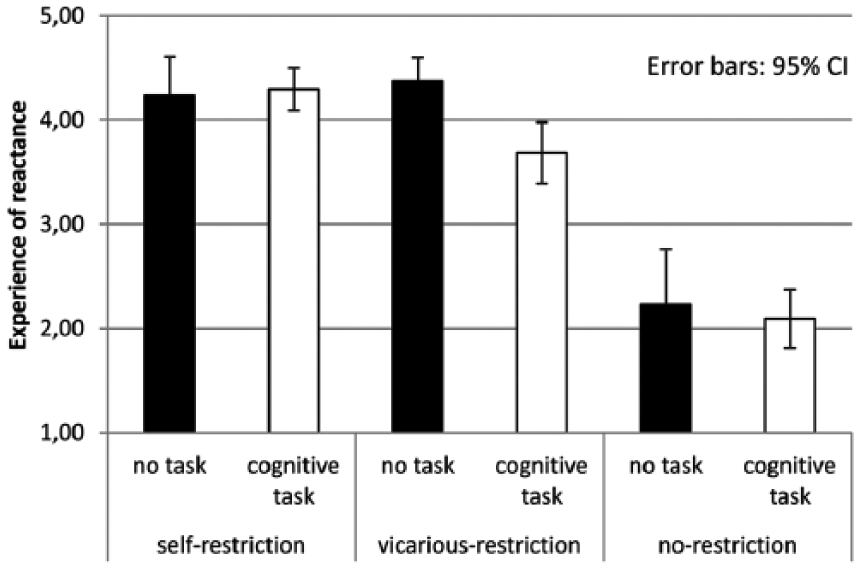
Study 4a: Experience of reactance in the Restriction × Task conditions.
Behavioral intentions
We found a significant main effect of restriction, F(2, 138) = 54.46, p < .001, η2 = .44. Participants in the self-restriction (M = 3.54, SD = 0.60) and vicarious-restriction (M = 3.40, SD = 0.81) conditions showed more behavioral intentions than participants in the no-restriction condition (M = 2.09, SD = 0.82). Subsequent post hoc analyses showed significant differences between the no-restriction condition and both the self-restriction and the vicarious-restriction conditions (p < .001). There was also no significant difference between the self-restriction and vicarious-restriction conditions (p = .757). We did not find a significant main effect of task, F(1, 138) = 1.49, p = .225, η2 = .01.
Importantly, we found a marginal interaction with restriction, F(2, 138) = 2.66, p = .073, η2 = .04. The follow-up simple-effects analyses for the behavioral intentions measure supported our hypothesis that a cognitive task would have an effect only in the vicarious-restriction condition. Simple-effects analyses showed that in the vicarious-restriction condition, the cognitive task led to a significant decrease in behavioral intentions compared with no task, F(1, 138) = 6.74, p = .010, η2 = .05. In the self-restriction, F(1, 138) < 1, p = .985, η2 = .00, and no-restriction F(1, 138) < 1, p = .669, η2 = .00) conditions, the cognitive task had no effect on behavioral intentions. In the no-task groups, participants in the self-restriction condition showed about the same level of behavioral intentions as participants in the vicarious-restriction condition, p = .352. Participants in the self-restriction and vicarious-restriction conditions had higher behavioral intentions scores than participants in the no-restriction condition, p < .001. In the cognitive-task groups, participants in the self-restriction condition tended to showed more behavioral intentions than participants in the vicarious-restriction condition, p = .075. Participants in the self-restriction and vicarious-restriction conditions displayed more behavioral intentions than participants in the no-restriction condition, p < .001. Means and standard deviations/errors are displayed in Table C in the supplementary materials and illustrated in Figure 4.
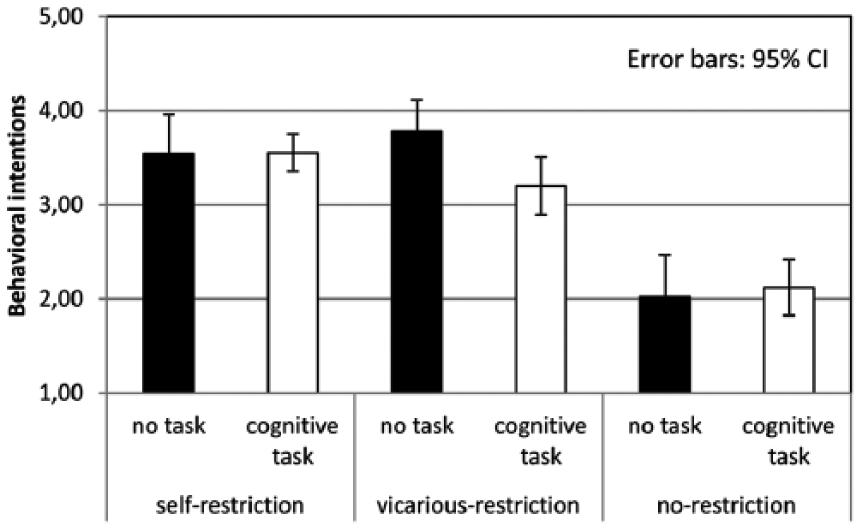
Study 4a: Behavioral intentions in the Restriction × Task conditions.
Aggressive tendencies
We found a significant main effect of restriction, F(2, 138) = 5.44, p = .005, η2 = .07. Participants in the self-restriction (M = 3.01, SD = 0.87) and vicarious-restriction (M = 2.93, SD = 0.86) conditions showed more aggressive tendencies than participants in the no-restriction condition (M = 2.54, SD = 0.79). Subsequent post hoc analyses showed significant differences between the no-restriction condition and both the self-restriction (p = .006) and the vicarious-restriction conditions (p = .004). There was no significant difference between the self-restriction and vicarious-restriction conditions (p = .974). We did not find a significant main effect of task, F(1, 138) < 1, p = .327, η2 = .01.
Crucially, we did, however, find a marginal interaction with restriction, F(2, 138) = 2.38, p = .096, η2 = .03. The follow-up simple-effects analyses for the reactance measure supported our hypothesis that the cognitive task had an effect only in the vicarious-restriction condition. Simple-effects analyses showed that in the vicarious-restriction condition, the cognitive task led to a significant decrease in aggressive tendencies compared with no task, F(1, 138) = 5.31, p = .023, η2 = .04. In the self-restriction, F(1, 138) < 1, p = .904, η2 = .00, and no-restriction, F(1, 138) < 1, p = .492, η2 = .00, conditions, the cognitive task had no effect on aggressive tendencies. In the no-task groups, participants in the self-restriction condition showed about the same level of aggressive tendencies as participants in the vicarious-restriction condition, p = .339. Participants in the self-restriction (p = .040) and vicarious-restriction (p = .003) conditions had more aggressive tendencies than participants in the no-restriction condition. In the cognitive-task groups, participants in the self-restriction condition showed a trend toward more aggressive tendencies than participants in the no-restriction condition, p = .056. Participants in the self-restriction (p = .215) and no-restriction conditions (p = .499) displayed the same amount of aggressive tendencies as participants in the vicarious-restriction condition. Means and standard deviations/errors are displayed in Table D in the supplementary materials and illustrated in Figure 5.
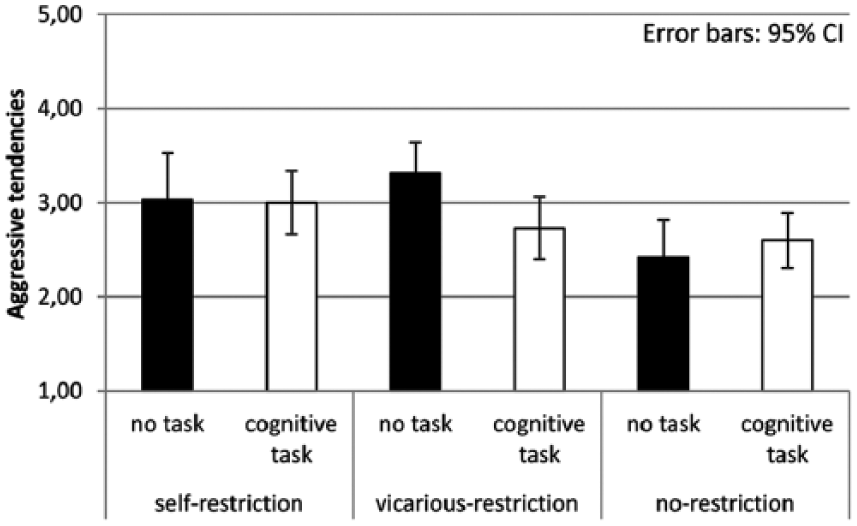
Study 4a: Aggressive tendencies in the Restriction × Task conditions.
These results suggest that in the cognitive-task group, a cognitive-load task impaired people’s cognitive resources and led to a decrease in the amount of reactance experienced, behavioral intentions, and aggressive tendencies for participants in the vicarious-restriction condition. These results also support our model contention that vicarious restrictions need cognitive resources compared with the more emotional process of self-restrictions. As the cognitive intervention specifically impaired cognitive resources, the cognitive task was not successful in the self-restriction condition but proved effective only in the vicarious-restriction condition.
The question remains as to how self-reactance can be affected. If our proposed model assumption is correct and self-reactance is a more emotional process, an emotional-distraction task, that is, one that puts people in a pleasant mood should affect reactance in self- but not in vicarious-restriction conditions. In Study 4b, we tested this prediction.
Study 4b
In Study 4b, we used an emotional-distraction or “positive mood” task to demonstrate that self-restrictions tend to evoke a more emotional process (Diefendorff, Richard, & Yang, 2008; Dolcos & McCarthy, 2006). The idea behind this method is that if the causal chain leading to an effect requires emotional processing, this effect should not occur among people who cannot engage in processing due to being emotionally distracted. Especially in psychotherapy, “positive-mood-evoking distractions” are used to distract someone from negative emotions, for example, distracting people with depression to get them out of a bad mood (Field & Kruger, 2008). For our paradigm, we expected that an emotional “positive-mood task,” such as thinking of the nicest day of the past summer, would more strongly affect self-reactance (because we believe self-restrictions trigger a more emotional process). On the contrary, vicarious reactance, supposed to be a more cognitive process, should not be affected by the positive-mood induction. 7
Method
Participants and design
Study 4b consisted of a 3 (self-restriction vs. vicarious-restriction vs. no-restriction) × 2 (emotional task vs. no task) factorial between-subjects design. Participants were randomly assigned to the conditions. Volunteers were 150 students (135 female, 15 male) with a mean age of 25 years (M = 24.70 years, SD = 6.03 years) recruited through university classes in the School of Education at the University of Salzburg, Austria.
Experimental procedure
We used the same procedure described in Study 4a but a different scenario to manipulate reactance (to generalize our findings beyond a particular instance of threat to freedom). Participants again read about an everyday student experience. Either they imagined being restricted in their own freedom by being refused a seat in an important university course, no longer having any free choice about the course, or they imagined a friend having the same experience.
In addition, in the emotional-task group, participants were first asked to read and imagine themselves in the university course scenario and then to write down at least six thoughts and feelings concerning the nicest summer day of the previous summer. They were instructed to be specific (e.g., “What did you do?” and “How did you feel?”). Remembering the last nice summer day should have put participants in a happy-aroused mood. After thinking about this summer day, participants answered first the scenario-adapted experience of reactance items and then the behavioral intentions items described in the previous studies. In the no-task group, participants were asked only to read the scenario and to proceed immediately to the reactance items. In accordance with the preliminary study, the internal consistency of the reactance scales (experience of reactance: α = .92, seven items, as well as behavioral intentions: α = .74, five items and aggressive tendencies: α = .73, two items) was acceptable. At the end of the questionnaire, the students were debriefed and thanked for their participation and they received a candy bar or course credit for participating.
Results and Discussion
To test our prediction that an emotional task should reduce reactance only in the self-restriction condition, we ran separate 3 (self-restriction vs. vicarious-restriction vs. no-restriction) × 2 (emotional task vs. no task) ANOVAs on the reactance measures.
Experience of reactance
We found a significant main effect of restriction, F(2, 144) = 28.19, p < .001, η2 = .28. Participants in the self-restriction (M = 3.67, SD = 0.93) and vicarious-restriction (M = 3.76, SD = 0.69) conditions showed higher reactance scores than participants in the no-restriction condition (M = 2.53, SD = 1.11). Subsequent post hoc analyses showed significant differences between the no-restriction condition and both the self-restriction and the vicarious-restriction conditions (p < .001). There was no significant difference between the self-restriction and vicarious-restriction conditions (p = .617). We did not find a main effect of task, F(1, 144) = 1.05, p = .308, η2 = .01.
However, most important, we found the predicted interaction, F(2, 144) = 3.88, p = .023, η2 = .05. The follow-up simple-effects analyses for the experience of reactance measure supported our hypothesis that an emotional task had an effect only in the self-restriction condition. Analyses showed that the emotional task led to a significant decrease in experienced reactance compared with the no-task condition, F(1, 144) = 7.55, p = .007, η2 = .05. In the vicarious-restriction, F(1, 144) < 1, p = .894, η2 = .00, and no-restriction, F(1, 144) = 1.23, p = .270, η2 = .01, conditions, the emotional task had no effect on reactance. When there was no task, participants in the self-restriction condition experienced about the same level of reactance as participants in the vicarious-restriction condition, p = .342, and both displayed higher levels of reactance than participants in the no-restriction condition, p < .001. Following the emotional task, participants in the vicarious-restriction condition tended to display higher reactance compared with participants in the self-restriction condition, p = .099, and both displayed more reactance than participants in the no-restriction condition, p ≤ .01. Means and standard deviations/errors are displayed in Table E in the supplementary materials and illustrated in Figure 6.
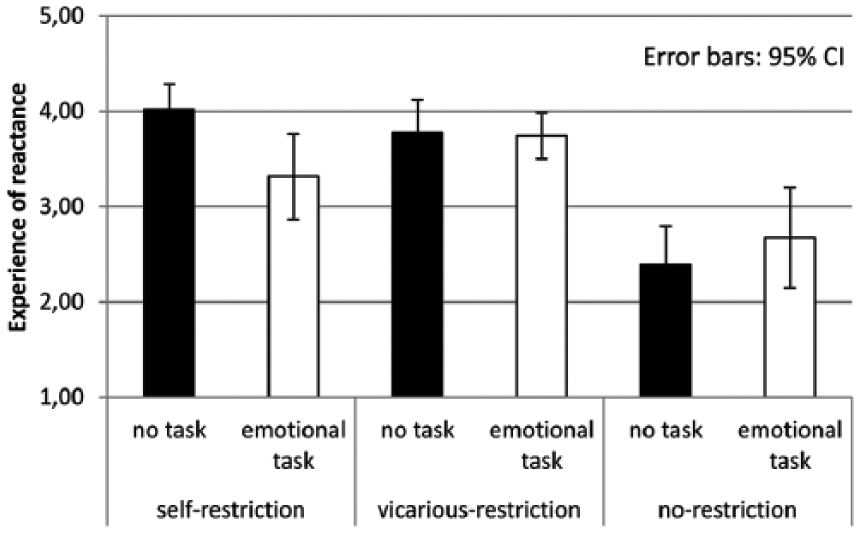
Study 4b: Experience of reactance in the Restriction × Task conditions.
Behavioral intentions and aggressive tendencies
We did not find an interaction effect (Restriction × Task) for the behavioral intentions measure, F(2, 144) < 1, p = .884, η2 = .00, or for the aggressive tendencies measure, F(2, 144) < 1, p = .641, η2 = .01, indicating that the emotional-task manipulation had an effect only on our “earlier” measured experience of reactance scale.
Nevertheless, the current results lend further support to our hypothesis that self-restrictions evoke a more emotional form of reactance compared with vicarious restrictions. Specifically, we found a reactance-reducing effect of an emotional intervention only among participants who imagined themselves being restricted. More precisely, participants in the self-restriction condition who completed an emotional-distraction task seemed to be distracted from negative emotions by thinking of the nicest day of the previous summer. However, this regulation of emotion had no effect in the vicarious-restriction condition.
The emotional task affected participants’ emotions only during the reactance experience. We can only speculate about this finding. Maybe the manipulation had no effect on behavioral intentions and aggressive tendencies because our mood manipulation was too weak and people did not remain in a positive mood. This result might also indicate that the emotional task affected only the first experiential response to the situation. After people had thought about the restriction, they might have realized that they did not want to accept it, and thus reacted with similar behavioral intentions and aggressive tendencies to those people who did not complete the emotional task. In our model, we expect that people argue against the restriction after they have reflected upon the situation. Maybe the emotional task could not block participants’ thoughts about the reasons for being refused a seat in an important university course and they, therefore, fell back into the same reactant state as people in the no-task group.
In any case, even if the effects of the mood manipulation on self-reactance are weaker than the effects of the cognitive-load manipulation on vicarious reactance (Study 4a), they complement the results of the previous studies and add to the overall picture of different processes underlying the experience of self versus vicarious reactance.
General Discussion
We were interested in investigating the mechanisms underlying self- and vicarious reactance. In five studies, we sought to determine whether the feelings or cognitions that arise during vicarious reactance differ from those elicited by being restricted oneself. We assumed that cognitions and emotions play a role in both self- and vicarious reactance, albeit to different degrees, and proposed a process model (see Figure 1) to try to explain the different underlying mechanisms.
In our first study, we showed that people indeed react with vicarious reactance when observing a real-life restriction of another person in a laboratory setting. People do not have to be told to take the perspective of the person being restricted; merely observing the restriction led to the feeling of vicarious reactance in the observer. In Study 2, we activated both self- and vicarious reactance in our participants. People interestingly showed the same amount of self- and vicarious reactance on the experience of reactance, behavioral intentions, and aggressive tenedencies scales. Moreover, we measured both forms of reactance physiologically, but with a faster response in self-reactance and a delayed response in vicarious reactance. These findings are in line with our model that proposes an impulsive route for self-restrictions arousing more emotional reactions, which should be quickly measurable through physiological parameters (e.g., HR). In contrast, we expected vicarious reactance to be a more reflective and cognitive process in which emotions and physiological arousal are delayed.
People who were invited to talk about their feelings and thoughts concerning the apartment-search scenario in a “free-association” study (Study 3) tended to list feelings and emotions when self-restricted, but more cognitive ideations when vicariously restricted. These results provide further evidence for our assumption that self-reactance is driven by emotional processes and vicarious reactance mainly by cognitive processes.
We then conducted two task-based studies to find more conclusive evidence for our assumptions. We reduced both forms of reactance with theory-driven tasks. In Study 4a, a cognitive-load task distracted participants cognitively, leading to lower reactance, behavioral intentions, and aggressive tendencies in the vicarious-restriction condition, but it had no effect on self-restrictions. Thinking of a summer day, putting participants in a happy-aroused mood—the emotional task used in Study 4b—reduced the experience of reactance only in the self-restriction condition. Together, these studies support our contention that self-restrictions activate an emotional process and vicarious restrictions a more cognitive process (dual-process theory). Moreover, people in both restriction conditions showed reactance (anger) as well as behavioral intentions and aggressive tendencies (counterarguing) as described in Dillard and Shen’s (2005) intertwined-process model of reactance. These results are similar to those of our previous study where illegitimate restrictions were more emotionally arousing than legitimate restrictions, which were associated more with cognitive processes (Sittenthaler, Steindl, & Jonas, 2015).
Theoretical Implications
Reactance theory—a classic social psychology theory—is an important starting point for understanding vicarious reactance processes, and self-reactance is a well-established research field. However, vicarious reactance seems to be rather more cognitive and more complex than self-reactance, which primarily arouses emotions. Looking deeper into our study series, we observed a “fast” physiological response, as well as “emotional” responses associated with “reflexes” in people given self-restrictions. People react quickly to restrictions, and the impulsive system is activated. In such cases, people experience negative emotions (anger, pressure, loss of freedom, etc.) and physiological arousal without delay. Emotional tasks such as thinking about a summer day should have an effect on the emotional process of self-reactance. In contrast, in vicarious reactance, we observed a delayed “slow” physiological response, as well as more cognitive responses overall, suggesting that people had to “reflect” on the situation. When witnessing the restriction of another person, people first must think about the experienced situation, and so the reflective system is activated, allocating cognitive resources. Only after cognition about the restriction is the emotional reaction (e.g., physiological arousal) measurable; that is, the aroused reactance appears only after a delay. To affect aroused vicarious reactance, cognitive tasks such as our cognitive-load task are necessary to block mental processes. Our proposed model (Figure 1) captures the different experiences of self- and vicarious reactance.
Limitations
A limitation of our research, however, is that in four of five studies we reported, we used only scenarios for the experimental manipulations to evoke reactance. One might question to what extent it was possible for participants to imagine how they might feel if they were restricted in their freedom. But following Study 1, we showed that vicarious reactance can also be observed if participants are confronted with realistic restrictions in the laboratory. Furthermore, the findings of Study 2 indicate that even if participants only imagined the restriction, they nevertheless showed a fast physiological response (in the self-restriction condition).
Further investigations should question whether observers could also experience vicarious reactance using the “emotional route” when freedom of choice is restricted in a very close other (e.g., one’s mother) versus a very distant person (e.g., Mr. X from Y). We have already found initial evidence that people with a collectivist cultural background show more vicarious reactance for an in-group member (i.e., person speaking the same language) compared with people with an individualist cultural background (Sittenthaler, Traut-Mattausch, & Jonas, 2015). It might be interesting to compare physiological and intervention studies cross-culturally to broaden our combined dual-process and intertwined-process reactance model.
Conclusion
We showed that different underlying processes are activated during self- and vicarious reactance, but more research is needed to complete the picture. Previous research on reactance has examined only self-restrictions. Our findings show that people can experience reactance personally and vicariously, and that there are differences in the underlying mechanisms. In our opinion, investigating the underlying processes behind these forms of reactance is important to broaden our understanding of how these and other social processes occur. With the accumulation of more such knowledge, it should be possible to create an even more complex model of self- and vicarious reactance.
Footnotes
Acknowledgements
The authors are grateful to Haliemah Mocevic, Judith Willberger, Julia Holzleitner, Barbara Pilgerstorfer, Laura Kravanja, Tobias Hassold, Pierre Powaska, and Vanessa Schwarz for their help with data collection. They thank Daniel Sullivan, Mark Zanna, Anita Todd, and Stephanie Schwenke for helpful comments on an earlier version of this manuscript.
Declaration of Conflicting Interests
The author(s) declared no potential conflicts of interest with respect to the research, authorship, and/or publication of this article.
Funding
The author(s) received no financial support for the research, authorship, and/or publication of this article.

Notes
References
Supplementary Material
Please find the following supplemental material available below.
For Open Access articles published under a Creative Commons License, all supplemental material carries the same license as the article it is associated with.
For non-Open Access articles published, all supplemental material carries a non-exclusive license, and permission requests for re-use of supplemental material or any part of supplemental material shall be sent directly to the copyright owner as specified in the copyright notice associated with the article.
