



Abstract
Loss aversion is considered a general pervasive bias occurring regardless of the context or the person making the decision. We hypothesized that conscientiousness would predict an aversion to losses in the financial domain. We index loss aversion by the relative impact of income losses and gains on life satisfaction. In a representative German sample (N = 105,558; replicated in a British sample, N = 33,848), with conscientiousness measured at baseline, those high on conscientiousness have the strongest reactions to income losses, suggesting a pronounced loss aversion effect, whereas for those moderately unconscientious, there is no loss aversion effect. Our research (a) provides the first evidence of personality moderation of any loss aversion phenomena, (b) supports contextual perspectives that both personality and situational factors need to be examined in combination, (c) shows that the small but robust relationship between income and life satisfaction is driven primarily by a subset of people experiencing highly impactful losses.
Loss aversion, whereby “losses loom larger than gains” (Kahneman & Tversky, 1979), is one of the most studied areas within cognitive psychology and behavioral economics. Typically, losses have around twice the psychological impact as equivalently sized gains (Novemsky & Kahneman, 2005) and this effect is commonly regarded as a pervasive general bias occurring regardless of the context or the person making the decision (Gaechter, Johnson, & Herrmann, 2007; Li, Kenrick, Griskevicius, & Neuberg, 2012). However, this assumption of pervasiveness has been called into question by recent research. First, loss aversion appears to be situation and domain specific, with whether the effect occurs depending on local cultural factors (Apicella, Azevedo, Christakis, & Fowler, 2014), as well as concerns connected to evolutionary fitness (Li et al., 2012). Second, the strength of loss aversion varies across individuals (Canessa et al., 2013; Tom, Fox, Trepel, & Poldrack, 2007). Thus, the expression of loss aversion appears to vary as a function of both context and individual differences (Hartley & Phelps, 2012; Nettle, 2006). Here, we develop and integrate this emerging literature through the first demonstration that the personality trait conscientiousness predicts the strength, and indeed the presence, of loss aversion in the financial domain.
Personality (defined within the five factor model [FFM] as comprising agreeableness, conscientiousness, extraversion, neuroticism, and openness; McCrae & Costa, 2008) is well known to play an important role with respect to the achievement of many major life outcomes (Ferguson, 2013; Ozer & Benet-Martínez, 2006; Roberts, Kuncel, Shiner, Caspi, & Goldberg, 2007). Of the FFM traits, however, conscientiousness has the strongest links with economic outcomes (Almlund, Duckworth, Heckman, & Kautz, 2011). Conscientious individuals not only have greater levels of motivation (Judge & Ilies, 2002) but also set themselves higher goals (Barrick, Mount, & Strauss, 1993), demonstrate a higher propensity to financially plan (Ameriks, Caplin, & Leahy, 2003), obtain higher wages (Mueller & Plug, 2006), and have higher well-being (Boyce, Wood, & Powdthavee, 2013; Steel, Schmidt, & Shultz, 2008), leading to the general conception that it is a positive adaptive personality trait. Theoretically, however, it has been argued that personality has evolved to meet the adaptive needs of changing contexts and thus represents a trade-off between different fitness costs and benefits (Nettle, 2006). No unconditional optimal trade-off exists, and thus as context changes, adaptive outcomes should vary for individuals according to their personality. A major implication of this is that some traits that are usually believed to be beneficial may also have a “dark side” and others, seen generally as negative, may have a “bright side” under certain environmental conditions (see Boyce, Wood, & Brown, 2010; Ferguson et al., 2014).
Conscientiousness, although seemingly essential to long-term goal attainment (Duckworth, Peterson, Matthews, & Kelly, 2007), is also accompanied by a rigidity of thought and obsessiveness (Carter, Guan, Maples, Williamson, & Miller, 2015; Nettle, 2006). Such factors may be particularly problematic under specific circumstances, for example, when a desired outcome is not achieved or is achieved and then lost. Conscientious individuals place great value on economic outcomes (Roberts & Robins, 2000) suggesting that conscientious individuals should experience a more pronounced effect from a loss in the financial domain (Boyce, Wood, & Brown, 2010). More generally, because conscientious individuals put more effort into achieving their goals (Duckworth et al., 2007), the loss of that outcome might be appraised as due to lack of their own ability as opposed to a lack of effort. Indeed, conscientiousness is positively associated with internal locus of control (Judge, Erez, Bono, & Thoresen, 2002). Specifically, this suggests that individuals low in conscientiousness might attribute a financial loss due to a lack of effort (a temporary and specific cause for failure), whereas conscientious individuals who worked to the best of their ability would not be able interpret the situation in this way. Instead they may attribute their failure to their own lack of ability (a stable and general cause of failure). Following the experience of negative events, such pessimistic attribution styles have been linked to lower self-esteem (Ralph & Mineka, 1998) and increased depression (Alloy et al., 2006). In addition, the tendency to take self-protective measures (which are likely to be higher in conscientious individuals) predicts increased aversion to loss (Li et al., 2012).
Our prediction that conscientiousness predicts how individuals respond to a financial loss also bares links with literature on stress. In particular, the conservation of resources model suggests that potential or actual loss of a valued resource is the primary source of individual stress (Hobfoll, 1989). The loss of any resource may threaten an individual’s status, economic stability, relationships, basic beliefs, and self-esteem, but the degree to which the loss is a threat depends upon the value an individual places upon that resource (Hobfoll, 1989). Personality characteristics are likely to play an important role in moderating this threat (Cohen & Edwards, 1989), and because conscientious individuals place a higher value on economic goals (Roberts & Robins, 2000), they will be more likely to experience stress when experiencing a financial loss. Although an individual may attempt to develop surplus resources, which may bring some positive psychological benefit and offset future stress from losses, it is the losses that are the most psychologically threatening (Clark, Diener, Georgellis, & Lucas, 2008; Hobfoll, Johnson, Ennis, & Jackson, 2003).
We index loss aversion by the relative impact of income losses and gains on life satisfaction. The exploration of how income relates to life satisfaction has been a mainstream research endeavor in economic psychology for several decades (e.g., Boyce, Brown, & Moore, 2010; Diener & Biswas-Diener, 2002; Di Tella, Haisken-De New, & MacCulloch, 2010; Easterlin, 1973; Ferrer-i-Carbonell & Frijters, 2004; Kahneman & Deaton, 2010; Layard, Mayraz, & Nickell, 2008; Stevenson & Wolfers, 2008) with the overall conclusion that income is a small but very robust predictor of life satisfaction (Lucas & Dyrenforth, 2006). Until recently, researchers examined the relationship between changes in income and changes in life satisfaction without taking into account that income changes represent both increases and decreases (e.g., Ferrer-i-Carbonell & Frijters, 2004; Layard et al., 2008). Thus, the robust correlation between changes in income and changes in life satisfaction has commonly been interpreted as representing the effect of increasing income on well-being. Recent research, however, has demonstrated that the classic loss aversion effect operates in this domain such that a loss of income decreases life satisfaction at least twice as strongly as it is increased by equivalently sized income gains (Boyce, Wood, Banks, Clark, & Brown, 2013, replicated at the macro level by De Neve et al., 2015). Although this is not the most direct way to explore loss aversion, there are a number of studies that have explored loss aversion using this indirect approach (see, e.g., Boyce, Wood, Banks, et al., 2013; De Neve et al., 2015; Di Tella et al., 2010; Vendrik & Woltjer, 2007). We therefore examine whether the strength of the loss aversion effect relating income to life satisfaction depends on conscientiousness, not only enabling a test of whether loss aversion is dependent upon a key personality trait but also showing both when and for whom income is most strongly related to well-being.
Previous research has identified conscientiousness as playing a key moderating role in explaining the link between changes in income and life satisfaction (Blázquez-Cuesta & Budría, 2015; Boyce & Wood, 2011a). The conclusion reached from this literature has been that conscientious people will benefit more from a given rise to their income. However, we believe this conclusion to be incorrect as, consistent with the general research on income and life satisfaction discussed above, research into the role of personality in reaction to income change has treated all changes as equal, when in fact these changes represent both increases and decreases. Given that both Boyce, Wood, Banks, et al. (2013) and De Neve et al. (2015) showed that the type of income changes that are the most impactful on life satisfaction are income decreases, it seems likely that the role of conscientiousness in determining reactions to income changes may be due to conscientious people reacting differently to income losses rather than income gains. Thus, a re-interpretation of this finding given the general loss aversion effect (Boyce, Wood, Banks, et al., 2013) would be that conscientious people are more loss averse. Our hypothesis is, therefore, that those high in conscientiousness will experience a pronounced life satisfaction decrease following an income loss and therefore will have a higher aversion to income losses. In contrast, we expect the relationship between life satisfaction and both gains and losses to be low for those low in conscientiousness (reduced loss aversion) because these individuals are not reactive to this domain. We make no further hypotheses about the remaining personality traits as they have not been robustly linked to the income domain.
Our primary exploration of this question is using income and life satisfaction data from a longitudinally representative sample of German households. We also examine the robustness of our result by carrying out further analyses on two sub-samples (single households and those who indicate they are the head of the household) and replicating our result in an equivalent sample of British households.
Method
Participants
Our primary sample included participants from the German Socio-Economic Panel Study (SOEP), a longitudinal study of German households. Noting the recent controversies around ability to replicate findings within psychology (Makel, Plucker, & Hegarty, 2012), we emphasize that the independently collected raw data are available through DIW Berlin (http://www.diw.de/en/soep) for any interested researchers wishing to replicate our analyses. We also replicate our main findings in a British survey. The SOEP data set, which began in 1984 in West Germany, has since been expanded to include East Germany and various sub-samples to maintain a representative sample of the entire German population (see Wagner, Frick, & Schupp, 2007). Personality was measured in 2005 and any income changes that took place up to 2005 may therefore have had an influence on both personality and life satisfaction (Boyce, Wood, Daly, & Sedikides, 2015; Roberts, Walton, & Viechtbauer, 2006). Therefore, to avoid possible confounding effects we used nine waves from the German panel from 2005 to 2013, focusing on changes in income that occurred only after personality was measured in 2005. In addition, conscientiousness shares a common genetic factor with life satisfaction (Weiss, Bates, & Luciano, 2008) and it is therefore also important to eliminate concerns of overlapping variance by examining changes in life satisfaction that occur after the measure of conscientiousness. Our final full sample includes 18,527 adult participants (53% female, age 19 to 103, M = 51.98, SD = 16.70), and 105,558 observations where two consecutive years of non-missing values for household income and life satisfaction were observed.
We carry out our primary test of the hypothesis that conscientious individuals experience larger life satisfaction drops following income losses using the full sample (N = 105,558). Our income variable, however, is based on the household income in which an individual resides. Although we adjusted for the household size, according to the Organisation for Economic Co-Operation and Development (OECD) household income equivalence scale, to better reflect individual spending power it is not possible to know how each of the household members were individually influenced from any household income change. Thus our main analysis assumes that the effects of any household income change are apportioned equally across all members. Because this assumption cannot be validated in our data, we also carry out two sets of sub-analyses as a robustness check of our main results. The first set of sub-analyses were on single households, because those living in single households will be the sole recipients of household income changes (n = 17,622). The second set of sub-analyses were on those individuals who indicate themselves as the head of the household (n = 63,964). Those who indicate themselves as the head of the household are more likely to make household decisions and may therefore be more sensitive to any household income changes. There is some overlap in these samples because those living in a single household will be the head of their household. There were 41,594 observations not included in either of these sub-samples, consisting of those living in households larger than one and who were not the head of the household in which they lived. We additionally examine whether the result replicates in a comparable nationally representative longitudinal data set (n = 33,848).
Measures
Life satisfaction
Life satisfaction was measured using a one-item scale across all years: “How satisfied are you with your life, all things considered?” from 0 (completely dissatisfied) to 10 (completely satisfied). Participants used the full range of the life satisfaction scale (M = 6.92, SD = 1.75), and responses were standardized (M = 0, SD = 1). Single-item scales, although typical for large data sets, can have low reliability resulting in an underestimation of the true effect size (inflating Type II, but not Type I, error). However, Lucas and Donnellan (2007) estimated the unstable state/error component of life satisfaction. They reported that it accounts for approximately 33% of the variance in responses and concluded that this measure has a reliability of at least r = .67. This reliability is larger than normally observed for single-item measures and is consistent with larger scales where alpha is not inflated by near identically worded items (Sijtsma, 2009).
Conscientiousness
A 15-item shortened version of the Big Five Inventory (Benet-Martínez & John, 1998) was administered in 2005 and developed specifically for use in the SOEP (Gerlitz & Schupp, 2005). Participants responded to the 15 items (from 1 = does not apply to me at all to 7 = applies to me perfectly), with three items assessing each of the FFM domains. For conscientiousness, participants were asked whether they see themselves as someone who “does a thorough job,” “tends to be lazy,” and “does things effectively and efficiently,” Although the overall response burden for participants in large representative data sets often necessitates the use of short scales (Gosling, Rentfrow, & Swann, 2003), the scale used in SOEP has comparable psychometric properties to longer FFM scales. For example, Lang, John, Lüdtke, Schupp, and Wagner (2011) showed that the short-item scale produces a robust five-factor structure across all age groups. Donnellan and Lucas (2008) demonstrated that each of the scales contained in the SOEP correlates highly (at least r = .88) with the corresponding sub-scale of the full Big Five Inventory (Benet-Martínez & John, 1998). Lang (2005) further showed that the retest reliability of the scale across 6 weeks is high (at least r = .75). Participants who answered each of the items on the conscientiousness scale had an average item score of 5.93 (SD = 0.92). The zero-order correlation between life satisfaction and conscientiousness was r = .09 (p < .01). There were 169 participants who had missing data across one or two of the items, which resulted in 828 overall observations where conscientiousness scores were unavailable. We used a multiple imputation approach to account for this missingness as described below in the Missing Data section. For our analyses, the average across the three items was standardized by the full sample imputed mean and standard deviation (M = 0, SD = 1).
Household income
The principal predictor variable is the net monthly household income in euros of the household to which an individual belongs. So that our income variable more accurately captures an individual’s spending power we deflate by the yearly price level and size of the household using the OECD equivalence scale (a deflator equal to 1 + [no. of adults − 1] × 0.6 + [no. of children] × 0.4). Income is well known to suffer from diminishing marginal returns in that a given absolute income change has a smaller impact on those with higher overall incomes. Consistent with this, it has been shown that there is a log-linear relationship between income and life satisfaction (Stevenson & Wolfers, 2008). Thus, to account for diminishing returns, we follow previous research and log-linearize the income variable. We therefore assess the changes from the previous year in the logarithm of income, and this implies that a given absolute income change will have a smaller impact on those with higher overall incomes. The bivariate correlation between our change in log income variable and life satisfaction is r = .02 (p < .01). Although log absolute income is correlated with conscientiousness (r = .01, p < .01), consistent with previous research (Mueller & Plug, 2006), there is importantly no significant correlation between conscientiousness and the change in log absolute household income, nor between conscientiousness and the change in absolute income. This suggests that our result cannot be explained by conscientious individuals being more likely to experience larger absolute or log-linear income changes.
Demographic characteristics
A number of other variables may explain the correlation between changes in life satisfaction and changes in household income, including in particular a change in employment, household formation or break up, or changing health. As covariates we include a series of socio-demographic control variables so as to eliminate these alternative explanations. This includes year and regional dummy variables, individual age, gender, education level, and the remaining FFM personality variables. We also controlled for both the level of and changes from T − 1 to T of the following: Marital status (marriage, separation, divorce, widowhood, and same-sex civil partnerships), household size (square rooted), self-reported health status, parental status, disability status, and employment status (unemployment and retirement). In particular, changes in employment status include movement specifically into and out of unemployment and as a later robustness check, and given previous work (Boyce, Wood, & Brown, 2010; Hahn, Specht, Gottschling, & Spinath, 2015), our unemployed variables (level and change) are further interacted with the conscientiousness variable.
Missing Data
Of the full sample (N = 105,558) that had at least two consecutive years of non-missing values for household income and life satisfaction, we observed a small amount of missing data. In particular, 169 participants answered only one or two items on the conscientiousness scale, which resulted in 828 (0.8%) fewer overall observations. Unless these items are missing completely at random (MCAR), listwise deletion, or imputing sample wide or item averages, have been shown to lead to biased estimates (Schafer & Graham, 2002). Given the small amount of missing data, we carried out multiple imputation (Rubin, 1987) of the conscientiousness scale at the item level. This imputation technique imputes a series of missing values based on estimates from other observed variables and more appropriately accounts for the statistical uncertainty in the imputations than many other commonly used techniques (Schafer & Graham, 2002). Specifically, we used multiple imputation chained equations (MICE; White, Royston, & Wood, 2011), which is a technique whereby for each of the multiple imputations a series of sequential regressions are carried out in an iterative fashion. To limit the imputed values to within their possible score ranges, we used a predictive mean-matching approach. We obtained five imputations (based on five sequential iterations using MICE), and we pooled each of our imputations to produce our final estimates. Our final conscientiousness score reflects the average across the three items following this multiple imputation procedure. The scale was then standardized with a mean of zero and a standard deviation of one (M = 0, SD = 1).
It has been demonstrated that interaction variables generated following imputation of composite variables can still result in bias, and it is thus recommended that interaction terms, rather than “impute then transform,” should be imputed as if they were “just another variable” (Seaman, Bartlett, & White, 2012). Although this approach creates an inconsistency in the imputed values, the resultant data set does have the correct means and covariances. Thus, we also multiple impute any missing interaction terms by including any conscientiousness interactions in our MICE procedure.
We also observed missing data in several of our covariates, including the remaining FFM personality variables (2.0%), self-reported health status (0.1%), and education (3.3%). We again included these variables in our MICE procedure. Overall, the approach we took to missing data resulted in an additional 6,243 (5.9%) observations that would have otherwise been excluded from our analysis. Given the amount of missing data overall, our chosen number of five imputations provided a relative efficiency of 98.8%, where >95% is an acceptable level (see Newgard & Haukoos, 2007).
Analytic Strategy
Specifically, our data set consisted of individuals (Level 2) observed across several time points (Level 1). Therefore, these data are analyzed using multilevel models. We predicted life satisfaction at T (LS T ) controlling for life satisfaction at T − 1 (LST − 1) such that we captured residualized changes in life satisfaction, avoiding issues surrounding regression to the mean. The main explanatory variable is the change (from the previous year) in the logarithm of an individual’s household income (logYT − logYT − 1 = ΔlogYT). To differentiate between losses and gains in income, a dummy variable is included to indicate that the change in income was due to a loss (LT). We interact this loss dummy with the change in income variable (ΔlogYT × LT). A measure of conscientiousness (C) taken in 2005 before any income changes had taken place, which may have influenced conscientiousness, was included as a Level 2 predictor and interacted with all the income variables. This included interacting conscientiousness with the income gains variable for completeness of analysis and to control for all potential interactions. This gives the regression model shown in Equation 1.


Initially, we estimate this model without incorporating any differences that there may be between losses and gains in income, nor any difference by conscientiousness (β2 = β4 = β5 = β6 = β7 = β8 = 0). Next, we establish whether there are any differences on average in how losses relate to life satisfaction (β2 = β6 = β7 = β8 = 0). Here, significance on β4 or β5 would indicate that the effect of an income loss on life satisfaction is different to an income gain on average across the sample, thus enabling confirmation that we find similar results to previous work which used earlier time points from this specific sample (Boyce, Wood, Banks, et al., 2013). We then investigate beyond this average effect by estimating the coefficients relating to conscientiousness (β2, β6, β7, β8). Significance on β6 would indicate that any income changes have a different influence on life satisfaction by conscientiousness, whereas β7 and β8 would indicate that the effect of income losses on life satisfaction differed by conscientiousness. We estimated all the models using Stata 12 (StataCorp, 2011).
Results
We carry out our primary test of the hypothesis that conscientious individuals experience larger life satisfaction drops following income losses using the full sample (N = 105,558). We then examine the robustness of our result on single households (n = 17,622) and on those individuals who indicate themselves as the head of the household (n = 63,964). We then examine whether the result replicates in the British Household Panel Survey (BHPS), a comparable longitudinal nationally representative data set (n = 33,848).
Full Sample Analysis
We begin by confirming previous research that has established that there is a loss aversion effect in the income–life satisfaction relationship using more recent waves of a previously used sample (Boyce, Wood, Banks, et al., 2013). When we estimate the effect that changes to income have on life satisfaction irrespective of whether the change is a loss or a gain, we obtain a small positive relationship (without controls: b = 0.08, 95% confidence interval [CI] [0.07, 0.10], β = .02, p < .01; with controls: b = 0.07, 95% CI [0.06, 0.09], β = .02, p < .01). Although the standardized coefficients are small, this is typical of the findings from the wider literature linking the relationship between changes in an individual’s income and changes in their life satisfaction. Prentice and Miller (1992) proposed that small effect sizes should be considered impressive when the intervention is minimal or when the outcome is difficult to influence, both of which are true in this case.
Next we account for differences in the impact of losses and gains by introducing an income loss dummy variable that indicates that the income change in the previous year arose from an income loss. We also include an interaction of this dummy with the income change variable to determine whether there are slope differences between how income losses and gains influence life satisfaction. Regression 1 in Table 1 displays the results of this analysis. Here, we see that there is a clear loss aversion effect—Income losses have a stronger relationship with changes in life satisfaction than gains. Not only is the dummy variable significant, indicating that an income loss no matter the size exerts a negative influence on life satisfaction, but also the interaction term is positive and significant, indicating that income losses have a larger slope in the relation with life satisfaction than income gains. Once we separate out losses and gains, income gains are shown not to be important for life satisfaction. Only income losses are significantly related with life satisfaction. Our data, confirming previous work (Boyce, Wood, Banks, et al., 2013) using a new and extended sample, suggest that by not differentiating between income losses and income gains, it could be misleading to conclude that increases in income are beneficial to life satisfaction. The relative ratio between losses and gains is approximately 4. Because this may not be true for everybody, we proceed to examine whether the effect of income losses and gains on life satisfaction differs according to an individual’s conscientiousness.
Multilevel Regressions Showing Conscientiousness Differences in the Influence of Income Changes on Life Satisfaction in the German Socio-Economic Panel (N = 105,558).

Note. Life satisfaction and conscientiousness were standardized with a mean of zero and a standard deviation of 1 (M = 0, SD = 1). Each regression has 105,558 observations from 18,527 individuals. No additional controls are included in Regression 1 and Regression 2. Regression 3 includes the following control variables: year and regional dummy variables, individual age, gender, education level, and the remaining FFM personality variables; and both the level of and changes from T − 1 to T of the individual’s marital status, household size (square rooted), self-reported health status, parental status, disability status, employment status (retired and unemployed). CI = confidence interval.
p < .05. **p < .01.
To test for conscientiousness differences in the effect of income losses and gains on life satisfaction, we interact our measure of conscientiousness with all three of the income variables: change in log income, income loss dummy, and the negative change in log income. The results without including any covariates are shown in Regression 2 in Table 1. There are significant interaction effects on conscientiousness (p < .01) across losses in income, but not gains. These effects survive once a full set of covariates are included that account for in particular, a change in employment (e.g., entering or exiting unemployment), household formation or break up, or changing health. The results accounting for covariates are shown in Regression 3. As a robustness check we further re-estimate Regressions 2 and 3 including our unemployed variables (level and change) additionally interacted with the conscientiousness variable. The effects remain significant. We also examined whether there were any differences between men and women in our effect by including gender interactions with all our income change and conscientiousness interaction variables. There was evidence for a main conscientiousness interaction effect on income losses (without controls: b = 0.10, 95% CI [0.04, 0.17], β = .01, p < .05; with controls: b = 0.06, 95% CI [−0.00, 0.12], β = .01, p < .10) but no evidence that this effect differed across men and women (without controls: b = 0.02, 95% CI [−0.07, 0.11], β = .00, p > .10; with controls: b = 0.03, 95% CI [−0.05, 0.12, β = .00], p > .10). Last, a complete case analysis, whereby we did not multiple impute for missing data, did not substantively alter our regression results.
The results from Regression 3 are displayed in Figure 1. Individuals who are low in conscientiousness have much smaller reductions in their life satisfaction when their incomes fall. For example, at mean levels of conscientiousness, a 1-unit decrease in log income (approximately a 67% fall in income), after controlling for correlated factors, is accompanied by a 0.10 standard deviation decrease in life satisfaction. For individuals who are 1 standard deviation below mean levels of conscientiousness, a 1-unit fall in log income, after controlling for correlated factors, is accompanied by a 0.06 standard deviation decrease in life satisfaction. However, for those who are 1 standard deviation above mean levels of conscientiousness, a 1-unit decrease in income is accompanied by a 0.15 decrease in life satisfaction. This suggests that a 1-unit decrease in log income for those who are moderately conscientious is accompanied by a reduction in life satisfaction that is approximately 2.5 times stronger than those who are moderately unconscientious. There are no significant differences with regard to income gains. Thus, there is no apparent loss aversion effect in those who are unconscientious and the extent to which losses influence life satisfaction more than gains increases with the level of conscientiousness.
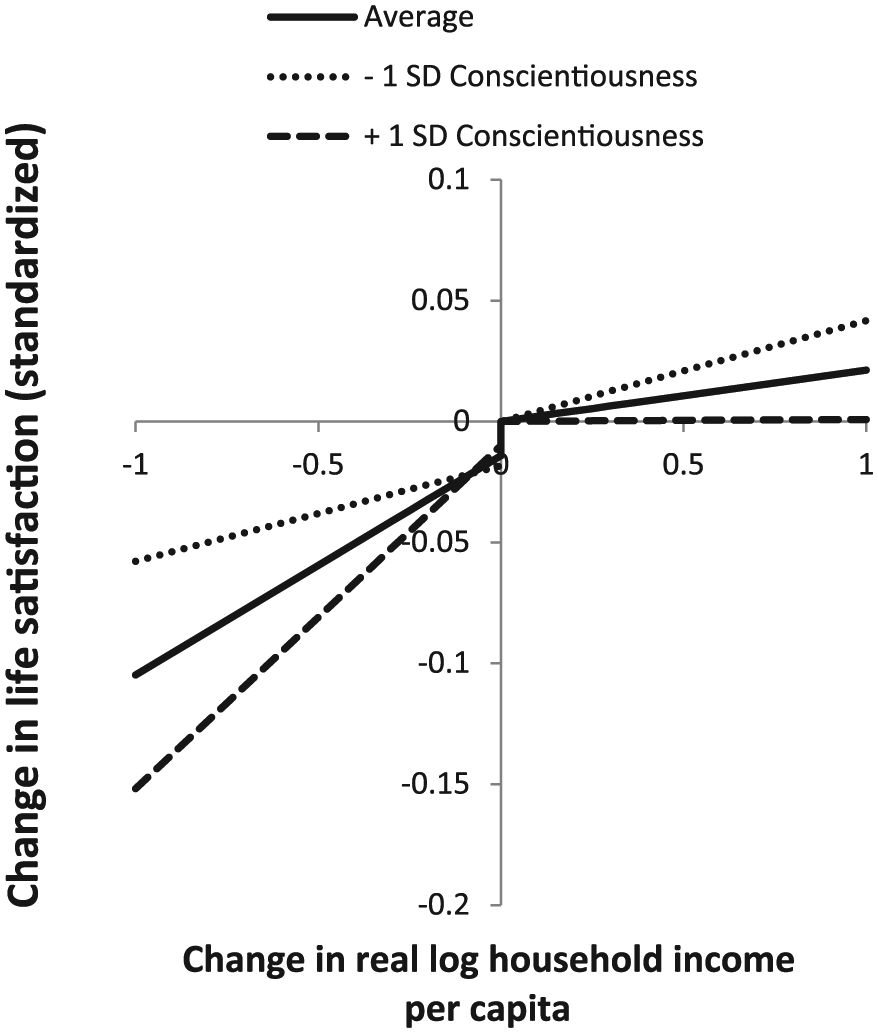
Conscientiousness differences in the relationship between life satisfaction and household income losses and gains controlling for correlated factors (Table 1, Regression 3).
Single Households
Because the above results are open to the criticism that changes in household income may not influence all individuals within a household in the same way, we repeat the analysis on single households (n = 17,622). Those who live alone will experience the full impact of changes in their household income. Regression 1 in Table 2 shows the results of this analysis. Although there is no main effect, there is a significant effect on the conscientiousness interaction with the income loss variable.
Multilevel Regressions Showing Conscientiousness Differences in the Influence of Income Changes on Life Satisfaction for Those Living in Single Households (n = 17,622) and Those Indicating Themselves as Head of Households (n = 63,964) in the German Socio-Economic Panel, and in the Replication Sample From the British Household Panel Survey (N = 33,848).

Note. Life satisfaction and conscientiousness were standardized with a mean of zero and a standard deviation of 1 (M = 0, SD = 1); Regression 1 includes 17,622 observations from 4,117 individuals; Regression 2 includes 63,964 observations from 11,631 individuals; Regression 3 includes 33,848 observations from 12,840 individuals. All regressions include the following control variables: year and regional dummy variables, individual age, gender, education level, and the remaining FFM personality variables; and both the level of and changes from T − 1 to T of the individual’s marital status, household size (square rooted), self-reported health status, parental status, disability status, employment status (retired and unemployed).
p < .05. **p < .01.
Head of Households
Next, we proceed to analyze whether our results are robust for those indicating that they are the head of the household (n = 63,964). Individuals who are the head of the household are more likely to be influenced by changes to household incomes. Regression 2 in Table 2 shows the results of this analysis. The results are consistent with our analyses carried out on the full sample. There is a significant main effect, as well as a significant conscientiousness interaction with the income loss variable. This further suggests our result is robust.
Replication Sample
Our final robustness check is in a sample from a comparable data set. Here, we used 12,840 participants (N = 33,848) from the BHPS, which, like the SOEP, is a nationally representative longitudinal data set (see Taylor, Brice, Buck, & Prentice-Lane, 2010, for further sampling information). The BHPS began in 1991, and in the 2005/2006 wave, a 15-item shortened version of the Big Five Inventory (Benet-Martínez & John, 1998) was administered that was, language differences aside, identical in nature to the one used in the SOEP. The BHPS also includes a one-item life satisfaction question which asks “how dissatisfied or satisfied are you with your life overall?” on a 7-point scale, from 1 (not satisfied at all) to 7 (completely satisfied). Unfortunately, the BHPS ended in 2008/2009, 1 and thus only 3 years of post-personality data are available providing an overall sample size of 33,848. Nevertheless, we proceed to estimate whether conscientiousness predicts how an individual’s life satisfaction responded to changes in income. To account for missingness in the data (2.4%), we again carried out multiple imputation using five imputations (Rubin, 1987). Regression 3 in Table 2 shows the results of this analysis. The results are consistent with our analyses carried out on the SOEP. Although there is not a significant main effect, there is a significant conscientiousness interaction (p < .05) with the income loss variable.
Discussion
We show that loss aversion, indexed by the influence that income changes have on life satisfaction, depends on an individual’s conscientiousness. Although high conscientiousness enhances the effect of an income loss on life satisfaction, this effect of income loss on life satisfaction was reduced for those low on conscientiousness. This effect was present after including an extensive set of covariates, including job loss and household composition changes, as well as on sub-analyses for both single person households and those who are indicated as the head of the household. Our result also replicated in an equivalent representative data set. These findings have widespread implications, not only for behavioral economics but also personality theories of wellbeing, and social policy.
Loss aversion has been considered widely within cognitive psychology and behavioral economics and is typically considered a pervasive general bias (Gaechter et al., 2007; Li et al., 2012). There is, however, neural evidence to support considerable variability in loss aversion at the individual level (Canessa et al., 2013; Tom et al., 2007), and it has been further argued that the expression of loss aversion varies as a function of context and individual differences (Hartley & Phelps, 2012). Our research, however, is the first to demonstrate that loss aversion is a function of any of the FFM personality traits, illustrating the potential for the use of personality psychology in understanding individual reactions to economic stimuli (see Bibby & Ferguson, 2011).
Our prediction concerning conscientiousness was fully supported. This is consistent with previous work showing that high conscientiousness, while enhancing life satisfaction in many domains, carries psychological disadvantages under certain circumstances (Boyce, Wood, & Brown, 2010; Duckworth et al., 2007; Ferguson et al., 2014; Nettle, 2006). Conscientious individuals appear to derive greater utility from the economic domain (e.g., Ameriks et al., 2003; Mueller & Plug, 2006), perhaps due to a greater concern for economic goals (Roberts & Robins, 2000). Thus, in the presence of a loss of income, conscientious individuals may be more psychologically vulnerable, perhaps attributing their failure to their own lack of ability (a stable and general cause of failure) that may damage their self-esteem (e.g., Ralph & Mineka, 1998). We do not expect that conscientiousness will necessarily predict reactions in all domains, and indeed we would expect other personality traits to be more important in the non-economic domain. For example, agreeable individuals value social goals, whereas individuals who score high on openness tend to value aesthetic and personal growth goals (Roberts & Robins, 2000), which may mean that these personality traits may predict aversion to losses in the respective domains. Our research is also highly relevant for the area of failure research (see, e.g., J. V. Wood, Giordano-Beech, & Ducharme, 1999). We would predict that the extent to which failure impacts on people depends on the extent of their failure and how that interacts with the personality traits most relevant to the domain on which people have failed. This is consistent with clinical observations (Johnson, Gooding, & Wood, 2011), and integrating the failure literature with that on personality by situation interactions could strongly benefit both fields.
Although our intention was to investigate the extent to which conscientiousness moderates the classic loss aversion effect, our research also has broad implications for income and life satisfaction research. There is substantial variation in the relationship between income and life satisfaction (Clark, Etilé, Postel-Vinay, Senik, & Straeten, 2005), suggesting that the general pattern of income relating to life satisfaction may not apply equally to everyone in every circumstance. Nevertheless, it is still often assumed that increasing income will improve everyone’s life satisfaction (Stevenson & Wolfers, 2008). Our research specifically demonstrates not only when income changes are likely to be important for well-being (when losses are experienced) but also for whom these income changes are most important (individuals who are conscientious). Thus, our work demonstrates that increased incomes are unlikely to affect most people in most situations. Indeed, it is the sign of a developing research field when the focus moves from observing a basic effect to asking when and for whom it applies. The commonly observed finding that changes in income positively relate to changes in life satisfaction is largely accounted for by people high in conscientiousness losing income. Thus, rather than attempting to increase individual and societal incomes, it may be better to avoid income losses even if that comes at the expense of gains, such as through maximizing stability over long-term growth.
Furthermore, in light of individual differences in the income and life satisfaction relationship, some groups of people may be more vulnerable to instability due to their core traits. Others, however, may have more resilience with which to deal with difficult life situations (Johnson, Wood, Gooding, Taylor, & Tarrier, 2011), and this may be useful in understanding possible coping mechanisms. One way the effect could be operating is through correlated changes in conscientiousness and life satisfaction. Major life events can result in changes to individual personality (Boyce, Wood, Daly, & Sedikides, 2015; Roberts, Walton, & Viechtbauer, 2006), and perhaps the income loss effect on life satisfaction was mediated via changes in conscientiousness. Now that the basic relationship has been demonstrated, such mechanistic questions will be important for future research.
In our research, we explored how life satisfaction, a general cognitive evaluation of one’s life (Fujita & Diener, 2005), related specifically to household income. Thus, with respect to assessing how a major life event influences an individual’s life as a whole, we made use of an optimum indicator of well-being. However, future research may wish to explore narrower indicators, such as financial satisfaction or positive affect, to investigate specific mechanistic pathways. Our focus on household income, however, leaves open the possibility that family dynamics may have been a key driver of our results. Our result may have arisen due to specific social dynamics within conscientious households that encourage disharmony among those living there. Although this is an interesting potential mechanism, it is unlikely to explain our result as the effect was in fact stronger when we carried out the analysis on single household individuals. Thus, in fact it may be that high levels of conscientiousness within families mitigates potential disharmony following negative events like income loss (Baltes, Zhdanova, & Clark, 2010). Nevertheless, exploring the social psychology of loss aversion, and how traits might influence this, would be a worthwhile task for future research. Perhaps there is an important interplay not only between family-level losses and an individual family member’s personality, but also broader interactions with the personality of others within the family and their individual reactions. For example, dyadic influences of personality traits (Roberts, Smith, Jackson, & Edmond, 2009) may mean that the effect of an income loss for a highly conscientious individual would be lower if they lived with someone low in conscientiousness.
Our research may also help in understanding how personality traits emerge, persist, and get expressed by geographical region (Rentfrow, Gosling, & Potter, 2008; but see A. M. Wood, Brown, Maltby, & Watkinson, 2012). If geographical personality differences are substantive, we would expect to observe greater life satisfaction losses during economic downturns in some geographical regions than others. Thus, given concerns regarding the exact meaning of self-report personality differences between regions (see A. M. Wood et al., 2012), and that personality differences may themselves emerge as a result of socio-economic conditions (see Boyce, Wood, Daly, & Sedikides, 2015), an important area for future research is the exploration of how macro-psychological factors relate to regional reactions to wider economic events (Obschonka et al., 2015).
There is a case for examining our effect using alternative longer scales, not only to further validate our result but also to enable an understanding of what components of conscientiousness are behind our results. Conscientiousness is the broad overarching trait and consists of a number of sub-components such as competence, order, dutifulness, achievement, self-discipline, and deliberation. Indeed, some of the components, such as achievement striving or competence, may be more strongly linked to loss aversion, whereas others such as the desire for order or self-discipline may not. Nevertheless, our work demonstrates the importance of taking an interactionist perspective to understanding life satisfaction, whereby both internal and external factors combine to generate greater life satisfaction.
There is also the important question of causality. We ensured our measure of conscientiousness was not contaminated by changes in income or changes in life satisfaction by using a measure that preceded any of these changes. However, this does not rule out the possibility of causality running from life satisfaction to income. Reverse causality is known to explain some of the relationship between income and life satisfaction (Lyubomirsky, King, & Diener, 2005; De Neve & Oswald, 2012), and as such, our results may have an alternative explanation in that those with higher levels of conscientiousness who lost life satisfaction would then go on to lose more income. Future research should test between the competing causal pathways. However, we point out that were causality to run in the opposite direction we would expect to observe the opposite pattern of results than those found in our study. That is, those with higher conscientiousness, following a loss in life satisfaction, would tend to lose less income than those with lower levels of conscientiousness. This is consistent with research showing conscientious individuals work harder in the face of difficulty (McMillan, O’Driscoll, Marsh, & Brady, 2001).
Another issue relevant to our results is that individuals with certain personality traits may be more prone to experiencing specific employment patterns (Winkelmann & Winkelmann, 2008) that result in income instability and job insecurity. Such patterns are known to be more detrimental to health and well-being (Sverke, Hellgren, & Näswall, 2002), and thus, it could be that it is not the loss per se that is important but instead the experience of constant changes in life. This is a possibility, but in our analyses, we dealt with this by including an extensive set of relevant covariates, including changes in employment status. In addition, there was no evidence in our data to suggest that income changes were more likely among the conscientious.
Loss aversion is typically investigated with respect to anticipated losses and gains, and it has therefore been suggested that loss aversion is primarily a “bias,” or decision based-error, in that losses and gains once they are experienced do not have a differential impact (Kermer, Driver-Linn, Wilson, & Gilbert, 2006). However, recent research has shown that loss aversion operates within experienced losses and gains (Boyce, Wood, Banks, et al., 2013). In our study, we chose to focus on experienced losses and gains, as this was the more novel area of this research, but it would be an exciting avenue for future research to further explore whether conscientiousness has a similar influence on anticipated losses and gains. Furthermore, in our study, we assessed loss aversion indirectly via the income and life satisfaction relationship. Our study therefore involved a large representative longitudinal sample with prospectively measured personality and life satisfaction. As such, our results have considerable ecological validity and add to evidence that loss aversion is present outside of laboratory conditions (Camerer, 2004). Nevertheless, experimental research that explores individual differences using a direct assessment of loss aversion would be an important avenue for future research. Although experimental research has less ecological validity, it often allows tighter demonstrations of causality and would therefore complement our research. Perhaps another promising way to further loss aversion research would be to establish whether interventions based around loss aversion were more effective in certain sub-groups of the population than others. Such intervention research has been hugely successful in other fields (Spaeth, Weichold, Silbereisen, & Wiesner, 2010).
It is clear that the use of cognitive psychology (an area of psychology concerned with how people process information in general), has helped improve the predictive power of economic models creating the hugely influential field of behavioral economics (Thaler & Sunstein, 2009). However, although behavioral economics has helped us understand how people react on average, there is often substantial variation in individual reactions (Clark et al., 2005). An understanding of not only when but specifically for whom an effect is the strongest is now needed. The use of personality psychology (an area of psychology focusing on individual differences in reaction) has the potential to instigate a second wave of behavioral economics to predict individual specific reactions to economic circumstance. Thus, we advocate a major change in how research is conducted within the social sciences. There is a need to routinely ask how personality interacts with the main effect observed, which is likely to be in situation specific ways, and we hope that this demonstration will encourage such a development (see also Boyce & Wood, 2011b).
Footnotes
Authors’ Note
The data were made available by the German Institute for Economic Research (DIW Berlin) and the ESRC Data Archive. Neither the original collectors of the data nor the Archive bears any responsibility for the analyses or interpretations presented here.
Declaration of Conflicting Interests
The author(s) declared no potential conflicts of interest with respect to the research, authorship, and/or publication of this article.
Funding
The author(s) disclosed receipt of the following financial support for the research, authorship, and/or publication of this article: The Economic and Social Research Council provided research support (ES/K00588X/1).

Notes
References
Supplementary Material
Please find the following supplemental material available below.
For Open Access articles published under a Creative Commons License, all supplemental material carries the same license as the article it is associated with.
For non-Open Access articles published, all supplemental material carries a non-exclusive license, and permission requests for re-use of supplemental material or any part of supplemental material shall be sent directly to the copyright owner as specified in the copyright notice associated with the article.
