




Abstract
Focusing on individual differences, we studied three influences on the accuracy of meta-perceptions of personality: (a) projection, that is, relying on one’s self-perception; (b) normative meta-insight, that is, relying on the perception of the typical person by others; and (c) distinctive meta-insight, that is, relying on others’ perception of one’s unique personality attributes. Using a round-robin design, 52 groups of four acquainted students described themselves, three acquaintances, and their meta-perceptions on the Big-Five factors of personality, and provided self-reports of psychological adjustment. Projection, normative, and distinctive meta-insight contributed uniquely to meta-perception, yet qualified by systematic individual differences: Psychologically adjusted meta-perceivers projected more and relied on distinctive meta-insight less. Moreover, acquaintance raised projection. Thus, psychologically adjusted meta-perceivers were less aware of discrepancies between their self-perceptions and their actual perceptions by others, and the better people knew another person, the more strongly they expected that this other person perceived them like they perceived themselves.
From time to time, persons wonder how they are perceived by others. For example, employees may believe that their supervisor perceives them as competent and conscientious. Such perceptions of others’ opinions of oneself are called meta-perceptions (Kenny, 1994). 1 As various researchers point out, meta-perceptions are very important within social contexts and interpersonal relationships (Carlson, Vazire, & Furr, 2011; Elfenbein, Eisenkraft, & Ding, 2009; Kenny, 1994; Levesque, 1997; Oltmanns, Gleason, Klonsky, & Turkheimer, 2005).
One question in this context is whether the meta-perceptions of persons resemble the way they are actually perceived by others, which addresses the issue of meta-accuracy (Kenny, 1994). Meta-accuracy can be conceptualized and measured in a variety of ways (e.g., Carlson & Furr, 2009; Carlson, Furr, & Vazire, 2010; Carlson & Kenny, 2012; Campbell & Fehr, 1990; Carlson et al., 2011; Kenny, 1994), these differences affecting the focus and the results of studies on meta-accuracy. Of central significance for the present study are the concept of meta-insight (Carlson et al., 2011), the distinction between variable-centered and person-centered approaches, the distinction between normative and distinctive meta-insight, and individual differences in meta-insight.
Meta-Insight
At first glance, meta-accuracy might suggest that people take others’ perspectives in interpersonal relationships, which enables them to understand the impressions they convey. Several findings on meta-perception, however, argue against this conclusion: First, the correlation between self-perceptions and meta-perceptions is very high: Kenny and DePaulo (1993) obtained a meta-analytically derived average correlation of .87 between how persons expect being generally perceived by others (i.e., their perceiver effect in meta-perception) and how they perceive themselves. Second, immediate feedback on actual perceptions by others does not seem to improve meta-accuracy (Schechtman & Kenny, 1994). Third, some findings on meta-accuracy parallel those on self–other agreement: Coefficients increase with acquaintance and with the observability of the trait, and they decrease with the evaluativeness of the trait (Carlson & Kenny, 2012; Kenny & DePaulo, 1993). Because of these findings, “several researchers have concluded that people assume others see them as they see themselves” (Carlson & Kenny, 2012, p. 247), that is, they project their self-view onto others. As there usually is substantial self–other agreement (Connelly & Ones, 2010), this should result in significant meta-accuracy (Kenny & DePaulo, 1993).
But there is more to meta-perception than projected self-perceptions only. First, even though self-perceptions and meta-perceptions are related to one another, the correlation is far from perfect. Second, under certain circumstances, people distinguish accurately between their perceptions by different interaction partners. For example, they tend to accurately perceive whether their parents or their college friends view them as more conscientious (Carlson & Furr, 2009). This implies that people distinguish self-perceptions from meta-perceptions to some extent. Third, Carlson et al. (2011) examined the relations between self-, meta-, and other perceptions for different personality attributes and various levels of acquaintance, finding that meta-accuracy tended to be higher than self–other agreement. Consequently, meta-perception predicted other perception even if self-perception was statistically controlled. Finally, if other perception was predicted from both meta-perception and self-perception, the unique contribution was higher for meta-perception.
Thus, it seems that, when engaging in meta-perception, persons project their self-perception to some extent. But over and above such projection, they integrate the other’s perspective and provide accurate judgments, apart from their self-perception, on how those others perceive the meta-perceiver’s personality. Based on these findings, Carlson et al. (2011) coined the term meta-insight to describe “the relationship between the beliefs people have about the impression they make on others (i.e., their meta-perceptions) and others’ actual impressions, independent of how people see themselves” (p. 831). Meta-insight is widespread and has been found even for pathological personality traits (Oltmanns et al., 2005).
Variable- and Person-Centered Approaches to Meta-Accuracy
Most studies on meta-accuracy were variable centered, comparing meta-perceptions with perceptions by others within traits across persons. For example, it was studied whether persons assuming to be generally liked by others are actually more popular (generalized meta-accuracy), and whether persons assuming to be particularly liked by a specific other person are actually liked by that person more than by other people (dyadic meta-accuracy). Such studies are helpful to establish the extent of generalized and dyadic meta-accuracy and meta-insight for specific traits, and they yielded important findings (Kenny, 1994). But the variable-centered approach is less suited for finding which persons report more accurate meta-perceptions, as well as which persons facilitate others’ meta-insight by revealing their impressions of those others more clearly. To answer such questions, it is helpful to measure, in a first step, meta-accuracy or meta-insight separately for individual dyads consisting of one meta-perceiver and one interaction partner.
The person-centered or profile approach to meta-perception lends itself to these kind of analyses. Here, meta-perceptions, other perceptions, and maybe self-perceptions are compared separately for individual dyads across variables, rather than separately for variables across dyads. For example, the profile of an observer’s ratings of a target on 30 traits (i.e., other-perception profile) may be compared with the profile of that target’s assumptions how that observer will rate her on those 30 traits (i.e., meta-perception profile). An early study on the effects of self-esteem on meta-accuracy, relying on personality profiles, was published by Campbell and Fehr (1990). These authors found that one’s self-esteem had strong effects on the favorableness of one’s meta-perceptions, but not on whether the shape of the other-perception profile resembled the shape of the meta-perception profile. But Campbell and Fehr (1990) did not yet distinguish between meta-accuracy and meta-insight, nor did they distinguish between normative and distinctive meta-accuracy.
Normative and Distinctive Meta-Insight
When self-perception profiles, other-perception profiles, and meta-perception profiles are compared for numerous persons, profile similarity can and should be decomposed into a normative component reflecting agreement on different variable means (i.e., the characteristics of the typical person), and a distinctive component reflecting residual agreement when the normative component is controlled (Biesanz, 2010; Cronbach, 1955; Furr, 2008; Wood & Furr, 2016). As these two components reflect different phenomena, their separation allows for a more thorough understanding of agreement in interpersonal perception, including meta-insight.
Consider the self-, other-, and meta-perception profiles of two interacting persons, Anna and Ben! Beyond projected self-perception, Anna’s meta-perception of how Ben perceives her may suggest meta-insight for two reasons: First, Anna may expect that Ben perceives her like the typical perceiver perceives the typical target (e.g., most persons are viewed by most observers as more agreeable than neurotic). We will refer to this as the normative profile in other perception. Even if Anna completely ignores any differences between this normative profile and Ben’s perception of her, some meta-insight will be found. This is because Ben’s perception of Anna is likely to resemble the normative profile to some extent (Furr, 2008; Wood & Furr, 2016), and thus, Anna’s meta-perception of how Ben perceives her will resemble Ben’s actual perception of Anna. Indeed, Anna’s meta-perception of how Ben perceives her tends to resemble the other perception of any target by any perceiver (Wood & Furr, 2016). The term normative meta-insight is used here for that component in meta-insight that reflects similarity of a person’s meta-perception to the normative profile in other perception.
Second, over and above meta-accuracy brought about by projected self-perception and normative meta-insight, Anna may understand how she is perceived by Ben specifically. This we will refer to as distinctive meta-insight. Maybe Anna knows that Ben is in love with her, and thus expects Ben to perceive her even more favorably than the typical person is perceived by others. Asked about her meta-perceptions, Anna will, therefore, report that Ben perceives her as extremely agreeable and not neurotic at all. And, because this is exactly what enamored Ben does, Anna’s meta-perception will resemble Ben’s other perception because Anna correctly assumes that Ben perceives her personality differently from how the typical person is judged by others (i.e., there will be distinctive meta-insight).
Carlson et al. (2010) found that persons know to some extent which of their traits others view as uniquely characteristic of them (distinctive meta-accuracy), over and above their knowledge of the impression the typical person conveys to others (normative meta-accuracy). But their study did not distinguish between meta-accuracy and meta-insight, and it did not investigate personality effects on meta-accuracy or meta-insight.
Individual Differences in Meta-Accuracy and Meta-Insight
In the context of his Realistic Accuracy Model (RAM), Funder (1995) suggested four moderators of judgmental accuracy, that is, attributes of (a) the target, (b) the judge, (c) the trait, and (d) the available information. A corresponding model specifically addressing meta-accuracy and meta-insight has not yet been suggested. Nevertheless, it is useful searching for moderators of meta-insight (Carlson et al., 2010; Carlson & Kenny, 2012). Profile comparisons are particularly useful to identify good meta-perceivers who are exceedingly aware of the impression they convey to others, as well as communicative partners who disclose their actual impressions of others especially clearly, thus facilitating accurate meta-perceptions (in the example above, Anna is the meta-perceiver and Ben is the partner). This is because profile comparisons yield separate indices of meta-insight for each dyad consisting of one meta-perceiver and one partner.
But using a profile approach is not yet sufficient for identifying the attributes of good meta-perceivers and communicative partners because, if there is only one partner per meta-perceiver, their effects are confounded. To separate their effects, each meta-perceiver has to report meta-perceptions for, and has to be described by, multiple partners. This is achieved by combining a profile approach to meta-insight with, for example, a round-robin design.
A preliminary question in research on personality effects on meta-insight is whether there are significant individual differences in meta-insight at all. If they are not, it is unpromising trying to identify predictors of meta-insight. This issue is not trivial as, in studies on other perception, the search for the good judge of personality has not been particularly successful (Kenny, 1994). Specifically, judges do not seem to differ in how accurately they perceive the unique personality attributes of others (Biesanz, 2010; but see Borkenau, Mosch, Tandler, & Wolf, 2016). However, well-adjusted perceivers seem to show higher normative accuracy (Human & Biesanz, 2011), more attractive targets seem to be more judgeable (Lorenzo, Biesanz, & Human, 2010), and well-adjusted targets seem to express their distinctive personality attributes more clearly (Human, Biesanz, Finseth, Pierce, & Le, 2014). Moreover, other perception and meta-perception are obviously different phenomena, and moderator effects in meta-perception may well differ from moderator effects found for other perception. Specifically, individual differences in distinctive meta-insight may well be found. If that is the case, it should be clarified next which attributes characterize good meta-perceivers and communicative partners.
Accuracy and Psychological Adjustment
In this context, psychological adjustment is a particularly interesting variable because it is related to the accuracy of other perception (Human & Biesanz, 2011; Human et al., 2014; Lorenzo et al., 2010), and because the relation between accuracy and psychological adjustment is controversial: Taylor and Brown (1988) argued that normal, healthy adults are positively biased rather than accurate. Specifically, healthy adults are said to hold unrealistically positive views of themselves, to hold illusions of control, and to engage in unrealistic optimism. Taylor and Brown (1988) did not explicitly address meta-accuracy but, extending their line of reasoning, it may be hypothesized that well-adjusted persons believe that others see them like they see themselves, instead of acknowledging discrepancies between their self-concept and how others actually perceive them, which possibly necessitates to acknowledge that at least some others see them less positively than they see themselves. And the direction of causality may also go the other way around: Believing that other perceptions coincide with one’s self-perception, even if they do not, may raise self-esteem, whereas acknowledging discrepancies between perception by others and self-perception may constitute feelings of being misunderstood or not authentic, and may reduce self-concept clarity. Thus, there are various reasons suggesting that projection rather than meta-insight may be associated with psychological adjustment.
The Taylor and Brown hypothesis is contentious, however, as other authors argue that psychological adjustment is associated with more accurate perceptions (Allport, 1961; Colvin & Block, 1994). Following this line of reasoning, adjustment may be associated with more meta-insight because well-adjusted persons better understand the importance of normativeness in personality profiles (Human & Biesanz, 2011), and because they engage less in defensive processes such as projection that reduce distinctive meta-insight. Conversely, holding more accurate beliefs of the impression one conveys may facilitate interpersonal interactions and the adaptation of one’s behavior to the expectations of others, thereby contributing to psychological adjustment and health. Therefore, it would also be reasonable finding psychological adjustment being associated with more meta-insight. Thus, our analyses of the effects of adjustment on meta-insight are exploratory.
Finally, it is not only personality but also dyadic variables such as the specific relationship between a meta-perceiver and a partner that seem to influence meta-accuracy: For example, higher meta-accuracy has been found for dyads in which subjects mutually like each other (Ohtsubo, Takezawa, & Fukuno, 2009). We, therefore, studied effects of knowing and liking on meta-insight. Moreover, we studied effects of confidence in one’s meta-perceptions on meta-insight, as it seems that meta-accuracy is higher for individuals feeling more confident that their meta-perceptions are accurate (Carlson et al., 2010).
The Present Study
The present study combined a profile approach with a round-robin design to investigate the effects of projection, normative meta-insight, and distinctive meta-insight on meta-perception. Besides working out how these factors affect meta-perception on average, we analyzed the variation in their importance between participants, and identified variables predicting this variation. Groups of participants described themselves, three acquaintances, and how they expected being described by those acquaintances on the Big-Five personality dimensions. Moreover, they filled in self-report measures of psychological adjustment and their relationship with each partner. The data were analyzed using multilevel modeling, estimating effects of projection, normative meta-insight, and distinctive meta-insight for individual dyads at Level 1, and predicting variation between dyads in these parameters at Level 2.
Method
Participants
Participants were 208 students (65 male, Mage = 22.43 years, SD = 2.25 years, range = 18-33 years), only few of them majoring in psychology. They were recruited as 52 groups of four mutual acquaintances, and reported an average length of acquaintance of 34.19 (SD = 39.72) months. Each participant received a remuneration of 25 Euro (approximately US$30). An examiner supervised the groups to prevent undesirable communication. 2
Measures
The participants provided three different kinds of reports for the domains of the Five-Factor model of personality: (a) self-reports to measure self-perception, (b) descriptions of the three other members of their group to measure other perception, and (c) assumptions how their personality was perceived by each member of their group to measure meta-perception. Furthermore, subjects filled in measures of psychological adjustment potentially predicting projection, normative meta-insight, and distinctive meta-insight, and they provided information on their relationship with each other.
Five-Factor model
For the assessment of the Big-Five personality dimensions, we used 30 bipolar German-language adjective scales, the Minimum Redundancy Scales with 30 Items (MRS-30). This is a short version by Schallberger and Venetz (1999) of Ostendorf’s (1990) Minimum Redundancy Scales. The five personality domains are measured with six items each, half of them being reverse keyed. The response scales run from 1 (very quiet) to 6 (very talkative). For self-perception, the participants were instructed to indicate how they perceived themselves. For other perception, participants were instructed to indicate their personality impressions of each of the three acquaintances in their group. Finally, for meta-perception, participants were instructed to report their assumptions how their personality attributes were perceived by each of the three other members of their group.
Psychological adjustment
Accuracy in interpersonal perception seems to be related to adjustment (Human & Biesanz, 2011; Human et al., 2014). Therefore, all participants completed the Multidimensionale Selbstwertskala (Multi-Dimensional Self-Esteem Scale [MSES]) by Schütz and Sellin (2006). This is a German-language adaptation of the Multidimensional Self-Concept Scale by Fleming and Courtney (1984), consisting of six subscales, that is (number of items in parentheses): Emotional Self-Esteem (7), Social Self-Esteem: Confidence in Interactions (5), Social Self-Esteem: Dealing With Criticism (5), Achievement-Related Self-Esteem (5), Physical Attractiveness Self-Esteem (5), and Athleticism Self-Esteem (5), with response options running from 1 to 7. Moreover, we administered the 117-item screening questionnaire for the Structured Clinical Interview for Diagnostic and Statistical Manual of Mental Disorders (4th ed.; DSM-IV; American Psychiatric Association, 1994)–Axis II (SCID-II) in a German adaptation by Wittchen, Zaudig, and Fydrich (1997). It covers the following personality disorders (PDs): avoidant PD (7), dependent PD (8), obsessive-compulsive PD (9), negativistic PD (8), depressive PD (8), paranoid PD (8), schizotypal PD (11), schizoid PD (6), histrionic PD (7), narcissistic PD (16), borderline PD (14), and antisocial PD (15). Here, the response options are yes or no, endorsement indicating maladjustment.
Dyadic variables
Furthermore, we measured six dyadic variables. Immediately after having provided personality ratings of an acquaintance, the participants indicated (a) how long they knew that person in years and months (length of acquaintance); (b) how well they knew that person (knowing), using a rating scale running from 1 (not at all) to 5 (very well); and (c) how much they liked that person (liking), using a rating scale running from 1 (not at all) to 5 (very much). In addition, after having reported their assumptions how an individual other member of their group perceived them, participants indicated how well that person knew them (assumed knowing) and how much that person liked them (assumed liking), on the same kind of scales as used for the knowing and liking ratings. Furthermore, participants indicated how confident they were that their assumptions concerning their perception by an acquaintance matched that acquaintance’s actual perception of their personality. These responses were provided on a rating scale running from 1 (not at all confident) to 5 (very confident).
Results
First, the reverse-keyed MRS-30 items were recoded such that, on all items, high scores indicated extraversion, agreeableness, conscientiousness, emotional stability, or openness to experience, that is, the socially more desirable poles of the scales. This is likely to attenuate normative influence as the scatter of item means is thereby reduced. The self-perception, other-perception, and meta-perception means, standard deviations, and internal consistencies of the Big-Five domain scores are reported in Table 1. Domain scores were the sum of the responses to the six corresponding marker scales, and other-perception and meta-perception scores were, in addition, averaged across the three acquaintances per participant. All these measures were sufficiently reliable.
Means, Standard Deviations, and Internal Consistencies of the Big-Five Domain Scores, and Correlations Between Self-Perception, Other perception, and Meta-Perception.
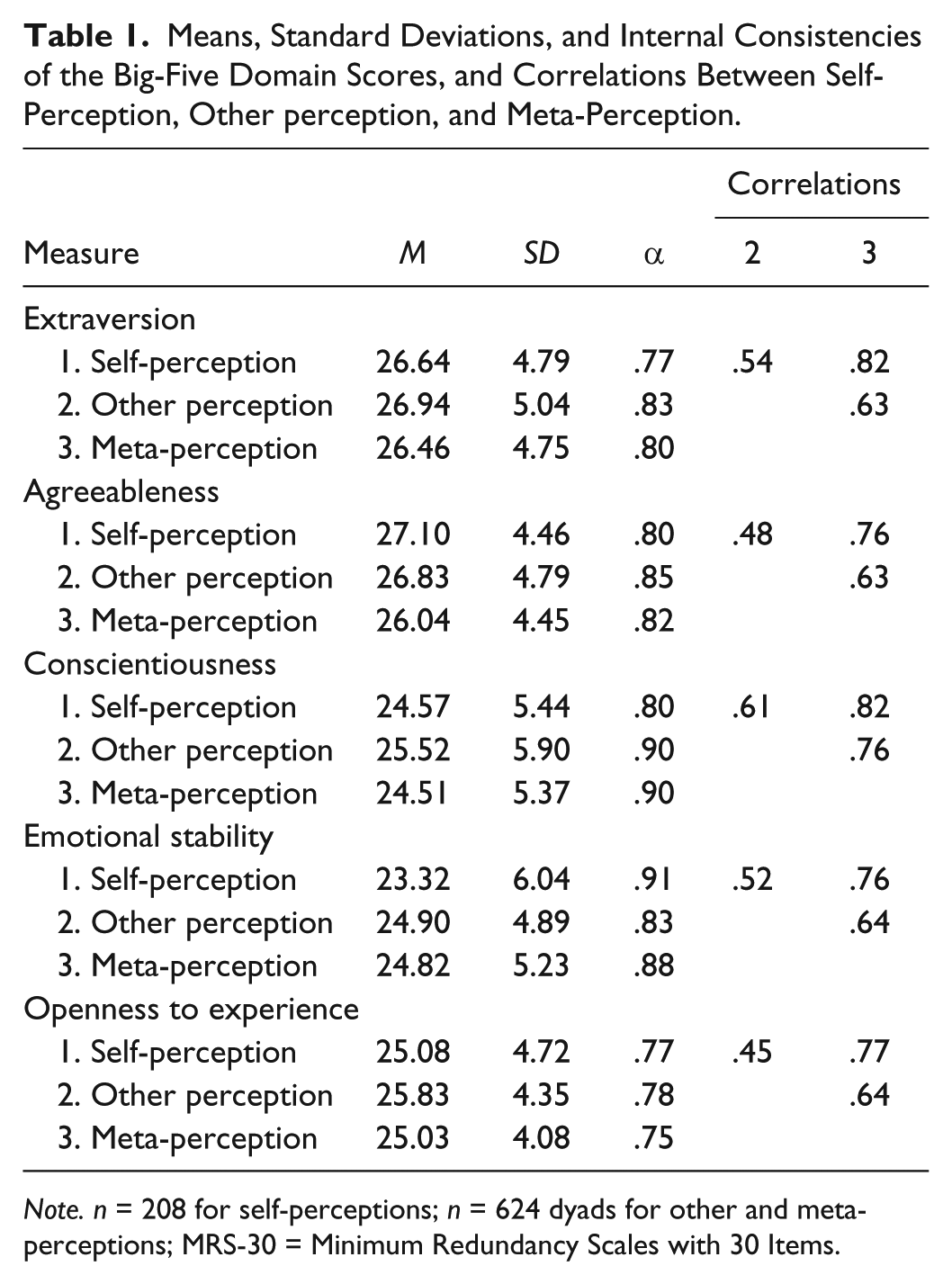
Note. n = 208 for self-perceptions; n = 624 dyads for other and meta-perceptions; MRS-30 = Minimum Redundancy Scales with 30 Items.
Notably, the means for meta-perception were lower than those for other perception in each Big-Five domain. To test the significance of this finding, we ran a 2 × 5 ANOVA with the within-subject factors perspective (other perception, meta-perception) and Big-Five domain. As the sphericity assumption was not met, we corrected the degrees of freedom using the Greenhouse–Geisser procedure. The main effect of perspective was significant, F(1, 207) = 18.03, p < .001,
The correlations, computed across participants, between self-perception, other perception, and meta-perception are reported, separately for the Big-Five domains, in the two rightmost columns of Table 1. Throughout, the correlations were highest between self-perception and meta-perception, but this may reflect common-method bias. More interesting is that perceptions by others were consistently more strongly related to meta-perception (indicating generalized meta-accuracy) than to self-perception (indicating self–other agreement), that is, reports by others shared variance with the meta-perceptions that they did not share with the self-reports. This is a first hint at meta-insight.
The internal consistencies of the six MSES subscales ranged from .80 to .91, and the reliability of the total score was .94. This justifies analyses at the level of the subscales and at the level of the composite score. The PD scales were less consistent, however, with Cronbach’s alphas ranging from .38 to .75. Therefore, we did not analyze their effects at the level of each of the 12 PD scores, but at the level of Cluster A scores (the thought-disorder cluster, including paranoid, schizotypal, and schizoid PD), Cluster B scores (the externalizing cluster, including histrionic, narcissistic, borderline, and antisocial PD), and Cluster C scores (the internalizing cluster, including avoidant, dependent, and obsessive-compulsive PD). Moreover, we computed a total PD score, that is, the number of endorsements of all 117 SCID-II items. For the PD cluster scales and the PD total score, the reliabilities were sufficient or even good. Descriptive statistics of the MSES scales, the PD cluster scales, and the PD total score are reported in Table 2.
Means, Standard Deviations, and Internal Consistencies of Self-Report Measures of Psychological Adjustment.

Note. N = 208. Cluster A included paranoid, schizotypal, and schizoid; Cluster B included histrionic, narcissistic, borderline, and antisocial; and Cluster C included avoidant, dependent, and obsessive-compulsive personality disorders. MSES = Multidimensional Self-Esteem Scale; SCID-II = Structured Clinical Interview for DSM-IV–Axis 2, Screening Questionnaire; DSM-IV = Diagnostic and Statistical Manual of Mental Disorders (4th ed.).
The means, standard deviations, and correlations of the dyadic variables are reported in Table 3. The means of the ratings of liking and assumed liking, as well as of knowing and assumed knowing, were all well beyond the scale midpoint of 3.0, suggesting that members of the same group mostly knew and liked each other. Moreover, all dyadic variables were positively correlated.
Means, Standard Deviations, and Correlations Among Measures of Actual and Assumed Knowing and Liking.

Note. N = 624 dyads in 52 independent groups.
Hierarchical Linear Modeling
The data were then analyzed using hierarchical linear modeling (Raudenbush & Bryk, 2002) and the software HLM7 (Raudenbush, Bryk, & Congdon, 2010). Throughout, we tested three-level random-effect models and relied on robust standard errors.
Level-1 analyses
At Level 1, we predicted, across the MRS-30 traits and separately for 624 dyads (i.e., 12 meta-perceiver–partner dyads within each of the 52 groups), the participants’ meta-perceptions of how they were perceived by each of their three acquaintances. Predictors were (a) self-perception (the meta-perceiver’s self-description), (b) normative other perception (the average profile of all 624 descriptions by others), and (c) distinctive other perception (the description of the meta-perceiver by the partner in that specific dyad). The Level-1 regression slopes (β coefficients) for these three predictor variables estimated: (a) projection, (b) normative meta-insight, and (c) distinctive meta-insight. The Level-1 equation was

In this equation, MP refers to meta-perception, SP to self-perception,
Level-2 analyses
In a series of cross-classified models, we tested for effects of psychological adjustment of the meta-perceivers and their partners on the Level-1 slopes. We ran separate analyses for different Level-2 predictors. But to distinguish clearly between effects of the meta-perceivers and their partners (whose personality scores might be correlated), we entered the scores of both persons on the same personality variable (e.g., the emotional self-esteem of the meta-perceivers and their partners) into one Level-2 equation. All Level-2 predictors were z standardized. Therefore, the Level-2 or γ coefficients indicate changes in projection, normative meta-insight, or distinctive meta-insight, being associated with a one-standard-deviation increase in the Level-2 predictor.
To identify dyadic variables predicting Level-1 slopes, we ran three-level hierarchical (not cross-classified) random-effect models. Here, the Level-1 model was very similar as in the preceding analyses, but the Level-1 slopes for a particular dyad were predicted by dyadic Level-2 variables, for example, by how long the meta-perceiver and the partner knew each other (see Note 3). We ran separate analyses for each of the six dyadic variables. Moreover, because these variables were substantially correlated, we also ran an analysis entering all six dyadic variables simultaneously.
Level-3 analyses
Level 3 was included because the participants had been recruited in groups who might differ systematically from each other. Indeed, according to a one-way random-effects ANOVA of the meta-perceptions, not including any predictor variables, there was significant heterogeneity in meta-perceptions between groups, SD = 0.21, χ2(51) = 229.84, p < .001, as well as between dyads within groups, SD = 0.34, χ2(572) = 2,396.21, p < .001. Therefore, the group code was entered as a cluster variable at Level 3. We did not include any Level-3 predictor but allowed all parameter estimates to vary between groups. This raised the statistical power of some of the analyses.
Predictors of Meta-Perception
Level-1 predictors
In an analysis without any Level-2 predictors, the Level-1 model described by Formula 1 accounted for 48% of the variance within dyads across traits. Thus, a weighted average of self-reports, the normative profile, and a participant’s description by a partner predicted the corresponding meta-perceptions strongly. The regression coefficients averaged across all dyads (the Level-1 fixed effects) were β = .47, SE = 0.02, p < .001, for projection; β = .36, SE = 0.02, p < .001, for normative meta-insight; and β = .20, SE = 0.01, p < .001, for distinctive meta-insight. Thus, all three predictors were significant, indicating that meta-perception did not reflect projection exclusively, and that there was distinctive meta-insight in addition to normative meta-insight. As these coefficients were not standardized, their size cannot be compared directly.
Level-2 predictors
Psychological adjustment
First, we checked whether the Level-1 regression slopes varied significantly among meta-perceivers, and among the partners of the meta-perceivers, because if there would be no significant variation, any search for Level-2 variables moderating projection or meta-insight would be futile. There was significant variation between meta-perceivers in projection, SD = 0.16, χ2(207) = 769.54, p < .001; in normative meta-insight, SD = 0.24, χ2(207) = 334.74, p < .001; and in distinctive meta-insight, SD = 0.10, χ2(207) = 372.89, p < .001. Between the partners of the meta-perceivers, there was also significant variation in projection, SD = 0.10, χ2(155) = 192.58, p = .02, and in distinctive meta-insight, SD = 0.06, χ2(155) = 198.75, p = .01; whereas, the variation in normative meta-insight was marginally significant, SD = 0.11, χ2(155) = 179.20, p = .09. Thus, descriptively, the variation among meta-perceivers was larger than among their partners. But because all these six standard deviations were marginally significant at least, we included personality attributes of both, the meta-perceivers and their partners, as Level-2 predictors of projection, normative meta-insight, and distinctive meta-insight.
The resulting γ coefficients are reported in Table 4 and show a clear pattern: Psychological adjustment of the partner had no significant effects, neither on projection nor on normative or distinctive meta-insight. By contrast, psychological adjustment of the meta-perceivers influenced projection and distinctive meta-insight consistently: The more self-esteem and the fewer PD symptoms participants reported, the more they expected their partners to perceive them as they perceived themselves, that is, they projected more. And almost the same personality variables were associated with reduced distinctive meta-insight, that is, persons reporting high self-esteem and few PD symptoms were less aware of how their unique personality attributes were actually perceived by others.
Measures of Psychological Adjustment as Level-2 Predictors of Projection, Normative Meta-Insight, and Distinctive Meta-Insight.

Note. N = 208 meta-perceivers and 208 partners. Confidence interval limits are reported as .00 if positive and <.005, and as −.00 if negative and >−.005. CI = confidence interval; MSES = Multidimensional Self-Esteem Scale; SCID-II = Structured Clinical Interview for DSM-IV–Axis 2, Screening Questionnaire; DSM-IV = Diagnostic and Statistical Manual of Mental Disorders (4th ed.).
Coefficients significant at p < .05 in a two-tailed test are printed in bold.
Unsurprisingly, self-esteem and self-reported PD symptoms were negatively correlated with each other. Therefore, we ran four additional cross-classified models to check whether self-esteem and PD scores contributed uniquely to the meta-perceivers’ projection and distinctive meta-insight. In these models, the Level-1 slopes were simultaneously predicted from the meta-perceivers’ and their partners’ total MSES scores, plus from either one of their three PD cluster scores or their PD total score. If MSES scores and Cluster A scores were included in the same analysis, the effects of Cluster A on projection and distinctive meta-insight remained significant, but those of self-esteem did not. If the MSES and Cluster B scores were included in the same analysis, both influenced distinctive meta-insight but the effect of self-esteem on projection (γ = .03, p = .06) fell below conventional levels of statistical significance. Moreover, if MSES and Cluster C scores were included, self-esteem did not show significant effects, whereas the Cluster C scores predicted projection significantly (γ = −.06, p = .004) and distinctive meta-insight marginally significantly (γ = .03, p = .06). Finally, if the MSES and the PD total score were included, self-esteem did neither predict projection (γ = .02, p = .27) nor distinctive meta-insight (γ = −.01, p = .55), whereas the PD total score significantly predicted projection (γ = −.03, p = .03) as well as distinctive meta-insight (γ = .03, p = .01). To summarize, the unique effects of PD symptoms on projection and distinctive meta-insight were stronger than those of self-esteem.
We also checked whether the opposite effects of personality on projection and on distinctive meta-insight might reflect strong negative correlations, across dyads, between the slope parameters β1 and β3, indicating projection and distinctive meta-insight. If that would be the case, the opposite signs of the coefficients in column 1 of Table 4, compared with those in its second-to-last column, might reflect two sides of the same coin. But the correlation between these two slope parameters was low, r = −.15.
Dyadic variables
Two sets of γ coefficients are reported in Table 5 for the dyadic variables as predictors of projection and meta-insight: coefficients resulting from six separate analyses each including one dyadic variable, and coefficients resulting from one combined analysis including all six dyadic variables. When the six dyadic variables were entered as a set, projection increased (a) with length of acquaintance, (b) the more meta-perceivers expected that their partner knew them well, and (c) the more meta-perceivers were confident that their meta-perceptions were accurate. It seems that meta-perceivers felt that the better others knew them, the more those others would perceive them like the meta-perceivers perceived themselves.
Dyadic Variables as Level-2 Predictors of Projection, Normative Meta-Insight, and Distinctive Meta-Insight.
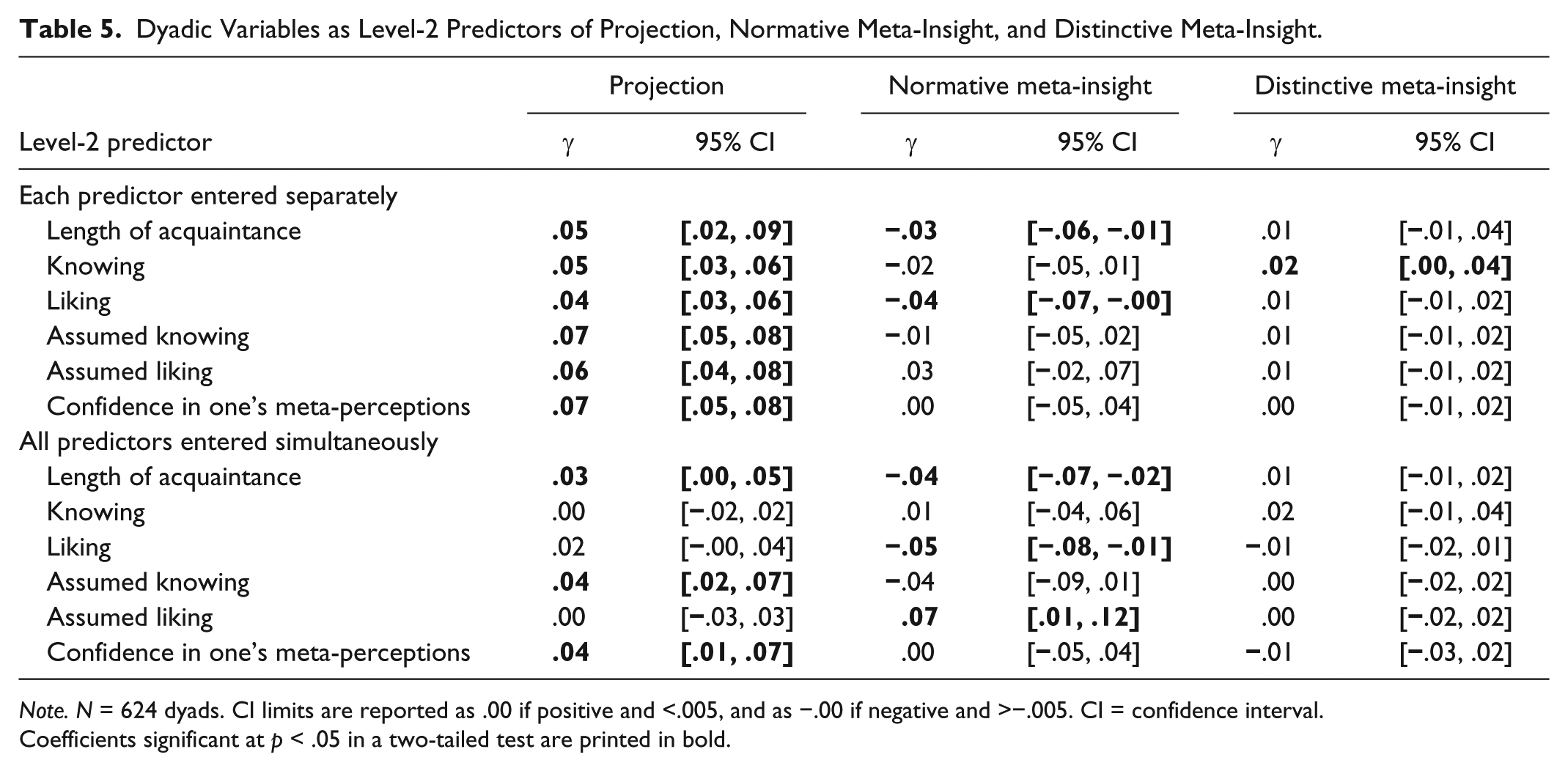
Note. N = 624 dyads. CI limits are reported as .00 if positive and <.005, and as −.00 if negative and >−.005. CI = confidence interval.
Coefficients significant at p < .05 in a two-tailed test are printed in bold.
Normative meta-insight was uniquely influenced by length of acquaintance: The longer meta-perceiver and partner knew each other, the less did the meta-perceiver expect to be perceived like the typical person. Concerning distinctive meta-insight, however, the effects of the dyadic variables were weak: Only one of six coefficients, that for knowing, was significant, and it fell below this threshold when the other dyadic variables were controlled. The sign of the coefficient for knowing, however, was consistent with expectations: Distinctive meta-insight was stronger the better the meta-perceiver knew the partner.
Liking and assumed liking did not have any effects on distinctive meta-insight, and their effects on normative meta-insight were complex: Whereas liking was inversely related to normative meta-insight, assumed liking was directly related.
Predicting Meta-Accuracy
We repeated the multilevel analyses with a reduced Level-1 model, predicting meta-perception from normative and distinctive other perception but not from self-perception. Thus, there was no path representing projection in these analyses, the two remaining Level-1 paths indicating normative and distinctive meta-accuracy (instead of normative and distinctive meta-insight). We ran these analyses to study the effects of lack of control for self-perception on estimates of meta-accuracy. The reduced Level-1 model accounted for 27% of the variance within dyads, the averaged regression coefficients (fixed effects) being 0.80 for normative meta-accuracy and 0.35 for distinctive meta-accuracy.
Effects of psychological adjustment on meta-accuracy
Whereas no personality variable predicted normative meta-insight (see Table 4), one personality variable predicted normative meta-accuracy (see Table 6): high scores of meta-perceivers on the MSES Social Self-Esteem: Confidence in Interactions were associated with more normative meta-accuracy, that is, participant’s scoring height on this scale had a stronger tendency to expect that their partners perceived them like persons are generally perceived by others. More pronounced were the differences between predictors of distinctive meta-insight and predictors of distinctive meta-accuracy: Whereas seven personality attributes of meta-perceivers predicted distinctive meta-insight (see Table 4), only four predicted distinctive meta-accuracy (see Table 6). These weaker effects of psychological adjustment on distinctive meta-accuracy than on distinctive meta-insight probably reflect that meta-accuracy confounds projection with distinctive meta-insight, projection being directly and distinctive meta-insight being inversely related to psychological adjustment.
Measures of Psychological Adjustment as Level-2 Predictors of Normative Meta-Accuracy and Distinctive Meta-Accuracy.
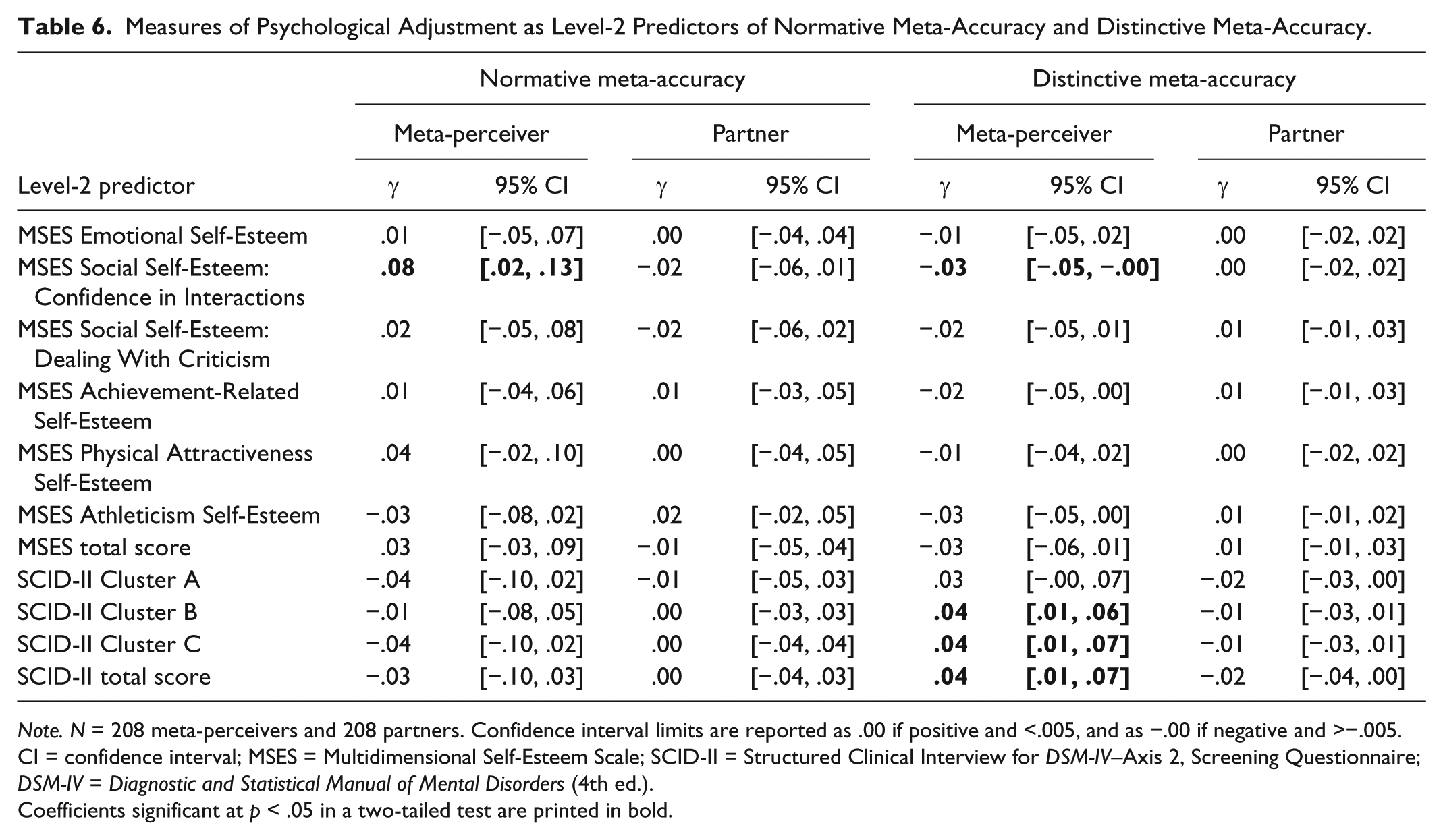
Note. N = 208 meta-perceivers and 208 partners. Confidence interval limits are reported as .00 if positive and <.005, and as −.00 if negative and >−.005. CI = confidence interval; MSES = Multidimensional Self-Esteem Scale; SCID-II = Structured Clinical Interview for DSM-IV–Axis 2, Screening Questionnaire; DSM-IV = Diagnostic and Statistical Manual of Mental Disorders (4th ed.).
Coefficients significant at p < .05 in a two-tailed test are printed in bold.
Effects of dyadic variables on meta-accuracy
When the six dyadic variables were entered one by one, four of them significantly predicted higher normative meta-accuracy, and all of them significantly predicted higher distinctive meta-accuracy (see Table 7). Significant negative predictors of meta-insight turned into insignificant predictors of meta-accuracy, whereas insignificant predictors of meta-insight turned into significant positive predictors of meta-accuracy (compare Table 5 with Table 7). Also considering that knowing and liking raised projection, this suggests that the effects of knowing and liking on meta-accuracy mostly reflected effects of projection: The more that acquaintances knew or liked each other, the more they expected that their partner perceived them like they perceived themselves. When the six dyadic variables were simultaneously entered into the same regression, however, none of the 12 coefficients predicting normative or distinctive meta-accuracy was significant.
Dyadic Variables as Level-2 Predictors of Normative and Distinctive Meta-Accuracy.

Note. N = 624 dyads. CI limits are reported as .00 if positive and <.005, and as −.00 if negative and >−.005. CI = confidence interval.
Coefficients significant at p < .05 in a two-tailed test are printed in bold.
Discussion
The present study confirms findings by Carlson et al. (2010, Carlson et al., 2011) that meta-perception reflects self-perception, normative meta-insight, and distinctive meta-insight. On average, persons seem to be sensitive to differences between how they perceive themselves and how they are seen by others, and to differences between their unique perception by others and the perception of the typical person. These findings provide further support that meta-perceptions generally tend to be quite accurate.
Our main findings, however, are on the individual differences in projection and meta-insight. First, there was significant variation in distinctive meta-insight. This is not trivial as, in other perception, differences between judges in how accurately they perceive the unique personality characteristics of others are small and frequently not significant (Biesanz, 2010). The present study suggests that, by contrast, individual differences in distinctive meta-insight are substantial. Second, psychological adjustment of the meta-perceivers predicted projection and distinctive meta-insight, whereas psychological adjustment of the partners did not. The latter finding may reflect that meta-perceivers are capable to reduce their projection by relying on their self-perceptions less, and to raise their distinctive meta-insight by being more attentive to feedback on how their personality attributes are perceived by others. By contrast, partners are in principle capable to provide more or less accurate feedback on how they perceive the meta-perceivers’ personality, but depend on the meta-perceivers’ willingness to actually utilize this feedback. Thus meta-perceivers have more control over their meta-perceptions than their partners have.
Influences of Psychological Adjustment
Meta-perceivers who reported higher self-esteem, or who reported fewer PD symptoms, showed significantly more projection and significantly less distinctive meta-insight. At first glance, this may seem inconsistent with studies on other perception, showing that perceivers reporting high self-esteem utilize normative information more appropriately (Human & Biesanz, 2011), and that well-adjusted targets express their distinctive personality attributes more clearly (Human et al., 2014).
But another finding by Human and Biesanz (2011) is fully consistent with the present ones: In that study, well-adjusted individuals assumed that others had similar unique personality characteristics as they had themselves, that is, they reported more assumed similarity. Whereas that suggests that well-adjusted individuals distinguish less clearly between self-perceptions and perceptions of others, the present study suggests that such persons distinguish less clearly between self-perceptions and meta-perceptions, that is, between self-perceptions and assumed perceptions by others. Although these are different phenomena, they may reflect a similar underlying mechanism, that is, a holistic, less differentiated information-processing style.
As self-esteem and PDs are associated with positive affect and with negative affect, respectively, less differentiation by more adjusted people is consistent with the hypothesis that positive affect supports a holistic processing mode, whereas negative affect supports an analytic processing mode (Bolte, Goschke, & Kuhl, 2003). Moreover, it is consistent with the depressive realism hypothesis (Alloy & Abramson, 1979) that judgments by persons reporting less positive affect tend to be more accurate, and with the Taylor and Brown (1988) formulation that perceptions by well-adjusted persons tend to be more biased.
Differences Between Psychological Disorder Symptoms and Self-Esteem
Predicting projection and distinctive meta-insight simultaneously from self-esteem and PD scores, we consistently found unique effects of PD scores but not of self-esteem. This suggests that it is maladjustment rather than self-esteem that influences, or is influenced by, meta-insight. Persons showing symptoms of maladjustment are likely to receive more negative feedback from others, sensitizing them that their perceptions by others tend to be inconsistent with their self-concept. Indeed, high PD scores are associated with less self–other agreement in ratings of personality (Tandler, Mosch, Wolf, & Borkenau, in press). And the effect may also take the opposite direction: Persons who realize that others perceive them differently from how they perceive themselves may feel misunderstood, disoriented, or treated unfairly, resulting in PD symptoms.
By contrast, according to sociometer theory (Leary, 1999), self-esteem signals a person’s relational value. High self-esteem signals that a person is favorably perceived by others, whereas low self-esteem signals poor evaluations by others. Thus, self-esteem reduces discrepancies between self-perceptions and perceptions by others independent of its level. Therefore, the level of self-esteem should not affect whether persons distinguish between their self-perceptions and their assumed perceptions by others.
Influences of Knowing and Liking
Three of the six dyadic variables had direct effects on projection: length of acquaintance, assumed knowing, and confidence in one’s meta-perceptions. By contrast, knowing, liking, and assumed liking had total but no direct effects on projection; rather, their effects on projection seem to be mediated by assumed knowing. Collectively, these findings suggest that meta-perceivers project the more they are convinced that their partner knows them well. They seem to expect that others knowing them really well perceive them as they perceive themselves. This would be reasonable because a major difference between self-perceptions and perceptions by others is that the self has access to information on internal states (Vazire, 2010) and on the person’s behavior in diverse settings (e.g., both work and leisure). These differences, however, tend to decline with the length and intimacy of the relationship (Kenny, 1994; Letzring, Wells, & Funder, 2006), implying that information overlap gets stronger, self–other agreement increases (Connelly & Ones, 2010), and self-perceptions become a less error-prone heuristic for generating meta-perceptions. But as normative and distinctive meta-insight did not increase with acquaintance, it seems that meta-perceivers do not use the incremental information resulting from a longer or more intimate relationship.
Whereas there were no direct effects of any of the dyadic variables on distinctive meta-insight, length of acquaintance and liking of the meta-perceiver reduced normative meta-insight. The first finding is reasonable: Meta-perceivers should expect that well-acquainted partners describe their personality less stereotypically because they have more information on the meta-perceiver’s unique personality traits. That liking reduced normative meta-insight is less easily explained, particularly as assumed liking boosted normative meta-insight. The latter finding is reasonable, however: As the normative profile tends to be a socially desirable profile (Borkenau & Zaltauskas, 2009; Wood & Furr, 2016), assumed liking should raise the resemblance between meta-perceptions and the normative profile, reflecting that meta-perceivers expecting to be liked by a partner should also expect being favorably described by that partner.
Conclusion
Projection, normative meta-insight, and distinctive meta-insight influence meta-perception, whereby persons reporting less self-esteem and more PD symptoms project less and show more distinctive meta-insight. Thus, less adjusted persons seem to distinguish more accurately between self-perceptions and perceptions by others, as well as between stereotypical and unique perceptions by others. Moreover, acquaintance increased projection: It seems that the better persons know each other, the more they believe that those others perceive them like they perceive themselves. But before drawing strong conclusions from these findings, they should be replicated, preferably in a sample consisting not of students exclusively.
Footnotes
Acknowledgements
The authors are indebted to Nancy Tandler for helpful comments on an earlier draft of this article.
Declaration of Conflicting Interests
The author(s) declared no potential conflicts of interest with respect to the research, authorship, and/or publication of this article.
Funding
The author(s) disclosed receipt of the following financial support for the research, authorship, and/or publication of this article: The research reported in this article was supported by grant Bo 774/17-1 from Deutsche Forschungsgemeinschaft (German Research Foundation) to Peter Borkenau.

Notes
References
Supplementary Material
Please find the following supplemental material available below.
For Open Access articles published under a Creative Commons License, all supplemental material carries the same license as the article it is associated with.
For non-Open Access articles published, all supplemental material carries a non-exclusive license, and permission requests for re-use of supplemental material or any part of supplemental material shall be sent directly to the copyright owner as specified in the copyright notice associated with the article.
