




Abstract
Most legal systems are based on the premise that defendants are treated as innocent until proven guilty and that decisions will be unbiased and solely based on the facts of the case. The validity of this assumption has been questioned for cases involving racial minority members, in that racial bias among jury members may influence jury decisions. The current research shows that legal professionals are adept at identifying jurors with levels of implicit race bias that are consistent with their legal interests. Using a simulated voir dire, professionals assigned to the role of defense lawyer for a Black defendant were more likely to exclude jurors with high levels of implicit race bias, whereas prosecutors of a Black defendant did the opposite. There was no relation between professionals’ peremptory challenges and jurors’ levels of explicit race bias. Implications for the role of racial bias in legal decision making are discussed.
Every year, millions of individuals around the world are charged with a crime and placed before a jury to decide their fate. It is assumed that the defendant will be treated as innocent until proven guilty and that the jury will be unbiased and make all decisions solely based on the facts of the case. Yet, jury members with viewpoints, experiences, and personalities that make them sympathetic or unsympathetic toward the involved individuals can affect the likelihood of a guilty verdict and potential sentence. Such influences are of particular concern when the victim or defendant is a racial minority member (Blair, Judd, & Chapleau, 2004; Fellner, 2009; Mustard, 2001; Williams & Holcomb, 2001). In cases involving members of different racial groups, jurors may be predisposed to make judgments in favor of certain groups and against the members of other groups.
One way to screen for race biases among jury members is the voir dire process, in which potential jurors are questioned regarding their backgrounds, opinions, knowledge of the case, qualifications, and ability to serve on a jury (Sommers & Norton, 2008). In American criminal trials, prosecutors and defense lawyers can ask potential jurors almost any question they wish. Based on the answers obtained in the voir dire process, prosecutors and defense lawyers are allowed to make a limited number of peremptory challenges. That is, they can request the removal of an individual from the jury pool without needing to state a reason. 1 Although not guaranteed by the U.S. constitution, peremptory challenges are meant to give prosecutors and defense lawyers an opportunity to remove jurors who might be biased, and thereby ensure a fair and impartial jury.
Yet, within the scope of a criminal trial, prosecutors and defense lawyers typically wish to have a jury weighted in their favor. When making a peremptory challenge, the two sides rarely aim for an impartial jury, but for a jury that is sympathetic to their arguments and their side of the case (Hans & Vidmar, 1982). Thus, in cases involving a racial minority member, prosecutors and defense lawyers tend to have opposing interests with regard to jury members’ level of racial bias. For example, when the defendant is Black and the victim is White, prosecutors may aim to keep jurors who are racially biased against Blacks, whereas defense lawyers may aim to remove such jurors. Conversely, when the defendant is White and the victim is Black, prosecutors may aim to remove jurors who are racially biased against Blacks, whereas defense lawyers may aim to keep such jurors. To the extent that each side is equally effective in identifying jurors’ levels of racial bias, their competing goals may ultimately result in balanced juries. Yet, impartiality may be in jeopardy if the two sides are not equally matched in their ability to identify jurors’ levels of racial bias (Sommers & Norton, 2008).
The main goal of the current research was to explore whether legal professionals are effective in screening potential jurors for racial bias during a simulated voir dire and “stacking the jury” in their favor. Using the average levels of racial bias among jurors kept and jurors removed as a criterion, we tested whether the peremptory challenges made by legal professionals reflect systematic differences in racial bias that are consistent with their legal interests, as determined by their role (i.e., prosecutor vs. defense lawyer) and the racial backgrounds of the involved individuals (i.e., Black defendant and White victim vs. White defendant and Black victim).
Explicit and Implicit Race Bias
An important aspect in the context of the current study is the distinction between explicit and implicit race bias. Explicit race bias refers to verbally endorsed evaluations of racial groups on self-report measures; implicit race bias is inferred from unintentional effects of race-related stimuli on responses in performance-based tasks (for a review, see Gawronski & De Houwer, 2014). Whereas explicit race bias is typically characterized as the outcome of controlled processes, implicit race bias is widely regarded as the product of automatic processes (cf. Bargh, 1994; Moors & De Houwer, 2006). Based on evidence from the social psychological literature, legal scholars have become increasingly concerned that implicit race bias might affect various aspects of the legal system, including criminal sentencing and jury decision making (e.g., Bennett, 2010; Kang et al., 2012; Lane, Kang, & Banaji, 2007; Page, 2005; for an overview, see Levinson & Smith, 2012). Yet, compared with the exponentially growing body of research in the area of implicit social cognition (for a review, see Gawronski & Payne, 2010), empirical data on the role of implicit race bias in legal decision making are still scarce (for some notable exceptions, see Levinson, Cai, & Young, 2010; Smith & Levinson, 2011). To our knowledge, there has been no research that investigated the role of implicit race bias in jury selection. In fact, previous research in social psychology suggests different conclusions as to whether explicit or implicit race bias might be more important for the outcome of jury decisions, and thus for legal professionals’ goal to identify jury members who are supportive of their side of the case.
According to dual-process theories, the behavioral impact of implicit and explicit race bias depends on various conditions, the most significant being the spontaneous versus deliberate nature of the relevant behavior (e.g., Fazio, 2007; Strack & Deutsch, 2004). A shared implication of these theories is that implicit race bias is a central determinant of spontaneous unintentional behavior, whereas explicit race bias has a greater role in influencing deliberate intentional behavior. Consistent with this hypothesis, several studies have shown that explicit race bias predicts deliberate but not spontaneous behavior, whereas implicit race bias predicts spontaneous but not deliberate behavior (e.g., Dovidio, Kawakami, & Gaertner, 2002; Fazio, Jackson, Dunton, & Williams, 1995; for a review, see Friese, Hofmann, & Schmitt, 2008). Because legal decisions fall into the category of intentional behaviors, one could argue that explicit race bias might play a more important role in jury decision making than implicit race bias. Thus, to the extent that prosecutors and defense lawyers are adept in identifying jurors who are supportive of their side of the case, their peremptory challenges may reflect systematic differences in explicit, but not implicit, race bias.
An alternative prediction could be derived from research showing that implicit bias can influence the processing of social information, and thereby future decisions that are based on this information (for a review, see Gawronski, Galdi, & Arcuri, 2015). This prediction is consistent with the core assumptions of the MODE model (Fazio, 2007), which suggests that automatically activated attitudes (e.g., implicit race bias) can have downstream effects on deliberate behavior by influencing the construal of attitude-related information. Examples of processing biases that have been shown to be associated with implicit biases include systematic memory distortions (Gawronski, Ehrenberg, Banse, Zukova, & Klauer, 2003), biased interpretations of ambiguous information (Gawronski, Geschke, & Banse, 2003; Hawkins & Nosek, 2012; Hugenberg & Bodenhausen, 2003, 2004; Knowles, Lowery, & Schaumberg, 2010), and confirmation biases in the search for unambiguous information (Galdi, Gawronski, Arcuri, & Friese, 2012). Importantly, many of these studies found biasing effects on information processing only for implicit, but not explicit, bias (e.g., Gawronski, Geschke, & Banse, 2003; Hawkins & Nosek, 2012; Hugenberg & Bodenhausen, 2003, 2004; Knowles et al., 2010). Moreover, although implicit biases have been shown to be introspectively accessible (Hahn, Judd, Hirsh, & Blair, 2014), their effects on information processing tend to occur outside of awareness, such that these effects remain uncorrected even when people are highly motivated to be unbiased (e.g., Gawronski, Geschke, & Banse, 2003; for a review, see Gawronski, Hofmann, & Wilbur, 2006). Thus, to the extent that implicit race bias influences jurors’ processing of case-relevant information, and thereby future decisions that are based on this information (see Galdi, Arcuri, & Gawronski, 2008; Lundberg & Payne, 2014), implicit race bias may play a more important role in jury decision making than explicit race bias. Based on these considerations, one could argue that prosecutors’ and defense lawyers’ peremptory challenges may reflect systematic differences in implicit, but not explicit, race bias.
The Current Research
Previous research suggests that either explicit or implicit race bias might play a more important role in jury decision making. Yet, applied to the realm of jury selection, either hypothesis raises the question of whether legal professionals are adept in identifying different levels of racial bias in potential jurors, and whether their peremptory challenges indeed show systematic relations to jurors’ levels of racial bias. The main goal of the current research was to address these questions.
Toward this end, we set out to simulate as much as possible the conditions under which juries are selected by prosecutors and defense lawyers. We conducted this study in three parts: In Part I, we surveyed practicing prosecutors and defense lawyers about the typical questions they pose in the voir dire. In Part II, we obtained a broad sample of American adults, asked them the questions obtained in Part I, and additionally administered measures of explicit and implicit race bias. In Part III, the crucial component of this study, we randomly assigned legal professionals to the roles of prosecutor and defense lawyer in a mock case involving either (a) a Black defendant and a White victim, or (b) a White defendant and a Black victim. After reviewing the case information, the professionals were presented with a random subset of individuals from Part II and asked to select the questions for which they wanted to see answers from their jurors. After viewing the answers gathered in Part II, the professionals were asked to indicate which jurors they wished to eliminate from the jury pool. Our primary question was whether the resulting groups of included and excluded jurors showed levels of explicit and implicit race bias that are consistent with the legal interests of the professionals’ role (i.e., prosecutor vs. defense lawyer) and the racial background of the involved individuals (i.e., Black defendant and White victim vs. White defendant and Black victim). 2
Method
Part I
In Part I, we surveyed American prosecutors and defense lawyers about the typical questions they ask potential jury members and how these questions relate to their exercise of peremptory challenges to eliminate individuals from a jury pool. The sample included 10 practicing prosecutors and 10 practicing defense lawyers. Participants were recruited through Zoomerang, a survey company that distributes online surveys to targeted groups within a panel of over 2 million individuals. Participants completed the survey in exchange for 50 cents to a charity of their choice and a chance to win a US$100 Amazon gift card. The fee paid to Zoomerang was US$11 per participant. The survey included several open-ended items about the typical questions they ask potential jurors and how they choose which jurors to eliminate from a jury pool in peremptory challenges. After completion of the data collection for Part I, the first and second authors reviewed the responses given with the goal of identifying a broad set of typical questions. Based on the obtained responses and additional suggestions from the second author who worked for an American organization that conducted juror screening in major criminal trials, we compiled a final list of 30 questions to be used in Part II. The details of all measures and materials of Part I are provided in the online supplemental materials.
Part II
In Part II, we obtained data from 299 participants who answered the questions identified in Part I, and additionally completed measures of explicit and implicit race bias. 3 Participants were again recruited through Zoomerang which provides access to samples that are broadly representative of the American population. As compensation for their time, participants received points which they could exchange for rewards (e.g., gift cards) through Zoomerang. The fee paid to Zoomerang was US$6 per participant. Fourteen participants were not American citizens, and thus ineligible for jury duty, which left us with data from 285 eligible participants. Of the 285 participants in the final sample, 53.3% were women, 53.0% had a college degree or higher, 17.9% reported a high school degree as the highest level of formal education, 61.1% were currently employed, 21.0% were currently retired or not looking for work, 24.9% self-identified as Republicans, 36.1% self-identified as Democrats, 77.7% were White, and 8.1% were Black. The age ranged from 18 to 86 years with a mean age of 41.2 years (SD = 15.4). The median income was in the US$50,000 to US$74,999 range. Respondents resided in 46 of the 50 American states with the largest numbers coming from California (8.1%), Texas (7.0%), and New York (6.0%).
Participants completed an online survey that included demographic questions pertaining to their gender, age, employment status, occupation, education, race/ethnicity, religion, income, relationship status, political party affiliation, citizenship, state of birth, and state of residence. In addition, participants completed several rating scales pertaining to political identity, open-mindedness, support for the death penalty, watching court shows, belief in a fair system, and importance of mitigation in sentencing. Several yes/no questions asked participants if they have previous jury experience, if they have any children, if they believe in innocence until proven guilty, if they know any victims of crime, if they ever visited a prison, if they know any prison workers, if they know anyone unjustly accused of a crime, if they know anyone ever convicted of a crime, if they have any friends or family who are lawyers, and if they have any friends or family who are law enforcement officials.
These items were followed by a measure of explicit race bias, which asked participants to report their feelings toward five racial groups: Whites, African Americans, Native Americans, Asians, and Hispanics. Participants were presented with an image showing a vertical scale ranging from 0° to 100°, with 0° signifying a very cold or unfavorable feeling and 100° signifying a very warm or favorable feeling. Participants were asked to report their feelings by including the corresponding number in a textbox.
The measure of explicit race bias was followed by an Implicit Association Test (IAT) designed to measure implicit race bias (Greenwald, McGhee, & Schwartz, 1998). The IAT was always administered after the explicit measure to avoid potential contaminations of the explicit measure by the prior completion of the IAT, which seems less likely compared with contaminations of the IAT by prior completion of an explicit measure. The IAT consisted of five blocks of trials: three practice blocks and two critical blocks. During the two critical blocks, participants were asked to categorize Black and White faces, as well as positive words and negative words by pressing one of two response keys. In one of the critical blocks, participants had to press the same key for Black faces and positive words, and another key for White faces and negative words (prejudice-incongruent trials). In the other critical block, participants had to press the same key for Black faces and negative words, and another key for White faces and positive words (prejudice-congruent trials). Each critical block consisted of 72 trials. When participants made a correct response, they were presented with a blank screen for 1,000 ms before the presentation of the next trial. When participants made an incorrect response, they were presented with a blank screen for 200 ms, followed by a red “X” for 800 ms, then another blank screen for 200 ms before presentation of the next trial. The IAT started with a practice block of 24 trials involving categorizations of Black and White faces (Block 1) and another practice block of 24 trials involving categorizations of positive and negative words (Block 2). Participants then completed the first block of critical trials with the key assignments of the two practice blocks (Block 3). This first critical block was followed by another practice block involving categorizations of Black and White faces with reversed key assignment (Block 4). The final block included the critical trials with the key assignment of the second and fourth block (Block 5). The order of prejudice-congruent and prejudice-incongruent key assignments in Blocks 3 and 5 was counterbalanced across participants. The details of all measures and materials of Part II are provided in the online supplemental materials.
Part III
In Part III, we recruited 143 American legal professionals (76 women, 67 men) through Zoomerang to complete an online survey in exchange for 50 cents to a charity of their choice and a chance to win a US$100 Amazon gift card. The fee paid to Zoomerang was US$8 per participant. 4 Participants were required to have a law degree to be eligible for participation in the study. Of the total sample, 109 participants were currently practicing as lawyers; 34 were not currently practicing. Thirty indicated a legal background as a defense lawyer, 14 were prosecutors, and 99 reported “other” as their legal role. When asked to further specify the “other” legal role, 28 indicated that they were civil trial lawyers, 17 were corporate lawyers, 10 were in-house general counsels, six were in family law, five were in real estate law, four were in administrative law, four were paralegals, three were general consultants, two were transactional lawyers, one was a bankruptcy lawyer, one was an immigration lawyer, one was a tax lawyer, one was a judge, one was both a prosecutor and a defense lawyer, one never held a law-related position, and 14 did not provide further details.
Participants were randomly assigned to the role of either prosecutor or defense lawyer for a mock trial that involved either (a) a Black defendant and a White victim or (b) a White defendant and a Black victim. 5 The mock trial involved the case of a man who was on trial for killing another man with his vehicle. In the case information, the prosecution claimed that the defendant was driving recklessly, whereas the defense claimed that the victim behaved recklessly and the defendant was not at fault for the victim’s death (see the online supplemental materials). Participants were told to treat the case as much as possible like a real legal case. After reading the case information, participants were presented with 22 jurors (numbered 1-285) who were pulled at random from the sample of Part II. 6 Participants were shown the questions of Part II (except for explicit and implicit race bias) and asked to indicate which information they would like to receive about the jurors. Participants were then shown the answers to the questions they selected for each of the 22 jurors and asked to identify 10 jurors they would eliminate to be left with a jury of 12. 7 One participant did not select any questions in the simulated voir dire process (all other participants selected three or more questions). Data from this participant were excluded from the analyses. The results did not differ depending on whether this participant was included or excluded. The details of all measures and materials of Part III are provided in the online supplemental materials.
Results
Part I
Examples of common questions noted by our sample of legal professionals in Part I included the following: If the person has any criminal background; if the person has friends or family who have been convicted of any crime; if the person has any friends or family who are police; if the person has ever been the victim of a crime; if the person has ever served on a jury; if the person believes in innocence until proven guilty; if the person supports the death penalty; and various questions pertaining to occupation and educational background. The factors that were deemed most important by our sample of legal professionals included the following: previous experience with law enforcement officials or the courts, age, employment, household makeup, belief in innocence until proven guilty, and open-mindedness.
Part II
To calculate IAT scores of implicit race bias, we used Greenwald, Nosek, and Banaji’s (2003) D algorithm. Scores of explicit race bias were calculated by subtracting the ratings for African Americans from the ratings for Whites. Higher scores on either measure indicate a stronger preference for Whites over Blacks. Correlations between implicit and explicit race bias, demographic characteristics, and responses to the survey questions in Part II are presented in Table 1. Explicit and implicit race bias showed a moderate positive correlation (r = .24, p < .001) that was comparable to the average correlation obtained in meta-analyses (Hofmann, Gawronski, Gschwendner, Le, & Schmitt, 2005). Both explicit and implicit bias scores were significantly higher for White as compared with non-White participants, and lower for Black as compared with non-Black participants. In addition, implicit race bias was negatively correlated with self-reported open-mindedness, the extent of watching law/court shows, liberal political identity, and close relatives who have been the victim of a crime. Explicit race bias was positively correlated with support of the death penalty and negatively correlated with liberal political identity, close relatives who have been the victim of a crime, and friends or relatives who are lawyers. Implicit bias and explicit bias were not significantly correlated with any of the other measures in Part II.
Correlations Between Implicit and Explicit Race Bias, Demographic Characteristics, and Responses to Survey Questions (N = 285), Part II.
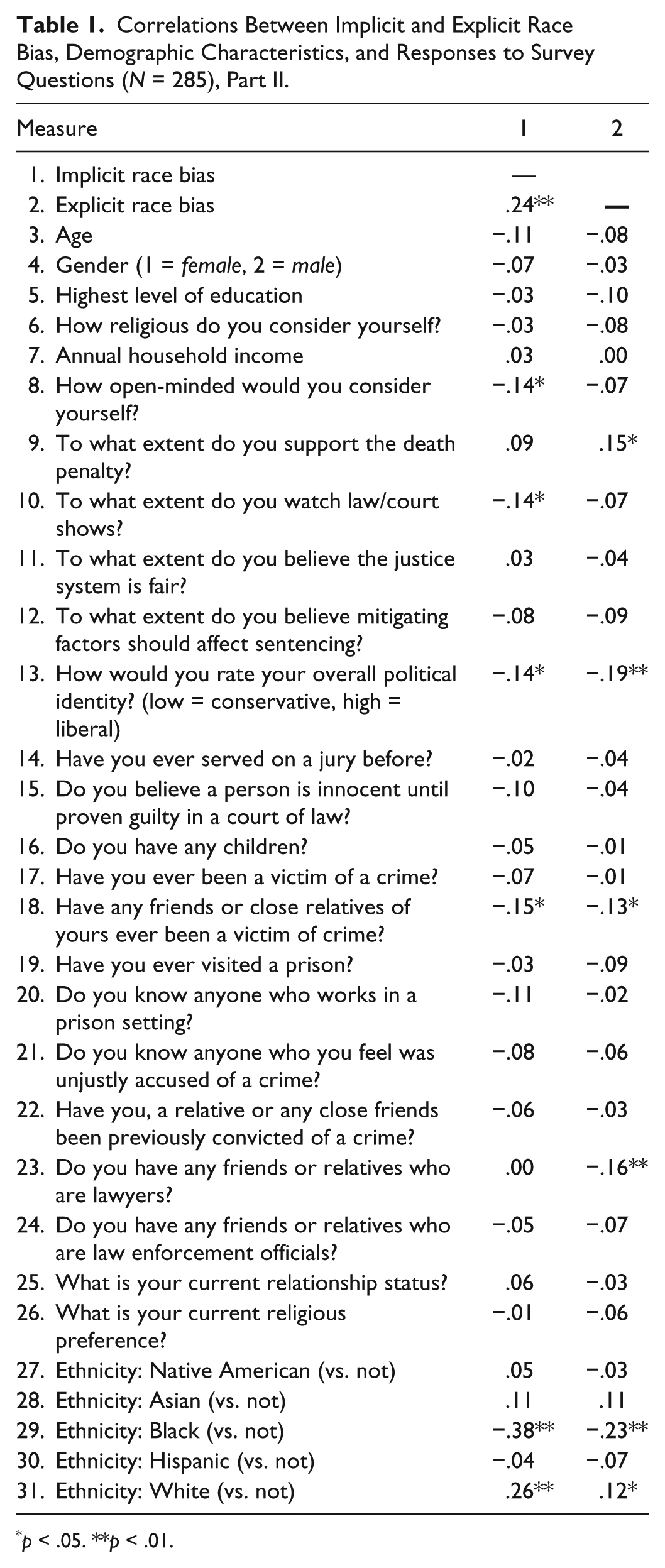
p < .05. **p < .01.
Part III
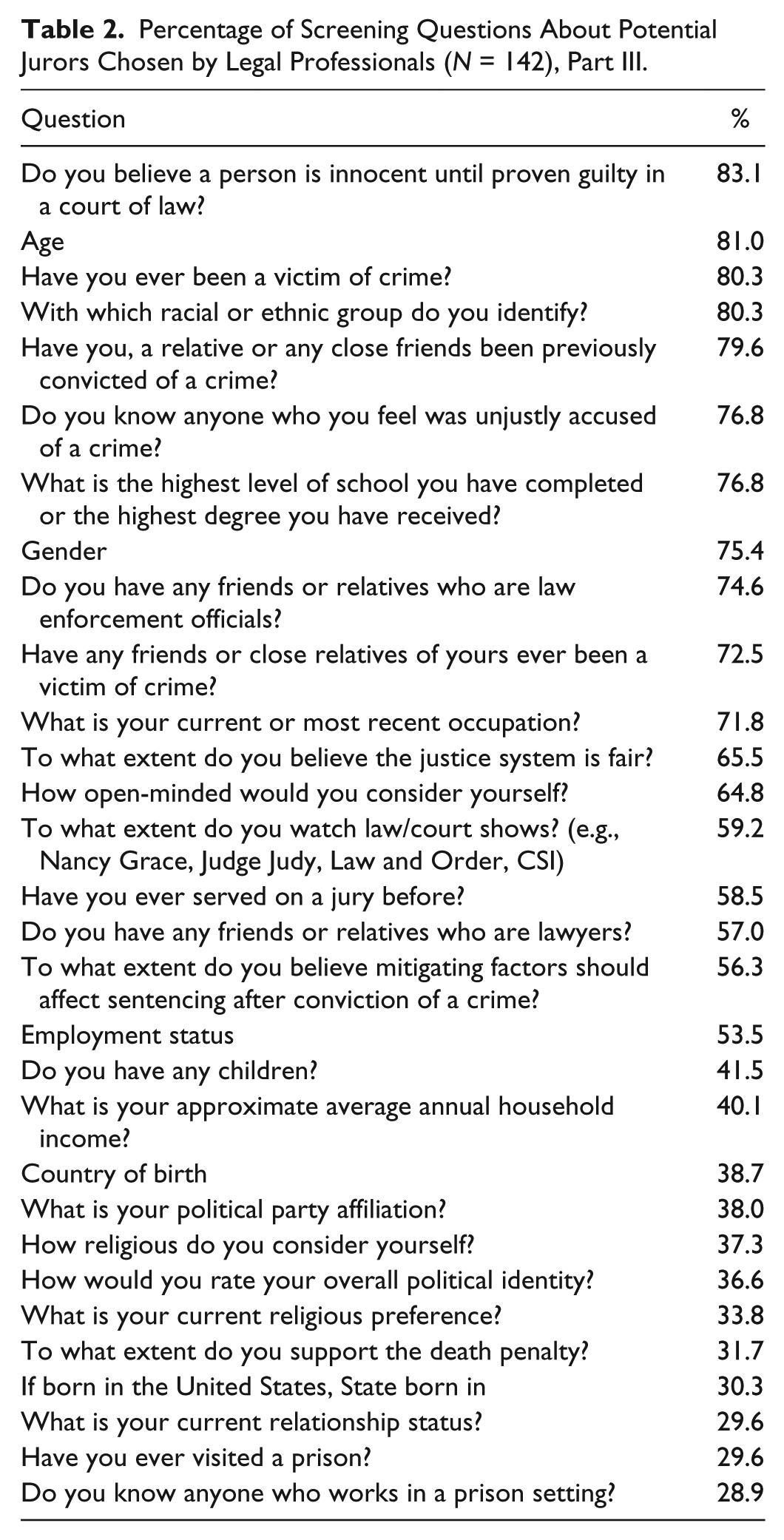
On average, the legal professionals in Part III wanted to know the answers to more than half of the 30 questions they could select from (M = 16.8, SD = 7.07). There were no significant differences across conditions in terms of the number of selected questions (all ps > .11). The percentages of chosen questions are presented in Table 2. The 10 most frequently selected questions were as follows: belief in innocence until proven guilty, age, if they had ever been a victim of crime, ethnicity, if they or their friends or family had ever been convicted of a crime, if they knew anyone they felt was unjustly accused of a crime, education level, gender, if they have family or friends who are police, and if they have family or friends who have been crime victims. The 10 least frequently selected questions were country of birth, political party affiliation, religiosity, political identity, religious preference, support for the death penalty, state born, relationship status, if they had ever visited a prison, and if they knew anyone who works in a prison setting.
Percentage of Screening Questions About Potential Jurors Chosen by Legal Professionals (N = 142), Part III.
To investigate the effects of legal role and defendant/victim race on the average level of implicit and explicit race bias among jurors kept and jurors removed, each of the two scores was submitted to a 2 (Legal Role: prosecutor vs. defense lawyer) × 2 (Target Race: Black defendant and White victim vs. White defendant and Black victim) × 2 (Juror Type: kept vs. removed) mixed-model ANOVA with the first two variables being between-subjects factors and the last variable being a within-subjects factor. For explicit race bias, the analysis revealed no significant main or interaction effects (all Fs < 1, all ps > .36; see Figure 1). For implicit race bias, the analysis revealed a marginally significant two-way interaction between Legal Role and Juror Type, F(1, 138) = 3.18, p = .08, η2p = .023, which was qualified by a significant three-way interaction between Legal Role, Target Race, and Juror Type, F(1, 138) = 8.26, p = .005, η2p = .057 (see Figure 2). To ensure that this interaction was not due to sampling error in the selection of potential jurors from the sample of Part II, we calculated the mean implicit race bias score among the 22 jurors of the jury pool and included it as a covariate in an ANCOVA with the same experimental factors. Although mean scores of implicit race bias among the 22 jurors accounted for a substantial proportion of variance in implicit race bias among jurors kept and jurors removed, F(1, 137) = 10,010.61, p < .001, η2p = .986, the critical three-way interaction remained statistically significant after controlling for baseline levels of implicit race bias, F(1, 137) = 7.23, p = .006, η2p = .053.
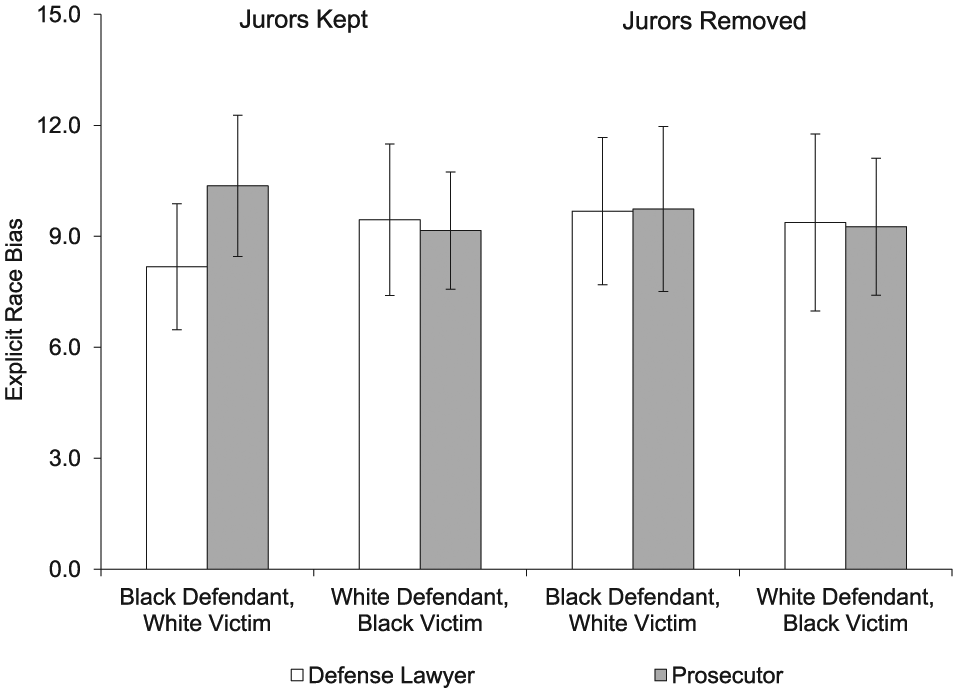
Mean levels of explicit race bias among jurors kept and removed by legal professionals (N = 142) as a function of legal role (prosecutor vs. defense lawyer) and race of defendant and victim (Black defendant and White victim vs. White defendant and Black victim), Part III.

Mean levels of implicit race bias among jurors kept and removed by legal professionals (N = 142) as a function of legal role (prosecutor vs. defense lawyer) and race of defendant and victim (Black defendant and White victim vs. White defendant and Black victim), Part III.
Broken down by Juror Type, separate 2 (Legal Role) × 2 (Target Race) ANOVAs revealed a significant two-way interaction between Legal Role and Target Race for jurors kept, F(1, 138) = 5.66, p = .02, η2p = .039, and a marginally significant two-way interaction for jurors removed, F(1, 138) = 3.77, p = .05, η2p = .027. Moreover, broken down by Target Race, separate 2 (Legal Role) × 2 (Juror Type) mixed-model ANOVAs revealed a significant two-way interaction between Legal Role and Juror Type when the defendant was Black and the victim was White, F(1, 68) = 9.79, p = .003, η2p = .126, but not when the defendant was White and the victim was Black, F(1, 70) = 0.67, p = .42, η2p = .009. Finally, broken down by Legal Role, separate 2 (Target Race) × 2 (Juror Type) mixed-model ANOVAs revealed a significant two-way interaction between Target Race and Juror Type for defense lawyers, F(1, 64) = 5.79, p = .02, η2p = .083, and a marginally significant two-way interaction for prosecutors, F(1, 74) = 3.20, p = .08, η2p = .041.
Further analyses revealed that, when the defendant was Black and the victim was White, jurors showed higher levels of implicit race bias when they were kept by prosecutors than when they were kept by defense lawyers, F(1, 68) = 4.36, p = .04, η2p = .060. In contrast, jurors removed showed higher levels of implicit race bias when they were removed by defense lawyers than when they were removed by prosecutors, F(1, 68) = 7.38, p = .008, η2p = .098. Moreover, when the defendant was Black and the victim was White, jurors kept by defense lawyers showed lower levels of implicit race bias than jurors removed by defense lawyers, F(1, 38) = 10.01, p = .003, η2p = .208; for jurors kept and jurors removed by prosecutors, there was a tendency in the opposite direction, but this difference failed to reach statistical significance, F(1, 30) = 2.29, p = .14, η2p = .071. When the defendant was White and the victim was Black, no significant differences emerged as a function of Legal Role and Juror Type (all Fs < 1.48, all ps > .22).
To explore whether the obtained pattern was affected by participants’ current occupation and legal background, we further tested whether the obtained three-way interaction was qualified by participants’ practicing status (i.e., whether a participant was currently practicing as a lawyer) and legal background (i.e., whether a participant has a legal background that is relevant to juror trials, which is the case for prosecutors, defense lawyers, judges, and civil trial lawyers). When added as an additional factor to the ANOVA, neither variable revealed a significant main or interaction effect (all Fs < 2.6, all ps > .11). The critical three-way interaction between Legal Role, Target Race, and Juror Type remained statistically significant in the ANOVA that included practicing status as an additional factor, F(1, 134) = 4.35, p = .04, η2p = .03, as well as the ANOVA that included legal background, F(1, 134) = 7.30, p = .008, η2p = .051. The corresponding four-way interactions failed to reach statistical significance in either case, F(1, 134) = 0.52, p = .47, η2p = .004, for practicing status as an additional factor, and F(1, 134) = 0.18, p = .67, η2p = .001, for legal background as an additional factor.
Supplementary Analyses
Expanding on these findings, we further explored if our list of questions included specific cues that helped legal professionals to identify jury members with levels of implicit race bias that were consistent with their professional interests in the mock trial. Toward this end, we identified those variables that were significantly correlated with implicit race bias in Part II, and tested whether these variables significantly contributed to the observed outcome.
First, we tested if our legal professionals in Part III simply kept or eliminated jurors who indicated their race was Black or White, which showed the highest correlations with implicit race bias. Toward this end, we first determined the proportion of Black jurors kept and removed, subtracted the proportion removed from the proportion kept, and entered this variable as a covariate in an ANCOVA with Legal Role and Target Race as between-subjects factors and Juror Type as within-subjects factor. We chose to use proportion instead of absolute numbers of Black jurors removed, because (a) participants did not keep or remove the same number of jurors and (b) harsher sentences toward Black defendants have been found to be related to a lower proportion of Blacks serving on a jury (for a review, see Bowers, Steiner, & Sandys, 2001). To the extent that our findings are driven by a simple strategy to keep or eliminate Black jurors, controlling for the proportion of Black jurors who were kept versus removed should reduce the critical three-way interaction between Legal Role, Target Race, and Juror Type to non-significance. Although the critical three-way interaction between Legal Role, Target Race, and Juror Type was slightly reduced after inclusion of the covariate, it was still marginally significant, F(1, 137) = 3.26, p = .07, η2p = .02. 8 The same analysis with proportion of Whites kept versus removed as a covariate did not affect the critical three-way interaction between Legal Role, Target Race, and Juror Type, F(1, 137) = 5.42, p = .02, η2p = .04. When both variables were simultaneously included as covariates, the three-way interaction effect still remained marginally significant, F(1, 137) = 3.16, p = .08, η2p = .02. 9 Together, these results suggest that a simple strategy to keep or eliminate Black versus White jurors does not entirely account for the obtained pattern of results.
We also conducted similar ANCOVAs for each of the other four questions that were significantly correlated with implicit race bias in Part II: open-mindedness, political identity, court show watching frequency, and knowing a victim of crime. Toward this end, the proportion or average score of jurors removed was subtracted from the proportion or average score of jurors kept for each variable and entered as a covariate in a mixed-model ANCOVA with Legal Role and Target Race as between-subjects factors and Juror Type as within-subjects factor. When testing each of the four variables individually, the critical three-way interaction between Legal Role, Target Race, and Juror Type remained statistically significant in all four cases (all Fs > 6.1, all ps < .02). When including all four variables together with the relative proportions of Whites and Blacks in a single ANCOVA, the critical three-way interaction was still marginally significant, F(1, 132) = 3.02, p = .09, η2p = .02, and not much different from the obtained interaction when controlling only for the proportion of Black jurors kept versus removed. Together, these results suggest that the four additional questions did not contribute to the obtained pattern of results over and above the proportion of Black jurors kept versus removed. 10
To further explore potential strategies in the identification of jury members, we examined which of the six cues associated with implicit race bias were used by our legal professionals in choosing to eliminate a given juror from the pool by examining data at the juror level. Because the presentation of 22 jurors (each with their own answers from the Part II data) to each individual participant can be viewed as multilevel data with repeated measures nested within persons (Hox, 2002), we used a multilevel modeling approach for all analyses that follow. A multilevel model is akin to a multiple nested regression analysis for which the coefficient of one level is the outcome of the next. From a multilevel modeling perspective, the current data comprise of two levels. Level 1 includes all data at the juror level, such as answers to the voir dire questions. At Level 2, individuals are the units of analysis, which includes variables such as Legal Role and Target Race to which each individual was assigned. Each level can interact with another. In the analyses that follow, Level 1 predictors are signified by coefficient b, Level 2 predictors and their interactions with Level 1 predictors are signified by coefficient γ. Multilevel modeling analyses were conducted using the Proc Glimmix procedure for hierarchical logistic regression with jurors nested within respondents, a random intercept, and cues as predictors, and juror kept versus removed (dichotomous) as the dependent variable.
Of the cues that were significantly correlated with implicit race bias, only knowing a victim of crime was related to jury removal, in that those who knew a victim of crime were more likely to be removed (b = −.28, SE = 0.07, p < .001). However, knowing a victim of crime ceased to be a significant predictor when all cues were included as predictors (b = −.11, SE = 0.11, p = .28). In this case, significant predictors of being kept on the jury were as follows: stronger beliefs in a fair justice system (b = .20, SE = 0.05, p < .001), stronger beliefs in innocence until being proven guilty (b = .72, SE = 0.14, p < .001), weaker beliefs that mitigating factors should affect sentencing (b = −.11, SE = 0.05, p = .02), not having visited a prison (b = −.26, SE = 0.11, p = .02), and not having friends or relatives who are lawyers (b = −.32, SE = 0.10, p = .002).
Importantly, when examining the interactions of these cues with Legal Role and Target Race, the only significant three-way interaction we found was an interaction between Juror Race Being Black, Legal Role, and Target Race (γ = 1.92, SE = 0.56, p < .001). Further analyses revealed that defense lawyers with a Black defendant were more likely to keep Black jurors (γ = 1.27, SE = 0.28, p < .001). Conversely, defense lawyers with a White defendant tended to be more likely to remove Black jurors (γ = −.57, SE = 0.33, p = .08). Being Black was not a significant predictor of being kept versus removed in any of the other conditions (all ps > .40). When all cues were included in the model predicting individual juror selection, the effect of being Black did not reach statistical significance in any individual condition (all ps > .17).
Together, our supplementary analyses suggest that keeping or eliminating Black jurors contributed to the obtained differences in implicit race bias as a function of Target Race and Legal Role. However, juror race does not fully account for the obtained findings, in that other (yet unknown) factors contributed to differences in implicit race bias over and above juror race.
Discussion
The current research represents the first examination of legal professionals’ ability to screen for explicit and implicit race bias in jury selection processes. Our findings indicate that individuals schooled in the law are adept at including or excluding implicitly biased jurors in a manner that is consistent with their legal interest. When the defendant was Black and the victim was White, legal professionals assigned to the role of defense lawyer were more likely to exclude jurors with high levels of implicit race bias, whereas legal professionals assigned to the role of prosecutor were more likely to exclude jurors with low levels of implicit race bias. Conversely, legal professionals assigned to the role of defense lawyer were more likely to keep jurors with low levels of implicit race bias, whereas legal professionals assigned to the role of prosecutor were more likely to keep jurors with high levels of implicit race bias. When the defendant was White and the victim was Black, there was a pattern in the opposite direction, but the effects were much weaker and failed to reach statistical significance. There was no significant relation between professionals’ peremptory challenges and jurors’ levels of explicit race bias.
We cannot say with certainty that our legal professionals were deliberately aiming to eliminate or keep implicitly biased jurors. Nevertheless, their decisions resulted in outcomes that were consistent with their legal interests when it came to defending or prosecuting a Black defendant. This result is consistent with previous research, showing that implicit biases can distort the processing of social information (e.g., Galdi et al., 2012; Gawronski, Ehrenberg, et al., 2003; Gawronski, Geschke, & Banse, 2003; Hawkins & Nosek, 2012; Hugenberg & Bodenhausen, 2003, 2004; Knowles et al., 2010), and thereby shape future decisions of seemingly impartial individuals (Galdi et al., 2008; Lundberg & Payne, 2014). Applied to the current question, it is possible that implicit race bias influences jurors’ processing of case-relevant information, and thereby the legal decisions that are based on this information. By relying on their stereotypes of people with racial bias, legal professionals seem to have the ability to identify jury members who do or do not suit their interest in a given case. 11 As a result, peremptory challenges based on these characteristics reflect systematic differences in implicit race bias that are consistent with the professionals’ interest.
Another interesting aspect of the current findings is that jury selection effects were limited to implicit race bias. We did not find any differences in explicit race bias among jurors kept or removed. There were also no significant differences in implicit race bias in cases involving a White defendant and a Black victim. A possible explanation for these findings is that explicit race bias plays a less significant role than implicit race bias in actual jury decisions. A similar conclusion might be drawn for the role of implicit race bias in trials involving a White defendant and a Black victim, which is consistent with evidence that defendant race plays a more important role in legal outcomes than victim race (e.g., Bagby, Parker, Rector, & Kalemba, 1994; Clark et al., 2013; for a meta-analysis, see Mazzella & Feingold, 1994). According to this interpretation, the absence of selection effects in such cases is due to the lack of observable influences of racial bias on jury decisions. Although cases involving Black victims have received considerable attention in recent years (e.g., high-profile cases of White police officers who shot unarmed African Americans), cases involving a Black defendant and a White victim tend to have a higher cognitive “fit” to existing racial stereotypes, which may facilitate their activation in response to the case. Such enhanced activation of racial stereotypes could influence selection effects by (a) strengthening the impact of implicit race bias on jury decisions and (b) increasing legal professionals’ concern with jurors’ levels of race bias. Future research is needed to further understand the role of implicit race bias in cases involving White defendants and Black victims, as well as the potential role of explicit race bias.
Selection Cues
The primary goal of the current study was to examine whether the peremptory challenges made by legal professionals show systematic relations to jurors’ levels of explicit and implicit race bias. Although not part of our primary question, our supplementary analyses also provide preliminary insights into the decision processes underlying the observed outcome. One important factor in this regard was juror race, which partly accounted for the obtained relation between juror selections and implicit race bias. Yet, selections based on juror race did not fully explain the obtained pattern of results, in that jurors kept and jurors removed still differed in terms of implicit race bias after controlling for juror race. Interestingly, neither of the other variables that were significantly correlated with implicit race bias in Part II accounted for the obtained selection effect in Part III. These variables included self-reported open-mindedness, the extent of watching law/court shows, liberal political identity, and close relatives who have been the victim of a crime.
It is important to note that our analyses focused exclusively on zero-order relations between individual cues and implicit race bias; they did not include higher-order interactions between multiple cues. Thus, it seems possible that our legal professionals based their peremptory challenges on complex combinations of multiple features rather than the mere presence versus absence of individual characteristics. 12 One potential strategy that legal professionals might use is to create a “mental model” of a given juror on the basis of multiple features, and then compare this model to their stereotypes of people with racial bias. To the extent that these stereotypes are accurate, they may help them identify jurors who would be sympathetic or unsympathetic to their side of a case, and these jurors may show different levels of implicit race bias.
One important factor in the creation of such “mental models” seems to be juror race, but our supplementary analyses suggest that juror race is insufficient to explain the obtained pattern of results. In this context, it is important to note that, although peremptory challenges do not require evidence for partiality, prosecutors and defense lawyers may be asked to justify their requests, and any such justifications must be race neutral (Batson v. Kentucky, 1986). This restriction raises the question of whether our legal professionals illegitimately used juror race as a basis for their peremptory challenges. Although the current study did not require them to explain their selections, research by Sommers and Norton (2007) suggests that legal professionals systematically use race as a basis for their peremptory challenges, but they tend to justify their race-based selections on the basis of race-neutral reasons that are entirely arbitrary. In their study, legal professionals instructed to assume the role of prosecutor in a case involving a Black defendant were more likely to exclude a Black juror from a pool of two potential jurors (the other one being White), and their justifications cited whatever race-neutral characteristic was randomly associated with the Black juror. Applied to the current research, Sommers and Norton’s findings suggest that our legal professionals may have used juror race as a basis for their decision. Yet, if they had been asked to justify their selection, they may have cited race-neutral characteristics of the Black jurors, even when these characteristics had no systematic relation to their decision.
Caveats and Limitations
Although the current findings raise a number of important questions about the role of implicit race bias in jury decision making, it is imperative to mention a few caveats to avoid premature and unjustified conclusions from this work. First, although our findings are consistent with the possibility that implicit race bias influences actual jury decisions, our study does not provide any data on this very important question. In fact, skeptics might argue that the relation between implicit race bias and overt discrimination is too small to have any detectable effects in “noisy” real-world contexts (see Oswald, Mitchell, Blanton, Jaccard, & Tetlock, 2013). From this perspective, the obtained differences in implicit race bias may be irrelevant for the actual outcomes of jury decisions. Yet, it is also possible that small effects of implicit race bias at the individual level lead to polarization at the group level (see Greenwald, Banaji, & Nosek, 2015), which could exacerbate their impact on legal outcomes. Although either of these hypotheses seems plausible, future research is needed to investigate the actual impact of implicit race bias on jury decision making.
Second, we want to warn against suggestions to use measures of implicit race bias as a tool to screen potential jurors. Although these measures have provided invaluable insights for research on prejudice and stereotyping, they have not reached a stage of development that would permit their use to diagnose a person’s individual level of implicit race bias (see Gawronski & De Houwer, 2014). Two major issues in this regard are (a) the arbitrary metric of their measurement scores (Blanton & Jaccard, 2006) and (b) their susceptibility to various kinds of material effects (e.g., Bluemke & Fiedler, 2009; Bluemke & Friese, 2006). Either of these characteristics makes it impossible to interpret the score of an individual participant in an absolute fashion (e.g., “Participant X shows a strong preference for Whites over Blacks”). This limitation is less relevant in research on implicit race bias using experimental or individual difference designs, which involves relative interpretations of differences between groups and individuals. Yet, screening of individual jurors requires absolute interpretations of individual scores, which are not feasible for the above-noted reasons.
Finally, it is important to note that the current study is far from perfect, and that future research is needed to replicate and extend our findings. In the absence of independent replication, the current findings should be treated as preliminary rather than conclusive. Moreover, although we strived to create a research context that is as externally valid as possible, we realize that our study has important limitations. One such limitation is the fact that our online study did not permit direct interactions between legal professionals and potential jury members. In making decisions regarding eliminations from a jury pool, legal professionals in real cases usually see the potential jury members and judge their demeanor as they are asked questions. This aspect of the voir dire could not be captured in the current study. Moreover, not all prosecutors and defense lawyers use all peremptory challenges (some choose to make none), and the number of permitted challenges varies by state and type of trial. In the current study, legal professionals were asked to make 10 challenges in the interest of having comparable data and a comparable trial context across legal professionals. We should note as well that our findings primarily speak to the effectiveness of defense lawyers and prosecutors in their efforts to obtain a jury that suits their interests rather than the total composition of a jury that a defendant will face. In fact, one could argue that the effectiveness of both sides in identifying jury members with suitable levels of implicit race bias has compensatory effects that will eliminate any differences in real-world jury compositions. Thus, we also warn against premature conclusions about potential policy implications, in that our findings neither support nor question the current practice of peremptory challenges. They can either reduce or increase the level of implicit race bias among jury members, depending on the relative effectiveness of the involved professionals.
Conclusion
All justice systems in the Western world strive to provide a fair trial to those charged with crimes, whereby they will only be convicted based on the facts of the case. However, in reality, humans are subject to biases that can intrude on our judgments and decisions. Prior research has shown that racial minorities face unique disadvantages in the courtroom due to racial biases that can exist among those who judge them, particularly in jury trials. Such challenges to a fair trial can be reduced if biased individuals are removed from the jury pool before the trial begins. Although the voir dire process provides a possibility to screen for racial biases among jury members, prosecutors and defense lawyers rarely aim for an impartial jury, but for a jury that is sympathetic to their arguments and their side of the case. Our findings indicate that legal professionals are effective in accomplishing this goal, in that their peremptory challenges reflect levels of implicit race bias among jury members that are consistent with their legal interests. Thus, the ultimate levels of implicit bias a racial minority defendant may face up against in court might depend on which side, the defense or the prosecution, happens to have the better judgment in selecting their jury members.
Footnotes
Declaration of Conflicting Interests
The author(s) declared no potential conflicts of interest with respect to the research, authorship, and/or publication of this article.
Funding
The author(s) disclosed receipt of the following financial support for the research, authorship, and/or publication of this article: This research was supported by a grant from the Canada Research Chairs (CRC) Program to the third author (215983).

Notes
References
Supplementary Material
Please find the following supplemental material available below.
For Open Access articles published under a Creative Commons License, all supplemental material carries the same license as the article it is associated with.
For non-Open Access articles published, all supplemental material carries a non-exclusive license, and permission requests for re-use of supplemental material or any part of supplemental material shall be sent directly to the copyright owner as specified in the copyright notice associated with the article.
