



Abstract
Antiprejudice norms and attempts to conceal racial bias have made Whites’ positive treatment of racial minorities attributionally ambiguous. Although some minorities believe Whites’ positivity is genuine, others are suspicious of Whites’ motives and believe their kindness is primarily motivated by desires to avoid appearing prejudiced. For those suspicious of Whites’ motives, Whites’ smiles may paradoxically function as threat cues. To the extent that Whites’ smiles cue threat among suspicious minorities, we hypothesized that suspicious minorities would explicitly perceive Whites’ smiles as threatening (Study 1), automatically orient to smiling White—as opposed to smiling Black—targets (Study 2), and accurately discriminate between Whites’ real and fake smiles (Study 3). These results provide convergent evidence that cues typically associated with acceptance and affiliation ironically function as threat cues among suspicious racial minorities.
A rental agent tells an African American family, “I’m very sorry, but we don’t have a vacancy today”; later, the same agent tells a White family the same thing but adds “I expect we’ll have one tomorrow.”
How much should people read into others’ smiles? As the most basic of affiliative cues, smiles are often candid signals of warmth, approval, and acceptance. Not all smiles should be taken at face value, however. Termed “racism with a smile” or “smiling racism,” legal scholars have documented that Whites’ often mask contemporary housing and employment discrimination with nominally positive and effusive behaviors (see Brooks, 1992). This legal evidence is complemented by social-psychological research that finds White people often amplify positivity toward racial minorities to create a likable, nonprejudiced image (e.g., Bergsieker, Shelton, & Richeson, 2010; Mendes & Koslov, 2013), and these effects are often strongest among prejudiced Whites (Shelton, Richeson, Salvatore, & Trawalter, 2005; Vorauer & Turpie, 2004). Thus, although Whites’ smiles may often signal genuine liking, they may just as frequently be deployed to mask genuine prejudice. Hence, decoding the motivation behind Whites’ smiles is a high-stakes task for minority group members with considerable social, material, and professional consequences. As Whites’ smiles may be associated with prejudice, we predicted that for suspicious individuals (i.e., those who believe Whites’ positivity is motivated more by the desire to avoid appearing prejudiced than by genuine egalitarian beliefs), Whites’ smiles may elicit patterns of social cognition indicative of threat. In Study 1, we first tested whether suspicious minority group members were able and willing to report Whites’ smiles as more threatening than nonsuspicious minorities. Study 2 then tested whether Whites’ smiles also elicited automatic attention patterns consistent with threat among suspicious minorities. Specifically, we employed a dot-probe task, which is frequently used as a cognitive marker of threat (Öhman & Mineka, 2001; Trawalter, Todd, Baird, & Richeson, 2008) to test the hypothesis that suspicious minorities would automatically oriented to smiling White targets in interracial contexts. In Study 3, we tested a functional benefit of the threat responses documented among suspicious minority group members. Namely, we tested whether suspicion conferred greater relative accuracy at differentiating between Whites’ real (Duchene) and fake (non-Duchene) smiles. To the extent that Whites’ smiles are perceived as threatening, suspicious individuals may scrutinize Whites’ smiles more closely than nonsuspicious individuals. Consequently, we hypothesized that suspicious minority group members would be more accurate at parsing Whites’ real and feigned positivity than those low in suspicion.
Attributional Ambiguity and Suspicion of Whites’ Motives
In interracial contexts, racial and ethnic minorities often have good reason to be suspicious of positive responses from White people. Although Whites’ public overtures toward minorities are often positive, their private attitudes tend to be more negative and they often express more bias on implicit and nonverbal measures of prejudice compared with measures that are under conscious and deliberate control (e.g., Devine, 1989; Dovidio, Kawakami, & Gaertner, 2002). Moreover, many White people fear appearing prejudiced and may treat minority group members favorably to avoid the stigma of being labeled racists (e.g., Crandall, Eshleman, & O’Brien, 2002). This research suggests that Whites have multiple motivations to smile in interracial interactions—whether to conceal personal biases, avoid appearing prejudiced, or communicate genuine acceptance. Consequently, minority group members may struggle with the attributional ambiguity concomitant with Whites’ positivity and, in some contexts, wisely question the authenticity of Whites’ smiles.
When concerns with the appearance of prejudice are potential motives for positive responses from White people, Whites’ praise and acceptance can feel threatening to racial and ethnic minorities. For instance, when they believe their race is known by others, positive feedback from White evaluators can reduce minority group members’ self-esteem (Crocker, Voelkl, Testa, & Major, 1991). In some contexts, even acceptance from Whites can feel threatening. Mendes, Major, McCoy, and Blascovich (2008) found that, whereas White participants responded positively to being accepted by Black peers, Black participants accepted by White peers responded negatively and exhibited a pattern of cardiovascular reactivity characteristic of threat. These authors argued that, because Whites’ positivity could have served self-presentational desires to avoid appearing prejudiced, acceptance was attributionally ambiguous and therefore threatening. Collectively, this research demonstrates that the attributional ambiguity that often surrounds Whites’ positivity can have a number of negative effects on minority group members.
Although studies have documented the effect of attributional ambiguity on the self, attributions to discrimination, and the evaluation of others (e.g., Crocker et al., 1991; Major, Kaiser, & McCoy, 2003; Major, Quinton, & Schmader, 2003), researchers have not tested attributional ambiguity’s effects on basic social-cognitive processes like emotion perception and social attention. The current work addresses this gap in the empirical literature by testing suspicion’s effect on a social cue commonly associated with attributional ambiguity for minority group members: Whites’ smiles.
Suspicion of Whites’ Motives
Major, Sawyer, and Kunstman (2013) recently developed an individual difference measure to assess minority group members’ suspicion of Whites’ motives. Modeled on Plant and Devine’s (1998) measure of external (EMS) and internal (IMS) motivation to respond without prejudice, the Suspicion of Motives Index (SOMI) combines minority group members’ beliefs about Whites’ fears of appearing prejudiced with their perception of Whites’ personal commitment to egalitarianism. Minority group members are termed “suspicious” if they chronically believe positive overtures from Whites are motivated more by external, social concerns with appearing prejudiced than internal, personal commitments to egalitarianism. Although the foremost theoretical value for the SOMI lies in its capacity to assess how minorities chronically resolve the attributional ambiguity that frequently surrounds positive overtures from Whites, it is also theoretically noteworthy because it provides a minority perspective on interracial motives, which heretofore have almost exclusively been studied from the view of Whites (e.g., Kunstman, Plant, Zielaskowski, & LaCosse, 2013; Plant, Devine, & Peruche, 2010).
The SOMI is also theoretically important because it provides an individual difference conception of the discounting principle at the core of attributional ambiguity theory (i.e., the tendency to attribute behavior to external sources more than internal sources; see Crocker & Major, 1989, 2003). Whereas past work has focused on situational factors that lead members of stigmatized groups to discount responses from dominant group member (e.g., overt discrimination; Major, Kaiser, & McCoy, 2003; Major, Quinton, & Schmader, 2003), research on the SOMI assesses discounting as a chronic individual difference. Suspicious minorities chronically discount positive overtures from Whites because they are perceived to be motivated more by external concerns with appearing prejudiced than internalized egalitarianism. The SOMI thus advances attributional ambiguity theory by providing an individual difference complement to research that has previously emphasized the situational side of the person by situation interaction.
Initial evidence suggests that suspicious (i.e., high-SOMI) minority group members are wary of praise from Whites. Across several studies, upon receiving praise from White confederates, Latinas highly suspicious of Whites’ motives exhibited patterns of cardiovascular reactivity characteristic of threat and reduced self-esteem (Major et al., 2016). Importantly, these effects were unique to positive feedback from White peers who ostensibly knew participants’ ethnicity and did not generalize to positive feedback from ethnic ingroup members, negative feedback from Whites, or praise delivered by Whites believed to be unaware of participants’ ethnic identity. Additional work shows that suspicious individuals are wary of Whites’ praise even when it is directed at other minority group members. In a vignette study with Latina participants, suspicion predicted the perception that Whites’ excessively positive feedback was inauthentic when it was given to a Latina classmate, but not when it was given to a White classmate (Major et al., 2013). These findings demonstrate that suspicious individuals view praise from Whites directed at both the self and fellow ingroup members with distrust. To date, however, research has focused on how minority group members respond to deliberate, written praise from Whites. Hence, it is unclear whether suspicion also influences responses to simple, more spontaneous cues of acceptance from White people. The current work extends research on the SOMI by testing whether suspicion moderates responses to the most basic of Whites’ affiliative cues (i.e., their smiles).
Suspicion and Smile Perception
A large literature has shown that people are equipped with attentional biases to detect threatening stimuli more quickly than nonthreatening stimuli (e.g., Kaiser, Vick, & Major, 2006; Öhman & Mineka, 2001; Trawalter et al., 2008). Studies have shown, for instance, that people are faster to notice a snake or spider in an array of flowers or mushrooms than vice versa (Öhman, Flykt, & Esteves, 2001). Similarly, in dot-probe paradigms, people are faster at locating a probe (a dot) on a computer screen when that probe appears where the picture of a snake or spider had been (Lipp & Derakshan, 2005). Presumably, the quick and easy detection of fear-relevant animals (i.e., spiders and snakes) facilitates an adaptive response, namely, the avoidance of a life-or-death threat.
This adaptive response has been co-opted for other and, in some cases, more social threats. For instance, White Americans orient to outgroup faces (Dickter, Gagnon, Gyurovski, & Brewington, 2015; Donders, Correll, & Wittenbrink, 2008; Trawalter et al., 2008). In dot-probe studies, White participants tend to be faster at locating a probe when it replaces a Black as opposed to a White target face. Research also shows that this effect is moderated by situational and individual difference factors. Whites orient to Black faces if they hold the stereotype that Blacks are dangerous (Donders et al., 2008), if they have had little contact with Black people (Dickter et al., 2015), and if Black and White target faces display a direct/confrontational (vs. averted/nonconfrontational) gaze (Trawalter et al., 2008). In sum, the emerging literature suggests that Whites orient to outgroup faces if and when outgroup members are perceived to pose a physical (Donders et al., 2008; Trawalter et al., 2008) or social threat (e.g., Dickter et al., 2015; Richeson & Trawalter, 2008). However, whereas Whites experience threat due to perceived outgroup hostility and danger (e.g., Donders et al., 2008), we predicted that suspicious minority group members would experience threat due to Whites’ displays of positivity (i.e., smiles). Due to “smiling discrimination” and the use of effusive behaviors to conceal prejudice (Brooks, 1992; Mendes & Koslov, 2013), we hypothesized that for suspicious minority group members, Whites’ smiles—cues typically associated with affiliation—would paradoxically function like cues to threat. Consequently, we predicted that suspicious minority group members would orient to smiling White faces in interracial contexts.
In addition to orienting toward Whites’ smiles, we further theorized that suspicion may also provide a relative advantage at parsing Whites’ real and feigned smiles. Although smiles often communicate genuine positivity, smiles can be faked and displayed even in the absence of true positive affect (Frank, Ekman, & Friesen, 1993). If suspicious minority group members believe Whites’ positivity is insincere, they may come to scrutinize Whites’ smiles in an attempt to detect hidden racial bias. This prediction is consistent with previous work demonstrating that individuals are particularly sensitive to smile authenticity in situations where others’ intentions are unclear (Bernstein, Young, Brown, Sacco, & Claypool, 2008; Johnston, Miles, & Macrae, 2010). For instance, Johnston and colleagues (2010) found that instructions to attend to the trustworthiness of others led participants to spontaneously categorize targets based on smile authenticity. If suspicious minority group members chronically evaluate Whites’ on their trustworthiness, they may learn to look beyond Whites’ smiles to more nuanced cues (e.g., contraction of eye muscles, which diagnose real smiles) to determine Whites’ true feelings. As Whites’ smiles may function as threat cues, we theorized suspicious individuals may carefully process and subsequently be relatively more accurate in their perceptions of Whites than those low in suspicion.
Consistent with this reasoning, evidence exists that suspicion seems to advantage relative social accuracy when perceiving White people’s behavior. When viewing short video clips of White students engaged in interracial interactions, those highly suspicious of Whites’ motives were more accurate at identifying Whites’ self-reported concerns with appearing prejudiced than those low in suspicion (i.e., EMS; LaCosse et al., 2015). Across targets low and high in EMS, the greater participants’ scores on the SOMI, the greater their relative accuracy at detecting Whites’ actual external motives.
Overview of Current Research
In three studies, we tested the general hypothesis that Whites’ smiles would elicit patterns of social cognition consistent with threat among suspicious minority group members. Specifically, we predicted that compared with those low in suspicion, high levels of suspicion would be associated with tendencies to (a) perceive Whites’ smiles as threatening, (b) orient toward smiling White targets, and (c) accurately differentiate Whites’ real and fake smiles. In all studies, suspicion was measured with the SOMI. In Study 1, Black participants evaluated smiling White and Black targets on an explicit threat index. We hypothesized that high-SOMI participants would label Whites’ smiles as more threatening than low-SOMI participants.
In Study 2, minority participants completed a dot-probe task with smiling and neutral Black and White targets presented in same-race and cross-race trials. On cross-race trials where interracial dynamics are expected to be salient, we hypothesized that the greater participants’ suspicions of Whites’ motives, the stronger their tendency to orient attention to smiling White targets relative to smiling Black targets.
In Study 3, we tested whether the SOMI predicted accuracy in differentiating Whites’ real and fake smiles among Black participants. In addition to recruiting Black participants, Study 3 also included White participants to empirically test suspicion’s unique social-cognitive effects among racial minority group members. In the study, Black and White participants watched videos of White targets displaying either real or fake smiles and then judged the smiles’ authenticity. As accurately detecting fake smiles may help them avoid covertly prejudiced White people, we hypothesized that among Black participants, higher scores on the SOMI would predict greater accuracy at differentiating White targets’ real and fake smiles. By comparison, as they need not worry about the interracial motives and potential to experience discrimination from racial ingroup members, we did not expect the SOMI to predict task performance among White participants.
Study 1
The current study tested our primary hypothesis that high-SOMI minority group members would perceive smiling White targets as more threatening than low-SOMI minorities. To test this hypothesis, Black participants evaluated smiling White and Black targets on four threat-related characteristics (e.g., suspicious, trustworthy [reversed]). These four items were then averaged to form a threat index. We selected targets featuring non-Duchene (fake) smiles, because these are the types of smiles theorized to be most frequently used by White people to conceal negative attitudes toward racial minorities. Hence, these smiles should be the most likely to be associated with threat in the real world. We anticipated that the greater participants’ SOMI scores, the more threatening they would perceive smiling White targets, and this effect would remain significant even when controlling for responses to Black targets. That is, over and above general distrust, we predicted high-SOMI participants would perceive White targets as more threatening than low-SOMI participants (see Major et al., 2013, for more on interpersonal distrust and the SOMI).
Here it is important to note that this task represents a relatively conservative test of our primary hypothesis. First, participants were asked to evaluate smiles, which are overt signals of positive affect. Consequently, it may seem inappropriate to participants to negatively evaluate signs of positive affect and affiliation. Second, minority group members may be particularly concerned that unfavorable evaluations of White targets may confirm negative stereotypes about Black people in the minds of others (i.e., stereotypes that Black people dislike and distrust Whites). Moreover, these concerns are theorized to be particularly strong when it comes to evaluations of nominally positive responses from Whites: Why, if not for negative attitudes, would Black people unfavorably evaluate smiling Whites? (see Major & Kunstman, 2013, for more on this issue). When considered en masse, numerous factors may prevent minority group members from deliberately rating Whites’ smiles unfavorably, which makes the use of this explicit task a strong test of the hypothesis that high-SOMI minorities would perceive Whites’ smiles as more threatening than low-SOMI minorities.
Method
Participants
In total, 108 Black American participants (63% female; Mage = 33.32, SDage = 9.83) were recruited from online data collection services (Amazon’s Mechanical Turk, TurkPrime) and compensated between US$.75 and US$1.50 for their responses. A post hoc power analysis using G*Power (V.3.1) software found that our primary analysis on the SOMI’s relationship with perceived threat was 85% powered (Faul, Erdfelder, Lang, & Buchner, 2007).
Facial stimuli
Fifteen Black and Fifteen White male headshots in which targets exhibited smiling expressions served as the stimuli for this study. All images featured targets making non-Duchene smiles. Pilot data from Friesen and colleagues (2016) found that the race of targets was readily identifiable and categorized equivalently for Black and White targets. Black and White targets were rated as equivalently happy. Images were gray scaled, standardized for size (360 × 450), and cropped to reveal only the internal facial features (see Friesen et al., 2016, for more on target stimuli). All stimuli used in the current work can be found in the Supplemental Material.
Threat index
Participants rated the degree to which (1 = not at all, 7 = extremely) images conveyed four threat-relevant characteristics (suspicious, trustworthy [reversed], genuine [reversed], authentic [reversed]; αWhite targets = .91, αBlack targets = .88).
SOMI
The SOMI scale (Major et al., 2013) measures the extent to which participants are suspicious of Whites’ motives (i.e., wanting to appear nonprejudiced rather than wanting to be nonprejudiced). Example items that measure perceptions of Whites’ external motives were “When White people act in a nonprejudiced way toward members of racial/ethnic minority groups, it is because they are trying to act politically correct, and they feel pressure from others to act nonprejudiced.” Example items to measure perceptions of Whites’ internal motives were “When White people act in a nonprejudiced way toward members of racial/ethnic minority groups, it is because it is important to their self-concept to be unprejudiced and it is personally important to them not to be prejudiced.” Perceived external motivation to respond without prejudice (PEMS) and perceived internal motivation to respond without prejudice (PIMS) were inversely correlated in the current sample, r = −.30, p = .002. In keeping with previous work (e.g., LaCosse et al., 2015; Major et al., 2016), SOMI scores were computed by subtracting participants’ scores on the PIMS items (α = .90; M = 5.87; SD = 1.66; range = 1.00-9.00) from their scores on the PEMS items (α = .86; M = 5.84; SD = 1.64; range = 1.00-9.00). In this sample, MSOMI = −0.03 (SD = 1.73; range = −8.00-8.00).
Procedure
After providing consent, participants viewed images of smiling White and Black male targets and evaluated each target on the threat index. Images were presented in random order, and participants evaluated all 15 White and 15 Black targets. After evaluating these targets, participants completed the SOMI and demographic questions. Participants were then thanked, debriefed, and compensated for their participation.
Results
To test our primary hypothesis, we conducted a regression analysis in which the SOMI (mean-centered) was entered into a model predicting perceptions of threat for smiling White targets. 1 As hypothesized, SOMI positively predicted threat perceptions for smiling White targets, B = 0.10, 95% confidence interval (CI) = [0.03, 0.16], t(106) = 2.97, p = .004, rp = .28. To provide evidence that the SOMI’s relationship with threat perceptions for smiling White targets existed over-and-above general mistrust of others (i.e., results are not merely the product of high-SOMI people being generally suspicious of others), we included perceived threat for Black targets as a covariate, B = 0.50, 95% CI = [0.31, 0.69], t(105) = 5.24, p < .001, rp = .46. As hypothesized, over-and-above general distrust, SOMI positively predicted threat perceptions for smiling White targets, B = 0.07, 95% CI = [0.01, 0.13], t(105) = 2.48, p = .015, rp = .24. The higher Black participants’ scored on the SOMI, the more threat they perceived in Whites’ smiles.
We next tested whether SOMI’s relationship with perceptions of threat for Whites’ smiles extended to perceptions of Blacks’ smiles. SOMI scores were entered as a predictor of threat perceptions for Black targets. Importantly, SOMI did not predict threat perceptions for Black targets, B = 0.04, 95% CI = [−0.01, 0.10], t(106) = 1.49, p = .14, rp = .14. Accounting for general distrust among high-SOMI people (i.e., including threat index for smiling White targets as a covariate), B = 0.42, 95% CI = [0.26, 0.57], t(105) = 5.24, p < .001, rp = .46, further weakens the relationship between the SOMI and threat perceptions for Black targets, B = 0.004, 95% CI = [−0.05, 0.06], t(105) = 0.16, p = .88, rp = .02. Suspicion’s effect on perceived threat appears to be specific to Whites’ smiles and did not generalize to perceptions of smiling Black targets. 2
Discussion
The current results provide initial evidence that minorities suspicious of Whites’ interracial motives perceive Whites’ smiles as threatening. High-SOMI participants perceived Whites’ fake smiles as more threatening than low-SOMI participants. Importantly, these effects were specific to smiling White targets and did not extend to perceptions of smiling Black targets. The SOMI predicted perceptions of threat, but only for potential perpetrators of covert racial discrimination (i.e., White people).
These results also provide social-psychological evidence consistent research on “smiling racism.” To the extent that smiles—particularly non-Duchene (fake) smiles—are sometimes used to conceal prejudice, minorities suspicious of Whites’ motives might be wary of Whites’ smiles because these displays of positive affect may signal that discrimination is imminent. In keeping with this theorizing, the stronger participants’ suspicion of Whites’ motives, the greater their threat perceptions for (non-Duchene) smiling White targets.
By using an evaluative task that was highly explicit, these results also represent a strong test of the current work’s primary hypothesis. Minority group members may have been concerned that unfavorable evaluations of Whites may have confirmed negative racial stereotypes in the minds of others (e.g., stereotypes that Black people distrust or dislike Whites). These concerns are theorized to be particularly salient when it comes to perceptions of nominally positive overtures from Whites, where negative responses might be especially likely to be attributed to Black people’s negative attitudes toward Whites. Yet, despite these social and methodological challenges, higher SOMI scores predicted greater threat perceptions for smiling White targets. Consequently, these results provide a fairly conservative test of the hypothesis that Whites’ smiles sometimes act as threat cues to suspicious minority group members.
Having connected the SOMI to threat perceptions for Whites’ smiles, we next tested whether Whites’ smiles would elicit other markers of threat among suspicious individuals. Specifically, we sought to test whether the explicit effect demonstrated in Study 1 would extend to more implicit attentional markers of threat (Study 2), and whether suspicion might also have functional benefits for differentiating between Whites’ real and fake smiles (Study 3).
Study 2
The current study tested the hypothesis that in interracial contexts, those suspicious of Whites’ motives would automatically orient to smiling White targets more than smiling Black targets. To test this hypothesis, we used a dot-probe paradigm to measure attentional markers of threat (e.g., Trawalter et al., 2008). In the paradigm, minority participants were presented with a pair of faces varying in race (Black/White) and expression (neutral/smiling). After a moment, target faces were removed revealing a dot probe behind one of the faces. As quickly and accurately as possible, participants then indicated by key press whether the dot was on the right or left side of the screen. Some trials featured same-race targets (i.e., two Black or two White targets), whereas other trials featured one Black and one White target. Consistent with attentional markers of threat, on cross-race trials, we theorized that suspicious minorities would orient to smiling White targets.
Method
Participants
Across one semester, 60 undergraduate students (43 women) from a large mid-Atlantic public university participated in this study for course credit. Of these, 45 were monoracial Black; the remaining 15 were biracial or multiracial with Black as one of their racial identities. For all analyses below, we exclude participants who were not born in the United States, resulting in a sample size of 52. SOMI scores did not differ between monoracial and multiracial participants, t(50) = 0.27, p = .785. A post hoc power analysis revealed that our primary analysis on the SOMI’s relationship with smile orientation was 81% powered (Faul et al., 2007).
Materials
Facial stimuli
We used six male target faces for each target race, target emotion combination for a total of 24 (i.e., six smiling Black faces, six smiling White faces, six neutral Black faces, six neutral White faces). Faces were taken from the well-validated NimStim face database (Tottenham et al., 2009). Pictures of the neutral and smiling faces were of the same six Black and six White targets.
SOMI
Like Study 1, SOMI scores (MSOMI = −.319; SD = 1.73; range = −3.80-3.40) were calculated by subtracting participants’ PIMS scores (α = .88; M = 4.69; SD = 0.991; range = 2.20-6.20) from their PEMS scores (α = .83; M = 4.37; SD = 1.19; range = 2.20-6.80).
Procedure
After providing consent, participants completed a dot-probe task. In this task, on each trial, participants saw a fixation cross for 1,000 ms followed by two target faces, one on either side of the fixation cross. Target faces were shown for 30 ms and were backward masked by a sunflower, shown for 50 ms. Then, a dot (“probe”) appeared where one of the two target faces (and sunflowers) had been. Participants indicated on which side of the fixation cross the dot appeared. Participants completed two blocks of 64 trials. Target race (Black or White), target expression (smiling or neutral), and dot location (right or left) were randomized across trials within each block. After completing the dot-probe task, participants completed the SOMI scale and demographic questions.
Results
To test our prediction that Black people high in SOMI orient to smiling White versus Black faces, we analyzed participants’ reaction times on critical trials, namely, cross-race trials for which the Black and White targets displayed the same emotion (see Richeson & Trawalter, 2008). We removed data from trials in which participants rendered an incorrect response (0.3% of all trials) and latencies greater than 1.5 interquartile ranges below the 25th percentile or above the 75th percentile (5.1% of remaining trials; Tukey, 1977). The remaining data were aggregated into average response latencies for smiling and neutral Black and White target faces. Averages were then entered into a 2 (target expression: smiling/neutral) × 2 (target race: White/Black) × SOMI (mean-centered) mixed-model ANCOVA with the first two factors entered as repeated measures and the third factor entered as a continuous predictor. Results revealed only the predicted three-way interaction, F(1, 50) = 4.87, p = .032 (see Figure 1).

Orienting response on the dot-probe task as a function of SOMI and trial type.
Univariate analyses—regressing SOMI on participants’ means for each trial type—revealed no significant effect of SOMI on reaction times. Thus, to probe the interaction, we computed difference scores between participant means for the Black and White neutral faces (Black–White), and for the Black and White smiling faces (Black–White). These difference scores represent a racial bias in attention for neutral and smiling faces, respectively (see Richeson & Trawalter, 2008, for similar procedure). Regressing SOMI on these difference scores revealed no effect of SOMI on the neutral expression difference score, B = −1.90, 95% CI = [−6.01, 2.21], t(50) = −0.93, p = .358, r = .13, but a significant effect of SOMI on the smiling expression difference score, B = 5.02, 95% CI = [0.59, 9.45], t(50) = 2.28, p = .027, r = .31. In other words, Black participants higher in suspicion of Whites’ motives were faster to detect the dot behind the smiling White versus Black target face relative to their less suspicious counterparts. 3
Discussion
Consistent with the current work’s threat-based hypotheses, Black participants’ suspicion of Whites’ motives moderated attention for smiling White relative to smiling Black targets. On cross-race trials where interracial dynamics were expected to be salient, the greater participants’ scores on the SOMI, the faster they were to orient to smiling White as opposed to smiling Black targets. Moreover, this effect did not extend to cross-race trials in which targets displayed neutral expressions; further highlighting that Whites’ smiles function as unique threat cues for suspicious minority group members. Rather than indiscriminately orienting to White targets, suspicion only elicited threat-consistent patterns of attention in response to Whites’ smiles in diverse, interracial contexts. These results are consistent with past research, which finds that in interracial interactions, it is Whites’ attributionally ambiguous positivity that is most threatening to suspicious minority group members (Major et al., 2016). When considered in tandem, these findings suggest that in interracial contexts, suspicious individuals appear predisposed to recognize and respond to “racism with a smile.”
In addition, the current study replicates and extends previous work in important ways. First, whereas previous work has illustrated that suspicion moderates deliberate judgments of Whites’ positivity (e.g., Study 1 of the current work; Major et al., 2013), Study 2 provides initial evidence that suspicion also shapes relatively automatic cognitive responses to Whites’ positivity. Second, the current study replicates an attentional bias for outgroup faces and, like previous research, finds that the attentional bias is specific to the contextual cues and dispositions associated with threat. Whites concerned about appearing prejudiced orient to Black neutral (but not smiling) faces as if they were a threat (Richeson & Trawalter, 2008). Complementing this research, suspicious Black participants oriented to White smiling faces as if they were a threat. In both cases, individuals with intergroup concerns orient to outgroup faces but only when those outgroup faces display an emotion relevant to their concern.
Study 3
Study 3 tested a functional outcome of attentional threat among suspicious minority group members. As they label Whites’ smiles as threatening and automatically orient toward Whites’ smiles, we expected minorities scoring high on the SOMI to better differentiate between Whites’ real and fake smiles than minority group members scoring low on the SOMI. This prediction is also consistent with LaCosse and colleagues’ (2015) finding that high suspicion minorities more accurately detected White targets’ EMS than those low in suspicion. Study 3 also sought to further illustrate the specificity of suspicion’s effects on intergroup social cognition. Hence, we collected data from White as well as Black participants. As White people’s motives for responding without prejudice are less relevant to other Whites than racial and ethnic minority group members, we expected that the SOMI would only predict performance for Black—but not White—participants. To test these hypotheses, Black and White participants completed the SOMI before attending a lab session in which they viewed videos of White targets displaying real and fake smiles. After each video, participants indicated whether they believed the target’s smile was real or fake. Signal detection analyses then assessed discriminant accuracy and response bias (i.e., favoring the “fake” response over the “real” response). We hypothesized that for minority participants, higher scores on the SOMI would be associated with greater accuracy discriminating between White targets’ real and fake smiles.
Method
Participants
Across two academic semesters, 54 undergraduates (27 Black, 27 White; 35 women) were compensated with US$10/course credit for participation. We manipulated smile authenticity (real/fake) in a within-participants design. A post hoc power analysis found that our primary analysis had 61% power to detect the interactive effect of SOMI and Participant Race.
Materials
Smile stimuli consisted of 4-s videos of a White target going from a neutral facial expression to either a real or fake smile and returning to a neutral expression (BBC, n.d.). There were 17 videos total, each with a unique target (seven real; six female). Like past work using this task (e.g., Bernstein et al., 2008), participants’ task was to decide whether each target’s smile was real or fake.
Procedure
Before the lab session, participants completed the SOMI. 4 The PIMS (α = .90) and PEMS (α = .78) were then combined to form SOMI scores (MBlack participants = 1.26, SD = 2.00; range = −2.60-5.60; MWhite participants = 0.07, SD = 1.56; range = −4.60-3.20). Correlations between PEMS and PIMS for Black (r = .19, p = .36) and White (r = .19, p = .35) participants were nonsignificant. In the lab session, participants watched all videos and made authenticity judgments. After the smile discrimination task, participants were debriefed, paid (if applicable), and dismissed.
Results
Data reduction
We used participants’ d′ scores to quantify their ability to discriminate between real and fake smiles. These scores were calculated by taking the difference between participants’ z-transformed hit rate (i.e., proportion of real smiles judged to be “real”) and z-transformed false alarm rate (i.e., proportion of fake smiles judged to be “real”). Thus, participants’ d′ scores reflected their ability to identify real smiles while correcting for any response bias. We also examined participants’ decision criterion (c) by first adding participants’ z-transformed hit rate and z-transformed false alarm rate together then multiplying their sum by −0.50. In this study, when criterion is zero, participants are no more likely to choose “real” versus “fake” response options. Increased decision criterion would indicate a more liberal threshold for identifying a smile as fake.
Smile discrimination
Participants’ d′ scores were simultaneously regressed on Participant Race (Black/White), SOMI (mean-centered), and their interaction. This analysis yielded only a significant interaction between Participant Race and SOMI, β = .29, b 95% CI = [0.01, 0.48], t(50) = 2.11, p = .039, rp = .29. To decompose this interaction, we examined the simple effects of the SOMI at each level of Participant Race. As predicted, SOMI significantly predicted Black participants’ ability to discriminate between real and fake smiles on White targets, β = .39, 95% CI = [0.01, 0.31], t(50) = 2.17, p = .035, rp = .29. The greater Black participants’ SOMI scores, the better their ability to differentiate between Whites’ smiles (see Figure 2). Furthermore, SOMI did not significantly predict smile discrimination among White participants, β = −.22, 95% CI = [−0.27, 0.09], t(50) = −0.97, p = .34, rp = −.14. 5
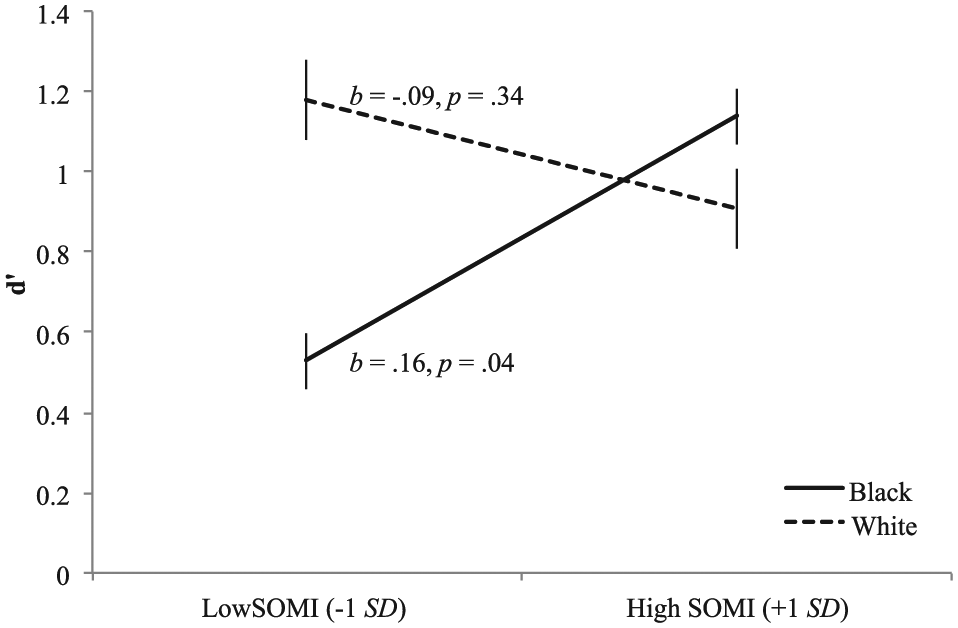
Interaction between Participant Race and SOMI in Study 3.
Alternative probes of this interaction tested the simple effect of Participant Race at low and high levels of SOMI (i.e., ±1 SD of the mean). At low levels of SOMI, there was a significant effect of Participant Race, such that Black participants were worse than White participants at differentiating White targets’ real and fake smiles, β = −.48, 95% CI = [−1.27, −0.13], t(50) = −2.45, p = .02, rp = −.33. However, at high levels of the SOMI, Black participants were just as adept at differentiating White targets’ real and fake smiles as White participants, β = .13, 95% CI = [−0.42, 0.81], t(50) = 0.65, p = .52, rp = .09.
Decision criterion
We next examined participants’ decision criterion. The only effect to emerge in an analysis predicting criterion from Participant Race, the SOMI, and their interaction was a marginal effect of Participant Race, β = −.25, 95% CI = [−0.34, 0.03], t(50) = −1.71, p = .09, rp = −.24. Black participants had a marginally more liberal threshold for calling a smile “fake” than did White participants. Importantly, the SOMI and Participant Race did not interact to predict criterion scores, t(50) = 0.01, β = .00, 95% CI = [−0.10, 0.10]. p = .99, rp = .00. Hence, it does not appear that effects were driven by the tendency for suspicious Black participants to categorize all White smiles as “fake.”
Discussion
As hypothesized, suspicion of Whites’ motives predicted Black, but not White, participants’ ability to accurately discriminate between White targets’ real and fake smiles. Importantly, suspicion was unrelated to decision criterion for Black participants, suggesting that results were not driven by the propensity to label all Whites’ smiles “fake.” Furthermore, at low levels of the SOMI (i.e., among those who believe Whites are primarily internally as opposed to externally motivated to respond without prejudice), Black participants demonstrated an outgroup disadvantage in distinguishing between White targets’ real and fake smiles, but this disadvantage was eliminated for those scoring high on the SOMI. When suspicions were high, Black participants performed just as well as White participants (i.e., racial ingroup members) on the smile discrimination task. These results provide initial evidence that suspicion affords a relative accuracy advantage when it comes to ascertaining the authenticity of Whites’ positivity. Moreover, these results suggest that suspicion also helps minority group members overcome a common and pronounced disadvantage in outgroup emotion perception generally (Elfenbein & Ambady, 2002) and outgroup smile discrimination specifically (Friesen et al., 2016).
The current results are also consistent with the prediction that suspicion facilitates accurate perceptions of Whites’ behavior. To the extent that Whites’ smiles function as threat cues, suspicion may lead minorities to examine these displays of positive affect for signs of hidden prejudice. In keeping with this theorizing, suspicious minorities appear more accurate at differentiating between Whites’ real and fake smiles. In interracial contexts, critically examining Whites’ smiles may allow suspicious minority group members to distinguish Whites who are genuinely happy from those faking positivity and potentially concealing prejudice. From this perspective, the capacity to differentiate between Whites’ real and fake smiles might help suspicious minorities detect disingenuous Whites and identify the literal face of “smiling racism.”
Although null effects should be interpreted with caution, the effects of the SOMI among White participants are also highly consistent with threat-based conceptions of suspicion’s effects on smile recognition. Whereas high-SOMI scores predicted accurate smile differentiation among Black participants, the SOMI was nondiagnostic of Whites’ responses. White people do not need to worry that the smiles directed at them from racial ingroup members conceal racial prejudice. Hence, these smiles are unlikely to function as threat cues for Whites scoring high on the SOMI. Consequently, it makes sense that suspicion would have different predictive power for minorities who experience “smiling racism” firsthand and Whites who may recognize the external motives of ingroup members but do not personally experience White racism.
These effects on discriminant accuracy also extend past research on stigma and threat detection (e.g., Kaiser et al., 2006). Although this past work illustrates that stigmatized individuals direct attention to (negative) threat cues, this research has remained relatively silent on the consequences of threat detection. The current study addresses this gap in the experimental literature by providing suggestive evidence that threatened patterns of attention can aid social cognition among members of stigmatized groups. The greater minorities’ suspicions, the better their ability to differentiate Whites’ real and feigned positive affect. These results illustrate that suspicion and its consequent threatened patterns of attention can provide functional benefits (e.g., heightened social accuracy) to members of stigmatized groups (Barrett & Swim, 1998).
Meta-Analysis
We performed a meta-analysis to test the strength and magnitude of suspicion’s effect on responses to Whites’ smiles across the three studies of the current work. We calculated the overall significance level and effect size for the simple effect of the SOMI on (a) explicit perceptions of threat for smiling White targets, (b) the cross-race trials featuring smiling targets in the dot-probe task, and (c) the accurate discrimination between Whites’ real and fake smiles among Black participants. In keeping with procedures outlined in Rosenthal and Rosnow (1991), effects were weighted by their degrees of freedom (df). Over these three studies, suspicion’s effect on the perception of Whites’ smiles was significant (z = 4.08, p < .001). The corresponding weighted effect size estimate across the studies was r = .29, 95% CI = [0.27, 0.31], suggesting a medium-sized effect. Importantly, this overarching effect estimate is highly consistent with past work on the SOMI (rmeta-analysis = .34; Major et al., 2016).
General Discussion
The results from three studies provide convergent evidence that Whites’ smiles function as threat cues among suspicious minority group members. In Study 1, high-SOMI participants perceived Whites’ smiles as more threatening than low-SOMI participants. In Study 2, on cross-race trials of the dot-probe task, those suspicious of Whites’ motives automatically directed attention toward smiling White as opposed to smiling Black targets. In Study 3, suspicion predicted Black participants’ ability to accurately discriminate between Whites’ real and fake smiles. The greater minorities’ suspicion, the better they were at accurately differentiating real and fake smiles from White targets. Importantly, suspicion did not predict discriminant accuracy for White participants and was unrelated to bias (i.e., criterion) among Black participants. Hence, suspicious Black participants accurately distinguished between White targets’ real and fake smiles without favoring one response over another. Moreover, these effects were specific to suspicious minority group members’ responses to smiling White targets and did not extend to smiling Black targets (Study 1), neutral emotional displays from White targets (Study 2), or White participants (Study 3). Collectively, the current results provide evidence that among minorities’ suspicious of Whites’ motives, cues typically associated with affiliation ironically act as cues to threat.
Implications
The current work provides a number of extensions both to general research on social cognition among minority group members and the specific moderating role of suspicion of Whites’ motives. First, these studies provide convergent evidence that Whites’ smiles—social cues typically associated with acceptance, affiliation, and positive interpersonal interactions—functionally act as attentional cues to threat among suspicious minority group members. Paradoxically, Whites’ smiles actually cue threat for suspicious minorities.
These results complement legal and psychological research that finds contemporary discrimination and racial bias are masked by Whites’ smiles and inappropriately effusive behaviors (Brooks, 1992; Dovidio et al., 2002; Mendes & Koslov, 2013). In line with this work, the current results suggest that suspicious minority group members are attentive to Whites’ smiles. Not only do suspicious minorities perceive Whites’ smiles to be threatening, they also automatically orient to Whites’ smiles in interracial contexts and are better at distinguishing between Whites’ genuine and disingenuous smiles. These results both illustrate the paradoxically threatening effect of Whites’ smiles on suspicious minorities and highlight the intriguing possibility that those suspicious of Whites’ motives might be well equipped to detect common forms of contemporary prejudice like “smiling racism” (Brooks, 1992) and aversive racism (Dovidio et al., 2002).
Second, these findings expand suspicion’s effects into the realm of automatic social cognition and suggest that the SOMI predicts responses to the most basic of Whites’ affiliative cues. Whereas past research found that suspicion moderated responses in cue-rich contexts where extensive verbal and nonverbal behaviors could inform judgments of White targets (e.g., LaCosse et al., 2015), the current findings provide evidence that suspicion not only shapes automatic attention but also demonstrates that suspicion moderates responses to the most basic affiliative cues: smiles. These findings extend research on the SOMI into the realm of automatic social cognition and suggest that suspicion may influence even the most basic of intergroup interactions in which positivity is communicated nonverbally.
Third, the smile discrimination findings from Study 3 provide empirical evidence for suspicion’s functional utility for interracial social cognition (Barrett & Swim, 1998). The greater minority group members’ suspicion of Whites’ motives, the better their ability to differentiate between Whites’ real and fake smiles. Moreover, minority group members scoring high on the SOMI differentiated Whites’ real and fake smiles at levels similar to their White counterparts, whereas minorities scoring low on the SOMI were significantly worse than Whites at differentiating between White targets’ real and fake smiles. These results suggest that suspicion helps minority group members differentiate between genuine and disingenuous positivity from Whites and overcome frequently documented deficits in outgroup emotion recognition (Elfenbein & Ambady, 2002; Young & Hugenberg, 2010). These results are especially noteworthy because although some past work has linked stigma with (hostile) attentional markers of threat (e.g., Kaiser et al., 2006), this research has not explicated the consequences of this pattern of attention. The results from the current work address this gap in the empirical literature by highlighting that threat cues can aid social-cognitive accuracy. Specifically, by differentiating real and fake positivity from White people with relative accuracy, suspicious minority group members may be adept at detecting, discounting, and avoiding inauthentic—and potentially prejudiced—White people. These results significantly extend research on the functional consequences of stigma by providing evidence that suspicion aids social-cognitive accuracy for racial and ethnic minorities.
Fourth, as an individual difference conception of the discounting principle (i.e., high-SOMI minorities attribute Whites’ positivity to more external sources than internal sources), the current SOMI findings extend attributional ambiguity theory into the realm of emotion perception, attention, and social accuracy. As previous research on attributional ambiguity theory has relied upon carefully scripted feedback and confederate responses (e.g., Crocker et al., 1991; Major, Kaiser, & McCoy, 2003; Major et al., 2016; Mendes et al., 2008), these situational manipulations precluded tests of social accuracy. The current results fill this gap in the attributional ambiguity literature by employing the SOMI. As an index of chronic discounting, the SOMI offered a unique means of examining attributional ambiguity’s effect on social perception. Just as situational manipulations of attributional ambiguity moderate responses for the self and others, so too do individual difference conceptions of attributional ambiguity moderate social attention and accuracy. These results extend research on attributional ambiguity theory and provide an individual difference counterpart to past research that has primarily focused on the situation side of the person by situation interaction.
Fifth, these results add to a growing body of evidence suggesting minority group members’ perceptions of Whites’ motives may be just as important for understanding interracial dynamics as Whites’ actual motivations for responding without prejudice. Whereas considerable work has highlighted motivation’s effect on Whites’ responses in interracial contexts (e.g., Plant et al., 2010), little is known about how these important motives are perceived by minority group members. The current research adds to this body of work and suggests that perceptions of Whites’ motives directly shape minority group members’ responses in interracial contexts.
Limitations and Future Directions
Limitations of the current work offer fruitful avenues for future research. Although the current work speaks to suspicion’s association with responses to Whites’ positive affect, it is not equipped to address suspicion’s relationship with perceptions of Whites’ negative affect. Whereas smiles are the primary means of displaying positive affect, there are numerous ways to display negative affect (Ekman, 1993). Thus, it is possible that suspicion may facilitate or hinder the recognition of other negative emotional displays from Whites (e.g., anger, fear). For instance, because it might be associated with Whites’ stereotypic beliefs, suspicious individuals might be sensitive to signs that White people are afraid of members of racial and ethnic minorities. Conversely, because they expect White people to conceal their prejudice with a smile, suspicious minority group members may have a harder time recognizing emotions that signal overt prejudice (e.g., contempt). Future work should examine suspicion’s effect on responses to displays of negative affect from Whites.
The small sample sizes of Studies 2 and 3 are another limitation of the current work. Unfortunately, racial and ethnic minorities continue to be underrepresented at universities in the United States (the authors’ main experiment participant pools), which makes obtaining large samples of minority group member difficult. Future research would benefit from replicating the current effects among larger and more diverse samples of minority participants.
Future research might also explore the effects of other forms of stigma on attention to smiling targets. Richman, Martin, and Guadagno (2016) found that stigma experiences inhibited the ability to detect acceptance (e.g., smiles) from others. Similarly, the current results suggest that for some individuals (i.e., high-SOMI racial minorities), race-based stigma can elicit threat-consistent responses to outgroup smiles. Future research might investigate how distinct stigmas shape responses to signs of outgroup affiliation.
Future work should also explore the consequences of less suspicious minority group members’ relative inability to determine the authenticity of White people’s positivity. In Study 3, we found that minority group members low in suspicion were worse at discriminating between White targets’ real and fake smiles compared with both minority group members high in suspicion and White participants generally. Additional research should examine the implications for less suspicious minority group members’ relatively poor ability to ascertain the authenticity of Whites’ smiles. Their performance suggests that less suspicious individuals are the most likely to mistake Whites’ feigned positive affect as a genuine signal of acceptance. This finding raises the disturbing possibility that those with the most optimistic perceptions of Whites’ motives are actually the most susceptible to being misled by disingenuous White people.
Conclusion
In an effort to avoid the stigma associated with racism, Whites are sometimes disingenuously effusive toward racial and ethnic minorities. The current work provides evidence that Whites’ vigorous efforts to impart a positive impression on minority group members may often be in vain. Not only are suspicious minority group members vigilant of Whites’ positivity, they also hold an advantage over less suspicious individuals at detecting when that positivity is insincere. For minorities, suspicion seems to confer functional benefits that allow individuals to detect and avoid White people who may engage in common “smiling” forms of contemporary racial bias.
Footnotes
Authors’ Note
This work was facilitated by a National Science Foundation (NSF) Graduate Research Fellowship awarded to the second author.
Declaration of Conflicting Interests
The author(s) declared no potential conflicts of interest with respect to the research, authorship, and/or publication of this article.
Funding
The author(s) received no financial support for the research, authorship, and/or publication of this article.

Notes
References
Supplementary Material
Please find the following supplemental material available below.
For Open Access articles published under a Creative Commons License, all supplemental material carries the same license as the article it is associated with.
For non-Open Access articles published, all supplemental material carries a non-exclusive license, and permission requests for re-use of supplemental material or any part of supplemental material shall be sent directly to the copyright owner as specified in the copyright notice associated with the article.
