



Abstract
Although studies have shown that sexual orientation can be judged from faces, this research has not considered how age-related differences in perceivers or targets affect such judgments. In the current work, we evaluated whether accuracy differed among young adults (YA) and older adults (OA) for young and old men’s faces by recruiting a sample of YA and OA in the lab, a community sample of sexual minority men, and a sample of online participants. We found that OA and YA judged sexual orientation with similar accuracy. Perceptions of gender atypicality mediated the difference in judging older and younger targets’ sexual orientation. Although participants used positive affect to correctly discern sexual orientation regardless of target age, perceptions of masculinity were valid only for judgments of YA.
To function effectively in the world, one must interpret and express a variety of social cues. Many of these are dynamic and explicit: the emotions we express on our faces, the tone we use when speaking with another person, and how we slouch or straighten our posture, to name a few. Yet other cues are less volitional and relatively static. Subtle aspects of facial appearance, for instance, can communicate a surprising amount of information about people, such as their physical health (Perrett et al., 2011), personality traits (Penton-Voak, Pound, Little, & Perrett, 2006), professional success (Collins & Zebrowitz, 1995; Rule & Ambady, 2010), and even ambiguous group memberships like sexual orientation (Tskhay & Rule, 2013).
Indeed, people can judge others’ sexual orientations from their faces, bodies, and voices more accurately than chance (see Tskhay & Rule, 2013, for review). Perceivers appear to extract this information rapidly and automatically, regardless of their own or the target’s racial and cultural background (Johnson & Ghavami, 2011; Rule, 2011; Rule, Ambady, & Hallett, 2009; Rule, Ishii, Ambady, Rosen, & Hallett, 2011; Rule, Macrae, & Ambady, 2009; Valentova, Rieger, Havlicek, Linsenmeier, & Bailey, 2011). This research has relied exclusively on young targets and perceivers, however, leaving unknown whether age-related differences in targets’ appearance or perceivers’ biases might mitigate perception. Here, we therefore compared judgments of sexual orientation by older adults (OA) and young adults (YA) for targets from both age groups.
People draw heavily on gender atypicality to accurately perceive others’ sexual orientation, construing men who look and act feminine as gay, and women who look and act masculine as lesbian (Kite & Deaux, 1987; Rieger, Linsenmeier, Gygax, Garcia, & Bailey, 2010). This relationship between “gender inversion” and homosexuality manifests in both appearance and behavior (Johnson, Gill, Reichman, & Tassinary, 2007). Despite their stereotypical foundations, judgments of sexual orientation based on gender atypicality tend to be fairly accurate (Rieger et al., 2010). Gender atypical behavior even reliably predicts whether children will grow up to become gay and lesbian adults (Rieger, Linsenmeier, Gygax, & Bailey, 2008). Moreover, gender atypical appearances facilitate accurate judgment based on minimal amounts of visual information (e.g., specific facial features; Freeman, Johnson, Ambady, & Rule, 2010; Skorska, Geniole, Vrysen, McCormick, & Bogaert, 2015). Specifically, people perceive masculine male and feminine female faces as straight, and feminine male and masculine female faces as gay and lesbian.
Although physical cues to sex dimorphism tend to be especially pronounced in younger faces, previous research suggests that they may change with age (Enlow & Hans, 1996; Perrett et al., 1998; Rhodes, Chan, Zebrowitz, & Simmons, 2003; Zebrowitz, 1997). People perceive older male faces as more masculine, and femininity communicates youth in the faces of both sexes (Berry & McArthur, 1985; Boothroyd et al., 2005; see also Yamaguchi, Kato, & Akamatsu, 1996). People typically ascribe masculine qualities (e.g., physical strength and dominance) to mature-faced individuals and generally assign traits associated with femininity (e.g., warmth, naiveté, weakness) to those with younger looking or more baby-faced appearances (Berry & McArthur, 1986). Given that perceptions of masculinity–femininity fundamentally influence sexual orientation judgments but vary with age (Yamaguchi et al., 1996), we reasoned that the validity of masculinity–femininity as a cue to sexual orientation might diminish for older versus younger faces.
In addition to overgeneralizing age-related appearance features in social perception, people also overgeneralize dynamic emotion cues. Most relevant here, individuals associate positive emotions with femininity and negative emotions with masculinity (Becker, Kenrick, Neuberg, Blackwell, & Smith, 2007; Dotsch, Wigboldus, Langner, & van Knippenberg, 2008; Marsh, Adams, & Kleck, 2005; McArthur & Baron, 1983; Zebrowitz, 1997; Zebrowitz & Collins, 1997; Zebrowitz, Kikuchi, & Fellous, 2010). We therefore expected that participants would use affect cues to judge targets’ sexual orientation and that individuals might reciprocally employ affective expressions to communicate their sexual orientation to others (see Tskhay & Rule, 2015a). Unlike structural cues to masculinity–femininity that may apply more to younger than older faces, affective expressions might cue sexual orientation across the life span.
Previous research has found that OA and YA differ in their ability to recognize emotions. Despite a spate of studies showing that OA and YA perceive social traits from faces similarly for a number of traits, such as aggressiveness (Boshyan, Zebrowitz, Franklin, McCormick, & Carré, 2014), health and competence (Zebrowitz, Franklin, Hillman, & Boc, 2013), and political affiliation and leadership success (Krendl, Rule, & Ambady, 2014; see also Franklin & Zebrowitz, 2016), OA do worse than YA when judging some negative emotions (e.g., anger and fear; Ruffman, Henry, Livingstone, & Phillips, 2008). However, OA perform as well as YA for positive emotions (Krendl & Ambady, 2010). We therefore examined whether perceiver age affects the accuracy of evaluating sexual orientation.
Recent work has also found that antigay bias negatively relates to the accuracy of sexual orientation judgments (Rule, Tskhay, Brambilla, Riva, Andrzejewski, & Krendl, 2015). Although previous research has not examined whether OA and YA differ in their bias against sexual minorities, we speculated that OA might express greater antigay bias than YA for several reasons. First, people did not openly discuss homosexuality when current OA came of age (e.g., Bronski, 1998). Moreover, society’s attitudes toward homosexuality have changed dramatically in recent years such that YA may have more discussions than OA about diversity in sexual orientation, potentially further widening the gap between them (Eckholm, 2013). Although OA have obviously lived longer than YA and have likely met and known more people, it is thus less likely that they would have discussed the sexual preferences or behaviors of those people, perhaps limiting their familiarity with gay men, which positively correlates with accuracy in judging sexual orientation (Brambilla, Riva, & Rule, 2013). We therefore investigated whether OA and YA differ in their levels of antigay bias and evaluated whether individual (and age) differences in antigay bias affect the accuracy of sexual orientation judgments.
First, we tested OA and YA participants’ accuracy in categorizing sexual orientation from the faces of older versus younger men among heterosexual (Sample 1) and gay male (Sample 2) participants. To highlight the role of antigay bias and target familiarity in these judgments, we also measured implicit antigay prejudice using an Implicit Association Test (IAT; Greenwald, McGhee, & Schwartz, 1998) in Sample 1. Moreover, if gender atypicality is less diagnostic for judgments of older men’s sexual orientation, then we would expect accuracy to be greater for younger versus older men’s faces in both samples. Furthermore, because older faces tend to look more masculine, and people associate masculinity with male heterosexuality, we directly tested whether perceptions of masculinity might mediate the accuracy of judgments of sexual orientation, predicting that masculinity would distinguish sexual orientation better for younger than for older targets due to age-related changes in facial appearance. Importantly, we also wanted to identify the cues to sexual orientation that participants might use regardless of target age. Thus, we tested positive affect as an additional mediator (Sample 3).
Method
Participants
Sample 1
We recruited 46 (26 female; Mdnage = 67 years, SD = 6.75) OA from the Bloomington, Indiana, community via newspaper and electronic advertisements, and 42 (24 female; Mdnage = 19 years, SD = 1.23) YA undergraduates from Indiana University in Bloomington. 1 We excluded one male OA who identified as gay and another two OA who provided the same response for every trial (final n = 88). Prior to enrollment, OA and YA completed a screening to ensure that they did not have a health, neurological, or psychiatric diagnosis that could disrupt cognitive function (e.g., untreated high blood pressure, stroke, history of depression); all OA furthermore scored 26 or higher on the Mini-Mental State Exam (Folstein, Folstein, & McHugh, 1975). Given that the YA were in the process of completing their undergraduate degrees, OA (Mdn = 16.9 years, SD = 2.9) unsurprisingly had more years of education than YA (Mdn = 13.5 years, SD = 1.2). All tasks took place in the lab, and OA received monetary compensation for their participation whereas YA received partial credit in an introductory psychology course.
Sample 2
We recruited gay (n = 121) and bisexual (n = 30) men to “test their accuracy in perceiving sexual orientation” during the City of Toronto Pride Festival in June 2013 (Mdnage = 38 years, SD = 13.3). We gave the participants their overall percent-correct score, a bottle of water, and a brochure describing psychological research on sexual orientation as compensation at the end of the study.
Sample 3
We recruited 73 participants (33 female; Mdnage = 34 years, SD = 11.5; n = 68 heterosexual) 2 from Amazon’s Mechanical Turk to participate in a study examining person perception. The participants received monetary compensation for their participation.
Stimuli
We borrowed photographs of young gay (n = 45) and straight (n = 45) men obtained from online dating websites in major U.S. cities from previous work (Rule & Ambady, 2008) and obtained photographs of older gay (n = 44) and straight (n = 44) men using similar methods (see Rule, Ambady, Adams, & Macrae, 2008, for details). Specifically, hypothesis-blind research assistants downloaded images of older men (minimum age = 65 years) from online dating websites. Half of the men explicitly indicated that they were looking for male partners whereas the other half indicated seeking female partners. We only downloaded photographs of men looking directly into the photographer’s camera who had no facial adornments (e.g., piercings, glasses). We extracted the faces from the original images, cropped them to the limits of the head, converted them to gray scale, and standardized them to the same height. Because the dating websites update automatically every time a user reenters and the research assistants downloaded the first available images, the photos consisted of a random selection of the websites’ users. Independent groups of participants rated these new faces for attractiveness (“How attractive?”; n = 32; 17 female; Mdnage = 36 years, SD = 14.8; interrater reliability Cronbach’s α = .91) using a 7-point scale (1 = not at all attractive, 7 = very attractive). As in the previous work using young men’s faces (Rule & Ambady, 2008), attractiveness did not differ between the older gay and straight targets, t(86) = 0.89, p = .38, r = .09.
Procedure
Categorization
Participants in Samples 1 and 3 completed two separate randomly ordered blocks (one with the pictures of the younger men and one with the pictures of the older men, within-subjects), asking them to indicate each man’s probable sexual orientation via key-press at a self-paced rate; the faces appeared in random order within each block. We never disclosed the targets’ sexual orientation to the participants, did not provide feedback about their responses, and no participant recognized any of the targets. Because we recruited participants in Sample 2 during the Pride Festival, we randomly assigned them to categorize either the younger (n = 73) or older (n = 78) men’s sexual orientation; otherwise, the procedure was identical except that we provided overall performance feedback (as noted above).
Additional measures
After completing the categorization task, participants in Sample 1 completed an IAT to measure their antigay bias (Inbar, Pizarro, Knobe, & Bloom, 2009). Due to participant fatigue and time constraints, 11 OA did not complete the IAT, leaving 35 OA participants in the IAT analyses. The OA (M = 0.64, SD = 0.50) showed greater levels of antigay bias than the YA did (M = 0.43, SD = 0.29), t(52.60) = 2.16, p = .035, r = .29, 95% confidence interval = [.03, .51]. 3 Participants’ accuracy did not significantly correlate with their performance on the IAT in either group, however: |r|s ≤ .24, ps ≥ .12. Thus, although OA had greater antigay bias than YA, this did not significantly correspond with accuracy and so we do not discuss the IAT results further. 4
To assess our mediation hypothesis, participants in Sample 3 rated the 90 young and 88 old men’s faces for masculinity (“How masculine?”) and affect (“How happy?”) from 1 (not at all X) to 7 (very X) at a self-paced rate. To minimize the duration of the study but allow us to obtain multiple ratings from the same participants, participants rated both traits simultaneously for each face prior to completing the categorization task.
Analytic Strategy
Categorization
We analyzed the data using generalized cross-classified mixed effects modeling with a probit link function to evaluate participants’ dichotomous ratings of sexual orientation (0 = gay, 1 = straight) according to Target Sexual Orientation (−1 = gay, 1 = straight), Target Age (−1 = younger, 1 = older), and the Target Sexual Orientation × Target Age interaction. We estimated random slopes and random intercepts for the participants and targets, as recommended by Judd, Westfall, and Kenny (2012). Because Participant Age (centered at 40 years old and expressed as standard deviations pooled across the three samples, SDpooled = 17.55) and Participant Sex (−1 = female, 1 = male) constituted perceiver attributes, we estimated their effects only on the participant level of analysis and specified them as additional moderators of the random effects. Target Age varied between participants in Sample 2 and so we also modeled it on the participant level of analysis.
Mediation
To test our hypothesis that differences in targets’ masculinity and affect may explain the predicted discrepancy in accuracy for younger and older faces, we implemented the generalization of Muller, Judd, and Yzerbyt’s (2005) analytic procedures for mediated moderation to a cross-classified research design (see Preacher, Zhang, & Zyphur, 2011; Preacher, Zyphur, & Zhang, 2010). Specifically, we estimated a multilevel structural equation model (MSEM) in the context of a cross-classified model, nesting the dependent variable within targets and participants simultaneously with a probit link function to accommodate the dependent variable’s categorical nature and simultaneously estimating all of the effects using the Bayesian estimator in Mplus (Asparouhov & Muthén, 2010;B. Muthén & Asparouhov, 2012).
We first regressed Perceived Masculinity and Perceived Affect on targets’ Actual Sexual Orientation (−1 = gay, 1 = straight ), their Age (−1 = younger, 1 = older), and the interaction between the two predictor variables. This allowed us to estimate the mediation a-paths (in the notation of Baron & Kenny, 1986). Next, we regressed Perceived Sexual Orientation on Target Sexual Orientation, Target Age, Perceived Masculinity, Perceived Affect, and the Target Sexual Orientation × Target Age interaction, effect-coding the categorical predictors, grand-mean centering the continuous predictors, and freely estimating the covariance between the mediators. The estimation of these effects allowed us to obtain the b-paths in the mediation model. We estimated the paths from the independent variables to the mediators within participants because Target Sexual Orientation and Target Age did not vary between participants. We estimated the b-paths between targets, between participants, and within participants, however, to account for the variability between clusters.
We computed the mediation effects as a product of the coefficients within perceivers, as described by Preacher et al. (2010, 2011; see also Preacher & Hayes, 2004, 2008). Here, we only specified random intercepts for the dependent variables but not random slopes, due to high model complexity and to facilitate model identification, model convergence, and the consistency of our estimates; however, fitting a less reliable model by estimating random slopes while dropping random intercepts from the model (to facilitate convergence) produced similar results (therein, the mediation effects comprised the sum of the product of the coefficients and the covariance between them; Kenny, Korchmaros, & Bolger, 2003). Notably, because the Bayesian estimator (see below) relies on a Markov Chain Monte Carlo simulation, which does not assume the normality of parameter estimates, we could be certain that our estimates of the indirect effects were unbiased (B. Muthén, 2011). We report results from the model involving random intercepts only, including unstandardized model parameters, their standard errors, and 95% credibility intervals (CI).
To examine the mediation effects on the target level, we aggregated the participants’ ratings of masculinity (mean), affect (mean), and Perceived Sexual Orientation (proportion of straight categorizations) across perceivers for each target and estimated the same model described above. Because this was a one-level model, we used the maximum likelihood estimator in the lavaan package implemented in R and followed the procedures outlined in Preacher and Hayes (2008) to estimate the indirect effects by resampling the estimates 5,000 times with replacement. This model therefore examined how Target Sexual Orientation and Target Age affected perceptions of sexual orientation via Perceived Masculinity and Affect for an average perceiver. We report unstandardized regression coefficients, their standard errors, and the 95% bootstrapped CIs. We supplemented this by estimating a regression model on the perceiver level of analysis (Target Sexual Orientation and Target Age did not vary between perceivers), regressing Perceived Sexual Orientation on Perceived Masculinity and Perceived Affect, noting perceivers’ biases in rating all targets. Here, we report unstandardized regression coefficients, their standard errors, 95% CIs, and standardized coefficients as measures of effect size.
Estimation
We used the Bayesian estimator in Mplus (B. Muthén & Asparouhov, 2012; L. K. Muthén & Muthén, 2011) in all relevant models. The Bayesian estimator has many advantages over other traditional methods (e.g., maximum likelihood), including a relative lack of assumptions about the distributions of the variables, better performance with small samples, and greater flexibility to estimate complex models (e.g., cross-classified structural equation models with nonlinear relationships). We used the Markov Chain Monte Carlo method to facilitate estimation (via the default random walk Gibbs algorithm in Mplus; Chib & Greenberg, 1998), initiating two chains while examining the convergence criterion on every 100th interaction via the potential scale reduction. We considered the first half of each chain preliminary, using the second part to derive the conjugate posterior distributions of the parameters and to check for convergence. Finally, we used the default model prior specifications in Mplus in which we specified that all of the means, intercepts, and regression coefficients be normally distributed, and all of the variance and covariance parameters be distributed according to the Inverse Gamma distribution. We refer interested readers to B. Muthén and Asparouhov (2012) and L. K. Muthén and Muthén (2011) for further discussion of the Bayesian estimator in Mplus.
Model fit
Although much of the research involving mediation analysis does not evaluate model fit because the hypothesized models are either fully saturated (as in the case of simple mediation) or because this information is not provided (i.e., some statistical software packages do not provide this information to users), mediation is a special case of structural equation modeling and thus allows users to test the convergence between theory and data.
In Bayesian structural equation models, one evaluates model fit by comparing actual versus simulated, and constructing a distribution of the differences between the actual and simulated fit (χ2) values: In such a case, one wants to observe that the difference in fit is bounded by a 95% CI that is roughly symmetric around zero. Alternatively, the posterior predictive p-value (PPP), examines the ability of the prior distribution of parameters to generate accurate posterior distributions with values near .50 suggesting good fit. We used both methods to evaluate the fit of our mediation model.
Results
Categorization
Consistent with the previous work on perceptions of sexual orientation, we found main effects of Target Sexual Orientation on Perceived Sexual Orientation across all three samples, meaning that participants perceived men’s sexual orientation more accurately than chance (see Table 1 for all parameter estimates, standard errors, significance levels, and 95% credibility intervals, and Table 2 for random effects estimates). We also found significant effects of Target Age in Samples 1 and 3 (but not Sample 2), such that participants more often categorized older targets as straight than gay. These effects were qualified by a significant (Samples 1 and 2) and marginal (Sample 3) Target Age × Target Sexual Orientation interaction.
Unstandardized Regression Parameter Estimates at the Perceiver Level With Standard Errors and 95% Credibility Intervals for the Generalized Cross-Classified Mixed Effects Models With a Probit Link Function Examined in Samples 1 to 3.
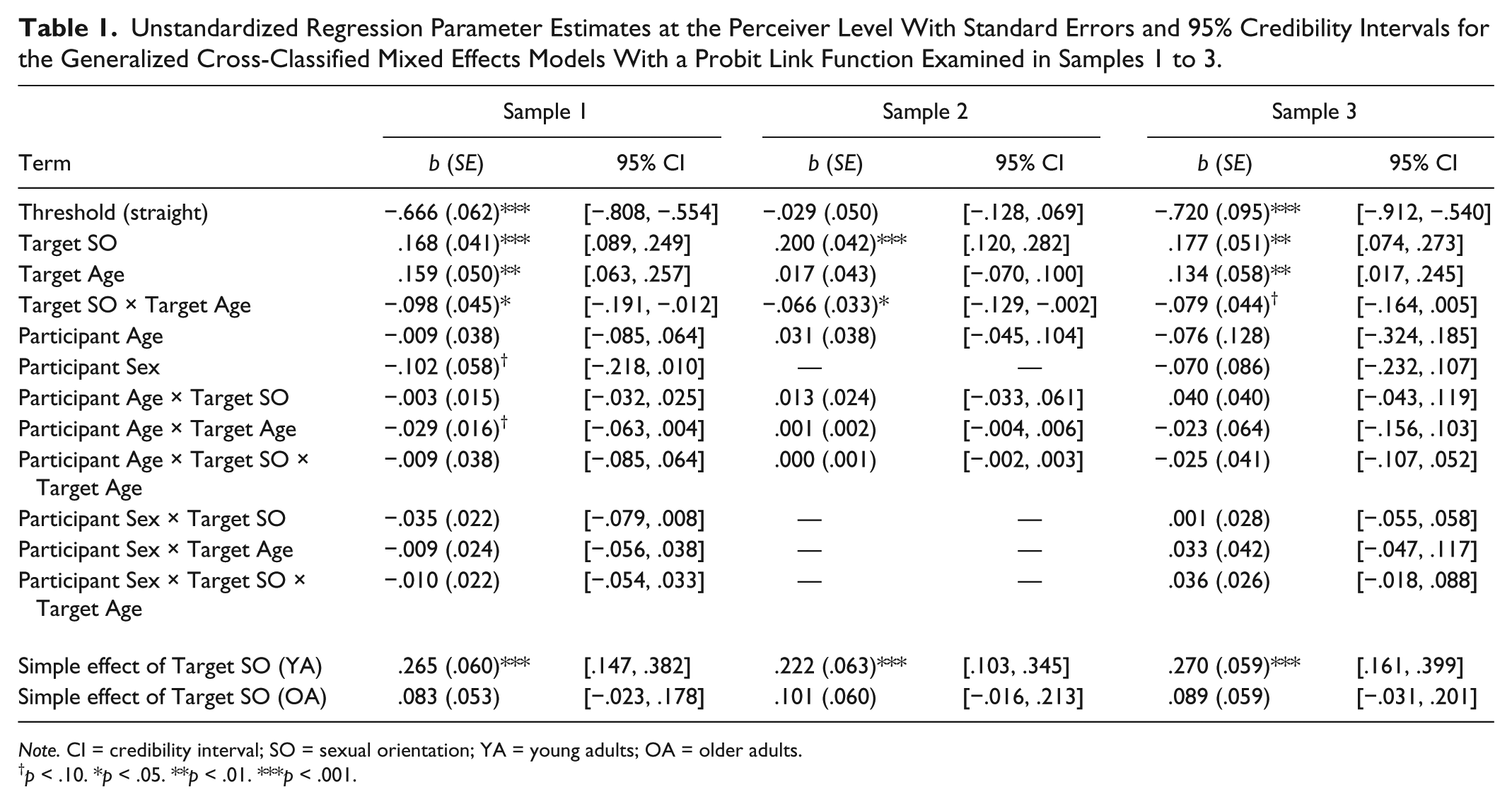
Note. CI = credibility interval; SO = sexual orientation; YA = young adults; OA = older adults.
p < .10. *p < .05. **p < .01. ***p < .001.
Random Effects Variance Estimates in Samples 1 to 3.
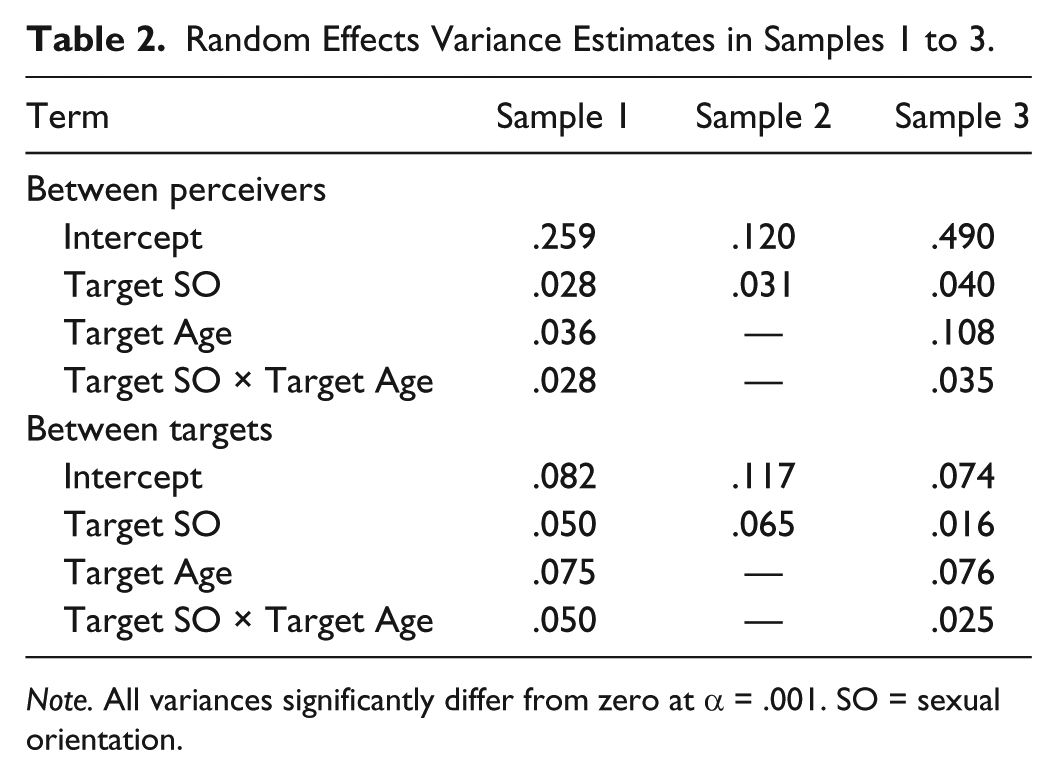
Note. All variances significantly differ from zero at α = .001. SO = sexual orientation.
We focused on the simple effects for older and younger targets separately to decompose the interaction. Although participants accurately discerned the sexual orientation of younger men across all three samples, their accuracy for categorizing the sexual orientation of older men did not exceed chance (see Table 3 for the marginal probabilities and their 95% credibility intervals). Thus, consistent with our hypotheses, accuracy for categorizing younger targets surpassed that for categorizing older targets. None of Participant Age, Participant Sex, or their interactions with the other variables significantly affected participants’ categorizations.
Predicted Probabilities and 95% Credibility Intervals for Categorization of Targets as Straight Corrected for Guessing According to Target Age and Sexual Orientation Across Samples 1 to 3.

Note. CI = credibility interval.
Mediation
The overall model fit for the participants’ trait-rating data in Sample 3 was excellent: The 95% CI of the difference between the χ2 values for the actual and simulated data was approximately symmetric around 0 and the PPP (.497) rounded to .50. The participants perceived gay men as happier and more feminine than straight men (see Figure 1). In turn, perceptions of greater happiness and femininity resulted in a higher likelihood that a target was categorized as gay. In other words, Perceived Affect, b = .019, SE = .008, 95% CI = [.005, .034], and Perceived Masculinity, b = .021, SE = .008, 95% CI = [.007, .037], mediated the relationship between Actual Sexual Orientation and Perceived Sexual Orientation. Notably, Actual Sexual Orientation did not interact with Target Age in predicting Perceived Affect, suggesting that participants accurately used affect to judge both older and younger targets’ sexual orientation.

Illustration of the generalized cross-classified mixed effects unconflated mediated moderation model with probit link function.
Actual Sexual Orientation did interact with Target Age to predict Perceived Masculinity, however, suggesting that the indirect effect from Actual Sexual Orientation to Perceived Sexual Orientation via Perceived Masculinity differed for older and younger targets: b = −.025, SE = .007, 95% CI = [−.039, −.011]. Consistent with our hypothesis, participants perceived gay and straight older targets as similarly masculine, b = −.042, SE = .045, 95% CI = [−.188, .050]. Critically, however, they perceived the young straight men as significantly more masculine than the young gay men, b = .259, SE = .063, 95% CI = [.125, .383]. Thus, although people used masculinity to judge sexual orientation, this only validly distinguished younger men’s faces.
We observed similar effects on the target level of analysis. Participants perceived straight men as less happy than gay men, b = −.258, SE = .094, 95% CI = [−.443, −.069]. Furthermore, they more often assigned happy men to the gay (vs. straight) category, b = −.036, SE = .006, 95% CI = [−.047, −.024]. In other words, affect mediated the indirect effect between Actual Sexual Orientation and Perceived Sexual Orientation, b = .009, SE = .004, 95% CI = [.002, .018]. All other CIs for indirect effects through Perceived Affect indicated that the estimates did not differ from zero. Again, Actual Sexual Orientation interacted with Target Age to predict Perceived Masculinity, suggesting different indirect effects for older and younger targets. As before, Perceived Masculinity mediated the relationship between Actual Sexual Orientation and Perceived Sexual Orientation for younger (b = .043, SE = 0.011, 95% CI = [.023, .067]) but not older (b = −.004, SE = .009, 95% CI = [−.023, .012]) targets.
Finally, participants who perceived all targets as more masculine also rated them as straight, b = .112, SE = .023, 95% CI = [.058, .165], β = .519. We did not find similar effects for Perceived Affect, b = − .043, SE = .032, 95% CI = [−.107, .022], β = −.163. These data, therefore, suggest that the participants generally were biased by their overall perceptions of masculinity, but not affect when evaluating men’s sexual orientations.
General Discussion
Here, we examined how age affects judgments of sexual orientation in several ways. Differences in participants’ ages did not influence their accuracy in judging sexual orientation; that is, OA and YA judged targets’ sexual orientation similarly. We found more notable differences based on the targets’ ages, however. Participants categorized sexual orientation more accurately from younger versus older targets. Explaining these differences in accuracy, we found that masculinity and affect provided valid cues to younger men’s sexual orientation whereas only affect validly cued older men’s sexual orientation. Thus, masculinity differentiated the sexual orientation of younger men, but affect distinguished gay and straight men in both age groups.
These findings accord with previous work showing that participants extract information about sexual orientation from faces (Rule & Ambady, 2008). Furthermore, the present research supports the utility of gender atypicality as a cue to sexual orientation (Rieger et al., 2010). Age may nuance this effect, however, as masculinity distinguished sexual orientation only in the faces of younger (but not older) men. Although masculinity may provide a kernel of truth in perceptions of sexual orientation from the faces of younger men, it therefore might not apply to other ages (but see Rieger et al., 2008). Perhaps differences in masculinity between gay and straight faces decreased because older faces generally appear more masculine due to age-related changes in facial structure (Yamaguchi et al., 1996), thereby diminishing the validity of masculinity as a cue (cf. Freeman et al., 2010). Importantly, positive affect validly cued targets’ sexual orientation regardless of their age. Together, this evidence suggests that both static (i.e., masculine–feminine facial structure) and dynamic (i.e., affect) cues to gender atypicality contribute to accurate perceptions of sexual orientation (see Tskhay & Rule, 2015a). Furthermore, auxiliary examination of the contribution of affect and masculinity on the participant level of analysis indicated that individuals biased to rate all targets as more masculine tended to categorize them as straight (parallel effects did not emerge for affect). Masculinity, but not affect, may therefore bias individuals’ perceptions of sexual orientation.
Along these lines, OA and YA showed similar accuracy in categorizing sexual orientation from the faces of both older and younger men. Moreover, participants did not show greater accuracy for judging their same-age peers, suggesting the absence of an ingroup advantage. Thus, despite significant differences in antigay bias between the OA and YA participants in Sample 1, and previous observations that OA perform worse than YA in recognizing emotions (Ruffman et al., 2008)—a vital cue to discerning targets’ sexual orientation, OA and YA performed similarly in their judgments. These results comport with emerging research examining the relationship between interpersonal accuracy and aging (Boshyan et al., 2014; Krendl et al., 2014; Zebrowitz et al., 2013) and add to the growing literature showing that biases against stigmatized groups may be more pronounced among OA than YA (e.g., Gonsalkorale, Sherman, & Klauer, 2009; Krendl, Heatherton, & Kensinger, 2009; Krendl & Wolford, 2013; Stewart, von Hippel, & Radvansky, 2009; von Hippel, Silver, & Lynch, 2000).
Although this work has value, it is not without limitations. For example, although we obtained a relatively large community sample of gay men attending the Gay Pride Festival (Sample 2), these participants may differ in important ways from other gay men, as the Pride Festival might attract people more open about their sexual orientation. In turn, these men might interact more with members of the gay community, potentially improving their ability to perceive sexual orientation (Brambilla et al., 2013). However, even here, we did not demonstrate that gay men performed much differently in their perceptions of sexual orientation than straight individuals did. However, future research may wish to examine whether the accuracy of sexual orientation judgments varies between gay men who are open about their sexual orientation versus those who conceal it (see also Tskhay & Rule, 2015b).
Furthermore, although we had a substantial number of targets, our participant sample sizes could have been larger. That said, our power analysis indicated that we had 97% power to ascertain our effects of interest. Moreover, replication of our main findings across three samples of university students, community members, and Mechanical Turk Workers suggests that our findings are robust and generalizable.
In addition, similar to other work on perceptions of sexual orientation (e.g., Rule & Ambady, 2008), we used photographs from online dating websites. Such individuals may have more motivation to convey their sexual orientation to attract potential mates, thereby exaggerating differences between gay and straight targets. Previous research has actually found the opposite effect, however: Accuracy for perceiving ambiguous group memberships (including sexual orientation) tends to decrease as participants have more control over their self-presentation (Tskhay & Rule, 2013). Thus, we would expect that using photos from personal advertisements would actually underestimate the true size of the differences between gay and straight targets (see Rule & Ambady, 2008; Rule, Ambady, & Hallett, 2009).
Nevertheless, future research would benefit from studies with more standardized photographs that may help to provide clearer insights about target differences. Here, we found that both structural appearance cues (i.e., masculinity) and dynamic self-presentation cues (i.e., affect) supported accurate judgments of sexual orientation. Given that Freeman et al. (2010) conceptualized masculinity in terms of facial shape and texture, future studies with such standardized stimuli might help to reveal what specific structural cues underlie perceptions of masculinity to communicate sexual orientation among targets of different ages. Moreover, Skorska et al. (2015) found that a variety of gender atypical facial cues may distinguish gay from straight men and women. Systematic exploration of how these various particular facial features vary across the life span (as well as extension of the present work to female targets) could help to meaningfully expand understanding of the expression and judgment of sexual orientation from facial cues.
In sum, the current work suggests that gender atypicality cues men’s sexual orientation differently according to target age. Specifically, whereas the validity of some cues remains stable across age groups (e.g., affect), the validity of other cues (e.g., masculinity) may change as people age. The perception of sexual orientation thus appears to differ for younger and older faces as a function of age-related physical changes and according to dynamic cues independent of age.
Footnotes
Acknowledgements
The authors would like to express thanks to Eunice Lee and Melissa Feriozzo for their help with data collection.
Declaration of Conflicting Interests
The author(s) declared no potential conflicts of interest with respect to the research, authorship, and/or publication of this article.
Funding
The author(s) disclosed receipt of the following financial support for the research, authorship, and/or publication of this article: This research was supported in part by a grant from the Social Sciences and Humanities Research Council of Canada to NOR.

Notes
References
Supplementary Material
Please find the following supplemental material available below.
For Open Access articles published under a Creative Commons License, all supplemental material carries the same license as the article it is associated with.
For non-Open Access articles published, all supplemental material carries a non-exclusive license, and permission requests for re-use of supplemental material or any part of supplemental material shall be sent directly to the copyright owner as specified in the copyright notice associated with the article.
