



Abstract
Individuals differ in how they deploy attention to their physical and social environments. These differences have been recognized in various forms as orientations, interests, and preferences, but empirical work examining these differences at a cognitive level is scarce. To address this gap, we conducted two studies to explore the links among attentional processes and interests in people and things. The first study measured selective visual attention toward person- and thing-related image content. In the second study, participants were randomly assigned to describe visually presented scenes using either an observational or narrative story format. Linguistic analyses were conducted to assess attentional bias toward interest-congruent content. Outcomes from both studies suggest that attention and motivational processes are linked to differential interests in physical and social environments.
Keywords
Recently, police in West Lafayette, Indiana, investigated an assault. The police probably thought they were fortunate to have more than one witness. What they discovered was that the witnesses, despite being present at the same location at the same time, recalled different events, or at least different aspects of the event. One witness remembered vividly that the assailant had a gun but could not recall many details about the victim. Another witness recalled the victim, describing her frightened look and the way she sat on the ground after the assault. The second witness did not remember the gun. If the witnesses saw the same incident, why were their recollections so dissimilar?
One potential explanation for these discrepant reports is that people differ in the way they orient toward their environments. Descriptions of social events are not random or chaotic, but depend on certain systematic tendencies that vary across individuals. This is well known in the literature on eye-witness identification (e.g., Spellman & Schauer, 2013), but it is not limited to issues of crime and punishment. Previous research has identified that one main fault line in these orienting tendencies lies between the social and the physical aspects of the environment (Cattell & Drevdahl, 1955; Graziano, Habashi, & Woodcock, 2011; Little, 1968, 1972, 1974; Thorndike, 1911). That is, some individuals selectively orient toward their social environment, attending and responding acutely to the people around them. This tendency is referred to as Person Orientation (PO; Graziano, Habashi, Evangelou, & Ngambeki, 2012). In addition, some people selectively orient toward the physical environment, attending and responding acutely to the objects around them; this is referred to as Thing Orientation (TO). These orientations appear to be basic individual difference factors that guide how people perceive and interact with their surroundings.
Early theorizing posited that interests in people and things lay along a single bipolar continuum. That is, if individuals were more interested in people, they were also less interested in things, and vice versa (Cattell & Drevdahl, 1995; Thorndike, 1911). This assumption was questioned in later work, and evidence emerged to suggest that PO and TO may be empirically orthogonal (Little, 1968, 1972). Graziano et al. (2011) conducted structural analyses of TO and PO to resolve the bipolarity/orthogonality issue and found support that these variables are orthogonal. This structure has been replicated in follow-up studies by independent groups of researchers (Graziano et al., 2012; Tay, Su, & Rounds, 2011), offering strong converging evidence for the orthogonality of PO and TO. Thus, these variables will be treated as independent constructs in the present research.
Early work on these orientations also noted large gender differences (e.g., Thorndike, 1911; see Su, Rounds, & Armstrong, 2009, for a review). On average, men tend to be more thing-oriented, whereas women tend to be more person-oriented. Woodcock et al. (2012) conducted the most comprehensive review of gender differences in PO and TO to date. Across 7,450 participants in 15 samples, the gender difference tends to be larger for TO (mean d = .99) than for PO (mean d = .49; 5-point scales). This pattern has been found consistently for samples from the United States, Greece, and Turkey, and within college students, sixth graders, and third graders. The developmental origin of gender differences in PO and TO awaits further empirical examination, but cultural and socialization factors likely contribute to the gender gap (Su & Rounds, 2015; Su et al., 2009; Woodcock et al., 2012).
Existing research has approached PO and TO as interest variables that relate to academic and occupational choices. Much work has examined how interests in people and things predict which career paths people choose (Dik & Rottinghaus, 2013; Prediger, 1982; Rounds, 1995; Su & Rounds, 2015; Su et al., 2009; Woodcock et al., 2012). For instance, highly thing-oriented individuals tend to pursue careers in science, technology, engineering, and mathematics (STEM) fields (Graziano et al., 2012; Graziano et al., 2011; Yang & Barth, 2015). In part, interests in people and things explain systematic gender differences in occupational preferences. Men, who tend to be higher on TO, gravitate toward thing-oriented occupations, whereas women, who tend to be higher on PO, have a tendency to choose person-oriented occupations (Lippa, 1998; Su & Rounds, 2015; Su et al., 2009). In this body of work, PO and TO have been linked to meaningful outcomes, but currently no research has investigated how these orientations function. These traits are well-documented as reliable predictors, but how they “get outside the skin” is currently unknown (Hampson, 2012). The present studies address this gap by examining how cognitive processes operate within PO and TO. Understanding these processes can help explain why, for instance, a witness recalls the characteristics of a victim at a crime scene but not the gun, or why a student chooses to become an engineer as opposed to a lawyer.
Building a Conceptual Process Model
The theoretical basis of this work draws from classic social-cognitive literature as well as the literature on interests. At their core, PO and TO imply differential responsiveness to the social and physical environments—in other words, selectivity of person or thing content. The information processing systems approach suggests that selectivity can take place at multiple stages along the cognitive stream (Carlston, 2013), such as attention, encoding, memory, or retrieval. Considering that PO and TO are conceptualized as interests in people and in things, a plausible starting place for such selective processing is attention. Interests are regarded as motivational variables, reflecting an “enduring predisposition to re-engage” with or attend to interest-relevant content (Hidi, 2006; Hidi & Renninger, 2006). In this view, the more a person is interested in a given topic, object, or idea, the more attention they tend to allocate toward it (Ainley, Hidi, & Berndorff, 2002; Hidi, Renninger, & Krapp, 2004; McDaniel, Waddill, Finstad, & Bourg, 2000). Based on this logic, the present studies examine attention as a process underlying PO and TO. Additional stages of information processing, such as the encoding, memory, and retrieval of social and non-social stimuli, may also differ in relation to these orientations. Existing evidence on interests, however, suggests that attention is the most likely entry point into the cognitive stream.
As motivational variables, interests are linked not only to attentional responses but also to affective responses. When individuals attend to interest-congruent content, they typically experience positive affect (Ainley, 2006; Silvia, 2001). This positive affect is rewarding and may drive future attention toward interest-congruent content as well as reinforce an individual’s interest (Bradley, 2009; Hidi, 2006; Lang, Bradley, & Cuthbert, 1997). Accordingly, the more individuals are driven and affectively reinforced by their interest in people or things, the more they should attend selectively to interest-congruent content. Highly person-oriented individuals should enjoy attending to their social environment and consequently, do so more readily, whereas highly thing-oriented individuals should enjoy attending to their physical environment. This idea of motivated attention informs the present research’s focus on selective attention, specifically, above other aspects of cognition.
These theoretical pathways are shown in Figure 1. The present studies explore this conceptual process model, in which individual differences in interest (i.e., PO and TO) act as motivational forces that drive selective attention to interest-congruent content (i.e., people or things). As discussed, attending to interest-congruent content should be affectively rewarding. In turn, positive affective responses may motivate further attention to such content in addition to bolstering an individual’s interest. This is the first research to examine PO and TO at the process level, so the goal was not to exhaustively test all of the pathways in this conceptual model. Rather, this work was intended to identify whether or not individual differences in PO and TO are linked to attention. Once evidence for this basic relationship is established, future research can pursue more systematic investigation of the proposed model.
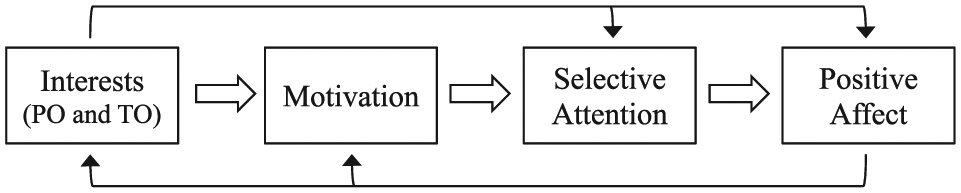
Conceptual process model representing the hypothesized relationships between individual differences in interest, motivation, selective attention, and affective responses.
Considerations in the Examination of Attention
Much selective attention research is perception-focused, investigating how stimulus properties and visual cues influence the orienting of attention (for a review, see Heinke & Humphreys, 2005). However, selective attention occurs not only in response to external properties of the stimulus but also on the basis of “internal selective mechanisms” (Pashler, 1998; Smilek & Frischen, 2013). As motivational constructs that may guide attention to interest-relevant content, PO and TO can be viewed as part of these higher order, internal selective processes. Furthermore, classical attention literature contends that selective attention can be categorized into multiple operations, one of which is the selection of outputs (Kahneman, 1973; Mole, 2013; see also Treisman, 1969). In other words, visual selection can take place at the response stage as well as at the stages of perception and encoding. Thus, an individual can detect both people and objects in an image but respond only to one or the other, attending selectively to one type of content despite consciously noticing and processing both. This output-based understanding of visual selection informed the design of the present studies, which primarily examined higher order attentional differences.
Given the covert nature of attention, it can be difficult to identify how and when individuals are selectively attending to a stimulus. The current research focuses on object-based attention, which involves the selection of discrete visual units (e.g., a person; Scholl, 2001). This approach differs from those that examine spatial- and feature-based attentions, in which attention is directed toward particular visual locations or stimulus characteristics (e.g., Carrasco, 2011; Smilek & Frischen, 2013). Whereas spatial- and feature-based attentions are primarily perceptual in nature, object-based attention involves more conceptual processing. Representations formed through such processing appear to play “a prominent role in guiding further inferences and actions” (Scholl, 2001, p. 38). Thus, in object-based attention, perceivers orient toward holistic stimulus components, and this macro-level orienting can shape behavioral responses. Building from this knowledge, the current studies focus on overt responses following exposure to stimuli involving both people and things. Selective attention toward people should manifest as more social content in individuals’ responses, whereas selective attention to things should manifest as more non-social response content.
To summarize, PO and TO operate theoretically as internal selective processes that function via object-based attention. Because these orientations are expected to predict higher order attention in particular, we hypothesize that selectivity differences will emerge at the response stage, rather than at lower order perceptual stages. Nonetheless, it is possible that PO and TO are also linked to lower order stages of attention. We collected more immediate measures of attention (e.g., reaction time) to examine this alternative possibility.
Research Overview
Two studies tested the hypothesis that PO and TO are related to selective attention toward social and physical aspects of the environment. First, a pilot study was conducted to pre-test stimulus materials and to establish baseline evidence for the operation of motivated attention. In the following two studies, we expected highly person-oriented individuals to attend selectively to images of people more than individuals low on PO. Similarly, we expected highly thing-oriented individuals to attend selectively to images of things more than individuals low on TO.
In Study 1, participants viewed a series of pictures and indicated which part of each picture caught their attention. They then rated their interest, valence, and arousal for each image. Lower order selective attention was measured using image element selections and image viewing time. If PO and TO are linked to lower order stages of attention, participants should select orientation-congruent image elements (i.e., people or things) more frequently than orientation-incongruent elements, and to spend more time looking at images after selecting orientation-congruent elements.
However, if PO and TO are linked to higher order stages of attention, Study 1 should provide evidence for motivated attention and affective reinforcement. Specifically, image-specific interest was expected to mediate the relationship between PO and affective ratings (valence and arousal) following selection of person-related (but not thing-related) image content. That is, participants higher on PO would express greater interest in the images, and consequently report more positive affective responses, after attending to person content. Similarly, image-specific interest was expected to mediate the relationship between TO and affective ratings (valence and arousal) following selection of thing-related (but not person-related) image content. That is, participants higher on TO would express greater interest in the images, and consequently report more positive affective responses, after attending to thing content.
Study 2 extended the findings of the first study by examining selective attention toward people or things via language use. In this study, participants composed a written response for three images. The content of each image was manipulated to be highly person-related, highly thing-related, or roughly equivalent. Selective attention to person or thing content was measured by assessing linguistic markers of person- and thing-related language. Compared with their low-PO peers, participants higher on PO were expected to use more person-related language in their written responses to the images. Likewise, compared with their low-TO peers, participants higher on TO were expected to use more thing-related language in their written responses.
In addition to the above hypotheses, we conducted exploratory analyses to account for the psychometric properties of PO and TO. Because these orientations are independent, orthogonal constructs, they are examined here as separate predictors. To isolate the effects of each orientation individually, we control for one orientation or examine their interaction where appropriate. Given the sizable gender differences reported for these orientations, it is also reasonable to question whether outcomes for PO and TO are independent from gender effects. To address this, some analyses include gender as a predictor, control variable, or interaction term. We do not expect the hypothesized processes to vary systematically on the basis of gender or PO × TO interactions, but we examine these possibilities to explore potential alternative explanations.
Pilot Study
The pilot study had three objectives: (a) to create an image set that would facilitate differential orienting toward social and non-social content—that is, both people and things should be prominent in each image to allow for attentional selectivity; (b) to replicate standardized affective ratings of the images; and (c) to establish baseline evidence that motivated attention is linked to PO and TO. Specifically, interests in people or things were expected to predict affective responses to interest-relevant content.
Method
Participants
Participants (N = 87; 60.9% women; M age = 19.9 years) were drawn from the Purdue University introductory psychology participant pool. They received course credit for completing the study.
Procedure
Participants were seated at individual laboratory computers and completed the experiment using Qualtrics software. They were told that they were participants in an “image viewing” experiment and that the researchers were interested in how people look at pictures. Following a brief demographic survey including age, gender, year in school, and major, participants viewed and rated a random selection of 26 images, which were drawn from a pool of 52 photographs. Participants then completed the 13-item Person and Thing Orientations scale (Graziano et al., 2011).
Materials and measures
A series of 52 photographs was selected, with the criteria that each image contained a prominent instance of both a person/people and an object/objects. Thirty-one images were drawn from the International Affective Picture System (IAPS; Lang, Bradley, & Cuthbert, 2008), a standardized stimulus database that is widely used in psychological research. To avoid aversive imagery, photographs that were highly arousing (i.e., average rating of 7 or above on a 9-point scale) or highly negative (i.e., average rating of 3 or below on a 9-point scale) were excluded. Twenty-one additional images were drawn from the Berkeley Segmentation set (Arbelaez, Maire, Fowlkes, & Malik, 2011), a database used to develop algorithms for computerized image segmentation. A complete list of these stimulus images is included in the supplementary materials, along with examples. The images show people engaging in a variety of activities in both occupational and leisure settings, including using a computer, operating vehicles, conversing with others, and playing musical instruments.
For each image, participants rated their arousal, valence, and interest along with the degree of person and thing content. Arousal and valence were each measured using two semantic differential items on 9-point scales. For arousal, the two items were “relaxed to stimulated” and “dull to jittery.” For valence, the two items were “unhappy to happy” and “annoyed to pleased.” These semantic differential items were adapted from Bradley and Lang (1994). For interest, participants responded to two items on a sliding scale from 0 (strongly disagree) to 100 (strongly agree): “I am interested in the contents of this picture” and “I enjoy looking at this picture.” For content ratings, participants responded to two items on a sliding scale from 0 (strongly disagree) to 100 (strongly agree): “This is an image of a person/people” and “This is an image of a thing/things.”
Results and Discussion
Participants’ ratings confirmed that both people and things were prominent in each photograph. Averaging across participants for each image, ratings of person content ranged from 61.7 to 91.3 (M = 79.7, SD = 7.5), whereas ratings of thing content ranged from 56.8 to 87.0 (M = 74.6, SD = 6.8). All the images were rated above the midpoint (50) for both person and thing content, indicating that the images contained substantial instances of each category.
We conducted correlation analyses to test whether the standardized valence and arousal ratings were replicated in this sample. The two valence items, r(50) = .96, p < .001, were averaged to create a composite valence measure. For the 31 IAPS images, these valence ratings were highly consistent with standardized IAPS figures, r(29) = .89, p < .001 (Lang et al., 2008). The two arousal items, r(50) = .76, p < .001, were averaged to create a composite arousal measure. These arousal ratings were also highly consistent with standardized IAPS figures, r(29) = .85, p < .001. Thus, we successfully replicated the standardized IAPS affective ratings using a four-item semantic differential measure.
Finally, interest ratings were examined to assess whether this pilot study offered suggestive evidence for a link between PO, TO, and motivated attention processes. The two interest items were highly correlated, r(85) = .87, p < .001, and averaged to create a composite interest measure. As this preliminary study did not include a measure of selective attention, interest ratings were correlated with PO and TO to determine which images were of high-person and high-thing interest. PO correlated positively with interest in 5 of the images, range of r(44) = .31 to .39, ps < .05. TO correlated positively with interest in 11 of the images, range of r(43) = .31 to .45, ps < .05. Independent-samples t tests were conducted to compare person and thing content ratings for these subsets of person-oriented and thing-oriented images. The person-oriented images were not significantly higher in person content (p = .27) or lower in thing content (p = .27), and the thing-oriented images were not significantly lower in person content (p = .08) or higher in thing content (p = .50). This suggests that subjective, affective responses to the images were largely independent from objective ratings of the image content.
Responses from the five-image and 11-image subsets were aggregated to form combined interest and affective ratings for person- and thing-oriented images. Using procedures recommended by Preacher and Hayes (2004), four mediation analyses were conducted to test whether situational, image-specific interest mediated the relationship between dispositional interest and affective responses. Specifically, interest in person-oriented images was expected to mediate the relationship between PO and valence ratings, and between PO and arousal ratings. Similarly, we expected that interest in thing-oriented images would mediate the relationship between TO and valence ratings, and between TO and arousal ratings. Estimates of the indirect effects were tested using standard errors and 95% confidence intervals, calculated from 5,000 bootstrapped samples. The confidence interval for the PO-arousal mediation included zero, with an unstandardized indirect effect of 0.15 [−0.05, 0.42] that approached significance in the expected direction (SE = .12, R2 = .07). Indirect effects were significant for the three remaining models (PO-valence, TO-valence, and TO-arousal), with confidence intervals that did not include zero (R2s ≥ .25, ps < .05; see Table 1). Taken together, these results show that greater interest in the images generally mediates the links between PO and TO and affective responses.
Mediation of the Effect of PO and TO on Valence and Arousal via Interest (Pilot Study).
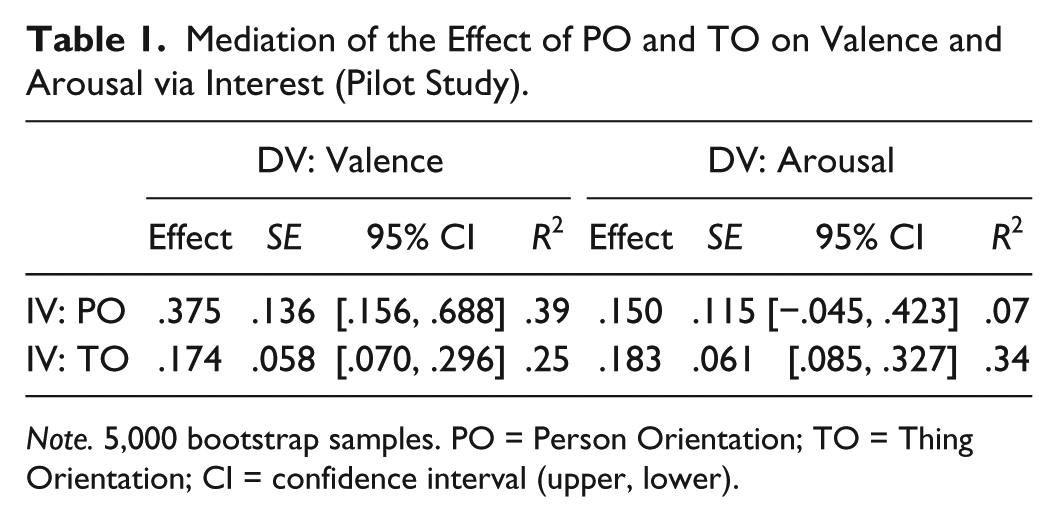
Note. 5,000 bootstrap samples. PO = Person Orientation; TO = Thing Orientation; CI = confidence interval (upper, lower).
We also reversed our hypothesized models to test alternative mediational pathways, using the same procedures as described previously. In these alternative models, interest is the dependent variable, with valence or arousal mediating the relationship between PO or TO and interest. The results mirrored those of the original analyses. Indirect effects were significant for three of the four models (PO-valence, TO-valence, and TO-arousal), with confidence intervals that did not include zero (R2s ≥ .37, ps < .05). The confidence interval for the PO-arousal mediation included zero, with an unstandardized indirect effect of 2.81 [−0.20, 4.04] that approached significance in the expected direction (SE = .95, R2 = .13).
Our rationale suggests that interest should mediate the relationship between PO or TO and affective responses. The pilot data support these relationships, and also showed that affective responses were equally strong mediators of the relationships between PO or TO and interest. These mediations will be re-examined in Study 1 to assess more fully the directionality of these effects.
Overall, the outcomes of the pilot study are consistent with the idea that being exposed to interest-congruent person or thing content is rewarding. For pictures that person-oriented individuals considered to be the most interesting, greater interest was related to more positive affective responses, with a parallel pattern for thing-oriented individuals and pictures. These findings are in line with reasoning about motivated attention, which argues that individuals’ interests lead them to direct their cognitive resources to content that is personally reinforcing (Lang et al., 1997). The pilot study provides initial evidence for a relationship between PO, TO, and selective attention, suggesting that greater interest in people or in things should predict more attention and stronger positive affect in response to interest-congruent images. The following two studies were conducted to extend the findings of the pilot study by examining selective attention more directly.
Study 1
Method
Participants
Participants (N = 234, 53.8% men, M age = 19.6 years) were drawn from the Purdue University introductory psychology participant pool. Sample size was determined by power calculations, assuming power at .80, alpha at .05, and anticipating small to medium effect sizes with correlations of .20 (Cohen, 1988). Participants received course credit for completing the study.
Materials and procedure
Participants were seated at individual laboratory computers and completed the experiment using Qualtrics software. They were told that they were participants in an “image viewing” experiment, and that the researchers were interested in how people look at pictures. Participants first completed a brief demographic survey including age, gender, year in school, and major. They were then presented with the 52 piloted images drawn from the IAPS (Lang et al., 2008) and the Berkeley Segmentation set (Arbelaez et al., 2011) in a random order. The number of images viewed by each participant varied (M = 40.8), dependent on time constraints. All aggregated dependent variables were computed proportionately to the number of images viewed by each participant.
For each image, participants were first instructed to “Click on the part of the picture that catches your attention.” Then, participants were asked to complete ratings of interest, valence, and arousal for each picture as a whole. Following procedures used in the pilot study, interest was measured using two items on a 9-point scale, whereas arousal and valence were measured using two semantic differential items on 9-point scales. After viewing and rating the images, participants completed the 13-item Person and Thing Orientations scale.
Image content coding
Using Qualtrics’s heat map function, the pictures were segmented into content areas corresponding to people and to things (see supplemental materials for an example). Most content fell readily into this dichotomy, but the categorization process naturally involved some ambiguities. As a result, some areas were coded as both people and things—for instance, when a person was wearing a prominent object, such as a fireman’s helmet. Animals were coded as separate areas due to their ambiguous person–thing status (e.g., Hills, 1989). Participants were unable to see the content segmentations when making their responses, which were automatically recoded into the pre-specified image segments.
Results
PO and TO measures
Internal reliability (Cronbach’s α) for the eight-item PO subscale was α = .65. Factor analyses were conducted to determine whether scale reliability could be improved, but removing items would not significantly increase reliability for PO. Internal reliability for the five-item TO subscale was α = .92. Consistent with previous research, PO and TO were orthogonal, r(232) = −.02, p = .79. These orientations were also orthogonal within men (p = .25) and women (p = .31) separately. As expected, significant gender differences were found for PO and TO. Women (M = 3.54) were significantly more person-oriented than men (M = 3.37), t(232) = 2.38, p < .02, Cohen’s d = .31. In contrast, men (M = 3.56) were significantly more thing-oriented than women (M = 1.97), t(232) = −12.06, p < .001, Cohen’s d = −1.58.
Descriptive statistics: Image selections
In general, participants showed minimal hesitation in identifying the object of their attention (i.e., their image selections). Averaging across all trials, participants clicked on each image an average of 1.20 times (SD = 0.20). Participants took an average of 4.17 s (SD = 1.63) to click for the first time, and an average of 6.32 s (SD = 2.29) to submit their response from the time each image was displayed. Because delayed responses may reflect cognitive processing more extensive than attention, outliers were examined using descriptive statistics and box plots. Nine participants’ average response times for the first click were two or more standard deviations above the mean, whereas six participants’ average response submission times were two or more standard deviations above the mean. There was no evidence that removing these participants significantly changed the pattern of results. Thus, the reported analyses were run using the full sample.
On average, participants made 40.2 image selections (SD = 4.3). The pre-specified content areas captured 96.1% of participants’ selections, with the remaining selections coded as “Other” (3.9%). The majority of selections were in areas coded as “Things” (53.9%) and as “People” (37.0%), whereas fewer responses were made in areas coded as “Both” (3.6%) and as “Animal” (1.6%). Because the areas coded as “Other” and “Both” did not contain people, these areas were combined with “Thing” areas to form a general thing category for subsequent analyses. Proportion scores were calculated for each category by dividing the number of selections each participant made in each category by their total number of responses.
Main analyses
First, we examined the possibility that PO and TO are linked to lower order, perceptual stages of attention. Correlation analyses were used to test the hypothesis that person- and thing-oriented individuals selected interest-congruent content more frequently. Results did not support this hypothesis. There was no evidence that PO correlated significantly with the proportion of person selections, r(231) = .07, p = .27, 95% CI = [−.06, 0.20], nor that TO correlated significantly with the proportion of thing selections, r(231) = .09, p = .18, 95% CI = [−.04, .22].
The hypothesis that participants would spend more time looking at interest-congruent content was also not supported. There was no evidence that PO correlated significantly with average time until the first click, nor the last click, for person selections, ps > .19. Participants higher on PO spent less time viewing the images following person selections, r(231) = −.13, p < .05, 95% CI = [−.25, −.002]. However, after controlling for gender in the first step of a hierarchical regression analysis (β = .83, p = .01), PO becomes non-significant as a predictor of submission time (β = −.46, p = .11). TO was significantly positively correlated with average time for the first click, last click, and submission time for thing selections, rs(231) ≥ .14, ps < .04. However, a main effect of gender accounted for these results, as women responded faster overall regardless of content type, first click: t(231) = −2.30, p = .02; last click: t(231) = −2.47, p = .01; submit: t(232) = −1.88, p = .06. After controlling for gender in a hierarchical regression analysis, TO becomes non-significant as a predictor of first click, last click, and submission response times for thing selections, ps > .24. Thus, after accounting for gender differences in response rates, there were no systematic differences in the frequency or speed of content selections in relation to PO and TO.
Next, we assessed the hypothesis that PO and TO are linked to higher order, conceptual stages of attention. Overall, participants’ image selections did relate to how they subsequently responded to the images. Participants higher on PO reported more interest in a given image after they had attended to a person-related area, r(231) = .15, p = .02, 95% CI = [.03, .28]. Similarly, participants higher on TO were more interested in a given image after they had attended to a thing-related area, r(230) = .21, p = .001, 95% CI = [.09, .33]. These relationships remained significant after controlling for gender and PO or TO in a hierarchical regression analysis (see Tables 2 and 3). These relationships also remain significant after accounting for PO × Gender, TO × Gender, and PO × TO interactions, none of which were significant (results provided in supplementary materials). Notably, PO and TO significantly predict only interest-congruent image selections—participants higher in PO were not more interested in a given image after selecting a thing-related area, r(231) = .07, p = .28, 95% CI = [−.06, .20], and participants higher in TO were not more interested in a given image after selecting a person-related area, r(230) = .08, p = .25, 95% CI = [−.05, .21].
Hierarchical Regression Results for Interest in Images Following Person Content Selections.
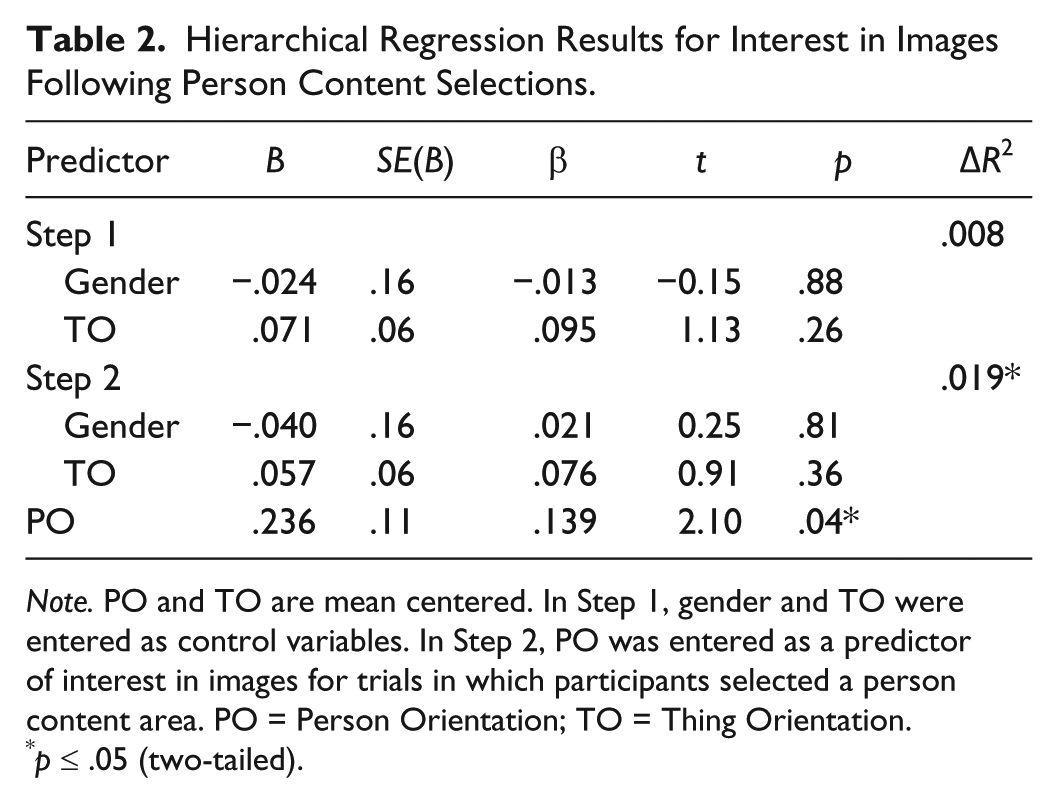
Note. PO and TO are mean centered. In Step 1, gender and TO were entered as control variables. In Step 2, PO was entered as a predictor of interest in images for trials in which participants selected a person content area. PO = Person Orientation; TO = Thing Orientation.
p ≤ .05 (two-tailed).
Hierarchical Regression Results for Interest in Images Following Thing Content Selections.
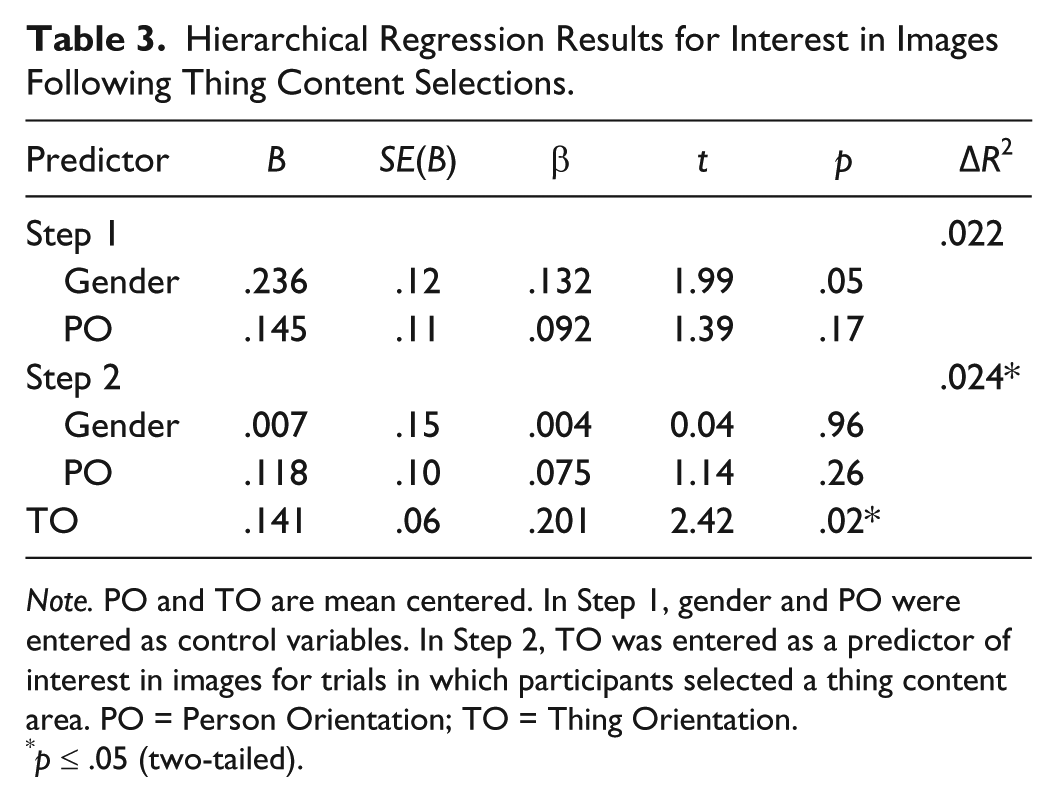
Note. PO and TO are mean centered. In Step 1, gender and PO were entered as control variables. In Step 2, TO was entered as a predictor of interest in images for trials in which participants selected a thing content area. PO = Person Orientation; TO = Thing Orientation.
p ≤ .05 (two-tailed).
To explore the relationships between PO, TO, and interest further, we conducted mediation analyses using procedures recommended by Preacher and Hayes (2004). Four mediation analyses were conducted to test whether Study 1 replicated the results of the pilot study. Interest in images following a person selection were expected to mediate the relationship between PO and valence ratings, and between PO and arousal ratings. Similarly, we expected that interest in images following a thing selection would mediate the relationship between TO and valence ratings, and between TO and arousal ratings. Estimates of the indirect effects were tested using standard errors and 95% confidence intervals, calculated from 5,000 bootstrapped samples. The confidence intervals did not include zero in any of the four models (PO-valence, PO-arousal, TO-valence, and TO-arousal), indicating that all of the indirect effects were significant (ps < .05; see Table 4). Thus, after participants attended to person (thing) content, the degree to which they found the images to be positively valenced and arousing was mediated by greater interest in the images for PO (TO).
Mediation of the Effect of PO and TO on Valence and Arousal via Interest.
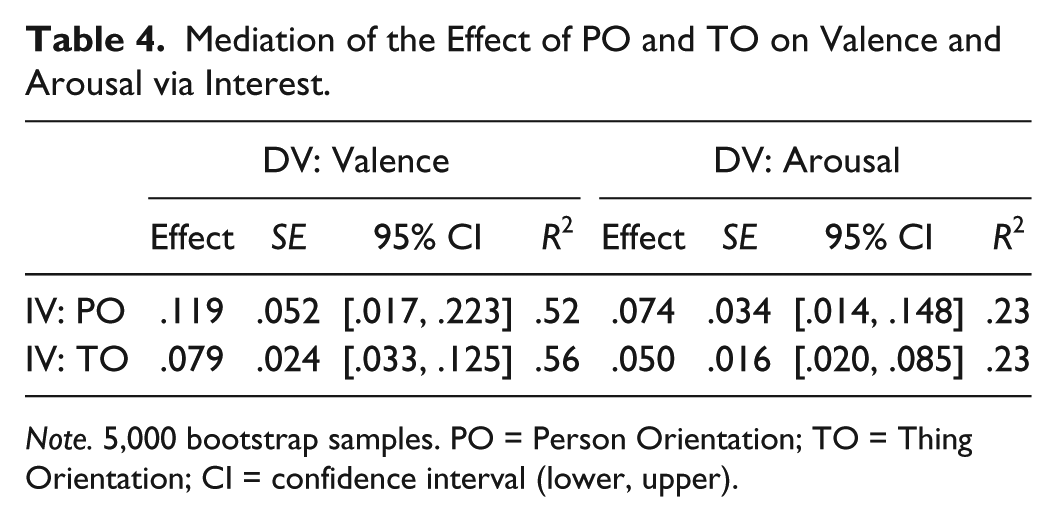
Note. 5,000 bootstrap samples. PO = Person Orientation; TO = Thing Orientation; CI = confidence interval (lower, upper).
Additional mediation analyses were conducted to test alternative models. All the following models were run using the same procedures and specifications as above. First, we assessed whether gender moderated the mediation effects. Gender was examined as a potential moderator of all three mediational paths in all four models. Gender does not significantly moderate the a path in any model (ps > .25 for PO models, ps > .46 for TO models), nor the b path for any model (ps > .09 for PO models, ps > .26 for TO models). When gender is added as a moderator to all three paths simultaneously, none of the interaction effects are significant (ps > .10 for PO models, ps > .19 for TO models).
Second, we tested alternative mediational pathways by reversing our hypothesized models. In these alternative models, interest is the dependent variable, with valence or arousal mediating the relationship between PO or TO and interest. Only one of the four model was significant; interest mediated the relationship between PO and valence, with an indirect effect of 0.23 [0.08, 0.39], SE = .08, R2 = .51. The remaining three models (PO and arousal, TO and valence, TO and arousal) were not significantly mediated by interest.
Discussion
Study 1 provides the first evidence that PO and TO are linked to higher order stages of attention. We found no evidence that participants’ levels of PO and TO related to indicators of lower order, perceptual attention. However, participants reported more interest in a given image after attending to content that was congruent with their orientations, reflecting higher order attentional processes. In addition, this study replicated the pilot study’s interest-based mediation models, which provide evidence to support the conceptualization of PO and TO as motivational variables. These results were independent from gender and interactive effects, demonstrating the robustness of these orientations as predictors. Taken together, these results provide the first direct support for a link between PO, TO, and motivated selective attention processes.
According to the mediation results, when individuals selectively attend to interest-relevant content, their orientations predict greater interest, which in turn predicts greater positive affect. These relationships are consistent with previous theorizing (Hidi, 2006; Lang et al., 1997), but alternative relationships are feasible. For instance, responding positively to interest-relevant content may lead to greater perceived interest. In simpler terms, the background process may be “Looking at this picture is pleasant, therefore I find it interesting” rather than “I find this picture interesting, therefore looking at it is pleasant.” The latter case is more consistent with our rationale and supported by all four mediation models, whereas only one of four models was successful for the reverse case. Given the mutually reinforcing nature of interest and motivation (Bradley, 2009; Hidi, 2006), both pathways likely operate for PO and TO. This work supports interest as a stronger mediator, but future research may investigate the mediational roles of valence and arousal in greater depth.
As discussed in the introduction, PO and TO likely operate as internal selective processes that motivate attention toward interest-relevant content (Pashler, 1998). Our approach in Study 1 is consistent with classical attention literature, which states that selective attention can take place not only at the stages of perception and interpretation but also at the response stage (Kahneman, 1973; Mole, 2013; Treisman, 1969). The Study 1 results support an output-based understanding of how PO and TO relate to attention. That is, these orientations appear to influence how individuals affectively respond to interest-relevant and interest-irrelevant content, but not how they initially perceive it (i.e., in terms of reaction time and viewing duration). The precise point at which PO and TO enter the cognitive stream, or exert their influence, is still an open question. This initial examination suggests that higher order, motivational processes are more involved than basic perceptual processes. Study 2 sought further evidence for the functioning of these higher order attentional processes.
Study 2
To extend the findings of the first study, Study 2 examined how selective attention to people and things manifests in language use. In this study, participants wrote about images that contained both people and things. Two writing conditions were created, such that participants wrote either a description or a story about each image. The story-writing condition was inspired by projective tests (e.g., the Thematic Apperception Test), which have been widely used in personality psychology to explore differences in stimuli construal. Study 2 offers a modern, social-cognitive version of a projective test (story condition), along with a more objective comparison group (description condition). Because so little is known about the cognitive functioning of PO and TO, these conditions were designed to capture a range of potential differences in task demands. For instance, composing a description may rely on more linear, analytical thinking, whereas composing a story may rely on more integrative, creative thinking processes. Both writing conditions were included so that the findings were not limited to a specific task type.
Study 2 examines markers of person- and thing-related language use. These markers were derived from previous research that examined linguistic indicators of social and non-social content. PO was expected to predict words that relate to social content—in particular, pronouns such as “I,” “we,” and “you,” and words involving relationships (e.g., family-related words like “mother”). Increased use of these words is associated with greater attention toward people (Pennebaker, 2011), as well as social interaction and affiliation (Chung & Pennebaker, 2007; Mehl & Pennebaker, 2003; Pennebaker, Mehl, & Niederhoffer, 2003).
TO was expected to predict words that relate to non-social content—for instance, fewer pronouns, verbs, and adverbs, but more articles and prepositions. Much like pronouns, verbs (and accordingly, adverbs) typically refer to people, reflecting attention toward their behavior and actions (Pennebaker, 2011). Thus, reduced use of these words suggests greater attention toward non-social content, as does increased use of articles and prepositions. These parts of speech are associated with discussion of concrete nouns and information (Newman, Groom, Handelman, & Pennebaker, 2008; Pennebaker et al., 2003; Tausczik & Pennebaker, 2010). More specifically, articles are used to identify particular objects, whereas prepositions are used to locate objects in space and in relation to each other. Thus, articles and prepositions, coupled with less use of person-related words like pronouns, indicate greater attention toward objects and the physical environment. We expect TO to predict these markers of non-social language.
In this study, we also examine the predictive impact of gender differences and individual differences other than PO and TO. Given that previous work has shown that gender and personality traits can be systematically related to language use (Pennebaker, 2011), it is important to assess the incremental validity of these orientations above and beyond other measures. To do so, we account for gender and for Big Five traits in our analyses.
Method
Participants
Participants (N = 381, 64.8% women, M age = 19.0 years) 1 were drawn from the Purdue University introductory psychology participant pool. Nearly all (98.4%) participants self-reported fluency in English, with 90.6% reporting that they were native speakers. An additional 6.0% reported more than 10 years of experience speaking English. Removing non-fluent participants did not significantly change the pattern of results; thus, the reported analyses were run with non-fluent participants’ data included. Participants received course credit for completing the study.
Materials and procedure
Participants were seated at individual laboratory computers and completed the experiment using Qualtrics software. Participants first completed a brief demographic survey including age, gender, year in school, academic major, and English fluency. Participants were randomly assigned to one of two conditions, either a description condition or a story condition.
Within both conditions, each participant viewed three images presented in a random order. Each of the three images was randomly selected from two possible images in each of three categories: high-person content, equal person–thing content, and high-thing content (see supplemental materials for examples). Using data from the pilot study, these selections were determined by calculating a difference score from participants’ ratings of the degree of person and thing content in each image. For the images with high-thing content, the person–thing difference was significantly below the mean across all images, zs = −2.06 and −2.28, one-tailed ps < .02. For images with high-person content, the person–thing difference was significantly above the mean, zs = 1.72 and 2.31, one-tailed ps < .04. For the images with equal person–thing content, the person–thing difference did not differ significantly from the mean, two-tailed ps > .97. Each participant viewed and wrote about one image from every category to ensure that both person and thing content were prominent in the task.
Participants in the description condition were instructed to “describe the picture in as much detail as possible,” while those in the story condition were instructed to “make up a story for the picture . . . tell a complete story with a beginning, middle, and end.” In both conditions, the pictures were first displayed for a 1-min viewing period. This was followed by a 4-min writing period, after which the program auto-advanced to the next image. In both conditions, the pictures were displayed individually on the same screen as a text entry box so that participants could refer to each image as they typed. After writing descriptions or stories for each of the three pictures, participants completed the 13-item Person and Thing Orientations scale and the 44-item Big Five Inventory (John & Srivastava, 1999).
Results
PO and TO measures
Internal reliability (Cronbach’s α) for the eight-item PO subscale was α = .71. Internal reliability for the five-item TO subscale was α = .91. Consistent with previous research, PO and TO were orthogonal, r(379) = −.02, p = .74. These orientations were also orthogonal within men (p = .36) and women (p = .95) separately. As expected, gender differences were found for PO and TO. Women (M = 3.40) were marginally more person-oriented than men (M = 3.29), t(379) = 1.83, p < .07, Cohen’s d = .19. In contrast, men (M = 2.97) were significantly more thing-oriented than women (M = 1.81), t(222.63) = −10.09, p < .001, Cohen’s d = −1.12. Levene’s test indicated non-homogeneity of variances, F(2, 379) = 23.67, p < .001, so adjusted values are reported for the TO t test.
Linguistic analyses
Participants’ written responses were analyzed using Linguistic Inquiry and Word Count software (LIWC; Pennebaker, Booth, & Francis, 2007). The default LIWC dictionary captured a mean of 85.8% (SD = 4.15, range = 68.6%-100%) of the words in the responses, which is consistent with the average capture rate (86%) reported by Pennebaker, Chung, Ireland, Gonzales, and Booth (2007). The average response length was 123.0 words (SD = 33.7, range = 23-291). Responses in the description condition (M = 126.9 words) were slightly longer than those in the story condition (M = 119.1 words), t(379) = 2.27, p = .02.
Person-related language use
Consistent with hypotheses, individuals higher on PO used more person-related language, suggesting selective attention toward the images’ social content. Specifically, PO was positively correlated with use of first-person singular pronouns, r(191) = .16, p < .03, 95% CI = [.02, .28]; first-person plural pronouns, r(191) = .17, p < .02, 95% CI = [.03, .31]; second-person pronouns, r(191) = .19, p < .01, 95% CI = [.05, .32]; and family-related words, r(191) = .17, p = .02, 95% CI = [.03, .30], in the story condition. Notably, PO significantly predicts all four of these linguistic markers after partialing out gender and TO in hierarchical regression analyses, ps < .03. The results of these analyses are summarized in Table 5. These effects were also not subject to PO × TO interaction effects (see supplementary materials for interaction results). To examine the possibility that other personality traits might explain these linguistic patterns, regression analyses were conducted using Big Five traits and PO as simultaneous predictors. These results are also summarized in Table 5. PO predicts differences in language use incrementally, above and beyond what was accounted for by extraversion, agreeableness, conscientiousness, neuroticism, and openness.
Gender, PO, TO, and Big Five Traits Predicting Linguistic Markers Related to PO.
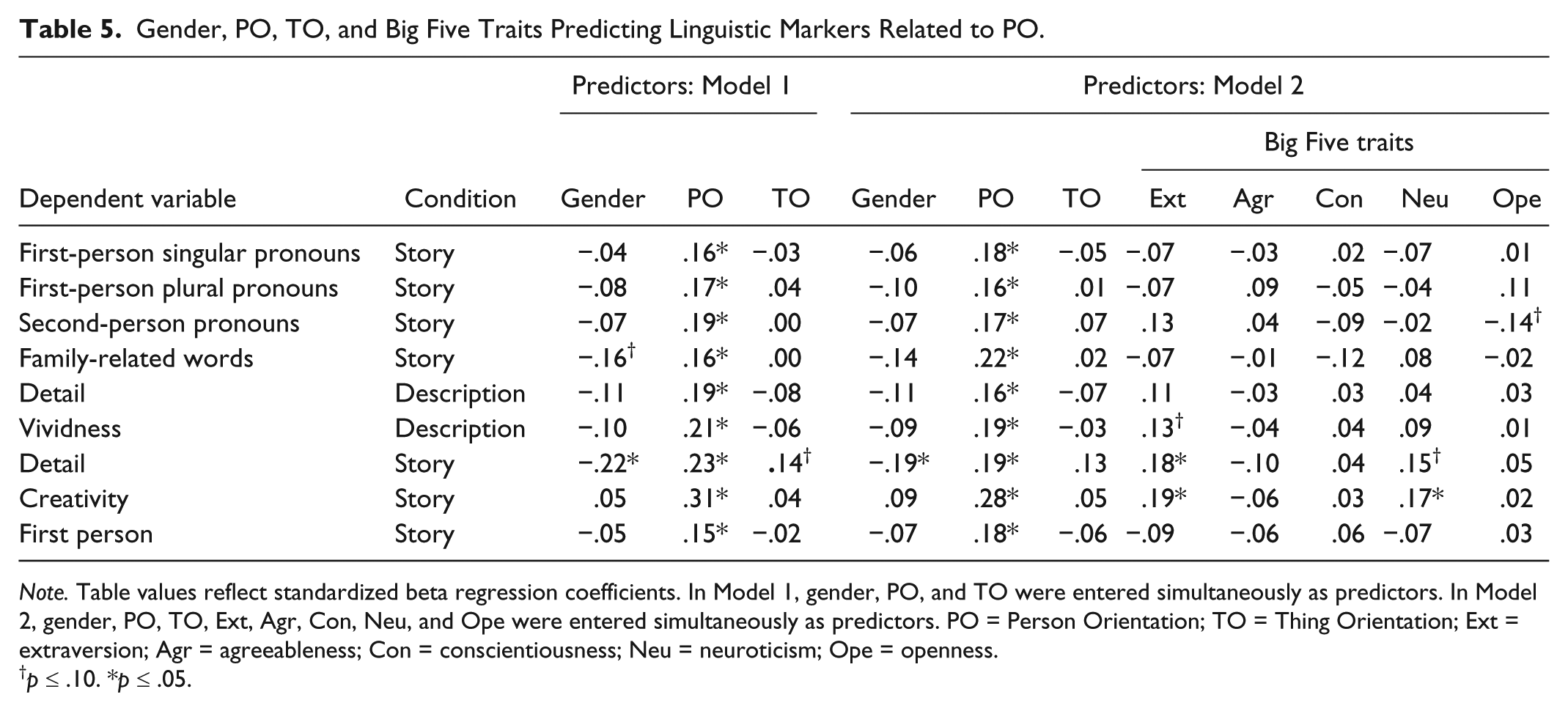
Note. Table values reflect standardized beta regression coefficients. In Model 1, gender, PO, and TO were entered simultaneously as predictors. In Model 2, gender, PO, TO, Ext, Agr, Con, Neu, and Ope were entered simultaneously as predictors. PO = Person Orientation; TO = Thing Orientation; Ext = extraversion; Agr = agreeableness; Con = conscientiousness; Neu = neuroticism; Ope = openness.
p ≤ .10. *p ≤ .05.
Thing-related language use
Individuals higher on TO used more thing-related language, indicating selective attention toward the images’ non-social content. In the description condition, TO was associated with the use of fewer pronouns, r(186) = −.17, p < .03, 95% CI = [−.30, −.02]; more articles, r(186) = .14, p < .05, 95% CI = [.001, .28]; fewer verbs, r(186) = −.21, p < .01, 95% CI = [−.34, −.07]; marginally fewer adverbs, r(186) = −.13, p < .08, 95% CI = [−.27, .02]; and more prepositions, r(186) = .19, p < .01, 95% CI = [.05, .32]. After partialing out gender and PO in hierarchical regression analyses, TO significantly predicted four of these five linguistic markers (ps < .07, p = .27 for adverbs.) The results of these analyses are summarized in Table 6, which also displays the relative predictive power of Big Five traits and TO for the linguistic markers. Of the five critical markers, TO significantly predicted the use of verbs and prepositions beyond the Big Five traits. Conscientiousness, neuroticism, and openness were significant or marginal predictors of article use, while TO was no longer a significant predictor. Openness marginally predicted adverb use, while TO and other traits were not significant, and none of the predictors were significant for pronoun use in the final step of the model. TO’s prediction of thing-related markers was not subject to PO × TO interaction effects (see supplementary materials for interaction results).
Gender, PO, TO, and Big Five Traits Predicting Linguistic Markers Related to TO.
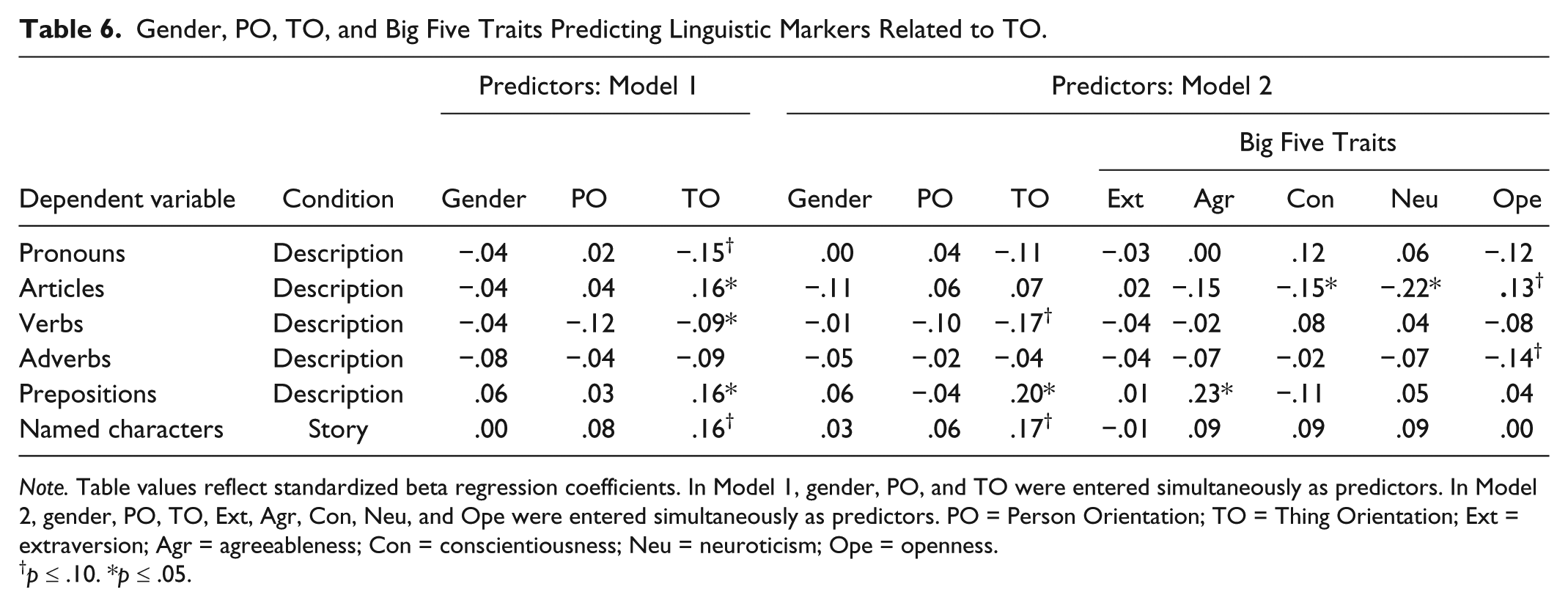
Note. Table values reflect standardized beta regression coefficients. In Model 1, gender, PO, and TO were entered simultaneously as predictors. In Model 2, gender, PO, TO, Ext, Agr, Con, Neu, and Ope were entered simultaneously as predictors. PO = Person Orientation; TO = Thing Orientation; Ext = extraversion; Agr = agreeableness; Con = conscientiousness; Neu = neuroticism; Ope = openness.
p ≤ .10. *p ≤ .05.
The story condition replicated the main TO results: TO was associated with the use of fewer pronouns, r(191) = −.22, p < .01, 95% CI = [−.33, −.10]; more articles, r(191) = .16, p < .03, 95% CI = [.02, .30]; fewer verbs, r(191) = −.13, p = .08, 95% CI = [−.26, .02]; fewer adverbs, r(191) = −.15, p = .04, 95% CI = [−.28, −.01]; and more prepositions, r(191) = .14, p = .05, 95% CI = [.001, .28]. However, after partialing out gender and PO, TO marginally predicted just one of these variables (pronouns p = .09), and the others became non-significant (ps = .15-.51).
Coding procedures
In addition to the LIWC analyses, we also coded the responses to explore more holistic writing characteristics. Four trained coders, blind to participants’ identities and individual difference measures, rated the responses. Each coder rated a random half of the responses, such that each response was rated by two coders. For the description condition, the coders rated each response on its level of detail (inter-rater reliability: α = .66) 2 and vividness (α = .65) on 1-to-5 scales. Coders also rated whether the responses contained more person- or thing-focused content (α = .65, 1 = predominantly person to 5 = predominantly thing), and whether the responses were more literal or speculative in nature (α = .62, 1 = literal to 5 = speculative). For the story condition, the coders rated each response on its level of detail (α = .75), creativity (α = .74), realism (α = .67), and use of humor (α = .68) on 1-to-5 scales. In a yes/no format, coders also rated whether the stories were written from a first-person perspective (α = .90) and whether the writer named any characters (α = .96).
Participants higher on PO wrote descriptions that were more detailed, r(186) = .20, p = .006, and vivid, r(186) = .22, p = .003. High-PO participants’ stories were also more detailed, r(191) = .23, p = .001; creative, r(191) = .31, p < .001; and more likely to be written from a first-person perspective, r(191) = .16, p < .03. Participants higher on TO wrote descriptions that were marginally less detailed, r(186) = −.13, p < .08, and were more likely to name characters in their stories, r(191) = .15, p = .03. Both PO and TO were negatively correlated with realism, r(191) = −.18, p < .02 for PO; r(191) = −.15, p < .04 for TO.
Image type
Coders’ ratings of person and thing content indicated that image type was manipulated successfully. The average content rating for descriptions was 2.13 (SD = .89) for high-person images, 2.89 (SD = 1.04) for equal-content images, and 3.78 (SD = 1.03) for high-thing images. Descriptions of high-person images contained significantly more person content than the equal-content images, t(186) = −8.03, p < .001. Descriptions of high-thing images contained significantly more thing content than the equal-content images, t(189) = 9.63, p < .001.
Discussion
The results of Study 2 extend those of Study 1, providing additional support for a link between attention processes and PO and TO. Person-oriented individuals use language to characterize their environments in ways that are different from their thing-oriented peers. Participants higher on PO used more person-related language in the story condition, whereas participants higher on TO used more thing-related language, particularly in the description condition. These results represent the first examination of linguistic differences in these orientations, suggesting that individuals attend to interest-congruent content when generating descriptions and stories.
Importantly, these linguistic patterns were associated more consistently with PO and TO than with Big Five personality traits or gender effects. Gender was not a significant predictor for most of the linguistic markers, and gender differences could not systematically explain the findings for PO and TO. In most cases, these orientations also predicted language use equally well or better than the well-established Big Five personality dimensions. Specifically, PO remained a significant predictor of all person-related linguistic markers when all Big Five traits were simultaneously added to the regression model. The findings for TO were less robust, likely because the effect sizes for thing-related linguistic markers were smaller. Importantly, no particular Big Five trait emerged as a more consistent predictor of the linguistic markers for either orientation. These personality effects were relatively scattered, and we found that PO and TO explained person- and thing-related language use more systematically than any other variable.
A notable outcome of Study 2 is the pattern of results across writing conditions. The linguistic markers associated with PO surfaced in the story condition, whereas TO was most strongly associated with linguistic markers in the description condition. This suggests that chronic differences in writing style are not sufficient to explain the pattern of results. If, for instance, person-oriented individuals simply use more pronouns in their writing, PO would have predicted increased pronoun use in both stories and descriptions. However, this relationship surfaced in the story condition, but not in the description condition. Orientation-based differences in writing style should have emerged across both conditions, but the present results do not support this explanation. It is possible that person- and thing-oriented individuals show systematic differences in language use, as research has found with other personality traits (e.g., Pennebaker, 2011). However, this work is the first attempt to measure linguistic effects in PO and TO, and further work is needed to explore this possibility.
The pattern of condition differences is also consistent with the basic nature of PO and TO as individual differences. According to the coders’ blind ratings, highly person-oriented individuals’ descriptions were more vivid, their stories were more creative, and their responses were more detailed across both writing conditions. This suggests that people high on PO may be more imaginative and expressive, which are qualities better suited to writing stories than straightforward descriptions (Wolfradt & Pretz, 2001). In contrast, thing-oriented individuals may be more inclined to write descriptions than stories, given that they tend to prefer the analytical to the artistic (Little, 1972), and are attracted more to STEM domains than the liberal arts (Graziano et al., 2012; Su & Rounds, 2015; Woodcock et al., 2012). Thus, the fit between participants’ skillsets and the differential nature of the description and story-writing tasks may have shaped the observed pattern of results. This possibility is a promising avenue for future research, which could investigate which types of tasks most effectively tap into the unique aptitudes of person- and thing-oriented individuals.
General Discussion
Currently, the psychological processes involved in orientations toward people and things are not well understood. The present research was conducted to increase understanding of these processes by examining the cognitive bases of PO and TO. The two studies reported here offer insights into the ways people orient to their environments. Our basic assumption was that selective attention is systematically linked to differential interests in people and in things.
In the first study, participants exhibited higher order selective attention toward interest-congruent content, as indicated by their interest and affect ratings after attending to interest-congruent stimuli. In the second study, participants higher on PO used more person-related language when responding to pictures, whereas participants higher on TO used more thing-related language in their responses. Notably, the effects in both studies could be reliably attributed to these orientations, rather than to gender differences or interactive effects. These studies are foundational first steps in uncovering the cognitive processes at work within PO and TO. Taken together, the evidence from these studies suggests that individuals attend selectively to social and non-social stimuli, providing empirical support for the assumptions that have long underlain these individual difference constructs (e.g., Cattell & Drevdahl, 1955; Graziano et al., 2011; Little, 1983; Su et al., 2009).
The results of these studies support the idea that higher order attention processes are linked to PO and TO, but the role of lower order attention processes is still unresolved. Specifically, the mediation models in Study 1 suggested that greater image-specific interest mediates the degree of positive affect participants experienced after attending to interest-congruent content. These models support the Lang et al. (1997) conceptualization of motivated attention, which is likely a higher order form of attentional processing. Similarly, the writing task in Study 2, given its effortful and deliberative nature, captured higher order, downstream selective attention processes rather than more immediate, micro-level attentional processing. Despite the relative indirectness of the selective attention measures in Studies 1 and 2, these operationalizations are consistent with classical theorizing on attention (i.e., Kahneman, 1973; Mole, 2013; Pashler, 1998; Treisman, 1969). In line with the literature on both attention and interests, PO and TO appear to act as internal selective processes that guide higher order attention.
It is still possible, however, that PO and TO also relate to lower order attention. Studies 1 and 2 provide evidence for selective attention at the response stage, but PO and TO may also predict selective attention at the perceptual stage. The image selection task in Study 1 was designed to approximate perception-based selective attention, but neither PO nor TO predicted the frequency of interest-congruent image selections. Participants responded relatively quickly (~4 s) when reporting what parts of the images caught their attention, yet attentional orienting can take place within milliseconds. Thus, it is plausible that the self-report method did not effectively capture the early stages of attention. A more immediate measurement of attention, such as eye-tracking, is needed to determine whether PO and TO relate to perceptual selection. Self-report was also used to measure interest in people and things; less subjective methods may be better for predicting lower order effects, although such methods are not currently available for these particular variables. Further research should pursue alternative operationalizations of attention and interest to investigate these possibilities.
Another point of discussion concerns the method through which interests in people and things were assessed. We approach this topic from the personality domain, and thus used the individual difference measures of PO and TO (Graziano et al., 2011). Similar constructs have been assessed in the vocational literature using preference inventories, such as the RIASEC (Realistic, Investigative, Artistic, Social, Enterprising, and Conventional; Holland, 1997; Prediger, 1982). How closely do these measurement approaches relate? The only known study to directly compare PO and TO measures with a vocational inventory found that the constructs show strong overlap (Woodcock et al., 2012). Specifically, PO correlates with the “Social” subscale of the RIASEC at r = .50, whereas TO correlates with the “Realistic” subscale at r = .70. Unlike the orthogonal PO and TO variables, the Social and Realistic RIASEC subscales are typically conceptualized as opposite ends of a bipolar people–things continuum (Prediger, 1982; Tay et al., 2011).
These vocational measures are believed to tap into the same latent interest constructs as PO and TO, but these scales are not considered to be interchangeable (Woodcock et al., 2012). Both sets of variables are assessed using subjective self-report measures, and thus involve similar methodological weaknesses. However, as personality-centric measures, PO and TO represent more fundamental individual differences in interest. Vocational inventories such as the RIASEC are designed to measure behavioral, career-related preferences. Our research examines basic cognitive processes, and we view the PO and TO scales as more appropriate for this task than measures that were designed for applied use. Additional work in this line could compare the relative predictive validity of these orientations with other interest-related measures.
Future research should also explore the implications of this work, particularly in applied settings. These orientations appear to shape how people think about, respond to, and interact with their environments. Indeed, PO and TO play important roles in real-world motivations and choices, especially involving occupations in STEM (Branch, Woodcock, & Graziano, 2015; Su & Rounds, 2015; Woodcock et al., 2012; Yang & Barth, 2015). If PO and TO are linked to selective attention, as these studies suggest, these attentional and motivational processes could be harnessed to improve instructional design and occupational decision-making. Becoming a scientist or an engineer requires years of specialized training involving hundreds of individual decisions and choices. Persistent patterns in these choices may be guided by the cognitive and motivational systems that underlie individual differences like PO and TO. As motivational variables, basic interests in things and people may steer academic and occupational decision-making through processes like selective attention. These basic interests may not be easy to change, but we can use them more effectively by knowing how they are linked to cognitive processes.
As a final point, women who are low on TO are more likely to withdraw from STEM disciplines, relative to their male, high-TO counterparts (Woodcock et al., 2012). By granting insights into how individual differences relate to selective attention and interests, this work could help address issues such as the scarcity of women in thing-oriented STEM careers (National Science Foundation, National Center for Science and Engineering Statistics, 2013). For example, textbooks, course materials, graduate program descriptions, and job postings could be tailored to appeal to individuals who are interested in both social and non-social environments, rather than focusing only on the thing-related aspects of STEM. Thus, a deeper understanding of the cognitive bases that relate to interests in people and in things may contribute to efforts at creating a more inclusive workforce.
Footnotes
Declaration of Conflicting Interests
The author(s) declared no potential conflicts of interest with respect to the research, authorship, and/or publication of this article.
Funding
The author(s) received no financial support for the research, authorship, and/or publication of this article.

Notes
References
Supplementary Material
Please find the following supplemental material available below.
For Open Access articles published under a Creative Commons License, all supplemental material carries the same license as the article it is associated with.
For non-Open Access articles published, all supplemental material carries a non-exclusive license, and permission requests for re-use of supplemental material or any part of supplemental material shall be sent directly to the copyright owner as specified in the copyright notice associated with the article.
