



Abstract
Do people advocate more on behalf of their own attitudes and opinions when they feel certain or uncertain? Although considerable past research suggests that people are more likely to advocate when they feel highly certain, there also is evidence for the opposite effect—that people sometimes advocate more when they experience a loss of certainty. The current research seeks to merge these insights. Specifically, we explore the possibility that the relationship between attitude certainty and attitudinal advocacy is curvilinear. Consistent with this hypothesis, we find evidence for a J-shaped curve: Advocacy intentions (and behavior) peak under high certainty, bottom out under moderate certainty, and show an uptick under low (relative to moderate) certainty. We document this relationship and investigate its potential mechanisms in three studies by examining advocacy intentions and the actual advocacy messages participants write when they feel high, moderate, or low certainty.
From their positions on controversial policies or current events to their enthusiasm for new products or services, individuals frequently advocate on behalf of their own beliefs and opinions. On social networking sites such as Facebook, for example, friends, acquaintances, and total strangers comment about and espouse views on political candidates, gun control, vaccinations, and even new restaurants or movies. Advocacy behavior can manifest in numerous ways, including expressing beliefs on social media to signal one’s identity, sharing opinions with others as a way of inducing them to share their own, or attempting to persuade friends, colleagues, or complete strangers to adopt one’s view.
What drives a person to advocate on behalf of his or her beliefs and opinions? Although there is an extensive literature exploring the drivers of attitude change and persuasion, surprisingly little is known about the determinants of advocacy. Broadly speaking, advocacy can be viewed as an expression of support for, or opposition to, something—for example, a person, product, policy, or cause. It can assume many forms—writing a review online, recommending a product, signing a petition, expressing a position in a public setting, and so on—and the goal or motivation to advocate can vary (Cheatham & Tormala, 2015), but at its core advocacy involves opinion expression. Interestingly, although advocacy is of central relevance to understanding information transmission, persuasion, and social influence more generally, its attitudinal determinants have been relatively unexplored. One factor that has been examined, and has been shown to play a crucial role, is attitude certainty.
Attitude Certainty and Advocacy
Attitude certainty refers to the subjective sense of confidence or conviction one has about one’s attitude (Rucker, Tormala, Petty, & Briñol, 2014). Whereas an attitude typically reflects an individual’s first-order evaluation of something (liking or disliking it), attitude certainty constitutes a higher order metacognitive assessment of the evaluation. Traditionally, certainty has been viewed as a dimension of attitude strength in that it shapes an attitude’s durability and impact (Krosnick & Petty, 1995). For example, attitudes held with certainty are more resistant to change and more influential over individuals’ choices and behaviors than are attitudes held with uncertainty (Tormala, 2016; Tormala & Rucker, 2007).
The current studies focus on understanding how attitude certainty shapes advocacy. At first glance, this appears to be a straightforward question. It seems rather intuitive that increased certainty would yield increased advocacy. And indeed, there is substantial support for this general notion. However, a smaller body of work hints at the possibility that in some cases, people might be especially likely to advocate when their certainty has been compromised in some way. Thus, although the dominant relationship between certainty and advocacy appears to be positive, there is some evidence for a negative relationship as well. Our research seeks to merge these insights to better understand the complex effect of attitude certainty on advocacy intentions and behavior.
Positive Relationship
First, there is a growing body of research suggesting that attitude certainty promotes advocacy. For instance, Krosnick, Boninger, Chuang, Berent, and Carnot (1993) found that greater certainty increased people’s likelihood of talking about their attitudes on a variety of issues. Barden and Petty (2008) found that high certainty increased people’s willingness to sign petitions and vote. Perhaps most relevant to the current concerns, there is now ample evidence that people are more willing to share their opinions and more likely to attempt to persuade others when they feel certain as opposed to uncertain about their attitudes (Akhtar, Paunesku, & Tormala, 2013; Cheatham & Tormala, 2015; Rios, DeMarree, & Statzer, 2014; Visser, Krosnick, & Simmons, 2003). For example, across a number of issues, Cheatham and Tormala (2015) found that experimental manipulations that induced greater feelings of attitude clarity and attitude correctness—two distinct subcomponents of global attitude certainty (Petrocelli, Tormala, & Rucker, 2007)—increased people’s sharing and persuasion intentions, respectively. Thus, there appears to be substantial evidence indicating that people advocate more on behalf of their attitudes and opinions when they hold those attitudes and opinions with more certainty.
Negative Relationship
In contrast to the notion that certainty fosters advocacy, there is some evidence suggesting that people advocate more aggressively when they feel uncertain. Although this evidence comes from research on other forms of uncertainty (e.g., worldview uncertainty, self-uncertainty), it hints at the possibility that attitude uncertainty might sometimes play a similar role. In a classic example, Festinger, Riecken, and Schachter (1956) described the manner in which a doomsday cult responded to its own failed prophecy. Surprisingly, when the world did not end as had been anticipated by the cult members, those members increased their proselytization efforts, suggesting that their failed prophecy (which presumably provoked uncertainty) had redoubled their commitment to the group and their motivation to advocate on its behalf. In recent work, Gal and Rucker (2010) explained this apparent anomaly by showing that people sometimes advocate to compensate for the threat posed by uncertainty. Their research revealed that when a person’s confidence in a belief is undermined, they feel threatened and will engage in compensatory advocacy on behalf of the uncertain belief to reduce the threat (see also McGregor, Zanna, Holmes, & Spencer, 2001).
Approaching these issues from a different perspective, Rios, Wheeler, and Miller (2012) found that individuals with low implicit self-esteem who were induced to feel self-uncertainty were more likely to express minority opinions on a variety of topics. This finding is consistent with the notion that expressing opinions can serve to defend against the threat of feeling uncertain in some situations. Although the Rios et al. work focuses on people who may be predisposed to defensiveness in the face of self-threats, it lends credence to the notion that, in at least some instances, uncertainty can fuel advocacy-type behavior.
The Current Research
In short, although considerable past work points to the positive effect of certainty on advocacy behavior, there is also reason to suspect that sometimes uncertainty promotes advocacy through a defensive, compensatory process. The current research seeks to merge these insights and offer a more holistic analysis of the relation between attitude certainty and advocacy. Our central hypothesis is that attitude certainty has a curvilinear relationship with advocacy intentions and behavior. Although we generally expect to observe increased willingness to advocate with increasing certainty, we also predict that very uncertain individuals will be more motivated to advocate than their moderately certain counterparts. Hence, we predict a J-shaped curve for this relationship: Advocacy intentions (and behavior) will peak at very high certainty, bottom out at a moderate level of certainty, and show a slight uptick at very low (compared with more moderate) certainty.
Why would the relationship between certainty and advocacy be curvilinear? What drives high and low certainty advocacy? As a starting point, consider high certainty. As noted earlier, past research generally reveals that the more certain a given individual is about an attitude, the more likely she is to act in accordance with that attitude. This seems especially true in the case of advocacy. Indeed, the clearer and more correct an individual feels about her opinion toward a new policy, the more willing she tends to be to express that opinion to others and even try to persuade those who disagree (Cheatham & Tormala, 2015). High certainty promotes action, and advocacy is a quintessential form of attitudinal action. As one moves from moderate to very high certainty, then, one becomes increasingly likely to advocate. This high certainty advocacy could be driven by the feeling of moral and value conviction (Skitka, 2010), or by the urge to judge others who disagree or make salient that one’s own opinion is clear and correct. If true, we might expect to observe evidence of these processes in highly certain individuals’ actual advocacy messages.
Interestingly, though, as one shifts from moderate to very low certainty, there might be a different urge to express one’s opinion that emanates from a different set of motives. As discussed earlier, previous research suggests that advocacy at the low end of certainty might be compensatory in nature. If so, uncertain advocacy might contain expressions of confidence or conviction—designed to mask uncertainty—as research by McGregor et al. (2001) would suggest. However, it also could be that uncertain advocacy takes a different form, geared more toward uncertainty resolution. That is, uncertain individuals might be threatened or discomforted by their uncertainty, but their advocacy could be designed to resolve rather than disguise that uncertainty. For instance, perhaps uncertain advocacy is a form of self-persuasion, such that individuals advocate for one side of an issue to convince themselves and boost their own certainty. Past research does suggest that advocating for a particular belief can foster self-generated attitude change, and that it can boost feelings of belief confidence (Janis & King, 1954; Zimbardo, 1965).
Alternatively, uncertain advocacy might have less to do with persuasion (of the self or others) and more to do with using advocacy opportunities as a way to seek information. For example, uncertain individuals might express their opinions as a means of inducing others to express their views, engaging in conversation, and acquiring information that helps them resolve their uncertainty. If true, uncertain individuals’ advocacy messages might reflect questioning, expressions of interest in opposing viewpoints, and even hedges and qualifying statements. To be clear, we do not argue that information-seeking is advocacy per se, but rather that uncertain individuals might engage in advocacy—that is, they might express their views—as an opportunity to gain information, perhaps seeing their own attitude expression as a way to initiate dialogue about an issue. Operationally, we posit that uncertain individuals will sometimes clearly express a belief or opinion (thus, constituting advocacy by definition), but follow that up with a question or general expression of interest in learning about others’ views. Importantly, both self-persuasion and information-seeking could underlie uncertain advocacy if that advocacy is motivated by uncertainty reduction. We explored these potential roles in the current work.
Overview
In summary, based on prior studies from different research streams, we submit that the role of attitude certainty in advocacy is more complex than previously believed. Our central hypothesis is that the certainty–advocacy relationship is curvilinear. More specifically, we postulate that certainty predicts advocacy in a J-shaped curve: Advocacy will peak at high certainty, dip down at moderate certainty, and show a slight uptick at low certainty. We present three studies exploring this possibility. In Study 1, we use a correlational design to provide initial evidence of the proposed curvilinear relationship between certainty and advocacy intentions across three different policy issues. In Study 2, we replicate this pattern with a different issue and employ a self-affirmation manipulation to provide initial process insight into what drives uncertain advocacy. Finally, in Study 3, we develop a new certainty manipulation designed to experimentally capture our effect while also providing more precise insight into the different motives driving actual advocacy behavior under low and high attitude certainty.
Study 1
Study 1 used a correlational design to provide an initial test of whether certainty has a curvilinear relationship with advocacy. Across three different issues, participants were asked about their attitudes, attitude certainty, and advocacy intentions. As outlined earlier, based on past research showing a positive linear relationship between certainty and advocacy, we generally expected to observe increased advocacy intentions with increasing certainty. Importantly, though, we also predicted that very low certainty individuals would express greater advocacy intentions than their moderate certainty counterparts.
Method
Four hundred thirteen participants (Mage = 38.80, SDage = 16.37, 54.5% female) took part in an online study. Participants were recruited from two national samples. Half were compensated monetarily (on Amazon’s Mechanical Turk; n = 200) and half (from Survey Monkey; n = 213) took part in exchange for a donation to the charity of their choice.
Participants were asked about their attitudes toward three different policy issues (presented in random order). The descriptions read as follows:
Labeling of genetically engineered foods. GMO—genetically modified organisms are food products that have had their DNA artificially altered in a laboratory by genes from other plants, animals, viruses, or bacteria. Example: Genetically modified corn has been engineered to produce pesticides in its own tissue.
Capital punishment (the death penalty) is the lawful infliction of death as a punishment.
Many universities in the United States are considering instituting a mandatory year of service before students can graduate with their bachelor’s degree. This year of service would entail doing some sort of work that will benefit society, allowing students to either create their own service project or be a part of a university arranged project.
For each issue, participants were asked to report their attitudes on a scale ranging from 1 (against) to 9 (in favor). Following the attitude item for each issue, participants completed a measure of attitude certainty adapted from past research (Fazio & Zanna, 1978; Tormala & Petty, 2002), asking how certain they were of their attitudes toward that specific issue. Responses were provided on a scale ranging from 1 (not at all) to 9 (very much).
After reporting certainty, participants completed a series of scales assessing advocacy intentions, adopted from Cheatham and Tormala (2015). First, participants answered three questions concerning sharing intentions: (a) How likely would you be to share your views on this topic with your friends or family? (b) How likely would you be to share your views on this topic with someone you do not know well but see often (a classmate, colleague, or neighbor)? (c) How likely would you be to share your views on this topic with a stranger? Next, participants answered three questions assessing persuasion intentions: (a) How likely would you be to try to persuade your friends or family to your position on this topic? (b) How likely would you be to try to persuade someone you do not know well but see often (a classmate, colleague, or neighbor) to your position on this topic? (c) How likely would you be to try to persuade a stranger to your position on this topic? Participants responded to each item on a scale ranging from 1 (not at all) to 9 (very much). Although past research (Cheatham & Tormala, 2015) suggests that sharing and persuasion intentions can be meaningfully differentiated in their mapping onto attitude clarity and correctness, we found no evidence that they were differentially predicted by global attitude certainty in the current studies, nor that they were differentially likely to adhere to the predicted curvilinear pattern. Thus, to simplify analysis and presentation (in Studies 1 and 2), we averaged across all six items for each issue to create composite indices of advocacy intentions (all αs > .90). Finally, all participants completed a set of demographic questions.
Results
To test the hypothesis that certainty has both a linear and a curvilinear relationship with advocacy, we conducted a series of regression analyses predicting advocacy intentions. For each policy issue, certainty was entered as a predictor in the first step, followed by the quadratic term for certainty in the second step, which enabled us to assess the curvilinear relationship (Aiken & West, 1991). Replicating past research, this analysis revealed a significant linear relationship between certainty and advocacy intentions for all three issues—GMO: B = .50, t(409) = 11.66, p < .001, 95% CI = [0.41, 0.58], d = 1.15; death penalty: B = .43, t(406) = 9.83, p < .001, 95% CI = [0.35, 0.52], d = 0.97; service year: B = .46, t(407) = 10.52, p < .001, 95% CI = [0.37, 0.54], d = 1.04). In addition, when the quadratic term was included in the second step, all three issues showed the predicted curvilinear relationship—GMO: B = .06, t(408) = 3.01, p = .003, 95% CI = [0.02, 0.09], d = 0.30; death penalty: B = .04, t(405) = 2.30, p = .022, 95% CI = [0.01, 0.08], d = 0.23; service year: B = .06, t(406) = 3.05, p = .002, 95% CI = [0.02, 0.09], d = 0.30. Thus, we observed both linear and curvilinear relationships between certainty and advocacy intentions on all three issues (see Figure 1). Variation in degrees of freedom stem from missing data on some items.

Linear and curvilinear relationships between certainty and advocacy intentions for the genetically modified organisms (GMO) (Panel A), death penalty (Panel B), and service year (Panel C) issues in Study 1.
Notably, controlling for attitudes leaves the results essentially unchanged. The curvilinear relationship remains significant for all three issues: GMO (p = .003), death penalty (p = .02), and university service (p < .001). In addition, to assess whether the curvilinear relationships might be driven by a few outliers (particularly at low certainty), we removed outliers using Cook’s D and reran the analyses (Stevens, 1984). All curvilinear results remain significant (all ps < .01).
Discussion
Study 1 revealed that for each issue assessed, certainty had both a linear and a curvilinear relationship with advocacy intentions. Individuals with high certainty expressed a greater likelihood of sharing their attitudes with others and trying to persuade them than did individuals with low or more moderate certainty. Moreover, at very low certainty, there was a slight uptick such that participants appeared to begin expressing greater advocacy intentions than did participants with more moderate certainty. Although this tendency did not produce enough upswing to create a full U-shaped curve on advocacy intentions, it was suggestive of the possibility that with a larger number of very uncertain participants, we might observe a more substantial rise in advocacy at the uncertain end of the continuum. Study 2 was designed to examine this issue further and provide some initial process evidence.
Study 2
Study 2 investigated the notion that elevated advocacy intentions among uncertain individuals stem from a need to resolve or compensate for feelings of uncertainty. As described earlier, past research suggests that uncertain individuals sometimes compensate for uncertainty by engaging in advocacy-like behavior. The logic is that expressing a belief, or proselytizing for it, when one feels uncertain might mask or even reduce feelings of uncertainty. Importantly, though, the drive to advocate for a belief when one feels uncertain should be attenuated when people are less concerned about, or discomforted by, feeling uncertain. Consistent with this notion, Gal and Rucker (2010) found that self-affirmation procedures undid the uncertainty–advocacy effect (see also McGregor et al., 2001). That is, when participants were affirmed, they no longer felt the need to compensate for their uncertainty through advocacy-type behavior.
According to self-affirmation theory (Steele, 1988; Steele & Liu, 1983), maintaining a sense of self-worth is a primary source of motivation for most people. Self-affirmation research has shown that situations that pose a threat to the self (e.g., feeling uncertain about one’s beliefs) can cause defensive and compensatory reactions. However, those reactions can be reduced or even eliminated when individuals meet their overarching self-esteem needs in other ways, such as affirming the self (Gao, Wheeler, & Shiv, 2009; Koole, Smeets, van Knippenberg, & Dijksterhuis, 1999; Sherman, Nelson, & Steele, 2000; Steele & Liu, 1983). In the Gal and Rucker (2010) work, participants who felt uncertain put substantial effort into persuading others, presumably as a defensive reaction to their own uncertainty. Undergoing a self-affirmation procedure reduced participants’ defensiveness and, in turn, reduced their advocacy effort.
Based on this reasoning, we submit that a self-affirmation manipulation should reduce or even eliminate the need to advocate among uncertain individuals. Indeed, if it is true that people with low certainty advocate because of a motivation to reduce the threat or discomfort of uncertainty, and that self-affirmation can reduce the need to resolve or mask feelings of uncertainty about a particular issue, then self-affirmation should reduce the motivation to advocate among uncertain individuals. Thus, if people advocate when they feel uncertain as a means of resolving or disguising their uncertainty, self-affirmation should moderate the curvilinear relationship between certainty and advocacy intentions. To test this, we employed a traditional self-affirmation manipulation (Steele, 1988; Steele & Liu, 1983). We expected to find an interaction between certainty and affirmation condition, such that the curvilinear relationship between certainty and advocacy intentions would be obtained under control conditions but not affirmation conditions.
We also made other changes in this study. First, to further establish the generalizability of the curvilinear relationship, we changed the attitude issue. Participants in Study 2 read about a proposal to lower the drinking age. Also important, we added a measure of issue importance Measuring importance permitted us to assess whether certainty’s relationship with advocacy intentions was independent of this construct. Past research on attitude importance, which is closely tied to issue importance and assessed with the same basic measures, suggests that it can be a reliable predictor of advocacy-type behaviors such as attempting to persuade others, voting, and talking about one’s attitude (Krosnick et al., 1993; Visser et al., 2003). Moreover, though clearly distinct conceptually, certainty and issue importance have been shown to be positively correlated in past research (Krosnick et al., 1993). Thus, we controlled for importance to help establish certainty as the key driver of advocacy intentions in our studies.
Method
Two hundred thirty-eight participants (Mage = 31.16, SDage = 10.18, 37.0% female) from Amazon’s Mechanical Turk took part in exchange for monetary compensation. At the outset of the session, participants were led to believe that they would be taking part in two separate studies. The first constituted our self-affirmation manipulation, in which participants were randomly assigned to affirmation or no-affirmation (control) conditions. Self-affirmation was manipulated using a well-established procedure from past research (Fein & Spencer, 1997; Martens, Johns, Greenberg, & Schimel, 2006).Specifically, participants were instructed to rank order a list of 12 values and qualities according to personal importance. The list included artistic skills/aesthetic appreciation, sense of humor, relations with friends/family, spontaneity/living life in the moment, social skills, athletics, music ability/appreciation, neatness/tidiness, physical attractiveness, creativity, business/managerial skills, and romantic values. After ranking them, participants in the affirmation condition were presented with their first-ranked value and asked to write a brief statement about why the value was important to them. Participants in the control condition were presented with their ninth-ranked value and asked to write a brief statement about the value (without any mention of its importance).
Following the affirmation manipulation, participants proceeded to what they believed was an unrelated study. For this task, participants were asked about their attitudes toward a novel policy issue. The issue description read as follows:
The Amethyst Initiative advocates that the national drinking age should be lowered from 21 to 18. This initiative is quite controversial and we are looking to better understand how the general public feels about it. Please answer the questions in the rest of this survey thinking about how you feel about this controversial issue.
Following this description, participants completed the same measure of attitudes and certainty as in Study 1, but adapted to the current issue. They then completed a measure of issue importance (“How important do you believe this issue is?”), followed by the advocacy intentions measures from Study 1.
Results
We began by assessing the effect of the affirmation manipulation on each of our dependent measures. Following these analyses, we tested the predicted interaction between affirmation condition and certainty on advocacy intentions.
Attitudes, certainty, and importance
We found no effect of affirmation condition on attitudes, t(236) = −1.61, p = .11, 95% CI = [−1.35, 0.13]. Participants reported similar attitudes toward lowering the drinking age in the affirmed (M = 5.53, SD = 2.83) and control (M = 4.92, SD = 2.97) conditions. We also found no effect of affirmation on certainty, t(236) = 0.32, p = .75, 95% CI = [−0.42, 0.58]. Participants reported similar levels of certainty in the affirmed (M = 7.10, SD = 1.89) and control (M = 7.18, SD = 2.04) conditions. Likewise, there was no effect of affirmation on issue importance, t(236) = 1.18, p = .24, 95% CI = [−0.26, 1.05]. Participants reported similar levels of importance in the affirmed (M = 4.73, SD = 2.58) and control (M = 5.12, SD = 2.55) conditions.
Advocacy intentions
Finally, we examined the effect of our manipulation on advocacy intentions (α = .90). There was no main effect of affirmation on advocacy intentions, t(236) = 0.42, p = .67, 95% CI = [−0.41, 0.63]. Participants reported similar levels of advocacy intentions in the affirmed (M = 4.41, SD = 1.91) and control (M = 4.52, SD = 2.14) conditions.
More important, we submitted advocacy intentions to a hierarchical regression analysis in which we assessed the predicted interaction between affirmation condition (coded: −1 = not affirmed, 1 = affirmed) and the quadratic term for certainty. In an initial analysis, we controlled for attitudes, issue importance, the linear certainty term, and the interaction between the linear certainty term and condition. Specifically, we included attitudes, importance, certainty, and condition as predictors in the first step; the quadratic term for certainty and the linear certainty × condition interaction in the second step; and the interaction between quadratic certainty and condition in the third step. Both linear certainty, B = .34, t(233) = 5.78, p < .001, 95% CI = [0.22, 0.45], d = 0.76, and importance, B = .30, t(233) = 6.56, p < .001, 95% CI = [0.21, 0.38], d = 0.86, positively predicted advocacy intentions. There were no main effects for affirmation, B = .005, t(233) = 0.05, p = .96; attitudes, B = .04, t(233) = 0.92, p = .36; or quadratic certainty, B = .03, t(231) = 1.14, p = .26, and there was no interaction between condition and linear certainty, B = −.04, t(231) = −0.69, p = .49.
Most germane to our primary concerns, there was a marginal interaction between quadratic certainty and affirmation condition (see Figure 2), B = −.06, t(230) = −1.91, p = .057, 95% CI = [−0.11, 0.002], d = −0.25. Simple slope analysis revealed that participants in the control condition showed a significant curvilinear relationship between certainty and advocacy, B = .08, t(230) = 2.12, p = .035, 95% CI = [0.006, 0.15], d = 0.28. Under affirmation conditions, however, this relationship disappeared, B = −.03, t(230) = −0.70, p = .49.

Advocacy intentions in Study 2 as a function of certainty and affirmation condition.
In the above analysis, we controlled for the linear importance term because importance has been shown to correlate with certainty, and importance has a conceptually plausible and empirically documented relationship with advocacy-type behavior. A priori, there is little reason to suspect that importance would have a curvilinear relationship with advocacy intentions. Indeed, although there is a theoretical rationale for predicting that people would advocate when they feel uncertain (e.g., because uncertainty triggers defensiveness or uncertainty reduction motivation), it is not clear why individuals would be more likely to advocate when they believe an issue is unimportant (compared with somewhat important). It also is unclear why importance would interact with affirmation in shaping advocacy intentions. After all, if an issue is unimportant, one is unlikely to feel defensive about it or feel a need to resolve any underlying tension, thus attenuating any impact of an affirmation task.
Nevertheless, we reran our initial regression model testing the certainty effects, controlling for the linear and quadratic importance terms and interactions. In this case, the key interaction between condition and quadratic certainty was reduced, B = −.04, t(227) = −1.41, p = .159, 95% CI = [−0.10, 0.017], d = −0.19, though simple slope analysis revealed that the curvilinear relationship between certainty and advocacy intentions was marginally significant in the control condition, B = .07, t(227) = 1.63, p = .105, 95% CI = [−0.01, 0.14], d = 0.22, but not the affirmation condition, B = −.02, t(227) = −0.44, p = .66. Finally, we again removed outliers using Cook’s D and reran the analyses, controlling for all possible quadratic terms and interactions. In this case, the focal interaction between condition and quadratic certainty became significant, B = −.06, t(214) = −2.02, p = .045, 95% CI = [−0.12, −0.001], d = −0.28.
Discussion
In sum, Study 2 replicated the curvilinear relationship between attitude certainty and advocacy intentions in the no-affirmation condition, and attenuated this relationship in the affirmation condition. Most notably, the uptick in advocacy intentions for very uncertain individuals vanished under affirmation conditions. This result establishes an important boundary on our focal effect. Moderation by self-affirmation also suggests that when individuals who are uncertain of their attitudes seek to advocate, they likely do so for one of two reasons: to compensate for their uncertainty (to act or seem more certain than they are) or to actually resolve their uncertainty (to reduce or eliminate their feeling of uncertainty). Resolving uncertainty might be further unpacked into (a) self-persuasion processes, whereby people seek to convince themselves; or (b) information acquisition processes in which people express their opinions and use that expression as an opportunity to exchange information with others and perhaps learn from them. Each of these mechanisms could be attenuated by affirmation if affirmation reduces people’s concerns, or discomfort, with being uncertain on a particular attitude issue. Thus, the affirmation results from Study 2 yield tentative mechanism insight—suggesting that uncertain individuals intend to advocate to resolve or compensate for uncertainty—but they also highlight the need for a more focused analysis on exactly what drives uncertain advocacy.
Study 3
Study 3 had two primary objectives. The first was to measure actual advocacy behavior to shed light on what it means to advocate at high versus low certainty. That is, we sought to determine what individuals with high and low certainty would actually say when given the opportunity to send an advocacy message to someone else, and we used this assessment as a means of tapping into the motives driving high and low certainty advocacy. Of particular interest in this regard, we wanted to obtain insight into the psychology driving low certainty advocacy—that is, whether and how uncertain individuals attempted to resolve or compensate for their feelings of uncertainty.
If uncertain advocacy is truly compensatory, we might expect uncertain individuals’ advocacy messages to contain expressions of (false) confidence or clear beliefs. Such a result would parallel the findings of Rucker and Galinsky (2008), who discovered that feeling powerless leads consumers to compensate through high-status product acquisition, presumably to signal power to themselves and others. However, if uncertain advocacy is geared more toward uncertainty resolution—that is, the desire to actually resolve rather than merely disguise uncertainty—we would expect to observe different content in uncertain individuals’ advocacy messages. For example, as noted, perhaps uncertain advocacy functions as a form of self-persuasion such that people make the case for their views but do so to convince themselves rather than others. Alternatively, perhaps uncertain individuals express their opinions as a means of exchanging information or learning from others. That is, perhaps they have an information-seeking motive. The argument would not be that information-seeking is advocacy, but rather that uncertain individuals might advocate (i.e., express their views) as a way to initiate dialogue or exchange views with others. On the contrary, because high certainty tends to be linked to the perception that one has clear and correct views (Petrocelli et al., 2007), we expected to observe direct expressions of confidence and clear beliefs, greater argumentation in support of one’s position, and a more judgmental, moral, and value-based tone among high certainty individuals.
In addition to measuring the types of advocacy messages participants sent in Study 3, we also assessed their general advocacy effort. In past research, advocacy effort has been measured using the number of words or arguments participants write in an advocacy message—generally speaking, the more a participant writes, the more effort she has put into her advocacy message (Akhtar et al., 2013; Briñol, McCaslin, & Petty, 2012; Gal & Rucker, 2010). To assess effort, then, we tallied the number of words in participants’ advocacy messages. We expected to observe a curvilinear J-shaped effect of the attitude certainty manipulation on word count, thus lending actual behavioral support to the earlier findings with respect to advocacy intentions.
Our second major aim was to manipulate three levels of attitude certainty. Although the first two studies provided evidence for a curvilinear relationship between certainty and advocacy, the evidence was confined to measured certainty. Moreover, few participants reported truly low certainty in those studies; “low certainty” participants often were nearer the midpoint rather than bottom of the certainty scale. To create a wider range of certainty with large samples of participants at low, moderate, and high certainty, we developed a new manipulation designed to create three distinct levels. In essence, we asked participants to think of an issue about which they felt extremely certain, somewhat certain, or not at all certain, and then measured the actual messages participants would send to others regarding those issues.
Method
Six hundred participants (Mage = 32.43, SDage = 10.90, 37.7% female) from Amazon’s Mechanical Turk took part in exchange for monetary compensation. At the outset of the study, participants were randomly assigned to one of three conditions: low certainty, moderate certainty, or high certainty. In the low certainty condition, participants were instructed as follows:
Please think of an issue that you feel very uncertain about. For example, perhaps you think that you don’t have any information or knowledge about it yet, you feel like you don’t understand it at all, or you are just generally unsure of your thoughts and feelings about it. In politics, for instance, someone might feel very uncertain of their opinion of a foreign policy they’ve heard about if they believe that they don’t know much or anything about it. But this can be any issue you think of, as long as you feel very unsure of it and generally lack confidence in your opinion about it.
In the moderate certainty condition, participants received different instructions:
Please think of an issue that you feel somewhat (but not totally) certain about. For example, perhaps you think that you have some—but not complete—information or knowledge about it, you feel that you have a partial understanding of it, or you are just not yet fully sure of your thoughts and feelings about it. In politics, for instance, someone might feel somewhat certain of their opinion of a foreign policy they’ve heard about if they believe that they know just a little bit about it but could use more information. But this can be any issue you think of, as long as you feel somewhat sure of it but lack total confidence in your opinion about it.
Finally, in the high certainty condition, participants were instructed the following:
Please think of an issue that you feel very certain about. For example, perhaps you think that you already have all the information or full knowledge about it, you feel like you understand it completely, or you are just generally very sure of your thoughts and feelings about it. In politics, for instance, someone might feel very certain of their opinion of a foreign policy they’ve heard about if they believe that they know virtually everything about it. But this can be any issue you think of, as long as you feel very sure of it and generally have a lot of confidence in your opinion about it.
Following the attitude certainty manipulation, participants were asked to write down the issue and then complete the same attitude, certainty, and issue importance measures as in Study 2, but framed in terms of the issue they selected. There was no measure of advocacy intentions in this experiment. Instead, at the end of the study, participants completed an open-ended measure of actual advocacy behavior. Specifically, participants were asked,
Now imagine that you are going to have a discussion with someone who does not necessarily hold the same views as you about this issue. What would you say to this person? Write as much or as little as you like.
Again, we assessed word count—that is, the number of words participants wrote in their messages—to gauge overall advocacy effort. We expected that word count would reflect the same J-shaped pattern observed in Study 1 and Study 2 (no-affirmation condition).
As noted, we also aimed to provide insight into what people actually say when they advocate. Thus, we coded participants’ written messages on a number of dimensions. To code the open-ended messages, two research assistants were given extensive training on assessing each dimension (code book available on request). They went through each open-ended message independently and identified every individual point, idea, comment, or question made by the participant. Once a point or comment was identified, the coders consulted the code book and established whether that point should be labeled with a specific code. We began by generating a list of 20 separate codes that we then pared down to 13. Seven codes were eliminated based on overlapping categories, high inconsistency in the coders’ assessments, and/or limited evidence for relevant content (the code’s existence) in the messages. The coders assessed each separate point or comment made, and we subsequently separated the final 13 codes into four distinct factors. Table 1 contains a list of the final 13 coding dimensions and factor loadings.
Final Coding Dimensions and Factor Loadings in Study 3.
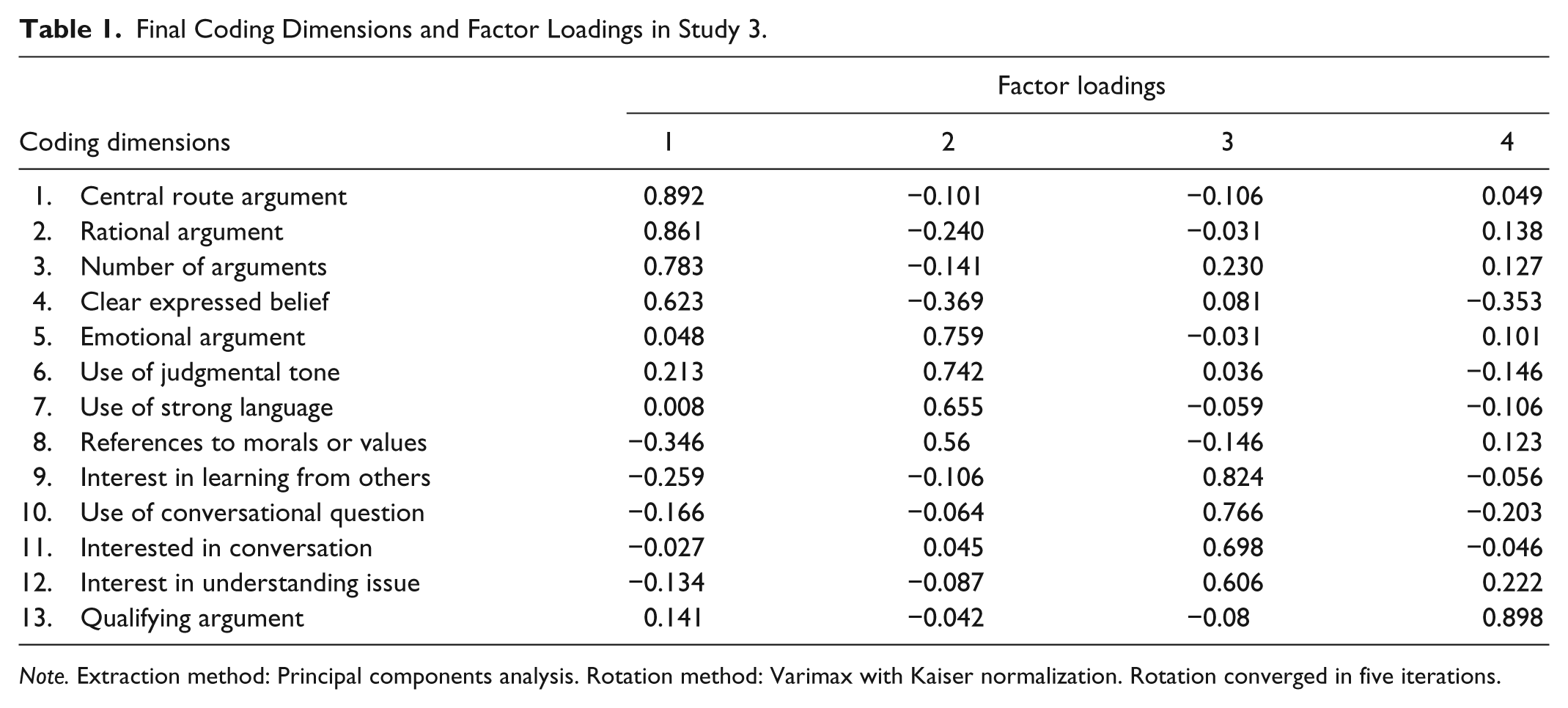
Note. Extraction method: Principal components analysis. Rotation method: Varimax with Kaiser normalization. Rotation converged in five iterations.
As an example, consider a message that contains three points (e.g., three arguments). If each point were viewed as based on a rational thought process, the message would be given a rating of 3 for rational arguments. If none of those points were perceived to have an emotional basis, the message would receive a rating of 0 for emotional arguments. If one of the three points were seen as rational, and the other two were labeled emotional, then the message would be given ratings of 1 for rational arguments and 2 for emotional arguments. Importantly, within each message, any single comment or point could receive multiple codes. For example, the same comment could be rated as rational and also as judgmental in tone, or as information-seeking, asking a question, emotional, and so on. Ultimately, the higher the number for a given code, the more points, comments, or arguments were present that were assigned that code. We examined the intraclass correlation (ICC) between the coders to gauge the reliability of their measurements, and we created a final coding index by averaging their scores on each dimension to create a single score for each dimension for analysis.
Results
We submitted each dependent measure to a one-way ANOVA, with the three-level certainty manipulation as the independent variable.
Attitudes
We first considered the attitude measure. This analysis revealed a significant effect of the certainty manipulation, F(2, 597) = 35.03, p < .001, ηp2 = .11. Participants in the low certainty condition (M = 4.57, SD = 1.83) were significantly less favorable toward their focal issues than were participants in the moderate, M = 5.16, SD = 1.98, t(597) = 2.51, p = .01, and high, M = 6.50, SD = 3.05, t(597) = 8.13, p < .001, certainty conditions, who also differed from each other, t(597) = 5.70, p < .001.
Attitude certainty
We also found a significant effect of the manipulation on certainty, F(2, 597) = 217.85, p < .001, ηp2 = .42. Participants in the low certainty condition (M = 4.38, SD = 2.30) were significantly less certain than participants in the moderate, M = 6.12, SD = 1.86, t(597) = 9.17, p < .001, and high, M = 8.32, SD = 1.43, t(597) = 20.79, p < .001, certainty conditions, who also differed from each other, t(597) = 11.77, p < .001.
Issue importance
There was a significant effect of the manipulation on importance, F(2, 597) = 58.50, p < .001, ηp2 = .16. Participants in the low certainty condition (M = 5.65, SD = 2.06) reported that their focal issue was less important to them than did participants in the moderate, M = 6.06, SD = 2.11, t(597) = 2.07, p = .04, and high, M = 7.66, SD = 1.71, t(597) = 10.16, p < .001, certainty conditions, who also differed from each other, t(597) = 8.21, p < .001.
Advocacy
Our central interest in this study was in differences in advocacy behavior across conditions. First, we considered the effect of our manipulation on word count—the number of words participants wrote in their open-ended advocacy messages—which served as a gauge of advocacy effort. On this index, we observed a significant effect of the manipulation, F(2, 597) = 7.29, p = .001, ηp2 = .02. As illustrated in Figure 3, participants in the high certainty condition (M = 45.33, SD = 41.34) wrote significantly more than participants in the moderate, M = 33.49, SD = 25.85, t(597) = 3.57, p < .001, and low, M = 35.45, SD = 31.35, t(597) = 2.93, p = .004, certainty conditions. Participants in the low certainty condition tended to write more than participants in the moderate certainty condition, though this difference was not significant, t(597) = 0.58, p = .56. Importantly, controlling for attitudes and importance did not change the results appreciably, F(2, 595) = 4.81, p = .01, ηp2 = .02.

The number of words contained in participants’ advocacy messages as a function of certainty condition in Study 3.
To provide an assessment of whether the effect of the certainty manipulation on word count was curvilinear, we conducted a regression analysis predicting word count in which we treated the certainty manipulation as a continuous variable ranging from 1 to 3 (low certainty = 1, moderate certainty = 2, high certainty = 3). We entered the linear term for manipulated certainty condition as a predictor in the first step, followed by the quadratic term for manipulated certainty in the second step. This analysis revealed a significant linear effect of certainty, B = 5.03, t(598) = 2.97, p = .003, 95% CI = [1.70, 8.35], d = 0.24. Moreover, the quadratic effect of certainty was significant, B = 6.90, t(597) = 2.38, p = .017, 95% CI = [1.21, 12.59], d = 0.20, suggesting a significant curvilinear relationship. Controlling for attitudes and both the linear and quadratic effects of importance, the curvilinear effect remained significant, B = 5.82, t(594) = 2.00, p = .046, 95% CI = [0.094, 11.54], d = 0.16.
To provide further evidence of the curvilinear relationship, we conducted a regression analysis predicting word count from self-reported (continuous) certainty. We entered the linear term for self-reported certainty as a predictor in the first step, followed by the quadratic term in the second step. This analysis revealed a marginally significant linear relationship between certainty and word count, B = .98, t(598) = 1.75, p = .08, 95% CI = [−0.12, 2.08], d = 0.14. More important, as illustrated in Figure 4, we observed the predicted curvilinear relationship, B = .88, t(597) = 3.55, p < .001, 95% CI = [0.40, 1.37], d = 0.29. Controlling for attitudes and both the linear and quadratic effects of importance, the curvilinear relationship remained significant, B = 0.69, t(594) = 2.55, p = 0.011, 95% CI = [0.16, 1.21], d = 0.21. Once again, we removed outliers using Cook’s D and reran all analyses. All curvilinear results remained significant (all ps < .05).
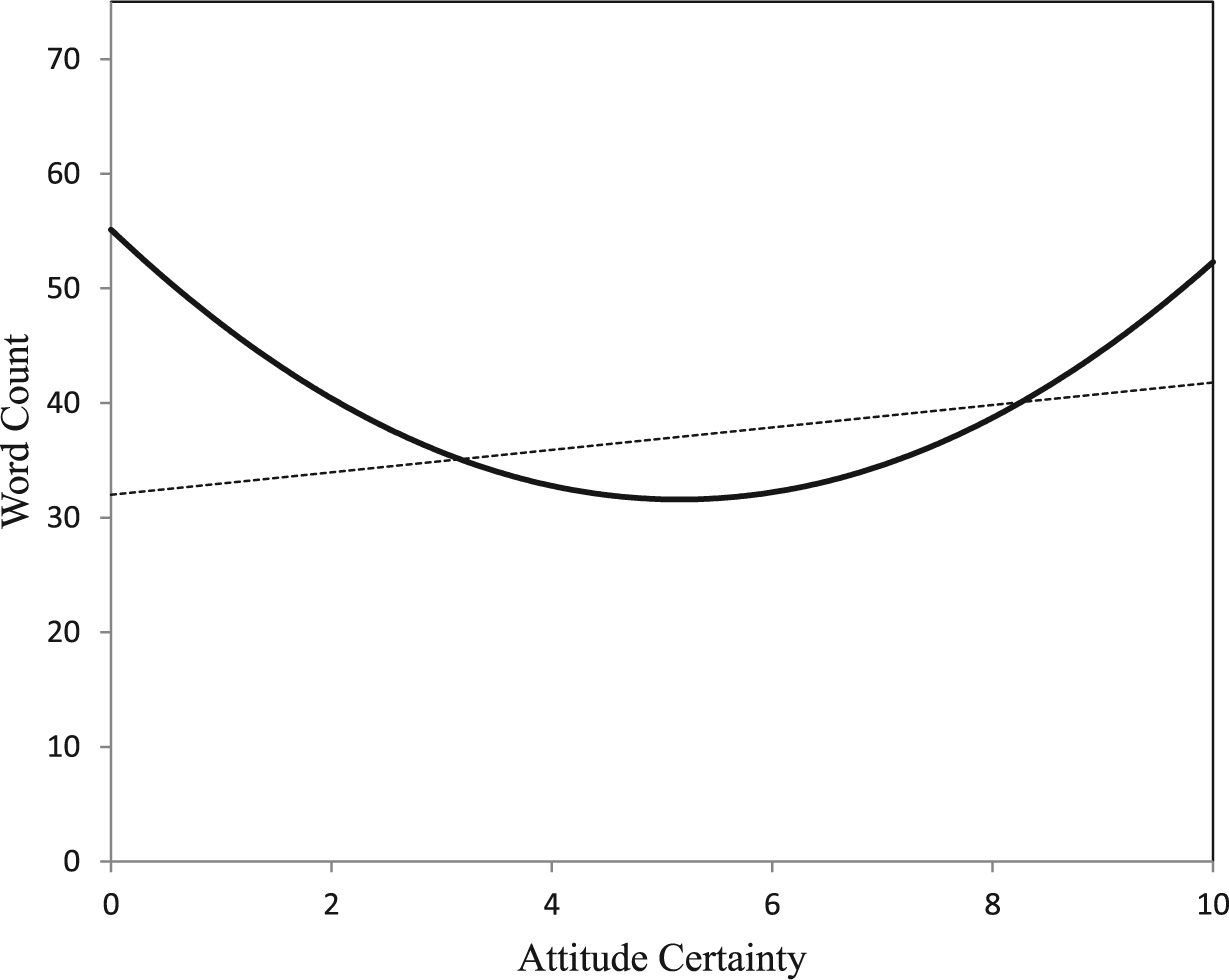
The number of words contained in participants’ advocacy messages as a function of self-reported certainty in Study 3.
Following our analysis of word count, we examined the content coding results. As noted earlier, we used 13 separate coding categories. These categories were submitted to a principal components analysis with varimax (orthogonal) rotation, which yielded four factors with eigenvalues greater than 1. The four-factor solution explained 63.88% of the total variance. We also performed Bartlett’s test of sphericity, which tests the overall significance of all the correlations within a correlation matrix, and the result was significant, χ2(480) = 2,047.07, p < .001, indicating that it was appropriate to use the factor analytic model on these 13 codes. Finally, the Kaiser–Meyer–Olkin (KMO) measure of sampling adequacy indicated that the strength of the relationships among the coded items was high (KMO = .76). Cronbach’s alpha coefficients for each factor ranged from .60 to .72.
Factor 1: Clear and rational argumentation
Factor 1 was composed of four dimensions that captured coders’ assessments that individual statements in the advocacy messages reflected expressions of clear beliefs and rational argumentation (ICC = .898). This factor included the following more specific coding dimensions: number of clearly defined arguments (how many separate arguments were listed), expression of clear belief (a belief is clearly stated), use of rational arguments (argument is based on reason or logic), and use of central route to persuasion (the argument considers the core information or merits of the position). This factor explained 28.71% of the variance. A one-way ANOVA on Factor 1 scores, treating the three-level certainty manipulation as the independent variable, revealed a significant effect of the manipulation, F(2, 597) = 33.38, p < .001, ηp2 = .10. Participants in the high certainty condition (M = 1.20, SD = 0.95) received higher scores on the clear and rational argumentation dimension than did participants in the moderate, M = 0.88, SD = 0.55, t(597) = 5.79, p < .001, and low, M = 0.76, SD = 0.51, t(597) = 7.86, p < .001, certainty conditions, which also differed from each other, t(597) = 2.15, p = .03. Controlling for attitudes and importance did not appreciably change the results, F(2, 595) = 15.27, p < .001, ηp2 = .05.
To test whether this effect was mediated by certainty, we conducted a mediation analysis following the recommendation of Hayes (2013), using the PROCESS macro for SPSS (model 4) and 10,000 bootstrapped samples. We treated the three conditions as a continuous variable in the model, such that low certainty = 1, moderate certainty = 2, and high certainty = 3. Results indicated a 95% CI around the indirect effect ranging from .05 to .15, suggesting that certainty mediated the effect of the manipulation on participants’ expressions of clear beliefs and rational argumentation. The more certainty participants expressed about their attitude, the more they expressed clear beliefs and rational arguments.
Factor 2: Emotions, morals, and values
Factor 2 was composed of four dimensions that captured coders’ assessments that statements in the messages reflected emotions, morals, and values (ICC = .669). It was made up of the following coding categories: use of emotional arguments (arguments grounded in person’s feelings; for example, “I feel it should not be allowed.”), references to core values or morals (“All people are created equal and should have equal rights.”), extreme or strong language (“Abortion is murder.”), and judgmental tone (“I think liberals are foolish . . .”). This factor explained 11.58% of the variance.
There was a significant effect of the manipulation on this factor, F(2, 597) = 9.68, p < .001, ηp2 = .03. Participants in the high certainty condition (M = 0.13, SD = 0.21) expressed more emotional, moral, and value-laden content than did participants in the moderate, M = 0.08, SD = 0.14, t(597) = 2.97, p = 0.003, and low, M = 0.06, SD = 0.12, t(597) = 4.28, p < .001, certainty conditions, which did not differ from each other, t(597) = 1.35, p = .18. Importantly, controlling for attitudes and importance did not change the results, F(2, 595) = 6.87, p = .001, ηp2 = .02, and certainty again mediated this effect, CI = [0.02, 0.04]. The more certainty participants expressed about their attitude, the greater their use of emotions, morals, and values.
Factor 3: Information-seeking
Factor 3 was composed of four dimensions capturing coders’ assessments that comments and statements in the messages contained evidence of information-seeking (ICC = .845). This factor included the following coding dimensions: interest in learning from others (“I’m interested to hear what you have to say, especially if you have peer-reviewed studies to back up your claims.”), interest in having a conversation (“I’d want to listen to what they have to say.”), use of conversational questions (“What’s your opinion?”), and interest in understanding the issue better (“I’m leaning toward legalization of marijuana, but really need some more information about it. I would like to hear your opinion. Maybe it could clarify things for me.”) This factor explained 15.16% of the variance.
We found a significant effect of the manipulation on information-seeking, F(2, 597) = 13.93, p < .001, ηp2 = .05. Participants in the low certainty condition (M = 0.19, SD = 0.27) expressed more information-seeking than did participants in the moderate, M = 0.15, SD = 0.24, t(597) = 1.94, p = .053, and high, M = 0.08, SD = 0.15, t(597) = 5.20, p < .001, certainty conditions, which also differed from each other, t(597) = 3.31, p = .001. Controlling for attitudes and importance did not change the results, F(2, 595) = 7.20, p = .001, ηp2 = .02, and certainty mediated the effect of the manipulation on information-seeking, CI = [−0.06, −0.02]. The less certain participants were of their attitudes, the more information-seeking they expressed.
Factor 4: Qualifying arguments
Factor 4 was made up of a single coding dimension: the presence of hedges or qualifiers (“I know they deserve to die for killing someone but I don’t want anyone to die.”). This factor explained 8.43% of the variance. We found a significant effect of the manipulation on qualifying arguments, F(2, 597) = 13.02, p < .001, ηp2 = .04. Participants in the low certainty condition (M = 0.21, SD = 0.34) expressed more qualifying arguments than did participants in the moderate, M = 0.14, SD = 0.31, t(597) = 2.48, p = .013, and high, M = 0.06, SD = 0.19, t(597) = 5.10, p < .001, certainty conditions, which also differed from each other, t(597) = 2.65, p = .01. Again, controlling for attitudes and importance did not change the results, F(2, 595) = 6.97, p = .001, ηp2 = .02, and the effect was mediated by certainty, CI = [−0.06, −0.01]. The less certain participants were, the greater their use of hedges and qualifiers.
Discussion
In Study 3, we manipulated attitude certainty and replicated the curvilinear effect from Studies 1 and 2. We also provided unique insight into participants’ advocacy motives by assessing exactly what they wrote in their advocacy messages. In short, we found that high certainty fosters argumentation; expression of clearer beliefs; a sense of objectivity; expression of emotions, morals, and values; and judgmental tone. Low certainty, however, encourages information-seeking, expressions of interest in understanding, questions, and qualifiers.
Again, our position is not that information-seeking and qualifiers are advocacy, or that emotions or morals represent advocacy per se, but rather that uncertain individuals advocate but do so in a way that involves qualifying arguments and provides an opportunity for information gathering. To confirm that participants in the low certainty condition did advocate—that is, did express their opinions—we coded all participants’ written messages for the presence (1) or absence (0) of an expressed opinion. Although there were differences across conditions (χ2 = 23.27, p < .001), each condition had an opinion expression rate of more than 76%. On average, then, participants in each condition advocated, but they also used that advocacy as an opportunity for information-seeking when they felt uncertain. To further establish that uncertain participants’ uptick in advocacy effort was not solely a function of them asking questions and expressing interest in alternate views (i.e., to help confirm that they were advocating), we reanalyzed the word count data controlling for the information-seeking factor. Both the curvilinear relationship between self-reported certainty and word count, B = .68, t(593) = 2.52, p = .012, 95% CI = [0.15, 1.21], d = 0.21, and the curvilinear effect of the certainty manipulation on word count, B = 5.79, t(593) = 1.99, p = .048, 95% CI = [0.06, 11.52], d = 0.16, remained significant.
Taken together, the results of Study 3 suggest that uncertain individuals do advocate, and that their advocacy is more tied to uncertainty resolution than to classic compensatory motives (the desire to seem certain) or even self-persuasion (persuading oneself by persuading others). It appears that uncertainty can prompt people to express and share their views with others as a means of having conversation, acquiring information, and developing a better understanding. In essence, whereas certainty promotes persuasive argumentation and more forceful messaging, uncertainty promotes information-seeking and a yearning for understanding. Both can accompany opinion expression, but the goal of that expression differs.
Finally, these differences in advocacy seem uniquely tied to attitude certainty. First, certainty mediated the effects of the manipulation on the actual content of participants’ written messages. Moreover, although attitudes and importance were affected by our manipulation, controlling for them did not appreciably change the results.
General Discussion
What drives people to advocate? Previous research reveals that attitude certainty is one important determinant. In general, past research suggests that the more certain people are of their attitudes, the more likely they are to advocate. As reviewed earlier, however, there is research hinting at the opposite effect, suggesting that people sometimes are particularly likely to advocate when they feel uncertain. The current research merges these ideas, offering a more holistic understanding of the role of certainty in advocacy.
Study 1 provided correlational evidence for a curvilinear relationship between certainty and advocacy across three different issues. Study 2 showed that this relationship is moderated by self-affirmation manipulation: The curvilinear relationship—in particular, the bump in advocacy at the low end of the certainty continuum—vanished when participants had undergone a self-affirmation procedure. This finding provided initial evidence for the notion that uncertain advocacy is driven by the desire to resolve or compensate for aversive feelings of uncertainty. Finally, in Study 3, we manipulated certainty and recorded participants’ actual advocacy messages to shed light on the distinct ways in which people advocate when they feel certain as opposed to uncertain.
Across studies, we confirmed that high certainty is a driver of advocacy, and this advocacy appears to be fueled by argumentation; expressing emotions, values, and morals; and even judgment. At the same time, low (relative to more moderate) certainty can also be associated with a boost to advocacy. In the latter case, advocacy appears to be leveraged as an opportunity to gather information. Indeed, uncertain individuals express opinions, but then ask questions and convey interest in information and understanding. They appear to treat their advocacy as an opportunity to communicate and learn, presumably as a means of resolving their uncertainty. In shedding light on the actual content of individuals’ advocacy messages, this research provides important new insights into how people advocate when they feel certain versus uncertain. This depth of insight is not available from past work, which has tended to focus on advocacy intentions (using self-report scales), advocacy effort (word count or number of arguments), or opinion expression (Do people express their opinions? [yes or no]). We took a step further and gained insight into the actual content of the messages people send to others.
In extracting these insights, the current work suggests that previous research highlighting positive and negative relationships between certainty and advocacy might have involved different forms of advocacy. Our work also hints at the possibility that prior studies showing a negative certainty–advocacy relation might have involved a more extreme feeling of uncertainty than was present in studies showing a positive certainty–advocacy relation. As one possibility, it could be that studies yielding a negative relationship invoked a feeling of uncertainty that was more pressing to resolve or address for participants, which is why uncertain individuals advocated in those studies. For instance, perhaps self-uncertainty (Rios et al., 2012) and uncertainty about the world’s fate (Festinger et al., 1956) are more extreme or intense feelings of uncertainty than the uncertainty one feels about a social issue (Cheatham & Tormala, 2015). Direct comparisons across previous studies are difficult to make given the different forms of certainty studied, but the current findings suggest that this account might offer a plausible bridge connecting past research in this domain.
Future Directions
Finally, there are numerous paths that we see as potentially fruitful for future work on this topic. First, although we made headway in examining the nature of people’s advocacy messages at high and low certainty, we have yet to explore how people respond to those messages. Although it seems reasonable to surmise that high certainty advocacy might be more persuasive—after all, it contained both more argumentation and greater appeals to emotion in Study 3—it could be that messages sent by uncertain individuals resonate with recipients as well. Indeed, past research has identified conditions under which direct expressions of uncertainty can be highly persuasive (Karmarkar & Tormala, 2010). It could be that the information-seeking, questioning, conversational dynamic conveyed in uncertain advocates’ messages might be highly engaging and influential over message recipients. It is worth investigating the persuasive impact of certain versus uncertain advocacy messages in different contexts in future studies.
As well, it is worth noting that our open-ended advocacy measure in Study 3 asked participants what they would say to someone who did not necessarily hold the same view as them on the target issue. Although Studies 1 and 2 did not specify agreement or disagreement, it is reasonable to question whether the results might differ if participants were interacting with someone who did share their view. A quick glance at people’s behavior on social media suggests that individuals do indeed express their opinions to like-minded others with some frequency (see Halberstam & Knight, 2014), but their motives likely differ when they send pro- versus counter-attitudinal messages. According to Clark and Wegener (2013), message position can play an important role in moderating a variety of attitudinal effects. We suspect that though pro- and counter-attitudinal advocacy might both reflect the curvilinear pattern observed in the current studies, the motives driving certain and uncertain advocacy might differ by message position. This is an important topic to examine in future research.
Finally, we see the current research as sounding a call to other researchers interested in advocacy to focus greater attention on the actual content of individuals’ messaging. Now more than ever, people express their own beliefs (e.g., on Facebook) and seek out the beliefs of others (e.g., on customer review websites) in their engagement with their social worlds. Understanding when, why, and how individuals express their opinions has tremendous value. The current work begins to explore the content of advocacy and finds notable differences in messages written at high and low certainty. Content analysis gave us the opportunity to uncover these differences and provide deeper insight than self-report measures, or even word counts, could on their own. Thus, we call on future researchers to consider content analysis in their work on this topic.
Footnotes
Declaration of Conflicting Interests
The author(s) declared no potential conflicts of interest with respect to the research, authorship, and/or publication of this article.
Funding
The author(s) received no financial support for the research, authorship, and/or publication of this article.
