




Abstract
The current research explores whether humans process inputs about combat (e.g., assessments of formidability) that produce outputs of post-fight respect (e.g., shaking an opponent’s hand when the fight ends). Using an online questionnaire (Study 1, n = 132), an in-person questionnaire (Study 2, n = 131), and an in-lab fight simulation (Study 3, n = 58), we investigated whether participants were more likely to receive (Studies 1 and 3) and display (Studies 2 and 3) post-fight respect as a function of the fight outcome (Hypothesis 1), use of fight tactics (Hypothesis 2), fighter asymmetries (Hypothesis 3), fighter ranking (Hypothesis 4), and the presence of witnesses (Hypothesis 5). The results support Hypotheses 1 to 4 concerning expectations of receiving post-fight respect, and support only Hypotheses 2 and 3 concerning displays of post-fight respect. We suggest that post-fight respect signals positive valuations of fighting performance that may function to maintain valuable relationships within the social group.
Respect is an attitude of favorable evaluation (Eagly & Chaiken, 1993) and functions to facilitate cooperation with the target individual, whereas disrespect promotes conflict (Wolf, 2011). Displays of respect vary with several factors (e.g., the relationship of the involved parties; Stenzel & Rupert, 2004; cultural norms; Wang & Li, 2007), and displays of respect can sometimes be perceived in different ways. However, displays of respect following combat, in particular, might not vary significantly because humans have an evolutionary history of combative fighting (Parker, 1974; Pinker, 2011), and may therefore have evolved psychological mechanisms to motivate displays of post-fight respect.
The causes of combative fights are predictable (Ong, 2012). Events leading to combat include steady escalations that mirror nonhuman escalations of combat (Clutton-Brock, Albon, & Gibson, 1979; Payne, 1998). The social acceptability of fight tactics is uniform across cultures (Romero, Pham, & Goetz, 2014). In fact, individuals often “cordially” desist fighting in line with apparent cost–benefit analyses associated with continuing versus desisting the fight (Sell, 2011), such as detecting key indicators of an opponent’s defeat (e.g., postural submission into fetal position, lying motionless).
Not all fights conclude with respect—sometimes, combatants display post-fight hostility. Post-fight hostility might be expected as the most common conclusion to conflicts that escalate to physical violence. Post-fight hostility, in contrast to displays of post-fight respect, may result from negative valuations of an opponent’s fighting performance, or an absence of conflict resolution between combatants. Post-fight respect, therefore, may occur reliably under particular circumstances. Investigation of the conditions that facilitate post-fight respect, in particular, can be informative for the understanding of human evolved psychology given our evolutionary history of violence (Daly & Wilson, 1988; Pinker, 2011). Specifically, we propose that post-fight respect occurs following combative conditions in which an individual has positive valuations of an opponent’s fighting performance.
Given the cross-cultural consistency of such indicators before, during, and after combat, we anticipate consistency in human displays of post-fight respect. Indeed, there are few—but extraordinarily common—displays of post-fight respect in combat sports (e.g., mixed martial arts, boxing), which include hugging an opponent, shaking an opponent’s hand, and verbally praising an opponent (Wang & Li, 2007). Similar post-fight behaviors are observed in nonhumans, such as chimpanzees. Known as post-conflict reconciliation in the nonhuman literature, de Waal and van Roosmalen (1979) were the first to document post-conflict reconciliation between chimpanzee combatants. Following conflict, chimpanzees perform “friendly” behavioral patterns with their former opponent, including kissing, touching, contact-sitting, playing, and grooming (de Waal & van Roosmalen, 1979).
From an evolutionary perspective, why would displays of post-fight respect toward a combatant be advantageous for the signaler? Previous research has not investigated the conditions under which post-fight respect occurs in human combative situations. Research on post-conflict reconciliation in nonhuman primates, however, suggests potential proximate and ultimate reasons why displays of post-fight respect as valuations of an opponent’s fighting performance may be advantageous in humans.
Anxiety is one proximate mechanism (an “emotional barometer” that motivates animals to settle an unresolved dispute) that influences post-conflict reconciliation in nonhuman primates. Anxiety—as a function of conflict and of post-conflict reconciliation—has been investigated for many primates, including macaques (Aureli & van Schaik, 1991; Kutsukake & Castles, 2001), baboons (Castles & Whiten, 1998a, 1998b), chimpanzees (de Waal & van Roosmalen, 1979), and patas monkeys (York & Rowell, 1988). The effect of post-conflict reconciliation on post-conflict anxiety is often measured physiologically (e.g., heart rate) and behaviorally (e.g., performance of self-directed nervous behaviors such as self-scratching; Aureli & Smucny, 2000; de Waal & van Roosmalen, 1979). Anxiety increases immediately after conflict, but anxiety decreases following post-conflict reconciliation compared with unreconciled conflict (Aureli, Cords, & Van Schaik, 2002). This suggests that post-conflict reconciliation may be designed to reduce feelings of anxiety that are associated with engaging in conflict.
The valuable relationship hypothesis (de Waal & Aureli, 1997) provides an ultimate or evolutionary explanation for post-conflict reconciliation in nonhuman primates. The hypothesis proposes that reconciliation between two combatants will occur when the benefits of reconciliation outweigh the costs of nonresolution. Put differently, if the relationship between combatants is valuable, post-conflict reconciliation is more likely to occur. Cords (1994) conducted a study with macaques in which the value of the relationship between combatants was experimentally manipulated by training them to depend on their opponent for resources. Consistent with the valuable relationship hypothesis, Cords (1994) documented that dyads of macaques deployed post-conflict reconciliation more quickly when the value of the relationship was experimentally increased. The valuable relationship hypothesis is also consistent with previous research documenting that post-conflict reconciliation results in fewer instances of future conflict between former opponents (Aureli & van Schaik, 1991; Castles & Whiten, 1998b; Cords, 1992; de Waal, 1993; Kutsukake & Castles, 2001; Silk, Cheney, & Seyfarth, 1996; Watts, 1995).
Behaviors that promote reconciliation following conflict may be particularly likely to occur in humans given that social relationships are a recurrent feature of human evolutionary history (Koski, Koops, & Sterck, 2007). Research has shown that maintaining valuable relationships is an important determinant of post-conflict reconciliation in other social and cooperative primates, including rhesus macaques (de Waal & Yoshihara, 1983), chimpanzees (de Waal & van Roosmalen, 1979), bonobos (Palagi, Paoli, & Tarli, 2004), and gorillas (Watts, 1995). Displays of post-fight respect in humans, therefore, may occur reliably under certain combative conditions ultimately to maintain potentially valuable relationships. Communicating an opponent’s formidability back to an opponent via displays of post-fight respect may function to reduce further conflict between the two combatants, or maintain and repair relationships to facilitate future cooperation with an opponent (see also, Benenson & Wrangham, 2016).
If respect, in general, signals positive valuations of performance (van Quaquebeke, Henrich, & Eckloff, 2007), then post-fight respect, in particular, should signal to an opponent a positive valuation of the opponent’s fighting performance. Fighting performance can be assessed in several ways. One correlate of fighting performance is whether a combatant is victorious: Combatants who outperform their opponent are more likely to win. In regulated fights such as combat sports, determining the winner is complex because time limits may prevent the emergence of clear winners. The Association of Boxing Commissions (ABC) is a government regulatory commission that publishes judging guidelines for combat sports. Fight judges use these guidelines to determine winners and losers based on fighting performance (e.g., effective striking, control of the fighting area, effective aggressiveness, defense; ABC, 2009). The ABC also recognizes signals of submission that parallel unregulated combat (i.e., street fights), such as verbal signals of defeat, or adopting submissive postures (e.g., “unintelligently” defending oneself; ABC, 2009). Because the outcome of the fight indicates superior fighting performance, we hypothesize that fight outcome will influence the occurrence of post-fight respect (Hypothesis 1).
If post-fight respect signals recognition of a praiseworthy fighting performance, then “dirty” fight tactics (e.g., punching an opponent’s testicles) should not elicit post-fight respect, regardless of whether a combatant is victorious. Combative fights—unlike lethal conflicts (e.g., war)—have implicit rules that permit combatants to honestly signal their formidability (Romero et al., 2014). Performing dirty fight tactics violates these implicit rules, thereby preventing opportunities to honestly signal formidability. Thus, performing dirty fight tactics is similar to running away from a fight, which may explain why combatants who perform dirty fight tactics are perceived as “cowards” (O’Driscoll, 2012). Romero et al. (2014) documented that dirty fight tactics are perceived as less respectable fight tactics. We extend these results to the respectability of combatants who perform dirty tactics. We hypothesize that combatants’ use of dirty fight tactics will influence the occurrence of post-fight respect (Hypothesis 2).
An individual who wins a fight will not necessarily receive post-fight respect because he or she may not have displayed a praiseworthy fighting performance (e.g., used dirty tactics). By extension, there may be instances in which the loser receives post-fight respect, despite the loss, because he or she has demonstrated exceptional fighting performance (e.g., losing a heavily handicapped fight). For example, if the eventual loser fairs well against a much larger opponent (e.g., a smaller 16-year-old boy competing against a larger 25-year-old man), then the loser may receive post-fight respect from the winner because the loser displayed courageousness by fighting a larger opponent. Humans have evolved mechanisms that are sensitive to cues of formidability (e.g., size difference between opponents; Sell et al., 2009), and these mechanisms assist humans in determining asymmetries between fighters. For example, a frequent method of street gang initiation is “jumping-in,” in which several gang members violently assault a gang “applicant” (Vigil, 1996). The incumbents do not expect the applicant to emerge victorious because the fight is severely handicapped, but the applicant receives post-fight respect simply by engaging in the fight, often resulting in the applicant’s entry into the gang (Vigil, 1996). Thus, we hypothesize that the relative asymmetries between combatants will influence the occurrence of post-fight respect (Hypothesis 3).
Humans, like many other social species, recognize status hierarchies (Chiao et al., 2009). Many professional combat sports rank fighters based on their combative performance and win–loss record, with the expectation that higher ranking individuals will defeat lower ranking individuals (e.g., Ultimate Fighting Championship). In nonhuman species, hierarchies allow for higher ranking individuals to receive a greater proportion of resources without the need to participate in costly, frequent fights (e.g., chimpanzees; Newton-Fisher, 2004). If a lower ranking individual defeats a higher ranking individual in combat, we might expect the lower ranking individual to receive post-fight respect, given that respect is a valuation of skill and performance—and perhaps a communicative signal that there is a reorganization of the hierarchy. In contrast, a higher ranking individual who defeats a lower ranking individual would not receive as much respect, perhaps because the outcome is perceived as unnecessary bullying. We hypothesize that the ranking of combatants will influence the occurrence of post-fight respect (Hypothesis 4).
Expectations of receiving respect from an opponent and displaying respect to an opponent may not align given differing cost–benefit analyses for the signaler of respect and the recipient of a respect signal (see Bird & Smith, 2005). The current research investigates which inputs predict expectations of receiving respect from an opponent (Studies 1 and 3), and which inputs predict displaying respect to an opponent (Studies 2 and 3). It is hypothesized that fight outcome will influence the occurrence of post-fight respect (Hypothesis 1); combatants’ use of dirty fight tactics will influence the occurrence of post-fight respect (Hypothesis 2); the relative asymmetries between combatants will influence the occurrence of post-fight respect (Hypothesis 3); and the ranking of combatants will influence the occurrence of post-fight respect (Hypothesis 4). We propose that post-fight respect signals positive valuations of fighting performance. Displays of post-fight respect following combative situations may proximately function to reduce further conflict between two combatants, and ultimately to maintain or repair relationships with members of the social group. No additional studies were conducted to test the study hypotheses other than those reported below.
Study 1
In Study 1, participants self-reported the likelihood of receiving post-fight respect from their opponent under various conditions of their fighting performance and opponent attributes. Hypotheses 1 to 4 are tested in Study 1.
Method
Participants
We recruited 132 individuals (68 men, 62 women, 2 other). The mean age of participants was 28.9 years (SD = 10.7). Data collection was terminated at the end of the semester in which the data were collected.
Procedure
Prospective participants viewed a study link on publicly accessible webpages on Facebook and Reddit. Interested participants were redirected to an online questionnaire. Participants reviewed an online consent form. Those who electronically consented were allowed to complete the questionnaire. Those who did not consent were exited from the study (n = 2). Participation was voluntary, and participants were not compensated.
Materials
Participants read 16 fight scenarios in which they imagined themselves in a one-on-one fight with a same-sex opponent. Each scenario varied along four target variables, with each variable containing two levels: “fight outcome” (participant won vs. participant lost), “fighter asymmetries” (participant fought a smaller opponent vs. larger opponent), “dirty fight tactics” (participant did not use dirty fight tactics vs. participant used dirty fight tactics), and “fighter ranking” (opponent was an amateur fighter vs. a professional fighter). Each participant was shown 16 different fight scenarios, each containing a unique combination of levels of the four key variables: 2 (fight outcome) × 2 (fighter asymmetries) × 2 (dirty fight tactics) × 2 (fighter ranking). The presentation order of the fight scenarios was randomized for each participant.
For each scenario, participants reported on a 10-point Likert-type scale (1 = not at all likely, 10 = extremely likely) the likelihood that they would receive respect from their opponent at the conclusion of the fight (Grand Mean [GM] = 4.52, SD = 3.11). Participants were informed that displays of post-fight respect could include shaking the opponent’s hand, congratulating the opponent, hugging the opponent, or other behaviors that the participant would interpret as respect. An example of a scenario is “How likely would it be for you to receive respect from your opponent if you WON a fight against a LARGER PROFESSIONAL fighter, and during the fight you DID NOT use dirty tactics?”
Participants also reported their age, sex, 1 weight (in pounds), height (in feet and inches), number of combative fights in which they participated in their lifetime, and self-rated combat abilities on a 10-point Likert-type scale (1 = not at all skilled in fighting, 10 = extremely skilled in fighting). Prior to data analyses, it was decided that these data were to be used to test hypotheses unrelated to the current study. No additional measures were included in this study.
Results
To test the study hypotheses, we conducted a 2 × 2 × 2 × 2 repeated-measures ANOVA on the dependent variable of the participants’ likelihood of receiving respect from their opponent. Given the complexity of a 2 × 2 × 2 × 2 ANOVA, only main effects are reported that directly test each of the study hypotheses. Analyses involving interaction effects are available upon request. 2
To test Hypothesis 1 (fight outcome), we assessed differences in the likelihood of receiving post-fight respect for scenarios in which the participant won the fight against scenarios in which the participant lost the fight. Hypothesis 1 was supported: Individuals are more likely to anticipate receiving respect from their opponent if they won the fight (M = 4.99, SE = 0.12) than if they lost the fight (M = 4.04, SE = 0.11), F(1, 131) = 80.37, p < .01, ηp2 = .38, Cohen’s f = .78.
To test Hypothesis 2 (dirty fight tactics), we assessed differences in the likelihood of receiving post-fight respect for scenarios in which the participant used dirty tactics against scenarios in which the participant did not use dirty tactics. Hypothesis 2 was supported: Individuals are more likely to anticipate receiving respect if they did not use dirty fight tactics (M = 6.62, SE = 0.15) than if they did use dirty fight tactics (M = 2.41, SE = 0.12), F(1, 131) = 507.96, p < .01, ηp2 = .63, Cohen’s f = 1.30.
To test Hypothesis 3 (fighter asymmetries), we assessed differences in the likelihood of receiving post-fight respect for scenarios in which the participant fought a larger opponent against scenarios in which the participant fought a smaller opponent. Hypothesis 3 was supported: Individuals are more likely to anticipate receiving respect if they fought a larger opponent (M = 5.12, SE = 0.12) than if they fought a smaller opponent (M = 3.92, SE = 0.10), F(1, 131) = 221.55, p < .01, ηp2 = .63, Cohen’s f = 1.30.
To test Hypothesis 4 (fighter ranking), we assessed differences in the likelihood of receiving post-fight respect for scenarios in which the participant fought a professional fighter against scenarios in which the participant fought an amateur fighter. Hypothesis 4 was supported: Individuals are more likely to anticipate receiving respect if they fought a professional fighter (M = 4.78, SE = 0.11) than if they fought an amateur fighter (M = 4.26, SE = 0.11), F(1, 131) = 54.87, p < .01, ηp2 = .30, Cohen’s f = .65.
Discussion
Study 1 provided evidence that individuals anticipate receiving post-fight respect from an opponent if the participant won the fight, did not use dirty fight tactics, and fought a larger or higher ranking fighter. However, whether a combatant anticipates receiving respect may not predict whether the opponent actually displays respect (e.g., Bird & Smith, 2005). In addition, combatants may have different perceptions regarding the dirtiness of fight tactics, depending on whether those tactics were performed by themselves or by an opponent. Finally, combatants may disagree on who emerged victorious during fights in which a winner is not clearly determined. Study 2 addresses these limitations.
Study 2
The methodology of Study 2 was similar to the methodology of Study 1 but included several important differences. Whereas participants in Study 1 reported the likelihood that they would receive post-fight respect from an opponent, participants in Study 2 reported the likelihood that they would display post-fight respect to an opponent. In addition, Study 2 investigated the presence or absence of dirty tactics deployed by an opponent, rather than by the participant, as well as whether an opponent, rather than the participant, won or lost the fight. Hypotheses 1 to 4 are tested in Study 2.
Method
Participants
We recruited 131 participants (71 men, 59 women, 1 other) residing in the United States. The mean age of participants was 26.0 years (SD = 9.8).
Procedure
Participants were approached by one of the authors (N.B.) in public spaces in a metropolitan city located in the Midwestern region of the United States. Participants were presented with a consent form. Those who signed the consent form were given the questionnaire. Participation was voluntary, and participants were not compensated. Data collection was terminated at the end of the semester in which the data were collected.
Materials
On a paper questionnaire, participants read 16 fight scenarios in which they imagined themselves in a one-on-one fight with a same-sex opponent (see Study 1). Each participant was shown 16 different fight scenarios, each containing a unique combination of levels of the four key variables: 2 (fight outcome) × 2 (fighter asymmetries) × 2 (dirty fight tactics) × 2 (fighter ranking). The presentation order of the 16 fight scenarios was randomized for each participant.
For each scenario, participants reported on a 10-point Likert-type scale (1 = not at all likely, 10 = extremely likely) the likelihood that they would display respect to their opponent at the conclusion of the fight (GM = 5.39, SD = 3.98). Participants were informed that displays of post-fight respect could include shaking the opponent’s hand, congratulating the opponent, hugging the opponent, or other behaviors that they would interpret as respect. An example of a scenario is, “How likely would it be for you to display respect to your opponent if a SMALLER AMATEUR fighter LOST a fight against you, and during the fight your opponent DID use dirty tactics?”
Participants also reported their age, their sex, 3 their weight (in pounds), their height (in feet and inches), the number of combative fights in which they participated in their lifetime, and their self-rated combat abilities on a 10-point Likert-type scale (1 = not at all skilled in fighting, 10 = extremely skilled in fighting). Prior to data analyses, it was decided that these data were to be used to test hypotheses unrelated to the current study. No additional measures were included in this study.
Results
To test all Hypotheses, we conducted a 2 × 2 × 2 × 2 repeated-measures ANOVA on the dependent variable of the participants’ likelihood of displaying respect to their opponent. Given the complexity of a 2 × 2 × 2 × 2 ANOVA, only main effects are reported that directly test each of the study hypotheses.
To test Hypothesis 1 (fight outcome), we assessed differences in the likelihood of displaying post-fight respect for scenarios in which the opponent won the fight against scenarios in which the opponent lost the fight. Hypothesis 1 was not supported: Individuals were not more likely to display respect if their opponent won the fight (M = 5.31, SE = 0.11) than if their opponent lost the fight (M = 5.47, SE = 0.16), F(1, 130) = 1.83, p = .18, ηp2 = .01, Cohen’s f = .10.
To test Hypothesis 2 (dirty fight tactics), we assessed differences in the likelihood of displaying post-fight respect for scenarios in which the opponent used dirty fight tactics against scenarios in which the opponent did not use dirty fight tactics. Hypothesis 2 was supported: Individuals were more likely to display respect if their opponent did not use dirty fight tactics (M = 8.07, SE = 0.18) than if their opponent did use dirty fight tactics (M = 2.70, SE = 0.15), F(1, 130) = 536.44, p < .001, ηp2 = .81, Cohen’s f = 2.06.
To test Hypothesis 3 (fighter asymmetries), we assessed differences in the likelihood of displaying post-fight respect for scenarios in which the participant fought a larger opponent against scenarios in which the participant fought a smaller opponent. Hypothesis 3 was supported: Individuals were more likely to display respect if they fought a smaller opponent (M = 5.51, SE = 0.17) than if they fought a larger opponent (M = 5.26, SE = 0.15), F(1, 130) = 6.91, p = .01, ηp2 = .05, Cohen’s f = .23.
To test Hypothesis 4 (fighter ranking), we assessed differences in the likelihood of displaying post-fight respect for scenarios in which the participant fought a professional fighter against scenarios in which the participant fought an amateur fighter. Hypothesis 4 was not supported: Individuals were not more likely to display respect if they fought an amateur fighter (M = 5.35, SE = 0.11) than if they fought a professional fighter (M = 5.43, SE = 0.15), F(1, 130) = .65, p = .42, ηp2 = .01, Cohen’s f = .10.
Discussion
The results of Study 2 provided support for Hypothesis 2 in that individuals were more likely to display respect to an opponent if the opponent did not use dirty fight tactics than if the opponent did use dirty fight tactics. The results also provided support for Hypothesis 3 in that individuals were more likely to display respect to a smaller (vs. larger) opponent. The other two hypotheses were not supported: Individuals were not more likely to display respect to an opponent if the opponent won the fight (Hypothesis 1) or if the opponent had a lower ranking (Hypothesis 4).
Across Studies 1 and 2, participants reported expectations of receiving and displaying post-fight respect as a function of whether dirty tactics were deployed during the fight, and whether there were asymmetries between the fighters (e.g., size). However, Studies 1 and 2 appear to document discrepant findings for the other two hypotheses: Participants reported expectations of receiving post-fight respect when they demonstrate honest signals of formidability, but they did not report parallel expectations of displaying post-fight respect when an opponent demonstrates honest signals of formidability.
Studies 1 and 2 utilized self-report methodology to test the study hypotheses. A limitation of this research design is that participants may have experienced difficulty imagining themselves in one-on-one fight scenarios. In Study 3, we addressed this limitation and sought to increase the external validity of the research by engaging participants in a fight simulation and examining the influence of witnesses on the occurrence of post-fight respect.
Study 3
Combative conflicts are often witnessed by other members of the social group which may influence the occurrence of post-fight respect. Praise of a victorious opponent by the defeated combatant may communicate inferiority within the social hierarchy, thereby negatively affecting the loser’s social reputation. The stability of a social hierarchy may depend on whether relevant information spreads among the hierarchy members (e.g., who won and who lost). Consequently, post-fight respect can signal to conspecifics relative position in a status hierarchy. The loser of a fight may display post-fight respect to a winner to acknowledge the loser’s lower rank, and yet simultaneously maintain amicable relationships with the opponent and other witnesses to continue receiving benefits from the social group. McCullough, Pedersen, Tabak, and Carter (2014) documented that individuals who displayed gestures of respect following a conflict perceived greater value in their relationship, perceived a lower risk of exploitation, and reported less anger. Given the importance of social living in humans, and given the relationship-building benefits of displaying post-fight respect, we hypothesize that individuals are more likely to display and anticipate receiving post-fight respect in the presence of witnesses than in the absence of witnesses (Hypothesis 5). Study 3 tested Hypothesis 1 (fight outcome), Hypothesis 3 (fighter asymmetries), and Hypothesis 5 (witnesses).
Method
Participants
We recruited 58 men through a university psychology department subject pool in which undergraduate students participate to fulfill a research participation requirement for their psychology courses. The mean age of participants was 20.5 years (SD = 3.1). Only men were recruited for the study because (a) over evolutionary history, men more frequently engaged in combat than women (Daly & Wilson, 1988; Parker, 1974; Pinker, 2011), resulting in sex-specific psychological mechanisms for aggression (Sell, Hone, & Pound, 2012); (b) men engage in friendly touching behaviors after combative fights longer than women (Benenson & Wrangham, 2016); and (c) men, more than women, more frequently play combative video games, specifically (Lucas & Sherry, 2004). Data collection was terminated at the end of the semester in which the data were collected.
Procedure
Participants arrived to a laboratory and were presented with a consent form. Consenting participants were seated in a private room in front of a desktop computer. All study sessions were conducted by a male experimenter. Participants played Street Fighter 2—a one-on-one fight simulation game in which each player controls an avatar that performs various combat actions (e.g., punches, kicks, throws). Players fight each other in a series of “rounds.” Participants played six sets of five rounds (30 rounds total). Each player’s avatar has a colored bar at the top of the screen signifying that player’s “health” (i.e., how many times an avatar can be hit before that player loses the round). A round concludes when one player’s health bar reaches “zero.”
Prior to beginning the study trials, participants were introduced to the game controls and were given 5 min to learn and practice the game controls. The experimenter provided the participant with the following cover story:
For this study, you will be playing a video game called Street Fighter 2. Street fighter 2 is an arcade fighting game in which two players use avatars to fight against one another. Each avatar has a unique fighting style that consists of punches, kicks, body slams, and several special abilities. You will be fighting against another participant over the Internet who is currently being briefed by another researcher in a different room. You will fight against your opponent in a series of rounds. In each round, the objective will be to fight and damage your opponent until his health or your health reaches zero, at which point the round will end. In total, you will play thirty rounds against your opponent. Your goal will be to win as many of these rounds as possible.
In fact, participants were not playing against another person, but they were playing against a computer-controlled player. Before each set of rounds began, the experimenter acted as though he was communicating with the other experimenter via a cell phone to coordinate the start of each fight. Prior to the start of each set of rounds, participants were told whether their opponent would have (a) equal, (b) double, or (c) half the amount of health as the participant. Following each set of rounds, participants responded to questions about whether they anticipated receiving respect from their opponent, and whether they would display respect to their opponent. Responses to these questions were reported privately on a computer and verbally to the experimenter. At the conclusion of the study, participants were debriefed and compensated with course research credits.
Manipulations
Study 3 employed a 2 (fight outcome; between-subjects) × 2 (witnesses; within-subjects) × 3 (asymmetries; within-subjects) research design. Fight outcome was manipulated by randomly assigning each participant to play against either an easy opponent (Win condition) or a difficult opponent (Lose condition). The experimenter recorded whether the participant won or lost each of the 30 rounds to verify that the fight outcome manipulation was successful. Participants assigned to the Win condition won significantly more rounds (M = 23.97, SD = 3.61) than participants in the Lose condition (M = 2.76, SD = 3.35), t(56) = 23.20, p < .001.
To manipulate the perception of relative fighting abilities (fighter asymmetries) between the participant and the opponent, participants were informed prior to each set of rounds that the experimenter had manipulated the game so that their opponent had (a) equal, (b) double, or (c) half the amount of health as the participant. In fact, neither combatant’s health was manipulated. Health bars on the computer screen were occluded to mask the fact that health was not actually manipulated.
To manipulate the presence of witnesses, participants responded to questions privately at the computer (witness absent) for 15 rounds and verbally to the experimenter (witness present) for 15 rounds. The order in which participants responded with a witness present or absent was counterbalanced.
Each set of matches contained a unique combination of the “witnesses” variable (two levels) and the “fighter asymmetries” variable (three levels). At the conclusion of the study (six sets containing five rounds each), each participant had received all possible combinations of “witnesses” and “fighter asymmetries” manipulations. No additional manipulations were implemented other than those described above.
Materials
At the conclusion of each set (i.e., every five rounds), participants answered questions about receiving and displaying post-fight respect on a 10-point Likert-type scale ranging from 1 (not at all likely) to 10 (extremely likely) based on the set of five rounds they previously completed. Participants reported how likely it would be for them to receive post-fight respect from their opponent (“If your opponent saw you in person, what is the likelihood that he would show respect for you as an opponent [e.g., praise your performance, shake your hand, tell you the match was ‘well played’”]; GM = 6.50, SD = 2.31), and how likely they would be to display post-fight respect to their opponent (“If you saw your opponent in person, what is the likelihood that you would show respect for him as an opponent [e.g., praise his performance, shake his hand, tell him the match was ‘well played’”]; GM = 7.93, SD = 2.10).
Participants answered basic demographic questions (i.e., age, gender, ethnicity, sexual orientation). In addition, participants completed the HEXACO personality inventory (Lee & Ashton, 2004) and a spitefulness inventory (Marcus, Zeigler-Hill, Mercer, Norris, 2014). Prior to data analyses, it was decided that these data were to be used to test hypotheses unrelated to the current study. No additional measures were included in this study.
Results
To test Hypotheses 1, 2, and 5, we conducted two 2 × 2 × 3 mixed-model ANOVAs: one on the dependent variable of participants’ likelihood of receiving respect from their opponent, and one on the dependent variable of the participants’ likelihood of displaying respect to their opponent. Given the complexity of a 2 × 2 × 3 ANOVA, only main effects are reported that directly test each of the study hypotheses.
Receiving post-fight respect
To test Hypothesis 1 (fight outcome), we assessed differences in the likelihood of participants receiving post-fight respect from their opponent for participants who won their fights against their opponent (Win condition) against participants who lost their fights against their opponent (Lose condition). Hypothesis 1 was supported: Participants who won their fights were more likely to anticipate receiving respect from their opponent (M = 7.21, SE = 0.37) than participants who lost their fights (M = 5.79, SE = 0.37), F(1, 56) = 7.56, p < .01, ηp2 = .12, Cohen’s f = .37.
To test Hypothesis 3 (fighter asymmetries), we assessed differences in the likelihood of receiving post-fight respect under conditions in which the participant had lower, equal, or greater health than their opponent. Hypothesis 2 was supported, F(1, 55) = 7.97, p = .001, ηp2 = .13, Cohen’s f = .39. Pairwise comparisons revealed that participants were more likely to anticipate receiving respect from their opponent if they had lesser health than their opponent (M = 6.78, SE = 0.25) than if they had greater health than their opponent (M = 6.19, SE = 0.31; p = .001). Participants were not more likely to anticipate receiving respect from their opponent if they had equal health to their opponent (M = 6.53, SE = 0.25) than if they had greater health than their opponent (M = 6.19, SE = 0.31; p = .13), and participants were not more likely to anticipate receiving respect from their opponent if they had lesser health than their opponent (M = 6.78, SE = 0.25) than if they had equal health to their opponent (M = 6.53, SE = 0.25; p = .15).
To test Hypothesis 5 (witnesses), we assessed differences in the likelihood of receiving post-fight respect when there was a witness present versus no witness present. Hypothesis 5 was not supported: Participants were not more likely to anticipate receiving respect from their opponent when there was a witness present (M = 6.64, SE = 0.27) than when there was not a witness present (M = 6.34, SE = 0.27), F(1, 56) = 3.48, p = .07, ηp2 = .06, Cohen’s f = .25.
Displaying post-fight respect
To test Hypothesis 1 (fight outcome), we assessed differences in the likelihood of displaying post-fight respect for participants who won their fights against their opponent (Win condition) against participants who lost their fights against their opponent (Lose condition). Hypothesis 1 was not supported: Participants who lost their fights were not more likely to display respect toward their opponent (M = 8.03, SE = 0.33) than participants who won their fights (M = 7.83, SE = 0.33), F(1, 56) = 0.18, p = .67, ηp2 = .003, Cohen’s f = .05.
To test Hypothesis 3 (fighter asymmetries), we assessed differences in the likelihood of displaying post-fight respect under conditions in which the participant had lower, equal, or greater health than their opponent. Hypothesis 2 was supported, F(1, 55) = 11.07, p < .001, ηp2 = .17, d = .91. Pairwise comparisons revealed that participants were more likely to display respect toward their opponent if they had greater health than their opponent (M = 8.28, SE = 0.23) than if they had lesser health than their opponent (M = 7.64, SE = 0.27; p < .001). Participants were more likely to display respect toward their opponent if they had greater health than their opponent (M = 8.28, SE = 0.23) than if they had health equal to their opponent (M = 7.89, SE = 0.25; p < .05). Participants were not more likely to display respect toward their opponent if they had equal health to their opponent (M = 7.89, SE = 0.25) than if they had lesser health than their opponent (M = 7.64, SE = 0.27; p = .20).
To test Hypothesis 5 (witnesses), we assessed differences in the likelihood of displaying post-fight when there was a witness present versus no witness present. Hypothesis 5 was not supported: Participants were not more likely to display respect to their opponent when there was a witness present (M = 8.12, SE = 0.24) than when there was not a witness present (M = 7.75, SE = 0.30), F(1, 56) = 3.68, p = .06, ηp2 = .06, Cohen’s f = .25.
Discussion
Participants were more likely to anticipate receiving post-fight respect from their opponent if they won their fights, supporting Hypothesis 1. Hypothesis 3 was supported in that participants were more likely to anticipate receiving respect if they had lesser health than their opponent—such that there were asymmetries between the opponents. Hypothesis 5 was not supported: Participants were not more likely to anticipate receiving respect if there was a witness present, although the direction of the difference was as hypothesized and approached statistical significance.
Participants reported that they were more likely to display post-fight respect if they had greater health than their opponent (asymmetries between the opponents), supporting Hypothesis 3. The other hypotheses were not supported: Participants were not more likely to display respect if their opponent won the fights (Hypothesis 1), and were not more likely to display respect if there was a witness present (Hypothesis 5), although the direction of the difference was as hypothesized and approached statistical significance.
General Discussion
The current research examined whether humans have psychological mechanisms that process inputs about one-on-one combative fights (e.g., assessments of formidability, the acceptability and respectability of tactics) and whether such mechanisms produce outputs of post-fight respect (e.g., hugging an opponent or shaking an opponent’s hand when the fight ends). We investigated which inputs predicted expectations of receiving respect from an opponent (Study 1 and Study 3), and which inputs predicted displaying respect to an opponent (Study 2 and Study 3). The results provide support for Hypotheses 1 to 4 concerning individuals’ expectations of receiving post-fight respect, whereas the results provide support for only Hypotheses 2 and 3 concerning individuals’ expectations of displaying post-fight respect. A summary of results across the studies is provided in Table 1.
Summary of Results Across Studies.
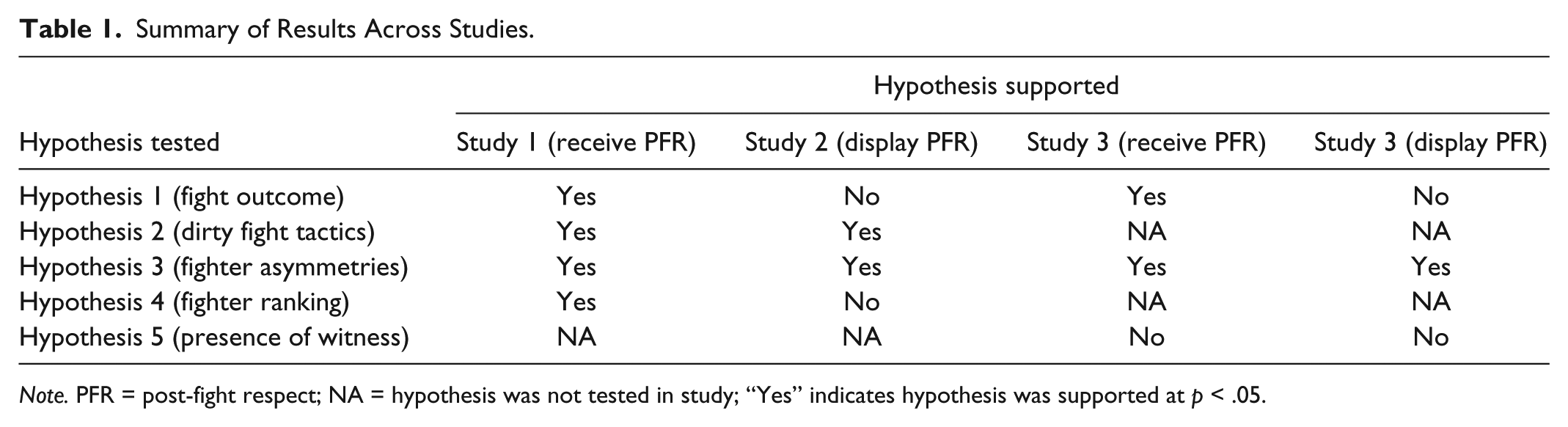
Note. PFR = post-fight respect; NA = hypothesis was not tested in study; “Yes” indicates hypothesis was supported at p < .05.
The findings of the current research suggest that individuals process the inputs of one-on-one combat differently when anticipating receiving respect from an opponent versus when anticipating displaying respect toward an opponent. The current research suggests that individuals have strong expectations for receiving respect from a combatant under particular circumstances. Following the conclusion of a fight, individuals expect to receive respect from their combatant if they win the fight, fight a more formidable or higher ranking opponent, and do not violate implicit rules of combat. In contrast, individuals are willing to signal respect to their opponent only if they fight a less formidable opponent and their opponent does not violate implicit rules of combat.
Because respect signals positive valuations of performance (van Quaquebeke et al., 2007), we suggest that post-fight respect signals positive valuations of fighting performance. Fighting performance in the current research was assessed in terms of fight outcome (Hypothesis 1), fight tactics (Hypothesis 2), fighter asymmetries (Hypothesis 3), and fighter ranking (Hypothesis 4). The results suggest that expectations of receiving respect from an opponent and anticipated displays of respect toward an opponent can be predicted as a function of dirty fight tactics and asymmetries between opponents. Specifically, individuals reported that they are more likely to display respect toward an opponent who is less formidable (e.g., smaller, lesser health) and toward an opponent who does not use dirty fight tactics. In contrast, an opponent who violates rules of combat (e.g., punching an opponent in the testicles) does not fulfill combat expectations and therefore does not receive respect (Romero et al., 2014).
An opponent’s fight tactics and relative formidability may elicit respect insofar as these are honest signals of fighting ability. Combatants display respect toward an opponent who honestly signals his or her formidability, either through engaging in an unmatched fight (fighting a larger opponent) or demonstrating skillful (and appropriate) fight tactics. Escalation between unevenly matched combatants (i.e., those who differ in size and strength) into physical aggression is not typical. Indeed, violence most often occurs between two evenly matched opponents (Daly & Wilson, 1988). Fighting is costly, and the risk of injury or death is especially high for relatively less formidable combatants. Men, in particular (and women, although to a lesser degree), can accurately assess the formidability and physical strength of other males (Sell et al., 2009). The results across Studies 1, 2, and 3 suggest similar patterns of expectations of receiving respect and displaying respect when combatants are unevenly matched. By engaging in an unevenly matched fight, an individual exceeds standard expectations of combat—in response to which the more formidable opponent bestows reputational enhancements in the form of respect (Romero et al., 2014) to the less formidable combatant.
An individual’s expectations of receiving respect, however, do not necessarily translate into anticipations of displaying respect. The discrepancies in expectations of receiving respect from an opponent versus signaling respect to an opponent suggest differing cost–benefit analyses for the signaler and the recipient (Bird & Smith, 2005). In Study 1, for example, we documented that individuals are more likely to anticipate receiving respect if they fought a higher ranking opponent, whereas in Study 2, we documented that individuals are not more likely to anticipate displaying respect to a lower ranking opponent. In one-on-one status contests, for example, lower ranking individuals may anticipate receiving respect from their opponent because the lower ranking individual is attempting to ascend the status hierarchy. Engaging in a fight with a higher ranking opponent may bestow on the lower ranking fighter a level of prestige, especially if the lower ranking individual wins. That is, the lower ranking combatant expects to receive respect because of his demonstration of superior fighting performance and the lower ranking opponent’s ascent of the status hierarchy. The higher ranking opponent, however, does not equally benefit from displaying respect to a lower ranking opponent, especially if the higher ranking opponent loses the fight.
Similar patterns regarding post-fight respect as a function of fight outcome were documented across Studies 1, 2, and 3. Combatants who outperform their opponent are more likely to win. Indeed, individuals anticipate receiving respect from their opponent if they are victorious, but individuals did not report being more likely to display respect to their opponent if they lost the fight. Cost–benefit analyses for one-on-one combat differ for the signaler and the receiver (Bird & Smith, 2005), which is evident in the discrepancies regarding receiving and displaying post-fight respect across the current studies.
Finally, in Study 3, we examined whether individuals were more likely to receive and display post-fight respect in the presence of a witness (Hypothesis 5). The stability of a social hierarchy depends on whether status-relevant information spreads among the constituent hierarchy members. Post-fight respect may facilitate the maintenance of amicable relationships with an opponent and with others in the social group (see McCullough et al., 2014). The results suggest that participants were somewhat more likely to anticipate receiving respect from an opponent (p < .06) and somewhat more likely to anticipate displaying respect toward an opponent (p = .07) in the presence (vs. absence) of a witness. Other confounding factors may have influenced the “witness” manipulation used in Study 3. For instance, whether the witnesses have alliances with either of the combatants may influence whether one displays respect following a fight. For instance, a combatant without alliances present may be more likely to display post-fight respect to avoid post-fight hostility from his opponent’s allies who are present.
The relationship between the two fighters was not assessed or manipulated in the current research. Whether two combatants are from the same social group or different social groups may influence the occurrence of post-fight respect. Men from the same social group may be more likely than men from different social groups to display post-fight respect following a one-on-one combative conflict. Post-fight respect among in-group members may facilitate stability within the social group and reconciliation between combatants (McCullough et al., 2014). A profitable avenue for future research is to examine the extent to which displays of post-fight respect signal resolution of the conflict that instigated the violence. If displays of post-fight respect also signal conflict resolution between combatants, then conflict resolution may be more imperative among in-group members than among out-group members to maintain valuable relationships within the social group.
The current research is, to our knowledge, the first empirical investigation concerning the psychology of post-fight respect in humans. The focus of the current investigation was on the evolved psychology of post-fight respect: What are the inputs associated with combative fights that produce outputs of post-fight respect. The findings of the current research add to the literature on human aggression and bridge related research on post-conflict reconciliation in nonhuman primates.
An important direction for future research in this domain could be the investigation of observable post-fight respect behaviors. Although related, investigations of psychological processes and overt behavior are important, but distinct, research endeavors. Benenson and Wrangham (2016) documented that following sanctioned boxing matches, men spend more time engaging in friendly touching behaviors than women. This research, however, did not examine features of the fight (e.g., fighter size, ranking) that may influence displays of post-fight respect. Future research on post-fight respect in humans could benefit from content analyses of fights, investigating the features of the combative interaction that influence overt displays of post-fight respect in regulated fights (e.g., Ultimate Fighting Championship) and “street” fights.
Conclusion
Previous research demonstrates that human psychology includes mechanisms for assessing combatant formidability (Sell et al., 2009) and mechanisms that track adherence to implicit rules about the context-appropriate fight tactics (Romero et al., 2014). The current research explored whether human psychology also includes mechanisms that produce outputs of post-fight respect. Across three studies with varying methodologies, we investigated whether post-fight respect can be predicted as a function of fight outcome, relative formidability and fighter ranking, fight tactics, and presence of witnesses. Receiving and displaying post-fight respect can be predicted as a function of relative formidability between combatants and deployment of fight tactics, specifically. These results indicate that humans may have evolved psychological mechanisms for interpreting fighting performance. We suggest that displays of post-fight respect signal positive valuations of fighting performance that may ultimately function to maintain or repair valuable social relationships, potentially to facilitate future cooperation.
Footnotes
Supplemental Material
The supplemental material is available with the online version of the article.
Notes
References
Supplementary Material
Please find the following supplemental material available below.
For Open Access articles published under a Creative Commons License, all supplemental material carries the same license as the article it is associated with.
For non-Open Access articles published, all supplemental material carries a non-exclusive license, and permission requests for re-use of supplemental material or any part of supplemental material shall be sent directly to the copyright owner as specified in the copyright notice associated with the article.
