



Abstract
Two large-scale surveys conducted in Israel (Study 1A) and the Palestinian Authority (Study 1B) show that the belief by group members that people in the “enemy” group acknowledge their victimhood (i.e., Holocaust and Nakba for Jews and Palestinians, respectively) is associated with Israeli-Jews’ readiness to accept responsibility for Palestinian sufferings and offer apologies. For Palestinians, this belief is linked to a perceived higher likelihood of a reconciled future with Israelis. Three field experiments demonstrate that a manipulated high level of acknowledgment of Jewish victimhood by Palestinians (Studies 2 and 4) and of Palestinian victimhood by Israeli-Jews (Study 3) caused greater readiness to make concessions for the sake of peace on divisive issues (e.g., Jerusalem, the 1967 borders, the right of return) and increased conciliatory attitudes. Additional analyses indicate the mediating role of increased trust and reduced emotional needs in these relationships.
Keywords
Introduction
Intractable conflicts are perceived by group members as existential and insoluble (Bar-Tal, 2013). Oftentimes, such conflicts resist resolution because of psychological barriers that block the road to achieving a compromise on issues that separate the two parties (e.g., division of disputed land). Among these emotional barriers are lack of trust, fear of being blamed as the author of immoral acts, and victims’ desire to avenge past victimization (Nadler, 2012). Furthermore, in intractable conflicts, a sense of collective victimhood is an inseparable part of the shared collective memory of the conflict and the ethos of conflict (e.g., Bar-Tal, 2013). The present research focuses on how the acknowledgment of the ingroup’s victimhood by the adversary ameliorates the negative consequences of competitive victimhood (Noor, Shnabel, Halabi, & Nadler, 2012). We examine this within the context of the Israeli–Palestinian conflict, one of the most intractable conflicts that, in spite of the great cost in human life, economic resources, and psychological traumas for both sides, has defied resolution for more than a century.
Being a victim of others’ violence is a negative psychological experience. It results in an increased sense of humiliation, fear, anger, and hopelessness, and a desire for revenge (e.g., Skitka, Bauman, & Mullen, 2004). It is a source of threat to identity in that it portrays victims as powerless and lacking control over their fate (e.g., Shnabel & Nadler, 2008). This conglomerate of affective, cognitive, and motivational reactions associated with victimhood constitutes a major psychological barrier to ending the conflict (Noor et al., 2012). In spite of the detrimental consequences of victimhood for intergroup relations, it is associated with psychological benefits (e.g., garnering support from third parties) and groups competing over which is the “true victim” (Noor et al., 2012). This competitive victimhood has been documented in a number of conflictual contexts. It has dominated relations between Catholics and Protestants in Northern Ireland (Noor, Brown, & Prentice, 2008), Serbs and Croats in the former Yugoslavia (Andrighetto, Mari, Volpato, & Behluli, 2012), and Israelis and Palestinians in the Middle East (Shnabel, Halabi, & Noor, 2013) and is associated with belligerent attitudes toward the adversary (e.g., lack of trust, unwillingness to forgive; Noor et al., 2012). Given the adversarial groups’ motivation to “win” this competition for victimhood, a proclamation by a reputable third party (e.g., the United Nations) that one’s group has suffered more than its adversary increases readiness to reconcile (SimanTov-Nachlieli, Shnabel, & Halabi, 2015).
The group’s victimization is a central element of the narrative about the causes of the conflict and its progression that serves as a major building block of the group’s collective identity (Paez & Liu, 2011). Oftentimes, an event of past victimization is the nucleus of the story that the group tells its members about the roots of the conflict and conditions for its resolution, and becomes the group’s “chosen trauma” that affects the course of conflict and the likelihood of its resolution (Volkan, 2006). The Jewish Holocaust and the Palestinian Nakba, that is, Palestinians’ belief that the establishment of Israel turned them into refugees, are two “chosen traumas” that play a central role in the Israeli–Palestinian conflict. Israelis’ preoccupation with security concerns and fears of annihilation are traced back to centuries of discrimination, persecution, and pogroms, culminating in the Holocaust (e.g., Klar, Schori-Eyal, & Klar, 2013), and Palestinians’ desire to redeem their people from the status of stateless refugees is attributable to the establishment of Israel in 1948 (Auerbach, 2009). Although, as noted, the group’s adherence to its victim identity can have positive consequences for the group (e.g., a sense of entitlement), it is detrimental to intergroup relations (Noor et al., 2012). For example, priming Canadian-Jews with the suffering of Jews during the Holocaust reduced their concern for the moral implications of actions committed by Israelis against Palestinians (Wohl & Branscombe, 2008).
Social-psychological research and theory suggests three mechanisms that may reduce the negative impact of group adherence to victim identity on intergroup relations. The first rests on the assumptions of the needs-based model of reconciliation (e.g., Nadler & Shnabel, 2008) and consists of restoring the victim’s sense of power. This has been shown to increase trust in the adversary by members of victimized groups (Shnabel, Nadler, & Dovidio, 2014) and readiness to reconcile with the adversary (Shnabel, Nadler, Ullrich, Dovidio, & Carmi, 2009). The second mechanism consists of inducing group members to view both the ingroup and the adversarial outgroup as victims (Shnabel et al., 2013). This inclusive common victim identity results in more positive intergroup perceptions and less competitive victimhood (see also Vollhardt & Bilali, 2015). The third mechanism, acknowledgment of the ingroup’s victimhood, is assessed in the present research.
Research on the effects of acknowledgment of victimhood in intergroup relations supports its ameliorative effects on victims’ well-being. Acknowledgment of the sufferings of victims in Chechnya had positive effects on their psychological well-being (Maercker, Povilonyte, Lianova, & Pöhlmann, 2009), and acknowledgment of the suffering of political prisoners was positively related to their reduced desire to take revenge on their tormentors (David & Choi, 2009). In an experiment conducted in Belgium, attitudes toward the French-speaking community improved when this community had acknowledged the Dutch-speaking community’s past sufferings (Alarcón-Henríquez et al., 2010). Furthermore, people of Armenian descent who had been exposed to Turkish acknowledgment of the Armenian genocide, and Jewish-Americans who had been exposed to an acknowledgment of violence against Jews by Poles and Germans, evidenced more conciliatory attitudes toward their former tormentors (Vollhardt, Mazur, & Lemahieu, 2014). By the same token, the denial of an ingroup’s victimhood, especially when it reflects on the group’s “chosen trauma,” is tantamount to questioning its collective identity and is experienced as a revictimization. Thus, the denial of the Armenian genocide elicited feelings of resentment, hatred, and anger among Armenian survivors (Kalayjian, Shahinian, Gergerian, & Saraydarian, 1996).
The present research was conducted to examine whether the positive effects of acknowledgment of an ingroup’s victimhood by the adversary group would impact people’s readiness to make compromises on central issues that have been on the negotiating table between Israelis and Palestinians (e.g., the final status of Jerusalem, evacuation of settlements in the West Bank, etc.). This focus departs from previous studies that have investigated the links between acknowledgment of victimhood and intergroup relations in at least three respects. First, the effects of acknowledgment are examined within the context of a “hot” conflict that has defied resolution for decades. Second, it examines the effects of acknowledgment on willingness to make compromises on specific conflict-related issues rather than on the victims’ well-being or general positive attitudes toward the adversary. Third, the Israeli–Palestinian conflict is characterized by intense feelings of competitive victimhood (Nadler, 2002). This has not been the case in Jewish–German or Armenian–Turkish relations where there has been relative consensus on the identity of the victims (i.e., Jews and Armenians, respectively).
This point is of special relevance because competitive victimhood leads each party not only to pay exclusive attention to its own sufferings but to also minimize, or even deny, the adversary’s victimhood (Vollhardt, 2009). This finds expression in the recurring attempts by Palestinians to belittle or deny the Jewish Holocaust, and Israelis to belittle or deny the sufferings of Palestinians since 1948. This reality has contributed to the distrust and animosity that have characterized relations between these two peoples and has been expressed in parties’ unwillingness to make concessions to each other on key issues which could have facilitated a movement forward.
Research indicates that a strong sense of collective victimhood is negatively associated with intergroup trust (e.g., Andrighetto et al., 2012; Noor et al., 2008) and with decreased readiness for intergroup forgiveness (Noor et al., 2008). Distrust in one’s adversary also decreases willingness to compromise to promote an end to conflict. In situations in which the adversary cannot be trusted, making political compromises may seem like a risk to the ingroup’s safety. Indeed, in a study in the context of the Israeli–Palestinian conflict, Jewish-Israelis who showed a stronger sense of collective victimhood were less willing to support compromises to end the conflict (Schori-Eyal, Halperin, & Bar-Tal, 2014). The present research aims to examine whether these negative trends can be reversed through the reciprocal acknowledgment by Israelis and Palestinians of the other’s “chosen traumas” (i.e., acknowledgment of the Jewish Holocaust by Palestinians, and the Nakba-related sufferings by Israeli-Jews) and whether this will affect the readiness to make compromises on key divisive issues.
To examine this possibility, we first conducted two surveys among Israeli-Jews (Study 1A) and Palestinians living in the West Bank (Study 1B), that examined the link between the perceived acknowledgment by the adversarial outgroup of the ingroup’s trauma and readiness to reconcile with them. Whereas the aim of these surveys was more descriptive in nature, the second phase of this project was designed to establish the causal effect of acknowledgment of victimhood on making concessions on divisive issues and general conciliatory attitudes, and to examine possible psychological mechanisms that explain this link. This phase consisted of three field experiments. In Studies 2 and 4, Israeli-Jews were given information that a large or small percentage of Palestinians viewed the Holocaust as a terrible catastrophe for the Jewish people. In Study 3, Palestinians with Israeli citizenship were exposed to the information that a large or small percentage of Israeli-Jews agreed that since the establishment of Israel, Palestinians had endured much suffering. In addition to conciliatory attitudes, the experiments assessed the effects of acknowledgment of victimhood on respondents’ readiness to make concessions on major divisive issues (e.g., 1967 borders, the final status of Jerusalem, the right of return). These experiments also sought to identify the psychological mechanisms that may explain the acknowledgment-concessions link by examining the role of conceptually relevant mediators: trust in one’s adversary (Studies 2-4), and fulfillment of emotional needs suggested by the needs-based perspective (e.g., Nadler & Shnabel, 2008), collective victim identity (Klar et al., 2013), and the need to reciprocate the adversary’s acknowledgment (Study 4), as possible mediators of the hypothesized positive effects of acknowledgment of victimhood on the dependent measures.
Study 1A
The first phase of our research consisted of a survey in Israel (Study 1A) and in the Palestinian Authority (PA; Study 1B). In these surveys, we examined the links between (a) a perceived rival group’s acknowledgment of “chosen trauma” (i.e., the Holocaust and the Nakba, in Israel and in the PA, respectively), and readiness to (b) acknowledge the outgroup’s trauma, and (c) assume responsibility for Palestinians’ sufferings (in the Israeli-Jewish sample), or perceived likelihood of a reconciled future (in the Palestinian sample). 1
Method
Participants
A representative sample of 519 Israeli-Jews, of whom 18 were dropped because they did not finish answering the questionnaire, left us with a final sample of 501 participants (254 women). Their mean age was 39.11 (SD = 13.33), and 56.5% self-identified as rightists, 15.4% as leftists (“hawks” and “doves” in matters of making concessions to Palestinians to promote peace, respectively), and 28.1% as centrists. Participants took part in an omnibus survey conducted by an online surveying company in September 2013. Items of interest were embedded within the larger omnibus questionnaire that is administered weekly by this company.
Measures
Political ideology was measured on 7-point scale ranging between 1 = extreme right and 7 = extreme left. Perceived acknowledgment of Israeli-Jewish trauma by Palestinians was measured by asking participants to assess the percentage (0%-100%) of Palestinians they thought had denied or belittled the Jewish Holocaust. This measure was reverse coded, such that the higher the score, the more participants perceived that Palestinians acknowledge the Jewish Holocaust. Perceived acknowledgment of Palestinian victimhood was assessed by participants’ ratings on a scale ranging between 1 = not at all severe and 6 = severe to a very large extent on two items assessing the Palestinians’ suffering as they have been forced to live as refugees since 1948, and their suffering caused by living under military occupation since 1967 (r = .79, p < .001). Finally, Israeli willingness to take responsibility and apologize was measured by asking participants to indicate their level of agreement from 1 = completely disagree to 6 = agree to a very large extent, with two items (i.e., “In many places, Israel was established on the ruins of Palestinian communities that lived there before 1948” and “I am in favor of the idea that the Israelis should apologize to the Palestinians for the suffering they have experienced”; r = .40, p < .001).
Results and Discussion
To test the bivariate correlations, we used bootstrapping command with 5,000 samples. As expected, perceived acknowledgment of the Holocaust by Palestinians was positively correlated with Israeli-Jews’ perceived severity of Palestinian victimhood (r = .29, SE = .04, p < .001, 95% confidence interval [CI] = [.20, .37]), and readiness to take responsibility for it and apologize (r = .31, SE = .04, p < .001, 95% CI = [.23, .39]). These correlations held when we controlled for participants’ age, gender, political ideology, and level of religiosity (see Table 1 for means, standard deviations, and bivariate correlations).
Means, Standard Deviations, and Bivariate Correlations for All Variables in Study 1A.
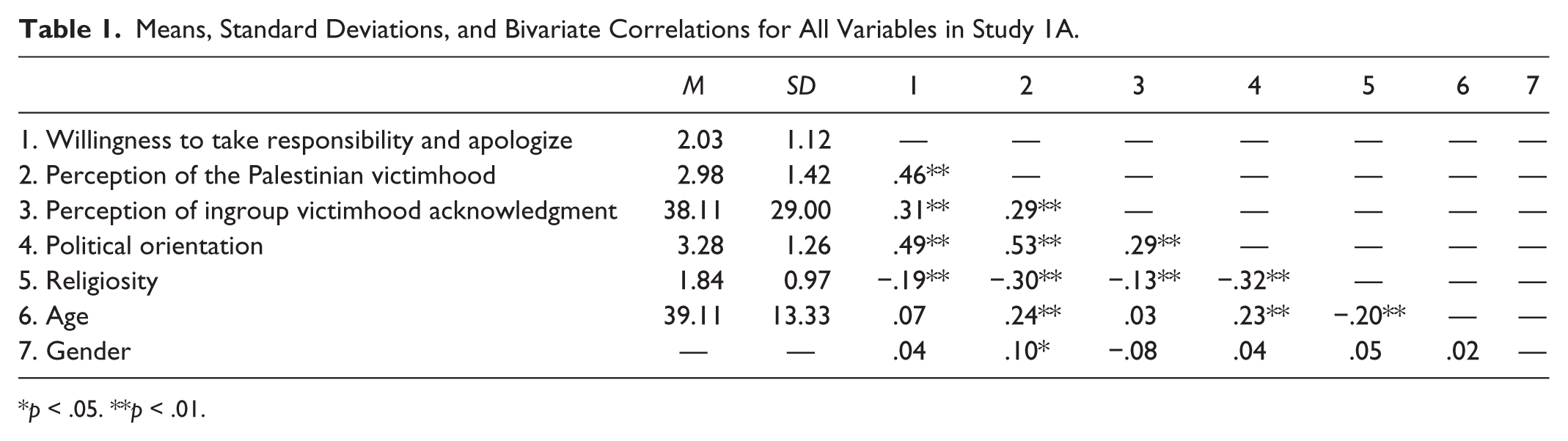
p < .05. **p < .01.
In Study 1A, among a representative sample of Jewish-Israelis, we found that the degree to which participants perceived that Palestinians acknowledge the Jewish Holocaust was associated with more readiness to acknowledge the Palestinians’ suffering, and more willingness to take responsibility and apologize for their suffering. One limitation of this study may be that we measured perceived denial of the Holocaust as a mirror image of its acknowledgment (e.g., a response that none [0%] of the Palestinians denied the Holocaust was taken to mean its perceived acknowledgment). One may argue that nondenial of the Holocaust may mean that the respondent is uncertain about the historical validity of the Holocaust but does not necessarily acknowledge it. Yet, in the context of ongoing protracted conflicts such as the Israeli–Palestinian, that are characterized by high levels of competitive victimhood, the validity or invalidity of the enemy’s trauma is a binary issue. The adversary either acknowledges or does not acknowledge the other’s trauma. In fact, uncertainty as to whether or not the Holocaust had occurred is likely to be perceived by Jews as its denial.
Study 1B
Method
Participants
Participants were 202 Muslim-Palestinians (101 men) from the West Bank, with a mean age of 22.33 (SD = 5.63). Three participants who did not fill out the questionnaire properly were excluded from the analysis. The lower number of participants in the Palestinian sample is due to the difficulties of conducting research in the West Bank by Israeli researchers. Using pen and pencil questionnaires, an individual Palestinian pollster recruited participants who volunteered to take part on various college campuses in the West Bank in February 2014. The dependent measures were embedded within a larger questionnaire, which included items unrelated to the current study. All participants rated themselves as being 1 = very hawkish to 7 = very dovish (i.e., comparable with “very right wing” and “very left wing” in the Israeli sample). Of the participants, 39.7% self-identified as hawks, 37.7% as centrists (neither hawks, nor doves), and 22.6% as doves. 2
Measures
Perceived acknowledgment of Palestinian trauma by Israelis was measured by participants’ agreement with the statement “I think that most Israeli-Jews have empathy for and understanding of the suffering my people have experienced” (1 = completely disagree to 6 = agree to a very great extent). In the Israeli–Palestinian context, this statement implies the sufferings that began with the Palestinians’ becoming refugees in 1948 (i.e., the Nakba). Acknowledgment of the Jewish trauma (i.e., Holocaust) was measured by the extent to which participants agreed with the statement that “During the Second World War, six million Jews were murdered only because they were Jewish” (1 = certainly not to 5 = certainly yes). To assess the effects of acknowledgment on intergroup relations, we measured the degree to which they agreed with the statement that “I believe that Palestinians and Israelis can live in peace and prosperity, much like the French and British people of today” (1 = completely disagree to 6 = agree to a very great extent).
Results and Discussion
Similar to Study 1A, to test the bivariate correlations, we used bootstrapping command with 5,000 samples. As expected, perceived acknowledgment of Palestinian sufferings by the Israelis was positively correlated with both acknowledgment of the Jewish Holocaust (r = .18, SE = .07, p = .01, 95% CI = [.04, .32]) and the belief in a reconciled future (r = .27, SE = .08, p < .001, 95% CI = [.11, .42]). These correlations held when we controlled for participants’ age, gender, and conflict-related ideology (see Table 2 for means, standard deviations, and bivariate correlations). Indeed, the relationships between the main variables were similar for Israeli-Jews (Study 1A) and Palestinians (Study 1B). Perceived acknowledgment of the ingroup’s victimhood was positively related to the ingroup’s readiness to acknowledge the adversary’s victimhood and a conciliatory attitude toward them.
Means, Standard Deviations, and Bivariate Correlations for All Variables in Study 1B.
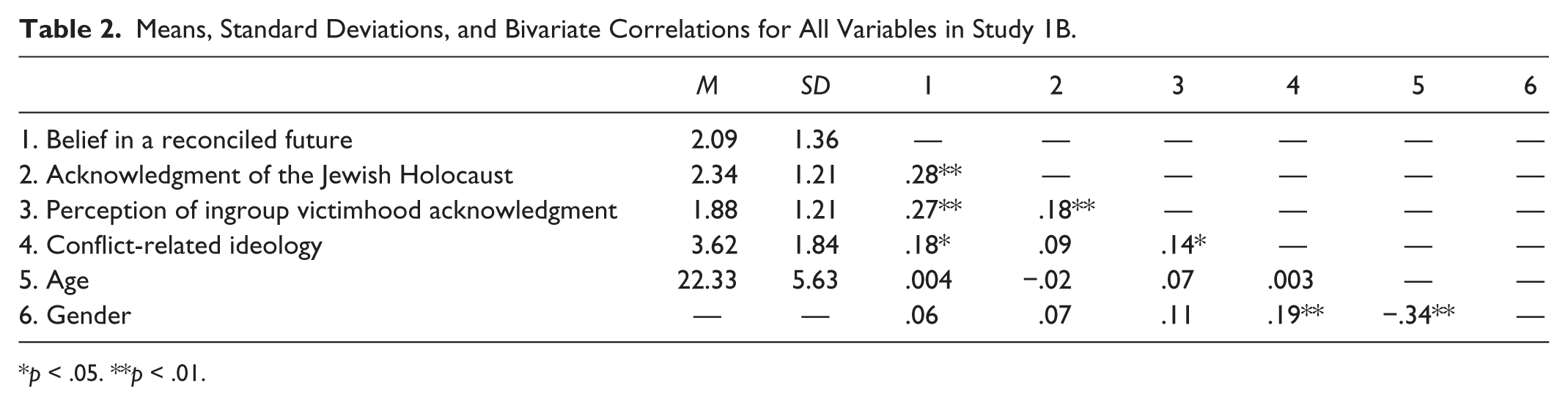
p < .05. **p < .01.
Variables in both Studies 1A and 1B were skewed toward nonconciliatory attitudes (see Tables 1 and 2), as would be expected in the context of a protracted conflict, where both parties have a strong sense of competitive victimhood (Noor et al., 2012). Furthermore, because of their correlational nature, these findings cannot be taken to mean that perceived acknowledgment of the ingroup’s trauma by the “enemy” in a protracted conflict facilitates the end of the conflict. It is possible, and may even be likely, that group members who hold conciliatory attitudes are also more willing to acknowledge the adversary’s victimhood and believe that the adversary acknowledges theirs. Yet, with these limitations in mind, because of the use of bootstrapping technique, a robust statistical analysis that does not require the assumption of normal distribution (Byrne, 2009), and the relatively large sample sizes, the present findings suggest an empirical link between acknowledgment of the ingroup’s victimhood by one’s enemy and conciliatory attitudes. To examine the hypothesis that the acknowledgment of the ingroup’s victimhood by the enemy causes greater willingness to make compromises on key divisive issues and a conciliatory orientation toward one’s adversary, we conducted three field experiments: two with Israeli-Jewish participants (Studies 2 and 4), and one with Palestinian citizens of Israel (Study 3). These experiments have also allowed us to examine the psychological mechanisms that drive these effects.
Study 2
Method
Participants
The sample included 158 Israeli-Jews (M age of 32.58, SD = 9.94, 95 men). We had to remove 53 participants who, as revealed by reading comprehension questions, failed to remember the information included in the experimental materials (for comparable rates with online American samples, see Berinsky, Huber, & Lenz, 2012). This resulted in a final sample of 105 participants (66 men), with the mean age of 33.43 (SD = 11.34). Importantly, the pattern of results remains similar when analyzing the results with the full sample. Of the final sample, 51.4% of the participants self-identified as rightists, 30.5% as centrists, and 18.2% as leftists. Participants participated in the experiment using an online surveying company in November 2014 in exchange for 10 Israeli shekels (about US$2.5).
Procedure
The experiment was introduced as two unrelated studies. The first was presented as examining the effects of being exposed to the same news story on TV or reading about it, on its comprehension. The second study was said to assess general public attitudes regarding Operation Protective Edge, the Israeli military operation in the Gaza Strip during the summer of 2014, and its consequences. In the first study, participants were told that they had been randomly assigned to the “written news item” group and asked to read a news story published in Israel’s leading online news service, followed by several reading comprehension questions to bolster the credibility of the cover story. Subsequently, in the ostensibly second study, participants were asked to respond to a questionnaire, with several dozen items, said to assess their general attitudes regarding Operation Protective Edge, and its consequences. These items were relevant to the research context, that is, the Israeli–Palestinian conflict, and Operation Protective Edge (e.g., support for different policies during this operation, perceived perception of Israel by the international community), but less so to our central purpose of the research. The dependent variable items were embedded within this questionnaire (see supplementary material).
Manipulation of victimhood acknowledgment
Participants were randomly assigned to either high (n = 48) or low acknowledgment of victimhood (n = 57) conditions. 3 Participants read a short news story describing the findings of a new worldwide study on social attitudes said to be conducted by researchers from Harvard University. The story indicated that either 73% or 27% of the Palestinians in the West Bank, that is, high acknowledgment and low acknowledgment conditions, respectively, think that the Holocaust was a terrible crime committed against the Jewish people (see supplementary material for the full text).
Measures
Following the manipulation, participants were asked to indicate the perceived clarity of the article on a 6-point scale, and its credibility on a 4-point scale. Dependent variables included a measure of trust (i.e., degree of agreement on a 6-point scale with the statement that “Generally speaking, the Palestinians cannot be trusted”; see Nadler & Liviatan, 2006). This item was reverse coded, such that the higher the score, the more trust participants showed toward Palestinians. Willingness to compromise, take responsibility, and apologize was measured using five items. The first two assessed participants’ readiness to take responsibility for the events of 1948 and apologize to the Palestinians, identical to the items used in Study 1A. Participants’ willingness to make compromises on divisive issues within the Israeli–Palestinian conflict was assessed by asking them to indicate on 6-point scales their agreement to evacuate Israeli settlements in the West Bank, to divide Jerusalem into a Palestinian and an Israeli capital, and to allow a limited number of Palestinian refugees to enter Israel and receive Israeli citizenship (α = .78; for similar measures, see Hameiri, Porat, Bar-Tal, Bieler, & Halperin, 2014).
Results and Discussion
To examine our hypotheses, all of the dependent measures were analyzed with a one-way ANOVA that controlled for the participants’ level of religiosity throughout the analysis. 4 The pattern of results remained identical when not controlling for this background variable (for means, standard deviations, and bivariate correlations, see Table 3).
Means, Standard Deviations, and Bivariate Correlations for All Variables in Study 2.
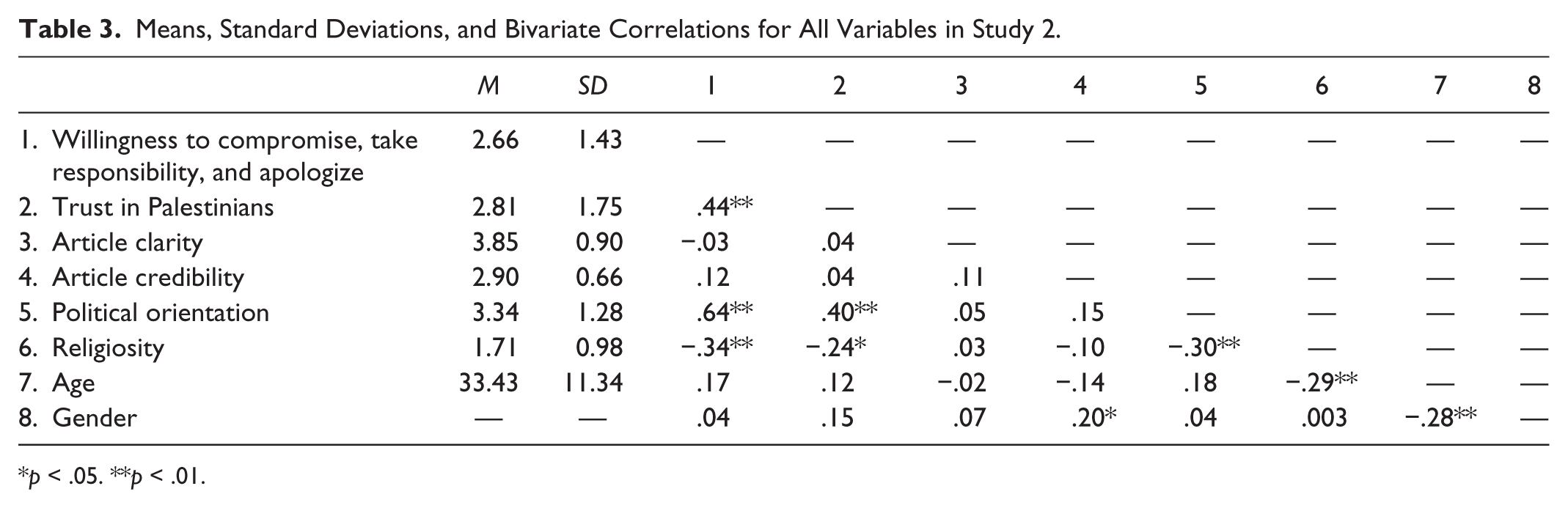
p < .05. **p < .01.
Perceived clarity and credibility of article
Participants reported similar levels of article clarity in the high (M = 3.99, SD = 0.88) and low acknowledgment (M = 3.72, SD = 0.90) conditions, F(1, 102) = 2.51, p = .12, Cohen’s d = .30, and perceived it to be more credible in the low than the high acknowledgment condition, F(1, 102) = 7.91, p = .006, Cohen’s d = .56 (M = 2.71, SD = 0.77, and M = 3.07, SD = 0.49, respectively).
Level of trust in the adversary
Participants’ general level of trust toward Palestinians was higher in the high than the low acknowledgment condition (M = 3.31, SD = 1.98; M = 2.45, SD = 1.45, respectively), F(1, 102) = 6.91, p = .010, Cohen’s d = .50.
Willingness to make concessions and conciliatory orientation
Participants in the high acknowledgment condition were significantly more willing to compromise, take responsibility, and apologize to the Palestinians than those in the low acknowledgment condition (M = 3.08, SD = 1.71; M = 2.38, SD = 1.09, respectively), F(1, 102) = 7.47, p = .007, Cohen’s d = .49.
Using Hayes’s (2013) PROCESS bootstrapping command with 5,000 iterations (Model 4), we tested a mediation model in which (a) high acknowledgment of ingroup victimhood (vs. low) increased general trust toward the Palestinians, (b) which, in turn, increased willingness to compromise, take responsibility, and apologize, while controlling for level of religiosity as in the previous analyses. The model, presented in Figure 1, suggests, as expected, that high acknowledgment by Palestinians of the Jewish Holocaust led to more trust in the Palestinians, which in turn led to more willingness to compromise on conflict specific issues, take responsibility over the events of 1948, and apologize to the Palestinians. More importantly, the analysis revealed that victimhood acknowledgment’s effect on willingness to compromise (b = .71, SE = .26, t = 2.73, p = .007) was reduced after the mediator (i.e., level of trust) was considered in the model (b = .47, SE = .25, t = 1.87, p = .065), and the indirect effect was significant (effect = .24, SE = .13, 95% CI = [.05, .56]).
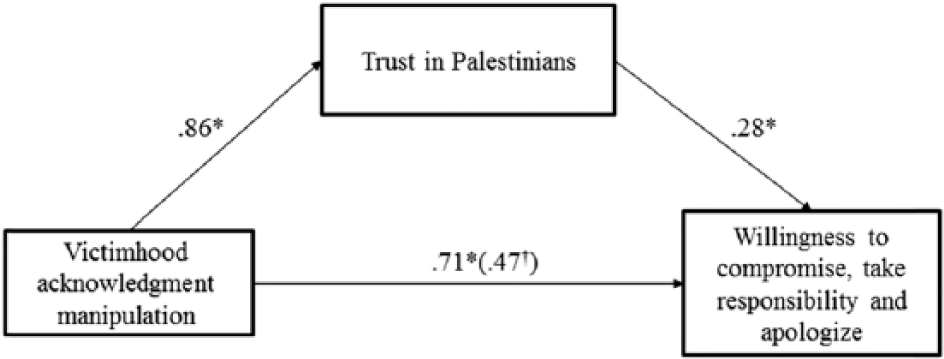
Results from Study 2 (n = 105 Jewish-Israelis) of the mediation model assessing the victimhood acknowledgment manipulation—trust in Palestinians—willingness to compromise, take responsibility, and apologize path.
In Study 2, we found that manipulated acknowledgment of victimhood led Jewish-Israelis to express more trust toward Palestinians, and most importantly, more willingness to take responsibility, apologize, and make political concessions to promote a peaceful resolution of the conflict. Mediation analysis suggested that the manipulated high levels of acknowledgment (vs. low acknowledgment) led to more trust in Palestinians, which in turn led to the above-mentioned more positive conciliatory attitudes. Finally, although participants perceived the high acknowledgment article to be more credible, this variable was not significantly correlated with any of the dependent variables (see Table 3) suggesting that it did not affect the manipulation’s effectiveness. In Study 3, we sought to examine whether a similar pattern of results would be obtained with Palestinian participants.
Study 3
Method
Participants
Because this experiment was conducted in early 2015, shortly after the hostilities in Gaza in the summer of 2014, data collection in the West Bank was impossible. We therefore examined the effects of acknowledgment of Palestinian victimhood by Israeli-Jews, that is, the Nakba, on conciliatory attitudes and their willingness to make compromises on divisive issues with a sample of 52 Palestinians, citizens of Israel. Originally, we sampled 61 participants (38 men), with the mean age of 24.38 (SD = 6.36). Forty-four identified themselves as Muslims, nine as Christians, one as Druze, and seven did not self-identify. Participants were approached by a Palestinian pollster using an online platform. We excluded eight participants who gave a wrong answer on at least one of the reading comprehension questions, and one more participant due to extreme scores on the trust measure (over 2.5 standard deviations from the mean), leaving a sample of 52 participants (33 men), with the mean age of 24.19 (SD = 5.30). Importantly, the pattern of results remains similar when analyzing the results with the full sample. Seventeen participants identified themselves as hawks, 15 as centrists, and 20 as doves with regard to the Israeli–Palestinian conflict.
Procedure
Procedures were identical to those in Study 2. Participants in the high acknowledgment condition (n = 27) were asked to read an Arabic version of a news story, ostensibly published in a reliable news source for Palestinian citizens of Israel, that reported the results of a worldwide study conducted by Harvard University on social attitudes where 73% of Israeli-Jews agreed that the Nakba was a terrible disaster for the Palestinian people. In the low acknowledgment condition (n = 25), participants read that 27% of Israeli-Jews held this attitude (see supplementary material for the full text). They were then asked to respond to several reading comprehension questions. Subsequently, in what was described as a second and unrelated study, they were asked to respond to a questionnaire in which the dependent variables were embedded (see supplementary material).
Measures
Following the assessment of perceived article’s clarity and credibility, participants filled out a measure of trust in Israelis, adapted from the trust measure used in Study 2, and indicated their agreement on a 6-point scale, with three statements that assessed participants’ conciliatory attitude toward Jews (α = .72; that is, “Palestinians and Israelis can live in peace and prosperity, much like the French and British people of today”; “Today I see the Jewish people in a more positive light”; and “I am willing to work for reconciliation between the Jewish people and the Palestinian people”; see Shnabel et al., 2009).
Participants indicated their willingness to compromise, on a 6-point scale, on three divisive issues that are especially relevant for Palestinian Israelis (i.e., the right to return for Palestinian refugees, compensation for Palestinian refugees living in Israel, and the division of Jerusalem; α = .61; see Halperin, Russell, Trzesniewski, Gross, & Dweck, 2011). Finally, we measured participants’ identification with Israeli society by asking them to choose one of five pairs of circles with different degrees of overlap (ranging from complete separation to full overlap), where one circle in each pair represented the self and the other represented “an Israeli” (see Nadler & Liviatan, 2006).
Results and Discussion
All dependent measures were analyzed using a one-way ANOVA, in which the “identification with Israeli society,” 5 religiosity, and gender were controlled. The pattern of results remained similar when not controlling for these background variables (for means, standard deviations, and bivariate correlations, see Table 4).
Means, Standard Deviations, and Bivariate Correlations for All Variables in Study 3.

p < .05. **p < .01.
Perceived clarity and credibility of article
Participants reported similar levels of article clarity in the high (M = 3.81, SD = 0.80) and low acknowledgment (M = 3.96, SD = 0.65) conditions, F(1, 47) = 0.53, p = .469, Cohen’s d = .20, and perceived the article to be more credible in the low (M = 2.82, SD = 0.37) than in the high acknowledgment condition (M = 2.38, SD = 0.69), F(1, 47) = 7.91, p = .007, Cohen’s d = .79.
Level of trust in the adversary
Participants’ general level of trust toward Israelis in the high acknowledgment condition was higher than that of participants in the low acknowledgment condition (M = 2.64, SD = 1.62, M = 1.87, SD = 1.26, respectively), F(1, 47) = 4.61, p = .037, Cohen’s d = .53.
Willingness to make concessions and conciliatory orientation
Participants in the high acknowledgment condition evidenced greater willingness to compromise on divisive issues than participants in the low acknowledgment condition (M = 2.12, SD = 0.89, M = 1.61, SD = 1.06, respectively), F(1, 47) = 4.61, p = .037, Cohen’s d = .52, and had significantly higher scores on the Conciliatory Attitude scale (M = 3.48, SD = 1.07, M = 2.83, SD = 1.33, respectively), F(1, 47) = 4.06, p = .05, Cohen’s d = .54.
Using Hayes’s (2013) PROCESS bootstrapping command with 5,000 iterations (Model 4), we tested a mediation model in which (a) high acknowledgment of ingroup victimhood (vs. low acknowledgment) increased general trust toward the Israelis, (b) which, in turn, increased a conciliatory attitude toward Israeli-Jews. The model, presented in Figure 2A, suggests that, as expected, acknowledgment of the Palestinian Nakba led to more trust in Israelis, which in turn led to more positive conciliatory attitudes. More importantly, victimhood acknowledgment’s effect on conciliatory attitudes (b = .64, SE = .32, t = 2.01, p = .050) was reduced after the mediator (i.e., level of trust) was considered in the model (b = .36, SE = .31, t = 1.18, p = .245), and the indirect effect was significant (effect = .28, SE = .15, 95% CI = [.04, .66]).
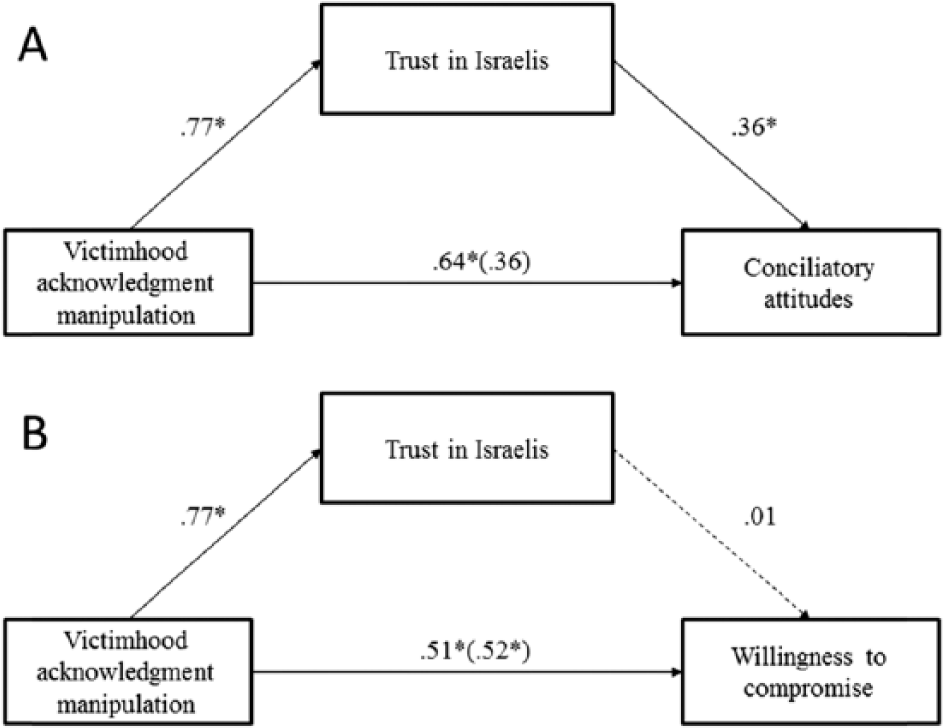
Results from Study 3 (n = 52 Palestinians, citizens of Israel) of the mediation models assessing the victimhood acknowledgment manipulation—trust in Israelis—willingness to compromise (2A) or conciliatory attitudes toward Israelis (2B) paths.
We then examined an identical mediation model with willingness to compromise as the dependent variable. This model, presented in Figure 2B, suggests, unexpectedly, that acknowledgment of the Palestinian Nakba led to more trust in Israelis, but the increase in the level of trust did not consequently lead to an increase in the participants’ willingness to compromise. Thus, the indirect effect was not significant (effect = .01, SE = .10, 95% CI = [−.20, .21]).
In the main, the results in Study 3 replicated the patterns of results in Study 2. High levels of acknowledgment (vs. low acknowledgment) by Israeli-Jews of Palestinians’ sufferings led Palestinian participants to express more trust in Israeli-Jews, adopt more positive conciliatory attitudes toward them, and be more willing to endorse political concessions to promote a peaceful conflict resolution. Mediation analyses indicated that trust played a mediating role only when the dependent variable was conciliatory attitudes toward Jewish-Israelis, while it was not associated with the participants’ willingness to make compromises. We will address this issue in the general discussion. Finally, similar to Study 2, participants perceived the low acknowledgment article to be more credible than the high acknowledgment article, but credibility was not significantly correlated with any of the dependent variables.
Study 4
Study 4 aimed to replicate the previous findings and shed light on the psychological mechanisms that explain the link between acknowledgment of victimhood and readiness to compromise and adopt conciliatory attitudes in “hot” conflicts. Because this study was conducted in early 2016, a time of peak violence in Israeli–Palestinian relations, we could solicit research cooperation only from Israeli-Jews. This study also included a control group which read a story that focused on the Holocaust but did not imply anything about the level of its acknowledgment by Palestinians. This allowed us to assess the effects of high or low acknowledgment against a comparable baseline. Finally, the study assessed the role of four conceptually relevant variables as psychological mechanisms that explain the effects of acknowledgment on concession making, taking responsibility for adversary’s sufferings and apologizing: trust, collective victim identity, need for acceptance of the ingroup, and reciprocity.
The mediating effects of trust in the adversary have been observed and discussed in Studies 2 and 3 and will not be further discussed here. The second mediator is the degree to which group members regard their group’s past victimization as a central element in their collective identity (i.e., collective victim identity, Klar et al., 2013). Protracted and violent conflicts, such as the Israeli–Palestinian conflict, are dominated by feelings and perceptions of competitive victimhood (Noor et al., 2012) which render victimhood a central element in the group’s identity. This centrality of victimhood leads to viewing the adversary as a source of potential revictimization and results in the adoption of a cautious and unyielding stance in relations with them. The adversary’s acknowledgment of the group’s victimhood implies that competitive victimhood no longer dominates, lowering the centrality of the ingroup’s victimhood which leads to a more conciliatory orientation and greater willingness to make concessions on divisive issues.
A third possible mediator is participants’ need for acceptance. This variable is of special significance in the present study with Israeli-Jews participants who were likely, like many other Israeli-Jews, to experience threat to their moral image because Israel is often viewed as the author of immoral behavior toward the Palestinians (Shnabel et al., 2009). According to the needs-based model, and related research, this threat to moral image results in the group’s need to be accepted by outgroups, which, until satisfied, discourages reconciliation (Shnabel & Nadler, 2015). The acknowledgment of the Jewish Holocaust by Palestinians implies to Israelis that they understand, however conditionally and tentatively, that Jewish history compels Israelis to be overly vigilant, which may lead them to implement apparently immoral policies. This reduces the threat to Israelis’ moral image and, with it, the need for acceptance by other groups (i.e., the world community). As research indicates, satisfaction of the need for acceptance for the perpetrator increases readiness for reconciliation (Nadler & Shnabel, 2015). Thus, the lower need for acceptance expressed by Israelis is expected to mediate their readiness to make concessions.
A fourth possible mediator is participants’ need to reciprocate the acknowledgment of their collective victimhood by adopting a conciliatory orientation. As we could not ask participants directly whether the acknowledgment of their victimhood should be reciprocated by making concessions, we assessed variations in the need for reciprocity by asking participants about the degree to which they thought that an acknowledgment of their group’s victimhood needs to be reciprocated by acknowledging Palestinian suffering.
Method
Participants
Originally, 186 participants took part in the experiment (M age of 45.72, SD = 16.34, 98 men), four of whom were excluded for realizing the true aim of the study and 11 due to extreme scores on any of the dependent variable scales (over 2.5 standard deviations from the mean), leaving a final sample of 171 with the mean age of 45.78 (SD = 16.20). Based on the G*Power approach to an optimal cell size (Faul, Erdfelder, Buchner, & Lang, 2009), we aimed to sample 55 participants in each condition. Importantly, the pattern of results remains similar when analyzing the results with the full sample. Of the final sample, 57.9% of the participants self-identified as rightists, 26.9% as centrists, and 15.3% as leftists. Participants took part in the experiment using an online surveying company in April 2016 in exchange for approximately seven Israeli shekels (about US$2).
Procedure and manipulation
The experiment followed the same procedure as in Study 2, with several changes. First, a control group was added to the high and low acknowledgment groups in which participants read a Holocaust-related news item which was unrelated to its acknowledgment by Palestinians (i.e., Holocaust-related educational program; see supplementary material for the full text). Second, to boost the procedure’s credibility, the two ostensibly unrelated studies were administered using two different online platforms. Participants were redirected automatically to the second platform when they completed the first. Furthermore, all participants answered the reading comprehension questions correctly after having been given two consecutive opportunities to answer them. Participants were randomly assigned to either high acknowledgment (n = 56), low acknowledgment (n = 56), or control (n = 59) conditions.
Measures
As in Studies 2 and 3, after the manipulation, the article’s perceived clarity and credibility were measured. The manipulation check consisted of level of agreement on a 7-point scale with the statement that “I think that the majority of the population in the Palestinian Authority acknowledges the importance of the Holocaust in the history of the Jewish people.”
Dependent variables included collective victim identity, measuring five items (α = .82) to which participants indicated level of agreement on a 7-point scale, for example, “The Jewish Holocaust is the most significant event in human history, and no group or people have ever been harmed as we have” (for a similar scale, see Hameiri, Sharvit, Bar-Tal, Shahar, & Halperin, 2016). Need for social acceptance was measured by indicating level of agreement on a 7-point scale on two items (r = .92, p < .001) adapted from Shnabel and Nadler (2008; that is, “I would like the international community to know that Israel is trying to act morally” and “I would like the international community to understand the reasons for the actions of the State of Israel”). A single item assessed variations in felt need for reciprocity (i.e., “If Palestinians acknowledged the suffering of the Jewish people throughout history, Israel should reciprocate by acknowledging the suffering of Palestinians”). Finally, we measured trust and willingness to compromise, take responsibility, and apologize (α = .86) with the items used in Study 2 (see supplementary material).
Results and Discussion
To examine our hypotheses, we entered measures of article perceptions and the manipulation check into a one-way ANOVA. In the next step, we examined all of the dependent variables with a multivariate ANOVA. We controlled for the participants’ level of religiosity throughout the analysis. The pattern of results remained identical when not controlling for this background variable (for means, standard deviations, and bivariate correlations, see Table 5).
Means, Standard Deviations, and Bivariate Correlations for Main Variables in Study 4.
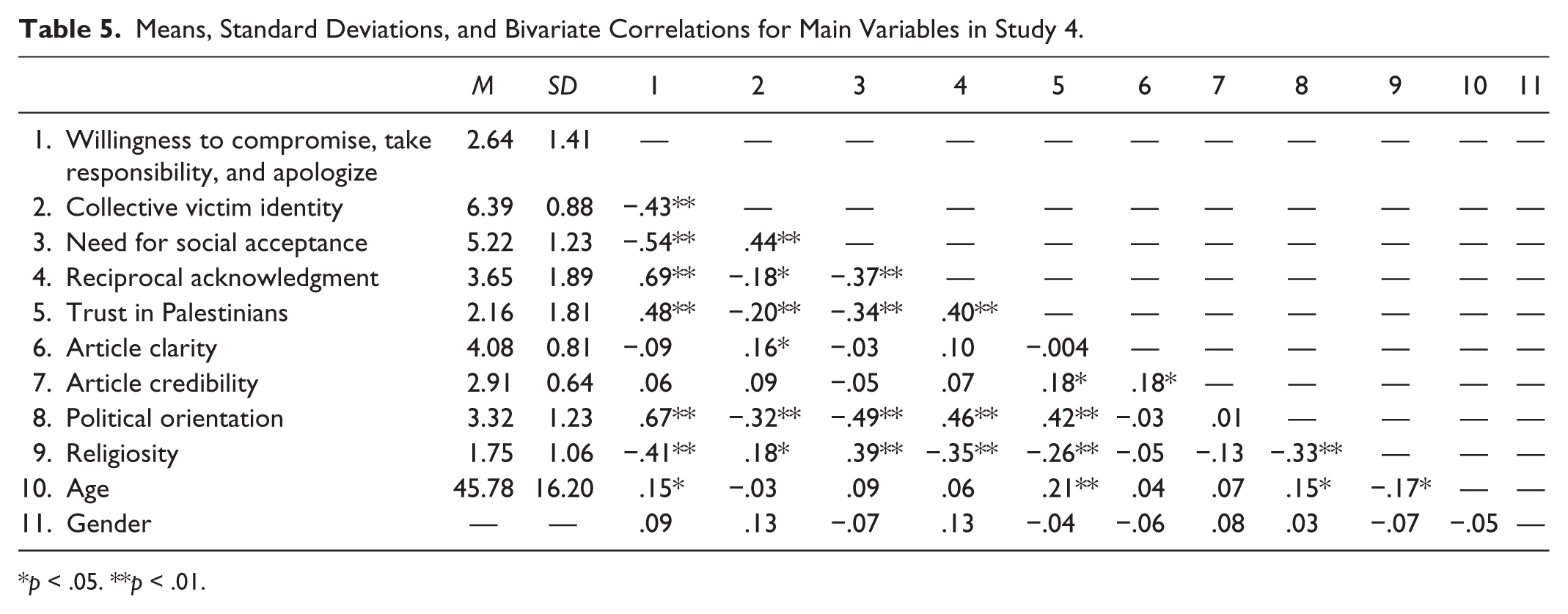
p < .05. **p < .01.
The article’s perceived clarity and credibility
Participants reported similar levels of clarity in all conditions, F(2, 167) = 0.14, p = .869, ηp2 = .002. A perceived credibility main effect, F(2, 167) = 5.26, p = .006, ηp2 = .06, indicates that participants perceived the article to be more credible in the control condition (M = 3.11, SD = 0.53) than in the high (M = 2.75, SD = 0.79) and low acknowledgment (M = 2.84, SD = 0.53) conditions, both ps < .05. There was no difference between the high and low acknowledgment conditions (p = .45).
Manipulation check
Participants indicated higher levels of Palestinian acknowledgment of the Holocaust in the high compared with the low acknowledgment and the control conditions (M = 3.52, SD = 1.45; M = 2.36, SD = 1.13 and M = 1.92, SD = 1.26, respectively), both ps < .001. Levels of perceived acknowledgment were marginally significantly higher in the low acknowledgment condition, compared with the control (p = .067). The condition main effect was highly significant, F(2, 167) = 23.70, p < .001, ηp2 = .22.
In the multivariate ANOVA with all dependent variables, we found a significant multivariate effect, F(5, 164) = 3.24, p = .008, ηp2 = .09. The condition had a significant effect on willingness to compromise, take responsibility, and apologize, F(2, 167) = 4.30, p = .015, ηp2 = .05, replicating and extending the results from Studies 2 and 3; collective victim identity, F(2, 167) = 4.44, p = .013, ηp2 = .05; and need for acceptance, F(2, 167) = 4.89, p = .009, ηp2 = .06. We found a marginally significant effect on reciprocal victimhood acknowledgment, F(2, 167) = 2.41, p = .093, ηp2 = .03. Finally, in contrast to Studies 2 and 3, we did not find a condition main effect for the measure of trust, F(2, 167) = 0.39, p = .681, ηp2 = .005.
Upon further examination, these findings indicate that participants showed more willingness to compromise, take responsibility for Palestinian sufferings, and apologize in the high (M = 3.04, SD = 1.60) than in the low acknowledgment (M = 2.44, SD = 1.12), and the control (M = 2.43, SD = 1.33) conditions, both ps < .02. There was no difference between the low acknowledgment and the control conditions (p = .98). Moreover, participants showed lower levels of perceived sense of collective victim identity in the high (M = 4.86, SD = 1.52) than in the low acknowledgment (M = 5.38, SD = 1.02) and the control (M = 5.42, SD = 1.04) conditions, both ps < .02. There was no difference between the latter two conditions (p = .854). Participants evidenced lower need for acceptance in the high (M = 6.10, SD = 1.15) than in the low acknowledgment (M = 6.48, SD = 0.79) and the control (M = 6.58, SD = 0.57) conditions, both ps < .03. There was no difference between the latter two conditions (p = .53). Finally, participants tended to express the need to reciprocate for Palestinian acknowledgment of their victimhood in the high (M = 4.07, SD = 1.87) than in the low acknowledgment (M = 3.43, SD = 1.78) and the control (M = 3.45, SD = 1.99) conditions, both ps < .07. There was no difference between the low acknowledgment and the control conditions (p = .94).
Due to the results of all dependent variables, we created a dummy variable in which we collapsed the low acknowledgment and control together (0 = low acknowledgment and control, 1 = high acknowledgment). We then examined the mediation model, in which (a) high acknowledgment of ingroup victimhood (vs. low acknowledgment and control) lowered collective victim identity and need for acceptance, while increasing the need to reciprocate, (b) which, in turn, increased willingness to compromise, take responsibility, and apologize. We used Hayes’s (2013) PROCESS bootstrapping command with 5,000 iterations (Model 4), while controlling for level of religiosity as in the previous analyses. The model, presented in Figure 3, suggests, as expected, that high acknowledgment by Palestinians of the Jewish Holocaust led to decreased sense of collective victim identity and need for acceptance, while increased the need to reciprocate, which in turn led to more willingness to compromise to achieve a peaceful resolution, take responsibility on the events of 1948, and apologize to the Palestinians. More importantly, the analysis revealed that victimhood acknowledgment’s effect on willingness to compromise, take responsibility, and apologize (b = .61, SE = .21, t = 2.94, p = .004) was reduced after the mediators were considered in the model (b = .07, SE = .15, t = 0.50, p = .617), and all indirect effects were significant (collective victim identity: effect = .12, SE = .06, 95% CI = [.04, .27]; need for acceptance: effect = .15, SE = .07, 95% CI = [.07, .32]; reciprocity: effect = .25, SE = .12, 95% CI = [.04, .50]).
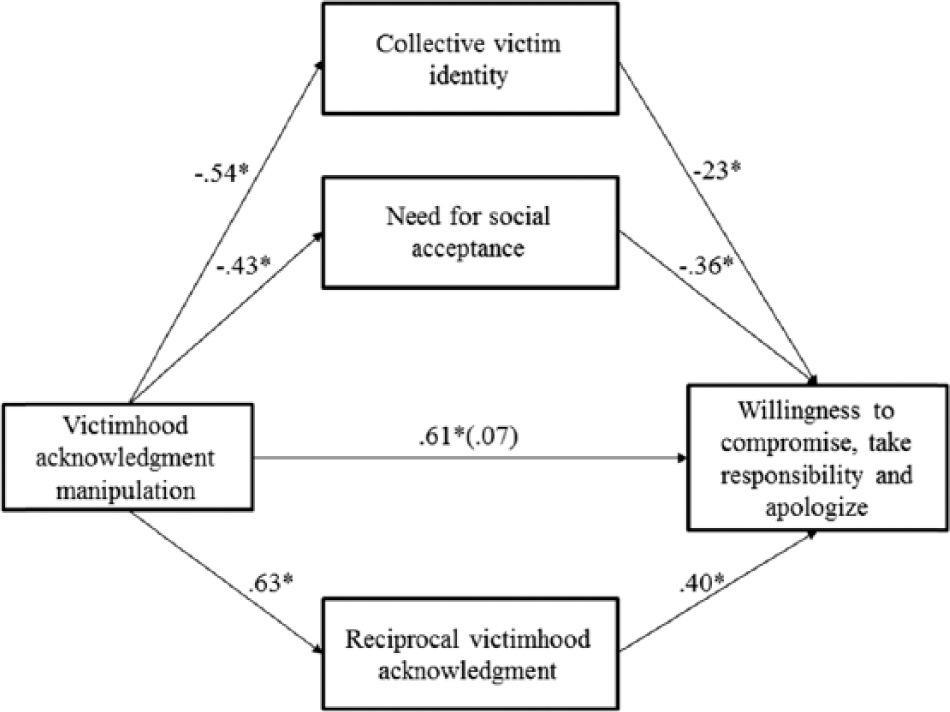
Results from Study 4 (n = 171 Jewish-Israelis) of the mediation model assessing the victimhood acknowledgment manipulation—collective victim identity, need for acceptance, and reciprocity—willingness to compromise, take responsibility, and apologize paths.
The results in Study 4 replicated the main findings of Studies 2 and 3. Compared with low acknowledgment and control groups, Israeli-Jews who had been exposed to a high level of victimhood acknowledgment by Palestinians evidenced greater willingness to compromise, take responsibility for causing suffering to Palestinians, and apologize for it. This effect was mediated by decreased adherence to collective victim identity, lower need for acceptance, and higher need to reciprocate. Differently from the previous studies, we did not find effects on trust in Palestinians, which may be due to a floor effect. Because a different socio-political reality prevailed during the collection of data for Study 4 than that had prevailed during the collection of data for Study 2 (i.e., a peak period of violence vs. relative calm), trust scores in Study 4 were uniformly low and significantly lower than those in Study 2 (M = 2.16, SD = 1.81 and M = 2.81, SD = 1.75, respectively), t(274) = 2.93, p = .003.
Our manipulation check indicated that, while the means in the control and the low acknowledgment conditions were very low (i.e., 1.92 and 2.36, respectively), perceived acknowledgment tended to be higher in the low acknowledgment condition than in the control (p = .067). This difference suggests that in the absence of any information, that is, control condition, Israeli-Jews view Palestinians as deniers of the holocaust. The information that 27% of Palestinians acknowledge the Holocaust, that is, low acknowledgment condition, produced a relatively small shift from the default perception that Palestinians uniformly deny or belittle the holocaust. Yet, this increase in the perceived acknowledgment was not enough to neutralize the perceptions of Palestinians as holocaust deniers, and produce a conciliatory movement in their direction. It took a more substantial level of acknowledgment (i.e., 73% of Palestinians) to break this default perception of Palestinians as holocaust deniers and affect a shift in conciliatory and compromising positions toward them. In support of this, while the difference in perceived acknowledgment of the Holocaust by Palestinians between the control and low acknowledgment conditions was small and marginally significant, the parallel differences between these conditions and the high acknowledgment condition were large and highly significant (both ps < .001).
Finally, similar to Studies 2 and 3, there was a significant difference in terms of the participants’ perceptions of the article’s credibility in the three conditions. However, at the same time, this variable was not significantly correlated with any of the dependent variables, but level of trust (see Table 5). Importantly, the pattern of results outlined above remains identical when controlling for this variable.
General Discussion
This research demonstrates the positive effects of acknowledgment of the ingroup’s victimhood by the adversary on intergroup relations. Surveys conducted in Israel and PA indicated that the perception by Israeli-Jews that Palestinians acknowledge the Holocaust as a major victimizing event for the Jewish people was related to their acknowledgment of Palestinian suffering, willingness to take responsibility, and apologize for it. In the same vein, the Palestinian perception that Israeli-Jews acknowledge Palestinian Nakba–related sufferings was related to their readiness to acknowledge the Jewish Holocaust and their belief in the possibility of a reconciled future with Israelis. Three subsequent field experiments substantiated the causal link between acknowledgment of ingroup’s victimhood and the readiness to compromise on divisive issues and adopt conciliatory attitudes toward the adversary. These experiments also examined the mediators of these links.
The experiments indicate that Israelis (i.e., Israeli-Jews) who had been led to believe that a majority of Palestinians acknowledge the Holocaust expressed more conciliatory attitudes than those who had been led to believe that only a minority of Palestinians do so, or those in the control group (Study 4). Palestinians, citizens of Israel, who believed that a majority of Israeli-Jews acknowledge Nakba-related suffering held more conciliatory attitudes than those who believed that only a minority of Israeli-Jews do so. Importantly, and unique to these experiments, acknowledgment of ingroup trauma by the adversary led Israelis and Palestinians to be readier to make compromises on issues that have divided them for decades (i.e., Israeli West Bank settlements; partition of Jerusalem and allowing a limited number of refugees to obtain Israeli citizenship, for Israelis; and compromises on Palestinian “right of return” and partition of Jerusalem, for Palestinians).
Further analyses indicated that in Studies 2 and 3, higher levels of trust mediated the link between acknowledgment and conciliatory orientation toward the adversary. In the Jewish-Israeli, but not the Palestinian, sample, it mediated the link between acknowledgment and readiness to make concessions on central issues. One reason for this may have been that while Israeli-Jews contemplated compromising with the actual adversary at the future negotiating table (i.e., Palestinians living outside of Israel), Palestinians, citizens of Israel, considered concessions more indirectly (i.e., the concessions that Palestinians living outside the borders of Israel would be willing to make).
The mediational analysis in Study 4 suggests that the effects of acknowledgment of victimhood on concession making and conciliatory orientation reflect the workings of (a) identity-related and (b) relationship-related psychological mechanisms. Regarding identity-related mechanisms, threat to moral identity is likely to have led the Israeli-Jews participants to embrace collective victimhood with its associated feelings of entitlement, while the acknowledgment of victimhood ameliorated this threat, and the associated need for acceptance by others, and lessened the need to embrace a collective victim identity. Consistent with the work of the needs-based model of reconciliation (Nadler & Shnabel, 2015), and work on collective victimhood (Noor et al., 2012), these identity-related changes increase readiness for reconciliation by taking the “first step” forward, that is, offering concessions and adopting a conciliatory orientation. Regarding relationship-related mechanisms, beyond acknowledging victimhood, the adversary has made a positive gesture toward the ingroup which affects readiness to reciprocate in kind and, in Study 2, increased trust in them. These relationship-related variables mediated the effects of acknowledgment of the Jewish Holocaust on concession making and conciliatory orientation. As a cautionary note, it should be mentioned that due to extremely low trust scores because of violence on the ground, trust did not play a similar role in Study 4.
These dual mediating paths, identity-related and relationship-related, are likely to be especially operative in protracted and violent conflicts. Such conflicts generate threats to group identities and are associated with much intergroup distrust and animosity (cf. Nadler, 2012, for a similar distinction between socioemotional and instrumental processes of reconciliation). The relative salience of each of these paths in mediating the effects of acknowledgment is likely to be situationally determined. Compared with conflicts that are protracted and violent, and therefore associated with threats to collective identities, the mediating role of identity-related aspects is likely to be smaller than in less protracted and less violent conflicts. In addition, when the source of acknowledgment is a third party (e.g., the United Nations acknowledges Israeli or Palestinian victimhood), the mediating role of relationship-related aspects in explaining the effects of acknowledgment is likely to be lower than when the source is one’s adversary. These, and related, questions await the scrutiny of further research.
The present research is unique on a number of levels. First, it has examined the effects of acknowledgment of victimhood on the victimized group (rather than on the perpetrating group’s willingness to acknowledge their adversary’s victimhood, and the associated collective guilt, and conciliatory orientations; for example, Čehajić & Brown, 2010) within the context of an ongoing, protracted, and violent conflict. This has allowed us to extend the examination of the effects of acknowledgment beyond the commonly used attitudinal and perceptual measures employed in past research centering on conflicts that have long ended, to readiness to make actual concessions that can break the cycle of violence in an ongoing protracted conflict. This focus highlights the applied implications of our research. In such conflicts, where the belittling or denial of the other’s victimhood may be common, its recognition by the adversary, even if not caused by them, promises to be an important step forward. This is supported by the findings of a recent study which has similarly found that Israelis who had read a message written by a Palestinian which acknowledged the Holocaust evidenced empathy toward their Palestinian adversary (Gubler, Halperin, & Hirschberger, 2015). As discussion of competitive victimhood (Noor et al., 2012) and moral disengagement (Bandura, 1999) indicates, feelings of empathy toward one’s adversary are an important step on the ladder toward ending the conflict. Finally, as the research on victimhood acknowledgment is in its initial stages, the psychological process that underlies it has yet to be identified. In the present research, we examined several theoretically relevant psychological mechanisms.
At this point, it should be noted that although victimhood acknowledgment by adversaries seems a promising route to promote more positive relations, in reality, this rarely happens. Such acknowledgment, for example, may be perceived as hindering the ingroup’s campaign to garner support from third parties (Noor et al., 2012). In cases in which an outgroup was victimized by one’s ingroup, the reluctance to acknowledge the other’s victimhood may stem from the motivation to maintain a positive social identity, whether by belittling the other’s victimhood or by minimizing one’s own culpability for it (e.g., Leidner, Castano, Zaiser, & Giner-Sorolla, 2010).
An important future research direction concerns the effects of acknowledgment of victimhood by a third party. If the effects of acknowledgment are due to an increase in the victim’s sense of being just and morally superior to his adversary, then compared with an acknowledgment by the adversary, an acknowledgment by a third party (e.g., the United Nations) should have similar, if not stronger, ameliorative effects. Yet, if the positive effects of acknowledgment are attributable to the implication that the enemy legitimizes the ingroup’s identity, an acknowledgment from a third party should have lesser, if any, ameliorative effects. Another future research direction concerns the different meanings that acknowledgment of victimhood has for the more and less powerful in the conflict. Consistent with the logic of the needs-based model (Shnabel & Nadler, 2008), for the weaker party, acknowledgment means that the injustice done to them is recognized and needs to be rectified, while for the more powerful party, acknowledgment means that as they are victims, they are exonerated from being portrayed as the all evil perpetrator. The finding that Israelis’ need for acceptance of Israel by the world community was lower in the high than the low acknowledgment condition supports this possibility.
An important implication of the present research suggests that the first step on the road to intergroup reconciliation is the acknowledgment of the adversary’s victimhood. Adversarial groups not only deny their responsibility for the outgroup’s sufferings, but forces of competitive victimhood lead them to deny, or belittle, the significance of these sufferings. Yet, when collective victimhood is a central element in the way the group views itself and its relations with outgroups (i.e., a “chosen trauma”), its denial is tantamount to invalidating the group’s identity. This denial of victimhood exerts a negative influence on intergroup relations even after the conflict has ended, but is particularly destructive in ongoing conflicts. As the present findings indicate, under these circumstances, the denial of the ingroup’s victimhood leads to intransigent positions on divisive issues threatening to turn the conflict into a protracted one. The acknowledgment of the adversary’s “chosen trauma” lowers ingroup members’ defenses against future revictimization and encourages compromises on divisive issues and a more conciliatory and hopeful view of their relations with their adversary than if such an acknowledgment is withheld. By studying the effects of acknowledgment of victimhood in the context of the protracted Israeli–Palestinian conflict, the present research illustrates these processes. The question as to whether these findings are unique to such contexts where parties deny each other’s “chosen trauma” or would be also manifested in other kinds of intergroup conflicts should be examined by future research.
Finally, the present research is not without limitations. Due to the conflict situation on the ground, the samples in the five studies differ. Second, the heated intergroup relations made it extremely difficult and expensive to collect data in Study 3, which led to a small sample size, and thus to a relatively underpowered statistical analysis. Finally, when examining effect sizes, we found that most are of medium strength. Thus, we do not claim that these findings are the philosopher’s stone that will transform animosity into harmony. Yet, the robustness of this effect, found in five separate studies using diverse samples and methodologies, suggests that the simple act of acknowledging the other’s victimhood encourages conciliatory orientation and readiness to compromise on divisive issues. This may pave the road to reconciliation in one of the oldest, violent, and seemingly intractable conflicts on the world stage today: the Israeli–Palestinian conflict.
Footnotes
Acknowledgements
The authors would like to express gratitude to Siwar Aslih, Ahmad Hamdan, and Mohammad Juda for their great assistance in translating the materials to Arabic and the data collection for Studies 1B and 3.
Declaration of Conflicting Interests
The author(s) declared no potential conflicts of interest with respect to the research, authorship, and/or publication of this article.
Funding
The author(s) disclosed receipt of the following financial support for the research, authorship, and/or publication of this article: This research was supported by the German Research Foundation (DFG) Grant LE 1260/3-2 to Arie Nadler. Boaz Hameiri is grateful to the Azrieli Foundation for the award of an Azrieli Fellowship.
Supplemental Material
The supplemental material is available online.
Notes
References
Supplementary Material
Please find the following supplemental material available below.
For Open Access articles published under a Creative Commons License, all supplemental material carries the same license as the article it is associated with.
For non-Open Access articles published, all supplemental material carries a non-exclusive license, and permission requests for re-use of supplemental material or any part of supplemental material shall be sent directly to the copyright owner as specified in the copyright notice associated with the article.
