




Abstract
We assessed self-consistency (expressing similar traits in different situations) by having undergraduates in the United States (n = 230), Australia (n = 220), Canada (n = 240), Ecuador (n = 101), Mexico (n = 209), Venezuela (n = 209), Japan (n = 178), Malaysia (n = 254), and the Philippines (n = 241) report the traits they expressed in four different social situations. Self-consistency was positively associated with age, well-being, living in Latin America, and not living in Japan; however, each of these variables showed a unique pattern of associations with various psychologically distinct sources of raw self-consistency, including cross-situationally consistent social norms and injunctions. For example, low consistency between injunctive norms and trait expressions fully explained the low self-consistency in Japan. In accord with trait theory, after removing normative and injunctive sources of consistency, there remained robust distinctive noninjunctive self-consistency (reflecting individuating personality dispositions) in every country, including Japan. The results highlight how clarifying the determinants and implications of self-consistency requires differentiating its distinctive, injunctive, and noninjunctive components.
For decades, there has been debate over the degree to which people express similar personality traits across different situations (Mischel, 2004). There has also been considerable interest in understanding the causes and consequences of individual differences in cross-situational consistency; for example, are highly consistent individuals well-adjusted or maladjusted (Block, 1961)?
In previous research, the degree to which an individual reports expressing the same traits in different contexts has been given various labels, including cross-role consistency (Boucher, 2011; Church et al., 2008), self-concept consistency (Church et al., 2012; Constantino, Wilson, Horowitz, & Pinel, 2006; Cross, Gore, & Morris, 2003; English & Chen, 2011; Katigbak et al., 2013; Kraus, Chen, & Keltner, 2011; Locke, 2006), identity consistency (Daukantaitė & Thompson, 2014; Hong & Woody, 2007; Suh, 2002), self-continuity (Dunkel, Minor, & Babineau, 2010) or, inversely, role variability (Block, 1961), cross-role variation (Sheldon, Ryan, Rawsthorne, & Ilardi, 1997), intraindividual personality variability (Baird, Le, & Lucas, 2006; Clifton & Kuper, 2011), and self-concept differentiation (Diehl & Hay, 2007; Donahue, Robins, Roberts, & John, 1993; Fukushima & Hosoe, 2011; Lutz & Ross, 2003). Following Gage, Coker, and Jobson (2015) and Locke and Christensen (2007), we will call this construct self-consistency.
Noninjunctive and Distinctive Sources of Self-Consistency
Most self-consistency research has conceptualized and quantified self-consistency as a unitary attribute of a person. Specifically, the studies assessed raw self-consistency—the degree to which an individual’s raw trait expressions in one situation predict that individual’s raw trait expressions in other situations—and then tested whether individual differences in raw self-consistency were associated with individual differences in other qualities (e.g., age, well-being). However, raw self-consistency conflates multiple distinct sources of consistency, including cross-situationally consistent social norms and cross-situationally consistent trait expressions not attributable to norms. By assessing only raw self-consistency, previous self-consistency studies cannot say which specific sources of consistency explained their findings and therefore, in many cases, whether their findings supported their hypotheses. To more clearly and precisely test hypotheses regarding the origins and implications of self-consistency, the current study will systematically separate several sources of raw self-consistency.
Injunctive norms (henceforth, simply injunctions) are an individual’s beliefs about the behaviors other people approve or disapprove of in a specific context, and are a potent source of social influence (Cialdini, Kallgren, & Reno, 1991). Trait injunctions are beliefs regarding which traits are more or less appropriate to express in specific situations. The degree to which an individual’s trait injunctions for one situation predict that individual’s injunctions for other situations is that individual’s injunctive-consistency. The degree to which an individual’s trait injunctions predict that individual’s trait expressions in a specific situation is that individual’s self-injunctive consistency. If there is injunctive-consistency, then self-injunctive consistency will be a source of raw self-consistency that does not entail any personal disposition to express the traits in question. Therefore, to estimate an individual’s disposition to express various traits requires controlling for the influence of trait injunctions. After doing so, the degree to which an individual’s trait expressions in one situation continue to predict the individual’s trait expressions in other situations is noninjunctive self-consistency.
An individual’s profile of trait expressions can be decomposed into normative and distinctive components (Cronbach, 1955; Furr, 2008). The normative component is each trait’s average level across individuals. The distinctive component is how much the individual expresses each trait more or less than average. The degree to which an individual’s distinctive trait expressions in one situation predict that individual’s distinctive trait expressions in other situations is distinctive self-consistency (Borkenau & Leising, 2016). 1 We can also separate perceived injunctions into a normative component and a distinctive component (e.g., Does this individual believe it is more appropriate to be talkative in this situation than the average person does?). The degree to which an individual’s distinctive injunctions for one situation predict that individual’s distinctive injunctions for other situations is distinctive injunctive-consistency. The degree to which an individual’s distinctive trait injunctions predict the individual’s distinctive trait expressions within specific situations is distinctive self-injunctive consistency. If there is distinctive injunctive-consistency, then distinctive self-injunctive consistency can be a source of distinctive self-consistency independent of any personal disposition to express the traits in question. Therefore, to estimate an individual’s disposition to express various traits requires controlling for the influence of trait injunctions. After doing so, the degree to which an individual’s distinctive trait expressions in one situation predict the individual’s distinctive trait expressions in other situations is distinctive noninjunctive self-consistency. As argued in the next section, this is the construct most relevant to trait and cultural psychology hypotheses regarding cultural differences in self-consistency.
Table 1 summarizes the sources of raw consistency. To make them more concrete, consider an example. If Maria, a student, is more outspoken than quiet with both her parents and her friends, then Maria exhibits raw self-consistency for those traits. If there is injunctive-consistency (consistency between how outspoken/quiet Maria believes her parents want her to be and her friends want her to be), then self-injunctive consistency (between how outspoken/quiet Maria thinks they want her to be and how outspoken/quiet Maria actually is with her parents or friends) will contribute to Maria’s raw self-consistency. Maria may additionally show noninjunctive self-consistency that cannot be attributed to the influence of injunctions.
Names and Definitions of Each Source of Self-Consistency.
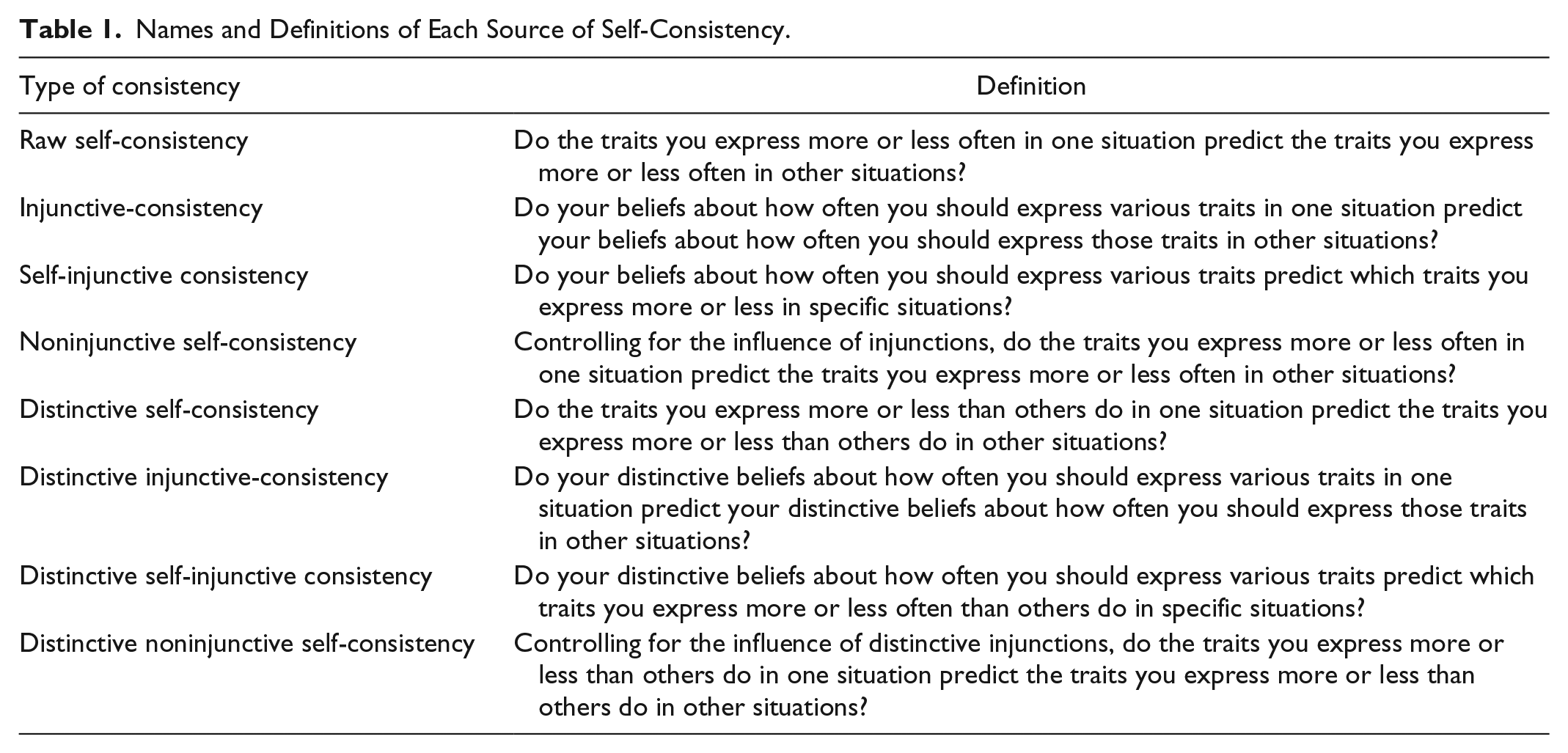
Distinctive self-consistency reflects Maria’s being more outspoken than quiet than the typical student with both her parents and her friends. Distinctive injunctive-consistency reflects consistent differences between Maria’s beliefs about how outspoken/quiet her parents/friends want her to be and those of the typical student. Distinctive self-injunctive consistency indicates how well Maria’s distinctive injunctions predict how distinctively outspoken/quiet she is. Maria’s distinctive noninjunctive self-consistency reflects her tendency to be more outspoken than quiet than the typical student with both parents and friends, independent of the influence of distinctive injunctions. When Maria’s parents or friends speak of Maria’s “personality,” they probably mean this distinctive noninjunctive self-consistency that cannot be explained by what others do or want Maria to do.
Some theories presume that the influence of social norms decreases self-consistency (Suh, 2002), but for many behaviors the opposite is true. To illustrate, imagine Maria is trying to solve a problem for her algebra class. When working on the problem alone in her room, at any one moment we may find Maria sitting or pacing, silent or cursing at her algebra book, or finding creative ways to procrastinate. While the external situation does not change, Maria’s behavior changes markedly as her internal states change. In contrast, when solving the problem with her friends or professor, then, regardless of her inner states, Maria is more apt to sit and work and less apt to pace or curse. Maria tends to express similar traits with her friends and with her professor because of—not in spite of—the social norms within each situation. Thus, removing social influences can result in people being less predictable within specific situations and thus, if different situations evoke similar norms, less consistent across situations. The broader point is that determinants of behavior that are inconsistent across situations—whether intrinsic (e.g., emotions) or extrinsic (e.g., unique task demands)—should undermine self-consistency, whereas determinants of behavior that are relatively invariant across situations—whether intrinsic (e.g., dispositions) or extrinsic (e.g., injunctions)—should enhance self-consistency.
Is Nationality Related to Self-Consistency?
In accord with trait theory—which predicts that in any culture individuals will show at least moderate self-consistency (Church, 2000)—self-consistency studies have reliably found significant (and often sizable) levels of self-consistency. Although most of these studies were conducted in the United States, some also reported data from other countries (specifically, Australia, Canada, China, England, Japan, Malaysia, Mexico, the Philippines, Singapore, and Venezuela). Unfortunately, the results of studies that compared self-consistency across countries do not paint a completely coherent picture. Three studies found more self-consistency in the United States than in an Asian country—namely, Korea (Suh, 2002), Singapore (Dunkel et al., 2010), or China (Boucher, 2011). Church et al. (2012; Church et al., 2008) likewise found that self-consistency was lower in Japan than various other countries, but some of those other countries were in Asia, and self-consistency was not low in those other Asian countries. Specifically, Church et al. (2012) and Church et al. (2008) found self-consistency in China, Malaysia, and the Philippines to be comparable to self-consistency in Australia, Mexico, the United States, and Venezuela. Likewise, Katigbak et al. (2013) found similar levels of raw self-consistency in China, the United States, Mexico, and Venezuela, and Locke, Zheng, and Smith (2010) found slightly lower self-consistency in the United States than China. To summarize, of the seven studies that compared Western countries with either Southeast Asian countries or China, one found more self-consistency in China, two found less self-consistency in Asia (i.e., China or Singapore), and four found no differences. However, all three studies that included Korea or Japan found less self-consistency in those countries than elsewhere. Collectively, these studies suggest that although self-consistency may not differ between Eastern and Western countries in general, it may be particularly low in Japan and Korea.
Several explanations have been offered for why self-consistency might be relatively low in East Asia. Each explanation implicitly predicts that only certain sources of self-consistency will be low in East Asia. Because prior studies reported only raw self-consistency, we do not know which sources of self-consistency were actually low in East Asia and thus which explanations actually received support. By differentiating sources of raw self-consistency, the current study can test these explanations more definitively.
One explanation for low self-consistency in East Asia is the influence of dialecticism (Boucher, 2011; Church et al., 2012), a conceptual framework characterized by expecting and accepting contradiction and change (Peng & Nisbett, 1999; Spencer-Rodgers, Williams, & Peng, 2010). Appreciating personality as fluid and complex may license East Asians to be less consistent in their expressions of personally defining traits, but should not reduce the influence of social norms. Thus, the specific source of self-consistency that should be reduced by dialecticism is distinctive noninjunctive self-consistency.
Another explanation is based on the premise that people from relatively individualistic Western cultures prefer to conceptualize the self as distinct from others, whereas people from relatively collectivistic Eastern cultures prefer to conceptualize the self as interdependent with others (Heine, 2001; Markus & Kitayama, 1991; Suh, 2007; Triandis, 1995). To quote Suh (2002), “It is more imperative in Western cultures to cultivate and express these stable, self-defining inner attributes than to tailor the self to fit social mandates and expectations” (p. 1379). The preceding statement suggests that people in East Asia show less self-consistency due to less distinctive noninjunctive self-consistency (i.e., express “stable, self-defining inner attributes”) and more self-injunctive consistency (“tailor the self to fit social mandates”). Note that self-injunctive consistency will reduce self-consistency only if the injunctions in different situations push behavior in divergent directions. Thus, this hypothesis implicitly assumes a lack of injunctive-consistency in East Asia. Although that assumption has not been explicitly articulated or tested, one could argue that the influence of Confucianism—which emphasizes sustaining social harmony by following rules specific to particular types of relationships—might contribute to diverging or contrasting injunctions in different situations in East Asia (Malloy, Albright, Diaz-Loving, Dong, & Lee, 2004; Yum, 1988). That is, the influence of Confucianism might reduce injunctive-consistency.
A final cultural explanation suggests that relatively low raw self-consistency in East Asia “may be due to cultural differences in self-enhancement rather than cultural differences in self-consistency” (Locke, 2006, p. 243). Specifically, if East Asians self-enhance less than Westerners (Heine & Hamamura, 2007), then they will report less self-injunctive consistency, thereby weakening the effect of consistent injunctions on reported raw self-consistency. In line with this hypothesis, Gage et al. (2015) found that compared to British natives, East Asians living in Britain for less than 5 years were less likely to consistently endorse desirable traits but more likely to consistently endorse undesirable traits, suggesting that favorable rather than consistent self-ratings underlies the cultural difference.
The preceding cultural theories each predicted cultural differences in certain sources of self-consistency and not others. Trait theory also concerns only one source of self-consistency: distinctive noninjunctive self-consistency. Trait theory expects to find significant and similar levels of distinctive noninjunctive self-consistency in any culture. Trait theory is silent regarding the influence of social norms on self-consistency because they are theoretically and statistically separable from the influence of personality dispositions. Thus, trait theory and cultural theory make divergent predictions only with respect to distinctive noninjunctive self-consistency. To test these various predictions, the current study will quantify and compare multiple distinct sources of self-consistency across nine diverse countries.
Is Well-Being Related to Self-Consistency?
Numerous studies have found a positive relationship between subjective well-being (self-esteem, life satisfaction, affect, adjustment) and self-consistency (e.g., Block, 1961; Cross et al., 2003; Diehl, Hastings, & Stanton, 2001; Donahue et al., 1993; Sheldon et al., 1997; Sherman, Nave, & Funder, 2010). However, because these studies only analyzed raw self-consistency, it remains ambiguous which sources of self-consistency were associated with well-being. The standard explanations for positive associations between well-being and self-consistency emphasize the benefits of a clear, stable, individuated personality—that is, distinctive noninjunctive self-consistency. However, other sources of self-consistency may also predict well-being. In particular, people whose traits match injunctions (i.e., who display socially appealing personalities) are apt to both show elevated self-esteem and—if injunctions are consistent across situations—elevated cross-situational consistency. Thus, the association between self-consistency and well-being may be due to self-injunctive consistency elevating both self-consistency and well-being. Indeed, Locke (2006) and Gage et al. (2015) found that while consistently denying undesirable traits predicted higher well-being, consistently endorsing undesirable traits predicted lower well-being. In other words, a consistently irreproachable personality (rather than a consistent personality per se) is what predicted well-being. Thus, another aim of the current study is to clarify the degree to which well-being is actually associated with distinctive noninjunctive self-consistency (i.e., that does not reflect conformity to social norms).
To our knowledge, only four studies have tested if the association between self-consistency and well-being generalizes across countries. First, Suh (2002) found self-consistency predicted subjective well-being in both Korea and the United States, but the association was weaker in Korea. Second, Dunkel et al. (2010) found that greater self-consistency predicted less negative affect in the United States and Singapore, with no significant cultural differences. Third, Church et al. (2008) found self-consistency predicted adjustment in the United States, Australia, Mexico, Philippines, Malaysia, and Japan, but the association was weaker in Japan. Finally, Church et al. (2014) collected new data in those same six countries as well as in China and Venezuela, and found that greater self-consistency predicted less negative affect and neuroticism in all eight countries, with no significant cultural differences. In sum, four previous studies found reliable evidence of a positive association between raw self-consistency and well-being in diverse countries, plus some inconsistent evidence that the association is weaker in Japan and Korea. The current study involving nine different countries will add to our still preliminary understanding of whether the association between self-consistency and well-being differs across cultures.
Overview of Current Study
The aim of the current study was to analyze how different sources of self-consistency—including those not attributable to social norms—relate to variables that previous studies found were associated with individual differences in raw self-consistency. The key individual difference variables were nationality and well-being, but because several previous studies reported positive associations between self-consistency and age (Daukantaitė & Thompson, 2014; Diehl et al., 2001; Diehl & Hay, 2007), we also tested for age effects. To test whether self-consistency varies by culture and region, we recruited participants from geographically and culturally distinct countries: three English-speaking “Western” countries (Australia, Canada, and the United States), three Spanish-speaking Latin American countries (Ecuador, Mexico, and Venezuela), and three East/Southeast Asian countries (Japan, Malaysia, and the Philippines). To assess and separate the sources of self-consistency, we asked participants to describe the traits they express in each of four different social situations (i.e., trait expressions) and the traits that the other people in each situation would consider desirable or appropriate for them to express (i.e., trait injunctions). Because our self-consistency estimates rely on self-reported trait expressions, they may overestimate or underestimate participants’ actual cross-situational consistency. We will return to this issue in the “Discussion” section.
Method
Participants
We limited our sample to college students, which establishes a greater degree of comparability across cultures than is readily achieved using community samples. We sampled universities whose students are reasonably representative of college students in the respective cultures. Participants were recruited from classes or participant pools and received course credit for participating. Participants had to be ≤30 years old, citizens of the country where data were being collected, and residents of that country for ≥5 years. Participants were excluded if they either skipped a questionnaire page or gave identical answers to every item on a page.
Australia
The Australian sample included 220 students (39 men, 181 women) from Murdoch University in Perth (Mage = 21.3, SD = 3.1). All year levels were represented. Their self-reported ethnicities were Anglo-Celtic or European (n = 174), Asian or Pacific Islander (n = 17), and multiracial/Other (n = 29).
Canada
The Canadian sample included 240 students (62 men, 178 women) from Wilfrid Laurier University in Waterloo (Mage = 19.0, SD = 1.6). All year levels were represented, but most were first-year students. Their ethnicities were White or Caucasian (n = 191), Asian or Pacific Islander (n = 28), Black (n = 6),and multiracial or Other (n = 15).
Ecuador
The Ecuadorian sample included 101 students (34 men, 67 women) from Pontificia Universidad Católica del Ecuador (Mage = 22.6, SD = 2.9). All year levels were represented, but approximately half were fourth-year students. Their ethnicities were Mestizo (n = 98) and White or Caucasian (n = 3).
Japan
The Japanese sample included 178 students (116 men, 62 women) from Kansai University in Osaka (Mage = 20.3, SD = 1.1). All year levels were represented, although approximately half were third-year students. Given the anticipated ethnic homogeneity of the sample, we did not ask about ethnicity.
Malaysia
The Malaysian sample included 254 students (62 men, 185 women, seven not reporting) from the National University of Malaysia in Bangi (Mage = 20.3 years, SD = 1.1). All year levels were represented, but most were second year students. Their ethnicities were Malay (n = 206), other indigenous Malaysian groups (e.g., Iban; n = 10), Chinese (n = 31), Indian (n = 6), and one unreported.
Mexico
The Mexican sample included 209 Mexican students (63 men, 146 women) from the National Autonomous University of Mexico at Iztacala (Mage = 20.2, SD = 2.0). All year levels were represented. Their self-reported ethnicities were some variant of Mestizo (n = 156), mixed/unsure (n = 42), or Other (n = 11).
Philippines
The Philippine sample included 241 students (63 men, 178 women) from De La Salle University and the University of Santo Tomas in Manila (Mage = 18.6, SD = 1.0). All year levels were represented, although approximately half were third-year students. We assessed ethnicity with an open-ended question and invited participants not to answer if they wished; most chose not to answer, but those who did described their ethnicities as Filipino (62%), Chinese (10%), and both Filipino-Chinese (13%).
United States
The U.S. sample included 230 students (73 men, 157 women) from the University of Idaho (Mage = 19.9, SD = 2.6). All year levels were represented. Their self-reported ethnicities were White or Caucasian (n = 190), Latino/Hispanic (n = 21), multiracial (n = 8), and Other (n = 11).
Venezuela
The Venezuelan sample included 209 students (80 men, 129 women) from Universidad Católica del Tachira in San Cristobal (Mage = 21.6, SD = 2.5). All year levels were represented, though over half were third-year students. Self-reported ethnicities were White or Caucasian (n = 110), Moreno (n = 86), and Other (n = 13).
Materials
Materials given to participants in Latin America and Asia were translated from English into Spanish, Filipino (Tagalog), Malaysian, or Japanese by native speakers. Following standard back-translation procedures, a different set of translators then translated the materials back into English, and minor modifications were made to the translations to resolve any discrepancies with the original materials.
Traits and injunctions
To assess traits, we asked participants how often they expressed each of 20 traits in each of four different social situations: at home with parents, at home with siblings (or other close relatives similar in age), at college with friends, at college with professors. To assess injunctions, we asked participants how often the other people in those situations would consider it appropriate for them to express each trait; for example, “when at college with your professors, how often would they consider it desirable or appropriate for you to show each of the following traits?” In total, each participant made 80 (20 Traits × 4 Situations) self-ratings and 80 injunction ratings. Participants made both self-ratings and injunction ratings on the following 7-point scale: never, almost never, less than half the time, about half the time, more than half the time, almost always, and always.
The number and type of situations sampled in the current study is similar to that in previous self-consistency studies. For example, of the 28 studies cited in the second paragraph of this article, 23 used between three and five situations, and most used the situations “with friends” and “with parents.” The particular situations sampled in the current study intentionally reflected the crossing of two dimensions familiar to undergraduate participants: home-versus-college (location) and peer-versus-authority (status). To further facilitate continuity with previous research, our trait list included the 10 traits used by English and Chen (2007), which included five positive traits (considerate, conscientious, expressive, open-minded, and patient) and five negative traits (bossy, irresponsible, lazy, moody, and picky). To make the distribution of traits more normal and representative, we also added 10 nonevaluative traits. Specifically, using existing desirability norms (Hampson, Goldberg, & John, 1987; Norman, 1967), we selected five pairs of contrasting but relatively neutral traits: casual, formal; cautious, carefree; traditional, nonconforming; mischievous, predictable; and quiet, outspoken.
Well-being
Participants completed two measures of well-being. First, they completed Rosenberg’s (1965) 10-item Self-Esteem Scale, rating each item on a 6-point scale ranging from strongly disagree to strongly agree. Across the nine countries, alphas ranged from .75 to .89 (Median = .84). Second, participants rated how much they experienced each of 10 feelings (happiness, joy, loneliness, sadness, shame, guilt, anger, irritation, worry, anxiety) during the preceding month on the following 5-point scale: very rarely or never, rarely, sometimes, often, and very often or always. To obtain a measure of overall affective valence, we averaged each participant’s 10 ratings (with negative feelings reverse-scored). Across the nine countries, αs ranged from .79 to .88 (Median = .84).
Because we will compare the associations between well-being and self-consistency across countries, we conducted multiple-group confirmatory factor analyses to evaluate the cross-cultural metric (factor loading) equivalence of the well-being measures (Church, 2010). The latent constructs were measured by three item parcels (Church, 2010; Kishton & Widaman, 1994). Both measures showed good metric equivalence across countries, as indicated by comparative fit index (CFI) values > .95 and root mean square error of approximation (RMSEA) values < .05. Specifically, constraining the factor loadings to be equal across countries, the RMSEAs for self-esteem and affect were, respectively, .039 and .016, and the CFIs were .986 and .997.
Procedure
First, participants answered demographic questions (and two general personality measures not pertinent to the current article). Second, they completed the self-esteem measure. Third, they rated their trait expressions in each situation. Fourth, they rated the injunctive norms for each situation. Finally, they completed the affect measure. All participants completed the questionnaire online except for 188 Malaysian participants who completed a printed version.
Data Analyses
Because ratings of trait injunctions and trait expressions were nested within persons, we used multilevel random coefficient models similar to those used to estimate Biesanz’s (2010) social accuracy model. To quantify raw self-consistency (how well an individual’s trait expressions in one situation predict that individual’s trait expressions in another situation, across all pairs of situations), the trait-level (Level 1) equation was the following:

where Self ijk1 and Self ijk2 are participant i’s expressions of trait j in situations k1 and k2; β0i is participant i’s mean rating across all traits and situations; β1i is participant i’s raw self-consistency coefficient; and rijk1k2 is the error in prediction for that participant, trait, and pair of situations.
The following person-level (Level 2) equation tested if β1i varied between participants as a function of nationality, age, and gender:
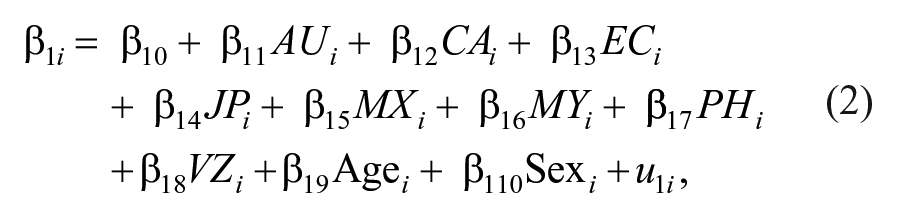
where β19 and β110 are effects of age (grand-mean centered) and gender (coded male = .5, female = −.5), β11 to β18 are effects of nationality, and u1i is the residual. 2 (An analogous equation modeled between-person variance in β0i, but for brevity, we will omit that part of the model and those results which presumably reflect response style and lack substantive implications.) Nationality was indexed by eight dummy codes. If participant i was Australian, AU was 1; otherwise AU was 0. Likewise, the other dummy codes indicated if the person was Canadian (CA), Ecuadorian (EC), Japanese (JP), Mexican (MX), Malaysian (MY), Filipino (PH), or Venezuelan (VZ). The United States was the reference or default group because most self-consistency studies have been conducted on Americans, making it most informative to know whether the results of those studies generalize to other nationalities. Thus, the β10 (slope intercept) is the estimated raw self-consistency when all Level 2 predictors are zero, corresponding to a participant of average age and U.S. nationality; β11 is the effect of being Australian versus American, β12 is the effect of being Canadian, and so on.
Estimating injunctive-consistency involved replacing trait expressions with trait injunctions as follows:

where Injunctionijk1 and Injunctionijk2 are participant i’s injunctions for trait j in situations k1 and k2. Estimating self-injunctive consistency involved changing the Level 1 model to the following:

Estimating noninjunctive self-consistency involved changing the Level 1 model to the following:

where β1i (the fixed effect of interest) is participant i’s noninjunctive self-consistency coefficient (how well i’s trait expressions in one situation predict i’s trait expressions in another situation, holding constant i’s trait injunctions for that situation).
By replacing raw ratings with distinctive ratings, the preceding models also estimated distinctive self-consistency, distinctive injunctive-consistency, distinctive self-injunctive consistency, and distinctive noninjunctive self-consistency. Distinctive traits were computed by subtracting the relevant normative rating (the mean for a particular trait x situation x country—for example, the average “bossy with parents” in Ecuador) from each raw trait rating (i.e., DistinctiveSelf ijk = Selfijk—NormativeSelf jk ). Distinctive injunctions were computed in the same way.
The models were estimated using Mplus 7.2 (Muthén & Muthén, 2014). The data and essential syntax are publicly available via the Open Science Framework at osf.io/6z4bm/. All Level 1 coefficients reflect variation in the outcome on a 1 (never) to 7 (always) scale as a function of variations on that same scale in the person-centered predictor. Statistical significance was defined as p ≤ .01. Still, given our large sample size, the power of the multilevel models to detect even small cross-level interactions reliably exceeded .90 across a variety of assumptions (computed using procedures from Spybrook, Kelcey, & Dong, 2016). Missing data were omitted (except if only one item was missing from a well-being scale, then the individual’s scale mean was computed from the remaining items).
Results
Raw Self-Consistency
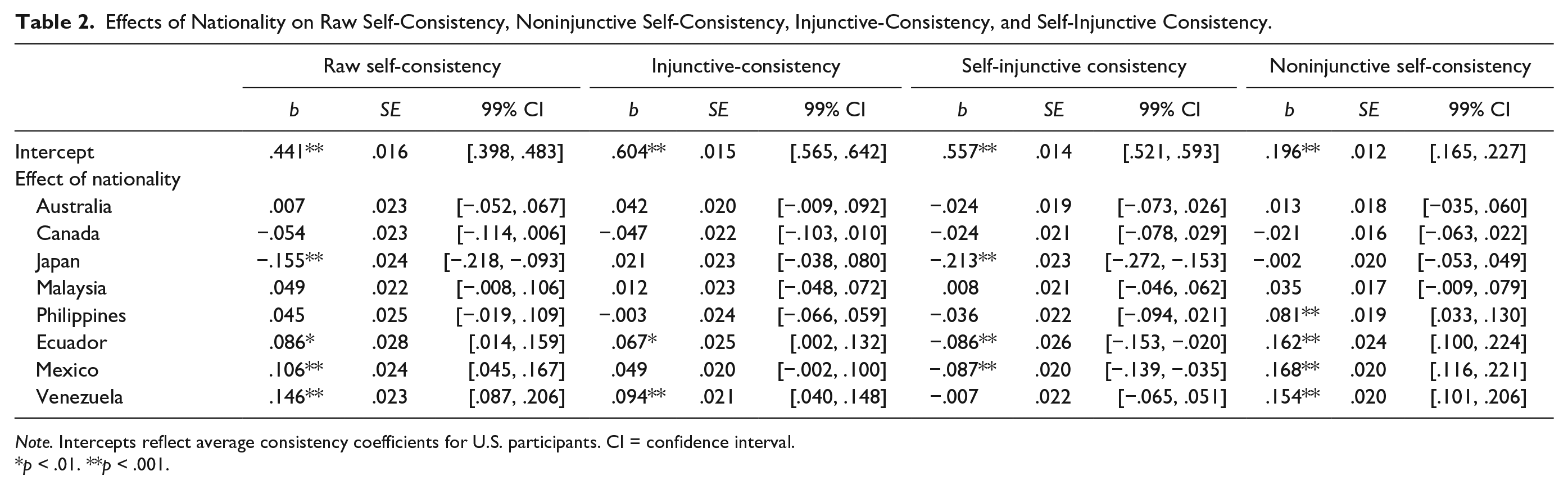
Table 2 (leftmost columns) shows the effects of nationality on raw self-consistency; Figure 1 (dark squares) plots the corresponding estimated raw self-consistency coefficient for each country. The intercept in Table 2 indicates that in the United States, a one-scale-unit difference in trait expression in one situation predicted a 0.44-scale-unit difference in trait expression in other situations. Nationality moderated raw self-consistency. To facilitate interpretation, all tables and figures display the results for English-speaking countries first, Asian countries second, and Latin American countries third. Raw self-consistency tended to be high in Latin America (especially Venezuela) and relatively low in the English-speaking countries (especially Canada), but the outlier was Japan, where self-consistency was lower than in any other country. Nonetheless, as Figure 1 shows, raw self-consistency was positive and strong in every country. Even in Japan, the traits individuals expressed in one situation predicted the traits they expressed in other situations.
Effects of Nationality on Raw Self-Consistency, Noninjunctive Self-Consistency, Injunctive-Consistency, and Self-Injunctive Consistency.
Note. Intercepts reflect average consistency coefficients for U.S. participants. CI = confidence interval.
p < .01. **p < .001.
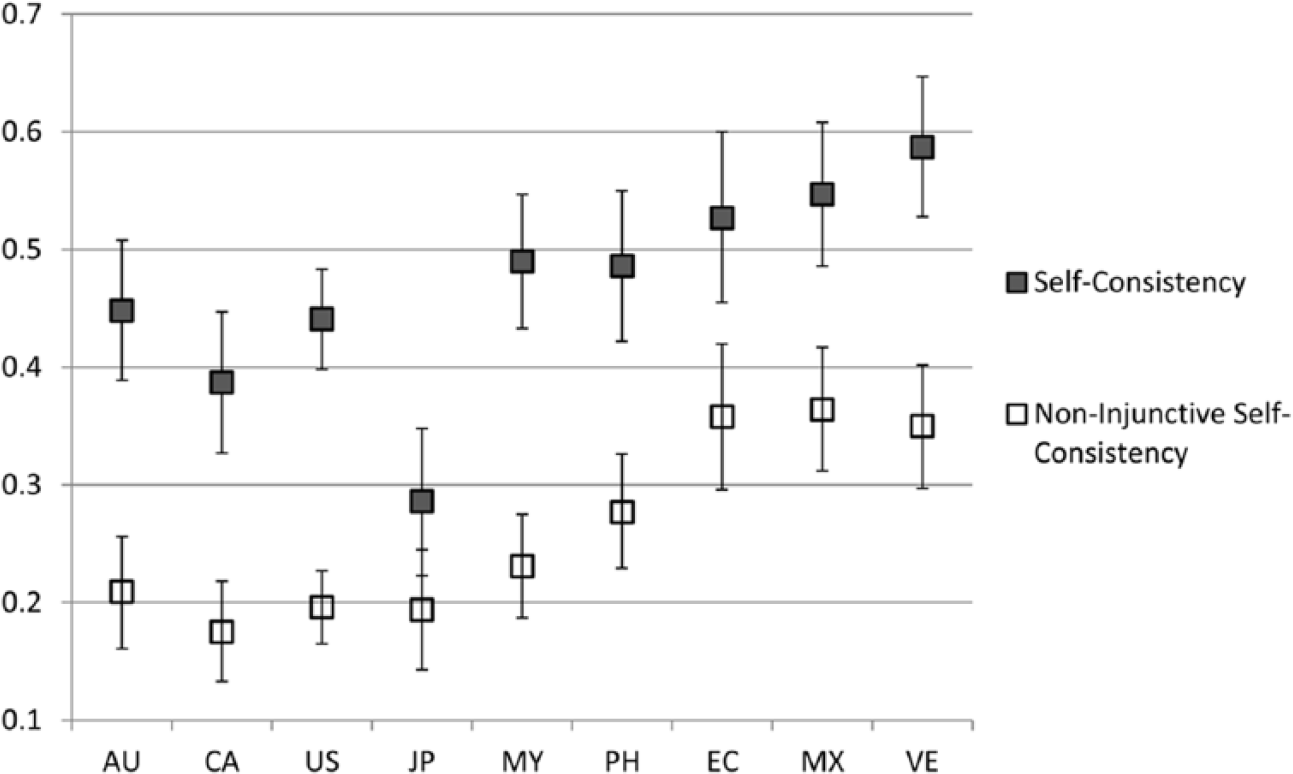
Raw self-consistency and noninjunctive self-consistency as a function of nationality.
Injunctive-Consistency
Injunctive-consistency indicates how well an individual’s injunctions for one situation predict that individual’s injunctions for other situations. Table 2 (center-left columns) shows that injunctive-consistency was very strong—and stronger than self-consistency—in every country. Injunctive-consistency tended to be higher in Latin America than elsewhere, but the impact of nationality on injunctive-consistency was weaker than its impact on self-consistency, and there were no differences in injunctive-consistency among the English-speaking and Asian countries.
Self-Injunctive Consistency
Self-injunctive consistency indicates how well an individual’s trait injunctions predict that individual’s trait expressions within a particular situation. Table 2 (center-right columns) shows that trait injunctions strongly predicted trait expressions in every country. For example, the intercept indicates that in the United States, a one-scale-unit difference in injunctions for expressing various traits predicted a 0.56-scale-unit difference in expressing those traits within a particular situation. Nonetheless, self-injunctive consistency did differ between countries: It was relatively low in Ecuador and Mexico, and uniquely low in Japan.
Noninjunctive Self-Consistency
Noninjunctive self-consistency reflects the consistency of trait expressions across situations, controlling for the effect of trait injunctions. Table 2 (rightmost columns) shows the effects of nationality on noninjunctive self-consistency, and Figure 1 (light squares) plots the corresponding estimated noninjunctive self-consistency coefficient for each country. Controlling for the influence of injunctions reduced self-consistency in every country, but the reductions were greater where injunctions had more influence. Because the impact of injunctions was weakest in Japan, the reduction was smallest in Japan. Thus, in contrast to raw self-consistency, noninjunctive self-consistency was not lower in Japan than in the English-speaking or other Asian countries.
Distinctive Self-Consistency
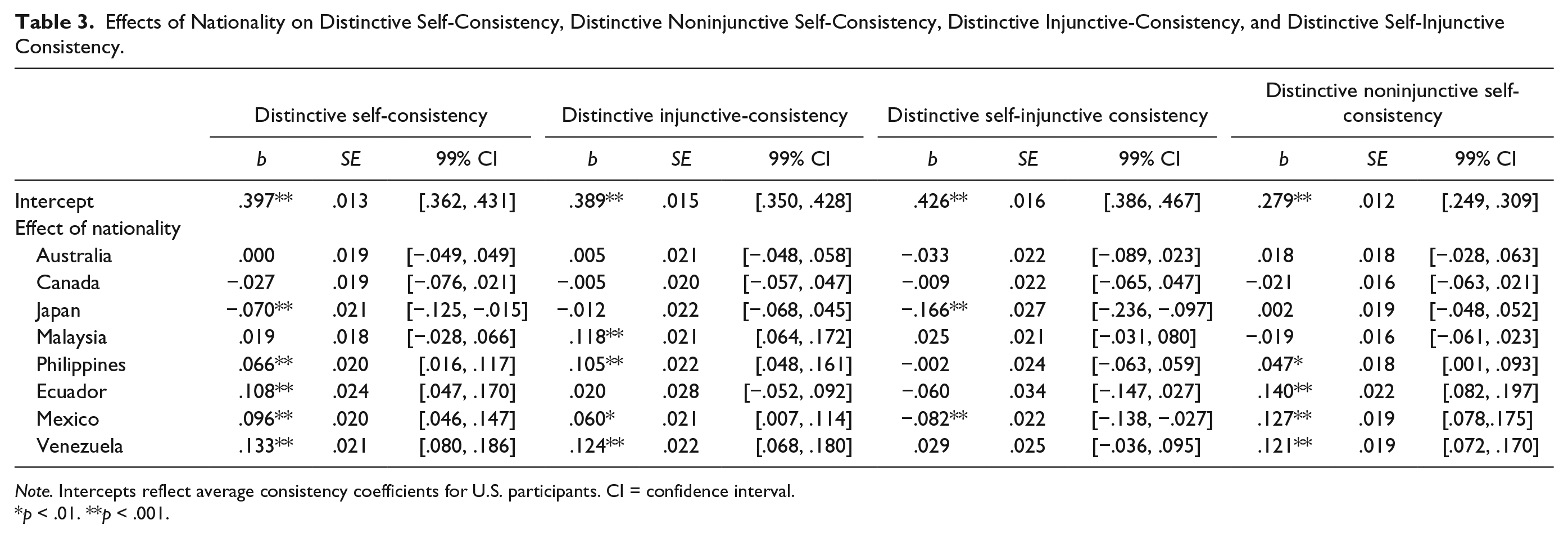
Distinctive self-consistency reflects consistently expressing some traits more and other traits less than others do. Table 3 (leftmost columns) shows the effects of nationality on distinctive self-consistency, and Figure 2 (dark circles) plots the corresponding estimated distinctive self-consistency coefficient for each country. Distinctive self-consistency was greater in the Philippines and Latin America (especially Venezuela) and lower in Japan than in the United States. Nonetheless, distinctive self-consistency remained positive and strong in every country, including Japan. Thus, the distinctive self-consistency results roughly mirrored the raw self-consistency results.
Effects of Nationality on Distinctive Self-Consistency, Distinctive Noninjunctive Self-Consistency, Distinctive Injunctive-Consistency, and Distinctive Self-Injunctive Consistency.
Note. Intercepts reflect average consistency coefficients for U.S. participants. CI = confidence interval.
p < .01. **p < .001.
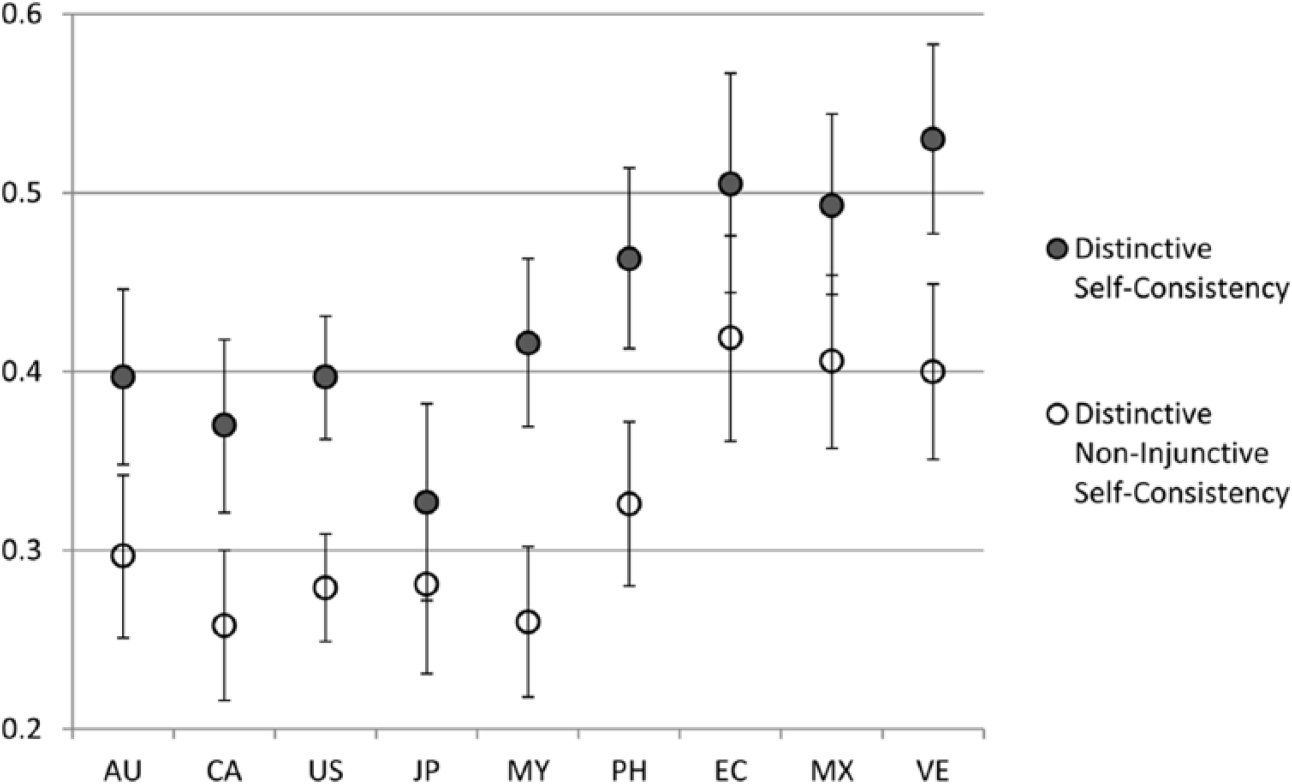
Distinctive self-consistency and distinctive noninjunctive self-consistency as a function of nationality. Error bars show the 99% confidence interval around each mean.
Distinctive Injunctive-Consistency
Distinctive injunctive-consistency reflects the cross-situational consistency of a person’s distinctive injunctions. Table 3 (center-left columns) shows that distinctive injunctive-consistency was strong everywhere, and strongest in the Philippines, Malaysia, Mexico, and Venezuela. However, distinctive injunctive-consistency was always much weaker than raw injunctive-consistency (e.g., compare intercepts in Tables 2 and 3), suggesting that consistent normative injunctions (culturally shared beliefs that certain traits are more appropriate than others across situations) are the main source of raw injunctive-consistency, with consistent distinctive injunctions (that differ from cultural norms) playing a smaller role.
Distinctive Self-Injunctive Consistency
Distinctive self-injunctive consistency indicates how well an individual’s distinctive trait injunctions predict that individual’s distinctive trait expressions. Mirroring the results for raw self-injunctive consistency, Table 3 (center-right columns) shows that distinctive self-injunctive consistency was relatively low in Mexico and lowest in Japan. People everywhere typically believed their traits deviated from average in ways that made them better than average (i.e., the estimated distinctive self-injunctive consistency coefficients were positive in every country); however, compared with individuals from other countries, Japanese individuals were much less apt to report that their distinctive trait levels reflected socially appropriate trait levels.
Distinctive Noninjunctive Self-Consistency
Distinctive noninjunctive self-consistency reflects the consistency of distinctive trait expressions across situations, controlling for the effect of an individual’s distinctive injunctions. Table 3 (rightmost columns) shows the effects of nationality on distinctive noninjunctive self-consistency, and Figure 2 (light circles) plots the corresponding estimated consistency coefficient for each country. Controlling for the effect of distinctive injunctions reduced distinctive self-consistency, with greater reductions in countries where distinctive injunctions had more influence on trait expression. Because distinctive injunctions had the least effect in Japan, the reduction was smallest (and nonsignificant) in Japan, leaving the residual distinctive noninjunctive self-consistency in Japan comparable with that in Malaysia and the English-speaking countries.
Consistency and Well-Being
To test whether consistency was related to well-being, we added self-esteem or affective valence (standardized across participants) as a Level 2 predictor to the above analyses. Both measures yielded similar results. Self-esteem and affect had very strong positive associations with raw self-consistency (bs = .083 and .077, SEs = .006, 99% CIs = [.066, .099] and [.063, .091]) and self-injunctive consistency (bs = .076, SEs = .006 and .005, 99% CIs = [.060, .091] and [.062, .089]), all ps < .001. Controlling for the effect of injunctions, noninjunctive self-consistency showed considerably weaker associations with self-esteem and affect (bs = .027 and .018, SEs = .005, 99% CIs = [.013, .041] and [.006, .030], ps < .001). Distinctive consistency yielded analogous findings. Self-esteem and affective valence had strong positive associations with distinctive self-consistency (bs = .033 and .031, SEs = .006 and .005, 99% CIs = [.019, .047] and [.019, .044]) and distinctive self-injunctive consistency (bs = .039 and .051, SEs = .007 and .006, 99% CIs = [.021, .057] and [.036, .067]), ps < .001. Controlling for the effect of injunctions, distinctive noninjunctive self-consistency showed considerably weaker associations with self-esteem and affect (bs = .022 and .012, SEs = .005, 99% CIs = [.008, .035] and [.001, .024], ps < .01).
Thus, the link between well-being and self-injunctive consistency largely explained the link between well-being and both raw and distinctive self-consistency. However, the residual association between noninjunctive self-consistency and well-being remained significant: Consistency was associated with well-being even when the trait levels being consistently expressed were not the most appropriate.
Figure 3 displays the estimated simple slopes for raw, noninjunctive, distinctive, and distinctive noninjunctive self-consistency as a function of individuals’ self-esteem and affective valence. Figure 3 highlights several patterns. First, self-esteem and affect yielded similar results. Second, controlling for normative or injunctive sources of self-consistency greatly reduced the associations between self-consistency and well-being (with normative and injunctive influences being largely redundant with each other). Third, among people low in well-being, trait injunctions were less predictive of trait expressions; consequently, controlling for the influence of injunctions had little impact on their self-consistency.
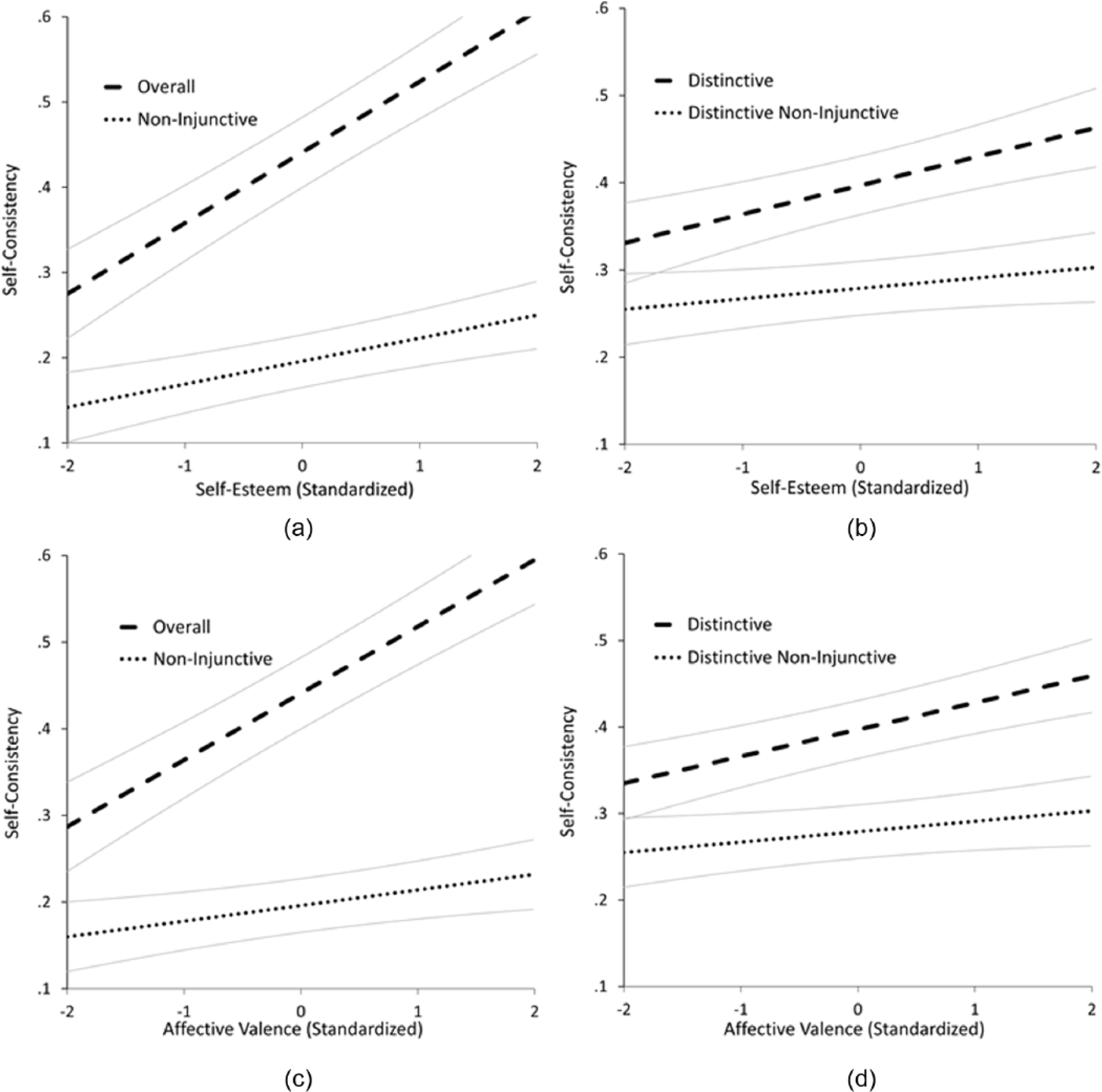
Total raw, noninjunctive, distinctive self-consistency, and distinctive noninjunctive self-consistency as a function of self-esteem (a and b) or affective valence (c and d).
To test whether nationality moderated the associations between self-consistency and well-being, we added to the above analyses the interactions between nationality and self-esteem or affective valence. Only two effects were significant: Self-esteem was a stronger predictor of raw self-consistency (b = .070, SE = .026, 99% CI = [.002, .138]) and self-injunctive consistency (b = .083, SE = .026, 99% CI = [.016, .151]) in Malaysia. Controlling for the effect of injunctions, the effect of self-esteem on noninjunctive self-consistency was no longer stronger in Malaysia (b = .012, SE = .023). Thus, an unusually strong link between self-esteem and self-injunctive consistency in Malaysia explained the unusually strong link between self-consistency and self-esteem.
Age and Gender
All analyses included age and gender as covariates. Here we briefly summarize the effects of age and gender (controlling for effects of nationality). Gender was unrelated to any type of self-consistency. 3 Age had significant positive associations with raw, noninjunctive, and distinctive noninjunctive self-consistency (bs = .012, .009, .006; SEs = .003, .002, and .002; 99% CIs = [.006, .019], [.003, .015], and [.000, .012]), but only marginal associations with distinctive self-consistency (b = .005, SE = .002, 99% CI = [−.001, .011]). (These unstandardized regression coefficients reflect the average change in self-consistency due to a 1-year increment in age.) Age also predicted greater raw self-injunctive consistency (b = .007, SE = .002, 99% CI = [.001, .014]), but not distinctive self-injunctive consistency (b = .000, SE = .002). Collectively, these results suggest that self-consistency increases with age in part because participants’ trait profiles become more culturally normative with age.
Discussion
Raw self-consistency conflates consistency due to individuating dispositions with consistency due to social norms. The current study aimed to separate these psychologically distinct sources of self-consistency and test their unique associations with nationality and well-being. Before considering the influence of individual differences, though, we first review the findings that held true across diverse individuals and cultures.
General Findings
First, both raw and distinctive self-consistency were clearly evident in every country: The traits individuals expressed in one situation predicted the traits they expressed in other situations. Second, there was also sizable raw and distinctive injunctive-consistency in every country: Individuals’ beliefs about the traits more/less appropriate for one situation predicted their beliefs about the traits more/less appropriate for other situations.
Third, there was significant self-injunctive consistency in every country. Raw self-injunctive consistency was expected: It is well known that the more socially desirable a trait, the more people report showing that trait (Edwards, 1953). It is also well known that profiles of traits and trait desirability share sizable normative components (Wood & Furr, 2016); therefore, what is more interesting is that, after extracting the normative components, people everywhere still showed distinctive self-injunctive consistency. Whether distinctive trait injunctions shaped distinctive trait expressions or vice versa, most individuals believed that their idiosyncrasies—the ways they deviated from average—enhanced their social desirability. Locke and Horowitz (1997) also compared individuals’ judgments of trait desirability with average judgments of trait desirability derived from normative samples and found that individuals judged traits they thought they possessed as more desirable—and traits they lacked as less desirable—than did the average person. The current study replicated this pattern across diverse countries.
Fourth, because conformity to consistent injunctions enhanced self-consistency, controlling for self-injunctive consistency reduced both raw and distinctive self-consistency; nonetheless, there remained robust residual raw and distinctive noninjunctive self-consistency in every country. Distinctive noninjunctive cross-situational self-consistency—attributable to neither descriptive nor injunctive social norms—presumably reflects stable internal dispositions. As people everywhere display these “personality” dispositions, it is not surprising that people across diverse cultures spontaneously use trait terms to describe themselves and others (del Prado et al., 2007).
Nationality
We will organize our discussion of effects of nationality around the results for Latin America (Ecuador, Mexico, and Venezuela) and Japan because these countries produced the most distinctive results and Japan has been a central focus of the cultural psychology literature.
Latin America
Latin Americans had the highest levels of raw, distinctive, noninjunctive and distinctive noninjunctive self-consistency. Latin Americans’ elevated self-consistency could not be explained by elevated conformity to social norms. Interestingly, a similar but weaker pattern of results characterized the Philippines, which—like Ecuador, Mexico, and Venezuela—experienced centuries of Spanish colonial influence.
Although we did not predict these findings, they accord with previous suggestions that the Latin American cultural norm of simpatía may contribute to relatively high levels of self-consistency across different situations—at least social situations involving ingroup members—because “interaction styles brewed in the family environment spill over into the realms of friends and acquaintances” (Diaz-Loving & Draguns, 1999, p. 111). In accord with this hypothesis, a study comparing Mexico and China found that agreement between friends and family regarding an individual’s traits was greater in Mexico than China, suggesting that the traits individuals expressed with friends and with family were more consistent in Mexico (Malloy et al., 2004). On the contrary, three previous studies that assessed self-consistency across multiple countries (using methodologies similar to those used in the current study) did not find greater self-consistency in Latin America (Church et al., 2012; Church et al., 2008; Church et al., 2013). Therefore, the current finding of greater self-consistency in Latin America should be interpreted cautiously; nonetheless, we hope that it encourages further study of Latin America, a relatively neglected region in literature on how culture shapes the self.
Japan
Replicating previous research (Church et al., 2012; Church et al., 2008), we found less raw self-consistency in Japan than in other countries. Every proposed explanation of low self-consistency in East Asia implicitly makes predictions about certain sources of self-consistency and not others. By separating these potential sources of raw self-consistency, the current study tested these predictions.
One explanation is that East Asians are less consistent due to the cultural influence of Confucianism, which prescribes injunctions specific to particular types of relationships (Malloy et al., 2004; Yum, 1988); thus, trait expressions will vary across situations because trait injunctions vary across situations. Our results did not support this hypothesis because injunctive-consistency was not below average in Japan. An interrelated hypothesis is that East Asians are less consistent because they are more responsive to social expectations (Suh, 2007). Again, our results do not support this hypothesis because injunctions were consistent across situations in Japan, in which case responsiveness to social expectations should increase self-consistency.
Instead, our results support the opposite hypothesis: In Japan, trait expressions are less consistent across situations because within situations, trait expressions are less consistent with trait injunctions. In short, self-consistency was low because self-injunctive consistency was low. After removing the contribution of injunctions, noninjunctive self-consistency was not lower in Japan than in Malaysia or English-speaking countries. This finding contradicts influential explanations of cultural differences in self-consistency that imply that culture specifically shapes distinctive noninjunctive self-consistency. One such explanation is that Western cultures teach people to conceptualize themselves as distinct and independent of social roles, whereas East Asian cultures teach people to conceptualize themselves as interdependent and defined by specific roles and relationships (Heine, 2001; Markus & Kitayama, 1991). Another cultural explanation is that Western cultures teach people to conceptualize themselves as stable and coherent, whereas East Asian cultures teach people to conceptualize themselves as fluid and inconsistent (Spencer-Rodgers et al., 2010). Both explanations predict that individuals shaped by Western more than Eastern cultures will show more distinctive noninjunctive self-consistency (i.e., dispositions that do not simply mirror social norms).
Indeed, distinctive noninjunctive self-consistency provides the critical test between the predictions of these two popular cultural theories and the predictions of trait theory. Trait theory predicts that individual differences in stable personality dispositions will be evident within any culture (Church, 2000), independent of the influence of social norms. In contrast, the cultural theories predict that personality dispositions will be weaker or undetectable in Eastern cultures. Because we found distinctive noninjunctive self-consistency to be clearly evident in every culture, with no differences between the English-speaking countries and Asian countries, our data offer stronger support for trait theory than for the cultural theories.
Well-Being
In accord with Church et al. (2014), we found strong positive associations between raw self-consistency and well-being across diverse countries. However, we found equally strong associations between well-being and self-injunctive consistency: The more people believed their actions fulfilled social expectations, the better they felt and the better they felt about themselves. Moreover, in accord with Locke (2006) and Gage et al. (2015), the association between well-being and self-injunctive consistency was largely responsible for the association between well-being and self-consistency. However, even after removing normative and injunctive sources of consistency, distinctive noninjunctive self-consistency continued to show positive associations with well-being. The latter finding supports the theoretical arguments for the benefits of consistency because it suggests that greater well-being is also associated with consistently behaving in ways that are not the most typical or socially appropriate.
Although some researchers have suggested that self-consistency predicts adjustment more strongly in individualistic than collectivistic cultures (Bleidorn & Kodding, 2013), that was not true in our data. However, one caveat is that we assessed hedonic well-being (self-esteem and affective valence), not eudaimonic well-being (experiencing one’s life as meaningful and self-actualizing). Church et al. (2014) found that whereas culture did not moderate associations between self-consistency and hedonic well-being, associations between self-consistency and eudaimonic well-being were stronger in individualistic than collectivistic cultures. Church et al. only examined raw self-consistency, but it could be informative to examine how different sources of self-consistency relate to eudaimonic well-being. For example, distinctive noninjunctive self-consistency (dispositions that do not conform to social norms) in particular may explain the stronger association between eudaimonic well-being and self-consistency in individualistic cultures.
Age
Three previous studies that examined age differences in self-consistency found that raw self-consistency increased with age throughout early adulthood (Daukantaitė & Thompson, 2014; Diehl et al., 2001; Diehl & Hay, 2007). The current study also found positive associations between age and self-consistency in early adulthood, and in a more culturally diverse sample. Older participants were more consistent largely because their trait expressions were more culturally normative (and normative profiles correlate highly across situations). Nonetheless, after removing the normative component from self-ratings, a weak association remained between age and distinctive self-consistency, suggesting that dispositional tendencies to express certain traits more or less than average also increase with age, and, thus, also contribute to age differences in raw self-consistency. Because our participants were young adults, additional research is needed to elucidate whether and how normative self-consistency and distinctive self-consistency change during other periods of life.
Limitations
The generalizability of a study depends on its sampling of persons, materials, and cultures. Because we deliberately limited our sample to university students 30 years old or younger, our findings may not generalize to other populations. For example, university students may be more individualistic and cosmopolitan than is typical, especially in countries with low rates of college attendance. Moreover, no self-consistency studies—including ours—have included participants from Africa or Central or South Asia; data from these regions may yield informative surprises. A related caveat is that magnitudes of within-person cross-situational consistency coefficients depend on the particular situations, traits, and scales a particular study uses (Funder, 2009; Leikas, Lönnqvist, & Verkasalo, 2012). The current study deliberately used generic situations familiar to students from any culture; altering the psychological similarity or specificity of the situations would undoubtedly alter the magnitude of the consistency coefficients (Furr & Funder, 2004; Sherman et al., 2010). Finally, the current study relied on self-reports, which—as explained below—can introduce systematic biases.
Accuracy and Bias
Self-reports reflect a mixture of accuracy and bias (Vazire & Carlson, 2010). Lacking a measure of accuracy (e.g., behavioral observations or peer ratings), the current study cannot determine the degree to which participants’ self-reports—and thus their consistency coefficients—were accurate or biased (Leising, Locke, Kurzius, & Zimmerman, 2016). However, past research suggests that our participants’ self-ratings were at least somewhat accurate. For example, Ching et al. (2013) obtained self-reports of traits expressed “in general” and in specific social situations before using event-contingent interaction records to assess trait-relevant experiences in those social situations over a 2-week period. Ching et al. found that self-reports of situation-specific traits (like those used in the current study) predicted actual experiences in those situations quite well, and better than did self-reports of global traits (like those used in most studies of accuracy). Moreover, the ability of situation-specific traits to predict naturalistic experiences was similar across the five countries studied (China, Japan, Malaysia, Mexico, and the United States), which gives some confidence that in our study, self-report accuracy—however imperfect—probably did not differ significantly across countries.
Because we deliberately made the measures of trait injunctions and trait expressions as similar as possible, various sources of shared method variance (e.g., response styles, item order) may have contributed to self-injunctive consistency. More importantly, these same sources of method variance will also contribute to raw self-consistency. Consequently, controlling for the variance trait ratings share with injunction ratings should control for these sources of method variance, thus mitigating the impact of common method variance on estimates of noninjunctive self-consistency.
The principal source of method variance in the current study was evaluative bias. The consistency of any type of rating will increase to the degree that raters share similar evaluative biases and items share similar evaluative implications (Leising, Scherbaum, Locke, & Zimmerman, 2015). In the case of self-ratings, a consistent bias to self-enhance—by exaggerating how often one expresses desirable traits or how rarely one expresses undesirable traits—can inflate self-consistency; consequently, individual differences in self-enhancement may contribute to differences in self-consistency (Locke, 2006). For example, self-enhancement tends to be elevated among individuals with elevated well-being (Taylor & Brown, 1988) but low among Japanese individuals (Heine & Hamamura, 2007), which could explain why nationality and well-being predict raw self-consistency (Gage et al., 2015; Locke, 2006).
The evaluations of behavior that the assessment literature calls social desirability and conceptualizes as a source of response bias that undermines validity are roughly equivalent to what the sociological and social psychological literature calls injunctive norms and conceptualizes as a source of social influence essential for group functioning. Of course, both perspectives are correct: Injunctions influence what people do and what people say they do. People inflate how often they express desirable traits and how rarely they express undesirable traits, but they also, in reality, do express desirable traits (e.g., polite) more than undesirable ones (e.g., rude).
Methodologically, social injunctions are typically measured by asking people what others would consider desirable for you to do, whereas social desirability is typically measured by asking people what you would consider desirable for others to do (Edwards, 1953); however, in reality, they overlap considerably. For example, when people evaluated a set of traits similar to those used in the current study, the average profile correlation between ratings of “how desirable do you think [each trait] is” and ratings of “how desirable most people think [each trait] is” was .88 (Locke, Craig, Zheng, & Gohil, 2012, Study 5). Thus, by controlling for the influence of trait injunctions on trait expressions, noninjunctive self-consistency should be largely unaffected by social desirability. To summarize, while self-consistency research will certainly benefit from cross-cultural studies of actual behavior, the above considerations suggest that the impact of response styles and method variance on the current findings was circumscribed.
Conclusion
The trait expressions that characterize a “good” or “normal” person are quite consistent across situations; therefore, simply being good (consistent with injunctive norms) or normal (consistent with descriptive norms) within situations increases consistency across situations. However, even controlling for consistency arising from being good or normal, most individuals show distinctive noninjunctive self-consistency, presumably reflecting global personality dispositions.
Previous studies found raw self-consistency to be positively associated with well-being and age, and to be relatively low in Japan. The current study not only replicated these findings but also found that each of these variables showed a different pattern of associations with different sources of raw self-consistency. Japanese nationality predicted lower self-consistency because it predicted lower self-injunctive consistency. Well-being predicted greater self-consistency because it was associated with both greater self-injunctive consistency and greater noninjunctive self-consistency. Age predicted greater self-consistency because it predicted greater fidelity both to social norms and to one’s own distinctive dispositions.
Although previous studies only assessed raw self-consistency, their actual hypotheses typically concerned distinctive noninjunctive self-consistency. Precisely testing those hypotheses—or any hypotheses regarding the causes, correlates, and consequences of self-consistency—requires separating the sundry sources of self-consistency that remain intertwined in indices of raw self-consistency. Although specific hypotheses inevitably focus on specific sources of self-consistency, no single source is necessarily more important or authentic. Normative, distinctive, injunctive, and noninjunctive influences are all meaningful sources of cross-situational self-consistency because within any situation, as social individuals, we are responsive both to social norms and to our distinctive dispositions.
Footnotes
Acknowledgements
The authors thank Takako Grimm, Xiu Hui Pook, and Azucena Dominguez Urruzola for translation assistance.
Declaration of Conflicting Interests
The author(s) declared no potential conflicts of interest with respect to the research, authorship, and/or publication of this article.
Funding
The author(s) received no financial support for the research, authorship, and/or publication of this article.
Supplemental Material
The supplemental material is available online.
Notes
References
Supplementary Material
Please find the following supplemental material available below.
For Open Access articles published under a Creative Commons License, all supplemental material carries the same license as the article it is associated with.
For non-Open Access articles published, all supplemental material carries a non-exclusive license, and permission requests for re-use of supplemental material or any part of supplemental material shall be sent directly to the copyright owner as specified in the copyright notice associated with the article.
