




Abstract
Psychological essentialism entails a focus on category boundaries (e.g., categorizing people as men or women) and an increase in the conceptual distance between those boundaries (e.g., accentuating the differences between men and women). Across eight studies, we demonstrate that essentialism additionally entails an increase in support for boundary-enhancing legislation, policies, and social services, and that it does so under conditions that disadvantage social groups, as well as conditions that benefit them. First, individual differences in essentialism were associated with support for legislation mandating that transgender people use restrooms corresponding with their biological sex, and with support for the boundary-enhancing policies of the 2016 then-presumptive Republican presidential nominee (i.e., Donald Trump). Second, essentialism was associated with support for same-gender classrooms designed to promote student learning, as well as support for services designed to benefit LGBTQ (lesbian, gay, bisexual, transgender, queer) individuals. These findings demonstrate the boundary-enhancing implications of essentialism and their social significance.
Psychological essentialism is the belief that members of certain categories share an innate, immutable, inductively potent, and unobservable “essence” (Gelman, 2003; Medin, 1989; Rothbart & Taylor, 1992). Natural kinds are good illustrations: Apple seeds planted in cornfields will grow into apples and not corn, gold may change in appearance from dusty nuggets to polished coins but will always remain gold, and dogs dressed up as cows will bark and not moo (Gelman & Wellman, 1991; Keil, 1989). Social categories (e.g., gender, nationality, race) are often essentialized as well: Boys raised in an all-female environment are expected to grow up to play with trucks and not dolls, immigrants are believed to be more similar to people of the nation in which they were born than to people of the nation in which they were raised, and a person with one Black and one White parent is believed to be Black and not White (Haslam, Rothschild, & Ernst, 2000; Ho, Roberts, & Gelman, 2015a; Smiler & Gelman, 2008). In the present research, we tested whether essentialism entailed support for boundary-enhancing legislation, policies, and services that increased the distance between social groups. More specifically, we tested whether essentialism corresponded to support for legislation that mandated people to use facilities based on their biological sex (Study 1), a Presidential candidate who emphasized group-based boundaries and isolationist policies (Studies 2A and 2B), same-gender classrooms (Studies 3A and 3B), and LGBTQ (lesbian, gay, bisexual, transgender, queer) counseling services (Studies 4A-4C). Before turning to these studies, we briefly review research on some of the key elements of essentialism.
Essentialism entails the belief that certain categories, including social categories such as those based on race, gender, and ethnicity, are objective and natural, indicative of fundamental within-group similarities and between-group differences, stable across time, and useful for making deep inferences about people—and that these objective and natural categories have unobservable causal essences (Gelman, 2003; Haslam & Whelan, 2008; Meyer, Leslie, Gelman, & Stilwell, 2013; Prentice & Miller, 2007; Rhodes & Mandalaywala, 2017; Rothbart & Taylor, 1992; Yzerbyt, Corneille, & Estrada, 2001). For example, people who believe that gender differences are innate (rather than learned) often believe that men and women differ in their appearances, personalities, interests, and responsibilities (Frable & Bern, 1985; Martin & Parker, 1995). Indeed, fathers who hold essentialist views about gender often spend less time caring for their children, likely because they believe child care to be a mother’s natural responsibility (Gaunt, 2006). People high in racial essentialism often use race to group people together, and struggle to conceptualize others (or themselves) as having multiple cultural identities (e.g., Asian and American; Chao, Chen, Roisman, & Hong, 2007; Chao, Hong, & Chiu, 2013). Moreover, they believe that those categories will exist across time and cultures (e.g., that the same types of racial categories will always be used to classify people; Haslam et al., 2002), and they use those categories to make inferences and stereotypical judgments about people (Williams & Eberhardt, 2008). For example, the belief that sex differences are rooted in biology often leads to the endorsement and acceptance of stereotypes about women (Coleman & Hong, 2008). Essentialism can also contribute to prejudice (Mandalaywala, Amodio, & Rhodes, in press), such that people tend to devalue and dehumanize social groups that reflect a “lower status essence” (see also Haslam et al., 2002; Keller, 2005; for research on how these elements of essentialism develop with age, see Diesendruck, Goldfein-Elbaz, Rhodes, Gelman, & Neumark, 2013; Hirschfeld, 1995; Rhodes & Gelman, 2009a; Rhodes & Mandalaywala, 2017; Roberts & Gelman, 2016, 2017b; Shutts, Pemberton, & Spelke, 2013; Taylor, Rhodes, & Gelman, 2009).
Another core aspect of essentialism is the process of treating categorical boundaries as dichotomous and immutable, rather than continuous and flexible (for a review of boundary intensification, see exGelman, 2003, pp. 67-74). As an analogy, consider the well-known research on the categorical perception of speech sounds (Harnad, 1987). When people hear the sounds pa and ba, they perceive the boundary between them as absolute (i.e., each sound is either completely pa or completely ba) rather than graded (i.e., somewhat pa and somewhat ba), despite graded variation in the acoustic signal. Similar effects appear with people’s reasoning about categories. For example, artifact categories (e.g., clothing, tools), which are not typically essentialized, are treated as graded in their typicality (e.g., a belt is a more atypical clothing item than a shirt) and categorized in graded terms (e.g., a belt is only sort of a clothing item; Rhodes & Gelman, 2009b). Natural categories (e.g., birds, fish), on the contrary, which are typically essentialized, are treated as graded in their typicality (e.g., a flamingo is a more atypical bird than a robin), but are nonetheless categorized in absolute terms (e.g., a flamingo is completely a bird; Diesendruck & Gelman, 1999; Rhodes & Gelman, 2009b). Similarly, despite the reality that genes only probabilistically correspond to racial categories, people report that Black and White people have nonoverlapping distributions of genes (Christensen, Jayaratne, Roberts, Kardia, & Petty, 2010). Furthermore, in the United States, people with both Black and White parentage are often categorized as primarily Black rather than as equally Black and White (Ho, Kteily, & Chen, 2017; Ho, Sidanius, Levin, & Banaji, 2011). Even preschoolers categorize people in absolutes, believing that social categories demarcate objectively distinct “kinds” of people (Diesendruck et al., 2013; Rhodes & Gelman, 2009a, 2009b), and under certain conditions, categorize Multiracial children as Black (Roberts & Gelman, 2015, 2017a), suggesting that the tendency to treat essentialized categories as dichotomous is early-emerging.
One manifestation of the tendency to treat categorical boundaries as dichotomous and immutable, first identified by Rothbart and Taylor (1992), is an accentuation of categorical boundaries, which we refer to as boundary enhancement. That is, not only does essentialism entail the process by which graded distributions of features are simplified into dichotomous categorical representations (e.g., categorizing people as men or women; Gelman, 2003), it additionally entails the process of increasing the separation of, and conceptual distance between, categories (e.g., exaggerating the differences between men and women; Rothbart & Taylor, 1992). In the present research, we hypothesized that if essentialism generates boundary enhancement, it should also generate support for boundary-enhancing initiatives, as doing so would justify and maintain an essentialist worldview.
Prior work provided some evidence of boundary enhancement, as conceptualized above. First, Williams and Eberhardt (2008) found that White Americans who endorsed essentialist beliefs about race were more likely to accept racial inequalities and less interested in interacting with racial outgroup members. Second, Bastian and Haslam (2008) found that Australian people who endorsed essentialist beliefs, especially those who identified strongly as Australians, perceived Asian immigrants as homogeneous (within-group similarity) and different from native-born Australians (between-group differences). Furthermore, they showed greater anti-immigrant prejudice and more negative attitudes toward services designed to help immigrants integrate into mainstream culture. Bastian and Haslam also found that Asian immigrants, to the extent they engaged in essentialist reasoning, were more likely to separate themselves from the Australian majority. Third, Pehrson, Brown, and Zagefka (2009) found that British participants high in essentialism and national identification showed greater prejudice toward asylum seekers, and supported political groups that actively opposed asylum seekers. Together, these studies provided preliminary evidence that essentialism entails support for boundary-enhancing initiatives.
The Present Research
The present research provides a broader and more systematic test of the boundary-enhancing consequences of essentialist beliefs, and differs from prior work in two notable ways. First, whereas prior work focused on boundary enhancement with regard to anti-Black and anti-immigration attitudes, we examined a broader range of social categories (e.g., gender, nation states, and sexual orientation), thereby providing insight into the extent to which these processes extend across various social categories. Second, previous research focused on how empowered groups (e.g., White Americans, native-born citizens) disadvantaged stigmatized groups (i.e., Black Americans, immigrants), thereby leaving unclear the extent to which boundary enhancement operates independently of motives intended to disadvantage low-power groups. For example, White Americans and native-born citizens may oppose Black Americans and immigrants as a means to maintain and reinforce the extant system of intergroup hierarchy and inequality (Ho et al., 2015a, 2015b, 2012), or to justify the status quo (Jost, Banaji, & Nosek, 2004; Mandalaywala et al., in press). Here, we tested whether essentialism entailed boundary enhancement even under conditions in which stigmatized groups would benefit rather than suffer (i.e., when the hierarchical status quo is disrupted).
In total, we conducted eight studies. First, we tested the relation between essentialism and boundary enhancement, when boundary enhancement results in negative consequences for stigmatized social groups. Specifically, in Study 1, we tested whether participants high in essentialism were more likely to support North Carolina’s “Bathroom Bill” (General Assembly of North Carolina, 2016), which mandated that people, including those who self-identified as transgender, used public restrooms and facilities that corresponded to their natal sex. In Studies 2A and 2B, we examined whether participants high in essentialism were more likely to support 2016 U.S. Presidential candidate Donald Trump prior to the election, a candidate who espoused a number of divisive policies (e.g., building a wall along the Mexico–U.S. border, limiting trade with China, restricting immigrants from entering the United States). Next, we tested whether essentialism related to support for a boundary-enhancing initiative that did not clearly disadvantage a stigmatized social group. That is, in Studies 3A and 3B, we examined whether participants high in essentialism showed greater support for same-gender classrooms intended to improve the learning environment for both female and male students. In the final set of studies, we tested whether essentialism was positively related to support for boundary-enhancing initiatives that benefitted, rather than disadvantaged, a stigmatized social group. Specifically, in Studies 4A and 4B, we tested whether participants high in essentialism showed greater support for LGBTQ counseling services. Then, in Study 4C, we tested whether experimentally priming essentialist beliefs (compared to debunking them or not introducing any prime) caused increased support for LGBTQ counseling services. All materials and data are publicly available in the online supplemental materials (OSM) via the Open Science Framework (https://osf.io/4qbuw/).
Study 1
Transgender individuals identify with a gender that does not correspond with their natal sex, thus challenging the belief that gender boundaries are fixed and immutable (Dunham & Olson, 2016). One way that people with essentialist beliefs might react when confronted with those who are transgender is to support legislation that reinforces the notion that gender is objectively defined and discrete (i.e., to create greater distance between men and women, or engage in boundary enhancement). To test this, we examined whether individual differences in essentialism were associated with support for North Carolina’s Public Facilities Privacy and Security Act (of 2016), which mandated that people, including those who are transgender, use only public restrooms and facilities that correspond with the sex listed on their birth certificate. Henceforth we refer to this as the “Bathroom Bill” (as it was popularly called). If essentialism entails boundary enhancement, we predict that it should also entail support for legislation that reinforces the distance between men and women.
Method
Participants
Participants were U.S. adults (N = 107; Mage = 28.65, SD = 5.82; 49% female, 49% male, 1% transgender, 1% agender; 67% White/European American, 11% Black/African American, 10% Asian/Asian American, 8% Latino/Hispanic, 2% Multiracial, and 2% Native American; 45% completed some college, 35% bachelor’s degree, 11% high school diploma or less, and 10% partial completion or completion of a graduate or professional degree). Across all studies, sociodemographic information (e.g., age, gender, race) was participant-supplied, and all participants were recruited via Amazon’s Mechanical Turk. Across all studies, we report all excluded observations and all independent and dependent variables. Our a priori goal was to have roughly 100 participants per condition/study (with the exception of 4C, which was a large-scale preregistered experiment).
Materials and procedure
Participants first completed a 23-item measure of essentialism (e.g., “Everyone is either a certain kind of person or they are not,” “The kind of person someone is can largely be attributed to their genetic inheritance”; see Bastian & Haslam, 2006). On each item, participants indicated their agreement on a 7-point scale (1 = strongly disagree, 7 = strongly agree; α = .82). Next, participants were told that we were also interested in their opinions on social issues, and they then read the following description:
North Carolina’s General Assembly recently passed a law that directed all public schools, college campuses, and government agencies to require that every multiple-occupancy bathroom or changing facility (e.g., school restroom, locker room, changing room, or shower room) be used only by people based on their biological sex (i.e., the physical condition of being male or female, which is stated on a person’s birth certificate). This law requires that transgender people use the bathroom that corresponds to the gender on their birth certificate.
After reading the description of the Bill, participants were asked to share their reactions, which were coded into three types: Opposition (given by 61% of the sample: for example, “I think it’s stupid and discriminatory,” “This law is silly and I don’t understand why we have segregated bathrooms”), Support (given by 29% of the sample: “Our gender is determined at birth. That is the gender you are and that is the gender that determines which bathroom you should use,” “The whole reason we even have men and women restrooms is to be separated from the other sex . . .”), and Other (given by 8% of the sample: “I’m not sure what to think,” “I can see both sides of the issue”). The open-ended responses were coded by two research assistants who were blind to the hypotheses of the study and all other participant data (Cohen’s kappa = .95). Disagreements were resolved by discussion. Next, participants were asked four questions that assessed their support for the Bathroom Bill: (a) Do you support this law? (b) Should every state adopt a law like this? (c) Is it wrong for people to use a bathroom that doesn’t correspond with their biological sex? (d) Should transgender people be allowed to use any bathroom they feel comfortable with? [reverse-coded]. Participants responded on a 7-point scale (1 = definitely no, 7 = definitely yes). These four items showed excellent reliability (α = .95) and were averaged to create an index of Bathroom Bill support (M = 3.52, SE = .11). All data were collected in the spring of 2016.
Results and Discussion
First, we examined whether essentialism was positively related to participants’ support for the Bathroom Bill in their open-ended reactions (participants coded into the “other” category were not included in this analysis). Consistent with our hypothesis, a binomial logistic regression including participants who expressed clear support or opposition to the law (n = 98) showed that essentialism was associated with being more than twice as likely to indicate support for the Bathroom Bill in the open-ended responses (odds ratio = 2.27, B = .82, SE B = .38, χ2 = 4.76, p = .029, 95% CI of B = [0.08, 1.56], CI of the odds ratio = [1.09, 4.74]). Next, a correlational analysis with essentialism and support for the Bathroom Bill revealed a positive relation (r = .24, p = .006), and a hierarchical regression showed that this relation held even after controlling for education level, B = .44, SE B = .17, β = .24, t = 2.55, p = .012, ∆R2 = .06, 95% CI of B = [0.10, 0.79]. Thus, using two distinct indices of support for the Bathroom Bill, we found that essentialism was related to support for legislation that reinforced gender-based boundaries, demonstrating a powerful way that essentialism relates to real-world attitudes.
Study 2A
Next, we hypothesized that people high in essentialism may support a political candidate who reifies social group boundaries (i.e., who engages in boundary enhancement). To test this, we examined whether participants high in essentialism-supported Donald Trump, the then-presumptive Republican presidential nominee in the spring of 2016, who proposed several divisive, ethnicity-based, and isolationist positions and statements (e.g., making Mexico build and finance a wall along the southern U.S. border).
Method
Participants
Participants were a new group of U.S. adults (N = 109; Mage = 28.82, SD = 5.66; 53% male, 46% female, and 1% transgender; 75% White/European American, 9% Asian/Asian American, 7% Latino/Hispanic, 4% Multiracial, 3% Black/African American, and 1% Native American; 36% some college, 36% bachelor’s degree, 21% partial completion or completion of a graduate or professional degree, and 8% high school diploma or less).
Materials and procedure
Participants first completed the same essentialism measure as in Study 1 (α = .85). Next, participants were told that they would be shown some of Donald Trump’s political positions, and asked to indicate the degree to which they agreed or disagreed with each position. Participants were then shown seven political positions, one at a time and in random order, that were taken verbatim from Trump’s official campaign website (Trump, 2016): (a) Getting Mexico to pay for the U.S.–Mexican border (i.e., Pay for the Wall) 1 ; (b) Repealing the Affordable Care Act–Obamacare (i.e., Health care reform); (c) Through smart negotiations, challenging China to live up to its obligations (i.e., U.S.–China Trade Reform); (d) Addressing corruption and incompetence in the Department of Veterans Affairs (i.e., Veterans Administration Reforms); (e) Increase domestic jobs for middle class families through a tax plan (i.e., Tax Reform); (f) Keeping the right to bear arms (i.e., Second Amendment Rights); and (g) Prioritizing U.S. needs over the needs of other nations (i.e., Immigration Reform). For each position, participants indicated their agreement on a 7-point scale (1 = strongly disagree, 7 = strongly agree). These positions showed strong reliability (α = .88) and were averaged to create an index of position agreement (M = 4.46, SE = .15). Last, participants were asked how likely they were to vote for Trump to become the next U.S. President (1 = very unlikely, 7 = very likely; M = 3.07, SE = .23). All data were collected in the spring of 2016.
Results and Discussion
As predicted, essentialism was positively related with position agreement (r = .19, p = .02), even after controlling for education level, B = .46, SE B = .20, β = .22, t = 2.31, p = .023, ∆R2 = .05, 95% CI of B = [0.07, 0.86]. Regarding intent to vote for Trump, essentialism was positively related (r = .17, p = .038), and showed a nonsignificant tendency after controlling for education level, B = .60, SE B = .31, β = .19, t = 1.91, p = .058, ∆R2 = .03, 95% CI of B = [−0.02, 1.23]. Overall, these data demonstrated that essentialism was related to support for a Presidential candidate who emphasized boundary-enhancing positions, thereby demonstrating further the real-world implications of essentialist beliefs.
Study 2B
Given Trump’s affiliation with the Republican Party, political conservatism may be strongly related to support for his candidacy. Prior results indicate that essentialism relates to conservatism (Rhodes & Gelman, 2009a), raising the possibility that the relation between essentialism and support for Trump’s positions may simply reflect a link between political conservatism and intention to support a conservative candidate. We therefore conducted an additional study in which we attempted to replicate the results of Study 2A, controlling for political conservatism.
Method
Participants
A new group of U.S. adults was recruited (N = 105; 47% female, 53% male, Mage = 28.88, SD = 5.49; 75% White/European American, 11% Asian/Asian American, 7% Black/African American, 5% Latino/Hispanic, 2% Multiracial, and 1% Other; 46% bachelor’s degree, 34% some college, 14% graduate or professional degree, and 7% high school diploma or less).
Materials and procedure
Participants first completed the same essentialism measure (α = .88) and items assessing support for Trump (α = .87) as in Study 2A. Participants were also given a two-item measure of their political attitudes and beliefs (i.e., “In terms of economic [social] issues, how would you describe your political attitudes and beliefs?” 1 = very liberal, 7 = very conservative, r = .83, p < .001). All data were collected in the spring of 2016.
Results and Discussion
Correlations and descriptives can be found in Table 1. Our central question was whether essentialism was related to both position support and intent to vote. Regarding position support, essentialism was positively related (r = .29, p = .003), even after controlling for both conservatism and education level, B = .38, SE B = .15, β = .21, t = 2.60, p = .011, ∆R2 = .04, 95% CI of B = [0.09, 0.66]. Regarding voting for Trump, essentialism was also positively related (r = .21, p = .035), but not when controlling for conservatism and education level, B = .28, SE B = .21, β = .11, t = 1.33, p = .19, ∆R2 = .01, 95% CI of B = [−0.14, 0.71]. Thus, although the relations between essentialism and voting intentions were not significant after controlling for conservatism and education level, 2 the relation between essentialism and support for Donald Trump’s policies did remain significant, providing evidence converging with Studies 1 to 2A.
Study 2B: Correlations and Descriptives of All Study Measures, Including Support for Trump’s Boundary-Enhancing Policies, and the Intent to Vote for Him in the 2016 Presidential Election.
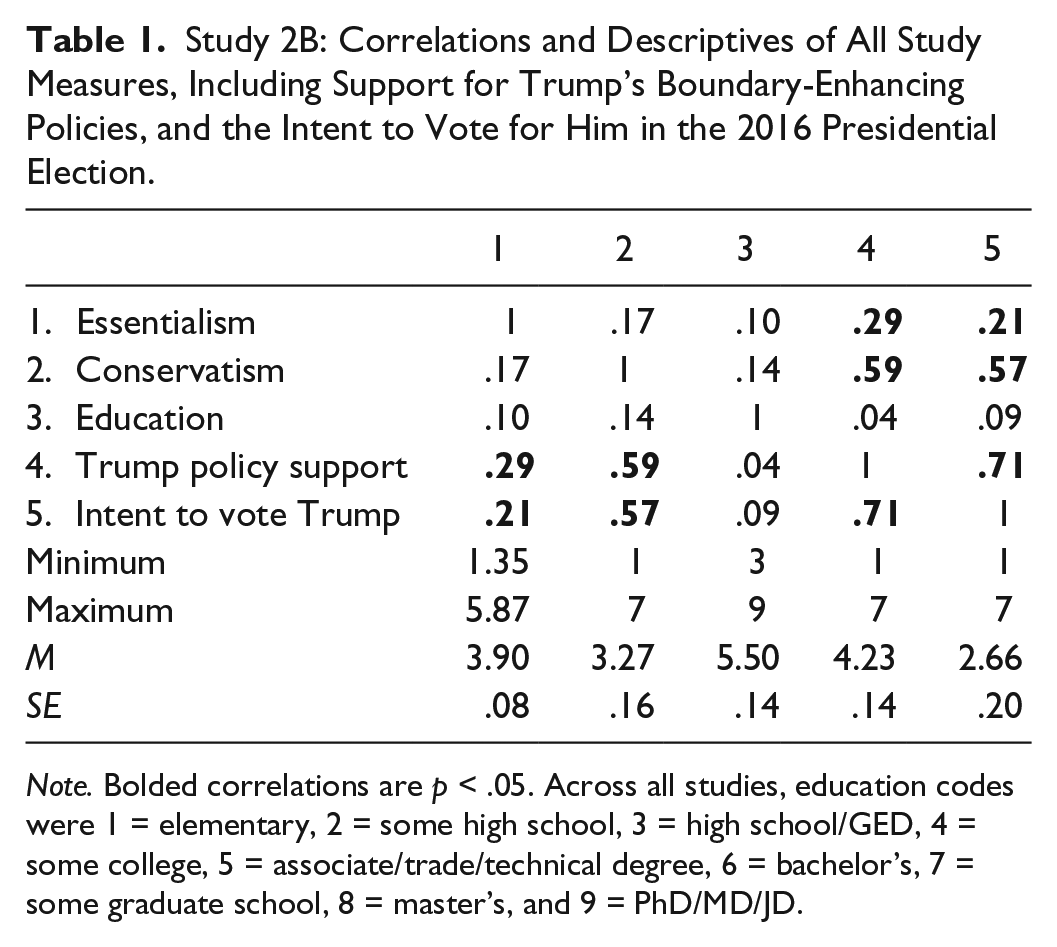
Note. Bolded correlations are p < .05. Across all studies, education codes were 1 = elementary, 2 = some high school, 3 = high school/GED, 4 = some college, 5 = associate/trade/technical degree, 6 = bachelor’s, 7 = some graduate school, 8 = master’s, and 9 = PhD/MD/JD.
Interim Discussion
Thus far, the current studies provide converging evidence for the proposition that psychological essentialism contributes to boundary-enhancing initiatives. Notably, though, in the previous studies, we focused on how empowered groups (i.e., samples that were cisgender, predominantly White Americans) reasoned about stigmatized groups (e.g., policies affecting transgender people and immigrants). Because of this, what remained unclear was whether these relations would hold outside of conditions designed to disadvantage stigmatized groups (i.e., essentialism may have simply led empowered groups to distance themselves from less powerful groups; see also Bastian & Haslam, 2006; Pehrson et al., 2009). If essentialism does indeed increase the conceptual distance between groups, it should do so even outside of such conditions. That is, essentialism should be associated with accentuating the distance between groups (i.e., boundary enhancement), even when doing so does not disadvantage stigmatized social groups. We tested this possibility in Studies 3A to 4C.
Study 3A
Gender is a highly essentialized category, among both children and adults (Bastian & Haslam, 2006; Rhodes & Gelman, 2009a; Roberts & Gelman, 2017c; Taylor et al., 2009), and Study 1 in the present research demonstrated that essentialist beliefs entailed boundary enhancement in terms of support for legislation that disadvantaged transgender people. In Study 3A, we tested whether essentialism entails boundary enhancement even in a context that does not clearly disadvantage a stigmatized social group. Specifically, we tested whether people who express greater essentialist beliefs would show greater support for same-gender classrooms designed to improve educational outcomes for boys and girls, thereby supporting gender-based segregation.
Critically, support for same-gender classrooms can be viewed in competing ways, as either disadvantaging women or as furthering the academic achievement of both men and women (for reviews, see Bigler & Signorella, 2011; Pahlke & Hyde, 2016). For example, some people support same-gender classrooms to maintain and perpetuate differences between men and women, and indeed, some findings suggest that same-gender classrooms disadvantage women more than men. Yet others believe that same-gender classrooms support fundamental intellectual and emotional differences between men and women, or that they prevent gender-based discrimination, and that they are therefore useful for promoting the academic achievement of all students (see also Crosby et al., 1994). Thus, unlike support for the Bathroom Bill, or for Trump’s boundary-enhancing policies, which more clearly disadvantage stigmatized groups, support for same-gender classrooms can stem from motives meant either to disadvantage or to benefit students. Study 3A tested whether essentialist thinking had boundary-enhancing consequences even in this more ambiguous context.
Method
Participants
Participants were a new group of U.S. adults (N = 103; 56% female, 44% male, Mage = 31.73, SD = 8.89; 79% White/European American, 8% Latino/Hispanic, 7% Black/African American, 4% Asian/Asian American, 1% Native American, and 1% Other; 39% some college, 38% bachelor’s degree, 11% partial completion or completion of a graduate or professional degree, and 13% high school diploma or less).
Materials and procedure
Participants first completed the same essentialism measure as in Studies 1 to 2B (α = .84). Next, participants were told that we were also interested in their opinion on current social research, and then they read a fictitious article about the effectiveness of same-gender classrooms (see Appendix A for the full article). Participants were then asked to share their reactions, which were coded into three types: Opposition (given by 36% of the sample: for example, “Genders should never be kept separate from each other!” “I disagree because it assumes that males and females are only interested in certain subjects”), Support (given by 48% of the sample: “ . . . schools should definitely approve this approach to learning,” “ . . . this is a solid idea as it can keep gender issues out and focus on learning and growing”), and Other (given by 16% of the sample: “hmmm . . . interesting,” “This approach could work for some, but will never work for everyone”). The open-ended responses were coded by two research assistants who were blind to the hypotheses of the study and all other participant data (Cohen’s kappa = .82). Disagreements were resolved by discussion. Following this, participants answered four questions that assessed their support for same-gender classrooms: (a) Do you support same-gender classrooms? (b) Should school districts provide same-gender classrooms as options? (c) Is it wrong for parents to want same-gender classrooms for their children? [reverse-coded], and (d) Should students be allowed to enroll in same-gender classrooms if that is what they feel most comfortable with? Participants responded on a 7-point scale (1 = definitely no, 7 = definitely yes). These items showed excellent reliability (α = .90) and were averaged to create an index of support for same-gender classrooms. Participants were then given the same two-item measure of political attitudes and beliefs as those used in Study 2B (r = .85, p < .001). All data were collected in the fall of 2016.
Results and Discussion
See Table 2 for all correlations and descriptives of study measures. There were no significant gender differences, so the data were collapsed over this variable. We first examined whether essentialism was associated with support for same-gender classrooms, as indicated in participants’ open-ended responses (excluding participants who were coded into the “other” category). A binomial logistic regression including participants who expressed support or opposition (n = 87) showed that essentialism was not significantly associated with being more likely to indicate support for same-gender classrooms in the open-ended responses (odds ratio = 1.84, B = .61, SE B = .34, χ2 = 3.27, p = .071, 95% CI of B = [−0.06, 1.27], 95% CI of the odds ratio = [0.95, 3.54]. Counter to our expectation, essentialism was not significantly related to support for same-gender classrooms (bivariate r = .15, p = .13; controlling for conservatism and education, B = .23, SE B = .15, β = .15, t = 1.50, p = .14, ∆R2 = .01, 95% CI of B = [−0.07, 0.53]). These data did not support the prediction that general essentialist beliefs about social groups relate to attitudes toward same-gender classrooms. In Study 3B, we tested whether a more precise measure of the relevant essentialist beliefs—essentialist beliefs about gender in particular—might contribute to these beliefs.
Study 3A: Correlations and Descriptives of all Study Measures, Including Support for Same-Gender Classrooms.

Note. Bolded correlations are p < .05.
Study 3B
Method
Participants
A new group of U.S. adults was recruited (N = 100; 38% female, 60% male, 1% unlabeled, 1% queer, Mage = 31.35, SD = 7.09; 77% White/European American, 8% Latino/Hispanic, 6% Asian/Asian American, 6% Black/African American, and 3% Multiracial; 40% some college, 37% bachelor’s degree, 11% partial completion or completion of a graduate or professional degree, and 11% a high school diploma or less).
Materials and procedure
Participants first completed a 23-item measure of essentialism that was adapted from Bastian and Haslam (2006) to be gender specific (e.g., “A person is either a male or a female,” “A person’s gender can be largely attributed to their genetic inheritance”; 1 = strongly disagree, 7 = strongly agree; α = .93). Next, participants read the same fictitious article as in Study 3A and were then asked to share their reactions, which were again coded into three types: Opposition (given by 40% of the sample), Support (given by 45% of the sample), and Other (given by 15% of the sample). These open-ended responses were coded by two independent coders who were blind to the hypotheses of the study and all other participant data (Cohen’s kappa = .94). Disagreements were resolved by discussion. Following this, participants answered the same four questions used in Study 3A (α = .90), which were again averaged to create an index of support for same-gender classrooms. Last, participants were given the same two-item measure of political attitudes and beliefs as those used in Studies 2B and 3A (r = .71, p < .001). All data were collected in the fall of 2016.
Results and Discussion
Correlations and descriptives of study measures can be found in Table 3. Again, there were no significant gender differences, so the data were collapsed over this variable. 3 We first examined whether essentialism was associated with support for same-gender classrooms, as indicated in participants’ open-ended responses (excluding participants who were coded into the “other” category). As expected, a binomial logistic regression including only those who expressed clear support or opposition (n = 85) showed that gender essentialism was associated with being more than twice as likely to indicate support for same-gender classrooms in the open-ended responses (odds ratio = 2.14, B = .76, SE B = .24, χ2 = 9.85, p = .002, 95% CI of B = [0.29, 1.23], 95% CI of the odds ratio = [1.33, 3.43]). Next, we found that essentialism was positively related to support for same-gender classrooms (r = .35, p < .001), even after controlling for conservatism and education, B = .47, SE B = .16, β = .33, t = 2.94, p = .004, ∆R2 = .10, 95% CI of B = [0.15, 0.79]. Thus, as predicted, using two distinct indices of support for same-gender classrooms, we found that gender essentialism was related to support for separating boys and girls into separate classrooms to promote learning for everyone, thereby providing further support for the link between essentialism and boundary enhancement even outside of conditions that clearly disadvantaged social groups.
Study 3B: Correlations and Descriptives of all Study Measures, Including Support for Same-Gender Classrooms.

Note. Bolded correlations are p < .05.
Study 4A
Study 4A focused on beliefs regarding sexual orientation. As with the prior studies, we predicted that essentialism would be associated with lead to support for boundary-enhancing positions. However, in contrast to the prior studies, we predicted that essentialist beliefs about sexual orientation would be associated with lead to support for initiatives that would clearly benefit (rather than disadvantage) members of a minority group (here, gay men and lesbian women). Our logic was as follows: Because essentialist beliefs about sexual orientation are associated with more positive attitudes and tolerance toward gay men and lesbian women (if homosexuality is innate and immutable, the belief that it is a sinful perversion that can be “corrected” becomes invalidated; Haslam & Levy, 2006; Haslam & Whelan, 2008; Hegarty & Pratto, 2001), we predicted that essentialist beliefs about sexual orientation would be positively associated with support for a boundary-enhancing initiative that furthered, rather than disadvantaged, gay men and lesbian women. To test this, we examined whether essentialist beliefs about sexual orientation were associated with support for LGBTQ counseling services that helped gay men and lesbian women understand their sexual experiences and embrace their sexual identity. Thus, unlike in the previous studies, Studies 4A to 4C examined the association between essentialism and boundary enhancement in an unambiguously progressive context that empowered a stigmatized social group.
Previous research suggests that progressive beliefs about homosexuality are associated with beliefs about innateness, immutability, and universality (i.e., that it exists in all cultures and historical periods), whereas prejudice against homosexuality is associated with the belief that it is a discrete category (i.e., that it is fundamentally different and distinct from heterosexuality; see Haslam & Levy, 2006). Because of this, in Studies 4A and 4B, we focused on the factors of innateness, immutability, and universality; in contrast, we did not examine participants’ beliefs about the discreteness of sexual orientation, as we had an a priori theoretical reason to believe that concepts of discreteness would be associated with oppression rather than support of LGBTQ people (Haslam & Whelan, 2008; Hegarty & Pratto, 2001).
Method
Participants
Given our a priori interest in how privileged groups supported stigmatized groups, we focused only on participants who self-identified as heterosexual, and excluded from the analyses all participants who identified other than heterosexual (e.g., asexual, bisexual, pansexual, demisexual; 15 in Study 4A, 15 in Study 4B, 212 in Study 4C). Participants in Study 4A were a new group of U.S. adults (N = 108; 49% female, 51% male, Mage = 32.77, SD = 8.44; 78% White/European American, 8% Black/African American, 6% Asian/Asian American, 4% Latino/Hispanic, 3% Multiracial, 1% Native American, and 1% Other; 48% some college, 30% bachelor’s degree, 17% partial completion or completion of a graduate or professional degree, and 6% a high school diploma or less).
Materials and procedure
Participants first completed a 10-item measure that assessed their essentialist beliefs about sexual orientation (e.g., “People cannot change their sexual orientation,” “Sexual orientation is caused by biological factors,” “In all cultures, there are people who consider themselves homosexuals”; see Haslam & Levy, 2006). On each item, participants indicated their agreement on a 7-point scale (1 = strongly disagree, 7 = strongly agree; α = .88). Next, participants were told that we were also interested in their opinion on current social issues, and they then read the following:
The University of North Carolina’s LGBTQ Task Force supports, provides, and fully funds counseling services that help gay men and lesbian women understand their sexual experiences and feel secure in their sexual orientation.
Participants were then asked to share their reactions to this Task Force, which were coded into three types: Opposition (given by 8% of the sample: for example, “I think the money could be better spent on issues that aren’t caused by the situations people choose to put themselves into,” “I think it is a waste of valuable resources”), Support (given by 83% of the sample: “I support their effort, but only if they are not attempting to change a person’s orientation or provide conversion therapy,” “I think it’s a great thing to help create more equality”), and Other (given by 9% of the sample: “I don’t have an agreeable or disagreeable feeling,” “I don’t care. Does not have anything to do with me or my life since I am not related to those type of people”). These open-ended responses were coded by two independent coders who were blind to the hypotheses of the study and all other participant data (Cohen’s kappa = .92), with disagreements resolved by discussion.
Next, participants answered four questions that assessed their support for the LGBTQ Task Force: (a) Do you support the mission of this Task Force? (b) Should every university have a Task Force like this? (c) Is it wrong for university counselors to provide services that help gay men and lesbian women? [reverse-coded], (d) Should government agencies fund counseling services that promote the LGBTQ community? Participants responded on a 7-point scale (1 = definitely no, 7 = definitely yes). These items showed strong reliability (α = .87) and were averaged to create an index of support for the LGBTQ Task Force. Participants were then given the same two-item measure of political attitudes and beliefs as those used previously (r = .73, p < .001). Because religiosity is a strong predictor of anti-homosexual attitudes (Hicks & Lee, 2006), we included a one-item measure of religiosity (i.e., “Do you consider yourself religious, 1 = no, not at all, 7 = yes, very much”) that was also used in previous research on the essentialism of sexual orientation (Haslam & Levy, 2006). All data were collected in the fall of 2016.
Results and Discussion
See Table 4 for the correlations and descriptive statistics of all study measures. Because only a few participants expressed opposition to the Task Force in their open-ended responses, we did not analyze those data further. Regarding the survey items, as predicted, essentialist beliefs about sexual orientation were positively related to support for the LGBTQ Task Force (r = .55, p < .001), even after controlling for education level, conservatism, and religiosity, B = .57, SE B = .11, β = .46, t = 5.26, p < .001, ∆R2 = .18, 95% CI of B = [0.36, 0.79]. Overall, these data demonstrated that essentialism was related to support for a LGBTQ Task Force, thereby demonstrating further the boundary-enhancing consequences of essentialism, even outside of contexts designed to disadvantage stigmatized social groups.
Study 4A. Correlations and Descriptives of All Study Measures, Including Support for the LGBTQ Task Force.

Note. Bolded correlations are p < .05. LGBTQ = lesbian, gay, bisexual, transgender, queer.
Study 4B
Given that essentialist beliefs about sexual orientation, as measured in Study 4A, are associated with pro-gay attitudes (Haslam & Levy, 2006; Hegarty & Pratto, 2001), it is possible that the relation between essentialism and LGBTQ support could simply reflect an association between pro-gay attitudes and intention to support members of the LGBTQ community. To test this, we conducted an additional study in which examined whether essentialism related positively to LGBTQ support, even after controlling for attitudes toward gay men and lesbian women.
Method
Participants
Participants were a new group of heterosexual U.S. adults (N = 100; 49% female, 51% male, Mage = 31.23, SD = 7.89; 68% White/European American, 13% Asian/Asian American, 9% Latino/Hispanic, 7% Black/African American, and 3% Native American; 41% some college, 28% bachelor’s degree, 19% partial completion or completion of a graduate or professional degree, and 12% high school diploma or less).
Materials and procedure
Participants first completed the same essentialism measure as in Study 4A (α = .79), read the short excerpt on the LGBTQ Task Force, and were then asked to share their reactions, which were coded into three types: Opposition (10%), Support (76%), and Other (14%). These data were coded by two independent coders who were blind to the hypotheses of the study and all other participant data (Cohen’s kappa = .87). Disagreements were resolved by discussion. Next, participants were given the four-item scale assessing support for the LGBTQ Task Force (α = .82), which was averaged to create an index of support for the LGBTQ Task Force, followed by a 10-item measure of attitudes toward lesbians and gay men (e.g., “I think lesbians/male homosexuals are disgusting,” “Female/male homosexuality is a perversion”; Herek, 1997). Responses were coded on a 7-point scale (1 = strongly disagree, 7 = strongly agree; α = .94), and averaged to create an index of anti-homosexual attitudes. Last, as in Study 4A, participants completed the two-item measure of political attitudes and beliefs (r = .79, p < .001), and one-item measure of religiosity. All data were collected in the fall of 2016.
Results
Correlations and descriptives of all study measures can be found in Table 5. Again, because only a few participants expressed clear opposition in their open-ended responses, we did not analyze these data further. With respect to degree of policy support, as measured by our continuous scale, essentialist beliefs about sexual orientation were positively related to support for the LGBTQ Task Force (r = .58, p < .001), even after controlling for conservatism, education, religiosity, and anti-gay attitudes, B = .33, SE B = .14, β = .21, t = 2.47, p = .015, ∆R2 = .03, 95% CI of B = [0.07, 0.60]. Thus, replicating Study 4A, these data demonstrate again the association between essentialist beliefs and support for LGBTQ individuals.
Study 4B: Correlations and Descriptives of All Study Measures, Including Support for the LGBTQ Task Force.
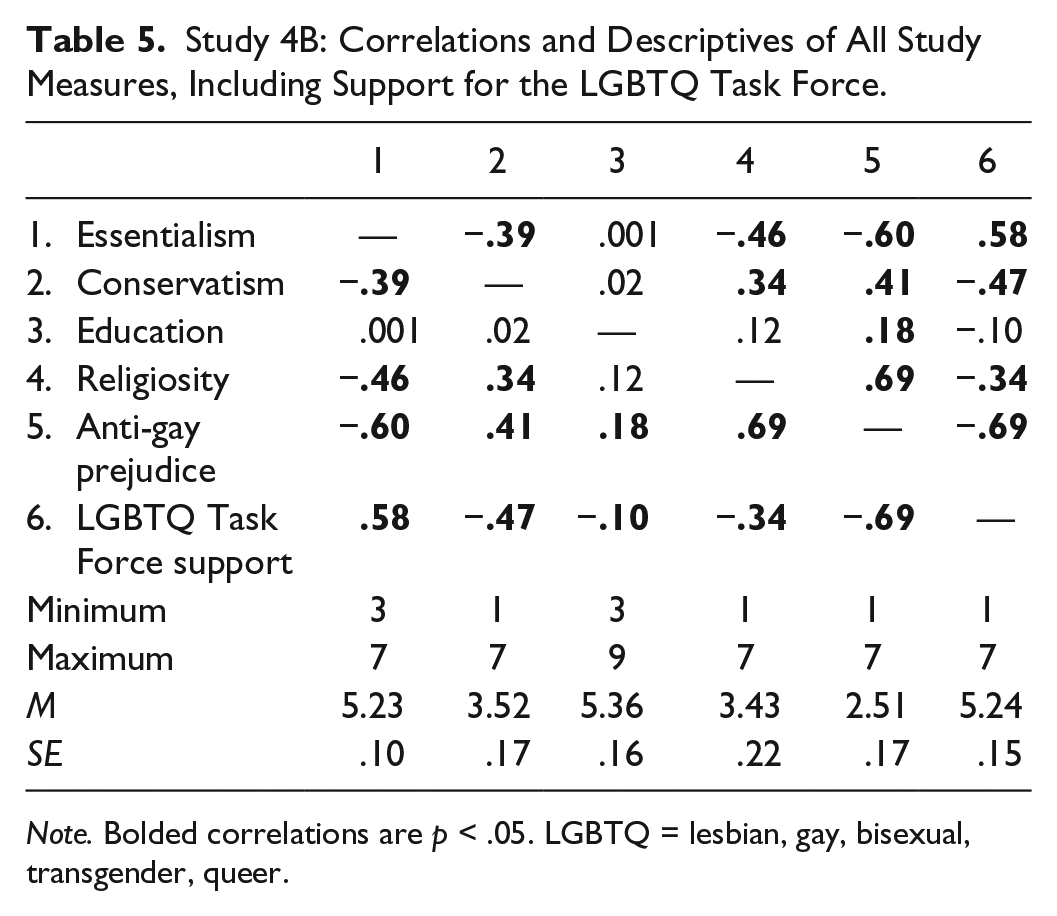
Note. Bolded correlations are p < .05. LGBTQ = lesbian, gay, bisexual, transgender, queer.
Study 4C
Our final study was a large-scale preregistered experiment in which we sought to establish causal evidence for the role of essentialism in support for boundary-enhancing initiatives. Because participants in Studies 4A to 4B showed high levels of essentialist beliefs about sexual orientation, we expected that there would be little room to further increase participants’ essentialist beliefs. Two hypotheses followed from this expectation: Participants who had their essentialist beliefs disconfirmed, and thereby undermined, would shower lower essentialist beliefs (Hypothesis 1 [H1]) and subsequently less support for the LGBTQ Task Force (Hypothesis 2 [H2]) compared with participants who had their essentialist beliefs confirmed or to participants in a no-prime control condition. We did not expect any significant differences between participants who had their essentialist beliefs confirmed and participants in the no-prime control condition. Nevertheless, it was possible (and consistent with our theorizing) that confirming participants’ essentialist beliefs about sexual orientation would indeed increase their essentialist beliefs and support for LGBTQ individuals, compared with participants in a no-prime control condition. This study and these hypotheses were preregistered before any data were collected (https://aspredicted.org/c8ji5.pdf).
Method
Participants
A preliminary study suggested that manipulating essentialist beliefs about sexual orientation would have a small effect on support for the LGBTQ Task Force (see Study 4D in the OSM), and a subsequent power analysis using G*Power (Faul, Erdfelder, Buchner, & Lang, 2009) determined that we needed at least 957 participants to detect this effect. We therefore sought to have roughly 1,000 participants. We overestimated our preregistered exclusion criterion (the number of participants predicted to suspect that the articles were fictitious and intended to deceive them) and therefore exceeded this projected sample size. Thus, the final sample consisted of a new group of heterosexual U.S. adults (N = 1,216; 58% female, 42% male, Mage = 30.57, SD = 7.33; 71% White/European American, 10% Black/African American, 8% Latino/Hispanic, 7% Asian/Asian American, 3% Multiracial, and 1% Native American; 40% some college, 33% bachelor’s degree, 16% partial completion or completion of a graduate or professional degree, and 11% a high school diploma or less).
Materials and procedures
Participants were randomly assigned to one of three conditions. Participants in the essentialism-confirmed condition (n = 399) read a fictitious article titled, “Homosexuality is Biological: Scientists Pinpoint a Gay Gene,” and participants in the essentialism-disconfirmed condition (n = 412) read a fictitious article titled, “Homosexuality Is Not Biological: Scientists Say There Is No Gay Gene” (see Appendix B for the full articles). Participants in the control condition (n = 405) did not read any article. Next, participants were asked to share their reactions to the articles. We excluded an additional 40 participants who explicitly reported that they believed that the articles were fake and intended to deceive them (e.g., “I think this is a fabrication written expressly for this study,” “I’m suspicious this is a test condition”: essentialism-supported condition: n = 18; essentialism-challenged condition: n = 22). These exclusions were identified by two independent observers who were blind to the hypotheses of the study (Cohen’s kappa = .77). 4 Participants then completed the same essentialism measure used in Studies 4A to 4B as a manipulation check (M = 5.07, SE = .03, α = .77). They then read the excerpt on the LGBTQ Task Force and were asked to share their reactions, which were again coded into three types: Opposition (9%), Support (80%), and Other (10%). These open-ended responses were coded by two independent coders who were blind to the hypotheses of the study and to all other participant data (Cohen’s kappa = .84). Disagreements were resolved by discussion. Last, participants were given the four-item scale measuring support for the LGBTQ Task Force (M = 5.47, SE = .05, α = .89). These data were collected in the spring of 2017.
Results and Discussion
The manipulation worked as predicted: A univariate ANOVA with condition (3: essentialism-confirmed, essentialism-disconfirmed, no-prime control) as the independent variable and essentialist beliefs about sexual orientation as the dependent variable yielded a significant effect of condition, F(2, 1213) = 14.88, p < .001, η2p = .02. Consistent with our first hypothesis (H1), participants in the essentialism-disconfirmed condition (M = 4.86, SE = .05) showed lower essentialist beliefs compared with participants in the essentialism-confirmed condition (M = 5.22, SE = .05, t = 5.12, p < .001, 95% CI of the mean difference = [0.22, 0.50]) and with participants in the no-prime control condition (M = 5.16, SE = .05, t = 4.35, p < .001, 95% CI of the mean difference = [0.16, 0.44]). As expected, the difference between the essentialism-confirmed condition and no-prime control condition was not significant (Mdiff = .06, SE = .07, p = .41, 95% CI of the mean difference = [−0.08, 0.20]), which we reasoned stemmed from participants’ already high baseline rates of essentialist beliefs about sexual orientation.
Because only a minority of participants expressed clear opposition in their open-ended responses, we did not analyze the open-ended data further. A univariate ANOVA with condition as the independent variable and support for the LGBTQ Task Force as the dependent variable yielded a significant main effect of condition, F(2, 1213) = 3.01, p = .049, η2p = .01. Consistent with our second hypothesis (H2), participants in the essentialism-disconfirmed condition (M = 5.32, SE = .08) showed less support for the LGBTQ Task Force compared with participants in the essentialism-confirmed condition (M = 5.58, SE = .08, t = 2.35, p = .018, 95% CI of the mean difference = [0.05, 0.48]). The no-prime control condition (M = 5.51, SE = .08) did not differ significantly from either the essentialism-disconfirmed condition or the essentialism-confirmed condition, ps = .09, .51, respectively). Taken together, these data support our main hypotheses: Compared with participants who had their essentialist beliefs confirmed, participants who had their essentialist beliefs disconfirmed showed lower levels of essentialist beliefs (H1) and less support for LGBTQ individuals (H2), thereby providing causal evidence for the boundary-enhancing implications of essentialism (Gelman, 2003; Rothbart & Taylor, 1992). In other words, essentialist beliefs provided an intellectual basis for supporting a boundary-enhancing policy that helped LGBTQ individuals, and thus undermining essentialist beliefs led to a significant decrement in support for such a policy. Notably, we also tested whether essentialism (as measured by the survey items) was related to support for the LGBTQ Task Force. Indeed, it showed a significantly positive relation (r = .55, p < .001).
Internal Meta-Analysis
Using the procedure outlined by Goh, Hall, and Rosenthal (2016), we meta-analyzed Studies 1 to 4C (and Study 4D from the OSM) to more closely estimate the association between essentialism and support for boundary-enhancing initiatives (N = 2,217). The mean correlations between essentialist beliefs (as measured by the survey items) and support for boundary-enhancing initiatives were weighted by sample size, and those correlations were Fisher’s z-transformed for analyses and transformed back to Pearson’s correlations for presentation. For Studies 2A and 2B, support for Donald Trump’s policies (not voting intention) was used as the dependent variable. This meta-analysis revealed that across the nine studies, essentialism showed a strong and positive association with support for the boundary-enhancing initiatives (Mr = .54, z = 17.27, p < .001).
General Discussion
Essentialism predicts an increased use of categorical boundaries (e.g., categorizing people as men or women; Gelman, 2003), and an accentuation of the distance between categorical boundaries (e.g., exaggerating the differences between men and women; Rothbart & Taylor, 1992). The present data empirically demonstrate that essentialism is associated with support for boundary-enhancing initiatives that disadvantage already disadvantaged groups, but also those that could benefit disadvantaged groups. Thus, not only does essentialism transform graded distributions of features into dichotomous categorical representations (Diesendruck & Gelman, 1999; Rhodes & Gelman, 2009b), it also corresponds to accentuating the distance between social categories through sociopolitical means, highlighting how essentialism is strongly linked to social cognition and real-world outcomes.
In Study 1, individual differences in essentialism were related to greater support of North Carolina’s Bathroom Bill, which mandates that people, including those who are transgender, use bathrooms that correspond with the sex on their birth certificate. In Study 2A, individual differences in essentialism were related to support of Donald Trump’s boundary-enhancing and isolationist policies, and in Study 2B, essentialism was associated with support for these policies even after controlling for education and conservatism. Studies 3A and 3B demonstrated that although a measure of general essentialist beliefs about social groups did not relate to support for same-gender classrooms, essentialist beliefs about gender categories did indeed do so. That is, gender essentialism was associated with support for same-gender classrooms designed to promote learning for both male and female students, thus showing that essentialism relates to boundary enhancement even under conditions that were not clearly depriving of low-power groups. Critically, Studies 4A to 4C demonstrated that essentialism entailed boundary enhancement even under conditions that unambiguously benefitted, rather than disadvantaged, a stigmatized group (see also Study 4D in the OSM). In Studies 4A and 4B, essentialist beliefs about sexual orientation were related to support for LGBTQ counseling services designed to help gay men and lesbian women understand and feel secure in their sexual orientation, and this relation held even after controlling variables known to influence perceptions of homosexuality (e.g., conservatism, religiosity, anti-gay prejudice). Study 4C provided support for a causal link between essentialist beliefs and support for boundary-enhancing initiatives. Participants randomly assigned to believe that homosexuality was genetic in origin showed greater support for LGBTQ counseling services compared with participants randomly assigned to believe that homosexuality was not genetic in origin. Together, these studies demonstrate that essentialism relates to support for initiatives that enhance social group boundaries, under conditions that are seemingly oppressive (e.g., support for the Bathroom Bill) or progressive (e.g., support for the LGBTQ community).
As society becomes increasingly diverse and integrated, thereby challenging essentialist assumptions about group-based boundaries (Dunham & Olson, 2016; Liebler, 2016), people who espouse essentialist beliefs may attempt to maintain and enhance social boundaries. The implications of such attempts are potentially far-reaching, including influencing legislative support and political advocacy. An important question for psychologists, sociologists, political scientists, and other social scientists is how far-reaching these attempts are, and also, the conditions under which they may be weakened or strengthened. For example, people who espouse essentialist beliefs may actively campaign for policies and political candidates that are boundary-enhancing, and against policies and political candidates that are boundary-minimizing, especially under contexts in which they feel that group-based boundaries are challenged (e.g., when aware of increases in interracial marriages, immigration, transgender people). We look forward to additional research that tests the extent to which the essentialism contributes to real-world behavior across various contexts.
We ruled out several alternative factors that could have contributed to the patterns detected here (i.e., education, conservatism, religiosity, prejudice), and provided causal evidence in Study 4C, though certainly other factors deserve consideration. One possibility is that participants who did not support the Bathroom Bill, or participants who supported Trump’s political positions, did so because they were resistant to change or opposed to equality. Our data do not completely rule out these possibilities, though because we controlled for conservatism, which is associated with resistance to change and opposition to equality (Jost et al., 2004), we may have controlled for such factors by extension. Moreover, resistance to change or opposition to equality would likely not predict support for progressive forms of boundary enhancement, such as support for the LGBTQ community. Nevertheless, additional research would do well to test the roles of these other ideologies more directly.
Future research could also test whether factors like support for intergroup hierarchy and inequality (i.e., social dominance orientation; SDO) moderate the relation between essentialism and boundary enhancement (see Ho et al., 2015b; Pratto, Sidanius, Stallworth, & Malle, 1994). That is, high essentialist beliefs and high SDO could jointly contribute to boundary enhancement for outcomes meant to disadvantage stigmatized groups (Studies 1-2B), such as support for Trump’s boundary-enhancing policies, as such policies would satisfy essentialist notions of clear group-based boundaries as well as high SDO people’s preferences for hierarchy maintenance. In contrast, high essentialist beliefs and low SDO (i.e., preference for social equality) could jointly contribute to boundary enhancement for outcomes meant to further stigmatized groups (Studies 4A-4C), such as support for LGBTQ people, as such support would satisfy essentialist notions of clear group-based boundaries as well as low SDO people’s preferences for intergroup equality. Interestingly, then, essentialism could influence seemingly oppressive forms of boundary enhancement when combined with high SDO, whereas essentialism could influence seemingly progressive forms of boundary enhancement when combined with low SDO.
Of course, whether the various forms of boundary enhancement examined in the current work do in fact have oppressive or progressive downstream consequences is beyond the scope of this research, though our data suggest that benevolent sentiments could motivate boundary-enhancing policy support, even if ultimately, the policies in question disadvantage their intended beneficiaries. For example, people high in gender essentialism could benevolently support same-gender classrooms because they believe them to be beneficial to all students, even though same-gender classrooms could ultimately disadvantage women (Bigler & Signorella, 2011; Pahlke & Hyde, 2016). Similarly, people high in essentialism could benevolently support multiculturalism (e.g., understanding and appreciating group differences) and oppose polyculturalism (e.g., understanding and appreciating group similarities), even though the former could be used to justify and license stereotyping and discrimination on the basis of group differences (see Rosenthal & Levy, 2010). Thus, even seemingly progressive forms of boundary enhancement could have oppressive consequences. Additional research is needed to test this more fully. Future research should also test whether individuals high in essentialism support seemingly progressive forms of boundary enhancement even when they are made aware of any potentially oppressive consequences of their support. Answering this question would help understand how strongly essentialism predicts boundary enhancement, and the extent to which people abandon essentialism for the sake of avoiding oppressive outcomes.
Future research could also explore whether social constructs such as SDO dissociate from essentialism in relation to boundary enhancement. Whereas social constructs are likely to be predictive of social boundary enhancement (e.g., exaggerating boundaries between social groups), they may not relate to nonsocial boundary enhancement. In contrast, essentialism, a more general and early-emerging cognitive bias (Gelman, 2003), is expected to directly predict boundary enhancement even in nonsocial domains (e.g., when distinguishing cats and dogs; Diesendruck & Gelman, 1999; Rhodes & Gelman, 2009b; Rothbart & Taylor, 1992). An additional question for future research concerns the measurement of essentialism. The present studies included both domain-general and domain-specific measures, as well as different subcomponents of essentialism (e.g., naturalness, immutability). Although these measures shared important subcomponents, and although we found consistent relations between the essentialism measures and boundary enhancement, thereby suggesting a robust and generalizable association, additional research is needed to understand under which conditions boundary enhancement requires domain-general essentialism, domain-specific essentialism, or specific subcomponents of essentialism (e.g., naturalness). Recall that in Study 3A, general essentialism was nonsignificantly related with support for same-gender classrooms, whereas in Study 3B, a more specific measure of gender essentialism showed a strong relation. One possibility is that domain-general measures of essentialism do not relate equally to boundary enhancement across different social domains. Indeed, previous research suggests that general measures do not relate equally to prejudice across difference social categories (Haslam, Rothschild, & Ernst, 2002). The present studies do not speak to this possibility, so additional work is needed, and may benefit from using more domain-specific measures. Additional work is also needed to systematically explore how various subcomponents of essentialism (e.g., naturalness) relate to boundary enhancement. We did not explore these relations in the present research as they were not our a priori interest, and because the subcomponents included in the measures we used varied across studies (i.e., Studies 4A-4C did not include a discreteness subcomponent, for theoretical reasons mentioned previously). We speculate that some subcomponents of essentialism (e.g., naturalness) may have more boundary-enhancing consequences than others (e.g., informativeness; see Rhodes & Mandalaywala, 2017, for theoretical insight).
In conclusion, although social groups are complex, probabilistic, and continuous with permeable boundaries, essentialist beliefs may alter one’s conceptualization of social group boundaries and may ultimately relate to support for boundary-enhancing initiatives. Importantly, this support can have ostensibly oppressive or progressive consequences, thereby suggesting that essentialism relates to social cognition in complex and multifaceted ways. We look forward to additional research that further explores these complexities, as well as their social implications.
Footnotes
Appendix A—Studies 3A and 3B (Full Article)
CHARLOTTESVILLE—Researchers working on how to improve high school classrooms in the United States recently found that same-gender classrooms (classrooms that had only males or only females) may be effective for educating students. “A long line of research shows that males tend to prefer mathematics and independent learning, whereas females tend to prefer language and collaborative learning,” said Dr. Lisa Faridany, a University of Virginia researcher and lead author of the study. Because of this research, Dr. Faridany and colleague, Dr. Robert Kaminsky, hypothesized that students in same-gender classrooms would learn more effectively, as those classrooms would be best able to fulfill the needs of male and female students. Indeed, that is exactly what they found. “During a five-year study, we visited over 100 high schools in North Carolina, Texas, California, Ohio, Maine, and New York, and found that males and females in same-gender classrooms were more likely to enjoy their studies, speak openly in the classroom, feel encouraged to pursue their interests, and experience higher academic achievement,” said Dr. Faridany. Notably, the researchers emphasized that males and females should interact with one another during the school day, as such interactions play an important role in their social development. “It is important for males and females to interact during recess and lunch, so they can learn how to socialize with one another,” said Dr. Kaminsky. He continued, “Regardless, our research suggests that in the classroom, males and females learn most effectively in same-gender environments.” Dr. Faridany and Dr. Kaminsky hope that their findings will encourage policy makers to consider single-gender classrooms as an effective way to meet the cognitive, intellectual, and educational needs of students. The full article, which was funded by the American Educational Research Association, appears in the prestigious American Journal of Education.
Appendix B—Study 4C (Experimental Vignettes)
Acknowledgements
We thank Zahra Dawson, Justine Ezell, Melissa Granville, Jack Kim, Tiffany Valencia, and Yara Gayar for data coding; Soraya Giaccardi for feedback; and Nick Haslam and anonymous reviewers for their critical and invaluable input.
Declaration of Conflicting Interests
The author(s) declared no potential conflicts of interest with respect to the research, authorship, and/or publication of this article.
Funding
The author(s) disclosed receipt of the following financial support for the research, authorship, and/or publication of this article: This research was supported by National Science Foundation and Ford Foundation Graduate Student Research Fellowships awarded to Steven O. Roberts.
Notes

References
Supplementary Material
Please find the following supplemental material available below.
For Open Access articles published under a Creative Commons License, all supplemental material carries the same license as the article it is associated with.
For non-Open Access articles published, all supplemental material carries a non-exclusive license, and permission requests for re-use of supplemental material or any part of supplemental material shall be sent directly to the copyright owner as specified in the copyright notice associated with the article.
