



Abstract
Despite substantial research on cheating, how and when individual predispositions figure into cheating behavior remains unclear. In Study 1, we investigated to what extent Honesty-Humility predicted cheating behavior. As expected, individuals high on Honesty-Humility were less likely to cheat than were individuals low on this trait. In Study 2, integrating arguments from personality research about traits with arguments from behavioral ethics about moral primes, we examined how Honesty-Humility and situational primes interacted to affect cheating. We found an interaction indicating that individuals high on Honesty-Humility consistently did not cheat much across situational primes, whereas individuals low on Honesty-Humility cheated more when exposed to immoral primes than when exposed to moral primes. Our research invites reflection about the interplay of individual differences in Honesty-Humility and situational cues in predicting cheating, including the design of anti-cheating systems and the context in which these person and situation factors interact.
Overreporting one’s performance, underreporting taxable income, or falsely claiming sick leave are examples of transgressions of social rules. Such actions—typically considered to be cheating—give individuals an unfair advantage and can engender great costs for society and institutions. Accordingly, the prevention of cheating constitutes a critical task for policy makers, who need to understand the causes of cheating: Is it a function of personal attributes of the cheating person, or of situational factors, or of their interaction? We sought to answer this question by examining Honesty-Humility, an individual difference, and moral primes, a situational factor, as antecedents of cheating behavior.
One stream of research in behavioral ethics has focused on situational antecedents of cheating, such as situational norms (e.g., John, Loewenstein, & Rick, 2014). Much of this research ignored variations in individual preferences for cheating, assuming that individuals “typically value honesty” and generally cheat just a little bit to maintain a positive self-concept (Mazar, Amir, & Ariely, 2008). Conversely, another body of research affirms that individual predispositions predict cheating behavior. A nascent line of research on genetic sources indicates that genes explain about a third of the variation in standards of everyday honesty (Loewen et al., 2013). In addition, there is a growing line of research on directly measurable individual-difference antecedents of cheating, which are more proximal than genes and, hence, are more relevant to the design of anti-cheating policies. In particular, the Honesty-Humility (H), Emotionality (E), eXtraversion (X), Agreeableness (A), Conscientiousness (C), and Openness to Experience (O) (HEXACO) personality model (Ashton & Lee, 2001; Ashton et al., 2004) has emerged as a predictor of cheating behavior (e.g., Hilbig & Zettler, 2015). In our Study 1, we aim to constructively replicate this research.
To our knowledge, however, research that integrates work on situational antecedents of cheating behavior with that on person-related dispositional antecedents is extremely sparse (for an exception, see Experiment 5 in Hilbig & Zettler, 2015). Such integrative research is important for both understanding the causes of cheating and designing policies against it. From a scientist’s point of view, it is critical to be aware of the boundary conditions for situational and individual antecedents of cheating to make more precise predictions. For example, as we argue, moral and immoral primes as situational factors might mostly affect the cheating behavior of individuals low on Honesty-Humility. Hence, considering Honesty-Humility allows specifying to whom predictions about effects of moral primes apply. Policy makers could then set up more targeted interventions, for example, using moral primes only if the targeted population consisted mostly of people low on Honesty-Humility. Understanding the interplay of personal and situational factors on cheating behavior, hence, seems crucial for both scientists and practitioners. In Study 2, we contribute to this understanding, which also allows us to reflect about the context in which these interactions are embedded. For example, a person–situation interaction might unfold differently depending on whether cheating or not cheating is the default behavior.
The remainder of the manuscript unfolds as follows. On the basis of targeted reviews of research on Honesty-Humility as an antecedent of cheating and of research on situational antecedents, we build arguments for interactive effects between Honesty-Humility and moral primes on cheating behavior. Next, we report the methods and results of two studies designed to test our hypotheses, and we conclude by discussing the implications of our research.
Honesty-Humility as an Antecedent of Cheating
The personality factor of Honesty-Humility captures variation in sincerity, fairness, greed-avoidance, and modesty (Lee, Ashton, & Shin, 2005). Ashton and Lee (2007) defined Honesty-Humility as “the tendency to be fair and genuine in dealing with others, in the sense of cooperating with others even when one might exploit them without suffering retaliation” (p. 156). Negative adjectives representing low levels of Honesty-Humility include greedy, conceited, pretentious, and sly. Honesty-Humility has been shown to be partly heritable (Lewis & Bates, 2014), and the stability of personality by adulthood suggests that Honesty-Humility is largely exogenous and can be modeled as a predictor of outcomes. Honesty-Humility correlates weakly with agreeableness and conscientiousness, but unlike these traits taps more into a person’s moral conscience (Marcus, Lee, & Ashton, 2007). For example, whereas a lack of agreeableness is indicative of hostile behaviors to others, a low-level of Honesty-Humility picks up tendencies toward socially problematic and selfish behaviors (Lee & Ashton, 2004). Moreover, Honesty-Humility is inversely related to the “dark triad” of psychopathy, narcissism, and Machiavellianism (Lee & Ashton, 2005).
Numerous studies have shown relationships between Honesty-Humility and self- or other-reports of workplace delinquency and antisocial behavior, counterproductive behavior, and ethical decision making (e.g., Allgaier, Zettler, Wagner, Püttmann, & Trautwein, 2015; Lee, Ashton, & de Vries, 2005; Lee, Ashton, Morrison, Cordery, & Dunlop, 2008; Marcus et al., 2007; Oh, Lee, Ashton, & de Vries, 2011; Zettler & Hilbig, 2010). For instance, individuals low on Honesty-Humility were more likely to engage in counterproductive work behavior than were individuals high on this trait (Zettler & Hilbig, 2010), in particular in a context favoring such behavior (see also Allgaier et al., 2015). Research has also shown effects of Honesty-Humility on cheating behavior (Hershfield, Cohen, & Thompson, 2012; Hilbig, Moshagen, & Zettler, 2016; Hilbig & Zettler, 2015; Thielmann, Hilbig, Zettler, & Moshagen, 2016). For instance, across six studies with different cheating paradigms, Honesty-Humility was consistently negatively related to cheating (Hilbig & Zettler, 2015). Seeking to replicate these findings, we hypothesize as follows:
Having reviewed research on trait honesty as an antecedent of cheating behavior, we now turn our attention to situational antecedents.
Situational Antecedents of Cheating
Research has extensively demonstrated the role of situational cues for cheating behavior (e.g., Bucciol & Piovesan, 2011; Gächter & Schulz, 2016; Gill, Prowse, & Vlassopoulos, 2013; Gino & Galinsky, 2012; Gino, Krupka, & Weber, 2013; Gino & Pierce, 2009; Hildreth, Gino, & Bazerman, 2016; John et al., 2014; Mazar et al., 2008; Mead, Baumeister, Gino, Schweitzer, & Ariely, 2009; Shalvi, Eldar, & Bereby-Meyer, 2012; Wiltermuth, 2011). For instance, individuals cheat less if instructed not to cheat (Bucciol & Piovesan, 2011) and in the presence of other individuals (Gino et al., 2013). Conversely, individuals cheat more when they are under time pressure (Shalvi et al., 2012) or when wealth is salient to them (Gino & Pierce, 2009).
A series of studies by Mazar et al. (2008) is one example of research on the role of situational cues. These researchers tested a theory of self-concept maintenance, according to which individuals can maintain a self-concept of being honest despite cheating, as long as they can tell themselves that they cheated just a little bit. They can justify a little cheating as “okay,” in part by selective inattention to moral standards. Mazar et al. manipulated moral primes to vary the salience of moral standards. In the moral prime condition, participants had to write down as many of the Ten Commandments as they knew, and in the neutral prime condition the titles of 10 books that they had read in high school. Participants then performed a cognitively challenging task, and, in the cheating condition, had the opportunity to cheat when self-reporting their performance. As expected, the salience of moral norms reduced cheating. In our research, we attempt to replicate constructively this finding of a moral prime effect on cheating (relative to a neutral condition). We used a different manipulation of the moral prime in a different sample and cultural context (i.e., students of a Swiss university). Adding to the work of Mazar et al., we also test whether an immoral prime can induce acts of cheating. Hypothesis can be stated formally as follows:
Having reviewed person and situation factors for explaining cheating behavior, we now develop our arguments for an interaction between Honesty-Humility and moral primes.
Interactive Effects of Honesty-Humility and Moral Primes on Cheating Behavior
Person–situation interactions are often explained by the strength of situations (Mischel, 1968). Strong situations constrain behaviors across individuals by inducing uniform expectancies regarding appropriate response patterns and providing incentives for enacting these response patterns (Mischel, 1977). In contrast, weak situations allow for variability in behaviors across individuals. In its generic form, the explanation of person–situation interactions through situational strength is merely a descriptive statement. For it to become a theoretical argument about interactive effects between trait honesty and moral primes on cheating, we elaborate on three points. First, we specify the attributes that render a situation strong or weak for the context of our study. Second, we recast the arguments for the interaction through the lens of persons who behave consistently across situations versus persons who do not do so. Third, we show how an understanding of interactive effects requires also a consideration of the context in which the interaction occurs.
Moral and Immoral Primes Inducing Strong and Weak Situations
In understanding the constraining effect of strong situations, it is helpful to consider the effects of reinforcement and punishment. Is a strong situation one in which the targeted behavior is associated with positive consequences (reinforcement)? Or, is a strong situation one in which not showing a targeted behavior is associated with negative consequences (punishment)? Cheating can be explained on the basis of maximizing economic utility, but bearing in mind psychological costs incurred for violating social norms (Bendahan, Zehnder, Pralong, & Antonakis, 2015; see also Church, Gaa, Khalid Nainar, & Shehata, 2005; Shalvi et al., 2012). Cheating is generally socially condemned, and violating social rules may trigger unpleasant psychological tensions. In general, moral norms prescribe honesty and contribute to corresponding behavior (e.g., Abeler, Nosenzo, & Raymond, 2016; Bandura, 1986; Gino, Ayal, & Ariely, 2009; Mazar et al., 2008). Minimal cheating or not cheating can be considered as the behavioral default (i.e., what one normally does).
In our study, cheating enhances the likelihood of making money, but noncheating does not lead to having money taken away. Stated differently, cheating is associated with a positive economic consequence, whereas noncheating is not associated with punishment. Because these economic consequences are present in alike form across experimental conditions, they cannot explain why one condition might constrain effects of Honesty-Humility on cheating more so than might another condition. We thus turn to a noneconomic argument for strong or weak situations, namely moral primes. We view a moral prime as a, so to say, magnifying glass that brings into focus social norms of honesty that prescribe noncheating or minimal cheating as the default behavior. A moral prime makes both a norm for honesty and the default behavior of not cheating salient. Thus, it creates a strong situation that induces individuals to act honestly even if they are predisposed to be dishonest. If individuals violated this norm, they would experience psychological discomfort.
Conversely, an immoral prime makes the social norm of honesty opaque. That is, individuals may infer that cheating is at least less socially disapproved relative to a moral prime or the absence of an immoral prime (Keizer, Lindenberg, & Steg, 2008). Hence, individuals low on Honesty-Humility can act on their predisposition to cheat, whereas those high on Honesty-Humility continue to not cheat. An immoral prime represents a relatively weak situation relative to a moral prime, because an immoral prime weakens constraints imposed by generic social norms for honesty.
Finally, in the absence of both moral and immoral primes (i.e., the control condition), we expect individuals to display the default behavior of cheating just a little at most (e.g., Mazar et al., 2008; Shalvi, Handgraaf, & De Dreu, 2011). More specifically, we expect that in the control condition, the norm for honesty as the default behavior is less salient than in the presence of a moral prime. Individual differences would thus have a greater effect on cheating behavior in the control condition than in the moral prime condition. Furthermore, relative to the presence of an immoral prime, the effect of individual differences on cheating behavior should be weaker in the control condition.
So far, we have explained a person–situation interaction as a function of strong situations, which reduce behavioral variability, versus weak situations, which allow for behavioral variability. Alternatively, one can explain a person–situation interaction as a function of individual differences which either motivate consistent behavior or which motivate adaptive and, thus, inconsistent behavior. We develop such an argument below.
Honesty-Humility and Behavioral Consistency
To explain a person–situation interaction as a function of the behavioral consistency induced by a person factor is particularly appropriate in the case of Honesty-Humility. Ashton and Lee’s (2007) earlier cited definition of Honesty-Humility implies that individuals high on this trait are motivated to behave consistently according to their moral convictions. They seek to act in a truthful and sincere manner across situations. In contrast, individuals low on Honesty-Humility seek opportunities to cheat. As Zettler and Hilbig (2010) argued, these individuals “are motivated to seek advantages and exploit others when possible without having to fear retaliation”; furthermore, “such individuals should also be more sensitive to the characteristics of different situations” (p. 572). Behavioral consistency across situations thus distinguishes individuals who are high on Honesty-Humility from those who are not.
Empirical evidence on differences in behavioral consistency as a function of Honesty-Humility comes from an ultimatum-game study by Hilbig and Zettler (2009). Whereas individuals low on Honesty-Humility cooperated only when the recipient had the possibility to retaliate, those high on Honesty-Humility acted cooperatively independent of the recipient’s retaliation ability.
Integration of Arguments About Situations and Persons
We have argued above for a person–situation interaction through both the lens of strong situations and that of consistently behaving persons. Doing so allows us to recognize that our interaction is best understood by considering both perspectives simultaneously and also within their larger context (Funder, 2008). We refer to this larger context as the “supra-situation,” which defines the default behavior as either cheating or not cheating.
Suppose that cheating—unlike in our research—could have been traced and punished. Stated differently, the supra-situation would set behaving honestly as a strong and unambiguous default. Drawing on arguments by Zettler and Hilbig (2010; see also Hilbig & Zettler, 2009), then all individuals, independent of their level of Honesty-Humility, should act similarly across situations by displaying the default behavior of not cheating. Hence, whether a person-based argument can be made such that honest persons behave consistently and less honest persons do not do so depends on the supra-situation. Note that the supra-situation also affects situation-based arguments. For example, in the case of traceable and punishable cheating behavior, moral or immoral primes would no longer be expected to be effective.
In conclusion, our contextualized treatment of an interaction between Honesty-Humility and moral primes when cheating is incentivized leads us to hypothesize as follows:
Overview of Studies
To test our hypotheses, we conducted two studies in which participants performed a task and self-scored their performance, on the basis of which they were compensated with lottery tickets to win a monetary prize. Given that participants’ knew we could not verify their performance, they had ample opportunity to cheat. For the sake of ecological validity, we included monetary incentives into the design so that participants were motivated to perform well and to potentially cheat. Overall, our study design allowed us to investigate whether Honesty-Humility predicted cheating and, if so, under which conditions (i.e., moral vs. immoral vs. neutral primes).
We assessed participants’ personality traits using the HEXACO Inventory, along with other control variables. In Study 1, we examined the direct impact of Honesty-Humility on self-scored performance. Study 1 also allowed us to establish a behavioral norm for our context, that is whether cheating, cheating a little bit, or not cheating would be the default behavior. In Study 2, we additionally examined the main effect hypothesis for moral primes and the interaction hypothesis by manipulating moral primes. We decided to use different tasks in Studies 1 and 2 to examine the robustness of our predictions across settings. In Study 1, in a dice rolling task participants’ performance was dependent on luck, which made it relatively easy to justify cheating. In Study 2, however, in a math task participants’ performance was dependent on their cognitive ability (i.e., skill), making cheating more difficult to justify. All materials were in French.
For both studies, our sample sizes were larger than the average sample size published in applied psychology (Shen et al., 2011). For Study 1, our sample size was 195, which is sufficiently large to detect a small effect in linear models; for Study 2, we had more than 100 participants per manipulated cell (i.e., N = 350), which, under nonoptimal conditions, could be considered sufficiently large to detect a small effect (Simmons, Nelson, & Simonsohn, 2011, 2013). Given that we modeled interactions in the context of a nonlinear model with high dispersion makes it difficult to apply any known power guidelines, which is why we erred on the side of caution and gathered a relatively large sample.
Study 1
Method
Sample and procedure
The sample consisted of 195 students from a Swiss university who voluntarily participated (34% women; Mage = 20.85, SD = 2.23). We conducted this study in the laboratory, and on average there were 13 participants per session. Responses were anonymous and participants received 20 Swiss Francs (about US$20) as compensation for their participation. After having first gathered individual-differences data, we asked participants to individually play a dice game giving them the chance to enter tickets into a lottery for a monetary prize. To link all data and to identify the winners of the lottery, we assigned an anonymous code to each participant. Participants were thus ensured that we could not link their identity to their questionnaires and lottery tickets. We describe all measures next.
Measures
We collected data on participants’ personality traits, cognitive ability, and demographics. The dice game included a behavioral measure of cheating. Table 1 shows internal consistency coefficients, means, standard deviations, and intercorrelations.
Internal Reliability Coefficients, Means, Standard Deviations, and Correlations Among Variables for Study 1 (N = 195).
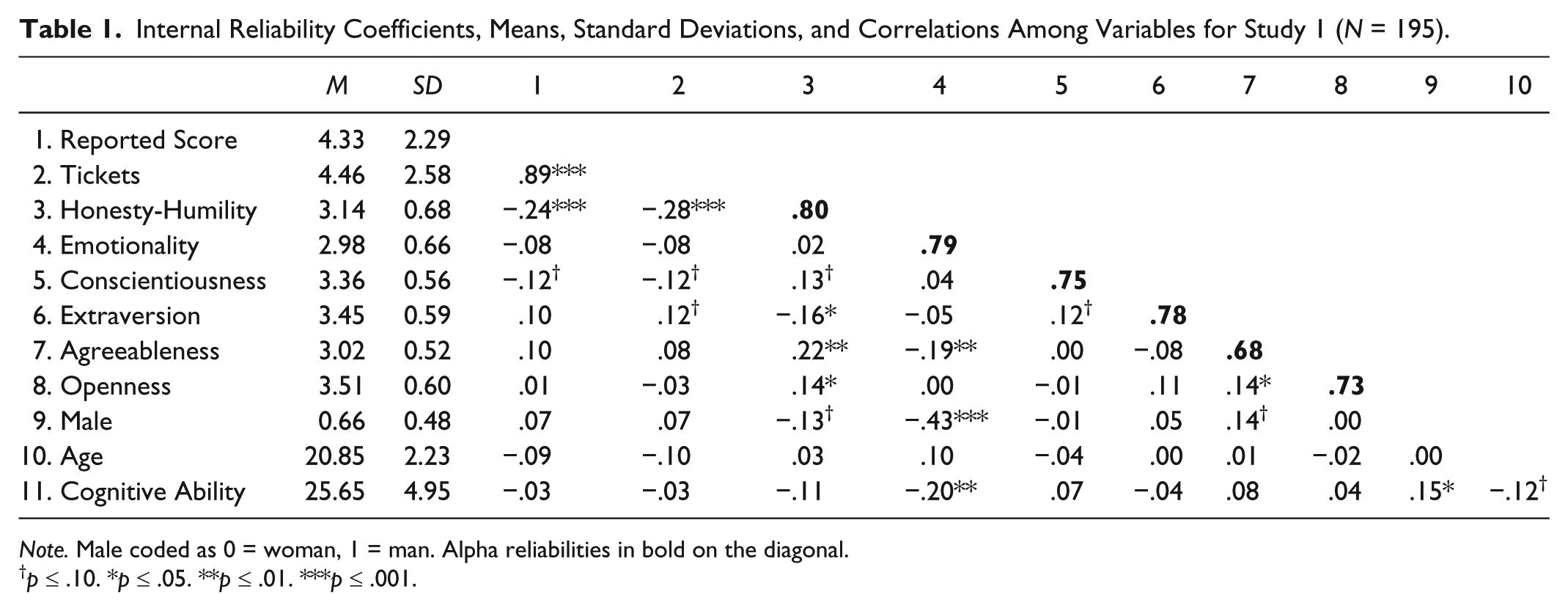
Note. Male coded as 0 = woman, 1 = man. Alpha reliabilities in bold on the diagonal.
p ≤ .10. *p ≤ .05. **p ≤ .01. ***p ≤ .001.
Personality traits
We measured the personality traits of HEXACO using the French version of the short HEXACO (HEXACO-PI [HEXACO–Personality Inventory]), which includes 60 items (Ashton & Lee, 2009), 10 for each trait. Items are scored on the 5-point Likert-type scales ranging from 1 (strongly disagree) to 5 (strongly agree). The Honesty-Humility scale assesses sincerity, fairness, greed-avoidance, and modesty. Sample items are “I’d be tempted to use counterfeit money, if I were sure I could get away with it” and “Having a lot of money is not especially important to me.”
The emotionality scale assesses fearfulness, anxiety, dependence, and sentimentality. A sample item is “I would feel afraid if I had to travel in bad weather conditions.” The extraversion scale measures social self-esteem, social boldness, sociability, and liveliness. A sample item is “I feel reasonably satisfied with myself overall.” The agreeableness scale taps into forgiveness, gentleness, flexibility, and patience. A sample item is “I rarely hold a grudge, even against people who have badly wronged me.” The conscientiousness scale gauges an individual’s level of organization, diligence, perfectionism, and prudence. A sample item is “I plan ahead and organize things, to avoid scrambling at the last minute.” Finally, the openness to experience scale assesses aesthetic appreciation, inquisitiveness, creativity, and unconventionality. A sample item is “I’m interested in learning about the history and politics of other countries.”
Research has shown that this inventory has excellent psychometric properties both in terms of reliability and validity (e.g., Bendahan et al., 2015; Lee & Ashton, 2004, 2005, 2008; Lee et al., 2008; Oh et al., 2011; Thielmann et al., 2016). For instance, Bendahan et al. (2015) and Lee et al. (2008) have demonstrated Honesty-Humility to be a significant predictor of antisocial behavior and integrity, respectively.
Control variables
We assessed cognitive ability using the French version of the Wonderlic Classic Cognitive Ability Test (Wonderlic, 2002), in which participants have to respond to 50 questions in 12 min. We controlled for participant age, gender, and nationality (Swiss, non-Swiss, and dual Swiss/non-Swiss). Of the participants, 37% were Swiss, 43% non-Swiss, and 20% held dual citizenships. We further controlled for French proficiency on a 5-point scale (98% of participants reported at least a good level of French with 76% being native speakers), faculty of study, and year of study. Participants came from several faculties, mostly from an institute of technology (39%) or a faculty of business and economics (26%). Of the participants, 87% were undergraduate students and the remainder were graduate students.
Cheating behavior
We assessed cheating behavior in the context of a dice game (adapted from Fischbacher & Föllmi-Heusi, 2013), in which participants could win an additional 20 Swiss Francs, beyond their participation fee. Participants received three dice and 15 lottery tickets; they rolled the three dice 5 times, and reported how many sixes they got. The number of sixes obtained, from a minimum of zero to a maximum of 15, determined the number of lottery tickets they could enter into a draw. At the end of each experimental session, a lottery was held producing one winner. Given that 15 sessions took place, there were 15 lotteries and a total of 15 winners.
Participants were seated in front of a computer with blinds on each side and in front of them. Neither the experimenter nor participants could see other participants rolling the dice. Participants were thus able to cheat by reporting more sixes than they actually got and entering more lottery tickets than they were entitled to. Participants placed their tickets in a box from which the experimenter drew one winning ticket at the end of the session.
After participants had left the laboratory, an experimenter counted the number of lottery tickets placed in the box by each participant. We thus obtained two different measures of cheating behavior. The first measure was their self-reported score on the computer (i.e., number of sixes; M = 4.33, SD = 2.29). The second measure was the number of tickets participants had put in the box (M = 4.46, SD = 2.58). The two measures strongly correlated with each other (r = .89, p < .001) and did not differ significantly, t(194) = 1.55, p = .122.
We computed the probability of obtaining sixes when throwing a fair die 15 times using the following probability mass function (Wadsworth, 1960):

where p represents the probability of getting r success(es).
Figure 1 depicts this probability. Getting a six twice is most probable (i.e., 27%), whereas the probability of getting a six more than 6 times was less than 1%. The theoretical mean was 2.5, which was significantly lower than the observed means for the self-reported score, t(194) = 11.13, p < .001, and the number of tickets taken, t(194) = 10.58, p < .001. These observed means, in turn, were much lower than the maximum possible mean of 15, t(194) = 64.96, p < .001, and t(194) = 57.04, p < .001, respectively, indicating that, although cheating occurred, participants on average strongly refrained from fully exploiting their opportunity to cheat.
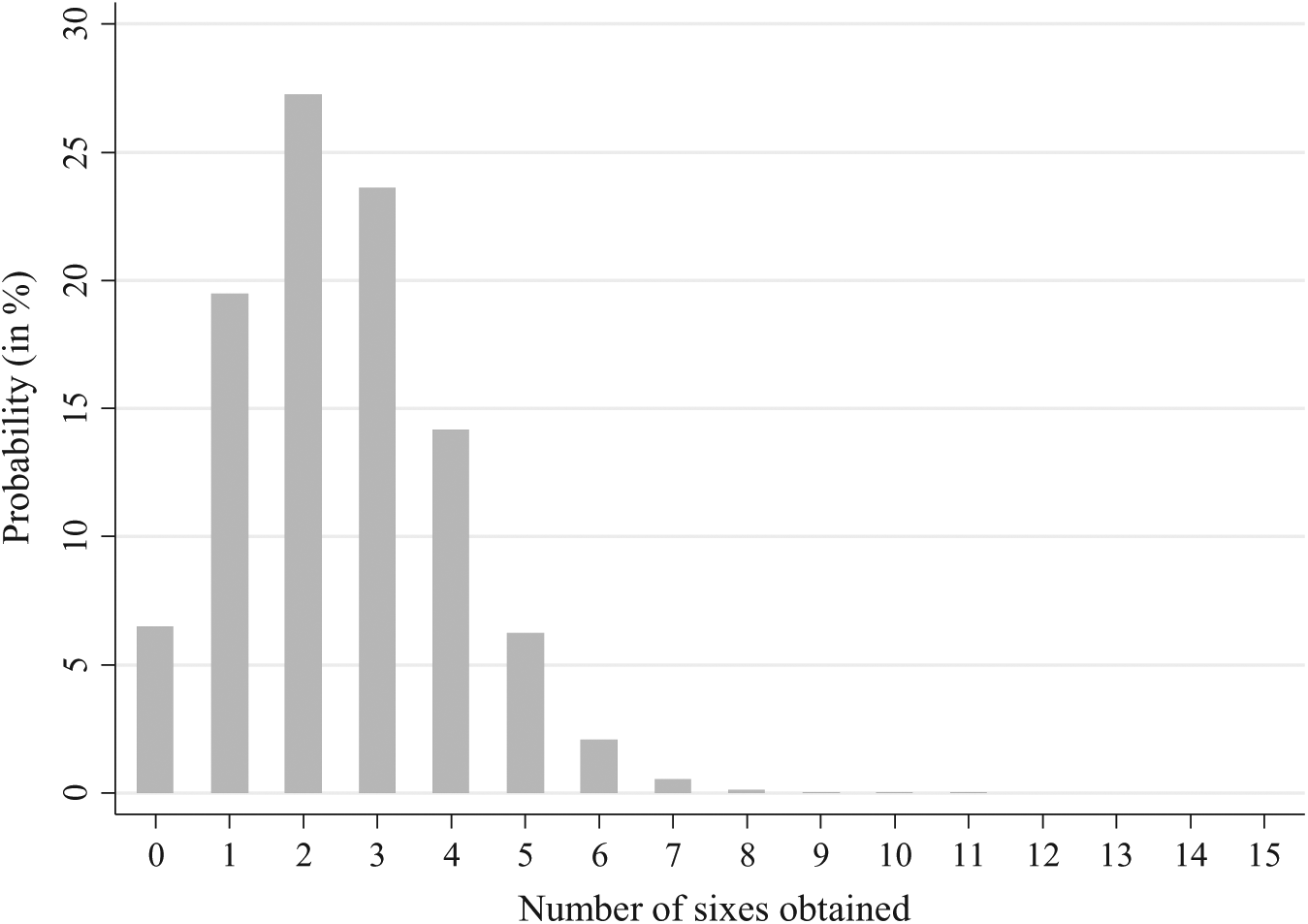
Probability of getting the number six by throwing a die 15 times.
Results
To test Hypothesis 1, we estimated a Poisson model (Blevins, Tsang, & Spain, 2015) by regressing the self-reported score on the six personality traits and the control variables. We report the results in Table 2. In addition to the observed coefficients (which are not isomorphic to the marginal effect), we also reported the average marginal effect of Honesty-Humility on the self-reported score. The results suggested a strong negative effect of Honesty-Humility on cheating behavior (dy / dx = −0.92, p = .001), supporting Hypothesis 1. Prior to adding the controls and the covariates, note that the effect of Honesty-Humility on cheating is highly significant: b = −0.19, SE = 0.05, z = 3.46, p = .001 (95% confidence interval [CI] = [−0.29, −0.08]), dy / dx = −0.80, p = .001. Adding the rest of the regressors and the controls slightly strengthened the coefficient, as indicated in Table 2.
Results of Regression Analyses for Study 1 for the Criterion Self-Reported Score.
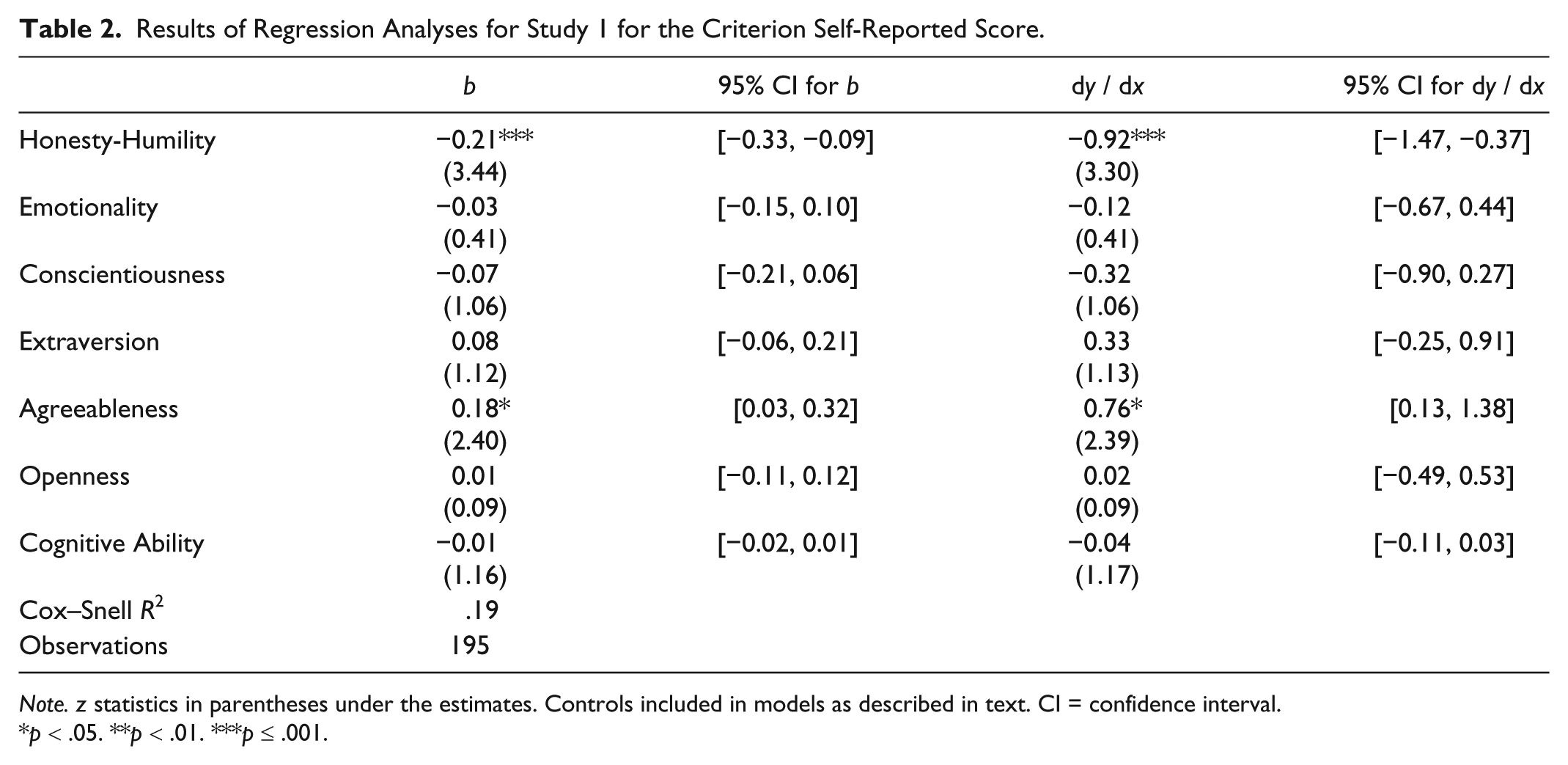
Note. z statistics in parentheses under the estimates. Controls included in models as described in text. CI = confidence interval.
p < .05. **p < .01. ***p ≤ .001.
The marginal mean from the full model for individuals high on Honesty-Humility (+1SD from the mean) was 1.48, SE =0.45, z = 3.29, p = .001 (95% CI = [0.60, 2.36]); for those low on Honesty-Humility the marginal mean was 12.47, SE = 3.98, z = 3.14, p = .002 (95% CI = [4.68, 20.27]). We examined whether these predicted means were different from the theoretical mean of 2.5; individuals high on Honesty-Humility reported significantly fewer incidences of rolling sixes, χ2(1) = 5.17, p = .023, and those low on Honesty-Humility reported significantly higher incidences of rolling sixes, χ2(1) = 6.29, p = .012.
Finally, we replicated this analysis using the number of lottery tickets as the dependent variable. Results revealed the same pattern of findings as for the self-reported score.
Discussion and Study 2
In support of Hypothesis 1, in Study 1, individuals high on Honesty-Humility were less likely to cheat than were individuals low on Honesty-Humility. These results add to and constructively replicate earlier findings by Hilbig and Zettler (2015). Jointly, our and their findings point to the importance of Honesty-Humility for explaining cheating behavior. Having demonstrated a main effect of Honesty-Humility, in Study 2 we sought to investigate the potential interactive effect of this trait and moral primes, thereby allowing for tests of Hypotheses 2 and 3.
Method
Sample and procedure
A sample of 350 undergraduate students from a Swiss university voluntarily participated in the study (35% women; Mage = 21.75, SD = 1.64). We drew participants from an organizational behavior course. Participants received a bonus point on their grade for their participation. Students who did not participate in the study could complete an extra project to earn the bonus. A total of 426 participants completed the first wave of measures, but 76 of these participants dropped out. A Heckman (1979) selection model indicated that estimates were unaffected by these dropouts.
As in Study 1, we obtained individual difference measures. The measure of cheating came from a paper-and-pencil math exercise (adapted from Mazar et al., 2008) conducted in class. The completion of this exercise gave participants the chance to enter tickets into a lottery for a monetary prize. In a between-participants design, we embedded the experimental manipulations (a moral, immoral, or neutral prime) into this exercise. To link all data and to identify the winners of the lottery, participants created a personal code. However, the data collection was not completely anonymous because in the first questionnaire we asked participants to indicate their names. We needed to do so to check which students participated in the study, so that they could receive course credit for their participation. We assured participants that their identity would be removed from the database after the assignment of the course credit and that we would not link their identity to their responses in the experiment.
Measures
We collected data on the same variables as in Study 1 (i.e., personality traits, cognitive ability, and demographics). The math exercise included a behavioral measure of cheating. Table 3 shows internal consistency coefficients, means, standard deviations, and intercorrelations.
Internal Reliability Coefficients, Means, Standard Deviations, and Correlations Among Variables for Study 2 (N = 350).
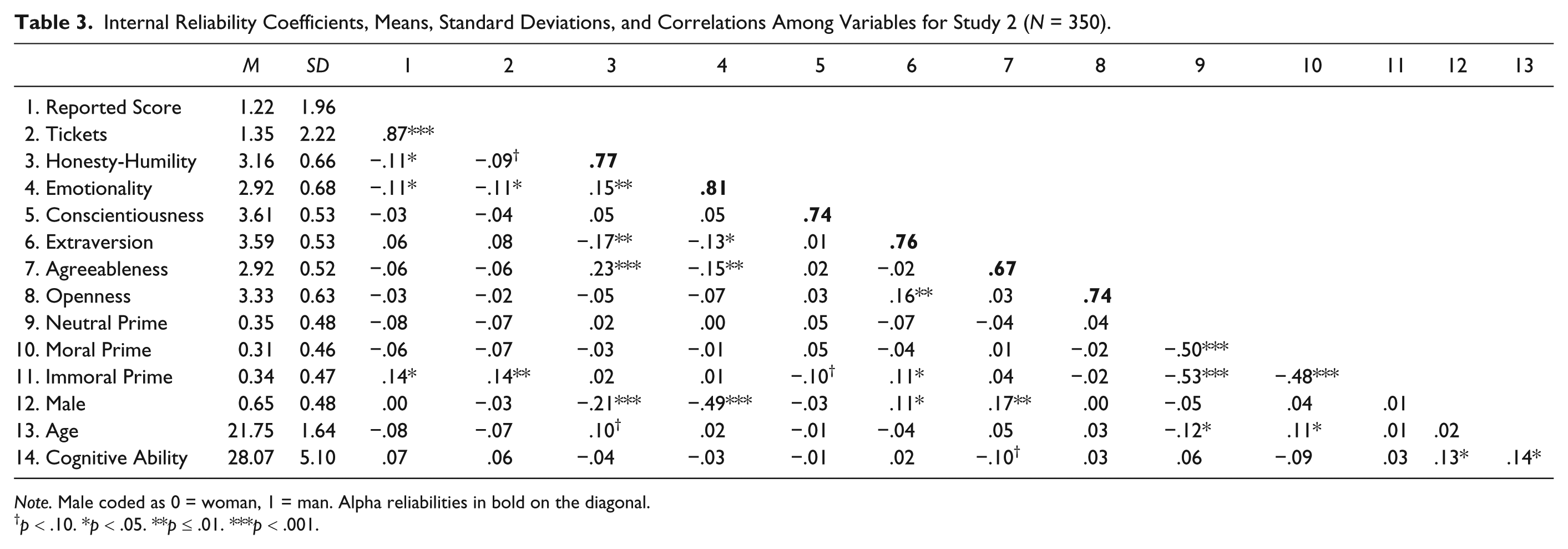
Note. Male coded as 0 = woman, 1 = man. Alpha reliabilities in bold on the diagonal.
p < .10. *p < .05. **p ≤ .01. ***p < .001.
Personality traits and control variables
We measured personality traits with the HEXACO-PI, as used in Study 1, 2 months before the experiment. We assessed cognitive ability with the Wonderlic test after participants had completed the math exercise. We included the same demographic information as in Study 1 except for the variables controlling for faculty and year of study given that in Study 2, participants were homogeneous in this respect. Of the participants, 38% were Swiss, 32% non-Swiss, and 30% had dual nationality. Moreover, 83% were French-native speakers and, except for 1%, participants reported at least a good level of French proficiency.
Cheating behavior
In the math exercise, participants received a sheet containing 15 tables with 12 numbers each. Participants had to find as many pairs of numbers adding up to 10 (e.g., 3.08 + 6.92) per table as they could in 2 min. Only two such pairs were included in the 15 tables. Because of the large sample size, we randomly assigned participants to four different rooms and we controlled for this effect in our analyses. At the end of the exercise, participants reported how many pairs they found summing up to 10. Then they took their lottery tickets, supposedly one for each identified pair of numbers adding up to 10, out of a stack of 10 tickets and placed the taken tickets in a box. Finally, the experimenter drew, depending on the number of participants in each room, between three and eight winning tickets and gave 20 Swiss Francs to the holder of each winning ticket. The range of winners varied between three and eight depending on the room. The four rooms were of different sizes, and we wanted participants to perceive similar chances of winning independent of the size of their room.
As in Study 1, we obtained two different measures of cheating. The first measure was the self-reported number of pairs found (M = 1.22, SD = 1.96), and the second measure was the number of tickets placed by participants in the box (M = 1.35, SD = 2.22). The two measures correlated strongly with each other (r = .87, p < .001). Controlling for the fixed effect of room showed that these two measures did not differ significantly, F(1, 349) = 1.01, p = .32. The number of tickets reported and taken was far below the maximum of 10, t(349) = 83.75 and t(349) = 72.83, respectively, both ps < .001, again showing that participants refrained from fully exploiting the opportunity to cheat.
Experimental manipulation
Before participants worked on the math task, we randomly assigned them to one of three conditions: a moral, immoral, or neutral priming condition. In each condition, we asked participants to indicate whether they knew the titles of books by answering “yes” or “no.” As the appendix shows, the titles of the first two books were morally neutral and alike across conditions (i.e., The Undergrowth and As Deep as the Ocean), whereas the third title served as the manipulation and differed across conditions. For the moral priming condition, the title was Moral Education, for the immoral priming condition, it was Win at All Costs, and for the neutral priming condition it was When the Sailors Come Back. A check revealed that two participants (0.57%) knew the neutral book, two participants (0.57%) knew the immoral book, and eight participants (2.30%) knew the moral book, and there were two missing responses among the 350 participants. These low percentages precluded any further analyses on participants who knew the books.
Results
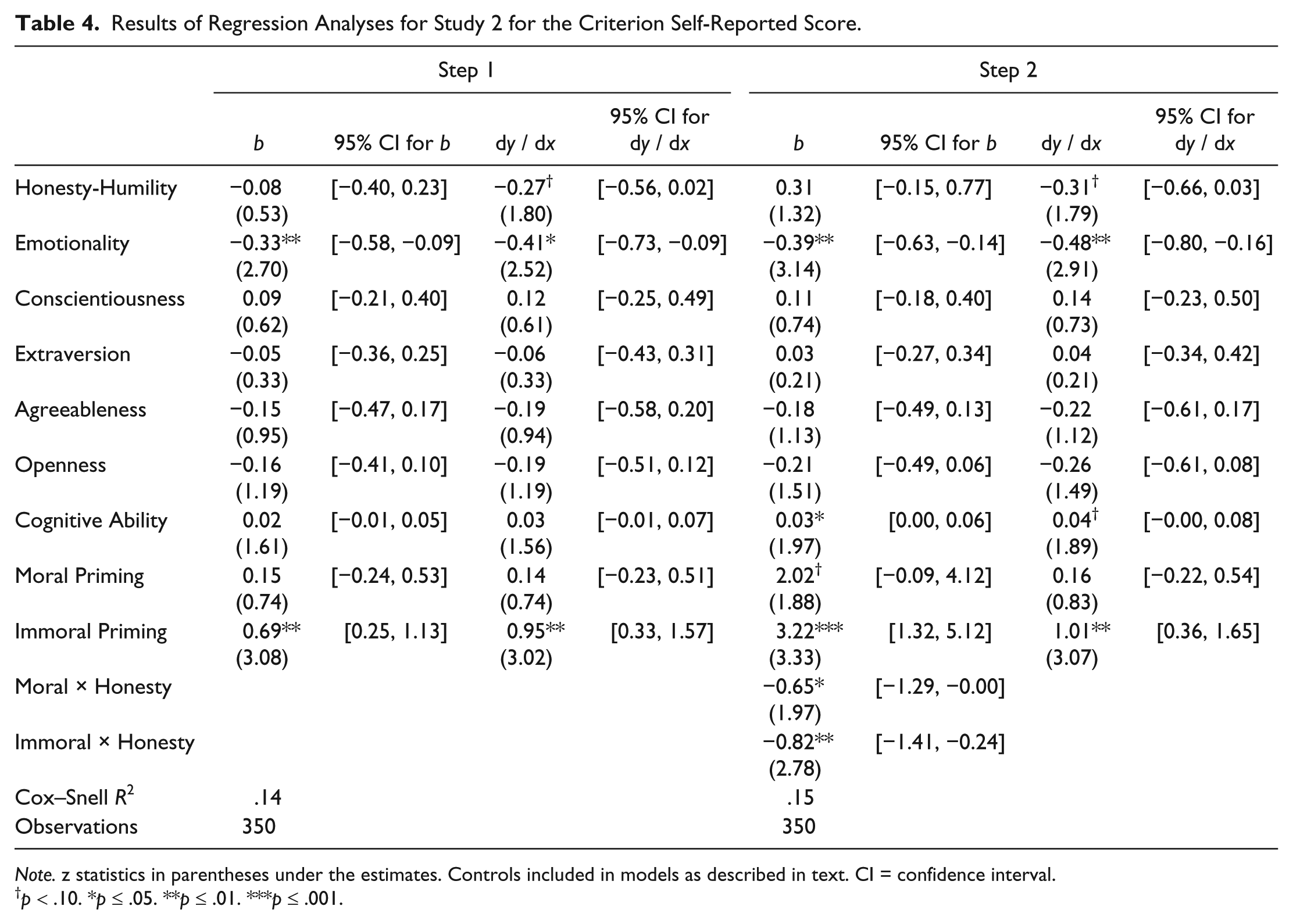
Because participants reported a large number of zeros (46.57%), we estimated a zero-inflated negative binomial regression analysis for predicting the self-reported score (Blevins et al., 2015). In Step 1, we regressed this score on the six personality traits and the control variables (i.e., participant age, gender, nationality, cognitive ability, French level, and assigned room) to test Hypothesis 1. We also included two dummy variables for the priming manipulations to test Hypothesis 2. The baseline group was the neutral priming condition. In the zero-inflation equation, we included Honesty-Humility, the two priming dummy variables, and the control variables of gender and assigned rooms. Results are reported in Table 4.
Results of Regression Analyses for Study 2 for the Criterion Self-Reported Score.
Note. z statistics in parentheses under the estimates. Controls included in models as described in text. CI = confidence interval.
p < .10. *p ≤ .05. **p ≤ .01. ***p ≤ .001.
As a test of Hypothesis 1, results revealed that the average marginal effect of Honesty-Humility on the self-reported score approached significance (dy / dx = −0.27, p = .071). Results also revealed a significant average marginal effect of immoral priming on the self-reported score (dy / dx = 0.95, p = .003), consistent with Hypothesis 2. Inconsistent with Hypothesis 2, however, the average marginal effect of moral priming was not significant (dy / dx = 0.14, p = .46). Participants reported a higher score in the immoral priming condition (M = 1.59, SD = 2.32) than in the neutral priming condition (M = 1.01, SD = 1.80). For the moral priming condition, the mean was 1.05 (SD = 1.63).
In Step 2, we created two interaction terms by multiplying each dummy variable with Honesty-Humility and included these variables in our model to test Hypothesis 3. We also included these variables in the zero-inflation equation. As expected, the Immoral Priming × Honesty interaction (b = −0.82, p = .005) on the self-reported score was significant, as was the Moral Priming × Honesty interaction (b = −0.65, p = .049). Wald tests, which are joint tests for a set of regressors being different from zero (Cohen, Cohen, West, & Aiken, 2003), indicated that the model with main effects of the primes and the interactions or a model with only interactions significantly affected cheating, χ2(5) = 20.78, p < .001, and χ2(2) = 8.24, p = .016, respectively. Probing the interaction (see Figure 2) showed that participants high on Honesty-Humility (+1SD) reported similar performance in the three conditions (the marginal means were 1.31, 0.83, and 0.95, for the immoral, moral, and neutral conditions, respectively), χ2(1) = 2.01, p = .156. Participants low on Honesty-Humility (−1SD), however, reported a higher score in the immoral condition as compared with the moral and neutral conditions (the marginal means were 2.41, 1.25, and 0.82, for the immoral, moral, and neutral conditions, respectively), χ2(1) = 7.47, p = .006. Furthermore, participants low or high on Honesty-Humility (±1SD) reported similar performance (the marginal means were 1.25 and 0.83, respectively) in the moral priming condition, χ2(1) = 1.94, p = .164; however, participants high on Honesty-Humility reported a lower performance than did participants low on Honesty-Humility (the marginal means were 1.31 and 2.41, respectively in the immoral priming condition), χ2(1) = 4.05, p = .044. Furthermore, results revealed that participants low or high on Honesty-Humility (±1SD) reported similar performance (the marginal means were 0.82 and 0.95, respectively) in the neutral condition, χ2(1) = 0.26, p = .608. Finally, participants low or high on Honesty-Humility (±1SD) reported similar performance when comparing the neutral and moral conditions—the marginal means were 0.82 and 1.25, χ2(1) = 2.25, p = .133, and .95 and .83, χ2(1) = .20, p = .657, respectively, for participants low or high on Honesty-Humility. These results partially supported Hypothesis 3. Analyses at ±2 standard deviations produced the same results.
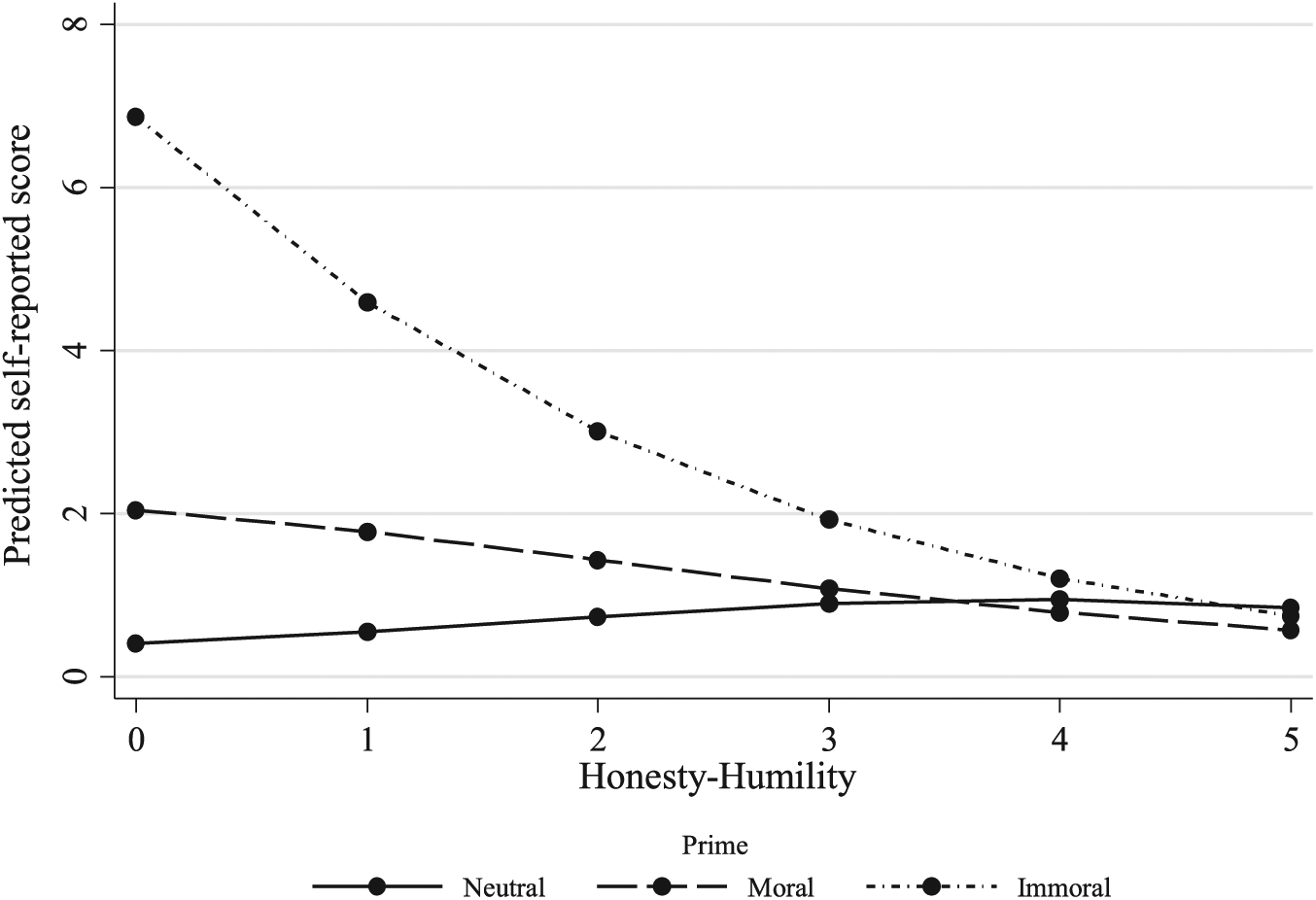
Average predicted number of pairs as a function of participant level of Honesty-Humility and the type of priming.
When we ran the analyses without controls and covariates, we did not find a significant average marginal effect of Honesty-Humility on cheating, b = −0.22, SE = 0.12, z = 1.80, p = .072 (95% CI = [−0.46, 0.02]), dy / dx = −0.56, p = .33. However, we found a similar pattern of results for the effect of moral priming, b = −0.01, SE = 0.21, z = 0.03, p = .974 (95% CI = [−0.43, 0.41]), dy / dx = 0.00, p = .994, and for the effect of immoral priming, b = 0.40, SE = 0.21, z = 1.92, p = .055 (95% CI = [−0.01, 0.81]), dy / dx = 0.55, p = .037. Adding the interaction terms to that model revealed that the Immoral Priming × Honesty interaction effect was marginally significant, b = −0.60, SE = 0.31, z = 1.91, p = .056 (95% CI = [−1.22, 0.02]), as was the Moral Priming × Honesty interaction effect, b = −0.58, SE = 0.34, z = 1.70, p = .089 (95% CI = [−1.25, 0.09]).
We also estimated the model using number of lottery tickets taken as the dependent variable; here we used negative binomial regression given that the model using zero-inflated negative binomial regression did not converge. The pattern of results we observed was essentially the same as was that for the self-reported scores.
General Discussion
Across two studies, we examined the effects of Honesty-Humility on incentivized cheating behavior. In Study 2, we additionally examined interactive effects of Honesty-Humility and the situation variable moral/immoral primes. Consistent with Hypothesis 1, Honesty-Humility was negatively predictive of cheating behavior, even when we accounted for other personality traits and cognitive ability. In partial support of Hypothesis 2, an immoral prime caused cheating behavior, whereas a moral prime did not have an effect. More importantly, in support of Hypothesis 3, Honesty-Humility and moral/immoral primes had an interactive effect on cheating behavior: Individuals low on Honesty-Humility cheated more when exposed to an immoral prime, whereas individuals high on Honesty-Humility behaved consistently across the situational conditions by not cheating much. Interestingly, findings also revealed that no other trait had a consistent effect on cheating across both experiments. In Study 1, agreeableness had a positive effect on cheating, and in Study 2, emotionality had a negative effect on cheating. Below, we first discuss the theoretical contributions of our research before turning to its policy implications as well as limitations and strengths.
Theoretical Contributions
Our research contributes to the literature in several ways. Advancing the literature on cheating in the fields of both behavioral ethics and personality research (e.g., Abeler et al., 2016; Bucciol & Piovesan, 2011; Gächter & Schulz, 2016; Gill et al., 2013; Hilbig & Zettler, 2015; John et al., 2014; Mead et al., 2009; Rosenbaum, Billinger, & Stieglitz, 2014), we argued and found that personal and situational factors can interact to predict cheating behavior. The few studies that had taken person–situation interactions involving Honesty-Humility into account examined mostly deviant behaviors other than cheating such as antisocial and counterproductive work behaviors (e.g., Allgaier et al., 2015; Zettler & Hilbig, 2010; for an exception, see Hilbig & Zettler, 2015). We show that Honesty-Humility can serve as a boundary condition for effects of situational factors on cheating, such that situational effects diminish as Honesty-Humility increases. Future research on effects of moral cues on cheating behavior, thus, has to take into account who is sensitive to these cues and who is not.
We also add to the literature on personality, in particular research using the HEXACO, by demonstrating when Honesty-Humility has predictive validity and when not. Although this trait is generally an effective predictor of deviant behaviors (e.g., Lee, Ashton, & de Vries, 2005; Marcus et al., 2007), we showed that in certain situations individuals display similar cheating behaviors independent of their level of Honesty-Humility (see also Hilbig, Zettler, & Heydasch, 2012; Zettler & Hilbig, 2010; Zettler, Hilbig, & Heydasch, 2013). Theorizing about the effects of Honesty-Humility on cheating, hence, needs to consider when the situation allows these effects to emerge.
More specifically, the findings might add to the understanding of the theory of self-concept maintenance (Mazar et al., 2008; Mulder & Aquino, 2013; Shalvi, Dana, Handgraaf, & De Dreu, 2011). To the extent that the self-concept refers to how persons perceive themselves (Shavelson, Hubner, & Stanton, 1976), our measure of Honesty-Humility reflects, at least partially, individuals’ self-concept regarding their honesty (Ackerman, 1997; McCrae & Costa, 1982). Back, Schmukle, and Egloff (2009), for example, suggested that measures of personality traits captured the explicit self-concept of personality. In this sense, our findings suggest that individuals vary in their explicit self-concept regarding their honesty, which in turn, affects their cheating behavior. Thus, results of both studies suggest a more fine-grained version of the argument by Mazar et al. (2008) that people just cheat a little bit to maintain a positive self-concept. As Mazar et al. did, we found that participants did not come close to fully exploiting their opportunities for cheating. We, however, add that “cheating a little bit” meant different things to different people depending on their Honesty-Humility. Self-concept maintenance theory can, hence, not only explain why people tend to cheat only a little bit, but also why people vary in their cheating behaviors.
In addition, we heed calls for more extensive theorizing on person–situation interactions (e.g., Funder, 2008; Kihlstrom, 2013) by explaining interactive effects through both the situation and person perspectives and under explicit consideration of features of the supra-situation, such as the governance system within which a behavior is embedded. Theorizing from multiple perspectives allowed us to flesh-out assumptions made in theoretical models. For example, the argument that a moral cue constitutes a strong situation presumes a behavioral norm for honesty, and a person argument about behavioral inconsistency among individuals low on Honesty-Humility assumes a context in which cheating is not punished.
A thought experiment reveals the importance of considering the supra-situation, showing that what is a strong situation in one supra-situation can be a weak one in another supra-situation. An aspect of the supra-situation is the default behavior, which for the context of our research is cheating a little bit at most. Now suppose that, unlike in our study, cheating was the default behavior. Then, we would predict again a person–situation interaction, but our arguments would be reversed. The immoral prime would now be the strong situation reinforcing the behavioral norms for cheating, in which both honest and less honest persons cheat. In contrast, the moral prime would be the weak situation that would allow for behavioral variability in cheating. Or, stated through the person lens, it would now be less honest persons who would behave consistently across situations, whereas those high on Honesty-Humility would be expected to change their behavior according to the situation. Findings of Experiment 3 in Zettler et al. (2013) support our argument. In their experiment, participants took part in a trust game and were informed about the other player’s probability to cooperate (i.e., either at 40% or 60%). Results revealed that participants low on Honesty-Humility behaved consistently across conditions, that is, by being non-cooperative (see also Pfattheicher & Böhm, 2017). Conversely, participants high on Honesty-Humility tended to be non-cooperative when the other’s probability to cooperate was low (i.e., 40%), whereas they cooperated when the other’s probability to cooperate was high (i.e., 60%).
Such more extensive reasoning illustrates that the interaction between Honesty-Humility and moral primes might be best understood as a person-in-situation interaction, whereby both the person and the situation are considered simultaneously in their context (Funder, 2008). In contrast, if theorists spoke of a person-by-situation interaction, they might choose either a person or situation perspective thereby possibly ignoring the context, in which person and situation factors are embedded.
Practical Implications
Despite studying actual cheating behavior, we caution practitioners not to overinterpret our results. One might say that, like the research by Mazar et al. (2008), our research sensitizes us to the role that situational cues—which are provided immediately before a task—can play in affecting cheating. We add that such cues can be detrimental if they cloud standards of honesty, such as the immoral prime in our research. Situational cues blurring legitimate and moral rules within organizations might invite the spreading of counter-normative behavior (Keizer et al., 2008). An example are employees who might mimick the immoral behavior of their supervisors.
More importantly, our findings invite reflection about the utility of considering individual differences when designing anti-cheating policies. Although individuals generally value honesty (Abeler et al., 2016), there is sufficient between-individuals variation in Honesty-Humility to affect cheating (Hilbig & Zettler, 2015). Hence, the question arises whether selection on this trait could be a policy measure, particularly when honest behavior is critical and when individuals are exposed to immoral primes which cannot be eliminated. If selection is not an option, then policy makers might seek to design strong situations to keep the predisposition to cheat in check. Such strong situations clearly convey the message of not cheating and can include enforceable governance and auditing systems or ethical climates.
Limitations and Future Research
Our study has several strengths and limitations. Strengths include the use of a behavioral indicator of cheating and an unobtrusive experimental design, in which participants’ actions had actual economic consequences. In fact, we used two indicators of behavioral cheating, namely self-reported performance as the most commonly used measure (Rosenbaum et al., 2014), and an objective outcome of cheating behavior in the form of a count of lottery tickets taken. Thereby, we could validate self-reported performance as a measure of cheating by showing a strong correlation with an alternative behavioral indicator.
Yet, our findings await replication in other samples and contexts. For example, in collectivistic cultures, in which behavior is often more a function of the situation than the person, the effects of individual differences on cheating might be weaker (Morris & Peng, 1994). Moreover, research could seek to manipulate standards of honesty rather than their salience to create new norms rather than affect existing ones. Furthermore, whereas our experimental design increased the likelihood of monetary gains, participants did not gain directly from cheating. Thus, our results are likely conservative in that they represent lower-bound estimates. Future research should examine whether immediate personal gains from cheating behavior would increase such behavior.
Finally, unlike Mazar et al. (2008), we did not find that a moral prime reduced cheating compared with a neutral prime. As mentioned before, Mazar et al. asked participants in the moral prime condition to write down as many of the Ten Commandments as they knew and, in the control condition, the titles of 10 books that participants had read in high school. We primed participants by asking them whether they knew three books, and we manipulated the moral connotation of the title of one of these books. We also included an immoral prime. With this manipulation, we sought to avoid a potential demand effect (Zizzo, 2010). Furthermore, we preferred to use a symmetrical design, whereas the design by Mazar et al. was asymmetrical by not including a condition in which participants wrote down, for example, a list of socially undesirable behaviors. Our moral prime might have been too subtle to have effects. It is also possible that the low base rate of cheating in Study 2 did not allow a moral prime to be effective. Nonetheless, we found an effect of the immoral prime, suggesting that the salience of a subtle norm for dishonesty could increase cheating particularly among individuals low on Honesty-Humility. Future research might replicate our Study 2 using a stronger manipulation or a task with a higher base rating of cheating.
Conclusion
In two behavioral studies, we investigated to what extent Honesty-Humility and moral situational cues predicted cheating behavior. We found that individuals high on Honesty-Humility were less likely to cheat and less likely to be induced to cheat by immoral situational cues than were individuals low on Honesty-Humility. Ultimately, our work provides a backdrop from which to consider policies targeting either persons or situations, or both to prevent cheating behaviors. To conclude, we find that most individuals have good intentions and do not cheat or cheat very little. Still, the weaker the norms against cheating are, the more it is likely that there will be some who will succumb to the power of the “dark side.”
Footnotes
Appendix
Acknowledgements
The authors thank Valérie Chavez for her helpful comments on the manuscript.
Declaration of Conflicting Interests
The author(s) declared no potential conflicts of interest with respect to the research, authorship, and/or publication of this article.
Funding
The author(s) disclosed receipt of the following financial support for the research, authorship, and/or publication of this article: The author(s) wish to thank the Faculty of Business and Economics and the equality office of the university of Lausanne for their financial support.
Supplemental Material
Supplementary material is available online with this article.
References
Supplementary Material
Please find the following supplemental material available below.
For Open Access articles published under a Creative Commons License, all supplemental material carries the same license as the article it is associated with.
For non-Open Access articles published, all supplemental material carries a non-exclusive license, and permission requests for re-use of supplemental material or any part of supplemental material shall be sent directly to the copyright owner as specified in the copyright notice associated with the article.
