



Abstract
Social psychology experiences recurring so-called “crises.” This article maintains that these episodes actually mark advances in the discipline; these “crises” have enhanced relevance and led to greater methodological and statistical sophistication. New statistical tools have allowed social psychologists to begin to achieve a major goal: placing psychological phenomena in their larger social contexts. This growing trend is illustrated with numerous recent studies; they demonstrate how cultures and social norms moderate basic psychological processes. Contextual social psychology is finally emerging.
Keywords
Every generation or so, social psychologists seem to enjoy experiencing a “crisis.” While sympathetic to the underlying intentions underlying these episodes—first the field’s relevance, then the field’s methodological and statistical rigor—the term crisis seems to me overly dramatic.
Placed in a positive light, social psychology’s presumed “crises” actually marked advances in the discipline. The first such episode was triggered by the large-scale entrance into the field of young, politically liberal doctorates who were influenced by the marked changes going on during the 1960s and early 1970s throughout the Western world. (More radical young social scientists tended to enter sociology.) This was the largest cohort of new PhD’s ever to enter the field. And those who entered at that fateful time were often disappointed that the discipline was not more active in social change.
Pre–World War II social psychology in North America had been far more interested in addressing social issues. Witness the formation of SPSSI (Society for the Psychological Study of Social Issues) in 1936 (Pettigrew, 2011). Extensive shifts in social psychology following the war—narrowing its theoretical focus, breaking ties with the other social sciences, focusing on laboratory experiments as its prime method, losing interest in action research—triggered what was extravagantly termed a “crisis” in social psychology (Pettigrew, 2018). A host of critiques from all directions ensued from established members of the field as well as others who had entered the field during the political turmoil of the 1960s (e.g., Cartwright, 1979; Elms, 1975; Gergen, 1973; Helmreich, 1975; McGuire, 1973; Ring, 1967; Sherif, 1977). Newcomers to the discipline and others rightly challenged the field’s relevance.
European social psychologists also participated in this era of critique. Holzkamp’s (1964a, 1964b) “critical psychology” garnered considerable attention in Germany. Israel and Tajfel (1972) criticized American social psychology for its inattention to the cultural and structural context of its phenomena and its greater focus on equity than on equality. The Europeans, in common with many of their North American colleagues, held the view that the field had strayed from its purpose to further human betterment, had become too distanced from “real life,” too trivial, too reductionist, and too asocial (Greenwood, 2004). Adding to the malaise, ethical concerns were raised about the deceptive methods employed by some social psychological experimenters and typified by Milgram’s (1974) famous and controversial study of obedience.
The second “crisis” now underway concerning “false positives” and replication failures is also overblown. This article will later provide a detailed discussion to support this view, but here again the discipline can potentially sharpen its research procedures from these recent debates despite the exaggerations involved.
To be candid, I have never been much affected by these so-called “crises.” I have just kept plugging away for more than six decades, confident that social psychology was an important field that can benefit society in many ways. Although it was hardly a “crisis” either, I did become frustrated when the “cognitive revolution” became so dominant in social psychology that emotion and groups were virtually ignored (Pettigrew, 1981). I was not alone in my discomfort. Ivan Steiner (1974) was moved to object to the cognitive concentration of social psychology by asking, “Whatever happened to the group in social psychology?”
The near-exclusive attention to cognition greatly expanded our understanding of stereotypes and many other phenomena. But it led to two problems. First, it seriously diverted attention away from the social context of psychological phenomena. Second, it obscured the importance of emotion. And, if you specialize in the study of prejudice and race relations or many other fields, you can never ignore emotion—hate, resentment, envy, fear, and a host of other negative emotions.
Contrary to dominant opinion at present, I believe the discipline is finally beginning to live up to its promise as an important contributor to understanding our complex social world. Ask yourself: What differentiates social psychology from general psychology? Surely, the very title of the field implies that social psychologists specialize in placing psychological phenomena in their social contexts. As such, the discipline should be acting as a meso-level link between the micro-level of psychology and the macro-level of the other social sciences—sociology, political science, social anthropology, and economics. This focus was certainly a major goal of the founders of the field from Wilhelm Wundt and his Volkerpsychologie (Graumann, 2001) to the Allports, Kurt Lewin, Gardner Murphy, Muzafer Sherif, and Henri Tajfel. Recall Lewin’s classic formula: Behavior = f (Person, Environment).
Figure 1 clarifies how this article is broadly defining social context. Six paths connect the three basic levels of analysis—micro, meso, and macro. Fiske (2000) made a convincing case that social psychology has acted in recent years to connect the micro- with the meso-levels (Paths B and E). Placing such personality variables as authoritarianism and social dominance orientation in their situational contexts is a prime example. And this has been a growing trend over recent decades in both personality and social psychology (Pettigrew, 2018). But here we are focusing on Paths A, C, D, and F that link the micro- and meso-levels with the broad macro-contexts that are the focus of the other social sciences. In joining with the earlier call of Cacioppo, Berntson, Sheridan, and McClintock (2000) for multilevel analyses, I believe that in the years since their article appeared, social psychology has in fact been developing such analyses.
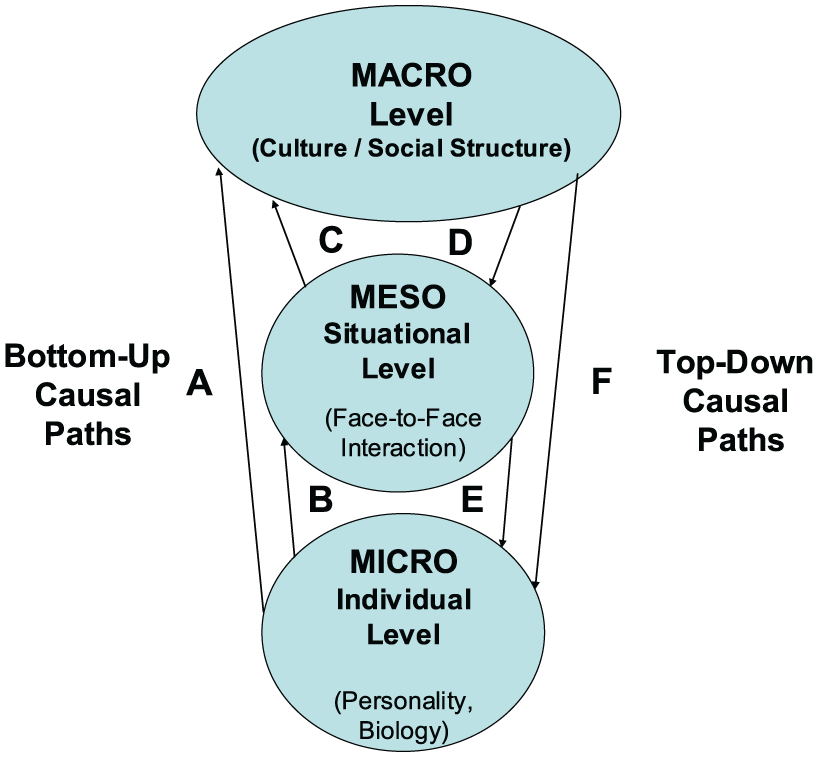
Six causal paths from three levels of analysis.
A major reason for applying multilevel analyses is to avoid the recurrent problems posed by the compositional and ecological fallacies (Pettigrew, 1997). The compositional fallacy involves drawing conclusions at the macro-level of analysis from individual data alone—a problem that all-too-often arises in psychological theorizing. This is a fallacy because organizations and societies are social systems and as such are more than the sum of their individual parts. Macro-units have unique properties of their own that the macro-social sciences specialize in studying.
The ecological fallacy involves the exact opposite confusion of levels. Here, we draw conclusions about individuals from macro-level data alone—a mistake often seen in statements made about individual voters from aggregate voting results alone. This is a fallacy because macro-units are too broad to determine individual data, and individuals also have unique properties that cannot be inferred from macro data. Working at both levels simultaneously protects against these common fallacies in social science.
To be sure, multilevel approaches are complex, but “the real world” is complex. Consequently, multilevel perspectives are arguably closer to real-life circumstances. Paradoxically, this complexity can often untangle puzzles that arise at a single level of analysis. For example, Wagner, van Dick, Pettigrew, and Christ (2003) were able to explain persistent differences in prejudice between the macro-units of East and West Germany using individual differences in intergroup contact. They found that the greater prejudice in East Germany was largely a result of East Germans having far less contact with minorities than West Germans enjoyed.
To be fair, it is social psychologists in psychology who have strayed in the past from the contextualizing task. Many social psychologists in sociology have continuously pursued this goal (e.g., Taylor, 1998). A striking example of the D and E causal paths is provided by the work of Alex Inkeles in six developing nations (Inkeles & Smith, 1974). He demonstrated that industrialization leads to similar forms of social organization in all six countries. In turn, these “modern” organizations shape face-to-face situations that in time produce similar patterns of “modern” beliefs, perceptions, and values.
At present, I am excited that psychological social psychology is finally getting the tools to put its phenomena in such broader social contexts. While we focus on whether we can trust p values, we should also be teaching, using, and advocating the new tools that allow us to meet belatedly the original thrust of social psychology. To name a few such methods, structural equation modeling, moderator and mediator analyses, meta-analysis, and especially multilevel analyses.
The following two sections will offer recent examples of research in social psychology that consider cultural and normative contexts. These examples of strong contextual effects are necessarily drawn from social psychological phenomena with which I am most familiar. Social psychological readers will undoubtedly be able to think of many other recent contextual articles in their specialty fields. By late 2017, PsycInfo explicitly listed the term “contextual social psychology” as a major subject in 94 references and as a key word in 109 references.
Cultural Contexts for Basic Social Psychological Phenomena
A number of prominent social psychologists—such as Fiske, Kitayama, Markus, and Nisbett (1998) and Triandis (1994)—have long focused on cultural effects. But social psychologists generally have not been active in this domain using the latest multilevel statistical tools. Cross-Cultural Analysis (Davidov, Schmidt, & Billiet, 2011), a leading volume for this area, has 51 contributors only one of whom is a self-identified social psychologist.
This situation is now starting to change. The new methodological tools have encouraged social psychologists to begin to consider how culture influences basic social psychological phenomena at multiple levels. Consider recent studies that employ these new methods to place fundamental social psychological processes in their cultural contexts. Kende, Phalet, Van Den Noortgate, and Fisher (in press) meta-analytically tested intergroup contact theory across 36 different cultures. Using the meta-analytic base of Pettigrew and Tropp (2006) and 477 separate studies with 187,025 participants, they found such contact had larger effects in cultures characterized by egalitarian values. Consistent with contact theory’s contention that intergroup contact typically reduces prejudice, all of the 36 cultures revealed a negative relationship between intergroup contact and prejudice. But although the effect still operated in cultures with hierarchical values, it was markedly reduced in these cultures. Indeed, Kende et al. determined that cultural context made a difference somewhat greater than the important moderator of equal status in the contact situation measured at the individual level.
Similarly, culture shapes the effects of relative deprivation (RD). RD is the judgment that one or one’s ingroup is worse off compared with some relevant standard coupled with feelings of anger and resentment with this situation. When properly measured, RD predicts a wide range of outcomes (Pettigrew, 2015, 2016; Smith, Pettigrew, Pippin, & Bialosiewicz, 2012; Walker & Smith, 2001).
Smith and her colleagues (under review) first used national assessments of individual-collectivism, power distance, and economic inequality to code 303 effect sizes from 31 different countries with 200,578 participants. RD predicted all types of outcomes more strongly within individualistic nations.
Next, these investigators employed a survey of 6,113 undergraduate university students from 28 different countries that confirmed the importance of cultural differences for RD effects. The relationship between individual relative deprivation (IRD) and different outcomes was again stronger for undergraduates who lived in more individualistic countries. Group relative deprivation (GRD) also predicted political trust more strongly for undergraduates who lived in countries marked by lower power distance. Thus, RD effects are also culturally bounded. In particular, RD is more likely to motivate reactions within individualistic countries that emphasize individual agency and achievement as a source of self-worth.
Consider, too, the ingroup favoritism phenomenon found repeatedly by research on the ingroup attribution bias (Hewstone, 1989, 1990; Pettigrew, 1979). People in Western societies tend to attribute positive behaviors by ingroup members to internal, dispositional causes while typically attributing the same behaviors by outgroup members to situational causes. For negative behaviors, the opposite process is typical: for ingroup members, such behaviors are typically explained away with situational causes while attributing the same negative actions by outgroup members to dispositional causes. “We did it because we had to in that situation; they did it because that is just the way they are.”
But, once again cultural context is critical. Some cultures are far less prone to this attributional bias. Repeatedly, research has found that some Asian cultures are less prone to dispositional attributions in general and to group attribution bias in particular (Hewstone & Ward, 1985; Khan & Liu, 2008; Menon, Morris, Chiu, & Hong, 1999; Morris, Nisbett, & Peng, 1995; Morris & Peng, 1994).
The pervasiveness of cultural contextual effects puts into question the possibility of cross-cultural consistencies of social psychological phenomena. This places a premium on finding such cross-cultural universals; but here, too, the field has advanced. As an especially noteworthy example, the stereotype content model with its focus on competence and warmth seems to meet the valuable property of operating similarly across vastly different cultures and groups (Fiske, Cuddy, Glick, & Xu, 2002).
Normative Contexts for Basic Social Psychological Phenomena
Norms are critically important determinants of behavior even if social and personality psychologists have too often ignored them (Gelfand, Harrington, & Jackson, 2017; Pettigrew, 1991). Even such classics as The Authoritarian Personality (Adorno, Frenkel-Brunswik, Levinson, & Sanford, 1950, pp. 130, 171, 267, 817ff) failed to consider the importance of context. This famous study recorded its highest F scale average in an infamously harsh prison without considering the authoritarian context in which the inmates were taking the measure. For these imprisoned respondents, some of the authoritarian items were literally true. Later work, however, has repeatedly demonstrated the ubiquitous interaction between such personality syndromes as authoritarianism and the social context. For instance, authoritarianism rises in times of societal threat and recedes in times of calm (Sales, 1973).
Now recent advances in multilevel analyses have made it possible to check systematically on how norms at the macro-level of analysis provide critical contexts for social psychological phenomena at the micro- and meso-levels of analysis.
In psychological social psychology, Oliver Christ and Ulrich Wagner have advocated and demonstrated the importance of multilevel analyses using probability survey data (Christ, Sibley, & Wagner, 2012; Christ & Wagner, 2013). One immediate advantage of such analyses is that context in the past was characteristically measured as individually perceived, whereas now multilevel analyses also typically use an objective context. For example, earlier work often asked respondents how many minorities live in their neighborhood (e.g., Wagner & Zick, 1995), but now objective data are also typically employed. And these two types of measures can be quite dissimilar (e.g., Pettigrew, Wagner, & Christ, 2010).
Consider the following examples of recent multilevel research that demonstrate the importance of normative climate on social psychological phenomena.
The effect of the intergroup climate on acculturation preferences among host-majority and immigrant group members has long been acknowledged in the acculturation literature. But only recently has multilevel research made it possible to examine directly the effect of the intergroup climate on acculturation preferences. Christ and his colleagues (2013) adopted a multilevel approach to examine the effect of the intergroup norms and climate (social context level of analysis) on immigrants’ acculturation preferences (at the individual level of analysis) over and above individual-level predictors of acculturation preferences. They employed German cross-sectional survey data, and examined the acculturation preferences (cultural maintenance and maintenance of intergroup relations) of members of immigrant groups living in various districts in Germany.
At the social context level, they used the mean prejudice and acculturation preferences scores of nonimmigrant German respondents as indicators of the dominant intergroup norms and climates within these districts. Results of their multilevel path analysis revealed that on the contextual level, a negative intergroup climate (i.e., a higher amount of prejudice of the German respondents within the districts) was systematically related to a stronger desire for cultural maintenance among the immigrants. When faced with greater prejudice of native Germans, immigrants tended to turn inward and work to maintain their culture rather than more actively work to adopt their new host culture. Hostile intergroup norms lead to reduced assimilation efforts.
In another study, Christ et al. (2014) assessed evidence for a contextual effect of positive intergroup contact. They checked to see if the effect of intergroup contact between social contexts (the between-level effect) on outgroup prejudice is greater than the effect of individual-level contact within contexts (the within-level effect). Across seven large-scale surveys (five cross-sectional and two longitudinal), using multilevel analyses, they found an important and reliable contextual (normative) effect. That is, intergroup contact across social contexts had a strong effect on diminishing prejudice. Moreover, this effect was found in multiple countries, across time, and at multiple levels (regions, districts, and neighborhoods), and with and without controlling for an array of demographic and context variables.
These findings support the view that intergroup contact has a significant role to play in prejudice reduction at various social levels. Indeed, contact has great policy potential to improve intergroup relations. Because it can shape norms, intergroup contact can affect large numbers of people who do not themselves experience such contact.
Another example of multilevel research also reveals how minority groups are influenced by the climate of the social context in which they reside (Kauff, Green, Schmidt, Hewstone, & Christ, 2016). Intergroup contact theory has been criticized for ignoring the larger context in which such contact occurs. In particular, single-level studies have shown that minority members who have experienced the most intergroup contact are in general more reluctant to protest for change (Dixon et al., 2010; Dovidio, Gaertner, Ufkes, Saguy, & Pearson, 2016; Saguy, Tausch, Dovidio, & Pratto, 2009; Wright & Lubensky, 2008). Thus, it seems as if intergroup contact leads minorities to like the majority more and this in turn reduces their motivation for change.
However, the multilevel analyses of Kauff and his colleagues challenge this finding. Using two cross-sectional general population surveys (one across 22 countries, another across Switzerland’s 136 districts), they examined whether ethnic majority members’ positive contact influences ethnic minority members’ support for ingroup rights at the social context level. Applying multilevel path analysis, they show that minority members are more, not less, likely to support anti-discrimination laws and immigrant rights when they live in social contexts in which majority members have more positive intergroup contact experiences. What the single-level studies missed was that widespread positive intergroup contact in an area influences the intergroup norms of the area (Pettigrew & Hewstone, 2017). Positive norms encourage minorities to seek change as a viable, attainable goal.
While the Kauff study revealed contrasting effects of contact at the micro and macro levels of analysis, other studies find similar effects emerging at both levels. Take, for example, the results of a recent European study of GRD. Meuleman, Abts, Schmidt, Pettigrew, and Davidov (in press) analyzed data from the seventh edition of the European Social Survey across 20 European nations. Employing multilevel structural equation modeling (MLSEM), they determined that GRD had major effects on attitudes toward immigrants at both the individual and national levels. GRD did so by mediating the impact of individual and contextual indicators of ethnic threat. Phrased differently, the sense of GRD at both the individual and national levels enhanced the perceived ethnic threat posed by Europe’s recent massive in-migration.
The Crisis of Relevance
As we have noted, newcomers to the discipline and others rightly challenged the field’s relevance in the 1960s and 1970s. Their efforts succeeded in making applications of social psychology to social policy a central concern. Membership in SPSSI increased, and the organization later moved its office to Washington to play the “honest broker” role of supplying social science information to policy makers (Pettigrew, 1967). More recently, SPSSI began publishing a journal that explicitly addresses social policy—Social Issues and Policy Review.
Numerous outstanding examples of the field’s relevance have emerged. One of the most ambitious attempts to apply social psychological principles to a major social problem is Herbert Kelman’s efforts to ease Middle Eastern tensions through carefully constructed problem-solving workshops (Kelman & Fisher, 2016). Explicitly using contextual principles, Kelman managed to employ the small group as (a) a microcosm of the larger macro-system, (b) a laboratory for creating inputs to the larger macro-system, (c) a setting for direct interaction of significant members of each side of the conflict, (d) a coalition across the conflict lines, and (e) a nucleus for a fresh new relationship between the conflicting parties. Kelman’s ambitious efforts provide a useful model for similar efforts in other conflict arenas.
Consider another such example provided by Fiske, Bersoff, Borgida, Deaux, and Heilman (1991) in the ground-breaking gender discrimination case of Price Waterhouse v. Hopkins. This was the first case in which the U.S. Supreme Court used social psychological research on sex stereotyping. Susan Fiske effectively testified to the antecedent conditions, indicators, consequences, and remedies of stereotyping on the basis of extensive social psychological research. Her testimony was cited at length by the trial and appeals courts as well as the Supreme Court. The plaintiff won the case; and this episode surely meets the earlier concerns about the field’s relevance to the world’s problems.
At present, European social psychologists are using their research findings on intergroup contact and related phenomena to help generate greater acceptance of the enormous number of immigrants suddenly reaching the continent’s shores. When the number of refugees from Syria, Afghanistan, and African states to Germany increased to nearly 900,000 in 2015, 150 German social psychologists signed a petition and sent it directly to the German chancellor and parliament. They made recommendations based on social psychological knowledge about intergroup relations and intergroup contact for a humanitarian political handling of this immigration (see in German: https://www.uni-marburg.de/fb04/team-sozialpsychologie/aktuelles/document.2016-02-10.0875762241). Although Chancellor Angela Merkel never directly responded, social psychological knowledge did diffuse into the political debate, especially with discussions in the Bundestag and elsewhere of the positive effects of intergroup contact.
This notable German effort suggests the need for a similar collective response from American social psychologists, joined hopefully by other social scientists, especially sociologists and political scientists. We have helpful things to say on bringing together the nation’s sharp political divides as well as improving the acceptance of immigrants. And, like our German counterparts, we should address political leaders directly.
The Latest “Crisis”
The more recent second “crisis” is a direct consequence in the field’s increasing statistical and methodological sophistication. How can that be a dire development? Indeed, this increasing sophistication is a major driving force behind the growth in such contextual social psychological studies as just reviewed. And it is part of a general trend of major advances throughout the social sciences. To quote Glaeser (2017 pg. 78), “ . . . progress is still being made at a ferocious pace, and the contours of [the social sciences] are rapidly evolving.”
The latest “crisis” has two interrelated parts; one focuses on “false positives,” the other on replication failures. The concerns over false positives, even if sharply overstated, can potentially be a step forward in statistical practice in social psychology (Simmons, Nelson, & Simonsohn, 2011, 2017). But it does not represent, in the journalistic hyperbole of the New York Times, a “revolution” that could render “ . . . vast amounts of research, even entire sub-fields, . . . unreliable” (Dominus, 2017).
What is distressing about this debate is its personal nature as reported by Dominus (2017). I have been proud of the professional stance of social psychology throughout my long career. But unrefereed blogs and social media attacks sent to thousands can undermine the professionalism of the discipline. Accusing authors of studies you reject as being either stupid or dishonest has no place in social psychology or any other science—save in such lamentable situations as the Diederik Stapel affair.
Yet there are valuable things to be learned in this latest “crisis.” Simmons et al. (2011, 2017) proposed six somewhat burdensome requirements for authors to meet to reduce the possibility of p-hacking. These suggestions deserve thoughtful consideration.
But the term “p-hacking” implies intentional distortion. That this occurs cannot be denied, yet I am unconvinced that it is as widespread as the critics of the field maintain. John, Loewenstein, and Prelec (2012) reported that various “questionable research practices” are common in psychology, with prevalence estimates of up to 100%. Norbert Schwarz (2012), a survey specialist, pointed out that their survey purporting to show this widespread p-hacking suffered from a very low response rate (24%), selective attrition from an extremely high break-off rate, and seriously biased questions—even questions for which any answer counted as a “questionable practice.”
Moreover, some adjustments to research data are fully justified, and some even raise p levels (e.g., removing extreme outliers that favor the hypothesis). These justifiable adjustments should continue, but they need a footnote to show the reader how they are affecting the p level.
Now some social scientists, following earlier writers (e.g., Schmidt & Hunter, 1995), are suggesting either to stop giving special privilege to significance levels (Amrheim & Greenland, 2017) or to reduce the p level from .05 to .005 (Benjamin, Berger, & Johnson, 2017). This last suggestion immediately raises questions about the large increase in Type II errors that would necessarily occur from lowering the p level for significance. Benjamin et al. (2017) offered an interesting option; they suggest a third category of “suggestive” for low p levels above .005. These various possibilities seem premature for social psychology at this point, but they are certainly worth debate. Yet different levels are appropriate for different fields. Physics can easily afford to have far more rigorous standards than the social sciences; and there may well be differences among the social sciences and even within psychology itself.
It is also useful for the discipline to think more deeply about replications. The publication in Science of the replication findings by the Open Science Collaboration (2015) brought on this so-called “replication crisis” by apparently showing that psychological research in general and social psychological and personality research in particular often fails to replicate. Gilbert, King, Pettigrew, and Wilson (2016, 2017) calmed the waters by showing that this conclusion was simply not justified. They demonstrated that when the Collaboration’s analyses are corrected for error, power, and bias, “ . . . the pessimistic conclusions that many have drawn from this article—namely, that there is a ‘replication crisis’ in psychology—are unwarranted” (Gilbert et al., 2017).
An especially damaging part of the Gilbert critique was that many of the replication studies were in fact quite different from the original studies. For instance, the replications of two studies conducted in the United States were actually carried out in Italy and the Netherlands. Such extensive contextual differences can be critical—the fundamental point of contextual social psychology. Not surprisingly, then, these poorly replicated studies turned out to be 4 times more likely to fail to support the original findings.
The retort to the Gilbert paper did not sufficiently address its claims (Anderson et al., 2016; Gilbert et al., 2017). Indeed, it even acknowledged that the opposite conclusion of high reliability in psychological studies could also be inferred from their project’s results. Apparently, social psychological studies do replicate at reasonable levels, and this finding also speaks against the claims of John et al. (2012) of widespread “questionable research practices.” If there are indeed acceptable levels of replication, then p-hacking and other questionable practices cannot be as extensive as these authors claim. In any event, the large-scale effort of the Open Science Collaboration has at least served a valuable purpose by renewing attention to the importance of replications.
We should note that the incivility that marked the “p-hacking” debate did not occur in this exchange about replication. Gilbert emphasized that no one in the Collaboration was trying to deceive anyone. And a leader of the Collaboration, Brian Nosek, actually made useful suggestions to Gilbert and his colleagues for their rebuttal (Gilbert et al., 2017).
All scientists favor replications, but the issue is more complex than often presented. Some critics seem to think that replication problems are largely an issue for social psychology. But, of course, replication is important for all empirical sciences.
Also forgotten in much of the replication discussion in social psychology is the fact that the discipline’s major studies upon which much of its basic theory is based have been successfully replicated repeatedly. Recall the influential experiments of Solomon Asch (1955, 1956) on conformity and Stanley Milgram (1974) on obedience. Asch carefully repeated his conformity experiment over and over, constantly testing rival explanations for his surprising results. Milgram, who had studied with Asch, did the same thing with his unanticipated obedience results. Consistent with the findings of the reproducibility study (Open Science Collaboration, 2015), these legendary studies had strong effects initially—the primary predictor of reproducibility. And each of the Asch and Milgram tests not only replicated their original findings but tested a different explanation for their unexpected results. Thus, this careful work also avoided the single factor fallacy (Pettigrew & Hewstone, 2017).
Meta-analysis, which social psychology has often successfully employed, also provides evidence that research in the field is not in the dire position its critics would have us believe. Consider the five meta-analyses conducted on intergroup contact theory. First, Pettigrew and Tropp (2006) showed that hundreds of studies found a solid relationship with reduced prejudices of many types. Next, Davies, Tropp, Aron, Pettigrew, and Wright (2011) found that contact studies involving friends led to an even stronger relationship between contact and lessened prejudice.
Then Beelmann and Heinemann (2014) demonstrated that structured contact programs promoted positive intergroup attitudes in children and adolescents. And Lemmer and Wagner (2015) found that studies conducted outside of the laboratory using direct and indirect contact interventions also reduced ethnic prejudice. Finally, Miles and Crisp (2014) analyzed studies of imagined intergroup contact. They uncovered in these studies a significant reduction in both implicit and explicit intergroup prejudice. Although there is some overlap in the research included in these five meta-analyses, together they boasted roughly a third of a million different subjects across almost 700 separate studies. Their summary statistics were significant for both published and unpublished studies, and emerged across a broad range of target outgroups and contexts.
Greenfield (2017) raised yet another key consideration. She notes that cultures change over time, so failures to replicate may simply reflect this change. Greenfield’s point can be extended to dissimilar contexts in general. In social psychology, as Gilbert and his colleagues (2016, 2017) emphasized, disparate contexts of the experiments can easily lead to differential results. A study done in the United States may not replicate in Switzerland because of cultural differences between the two nations. Studies of crowding and personal space in spacious parts of North America may not replicate in Tokyo, the densely populated Netherlands, or the even more densely populated German state of North Rhine-Westphalia.
Narrower contexts can also disrupt replications. For instance, college campuses vary widely in the composition of their student bodies from which most social psychological experiments draw their subjects. Thus, replicated results from studies conducted on a broad variety of campuses are likely to be the most firmly grounded.
Survey research also needs to be carefully replicated. It is often too expensive to repeat large surveys, but a simple, if somewhat crude, method with large surveys is available but rarely employed. Random subsamples can be tested to see how closely their results align with those of the total sample.
A Final Word
On multiple grounds, this article argues strongly that social psychology’s supposed “crises” have exaggerated the field’s difficulties. Indeed, each of these episodes has actually marked advances in the field’s theory, applications, and research methods. And these contentions apply with special force to the recent uproar about “false positives” and replication.
More importantly, new theory and methods have aided social psychology to begin to situate its phenomena in their broad social contexts. This is an extremely significant advance in the discipline that should be celebrated and continued. Contextual social psychology is finally emerging.
Footnotes
Acknowledgements
The author wishes to thank Professors Oliver Christ, Chris Crandall, Susan Fiske, Peter Schmidt, Norbert Schwarz, Heather Smith, Ulrich Wagner, and two anonymous reviewers for their considerable assistance.
Declaration of Conflicting Interests
The author(s) declared no potential conflicts of interest with respect to the research, authorship, and/or publication of this article.
Funding
The author(s) received no financial support for the research, authorship, and/or publication of this article.