




Abstract
Latinos and Asian Americans confront similar stereotypes as they are often presumed to be foreigners and subjected to American identity denial. Across six studies (total N = 992), we demonstrate that Latinos and Asians anticipate ingroup prejudice and specific types of subordination (e.g., American identity threat) in the face of outgroup threats that target one another (i.e., stigma transfer). The studies explore whether stigma transfer occurred primarily when shared Latino and Asian stereotype content was a salient component of the prejudice remark (e.g., foreigner stereotypes; Study 3), or when outgroup prejudice targeted a social group with shared stereotype content (Study 4), though neither appeared to substantively moderate stigma transfer. Minority group members who conceptualize prejudiced people as holding multiple biases (i.e., a monolithic prejudice theory) were more susceptible to stigma transfer suggesting that stereotype content is not necessary for stigma transfer because people assume that prejudice is not singular.
Asians and Latinos represent the two fastest growing single-race American populations with projections of population growth at 143.1% and 114.8%, respectively from 2014 to 2060 (Colby & Ortman, 2014). Given their representation in the American population, it is surprising that Asian Americans and Latino Americans also share the experience of being denied their American identity and being assumed to be immigrants (Cheryan & Monin, 2005; Guendelman, Cheryan, & Monin, 2011; Sue et al., 2007; Wang, Minervino, & Cheryan, 2013). This may be because people hold implicit associations between “American” and “White,” leaving ethnic minorities, such as Asian and Latino Americans, as outsiders in their native country (Devos & Banaji, 2005; Devos & Heng, 2009). This assumption of foreigner status occurs more frequently for Latinos and Asians compared with African Americans (Zou & Cheryan, 2017), resulting in related microaggressions against Latino and Asian Americans, such as assumptions that they were not born in the United States or do not speak English (e.g., Nadal, Mazzula, Rivera, & Fujii-Doe, 2014). These identity denial experiences and microaggressions have harmful downstream effects on the psychological health of Asians and Latinos (Albuja, Sanchez, & Gaither, 2017; Huynh, Devos, & Smalarz, 2011; Nadal, Griffin, Wong, Hamit, & Rasmus, 2014; Nadal, Mazzula, et al., 2014; Wang, Leu, & Shoda, 2011). Yet, no studies to date have examined the contexts that mutually evoke American identity threats for Latinos and Asian Americans. Thus, the present study examines whether American identity threats aimed at Latinos lead Asians to anticipate American identity threats and whether the same is true for Latinos.
Research has demonstrated that stigma-salience can evoke common identities between racial group members (Craig & Richeson, 2012, 2014). For example, when minorities think about the racial discrimination they face, they express more positive attitudes toward other ethnic minorities (e.g., African Americans) and in some cases, other stigmatized groups that are unrelated to race (Galanis & Jones, 1986). These perceived similarities can lead to more favorable intragroup minority attitudes, including support for policies that favor outgroup rights (e.g., Tedin & Murray, 1994; Vollhardt, Nair, & Tropp, 2016). In the present studies, we focused on the shared experience of stigma when exposed to outgroup discrimination. Recent findings suggest that stigma can transfer such that, for example, White women experience gender identity threats when they encounter racial prejudice because they believe perpetrators of one type of prejudice may also harbor negative attitudes toward their ingroup (Sanchez, Chaney, Manuel, Wilton, & Remedios, 2017). In addition, safety cues in an organizational setting for racial minorities and women can also transfer. For example, an organization in receipt of accolades for their treatment of African Americans is also viewed as a supportive environment to work by White women (Chaney, Sanchez, & Remedios, 2016). Similarly, companies that adopt gender inclusive bathrooms to create climates that facilitate identity safety among transgender individuals may also signal comfort for cisgender women and men of color (Chaney & Sanchez, in press). Yet, prior work has not examined what factors may moderate stigma or safety cue transfer.
Stereotype Content
In research to date, stigma transfer has only been demonstrated among groups that share stereotype content. For example, stigma transfer has been documented among White women and African Americans who contend with similar stereotypes regarding their innate intelligence and their perceived lack of fit for fields perceived to require brilliance (Leslie, Cimpian, Meyer, & Freeland, 2015; Storage, Horne, Cimpian, & Leslie, 2016). Facing similar struggles with a minority outgroup could encourage identification with minority outgroups that lends itself to solidarity (Cortland et al., 2017), and in the case of stigma transfer, viewing oneself as vulnerable to the same threat. In the present work, examining Latinos’ and Asians’ stigma transfer allows the opportunity to explore the role of stereotype content in facilitating identity threat transfers as these groups face both overlapping stereotypes (e.g., as foreigners) and distinctive content regarding their competence, with Latinos viewed as lower in competence than Asian Americans (Fiske, Xu, Cuddy, & Glick, 1999; Gonzales, Blanton, & Williams, 2002; Lee & Fiske, 2006; Lin, Kwan, Cheung, & Fiske, 2005). Thus, the present article explores whether stigma transfer and resultant American identity threat depend on whether outgroup threats explicitly address shared stereotype content (Study 3) or explicitly target groups with shared stereotype content (Study 4). Although stereotype content is expected to facilitate stigma transfer, it is also possible that people’s lay beliefs about the monolithic nature of prejudice is a binding force that facilitates viewing outgroup bias as an ingroup threat regardless of stereotype content (Study 5).
Monolithic Theory of Prejudice
Given that stigmatized group members are often subjected to prejudice, they may be uniquely tuned to instances of discrimination and, therefore, learn whether prejudice remarks target multiple groups or tend to exist in isolation. As a result, they may come to hold beliefs about the nature of prejudice and whether or not prejudices go hand in hand (i.e., prejudiced people tend to target more than one group). Some have demonstrated that minority group members who experience threats on the same identity dimension (e.g., race) more readily perceive one another as similar (Craig & Richeson, 2014). For example, when Asian Americans are primed to think about prejudice against Asians, they tend to view themselves as having more in common with African Americans compared with situations where discrimination is not salient (Craig & Richeson, 2012). As minority group members (regardless of stereotype content) view themselves as sharing the experience of racial discrimination (even if they are of a different race), they may be likely to view racial prejudice itself as having overlapping targets. This would be particularly interesting to consider given that it may be disadvantageous to assume that prejudices go together as this may translate into more contexts signaling identity threats. Moreover, self-enhancement goals and intergroup tendencies to associate with the ingroup and distance from the outgroup in the context of threat to protect self-esteem (e.g., Branscombe, Ellemers, Spears, & Doosje, 1999; Branscombe, Spears, Ellemers, & Doosje, 2002; Tajfel & Turner, 1979, 1986) would seemingly imply that minority group members would avoid conceptualizing prejudice toward outgroups as interlinked to ingroup, yet minority group members may come to hold beliefs about the monolithic nature of prejudice that prevent such self-protection.
In the scholarly literature, there has been much debate among researchers about whether to view prejudice as monolithic (i.e., part of a broader prejudiced personality; Pratto, Sidanius, Stallworth, & Malle, 1994; Sibley & Duckitt, 2008; Sidanius, 1993), more differentiated (Fiske & Stevens, 1993; Rudman & Glick, 2008; Young-Bruehl, 1998), or both (Akrami, Ekehammar, & Bergh, 2011). Although prejudices may well have both monolithic and distinctive characteristics, the consequences for stigmatized targets of holding a lay theory of prejudice as monolithic are unknown, and thus, Study 5 represents a novel extension of stigma transfer. An emerging literature on lay theories of prejudice (and the social categories upon which they are based) has shown that they can influence the experience of stigma and intergroup behavior (Carr, Dweck, & Pauker, 2012; Hong, Chiu, Dweck, Lin, & Wan, 1999; Williams & Eberhardt, 2008). Moreover, research shows that lay theories need not be accurate to influence behavior (Crandall, 1994; Hong, Levy, & Chiu, 2001; Levy, Chiu, & Hong, 2006). Although not all perpetrators hold multiple prejudices, some stigmatized group members may come to believe that forms of racism coexist because of their attention to discrimination and its co-occurrence, the tendency to see minority outgroup members as similar when ingroup discrimination is salient, and the actual nature of prejudice itself. Thus, Study 5 tests whether stigma transfer is most likely among those minority group members who hold a monolithic theory of prejudice.
The Present Studies
The present studies will examine stigma transfer between Asian and Latino threats for the first time, to test whether identity denial (a unique type of identity threat) transfers (Studies 1-5). Furthermore, the present studies will expand the stigma transfer literature by exploring two factors: stereotype content (i.e., the extent to which the outgroup, or the threat itself, shares overlapping content with the ingroup; Studies 3 and 4) and individual differences in holding a monolithic theory of prejudice (i.e., the lay belief that prejudicial beliefs about groups are overlapping; Study 5).
Study 1a
Study 1a tests whether Asian Americans anticipate identity threats (including cultural denial) from Latino prejudice cues.
Method
Participants
Participants were recruited from Amazon Mechanical Turk® (MTurk®) using instructional attention checks and affirmations to increase the integrity of the research and a screener to select the population of interest (Oppenheimer, Meyvis, & Davidenko, 2009; Rosegrant, 2015) After removing participants who answered attention checks incorrectly or who failed to indicate an intention to answer honestly (n = 5), Study 1a had an analytic sample of 134 Asian American participants (46.3% female; Mage = 32.62, SDage= 11.53, Agerange = 18-77) in exchange for US$.40. Across all studies, data collection stop points were set to 30 to 40 participants per condition following prior studies on stigma transfer (Sanchez et al., 2017).
Procedure
Participants were told that they were in an organizational impressions study, and randomly assigned to read one of three profiles (based on Kaiser et al., 2013) about an organization accused of either Latino bias, Asian bias, or environmental misconduct. Participants completed the following measures in the order presented below.
Perceptions of bias
Participants indicated the extent to which they believed managers at this company held anti-Asian bias with four items such as “How likely is it that a manager at Smith & Simon Corp treats Asians unfairly?” on a scale from 1(very slightly or not at all) to 5 (extremely or a lot) (α = .94). These same items were adjusted to address anti-Latino bias (α = .83).
Identity threats
On a scale from 1 (not at all) to 7 (a great deal), participants completed three items on how concerned they would be that managers at this company would judge them negatively based on their race (e.g., “my race,” “Asian background”) (α =.97), which served as the measure of anticipated stigma. Using the same scale, participants rated how likely managers at the company would believe that they “belong in America,” “would subscribe to American values,” and “would be patriotic” (α = .90). Participants also rated how likely managers at this company would be patriotic and identify as American (α = .78). Cultural denial was operationalized as a difference score between manager’s perceived patriotism and how patriotic they would judge the participant. We used a relative measure of Americanism as the measure of threat as we had reason to believe that those holding outgroup prejudice would be viewed as more likely to cling to American values and simultaneously more likely to view the participant as failing to meet them. Thus, together, cultural denial experiences may be a product of value incongruence (being perceived as less American than perceivers). Analysis conducted separately for patriotism judgments of self and manager can be found in the Supplemental Material.
Liking
Participants responded to four questions such as “How well do you think you would get along with a manager at this company?” on a scale from 1 (very slightly/not at all) to 5 (extremely/a lot) (α = .94). Controlling for liking in the following studies did not alter the conclusions and upon reviewer’s request, analyses are presented without this covariate (see Supplemental Material for analysis with liking).
Results and Discussion
Primary analysis
One-way ANOVAs were conducted to determine the effects of conditions followed by Fisher’s Least Significant Difference (LSD) post hoc analyses to determine simple effects. To test whether participants anticipated American threat (i.e., believed they would be viewed as less American than those at the company), we conducted a 3 (condition: anti-Asian, anti-Latino, or control) × 2 (patriotism perceptions: company vs. self) mixed-model ANOVA with repeated measures on the second factor.
Anti-Asian bias
There was a significant main effect of condition, F(2, 131) = 14.23, p < .001,
Racial stigma
There was a significant main effect of condition, F(2, 131) = 7.29, p = .001,
American threat
Mixed-model ANOVA revealed that participants thought that the managers would view themselves as more American than participants, F(1, 131) = 93.93, p < .001,
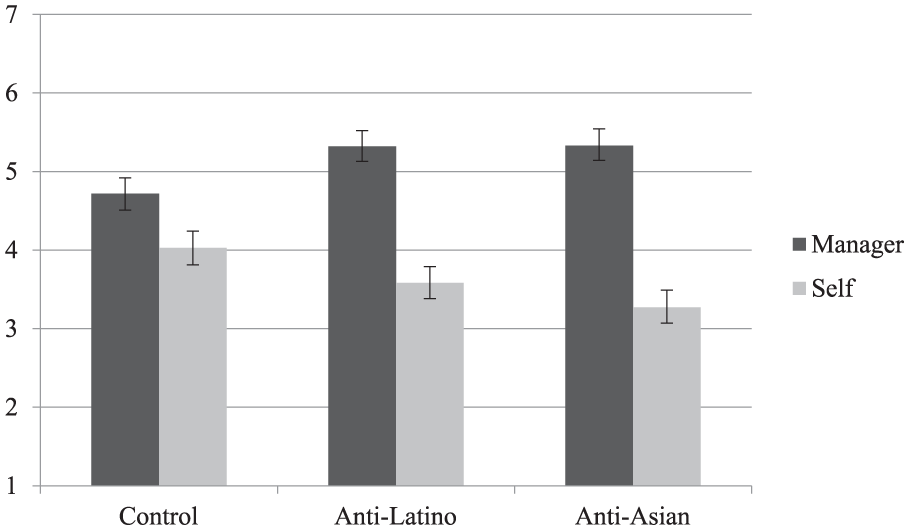
Study 1a results for American threat by type of prejudice at organization.
Summary
Study 1a demonstrated that companies accused of anti-Latino bias were viewed as more likely to hold anti-Asian attitudes and, therefore, caused Asian Americans to anticipate stigma and American threats.
Study 1b
Study 1b aimed to demonstrate American identity threat transfer among Latinos.
Method
Participants
After removing participants who answered attention checks incorrectly (n =7), 117 Latino American participants (53.8% female; Mage = 34.91, SDage= 14.60, Agerange = 18-100) were recruited to participate from MTurk® in exchange for US$1.00.
Procedures and measures
The organization materials were nearly identical to Study 1a (see Supplemental Material) and the procedure was the same. After reading the articles, participants completed measures of anti-Asian bias (α = .97), anti-Latino bias (α = .98), anticipated racial stigma (α =.97), and a five-item liking measure (α = .94). The American threat measure was identical to Study 1a but one item was added so that both subscales, anticipated American perceptions by the manager (α =.90) and managers’ American self-perceptions (α =.82), had the same number of items.
Results and Discussion
Anti-Latino bias
Following the analyses of Study 1, an ANOVA revealed a significant main effect of condition, F(2, 114) = 30.72, p < .001,
Racial stigma
There was a significant main effect of condition, F(2, 114) = 17.01, p < .001,
American threat
The repeated measures ANOVA revealed that participants thought that they would view them as less American than those at the company, F(1, 114) = 62.11, p < .001,

Study 1b results for American threat by type of prejudice at organization.
Summary
Study 1b replicated Study 1a with Latino participants, showing that a company that was accused of Asian discrimination was also viewed as likely to hold anti-Latino attitudes, and evoke anticipated racial stigma and American threat among Latino Americans.
Study 2
Because Study 1a and Study 1b used a hypothetical scenario, Study 2 sought to conceptually replicate American identity threat transfer in a more realistic evaluative setting.
Method
Participants and procedure
Participants were recruited from an Introductory Psychology subject pool after they indicated in a prescreen that they were both U.S. citizens and Asian American. Of the participants who arrived at the lab who were Asian and of appropriate age to participate in the study (18 or older), two were unable to speak English fluently, five requested data removal, and six did not pass an attention check, leaving a final analytic sample of 170 (66% female; Mage = 18.54, SDage= 0.94, Agerange = 18-24).
Upon arrival to the study, participants learned that they would be involved in a social exchange and performance evaluation task. Participants were ostensibly randomly chosen to be the performer, requiring them to deliver an impromptu speech evaluated by the other participant (always a White male confederate). They were then separated in two rooms to complete questionnaires about their personality, and so on, which they would later exchange, ostensibly to learn about their evaluator’s personality. Following prior research (Sanchez et al., 2017; Sawyer, Major, Casad, Townsend, & Mendes, 2012), participants were randomly assigned to form impressions of their evaluator whose initial survey responses revealed anti-Asian prejudice, anti-Latino prejudice, or no evidence of either (see Supplemental Material). The profile packet included identical bubbled-in responses to three filler personality inventories (e.g., The Big Five Inventory) as well as the key prejudice measure for the experimental conditions. Participants assigned to the neutral condition only received responses to the demographic and personality measures, whereas the profiles in the Asian and Latino prejudice conditions also included responses indicating moderately high levels of prejudice on an Asian or Latino prejudice scale, respectively.
Participants were then asked to report on their impression of the evaluator prior to the speech task using similar measures from Study 1a but reworded to address perceptions of the evaluator: presumed anti-Asian prejudice (α = .94), presumed anti-Latino prejudice (α = .91), liking of the evaluator (α = .91), anticipated racial stigmatization (α = .97), perceived impression of the participant’s patriotism (α =.73), and assumed level of patriotism of the profiled person (α =.47). As the reliability was low, we dropped this component of the scale. In addition, participants were asked how they would be treated by their evaluator with six items such as “How likely is it that the evaluator would treat you favorably?” (α = .95).
Results and Discussion
Anti-Asian bias
An ANOVA revealed a significant main effect of condition, F(2, 166) = 83.32, p < .001,
Anticipated racial stigmatization
There was a significant effect of condition, F(2, 166) = 55.56, p < .001,
American threat
Because of the low reliability on the perceived patriotism of the evaluator scale, an ANOVA was conducted on the measure of perceived patriotism of the self, which revealed a significant effect of condition, F(2, 166) = 37.14, p < .001,
Anticipated treatment by evaluator
A significant effect of condition, F(2, 166) = 52.80, p < .001,
Summary
Study 2 revealed that anti-Latino evaluators caused Asian Americans to anticipate stigma, mistreatment, and American threat; however, all three studies thus far have used outgroup prejudice cues that implicate shared stereotype content (namely, the foreigner stereotype). For example, the articles in Study 1a and Study 1b mentioned a Latino employee experiencing an American threat and the Study 2 prejudice measure implicated anti-Latino immigrant views. It is unclear whether Latino prejudice that cues distinctive content (e.g., the lazy/incompetent stereotype) would also facilitate stigma transfer. Although Latinos and Asian Americans are similarly treated as interlopers in the United States, making them vulnerable to American identity denial (Huynh et al., 2011; Zou & Cheryan, 2017), they also contend with dissimilar stereotype content about their relative competence and work ethics. Namely, Asians are more often viewed as hard working and highly competent (Lin et al., 2005) whereas Latinos are viewed as lazy and incompetent (Fiske et al., 1999; Lee & Fiske, 2006). If stigma transfer is driven by stereotype content, then outgroup prejudice remarks that contain distinctive stereotype content (e.g., lazy stereotype of Latinos) would be less likely to result in threat (e.g., Asian Americans). If instead, stigma transfer occurs because minority groups are prone to view prejudice as having monolithic qualities, stigma transfer would persist regardless of stereotype content.
Study 3
Study 3 explores whether anti-Latino prejudice that has unshared stereotype content also leads to stigma transfer for Asians.
Method
Participants
After removing participants who answered instructional attention checks incorrectly (n = 7), 115 Asian-American participants (48.7% female; Mage = 32.14, SDage= 10.04, Agerange = 18-72), were recruited to participate from MTurk® following Study 1a and Study 1b, in exchange for US$1.00.
Procedure and measures
Participants were asked to form impressions of organizations following procedures of Studies 1a and 1b, and were randomly assigned to read one of three articles about an organization accused of Latino prejudice involving American threats (identical articles to Study 1b), competence threats (i.e., accusing the company of saying that the Latino employee was incompetent), or the environmental misconduct control condition. Specifically, the American threat manipulation stated, “After he complained, he says, other colleagues retaliated against him. One coworker suggested that as a Latino, I am taking away potential clients from American workers, and I should just go back to my home country.” Within the competence threat condition, this statement was replaced with, “One coworker suggested that I am just a ‘lazy Latino’ who doesn’t know how to work hard to build my business.” In all other ways, materials were identical to Studies 1a and 1b. Participants completed the index of anti-Asian attitudes of the company (α = .96), along with anticipated race stigmatization (α = .96), liking (α = .95), how American they would be perceived (α =.77), and how American managers at this company would see themselves (α = .92), in that order.
Results and Discussion
Anti-Asian bias
A significant effect of condition was found, F(2, 112) = 16.86, p < .001,
Anticipated racial stigmatization
An ANOVA revealed a significant main effect of condition, F(2, 112) = 23.03, p < .001,
American threat
Consistent with prior studies, participants generally thought that the managers would view themselves as more American than participants, F(1, 112) = 106.31, p < .001,
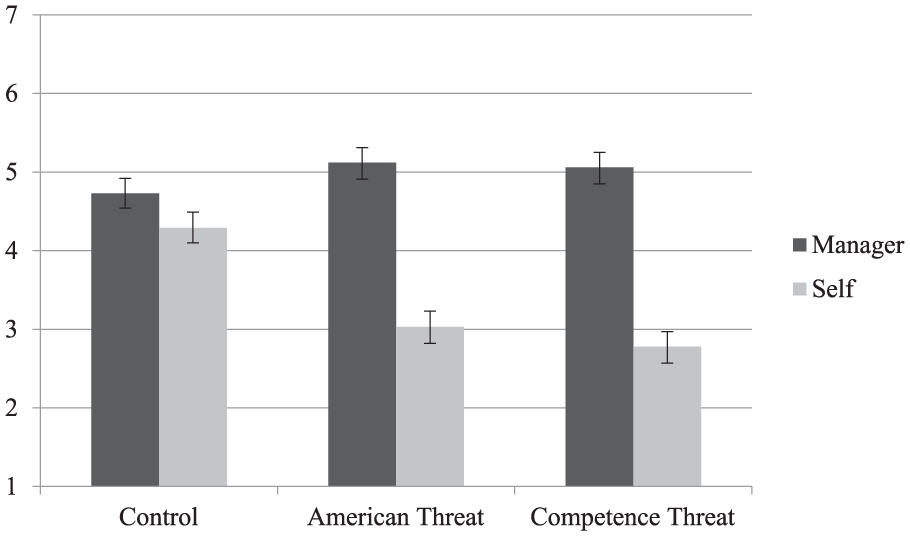
Study 3 results for American threat by stereotype content evoked in anti-Latino organization.
Summary
Study 3 revealed that the presence of explicit shared stereotype content was not necessary for Latino American threat transfer to occur for Asian Americans. As Latinos and Asians encounter some overlapping stereotype content, the preexisting common experience of encountering foreigner status may foster stigma transfer even when distinctive stereotype content is highlighted. Thus, Study 4 sought to test whether stigma transfer and American identity threat occurs when the outgroup prejudice targets African Americans who are not typically stereotyped as foreigners. African Americans share little stereotype content with Asian Americans as they are not typically viewed as foreigners in the United States, nor are they viewed as highly competent (Zou & Cheryan, 2017). Again, stigma transfer would persist regardless of which type of racial prejudice was presumably held by the evaluator if these findings were driven by the lay theory that prejudice is monolithic. If instead, shared stereotype content was primary, stigma transfer would be most likely when encountering prejudice from a group for which there is overlapping content. In other words, Asian Americans would be more likely to anticipate stigma from Latino bias compared with African American bias.
Study 4
Study 4 tested whether African American prejudice would be less likely to arouse American threat transfer compared with Latino prejudice for Asian Americans.
Pilot Testing
Asian Americans (n = 18) and Latino Americans (n = 19) were included in a pilot test to examine whether Latino and Asian Americans (but not African Americans) were viewed as facing similar stereotypes regarding their foreigner status. On a scale from 1 (not at all) to 7 (very much), participants were asked four questions about each racial group; specifically, they were asked whether the average White American (a) assumes (Latino Americans, African Americans, Asian Americans) are from another country, (b) assumes (group x) were not born in the United States, (c) perceives (group x) as foreigners, and (d) perceives (group x) as not adopting American values (αs by group = .81-.89). A repeated-measures ANOVA revealed that foreigner stereotypes varied by group, F(2, 34) = 51.42, p <.001. Participants rated Latino (M = 5.62, SD = 1.10) and Asian (M = 5.70, SD = 1.18) Americans as facing similar foreigner stereotypes, p = 1.0, whereas African Americans were viewed as the less likely to face foreigner stereotypes compared with both Asians and Latinos (ps < .001). Participant race did not moderate this effect, F(2, 34) = 0.52, p =.59. Thus, anti-Black bias served as the alternative targeted group.
Method
Participants
After removing participants who answered instructional attention checks incorrectly (n = 20), 172 Asian-American participants (54.7% female; Mage = 31.97, SDage= 9.40, Agerange = 18-63) were recruited to participate from MTurk® in exchange for US$1.00.
Procedure
Participants were told (and believed) that they would interact with a fellow MTurk® worker in an evaluation task though no interaction ultimately took place. Participants thought they were randomly assigned to the role of interviewee (following Sanchez et al., 2017). As in Study 2, participants were randomly assigned to receive a profile of their interviewer. Unique to Study 4, the study involved a 2 (level of prejudice: high or low) × 2 (type of prejudice: Latino or African American).
Measures
Participants completed the index of anti-Asian attitudes of the evaluator (α = .97) along with anticipated stigmatization (α = .99), liking (α = .95), how American they would be perceived (α =.95), and how American the evaluator would see himself (α = .84).
Results and Discussion
Anti-Asian bias
A 2 × 2 ANOVA revealed a significant main effect of prejudice level, F(1, 168) = 117.46, p < .001,
Racial stigma
A 2 × 2 ANOVA revealed a significant main effect of prejudice level, F(1, 168) = 183.78, p < .001,
American threat
To test whether participants anticipated American threat more when encountering an anti-Latino prejudice evaluator, we conducted a 2 (prejudice type) × 2 (level of prejudice) × 2 (perceptions of patriotism: manager vs. participant) ANOVA with repeated measures on the third factor. Participants thought that the evaluator would view himself as more American than the participant, F(1, 168) = 84.06, p < .001,
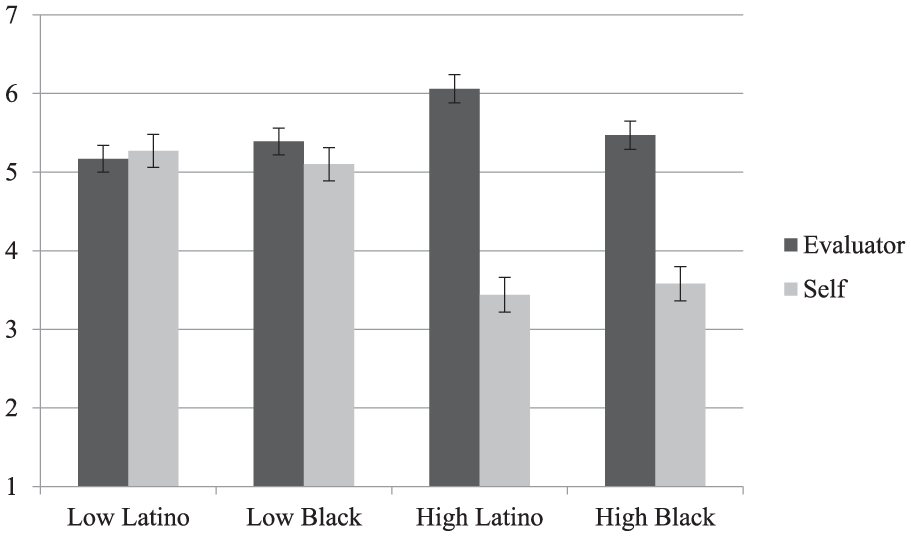
Study 4 results for American threat by type and level of organization prejudice.
Summary
Study 4 revealed that although prejudice cues transferred regardless of whether the targeted group generally contended with similar stereotype content, the type of threat one anticipates from outgroup prejudice may vary by shared stereotype content. Specifically, Asian Americans were more likely to anticipate American identity threats from Latino prejudice cues than African American prejudice cues, likely because Latino bias serves as a stronger indicator of the endorsement of foreigner stereotypes. It should be noted however that the effect of high or low prejudice cues is much stronger than the type of prejudice cue (Black or Latino bias). Thus, Study 5 aims to explain why stigma transfers regardless of stereotype content by examining whether holding a monolithic theory of prejudice moderates prejudice transfer. Although prejudice may have both monolithic and distinctive characteristics (see Akrami et al., 2011), the consequences of holding a monolithic theory of prejudice are unknown, and may help to explain why stigma transfers regardless of whether shared stereotype content is salient (Study 3) or whether the minority outgroup contends with shared stereotype content (Study 4).
Study 5
Study 5 explored whether holding a monolithic theory of prejudice moderated American identity threat and stigma transfer among Asian Americans in the face of Latino prejudice.
Method
Participants
After excluding 23 participants who incorrectly responded to instructional attention checks, the final sample of 261 (52.5% female; Mage = 32.07, SDage = 9.08, Agerange = 18-72) who received US$0.60 in exchange for participation in an MTurk® study.
Procedures
Following the procedures of Study 4, participants were led to believe they would be interacting with another MTurk® worker who was randomly assigned to the role of evaluator that would take place in a virtual environment. In anticipation of an online interaction with the evaluator, participants exchanged social information in a counterbalanced order (i.e., they either received the profile first or filled out the profile first). The White male evaluator’s profile indicated that he was either high or low in prejudice toward Latinos, as in Study 4.
Measures
Participants completed the same items from Study 1a to index anti-Asian attitudes of the evaluator (α = .98) along with anticipated stigmatization (α = .99), liking (α = .95), how American they would be perceived (α = .88), and how the evaluator would see himself (α = .83). Finally, participants completed a unique measure of monolithic lay theory of prejudice on a scale from 1 (strongly disagree) to 7 (strongly agree). Items included, “When someone is prejudiced towards one group of people, he or she is prejudiced against many other groups of people,” “When someone holds hateful beliefs against one group of people, they often hold hateful beliefs against other groups of people,” and “Holding biased beliefs about one group of people tends to be a sign of holding biased beliefs about other groups of people” (α = .95). The mean score on monolithic theory of prejudice was above the midpoint at 5.36 (SD = 1.31).
Results and Discussion
Anti-Asian bias
Using hierarchical linear regression, anti-Asian bias was regressed on condition (–1 = low Latino bias, 1= high Latino bias) and standardized lay theory of prejudice scores in Step 1, and the Condition × Lay Theory interaction in Step 2. Although both condition, B = 0.87, SE = 0.06, p < .001, 95% CI = [0.75, 0.98], and lay theory, B = 0.23, SE = 0.06, p < .001, 95% CI = [0.11, 0.34], significantly predicted anti-Asian bias, these main effects were qualified by a significant Condition × Lay Theory interaction, B = 0.42, SE = 0.06, p < .001, 95% CI = [0.31, 0.54]. Although participants low in a monolithic lay theory of prejudice (–1 SD) perceived greater anti-Asian bias in the high prejudice condition than the low prejudice condition, B = 0.44, SE = 0.08, p < .001, 95% CI = [0.28, 0.61], this effect was greater among participants high in a monolithic lay theory (+1 SD), B = 1.29, SE = 0.08, p < .001, 95% CI = [1.13, 1.45].
Anticipated racial stigma
For anticipated stigma, hierarchical linear regression revealed a main effect of condition, B = 1.34, SE = 0.10, p < .001, 95% CI = [1.14, 1.54], and monolithic lay theory, B = 0.39, SE = 0.10, p < .001, 95% CI = [0.19, 0.59], as well as a significant Condition × Monolithic Lay Theory interaction, B = 0.64, SE = 0.10, p < .001, 95% CI = [0.44, 0.84]. Although participants low in a monolithic lay theory (–1 SD) anticipated greater racial stigma in the high prejudice condition than the low prejudice condition, B = 0.70, SE = 0.14, p < .001, 95% CI = [0.42, 0.98], this effect was greater among participants high in a monolithic lay theory (+1 SD), B = 1.98, SE = 0.14, p < .001, 95% CI = [1.70, 2.26].
American threat
For simplicity, hierarchical regression was performed using the difference score for American identity threat (see Figure 5). A significant main effect of condition, B = 0.78, SE = 0.08, p < .001, 95% CI = [0.62, 0.94], and monolithic lay theory, B = 0.44, SE = 0.08, p < .001, 95% CI = [0.28, 0.61], and a significant Condition × Monolithic Prejudice Theory interaction emerged, B = 0.50, SE = 0.08, p < .001, 95% CI = [0.33, 0.66]. Although participants low in a monolithic lay theory (–1 SD) reported significantly more American threat in the high prejudice condition than the low prejudice condition, B = 0.28, SE = 0.12, p = .02, 95% CI = [0.05, 0.52], they reported greater American threat in the high prejudice condition compared with the low prejudice condition when high in a monolithic lay theory (+1 SD), B = 1.28, SE = 0.12, p < .001, 95% CI = [1.05, 1.51].
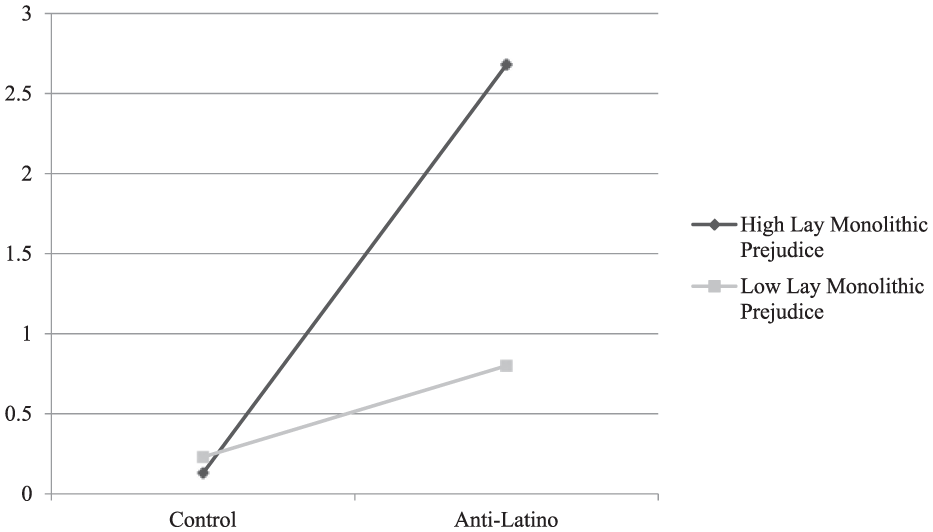
Study 5 results for American threat from Latino prejudice for those high and low monolithic lay theory.
Summary
Study 5 revealed that stigmatized group members who hold a higher monolithic theory of prejudice (i.e., believe that prejudiced beliefs are not singularly held but rather an indicator of multiple forms of bias) are more susceptible to overall stigma transfer as well as American identity threat, specifically. Notably, both high and low prejudice individuals showed evidence of stigma transfer but it was most pronounced among those who endorsed these beliefs more. Moreover, most participants were above the midpoint of the scale, suggesting that role of stereotype content may be overshadowed by the prevailing belief that evidence of racial prejudice, regardless of which racial minority group it is directed to, is perceived to indicate a person or organization who holds systemically derogatory beliefs about other minority groups.
General Discussion
Across six studies, stigma transfer was consistently found—prejudice aimed at one stigmatized racial group (e.g., Latinos) evoked identity threat in nontargeted stigmatized racial group members (e.g., Asians). Unique to this set of studies, American identity threat transferred for both Asian and Latino American participants who evaluated prejudiced organizations, and individuals in face-to-face and anticipated interactions. Moreover, American identity threat transfer (anticipating being viewed as less American) occurred regardless of whether shared stereotype content was explicitly evoked (e.g., foreigner vs. competence stereotype). For example, despite highlighting the incompetence stereotype toward Latinos (in Study 4), Asians continued to anticipate American identity threat in the face of this type of Latino bias even though their group does not face incompetence stereotypes. Although stigma transfer was found for Asian Americans consistently when faced with either Latino or Black prejudice, American identity threat, specifically, was most likely to occur when outgroup prejudice involved a racial group who experienced similar cultural threats (e.g., Latinos; Study 4). Although there was overall minimal evidence on other outcomes that type of prejudice (anti-Black or anti-Latino) moderated stigma transfer, anticipation of cultural denial was higher when Asian Americans encountered evaluators with high Latino bias compared with high Black bias. Distinctive stereotype content may not have played a larger role in mitigating stigma transfer because people tend to endorse a monolithic lay theory of prejudice. Study 5 revealed that most Asian Americans held a monolithic theory of prejudice and that this view of prejudice facilitated stigma transfer.
Stigma Transfer
These findings add to a growing literature that reveals the widespread negative effects of prejudice on bystanders. Although prior work has largely focused on the negative impact of insults and crimes aimed at other ingroup members (e.g., collective victimhood, victim consciousness; Vollhardt, 2015) or close others (e.g., courtesy stigma; Birenbaum, 1970; Pryor, Reeder, & Monroe, 2012), the present work suggests that prejudice events, even when aimed at outgroup members with whom you have no close relationship or shared race (e.g., Latino strangers), could have similar psychological consequences (e.g., for Asians), especially when stigmatized group members hold a monolithic lay theory of prejudice. Moreover, this was the first demonstration that American identity threat specifically was experienced by groups that historically experience identity denial (Latinos, Asians) when they encounter outgroup prejudice. Notably, this study examined stigma transfer within racial groups, who may be more prone to feeling a commonality in their discrimination experiences (i.e., being mistreated on the basis of their race); thus, future work should address the extent to which stereotype content is important in stigma transfer when the domain of prejudice is not overlapping.
Lay Theory of Prejudice
Although the purpose of this article is not to enter the debate on whether prejudice is better described as monolithic or distinctive, the current studies suggest that stigmatized group members may generally endorse a monolithic prejudice theory with important implications regarding the contexts in which they experience threat. For example, holding a monolithic theory about prejudice broadly determined the magnitude of stigma transfer. This may have important implications for when groups engage in coalition building. Specifically, a common perpetrator may foster collaborative action between stigmatized groups against racial injustice. Thus, monolithic prejudice viewpoints may be a critical component of collective action. Critically, the present research demonstrates that a monolithic lay theory is not necessary for stigma transfer to occur, though holding a monolithic lay theory exacerbates the intensity with which targets expect stigma in the presence of outgroup prejudice. Therefore, an additional generative path for future work will be to examine when people typically hold a monolithic prejudice lay theory, the extent to which it applies to prejudices that do not share the same social category (sexism and racism, anti-Semitism and Black prejudice). Certain contexts may also prime monolithic theories of prejudice such that, for example, people may be more likely to believe in a monolithic theory of prejudice when thinking of prototypical perpetrators (e.g., White men) versus aprototypical perpetrators (e.g., racial ingroup members). Thus, the nature of prejudice beliefs and its perceived shared targeting of groups is an important area of future research.
Limitations and Future Directions
By involving participants of color, this work contributes to diversity in psychological research; however, the present studies are limited by their focus on Asian and Latino American participants. Prior research has established that White men are unlikely to experience stigma transfer (Sanchez et al., 2017); yet, it is unclear whether other stigmatized groups with shared stigma attributes experience stigma transfer. Specifically, some stigmatized groups share stigma attributes such that their identity is concealable (e.g., sexual orientation) or perceived by others to be controllable (e.g., obesity). Sharing stigma attributes may facilitate stigma transfer. Moreover, this study did not examine prejudice that is experienced between minority groups, which may prevent stigma transfer. Indeed, distancing from other minority outgroups occurs to increase ingroup status (e.g., White & Langer, 1999; White, 2006), to protect the self from stigmatization or to bolster self-worth (e.g., Branscombe et al., 1999; Branscombe et al., 2002). As such, in some cases, for example, stigmatized group members may align themselves with outgroup prejudice perpetrators to protect their self-worth or to preserve resources or status for their ingroup. In contexts, where opportunities are given to align with outgroup prejudiced perpetrators or the situations is likely to encourage competition among minority groups (e.g., limited resources), stigma transfer may be unlikely.
Conclusion
In summary, across six studies, prejudice directed toward one racial group (e.g., Asian Americans) elicited cultural identity denial in another racial group (e.g., Latino Americans), particularly when prejudice expressions involved groups that experienced similar American identity threats. This is the first study to show that anticipated American threat can transfer from outgroup prejudice. Overall, however, there was more evidence of stigma transfer regardless of stereotype content. Results reveal that the primary intervening factor on the likelihood of stigma transfer was whether individuals hold a monolithic theory of prejudice. These studies suggest that the theories people hold about the nature of prejudice play an important role in the experience stigma.
Supplemental Material
AmericanIThreatTransferPSPBSupplement – Supplemental material for Theory of Prejudice and American Identity Threat Transfer for Latino and Asian Americans
Supplemental material, AmericanIThreatTransferPSPBSupplement for Theory of Prejudice and American Identity Threat Transfer for Latino and Asian Americans by Diana T. Sanchez, Kimberly E. Chaney, Sara K. Manuel and Jessica D. Remedios in Personality and Social Psychology Bulletin
Footnotes
Declaration of Conflicting Interests
The author(s) declared no potential conflicts of interest with respect to the research, authorship, and/or publication of this article.
Funding
The author(s) disclosed receipt of the following financial support for the research, authorship, and/or publication of this article: The first author was supported by a Presidential grant from the Russell Sage Foundation.
Supplemental Material
Supplementary material is available online with this article.

References
Supplementary Material
Please find the following supplemental material available below.
For Open Access articles published under a Creative Commons License, all supplemental material carries the same license as the article it is associated with.
For non-Open Access articles published, all supplemental material carries a non-exclusive license, and permission requests for re-use of supplemental material or any part of supplemental material shall be sent directly to the copyright owner as specified in the copyright notice associated with the article.
