



Abstract
We examined age differences in the use of different types of social support and the reasons for these differences. We found that older adults (age 60+) seek explicit social support less compared with young adults (age 18-25), but there is no difference in implicit social support seeking. Concerns about the potential social costs of seeking explicit support mediate the age differences in explicit social support seeking. Whereas young adults view this strategy as conferring more benefits than costs, older adults have a more balanced view of the costs and benefits of explicit social support seeking. Older and young adults do not differ in perceptions of the relative costs versus benefits of implicit social support seeking. Finally, we found older adults benefit more from implicit (vs. explicit) social support emotionally than young adults, which further explains why age groups differ in their use of explicit versus implicit social support.
Keywords
Introduction
Imagine that you are coping with a social stressor, for example, a fight with a family member or the end of a friendship. Do you tell close others about the stressor and explicitly ask for help or emotional support? Or, do you rely on implicit means, such as spending time with close others without discussing your stressor, because you worry you will upset close others if you explicitly ask for social support?
“Social support” is defined as the perception or experience that one is loved and cared for, esteemed and valued, and part of a social network of assistance and mutual obligations (Wills, 1991). Social support may come from a spouse, relatives, friends, and community ties in the form of emotional support and/or instrumental support (e.g., tangible assistance or informational support; Seeman, 1996; Taylor, 2007). Past research has focused on the stress-reduction benefits of social support (Barrera, Chassin, & Rogosch, 1993), and some studies have shown that social support reduces psychological distress, prevents pathogenic sickness, staves off cognitive decline among the older, and improves survival rates among those suffering from disease (Berkman, 1995; Cohen & Wills, 1985; Seeman, Lusignolo, Albert, & Berkman, 2001). Other studies, however, have found no such effects or even negative effects of social support seeking (Penley, Tomaka, & Wiebe, 2002; Rook, 1984). These mixed results suggest there are moderating variables that determine whether social support has salutary effects on coping outcomes.
Indeed, there appear to be several moderating variables that influence the effects of social support on coping outcomes. An important category of moderators relates to different components of the social support construct. Within the social support construct, theorists distinguish among “social embeddedness” (i.e., the extensiveness or structure of the individual’s support network), “perceived support” (recipients’ subjective judgment that providers will offer help during times of need), and “enacted support” (i.e., the support individuals report having received from others; also known as “received support”; Finch, Okun, Pool, & Ruehlman, 1999; Sarason, Sarason, & Pierce, 1990). Studies have shown that enacted social support is often not beneficial when it is visible to the support recipients because enacted social support could lower self-esteem and signal unwanted attention (Bolger, Zuckerman, & Kessler, 2000; Shrout, Herman, & Bolger, 2006).
Another important category of moderators is personal characteristics. Some people appear more sensitive to social costs associated with social support than others do. For example, people from collectivistic cultural backgrounds benefit more from unsolicited social support than from solicited social support, in contrast to people from individualistic cultural backgrounds, who benefit equally from using different types of social support (Kim, Sherman, Ko, & Taylor, 2006; Mojaverian & Kim, 2013). Moreover, males are more likely to seek instrumental versus emotional social support, whereas females are equally likely to seek instrumental and emotional social support (Ashton & Fuehrer, 1993). The present research focuses on another important moderating personal characteristic, older versus young adults.
In four studies, we examine whether there is a difference in the use of different types of social support and their relative effectiveness between young adults (age 18-25) and older adults (age 60 and above). Specifically, we investigate whether young adults and older adults differ in their explicit social support seeking and implicit social support seeking. Explicit social support seeking is the act of explicitly soliciting instrumental support and/or emotional social support, whereas implicit social support seeking is the act of gaining emotional comfort from one’s social ties without disclosing or discussing one’s problems vis-à-vis specific stressful events (Taylor, Welch, Kim, & Sherman, 2007). Implicit social support can take different forms, such as thinking about a social group one belongs to, looking at a photo of a loved one, or spending time with friends without divulging the specific stressor (Kim, Sherman, & Taylor, 2008; Master et al., 2009). Implicit social support overlaps with but is distinct from related types of social support, such as perceived support (Sarason et al., 1990), invisible support (Bolger et al., 2000), or simple companionship (cf. Kim et al., 2008; Taylor et al., 2007, for more detailed descriptions of implicit support). 1 Studies show that implicit social support can lessen both physiological and psychological distress (Kim et al., 2008; Master et al., 2009; Taylor et al., 2007).
Past research on the effects of culture on social support seeking indicates that East Asians are less likely to seek explicit social support compared with European Americans because they worry more about its consequences on their relationships (Taylor et al., 2004). Because of their heightened relationship concerns (perceived costs to others), East Asians experience more stress when seeking explicit social support (Taylor et al., 2007). The present research tests the idea that like individuals from collectivistic cultural backgrounds, older adults may be less willing to seek explicit social support to deal with stressful events because they worry more about its relational costs. Because implicit social support does not entail these costs, older adults may be as willing as young adults are to seek implicit social support.
Background and Hypotheses
Past research suggests people become more prosocial with age (Beadle, Sheehan, Dahlben, & Gutchess, 2013; Harris, Rushton, Hampson, & Jackson, 1996; Sze, Gyurak, Goodkind, & Levenson, 2012). For example, relative to young adults, older adults exhibit greater prosocial behaviors in social economic games (e.g., Beadle et al., 2013; Roalf, Mitchell, Harbaugh, & Janowsky, 2011), greater donating behavior in real-world context (Midlarsky & Hannah, 1989), and greater volunteering behavior (Luoh & Herzog, 2002). Research also found that older adults are more likely to empathize with distressed others, and this tendency underlies the greater prosocial behaviors of older adults (Sze et al., 2012). Moreover, as people age, they tend to focus more on the quality of their close interpersonal relationship (Carstensen, 1992). Taken together, one would expect older adults to feel greater concern and compassion for members of their social networks, and in turn, they may be less willing to disrupt their social networks to seek explicit social support to cope with their stressor, even if doing so confers informational benefits on the support seeker. Thus, we predict,
Explicit social support seeking includes instrumental social support seeking and emotional social support seeking. Whereas instrumental social support seeking is the act of seeking help and advice, emotional social support seeking is the act of seeking emotional comfort. Given that older adults tend to be less information-focused and more emotion-focused (Carstensen, 1992), we hypothesize that the differences between older and young adults on explicit social support seeking will primarily be observed with respect to instrumental support seeking.
Although older adults may be reluctant to seek explicit social support, there is no reason to assume that they would seek implicit social support less compared with young adults, as implicit social support does not entail the cost of disrupting one’s social networks. Like young adults, older adults can actively think of close others to reduce their stress. We hypothesize,
We also examine how young and older adults differ in the perceptions of social costs of social support seeking, and whether the differences in young adults’ versus older adults’ propensity to seek explicit social support stem from these differences in perceived costs. Potential social costs may be rooted in two different concerns—concerns about incurring costs to others (e.g., worrying them or burdening them) or concerns about incurring costs to oneself (e.g., embarrassing oneself or being criticized by others; Pryor & Bos, 2015). As discussed above, older (vs. young) adults exhibit more prosocial and empathic behaviors (Beadle et al., 2013; Harris et al., 1996; Sze et al., 2012). Accordingly, we conjecture that older adults may be more cognizant of the social costs of explicitly asking for support and thus, may be more cautious in their social support seeking. We predict,
Last, the present research examines emotional coping outcomes associated with explicit and implicit social support, in part to answer the question of why young and older adults exhibit different relative use of explicit versus implicit social support. Specifically, we examine how using explicit or implicit support affects young adults’ and older adults’ stress and happiness. To appropriately understand age-specific well-being response, we also measure the level of arousal as well. Previous research suggests that the link between psychological well-being and valence and arousal varies for different age or cultural groups (e.g., Mogilner, Kamvar, & Aaker, 2011; Tsai, Knutson, & Fung, 2006). By doing so, we aimed to increase precision in our understanding of why young adults rely relatively more on explicit social support seeking in contrast to older adults who rely relatively more on implicit social support seeking.
We present four studies to examine whether (a) age-related differences in the incidence of explicit versus implicit social support seeking arise from differences between older and young adults in the perceived costs and benefits of different types of social support seeking, and (b) there are age-related differences in the effectiveness of seeking explicit versus implicit social support on coping outcomes, including stress and happiness levels. Studies 1 and 2 investigated whether the incidence of explicit versus implicit social support seeking differs between older and young adults by measuring different types of social support seeking. Studies 3 and 4 manipulated social support seeking strategies (implicit vs. explicit) and examined their effects on coping outcomes. Specially, Study 3 examined the perceived costs and benefits of social support seeking and Study 4 used emotional responses as support use outcomes. Studies 1 and 4 prompted participants to come up with their stressor in a relatively unspecified manner to investigate the differences in social support seeking between older and young adults in relation to age-specific stressors, and Studies 2 and 3 prompted participants to think of stressors of a specific type to ensure that the differences in social support seeking are not the result of different age groups thinking about different types of stressors. All studies included only European American participants given that past research has demonstrated large effects of cultural background on social support seeking (Kim et al., 2006; Taylor et al., 2007).
Study 1
Study 1 investigated the types of social support young versus older adults tended to rely on to cope with a social stressor. The study featured a questionnaire that asked participants to describe a past social stressor, how they had coped with it, and how successful their efforts to cope were. That is, Study 1 tested young and older adults’ self-reported use of different types of social support in a recalled setting. We hypothesized (H1-H2) that older adults would report seeking less explicit social support compared with young adults, but there would be no differences in implicit social support seeking.
Method
We first estimated the sample size necessary to achieve a power level of 0.80 for a medium-sized effect (Cohen d = .5). The analysis using G*Power (Faul, Erdfelder, Buchner, & Lang, 2009) suggested a minimum N of 40 per group. Study 1 has two age groups, young adults and older adults. We collected data to exceed the minimum sample size.
One hundred fifty-six European American participants completed a paper-and-pencil survey in exchange for a US$15 payment. Sixty-five young adults (68.1% female, Mage = 20 years, age range = 18-25 years) were recruited with flyers posted on the University of California, Los Angeles (UCLA) campus. Ninety-one older adults (74.7% female, Mage = 70 years, age range = 60-86 years) were recruited by a librarian at a public library. In this study, and in all other studies, older adult participants were in good physical health and cognitive status.
Participants completed a questionnaire used by Taylor et al. (2004, p. 357) that assesses social support seeking in response to stress. Using an open-ended format, participants first described a specific social stressor they had faced within the past 3 months:
Most people encounter social stressors on a fairly regular basis. You might have relationship problems, difficulties with a romantic partner, conflicts with family members, a falling out with a friend, or were just plain lonely. Think back over the last three months and identify the greatest social stressor you faced. Describe it briefly in the space below.
Participants wrote about their greatest social stressor. We selected “social stressor” because the category is broad; it includes stressors involving family members, friends, romantic partners, neighbors, work colleagues, and roommates, as well shyness, loneliness, and social anxiety. Most importantly, both young and older adults encounter social stressors on a regular basis. After participants wrote about the stressor, they then rated the event in terms of how negative and stressful it was and how responsible they felt for the event using a 7-point scale (0 = not at all, 6 = very much).
Participants’ coping strategies were assessed via the Brief COPE (Carver, 1997), which measures the use of different coping strategies in response to stress. Because our interest was primarily in social support, we supplemented the Brief COPE’s social support items with additional social support items from the long form of the COPE (Carver, Scheier, & Weintraub, 1989) and three implicit social support items. We included eight items measuring explicit social support seeking (α = .91), comprised of instrumental social support seeking (e.g., “I get advice from someone about what to do”; α = .87), and emotional social support seeking (e.g., “I get sympathy and understanding from someone”; α = .90). We included three items measuring implicit social support (e.g., “I tried to relax with people who are close to me without bringing up the stressful event”; α = .80). Participants rated each coping statement in terms of how much they had used it to cope with the stressor, 1 (not at all) and 5 (very much).
Next, participants completed a questionnaire designed to identify factors that discourage social support seeking (Kim et al., 2006). They rated how important each of the listed concerns was in their deciding whether to seek or use social support. Participants then rated 13 items that map onto three categories of explanations: (a) concerns about potential relational costs (e.g., “I’m concerned that if I tell the people I am close to about my problems, they would be hurt or worried for me,” six items, α = .82), (b) concerns about criticism and social censure (e.g., “I don’t want to ask for support for my problems because people might judge me negatively because of my problems,” five items, α = .84), and (c) expectation of unsolicited social support (e.g., “I would not need to ask for help because others will probably offer help without me asking,” two items, α = .70).
At the conclusion of the study, participants completed a demographic questionnaire and were debriefed and thanked.
Results
Previous studies have found that gender affects stress levels (Taylor et al., 2000), so we tested for gender effects and included gender as a covariate in all our analyses. We also ran analyses without gender as a covariate. Both the pattern and significance of the results do not change.
Age and stress
Two middle-aged (Mage = 42) independent coders rated the stressfulness of the event (items: “stressful,” “negative,” “interfere with goal,” α =.90) using 7-point scales (0 = not at all, 6 = very much). The ratings of the independent coders served as a more “objective” measure of how stressful the events were. The coders rated the events older adults listed as significantly more stressful compared with those of young adults, older: M = 4.04, SD = 1.14; young: M = 1.83, SD = 1.25, t(153) = 13.49, p < .0001. Yet, older adults (M = 3.76, SD = 1.49) self-reported experiencing less stress compared with young adults, M = 4.33, SD = 1.31, t(153) = −2.86, p = .005. This may be due to older adults’ increased ability at emotion regulation (Urry & Gross, 2010). Because young adults differed from older adults in perceptions of the severity of different stressors, we included perceived stressfulness as a covariate when examining the effect of age on social support seeking.
Age and social support seeking
A regression with explicit social support seeking as the dependent variable, age group as the independent variable, and the variables perceived severity of the stressor (hereafter, PSS) and gender as covariates revealed an effect of age group, F(1, 152) = 4.76, p < .03. Gender and PSS were significant: Females were more likely to report seeking explicit social support than were males, t(152) = 2.15, p < .03, and the greater the PSS, the more likely participants were to seek explicit social support, β = .19, t(152) = 2.15, p < .004. The effect of age group was even more significant if the covariates were dropped from the model, F(1, 154) = 6.51, p < .01. Below, we report the results with the covariates included in the model estimation.
Consistent with H1, older adults (M = 3.03, SD = 1.13) reported seeking explicit support less compared with young adults, M = 3.39, SD = 1.25; t(152) = −1.96, p < .05, β = –.36, 95% confidence interval (CI) = [–0.718, –0.002]. Within explicit social support, we distinguished between instrumental support and emotional support. This effect of age on explicit social support seeking appears driven by differences in instrumental support seeking but not emotional support seeking. Older adults reported seeking instrumental support less (M = 2.72, SD = 1.18) compared with young adults (M = 3.41, SD = 1.30), t(152) = −3.32, p < .001, β = –.69, 95% CI = [–1.11, –0.21]. However, young and older adults did not differ in emotional support seeking (older: M = 3.35, SD = 1.28, young: M = 3.37, SD = 1.36), t(152) = −0.08, p = .94, β = –.02, 95% CI = [–0.48, 0.52].
A regression with implicit social support as the dependent variable, age group as the independent variable, and PSS and gender as covariates did not reveal a significant effect of age group, F(1, 152) = 1.23, p = .26, but significant effects of gender and PSS. Females were more likely to report seeking implicit social support than males, t(152) = 2.19, p < .03; the greater the PSS, the more likely participants sought implicit social support, β = 0.17, t(152) = 2.69, p < .008. Older adults (M = 2.90, SD = 1.21) and young adults (M = 3.11, SD = 1.08) did not significantly differ in their reported implicit support seeking, t(152) = 1.09, p = .27, β = –.21, 95% CI = [–0.60, 0.18]. In summary, compared with young adults, older adults were less willing to seek explicit social support, especially instrumental social support, but were equally willing to seek implicit social support. These results provide support for H1 and H2.
We analyzed factors that might serve to discourage the use of explicit social support, namely unsolicited support, concerns about potential costs to others, and concerns about criticism and embarrassment. We ran regressions with age group as the independent variable, and gender and PSS as covariates. Results showed that, compared with young adults, older adults worried more about potential costs to others (older: M = 2.77; SD = .96; young: M = 2.34; SD = .93), t(152) = 2.05, p < .05, β = .43, 95% CI = [0.01, 0.85], and were more likely to think others who were close to them would take care of their needs without them having to ask (older: M = 2.40; SD = 1.08; young: M = 2.19; SD = .74), t(152) = 2.42, p < .02, β = .21, 95% CI = [0.04, 0.34]. Older adults and young adults did not differ in concerns about criticism and embarrassment (older: M = 2.06; SD = 1.01; young: M = 2.19; SD = .94), t(152) = −0.43, p = .78, β = .13, 95% CI = [–0.47, 0.73]. These results suggest that older adults were relatively more concerned about costs to others (e.g., disrupting others), rather than immediate self-image costs to the self (e.g., embarrassment and social censures).
We tested whether these three process variables mediated the effect of age group on social support seeking using Hayes’s (2013; Model 4) mediation model with gender and PSS as covariates. Concerns about potential costs to others fully mediated the effect of age group on explicit support seeking. Preacher and Hayes’s (2008) SAS macro with 10,000 bootstrapped samples revealed indirect-only mediation (Zhao, Lynch, & Chen, 2010). Controlling for age group, concerns about potential costs to others were negatively associated with seeking explicit support, β = –.32; t(151) = −3.28, p = .001, 95% CI = [–0.52, –0.12]. The direct effect of age group on explicit support seeking was not significant when concerns about potential costs to others was included in the model, β = –.13; t(151) = −1.36, p = .18, 95% CI = [–0.31, 0.06]. The indirect path (β = –.05, 95% CI = [–0.128, –0.002] had a 95% CI that did not include zero. Mediation still held without the covariates in the model (Indirect path: β = –.04, 95% CI = [–0.11, –0.0015]). We found no evidence that unsolicited support (Indirect effect: β = .01, 95% CI = [–0.03, 0.06]) or concerns about criticism and embarrassment (Indirect effect: β = .01, 95% CI = [–0.04, 0.08]) mediated the effect of age group on explicit social support seeking. Again, these results suggested that older adults sought less explicit support due to their concerns about social costs to others, rather than the concerns about immediate self-image costs to the self (e.g., embarrassment and social censures).
Study 2
In Study 1, we asked participants to write about social stressors in their past. Given the breadth of the category “social stressors,” it is possible that young versus older adults focused on different kinds of stressors (e.g., social isolation due to a chronic health problem vs. anxiety about a romantic relationship). To address this concern, Study 2 asked both young and older participants about more specific types of stressors. We observed that both young and older adults often identified relationship stressors and financial stressors. As a result, Study 2 asked participants about (a) a relationship stressor and (b) a financial stressor; question order was counterbalanced. We did not expect age-related differences between the two types of stressors. Instead of writing about their stressors from the past, Study 2 participants imagined stressful events in both the relationship and financial domains—for each category, they indicated what types of social support they would use to combat this stressor. By keeping the stressor categories constant, we sought to rule out the explanation that older adults seek explicit social support less than young adults because the types of stressors they face are different.
Method
One hundred fifty-eight European American participants (85 young: 45.9% female, Mage = 23 years, age range: 18-25 years; 73 older: 50.1% female, Mage = 64 years, age range: 60-77 years) were recruited from United States using an online panel (Qualtrics®). The Qualtrics (http://www.qualtrics.com/) participant pool consists of more than 3 million unique panel members. To avoid self-selection and professional survey takers, Qualtrics utilizes by-invitation-only online panel recruitment, thus attracting a cross-section that better generalizes to the population at large, including a large pool of cognitively and physically healthy older adults. In brief, we believe it can provide representative samples of both younger and older adults. We requested two age groups from Qualtrics, young adults age 18 to 25 and older adults age 60 and above.
For the relationship stressor, participants were asked to imagine that they had argued with one of their family members and to write about what the stressful event was like. They then rated the event in terms of how stressful and negative it was and how responsible they felt for it using a 7-point scale (1 = not at all, 7 = very much). For the financial stressor, participants read a scenario in which they found they had an unexpectedly high credit card bill; see the appendix. Participants followed the same procedure to indicate how stressful and negative it is and how responsible they felt for it.
The measurement of social support seeking was the same as in Study 1. After describing a stressor, participants completed the Brief COPE (Carver, 1997), including items for emotional support seeking and instrumental support seeking. We supplemented these items with additional items from the long form of the COPE (Carver et al., 1989). Participants rated each coping statement in terms of how much they had relied on it to cope with the stressor on a 7-point scale (1 = not at all, 7 = very much).
Results
As in Study1, we tested for gender effects and included gender as a covariate. We also included PSS as a covariate.
Age and social support seeking
We examined explicit social support as a function of age group (between-subject factor), type of stressor (within-subject factor), their interaction, and PSS and gender as covariates. A regression revealed a significant effect of age group, F(1, 154) = 6.52, p < .02, and type of stressor, F(1, 154) = 4.53, p < .04. As predicted, the interaction between age group and types of stressor was not significant, F(1, 154) = 1.25, p = .27, suggesting that age group differences in explicit social support seeking were found consistently for both types of stressors. Hence, we pooled the data across both scenarios and treated the two scenarios as repeated measures. Central to our hypothesizing, older adults reported seeking explicit social support less compared with young adults (older: M = 4.09, SD = 1.83; young: M = 4.66, SD = 1.69), t(154) = −2.55, p = .01, β = –.57, 95% CI = [–1.00, –0.13]. Also, older (vs. young) adults reported seeking less instrumental support (older: M = 4.07, SD = 1.84; young: M = 4.71, SD = 1.73), t(154) = −2.95, p < .004, β = –.63, 95% CI = [–1.05, –0.21], but we did to find a significant difference for emotional support (older: M = 4.11, SD = 2.06, young: M = 4.60, SD = 1.89), t(154) = −1.94, p = .06, β = –.49, 95% CI = [–1.00, 0.02].
In summary, Study 2 replicated the findings from Study 1 and provided further evidence that older adults’ tendency to seek less explicit social support when combating stress was not simply due to the specific categories of stressors they encountered. For the same categories of stressors, older adults sought less explicit social support compared with young adults.
Study 3
Studies 1 and 2 demonstrated that older adults are less likely to seek explicit support to cope with stress and that the concerns for potential costs to others mediated the age differences in explicit social support seeking. These results support the prediction that older (vs. young) adults are more prosocial and empathic, and thus, may take into account costs to others. This age difference in prosocial and empathic concern may then lead to differences in how older adults and young adults assess the costs and benefits associated with explicit social support seeking. Among older adults, costs loom as psychologically large as benefits. In contrast, young adults view the benefits of explicit social support seeking as outweighing the costs. Study 3 investigates whether differences in perceptions of costs and benefits underlie the effect of age on use of explicit versus implicit social support seeking.
Method
Participants
One hundred forty-nine European Americans (96 young: 38.5% female, Mage = 23 years, age range: 18-25 years; 53 older: 47.1% women, Mage = 64 years, age range: 60-75 years) were recruited from an online panel (Qualtrics®). To keep the stressor category constant between young and older adults, all participants were asked to imagine that they had argued with a family member. Using an open-ended format, participants first described the event and then rated the event in terms of how stressful and negative it was and how responsible they felt for it using a 7-point scale (0 = not at all, 6 = very much). These questions measured the severity of the stressor (PSS) before any manipulation of social support seeking and served as potential covariates.
Next, we primed coping strategies by randomly assigning participants to one of two coping instruction conditions, following the method utilized by Taylor et al. (2007) and Roberts, Bernstein, and Colby (2016). Participants in the explicit social support priming condition read,
Please take a few minutes to think about those who care about you and to whom you are close. Then write a letter seeking support and advice from one of these people or group of people and ask for support. You might ask them to help you with a stressor, to root for you while you are going through it, or to give you advice on how to get through it.
Participants in the implicit social support priming condition read,
Please take a few minutes to think about a group to which you are a part of, with people whom you are close. It could be your family, a team, a club, or a romantic relationship. Take several minutes to write about the aspects of this group and its members that are important to you, such as the things you enjoy doing with them, how long you have known them, and why you are close to them.
With these tasks, we are able to isolate the support seeking process from the support receiving process, as previous research suggests provider’s responsiveness to support requests influences the effectiveness of social support (i.e., Maisel & Gable, 2009). As our interest is in why older and young adults seek different kinds of social support, we do not want our results to be confounded by their social network’s responsiveness.
Participants next listed the costs and benefits of the primed strategy after the social support type manipulation. Participants rated the consequences of this exercise using a 5-point scale with anchors at 1 (all benefits; no costs), 3 (balanced in benefits and costs), and 5 (all costs; no benefits). In the following section, we analyzed participants’ self-reported “cost-benefit” ratings. Finally, participants listed whom they were thinking about when they sought explicit or implicit social support. Two independent coders (α = .94) classified participants’ responses on whom they would seek social support from into four categories: (a) family, (b) friends, (c) acquaintances, (d) other. The final question was included to rule out alternative explanations that people in the explicit and implicit social support conditions were seeking support from different groups of people and that our effects may be due to this confound.
Results
Seeking social support from whom
To make sure the explicit versus implicit support manipulation is not confounded with whom participants seek social support from, we first analyzed whom participants thought of when seeking explicit versus implicit social support. In the explicit support condition, 52.63% of participants thought about family members compared with 42.86% of participants in the implicit support condition. Furthermore, 46.06% of participants in the explicit support condition thought about friends compared with 48.58% of participants in the implicit support condition. And, 1.32% of participants in the explicit support condition and 4.29% of participants in the implicit support condition thought about acquaintances. A chi-square test of independence was performed to examine whether the distribution of outcomes (whom participants thought of when seeking support) is independent of the explicit versus implicit treatment. There was no condition difference on types of relationship referred to, χ2(3, N = 149) = 2.74, p = .43, showing that participants thought about groups of similar characteristics in the explicit and the implicit conditions.
Costs and benefits
Higher numbers on the cost-benefit scale correspond to greater perceived costs and fewer perceived benefits. An ANOVA was conducted with the cost-benefit rating as the dependent variable, age group, condition and the interaction between age group and condition as independent variables, and gender and the severity of the stressor as covariates. We found a significant main effect of condition, F(1, 143) = 20.46, p < .0001, and a significant interaction between age group and condition, F(1, 143) = 4.21, p < .04. 2 Further analysis revealed that older adults (M = 2.80, SD = .96) associated explicit social support seeking with greater costs and fewer benefits compared with young adults (M = 2.37, SD = .80), t(143) = 2.10, p < .04, β = .43, 95% CI = [0.03, 0.83]. Regarding implicit social support, we did not find significant differences between young and older adults in their assessment of the costs and benefits associated with implicit social support seeking (older: M = 1.82, SD = .83, young: M = 2.04, SD = .77), t(143) = −1.09, p = .28, β = –.22, 95% CI = [–0.62, 0.18] (Table 1).
Perceived Cost-Benefit Ratings of Explicit and Implicit Social Support Seeking for Young and Older Adults: Study 3 Means and Standard Deviation.
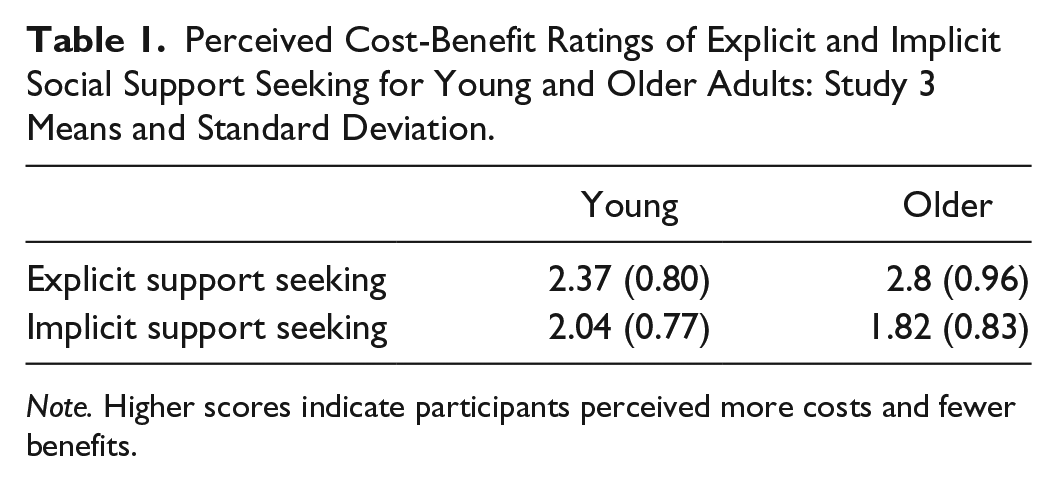
Note. Higher scores indicate participants perceived more costs and fewer benefits.
Moreover, we conducted one-sample t tests comparing the cost-benefit ratio scores against the mid-point of 3, indicating the same amount of perceived costs and benefits. These revealed that older adults believed that explicit social support seeking had nearly the same amount of costs versus benefits (M = 2.80, SD = .96), t(143) = −1.04, p = .31. In contrast, young adults believed that explicit social support seeking had more benefits than costs (M = 2.37, SD = .80), t(143) = −5.58, p < .001. In brief, compared with older adults, young adults had a more positive view of explicit social support seeking but their views of implicit social support seeking were not significantly different. These results help explain the observed differences between young and older adults in explicit social support seeking.
Study 4
In Study 3, older (vs. young) participants viewed explicit social support seeking as carrying greater costs and fewer perceived benefits. However, there was no evidence that older and young participants differed in their view of the relative costs and benefits of implicit social support. The purpose of Study 4 is to examine age-related differences in the relative effectiveness of coping using an explicit versus implicit social support strategy. To do so, Study 4 measures changes in young versus older adults’ emotional states (emotional outcomes) after they seek social support.
In this study, we primed explicit or implicit social support strategies as in Study 3. We hypothesized that older adults in the implicit social support condition will have better emotional outcomes compared with older adults in the explicit social support and control conditions. Furthermore, young adults in the explicit support seeking condition strategies will have relatively better emotional outcomes compared with young adults in the implicit social support seeking and control conditions (H4).
Method
Participants
We recruited 283 European American participants, including 165 young adults (63.57% female, Mage = 20 years, age range = 18-25 years) and 118 older adults (73.77% female, Mage = 68 years, age range = 60-90 years) from libraries in the so-called “Chicagoland” area.
Materials and procedures
Study 4 had a 2 (age group: older vs. young) by 3 (explicit support vs. implicit support vs. control) between-subjects design. Because we sought to examine how different manipulation influences following emotional states, Study 4 asked participants to write about a current stressor and their coping intentions, rather than to report past coping experiences. Participants completed a questionnaire utilized in Kim et al. (2006), which assesses social support seeking intentions in response to stress. Specifically, participants were asked to describe a current stressor using an open-ended format:
Most people encounter stressful events on a fairly regular basis. You might have relationship problems, financial difficulties, conflicts with family members, illness, job stressors or school related concerns. What is the greatest stressor you are currently facing? Describe it briefly in the space below.
Participants could write up to one full page. They then rated the stressor in terms of how negative and stressful it was and how responsible they felt for it using a 7-point Likert-type scale (0 = not at all, 6 = very much). This measure corresponded to participants’ initial stress level (or the perceived severity of stressor, PSS) before any manipulation of social support seeking and served as a potential covariate.
We next primed different social coping strategies by randomly assigning participants to one of three conditions: Explicit support, implicit support, and control conditions. The instructions for the explicit and implicit social support conditions were the same as those used in Study 3. Participants in the explicit social support condition were asked to write a letter seeking advice and support, and participants in the implicit support condition were asked to think about a group they belonged to and write about it. Participants in a control condition were instructed to write down how they felt about this stressful situation and how they might cope with it.
Last, participants completed a questionnaire designed to measure their emotional responses (Mano, 1990). Participants were asked to report how they were feeling right at the moment by rating 30 emotions on 7-point scales (1 = not at all, 7 = very much), right after they finished the social coping strategy manipulation. At the conclusion of the study, participants answered demographic questions and were thanked and debriefed.
Results
Effectiveness of social support
Studies 1 to 3 found that initial stress levels (or the severity of the stressor, PSS) were lower among older adults versus young adults. Hence, we included initial stress level as a covariate in our analysis. We also tested gender as a covariate. Below, we report the results with these covariates in the model; the results do not change significantly when they are not included as covariates.
We used Mano’s (1990) PANAS scale to assess the effect of using different social coping strategies on participants’ emotional responses. A factor analysis of the 30 scale items revealed multiple factors: “stress” (items: anxious, stress, tense, α = .82), “happiness” (items: pleased, satisfied, happy, α = .91), and “arousal” (items: aroused, astonished, surprised, excited, α = .72). First to examine whether the present results support previous finding that arousal is viewed stressful among older adults compared with young adults (Mogilner et al., 2011), we examined age group specific associations among these three forms of emotional response. We compared the strength of correlations by regressing emotional intensity (stressed or happiness) on arousal, age group, types of emotions (stressed vs. happiness), and two-way and three-way interactions between these variables. The regression revealed a main effect of types of emotions (the emotional intensity for happiness is stronger than stress; stressed: M = 3.21 vs. happiness: M = 4.55), F(1, 275) = 21.68, p < .0001, arousal (higher arousal predicts higher emotional intensity), F(1, 275) = 34.15, p < .0001) and a three-way interactions between type of emotions, arousal and age group, F(1, 275) = 3.83, p < .05. What is more interesting is the comparisons of strengths of correlations between arousal and different emotions (stressed vs. happiness). Breaking down the three-way interaction, we looked at young and older adults separately. For older adults, we found a marginally significant two-way interaction between arousal and type of emotions, F(1, 275) = 2.82, p < .10. Among older adults, arousal was correlated with stress, r = .40, p < .0001, but not with happiness, r = .17, p < .08. Among young adults, the two-way interaction was not significant, p = .27, and arousal was correlated with both happiness (r = .31, p < .0001) and with stress (r = .19, p < .002). These findings are consistent with studies showing that older adults tend to seek low-arousal positive emotions whereas young adults tend to seek high-arousal positive emotions (Mogilner et al., 2011).
Next, we ran a regression in which participants’ postmanipulation stress levels was the dependent variable; age group, condition and their interaction were independent variables, and PSS and gender were covariates. The regression revealed main effects of age group, F(1, 275) = 31.30, p < .0001, and condition, F(2, 275) = 3.21, p < .02, that were qualified by the interaction between age group and condition, F(2, 275) = 3.67, p < .02. Compared with participants in the control condition, older participants in the implicit social support condition felt less stressed after the writing task (Implicit support: M = 1.93, SD = .96, Control: M = 2.83, SD = 1.29), t(275) = 3.03, p < .003, β = –.90, 95% CI = [–1.48, –0.32]. Stress levels for older adults between the explicit social support and the control conditions did not differ (Explicit support: M = 2.50, SD = 1.28, Control: M = 2.83, SD = 1.29), t(275) = − 1.03, p = .30, β = –.33, 95% CI = [–0.90, 0.28].
In contrast, young adults’ stress levels did not differ between the implicit social support and the control conditions (Implicit support: M = 2.87, SD = 1.27, Control: M = 2.90,SD = 1.36), t(275) = –.13, p = .90, β = –.03, 95% CI = [–0.48, 0.42], or between the explicit social support and the control conditions (Explicit support: M = 3.41, SD = 1.20, Control: M = 2.90, SD = 1.36), t(275) = 1.75, p = .08, β = .51, 95% CI = [–0.06, 1.08]. Stress levels for young adults between the explicit social support and the implicit social support conditions did not significantly differ either.
We ran similar regressions on happiness and arousal. A regression with happiness as the dependent variable, age group, support condition and their interaction as independent variables, and PSS and gender as covariates, revealed significant effects of support condition, F(2, 275) = 4.25, p < .02, and age group, F(1, 275) = 12.29, p < .006. Regardless of support condition, older adults felt happier than young adults were (older: M = 4.96, SD = 1.28; young: M = 4.30, SD = 1.30), t(275) = 3.51, p < .0006, β = .66, 95% CI = [0.29, 1.03]. These main effects were qualified by a significant interaction between age group and support condition, F(2, 275) = 3.30, p < .04. Older participants in the implicit social support condition felt happier (M = 5.42, SD = 1.41) than those in the explicit support condition (M = 4.65, SD = 1.23), t(275) = 2.24, p < .03, β = .77, 95% CI = [0.43, 1.11], and marginally happier than those in the control condition (M = 4.83, SD = 1.41), t(275) = 1.66, p < .10, β= .59, 95% CI = [–0.10, 1.28]. Older participants in the explicit support condition and the control condition did not differ significantly, t(275) = .55, p < .58, β = –.18, 95% CI = [–0.82, 0.46]. In contrast, young participants in the explicit social support condition felt happier compared with those in the control condition (Explicit support: M = 4.56, SD = 1.22, Control: M = 3.82, SD = 1.20), t(275) = 2.32, p = .02, β = .74, 95% CI = [0.12, 1.36], and felt happier in the implicit social support condition (M = 4.53, SD = 1.31) than in the control condition (M = 3.82, SD = 1.20), t(275) = 2.51, p < .013, β = .71, 95% CI = [0.15, 1.26]. Young participants in the explicit and the implicit social support conditions did not differ significantly (Implicit support: M = 4.53, SD = 1.31, Explicit support: M = 4.56, SD = 1.22), t(275) = .10, p = .92, β = –.03, 95% CI = [–0.62, 0.56] (Table 2).
Coping Effectiveness of Explicit and Implicit Social Support Seeking for Young and Older Adults: Study 4 Means and Standard Deviation.
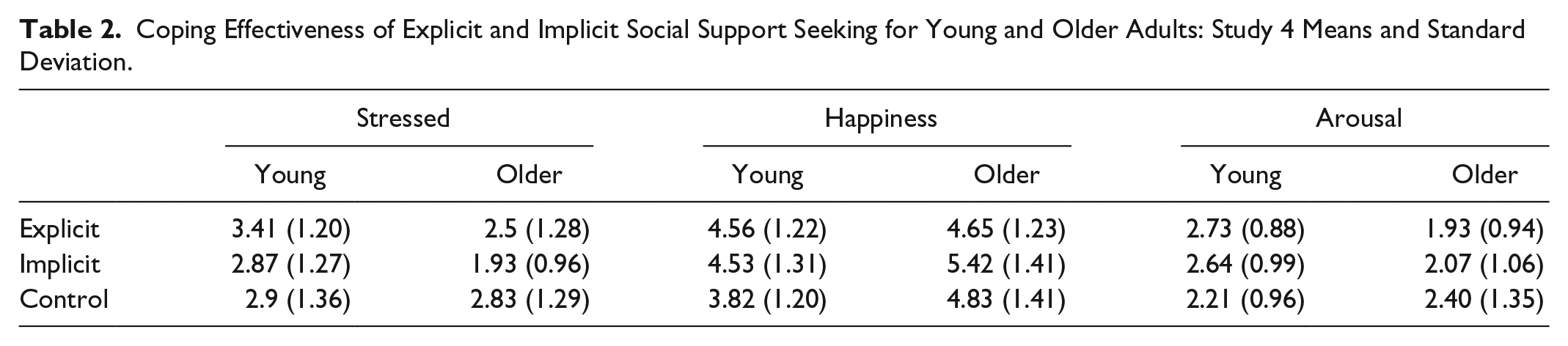
A regression with arousal as the dependent variable; age group, support condition, and the age group by support condition interaction as independent variables; and PSS and gender as covariates, revealed the main effect of age group, F(1, 275) = 7.89, p < .0053. Overall, older participants reported feeling less arousal than young participants regardless of support condition (older: M = 2.13, SD = 1.14, young: M = 2.53, SD = 0.97), t(275) = 2.81, p < .0053. There was also a significant interaction between age group and support condition, F(2, 275) = 4.31, p < .01. Young participants in the explicit social support condition reported higher arousal (M = 2.73, SD = 0.88) compared with control condition participants (M = 2.21, SD = 0.96), t(275) = 3.19, p < .002. Young participants in the implicit social support condition also reported higher arousal compared with those in the control condition (M = 2.64, SD = 0.99), t(275) = 2.75, p < .006. There was no significant difference between the explicit support condition and the implicit support condition among young participants, t(275) = .60, p < .54. In contrast, older adults did not significantly differ across all three conditions (Explicit support: M = 1.93, SD = 0.94, Control: M = 2.40, SD = 1.35; Implicit social support: M = 2.07, SD = 1.06).
Discussion
In Study 4, we primed explicit versus implicit support seeking, and examined their respective effectiveness on the emotional coping outcomes of young versus older adults. Study 4’s results, in part, explained why older adults’ tendency to use implicit social support, and why young adults seek both explicit and implicit social support. Young adults experienced more happiness and arousal and the same amount of stress in the social support conditions, regardless of the type, than in the control condition. Older adults experienced more happiness, the same amount of (low) arousal, and less stress in the implicit social support condition than in the control and explicit social support conditions. Furthermore, we also found arousal is positively correlated with happiness among young adults but with stress among older adults. Taken together, these results suggest that whereas young adults’ use of explicit and implicit support similarly brings their best age-specific desired outcomes of happiness and high arousal, older adults’ use of implicit support increases happiness and reduces stress without increasing arousal.
In Study 4, we did not find a stress-reducing effect of social support seeking among young adults. Yet, young adults reported higher happiness and higher arousal in both social support conditions. Then, their goal in support seeking may not be reducing stress per se. This finding is consistent with previous research showing that young adults’ primary goal is to obtain knowledge through social interactions rather than emotional satisfaction (Carstensen, 1992). In contrast, a primary goal for older adults is emotional satisfaction, and thus, happiness and reduction of stress may be more central goal in support seeking, and emotional coping through implicit social support seeking (as opposed to other types of coping goals; Sorkin & Rook, 2006) helps them reach this goal.
In combination with Study 3’s result that older (vs. young) adults view explicit social support seeking as having more costs (vs. benefits) to others, Study 4’s results help explain why older adults seek implicit more than explicit social support, and young adults seek both implicit and explicit social support. Young adults seek higher arousal (e.g., social support cheers them) and are not as concerned about burdening others; agentic problem-solving makes young adults more excited (higher arousal) and happier. Alternatively, older adults are more concerned about burdening others; implicit social support makes older adults relaxed and happier.
General Discussion
Summary of Findings
This research has several notable findings. We found that older adults experience less stress compared with young adults even though they encountered more objectively stressful events (as indicated by the ratings of the independent coders). This result is consistent with past research on aging and positivity bias (e.g., Gross et al., 1997; Löckenhoff & Carstensen, 2004). We also found that older (vs. young) adults reported seeking less explicit social support, especially instrumental social support, but reported using a similar amount of implicit social support seeking, to cope with their stressors, consistent with H1 and H2.
Furthermore, we demonstrated that the age difference in social support seeking was due at least in part to concerns about potential costs to others (vs. benefits). Mediation analysis revealed that older (vs. young) adults were more concerned about potential social costs, and this led them to seek less explicit social support. We also found a consistent age difference when we examined the perceived costs and benefits of explicit and implicit social support seeking among young and older adults. In comparison with young adults, older adults associated explicit social support seeking with more perceived costs (vs. benefits). There was no difference between young and older adults in terms of the perceived costs and benefits of implicit social support. We note that the above pattern of results is consistent with the fact that older adults are more prosocial and more empathetic, and thus, they do not want to disrupt their social networks (Beadle et al., 2013; Harris et al., 1996; Sze et al., 2012). Finally, we investigated the emotional coping outcomes associated with explicit and implicit social support, in particular on happiness, stress, and arousal. The results show that overall, young adults emotionally benefit from using both explicit and implicit support whereas older adults emotionally benefit from using implicit support in particular.
An alternative explanation for why older adults seek less explicit support is that older adults may have learned how to cope effectively without asking others for support over a lifetime of coping with various stressors. However, the results in Study 1 showing that social costs concerns mediate the age difference in explicit support seeking help to rule out learning/knowledge as an alternative explanation. The difference between young and older adults in seeking social support seem not be a difference in abilities but a difference in their goals: Older adults care about the costs to others and aim to avoid burdening others more than young adults do.
Implications
Our research has several implications for both practice and theory. Our results show that older adults might be less willing to draw on explicit social support because doing so taxes social resources of themselves and others. Interestingly, if one focuses only on emotional benefits, the effect of implicit social support on older adults is comparable with the effect of explicit social support on young adults. Again, explicit support may not only confer emotional and informational benefits on the seeker but also social costs (cf. Bolger et al., 2000). Although implicit support may not entail the same costs, it may be less effective than explicit support in terms of generating concrete information that could be helpful in dealing with stressful events. Accordingly, it is important for designers of supportive services to take into age differences into account. Due to increased cognitive and physical limitations, older adults may simply need more social support than young adults do. Our research demonstrates that older adults tend to rely more on implicit social support. Architects of social support services, then, should recognize this age-related tendency and encourage older adults to seek implicit social support. These results, combined with the literature of health benefits of support giving (Brown, Nesse, Vinokur, & Smith, 2003), suggest that older adults may benefit more from support giving rather than explicit support seeking. If this is true, designers of supportive services may want to provide opportunities for older adults to give social support. Future research may want to compare directly the benefits of support seeking and support giving for older adults.
To some extent, our finding can be explained in terms of how people of different ages value self-goals versus (other-focused) relationship-goals, and the effects of different types of support seeking on the social networks (Sorkin & Rook, 2006). Among young adults, relationships are seen as a means for advancing informational goals. As such, they may seek help from members of their social networks to meet their personal goals. Because older adults are more other-focused, they may not want to disturb members of their social networks. This helps explain why older adults are more reluctant than young adults are to call on members of their social networks for explicit support.
Our finding that older adults are less likely to seek explicit social support fits with the notion that older versus young adults tend to use avoidance coping (vs. confrontative coping) strategies (Moschis, 2007). Use of confrontative coping strategies declines with age due to cognitive decline (Heckhausen, 2002; Heckhausen & Schulz, 1995) and changes in life goals (Carstensen, 1992). Cognitive decline increases the riskiness of using a confrontative coping strategy because it makes successful execution of the strategy more difficult. Older adults’ relative disinclination to seek explicit social support is consistent with an increased focus on emotion-based goals and use of avoidance coping strategies. Future research might explore the development of age sensitive interventions that minimize the costs and maximize the benefits associated with different types of social support seeking.
Our results also have implications for the measurement of social support. Measures that mostly gauge explicit efforts to extract emotional or tangible support may be less applicable to older adults who tend to seek social support through implicit means. For older adults, measures of social support should include assessments of implicit social support.
Beyond understanding social support transactions between different age groups, the current research brings forward the fact that social support transactions involve both benefits and costs to the person and the relationship. The present set of findings suggests that the relative importance of the potential costs and benefits garnered by social support use depends on individuals’ specific needs and circumstances. Being in different places in life history as a function of age makes different goals salient, and thus, systematically influences how individuals weigh and balance different costs and benefits. Ultimately, this difference affects whether and how to use social support, much akin to how social support use is affected by cultural values (e.g., Campos & Kim, 2017; Kim et al., 2008) and reliance on exchange norms (e.g., Miller, Akiyama, & Kapadia, 2017). Thus, the present research highlights the usefulness of taking a cultural psychological framework to understand psychological differences among different age groups.
Limitations and Future Research
We examined age groups in a discrete fashion: young (18-25 years) versus older adults (60 years and above). Because our main goal was to compare older versus young adults, we did not include “middle-age” participants aged 25 to 60 years. Yet, understanding middle-age adults’ use of different types of social support and their relative effectiveness is clearly important. Middle-age adults might exhibit more balanced (or “in-between”) use of different types of social support strategies. However, this conjecture rests on the assumption that middle-age adults will have a more balanced view of the potential costs and benefits associated with different social support strategies, including implicit and explicit social support seeking, perhaps due to a more balanced focus on information-based versus emotion-based life goals. Future research should test this assumption.
Second, note that we use the term “age effects” to refer broadly to age-related effects (e.g., including period and cohort effects) rather than narrowly referring to age-specific effects. Our data were cross-sectional, not longitudinal, and therefore the data do not allow us to draw conclusions on whether the differences in support seeking are due to age specifically, or are due to maturation or development. Previous research also suggested it might be extremely difficult to tease apart age-specific effect from period effect and cohort effect (Bell & Jones, 2013). For example, older people may have better established social relations or longer social histories with other people. In this article, we do not distinguish age-specific effect with cohort effect. Future research is needed to tease these mechanisms apart.
Older and young adults may also face different stressors. For example, health-related stressors and relationship-losses stressors may loom larger in older adults’ lives, and achievement/work-related stressors and stressors associated with establishing intimate relationships and launching families loom large in younger adults’ lives. In the current research, we sought to address this concern by looking at both broad categories and narrow categories of stressors: In Studies 1 and 4, participants were free to write about their stressors and listed the categories to which stressors belonged. In Studies 2 and 3, we selected narrow categories of stressors young and older adults shared (financial and relationship stressors) and measured social support seeking in response to those categories. Studies that focus on broad categories were sufficiently broad to tell us conclusively about age differences in use of support; studies that focus on narrow shared stressor categories (financial and relationship stressors) help, at least to some extent, reduce potential confounds by showing the different social support seeking between young adults and older adults are not simply due to the fact that older and young adults’ stressors were of different categories. We hope this combined approach has minimized this concern. Future research may want to collect longitudinal data to tease apart age-specific effects versus cohort effects.
Finally, in two of our studies (Studies 1 and 4) we recruited young and older adults in public libraries. In two of our other studies, we recruited young and older adults via an online participant pool (Qualtrics®, Studies 2 and 3). We tried to make sure older adults were in good physical and mental conditions. However, it is highly likely that older adults recruited in this manner tend to be more educated than the average older adult is.
Conclusion
Building on previous research that has shown that Asians and Asian Americans report seeking explicit social support less compared with European Americans (Kim et al., 2006; Taylor et al., 2004), the present research reveals less explicit social support seeking among older adults versus young adults. These results are consistent with studies that have shown that social support is not beneficial to everyone. Important individual difference factors moderate the types of social support that people tend to seek out when coping with stress as well as the effects that different types of social support seeking have on coping outcomes. The present research underscores the necessity to consider individual difference factors in understanding how and why social support is used and how best to utilize one of the most important resources—one’s social network.
Supplemental Material
li_online_appendix – Supplemental material for Age and Social Support Seeking: Understanding the Role of Perceived Social Costs to Others
Supplemental material, li_online_appendix for Age and Social Support Seeking: Understanding the Role of Perceived Social Costs to Others by Li Jiang, Aimee Drolet, and Heejung S. Kim in Personality and Social Psychology Bulletin
Footnotes
Appendix
Declaration of Conflicting Interests
The author(s) declared no potential conflicts of interest with respect to the research, authorship, and/or publication of this article.
Funding
The author(s) received no financial support for the research, authorship, and/or publication of this article.
Notes
Supplemental Material
Supplementary material is available online with this article.
References
Supplementary Material
Please find the following supplemental material available below.
For Open Access articles published under a Creative Commons License, all supplemental material carries the same license as the article it is associated with.
For non-Open Access articles published, all supplemental material carries a non-exclusive license, and permission requests for re-use of supplemental material or any part of supplemental material shall be sent directly to the copyright owner as specified in the copyright notice associated with the article.
