



Abstract
The current studies integrate different frameworks on the positive and negative consequences of ethnic diversity for intergroup relations. Using a nationally stratified sample of Dutch majority members (N = 680) from 50 cities in the Netherlands, Study 1 demonstrated that objective diversity was indirectly related to prejudice and to generalized, ingroup, and outgroup trust, through more positive and more negative contact. These indirect effects tended to be stronger for high versus low authoritarians. Furthermore, perceived diversity was indirectly related to less trust and greater prejudice, via more negative contact and threat. Again, these associations were more pronounced among high authoritarians. Study 2, using a representative sample of German majority members (N = 412) nested within 237 districts, replicated the cross-sectional results regarding objective diversity and prejudice. In addition, longitudinal analyses indicated that objective diversity predicted more positive and more negative contact 2 years later, though only among moderate and high authoritarians.
The rise in ethnic diversity in Western European societies repeatedly covers the news headlines and has attracted increased scholarly attention in social and political sciences (Hewstone, 2015). As a result, a growing body of research has investigated the effects of diversity on societal and intergroup outcomes such as social capital (e.g., Laurence, 2011; Letki, 2008), trust (e.g., Putnam, 2007; Schmid, Al Ramiah, & Hewstone, 2014; van der Meer & Tolsma, 2014), and prejudice (e.g., Pettigrew, Wagner, & Christ, 2010; Quillian, 1995; Van Assche, Roets, Dhont, & Van Hiel, 2014, 2016). The vast majority of these studies have shown no overall effects of diversity; yet, this seems to be the result of various processes with opposite consequences competing with each other. In the current set of two studies, we aim to delineate these processes and their repercussions for several key aspects of intergroup relations (e.g., trust and prejudice), taking into account the mediating role of positive intergroup contact, negative intergroup contact, and threat, while also considering the moderating role of right-wing authoritarianism (RWA; see Figure 1).
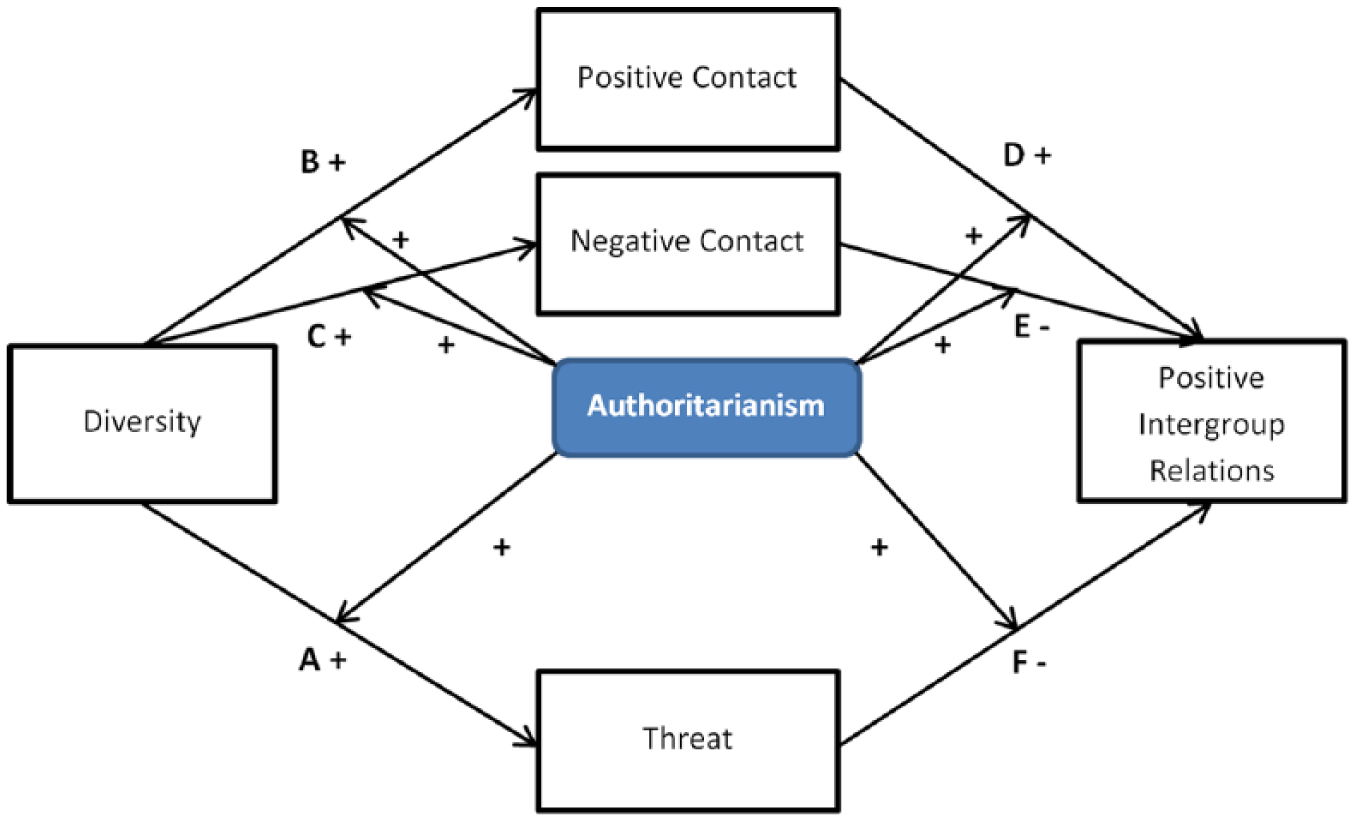
Schematic representation of the tested moderated mediation model of diversity effects.
Contact and Threat as Mediators of Diversity Effects
Two conflicting sets of theories have dominated research on ethnic diversity effects (see Hewstone, 2015; van der Meer & Tolsma, 2014 for reviews). On one hand, research inspired by the intergroup contact theory (Allport, 1954; Brown & Hewstone, 2005; Pettigrew, 1998) has proposed that the growing representation of varied ethnic groups in Western societies is associated with more contact between members of different ethnic groups, which in turn leads to more tolerance and positivity toward outgroups (e.g., Wagner, Christ, Pettigrew, Stellmacher, & Wolf, 2006; Wagner, Van Dick, Pettigrew, & Christ, 2003). In line with this perspective, some studies have shown that higher diversity was associated with more positive outgroup perceptions (Oliver & Wong, 2003), and less prejudice (Kunovich & Hodson, 2002).
On the other hand, intergroup conflict theories (Blalock, 1967; Blumer, 1958; Bobo, 1999), encompassing group threat theory (Quillian, 1995) and integrated threat theory (Stephan & Stephan, 2000), claim that diversity is often perceived as threatening by members of the host society (e.g., Semyonov, Raijman, Tov, & Schmidt, 2004; Taylor, 1998). Consequently, diversity would lead to more prejudice and less trust toward ethnic outgroups (e.g., Scheepers, Gijsberts, & Coenders, 2002; Schneider, 2008). Based on a sample of more than 30,000 people from 41 American communities, Putnam (2007) even concluded that—other things being equal—more diversity was associated with less trust both between and within ethnic groups. Extending this perspective, Koopmans and Veit (2014) found that experimental primes of ethnic diversity caused lower trust in one’s neighbors.
Putnam’s (2007) infamous “constrict claim,” stating that ethnic diversity has detrimental consequences for social cohesion and trust, has been the subject of a hot and unresolved debate among both policy makers and academics. Following Putnam’s claim, a number of studies in several countries tested the “hunkering down” hypothesis. Do individuals “pull in like a turtle” (Putnam 2007, p. 149), withdraw from others and from social life at large in the face of diversity? In a comprehensive review of 90 post-Putnam studies, van der Meer and Tolsma (2014) concluded that, at best, evidence for Putnam’s constrict claim is mixed. Especially in European societies, the idea of univocal negative repercussions of diversity for trust and prejudice can be refuted (see Gijsberts, van der Meer, & Dagevos, 2012; Hooghe, Reeskens, Stolle, & Trappers, 2009). In particular, it seems that the two major competing processes, positive intergroup contact and perceived outgroup threat, cancel each other out, yielding no main effects of diversity.
Indeed, various scholars have tried to integrate both theoretical frameworks in one single design, and provided evidence for these opposite mechanisms (e.g., Green, Fasel, & Sarrasin, 2010; Savelkoul, Gesthuizen, & Scheepers, 2011; Schlueter & Scheepers, 2010; Schlueter & Wagner, 2008; Schmid et al., 2014). For instance, Schmid and colleagues (2014) tested the diversity-trust association in the United Kingdom and demonstrated that diversity as such had no substantial overall effects on outgroup trust and outgroup attitudes, because the positive effect of higher positive intergroup contact and the negative effect of higher perceived threat counterbalanced each other. These opposing processes may thus explain why many studies reported nonsignificant overall effects of diversity on societal and intergroup outcomes (Hewstone, 2015; van der Meer & Tolsma, 2014).
Authoritarianism as Moderator of Diversity Effects
Although diversity may instill opposite and “counterbalancing” processes related to contact and threat, its effects also seem to depend on the characteristics of the individual. Not everyone seems equally sensitive to diversity (Stolle, Soroka, & Johnston, 2008). Correspondingly, Wagner and colleagues (2006) suggested that whether contact or threat effects dominate may depend on moderating factors. More specifically, the extent to which people hold right-wing social-ideological attitudes has been identified to play a critical role in whether ethnic diversity is perceived predominantly as a contact opportunity or as a threat and, in turn, is associated with either increased or decreased outgroup positivity (see Kauff, Asbrock, Thörner, & Wagner, 2013; Van Assche et al., 2016).
The seminal work by Adorno, Frenkel-Brunswik, Levinson, and Sanford (1950) on “The Authoritarian Personality” offers an interesting outlook on how such individual differences have the potential to shape diversity effects. Contemporary accounts conceptualize authoritarianism as a social-ideological attitude most frequently operationalized in terms of RWA (Altemeyer, 1981). RWA is defined as the conglomerate of conventionalism (i.e., adherence to traditional norms and values), submission to authorities, and aggression toward norm violators (Altemeyer, 1988). According to Duckitt (2001; see also Van Hiel, Cornelis, & Roets, 2007), people high in RWA generally perceive the world as a dangerous place and are motivated to protect ingroup cohesion, order, and collective security. Therefore, right-wing authoritarians tend to perceive ethnic diversity more as a threat to traditional norms and values (see also De keersmaecker, Van Assche, & Roets, 2016; Dhont & Van Hiel, 2011; Kauff et al., 2013; Van Assche, Asbrock, Roets, & Kauff, in press).
Van Assche and colleagues (2014, 2016) showed that authoritarianism shapes the associations between diversity and various intergroup outcomes. Specifically, diversity was found to be associated with less positive attitudes and more mistrust toward ethnic outgroups, yet only among high authoritarians. Among low authoritarians, diversity was related to more outgroup positivity. Analogous interaction patterns have been revealed for individual differences in left–right self-placement (Karreth, Singh, & Stojek, 2015), dangerous worldviews (Sibley et al., 2013), and conformity values (Fasel, Green, & Sarrasin, 2013), three concepts closely related to RWA (Duckitt, 2001). In particular, individuals living in diverse environments who strongly endorse conservative ideologies, dangerous worldviews, or group conformity typically hold more negative attitudes toward minorities than their neighbors who do not hold these respective values. Van Assche and colleagues (2016) further revealed that diversity is associated with more outgroup threat, but again, only among high authoritarians. Similarly, Kauff and colleagues (2013) found that high (vs. low) authoritarians perceive a multicultural ideology as a threat to cultural traditions, which leads to an increase in prejudice. In sum, diversity is most likely to be perceived as a threat by authoritarians, and for them, diversity consequentially breeds more prejudice and less trust toward minorities. This moderating role of RWA in the relationship between diversity and threat is included as Path A in Figure 1.
The role of authoritarianism in the association between diversity and intergroup contact is less straightforward. On one hand, authoritarians usually tend to avoid contact with outgroup members (see Dhont & Van Hiel, 2009, 2011; Pettigrew, 2008). On the other hand, recent research has shown that, in very diverse environments, people high in authoritarianism appear to show a steep increase in intergroup contact encounters (Brune, Asbrock, & Sibley, 2016). Indeed, although almost all individuals living in diverse areas tend to have increased intergroup contact (e.g., Schlueter & Wagner, 2008; see Hewstone, 2015), this effect, counterintuitively, was found to be most pronounced among authoritarians (Brune et al., 2016). This finding suggests that authoritarians in homogeneous areas manage to avoid contact with other ethnic groups, but in diverse environments—where contact is inevitable—they may have no choice but to give up their general avoidance tendencies, and engage more with outgroup members. Furthermore, in diverse neighborhoods, where intergroup contact is the norm, authoritarians as such comply with the norm (Brune et al., 2016). Yet, this increased engagement may include both positive and negative contact experiences. Indeed, while previous studies almost exclusively focused on increased opportunities for positive contact, diversity likely increases both positive and negative intergroup encounters (Koopmans & Veit, 2014). In this regard, Laurence, Schmid, and Hewstone (2018) recently found that diversity increased both positive and negative contact, with the former improving and the latter harming intergroup relations. It is therefore essential to simultaneously include positive and negative intergroup contact when testing diversity effects for high and low authoritarians. In sum, we propose that diversity is associated with more (positive and negative) intergroup contact, and these associations are especially pronounced for those high in authoritarianism. This hypothesis is represented by Paths B and C in Figure 1.
Authoritarianism as Moderator of Contact and Threat Effects
Where positive contact reduces prejudice, threat (and negative contact) induces it. On one hand, a bulk of evidence has accumulated for the positive effects of positive contact on many different outcomes (Hewstone et al., 2014; Hewstone & Swart, 2011; Pettigrew & Tropp, 2006; Pettigrew, Tropp, Wagner, & Christ, 2011). On the other hand, the negative effects of threat on trust and tolerance are also indisputable (Blalock, 1967; Blumer, 1958; Bobo, 1999; Stephan & Stephan, 2000).
However, also contact and threat effects on intergroup outcomes have been shown to depend on individual differences in authoritarianism (Paths D, E, and F in Figure 1). For example, once authoritarians experience positive intergroup contact, they often benefit from it the most (Asbrock, Christ, Duckitt, & Sibley, 2012; Dhont & Van Hiel, 2009, 2011; Hodson, 2011; see Figure 1, Path D). Moreover, negative contact experiences may also have the greatest impact among authoritarians (Dhont & Van Hiel, 2009; see Figure 1, Path E). Hence, high authoritarians are most likely to engage in intergroup contact in diverse environments, compared with homogeneous environments, and these encounters have the potential to influence their prejudice and trust levels to a greater extent. In the same vein, authoritarians tend to be most prone to societal threat (e.g., Feldman & Stenner, 1997; Stellmacher & Petzel, 2005), yielding stronger positive associations of threat with prejudice and negative outgroup emotions (Cohrs & Asbrock, 2009) among those high versus low in authoritarianism. In other words, threatening conditions or perceptions—particularly resonant in diverse environments—potentially have the greatest impact among those holding strong authoritarian attitudes (Stenner, 2005; see Figure 1, Path F).
The Present Studies
The current contribution aims to fill the gap in fundamental research on diversity effects by integrating previous mediation and moderation approaches into a unifying multilevel moderated mediation design (see Figure 1, for a schematic representation of our model). First, we want to investigate how diversity affects trust and prejudice simultaneously via positive intergroup contact, negative intergroup contact, and outgroup threat, and how these processes may counterbalance each other. Second, we want to examine for whom diversity is most strongly associated with these mediating processes, and furthermore, for whom these mediators have the strongest repercussions on relevant intergroup outcomes. In Study 1, we focused on five outcomes (i.e., generalized trust, ingroup trust, outgroup trust, subtle prejudice, and blatant prejudice), using a unique, nested adult sample from the 50 largest cities in the Netherlands. Study 2 dug deeper into racial prejudice in a representative German sample, using a rare, yet important, longitudinal design.
Important in the study of diversity effects is the distinction between objective diversity and perceptions of diversity, as they might have differential effects (Hewstone, 2015; Koopmans & Schaeffer, 2015). In line with this, Semyonov and colleagues (2004) found that not the actual relative size of the outgroup population but rather the perception of its size (i.e., the estimated percentage) was associated with greater perceived threat and exclusionary outgroup attitudes. Moreover, objective and perceived diversity may in fact also work differently through the various processes (Pettigrew et al., 2010). Hence, a thorough test of diversity effects should acknowledge this distinction and therefore, in our studies, we look at objective diversity as well as the perception of diversity.
Our first set of hypotheses states that objective diversity yields no overall effects on intergroup outcomes, but it may have detrimental total effects for high authoritarians on one hand, and beneficial effects for low authoritarians on the other hand. Moreover, we hypothesize that these differences are explained by the indirect associations of diversity with trust and prejudice via positive contact, negative contact, and threat, which should be different (and stronger) among high (vs. low) authoritarians.
Our second set of hypotheses focuses on perceptions of diversity, which potentially yield more detrimental total effects in terms of lower trust and higher prejudice, compared with objective diversity. Again, we assume that the indirect associations via positive contact, negative contact, and threat are significant, and most pronounced among high authoritarians. Finally, we also examine how contact and threat further relate to intergroup outcomes, once more hypothesizing that especially the associations would be especially large for high authoritarians.
Study 1
Method
Participants
We used a nationally stratified sample of citizens (N = 680) without migration background from the 50 largest cities in the Netherlands (mean number of observations per city, M = 13.80). This dataset was collected online in 2015 through an independent ISO 26362-certified survey company. The mean age of the sample was 51 years (SD = 16.69) and 52% were men. Thirty-four percent of the participants had completed primary school, 40% had completed high school, and 27% had a college or university degree. Income distributions are provided in Online Appendix A.
Measures
Objective diversity
We assessed the percentage of non-Western minority members within a specific city as an objective indicator of diversity within the year of data collection (see also Van Assche et al., 2016). We used the available data from the Dutch Central Bureau of Statistics (Centraal Bureau voor de Statistiek, 2015), indicating the number of individuals per city of non-Western origin, and we calculated the percentage as a function of the total number of registered inhabitants to get a measure of relative objective diversity (M = 16.76%, SD = 9.15, minimum = 4.11%, maximum = 37.34%).
Estimations of diversity
To measure perceptions of diversity, participants had to specify their estimated percentage of non-Western immigrants living in their city, with M = 28.31% (SD = 17.85, minimum = 0.00%, maximum = 95.00%).
RWA
A six-item RWA-scale (based on Altemeyer, 1981; see Onraet, Dhont, & Van Hiel, 2014) was administered on 7-point scales anchored by 1 (totally disagree) and 7 (totally agree). A sample item is “Obedience and respect for authority are the most important virtues children should learn,” α = .67, M = 4.47 (SD = 1.53).
Intergroup contact
We assessed intergroup contact by asking respondents the frequency of both positive and negative interactions with people of immigrant origin (e.g., Dhont & Van Hiel, 2009), using 7-point scales ranging from 1 (never) to 7 (very frequently). The items are “How often did you have positive interactions with people of immigrant origin?” (M = 4.29, SD = 1.53) and “How often did you have negative interactions with people of immigrant origin?” (M = 2.98, SD = 1.53).
Outgroup threat
Outgroup threat was measured with four items (based on Stephan et al., 2002; see also Dhont & Van Hiel, 2011). An example item reads “People of immigrant origin threaten the way of life of people of Dutch origin.” Respondents answered using 7-point scales ranging from 1 (totally disagree) to 7 (totally agree), α = .87, M = 4.03 (SD = 1.44).
Trust
We tapped into general, ingroup, and outgroup trust. General trust was measured by three items from the European Social Survey (ESS Round 7: European Social Survey Round 7 Data, 2014). An example item reads “Generally speaking, would you say that most people can be trusted, or that you can’t be too careful in dealing with people?” Respondents answered using 7-point scales ranging from 1 (You can’t be too careful) to 7 (Most people can be trusted), yielding a reliable scale with α = .84; M = 4.19 (SD = 1.15). For ingroup trust, respondents answered to one item (“When you specifically think of people of Dutch origin, do you think most of them are to be trusted or not to be trusted?”; M = 4.52, SD = 1.07), anchored by 1 (Most people cannot be trusted) and 7 (Most people can be trusted). Outgroup trust was also measured with one item (“When you specifically think of people of immigrant origin, do you think most of them are to be trusted or not to be trusted?”; M = 4.02, SD = 1.23), using the same anchors.
Racial prejudice
An eight-item subtle racism and a four-item blatant racism scale were administered (based on Pettigrew & Meertens, 1995; see Onraet & Van Hiel, 2013). Sample items are “I feel sympathy for people of immigrant origin” (reverse coded) for subtle racism and “All things taken together, the White race is superior over other races” for blatant racism. Respondents answered using 7-point scales ranging from 1 (totally disagree) to 7 (totally agree). Cronbach’s alphas were .82, with M = 4.18 (SD = 0.92), and .88, with M = 2.30 (SD = 1.39), for subtle and blatant racism, respectively.
Results
Preliminary analyses
We first investigated whether multilevel analyses were warranted because our data were nested (i.e., individuals were located within cities). We estimated empty (intercept-only) models that provide insight in the variances in our mediators and outcomes at the individual and contextual level. We also assessed the intraclass correlations (ICCs) that confirmed there was substantial between-level variance, warranting the use of multilevel modeling (see Online Appendix B). 1 The correlations among all variables are presented in Online Appendix C.
Main analyses
Multilevel path analyses with maximum likelihood estimation were conducted using the MPlus package (version 7.1; Muthén & Muthén, 2012). Standard errors were computed using bootstrapping (N = 50,000 bootstrap samples). All independent variables were centered around the overall average of the sample to control for their compositional effects at the contextual level (Raudenbush & Bryk, 2002). We modeled a random intercept model where the intercept coefficients vary across cities (see Pituch & Stapleton, 2012; Raudenbush & Bryk, 2002). Specifically, we tested the hypothesized model with one context-level predictor (i.e., either objective diversity or estimations of diversity at the city level), three individual-level mediators (i.e., positive intergroup contact, negative intergroup contact, and outgroup threat), and five individual-level outcomes (i.e., generalized trust, ingroup trust, outgroup trust, subtle prejudice, and blatant prejudice). Furthermore, RWA was included as an individual-level moderator variable and we allowed each path of the mediation model to be moderated by RWA. For all paths, we estimated the effects for low (<1SD below the mean), medium (mean level), and high (>1SD above the mean) authoritarians, as such examining the conditional effects of the predictor and mediators at various levels of RWA (while allowing all individual-level variables to vary both between individuals and between contexts). 2 Tables 1 and 2 display the standardized coefficients of the model considering objective diversity, and Tables 3 and 4 portray the standardized coefficients for the model considering perceived diversity. 3
Path Analysis: Standardized Estimates of the Structural Model in Study 1 Considering Objective Diversity’s Conditional Total Effects on the Mediators, and the Mediators’ Conditional Total Effects on Intergroup Outcomes.
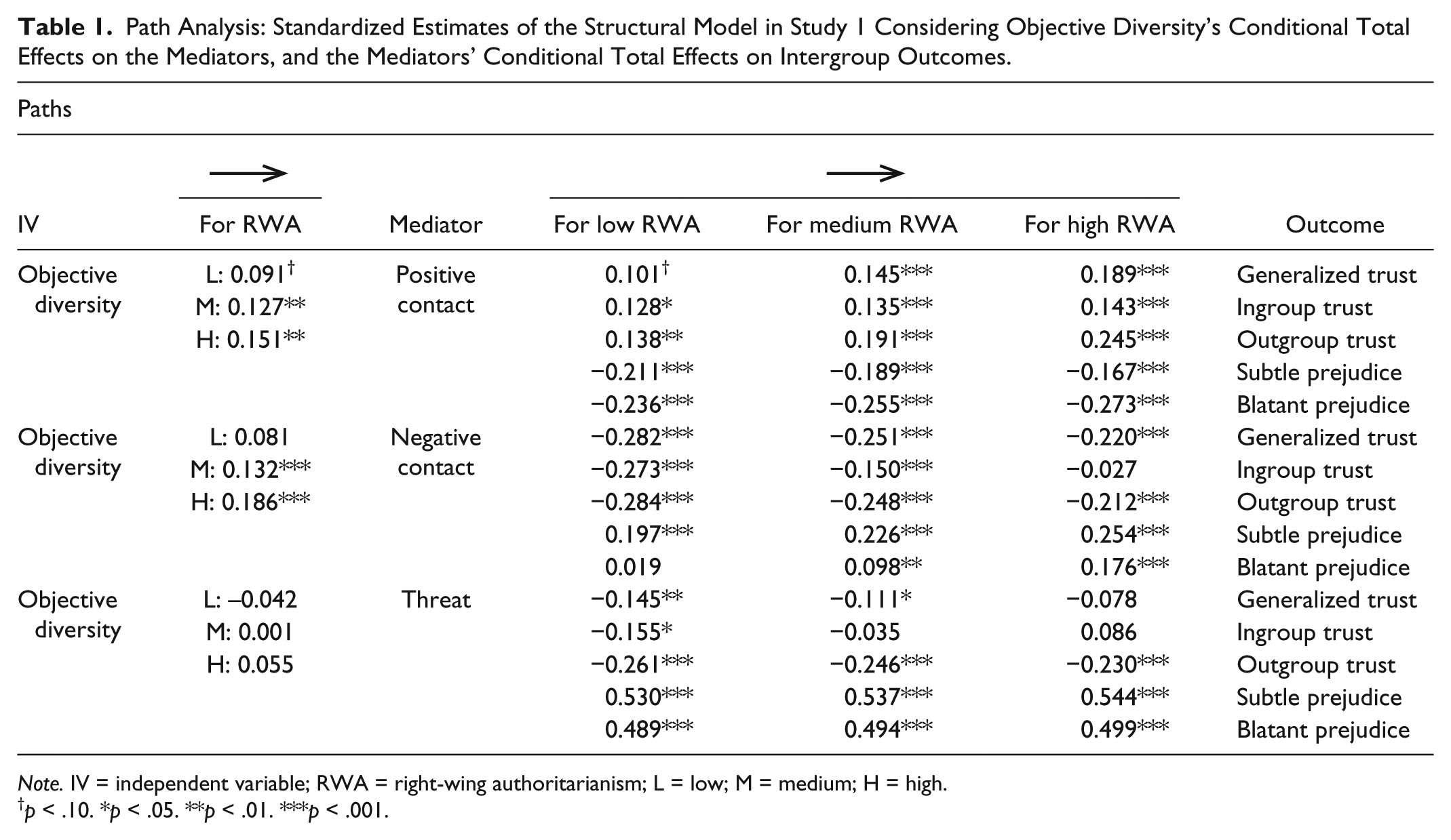
Note. IV = independent variable; RWA = right-wing authoritarianism; L = low; M = medium; H = high.
p < .10. *p < .05. **p < .01. ***p < .001.
Path Analysis: Standardized Estimates of the Structural Model in Study 1 Considering Objective Diversity’s Conditional Total, Direct, and Indirect Effects on Intergroup Outcomes.
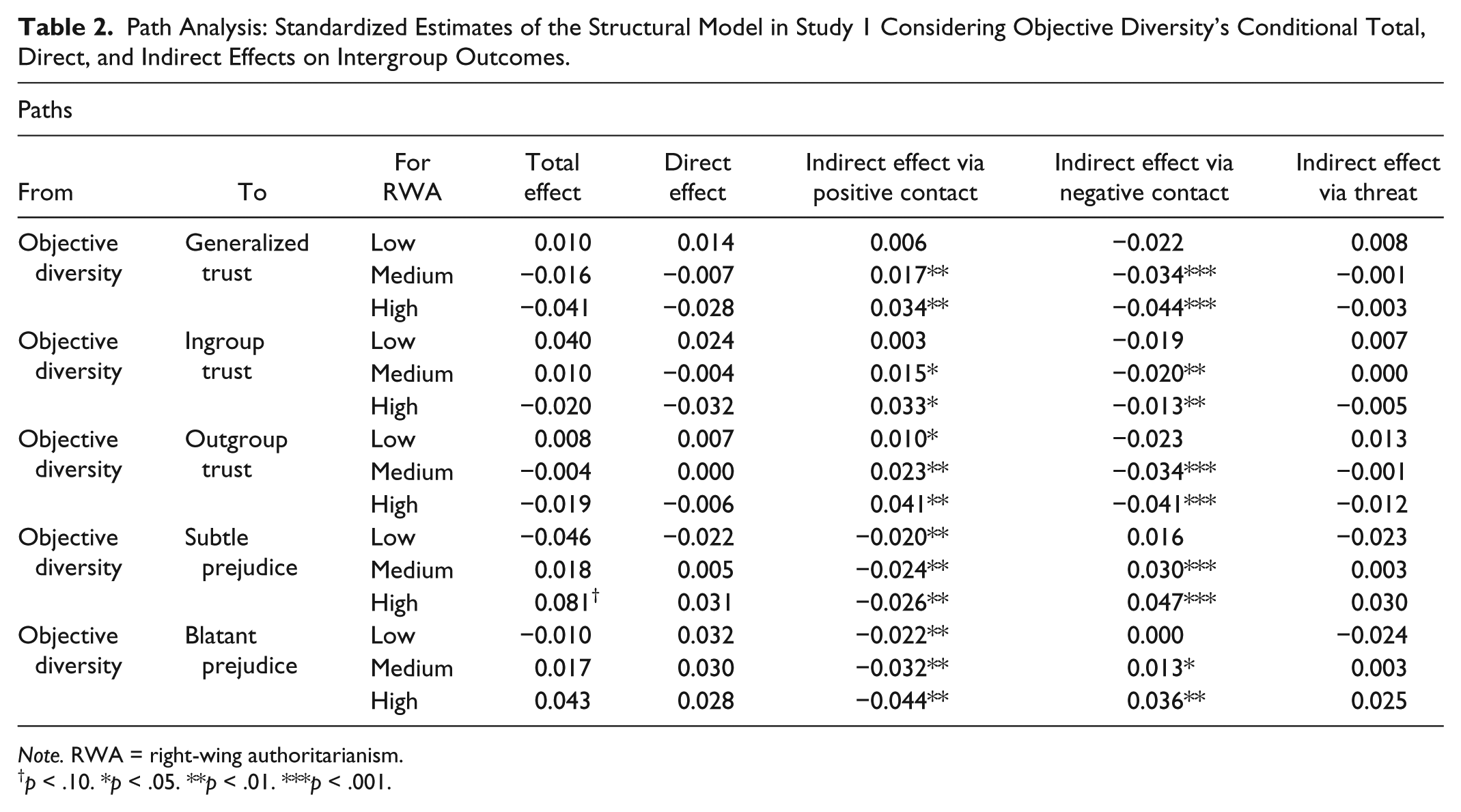
Note. RWA = right-wing authoritarianism.
p < .10. *p < .05. **p < .01. ***p < .001.
Path Analysis: Standardized Estimates of the Structural Model in Study 1 Considering Estimations of Diversity’s Conditional Total Effects on the Mediators, and the Mediators’ Conditional Total Effects on Intergroup Outcomes.
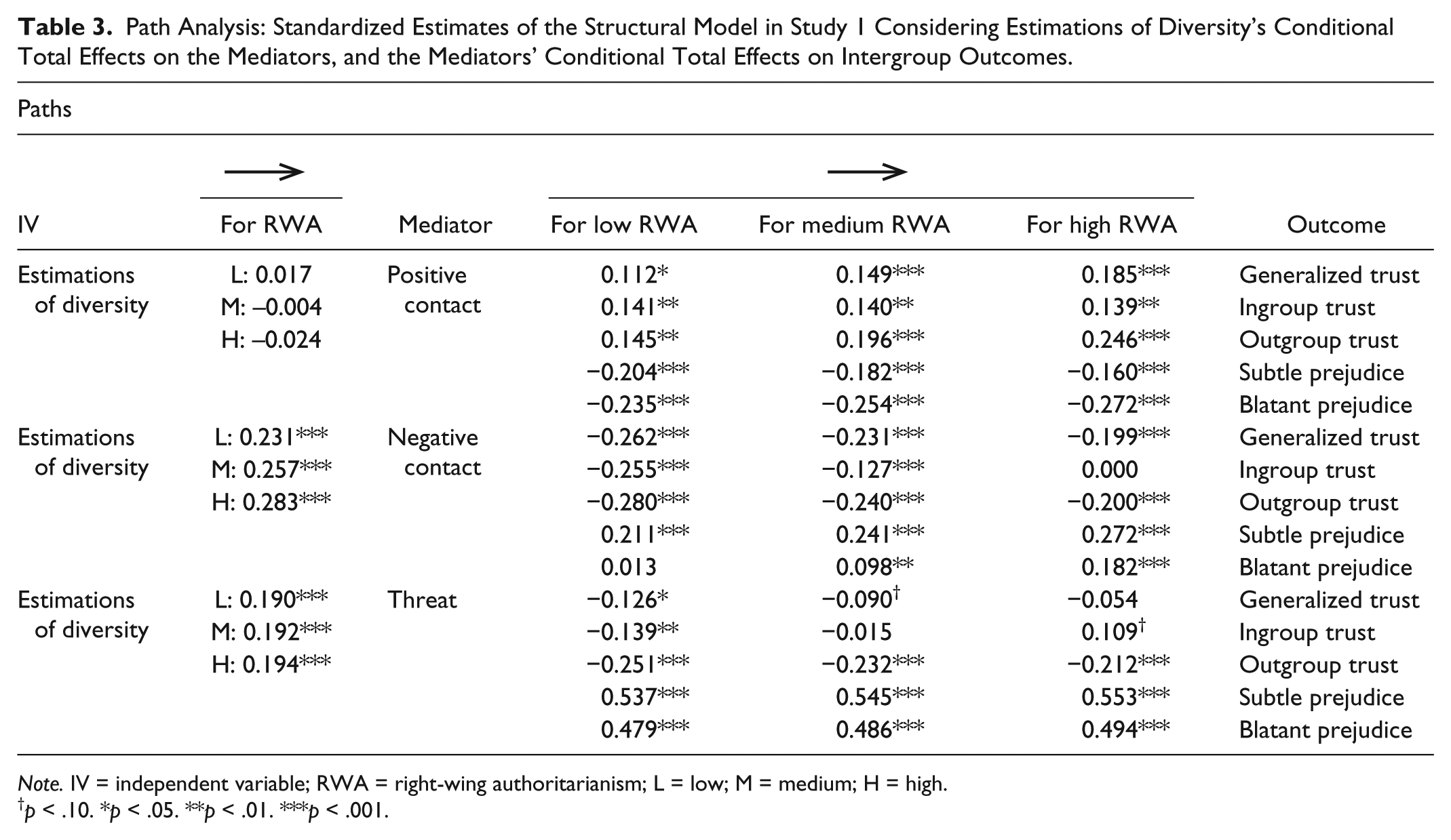
Note. IV = independent variable; RWA = right-wing authoritarianism; L = low; M = medium; H = high.
p < .10. *p < .05. **p < .01. ***p < .001.
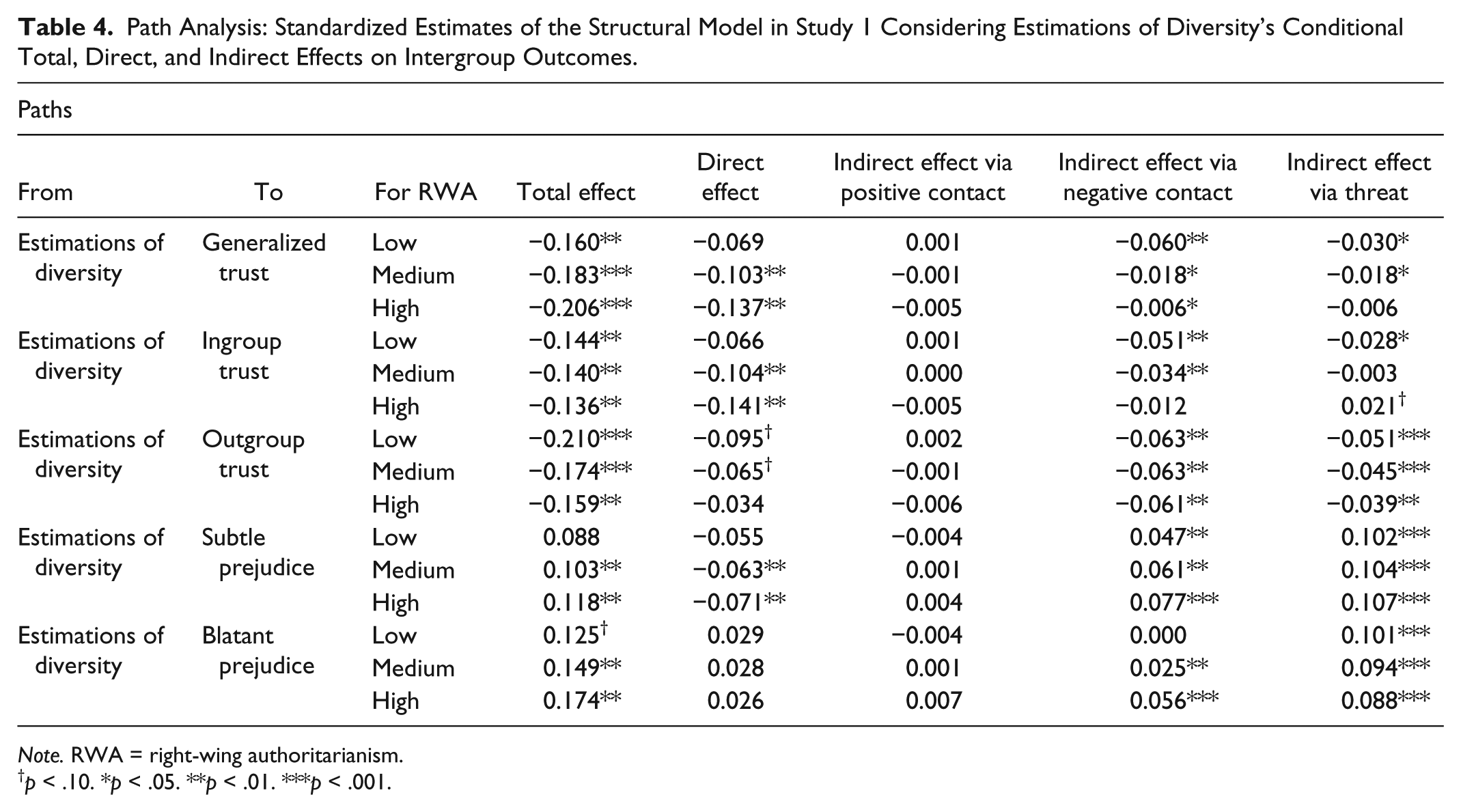
Path Analysis: Standardized Estimates of the Structural Model in Study 1 Considering Estimations of Diversity’s Conditional Total, Direct, and Indirect Effects on Intergroup Outcomes.
Note. RWA = right-wing authoritarianism.
p < .10. *p < .05. **p < .01. ***p < .001.
As expected, the results showed that higher objective diversity was related to more positive and more negative contact, but only among individuals with moderate or high levels of authoritarianism (see Table 1). Positive contact was further associated with more trust and less prejudice, and a reversed pattern of results was revealed for negative contact. Most importantly, the results indicated that there were no significant total effects of objective diversity on any of the five outcomes (see Table 2). Nonetheless, there were significant indirect effects via positive and negative contact, but only among those with average and high levels of authoritarianism. In sum, overall, objective diversity did not affect intergroup relations, as it was associated with both more positive and more negative intergroup contact, and hence the “positive” and the “negative” processes canceled each other out. Finally, these indirect effects were more pronounced among high authoritarians, and less outspoken or even absent among low authoritarians. Surprisingly, outgroup threat did not mediate objective diversity effects.
Second, the results concerning perceived diversity showed a somewhat different pattern. Higher estimates of diversity were related to more negative intergroup contact and higher threat perceptions, and these two “negative” processes were further associated with less trust and more prejudice (see Table 3). Most importantly, the results indicated that there were significant negative total effects of estimations of diversity on trust, and significant positive total effects on prejudice, but only among moderate and high authoritarians (see Table 4). Furthermore, there were significant indirect effects via negative contact and threat, but not via positive contact. The conclusion here is that, overall, unlike the results with objective diversity, higher individual estimates of diversity seem to drive down trust and increase prejudice, as these estimates were associated with both more negative contact and more threat, two “negative” processes that add up to less tolerance. Finally, similar to the objective diversity results, these relations were generally more outspoken among high authoritarians whereas they were smaller and even nonsignificant among low authoritarians.
Brief Discussion
In conclusion, in Study 1, our hypotheses were confirmed with regard to the lack of total effects of objective diversity versus the negative total effects for estimations of diversity. Second, with regard to the processes explaining the total effects, we found mediation effects via positive and negative contact when considering objective diversity effects versus mediation effects via negative contact and threat when considering estimations of diversity. Third, across both models, our results confirm that it is crucial to take into account individual differences in authoritarianism, as the relations are especially pronounced among individuals with average or high levels of RWA.
Finally, our findings revealed largely similar repercussions of diversity for three pertinent trust outcomes as well as for two forms of racial prejudice. Indeed, generalized trust, commonly regarded as part of the “social glue” that holds communities together (Schmid et al., 2014), trust in ethnic outgroups, and subtle and blatant prejudicial attitudes toward these outgroups are to largely the same extent affected by diversity, through the same mechanisms, and with consistently stronger effects among high authoritarians. Yet, ingroup trust was slightly differentially affected for high versus low authoritarians. Specifically, as authoritarians are prominently concerned about ingroup protection (Duckitt, 2001), negative intergroup contact and threat experiences accompanying diversity did not necessarily lower their trust in the own ethnic group.
Study 2
Study 2 extended Study 1 in two significant ways. First, Study 2 was conducted in Germany, another Western European country with a fair share of immigrants and foreigners. Second, we examined the longitudinal effects of diversity, which has rarely been done in previous research. Study 2 involved secondary analyses of existing data with less variables compared with Study 1. Yet, the dataset included a sufficient number of critical variables to test our hypotheses. More specifically, Study 2 tested the cross-sectional and longitudinal effects of objective and perceived diversity on racial prejudice, through positive and negative contact (but not threat) for high and low authoritarians.
Method
Participants
We analyzed a representative sample of German majority members (N = 412 individuals nested within 237 districts, 4 mean number of observations per district, M = 1.74) from the 2008 (T1) and 2010 (T2) waves of the Group-Focused Enmity project (Heitmeyer, 2002). There were no missing data among respondents who completed the questionnaire at both time points. The mean age of the sample at T1 was 51 years (SD = 14.55) and 45% were men. Thirty-three percent of the participants had completed primary school, 21% had completed lower high school, 29% upper high school, and 17% had a college or university degree. Income distributions, family status, and religious affiliation are provided in Online Appendix A.
Measures
Objective diversity
We assessed the share of foreigners in each district as an objective indicator of diversity within the year of data collection (MT1 = 7.62%, SDT1 = 5.60, minimumT1 = 0.70%, maximumT1 = 23.50%; and MT2 = 7.55%, SDT2 = 5.57, minimumT2 = 0.70%, maximumT2 = 23.40%).
Perceived diversity
To assess perceptions of diversity, respondents had to evaluate “How many foreigners live in your neighborhood?” using 4-point rating scales ranging from 1 (absolutely none) to 4 (a great number; MT1 = 2.10, SDT1 = 0.89; MT2 = 2.04, SDT2 = 0.82).
RWA
A four-item RWA-scale based on Altemeyer (1981) and Lederer (1982) was administered on 4-point scales anchored by 1 (I do not agree at all) and 4 (I totally agree). A sample item is “Crime should be punished more harshly.” Cronbach’s alpha was .76 at T1 and .78 at T2, with MT1 = 2.70 (SDT1 = 0.69) and MT2 = 2.73 (SDT2 = 0.71).
Intergroup contact
We assessed the frequency of both positive and negative contact experiences with ethnic minorities (in this study referred to as “foreigners”), using 4-point scales ranging from 1 (never) to 4 (frequently). The positive contact items were “How often did a foreigner help you?” and “How often did you have an interesting conversation with a foreigner?” Both items were strongly positively related (rT1 = .49, p < .001; rT2 = .50, p < .001), MT1 = 2.54 (SDT1 = 0.83) and MT2 = 2.50 (SDT2 = 0.82). The item for negative contact reads, “How often were you harassed by a foreigner?” (MT1 = 1.42, SDT1 = 0.67; and MT2 = 1.45, SDT2 = 0.68).
Racial prejudice
A four-item racial prejudice scale was administered (based on Wasmer, Koch, Harkness, & Gabler, 1996). A sample item reads, “There are too many foreigners living in Germany.” Respondents answered using 4-point scales ranging from 1 (I do not agree at all) to 4 (I totally agree). Cronbach’s alpha was .80 at T1 and .81 at T2, with MT1 = 2.20 (SDT1 = 0.68) and MT2 = 2.21 (SDT2 = 0.67).
Results
Preliminary analyses
As in Study 1, we investigated whether multilevel analyses were warranted because our data were nested (i.e., individuals were located within districts). We estimated empty (intercept-only) models that provided insight in the individual- and context-level variances in our mediators and outcomes. We also calculated the ICCs that confirmed there was substantial between-level variance, warranting the use of multilevel modeling (see Online Appendix B). Correlations among all study variables can be found in Online Appendix C.
Main analyses
A multilevel random intercept model was tested, in which the intercept coefficients varied across districts (see Pituch & Stapleton, 2012; Raudenbush & Bryk, 2002). Specifically, we investigated a model with one predictor (i.e., either objective district-level or perceived individual-level diversity), two individual-level mediators (i.e., positive and negative intergroup contact), and one individual-level outcome (i.e., racial prejudice). To compute the slopes for low and high authoritarians, we allowed each path to be moderated by individual-level RWA. For all paths, we estimated the effects for low (<1SD below the mean), medium (mean level), and high (>1SD above the mean) authoritarians, as such examining the conditional effects of the predictor and mediators at various levels of RWA (allowing all individual-level variables to vary between individuals and contexts; cf. Raudenbush, Bryk, Cheong, Congdon, & Du Toit, 2004). Tables 5 and 6 report all standardized coefficients of the cross-sectional and longitudinal models considering objective diversity. Tables 7 and 8 portray all standardized coefficients of the cross-sectional and longitudinal model considering perceived diversity.
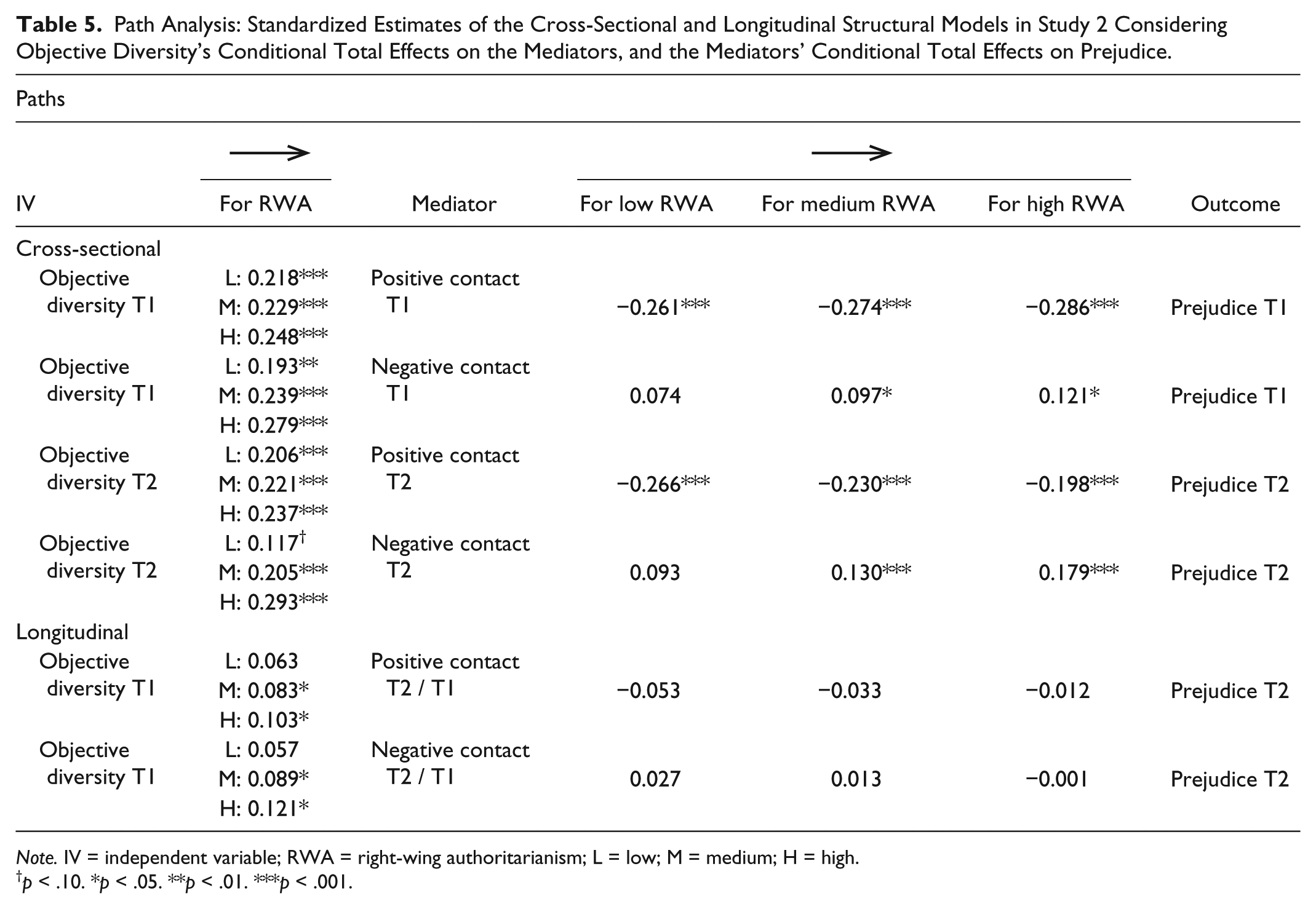
Path Analysis: Standardized Estimates of the Cross-Sectional and Longitudinal Structural Models in Study 2 Considering Objective Diversity’s Conditional Total Effects on the Mediators, and the Mediators’ Conditional Total Effects on Prejudice.
Note. IV = independent variable; RWA = right-wing authoritarianism; L = low; M = medium; H = high.
p < .10. *p < .05. **p < .01. ***p < .001.
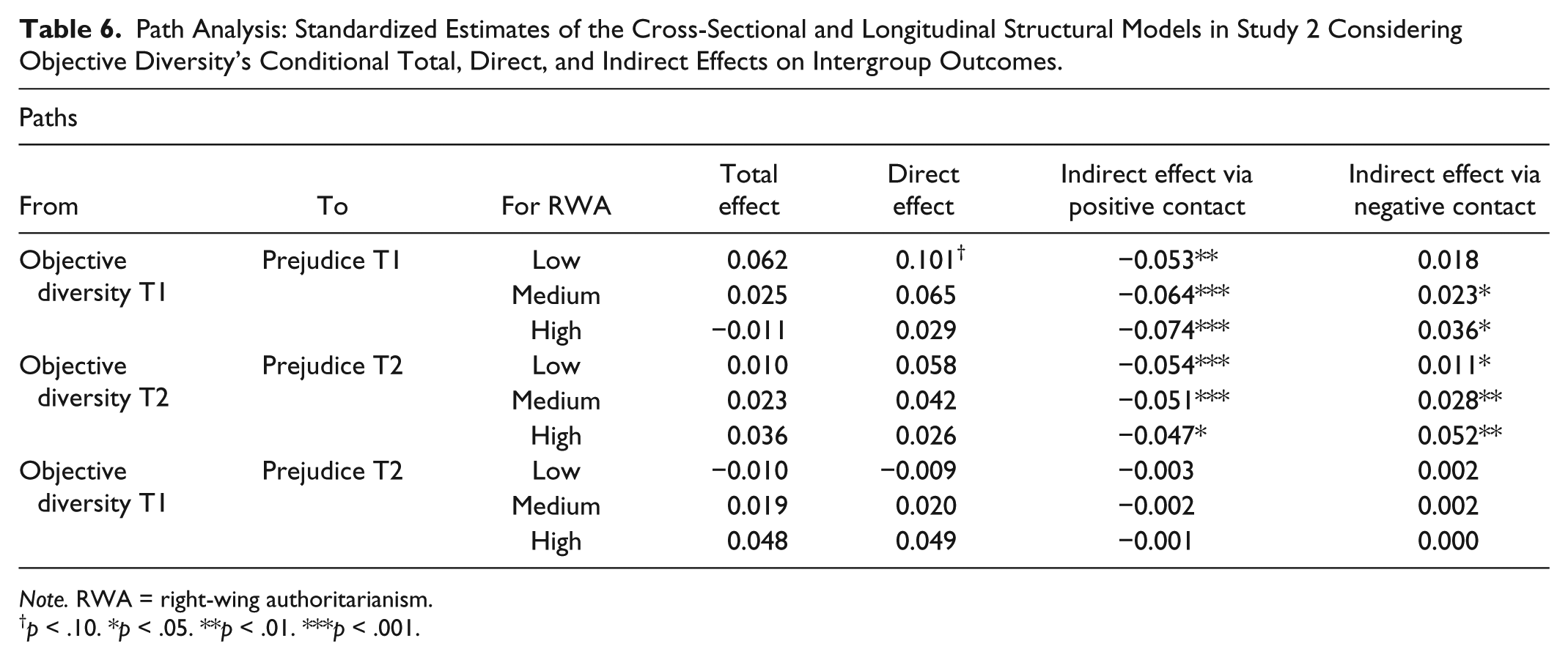
Path Analysis: Standardized Estimates of the Cross-Sectional and Longitudinal Structural Models in Study 2 Considering Objective Diversity’s Conditional Total, Direct, and Indirect Effects on Intergroup Outcomes.
Note. RWA = right-wing authoritarianism.
p < .10. *p < .05. **p < .01. ***p < .001.
Path Analysis: Standardized Estimates of the Cross-Sectional and Longitudinal Structural Models in Study 2 Considering Perceived Diversity’s Conditional Total Effects on the Mediators, and the Mediators’ Conditional Total Effects on Prejudice.

Note. IV = independent variable; RWA = right-wing authoritarianism; L = low; M = medium; H = high.
p < .10. *p < .05. **p < .01. ***p < .001.
Path Analysis: Standardized Estimates of the Cross-Sectional and Longitudinal Structural Models in Study 2 Considering Perceived Diversity’s Conditional Total, Direct, and Indirect Effects on Intergroup Outcomes.

Note. RWA = right-wing authoritarianism.
p < .10. *p < .05. **p < .01. ***p < .001.
Cross-sectional results
First, higher objective diversity was related to more positive and more negative intergroup contact, especially among individuals with moderate or high levels of authoritarianism (see Table 5). Positive contact was further associated with less prejudice, and a reversed pattern of results was revealed for negative contact, but only among moderate and high authoritarians. Importantly, the results further indicated that there were no significant total effects of objective diversity on prejudice (see Table 6). Nonetheless, there were significant indirect effects via positive and negative contact, which were especially pronounced among those with average and high levels of authoritarianism. In line with the results of Study 1, objective diversity did not show an overall significant effect on prejudice because it was associated with both more positive and more negative intergroup contact, which, in turn, had opposite effects on prejudice. These indirect effects were less outspoken or even absent among low authoritarians.
Second, the cross-sectional results concerning perceived diversity showed an analogous pattern. Higher perceived diversity was related to more positive and more negative intergroup contact, especially among individuals with moderate or high levels of authoritarianism (see Table 7). Positive contact was further associated with less prejudice, and a reversed pattern of results was revealed for negative contact, but only among moderate and high authoritarians. Most importantly, the results indicated that there were no total effects of perceived diversity on prejudice, except for a negative total effect for low authoritarians at T2 (see Table 8). Furthermore, perceived diversity simultaneously showed a prejudice-reducing indirect effect via more positive contact experiences (which was significant for everyone) and a prejudice-enhancing indirect effect via more negative contact experiences (which was only significant among moderate and high authoritarians).
Longitudinal results
The cross-sectional analyses at T1 and T2 provided evidence for the hypothesized diversity-prejudice relation via positive and negative contact, which were especially outspoken among those high in RWA. Yet, to provide more clear indication of the direction of the associations, longitudinal analyses were conducted, following the procedure suggested by Cole and Maxwell (2003). In particular, we tested a model in which the centered T1 scores of diversity and RWA, as well as their interaction term predicted the T2 scores of positive and negative contact, controlling for T1 scores of positive and negative contact. By including the T1 contact scores, we controlled for the stability effect of contact over time (i.e., including the autoregressive paths; β = .60, p < .001 and β = .53, p < .001 for positive and negative contact, respectively). Furthermore, the centered T1 scores of contact and RWA, as well as their interaction terms were included as predictors of the T2 scores of prejudice, controlling for T1 scores of diversity and prejudice (with the autoregressive path β = .71, p < .001).
The bottom lines of Tables 5 and 6 display the standardized coefficients of the model considering objective diversity and Tables 7 and 8 consider the perceived diversity coefficients. As expected, higher levels of objective diversity predicted more positive and more negative intergroup contact over time. Importantly, this was only the case among those with medium and high levels of RWA, in line with our hypotheses (see Table 5). The paths from perceived diversity showed no such pattern (see Tables 7). Finally, all longitudinal total and indirect effects of diversity on prejudice did not reach significance (see Tables 6 and 8 for the models considering objective and perceived diversity, respectively).
Brief Discussion
In Study 2, we were able to replicate the cross-sectional results considering objective diversity and prejudice. Indeed, the opposing processes of positive and negative intergroup contact largely drive the null effects of objective diversity. Moreover, higher objective diversity longitudinally predicted more positive and more negative intergroup contact, especially among those with average and high levels of authoritarianism. Finally, the cross-sectional results for perceived diversity were similar to the objective diversity results, though they were not in line with the results considering estimations of diversity in Study 1. It seems that, compared with higher estimates of diversity, higher perceived diversity did not show the same negative relations with intergroup attitudes, which suggests an intriguing difference between both “types of measurement” of diversity perceptions.
General Discussion
The present series of studies investigated the associations of ethnic diversity with several aspects of intergroup relations, taking into account important mediators (i.e., positive and negative contact and threat) as well as a critical moderator (i.e., authoritarianism) of these associations. The results of the multilevel models in Studies 1 and 2 indicated that the nonsignificant overall associations of objective diversity with generalized, ingroup, and outgroup trust, as well as with subtle and blatant prejudice, were the result of mediating processes through positive and negative intergroup contact, working in opposite directions, while intergroup threat played no meaningful role. Moreover, a closer inspection of the slopes of the indirect effects for individuals high versus low in authoritarianism specified that especially among moderately and highly authoritarians, higher proportions of ethnic outgroups related to both more positive and more negative intergroup contact. The longitudinal results in Study 2 showed that, also over time, moderate and high authoritarians engage in more (positive as well as negative) contact when diversity levels are higher in their local environment.
Second, the results concerning perceptions of diversity yielded an interesting insight into the dynamics of diversity “in the eye of the beholder.” In Study 1, higher estimates of minority proportions (measured via percentage-guesses) were related to lower levels of trust and higher levels of prejudice via more negative intergroup contact and more outgroup threat, but not via positive intergroup contact. Again, these indirect associations were especially present among high authoritarians. Remarkably, in Study 2, higher perceived ethnic diversity (asking for respondents’ general impressions of diversity on scales ranging from no diversity to a great degree of diversity) showed no associations with prejudice. In fact, overall, higher perceived diversity was unrelated to prejudice. Moreover, analogous to the results regarding objective diversity, the nonsignificant total associations of perceived diversity with prejudice were mediated by both positive and negative intergroup contact. Once more, the slopes for these indirect effects tended to be more pronounced among moderate and high authoritarians. Longitudinally, however, higher perceptions of diversity were not related to higher levels of contact or prejudice over time. In the following, we discuss each of these core findings.
The Repercussions of Ethnic Diversity for Intergroup Relations
Objective versus subjective diversity
First and foremost, the results indicate that objective, estimated, and perceived indicators of diversity demonstrate differential relationships when it comes to intergroup relations. Indeed, whereas higher levels of objective diversity and higher perceptions of diversity did not show an overall relationship with intergroup attitudes because they simultaneously related to a constructive and a harmful process (i.e., both positive and negative intergroup contact), higher estimates of diversity were related to more negative intergroup attitudes because they related to two harmful processes (i.e., negative intergroup contact and perceptions of outgroup threat) at once. In corroboration with previous research, we found that the indirect effects of objective diversity via contact appeared to be stronger than via threat (e.g., Savelkoul et al., 2011; Schmid et al., 2014). Yet, in line with Laurence and colleagues (2018), we argue that it is warranted to look beyond just positive contact, as objective diversity offers opportunities for both positive and negative contact with ethnic and cultural outgroups.
Furthermore, we found that higher estimates of diversity sparked feelings of threat, corroborating previous research (e.g., Semyonov et al., 2004). This might indicate that the measurement of estimated diversity is more inflated and biased compared with the more “neutral” formulation of Likert-type-scale perceived diversity items. We argue that estimates of diversity, compared with general evaluations, are indeed far more likely to be misjudged, overemphasized, and driven by previous personal attitudes. Specifically, almost all majority members tend to overestimate the actual relative size of the minority population (see Hooghe & De Vroome, 2015). It seems reasonable that such exaggerated estimates of minority proportions do not form a basis for (self-reported) positive experiences with ethnic outgroups. Conversely, our findings showed that higher actual minority proportions do stimulate individuals to engage in (positive as well as negative) intergroup contact, and as such offer a more complete portrait of the opportunities within diverse settings.
The role of individual differences in authoritarianism
Our results also highlight the importance of taking individual differences into account when testing diversity effects. Our multilevel interaction approach of simultaneously including psychological and socio-structural variables in the prediction of social phenomena speaks directly to Pettigrew’s (1991, 2008) general calls for an integrative “contextual social psychology.” Furthermore, by considering the interplay between diversity and authoritarianism in various psychological processes, our research neatly builds upon the growing scholarly interest in applying this Person × Context interplay to the field of intergroup relations (Hodson & Dhont, 2015). Indeed, the question of whether and how diversity affect the social cohesion of communities has become an increasingly prominent and contested topic of debate (see Putnam, 2007) and individual differences in authoritarianism might serve as a key variable here. Whereas previous research has accumulated evidence for the moderating role of authoritarianism in the relations between (a) diversity and contact (e.g., Brune et al., 2016), (b) diversity and threat (e.g., Van Assche et al., 2016), and (c) diversity and intergroup attitudes (e.g., Kauff et al., 2013; Van Assche et al., 2014, 2016), the question remained how authoritarianism shaped the total, direct, and indirect effects of diversity via the three main mediating processes.
As such, the results of this study extend previous research on diversity, intergroup contact, and threat (e.g., Hewstone, 2015; Putnam, 2007; Schmid et al., 2014) by demonstrating that diversity effects are especially pronounced among moderate and high authoritarians, and sometimes even nonsignificant among low authoritarians. These findings seem to indicate that in diverse areas, where contact is highly likely and presumably more normative, authoritarians do not necessarily avoid the outgroup (as is their “natural” inclination). On the contrary, in an environment with many ethnic outgroups, authoritarians might perceive contact with such groups as inevitable and even normative (see also Brune et al., 2016). Remarkably, we replicated the findings of Brune and colleagues (2016) using a different diversity indicator (i.e., the proportion of immigrants in Study 1 and foreigners in Study 2 vs. the proportion of Asians in the Brune et al. study) and a different contact indicator (i.e., frequency of positive and frequency of negative contact experiences vs. an intergroup friendship scale in the Brune et al. study). This is noteworthy for two reasons. First, authoritarians likely feel more threatened by the presence of immigrants and foreigners as opposed to Asians (who are usually perceived as more competent). Still, we found that, even over time, authoritarians engage in contact with these outgroups. Second, where Brune and colleagues show that, for high authoritarians, diversity relates to intergroup friendship as an affective high-quality form of contact, we corroborate and extend these results by showing that diversity relates to less close forms of positive contact (i.e., mere quantity of positive experiences) and also to negative contact experiences. Future research could directly assess intergroup contact quality, or could assess the hours of positive versus the hours of negative contact, testing the possibility that the increased amount of intergroup encounters for authoritarians in the face of diversity might include relatively more negative experiences than positive ones.
Intriguingly, while our findings indicate that individuals high in authoritarianism are most prominently affected by diversity, they also suggest that individuals low in authoritarianism are little affected by diversity in terms of contact, threat, and intergroup attitudes. Future studies could specifically focus on low authoritarians by investigating why they are less sensitive to diverse environments compared with high authoritarians (see Van Assche, Dhont, Van Hiel, & Roets, in press; Van Assche et al., 2016). A tentative hypothesis could be that low authoritarians also have more intergroup contact and immigrant friends outside their local area, and thus depend less on the diversity in their direct physical environment for intergroup contact.
Finally, it is valuable to include several intergroup outcomes when examining diversity effects. In our aim to test Putnam’s pessimistic hunkering down hypothesis, we took into account five aspects of intergroup attitudes. With regard to the consequences of objective and perceived diversity, we found no evidence for any detrimental effects across our outcomes. With regard to the correlates of estimations of diversity, however, our results suggest that this aspect of diversity is indeed connected to greater prejudice and lower trust in people in general, in ethnic outgroups, and even in one’s own ethnic group. Whereas the impact of diversity tends to generalize across various intergroup facets, the conclusions for threat and contact effects are slightly divergent for outgroup attitudes (i.e., outgroup trust, subtle and blatant prejudice) compared with ingroup attitudes (i.e., ingroup trust) and more general attitudes (i.e., generalized trust). Positive contact experiences did ameliorate all these attitudes (with their largest benefits among high authoritarians; see also Dhont & Van Hiel, 2009). Negative contact and threat, on the contrary, decreased outgroup trust and increased prejudice for high and low authoritarians alike (with the exception that negative contact did not affect low authoritarians’ blatant prejudice), but only in low authoritarians did these negative processes also decrease ingroup and generalized trust. Indeed, high authoritarians’ perceived outgroup threat was even related to more ingroup trust, suggesting that they apply some sort of defense mechanism that protects against decreased ingroup trust in the face of negative intergroup experiences (cf. Kessler & Cohrs, 2008). Future research could dig deeper into this mechanism and test our speculative hypothesis.
Strengths, Limitations, and Directions for Future Research
The present study included slightly different measures and different levels of analysis across two studies, which precludes direct comparisons but offers insights in the robustness of our findings. Moreover, by including an objective and two subjective measures of diversity, we went beyond most previous diversity research. This differentiation is important because the similarity in findings for objective and perceived measures indicates that the results found with the perceived measure are robust and could not merely be attributed to biased or extreme responding. The deviating findings found for estimations of diversity, on the contrary, might point to potentially biased responding, a measurement issue that future research may want to investigate in greater detail.
A second merit bears upon the inclusion of both small-to-medium (i.e., city) and medium-to-large (i.e., district) levels of analysis to measure the specific ethnic environment of the respondents. In Study 1, we even specifically collected nested data with at least five observations per contextual unit. The specific choice for a relatively broad contextual unit of analysis may, however, also constitute a drawback, as previous studies suggested that ethnic diversity mainly affects trust in the microcontext, whereas these effects vanish in larger contextual units (Dinesen & Sønderskov, 2015; Koster, 2013). Indeed, diversity in the local neighborhood makes a stronger impression on individuals (Schaeffer, 2014), being the most direct geographical environment in which people spend most of their social time (Tolsma, van der Meer, & Gesthuizen, 2009). Yet, the present study, using two medium levels of analysis, showed no main effects of objective as well as perceived diversity, as such substantiating previous studies using smaller contextual units-of-analysis (e.g., Gijsberts et al., 2012; Schmid et al., 2014) as well as replicating studies that also used relatively large levels of analysis (e.g., the country-level study of Hjerm, 2007, the region-level study of Evans & Need, 2002, and the municipality-level study of Schlueter & Scheepers, 2010).
Third, future studies could empirically assess the contextual level where diversity exerts its strongest impact, and investigate which mediators play a role at which level. For example, it would be insightful to simultaneously examine ethnic diversity at the local, intermediate, and national level, to see whether contact effects outperform threat effects at each level. Indeed, regional diversity might not only relate to more individual contact experiences but also to more “higher level” contact. Christ and colleagues (2014) already showed that living in a contextual setting where fellow ingroup members engage in intergroup contact is extremely beneficial in terms of reduced prejudice, even among those who rarely experience individual face-to-face contact. This between-level effect of intergroup contact is even greater than its individual-level effect and might also show a differential associations with intergroup attitudes for low versus high authoritarians.
Fourth, by applying longitudinal analyses, we gained greater insight into how diversity affects intergroup contact and prejudice in the longer run. Our results indicated that, over a period of 2 years, higher minority proportions heighten positive and negative intergroup contact experiences, but they did not relate to prejudice levels over time. There may be various reasons for this lack of longitudinal effect on prejudice. First, actual minority proportions did not change that much in the 2-year period we considered. In fact, the levels dropped on average 0.07%, ranging from a small decrease of 1.20% in some districts to a small increase of 0.30% in others. Second, we believe that while contact experiences can easily vary both in quantity and quality, prejudiced attitudes may be less subjected to momentary circumstances but rather relatively stable across a few months or years, leaving not much room for diversity to exert a significant impact (cf. the correlation between prejudice at T1 and T2 was .78; see Online Appendix C, see also Dhont, Van Hiel, De Bolle, & Roets, 2012). Future studies may examine the change in the ethnic composition and its potential long-term effects on prejudice over a longer period of time with special attention to periods with large and sudden upsurges in immigration of foreign-born people (cf. the recent increase of refugees).
Finally, future research may want to use more elaborate (multi-item) measures, which are more reliable and may yield larger effect sizes, especially with regard to intergroup contact effects (see Pettigrew & Hewstone, 2017). Although the use of short scales (and particularly the lack of a threat measure in Study 2) is a limitation of the current contribution, we believe this research sets an example in two other ways. First, in terms of model building, we included many critical variables into one coherent and comprehensive model, hence avoiding “the Single Factor Fallacy” (i.e., the missing of key variables that might distort results and conclusions; Pettigrew & Hewstone, 2017). Second, in terms of methodology, we acknowledged the complex nature of the effects and processes instigated by diversity through applying mediation–moderation multilevel analyses and longitudinal research.
Conclusion
Our results add a crucial piece of the puzzle that goes beyond previous research unraveling the complex and multifaceted diversity effects. By providing new insights into the mediating role of contact and threat and the moderating role of authoritarianism in the associations of diversity with various facets of intergroup relations, this research will hopefully encourage future research to further develop the interesting theoretical framework of ethnic diversity, right-wing ideologies, and intergroup processes and attitudes.
Supplemental Material
van_assche_online_appendix – Supplemental material for The Diversity Challenge for High and Low Authoritarians: Multilevel and Longitudinal Effects Through Intergroup Contact and Threat
Supplemental material, van_assche_online_appendix for The Diversity Challenge for High and Low Authoritarians: Multilevel and Longitudinal Effects Through Intergroup Contact and Threat by Jasper Van Assche, Frank Asbrock, Kristof Dhont, and Arne Roets in Personality and Social Psychology Bulletin
Footnotes
Acknowledgements
The authors wish to thank Anna Brune, Emma Onraet, and Alain Van Hiel for their constructive input in the design of Study 1.
Declaration of Conflicting Interests
The author(s) declared no potential conflicts of interest with respect to the research, authorship, and/or publication of this article.
Funding
The author(s) received no financial support for the research, authorship, and/or publication of this article.
Notes
Supplemental Material
Supplementary material is available online with this article.

References
Supplementary Material
Please find the following supplemental material available below.
For Open Access articles published under a Creative Commons License, all supplemental material carries the same license as the article it is associated with.
For non-Open Access articles published, all supplemental material carries a non-exclusive license, and permission requests for re-use of supplemental material or any part of supplemental material shall be sent directly to the copyright owner as specified in the copyright notice associated with the article.
