



Abstract
An exchange model of religion implies that if a secular entity such as government provides what people need, they will be less likely to seek help from supernatural entities. Controlling for quality of life and income inequality (Gini), we found that better government services were related to lower religiosity among countries (Study 1) and states in the United States (Study 2). Study 2 also showed that during 2008-2013, better government services in a specific year predicted lower religiosity 1 to 2 years later. In both studies, a combination of better government services and quality of life was related to a particularly low level of religiosity. Among countries, government services moderated the relation between religiosity and two measures of well-being, such that religiosity was related to greater well-being only when government services were low. We discuss the relation between the exchange model and other theoretical approaches to religion.
Psychologists studying religion have long entertained the notion that people might turn to faith to obtain specific or general benefits. For example, Allport and Ross’s (1967) early distinction between extrinsic and intrinsic religiosity posited that people are extrinsically religious if they use religion as a means to some other end; they are intrinsically religious if their faith is an end in and of itself. The motivational approach attracted research attention, but also gave rise to critiques of both a conceptual (e.g., Batson, Schoenrade, & Ventis, 1993; Cohen, Hall, Koenig, & Meador, 2005; Pargament, 1992) and statistical or methodological nature (e.g., Donahue, 1985a, 1985b; Kirkpatrick & Hood, 1990). At the turn of the 21st century, research on the origin of religion replaced the motivational approach with the view that religious beliefs are by-products of cognitive tendencies such as teleological thinking, mentalism, theories of mind, and mind-body dualism (e.g., Atran, 2002; Atran & Norenzayan, 2004; Barrett, 2004; Bering, 2011; Bloom, 2007; Boyer, 2001; Frith & Frith, 2003; Kelemen, 2004).
The Exchange View of Religion
More recently, Norenzayan and colleagues developed a cultural evolution theory centered on the notion that the moralizing Big God of the Abrahamic faiths is a mechanism that helped small communities expand into large, cooperative societies of strangers (Norenzayan et al., 2016). In another direction, researchers began to examine a number of benefits that religion might provide to its followers. Reviews of this latter work were assembled under the rubric of a functional approach to religion (Sedikides, 2010; see special issue of Personality and Social Psychology Review, 2010). It was reported, for example, that religiosity can provide a sense of control (Kay, Gaucher, McGregor, & Nash, 2010), contribute to one’s self-enhancement (Sedikides & Gebauer, 2010), facilitate self-regulation (Koole, McCullough, Kuhl, & Roelofsma, 2010; McCullough & Willoughby, 2009), serve as an attachment system (Granqvist, Mikulincer, & Shaver, 2010), and confer some relief from existential questions about and fear of impending death (Vail et al., 2010). According to Sedikides (2010), these views and the evidence supporting them “ . . . argue in favor of specific motive or need driving religious belief and practice” (p. 4).
Norenzayan et al.’s (2016) cultural evolution theory posits a process that works at the group level—societies with a powerful moralizing God are more likely to survive over the long term. Like natural evolution, cultural evolution (in essence survival of the fittest society) is devoid of any specific motivation, agency, or intention. Sedikides’s (2010) functional approach focuses on individual motivation to fulfill one’s needs. Needs are also the focal point of an exchange system. We suggest that being or becoming religious to satisfy needs describes an exchange system; that is, religious beliefs, practice, and conduct are offered for the purpose, explicit or implicit, of getting certain benefits that the person needs.
Evidence Consistent With the Exchange Notion
The Greater the Need…
If religion is an exchange system, it follows that the greater the need for a commodity that religion might provide, the greater the religious commitment that seems necessary to get that commodity. Evidence supporting this relation abounds. For example, threats to both a person’s personal control and to order in the world, increased religious beliefs generally, and belief in a controlling God particularly (Kay, Gaucher, Napier, Callan, & Laurin, 2008; McGregor, Haji, Nash, & Teper, 2008; see also Rutjens, van der Pligt, & van Harreveld, 2010); threats of loneliness (Epley, Akalis, Waytz, & Cacioppo, 2008) and bereavement (Brown, Nesse, House, & Utz, 2004) were associated with stronger religious beliefs; the experience of an earthquake led to an increase in religious faith (Sibley & Bulbulia, 2012), as did increasing the salience of death (Norenzayan & Hansen, 2006; Vail, Arndt, & Abdollahi, 2012 see also Jong, Halberstadt, & Bluemke, 2012). The statement “. . . no atheists in foxholes” also attests to this phenomenon. These data suggest that individuals are more likely to enter the religious exchange when they have a greater necessity for the returns that the exchange might provide.
Promises Are Hard to Keep
Most religions promise the good life to their adherents (e.g., “Those who walk righteously . . . they will live on the heights . . . their food will be supplied, their water assured”; Isaiah 33). As this promise is hard to keep, religions sometimes postpone the provision of benefits to the afterlife. This solution does not always work, particularly in the face of personal or group calamities. One way to resolve the problem is to claim that the person or people exposed to the calamity did not fulfill their part in the exchange; as an illustration of this solution, consider the following reaction to hurricane Katrina: “Surely God is mad at America . . . Surely he doesn’t approve of us being in Iraq under false pretences” (see URL1 in supplementary materials).
Another possible strategy of dealing with adversity is to intensify religious commitments, thus making the person more deserving in the exchange (e.g., Tevino & Pargament, 2007). However, this strategy might fail when the crisis is extreme and lasting. In the latter case, people may experience religious struggle (Pargament, 1997), in effect, calling into question the contractual exchange they thought they had with God. Studies of bereaved individuals, terminally ill patients, and people undergoing other types of trauma showed that feelings of being abandoned by God or feelings of anger toward God were associated with poorer adjustment (e.g., Edmondson, Park, Chaudoir, & Wortmann, 2008; Exline, Park, Smyth, & Carey, 2011; Pargament, Koenig, Tarakeshwar, & Hahn, 2001). This is also the context for Wiesel’s (1960) proclamation that the God that failed to protect his people was hanging on the gallows in the Nazi concentration camps at Auschwitz and Buchenwald. These data suggest that if the religious exchange consistently fails to provide the expected returns, participating individuals may quit; this leaves them in a vulnerable position because, at least in the short run, they do not have another exchange partner that will provide comfort and support. Indeed, any transition away from religious beliefs may generate a sense of loss (Fisher, 2017).
Interchangeability of Religion and Government
If the benefits acquired in the religious exchange can be acquired elsewhere, religion becomes less useful. More than a 100 years ago, Durkheim (1912) suggested that the development of the welfare state as a provider of services, such as health and education, strips away the social role of religion and leads to its decline. Recently, this idea has been examined in three interrelated domains: control and predictability, morality and prosocial behavior, and standards of living. Regarding control and predictability, the power and order emanating from God can be outsourced to the government. Indeed, the studies by Kay et al. (2008), which showed that lower personal control was associated with greater belief in a controlling God, also showed that lower personal control was associated with greater endorsement of governmental control. In addition, Kay, Shepherd, Blatz, Chua, and Galinsky (2010) found that as the perception of political stability decreases, belief in a controlling God increases, and vice versa.
With regard to morality, recall Norenzayan et al.’s (2016) notion that a moralizing God facilitates cooperation in large communities of strangers. Evidence in support of this model includes the association between religiosity and prosocial behavior (for reviews, see Norenzayan, Henrich, & Slingerland, 2013; Shariff, Willard, Andersen, & Norenzayan, 2016). However, Norenzayan et al. (2016) also proposed that the development of secular institutions (e.g., police, courts) can promote prosocial behavior, thus replacing the role of the moralizing God. Indeed, Shariff and Norenzayan (2007) showed that priming either God concepts or secular moral institutions led to more cooperative behavior. Laurin, Shariff, Henrich, and Kay (2012) found that participants supporting the role of the state to catch and punish criminals were less likely to believe in a powerful intervening God. Finally, there is empirical evidence that atheists are distrusted because they are not supervised by a moralizing God (Gervais, Shariff, & Norenzayan, 2011), but such distrust is lower in countries with a strong secular rule of law (Norenzayan & Gervais, unpublished paper; cited, p. 23, in Norenzayan & Gervais, 2015), and when people are reminded of secular authority (Gervais & Norenzayan, 2012).
In terms of Norenzayan et al.’s (2014) cultural evolution theory, replacing God with government simply means that a moralizing God is no longer necessary for the survival of the group. In terms of exchange theory, we would posit that the order and predictability that people seek must be fair and just (Baumard & Boyer, 2013). To the extent that the government is responsible for a just order, there is less of a need for God as the arbiter of right and wrong.
Finally, Norris and Inglehart’s (2004) security hypothesis, and the focus of the present studies, is that people gain a sense of security from their religion or from their government. Although security can be broadly based (encompassing governmental provisions of justice as well as predictability), Norris and Inglehart’s (2004) research focused mostly on quality of life. They showed that religious beliefs and practice are lower in countries with better living conditions as measured by education (e.g., literacy), economic development (e.g., gross domestic product or GDP), health (e.g., child mortality), and income inequality (Gini; see also Rees, 2009). Other studies also showed that better quality of life is associated with lower religiosity (Diener, Tay, & Myers, 2011; Gray & Wegner, 2010; McCleary & Barro, 2006; Paul, 2009; Schieman, 2010).
Norris and Inglehart’s (2004) security hypothesis raises a question central to an exchange model: Can the government replace God (or other deities) as a provider? In other words, can secular exchange replace religious exchange? The focus on living conditions and economic inequality in the research discussed above, although related to government services, can also be viewed as an indicator of needs, for example, lower literacy signals a need for better education and higher inequality signals a need for more cohesions and social ties. The current studies directly assessed the role of government as a provider by testing whether, controlling for quality of life and economic inequality, better government services are related to lower religiosity. Our rationale is that even in the presence of better quality of life and higher economic equality, people can remain insecure about their future. A hurricane or illness can strike and induce a drastic deterioration in a person’s life and well-being. Expected and more gradual life changes (e.g., having children that will require education, growing old) may also generate greater stress and higher anxiety unless there is some certainty that the government will help. In other words, we hypothesize that the government provides an extra layer of security and can replace God as an agency of last resort.
Two more questions were of interest. First, it is possible that the need for religion recedes only when people are provided with both high quality of life and the security of government services. Thus, we examined whether the interaction between these two factors further depresses religiosity in addition to their additive effects.
Second, we examined the actual relation between religiosity and subjective well-being (SWB). If government replaces God as a source of security, it may also replace religion as a source of SWB. If so, we would expect a moderator effect such that under better government services, the relation between religiosity and SWB will be weaker. Indeed, Diener et al. (2011) found such a moderator effect for quality of life. Under better living conditions, the relation between religiosity and SWB was weaker for two out of three well-being indices. As we claimed that government services make a unique contribution to security (in addition to quality of life), we predicted that, controlling for the moderator effect of quality of life, there will be a moderator role for government services.
Study 1: Countries of the World
Study 1 tested the above predictions with countries of the world.
Method
Sample and religiosity measure
Religiosity (and SWB, see below) data were collected by the Gallup World Poll, 2005-2009, and published in Diener et al. (2011, Table 4). The Gallup poll collected data from representative samples of 155 countries, an average of 2,955 respondents per country. In total, 455,104 individuals above age 15 years were included in the survey. Primary sampling units were stratified by population size or geography. Random route procedures were used to sample households. The Kish (1949) grid technique was used to select persons for the interview within each household. Surveys were conducted by phone in countries with high telephone coverage (more than 80% of the population), or in-person in countries with less coverage.
For each country, Diener et al. (2011) presented the percentage of respondents who answered yes to the following question: “Is religion an important part of your life?” In addition to general religiosity, we also collected from the World Fact Book the percentage of each country’s population affiliated with each of four major religions (see URL2 in supplementary materials). The religions were Christianity, Islam, Buddhism, and Hinduism. Countries were categorized as associated with a particular religion if 50% or more of the population were affiliated with this religion. On this basis, there were 77 Christian countries, 34 Muslim countries, five Buddhist countries, and two Hindu countries; 17 countries were included in an “Other” category. As there were very few Buddhist and Hindu countries, they were moved to the Other category.
Quality of life and government services
The construction of the quality of life and government services measures were discussed elsewhere (Zuckerman, Li, & Diener, 2017). Briefly, both were composites of variables that were obtained from the World Bank (see URL3 in supplementary materials) and the World Fact Book. The quality of life composite included six variables. The first variable, education, was itself a composite comprising three measures obtained separately for males and females from the World Bank for the years 2005 to 2009: persistence to last grade of primary education, progression to secondary school, and literacy rate (all scored as percentage in female or male cohorts). We first averaged the variables across the years for which they were available and, because of skewness, log transformed them. As the averages were highly intercorrelated (rs = .53-.77), they were standardized and combined into separate composites for males and females (α = .88 for both composites). As the two composites were highly correlated (r = .96), they were combined into one educational variable. The remaining five variables in the quality of life composite were infant mortality (number of deaths/1,000 live births), percentage population in urban areas, life expectancy, number of physicians/1,000 population, and percentage of population below poverty level. Infant mortality, life expectancy, and poverty were log transformed due to skewness. After reverse scoring infant mortality and poverty, the six variables were standardized and combined into a single quality of life composite (α = .87). 1
The government services composite included two variables from the World Fact Book: health expenditures and education expenditures, both reported as percentages of GDP.
Gini
Gini values were obtained from the World Bank. These values can range from zero to one with zero indicating that the distribution of family incomes is completely flat (all incomes are equal), and one indicating maximal inequality (e.g., one family has the entire income and all the rest have none).
SWB
The SWB data were obtained from the aforementioned Gallup World Poll. SWB includes three components: life satisfaction, positive emotions, and negative emotions (Diener, 2000; Diener, Oishi, & Lucas, 2015). Life satisfaction was measured with Cantril’s (1965) 11-step ladder with higher steps representing better life for the respondent. Positive and negative emotions were measured by asking participants whether or not they experienced (an emotion) a lot during the previous day (1 = yes, 2 = no). After reversing the individual scores, the positive and negative affect scores were, respectively, the averages across positive emotion scores (smile/laugh, experience enjoyment; α = .62) and across the negative emotion scores (worry, sadness, depression, anger; α = .68); higher averages indicated more positivity for the positive emotions and more negativity for negative emotions.
Results
Predicting religiosity
We were able to collect data for 136 countries. A hierarchical regression analysis was used to predict religiosity from the quality of life and government services composites and their interaction, adjusting for income inequality and religion. After centering the two composites, they were entered as predictors in Step 1 along with the Gini scores and two dummy-coded variables, one representing the Muslim category and one representing the Other category; the Quality of Life × Government Services was entered in Step 2 (see Table S1 in supplementary materials for the full regression table). Result showed that, as expected, higher Gini scores were associated with higher religiosity (β = .19, t = 3.25, p = .001). In both Steps 1 and 2, the results also showed significant associations between lower religiosity and both better government services (in Step 2: β = −.15, t = −2.77, p < .02) and life quality (in Step2: β = −.59, t = −10.14, p < .001). The results of Step 2 also showed a significant Quality of Life × Government Services interaction (β = −.12, t = −2.27, p = .025). 2 Mean religiosity scores for countries 1 standard deviation above and below the means of both life quality and government services are depicted in Figure 1 (see simple slope analyses in Table S2 in supplementary materials). It can be seen that religiosity was particularly low when high quality of life was combined with more government services.
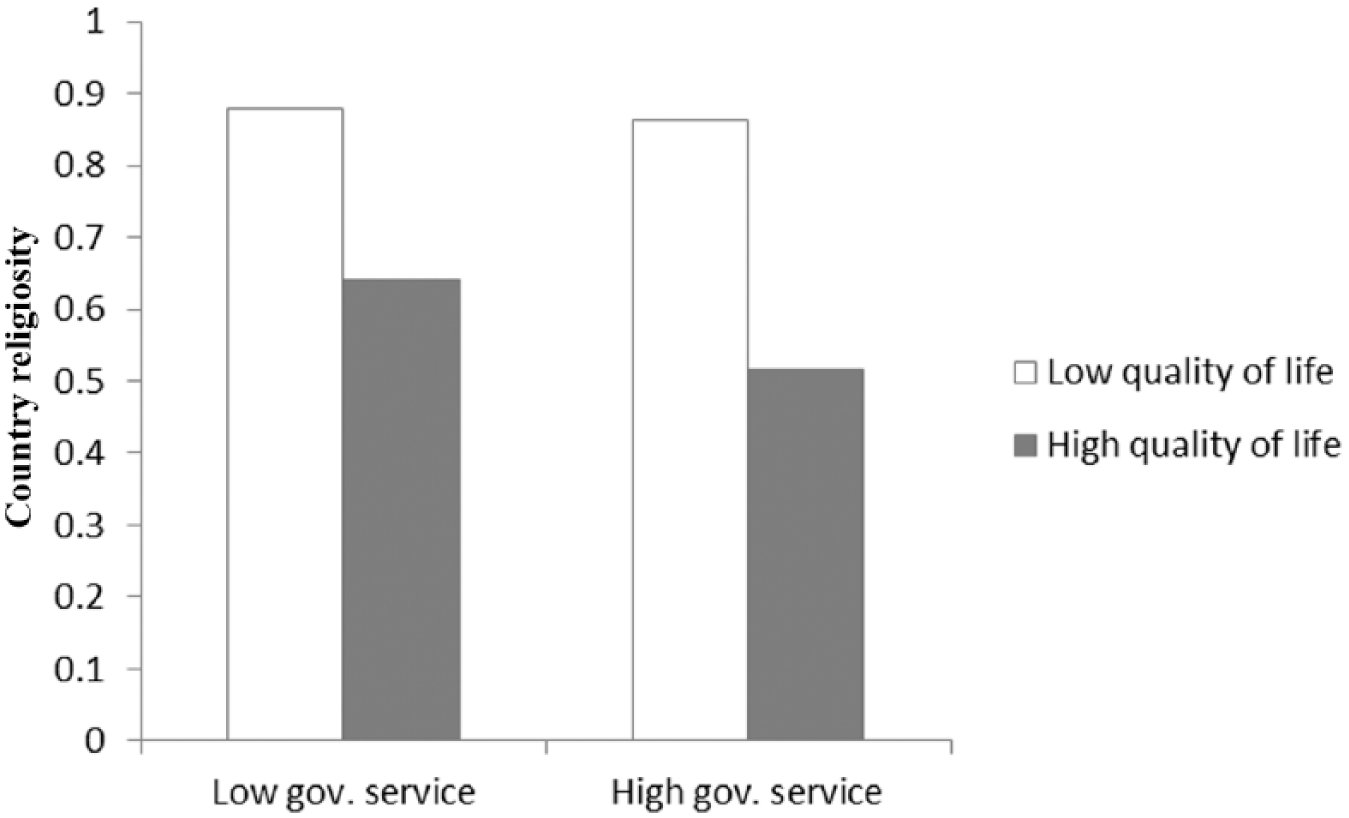
Predicted religiosity in countries with high versus low government services (±1 SD) and high versus low quality of life (±1 SD); Study 1.
Predicting SWB
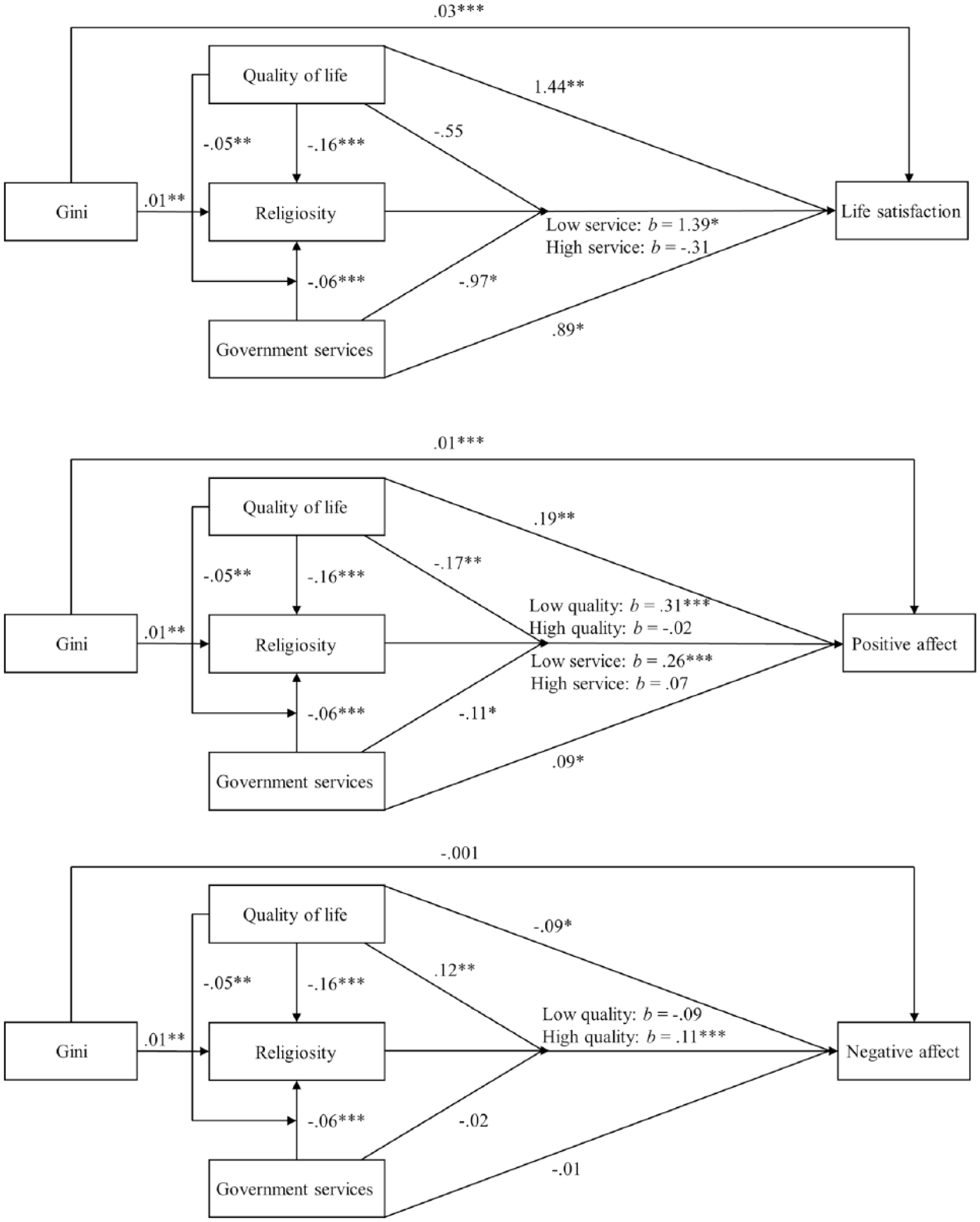
As government services and quality of life were used to predict religiosity but are now used (with religiosity) to predict well-being, we employed Structural Equation Modeling (SEM) models that can accommodate and test (using Mplus 7) all these relations together. As the three SWB measures are relatively independent, we constructed separate models for each measure (see Figure 2). The left hand side of all three models shows the relations that were discussed above with government services and quality of life (and their interaction) predicting religiosity; Gini also appears on the left side with relations to religiosity and to well-being; as a control variable, it was correlated (not shown) with both quality of life and government services.
Predicted religiosity in countries with high versus low government services (±1 SD) and high versus low quality of life (±1 SD).
On the right hand side, all three models test whether quality of life and, separately, government services, moderate the relation between religiosity and well-being. Accordingly, we added two moderation paths from quality of life and government services onto the relation between religiosity and well-being; to do so, we created the appropriate interaction (product) terms and correlated each of those with the two variables that made the product (e.g., Religiosity × Government Services was correlated with religiosity and Government services). The two interactions were also correlated with each other because they share religiosity as one of the product components. The final models showed good fit for life satisfaction: χ2(5) = 9.33, p = .10, root mean square error approximation (RMSEA) = .07, comparative fit index (CFI) = .99; for positive affect: χ2(5) = 8.49, p = .13, RMSEA = .07, CFI = .99; and for negative affect: χ2(5) = 8.11, p = .15, RMSEA = .06, CFI = .99.
As shown in Figure 2, better quality of life was associated with greater life satisfaction (B = 1.44, t = 3.45, p = .001), more positive affect (B = .19, t = 4.57, p < .001), and less negative affect (B = −.09, t = −2.57, p = .010). Better government services were related to greater life satisfaction (B = .89, t = 2.08, p = .037) and more positive affect (B = .09, t = 2.08, p = .037), but were not associated with negative affect, t < 1. Quality of life moderated the relation of religiosity with positive and negative emotions (B = −.17, t = −3.61, p < .001; B = .12, t = 3.24, p = .001; respectively) but not with life satisfaction; this is an exact replication of Diener et al. (2011), but with a somewhat different measure of quality of life, and with controlling for Religiosity × Government Services. Government services moderated the relation of religiosity with life satisfaction and positive affect (B = −.97, t = 2.04, p < .041; B = −.11, t = −2.14, p = .033, respectively) but not with negative effect. We tested simple slopes of religiosity at 1 standard deviation above and below mean quality of life (for two interactions), and above and below mean government services (for two interactions). As seen by the coefficients depicted in Figure 2, religiosity was significantly related to better SWB (life satisfaction and positive affect) at low level of government services, and not related to SWB at high level of government services. With regard to quality of life, religiosity was related to higher positive affect at low level of quality and not related to positive affect at high level of quality; religiosity was not related to negative affect at low quality of life, and was related to higher negative affect at high quality of life.
Summary
As predicted, religiosity was lower at higher levels of both government services and quality of life (controlling for one another), and was particularly low when both government services and quality of life were high. Government services also moderated the relation between religiosity and two SWB components, such that religiosity was related to higher life satisfaction and more positive emotions when government services were low but not when they were high.
Study 2: The United States
Study 2 was a replication of Study 1, using states in the United States as units of analysis. As such, Study 2 had both advantages and disadvantages. First, the number of states is smaller than the number of world countries. Second, it could be safely assumed that for both independent and dependent variables, variation among states would be lower than variation among countries. Both lower N and smaller variance imply lower power.
On the contrary, Study 2 was based on a 6-year (2008-2013) longitudinal design, increasing power (unless there is little variation across years) and allowing tests of prospective effects. The design also allowed us to test directionality of the effect, for example, not only whether government services predict changes in religiosity but also whether religiosity predicts changes in government services.
Method
Sample and religiosity measures
States’ religiosity data were obtained from the “State of the States” Gallup U.S. poll (Gallup State of the States, 2014; see URL4 in supplementary materials). Religiosity was measured by a single-item question, identical to the one used in Study 1: “Is religiosity an important part of your daily life?” From 2008 to 2013, more than 500 individuals were sampled daily and asked to respond to this question. Sampling weights were used, taking into account probabilities of selection and which phone (landline or mobile) was used. After the data were collected, they were stratified according to the following factors: age, gender, education, race, and ethnicity. Representative mean scores were then calculated for each state and for each year from 2008 to 2013. Importantly, these score form a longitudinal design for the states, not for the actual respondents (Gallup selected a new sample every year).
Quality of life and government services
Variables included in the quality of life and government services measures were obtained, respectively, from American Community Surveys conducted by U.S. Census Bureau from 2008 to 2013 (e.g., see URL5 in supplementary materials) and reports of state and local spending (see URL6 in supplementary materials). The quality of life measures was a composite made of eight variables: personal income, death rate (rates per 100,000), diabetes rate (per 100,000), percentage of people below poverty level, physician density (per 1,000), population without health insurance coverage (per 1,000), infant mortality (rate of death before 1 year per 1,000 live births), and percentage of population without primary care. The variables were examined in parallel analyses and exploratory factor analyses that were performed for each of the 6 years. All parallel analyses indicated that only one factor should be extracted from the eight variables; in the factor analyses, all variables across the 6 years loaded .59 or higher on the single factor that was extracted. Accordingly, after reverse scoring the appropriate variables, all were standardized and combined into six quality of life composites (αs ranged from .87 to .90).
Government services were measured by the total state and local spending as percentage of GDP. For exploratory analyses, we also coded separate government spending on education, welfare, and health.
Gini
Income inequality was again used as a control variable. Gini values were obtained from the American Community Survey conducted by the U.S. Census Bureau in 2008-2013 (see URL7 in supplementary materials).
SWB
The measures were collected in the United States by the aforementioned Gallup Organization. Each state was assigned three scores, reflecting life satisfaction (Cantril’s ladder, 1965), positive emotions (M of smile/laugh, enjoyment; α = .81), and negative emotions (M of worry, sadness, depression, anger; α = .87). Questions about experiencing positive and negative emotions were the same as those in Study 1.
Results
Predicting religiosity
The data were examined in Hierarchical Linear Modeling (HLM; Raudenbush & Bryk, 2002) to account for correlated errors from year to year within a state. We modeled within-state variations from year to year across the 6 years at Level 1. The variables at Level 1 included year (2008-2013), yearly religiosity, yearly government services, yearly quality of life, yearly interaction between government services and quality of life, and yearly Gini. Years were centered on 2008. Its coefficient reflects the slope of change in religiosity across the 6 years. All the other variables were centered on each state mean across the 6 years. We modeled between-states variations at level 2. The variables at level 2 included average quality of life, average government services, their interaction, and average Gini for each state. The intercept (i.e., baseline religiosity) and the 6-year slope of change were modeled as random effects, allowing baseline religiosity and slope of change to vary for each state. The yearly quality of life, government services, their interaction, and Gini were modeled as fixed effects.
We built separate models to test whether average quality of life, average government services, and their interaction predict average religiosity in each state, and whether changes in yearly quality of life, yearly government service, and their interaction predict shift in religiosity (away from its 6-year M) in the same year (model 1), from 1 year ago (model 2, lag 1), and from 2 years ago (model 3, lag 2).
Predicting baseline religiosity
In model 1, on average, 67.80% of the entire sample endorsed the statement that religiosity was an important part of their life in 2008. Higher average quality of life was related to lower baseline religiosity (B = −10.06, t = −11.48, p < .001); higher average government services was also related to lower baseline religiosity (B = −.90, t = −3.57, p = .001); finally, a marginally significant interaction of quality of life by government services (B = −.38, t = −1.86, p = .069) showed that baseline religiosity was especially low in states with better quality of life and better government services (see Figure 3; simple slope analyses are shown in Table S3 in supplementary materials). In models 2 and 3, the results were almost identical to those reported above and, therefore, are not presented. These results replicate those obtained in Study 1. 3
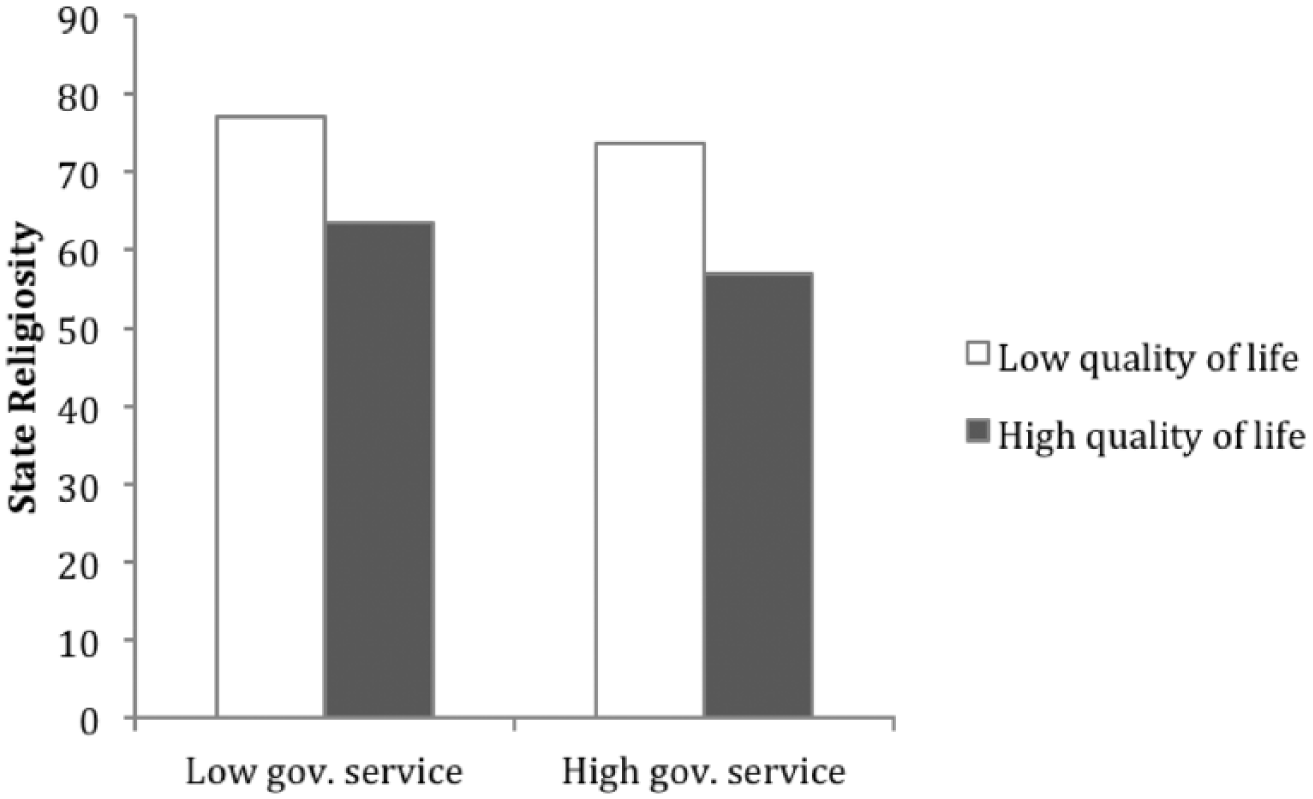
Predicted religiosity in states with high versus low government services (±1 SD) and high versus low quality of life (±1 SD); Study 2.
Predicting shifts in religiosity in the same year
Above and beyond each state’s average religiosity and slope of year, fluctuations in religiosity were negatively associated with shifts in government services (B = −.44, t = −5.26, p < .001). Shifts above a state’s average level of government services were related to shifts below a state’s average religiosity, and shifts below average level of government services were related to shifts above average religiosity. Fluctuations in religiosity were not related to shifts in quality of life (t < 1) or to the quality of life by government services interaction (t < 1).
Predicting changes in religiosity in a year and in 2 years
Government services in a specific year negatively predicted changes in religiosity over 1 year (B = −.78, t = −5.88, p < .001) and also over 2 years (B = −.68, t = −5.40, p < .001). Shifts in quality of life and the interaction between quality of life and government services did not predict shifts in religiosity over the years, ps > .12.
Predicting changes in religiosity from specific expenditures
Our prospective analyses also examined whether expenditures in specific domains (education, welfare, and health) predicted changes in religiosity over 1 and over 2 years. The results showed that each of the three expenditures was negatively related to changes in religiosity over 1 year (education: B = −1.76, t = −4.73, p < .001; welfare: B = −1.84, t = −6.19, p < .001; health: B = −2.38, t = −5.81, p < .001); higher education and welfare expenditures also predicted decreased religiosity over 2 years (education: B = −1.50, t = −3.74, p < .001; welfare: B = −1.60, t = −3.55, p = .001) but higher health expenditures did not.
Testing reversed relation
Given the prospective effects of government services on religiosity for both 1-year and 2-year lags, it was of interest to test whether the opposite relations also held. Accordingly, we reran the HLM model but replaced government services with religiosity as a predictor, and religiosity with government services as the dependent variable. The results showed that religiosity in any specific year actually predicted an increase in government services in the next year (B = .08, t = 2.35, p = .020); there was no relation between religiosity in a specific year and changes in government services 2 years later (B = −.04, t = −1.16, p = .247). In summary, higher government services predicted lower religiosity 1- and 2-year later, but not vice versa.
Predicting SWB
We examined each of the three SWB components in HLM similar to the analysis reported above except that instead of predicting religiosity, we now predicted each SWB from religiosity, quality of life, government services, and the interactions between religiosity and quality of life and between religiosity and government services. At Level 2, we tested between-state variations and, more specifically, whether the average of each SWB component was related to the average of each of the predictors. At Level 1, we tested within-state variations and, more specifically, whether the predictors in each specific year were related to SWB changes in the next year (lag 1), and in the year after next year (lag 2). Both levels controlled for Gini.
At both the between- and the within-state levels, we focused on the Religiosity × Quality and Religiosity × Government Services interactions. Only one between-state level interaction was significant: Religiosity × Quality of Life on life satisfaction, b = −.004, t = 2.03, p = .048; it showed stronger relation between religiosity and life satisfaction at lower levels of quality of life.
Range restriction
There were two sets of nonsignificant results in Study 2: (a) Quality of life did not predict religiosity longitudinally, and (b) with one exception, the interactions between religiosity and quality of life and between religiosity and government services did not predict well-being. Could lack of variance (range restriction) be a possible reason?
We found that quality of life did not predict religiosity longitudinally but government services did. We proceeded to compare the variances of these two variables by Z scoring each across states and years. We then computed for each state the variance of the Z scores in the 6 years. Side-by-side stem-and-leaf plots for the 50 states are presented in Figure S1 in the supplementary materials. Mean variance of government services (range: .008-.242; median = .095; M = .106, SD = .052) was significantly larger than mean variance for quality of life (range = .002-.101 with one more outlier at .281; median = .021; M = .032, SD = .043), t test = 10.32, p < .001, d = 1.47. In summary, levels of government services were much more likely to change year to year than did quality of life (ratio of 3.3:1) in the current sample.
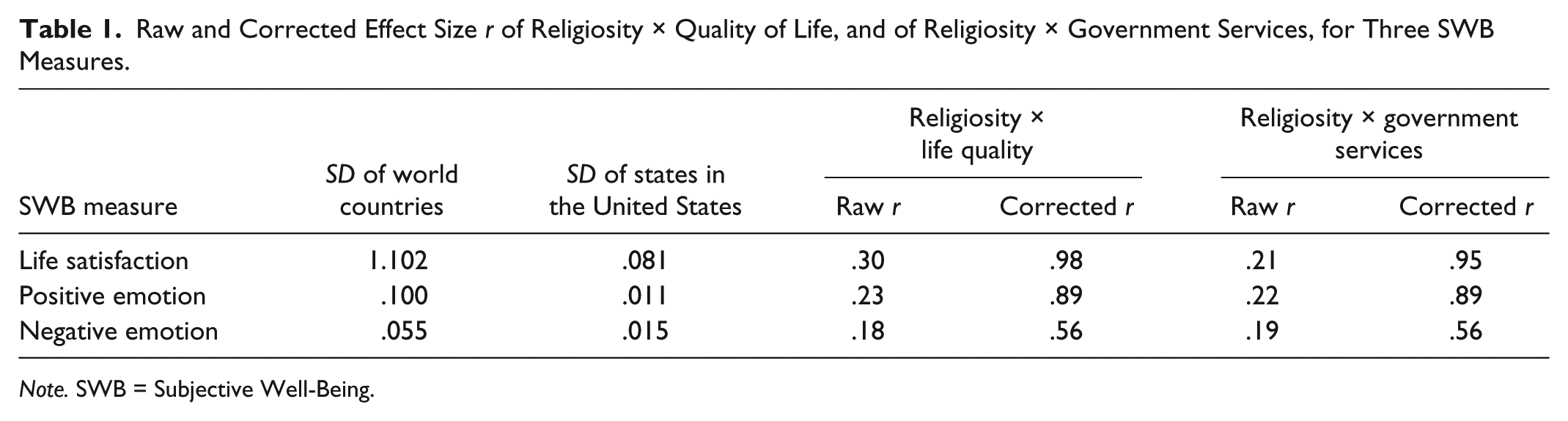
Moving to the second set of null results, in Study 1, SWB components were predicted from Religiosity × Government Services and from Religiosity × Quality of life in four out of six cross-sectional analyses; in Study 2, the effect sizes of all the corresponding analyses were in the predicted direction but only one was significant. We, therefore, compared the variances of the well-being measures in Study 1 and Study 2. 4 As these measures were based on the same scales, using the formula for correcting r for range restriction (Sackett & Yang, 2000), 5 we could actually assess the effect sizes that we would have gotten in Study 2 if the variances in that Study were as large as those in Study 1. The results of these calculations are presented in Table 1.
Raw and Corrected Effect Size r of Religiosity × Quality of Life, and of Religiosity × Government Services, for Three SWB Measures.
Note. SWB = Subjective Well-Being.
The left two columns in the table present standard deviations of the three well-being measures that were obtained for countries (Study 1) 6 and states (Study2). It can be seen that standard deviations for countries were larger (the ratios between country and state SDs ranged from 3.58:1 to 13.62:1; the ratios for the corresponding variances ranged from 12.5:1 to 185.5:1). The next column presents the effect size rs that were obtained for the Religiosity × Quality of Life in Study 2. As reported previously, only r = .30 for life satisfaction was significant, p < .05. The next column presents the corrected rs; ranging from .56 to .98, all would have been significant.
The next two columns present raw and corrected rs for the Religiosity × Government Services. As reported previously, none of the raw rs were significant; all the corrected rs, ranging from .56 to .95, would have been significant.
Importantly, the corrected rs do not imply that the results of Study 2 replicated those of Study 1. They simply raised the possibility that perhaps our null results were due to a lack of variance in the SWB measures and, thus, lower power.
Summary
Replicating the results from Study 1, the cross-sectional analysis showed that religiosity was lower at higher level of government services, and was particularly low when both government services and quality of life were high (the latter effect was close to significance). In addition, the longitudinal analyses showed that better government services in any specific year were related to lower religiosity in the next year and the year after next year. All the effects of government services were obtained while controlling for quality of life and income inequality. Quality of life did not predict religiosity longitudinally and the interactions between religiosity and either quality of life or government services did not predict SWB. We raised the possibility that range restriction might have been a reason for the null results.
General Discussion
We examined in two studies what is perhaps the most direct and central implication of the exchange model of religion: If a secular entity provides what people need, they will be less likely to seek help from God or other supernatural entities. Government is the most likely secular provider. We showed in two cross-sectional analyses, one using world countries and one using states in the United States, that better government services were related to lower levels of religiosity. An additional longitudinal analysis showed that better government services in any particular year predicted a decline in religiosity 1 and 2 years later, although quality of life did not show corresponding effects. In a field where predictions of aggregate religiosity levels are usually tested with cross-sectional designs, the prospective effect of government services on religiosity is a methodological strength. As these findings were obtained while controlling for quality of life and economic inequality, they imply that the government can provide an extra layer of security (Norris & Inglehart, 2004) that might help people cope with future needs, both expected and unexpected, and as such, might reduce dependence on God or other supernatural entities.
But having a secular source of help and support is not the entire story. Controlling for government services, quality of life was also related to lower religiosity. So besides the existence of a helpful government, tangible benefits also matter. Furthermore, an interaction between government services and quality of life (significant in Study 1 and close to significant in Study 2) indicated an extra reduction in religiosity when people have both a helpful government and high standards of living.
If the government provides, what are the consequences for SWB? The analyses of countries indicated that when the government provides (high government services), religious beliefs are no longer related to SWB (as measured by life satisfaction and positive emotion). Similar results (replicating Diener et al., 2011) were found for quality of life. Once again, the moderator effects of government services on the relation between religiosity and well-being were found while controlling for similar moderator effects of quality of life, and vice versa. These results have interesting implications for the large literature on the relation between religiosity and well-being as they imply that religious beliefs are beneficial for SWB only under some conditions.
Our findings support and extend Sedikides’s (2010) functional approach. Applying the present results to the functional view suggests that if the function that religiosity provides can be acquired from some other source, the allure of religion will diminish. For example, recall the association between bereavement and stronger religious beliefs (Brown et al., 2004); this association might weaken if alternative attachment figures (e.g., a friend or a new romantic partner) become available. The results also support and extend Norris and Inglehart’s (2004) security hypothesis in that a direct measure of government services, in addition to quality of life, was negatively related to religiosity and actually predicted a decline in religiosity over 1- and 2-year periods. Finally, the finding that the government can replace God in the role of a provider parallels previous empirical evidence that the government can replace a controlling God (Kay et al., 2008) or a moralizing God (Norenzayan et al., 2016).
One advantage of the exchange model is that it provides a single framework for the functional approach (Sedikides, 2010), the security hypothesis (Norris & Inglehart, 2004), the notion that government and God might be interchangeable (e.g., Shariff & Norenzayan, 2007), and other religion-related phenomena that were discussed earlier (e.g., religious struggle; Pargament, 1997). We propose that it is also connected to the cognitive tendencies that, as noted earlier, are viewed as precursors of religious beliefs.
To reiterate, cognitive tendencies that facilitate the development of religious beliefs include mentalizing (inferring the existence of mind in other entities, for example, Bering, 2011), teleology (seeing purpose behind occurrence of events and existence of objects, for example, Kelemen, 2004), dualism (the existence of mind as a separate entity from the body, for example, Bloom, 2007), and anthropomorphism (the projection of human traits on supernatural agents, for example, Barrett, 2004). Mentalizing is sometimes viewed as incorporating all other tendencies (Willard & Norenzayan, 2013). We propose that these tendencies are a prerequisite for the existence of a religious exchange system. Specifically, underlying the view that God helps and consoles or punishes and even dooms humans as a function of their behavior and beliefs requires that people develop a concept of a God that can think, reason, judge, reward, or retaliate—all faculties subsumed in mentalizing and the other cognitive tendencies discussed above.
The exchange model is also relevant to the issue of a moralizing God. As noted earlier, Norenzayan et al.’s (2016) cultural evolution operates at the group level, although they also describe various mechanisms that motivate people to abide by the norms prescribing a moral God. But, what is the core motivation at the individual level? Mentalizing is necessary but not sufficient as the tendency to mentalize God does not necessarily entail a moral element. The origin of belief in a moralizing God can be viewed from a historical perspective or as a development process within the life span. From an historical perspective, Baumard and Boyer (2013) proposed that exchange principles (e.g., proportionality between costs and benefits) first developed to allow cooperation and economic transaction among people and, at a later point, were projected unto God. From a developmental perspective, there is evidence that concepts of fairness and cooperation develop very early in life (e.g., Brownell, Ramani, & Zerwas, 2006; Hamlin, Wynn, & Bloom, 2007), certainly before the belief in a moralizing God. Both of these perspectives are consistent with the current approach that assumes that people apply exchange principles that govern interpersonal relations to their relations with God.
Our final note concerns two limitations of the present work. First, we tested aggregate data, which might make inferences about individuals problematic. Second, the data are correlational, precluding inferences about cause and effect. In both of our studies, government services were shown to have main effects (in relation to religion) and moderator effects (in relation to religion and well-being; only Study 1) that were independent of quality of life (in Study 2, the longitudinal effects of government services emerged in the absence of any effects of quality of life). Nevertheless, this is not the final word on the interplay among quality of life, government services, religiosity, and well-being. What is needed is longer term longitudinal research, with sufficient variations among societies and across time, that will retest both the relations found here and the relations that failed to emerge.
Supplemental Material
zuckerman_online_appendix – Supplemental material for Religion as an Exchange System: The Interchangeability of God and Government in a Provider Role
Supplemental material, zuckerman_online_appendix for Religion as an Exchange System: The Interchangeability of God and Government in a Provider Role by Miron Zuckerman, Chen Li and Ed Diener in Personality and Social Psychology Bulletin
Supplemental Material
Exchange_paper_supplementary_materials – Supplemental material for Religion as an Exchange System: The Interchangeability of God and Government in a Provider Role
Supplemental material, Exchange_paper_supplementary_materials for Religion as an Exchange System: The Interchangeability of God and Government in a Provider Role by Miron Zuckerman, Chen Li and Ed Diener in Personality and Social Psychology Bulletin
Footnotes
Declaration of Conflicting Interests
The author(s) declared no potential conflicts of interest with respect to the research, authorship, and/or publication of this article.
Funding
The author(s) received no financial support for the research, authorship, and/or publication of this article.
Notes
Supplemental Material
Supplementary material is available online with this article.
References
Supplementary Material
Please find the following supplemental material available below.
For Open Access articles published under a Creative Commons License, all supplemental material carries the same license as the article it is associated with.
For non-Open Access articles published, all supplemental material carries a non-exclusive license, and permission requests for re-use of supplemental material or any part of supplemental material shall be sent directly to the copyright owner as specified in the copyright notice associated with the article.
