



Abstract
One potential strategy for prejudice reduction is encouraging people to acknowledge, and take ownership for, their implicit biases. Across two studies, we explore how taking ownership for implicit racial bias affects the subsequent expression of overt bias. Participants first completed an implicit measure of their attitudes toward Black people. Then we either led participants to think of their implicit bias as their own or as stemming from external factors. Results revealed that taking ownership for high implicit racial bias had diverging effects on subsequent warmth toward Black people (Study 1) and donations to a Black nonprofit (Study 2) based on people’s internal motivations to respond without prejudice (Internal Motivation Scale [IMS]). Critically, among those low in IMS, owning high implicit bias backfired, leading to greater overt prejudice and smaller donations. We conclude that taking ownership of implicit bias has mixed outcomes—at times amplifying the expression of explicit prejudice.
During the 2016 presidential debates, Hillary Clinton encouraged people to examine their own implicit racial biases, presumably as a way to mitigate the expression of blatant bigotry (Horowitz & Livingston, 2016; Merica, 2016; Yudkin & Van Bavel, 2016). But, does thinking about one’s own implicit negative affect toward Black people necessarily decrease the expression of overt prejudice and discrimination? In the present research, we propose that encouraging people to think about their implicit racial biases has the potential to either increase or decrease the expression of overt bias—depending on the content of people’s thoughts about that bias (i.e., is this bias my own?), as well as their motivations.
Background
Implicit attitudes are generally understood as affective reactions that emerge automatically upon encountering a particular stimulus (Greenwald & Banaji, 1995). Thus, one feature that differentiates implicit from explicit attitudes is that implicit attitudes exist independent of an individual’s motivations (Devine, Plant, Amodio, Harmon-Jones, & Vance, 2002). This means that even someone who is dedicated to being egalitarian can (and often does) harbor negative implicit associations (i.e., biases) that can contribute to prejudice and discrimination (Cameron, Brown-Iannuzzi, & Payne, 2012; Devine, 1989; Dovidio, Kawakami, & Gaertner, 2002; Fazio, Jackson, Dunton, & Williams, 1995; Gendler, 2011; Mandelbaum, 2016).
The automatic and often unintentional nature of implicit attitudes means that these reactions may not feel as if they belong to the self at all. But, then, where do these biases come from? It is generally agreed that people do not have conscious access to the source of their implicit attitudes (e.g., Gawronski, Hofmann, & Wilbur, 2006), yet clever experimental designs have demonstrated that some implicit attitudes are associated more strongly with the self than others, which has important implications for predicting behavior. Karpinski and Hilton (2001) found that on an implicit association test (IAT; Greenwald, McGhee, & Schwartz, 1998) that assessed attitudes toward apples and candy bars, most people’s preferences aligned with what is culturally approved: (healthy) apples were more positive than (unhealthy) candy bars. Critically, however, these implicit preferences did not map onto subsequent behavioral choices for apples versus candy bars at the end of the study. The authors concluded that implicit attitudes that stem from extrapersonal sources are unlikely to predict personal behaviors. Building on these findings, Olson and Fazio (2004) created a personalized version of the IAT by shifting labels “pleasant” and “unpleasant” to “I like” and “I don’t like.” And, this new personalized IAT was better able to predict participant behavior than the original IAT—including choices for apples versus candy bars. Thus, while the mere existence of implicit attitudes in one’s mind is likely to affect one’s personal outcomes (Gendler, 2011; Mandelbaum, 2016), nuances of where those attitudes come from may also be an important factor determining their consequences.
In the present work, we too are interested in sources of implicit biases. However, instead of examining whether implicit racial biases are inherently associated with the self, we examine the inferential implications of believing that one’s implicit attitudes stem from the self or not. We propose that people’s thoughts about their own implicit biases—in particular whether they think of these biases as their own—will be quite consequential for predicting when implicit bias will translate into overt bias and discrimination.
Consistent with our reasoning, models of implicit and explicit attitudes indicate that the effect of one’s implicit associations on more effortful explicit attitudes and behavior depend on a number of factors including metacognitions (e.g., Is this thought valid? Olson & Fazio, 2008; Petty, Briñol, & DeMarree, 2007) and motivations (e.g., Do I want to suppress these negative associations?). For example, the associative-propositional evaluation model (APE model; Gawronski & Bodenhausen, 2007) describes implicit attitudes as associations that exist independent of motivations. In contrast, explicit attitudes involve motivated processing of existing associations (e.g., Black—danger) that are then tagged as either valid or invalid for determining one’s explicit, endorsed attitude. This latter point suggests that people do have access to the content of their implicit attitudes, even if they do not have access to their origin (Gawronski et al., 2006). To illustrate, Hahn and colleagues (Hahn, Judd, Hirsh, & Blair, 2014) asked people to predict their levels of implicit bias toward a variety of social groups and then take IATs to assess their attitudes toward those same groups. Results showed that participants’ predictions were strongly correlated with their actual scores. Thus, although implicit attitudes are often colloquially discussed as unconscious, a growing body of research indicates that people do have access to the content of those attitudes (Cooley, Payne, Loersch, & Lei, 2015; Cooley, Payne, & Phillips, 2014; Gawronski et al., 2006; Hahn & Gawronski, 2014; Hahn et al., 2014; Payne, Burkley, & Stokes, 2008).
Given that people have access to their implicit biases, one important question is whether this access can be used to attenuate explicit bias and promote behaviors that advance racial equality. Although abundant research has targeted changing negative implicit associations themselves (for review, see Lai et al., 2016), less research has examined the effects of introspecting about one’s existing implicit biases on the subsequent expression of bias. We reason that these qualitative thoughts are likely to be consequential given that implicit negative affect can mean different things to different people. For example, implicit negative affect in response to Black people can represent racial animus, but it can also reflect perceived injustice experienced by Black people (Uhlmann, Brescoll, & Paluck, 2006), or even sympathy toward Black people (Andreychik & Gill, 2012). Thus, there are many qualitative ways that people can construe their own negative affect toward particular racial groups once that affect is brought into awareness. Because people are often unaware of the source of their implicit attitudes, thoughts about where their implicit attitudes come from are likely to be particularly consequential.
Indeed, recent research has manipulated the types of thoughts that people have about their implicit bias (Cooley et al., 2015; Cooley et al., 2014)—including whether that bias is one’s own or not. This research finds that when people are encouraged to think of their implicit bias toward gay men as their own (vs. unowned; Cooley et al., 2015), they are more likely to subsequently express that bias overtly. While these findings demonstrate the importance of thought content for implicit–explicit attitude correspondence, they do not explore the interactive role of motivations to respond without prejudice, nor the downstream consequences for actions rather than attitudes. Thus, in the present work, we build upon this existing research (Cooley et al., 2015) by exploring the consequences of taking ownership for implicit racial biases (rather than implicit biases toward gay men).
Modern theories of racism agree that many people still harbor negative implicit racial biases (e.g., implicit biases), but that they are also motivated to suppress these biases given modern norms of tolerance (Crandall & Eshleman, 2003; Dovidio & Gaertner, 2004). Given this, we expect that the downstream consequences of taking ownership for implicit racial bias is likely to depend heavily on people’s internal motivations to respond without racial prejudice. Specifically, among those who are low in internal motivations to respond without prejudice, taking ownership for their implicit biases should not conflict with their internal standards and thus may be perceived as justifying the overt expression of that bias. As a result, encouraging those who are low in motivations to respond without prejudice to take ownership for their implicit biases may increase the likelihood that they will express those biases explicitly. However, among those who are high in internal motivations to respond without prejudice, we expect a different pattern. For these people, taking ownership for implicit racial biases may lead them to experience a conflict between these negative associations with Black people and their personal motivations to be egalitarian (Uhlmann, Poehlman, & Nosek, 2012). Indeed, a host of research indicates that those who are high in internal motivations to respond without prejudice are especially likely to experience negative self-directed affect (e.g., guilt) in response to realizing that their overt expression of bias and personal standards do not align (Devine, Monteith, Zuwerink, & Elliot, 1991; Devine et al., 2002; Monteith & Mark, 2005). Building from this work, we reason that people high in internal motivations to respond without prejudice, who are led to take ownership for their implicit biases, may show an inverse relationship between implicit and explicit bias.
In sum, in the present work, we hypothesized that the consequences of taking ownership for high implicit negative affect toward Black people is likely to either amplify or mitigate overt prejudice and discrimination based on the internal standards of the person.
Overview of Studies
We tested our hypotheses across two highly powered studies (N > 300). Samples sizes for both studies were determined using G*Power 3 software (Faul, Erdfelder, Lang, & Buchner, 2007) to ensure adequate power (1-β≥ .80) to detect a small effect (f = .10). Across both studies, we first led people to think of their implicit racial bias as their own, or as stemming from external factors. Next we measured the expression of explicit prejudice toward Black people (Study 1) as well as a consequential behavioral outcome: donations to a nonprofit dedicated to empowering Black men (Study 2). We expected that taking ownership for implicit racial bias would have the power to increase or reduce prejudice and discrimination, depending on people’s internal motivations to respond without prejudice. All measures are disclosed. Data and materials for all studies are available upon request.
Study 1
In Study 1, we manipulated the types of thoughts that people had about their implicit attitudes toward Black men and then examined the subsequent expression of overt prejudice. We expected that leading people to take ownership for their implicit racial bias would lead to an attenuation of explicit prejudice among those high in internal motivations to respond without prejudice and an exacerbation of explicit prejudice among those low in internal motivations to respond without prejudice.
Method
Participants
We recruited 500 participants through Amazon Mechanical Turk (Mturk). More people completed the study than were recruited. Thus, we used all data for which we were able to match implicit data (from Inquisit) and explicit data (from Qualtrics) through both time stamps and Mturk IDs. Some participants completed the study more than once. For these participants, we only included their data from the first time they completed the study. Our final sample was 595 people (218 men, 376 women, 1 other) who were majority White (84.9%; 10.1% Black, 5.7% Asian, 3.7% Native American or Pacific Islander, 4.9% Other) with an average age of 31 years and with a median education of a 2-year college degree. Because of our interest in White people’s attitudes toward Black people, the following analyses were conducted on 505 White participants (181 men, 324 women).
Procedure
After providing electronic consent, participants completed an Affect Misattribution Procedure (AMP; Payne, Cheng, Govorun, & Stewart, 2005) to measure implicit racial bias. Participants were told that this was a concentration task and that they would see photos of people and Chinese symbols flash quickly on the screen. Participants further learned that they should ignore the photos of people and make ratings of the Chinese symbols on whether they were more “pleasant” or “unpleasant” than average by pressing the “I” or “E” key, respectively. On each trial, participants saw an image of a Black or a White male face flash on a computer screen for 75 ms, followed by a Chinese character for 100 ms, and then an image of black and white “noise” that remained on the screen until participants made a response. Participants completed 10 practice trials and 48 critical trials—half of which were preceded by images of Black men and half of which were preceded by images of White men.
In the second part of the study, participants were randomly assigned to one of two conditions. All participants read that they may have had “gut feelings” toward the pictures of the Black and White faces during the previous task. In the “accept ownership” condition, they were told that people’s gut feelings usually reflect their genuine attitudes toward race and then were asked to list two to three reasons why the feelings they experienced during the task were their own attitudes about Black people. In the “reject ownership” condition, participants were informed that gut feelings usually do not reflect people’s genuine attitudes and were asked to list two to three reasons why their feelings were not their own attitudes about Black people. All participants then reported perceived ownership for their implicit attitudes (i.e., “My immediate feelings reflect my own beliefs about Black people”; “My gut reactions reflect my genuine attitude toward Black people”; “My gut reactions have nothing to do with my real attitudes toward Black people”) on 0 (strongly disagree) to 100 (strongly agree) scales. Participants additionally reported how diagnostic (“Overall, how diagnostic do you think your immediate feelings toward Black people are of your attitudes toward Black people?” and “To what extent do you think your immediate feelings toward Black people are indicative of your attitudes toward Black people?”) and valid (“My gut reactions reflect accurate beliefs about Black people,” “My gut reactions do NOT necessarily reflect true beliefs about Black people,” and “My immediate reactions toward Black people are valid”) they thought their gut feelings were on the same 0 (strongly disagree) to 100 (strongly agree) scales.
Next, participants reported their explicit racial attitudes on two measures. First, participants reported the extent to which they dislike Black people, feel negatively toward Black people, and approve of Black people on 0 (not at all) to 100 (very much) scales. Next, participants completed feeling thermometers of their attitudes toward Black people, White people, Asian people, and Hispanic people on scales from 0 (extremely cold/unfavorable) to 100 (extremely warm/favorable). Finally, participants reported demographic information and completed five items assessing their internal motivations to respond without prejudice (IMS subscale; Plant & Devine, 1998; for example, “Because of my personal values, I believe that using stereotypes about Black people is wrong”). Responses on the IMS were on 0 (strongly disagree) to 100 (strongly agree) scales. For exploratory purposes, participants ended the study by imagining they were a jury member in a court case involving the death of a Black man (see Supplementary Materials).
Results
Preliminary analyses
First, we calculated implicit racial bias. Overall, participants had a marginal tendency to press pleasant on a greater proportion of trials preceded by White faces (M = .629, SD = .19) than Black faces (M = .614, SD = .20), F(1, 504) = 2.87, p = .091, η p 2 = .006. Implicit bias scores were created by subtracting the proportion of “pleasant” responses on Black trials from the proportion of “pleasant” responses on White trials (M = .015, SD = .194).
As a manipulation check, we created an average index of reported ownership of implicit bias (M = 45.71, SD = 27.25; Cronbach’s α = .79) and predicted this variable by condition. As intended, those in the accept ownership condition reported significantly more ownership for their implicit attitudes (M = 51.95, SD = 27.16) than those in the reject ownership condition (M = 39.62, SD = 25.87), F(1, 496) = 26.91, p < .001, η p 2 = .051. Moreover, these patterns extended to perceptions of validity and diagnosticity of one’s implicit attitudes. People in the accept ownership condition perceived their implicit attitudes as more valid (M = 44.77, SD = 27.24) than those in the reject ownership condition (M = 37.69, SD = 25.34), F(1, 494) = 8.98, p = .003, η p 2 = .02. Likewise, people in the accept ownership condition perceived their implicit attitudes as more diagnostic of their true attitudes (M = 51.53, SD = 26.98) than people in the reject ownership condition (M = 41.47, SD = 28.25), F(1, 471) = 15.68, p < .001, η p 2 = .03. Together these analyses indicate that our manipulation of ownership had the intended effects.
Explicit warmth toward Black people was reflected by ratings of Black people on a feeling thermometer (M = 74.29, SD = 22.46). Favorable attitudes toward Black people were calculated by averaging ratings of disliking Black people (reverse scored), feeling negatively toward Black people (reverse scored), and approval of Black people (M = 88.87, SD = 16.03; Cronbach’s α = .84). We reverse scored these two indices of explicit attitudes, standardized them, and collapsed them together for a single index of explicit bias toward Black people. 1
Finally, internal motivations to respond without prejudice (IMS; Plant & Devine, 1998) were calculated by averaging across the five-item scale (M = 83.60, SD = 19.01; Cronbach’s α = .81). Because we measured IMS after our manipulation, we additionally assured that our manipulation did not unintentionally influence people’s IMS. Indeed, there was no difference in IMS based on whether people were in the accept ownership (M = 84.01, SD = 18.26) or reject ownership (M = 83.25, SD = 19.76) condition, F(1, 592) = .24, p = .627, η p 2 = .00. Table 1 provides the correlations among our main measures in Study 1.
Correlations Among Measures, Study 1.
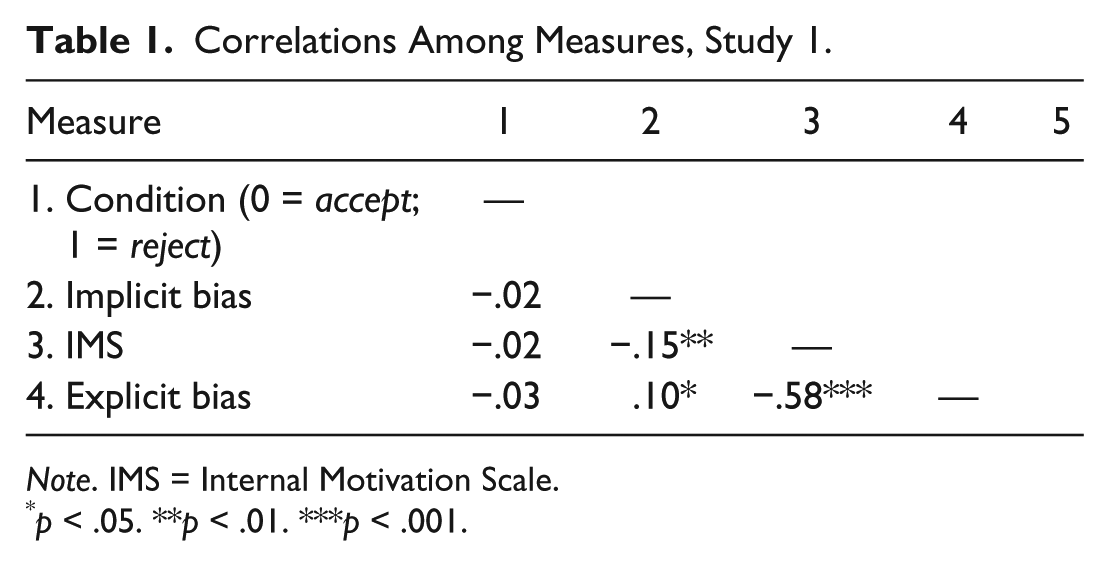
Note. IMS = Internal Motivation Scale.
p < .05. **p < .01. ***p < .001.
Predicting explicit bias toward Black people
Our main hypothesis was that leading people to take ownership for high implicit racial bias would have diverging consequences on the subsequent expression of explicit prejudice among those high and low in internal motivations to respond without prejudice. To test this hypothesis, we ran a linear regression, predicting explicit bias toward Black people by condition, implicit racial bias, and internal motivations to respond without prejudice (IMS), all two-way interactions, and the predicted three-way interaction. All variables were standardized for this analysis, and this model, as well as the simple slopes, was tested using the PROCESS Macro in SPSS (Model 3; Hayes, 2013) with 10,000 bootstrapped resamples. Table 2 displays the results of this model. Most critically, the predicted three-way interaction of Condition × Implicit bias × IMS was significant, b = −.21, t = −3.45, p = .0006, 95% confidence interval (CI) = [–.327, –.089].
Linear Regression Predicting Positive Explicit Attitudes Toward Black People.
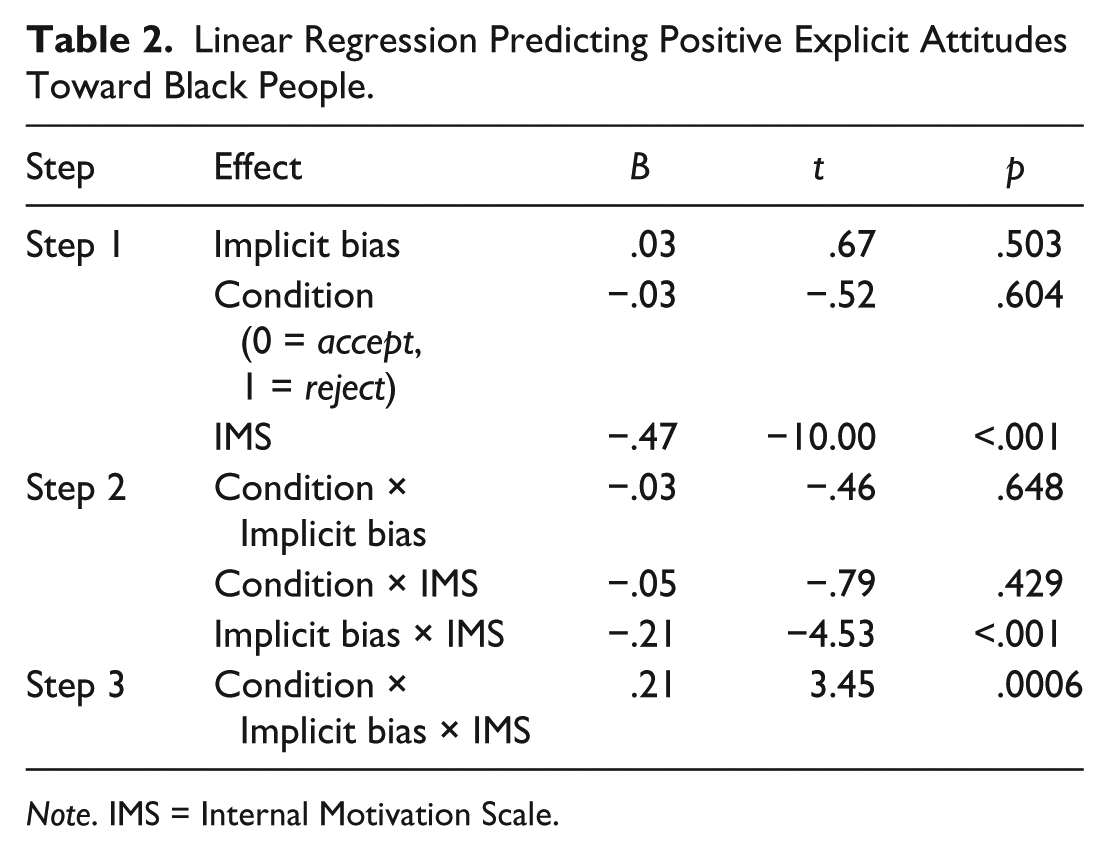
Note. IMS = Internal Motivation Scale.
Given our hypotheses, the most relevant way to probe this three-way interaction was to examine the two-way interaction of Implicit bias × IMS separately for those in the accept ownership versus reject ownership conditions. For participants in the reject ownership condition, there was no Implicit bias × IMS interaction, b = .00, t = .04, p = .968, 95% CI = [–.08, .08] (see Figure 1; left panel). Among participants who were led to accept their implicit bias as their own, however, there was a significant, predicted Implicit bias × IMS interaction, b = −.21, t = −4.53, p < .001, 95% CI = [–.30, –.12] (see Figure 1; right panel).
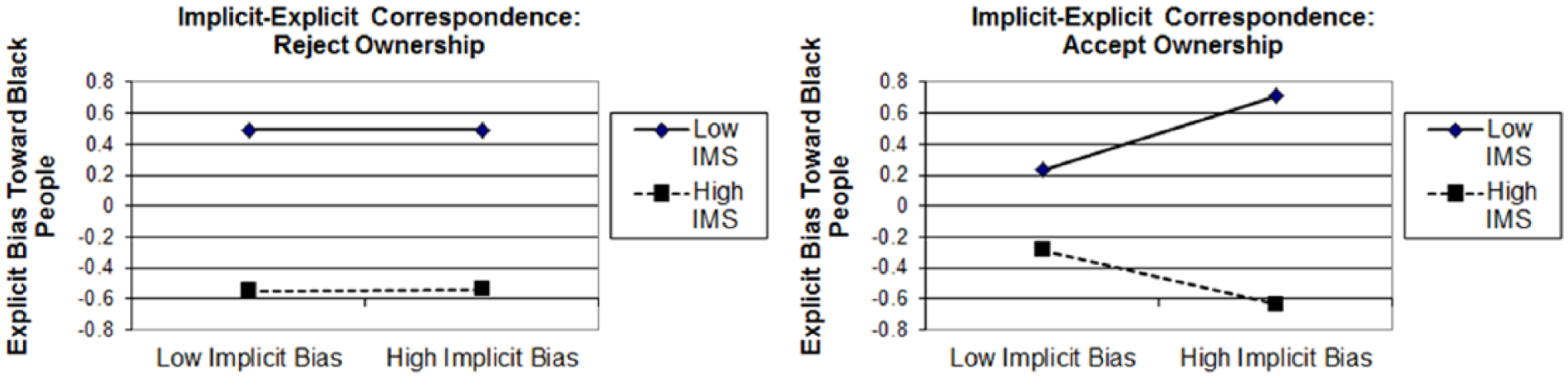
A significant two-way interaction of Implicit bias × IMS predicting explicit warmth toward Black people among those in the accept ownership condition (right panel), but not the reject ownership condition (left panel), Study 1.
We broke down this significant two-way interaction in the accept condition (right panel) in two ways. First, we examined the influence of motivations on explicit bias separately among those low and high in implicit bias. Among those who owned low levels of implicit bias, those high in IMS subsequently expressed significantly less overt bias than those low in IMS, b = .26, t = 3.78, p = .0002, 95% CI = [.12, .39]. Notably, this pattern was in the same direction, but more pronounced, among those who owned high levels of implicit bias, b = .67, t = 10.92, p < .001, 95% CI = [.55, .79]. Next, we examined implicit–explicit bias correspondence separately for those high and low in IMS. Critically, among those high in IMS, there was a significant inverse relationship between implicit and explicit bias, such that taking ownership for greater implicit bias predicted less explicit bias, b = −.14, t = −2.32, p = .02, 95% CI = [–.26, –.02] (right panel, dotted line). In contrast, among those low in IMS, there was a significant positive relationship between implicit and explicit bias, such that taking ownership for greater implicit bias was associated with the subsequent expression of greater explicit, overt bias, b = .24, t = 3.58, p = .0004, 95% CI = [.11, .37] (right panel, solid line).
Another way to break down the Condition × Implicit bias × IMS interaction is to examine the Condition × Implicit bias interaction separately for those high and low in IMS. This analysis yielded a marginally significant Condition × Implicit bias interaction for those high in IMS, b = .15, t = 1.74, p = .083, 95% CI = [–.02, .31]. This interaction was driven by a significant inverse relationship between implicit and explicit bias among those in the ownership condition, b = −.14, t = −2.32, p = .02, 95% CI = [–.26, –.02]. The relationship between implicit and explicit bias was not significant among those in the reject ownership condition, b = .00, t = .07, p = .94, 95% CI = [–.11, .12]. Moreover, there was a significant two-way interaction of Condition × Implicit bias among those low in IMS, b = .24, t = 2.77, p = .006, 95% CI = [.07, .40]. This interaction was driven by the significant positive relationship between implicit and explicit bias among those in the ownership condition, b = .24, t = 3.58, p = .0004, 95% CI = [.11, .37]. There was no relationship between implicit and explicit bias among those in the reject ownership condition, b = .00, t = .02, p = .981, 95% CI = [–.10, .11].
Together, the results of Study 1 demonstrate that taking ownership for high implicit racial bias has distinct consequences depending on people’s internal motivations to respond without prejudice. Among those high in IMS, owning their implicit bias led them to be less likely to express that bias overtly on explicit measures. Among those low in IMS, taking ownership of implicit bias seemed to serve as a justification for its overt expression, rather than as a reason to counteract that bias explicitly.
In Study 2, we aimed to replicate and extend these patterns to examine consequences of owning implicit racial bias for subsequent behavioral discrimination rather than prejudice. Because shifts in attitudes do not guarantee corresponding shifts in behavior (Ajzen, 2001; Glasman & Albarracín, 2006), we reasoned that this would be both a theoretically and practically meaningful extension of our Study 1 findings.
Study 2
In Study 2, we explored how taking ownership for implicit racial bias affects a consequential behavioral outcome: donations to a nonprofit called “100 Black men of Syracuse.” Extending upon Study 1, we predicted that people with high implicit bias who were led to think of that bias as their own would respond by donating more to a nonprofit targeted at empowering Black people (vs. a nonprofit for which the race of recipients is unknown)—but only when they were also high in internal motivations to respond without prejudice. In contrast, among those low in internal motivations to respond without prejudice, ownership for high implicit bias may amplify the expression of behavioral racial biases (i.e., channeling money away from a Black nonprofit). In addition, to get a better sense of what participants were doing in the reject ownership condition (i.e., What does it mean to “not own” an implicit bias?), we coded participants’ open-ended responses in Study 2 for the presence of external (rather than internal) attributions for their implicit biases. We hypothesized that those who were led to reject ownership for their implicit attitudes would respond by making more external attributions for their implicit biases (e.g., media).
Method
Participants
We recruited 400 participants through Amazon Mechanical Turk (Mturk). Our final sample was 328 people (141 men, 183 women, 4 other) who were majority White (86.1%; 6% Black, 6.6% Asian, 3.3% Native American or Pacific Islander, 3% Other) with an average age of 32 years and with a median education of a 4-year college degree. (Our final sample was smaller than the number of people we recruited and paid on Mturk because some people submitted the survey for payment without actually completing the study. We analyzed all data available once the survey was closed on Mturk.) As in Study 1, the following analyses were conducted on White participants (121 men, 161 women, 4 other).
Procedure
The procedure was the same as Study 1, except instead of measures of explicit prejudice we examined a behavioral outcome. In particular, participants learned that as a part of the study, the researchers wanted to give back to their local community. Thus, participants were given the chance to affect where we allocated a total of US$115 of donations among the two charities. Participants then learned about two nonprofits, one dedicated to people with eating disorders in which race is not mentioned and the other directly relevant to helping Black people: Ophelia’s Place’s mission is to redefine beauty and health by empowering individuals, families, and communities impacted by eating disorders, disordered eating, and body dissatisfaction. 100 Black men of Syracuse, Inc. is committed to the intellectual development of youth and the economic empowerment of the African American community based on the following precepts: respect for family, spirituality, justice, and integrity.
Participants were then asked to divide US$115 between the two charities in whichever way they preferred. Participants concluded with the IMS (Plant & Devine, 1998) and the same demographic information as Study 1.
Results
Preliminary analyses
First, we calculated implicit racial bias. Overall, participants had high levels of implicit bias as indicated by pressing “pleasant” more often on trials preceded by White faces (M = .63, SD = .20) than Black faces (M = .37, SD = .21), F(1, 277) = 161.94, p < .001, η p 2 = .369. Implicit bias scores were created by subtracting the proportion of “pleasant” responses on Black trials from the proportion of “pleasant” responses on White trials (M = .26, SD = .34).
Next, we created an average index of reported ownership of implicit bias (M = 49.15, SD = 25.36; Cronbach’s α = .73) and predicted this variable by condition. As in Study 1, our manipulation was successful. Those in the accept ownership condition reported significantly greater ownership for their implicit attitudes (M = 57.66, SD = 24.57) than those in the reject ownership condition (M = 39.68, SD = 22.80), F(1, 283) = 40.74, p < .001, η p 2 = .126. In addition, replicating Study 1, people who were led to think of their implicit attitudes as their own subsequently perceived their implicit attitudes as more diagnostic of their true attitudes (M = 50.41, SD = 29.95) than those who rejected those attitudes as unowned (M = 40.90, SD = 29.17), F(1, 282) = 7.71, p = .006, η p 2 = .03.
Next, we conducted analyses on the reasons participants listed for why their implicit, gut reactions were either (a) their own or (b) not their own (depending on the condition to which they were assigned). We hypothesized that asking participants to think of reasons why their implicit reactions were not their own would lead participants to develop more external attributions for their gut reactions than would asking participants to think of why their implicit reactions were their own. To test this, we had a research assistant, who was blind to hypotheses, code the first reason generated by each participant on whether it included an external attribution (1 = yes, 0 = no) for the bias. We then ran a binary logistic regression predicting number of external attributions by condition (0 = accept, 1 = reject). As predicted, participants in the reject ownership condition listed significantly more external attributions (e.g., “I grew up in the south”) for their implicit reactions, B = 1.62, SE = .28, p < .001, Exp (B) = 5.07.
Finally IMS (Plant & Devine, 1998) was calculated by averaging across all items as in Study 1 (M = 82.09, SD = 18.93; Cronbach’s α = .80). Also as in Study 1, condition did not unintentionally influence IMS: There was no difference in IMS based on whether people were in the accept ownership (M = 83.63, SD = 17.47) or reject ownership (M = 80.4, SD = 20.29) condition, F(1, 325) = 2.29, p = .131, η p 2 = .007. Table 3 displays the correlations among measures for Study 2.
Correlations Among Measures, Study 2.
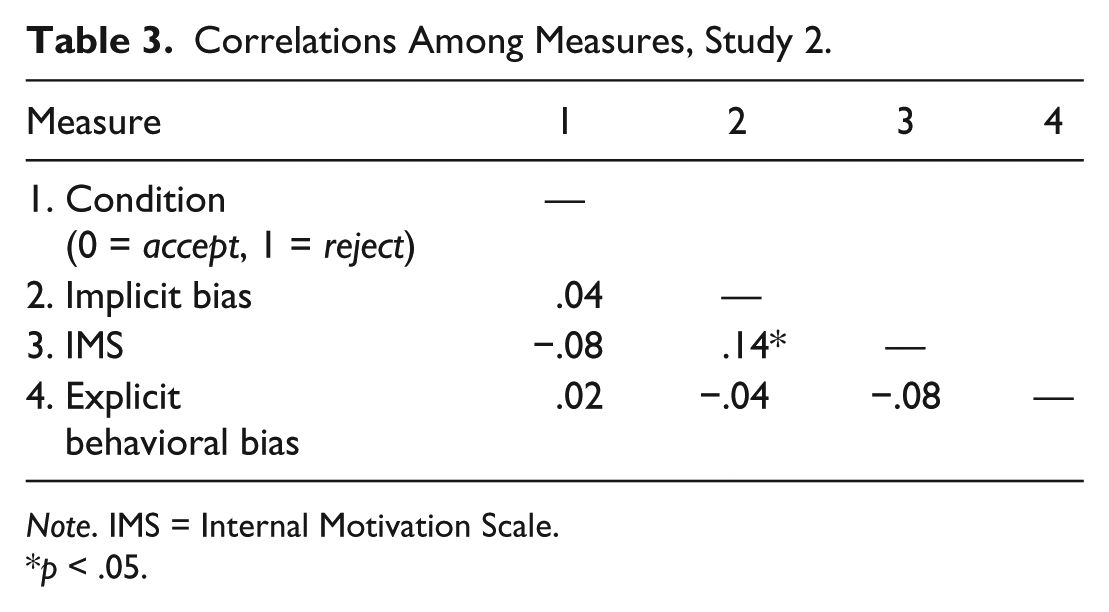
Note. IMS = Internal Motivation Scale.
p < .05.
Main analyses
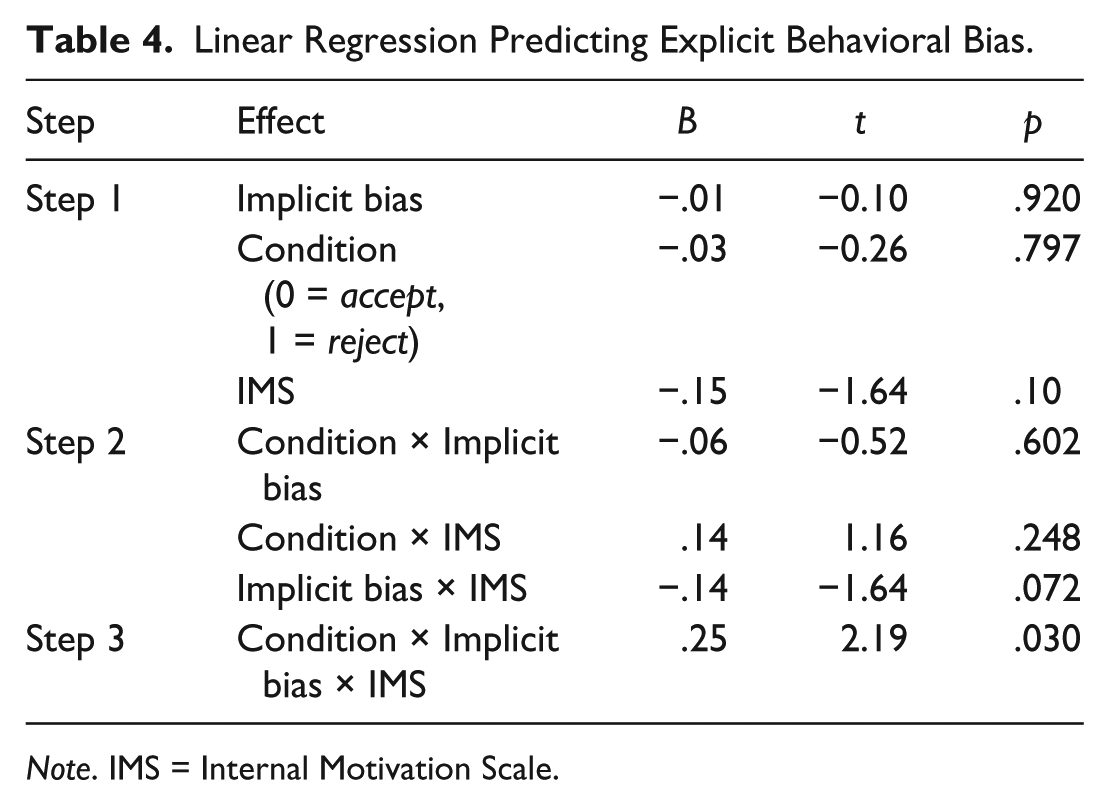
Our main hypothesis was that leading people to take ownership for implicit racial bias would lead to distinct patterns of subsequent overt race-related behaviors among those high as compared with low in internal motivations to respond without prejudice. To be consistent with Study 1, we standardized and reverse scored amount donated to 100 Black men of Syracuse (M = 65.90, SD = 25.32) so that higher values on this new variable would indicate greater explicit behavioral bias (i.e., money channeled away from the Black nonprofit). Next, we ran a linear regression predicting explicit bias by condition, implicit racial bias, and IMS, all two-way interactions, and the predicted three-way interaction using the PROCESS macro for SPSS and 10,000 bootstrapped resamples (Model 3; Hayes, 2013). All variables were standardized for the analysis. Table 4 shows the results of this model. Most critically, replicating Study 1, the predicted three-way interaction of Condition × Implicit bias × IMS was significant, b = .25, t = 2.19, p = .030, 95% CI = [.03, .48].
Linear Regression Predicting Explicit Behavioral Bias.
Note. IMS = Internal Motivation Scale.
To probe this three-way interaction, we examined the two-way interactions of Implicit bias × IMS separately for those in the reject and accept ownership conditions. Among participants in the reject ownership condition, there was no significant interaction of Implicit bias × IMS, b = .12, t = 1.34, p = .181, 95% CI = [–.06, .29] (see Figure 2; left panel). However, consistent with hypotheses and replicating Study 1, among participants led to accept their implicit bias as their own, there was a marginally significant, predicted Implicit bias × IMS interaction, b = −.14, t = −1.80, p = .072, 95% CI = [–.28, .01] (see Figure 2; right panel).
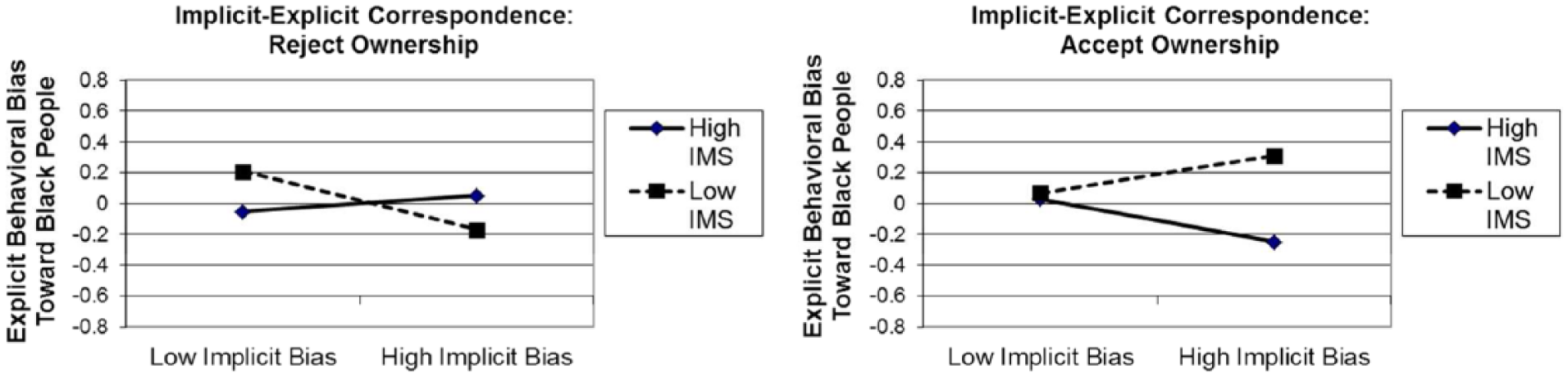
A marginally significant Implicit bias × IMS interaction predicting explicit behavioral bias toward Black people for those in the accept ownership condition (right panel), but not the reject ownership condition (left panel), Study 2.
As in Study 1, we broke down this significant two-way interaction in the accept condition (right panel) in two ways. First, we examined the influence of IMS on the expression of explicit bias separately among those high and low in implicit bias. Among those who were led to take ownership for low levels of implicit bias, there was no difference in the expression of overt bias among those high versus low in IMS, b = −.01, t = −.12, p = .903, 95 % CI = [–.22, .19]. Critically, however, among those who owned high levels of implicit bias, high IMS was associated with signifcantly less overt bias than low IMS, b = −.28, t = −1.09, p = .028, 95% CI = [–.54, –.03]. Next, we examined how attitude ownership influenced implicit–explicit bias correspondence separately for those high and low in IMS. Although the simple effects were not significant, the patterns replicated Study 1. In particular, among those high in IMS, there was, descriptively, an inverse relationship between implicit and explicit bias such that taking ownership for greater implicit bias predicted less explicit bias, b = −.14, t = −1.31, p = .193, 95% CI = [–.26, –.02] (right panel, dotted line). In contrast, among those low in IMS, the pattern was reversed. Descriptively, taking ownership for greater implicit bias was associated with the expression of that bias on an explicit behavioral measure, b = .13, t = 1.10, p = .273, 95% CI = [–.10, .36] (right panel, solid line).
Another way to break down the Condition × Implicit bias × IMS interaction is to examine the Condition × Implicit bias interaction separately among those high and low in IMS. This yielded a nonsignificant two-way interaction for those high in IMS, b = .94, t = 1.14, p = .256, 95% CI = [–.13, .48], and a marginally significant Condition × Implicit bias interaction among those low in IMS, b = −.32, t = −1.79, p = .074, 95% CI = [–.67, .03]. 2 Simple effects analyses indicated that, among those low in IMS, those who accepted ownership of high levels of implicit bias donated marginally less than those who rejected ownership for high levels of bias, b = −.48, t = .19, p = .071, 95% CI = [–1.03, .04]. The simple effect among those low in implicit bias was not significant, b = .15, t = −.99, p = .321, 95% CI = [–.51, .17].
Together, these results conceptually replicate Study 1 and extend them to a meaningful behavioral outcome. Owning high implicit bias led to diverging decisions about where to channel money based on people’s motivations to control prejudice. In particular, among those low in IMS, taking ownership for high implicit bias backfired as a prejudice reduction strategy such that owning high levels of implicit bias led to greater, rather than reduced, behavioral discrimination (as indicated by channeling money away from 100 Black men of Syracuse). This suggests that while encouraging those who are high in IMS to own their implicit biases may have neutral or beneficial consequences, encouraging those who are low in IMS to own their implicit biases may serve as a justification for the expression of overt behavioral bias.
General Discussion
Can encouraging people to think about their implicit racial biases help mitigate overt racial animus and discrimination? In the present research, we find a qualified yes—one that depends on both the types of thoughts people have (i.e., Does this bias belong to me?) and people’s internal motivations to respond without prejudice. Among those who are motivated, taking ownership of high implicit bias inspires corrections for that bias—leading to more pro-Black attitudes and behaviors that promote racial equality. However, among those who are not motivated, taking ownership for high implicit bias backfires—leading to greater endorsement of that bias on explicit measures. Critically, these findings replicated across both attitudinal and behavioral dependent variables: explicit warmth toward Black people (Study 1) and monetary donations to a nonprofit dedicated to helping Black people (Study 2). This latter outcome is particularly meaningful, given that participants were told that the researchers would make (and did make) contributions to the charities specified as a result of the study.
Although we did not overtly test the mechanisms behind our findings, among those high in IMS, we suspect that taking ownership for high levels of implicit bias likely elicited guilt, which may have motivated more prosocial responding on explicit measures. This reasoning is consistent with a variety of work on the role of guilt in prosocial behavior more generally (de Hooge, Nelissen, Breugelmans, & Zeelenberg, 2011; for review see Baumeister, Stillwell, & Heatherton, 1994), as well as work on the role of guilt in prejudice-related outcomes more specifically (Dovidio, Kawakami, & Gaertner, 2000; Monteith, Devine, & Zuwerink, 1993; Monteith & Voils, 1998). In contrast, among those low in IMS, we expect that taking ownership for high levels of implicit bias may elicit thoughts about why one’s implicit biases are justified and thus reinforce the overt expression of that bias. This reasoning is consistent with a variety of models of prejudice expression that contend that implicit bias will become overt when justifications are present for expressing that bias (Crandall & Eshleman, 2003; Dovidio & Gaertner, 2004).
Interestingly, interventions aimed at promoting racial equality often target changing the content of implicit attitudes rather than the way people think about those attitudes. And, although changing implicit attitudes can work in the short term, this tactic does not seem to be effective at changing implicit attitudes over the long term (Lai et al., 2016). These challenges inherent in trying to change implicit associations are consistent with philosophical perspectives that reason that negative implicit attitudes toward particular social groups are an inevitable by-product of the mere existence of racial categories in our culture (Gendler, 2011; Uhlmann et al., 2012). Moreover, the process of changing implicit attitudes themselves may be more complex than shifting a single negative association (Mandelbaum, 2016). And, even when interventions are effective at changing implicit attitudes, they do not reliably affect the expression of explicit prejudice (Forscher et al., under review), nor do they reliably affect behaviors (for a discussion, see Devine, Forscher, Austin, & Cox, 2012). Thus, the present findings suggest that shifting the way people think about their implicit biases (rather than shifting the associations themselves) may be worthy of greater empirical consideration. For example, although Hillary Clinton encouraged people to think about and accept their implicit biases, this strategy may not have beneficial consequences for everyone. In fact, the exact people Hillary may have been targeting, those who think racial biases are reasonable, may actually amplify their expression of prejudice as a result of taking ownership for their implicit biases. Thus, encouraging people to face their implicit biases, although intuitively appealing as a prejudice reduction strategy, may have the power to amplify growing divisions within our country (McCarty, Poole, & Rosenthal, 2016) rather than mitigate them.
Consistent with the present findings, previous research indicates that the content of thoughts that people have about their implicit bias toward gay men is important for determining how they express their explicit attitudes about gay men (Cooley et al., 2015; Cooley et al., 2014). Here we extend upon this work to demonstrate that thinking of implicit racial bias as one’s own interacts with people’s motivations to respond without prejudice to meaningfully shift not only explicit attitudes, but also consequential behaviors aimed at promoting racial equality. Of note, although internal motivations to respond without prejudice toward gay people were not examined in Cooley and colleagues (2015), we suspect that such motivations may tend to be slightly lower on average than internal motivations to control prejudice toward Black people. Indeed, PEW data show that in 2009 (when initial data were collected for Cooley and colleagues, 2015), national support for gay marriage was below 50% among both Democrats and Republicans (Pew Research Center, 2017). In addition, American laws prohibiting discrimination based on race far predate similar laws prohibiting discrimination toward gay people. And, such laws often exert a normative influence that suppresses expression of prejudice (e.g., Tankard & Paluck, 2017). Thus, the degree to which Americans have internalized motivations to control prejudice toward gay people is likely to be less than the degree to which people have internalized the motivations to control prejudice toward Black people. And, although we cannot speak to this directly (given that this information is not available in Cooley et al., 2015), we can say that the patterns of findings in the present work among those low in IMS look very similar to the overall findings in Cooley and colleagues (2015). Thus, considering the present findings in the context of this previous work suggests that the process of taking ownership for one’s implicit biases may be likely to have distinct consequences based on the social group of focus as well.
We should also note that although the behavioral outcome in Study 2 is one of the novel contributions of the present work, there were also several limitations to our donation measure. First, it is difficult to know whether donating to a nonprofit dedicated to helping Black people is driven by paternalistic motives or more general liking (or disliking) of Black people. In particular, both paternalism (driven by perceptions of high warmth and low competence; Fiske, Cuddy, Glick, & Xu, 2002) and respect/admiration (driven by perceptions of high warmth and high competence) could lead to greater donations. Because Study 2 intended to examine how shifting explicit warmth toward Black people (as documented in Study 1) may manifest in behaviors, we were most interested in whether the patterns of effects replicated. However, future research should explore whether owning implicit bias enhances sympathy and paternalistic motives or respect/admiration among those high in IMS. In fact, the ambiguity about what it means to provide help to Black people (paternalism vs. respect) may help explain why thoughts about implicit attitudes had less pronounced effects on our outcome variable among those high in IMS in Study 2 as compared with Study 1. However, regardless of specific motivation, we think differences in helping behaviors based on race are an important form of behavioral discrimination to explore (for review, see Saucier, Miller, & Doucet, 2005). We should also note that the alternative nonprofit that was intended to be independent of race information—Ophelia’s place—may have inadvertently conjured images of White women, given people’s stereotypical perceptions of who suffers from eating disorders. Thus, we can’t directly assess whether our intervention affected donations by shifting a desire to help recipients who were overtly described as Black, shifting a desire to help recipients who may have been perceived to be White, or some combination of both motivations. Future research should explore other behavioral outcomes that can better parse apart these different interpretations of our findings.
Another limitation of the present work is that we do not directly test for participants’ accuracy in inferring the content of their implicit attitudes. Instead, we build from recent research that indicates people can accurately report their implicit attitudes toward a variety of social groups (Hahn et al., 2014) to examine the potential consequences of this awareness for overt prejudice. We reason that if people were inaccurate at inferring the valence and/or strength of their implicit attitudes, we might expect a large degree of variability and inconsistency in how thoughts about implicit bias affected subsequently reported explicit prejudice in our studies. However, that was not the outcome we observed. Instead, the data reflect theoretically consistent patterns of implicit–explicit attitude correspondence, based on both manipulated and measured moderators.
Finally, although our primary interest was to examine patterns of implicit–explicit attitude correspondence within a given individual, it is also interesting to note differences in overall levels of implicit bias across our samples. In particular, the Study 1 sample demonstrated marginal levels of implicit race bias overall, whereas the Study 2 sample demonstrated significant levels of implicit race bias overall. One possible explanation for this difference is that Study 1 was posted the week directly after the 2016 National Election—an election that was rife with discussion about implicit bias (Yudkin & Van Bavel, 2016). Thus, one possibility is that our predominantly liberal Mturk sample exhibited lower levels of implicit racial biases in Study 1 due to increased rhetoric about implicit biases at that time (Merica, 2016). Regardless of the cause of this inter-sample variability, we were encouraged to see that our predicted pattern of findings replicated not only across different outcomes (i.e., prejudice and discrimination), but also across (large) samples with varying levels of implicit biases.
Conclusion
During the 2016 presidential campaign, Hillary Clinton encouraged America to confront its own implicit biases (Yudkin & Van Bavel, 2016). And, an increasing amount of media has addressed the importance of acknowledging these biases in ourselves and others (Merica, 2016). Given that implicit biases exist among people regardless of their motivations to respond without prejudice (Greenwald & Banaji, 1995; Olson & Fazio, 2008; Plant & Devine, 1998), harnessing the way people think about their implicit biases may, indeed, be the first step to developing effective strategies to reduce the overt expression of that bias. However, the present research also indicates that encouraging people to take ownership of their implicit biases is not enough—we also need to develop ways to encourage people to care about controlling those biases.
Supplemental Material
Methodology – Supplemental material for The Mixed Outcomes of Taking Ownership for Implicit Racial Biases
Supplemental material, Methodology for The Mixed Outcomes of Taking Ownership for Implicit Racial Biases by Erin Cooley, Ryan F. Lei and Taylor Ellerkamp in Personality and Social Psychology Bulletin
Supplemental Material
PSPB_TakingOwnershipImplicitRacialBiases_Supp_RR2_Final – Supplemental material for The Mixed Outcomes of Taking Ownership for Implicit Racial Biases
Supplemental material, PSPB_TakingOwnershipImplicitRacialBiases_Supp_RR2_Final for The Mixed Outcomes of Taking Ownership for Implicit Racial Biases by Erin Cooley, Ryan F. Lei and Taylor Ellerkamp in Personality and Social Psychology Bulletin
Footnotes
Acknowledgements
The authors would like to thank Gianna D’Alessio for her help with data processing and her valuable comments on previous versions of the manuscript.
Declaration of Conflicting Interests
The author(s) declared no potential conflicts of interest with respect to the research, authorship, and/or publication of this article.
Funding
The author(s) received no financial support for the research, authorship, and/or publication of this article.
Notes
Supplemental Material
Supplementary material is available online with this article.
References
Supplementary Material
Please find the following supplemental material available below.
For Open Access articles published under a Creative Commons License, all supplemental material carries the same license as the article it is associated with.
For non-Open Access articles published, all supplemental material carries a non-exclusive license, and permission requests for re-use of supplemental material or any part of supplemental material shall be sent directly to the copyright owner as specified in the copyright notice associated with the article.
