



Abstract
Do liberals and conservatives differ in their empathy toward others? This question has been difficult to resolve due to methodological constraints and common use of ideologically biased targets. To more adequately address this question, we examined how much empathy liberals and conservatives want to feel, how much empathy they actually feel, and how willing they are to help others. We used targets that are equivalent in the degree to which liberals and conservatives identify with, by setting either liberals, conservatives, or ideologically neutral members as social targets. To support the generalizability of our findings, we conducted the study in the United States, Israel, and Germany. We found that, on average and across samples, liberals wanted to feel more empathy and experienced more empathy than conservatives did. Liberals were also more willing to help others than conservatives were, in the United States and Germany, but not in Israel. In addition, across samples, both liberals and conservatives wanted to feel less empathy toward outgroup members than toward ingroup members or members of a nonpolitical group.
Liberals and conservatives (i.e., those on the left and right of the political spectrum) differ in their support for social policy issues, such as poverty, ill health, and education, as well as other issues related to maximizing well-being. Yet, there is an ongoing debate whether such political disagreements stem or not from basic psychological aspects (e.g., Brandt, Reyna, Chambers, Crawford, & Wetherell, 2014; Jost, Federico, & Napier, 2009). To the extent that social behavior is driven, in part, by social emotions, such as empathy, might liberals and conservatives differ not only in the policies they support but also in the emotions they desire? In this research, we tested whether liberals and conservatives differ in their motivation to feel empathy toward others. To assess potential consequences of these motivations, we also tested whether liberals and conservatives differ in how much empathy they actually feel, and how much they want to help others—namely liberals, conservatives, or members of a politically unidentified group.
Are There any Psychological Differences Between Liberals and Conservatives?
According to some scholars, political ideology reflects differences in basic psychological mechanisms (e.g., Adorno, Frenkel-Brunswik, Levinson, & Sanford, 1950; Caprara, Schwartz, Capanna, Vecchione, & Barbaranelli, 2006; Jost et al., 2009). For example, Jost, Glaser, Kruglanski, and Sulloway (2003) consider political ideology as a reflection of motivated social cognition, arguing that conservatives are more motivated than liberals to reduce uncertainty and threat. From this perspective, such differences in psychological needs and tendencies can explain why studies find liberals to be more tolerant of others (Lindner & Nosek, 2009) and less prejudiced against disadvantaged groups (Sears & Henry, 2003).
Others have challenged these ideas, suggesting that liberals and conservatives are more similar than previously assumed (e.g., Crawford & Pilanski, 2014; Morgan, Mullen, & Skitka, 2010). For instance, Brandt and colleagues (2014) demonstrated that both liberals and conservatives express similar levels of intolerance toward ideologically dissimilar and threatening groups. They proposed that the differences between liberals and conservatives found in previous research could be attributed to the use of ideologically biased target groups which are known to oppose conservative, but not liberal, core values (e.g., minority groups, such as African Americans, that generally support affirmative action and social welfare programs which conservatives oppose; Chambers, Schlenker, & Collisson, 2013). If so, it is not surprising that liberals were more tolerant than conservatives because they were presented with groups that hold similar worldviews. Indeed, when using target groups that are perceived as more conservative (e.g., antiabortionists and Tea Party supporters) liberals expressed more intolerance compared with conservatives (Brandt et al., 2014). These findings suggest that both liberals and conservatives are intolerant toward people who hold conflicting worldviews. Therefore, generalizations about basic differences may have been overstated.
The two perspectives described above reflect two sides in a lively ongoing debate. One reason why this debate has been ongoing concerns the types of targets typically examined, which at least in some cases appear to be ideologically biased. Therefore, in this article, we examine the motivation and experience of empathy among liberals and conservatives, using targets that are likely to be equivalent for liberals and conservatives.
Empathy and Political Ideology
Empathy involves sharing and understanding others’ emotional states (Decety & Jackson, 2004), and in the context of suffering or misfortune, empathy is characterized by feelings of sympathy and compassion for those in need (Batson & Shaw, 1991). Empathy has been linked to prosocial cooperative behaviors in interpersonal and intergroup relations (e.g., Batson & Moran, 1999; Batson et al., 1997; Eisenberg & Miller, 1987). Empathy can also have positive effects even in long-term violent intergroup conflicts (see Halperin, 2016, for a review). For example, in the context of the Israeli–Palestinian conflict, Israeli participants who reported feeling more empathy toward outgroup members were more supportive of providing humanitarian aid (e.g., Pliskin, Bar-Tal, Sheppes, & Halperin, 2014) and less supportive of aggressive policies (e.g., Rosler, Cohen-Chen, & Halperin, 2017).
Although there is a vast amount of evidence for the importance of empathy in our social life, it has some limitations: Batson, Klein, Highberger, and Shaw (1995), for example, found that inducing empathy toward one person can lead to unjust allocations at the expense of others’ welfare. Moreover, empathy does not always lead to prosocial behavior, and can sometimes motivate people to act immorally and harm others (Bloom, 2017). These ideas are demonstrated in two studies that assessed and manipulated empathy toward a distressed person who was entering a competition for a cash reward (Buffone & Poulin, 2014). Participants who experienced more empathy toward the person in need engaged in more aggressive behavior toward her competitor who did nothing wrong. Finally, although empathy often leads to positive outcomes, people differ in how much empathy they feel toward others and sometime fail to experience it (Mehrabian, Young, & Sato, 1988).
Some studies suggest that there may be differences in the experience of empathy and other prosocial emotions such as sympathy as a function of political ideology. For example, people who endorse liberal policies tend to experience more empathy in general (Iyer, Koleva, Graham, Ditto, & Haidt, 2012; McCue & Gopoian, 2000). In contrast, people high (vs. low) in social dominance orientation, who tend to be more conservative (e.g., Cohrs, Maes, Kielmann, & Moschner, 2007), express less empathic concern for others (e.g., Pratto, Sidanius, & Levin, 2006). Also, liberals often attribute external causes to people’s plight (e.g., perceive unjust social practices and structures as causes of poverty) and feel more sympathy toward them, while conservatives attribute internal causes (e.g., perceive laziness and drug use as causes of poverty) and feel less sympathy (e.g., Skitka & Tetlock, 1992). Overall, these studies suggest that liberals may be more empathetic than conservatives.
Others, however, have argued that there are no fundamental differences between liberals and conservatives in empathy. Instead, any demonstrated differences could be attributed to the specific context examined (Waytz, Iyer, Young, & Graham, 2016). Studies found that the tendency to attribute external causes over internal ones for people’s misfortune, and consequently becoming more empathic to their situation, does not always characterize liberals more than conservatives. Instead, the attribution effect was reversed when liberal values were more consistent with making internal attributions and conservative values were more consistent with making external attributions (Morgan et al., 2010).
Other support for the contextual effect on empathy is based on a broader phenomenon of intergroup empathy bias, which refers to people’s tendency to feel less empathy, if any, toward outgroup members compared with ingroup members (e.g., Cikara, Bruneau, Van Bavel, & Saxe, 2014). This bias was measured by a broad range of methodologies, including self-report, neuroimaging, and hormones (e.g., Cikara et al., 2014; Levy et al., 2016; Xu, Zuo, Wang, & Han, 2009), and was found among different types of groups such as racial, religious, national, and even arbitrary groups generated in experimental settings (see Vanman, 2016, for a review). In line with this phenomenon, if liberals and conservatives define different groups as ingroup and outgroup, we should expect to find differences in empathy as a function of the target group.
Indeed, studies found that liberals empathize more with larger and distant social circles, whereas conservatives empathize more with smaller and closer circles (Waytz et al., 2016). Building on these findings, it appears that previous studies examined empathy toward targets that may be considered as members of the outgroup by conservatives but not by liberals or vice versa. This methodological limitation made it difficult to infer differences in empathy between liberals and conservatives. To draw such inferences, it is necessary to examine targets that are equivalent in the degree to which conservatives and liberals perceive them as members of the ingroup or outgroup.
Motivated Empathy and Political Ideology
Empathy is often considered not only a reactive and automatic emotional response toward others (Levy et al., 2016), but it can also be a product of regulatory processes directed by what people want to feel (e.g., Zaki, 2014). Whether people are motivated to increase or decrease empathy determines whether they try to actively increase or decrease their empathy, respectively (Cameron & Payne, 2011). Greater motivation for empathy, in this respect, signals what people strive for emotionally and the direction in which they are likely to regulate empathy toward others. To the extent that liberals and conservatives differ in their motivation for empathy, such differences would not only shed light on the emotions they strive for but also explain possible differences in experiences of empathy.
People desire emotional states that are pleasant, or those that are instrumental for pursuing personal or social goals (Tamir, 2016). For instance, people may be motivated to decrease empathy to avoid others’ unpleasant feelings, or to increase empathy to strengthen social bonds (Zaki, 2014). The motivation to feel empathy may, therefore, reflect higher order goals. Indeed, some studies found that people who expected help to be costly were less motivated to feel empathy prior to an encounter with someone in need, and ended up feeling less empathy, as a consequence (e.g., Cameron & Payne, 2011; Shaw, Batson, & Todd, 1994). Whereas some goals are transient and context specific (e.g., avoiding costly help), other goals are more stable. For instance, people who value the welfare of others are more motivated to feel empathy in general, whereas people who value power are less motivated to feel it (Tamir et al., 2016). Such values are, in turn, linked to political ideology (Caprara et al., 2006).
Political ideology represents socially shared systems of beliefs about the ideal arrangement of society (Cohrs, 2012), and is connected to higher order social goals. At the societal level, according to Schwartz (1999), a liberal, egalitarian belief system rests on people feeling concern for others’ welfare. At the individual level, liberals tend to endorse self-transcendent values, such as universalism and benevolence, that emphasize tolerance, equality, and social welfare, whereas conservatives tend to endorse self-enhancement and conservation values that emphasize social dominance and power (Caprara et al., 2006). Given that empathy promotes the attainment of social goals, such as social welfare and equality (Hoffman, 2000), it might contribute, among other factors, to the link between the motivation to feel empathy and more liberal (vs. conservative) ideology.
Political ideology is not only a shared belief system, but it can also be the common basis for social groups. People tend to identify with and belong to groups of others who share similar values and beliefs, such as those captured by political ideology (Jost, Ledgerwood, & Hardin, 2008). As such, being a liberal or a conservative not only represents one’s political worldviews but also one’s affiliation with a group of people who share a similar ideology (e.g., Huddy, Mason, & Aarøe, 2015). People are motivated to maintain and enhance a positive group evaluation which is often achieved by a favorable comparison between their ingroup and other relevant outgroups (e.g., Tajfel & Turner, 1979). This can, in turn, lead to competition, and trigger ingroup favoritism and outgroup derogation (Brewer, 1999). Given that empathy strengthens social connection (e.g., Batson & Moran, 1999), people are likely to be more motivated to feel empathy toward ingroup members whom they favor (e.g., those who share their ideological beliefs) than outgroup members whom they derogate. Therefore, to examine potential differences between liberals and conservatives in the motivation and experience of empathy, it is necessary to consider the influence of group identification, and use ideologically diverse targets that both liberals and conservatives identify with (or not).
The Current Research
This study tested whether liberals and conservatives are equally motivated to feel empathy toward members of ingroups or outgroups, and if so, whether this extends to the subsequent experience of empathy and to willingness to help others. One possibility is that liberals are more motivated to experience empathy than conservatives are across contexts, reflecting differences in basic social goals. Another possibility is that liberals and conservatives do not differ in their general motivation for empathy, but each political group is more motivated to experience empathy toward ingroup members (with whom they identify more) than toward outgroup members (with whom they identify less).
Our design has several unique features that enable us to test our hypotheses: First, whereas previous studies used targets that, at least in some cases, were potentially ideologically biased, we used targets that should be equally relevant to both liberals and conservatives. Specifically, we examined reactions to people in need who were liberals or conservatives to insure that some targets would be perceived as ingroup members, and other targets would be perceived as outgroup members by both liberal and conservative participants. In addition, we used ideologically neutral targets as a comparison group. Second, whereas other studies examined political ideology and differences in experienced empathy, we examined whether liberals and conservatives differ in their motivation to feel empathy, their experienced empathy, and their tendency to help others. As far as we know, no other study has simultaneously assessed these three constructs that are likely to jointly determine how people treat one another. Third, to draw inferences about political ideology beyond a particular political context, we conducted the study in three social and cultural contexts—in the United States, Israel, and Germany. These countries differ in political climate, cultural background, intergroup relations, key ideological debates, and emotional norms. However, the basic features of conservatism and liberalism should be common across countries (Graham, Haidt, & Nosek, 2009; Pratto et al., 2013).
Method
Participants
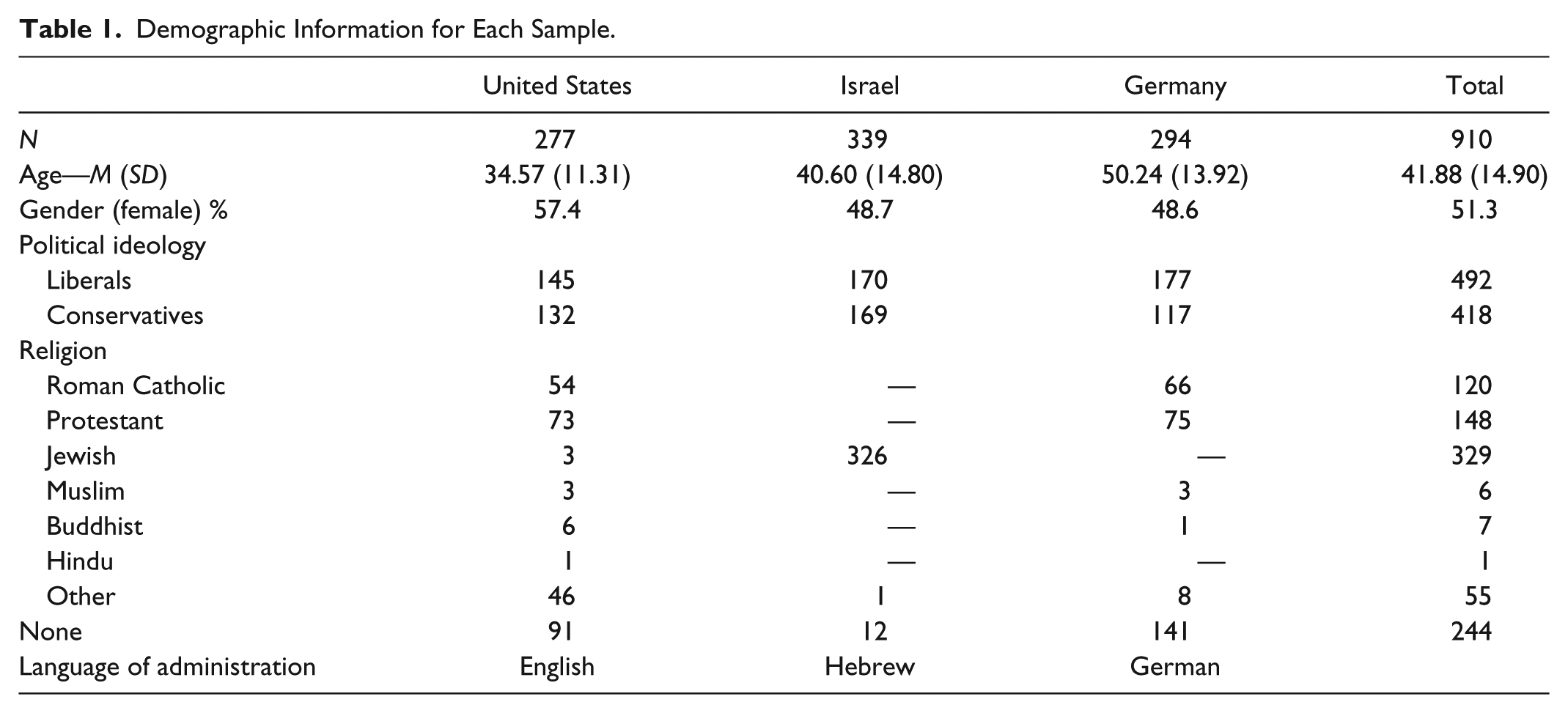
A total of 1,046 participants who are eligible to vote—350 Americans, 374 Israelis, and 322 Germans—participated in the study. The sample size was determined on the basis of a power analysis of a previously published study testing political ideology and motivation for empathy (Porat, Halperin, & Tamir, 2016). Detecting the same effect size (.19) at the power of .9 required a sample of 300 participants in each country. We oversampled to insure that the final sample, after potential exclusions, would have the minimum required number of participants. Participants were recruited from larger pools (based on precollected demographic pools on Amazon’s Mechanical Turk platform in the United States, and local survey companies in Israel and Germany) to confirm that they clearly placed themselves on one side of the political spectrum (i.e., liberals or conservatives), and were equally divided between the two political groups (54.1% liberals). In each sample, participants were randomly assigned to one of the different conditions. In total, 136 participants who identified as centrists with respect to their political ideology or held mixed political views were excluded (see Political Ideology scale for more details). In addition, the samples fairly represented the three population in terms of gender, age, and regions of residence. Demographic information of the final sample is provided in Table 1.
Demographic Information for Each Sample.
Measures
Political ideology
Participants rated their political ideology (1 = very conservative/rightist; 7 = very liberal/leftist) in general and with respect to social, economic, and security issues (α = .97). For each sample, we used the terms that are most commonly used in that country (conservative–liberal in the United States; right–left in Israel and Germany; Jost, 2009). Because the terms “right” and “left” are associated with “conservative” and “liberal” respectively (Fuchs & Klingemann, 1990), we treated them in the analyses as equivalent. Because political ideology was used in this study not only as a shared belief system but also as the basis for group identification, we included only participants who clearly self-identified with one side of the political spectrum on the general ideology item and grouped them into two groups. Participants who selected 1 to 3 on the general political ideology item were identified as conservatives and were coded 1; participants who selected 5 to 7 on the item were identified as liberals and were coded 2. 1 Furthermore, participants who self-identified in some domain differently than in the general item were excluded (i.e., conservatives whose political views in one of the specific issues were liberal, ranging from 5-7, and liberals whose political views in one of the specific issues were conservative, ranging from 1-3).
Values
To assess values that may explain the relationship between political ideology and motivation for empathy, we used a short version of the Portrait Values Questionnaire–Revised (PVQ-R; Schwartz et al., 2012). It included 21 items that assessed seven distinct values (benevolence: dependability; benevolence: caring; universalism: concern; universalism: tolerance; achievement; power: dominance; power: resource). With respect to each item, participants rated the extent to which the person described is or is not like them (e.g., “It is important to him to take care of people he is close to.” 1 = not like me at all; 6 = very much like me).
Ingroup and outgroup perceptions
Following Hall, Cohen, Meyer, Varley, and Brewer (2015), we used two items to assess the extent to which participants considered liberals and conservatives as members of their ingroup or outgroup (1 = definitely an outgroup; 4 = definitely an ingroup).
Empathic sentiments
Three items assessed the extent (1 = not at all; 7 = very much) to which participants generally felt empathy, sympathy, and compassion 2 toward liberals (α = .81) and toward conservatives (α = .79), regardless of specific events or actions.
Motivation for empathy
Three items assessed the extent (1 = not at all; 7 = very much) to which participants wanted to experience empathy, sympathy, and compassion (α = .93) toward the targets before reading the article.
Empathic reactions
Three items assessed the extent (1 = not at all; 7 = very much) to which participants experienced empathy, sympathy, and compassion (α = .93) toward the targets immediately after reading the article.
Willingness to help
Four items assessed the extent (1 = not at all; 7 = very much) to which participants wanted to help the injured protesters (e.g., donate money for the medical treatment of the injured protesters, α = .83).
Procedure
The study was conducted online at two different time points: In the first assessment, participants indicated their general values which allowed us to test whether any associations between political ideology and the motivation to feel empathy persist, even when controlling for values. In addition, they indicated their political ideology, their perception of liberals and conservatives as ingroup or outgroup members, and provided demographic information. In addition, they indicated their empathic sentiments toward liberals and conservatives, which reflect the extent to which they generally experience empathic feelings toward their political ingroup and political outgroup, unrelated to specific events or actions of that group. This measure allowed us to test whether any associations between political ideology and the motivation to feel empathy toward different groups persist, even when controlling for typical experiences of empathy toward those groups. A number of additional measures, included for exploratory purposes, were administered after our primary predictors, and will not be discussed here.
In the second assessment, which was administered a week later, participants were randomly assigned to one of three target conditions (i.e., political ingroup, political outgroup, and nonpolitical group). We assessed the motivation for empathy using a procedure previously used and validated by Porat, Halperin, and Tamir (2016). Participants were informed that they were about to read a newspaper article about protesters who were injured in an overcrowded demonstration. The identity of the protesters was manipulated, such that they were described as either liberals, conservatives, or local residents (i.e., unidentified politically). Participants were asked to indicate the extent to which they wanted to feel empathy-related emotions toward the injured protesters. Participants then read a bogus empathy-inducing article about 12 people who were badly injured in a protest that was overcrowded. After reading the article, participants rated their empathic reactions to the injured people and their willingness to help them.
Results
Measurement Equivalence
Before performing a joint analysis of the data across countries, we assessed the measurement equivalence of our measures using standard procedures (e.g., Byrne, Shavelson, & Muthén, 1989; Chen, 2007). To this end, we ran three increasingly restrictive multigroup confirmatory factor analyses. The satisfactory fit of the unconstrained model, χ² = 335.42; df = 96; χ²/df = 3.49; comparative fit index (CFI) = .97; standardized root mean square residual (SRMR) = .038; root mean square error of approximation (RMSEA) = .05, suggested configural equivalence across countries. Subsequent nested model comparisons indicated full metric ( ΔCFI = .001; ΔRMSEA = .002; ΔSRMR = .004) and partial scalar (ΔCFI = .012; ΔRMSEA = −.006; ΔSRMR = .001) equivalence. These results justify comparing associations between measures across countries but caution against direct comparisons of mean values across countries.
Ingroup and Outgroup Perceptions
To examine whether liberals and conservatives similarly perceived other liberals and conservatives as members of their ingroup or outgroup, we ran a repeated-measures ANOVA with the target identity (liberals vs. conservatives) as a within-participants variable, and the participants’ political identity (liberals vs. conservatives) as a between-participants variable. As expected, we found a significant Target identity × Political identity interaction, F(1, 908) = 1,617.92, p < .001, d = 2.67. Liberals perceived other liberals as ingroup members (M = 3.31, SD = 0.56) and other conservatives as outgroup members (M = 1.71, SD = 0.80), whereas conservatives perceived other conservatives as ingroup members (M = 3.33, SD = 0.66), and other liberals as outgroup members (M = 1.89, SD = 0.83).
Associations Between Key Variables
Before testing the associations between our measures, we ran a factor analysis (using principal axis factoring) to verify their distinctiveness from each other. A promax rotation specifying a three-factor solution accounted for 79.6% of the variance. As expected, all items loaded on their respective measures (see Supplementary Table 1). Simple correlations between our key variables showed that motivation for empathy was significantly related to empathic reactions and to willingness to help (see Supplementary Table 2).
Motivation for Empathy
To test whether liberals and conservatives differ in their motivation to experience empathy toward others, we ran an ANOVA with target condition (political ingroup, political outgroup, or nonpolitical group), participants’ political ideology (liberals vs. conservatives 3 ), and country (United States, Israel, and Germany) as between-participants variables. As shown in Figure 1, we found a significant main effect of political ideology on motivation for empathy, F(1, 892) = 53.4, p < .001, d = .49. On average, liberals (M = 4.96, SD = 1.59) were more motivated than conservatives (M = 4.32, SD = 1.82) to experience empathy toward others. We also found a significant main effect of condition, F(2, 892) = 28.57, p < .001, d = .51. Post hoc analyses, testing the differences between the three conditions, indicated that both conservatives and liberals wanted to feel less empathy toward the opposing political group compared with the nonpolitical group (p < .001) and to their own group (p < .001). However, there was no significant difference between the political ingroup and nonpolitical group (p = .11; see Supplementary Table 4 for means and SDs). These results persisted when controlling for values and empathic sentiments. There was no significant interaction between target condition and participants’ political ideology (p > .250). In addition, these effects did not vary by country, as there was no significant Country × Condition × Political ideology interaction (p > .250; see Supplementary Table 5 for more details). Secondary analyses of the differences between countries are described in a separate section.
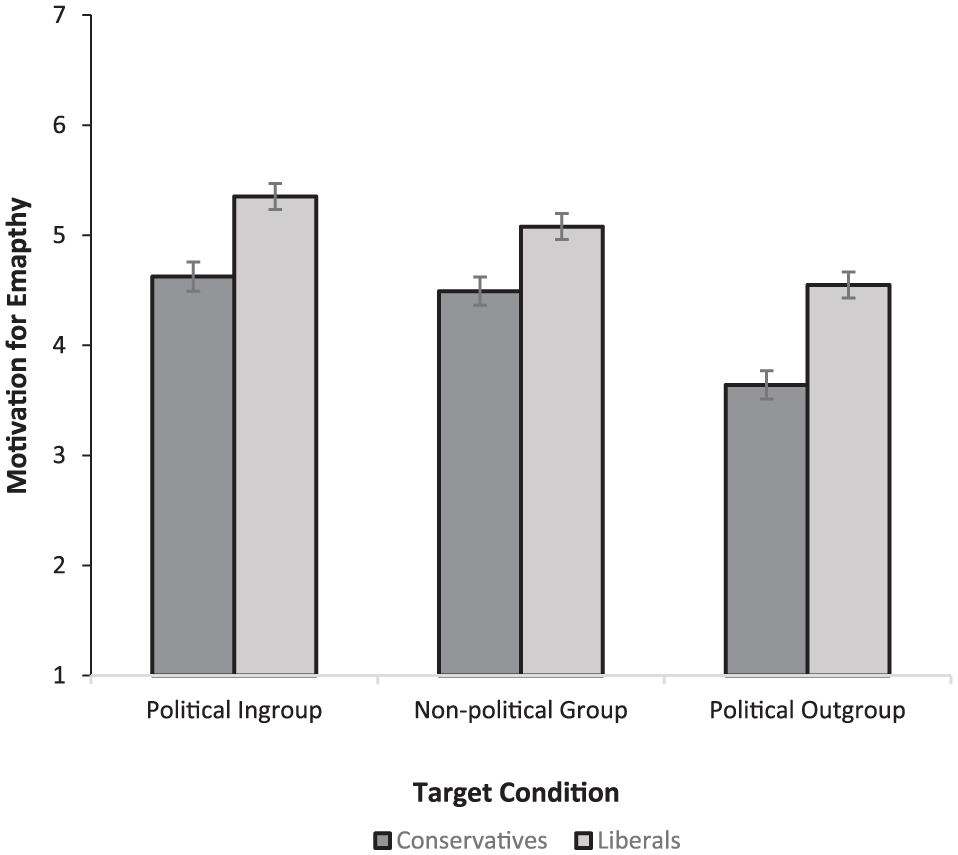
Motivation for empathy toward targets, as a function of the target identity (i.e., political ingroup, political outgroup, or nonpolitical group) and political ideology (conservatives vs. liberals).
Empathic Reactions
We repeated the above analyses, predicting subsequent empathic reactions toward the injured protestors, upon reading the empathy-inducing article. As shown in Figure 2, the analyses yielded a significant main effect of political ideology on empathic reactions, F(1, 892) = 32.4, p < .001, d = .38. On average, liberals experienced more empathy toward others (M = 4.89, SD = 1.61) than conservatives did (M = 4.33, SD = 1.8). We also found a significant main effect of condition, F(2, 892) = 32.86, p < .001, d = .54. Post hoc analyses, testing the differences between the three conditions, indicated that both conservatives and liberals felt less empathy toward the opposing political group compared with the nonpolitical group (p < .001) and to their own group (p < .001). However, there was no significant difference in empathic reactions between political ingroup and nonpolitical group (p = .148; see Supplementary Table 4 for means and SDs). There was no significant interaction between target condition and participants’ political ideology (p > .250). In addition, these effects did not vary by country, as there was no significant Country × Condition × Political ideology interaction (p > .250).
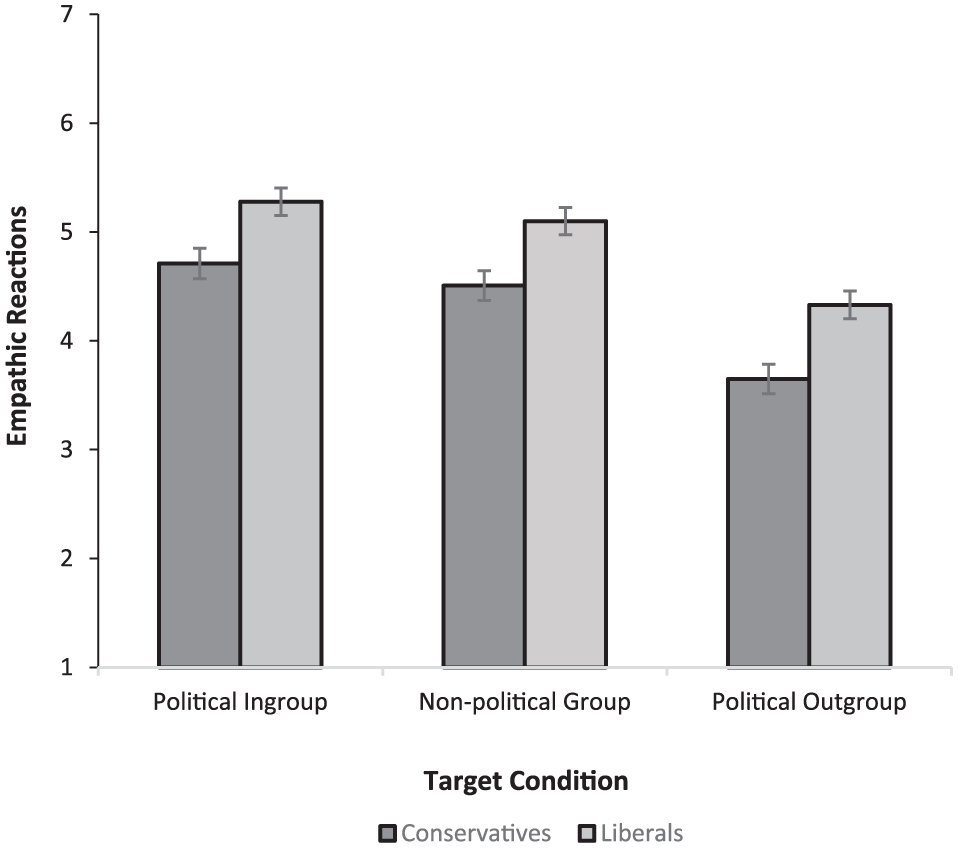
Empathic reactions as a function of target identify (i.e., political ingroup, political outgroup, or nonpolitical group) and political ideology (conservatives vs. liberals).
Willingness to Help
We ran similar analyses to predict willingness to help the injured protesters. Once again, our results revealed a significant main effect of political ideology on willingness to help, F(1, 892) = 7.12, p = .008, d = .18. As shown in Figure 3, on average, liberals were more willing to help others (M = 2.87, SD = 1.55) than conservatives were (M = 2.63, SD = 1.57). We also found a significant main effect of condition, F(2, 892) = 22.11, p < .001, d = .44. Post hoc analyses, testing the differences between the three conditions in terms of willingness to help, indicated that both conservatives and liberals were less willing to help members of the opposing political group compared with the nonpolitical group (p < .001) and to their own group (p < .001). However, there was no significant difference between political ingroup and nonpolitical group (p > .250; see Supplementary Table 4 for means and SDs). There was no significant interaction between target condition and participants’ political ideology (p > .250). In addition, these effects were consistent across countries, as there was no significant Country × Condition × Political ideology interaction (p > .250).
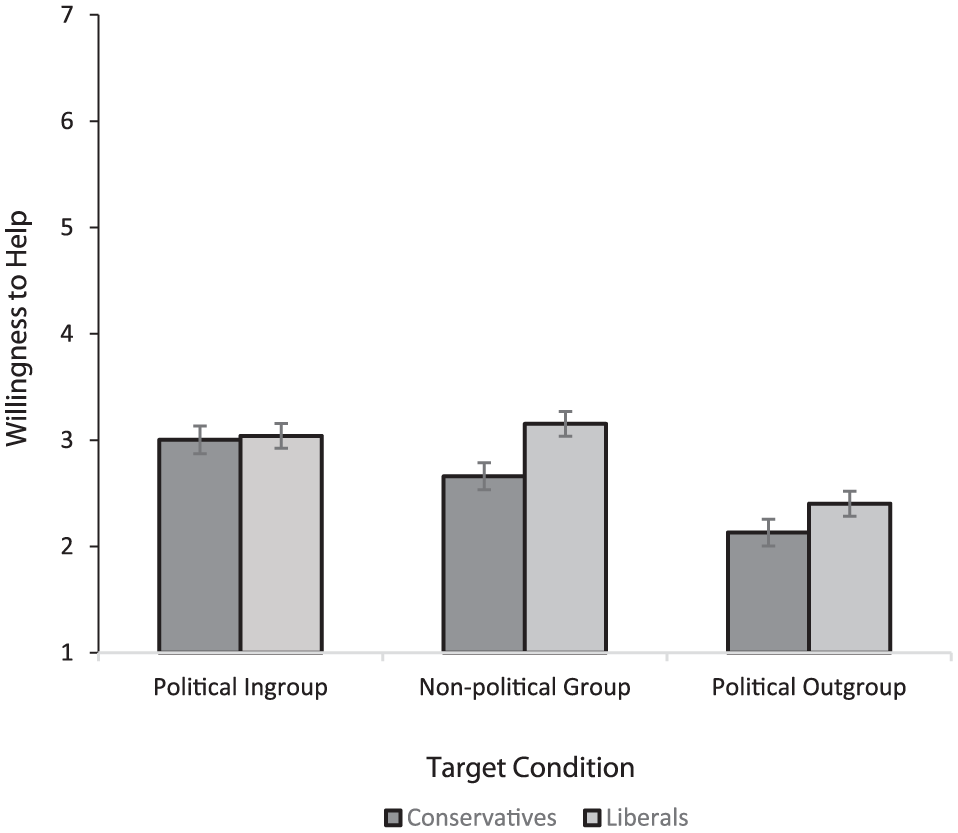
Willingness to help as a function of target identify (i.e., political ingroup, political outgroup, or nonpolitical group) and political ideology (conservatives vs. liberals).
Mediation Analysis
Although we cannot use the current design to infer causality, we examined a conceptual mediation model. Specifically, we tested whether the link between political ideology and willingness to help was mediated by the motivation for empathy and empathic reactions. To this end, we conducted a serial mediation analysis, employing the procedure of Hayes (2013) PROCESS bootstrapping macro (Model 6; 5,000 iterations). The model was specified with political ideology as the independent variable, motivation for empathy as the first mediator, empathic reactions as the second mediator, and willingness to help as the outcome variable (see Figure 4). As expected, the total effect of political ideology on willingness to help, b = .24, 95% confidence interval (CI) = [0.03, 0.44], t = 2.29, p = .022, was reduced and became insignificant when motivation for empathy and empathic reactions were added as serial mediators (b = −.08, 95% CI = [−0.25, 0.09], t = −.94, p > .250). The indirect effect through both of these mediators was statistically different from 0 (b = .20, 95% CI = [0.13, 0.28]). Compared with conservatives, liberals wanted to feel more empathy, which was, in turn, associated with more intense empathic reactions and greater willingness to help others. This mediation model is consistent with our conceptual model but does not rule out all alternative models.
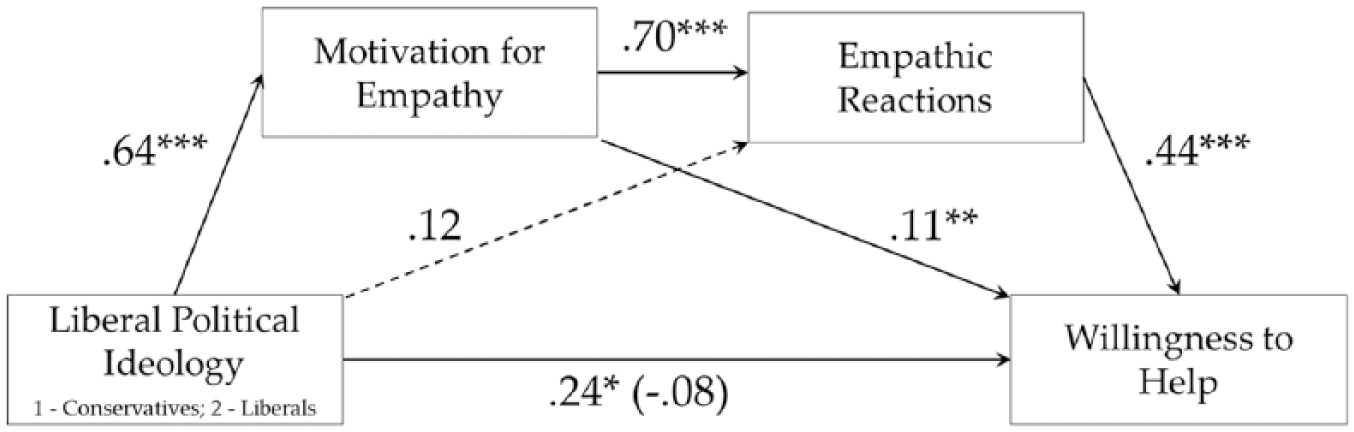
Motivation for empathy and empathic reactions mediate the association between more liberal (vs. conservative) political ideology and willingness to help.
Differences Between Countries
Although our key findings were not qualified by country, we found several notable differences between the countries: First, in all three analyses there were main effects for country, such that, on average, German participants were less motivated to feel empathy (M = 3.82, SD = 1.8) compared with Americans (M = 5.23, SD = 1.5) and to Israelis (M = 4.93, SD = 1.5), F(2, 892) = 81.86, p < .001, d = .86. German participants felt less empathy (M = 4.25, SD = 1.94) than did Americans (M = 4.8, SD = 1.6) and Israelis (M = 4.83, SD = 1.55), F(2, 892) = 16.20, p < .001, d = .38. German participants were less willing to help (M = 2.7, SD = 1.63) than were Israelis (M = 2.9, SD = 1.54) but did not differ from Americans (M = 2.64, SD = 1.49), F(2, 892) = 3.77, p = .023, d = .18. These differences, however, should be interpreted cautiously, given that our measures did not demonstrate full scalar invariance.
Second, all three analyses revealed a significant Country × Condition interaction (see Supplementary Table 6 for means and SDs), such that in Germany, but not in the United States or Israel, the motivation for empathy, F(4, 892) = 6.51, p < .001, d = .34, the empathic reactions, F(4, 892) = 4.60, p = .001, d = .29, and the willingness to help, F(4, 892) = 4.79, p = .001, d = .29, were significantly higher for members of the nonpolitical group compared with the other target groups.
Finally, we found significant Country × Political ideology interactions predicting motivation for empathy and willingness to help but not empathic reactions (p = .098). The difference between liberal and conservative participants in motivation for empathy was more extreme in the German sample (M = 4.30 and 3.09 for liberals and conservatives, respectively) compared with the American (M = 5.49 and 4.95 for liberals and conservatives, respectively) and Israeli (M = 5.19 and 4.67 for liberals and conservatives, respectively) samples, F(2, 892) = 4.48, p = .012, d = .2. When predicting willingness to help, the difference between liberal and conservative participants was significant in the American sample (M = 2.87 and 2.39 for liberals and conservatives, respectively), F(2, 892) = 5.79, p = .003, d = .23, and the German sample (M = 2.92 and 2.36 for liberals and conservatives, respectively) but not significant in the Israeli sample (M = 2.81 and 3.00 for liberals and conservatives, respectively).
Discussion
Do liberals and conservatives differ in how much empathy they want to feel toward others? Our findings suggest that there are both differences and similarities in empathy between liberals and conservatives. On average, liberals were more motivated to feel empathy and felt more empathy toward others than conservatives did. In two of the three countries (the United States and Germany), liberals also wanted to help others more than conservatives did. In addition, in all countries, both liberals and conservatives wanted to feel, and actually felt less empathy toward outgroup members compared with ingroup members or members of a nonpolitical group. These findings help integrate prior inconsistent findings. They not only replicate studies showing that liberals are generally more empathic than conservatives (e.g., McCue & Gopoian, 2000), but they also provide evidence for the context specificity of this effect (Waytz et al., 2016).
In this term, our study provides further elaboration upon the work by Waytz and colleagues (2016). Whereas they found that ideological differences are only reflected in the target group liberals and conservatives empathize with, our findings, in addition to conceptually replicating these previous evidence, also show a more general ideological difference in levels of empathy, such that liberals feel more empathy compared with conservatives regardless of the target group.
Our findings suggest that differences between liberals and conservatives in the experience of empathy (e.g., Iyer et al., 2012) may be attributed, in part, to different underlying motivations. Political ideology is linked not only to motivated social cognition (Jost et al., 2003) but also to motivated social emotion. Just as liberals support policies that promote social and economic equality more than conservatives do (e.g., Jost, 2006), they may also be more motivated to feel empathy, which could potentially foster social equality (Tamir et al., 2016).
Our findings also point to similarities between liberals and conservatives. Both liberals and conservatives wanted to feel more empathy toward members of their ingroup compared with the outgroup. This may be because empathy promotes social connection (e.g., Batson & Moran, 1999), and people want to feel emotions that increase their sense of belonging (e.g., Porat, Halperin, Mannheim, & Tamir, 2016). It is likely that although liberals and conservatives differ in their social values, they are similarly motivated to belong, and are therefore motivated to feel more empathy toward members of their ingroup than toward members of the outgroup.
Taken together, the findings shed light on the mechanism that can influence how liberals and conservatives treat one another. The findings suggest that political ideology is associated with motivation for empathy, and that such motivation comes into play even before an empathy-eliciting event occurs. This emphasizes that what people want to feel toward others varies as a function of their political ideology. Such motivation could, in turn, influence empathic reactions and helping behavior.
Although the main findings about empathy were replicated across samples and can be generalized beyond a particular political context, we found that the participants from the United States and Israel were higher in empathy compared with participants from Germany. Similar differences were also found in a cross-cultural study that measured empathy components (e.g., empathic concern and perspective taking) among 63 countries, of them the United States, Israel, and Germany (Chopik, O’Brien, & Konrath, 2016). However, for methodological reasons—scalar invariance is required to meaningfully interpret mean differences between countries—this finding should be viewed with caution.
The present study has both theoretical and methodological implications for research on ideological differences. Liberals and conservatives do not necessarily identify with the same groups. Because people feel more empathy toward similar others (Hoffman, 2000), using a target group that one political group is more likely to identify with than the other group is likely to lead to biased conclusions. Thus, to examine basic differences and similarities between liberals and conservatives, future studies should look at diverse social target groups that liberals and conservatives either identify with or not. Such designs would allow a deeper understanding of whether differences between political groups are context dependent (see also Kessler, Proch, Hechler, & Nägler, 2015). Therefore, rather than focusing on whether liberals and conservatives are inherently different from each other, future studies could potentially examine under which circumstances liberals and conservatives are different from or similar to each other, and why.
The present research has several limitations: First, we cannot infer any causal influence of political ideology on motivated empathy. Although we suggested that value-based goals and social needs may explain the relationship between the two constructs, it is still unclear what factors or processes are responsible for the apparent connection. Given that political ideology cannot be directly manipulated, future studies should at least try to manipulate the salience of political ideology, and test its potential causal effect on motivation for empathy and its subsequent effects.
Second, our proposed model points to one potential mechanism, such that political ideology shapes motivation for empathy. This mechanism finds support in studies that showed the influence of priming political ideology and values on motivation for empathy (Porat, Halperin, & Tamir, 2016; Tamir et al., 2016). In addition, while political ideology is relatively difficult to change (Bar-Tal, 2013), it is much easier to alter what people want to feel. However, because no causal evidence is provided, we cannot rule out the possibility that empathy may shape political ideology.
Third, all the measures used in this study were based on self-report. Although such measures have proven to be valid (e.g., Batson et al., 1997; Jost, 2006; Tamir & Ford, 2012), participants may have responded according to how they would like or expect to appear. Because both political groups stereotypically view conservatives as somewhat heartless, and liberals as having bleeding hearts, it might be that our results were influenced by these stereotypes (Farwell & Weiner, 2000). Thus, future studies should consider testing whether the results hold when using other measures of both desired and actual empathy.
Conclusion
This study, conducted in three social and cultural contexts, showed that political ideology is associated with the motivation for empathy in two parallel ways—one that emphasizes the differences between liberals and conservatives, and another that emphasizes the similarities between the two political groups. On the one hand, liberals, compared with conservatives, wanted to feel more empathy toward others regardless of the targets’ political identity. On the other hand, both liberals and conservatives wanted to feel less empathy toward outgroup members compared with members of their ingroup or an ideologically neutral group. The way liberals and conservatives wanted to feel subsequently shaped their empathic reactions and willingness to help. This study has both theoretical and methodological implications for research on ideological differences, and can hopefully address and promote the ongoing debate regarding psychological differences between liberals and conservatives.
Supplemental Material
hasson_online_appendix – Supplemental material for Are Liberals and Conservatives Equally Motivated to Feel Empathy Toward Others?
Supplemental material, hasson_online_appendix for Are Liberals and Conservatives Equally Motivated to Feel Empathy Toward Others? by Yossi Hasson, Maya Tamir, Kea S. Brahms, J. Christopher Cohrs and Eran Halperin in Personality and Social Psychology Bulletin
Footnotes
Declaration of Conflicting Interests
The author(s) declared no potential conflicts of interest with respect to the research, authorship, and/or publication of this article.
Funding
The author(s) disclosed receipt of the following financial support for the research, authorship, and/or publication of this article: This work was supported by the German-Israeli Foundation under grant I-324-105.1-2012, granted to Eran Halperin, Maya Tamir and J. Christopher Cohrs, and by the European Research Commission grant [335607] to Eran Halperin. The authors would like to thank the Levy Eshkol Institute for Economic, Social and Political Research for its support of Yossi Hasson.
Notes
Supplemental Material
Supplementary material is available online with this article.
References
Supplementary Material
Please find the following supplemental material available below.
For Open Access articles published under a Creative Commons License, all supplemental material carries the same license as the article it is associated with.
For non-Open Access articles published, all supplemental material carries a non-exclusive license, and permission requests for re-use of supplemental material or any part of supplemental material shall be sent directly to the copyright owner as specified in the copyright notice associated with the article.
