



Abstract
According to the process model of ego depletion, exercising self-control causes shifts in motivation and attention that may increase positive emotional reactivity. In an initial study and a preregistered replication, participants exercised self-control (or not) on a writing task before reporting their emotional responses to positive, negative, and neutral images. In Study 1 (N = 256), we found that exercising (vs. not exercising) self-control increased positive emotional responses to positive images among more extroverted individuals. In Study 2 (N = 301), we found that exercising self-control increased positive reactivity independent of extroversion. These findings support the process model of ego depletion and suggest that exercising self-control may influence responding that does not entail self-control (i.e., positive emotional reactivity)—an outcome that is not anticipated by the limited resource model of self-control.
Good self-control contributes to several desirable long-term outcomes, including mental and physical health, financial well-being, and academic and professional achievement (Vohs & Baumeister, 2011). But acts of self-control may also carry short-term costs. Numerous experiments have found that overriding or altering one’s predominant response tendencies temporarily reduces success at subsequent attempts at self-control. The leading explanation for this behavioral pattern, known as the ego depletion effect, is that exercising self-control at Time 1 consumes and depletes a limited inner resource needed to succeed at self-control at Time 2 (Muraven & Baumeister, 2000).
The ego depletion effect may also be explained without reference to limited resources. According to the process model of ego depletion, exercising self-control is an aversive event that causes shifts in motivation and attention away from self-control and toward more appealing activities (Inzlicht & Schmeichel, 2012; Inzlicht, Schmeichel, & Macrae, 2014). 1 These shifts may be particularly consequential when pleasurable stimuli are present in the environment following a self-control attempt. In this view, ego depletion is essentially a manifestation of emotion regulation: After engaging in frustrating or otherwise unpleasant attempts to override or alter a response, individuals become more attuned to opportunities to improve their emotional state.
The ego depletion effect has recently received intense scrutiny and skepticism (for an overview, see Friese, Loschelder, Gieseler, Frankenbach, & Inzlicht, 2018). Briefly, a preregistered study conducted across multiple laboratories found null results of exercising self-control at Time 1 on self-control at Time 2 (Hagger et al., 2016; cf. Baumeister & Vohs, 2016a), other preregistered studies have observed significant but smaller-than-expected effects (Dang, Liu, Liu, & Mao, 2017; Garrison, Finley, & Schmeichel, in press), and one meta-analytic estimate suggested that the magnitude of the ego depletion effect is not appreciably different from zero (Carter, Kofler, Forster, & McCullough, 2015; cf. Cunningham & Baumeister, 2016; Dang, 2018; Inzlicht, Gervais, & Berkman, 2015; Simonsohn, 2017). These developments have cast doubt on the reliability of the ego depletion effect.
Even if exercising self-control at Time 1 does not deplete a limited resource and therefore undermine self-control at Time 2, as skeptics have suggested, exercising self-control may nonetheless influence other processes and responses. Perhaps some of the inconsistent effects observed in past research stem from an exclusive focus on self-control-related dependent measures suggested by the limited resource model. Such measures may not adequately capture the aftereffects of exercising self-control.
The current studies differ from past research by focusing on the aftereffects of self-control on uncontrolled responding. Specifically, the current studies tested the hypothesis that exercising self-control at Time 1 increases positive emotional reactivity at Time 2. This hypothesis can be derived from the process model of ego depletion but not the resource model, as described below.
Aftereffects of Self-Control on Positive Reactivity
One main implication of the resource model is that all acts of self-control rely on the same underlying capacity, so that exercising self-control at Time 1 undermines success at even quite different self-control challenges at Time 2 (Muraven & Baumeister, 2000). But what if no self-control is required at Time 2? Does prior self-control influence subsequent uncontrolled responding?
The resource model does not supply answers to these questions because the hypothesized resource pertains only to self-control. Hence, exerting self-control at Time 1 is irrelevant for most Time 2 responses or behaviors insofar as they stem from habits, routines, or other more automatic processes that do not entail self-control. For example, the emotions that arise while viewing and responding to emotional pictures (as in the current experiments) should be unaffected by the prior depletion of limited resources because passive picture viewing requires no self-control. Viewing positive emotional pictures, in particular, does not typically require one to override a response and thus should not be influenced by the state of the limited resource for self-control.
The process model, by contrast, suggests that exercising self-control at Time 1 may influence responding that does not entail self-control at Time 2. Specifically, this model proposes that exercising self-control is an aversive, unpleasant activity that biases motivation and attention toward more rewarding or appealing activities. If the process model is correct, then exercising self-control at Time 1 may increase the subjective emotional impact of viewing positive pictures at Time 2, as individuals become more attuned to positive stimuli and positive feelings after an effortful bout of self-control.
Several past findings are consistent with the process model view. For example, participants in one study completed either a simple math task or an effortful thought suppression task at Time 1, and then attempted to inhibit smiles and other signs of amusement while watching humorous video clips at Time 2 (Muraven, Tice, & Baumeister, 1998, Study 3). Participants who had suppressed their thoughts went on to smile more and express more positive emotion while watching the amusing videos. In another study, chronic dieters who suppressed their emotional expressions during a movie at Time 1 consumed more ice cream on a taste-and-rate task at Time 2, compared with dieters who did not suppress their emotional expressions at Time 1 (Vohs & Heatherton, 2000). These findings are consistent with the idea that individuals respond more favorably to positive events after exercising self-control on an unrelated task.
But the findings reviewed above suffer from an interpretational ambiguity. Did exercising self-control increase positive emotional expressions (Muraven et al., 1998) or ice cream intake (Vohs & Heatherton, 2000) because of an increase in positive emotional reactivity, as the process model would predict? Or because participants were temporarily less capable of suppressing their smiles or sticking to their diets, as the resource model would predict? The observed outcomes—smiles and ice cream consumption—are not sufficient to distinguish between the two predictions because both positive reactivity and poor self-control could contribute to each outcome.
A more recent study found evidence to support the process model account. Participants completed a self-control task (or not) prior to viewing a mixture of neutral and emotional images (Schmeichel, Crowell, & Harmon-Jones, 2016). Crucially, unlike previous studies (e.g., Muraven et al., 1998), participants were not instructed to suppress their emotional responses at Time 2. Rather, they were instructed simply to view the images and respond in whatever way was normal and natural for them, thereby removing the requirement to exert control. Electroencephalographic activity revealed that exercising self-control at Time 1 caused an increase in relative left frontal cortical activity during emotional (both positive and negative) picture viewing at Time 2, but only among individuals higher in trait approach motivation. Greater relative left frontal cortical activity is thought to reflect relatively greater approach motivation (Coan & Allen, 2003; Harmon-Jones & Gable, 2018; Kelley, Hortensius, Schutter, & Harmon-Jones, 2017), so the results from this study suggested that exercising self-control shifts motivation during emotional images among approach-prone persons. This finding is not readily explained by the resource model; participants were not trying to exercise self-control at Time 2, so the state of the resource for self-control was irrelevant. But that study focused on neural measures and did not assess emotional experience, so the effects of exercising self-control on subjective responding remain unknown. Do individuals experience more positive emotions in response to pleasant events after they have exercised self-control?
Aftereffects of Self-Control on Negative Reactivity
Although the resource model does not predict changes in positive reactivity, it could be used to derive a hypothesis about the aftereffects of self-control on negative emotional reactivity. If one assumes that individuals spontaneously (i.e., without being instructed) downregulate their responses to negative stimuli (e.g., Pu, Schmeichel, & Demaree, 2010), perhaps out of a desire to appear undisturbed or to maintain a more positive emotional state, then exercising self-control at Time 1 may undermine the success of these emotion regulation efforts and thereby increase negative reactivity at Time 2. Evidence of increased reactivity to negative images may thus support the idea that prior efforts at self-control undermine spontaneous attempts to downregulate negative emotion. Such a pattern would be broadly consistent with the limited resource model.
Like the resource model, the process model also does not make specific predictions regarding negative reactivity. But insofar as exercising self-control motivates shifts toward reward and good feelings, it is plausible that exercising self-control also increases the tendency to avoid or ignore aversive events. Put differently, any increase in positive reactivity after exercising self-control may be accompanied by a corresponding decrease in negative reactivity. Therefore, the process model could be interpreted to predict that exercising self-control at Time 1 reduces negative emotional reactivity at Time 2. One previous study found suggestive evidence in this regard, insofar as exercising self-control increased a neural indicator of approach motivation in response to negative images (i.e., relative left frontal asymmetry; Schmeichel et al., 2016), but this result had not been predicted and has yet to be replicated. In the case of negative emotional reactivity, then, the resource model and the process model suggest divergent predictions, but these predictions require additional assumptions not inherent in either model.
Extroversion and Neuroticism as Potential Moderators
The foregoing predictions regarding emotional reactivity assume that all persons respond similarly to emotional stimuli. But past research has suggested that individual differences in extroversion and neuroticism moderate reactivity to emotional events. Gray (1981) and others (e.g., Costa & McCrae, 1980) hypothesized links between extroversion and sensitivity to positive stimuli and between neuroticism and sensitivity to negative stimuli, respectively. Most relevant for present purposes is evidence that more extroverted persons may report more positive reactions to positive stimuli, whereas more neurotic persons may report more negative reactions to negative stimuli (e.g., Gross, Sutton, & Ketelaar, 1998; Larsen & Ketelaar, 1989, 1991; see also Letzring & Adamcik, 2015; Lucas & Baird, 2004).
Based on evidence that extroversion and neuroticism are associated with emotional states (e.g., Rusting & Larsen, 1997) and may moderate reactivity to emotional stimuli (e.g., Larsen & Ketelaar, 1989), we hypothesized that these traits may influence the effects of Time 1 self-control on Time 2 emotional reactivity. We expected that picture valence (positive, negative, or neutral) would explain most of the variance in emotional reactivity. However, we reasoned that any effect of prior self-control on positive emotional reactivity would be most prevalent among individuals prone to experience positive emotion (i.e., those higher in extroversion), whereas any effects on negative emotional reactivity would be most prevalent among individuals prone to experience negative emotion (i.e., those higher in neuroticism).
To test these hypotheses, we conducted an experiment in which we measured trait extroversion and neuroticism, manipulated the exercise of self-control at Time 1, and assessed emotional reactivity to negative, neutral, and positive images at Time 2. We then conducted a preregistered direct replication in Study 2. Before reporting those experiments, we first report the results of a pilot study testing the manipulation of Time 1 self-control.
Pilot Study
According to the process model of ego depletion, aftereffects of self-control may stem in part from the aversive feelings that attend efforts to override or alter a predominant response tendency. We therefore conducted a pilot study to verify that the self-control manipulation participants completed in the primary experiments—a writing task that either did or did not require the exercise of self-control—was successful in eliciting aversive feelings and feelings of effort.
Method
Participants and design
Seventy undergraduate students (66 women, 14 men) participated in exchange for extra credit points in a psychology course. All participants completed a free writing task and a controlled writing task in a within-subjects design. Immediately after completing each task, participants reported on their subjective experiences during the task. A sample of N = 70 provided 80% power to detect a medium-sized effect of the writing manipulation.
Materials and procedures
Participants sat at desks in a large lecture hall. After providing informed consent, participants wrote two short stories as follows.
Writing task
Participants spent 6 min completing the controlled writing task. They were instructed to write about a recent trip they had taken. They were told the story could be about a trip to the store, a trip to another country, or some other trip of their choosing. Participants then received additional instructions: Very important! Do not use the letters A or N anywhere in your story! If you find yourself writing a word that includes the letters A or N, please stop writing that word and find an alternate way to express your thoughts.
After writing for 6 min, participants were prompted to list the one word that best described how they felt during the writing task. Then they rated how much mental effort and how much frustration they experienced during the task, using scales from 1 (none) to 7 (very much).
All participants then proceeded to complete the free writing task. This time, participants were encouraged to write about a recent trip and no restrictions were placed on their letter use. After writing for 6 min, participants listed the one word that best described how they felt during this version of the writing task and rated how much mental effort and frustration they experienced. Previous research has observed that the controlled writing task induces ego depletion (e.g., Schmeichel, 2007). All data are available online (https://osf.io/q74tx/).
Results
As expected, the controlled writing task was rated as more effortful (M = 6.21, SD = 0.99) than the free writing task (M = 2.14, SD = 1.12), t(69) = 21.44, p < .001, 95% confidence interval (CI) = [4.22, 4.92], d = 2.57. The controlled writing task was also rated as more frustrating (M = 5.84, SD = 1.36) than the free writing task (M = 1.27, SD = 0.54), t(69) = 25.84, p < .001, 95% CI = [3.69, 4.45], d = 3.35. The three most frequently used words to describe the experience of the controlled writing task were frustrated (27.1%), stressed (10.0%), and limited and challenged (both 4.3%). The three most frequently used words to describe the experience of the free writing task were nostalgic (11.4%); calm, easy, free, and relaxed (all 8.6%); and fine and relaxing (both 4.3%).
Discussion
The results of the pilot study confirmed that the controlled writing task requires more effort and invokes greater frustration compared with the free writing task. This evidence supports the idea that the controlled writing task entails more self-control. Furthermore, the descriptive analysis of the most frequently used words to describe the tasks revealed very different subjective experiences—the controlled writing task was more frustrating than the more benign free writing task. These findings are consistent with past evidence that self-control manipulations tend to be subjectively aversive and effortful (see Hagger, Wood, Stiff, & Chatzisarantis, 2010).
Study 1
To test the aftereffects of self-control on emotional responding, we conducted an experiment in which we measured trait extroversion and neuroticism, manipulated the exercise of self-control at Time 1 using the writing task from the pilot study, and assessed emotional reactivity to negative, neutral, and positive images at Time 2.
Method
Participants were randomly assigned to condition in a 2 (writing condition: controlled writing vs. free writing) × 3 (image type: positive, neutral, or negative images) mixed-factorial design, with picture type as a within-subjects variable.
Participants
Two hundred fifty-six undergraduate students (153 women; age M = 18.73, SD = 0.99) participated in exchange for credit toward a course requirement, providing us 80% power to detect a small-to-medium sized effect (d = 0.35) of the writing manipulation. We based our sample size on the power to detect a small-to-medium sized effect, which splits the difference between meta-analytic estimates of the ego depletion effect (see Carter et al., 2015; Hagger et al., 2010). Participants were randomly assigned between the free writing (n = 130) and controlled writing (n = 126) conditions. Sixteen additional participants were excluded from analyses: five had missing data (three due to computer error and two due to experimenter error), and 11 failed to follow the writing task instructions (e.g., drew pictures, did not write for the full 5 min, or used an inordinate number of as and ns on the controlled writing task; see below).
Materials and procedures
Participants arrived individually for a laboratory-based experiment on personality and emotion. After providing informed consent, participants completed the Big Five questionnaire (Goldberg, 1992), from which we derived scores from the 10-item extroversion (M = 31.78, SD = 8.17, α = .90) and neuroticism (M = 30.12, SD = 6.83, α = .82) subscales. Sample items on the extroversion subscale include “I am the life of the party” and “I am quiet around strangers” (reversed coded). Sample items on the neuroticism subscale include “I get upset easily” and “I seldom feel blue” (reversed coded). Participants responded to all items using a scale from 1 (very inaccurate) to 5 (very accurate).
Self-control manipulation
Next, participants spent 6 min writing a short story under one of the two sets of instructions described in the pilot study. Specifically, participants in the free writing condition were instructed to write about a recent trip. Participants in the controlled writing condition received the additional instruction: Very important! Do not use the letters A or N anywhere in your story! If you find yourself writing a word that includes the letters A or N, please stop writing that word and find an alternate way to express your thoughts.
Hence, participants in the latter group inhibited the use of two common letters, whereas those in the former group wrote without restrictions.
Emotional image-viewing task
Participants then viewed 29 International Affective Picture System (IAPS) images (nine positive, 10 negative, 10 neutral; Lang, Bradley, & Cuthbert, 2005) presented in a random order. We selected positive images depicting appetitive objects or activities that elicit high (positive) valence and arousal, negative images that depicted aversive or threatening objects or events that elicit low (negative) valence and high arousal, and neutral images that elicit middling (neutral) valence and low arousal. 2 Images remained onscreen until participants reported their emotional responses using self-assessment manikins (SAM; Bradley & Lang, 1994) for valence from 1 (unhappy) to 7 (happy) and arousal from 1 (calm) to 7 (excited). Participants also rated how much the content of each image elicited empathy and concern, both from 1 (none) to 7 (quite a bit). After the image-viewing task, participants indicated how much they tried to increase/decrease their emotional responses to positive/negative images, all from 1 (none) to 7 (quite a bit), and to describe what, if anything, they did to change their emotions.
Individual differences measures
Finally, participants completed the following questionnaires included for exploratory purposes: Emotion Regulation Questionnaire (Gross & John, 2003), Brief Self-Control Scale (Tangney, Baumeister, & Boone, 2004), Toronto Empathy Questionnaire (Spreng, McKinnon, Mar, & Levine, 2009), and a general demographic form. Results pertaining to the Brief Self-Control scale and self-reported Emotion Regulation efforts as a function of writing condition, extroversion, and neuroticism are reported in the online supplemental materials (https://osf.io/7gt8z/). All data are available online (https://osf.io/n5p2m/).
Results
Data analyses proceeded as follows. First, we assessed the effects of sex of participant on emotion responses (valence and arousal) in light of previous evidence for sex differences in emotional responding to IAPS images (e.g., Bradley, Codispoti, Sabatinelli, & Lang, 2001). Second, we used multilevel modeling (MLM) to examine emotional responses as a function of image type and writing condition, taking trait extroversion and neuroticism into account. Table 1 displays descriptive statistics and correlations within each writing condition for the variables used in the analyses.
Descriptive Statistics and Correlations by Writing Condition (Study 1).

Note. Means and standard deviations are for the overall sample (N = 256). Correlations above the diagonal are from the free writing condition, and correlations below the diagonal are from the controlled writing condition.
p < .05. **p < .01.
In the MLMs, responses to each image, nested within type (neutral, negative, and positive) and nested within participants, served as the outcome, with separate models for valence and arousal responses. Image type was a Level-1 predictor (i.e., direct predictor of valence or arousal). Writing condition, gender, and personality traits served as Level-2 predictors of the intercept and image type effects. The models included random intercepts (to account for dependence of ratings within participants) and random slopes (to examine cross-level interactions between personality traits and image valence). Extroversion and neuroticism were mean-centered, and writing condition, image type, and gender were effect-coded.
Models were fit in MPlus Version 8 (Muthén & Muthén, 2017) using full information maximum likelihood estimation with robust standard error estimation (all other analyses calculated using SPSS). 3 All random effects were allowed to covary. We used pseudo R2 (Snijders & Bosker, 1999) to quantify the predictive power of the models and semipartial R2 to assess the contributions of individual predictors (Edwards, Muller, Wolfinger, Qaqish, & Schabenberger, 2008). The statistical significance of the image type variable was assessed using likelihood ratio tests of nested models in which we compared a model with freely estimated regression coefficients for each effect-coded image type variable with a model in which the coefficients for the two image type effect-coded variables were fixed to zero (see West, Aiken, & Krull, 1996; Yuan & Bentler, 2000). The likelihood ratio tests yield a χ2 statistic, which was translated to an F-statistic for interpretive ease. MPlus syntax for the MLMs is available in the online supplemental materials (https://osf.io/7gt8z/).
Valence and arousal by participant sex
Women reported more negative emotional responses to negative images (M = 1.91, SD = 0.85) than did men (M = 2.21, SD = 0.74), t(254) = 2.97, p = .003, 95% CI = [0.10, 0.51], d = 0.38. Women also reported more positive emotional responses to positive images (M = 5.15, SD = 0.73) than did men (M = 5.37, SD = 0.75), t(254) = 2.31, p = .021, 95% CI = [0.03, 0.40], d = 0.30. Men and women did not differ in self-reported arousal in response to negative images, p = .348, or positive images, p = .486. Because of the observed sex differences in valence and prior research (e.g., Bradley et al., 2001), we included participant sex as a covariate in the analyses of emotional responding. Omitting sex as a covariate did not change the significance levels reported below.
Valence
Overall, the model explained roughly half of the variance in self-reported valence at the level of image type, pseudo R2Level 1 = .54, and a modest amount at the level of the individual participant, pseudo R2Level 2 = .08 (Cohen, 1992; Edwards et al., 2008). We observed significant main effects of image type, F(2, 250) = 116.53, p < .001, R2β = .482, and neuroticism, F(1, 250) = 5.929, p = .015, R2β = .023, which were qualified by a two-way Writing condition × Neuroticism interaction, F(1, 250) = 5.07, p = .024, R2β = .020, and a cross-level three-way Image type × Writing condition × Extroversion interaction, F(2, 250) = 4.02, p = .018, R2β = .031. See Table 2. 4
Multilevel Model Coefficients (Study 1).

Note. MLM = multilevel modeling; CI = confidence interval.
Probing the Writing condition × Neuroticism interaction revealed that neuroticism predicted lower (more negative) valence responses in the free writing condition, B = −0.019, SE(B) = 0.006, p = .001, but not in the controlled writing condition, B = –.001, SE(B) = 0.006, p = .864. We also explored the interaction by testing the effect of writing condition on valence responses at high (+1 SD) and low (–1 SD) levels of neuroticism. Writing condition influenced valence at high neuroticism, B = 0.183, SE(B) = 0.079. p = .020, but not at low neuroticism, B = −0.069, SE(B) = 0.079. p = .364, such that individuals higher in neuroticism reported higher (i.e., more positive) valence across all image types in the controlled writing condition.
Probing the three-way Image type × Writing condition × Extroversion interaction separately within each image type (Aiken & West, 1991; Preacher, Curran, & Bauer, 2006) revealed that extroversion predicted more positive valence in response to positive images in the controlled writing condition, B = 0.026, SE(B) = 0.008, p = .001, but not in the free writing condition, B = 0.000, SE(B) = 0.007, p = .999. See Figure 1. Extroversion did not interact with writing condition to predict valence in response to negative images, ps > .300, or neutral images, ps > .055.

Average valence response to positive images as a function of writing condition and extroversion, controlling for neuroticism and sex of participant in Study 1.
We also probed the three-way interaction by testing the effect of writing condition on valence responses to positive images at high (+1 SD) and low (–1 SD) levels of extroversion. The effect of writing condition was significant at high extroversion, B = 0.283, SE(B) = 0.116, p = .015, but not at low extroversion, B = −0.149, SE(B) = 0.137, p = .279. Neyman–Johnson regions of significance revealed that the effect of controlled writing on positive reactivity was significant among individuals: 0.67 standard deviations or more above the mean extroversion score. Thus, performing the controlled writing task increased subsequent valence responses to positive images among individuals higher in extroversion.
Arousal
Overall, the two-level model explained a large portion of the variance in self-reported arousal at the level of image type, pseudo R2Level 1 = .40, and a small amount of variation at the level of the individual participant, pseudo R2Level 2 = .05 (Cohen, 1992; Edwards et al., 2008). The MLM for arousal responses revealed main effects of image type, F(2, 250) = 174.53, p < .001, R2β = .583, and extroversion, F(1, 250) = 5.770, p = .016, R2β = .023, such that positive and negative images elicited more arousal than neutral images and more extroverted participants reported higher arousal regardless of image type. All other effects were nonsignificant. See Table 2.
Discussion
Study 1 yielded evidence that exercising self-control at Time 1 influences emotional reactivity at Time 2. Specifically, we found that exercising self-control increases subsequent emotional reactivity to positive images, but only among individuals higher in extroversion. Among individuals lower in extroversion, exercising self-control did not influence positive emotional reactivity. We also observed an unexpected result, whereby exercising self-control reduced the association between neuroticism and emotional reactivity across all image types. Exercising self-control did not influence self-reported arousal in response to the images.
These results lend support to the process model, which proposes that exercising self-control causes a shift in motivation and attention toward positive or rewarding events. The resource model does not predict this finding. Furthermore, the results provided little evidence that exercising self-control at Time 1 undermines spontaneous efforts to downregulate negative emotions at Time 2, as the resource model might predict. Emotional responding to negative images was largely unaffected by the manipulation of prior self-control. We also observed, unexpectedly, that exercising self-control at Time 1 reduced the association between neuroticism and valence (across all image types) at Time 2.
The increased positive reactivity we observed among participants who had previously exercised self-control depended on individual differences in extroversion. We had expected to find a main effect of prior self-control on positive emotional reactivity, as implied by the process model, but only more extroverted individuals showed the increase. This pattern is in line with past research, suggesting that the propensity to experience positive emotion may moderate the aftereffects of self-control. For example, a study by Crowell, Kelley, and Schmeichel (2014) found that exercising self-control increases approach-oriented responding, especially among individuals higher in trait approach motivation. They reasoned that, insofar as exercising self-control shifts attention and motivation toward more rewarding events, more approach-oriented individuals should be more likely to show the effect. A similar pattern appears to have emerged in Study 1, such that exercising self-control increased positive emotional reactivity especially among more extroverted individuals (who are prone to experience positive affect and tend to be more approach oriented; for example, Lucas & Baird, 2004). The implication is that the aftereffects of self-control vary across individuals, particularly as a function of traits pertaining to reward sensitivity or positive affectivity.
Study 2
To test the robustness of the positive reactivity findings from Study 1 and to see if the unexpected finding regarding neuroticism would replicate, we conducted a preregistered direct replication in Study 2 (https://osf.io/rmgz4/). Specifically, we preregistered the primary prediction that extroversion and writing condition would interact to influence responses to positive images, such that extroversion relates to more positive valence responses to positive images in the controlled writing condition relative to the free writing condition (as in Study 1). In addition, we preregistered the secondary prediction that neuroticism and writing condition would interact to influence valence in response to all images as found (unexpectedly) in Study 1. We also predicted gender differences, whereby women would rate images more negatively relative to men, as in Study 1, thereby providing additional justification for including gender as a covariate in our analyses.
Method
All methods and materials were identical to Study 1.
Participants
We preregistered our intent to collect usable data from at least 300 participants, which would yield a larger sample size than Study 1. Three hundred one undergraduate students (195 women; age M = 18.88, SD = 1.15) completed the experiment in exchange for credit toward a course requirement. Participants were randomly assigned between the free writing (n = 158) and controlled writing (n = 143) conditions. Twenty additional participants were excluded from analyses: four had missing data due to computer error, two reported participating in a similar study before, one decided to stop before finishing the image-viewing task, and 13 failed to follow instructions as specified by our preregistered exclusion criteria (e.g., failed to alert experimenter at appropriate time and completed emotion task before writing task, left blanks where as and ns should have been instead of choosing different words, or used an inordinate number of as and ns on the controlled writing task).
Materials and procedures
We again used the Big Five questionnaire (Goldberg, 1992) to derive scores from the 10-item measures of extroversion (M = 31.68, SD = 7.97, α = .903) and neuroticism (M = 29.27, SD = 7.24, α = .837). Once again, results pertaining to the Brief Self-Control Scale and self-reported Emotion Regulation efforts as a function of writing condition, extroversion, and neuroticism are reported in the online supplemental materials (https://osf.io/7gt8z/). All data are available online (https://osf.io/pgrzs/).
Results
Data analyses were identical to Study 1 and preregistered online (https://osf.io/rmgz4/). Table 3 displays descriptive statistics and correlations within each writing condition for the variables included in the analyses.
Descriptive Statistics and Correlations by Writing Condition (Study 2).

Note. Means and standard deviations are for the overall sample (N = 301). Correlations above the diagonal are from the free writing condition, and correlations below the diagonal are from the controlled writing condition.
p < .05. **p < .01.
Valence and arousal by participant sex
Women reported more negative emotional responses to negative images (M = 1.85, SD = 0.78) than did men (M = 2.39, SD = 0.80), t(298) = 5.69, p < .001, 95% CI = [0.35, 0.37], d = 0.68, and women reported higher arousal responses to negative images (M = 4.64, SD = 1.33) than did men (M = 4.25, SD = 1.31), t(298) = 2.41, p = .017, 95% CI = [0.07, 0.70], d = 0.30. Men and women did not differ in valence or arousal in responses to positive images, ps > .200. Because of the observed differences and our a priori intention to replicate the analyses used in Study 1, we included participant sex as a covariate in the analyses of emotional responding. Omitting sex as a covariate did not change the significance levels reported below.
Valence
Overall, the two-level model explained over half of the variance in self-reported valence at the level of image type, pseudo R2Level 1 = .57, and a modest amount at the level of the individual participant, pseudo R2Level 2 = .07 (Cohen, 1992; Edwards et al., 2008). The MLM for valence revealed a significant main effect of image type, F(2, 294) = 97.04, p < .001, R2β = .398, which was qualified by the two-way interactions between Image type × Extroversion, χ2(2) = 8.03, p = .018, and Image type × Writing condition interaction, χ2(2) = 7.69, p = .021, respectively. Unlike Study 1, the Writing condition × Neuroticism interaction, F(1, 294) = 0.146, p = .702, R2β < .001, and the Image type × Writing condition × Extroversion interaction, F(2, 294) = 1.35, p = .260, R2β = .009, were both nonsignificant. See Table 4.
Multilevel Model Coefficients (Study 2).

Note. MLM = multilevel modeling; CI = confidence interval.
We probed the simple effects of the two significant interactions separately within each image type. For the Image type × Extroversion interaction, higher extroversion predicted more positive valence in response to positive images, B = 0.020, SE(B) = 0.005 p < .001, and more negative valence in response to negative images, B = −0.011, SE(B) = 0.005, p = .044. Extroversion did not relate to valence responses to neutral images, B = 0.005, SE(B) = 0.004, p = .198.
For the Image type × Writing condition interaction, writing condition predicted valence in response to positive images, B = 0.218, SE(B) = 0.082, p = .008, such that participants reported experiencing more positive valence in the controlled writing condition than in the free writing condition. Writing condition had no significant effect on valence responses to negative images, B = −0.133, SE(B) = 0.090, p = .141, or neutral images, B = 0.128, SE(B) = 0.066, p = .053. See Figure 2.
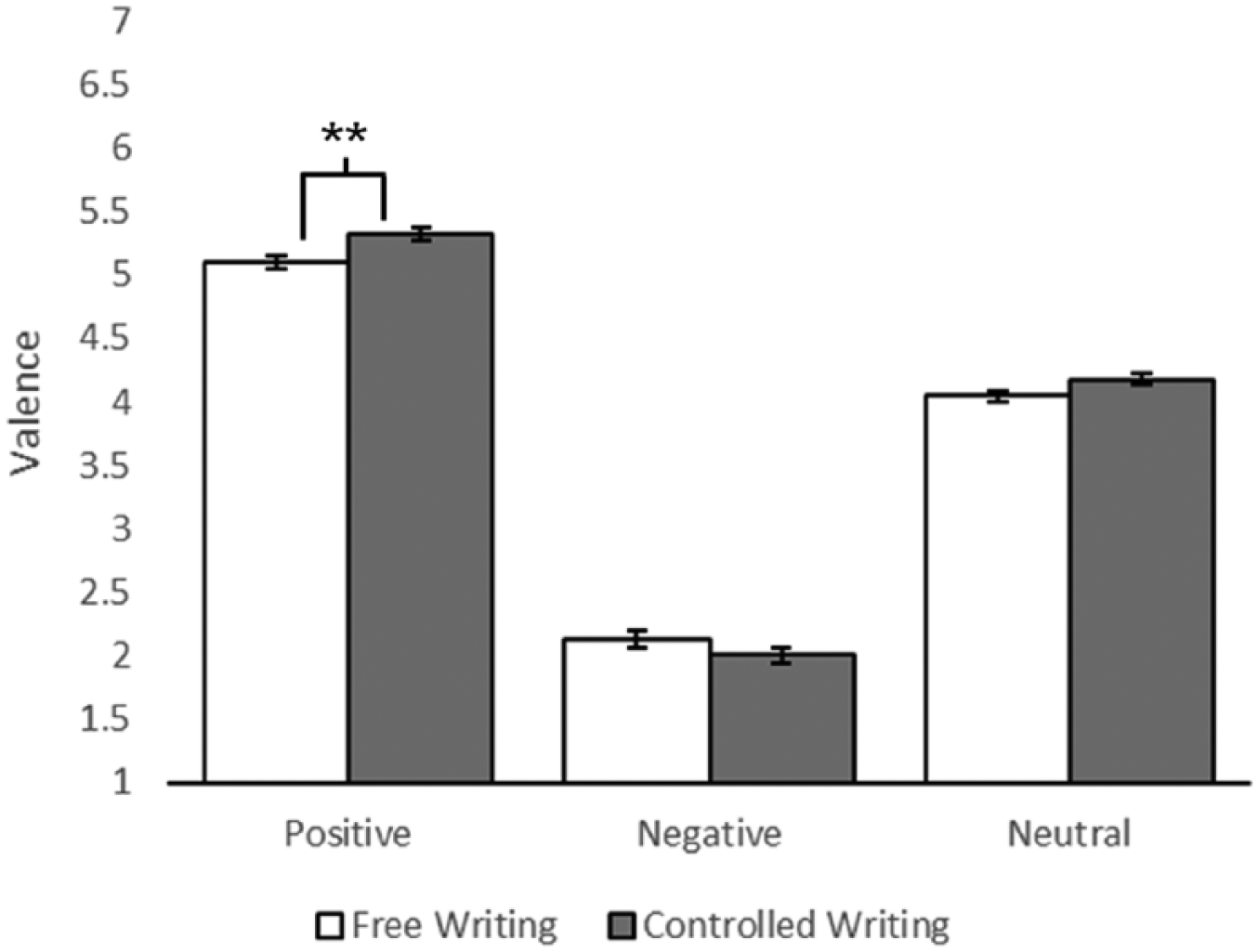
Average valence response to each image type as a function of writing condition, controlling for neuroticism, extroversion, and sex of participant in Study 2.
To be consistent with Study 1, we probed the interaction between extroversion and writing condition on positive reactivity. As in Study 1, valence responses to positive images increased with extroversion in the controlled writing condition, B = 0.025, SE(B) = 0.007, p < .001. Unlike Study 1, however, valence in response to positive images also increased with extroversion in the free writing condition, B = 0.015, SE(B) = 0.007, p = .033. See Figure 3.
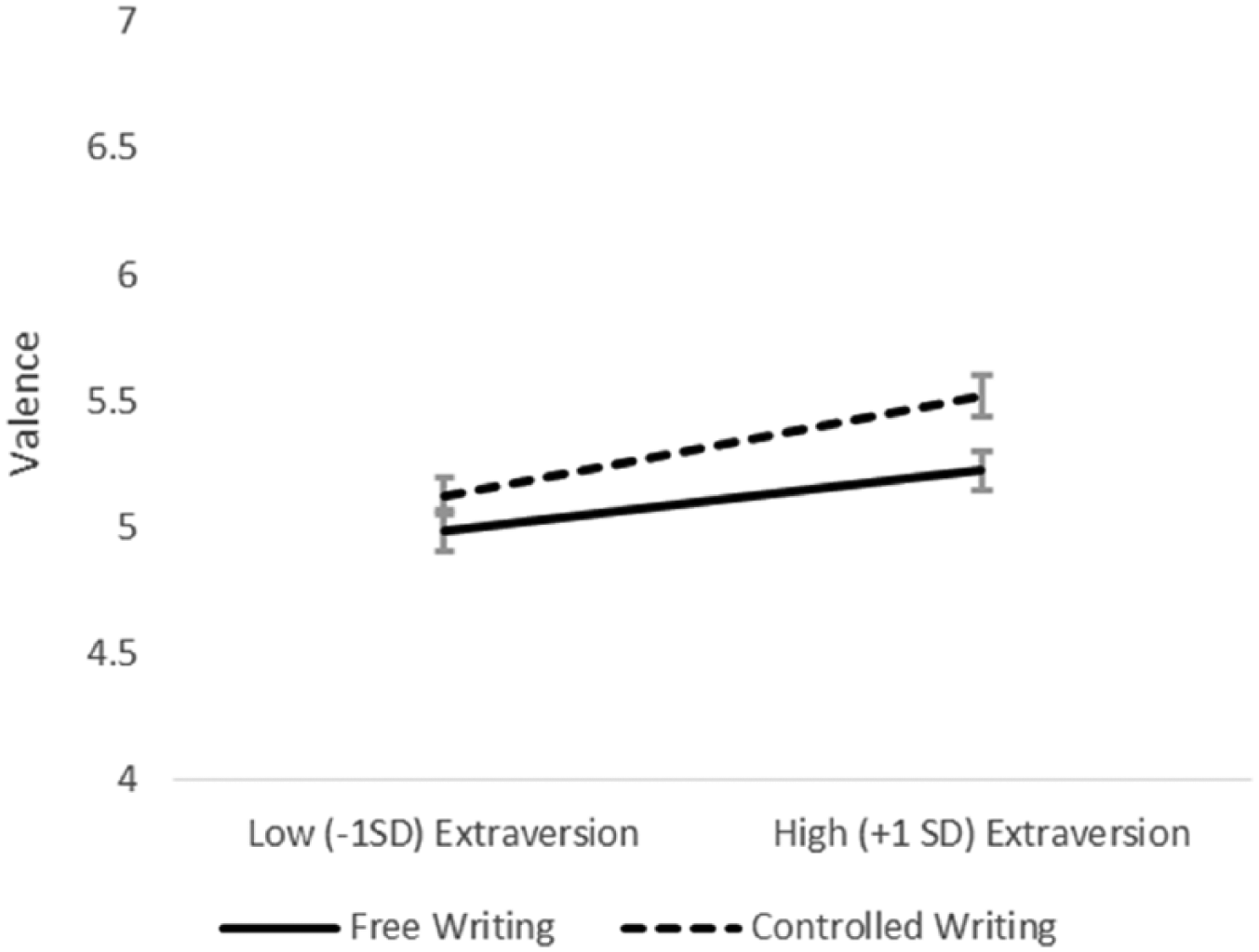
Average valence response to positive images as a function of writing condition and extroversion, controlling for neuroticism and sex of participant in Study 2.
As in Study 1, we again tested the effect of writing condition on valence responses to positive images at high (+1 SD) and low (–1 SD) levels of extroversion. The effect of writing condition was significant at high extroversion, B = 0.294, SE(B) = 0.113, p = .009, but not at low extroversion, B = 0.143, SE(B) = 0.111, p = .199. Neyman–Johnson regions of significance revealed that the effect of controlled writing on positive reactivity was significant among individuals from 0.21 standard deviations below the mean to 2.66 standard deviations above the mean extroversion score (this upper value exceeds the top range of the scale). Thus, the effect of controlled writing on subsequent valence responses to positive images emerged among individuals who were just below to well above the mean extroversion score in this sample.
Arousal
Overall, the two-level model explained a moderate portion of the variance in self-reported arousal at the level of image type, pseudo R2Level 1 = .38, and at the level of the individual participant, pseudo R2Level 2 = .09 (Cohen, 1992; Edwards et al., 2008). The MLM for arousal revealed significant main effects of image type, F(2, 294) = 178.72, p < .001, R2β = .549, extroversion, F(1, 294) = 15.187, p < .001, R2β = .049, and neuroticism, F(1, 294) = 14.923, p < .001, R2β = .078, which were qualified by the Writing condition × Image type interaction, F(2, 294) = 3.88, p = .021, R2β = .026, and the Image type × Extroversion interaction, F(2, 294) = 3.04, p = .048, R2β = .020. All other effects were nonsignificant; see Table 4.
We probed the simple effects of the two significant interactions separately within each image type. For the Image type × Extroversion interaction, arousal in response to positive images increased with extroversion, B = 0.034, SE(B) = 0.008 p < .001, as did arousal in response to neutral images, B = 0.018, SE(B) = 0.006, p = .003, but not in response to negative images, B = 0.015, SE(B) = 0.010, p = .123. For the Writing condition × Image type interaction, writing condition influenced arousal, such that participants reported experiencing higher arousal to positive images in the controlled writing condition than in the free writing condition, B = 0.355, SE(B) = 0.124, p = .004. Writing condition did not influence arousal in response to negative images, B = 0.047, SE(B) = 0.152, p = .758, or neutral images, B = 0.057, SE(B) = 0.099 p = .563. See Figure 4.
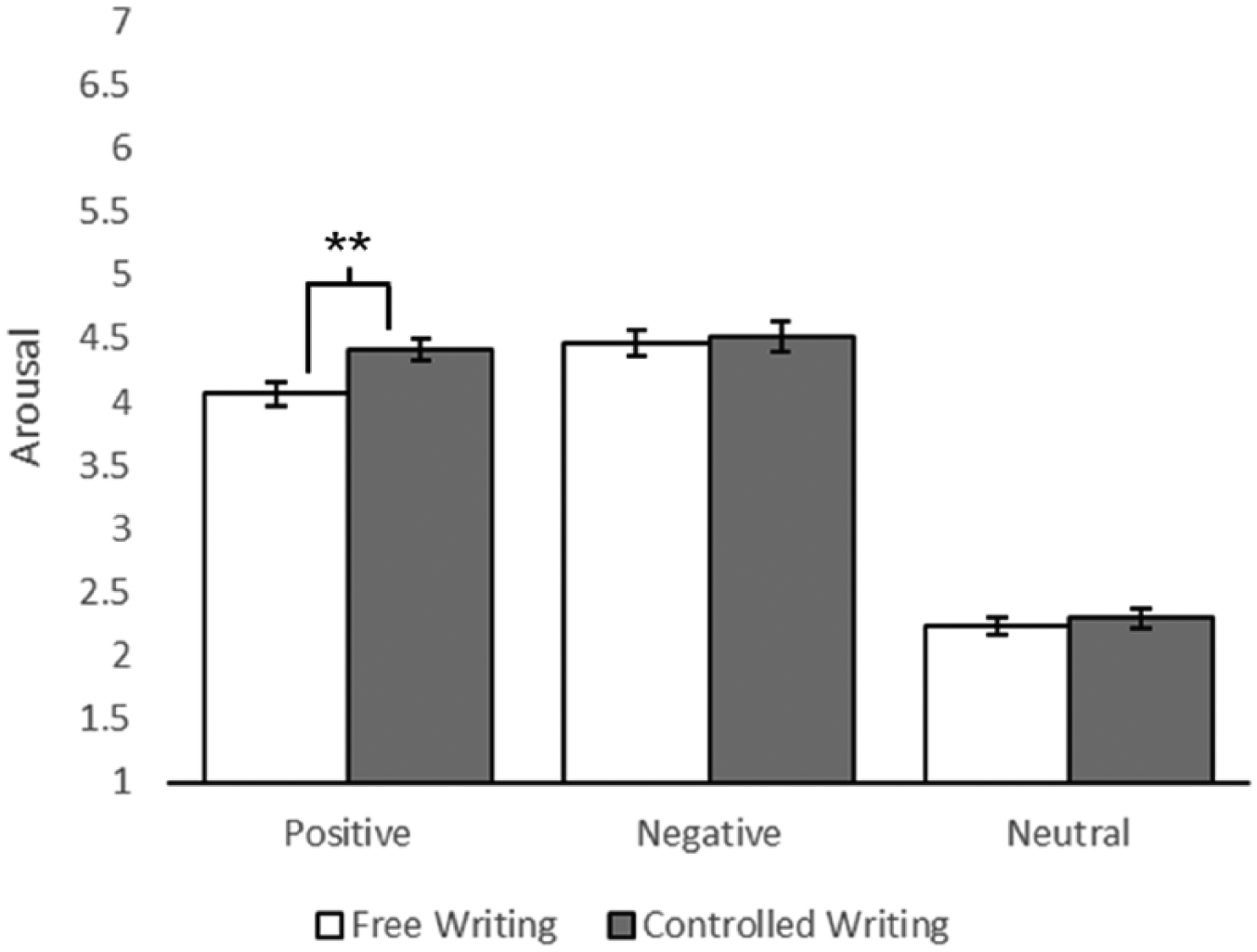
Average arousal response to each image type as a function of writing condition, controlling for neuroticism, extroversion, and sex of participant in Study 2.
Discussion
The results from Study 2 were broadly consistent with the results from Study 1, such that exercising self-control at Time 1 increased positive emotional reactivity at Time 2. In Study 1, the increase in positive emotional reactivity was moderated by trait extroversion (i.e., only more extroverted individuals showed increased positive reactivity after exercising self-control), but in Study 2 the increase in positive emotional reactivity was not moderated by extroversion (i.e., positive reactivity increased after exercising self-control across a wider range of extroversion scores). Furthermore, whereas prior self-control did not influence arousal in Study 1, in Study 2 we found that arousal increased in response to positive images after the controlled writing task compared with the free writing task. The evidence that exercising self-control increased both positive valence and arousal in response to pleasant images is consistent with the process model of ego depletion, which predicts that self-control triggers a subsequent shift in motivation and attention toward more positive events.
We did not replicate in Study 2 the unexpected neuroticism finding from Study 1, whereby prior self-control reduced the association between neuroticism and valence across image types. That finding, which we had not anticipated in Study 1, seems likely to have been a spurious result.
General Discussion
The aftereffects of self-control have been studied extensively from a limited resource perspective. Numerous experiments have found that exercising self-control temporarily undermines success at subsequent acts of self-control, resulting in more aggressive responding to provocation, poorer performance on tests of attention control, and reduced persistence at difficult tasks (for a review, see Baumeister & Vohs, 2016b). Those findings are consistent with the idea that exercising self-control at Time 1 depletes some limited inner resource or strength needed for further self-control at Time 2. However, the resource model has been challenged on both empirical and conceptual grounds, including some notable failures to replicate (see Friese et al., 2018).
The present investigation focused on the aftereffects of self-control for noncontrolled responding. Specifically, in two well-powered experiments, we manipulated the exercise of self-control and then had participants simply view and respond to positive, negative, or neutral photographic images. The state of the limited resource for self-control should be irrelevant during passive picture viewing because participants are under no obligation to control their emotional responses, but we found that exercising self-control at Time 1 influences positive emotional reactivity at Time 2.
In Study 1, performing a controlled writing task boosted the subsequent experience of positive emotional valence in response to positive images only among individuals higher in extroversion. In Study 2, performing the controlled writing task increased both positive valence and arousal in response to positive images regardless of trait extroversion. Exercising self-control had no consistent aftereffects on emotional responses to negative or neutral images. These findings are not readily explained by the resource model of self-control. If anything, the resource model would suggest that exercising self-control increases negative emotional reactivity, insofar as the spontaneous downregulation of negative emotion is reduced under ego depletion, but we found that negative reactivity was unaffected by the prior exercise of self-control.
The observed changes in emotional reactivity are more consistent with a process model of ego depletion, which proposes that exercising self-control causes shifts in motivation and attention toward potential rewards (Inzlicht & Schmeichel, 2012; Inzlicht et al., 2014). In this view, self-control is a frustrating or otherwise aversive endeavor that motivates individuals to seek out more pleasant emotional events. In the pilot study, we found support for the idea that exercising self-control is a frustrating and effortful activity. We propose that frustrating acts of self-control may subsequently bias individuals toward more pleasant “want-to” tasks (Inzlicht et al., 2014; Milyavskaya, Inzlicht, Hope, & Koestner, 2015), presumably out of a desire to achieve a more pleasant emotional state, thereby leading to an increase in positive emotional reactivity.
The current studies complement and advance prior research in three ways. First, these studies revealed aftereffects of self-control for subjective emotional experience, thereby extending past evidence that exercising self-control influences neural indices of motivational orientation (Schmeichel et al., 2016). Second, the current studies tested more participants and thus achieved greater statistical power than previous work, and one of the current studies was a preregistered replication, which reduces experimenter degrees of freedom and Type I error rates. The current research thus used stronger, more transparent research practices relative to previous work. And third, the current findings represent conceptual replications of prior evidence that exercising self-control increases reward sensitivity. The convergent evidence that has emerged across distinct methods of investigation increases confidence in the predictions based on the process model of ego depletion.
Individual Differences in the Aftereffects of Self-Control
The current findings underscore the role of individual differences in understanding the aftereffects of self-control. Most published research on ego depletion has observed main effects (see Hagger et al., 2010). But most prior research, unlike the current studies, used self-control tasks as the dependent measure. The current findings join with other recent evidence to suggest the aftereffects of self-control may extend to noncontrolled responding, and that such aftereffects are moderated by associated traits. For example, Crowell et al. (2014) found that exercising self-control increases personal optimism and attentional breadth, but only among individuals high in approach motivation (who are prone to optimism and to broadened attentional scope; Anderson & Galinsky, 2006; Förster, Friedman, Özelsel, & Denzler, 2006). Insofar as exerting self-control shifts attention and motivation toward hedonism or good feelings, individual differences in reward sensitivity, positive emotionality, and related constructs are likely to moderate the aftereffects, particularly when the Time 2 task taps reward-related responding.
The aftereffects of self-control hinged on individual differences in extroversion in Study 1, such that only more extroverted individuals showed an increase in positive reactivity. In Study 2, more extroverted individuals again showed more positive reactivity after exercising self-control, but less extroverted individuals did, too. Hence, the most consistent pattern across studies was increased positive emotional reactivity among more extroverted individuals. The main difference in the results across the studies was the relationship between extroversion and positive reactivity in the no depletion conditions. Extroversion did not relate to positive reactivity in the free writing condition in Study 1 but did relate to positive reactivity in the free writing condition in Study 2. These different relationships between extroversion and positive reactivity in the absence of prior self-control mirror past research, which sometimes has and sometimes has not found a relationship between extroversion and positive reactivity (e.g., Lucas & Baird, 2004).
Extroversion may be especially likely to influence positive emotional reactivity to appetitive or arousing stimuli, congruent with the idea that extroversion reflects a predisposition toward approach motivation and reward sensitivity (Smillie, Cooper, Wilt, & Revelle, 2012; Smillie, DeYoung, & Hall, 2015). Indeed, we selected positive IAPS images that elicit both high positive valence and high arousal, with the aim of tapping approach motivated positive affect. We propose that extroversion relates to positive emotional reactivity to appetitive stimuli, particularly when approach motivation is activated or primed, such as after an effortful bout of self-control. Future research should consider the extent to which other states associated with an approach orientation (e.g., anger, hunger) influence the relationship between extroversion and positive emotional reactivity.
Furthermore, given recent debates regarding the reliability of the ego depletion effect (Carter et al., 2015; Cunningham & Baumeister, 2016; Job, Dweck, & Walton, 2010; Vohs, Baumeister, & Schmeichel, 2012), it seems sensible to test potential moderators of self-control’s aftereffects. We have suggested that moderation by extroversion (and related traits like approach motivation) is likely specific to reward-related dependent measures. For other types of dependent measures, such as those that involve careful thinking or cognitive control, individual differences in cognitively oriented traits, such as need for cognition or action orientation, may be more relevant (e.g., Gröpel, Baumeister, & Beckmann, 2014). We encourage further research to consider the impact of pertinent traits when assessing the aftereffects of self-control.
Limitations and Future Directions
The process model proposes that exercising self-control causes shifts in attention and motivation toward rewarding stimuli, but it is unclear whether motivation or attention explains the current findings. Perhaps exercising self-control causes extroverted persons to attend more closely to positive images, or perhaps exercising self-control changes how individuals attend to their emotional reactions. Exercising self-control may also have increased reward sensitivity among more extroverted individuals. Additional research is needed to determine the extent to which exercising self-control alters emotional reactivity mainly due to shifts in attention or motivation (especially reward sensitivity).
The current research was also limited insofar as we assessed emotional reactivity using single-item SAM measures of valence and arousal after each picture. These measures are commonly used to track emotional responding to IAPS images (Caria, Sitaram, Veit, Begliomini, & Birbaumer, 2010; Lang et al., 2005; Thiruchselvam, Blechert, Sheppes, Rydstrom, & Gross, 2011), and they permit relatively fast and unobtrusive responses to multiple stimuli. But emotional responding is complex and entails more than just the two dimensions of valence and arousal (e.g., Cowen & Keltner, 2017; Fontaine, Scherer, Roesch, & Ellsworth, 2007; Tellegen, Watson, & Clark, 1999). We used MLM to capitalize on our decision to assess valence and arousal in response to several emotional stimuli, but the single-item SAM measures may have missed relevant aspects of emotional responding (e.g., parsing different forms of positive reactivity, such as excitement vs. interest). Further insight may be gained by using more nuanced measures to assess the emotional aftereffects of self-control.
In addition, the current research used a limited range of picture stimuli to elicit positive affect. We selected positive IAPS images that elicit both positive valence and high arousal, including primarily pictures of appetitive objects and activities. Individuals higher in extroversion appear to be more responsive to events that elicit positive activation (Smillie et al., 2015), and we deemed the selected pictures to be pertinent to this responsivity. The current research is, however, uninformative regarding the impact of prior self-control exertion on responses to stimuli that elicit other forms of positive affect (e.g., low arousal positive affects such as contentment or relaxation). Prior research has found that self-control exertion causes individuals to prioritize rest, which represents a low arousal (low activation) positive affective state (Job, Bernecker, Miketta, & Friese, 2015). Future research is needed to assess the possibility of more nuanced aftereffects of self-control on a wider range of positive emotional events. We suspect that exerting self-control results in more versus less activated positive emotional reactivity depending on the salience of rewarding or arousing positive events.
The current research is also limited by the fact that we did not assess participants’ subjective responses to the manipulation of self-control at Time 1. The pilot study affirmed that the controlled writing task was frustrating and effortful, and we suspect these characteristics of exercising self-control are integral to the observed increases in positive emotional reactivity at Time 2. But we decided not to assess subjective experiences of the Time 1 task during the main studies because asking participants to reflect upon their internal states may have influenced how they subsequently responded to the main dependent measure at Time 2 (i.e., the pictures). Manipulation checks may act as a manipulation (Hauser, Ellsworth, & Gonzalez, 2018). Indeed, prior research has observed that responses to emotional events can be altered by first asking participants to reflect on and report their subjective emotional experience (Kassam & Mendes, 2013; see also Berkowitz, Jaffee, Jo, & Troccoli, 2000). We also decided against asking participants to reflect back on their subjective experiences at the end of the experiment because such responses are susceptible to errors in memory and to other fallibilities in reporting prior subjective experiences (e.g., Thomas & Diener, 1990). Lacking direct measures of feelings of effort and averseness following the writing task, however, it is impossible to test these states as possible mechanisms for the increased positive reactivity observed in the current experiments. Additional research is needed.
Additional research is also needed to examine how the emotional aftereffects of self-control influence behavior. The present results may suggest a potential alternative explanation for self-control failures typically attributed to ego depletion—increased positive reactivity. For example, if exerting self-control causes appetitive stimuli, such as candy, alcohol, and cigarettes, to be enjoyed even more than usual, then this may help to explain why individuals act against their long-term goals and experience a momentary failure of self-control under ego depletion. The present results further suggest that some of the inconsistent results that have cropped up in the ego depletion literature may be due to the use of dependent measures unrelated to positive reactivity. Based on the process model and the current results, we suggest that the ego depletion effect is most likely to emerge for Time 2 tasks that entail the control of reward-related or appetitive impulses.
Linking subjective experiences and behavioral consequences will paint a more complete picture of self-control’s aftereffects and may suggest novel avenues for interventions to improve self-control. Insofar as increases in positive reactivity reflect an underlying increase in approach motivation and reward-seeking, we would also expect increases in the intensity of other approach-related responses, including anger and aggression (Carver & Harmon-Jones, 2009; Harmon-Jones, 2003). Indeed, some evidence suggests that prior efforts at self-control increase acts of aggression (DeWall, Baumeister, Stillman, & Gailliot, 2007; Stucke & Baumeister, 2006). Future research should probe the extent to which the aversive nature of self-control motivates hedonic-oriented emotion regulation, including perhaps anger and aggression, to restore positive affect. This pattern would imply that one way to mitigate the aftereffects of self-control may be to make self-control less aversive (e.g., by providing rewards or other encouragements for exerting self-control). Indeed, this perspective is congruent with evidence that positive affective events may counteract some of the behavioral aftereffects of self-control (Tice, Baumeister, Shmueli, & Muraven, 2007).
Conclusion
Increased scrutiny and skepticism regarding the ego depletion effect has cast doubt on the validity of the limited resource model of self-control. We maintain that exercising self-control has consequential aftereffects, but these may not be the consequence of a depleted resource. The current studies revealed aftereffects of self-control beyond tasks that require self-control. Indeed, self-control exertion influenced spontaneous, noncontrolled emotional responding during a passive image-viewing task in the current studies, such that more extroverted persons experienced more positive emotion. This pattern of results supports the process model of ego depletion and suggests that the aftereffects of self-control may be studied and understood without reference to limited resources.
Supplemental Material
Finley_OnlineAppendix – Supplemental material for Aftereffects of Self-Control on Positive Emotional Reactivity
Supplemental material, Finley_OnlineAppendix for Aftereffects of Self-Control on Positive Emotional Reactivity by Anna J. Finley and Brandon J. Schmeichel in Personality and Social Psychology Bulletin
Footnotes
Declaration of Conflicting Interests
The author(s) declared no potential conflicts of interest with respect to the research, authorship, and/or publication of this article.
Funding
The author(s) received no financial support for the research, authorship, and/or publication of this article.
Notes
Supplemental Material
Supplemental material is available online with this article.
References
Supplementary Material
Please find the following supplemental material available below.
For Open Access articles published under a Creative Commons License, all supplemental material carries the same license as the article it is associated with.
For non-Open Access articles published, all supplemental material carries a non-exclusive license, and permission requests for re-use of supplemental material or any part of supplemental material shall be sent directly to the copyright owner as specified in the copyright notice associated with the article.
