



Abstract
A growing literature on reframing effects has identified a robust negativity bias: Under many circumstances, people’s attitudes change less when framing switches from negative to positive (vs. positive to negative). Like other basic psychological biases, this one is often assumed to reflect a general human tendency, but there are theoretical reasons to expect boundary conditions on when and for whom it operates. In this article, we zero in on age as one important potential moderator, and test competing predictions from different perspectives. Using a large, highly powered data set that synthesizes across multiple past studies (N = 2,452; aged 18-81 years), we fit multilevel models to test the moderating impact of age on reframing effects, as well as single-shot framing effects. We found that (consistent with socioemotional selectivity theory), the negativity bias in reframing attenuated as age increased. We discuss implications for the aging literature and for understanding valence biases more broadly.
A growing body of research suggests that framing an object in positive or negative terms can influence not only people’s immediate evaluations of that object (Kühberger, 1998; Levin, Schneider, & Gaeth, 1998), but also the extent to which those evaluations change later on (Boydstun, Ledgerwood, & Sparks, in press; Ledgerwood & Boydstun, 2014; Sparks & Ledgerwood, 2017). Specifically, research on reframing suggests that in many contexts, negative frames “stick” in the mind and resist the influence of a subsequent frame: Whereas it is relatively easy for people to switch from thinking about something in positive terms to thinking about it in negative terms, it is cognitively more difficult for them to switch from negative to positive (Ledgerwood & Boydstun, 2014; see also Klein & O’Brien, 2016). People’s attitudes therefore often change less in response to reframing when a negatively framed object is reframed in a positive way, compared with when a positively framed object is reframed in a negative way (Boydstun et al., in press; Ledgerwood & Boydstun, 2014; Sparks & Ledgerwood, 2017).
Just as basic valence-framing effects (e.g., evaluating an object more favorably when it is framed positively vs. negatively) are often assumed to reflect general human tendencies, negativity biases in reframing have been assumed to reflect a general and functional human tendency to prioritize negative over positive information (Baumeister, Bratslavsky, Finkenauer, & Vohs, 2001; Kahneman & Tversky, 1979; Ledgerwood & Boydstun, 2014; Rozin & Royzman, 2001 see also O’Brien & Klein, 2017). When such basic effects are demonstrated, scholars tend to assume that they are universal—but this assumption is often unjustified (Henrich, Heine, & Norenzayan, 2010). Thus, if we are to advance our theoretical understanding of framing and reframing effects, it is crucial to probe their generalizability. Although these effects emerge robustly across the samples and contexts that researchers frequently examine, it is possible that these represent a relatively narrow slice of samples and contexts.
The present work advances our understanding of reframing effects by widening that sample, allowing us to ask whether there are theoretically important moderators that determine for whom a negativity bias in reframing operates. In particular, we examine age as one especially important individual difference that may moderate the negativity bias in reframing effects. Past work on reframing has exclusively examined samples of (on average) younger adults (Boydstun et al., in press; Ledgerwood & Boydstun, 2014; Sparks & Ledgerwood, 2017). However, several theories suggest that the way people process valenced information changes as they age, prompting a de-emphasis of negatives and/or prioritization of positives (Cacioppo, Berntson, Bechara, Tranel, & Hawkley, 2011; Carstensen, 2006; Labouvie-Vief, Grühn, & Studer, 2010; Mendes, 2010). For example, according to socioemotional selectivity theory (SST), people’s motivational priorities change as they age, leading them to increase their relative focus on positive (vs. negative) information (Carstensen, 2006). Thus, negativity biases may change across a person’s life span in important ways, and what are often assumed to be universal tendencies to prioritize negative information may in fact be limited to particular ranges of the developmental trajectory. Such a perspective predicts that although younger adults will display a negativity bias, this bias will diminish as age increases (Mather & Carstensen, 2005).
It therefore seems important to test whether age may moderate the negativity bias in reframing effects observed in past studies. Our primary aim in the current study was to conduct a highly powered test of the negativity bias in reframing across a wide range of ages extending into older adulthood. Because this endeavor also provided us with an opportunity to conduct a highly powered test of single-shot framing effects across a wide range of ages, and past work on this question has produced conflicting findings (e.g., Bruine de Bruin, Parker, & Fischhoff, 2007; Mayhorn, Fisk, & Whittle, 2002), we adopted a secondary aim of investigating whether age moderates the impact of a single, current frame on current judgments. The results will deepen our understanding of framing and reframing effects by unpacking when and for whom negativity biases operate as well as provide new data to help inform future work on age-related changes in information processing.
Single-Shot Framing Effects
A vast and multidisciplinary literature has demonstrated that the current frame influences people’s current attitudes: People evaluate an object more favorably when it is described in positive versus negative terms (e.g., Kahneman & Tversky, 1979; Levin & Gaeth, 1988; Levin, Schnittjer, & Thee, 1988; Marteau, 1989; Wilson, Kaplan, & Schneiderman, 1987). For example, studies have found that people rate a medical treatment more positively when it is described in terms of its success rate rather than its failure rate (Marteau, 1989; Wilson et al., 1987), and they rate the quality of ground beef more favorably when it is labeled as “75% lean” rather than “25% fat” (Levin & Gaeth, 1988). This well-established literature illustrates the power of the current frame to influence people’s current attitudes and decisions (see Kühberger, 1998; Levin et al., 1998 for reviews). Such framing effects have been termed attribute framing effects because they emphasize either the positive or negative attributes of an object or issue (e.g., describing a program in terms of its success or failure rate; Levin et al., 1998). Attribute framing effects are often assumed to be universal human tendencies—that is, researchers often assume or imply that such framing effects, similar to other basic psychological effects, generalize to most people, most of the time (Henrich et al., 2010; Levin et al., 1998).
Reframing Effects
Recent work has moved beyond studying single frames in isolation to consider what happens when people encounter different frames in sequence. After all, in everyday life, people often encounter multiple frames: In a political debate, one candidate might highlight the success rate of an employment program, and then another might emphasize the failure rate of that same program. Research on sequentially encountered frames suggests that in many contexts, negative frames tend to resist reframing more than positive frames: That is, people typically change their attitude less in response to reframing when an initial frame is negative (vs. positive; Ledgerwood & Boydstun, 2014).
In their initial work on reframing, Ledgerwood and Boydstun (2014) posited that once a person mentally labels an object in negative terms, that label may stick and make it difficult to reconceptualize the object in positive terms—a mechanism they label cognitive or conceptual stickiness. Supporting such a stickiness mechanism, participants took longer to solve math problems that required converting from a negatively framed concept to a positively framed one, compared to the reverse, and that reframing changed positive construals but not negative ones (Ledgerwood & Boydstun, 2014). Ledgerwood and Boydstun (2014) reasoned that this tendency for negative (vs. positive) conceptualizations to stick more strongly in the mind might represent one more instance of what is often assumed to be a very general human tendency to prioritize negative over positive information (Baumeister et al., 2001; Rozin & Royzman, 2001).
Age as a Potential Moderator
The current work investigates the generalizability of this negativity bias in reframing effects. Although “bad” may outweigh “good” for the average participant in past studies, there are reasons to expect that important boundary conditions constrain this effect (e.g., Carstensen, 2006; Henrich et al., 2010; Higgins & Liberman, 2018). Here, we probe the possibility that negativity biases in reframing effects might differ across the life span. Several theories suggest that how people think about valenced information changes as they age (Cacioppo et al., 2011; Mather & Carstensen, 2005; Mendes, 2010). Applying this insight from the aging literature to the current topic would suggest that the negativity bias in reframing may be limited to younger adults rather than a universal human tendency. We also take the opportunity to explore the potential moderating impact of age on initial or single-shot framing effects. Below, we first outline possible theoretical predictions for the effect of age on single-shot framing effects, and then turn to outline theoretical predictions for how age may moderate the negativity bias in reframing effects.
Age and Framing Effects
Different theoretical perspectives can be used to outline competing predictions for the expected effect of age on classic, single-shot framing effects. One key perspective on aging, SST, describes how motivational priorities change across the life span (Carstensen, 2006; Reed & Carstensen, 2012; Reed, Chan, & Mikels, 2014). This perspective suggests that younger adults, who feel their future time horizons are relatively open ended, will tend to prioritize future-oriented goals such as expanding knowledge and having new experiences, whereas older adults, who feel their future time horizons are more constrained, will instead prioritize present-focused goals related to emotional satisfaction and meaning. 1 According to SST, as people age, these changes in goal priorities shift attention and memory toward goal-congruent information and away from information that may interfere with these goals. Thus, SST suggests that whereas adults will tend to prioritize negative information when they are younger, they will increasingly attend to and remember positive (vs. negative) information as they age. Consistent with this notion, a wealth of research on attention, memory, and decision making has documented age-related changes in the relative prioritization of negative versus positive information (e.g., Charles, Mather, & Carstensen, 2003; Isaacowitz, Wadlinger, Goren, & Wilson, 2006; Löckenhoff & Carstensen, 2007; see Reed et al., 2014 for a review). For example, research has found that as people age, they pay less attention to negative (vs. positive) stimuli (Isaacowitz et al., 2006), and they experience less brain activity from negative (vs. positive) events (Wood & Kisley, 2006). Scholars in this area describe this motivational change as functional: The shift from a negativity bias for younger adults toward a positivity bias for older adults may serve to improve older adults’ mood and well-being in the present moment (Carstensen & Mikels, 2005; Mather & Carstensen, 2005).
In sum, SST suggests that there should be a shift in focus from negativity to positivity as people age. Applying this theorizing to single-shot framing effects, we reason that there are three specific predictions one could make that would be consistent with such a shift: As people age, they will become (a) more susceptible to positive frames, (b) less susceptible to negative frames, or (c) both more susceptible to positive frames and less susceptible to negative frames.
However, work on heuristic information processing could suggest a different prediction. Studies in this area have demonstrated that heuristic (vs. systematic) processing can increase susceptibility to framing effects (e.g., McElroy & Seta, 2003). Moreover, there is evidence that older adults may rely more on heuristics than younger adults (Besedeš, Deck, Sarangi, & Shor, 2012; Gonsalkorale, Sherman, & Klauer, 2009; Johnson, 1990). Researchers have drawn on such studies to predict that older adults will be more susceptible to both positive and negative frames compared with their younger counterparts (Bruine de Bruin, Parker, & Fischhoff, 2012; Kim, Goldstein, Hasher, & Zacks, 2005). If this is the case, then age should enhance the impact of both positive and negative frames on attitudes, such that the classic effect of framing on attitudes increases across the life span. (Note that although we focus here on predictions derived from SST and a heuristic processing perspective, other perspectives on aging could also be used to make predictions about age and framing; we return to these in the discussion.)
Inspired by some of these perspectives, several prior studies have explored whether age moderates single-shot framing effects (e.g., Bruine de Bruin et al., 2007, 2012; Goldsmith & Dhar, 2013; Kim et al., 2005; Mikels & Reed, 2009; Rönnlund, Karlsson, Laggnäs, Larsson, & Lindström, 2005; Shamaskin, Mikels, & Reed, 2010). But this work has produced conflicting results. Some studies found no age differences in framing effects (Mayhorn et al., 2002; Rönnlund et al., 2005). Meanwhile, however, other work has suggested that age enhances the effects of both positive and negative frames, consistent with a heuristic processing account (Bruine de Bruin et al., 2007; Kim et al., 2005). And yet, other studies have found that age decreased the relative power of negative versus positive frames, consistent with SST (Goldsmith & Dhar, 2013; Mikels & Reed, 2009; Shamaskin et al., 2010).
One possible explanation for these inconsistencies could be that many of these studies relied on relatively small sample sizes, which can lead to imprecise estimates that tend to fluctuate from one study to the next (Ledgerwood, Soderberg, & Sparks, 2017; Schönbrodt & Perugini, 2013), especially when testing moderators. It is also possible that inconsistencies in prior work could be due to the different types of frames studied (risky choice vs. attribute vs. goal or incentive framing; see Levin et al., 1988), but of course, it is difficult to know whether differences across small studies reflect meaningful moderators or statistical noise. A highly powered test of the effect of age on single-shot framing effects would advance our cumulative understanding of how framing effects may change across the life span.
In the present work, we chose to focus on attribute framing, which is arguably the most basic type of framing where a single attribute of an object is described in (mathematically equivalent) positive vs. negative terms. Attribute framing therefore provides the most straightforward context in which to test how age influences valence-framing effects, without conflating valence with people’s risk preferences or goal orientations. Moreover, attribute frames are the type of frame most commonly used to study reframing effects, which enables us to test our research questions with high statistical power. Future studies could then test whether the results observed here would generalize to other types of framing effects.
Age and Reframing Effects
Despite the recent interest in exploring age differences in how people respond to single frames, thus far, no work has looked at age differences in how people respond when information is reframed. This question seems critical to address: If there are developmental shifts in how people process valenced information, as suggested by the aging literature, then initial reframing research may paint an incomplete picture of how valence biases operate in the context of sequentially encountered frames. Indeed, SST makes a clear prediction that the negativity bias in reframing should diminish as age increases.
Despite this clear prediction from SST, one could also generate a competing prediction for how age may moderate reframing effects, drawing on a heuristic processing account (Gonsalkorale et al., 2009; Johnson, 1990). Older adults may have fewer cognitive resources to think carefully, leading them to use heuristics (like whichever frame is right in front of them) more than younger adults. This heuristic processing account would suggest that, regardless of an initial frame’s valence, older (vs. younger) adults will simply change their attitudes more in response to reframing. Such a prediction would be supported by a pattern of results indicating that the absolute amount of attitude change increases with age, and that the negativity bias in reframing effects (i.e., the difference in attitude change between people who see the positive vs. negative frame first) remains stable across the life span.
Testing these competing predictions could help clarify the conditions under which negativity biases in reframing operate, as well as provide new clues into the processes by which reframing can bias people’s judgments. If we are to fully understand how framing and reframing effects operate, we must examine whether and how they change over the life span. If robust age effects were to emerge, they could inform future theorizing about framing and reframing by suggesting that past research has delineated how these effects operate specifically in younger minds, whereas older minds may display substantially different patterns of bias. Thus, in the current work, we set out to investigate whether age moderates the negativity bias in reframing effects, as well as whether age moderates single-shot framing effects.
Method
Ensuring adequate statistical power is important for maximizing the informational value provided by a study (Button et al., 2013; Ledgerwood et al., 2017), but testing interactions with high power can require substantial sample sizes when the variables are not within subjects (Giner-Sorolla, 2018). To maximize our power to examine the potential moderating impact of age on reframing effects, we chose an analytic strategy that would allow us to aggregate across all of the individual studies that our lab has conducted examining reframing effects. We fit linear mixed effects models using the nlme package (Pinheiro, Bates, DebRoy, Sarkar, & Core Team, 2016) in the R environment (R Core Team, 2016). Multilevel modeling provides a valuable tool to investigate our research questions by formally modeling the hierarchical structure of our data with participants nested within study. 2 This analytic strategy accounts for the fact that participant responses from within the same study may be more highly correlated than participant responses across different studies. We decided a priori to include all studies conducted in our lab (both published and unpublished) that examined reframing effects using attribute frames. 3 We identified eight relevant studies, involving a total of 2,452 participants (1,379 men, 1,060 women, and 13 unreported; see Table 1 for a summary of key study details).
Demographic Information and Details for Each Study.
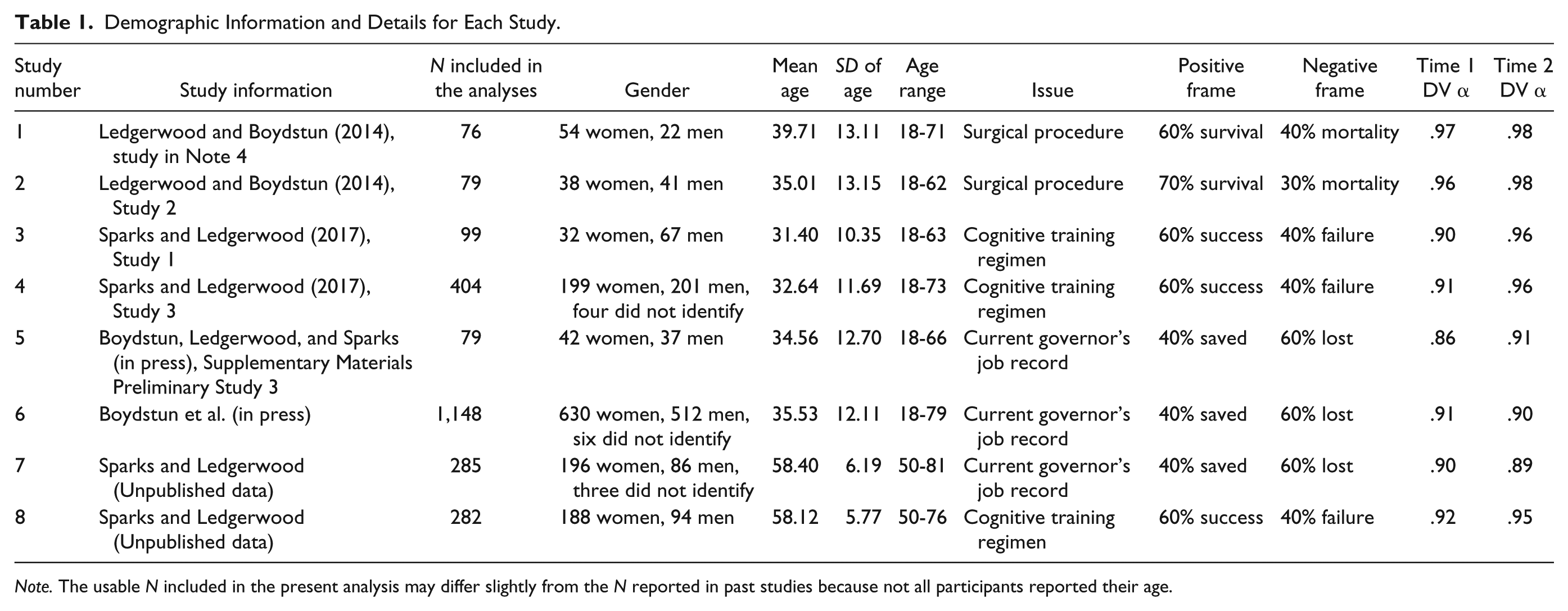
Note. The usable N included in the present analysis may differ slightly from the N reported in past studies because not all participants reported their age.
In each of these past studies, participants were recruited from Amazon’s Mechanical Turk (MTurk) and were randomly assigned to framing condition. 4 One key benefit of these MTurk samples over more traditional college samples is that they included participants from a diverse range of ages, allowing us to test the potential moderating role of age in the current article. Indeed, the last two samples were collected for the primary purpose of adding additional data points at the upper end of the age distribution. Importantly, older adult participants recruited on MTurk have been shown to be comparable with older adults recruited in community samples (Lemaster, Pichayayothin, & Strough, 2015). Moreover, MTurk samples have been shown to perform equally well to community samples on attention checks, and we have observed comparable reframing effects in online MTurk studies and lab-based student samples (Ledgerwood & Boydstun, 2014; Ledgerwood et al., 2017; Peer, Samat, Brandimarte, & Acquisti, 2015). Thus, we feel confident that these data can provide an important window into assessing the potential moderating impact of age on framing and reframing effects with both high experimental control and high power. At the same time, an important next step in establishing generalizability would be to replicate the findings from these highly powered analyses using a more externally valid community sample.
Typical Study Procedure
Each of the individual studies employed a similar procedure (see Supplemental Materials for example study materials). Participants took part in a study about “how people’s opinions about current events form and change over time as they learn new information about an issue.” They learned about a particular issue (e.g., the current Governor’s jobs record), which was initially framed in either positive terms (e.g., 40% of jobs were saved) or negative terms (e.g., 60% of jobs were lost). For example, in Study 5, participants read that “when the current Governor took office, statewide budget cuts were expected to affect 10,000 jobs, which would in turn affect the state and national economies.” In the positive-first condition, participants read that under the current Governor’s leadership, 40% of these jobs had been saved.
After reading this initial frame, participants rated their attitudes toward the issue by moving sliders along three unmarked, continuous scales anchored at the end points (e.g., very negative to very positive, harmful to beneficial, and completely oppose to completely favor). These scales were coded such that higher numbers always indicated more favorable attitudes toward the issue being framed. The three items were then averaged to form an index of attitudes toward the issue at Time 1 (see reliabilities reported in Table 1).
Next, participants read what was described as “additional information” about the issue—which was in fact the same information they had already seen, but now described using the opposing frame. For example, participants in the positive-first condition in Study 5 now read: “Critics of the current Governor point out that 60% of these jobs have been lost under the Governor’s leadership.” Thus, the information presented at the two time points was mathematically equivalent, but the language used to describe the issue switched either from positive to negative or from negative to positive.
Participants then rerated their attitudes toward the issue using the same three slider scales from Time 1, which were averaged to form an index of attitudes toward the issue at Time 2 (see Table 1 for scale reliabilities).
Grand mean-centered age
In each study, participants reported their age in years as part of a series of standard demographic questions. Figure 1 depicts a histogram showing the distribution of age for all participants included in the analyses.
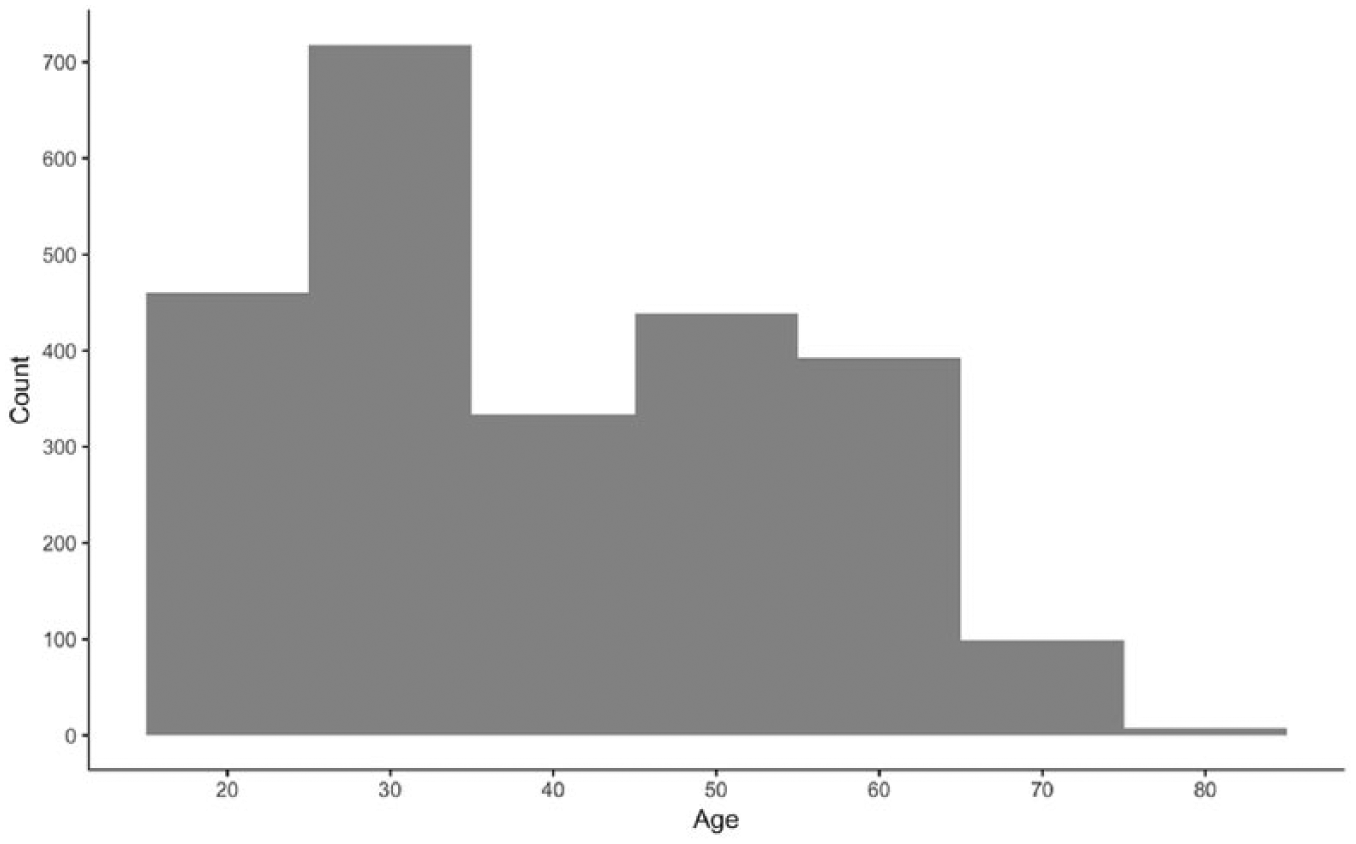
The distribution of age in Studies 1 to 8 included in the analyses.
To specify our multilevel models, we first calculated the grand mean age across all eight studies. We then centered participant ages around the grand mean (40.67 years old), by computing the difference between a participant’s reported age and the grand mean age. Using the grand mean for centering aids interpretation of our results by ensuring that we consistently compare people at the same meaningful age across studies (Bickel, 2007; Hox, 2002).
Results
Time 1 Framing Effects
Our first research question focused on whether age moderates the typical effect of positive (vs. negative) frames on attitudes in a single-shot framing context (i.e., Time 1 attitudes in these studies, when participants have only encountered a single positive or negative frame). To test this question, we fit a linear mixed effects model with Time 1 attitudes as the dependent variable. We specified study as a random intercept and added random slopes for initial frame valence (effects-coded: 1 = positive, −1 = negative), grand mean-centered age, and the interaction between those two predictors.
Across our eight studies with a total of 2,452 participants, the intercept effect was large and positive, B = 53.888, SE = 3.898, t(2439) = 13.825, p < .0001, representing the mean Time 1 attitude at the grand mean age. The frame valence effect was large and positive, B = 10.565, SE = 1.240, t(2439) = 8.517, p < .0001, indicating that on average, participants displayed a classic framing effect—they evaluated an issue more favorably when it was framed in positive rather than negative terms.
The possible predictions we derived from SST were that (1) people would be more susceptible to positive frames as age increases and/or that (2) people would be less susceptible to negative frames as age increases. If (3) both of these predictions occurred in our data, we would see an overall effect of age on Time 1 attitudes, such that attitudes simply became more positive in response to both positive and negative frames as age increased. In contrast, we found no overall effect of age on Time 1 attitudes, B = −0.029, SE = 0.077, t(2439) = 0.377, p = .706.
If only one but not the other possible predicted pattern we derived from SST occurred in our data, we would see an interaction between age and frame valence condition, such that attitudes become more positive in response to either positive frames or negative frames as age increases. Likewise, a heuristic processing perspective would predict an interaction between age and frame valence condition; in this case, the predicted pattern would be an amplification of the size of the classic framing effect as age increases. The results of our analysis indicated that the age by frame valence interaction effect was positive, B = 0.136, SE = 0.058, t(2439) = 2.334, p = .020. Figure 2 plots predicted values from the multilevel model across the age range in our sample. Follow-up simple slopes tests revealed a pattern that could be consistent with either the first SST prediction or the heuristic processing prediction: As people age, there is a nonsignificant trend toward increased susceptibility to positive frames, B = 0.107, SE = 0.064, t(2439) = 1.677, p = .094, and a nonsignificant trend toward increased susceptibility to negative frames, B = −0.165, SE = 0.121, t(2439) = 1.362, p = .173 (see Figure 2). In other words, by themselves, these results do not clearly support the first SST prediction (age will enhance the effect of positive but not negative frames) over a heuristic processing prediction (age will enhance the effect of both positive and negative frames) or vice versa. However, they do help rule out the idea that age will attenuate the impact of a negative frame (the second and third versions of the SST prediction outlined in the introduction).
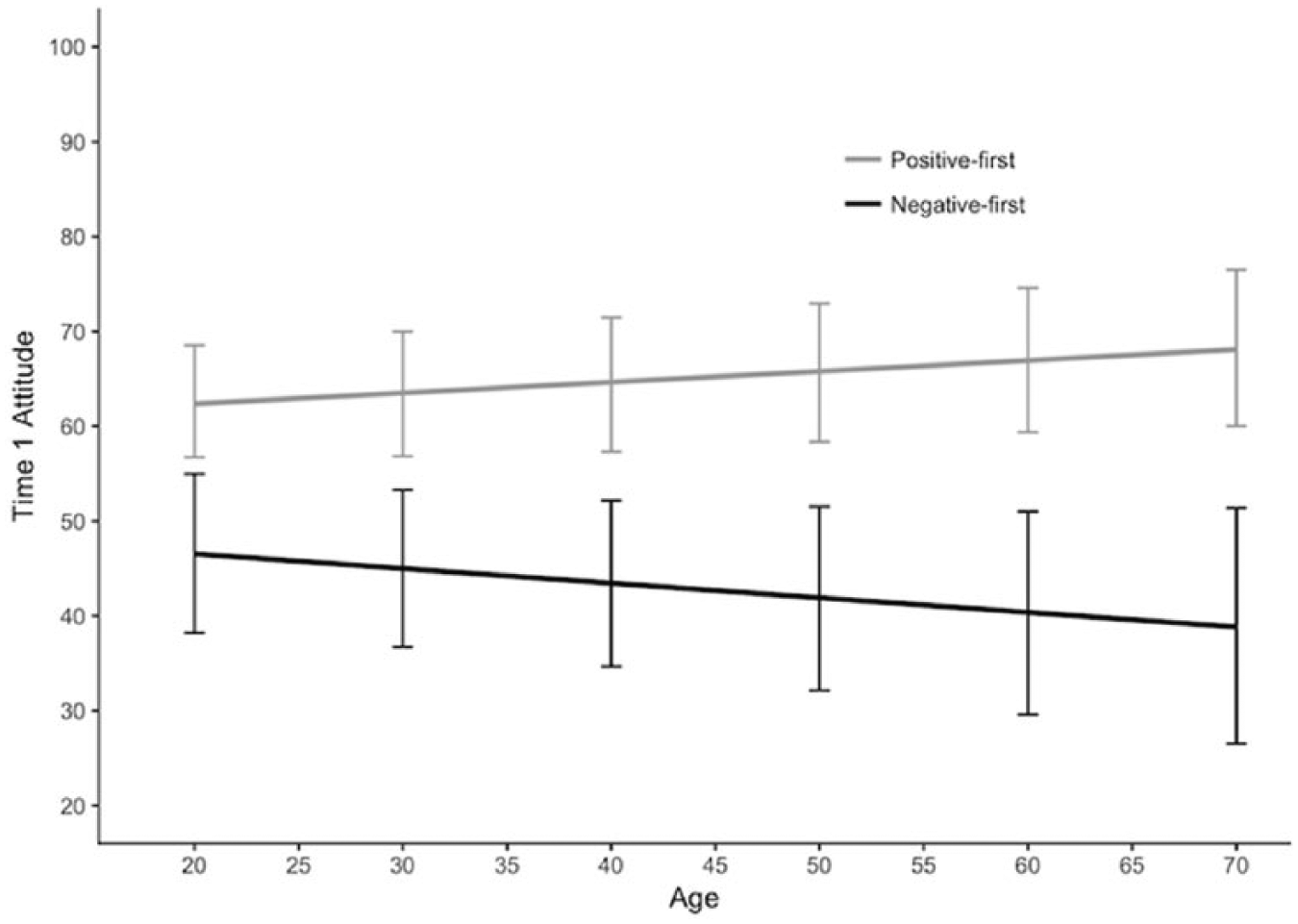
Plot of predicted values from the linear mixed effects model across the age range in our sample.
Reframing Effects
To test our more central research question—whether age moderates reframing effects—we fit a second linear mixed effects model, now with the dependent variable of attitude change toward the Time 2 frame (i.e., the amount each participant shifted away from the Time 1 frame in the direction of the Time 2 frame). 5 Once again, we specified study as a random intercept and added random slopes for initial frame valence (effects-coded: 1 = positive, −1 = negative), grand mean-centered age, and the interaction between those two predictors.
Across the eight studies, the intercept effect was large and positive, B = 13.488, SE = 1.106, t(2439) = 12.199, p < .0001, reflecting the fact that on average, participants’ attitudes tended to move toward the Time 2 frame (an average of about 13.5 points on the 100-point scale). The effect of frame valence order was large and positive, B = 3.552, SE = 0.445, t(2439) = 7.977, p < .0001, reflecting the negativity bias in reframing effects documented previously in individual studies (Boydstun et al., in press; Ledgerwood & Boydstun, 2014; Sparks & Ledgerwood, 2017): Participants’ attitudes changed less in response to reframing when the initial frame was negative (vs. positive).
The specific prediction derived from research on heuristic processing was that people would be generally more prone to changing their attitudes in response to reframing as they age. This prediction would manifest as a main effect of age on attitude change, such that regardless of frame valence, people would change more toward the Time 2 frame as they age. Inconsistent with this prediction, we found no overall effect of age on attitude change, B = −0.029, SE = 0.055, t(2439) = 0.536, p = .592. In other words, it does not seem to be the case that older (vs. younger) participants are generally more prone to changing their attitudes in response to reframing. Interestingly, the lack of a main effect also means that the tendency for older participants to become more susceptible to a Time 1 framing effect (as documented above) does not persist across time points; we see no evidence that older (vs. younger) participants are more susceptible to reframing effects at Time 2.
SST makes a clear prediction for how age will moderate reframing effects, suggesting that the negativity bias in reframing documented in past research should diminish as age increases. Consistent with this prediction, an interaction emerged between age and frame valence order, B = −0.115, SE = 0.045, t(2439) = 2.529, p = .012, indicating that age moderated the negativity bias observed in prior studies on reframing. As indicated in Figure 3, the negativity bias displayed among younger participants (i.e., the vertical distance between the gray and black lines) decreased as age increased.
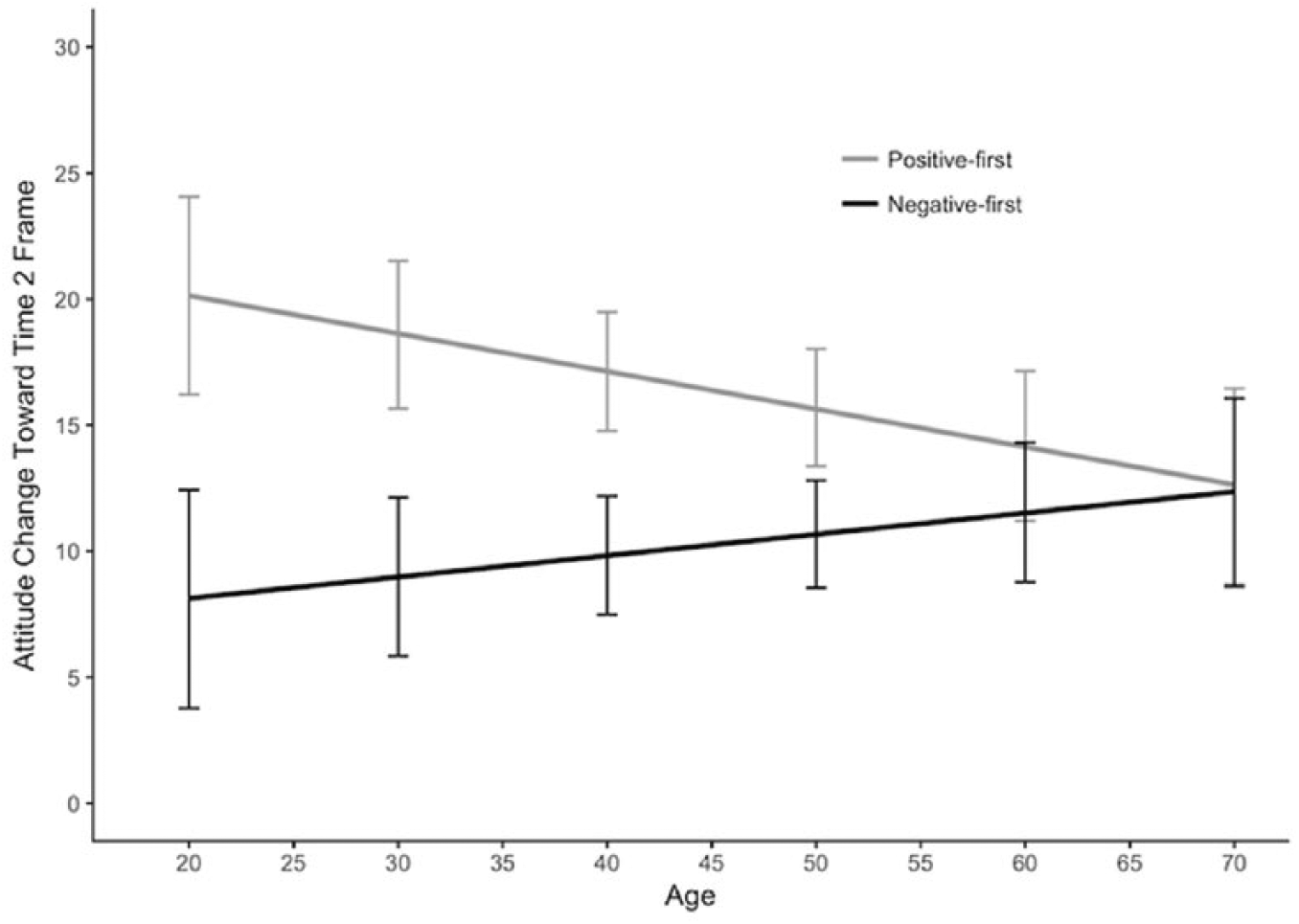
Plot showing predicted values based on the linear mixed effects model across the age range in our sample.
To further explore how the negativity bias in reframing changed across the range of ages represented in our sample, we conducted follow-up tests to estimate the extent of negativity bias at a series of specific ages. To ensure that we were not extrapolating beyond the data available, we examined the distribution of ages in our sample (see Figure 1) and chose a set of evenly spaced ages that represented meaningful values in our data (these ages were chosen a priori in that we selected and recorded them before testing the effect of frame valence order at any particular age). We recentered age at 20, 30, 40, 50, and 60 years and then followed the same analytic strategy described in the main analyses above.
The resulting estimates for the negativity bias and their associated statistical tests at each age are displayed in Table 2. At 20 years of age, the frame valence order effect was large and positive (B = 12.050, see Table 2), indicating that participants displayed a strong negativity bias in reframing at this age. This estimate indicates that a 20-year-old participant who saw the negative frame first is predicted to change their attitude about 12 points less in the direction of the Time 2 frame, compared with a 20-year-old participant who saw the positive frame first. At ages 30 and 40 years, the negativity bias was smaller in size but still present (note that our estimates at these ages are also more precise, because they are based on more participants). At 50 years of age, the negativity bias was smaller still, and at 60 years, it became indistinguishable from zero. These analyses suggest that around 60 years of age, the negativity bias in reframing started to disappear and participants began to exhibit more evenhanded sensitivity to negative and positive reframing (see also Figure 4).
Estimated Negativity Bias in Reframing at Age 20, 30, 40, 50, and 60 years.

Note. We calculated these estimates by doubling the multilevel model fixed effects coefficients for frame valence order and associated standard errors at each of our preselected ages (coefficients are doubled because frame valence order is effects coded rather than dummy coded). The estimates represent the negativity bias (i.e., the vertical distance between the gray and black predicted regression lines in Figure 3) at age 20, 30, 40, 50, and 60 years. Standard errors are provided in parentheses. By 60 years of age, the negativity bias is very small and no longer statistically significant.
p < .001.

Plot showing the predicted negativity bias in reframing with 95% confidence intervals at each age (i.e., 20, 30, 40, 50, and 60 years) used for planned follow-up tests.
Discussion
The current work investigated the moderating impact of age on both single-shot framing effects and reframing effects. The results of our first multilevel model suggested that age moderates single-shot framing effects: We found nonsignificant trends toward increased susceptibility to both positive and negative frames as age increases. This finding is potentially consistent with either the first SST prediction (i.e., age will increase susceptibility to positive frames but not negative frames) or the heuristic processing prediction (i.e., age will increase susceptibility to both positive and negative frames). This finding also mirrors results from (to our knowledge) the only other data set to assess age and attribute framing: Bruine de Bruin et al. (2007, 2012) report results from a data set that measured participants’ general susceptibility to a combination of risky choice and attribute frames. Their findings suggest that age enhances the size of these framing effects on average. Our findings add to this literature by providing the first highly powered, clear, and direct test of age on attribute framing effects specifically. 6 One important next step for this literature will be to adapt our approach for other types of framing (risky choice framing and goal framing) to assess whether our results generalize to these other types of frames or whether there are theoretically consequential differences in the effects of age on different types of framing (see Levin et al., 1998, for a fuller discussion of different frame types and why it is important to distinguish between them).
Most importantly for the purposes of this article, our second multilevel model found that age moderates the negativity bias observed in previous research on reframing. Whereas younger adults displayed the negativity bias in reframing effects found in past research, such that their attitudes changed less when frames switched from negative to positive (vs. positive to negative; Boydstun et al., in press; Ledgerwood & Boydstun, 2014), as age increased, adults were more evenhanded in their response to reframing. The results of the reframing analysis are uniquely consistent with SST’s prediction that negativity bias will decrease with age. Thus, although the framing analysis resulted in theoretically ambiguous findings (i.e., potentially consistent with SST or heuristic processing), the results of our reframing analysis provide additional evidence suggesting that SST provides the most parsimonious theoretical account for our data.
The present work provides the first evidence circumscribing for whom negativity biases in reframing effects operate, suggesting a key boundary condition to an effect that had thus far persisted robustly across multiple scenarios and samples. Why might this bias attenuate and even disappear as age increases? Building on past work that has investigated the psychological mechanisms underlying reframing effects (Ledgerwood & Boydstun, 2014), we suspect that the current results reflect a tendency for the conceptual stickiness of negative (vs. positive) frames to change across the life span. Specifically, initial research on reframing effects suggested that negative (vs. positive) conceptualizations tend to stick more strongly in the mind: It takes people longer to convert a negatively framed concept into a positively framed concept than to move in the opposite direction, and reframing changes positive construals more than negative construals. It therefore seems reasonable to posit that as age increases, this negativity bias in conceptual stickiness may attenuate, leading to the results we observe here.
However, other possible explanations for the observed moderating role of age on reframing effects deserve careful consideration as well. The first alternative explanation we considered was that perhaps people become more rational (i.e., wiser) as they grow older (Grossmann et al., 2010)—or perhaps the subset of older people who are on MTurk are particularly rational—such that they are simply less susceptible to normatively irrelevant contextual features (e.g., which frame they encounter first). Yet, if it were in fact the case that age increased rationality in this manner, we would also expect that age would reduce susceptibility to single-shot framing effects. In other words, if this increasing rationality account explained our data, we should have observed the Time 1 framing effect diminishing with age. Instead, we found evidence that age increased the Time 1 framing effect, and thus, our results appear inconsistent with an increasing rationality or wisdom account. Thus, although adults may of course gain wisdom from life experiences, this account does not seem to parsimoniously explain our data.
A second alternative explanation we considered was that memory might decline as age increases, and so perhaps our results could be explained by increasing age leading adults to simply not remember the first frame, regardless of valence (e.g., see LeBoeuf & Shafir, 2003; Stanovich & West, 2008). In other words, we might see a reduction in the tendency for negative (vs. positive) frames to persist in the face of reframing if declining memory were leading all frames to wear off more quickly as people aged. However, if it were in fact the case that age leads people to forget an initial frame more quickly, we should have also observed a main effect of age on attitude change: As people age, their attitudes should show greater change in the direction of the Time 2 frame, regardless of frame valence. Given that we observe no main effect of age on attitude change, this declining memory account does not seem to provide a parsimonious explanation for our findings.
Taken together, then, these considerations lead us to favor the hypothesis that age changes the relative stickiness of negative (vs. positive) conceptualizations as the most parsimonious and consistent explanation for our results—but of course, further research is needed to directly test this explanation for the moderating role of age on reframing effects.
Implications for Understanding Negativity and Positivity Biases
Research across diverse topic areas has demonstrated a pervasive tendency for people to give greater weight to negatives than positives. For example, studies have found that people pay more attention to negative than positive information and process it more thoroughly (Fiske, 1980), they respond more strongly to negative than positive emotions (Clore & Ortony, 1988), and they prioritize negative over positive data when forming impressions of others (Anderson, 1965). Synthesizing evidence across research domains, scholars have argued that as a general principle, negatives are more powerful than positives (Baumeister et al., 2001; Rozin & Royzman, 2001).
However, what seem to be general principles about basic psychological processes can often prove to be more circumscribed than researchers at first expect (Henrich et al., 2010; Higgins & Liberman, 2018). The results of our reframing analysis suggest that the negativity bias in reframing—a finding that had persisted robustly across multiple samples and scenarios—may not generalize across the life span. In other words, the results of past studies do not reflect a general human bias, but rather a more specific, young adult bias. The present work is the first to identify age as an important boundary condition to the negativity bias in reframing effects, adding to the growing literature delineating how negativity biases change across the life span (see Reed et al., 2014, for a review) and providing an important empirical constraint on future theorizing about negativity biases in reframing. The current results highlight the importance of testing other theoretically relevant boundary conditions to reframing, to expand our understanding of the precise conditions under which negativity and positivity biases emerge (see also Sparks & Ledgerwood, 2017).
Furthermore, the fact that we see different patterns of results for framing and reframing effects underscores the importance of studying how negativity and positivity biases operate when information is encountered sequentially over time, rather than just in one single-shot context. Our reframing paradigm may provide a useful tool to further explore for whom and under what conditions negativity and positivity biases emerge and dissipate (e.g., positivity biases related to self-enhancement; O’Brien & Kardas, 2016; negativity biases in diagnosing change; O’Brien & Klein, 2017).
Implications for the Aging Literature
The main goal of our study was to apply theory and research from the aging literature to advance our understanding of framing and reframing effects, but we can also consider the potential usefulness of these data for informing the aging literature. Of course, the results of our reframing analysis add to a growing literature documenting the age-related positivity effect predicted by SST (see Reed et al., 2014, for a review). But perhaps more interestingly, our data may also provide some clues to help future researchers interested in teasing apart different potential mechanisms for the positivity effect. For example, recall that our Time 1 framing results helped rule out the idea that as age increases, the impact of a negative frame decreases. This observation is potentially consistent with an explanation for the positivity effect that focuses on an age-related shift in motivational priorities (see Carstensen, Isaacowitz, & Charles, 1999, for a full discussion of a life span theory of motivation), as noted earlier. In contrast, because we do not see the impact of the negative frame decreasing with age, it seems challenging to reconcile these data with an explanation that focuses on age-related declines in the amygdala that inhibit responses to negative but not positive information (see Cacioppo et al., 2011, for a full discussion of the aging-brain model). More broadly, these data illustrate the potential usefulness of studying both framing and reframing effects for elucidating processes related to aging: By jointly examining the effects of age on both framing and reframing, we can learn more than if we studied only one or the other effect in isolation.
Moreover, our reframing result suggests interesting possible links between the cognitive mechanism presumed to underlie the negativity bias in reframing (i.e., conceptual stickiness) and motivational priorities. For instance, one could interpret the reframing finding as suggesting that the conceptual stickiness mechanism observed in younger adults (Ledgerwood & Boydstun, 2014) may stem from motivational concerns (e.g., a sensitivity to potential threats in younger age; Carstensen, 2006) that can change across time and situations. Future work might fruitfully explore whether age-related changes in these motives turn on and off the mechanisms underlying reframing effects, as well as whether manipulating these motives produces comparable results (see e.g., Pruzan & Isaacowitz, 2006).
Limitations and Future Directions
We have assumed that our results describe a developmental trajectory, but of course, these data are cross-sectional, and it is possible that the pattern we observe could be due to a cohort effect. For instance, perhaps the relatively younger adults in our sample grew up in a time when they were simply exposed to more negative information about the world (e.g., via the Internet). Yet, when we consider the current results in the context of the broader literature on SST, it seems likely that they reflect developmental changes. Longitudinal and experimental work on SST has found effects that generalize over time and across cohorts. For example, longitudinal work has shown that with increasing age, people recall more positive memories about their childhood (Field, 1981; Löckenhoff & Carstensen, 2004), experimental work has found that manipulating time horizons can produce patterns of results that look like typical age differences in valenced biases (Carstensen, 2006; Fung & Carstensen, 2003), and research has found that older adults report being more satisfied with their relationships than younger adults within and across cohorts spanning four decades (Lansford, Sherman, & Antonucci, 1998). Thus, we believe the current results are likely to replicate in a longitudinal design, and they provide an important and useful first step that suggests longitudinal research on this question is well worth conducting.
The finding that age attenuates the negativity bias in reframing effects supports the hypothesis (derived from SST) that negativity biases should decrease across the life span. We feel confident that the attenuation of the negativity bias describes our sample in the age range of 18 to 60 years old (where we have a large amount of data), but we are less sure about what happens beyond the age of 60 years. One interesting possibility (predicted by SST) is that the linear trend continues, such that at even older ages (approximately 72 years of age; see Reed et al., 2014), people exhibit a positivity bias in reframing effects (i.e., less attitude change when frames switch from positive-to-negative vs. negative-to-positive). In other words, it may be the case that after 72 years, adults begin to display a positivity bias in reframing such that initial positive frames stick in the mind more strongly than initial negative frames. A different possibility is that age-related cognitive declines may produce a nonlinear effect (see Labouvie-Vief, DeVoe, & Bulka,1989; O’Brien, Konrath, Grühn, & Hagen, 2012), such that adults in their 70s and 80s are—like adults in their 60s—evenhanded in their response to reframing. Future research could test these possibilities, as well as the generalizability of our current results, by recruiting a large community sample of adults at the higher end of the age range where a reversal from negativity bias to positivity bias could be theoretically expected to occur.
Finally, we note that the present analyses examine reframing effects in the loss domain, where people are considering the possibility of experiencing a negative event or punishment (e.g., lives lost due to an unusual disease, jobs lost due to an economic policy), framed in either positive terms (e.g., lives saved) or negative terms (e.g., lives lost). We chose to focus on the loss domain in the current work because the majority of the extant framing literature—and much of our own work on reframing effects—focuses either implicitly or explicitly on the loss domain (Boydstun et al., in press; Ledgerwood & Boydstun, 2014; Tversky & Kahneman, 1981; see Levin et al., 1998, for a review), and we wanted to build on this work and connect it to the literature on aging. At the same time, new findings suggest that reframing effects may operate differently in the understudied gain domain: Under certain conditions, positive (vs. negative) frames can be stickier when people are considering potential gains (e.g., a training regimen to enhance memory capacity, rather than a training regimen to prevent memory loss; Sparks & Ledgerwood, 2017). Given the important moderating role of age uncovered in the current work in the loss domain, future research might fruitfully examine the moderating role of age in the gain domain as well.
Conclusion
The present work suggests that age may function as a critical moderator circumscribing negativity biases in reframing. This finding adds to mounting evidence that reframing effects reflect functional biases (i.e., biases that serve evolutionary and/or current motivational priorities) in different contexts and across the life span (Sparks & Ledgerwood, 2017). Recent work on reframing has identified boundaries to negativity bias in contexts that promote the (presumably functional) discovery of rewards (Sparks & Ledgerwood, 2017). In a similar way, the current findings suggest that age may attenuate and even eliminate the previously observed negativity bias in reframing effects, a pattern that could functionally boost mood and well-being when future time horizons are limited. This research paves the way for future work to explore additional theoretically relevant moderators to reframing effects, thereby contributing to an integrative understanding of negativity and positivity biases.
Supplemental Material
Sparks_OnlineAppendix – Supplemental material for Age Attenuates the Negativity Bias in Reframing Effects
Supplemental material, Sparks_OnlineAppendix for Age Attenuates the Negativity Bias in Reframing Effects by Jehan Sparks and Alison Ledgerwood in Personality and Social Psychology Bulletin
Footnotes
Acknowledgements
The authors thank Cheryl Wakslak, Wiebke Bleidorn, Yilin Andre Wang, and Roger Sparks for their helpful feedback at various stages of this project and on earlier versions of this article.
Declaration of Conflicting Interests
The author(s) declared no potential conflicts of interest with respect to the research, authorship, and/or publication of this article.
Funding
The author(s) disclosed receipt of the following financial support for the research, authorship, and/or publication of this article: This research was supported in part by National Science Foundation Grant 1226389 to the second author.
Notes
Supplemental Material
Supplemental material is available online with this article.

References
Supplementary Material
Please find the following supplemental material available below.
For Open Access articles published under a Creative Commons License, all supplemental material carries the same license as the article it is associated with.
For non-Open Access articles published, all supplemental material carries a non-exclusive license, and permission requests for re-use of supplemental material or any part of supplemental material shall be sent directly to the copyright owner as specified in the copyright notice associated with the article.
