



Abstract
The experiences of mothers and fathers are different in ways that could affect their well-being. Yet few studies have comprehensively examined gender differences in parents’ well-being. In the current research, we investigated such gender differences in a large representative sample (Study 1a; N = 13,007), in a community sample using validated well-being measures (Study 1b; N = 472), and in a large experience sampling study measuring happiness during caregiving activities and during interactions with children (Study 2; N = 4,930). Fathers reported greater happiness, subjective well-being, psychological need satisfaction, and daily uplifts than did men without children (Studies 1a and 1b). During caregiving experiences, fathers reported greater happiness, whereas mothers reported lower happiness, compared with their other activities. Fathers also reported relatively higher happiness when interacting with their children than did mothers (Study 2). Across all three studies and more than 18,000 participants, parenthood was associated with more positive well-being outcomes for fathers than for mothers.
Although fathers are more involved in their children’s lives now than they were in the 1960s (Parker & Wang, 2013), mothers continue to spend more hours in their days with their children, bear more responsibility for managing child care, and engage in more housework than do fathers (Craig, 2006; Milkie, Bianchi, Mattingly, & Robinson, 2002; Yavorsky, Kamp Dush, & Schoppe-Sullivan, 2015). Conversely, fathers engage in relatively more play and leisure with their children (Musick, Meier, & Flood, 2016). These differences in mothers’ and fathers’ behaviors may have implications for their overall happiness. However, the primary question driving research on parenthood and well-being has been whether parents as a group are happier than adults without children (e.g., Aassve, Goisis, & Sironi, 2012; Balbo & Arpino, 2016; Deaton & Stone, 2014; Evenson & Simon, 2005; McLanahan & Adams, 1987; Nelson, Kushlev, English, Dunn, & Lyubomirsky, 2013). Accordingly, this broad question likely oversimplifies the complex association between parenthood and well-being and neglects important gender differences. We investigated gender differences in parents’ well-being in a large representative sample (Study 1a), in a community sample using validated well-being measures (Study 1b), and in a large experience sampling study assessing real-time happiness during caregiving and interactions with children (Study 2).
Definitions of Well-Being
The predominant scientific approach to defining well-being (i.e., subjective well-being) focuses on three components: high life satisfaction, frequent positive emotions, and infrequent negative emotions (Diener, 1984; Diener, Suh, Lucas, & Smith, 1999). Thus, the majority of research on parenthood and well-being has relied on global well-being variables, such as happiness, satisfaction, or general positive and negative emotions (e.g., Nelson et al., 2013). To unpack the complex relationship between parenthood and well-being, however, more work needs to incorporate other important constructs relevant to well-being. In the current studies, we explored gender differences in parents’ reports of a diverse range of well-being outcomes, including subjective well-being, depressive symptoms, state happiness, psychological need satisfaction, and stress.
Psychological Need Satisfaction
Psychological need satisfaction—that is, feeling autonomous, competent, and connected—is thought to be a key ingredient to living a happy life in general (Ryan & Deci, 2000, 2017) and among parents in particular (Brenning, Soenens, Mabbe, & Vansteenkiste, in press; Nelson, Kushlev, & Lyubomirsky, 2014). Yet few studies have examined the association between parenthood and need satisfaction. Preliminary evidence suggests that parents’ sense of efficacy (a construct related to competence; Bandura, Caprara, Barbaranelli, Regalia, & Scabini, 2011), their positive relationships with their children (an indicator of connectedness; Aber, Belsky, Slade, & Crnic, 1999), and their autonomy during pregnancy (Grossman, Pollack, Golding, & Fedele, 1987) each predict greater overall satisfaction. Furthermore, in a daily diary study directly measuring psychological need satisfaction, day-to-day fluctuations in mothers’ psychological need satisfaction were related to day-to-day variability in well-being (Brenning et al., in press). However, very few studies directly measure psychological need satisfaction, and none include gender differences or comparisons with nonparents. Therefore, more work is needed to fully understand psychological need satisfaction within the context of parenthood.
Stress
Raising children can be stressful. Parents are faced with myriad daily hassles in caring for children—from cleaning messes to resolving arguments between siblings to nagging teenagers about homework. Research on stress has taken two approaches—examining the impact of major life events (e.g., divorce) or of day-to-day hassles (i.e., minor daily demands) and uplifts (i.e., daily positive experiences; DeLongis, Folkman, & Lazarus, 1988; Kanner, Coyne, Schaefer, & Lazarus, 1980). This literature has revealed daily hassles and uplifts to be stronger predictors of subsequent psychological distress than life events in the general population (Kanner et al., 1980) and among parents specifically (Crnic & Greenberg, 1990). Evidence suggests that parents’ daily hassles are associated with lower psychological well-being (Crnic & Booth, 1991; Crnic & Greenberg, 1990); however, to our knowledge, no studies have examined the role of daily uplifts for mothers’ and fathers’ well-being. Although children supply parents with frequent daily hassles, they may also provide parents opportunities to experience more daily uplifts. For example, children may lighten their parents’ stress by offering a hug at the end of a long day or sharing a funny story over dinner.
Gender and Parenthood
Mothers’ and fathers’ experiences may differ systematically, but research on gender and parenthood offers a mixed portrait of gender differences in parents’ well-being. Research suggests that mothering and fathering are not uniquely different (Fagan, Day, Lamb, & Cabrera, 2014). Specifically, Fagan and colleagues (2014) argue that research on parenting ought to focus on a broad class of parenting behaviors that apply to both mothers and fathers, rather than investigate separate dimensions for mothers and fathers (e.g., father involvement). This argument rests on the assumption that essential constructs that apply only to mothers or only to fathers do not exist, but rather that mothers and fathers engage in parenting behaviors in similar ways.
However, gender does not appear to be inconsequential to the ways in which parents interact with their children. Consistent with theory regarding links between gender beliefs and social behavior (Eagly, Wood, & Diekman, 2000; Ridgeway & Correll, 2004), mothers report spending more time overall with their children (Craig, 2006; Nelson-Coffey, Borelli, & River, 2017; Parker & Wang, 2013), more time disciplining and providing emotional support for their children (Milkie et al., 2002), engaging in more solo parenting (Craig, 2006; Musick et al., 2016; Raley, Bianchi, & Wang, 2012), and bearing the brunt of their children’s care (Craig, 2006; Raley et al., 2012). Although fathers are now much more engaged in childrearing than fathers of previous generations, mothers still spend about twice as much time caring for children than do fathers (Parker & Wang, 2013). In one recent study, men and women completed time diaries before and after they had children (Yavorsky et al., 2015). According to these time diaries, a gender disparity emerged in housework and child care after the birth of a child: Mothers completed an additional 2 hr of such work per day, whereas fathers completed an additional 40 min per day. Another revealing finding is that fathers’ time with children typically consists of play and leisure (Musick et al., 2016; Yeung, Sandberg, Davis-Kean, & Hofferth, 2001).
Furthermore, these gender differences in parenting experiences extend beyond directly caring for children. For example, working mothers may feel stressed and guilty as they try to “have it all,” whereas employed fathers may enjoy the benefits of combining work and family (e.g., Borelli, Nelson, River, Birken, & Moss-Racusin, 2017; Borelli, Nelson-Coffey, River, Birken, & Moss-Racusin, 2017; Budig & England, 2001; Milkie et al., 2002). In addition, some evidence suggests that mothers may have a more difficult transition to parenthood, suffering decreases in self-esteem (van Scheppingen, Denissen, Chung, Tambs, & Bleidorn, 2018) and steeper declines in relationship satisfaction (Twenge, Campbell, & Foster, 2003) over the first few years of parenthood.
In turn, these discrepancies in parent–child interactions and related experiences could be associated with differential well-being among mothers and fathers. Indeed, fathers have been found to enjoy higher levels of well-being than men without children (Keizer, Dykstra, & Poortman, 2010; Nelson et al., 2013), but the findings for mothers have been much less consistent. However, most investigations of gender, parenthood, and well-being focus only on motherhood or only on fatherhood and therefore do not consider both genders simultaneously. Also, research on parenthood often relies on large-scale datasets, which typically include a single (and brief) well-being measure. Relatedly, many of these studies focus solely on global well-being (e.g., life satisfaction), which may not adequately reflect the richness of parents’ experiences in their daily lives. Although single-item and global measures can validly measure well-being (Cheung & Lucas, 2014; Diener, 1994), they do not allow researchers to establish whether gender differences are evident only for particular well-being constructs. Accordingly, more research is needed to better understand gender differences in parents’ well-being—focusing both on reports of global well-being and on well-being during daily experiences.
Methodological Considerations
Investigations of the association between parenthood and well-being have relied on three primary methods: (a) cross-sectional studies comparing parents with nonparents on well-being outcomes (e.g., Balbo & Arpino, 2016), (b) longitudinal studies considering changes in parents’ well-being before and after having children (e.g., Luhmann, Hofmann, Eid, & Lucas, 2012), and (c) daily experience studies considering parents’ feelings when they spend time with their children (e.g., Musick et al., 2016; for reviews of this literature, see Nelson, Kushlev, & Lyubomirsky, 2014; Nelson-Coffey & Stewart, 2019). Notably, each of these designs is limited and cannot provide a comprehensive answer to a complex question. For example, cross-sectional studies do not offer an understanding of how parents’ well-being may change over time and may be biased due to systematic differences between parents and nonparents.
Some investigators have sought to address these limitations by including several covariates (e.g., age, gender, marital status) in their comparisons to account for any systematic differences between parents and nonparents (e.g., Bhargava, Kassam, & Loewenstein, 2014); however, this approach is also limited (see Nelson, Kushlev, Dunn, & Lyubomirsky, 2014; Nelson, Kushlev, & Lyubomirsky, 2014). Including factors such as age, gender, or marital status as covariates masks any variation that may exist within these groups, such as differences between fathers and mothers. In addition, decisions to marry and to have children are likely intertwined, such that controlling for marital status in studying parenthood may account for meaningful information about parenthood. Indeed, evolutionary arguments suggest that one purpose of developing committed relationships is to promote reproduction and the survival of offspring (Kenrick, Griskevicius, Neuberg, & Schaller, 2010). Furthermore, parental care motivation is correlated with desired qualities in long-term partners that are also characteristics of good parents (e.g., kindness, loyalty, responsibility; Buckels et al., 2015), and married people express greater interest in caring for family members (Neel, Kenrick, White, & Neuberg, 2016). In other words, interest in having children may shape relationship commitments, and being married is related to important caregiving behaviors. Thus, controlling for marital status likely also removes this meaningful information about parenthood, such as interest in caring for family members.
Our goal in the present studies is to describe gender differences in the overall relationship between parenthood and well-being, rather than to isolate the causal effect of parenthood, gender, and their interaction by controlling for factors that may be meaningfully or spuriously related to parent status. Thus, consistent with prior work on parenthood and well-being (Nelson et al., 2013), we focus our analyses on the direct association between parenthood and well-being without covariates (see also, Nelson, Kushlev, Dunn, & Lyubomirsky, 2014). In addition, we recognize that any association between parenthood and well-being may be due, in part, to parents’ greater likelihood of being married. To account for this possibility, our second study focuses on within-parent comparisons, thus limiting any potential bias in our analyses due to parents’ greater likelihood of being married.
Current Studies
In the current research, we aim to further disentangle the link between parenthood and well-being by examining gender differences in parents’ global well-being (i.e., subjective well-being, happiness, depressive symptoms), as well as their psychological need satisfaction (i.e., autonomy, competence, and connectedness) and stress (i.e., hassles and uplifts). To this end, we compare mothers’ and fathers’ well-being with their respective peers without children (Studies 1a and 1b) and then examine how gender relates to mothers’ and fathers’ state happiness while caring for or spending time with their children (Study 2). To account for any systematic gender differences in well-being, we focus our analyses on within-gender or within-person comparisons of mothers and fathers relative to their peers without children or while engaged in caregiving relative to other daily activities; however, we also present analyses comparing mothers with fathers directly. Across all studies, we hypothesize that the association between parenthood and well-being will be more positive among men than among women.
Study 1a
To test whether gender moderates the association between parenthood and well-being, we analyzed data from the first wave of the National Survey of Families and Households (NSFH; Sweet, Bumpass, & Call, 1988), a nationally representative sample of individuals from the United States. The first wave of the NSFH was conducted in 1987-1988 and involved interviews with a cross-section of randomly selected adults and oversamples of subgroups of interest.
Method
Participants
Participants (N = 13,007; 59.8% female) were primarily White (72.4%), followed by Black (18.4%), Latino(a) (7.7%), Asian American (1%), American Indian (0.4%), and Other (0.2%). Respondents were ages 16 to 95 (Mage = 42.83, SD = 17.40). Approximately 52.9% were married, and 74.4% reported that they had at least one child (among parents Mchildren = 2.03, SD = 1.96). All respondents with available data were used in analyses.
Measures
Parenthood
We combined responses to two items reflecting respondents’ number of biological and adopted children, respectively, to create a variable indicating total number of children. Next, we dichotomized this variable to reflect parenthood (1 = at least one child, 0 = no children).
Happiness
Participants completed a single item (i.e., “Taking all things together, how would you say things are these days?”) to assess happiness on a scale from 1 (very unhappy) to 7 (very happy). Respondents were moderately happy on average (M = 5.35, SD = 1.40).
Depressive symptoms
Participants completed 12 items from the Center for Epidemiologic Studies Depression Scale (Radloff, 1977) describing their symptoms of depression over the past week (e.g., the number of days from 0 to 7 they felt lonely). A summed overall score was created for depressive symptoms (M = 15.47, SD = 17.20).
Results
We began with simple t tests to compare the happiness and depressive symptoms reported by parents and nonparents. Parents and nonparents did not significantly differ in self-reported happiness or depressive symptoms, ts < 1.30, ps > .18. Next, we tested whether parent gender moderates the association between parenthood and well-being with the PROCESS macro using 5,000 bootstrapped samples (Hayes, 2013).
Happiness
Gender moderated the association between parenthood and happiness, b = 0.24, 95% confidence interval (CI) [0.12, 0.36], p = .0001. Fathers (M = 5.43, SD = 1.39) reported greater happiness than men without children (M = 5.32, SD = 1.29), b = 0.10, 95% CI [0.02, 0.19], p = .02, and greater happiness than mothers (M = 5.30, SD = 1.46), b = 0.13, 95% CI [0.07, 0.19], p < .001. In addition, mothers reported lower happiness than women without children (M = 5.44, SD = 1.32), b = −0.14, 95% CI [−0.22, 0.05], p = .001 (see Figure 1).
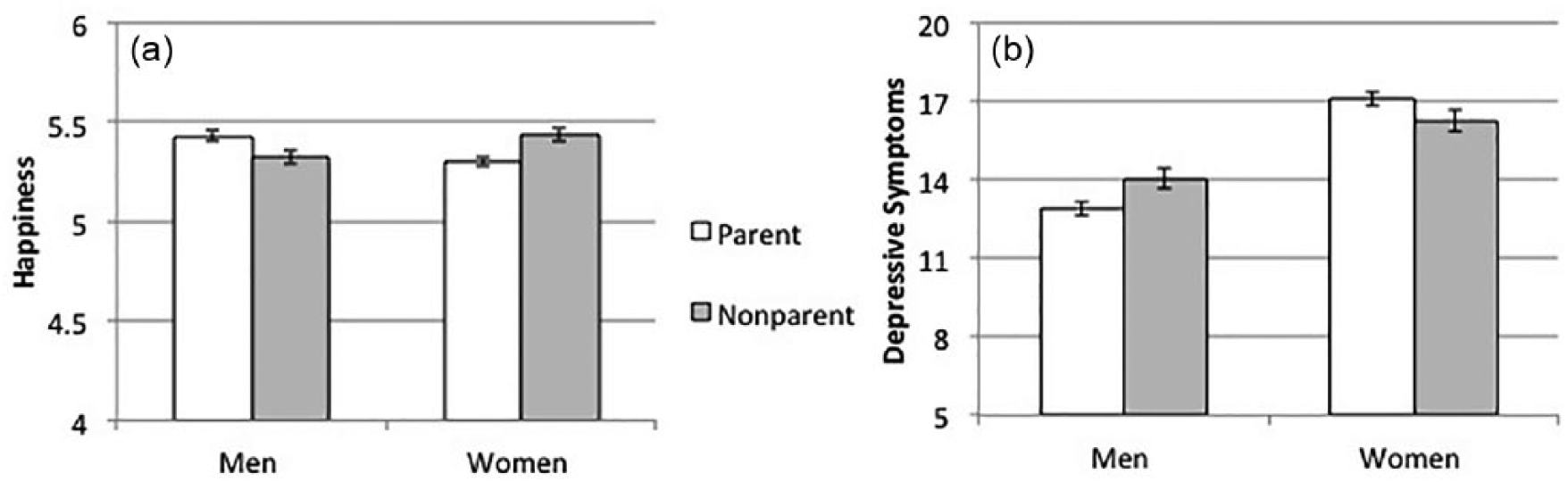
Gender moderates the association between parenthood and (a) happiness and (b) depressive symptoms in Study 1a.
Depressive symptoms
Gender also moderated the association between parenthood and depressive symptoms, b = −1.93, 95% CI [−3.33, −0.53], p = .007. Fathers (M = 12.92, SD = 16.21) reported fewer depressive symptoms than men without children (M = 14.05, SD = 15.66), b = −1.14, 95% CI [−2.14, −0.12], p = .03, and fewer symptoms than mothers (M = 17.10, SD = 18.01), b = −4.18, 95% CI [−4.92, −3.45], p < .001. Mothers did not differ in their reports of depressive symptoms compared with women without children (M = 16.30, SD = 16.94), b = 0.80, 95% CI [−0.17, 1.76], p = .11 (see Figure 1). In sum, depressive symptoms were lower in fathers than men without children, but directionally higher (p = .11) for mothers than women without children. Fathers also reported lower depressive symptoms than mothers.
Study 1b
In Study 1a, fathers reported elevated levels of well-being compared with men without children, whereas mothers did not. A strength of this study was the use of a large representative sample; however, the findings are limited by our reliance on a single-item measure of happiness. In Study 1b, we sought to address this limitation by examining gender differences in parents’ well-being using validated well-being measures theorized to be linked to parenthood—namely, subjective well-being (life satisfaction, positive emotions, and negative emotions), hassles and uplifts, and psychological need satisfaction (Nelson, Kushlev, & Lyubomirsky, 2014).
Method
Participants
Participants (N = 472; 60.0% female) were recruited from three populations: (a) Amazon Mechanical Turk (n = 166), (b) a community sample of adults (n = 154), and (c) an undergraduate sample (n = 152) for a study testing separate hypotheses regarding well-being improvement. 1 A plurality were White/Caucasian (41.9%), followed by Asian American (21.6%), Latino(a) (15.9%), Other (10.2%), African American (4.2%), Middle Eastern (2.1%), Hawaiian/Pacific Islander (1.5%), and American Indian/Alaskan Native (0.4%). Ages ranged from 17 to 67 years (M = 29.95, SD = 11.47). Previous research reports small effect sizes for the association between parenthood and well-being (Nelson et al., 2013), and Study 1a similarly revealed small effect sizes for gender differences in parents’ well-being. A sample of 472 participants was determined to provide 90% power to detect an effect size r = .15.
Measures
Parenthood
In addition to answering questions about their age, ethnicity, and gender, participants reported their number of children. As in Study 1a, we dichotomized this variable to reflect parenthood (1 = at least one child, 0 = no children; nparents = 140; nnonparents = 312). On average, parents reported having 2.05 children (SD = 0.96).
Subjective well-being
Participants completed the Satisfaction With Life Scale (Diener, Emmons, Larsen, & Griffin, 1985), which includes five items (e.g., “In most ways my life is close to my ideal”; α = .91) rated on a 7-point scale (1 = strongly disagree to 7 = strongly agree). Participants also completed the nine-item Affect-Adjective Scale (Diener & Emmons, 1984), which measures positive (i.e., happy, pleased, joyful, enjoyment/fun; α = .93) and negative (i.e., worried/anxious, angry/hostile, frustrated, depressed/blue, unhappy; α = .87) emotions. Participants rated the extent to which they experienced each emotion over the previous week on a scale ranging from 0 (not at all) to 6 (extremely much). We tested our hypotheses regarding gender differences in parents’ well-being separately for each indicator of subjective well-being.
Psychological need satisfaction
Psychological need satisfaction was assessed with the 18-item Balanced Measure of Psychological Needs (Sheldon & Hilpert, 2012), which includes six items each assessing autonomy (e.g., “I was free to do things my own way”; α = .74), competence (e.g., “I took on and mastered hard challenges”; α = .76), and connectedness (e.g., “I felt close and connected with other people who are important to me”; α = .78). Each item was rated on a 5-point scale (1 = no agreement to 5 = much agreement).
Hassles and uplifts
To measure the degree to which participants experienced hassles and uplifts during the previous week, they completed the Hassles and Uplifts Scale (DeLongis et al., 1988). Participants rated the extent to which several factors (e.g., children, work, exercise) were both a hassle and an uplift for them in the previous week on a 5-point scale (0 = not at all to 4 = a great deal). Both subscales demonstrated good reliability (uplifts α = .88, hassles α = .80).
Results
We began with simple t tests to compare the well-being reported by parents and nonparents (see Table 1 for means, standard deviations, and comparisons of parents and nonparents on all well-being variables). In these analyses, parents reported fewer negative emotions, greater life satisfaction, greater autonomy, marginally greater competence, greater connectedness, greater hassles, and greater uplifts.
Descriptive Statistics and Comparisons of Parents and Nonparents on All Well-Being Variables (Study 1b).

Gender differences in the association between parenthood and well-being
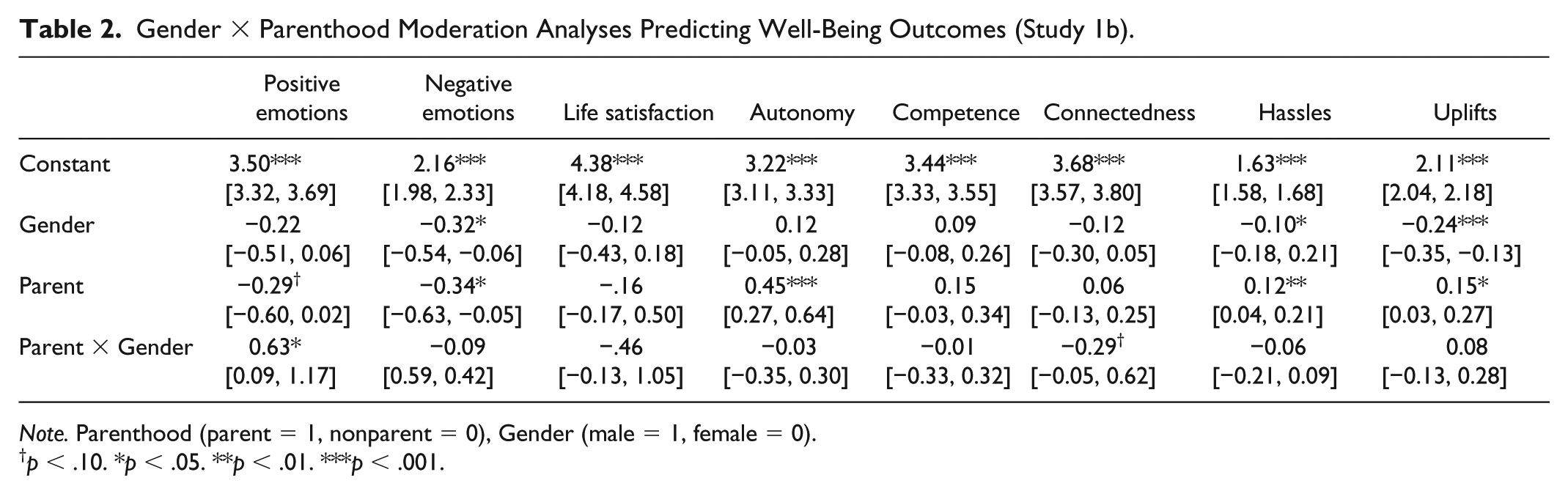
We tested whether gender moderated the association between parenthood and all well-being outcomes using the PROCESS macro with 5,000 bootstrapped samples (Hayes, 2013; see Table 2). In addition, given our primary hypothesis regarding gender differences in parents’ well-being and prior work suggesting gender differences in parents’ experiences (Balbo & Arpino, 2016; Musick et al., 2016), we also examined the association between parenthood and well-being separately for men and women, as well as differences in mothers’ and fathers’ well-being, in simple slopes analyses.
Gender × Parenthood Moderation Analyses Predicting Well-Being Outcomes (Study 1b).
Note. Parenthood (parent = 1, nonparent = 0), Gender (male = 1, female = 0).
p < .10. *p < .05. **p < .01. ***p < .001.
Subjective well-being
Gender significantly moderated the association between parenthood and positive emotions (see Table 2). The association between parenthood and positive emotions was positive for fathers (albeit not significantly), b = 0.34, 95% CI [−0.11, 0.78], p = .14, and negative for mothers, b = −0.29, 95% CI [−0.60, 0.02], p = .07. Furthermore, fathers reported marginally greater positive emotions than mothers, b = 0.41, 95% CI [−0.06, 0.87], p = .09.
Gender did not significantly moderate the association between parenthood and negative emotions, and analyses of the simple slopes did not reveal any significant differences.
Gender did not significantly moderate the association between parenthood and life satisfaction (see Table 2); however, analyses of the simple slopes revealed that fathers reported greater life satisfaction than men without children, b = 0.62, 95% CI [0.14, 1.11], p = .01, but mothers did not report greater life satisfaction than women without children, b = 0.16, 95% CI [−0.17, 0.50], p = .33. Mothers and fathers did not differ in their reported levels of life satisfaction, b = 0.34, 95% CI [−0.16, 0.84], p = .19.
Psychological need satisfaction
Gender marginally moderated the association between parenthood and connectedness (see Table 2). Analyses of simple slopes revealed that fathers reported significantly greater connectedness than men without children, b = 0.35, 95% CI [0.08, 0.63], p = .01, but mothers did not report greater connectedness than women without children, b = 0.06, 95% CI [−0.13, 0.25], p = .51. Mothers and fathers did not differ in their reported feelings of connectedness, b = 0.16, 95% CI [−0.12, 0.45], p = .26.
Gender did not moderate the association between parenthood and autonomy (see Table 2). Analyses of simple slopes revealed that both mothers and fathers reported greater autonomy than their counterparts without children, bs > 0.42, ps < .01, and mothers and fathers did not significantly differ in their reported feelings of autonomy, b = .09, p = .54.
Gender also did not moderate the association between parenthood and competence, and analyses of simple slopes did not reveal any significant differences.
Hassles and uplifts
Gender did not moderate the association between parenthood and perceived hassles (see Table 2); however, simple slopes analyses revealed that mothers reported greater hassles than women without children, b = 0.12, 95% CI [0.04, 0.21], p = .005, as well as greater hassles than fathers, b = 0.16, 95% CI [0.03, 0.29], p = .01, but fathers did not report greater hassles than men without children, b = 0.06, 95% CI [−0.06, 0.18], p = .32.
Gender did not moderate the association between parenthood and uplifts (see Table 2). Both mothers and fathers reported greater uplifts than their counterparts without children, bs > .15, ps < .02, and mothers reported marginally greater uplifts than fathers, b = 0.16, 95% CI [−0.01, 0.34], p = .07.
In sum, across all outcomes in this study, fatherhood was more consistently associated with greater well-being outcomes than motherhood. Relative to their peers without children, fathers reported greater life satisfaction, autonomy, competence, and uplifts; and they reported greater positive emotions and fewer hassles than mothers. Conversely, mothers reported greater hassles and lower positive emotions, but also greater autonomy and uplifts, compared with their peers without children. Thus, parenthood appears to be more consistently associated with well-being benefits for men—especially when compared with men without children.
Study 2
We found that gender moderated the association between parenthood and global well-being in a nationally representative sample of adults (Study 1a), and we replicated these findings using validated well-being measures (Study 1b). These findings are limited, however, in that participants’ responses to global measures of well-being could be biased due to recall errors, dissonance reduction, or idealization of parenthood (e.g., Eibach & Mock, 2011). In light of gender differences in how parents interact with and occupy time with their children (e.g., Musick et al., 2016), we deemed it important to examine gender differences in parents’ emotions while they are actually spending time with their children. Study 2 explored this question using data from a large sample of adults who completed an experience sampling study via a smartphone application.
Method
Participants
Parents (N = 4,930; 37.6% male; Mage = 44.71) with at least one child participated in our study via Track Your Happiness, a free iPhone application. Although the application was available to anyone, the current study included only users who reported having at least one child. On average, parents in this sample self-reported 2.04 children (median child age = 11.58 years; range from <1 year to >30 years). The majority were married (67.7%) or cohabiting (8.4%; 14.7% divorced, 4.2% separated, 2.7% single, 1.4% widowed, 0.7% no response), with a median personal income of US$55,000. Participants were primarily from the United States (80%), 2 and were predominantly White (84%), followed by Hispanic (4.4%), Asian (2.5%), Black (2.2%), Multiracial (2.3%), Other (1.2%), Indian (1.0%), Middle Eastern (0.5%), Native American (0.3%), Pacific Islander (0.3%), and no response (1.1%).
Materials and procedure
To provide insight into parents’ daily emotional experiences, participants completed an experience sampling procedure via the Track Your Happiness application (Killingsworth & Gilbert, 2010). The application contacts users at random 3 times per day during their waking hours, presents them with questions regarding their current mood and activities, and records their answers onto a database at www.trackyourhappiness.org. Users responded with a median delay of 19.7 min and answered 76.92% of prompts, providing 453,819 observations across 4,930 individuals.
State happiness
For each observation, happiness was measured by asking participants the valence of their current experience (i.e., “How do you feel right now?”) on a sliding scale from 0 (very bad) to 100 (very good).
Caregiving
We gathered information regarding caregiving activities from two items. First, participants reported their current activity by responding to the question, “What are you doing right now?” by selecting from a list of 22 activities (e.g., working, taking care of my children) adapted from the Day Reconstruction Method (Kahneman, Krueger, Schkade, Schwarz, & Stone, 2004). Each observation was coded to reflect whether their primary activity was child care (child care = 1, all other activities = 0).
Second, for each observation, participants were also asked, “Are you talking or interacting with anyone?” (yes/no). Those who responded yes to this question were then prompted to report with whom they were interacting by checking one or more of 11 options (spouse/partner/significant other, children, parents, other relatives, friends, acquaintances, strangers, coworkers, customers/students, boss, and other). We created a dummy-coded variable to reflect interactions with children (interacting with children = 1, not interacting with children = 0).
Results
We conducted two sets of analyses to investigate differences in parents’ happiness while engaging in child care or interacting with their children compared with their other daily activities using multilevel regression with random person-level intercepts to account for repeated measurements within individuals. To test our hypotheses regarding gender differences in caregiving, we created a dummy-coded variable to reflect gender (male = 1, female = 0). In addition, each observation was coded to reflect whether it involved child care (child care = 1, all other activities = 0). We conducted parallel analyses regarding parents’ interactions with their children (interacting with children = 1, not interacting with children = 0). Overall, parents were slightly but significantly less happy when taking care of their children compared with other daily activities (b = −0.34, t = 2.5, p < .05, 95% CI [−0.61, −0.07]) and were significantly more happy when interacting with their children than when not interacting with their children (b = 4.02, t = 52.0, p < .001, 95% CI [3.87, 4.17]).
Does gender moderate the association between caregiving and happiness?
Gender significantly moderated the association between child care and happiness (b = 2.42, t = 8.03, p < .001, 95% CI [1.83, 3.01]). Men reported greater happiness while caring for their children compared with their other daily activities, whereas women reported relatively lower levels of happiness while caring for their children, b = −1.11, t = −6.3, p < .001, 95% CI [−1.46, −0.768] (see Figure 2 and Table 3).
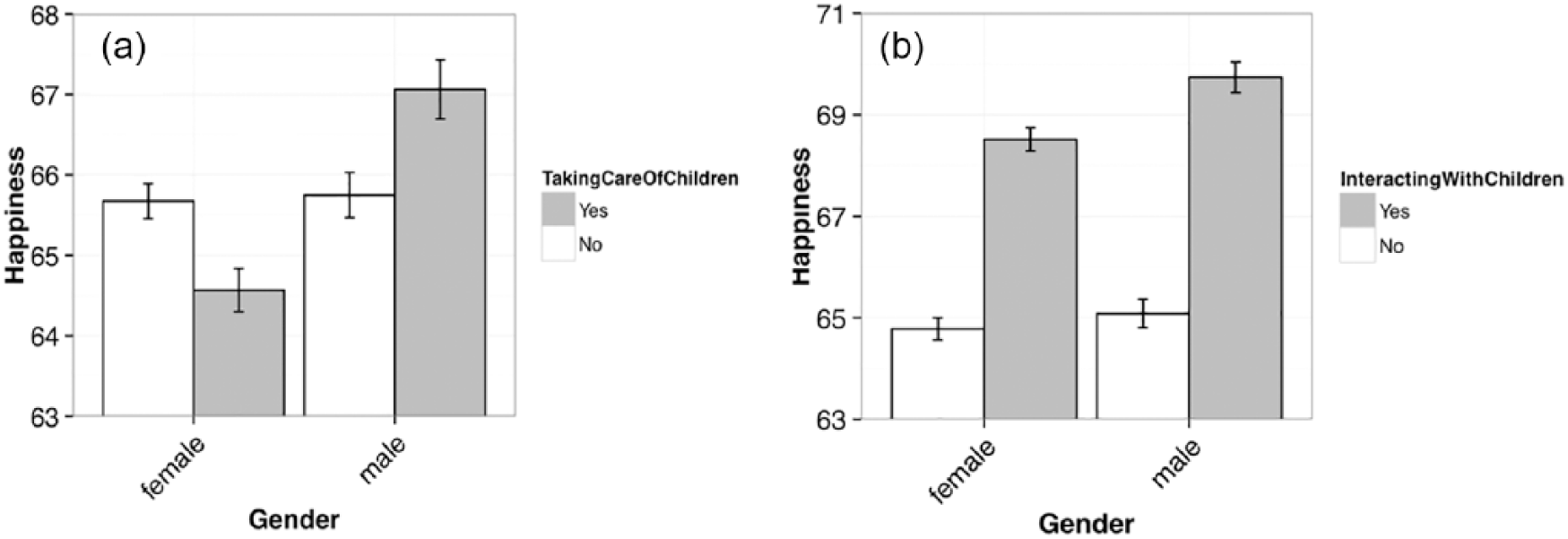
Gender moderates the association between (a) child care and happiness and (b) interacting with children and happiness in Study 2.
Gender Moderates the Association Between Child care and State Happiness (Study 2).
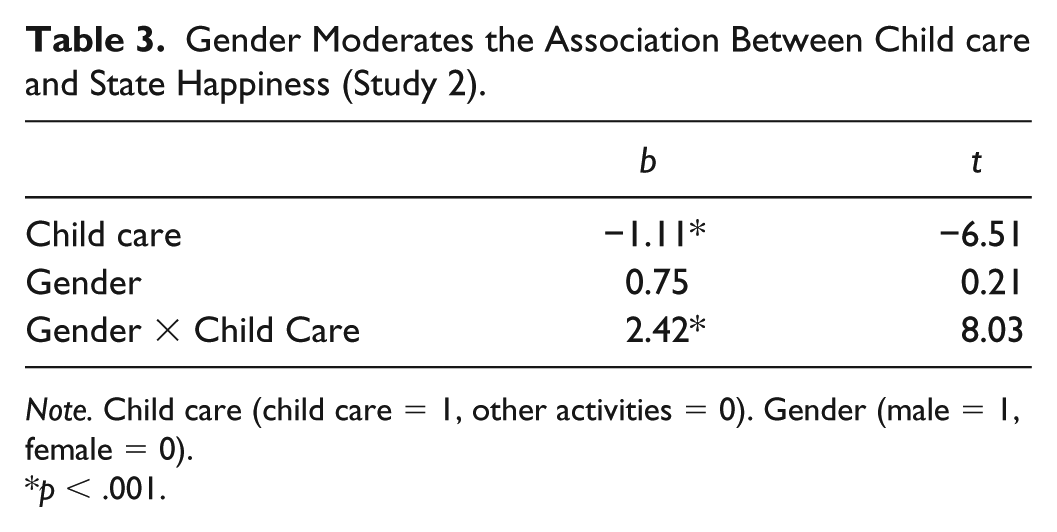
Note. Child care (child care = 1, other activities = 0). Gender (male = 1, female = 0).
p < .001.
Men also fared better during their interactions with their children. Again, gender moderated the association between interactions with children and happiness, with men experiencing greater happiness than women during interactions with their children versus other activities (b = 0.91, t = 5.51, p < .001, 95% CI [0.59, 1.24]), but even women still reported greater happiness while interacting with their children compared with other activities (b = 3.74, t = 38.73, p < .001, 95% CI [3.54, 3.93]; see Figure 2 and Table 4).
Gender Moderates the Association Between Interacting With Children and State Happiness (Study 2).
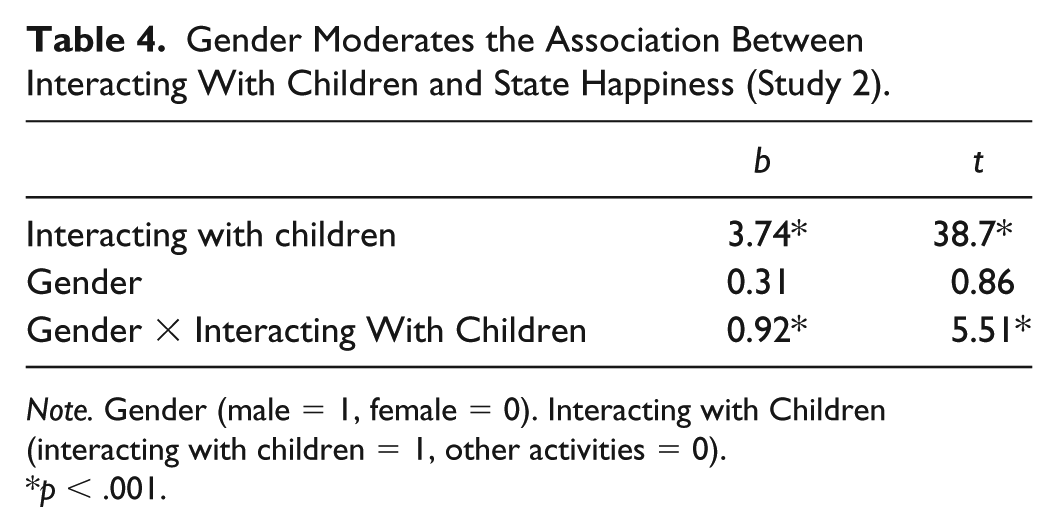
Note. Gender (male = 1, female = 0). Interacting with Children (interacting with children = 1, other activities = 0).
p < .001.
One manifestation of this gender difference is in the frequency of endorsing “playing” as a concurrent activity. Men were more likely than women to endorse “playing” while “taking care of children” (b = 0.364, t = 6.23, p < .001, 95% CI [0.352, 0.375]) and while interacting with children (b = 0.029, t = 6.95, p < .001, 95% CI [0.020, 0.027]).
Discussion
Across 18,000 participants in three studies using diverse methodologies, we found converging evidence that gender moderates the association between parenthood and well-being. Relative to men without children, fathers reported relatively greater happiness overall in a nationally representative sample (Study 1a) and in a small community sample of adults who responded to validated multi-item measures of well-being (Study 1b). Fathers also reported relatively elevated happiness when they were interacting with or specifically caring for their children compared with women, and compared with their other daily activities (Study 2).
Like much of the previous research examining parenthood and well-being (Nelson, Kushlev, & Lyubomirsky, 2014), our findings comparing parents with nonparents overall were mixed. In Study 1a, we did not find significant differences in parents’ and nonparents’ reports of happiness or depressive symptoms. Notably, however, parents reported greater life satisfaction, psychological need satisfaction, and uplifts, but also greater hassles, compared with nonparents in Study 1b. In addition, in Study 2, compared with engaging in their other daily activities, parents reported less happiness when they were caring for their children, but greater happiness when they were interacting with them. This finding suggests that types of caregiving activities are differentially associated with well-being outcomes. For example, child care (i.e., moments when parents endorsed that they were “taking care of” their children) may be more likely to involve onerous or frustrating tasks, such as getting a child ready for school. Conversely, interacting with one’s child could include a broad array of activities, such as play or leisure, that may confer more opportunities for positive emotions.
One way to understand the inconsistencies in previous findings comparing parents with nonparents overall is to take a closer look at factors—such as gender—that moderate the association between parenthood and well-being. Indeed, our findings regarding gender differences in parents’ well-being were quite consistent. Across three studies and multiple well-being measures, fathers consistently reported greater well-being overall compared with men without children, and they reported greater state happiness when they were interacting with or caring for their children compared with their other experiences over the course of their days. Mothers, by contrast, reported greater hassles than women without children and only reported greater state happiness when they were interacting with their children (not when engaged in child care) compared with their other daily activities. These gender differences in parents’ well-being are consistent with past work finding that fathers reported greater happiness and life satisfaction compared with men without children, but mothers and women without children did not differ in happiness or life satisfaction (Nelson et al., 2013).
Our studies revealed the strongest benefits for fathers in comparison to men without children. In these comparisons, fathers reported greater happiness, life satisfaction, and fewer depressive symptoms, along with greater connectedness and autonomy. When compared with women without children, mothers only reported greater autonomy, but also greater hassles and fewer positive emotions. These within-gender comparisons are valuable, as they account for any systematic gender differences in well-being outcomes—for example, that women are more likely to suffer depressive symptoms (e.g., Nolen-Hoeksema, 2001) and that relationship quality more strongly predicts married women’s happiness (Proulx, Helms, & Buehler, 2007; Saphire-Bernstein & Taylor, 2013). Thus, future work considering this parallel in the parent literature would be informative: Is the association between parent–child relationship quality and happiness stronger for mothers than for fathers? Notably, fathers also demonstrated clear benefits relative to mothers. In these comparisons, fathers reported relatively greater overall happiness, fewer depressive symptoms, more positive emotions, fewer hassles, and greater state happiness while caring for and interacting with their children.
Why do fathers fare better than mothers? One possibility may be inherent in the ways that fathers spend time with their children. For example, in Study 2, we found that fathers were more likely to endorse “playing” as an additional activity both when they spent time with and cared for their children. Playing with their children likely offers parents opportunities to experience positive emotions and cultivate closeness with their child. Prior research suggests that both positive emotions and parent–child connectedness are important predictors of parents’ well-being (Aber et al., 1999; Nelson, Kushlev, & Lyubomirsky, 2014). We also found that fathers reported relatively more uplifts and feelings of connectedness relative to men without children. In other words, fathers had more positive experiences over the course of their days (e.g., their families, friends, work, or health was felt as an uplift), and they felt closer and more connected to others who are important to them. Conversely, we found that mothers reported greater hassles in various life domains compared with women without children, as well as lower state happiness specifically while caring for their children relative to their other daily activities. Notably, both of these outcomes may be detrimental to their overall well-being (Crnic & Greenberg, 1990; Kanner et al., 1980). Interestingly, however, mothers reported greater happy mood while interacting with their children relative to their other experiences, though not while engaging directly in child care. This discrepancy suggests that how mothers and fathers spend time with their children might have important implications for their well-being. Of course, parents cannot forego providing care for their children, but creating more opportunities for play in the midst of child care (e.g., playing peek-a-boo while changing a diaper) may render those moments more joyful.
Furthermore, mothers may be relatively less happy because they are more likely to have high expectations about parenthood and thus more likely to be let down by the experience (e.g., Mauss, Tamir, Anderson, & Savino, 2011), due to personal upbringing and cultural messages that lead women to believe that they are supposed to enjoy motherhood (Russo, 1976; Sharp, 2018). Alternatively, mothers may be harmed more by declines in relationship satisfaction that coincide with becoming a parent (e.g., Twenge et al., 2003), such that mothers’ lower well-being could be accounted more by unhappiness with their partner than with their parent role. Finally, the incidence of postpartum depression and anxiety among some mothers could contribute to average levels of lower overall well-being among mothers, at least in the aftermath of childbirth (Dietz et al., 2007; Don, Chong, Biehle, Gordon, & Mickelson, 2014).
The discrepancy between mothers’ and fathers’ well-being may also be due in part to an uneven allocation of labor in work and family domains. Although many men and women endorse egalitarian ideals in sharing labor inside and outside the home (Galinsky, Aumann, & Bond, 2009), unequal divisions of labor persist for many heterosexual couples, with women devoting more time to child care and household tasks (Yavorsky et al., 2015). Unequal divisions of labor are linked with lower marital quality (Shockley & Shen, 2016) and general well-being (Kalmijn & Monden, 2012; Kornrich, Brines, & Leupp, 2013; Shockley & Shen, 2016). Furthermore, research indicates that perceptions of unfairness mediate the path from unequal sharing of labor to reduced relationship satisfaction (Mikula, Riederer, & Bodi, 2012). Thus, one explanation for the findings in the current studies may be that mothers, but not fathers, perceive the uneven divisions of labor in their homes as unfair, which in turn results in reduced well-being.
Strengths, Limitations, and Future Directions
The strengths of these studies include their reliance on large, well-powered, representative samples (Study 1a and Study 2), and convergence across multiple methodologies. Furthermore, although each study may be limited on its own, some of those limitations are offset by strengths of the remaining studies. For example, our first study was limited by the use of a single-item measure of happiness; however, Study 1b addressed this limitation by including several validated multi-item well-being measures. Study 1b included a relatively smaller sample, which may have limited our ability to detect significant moderation effects. However, comparisons of mothers and fathers with their peers without children revealed similar conclusions as Study 1a and Study 2—that parenthood is more consistently associated with greater well-being for fathers than for mothers. These findings should be interpreted with caution, given that the overall moderation effects were not significant. In addition, the reliance solely on global well-being in Study 1a and 1b may not capture parents’ actual experiences while engaged in caregiving. We sought to address this limitation in Study 2 by focusing on parents’ feelings specifically when they were spending time with and caring for their children. Finally, although Study 2 relied on a predominantly White middle-class sample, the consistent pattern of results across all three studies suggest that these findings are not restricted only to the affluent and educated.
As with any study of parenthood, these findings cannot conclusively determine whether having children causes mothers and fathers to feel more or less happy. Instead, they provide a descriptive portrait of parents’ emotional lives. Future studies examining mothers’ and fathers’ well-being using a longitudinal design would be informative. For example, the generalizability of the current findings would be strengthened if they were replicated in a study examining gender differences in shifts in parents’ well-being after the birth of a child.
Moreover, although our studies point to possible mechanisms explaining gender differences in parents’ well-being—namely, more opportunities for play, greater need satisfaction, and more uplifts among fathers, and more hassles among mothers—more work is needed to further understand why fatherhood is associated with relatively more positive outcomes. For example, as described above, one possibility is that gender differences in parents’ well-being are shaped by gendered division of parenting tasks (e.g., Milkie et al., 2002). A study comparing mothers’ and fathers’ well-being in couples with relatively egalitarian divisions of labor—or among cultures with such egalitarian norms—would be illuminating. Furthermore, future work could disentangle the causal role of parent–child activities for parents’ happiness by randomly assigning parents to engage in various activities (e.g., play) with their children and tracking subsequent changes both in happiness while parenting and in happiness overall.
Finally, the gender differences uncovered in the current research should be interpreted in light of the predominantly U.S. sample across the studies. Policies, media messages, and parenting practices in other cultures may produce different patterns of well-being among mothers and fathers. For example, many European countries offer generous parental leave policies for mothers and fathers following the birth of a child, and evidence suggests that such policies promote gender equality, workforce participation, and egalitarian divisions of labor across partners in the home (e.g., Bunning, 2015).
Implications
Although we did not distinguish married and unmarried parents in our studies, given prior work that relationship formation is closely tied with parenthood (Buckels et al., 2015; Neel et al., 2016), our findings do have implications for single parents. Previous research indicates that single parents are less happy than their married counterparts (Nelson et al., 2013). One possibility may be that both mothers and single parents may experience lower happiness in part due to their role as the primary parent and their greater responsibility for child care. Taken together, these findings suggest that fathers who are the primary parent (either as a single parent or a stay-at-home parent) may experience similar levels of stress and reduced well-being as do mothers. Notably, however, single fathers may also experience reduced well-being due to fewer opportunities for positive, playful interactions with their children, which our results suggest are important for parents’ well-being. Indeed, single fathers without custody of their children report low levels of well-being (Keizer et al., 2010).
The findings presented here have important policy implications. Given that mothers’ reduced well-being may be due in part to their relatively greater time spent engaging in child care (Musick et al., 2016), policies that encourage shared distribution of parenting tasks could reduce the parent gender well-being gap. For example, studies suggest that fathers are more involved with child care when they take parental leave following the birth or adoption of a child (Bunning, 2015; Haas & Hwang, 2008). Thus, offering extended parental leave to both parents could improve mothers’ well-being.
Our findings also have implications for parenting behaviors and child outcomes. Research indicates that happy parents engage in more beneficial parenting practices (Dix, 1991; Rueger, Katz, Risser, & Lovejoy, 2011). For example, in one study, mothers who reported greater life satisfaction when their children were toddlers engaged in more supportive parenting 2 years later, and their children had fewer teacher-rated externalizing behaviors at age 10 (Bornstein, Putnick, & Suwalsky, 2018). Furthermore, a meta-analysis of this literature revealed that negative affect is correlated with greater use of harsh parenting strategies, whereas positive affect is correlated with greater use of supportive parenting strategies (Rueger et al., 2011). Thus, efforts to improve mother’s overall well-being may have downstream consequences for their children via parenting behaviors.
Concluding Remarks
In sum, the findings presented here suggest that fathers, but not mothers, are happier than their childless counterparts. Whereas fatherhood was associated with greater happiness and daily uplifts, along with stronger feelings of connectedness, motherhood was associated with greater hassles and lower levels of positive emotions. This information may be useful to families or individuals planning to have children to better understand and anticipate differences in the experiences of mothers and fathers and to cultivate more opportunities for mothers to experience the same rewards of parenthood as fathers.
Supplemental Material
Nelson-Coffey_Online_Appendix – Supplemental material for Parenthood Is Associated With Greater Well-Being for Fathers Than Mothers
Supplemental material, Nelson-Coffey_Online_Appendix for Parenthood Is Associated With Greater Well-Being for Fathers Than Mothers by S. Katherine Nelson-Coffey, Matthew Killingsworth, Kristin Layous, Steve W. Cole and Sonja Lyubomirsky in Personality and Social Psychology Bulletin
Footnotes
Declaration of Conflicting Interests
The author(s) declared no potential conflicts of interest with respect to the research, authorship, and/or publication of this article.
Funding
The author(s) received no financial support for the research, authorship, and/or publication of this article.
Notes
Supplemental Material
Supplemental material is available online with this article.

References
Supplementary Material
Please find the following supplemental material available below.
For Open Access articles published under a Creative Commons License, all supplemental material carries the same license as the article it is associated with.
For non-Open Access articles published, all supplemental material carries a non-exclusive license, and permission requests for re-use of supplemental material or any part of supplemental material shall be sent directly to the copyright owner as specified in the copyright notice associated with the article.
