



Abstract
We investigated whether stereotypes linking Black men and Black boys with violence and criminality generalize to Black women and Black girls. In Experiments 1 and 2, non-Black participants completed sequential-priming tasks wherein they saw faces varying in race, age, and gender before categorizing danger-related objects or words. Experiment 3 compared task performance across non-Black and Black participants. Results revealed that (a) implicit stereotyping of Blacks as more dangerous than Whites emerged across target age, target gender, and perceiver race, with (b) a similar magnitude of racial bias across adult and child targets and (c) a smaller magnitude for female than male targets. Evidence for age bias and gender bias also emerged whereby (d) across race, adult targets were more strongly associated with danger than were child targets, and (e) within Black (but not White) targets, male targets were more strongly associated with danger than were female targets.
Keywords
Race relations—especially between Whites and Blacks in the United States—has been a topic of social psychological inquiry for decades. With few exceptions (e.g., Ghavami & Peplau, 2013; Plant, Goplen, & Kuntsman, 2011), however, prior work on racial bias toward Black Americans has focused on Black men (e.g., Correll, Park, Judd, & Wittenbrink, 2002) and Black boys (e.g., Goff, Jackson, Di Leone, Culotta, & DiTomasso, 2014) or on Black Americans in general (e.g., Cottrell & Neuberg, 2005). Thus, much as Black women are “invisible” in cultural, historical, and legal representation (Purdie-Vaughns & Eibach, 2008; Schug, Alt, Lu, Gosin, & Fay, 2017), Black women are also often invisible as targets of psychological research (Cole, 2009). Because people with different combinations of social identities (e.g., race, age, gender) may be perceived and treated in ways that are qualitatively distinct, and not simply as a linear combination of these identities (Kang & Bodenhausen, 2015), studying Black women and Black girls as potential targets of racial bias is vital.
Here, we examine implicit bias at the intersections of race, age, and gender. We test whether Black females, 1 like Black males, are more strongly associated with danger-related objects and concepts than are White females and White males, respectively (i.e., racial bias), and whether the magnitude of this racial bias differs across target age and target gender. We also test for (a) age bias (i.e., stronger associations linking adult versus child targets with danger) across target gender and target race and for (b) gender bias (i.e., stronger associations linking male versus female targets with danger) across target age and target race.
Implicit Associations Linking Black Women and Black Girls With Danger
One of the most pervasive stereotypes of Black Americans is that they are hostile and violent (Devine, 1989). Black Americans are frequently described as “dangerous” (Ghavami & Peplau, 2013) and, relative to White Americans, are commonly viewed as threats to physical safety (Cottrell & Neuberg, 2005). These stereotypes are consequential, having been shown to bias attention, memory, judgment, and behavior in a range of situations (Kawakami, Amodio, & Hugenberg, 2017). It is unclear, however, whether these danger-based associations generalize to Black Americans of various genders and ages or whether they are specific to Black men.
Theory and research suggest reasons why danger-based associations may not extend to Black women. Women are stereotyped as gentle and caring (Eagly & Mladinic, 1989), and White women are less readily categorized as being angry than are White men (Neel, Becker, Neuberg, & Kenrick, 2012). Furthermore, intergroup aggression has historically been perpetrated by men. Thus, Black men, but not Black women, may be readily associated with danger by non-Black perceivers (Navarrete et al., 2009). In one study, for example, “dangerous” was among the top 15 attributes nominated to describe Black men, but not Black women (Ghavami & Peplau, 2013). Because the prototype of the category “Black” is male (Schug, Alt, & Klauer, 2015; Sesko & Biernat, 2010; Thomas, Dovidio, & West, 2014), moreover, Black women may escape some of the associations commonly evoked by Blacks as a group (Purdie-Vaughns & Eibach, 2008). Supporting this possibility, Plant et al. (2011) found that White participants displayed biases away from shooting unarmed Black women in a first-person shooter task (Correll et al., 2002), even as they displayed biases toward shooting unarmed Black men.
Other work suggests that Black women may be just as susceptible as Black men to being targets of danger-based associations. In the United States, Black women are considered non-prototypical of the category “women” (Schug et al., 2015; Sesko & Biernat, 2010; Thomas et al., 2014), suggesting that stereotypes of women may often reflect stereotypes of White women, not Black women or women from other racial groups (Donovan, 2011). White women, for example, are stereotyped as feminine and submissive (Ghavami & Peplau, 2013), which aligns with the gentleness stereotype applied to women in general (Bem, 1974). Black women, in contrast, evoke opposing stereotypes: They are commonly viewed as hostile, aggressive, and unfeminine (Ghavami & Peplau, 2013; Landrine, 1985; Weitz & Gordon, 1993). Furthermore, Black women are judged as more masculine than White women and Asian women (Galinsky, Hall, & Cuddy, 2013; Goff, Thomas, & Jackson, 2008; Johnson, Freeman, & Pauker, 2012). Because masculine targets are more likely to be viewed as dangerous (Archer, 2004; Eagly & Steffen, 1986), the same danger-based associations commonly evoked by Black men may generalize to Black women.
Even if such associations generalize to Black women, they may not extend to young Black girls because youth may signal a lack of threat (Buckels et al., 2015; Sherman & Haidt, 2011). Challenging this possibility, however, multiple investigations of both explicit judgments (Goff et al., 2014; Rattan, Levine, Dweck, & Eberhardt, 2012; Small, Pope, & Norton, 2012) and implicit associations (Todd, Simpson, Thiem, & Neel, 2016; Todd, Thiem, & Neel, 2016) have found that youth does not exempt Black boys from racial bias in danger associations. Black girls may not be exempt from such associations, either. Relative to same-age White girls, Black girls are believed to be older and to need less nurturing and protection (Epstein, Blake, & Gonzalez, 2017). Black girls also face disproportionate rates of discipline and suspension in school, and at a magnitude even greater than the racial bias in discipline of boys (Crenshaw, Ocen, & Nanda, 2015; Epstein et al., 2017; Smolkowski, Girvan, McIntosh, Nese, & Horner, 2016).
Thus, there are theoretical reasons to expect that danger-based associations commonly evoked by Black men and Black boys will or will not generalize to Black women and Black girls. To test these possibilities, we examine racial bias in the identification of threatening stimuli (Payne, 2001): Does seeing Black female faces facilitate these identifications more than does seeing White female faces, and is the magnitude of this racial bias comparable across target gender and target age? In addition, we tested for potential gender bias and age bias in danger associations across target race.
Differences by Perceiver Race
We also examined whether the patterns of danger-based associations observed among White perceivers are observed among Black perceivers. Given ingroup favoritism, Blacks might display a pattern of racial bias opposite that commonly displayed by Whites (i.e., stronger associations linking Whites versus Blacks with danger; Olson, Crawford, & Devlin, 2009). Furthermore, the history of White Americans’ violence and prejudice toward Black Americans may lead Blacks to see Whites as potentially threatening (Monteith & Spicer, 2000) and, thus, to associate Whites with danger.
Other work suggests that Black perceivers may exhibit a pattern of racial bias resembling that of White perceivers. Implicit associations are rooted in stereotypic knowledge, and Blacks are exposed to the same cultural stereotypes that Whites are (Devine, 1989). Knowledge and frequent activation of stereotypes linking Blacks with violence and criminality, therefore, may lead Blacks to semantically associate Blacks with danger (e.g., Nosek et al., 2007). We assessed implicit danger-based associations among Black participants in our final experiment.
Overview of Experiments
We conducted three experiments to investigate implicit racial bias in semantic associations with danger at the intersections of target age and target gender. Following briefly presented faces varying in race (Black, White), age (adult, child), and gender (male, female), White undergraduates categorized either objects as guns versus tools (Experiment 1) or words as “threatening” versus “safe” (Experiment 2). Experiment 3 replicated the procedure of Experiment 1 with a community sample that included Black adults.
Across experiments, we examined response times (RTs) and error rates in object and word categorization, as is common with sequential-priming measures (Wentura & Degner, 2010). One issue with this approach, however, is that it equates a behavioral effect on a task (e.g., faster, more accurate gun identifications following Black versus White face primes) with the core construct of interest: “implicit racial bias.” Rather than assuming such tasks capture only automatic processes, we instead assume that both automatic and controlled processes contribute to task behavior (Payne, 2001). Consequently, claims of automaticity in sequential-priming tasks require isolating the unique contributions of automatic and controlled processes to task performance. The process dissociation procedure (PDP; Jacoby, 1991) is an analytical tool that is frequently used to disentangle component processes underlying performance on sequential-priming measures of implicit racial bias (e.g., Amodio et al., 2004; Payne, 2001; Todd, Thiem, & Neel, 2016); we used the PDP here to quantify these different processes. For all experiments, we report our a priori sample size rationale, and all data exclusions, manipulations, and measures.
Experiment 1
Method
Power and participants
A recent meta-analysis of published studies using Payne’s (2001) weapon identification task estimated the average effect size for the Prime Race × Target Object interaction indicative of racial bias as
White undergraduates (n = 138) participated for course credit. Computer malfunctions resulted in data loss for nine participants. Because chance performance (≤50% accuracy) could indicate confusion about response-key mappings or task instructions, we excluded data from one additional participant who performed below chance, leaving a final sample of 128 participants (101 women, 27 men; Mage = 19.06 years).
Procedure and materials
Participants completed a weapon identification task (Payne, 2001) wherein two images flashed in quick succession. Participants were instructed to ignore the first (prime) image and to quickly categorize the second (target) image by key press (key assignments were counter-balanced across participants). The primes were 48 facial photos: six each of Black and White girls and boys taken from the Child Affective Expression set (LoBue & Thrasher, 2015) and of Black and White women and men taken from the Chicago Face Database (Ma, Correll, & Wittenbrink, 2015). We selected photos in which faces were easily identifiable with respect to membership in the social categories under investigation (Black versus White, male versus female, adult versus child 2 ), had a neutral expression, and had no idiosyncrasies (e.g., scars). The target objects were six gun and six tool images taken from Payne (2001).
Each trial began with a fixation cross (500 ms), followed by a face prime (200 ms), then a target object (200 ms), and finally a pattern mask (on screen until participants responded). If participants did not respond within 500 ms, a message (“Please respond faster!”) appeared for 1 s. Each face prime was paired once with each target object, producing 576 randomly ordered experimental trials (two blocks of 288 trials each, with a short break between blocks). Eight practice trials preceded the experimental trials.
Results
Across experiments, we report the results most pertinent to our focal hypotheses (i.e., those concerning intergroup biases in object and word identification; for additional results, see the Supplemental Materials 3 ). Table 1 displays descriptive statistics for all prime–target combinations in Experiments 1 and 2.
Mean RTs, Error Rates, and PDP Estimates by Condition (Experiments 1 and 2).
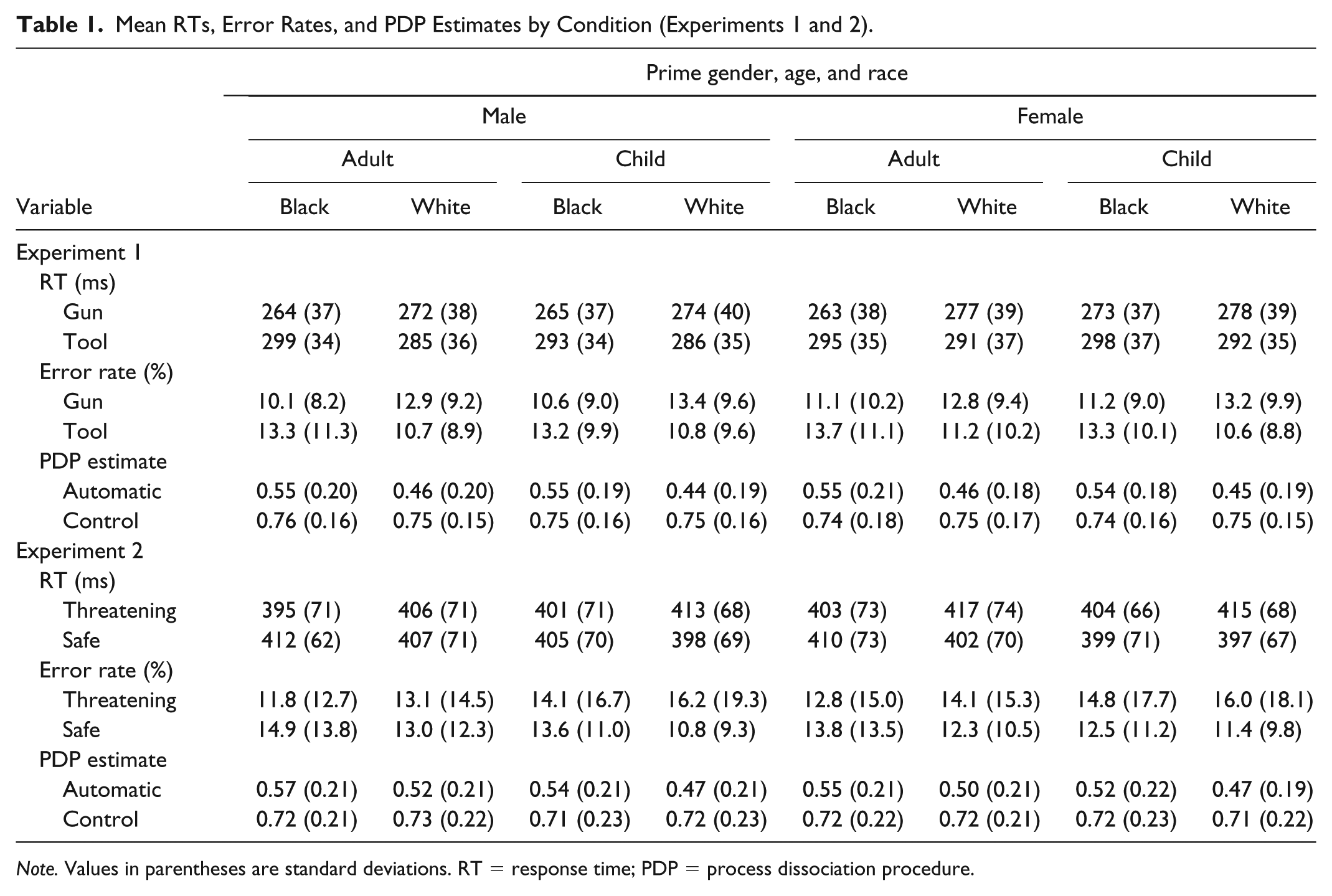
Note. Values in parentheses are standard deviations. RT = response time; PDP = process dissociation procedure.
Racial bias
RTs
Across experiments, for the RT analyses, we excluded trials with errors and trials with RTs <100 ms (Payne, 2001). We also excluded trials with RTs >2.5 SD from the grand mean as outliers and log-transformed the remaining RTs (Todd, Simpson, Thiem, & Neel, 2016), but we report raw RTs for interpretive ease. For all mixed-effects analyses, we tested a model with fixed effects of Prime Gender, Prime Age, Prime Race, and Target Object/Word; random intercepts for prime, target, and subject; and random slopes of Target Object/Word for subject. 4
This analysis yielded a Prime Race × Target Object interaction indicative of racial bias, b = −.063, SE = .005, 95% CI = [–.072, –.054], t = −13.87, p < .001. Decomposing this interaction revealed that guns were identified more quickly, b = −.035, SE = .005, 95% CI = [–.044, –.027], t = −7.81, p < .001, whereas tools were identified more slowly, b = .028, SE = .004, 95% CI = [.021, .035], t = 7.90, p < .001, after Black versus White primes.
In addition, a Prime Age × Prime Race × Target Object interaction, b = −.020, SE = .009, 95% CI = [–.038, –.003], t = −2.24, p = .025, indicated that racial bias was weaker after child primes, b = −.050, SE = .008, 95% CI = [–.065, –.034], t = −6.32, p < .001, than after adult primes, b = −.069, SE = .008, 95% CI = [–.085, –.054], t = −8.75, p < .001. 5 Although the magnitude of bias differed across prime age, the Prime Race × Target Object interaction was significant for both adult and child primes, suggesting that racial bias emerged across prime age.
Furthermore, a Prime Gender × Prime Race × Target Object interaction, b = −.020, SE = .009, 95% CI = [–.038, –.002], t = −2.16, p = .031, indicated that racial bias was weaker after female primes, b = −.051, SE = .008, 95% CI = [–.067, –.036], t = −6.59, p < .001, than after male primes, b = −.068, SE = .008, 95% CI = [–.083, –.052], t = −8.52, p < .001. The emergence of significant Prime Race × Target Object interactions for both male and female primes suggests that, although the magnitude of bias differed, racial bias emerged across prime gender. Finally, the four-way interaction was not significant, b = .024, SE = .018, 95% CI = [–.012, .060], t = 1.33, p = .19.
Error rates
A binomial mixed-effects model on the error rates with the same design specified for the RTs yielded a Prime Race × Target Object interaction indicative of racial bias, b = −.50, SE = .05, 95% CI = [–.60, –.41], z = −10.62, p < .001. Guns were misidentified as tools less often, b = −.24, SE = .04, 95% CI = [–.31, –.16], z = −6.21, p < .001, whereas tools were misidentified as guns more often, b = .27, SE = .03, 95% CI = [.20, .33], z = 7.92, p < .001, after Black versus White primes. There were no significant higher-order interactions involving Prime Race (|z|s < 1.1, ps > .28), suggesting the presence—with comparable magnitudes—of racial bias across prime age and prime gender.
Age bias
RTs
A Prime Age × Target Object interaction indicative of age bias emerged, b = −.018, SE = .005, 95% CI = [–.027, –.009], t = −3.95, p < .001. Guns were identified more quickly after adult versus child primes, b = −.017, SE = .005, 95% CI = [–.026, –.008], t = −3.76, p < .001, whereas tools were identified no more slowly after adult versus child primes, b = .001, SE = .004, 95% CI = [–.006, .008], t < 1, p = .79.
Recall that a significant Prime Age × Prime Race × Target Object interaction emerged. Decomposing this interaction within prime race (rather than within prime age, as reported above) revealed that age bias was evident for Black primes, b = −.028, SE = .006, 95% CI = [–.041, –.016], t = −4.38, p < .001, but not for White primes, b = −.008, SE = .006, 95% CI = [–.020, .005], t = 1.19, p = .24. These results suggest that, within Black (but not White) faces, adult faces facilitated the identification of dangerous objects more than child faces did. There were no other higher-order interactions involving Prime Age and Target Object (|t|s < 1.3, ps > .19).
Error rates
There were no significant interactions involving Prime Age (|z|s < 1.4, ps > .15), providing no evidence of age bias in error rates.
Gender bias
RTs
A Prime Gender × Target Object interaction indicative of gender bias emerged, b = −.009, SE = .005, 95% CI = [–.018, .000], t = −1.99, p = .047. Guns were identified more quickly after male versus female primes, b = −.021, SE = .005, 95% CI = [–.029, –.012], t = −4.54, p < .001, as were tools, b = −.011, SE = .004, 95% CI = [–.018, –.004], t = −3.22, p = .003. The interaction indicates that the magnitude of this Prime Gender effect was weaker for tools than for guns.
Decomposing the same Prime Gender × Prime Race × Target Object interaction reported above within prime race (rather than within prime gender, as reported above) indicates that gender bias was evident for Black primes, b = −.019, SE = .006, 95% CI = [–.032, –.007], t = −2.99, p = .002, but not for White primes, b = .001, SE = .006, 95% CI = [–.012, .013], t < 1, p = .91. These results suggest that, whereas White male and White female faces were comparably associated with danger, Black female faces were less strongly associated with danger than were Black male faces. There were no other higher-order interactions involving Prime Gender and Target Object (|t|s < 1.3, ps > .19).
Error rates
No significant interactions involving Prime Gender emerged (|z|s < 1.2, ps > .22), providing no evidence of gender bias in error rates.
PDP estimates
We next conducted PDP analyses to estimate the unique contributions of automatic and controlled processing to task performance. The PDP assumes that automatic and controlled processing can be dissociated by creating conditions that place these processes in concert and in opposition (Jacoby, 1991). For example, when a gun appears after a Black prime (i.e., congruent trials), both automatic racial bias and accurately identifying the target object lead to the same “gun” response. In contrast, when a tool appears after a Black prime (i.e., incongruent trials), automatic racial bias favors a “gun” response, but accurately identifying the object favors a “tool” response. The equations for calculating estimates of controlled (C) and automatic (A) processing are as follows (for the full set of equations, see Payne, 2005):
C = p(correct|congruent trials) – p(incorrect|incongruent trials)
A = p(incorrect|incongruent trials)/(1 − C)
Thus, C reflects the ability to accurately distinguish the objects, independent of response biases, whereas A reflects the unintentional biasing influence of the primes when control fails. For each participant, we computed estimates of C and A separately for Black and White primes of each age and each gender. In cases of perfect performance (C = 1), A is undefined; thus, we applied an adjustment commonly used in PDP analyses (Payne, Lambert, & Jacoby, 2002). In addition, because negative C estimates violate assumptions of PDP (Jacoby, 1991), we replaced such instances with a value of 0 (Lundberg, Neel, Lassetter, & Todd, 2018; Todd, Simpson, Thiem, & Neel, 2016); however, retaining the original (negative) C estimates produced nearly identical results. We followed this same procedure to calculate PDP estimates in Experiments 2 and 3. Because PDP estimates are calculated across stimuli for each participant, ANOVAs are appropriate.
A 2 (Prime Gender) × 2 (Prime Age) × 2 (Prime Race) ANOVA on the automatic estimates yielded only a Prime Race main effect indicative of automatic racial bias, F(1, 127) = 65.52, p < .001,
Discussion
The results of Experiment 1 suggest that, across age and gender, Blacks were more strongly associated with guns than were Whites. This racial bias emerged in both RT and error-rate analyses, and although the RT (but not the error-rate) analyses revealed this racial bias to be stronger for adult versus child primes and for male versus female primes, racial bias was present across prime age and prime gender.
An implicit assumption of these findings is that they reflect a generalization of racial stereotypes (i.e., Black = dangerous) across prime age and prime gender. An alternative possibility is that the racial bias revealed in the weapon identification task may reflect knowledge about racial differences in access to weapons or in gun violence victimization (cf. Neuberg & Sng, 2013) rather than semantic associations linking Blacks versus Whites with concepts related to danger. We addressed this possibility in Experiment 2 using a sequential-priming task that entailed classifying words as “threatening” or “safe” (Todd, Thiem, & Neel, 2016) rather than classifying objects as guns or tools. Based on the results of Experiment 1, we predicted that participants would have less difficulty categorizing threat-related words and more difficulty categorizing safety-related words following Black versus White face primes. We also anticipated that this pattern of racial bias in semantic associations would emerge across age and gender categories and would emerge primarily on estimates of automatic processing in PDP analyses.
In addition, the results of the RT (but not the error-rate) analyses in Experiment 1 revealed both an age bias and a gender bias, each of which was moderated by prime race. Inspecting each bias separately within each prime race revealed that, although there was no evidence that White-danger associations varied across prime gender or prime age, the magnitude of Black-danger associations varied across both identity dimensions. Black males and Black adults were more closely associated with danger than were Black females and Black children, respectively. In Experiment 2, we examined whether this pattern replicates.
Experiment 2
Method
Power and participants
White undergraduates (n = 160) participated for course credit. Data from eight participants were lost due to computer malfunctions. We also excluded data from seven participants who performed at or below chance (≤50% accuracy), leaving a final sample of 145 participants (92 women, 53 men; Mage = 18.94 years), which afforded >80% power to detect a medium-sized effect (
Procedure and materials
The sequential-priming task used in Experiment 2 was identical to that from Experiment 1, except we replaced the gun and tool images with words connoting threat and safety (Todd, Thiem, & Neel, 2016). Participants quickly categorized words as “threatening” (threatening, violent, dangerous, hostile, aggressive, criminal) or “safe” (safe, innocent, harmless, friendly, peaceful, trustworthy) while ignoring the face primes. We also increased the response deadline to 1 s to account for the greater difficulty of categorizing words versus objects (Kiefer, 2001).
Results
Racial bias
RTs
A mixed-effects analysis parallel to Experiment 1 yielded a Prime Race × Target Word interaction indicative of racial bias, b = −.047, SE = .005, 95% CI = [–.057, –.038], t = −9.46, p < .001. Threat words were identified more quickly, b = −.030, SE = .004, 95% CI = [–.038, –.021], t = −6.91, p < .001, whereas safety words were identified more slowly, b = .018, SE = .005, 95% CI = [.009, .027], t = 3.91, p < .001, after Black versus White primes. No higher-order interactions involving Prime Race were significant (|t|s < 1, ps > .37), indicating the presence—and comparable magnitude—of racial bias across prime age and prime gender.
Error rates
A mixed-effects analysis parallel to Experiment 1 revealed a Prime Race × Target Word interaction (i.e., racial bias), b = −.34, SE = .04, 95% CI = [–.42, –.25], z = −7.63, p < .001. Threat words were misidentified as safety words less often, b = −.15, SE = .03, 95% CI = [–.21, –.08], z = −4.50, p < .001, whereas safety words were misidentified as threat words more often, b = .19, SE = .03, 95% CI = [.13, .25], z = 6.01, p < .001, after Black versus White primes. No higher-order interactions involving Prime Race emerged (|z|s < 1.69, ps > .09), suggesting the presence—and comparable magnitude—of racial bias across prime age and prime gender.
Age bias
RTs
There was a Prime Age × Target Word interaction indicative of age bias, b = −.030, SE = .005, 95% CI = [–.040, –.020], t = −5.95, p < .001. Threat words were identified more quickly, b = −.009, SE = .004, 95% CI = [–.017, .000], t = −2.06, p = .046, whereas safety words were identified more slowly, b = .021, SE = .005, 95% CI = [.012, .030], t = 4.70, p < .001, after adult versus child primes. No higher-order interactions involving Prime Age were significant (|t|s < 1, ps > .37), suggesting age bias of comparable magnitudes across prime gender and prime race. These results differ from those in Experiment 1, wherein age biases on the RTs emerged only for Black—but not White—primes.
Error rates
A Prime Age × Target Word interaction (i.e., age bias) also emerged on the error rates, b = −.39, SE = .04, 95% CI = [–.48, –.30], z = −8.82, p < .001. Threat words were misidentified as safety words less often, b = −.24, SE = .03, 95% CI = [–.30, –.17], z = −7.19, p < .001, whereas safety words were misidentified as threat words more often, b = .15, SE = .03, 95% CI = [.09, .21], z = 4.86, p < .001, after adult versus child primes. There were no significant higher-order interactions involving Prime Age (|z|s < 1.7, ps > .09), which suggests that age bias was comparable in size across prime gender and prime race. This result is unlike that in Experiment 1, in which no age bias emerged on the error-rate metric.
Gender bias
RTs
A Prime Gender × Target Word interaction indicative of gender bias emerged, b = −.023, SE = .005, 95% CI = [–.033, –.013], t = −4.59, p < .001. Threat words were identified more quickly, b = −.013, SE = .004, 95% CI = [–.021, –.005], t = −3.01, p = .004, whereas safety words were identified more slowly, 7 b = .010, SE = .005, 95% CI = [.001, .019], t = 2.23, p = .032, after male versus female primes. No higher-order interactions involving Prime Gender were significant (|t|s < 1, ps > .37), suggesting gender bias of similar magnitude across prime age and prime race. These results differ from those in Experiment 1, in which gender biases on the RTs emerged only for Black (not White) primes.
Error rates
There was a Prime Gender × Target Word interaction (i.e., gender bias), b = −.12, SE = .04, 95% CI = [–.20, –.03], z = −2.64, p = .008. Threat words were misidentified as safety words less often after male versus female primes, b = −.07, SE = .03, 95% CI = [–.13, –.001], z = −2.00, p = .045, whereas the difference in misidentifying safety words after male versus female primes was not significant, b = .05, SE = .03, 95% CI = [–.01, .11], z = 1.60, p = .11. There were no higher-order interactions involving Prime Gender (|z|s < 1.7, ps > .09), which suggests that gender bias of comparable magnitude emerged across prime age and prime race. These results differ from the error-rate results in Experiment 1, which revealed no gender bias.
PDP estimates
An ANOVA parallel to that conducted in Experiment 1 on the automatic estimates yielded main effects of Prime Race (i.e., automatic racial bias), F(1, 144) = 21.66, p < .001,
Discussion
The results of our first two experiments suggest that Black faces were more strongly associated with danger-related objects and concepts than were White faces, across face gender and age. Unlike in Experiment 1, the RT analyses in Experiment 2 revealed no evidence that either prime age or prime gender moderated this racial bias. Error-rate analyses were similar across both experiments, however, suggesting racial bias of comparable magnitudes across prime age and prime gender. In both experiments, PDP analyses indicated that these effects were driven entirely by automatic (i.e., unintentional) racial biases in object and word identification. In addition, in both the RT and error-rate metrics, age bias and gender bias emerged in Experiment 2. Thus, males were more closely associated with danger than were females, and adults were more closely associated with danger than were children, and the magnitudes of these biases were comparable across race.
Because our samples in Experiments 1 and 2 comprised only White participants, however, it remains unclear whether Black perceivers display the same patterns of associations observed thus far. We examined this issue in Experiment 3.
Experiment 3
Method
We collected as much data as resources would allow to account for anticipated data exclusions. Adults in downtown Chicago (n = 245) participated for payment. Computer malfunctions resulted in data loss for two participants. We also excluded data from 39 participants with below-chance task performance;
8
three participants who left the experiment early; and because this experiment focused on participant race, 14 participants who did not report their race. Together, these exclusions left a final sample of 187 participants (112 men: 68 Black, 44 non-Black; 75 women: 40 Black, 35 non-Black
9
; Mage = 35.1 years), which afforded >90% power to detect a medium-sized effect (
Results
We ran the same models as before with the addition of fixed effects for participant race. Table 2 displays descriptive statistics for all prime–target combinations in Experiment 3.
M RTs, Error Rates, and PDP Estimates by Condition and Participant Race (Experiment 3).
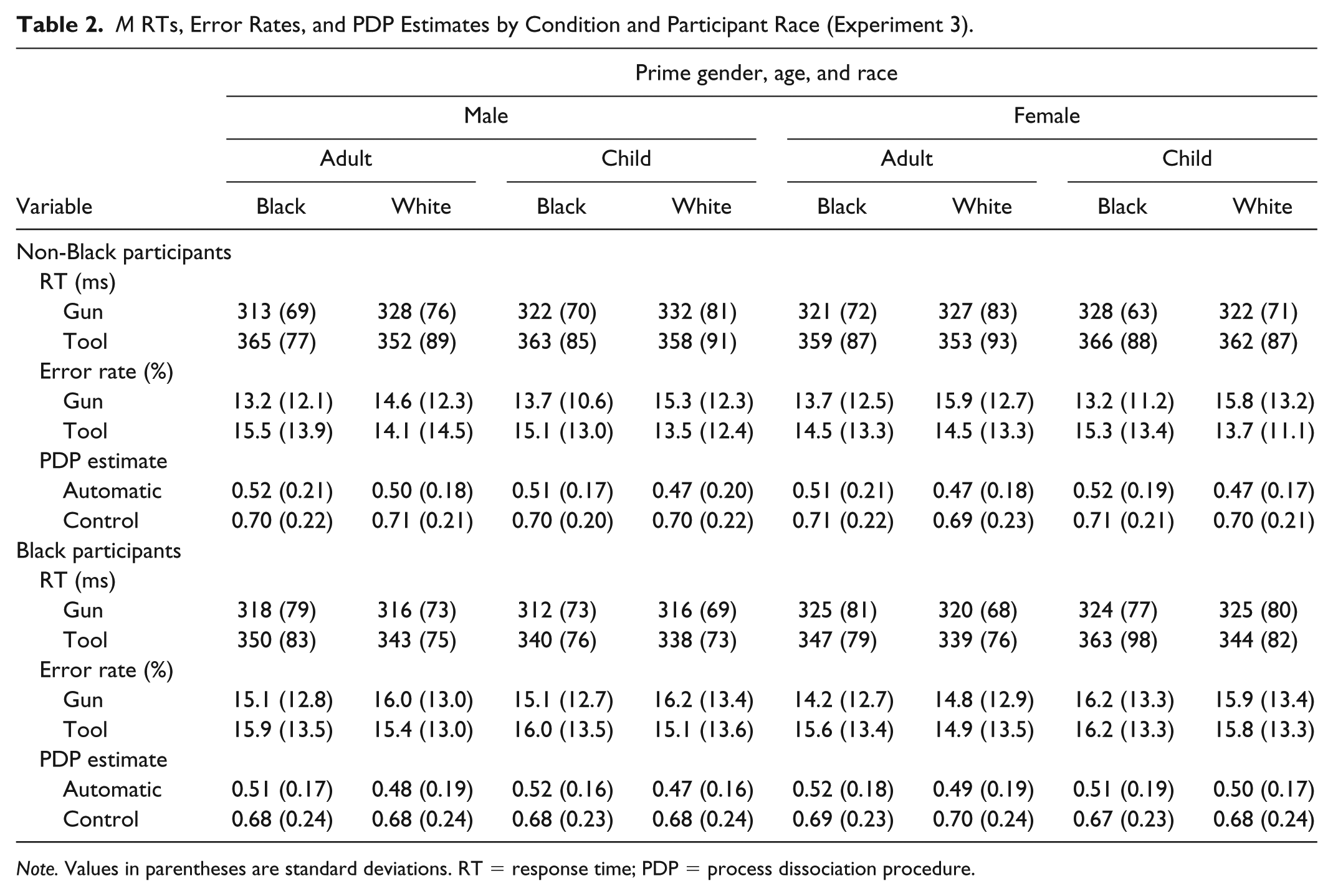
Note. Values in parentheses are standard deviations. RT = response time; PDP = process dissociation procedure.
Racial bias
RTs
RT analyses yielded a Prime Race × Target Object interaction indicative of racial bias, b = −.033, SE = .005, 95% CI = [–.043, –.024], t = −6.79, p < .001. Guns were identified nonsignificantly more quickly, b = −.007, SE = .004, 95% CI = [–.014, .000], t = −1.88, p = .060, whereas tools were identified more slowly, b = .027, SE = .005, 95% CI = [.017, .036], t = 5.57, p < .001, after Black versus White primes.
The Participant Race × Prime Race × Target Object interaction was not significant, b = .014, SE = .010, 95% CI = [–.006, .033], t = 1.39, p = .164; indeed, the Prime Race × Target Object interaction indicative of racial bias emerged among both non-Black participants, b = −.040, SE = .007, 95% CI = [–.054, –.026], t = −5.46, p < .001, and Black participants, b = −.026, SE = .006, 95% CI = [–.039, –.014], t = −4.10, p < .001. Furthermore, no other interactions involving Prime Race emerged (|t|s < 1.5, ps > .13), suggesting that the presence and magnitude of racial bias did not differ across prime age or prime gender.
Error rates
Error-rate analyses also yielded a Prime Race × Target Object interaction (i.e., racial bias), b = .19, SE = .04, 95% CI = [.12, .26], z = 5.15, p < .001. Guns were misidentified as tools less often, b = −.11, SE = .03, 95% CI = [–.16, –.06], z = −4.26, p < .001, whereas tools were misidentified as guns more often, b = .08, SE = .03, 95% CI = [.03, .13], z = 3.03, p = .002, after Black versus White primes.
In addition, there was a Participant Race × Prime Race × Target Object interaction, b = .17, SE = .07, 95% CI = [.02, .31], z = 2.29, p = .022. Whereas the Prime Race × Target Object interaction indicative of racial bias was sizable for non-Black participants, b = .27, SE = .06, 95% CI = [.16, .38], z = 4.87, p < .001, it was smaller (but still significant) for Black participants, b = .10, SE = .05, 95% CI = [.01, .20], z = 2.21, p = .027. No other interactions involving Prime Race were significant (|z|s < 1.4, ps > .18), which suggests the presence—and comparable magnitude—of racial bias across prime age and prime gender.
Age bias
RTs
The Prime Age × Target Object interaction indicative of age bias was not significant, t = −1.16, p = .25, but there was a significant Prime Age × Prime Gender × Target Object interaction, b = −.025, SE = .010, 95% CI = [–.044, –.006], t = −2.57, p = .010. Decomposing this three-way interaction revealed a significant Prime Age × Target Object interaction for male primes, b = −.018, SE = .007, 95% CI = [–.032, –.005], t = −2.64, p = .008, but not for female primes, b = .007, SE = .007, 95% CI = [–.007, .020], t = 0.98, p = .327. There were no other significant interactions involving Prime Age and Target Object (|t|s < 1.2, ps > .23), which suggests the presence of age bias—with similar magnitude—across prime race and participant race.
Error rates
There were no significant interactions involving Prime Age and Target Object (|z|s < 1.28, ps > .20), revealing no evidence of age bias in error rates.
Gender bias
RTs
A Prime Gender × Target Object interaction indicative of gender bias emerged, b = −.012, SE = .005, 95% CI = [–.022, –.003], t = −2.51, p = .012. Guns were identified more quickly (b = −.018, SE = .004, 95% CI = [–.025, –.011], t = −5.02, p < .001), whereas tools were identified no differently (b = −.005, SE = .005, 95% CI = [–.015, .004], t = −1.13, p = .266), after male versus female primes. This gender bias was moderated by Prime Age, as reported in the Prime Age × Prime Gender × Target Object interaction above. Decomposing this interaction within prime age (rather than within prime gender, as reported above) revealed a nonsignificant Prime Gender × Target Object interaction for child primes, b = .000, SE = .007, 95% CI = [–.014, .014], t < 1, p = .986. For adult primes, however, the Prime Gender × Target Object interaction was significant, b = −.025, SE = .007, 95% CI = [–.039, –.012], t = −3.66, p < .001. No other interactions involving Prime Gender and Target Object were significant (|t|s < 1.52, ps > .12), which suggests that the presence and magnitude of gender bias did not differ across prime race or participant race.
Error rates
No significant interactions involving Prime Gender and Target Object emerged (|z|s < 1.28, ps > .20). Thus, there was no evidence of gender bias in the error rates.
PDP estimates
A 2 (Participant Race) × 2 (Prime Gender) × 2 (Prime Age) × 2 (Prime Race) ANOVA on the automatic estimates yielded a Prime Race main effect (i.e., automatic racial bias), F(1, 185) = 12.34, p = .001,
General Discussion
We examined semantic associations with danger at the intersection of target race, target age, and target gender. Results from two initial experiments with White student samples revealed that seeing Black face primes facilitated the rapid and accurate categorization of danger-related objects and words relative to seeing White face primes. Moreover, this racial bias was not moderated by prime gender or prime age, except on the RT metric in Experiment 1 in which racial bias was weaker—but still present—for child versus adult primes and for female versus male primes. Results from a third experiment with a community sample suggested that both Black and non-Black participants displayed racial biases in their RTs, identifying guns more quickly and tools more slowly after Black versus White face primes, and this racial bias was moderated by neither prime age nor prime gender. The ultimate decisions of Black participants, as reflected in their error rates, however, were less differentially influenced by prime race than were the decisions of non-Black participants. PDP analyses indicated that the racial bias evident in both non-Black and Black participants’ error rates reflect an automatic (i.e., unintentional) biasing influence of prime race on object and word identification. In addition, some evidence of age bias and gender bias emerged across experiments, suggesting that children may be less strongly associated with danger than are adults, and females may be less strongly associated with danger than are males. To our knowledge, these are the first experiments to assess the operation of implicit biases at the intersection of three different social categories (race, age, and gender).
Internal Meta-Analysis
Although we found consistent evidence of racial bias across experiments and across response outcomes (i.e., RTs, error rates, and PDP estimates of automatic processing), we obtained inconsistent evidence for whether the magnitude of racial bias differed across prime age and prime gender: Both prime age and prime gender moderated racial bias on the RTs in Experiment 1, but these patterns of moderation did not emerge in Experiments 2 and 3, nor did they emerge on the error rates in any of the experiments. In addition, we obtained inconsistent evidence for age bias (i.e., stronger associations linking adults versus children with danger) and gender bias (i.e., stronger associations linking males versus females with danger) across experiments. Because a cumulative program of research is more informative than a single experiment in isolation (e.g., Braver, Thoemmes, & Rosenthal, 2014; Ledgerwood, in press), we conducted meta-analytic tests to synthesize our findings and to estimate more precisely the magnitude of the key effects. 11 Given our experiments’ methodological similarity, we ran fixed-effects models on the RTs, error rates, and PDP estimates of automatic processing using Comprehensive Meta-Analysis software (Borenstein, Hedges, Higgins, & Rothstein, 2009). 12 We report separate analyses for racial bias, age bias, and gender bias.
Racial bias
We first computed meta-analytic estimates of racial bias separately for primes of each age and each gender. 13 For the RTs and error rates, we created indices of racial bias (Kubota & Ito, 2014): (White prime with [gun or threatening word] trials – Black prime with [gun or threatening word] trials) + (Black prime with [tool or safe word] trials – White prime with [tool or safe word] trials). For the PDP estimates, we created an index of racial bias by subtracting automatic estimates for White primes from automatic estimates for Black primes.
The first analysis revealed significant racial bias after both adult primes (g = 0.34, 95% CI = [0.28, 0.39]) and child primes (g = 0.39, 95% CI = [0.33, 0.44]), with no difference across prime age (Δg = −0.01, 95% CI = [–0.08, 0.05], z < 1, p = .72). Thus, perceivers associated Black targets with danger more than they associated White targets with danger—and to the same degree for adult targets and child targets. This result suggests that danger-based racial bias consistently emerged across target age, replicating past work (Todd, Thiem, & Neel, 2016). The second analysis revealed significant racial bias after both male primes (g = 0.41, 95% CI = [0.36, 0.47]) and female primes (g = 0.31, 95% CI = [0.26, 0.37]); however, the magnitude of racial bias was weaker after female primes (Δg = 0.09, 95% CI = [0.02, 0.15], z = 2.69, p = .008). This difference in magnitude indicates that danger-based racial biases were dampened (though not eliminated) for female targets. These results suggest that stereotypes of Blacks as more dangerous than Whites may extend to targets across age and gender, and although the strength of this stereotype may be comparable for adults and children, it may be evoked less strongly by female targets than by male targets.
Age bias
We computed analogous meta-analytic estimates of age bias separately for primes of each race and each gender. The first analysis revealed significant age bias after both Black primes (g = 0.13, 95% CI = [0.08, 0.18]) and White primes (g = 0.13, 95% CI = [0.08, 0.19]), with no difference across prime race (Δg = 0.00, 95% CI = [–0.07, 0.06], z < 1, p = .98). That is, perceivers more readily associated adults versus children with danger, and the magnitude of this age bias was comparable for Black targets and White targets. Thus, age bias in danger associations consistently emerged across target race. The second analysis revealed significant age bias after both male primes (g = 0.17, 95% CI = [0.12, 0.22]) and female primes (g = 0.11, 95% CI = [0.06, 0.16]); however, this bias was weaker after female primes (Δg = 0.10, 95% CI = [0.04, 0.16], z = 3.20, p = .001). That is, the strength with which perceivers more readily associated adults versus children with danger was dampened (though not eliminated) for female targets. These results suggest that stereotypes of adults as more dangerous than children may be comparable for Black targets and White targets; however, these age-related stereotypes appear to be evoked less strongly by female targets than by male targets.
Gender bias
Finally, we computed analogous meta-analytic estimates of gender bias separately for primes of each race and each age. The first analysis revealed significant gender bias after Black primes (g = 0.13, 95% CI = [0.07, 0.18]) but not after White primes (g = 0.03, 95% CI = [–0.02, 0.08]), producing a significant difference across prime race (Δg = 0.10, 95% CI = [0.03, 0.17], z = 2.67, p = .008). Whereas there was no evidence that White female targets and White male targets were differently associated with danger, Black female targets were less strongly associated with danger than were Black male targets. Thus, gender bias in danger associations emerged only for Black targets. The second analysis revealed a significant gender bias after adult primes (g = 0.11, 95% CI = [0.06, 0.16]) but not after child primes (g = 0.04, 95% CI = [–0.01, 0.10]), producing a significant difference across prime age (Δg = 0.09, 95% CI = [0.02, 0.16], z = 2.52, p = .012). Whereas boys and girls were not differently associated with danger, women were less strongly associated with danger than were men. Thus, gender bias in danger associations emerged only for adult targets, suggesting that stereotypes of males as more dangerous than females may not extend equally to people of different races and ages: They may only be applied to Black (not White) targets and to adult (not child) targets.
Summary
These meta-analyses suggest several implications of our results for the joint operation of race, age, and gender in producing associations linking Black women and Black girls with danger. First, evidence for racial bias emerged across target age and target gender: Blacks of both ages and genders were more closely associated with danger than were their White counterparts. An important nuance emerged, however; even though racial bias was stronger for Black females than for White females, it was weaker for Black females than for Black males. This pattern parallels findings that Black females are seen as non-prototypical of both the category “female” and the category “Black” (e.g., Goff et al., 2008; Schug et al., 2015; Thomas et al., 2014); this pattern also aligns with findings that Black females are more likely than White females, but less likely than Black males, to be rated as possessing masculine traits (e.g., Ghavami & Peplau, 2013).
Age bias also emerged here, with adults being more closely associated with danger than were children, albeit with greater strength for male targets than female targets. Finally, gender bias emerged only for Black targets and adult targets; there was no evidence of gender bias for White targets and child targets. Speaking to our original question of whether Black women and Black girls are associated with danger, these findings suggest that Black women and Black girls collectively appear to be (a) more closely associated with danger than are White females (i.e., racial bias) and (b) less closely associated with danger than are Black males (i.e., gender bias). In addition, (c) Black children appear to be less closely associated with danger than are Black adults (i.e., age bias).
Implications and Future Research Directions
Collectively, these findings suggest that, across age, Black females, like Black males, may be more closely associated with danger than their White counterparts are. Because of this association, Black females may experience negative downstream outcomes, potentially including the tendency to be mistakenly shot when unarmed at rates higher than those for unarmed White females, as has been observed for unarmed Black men relative to unarmed White men (Correll et al., 2002; Hall, Hall, & Perry, 2016; but see Cesario, Johnson, & Terrill, 2018). At the same time, these results suggest that the magnitude of these racial biases may be smaller for Black females than Black males. A more complete understanding of the downstream implications of these results will require future research that systematically investigates how different target identities interact to affect shooting decisions.
As noted earlier, sequential-priming tasks are assumed to assess the strength with which different social categories (e.g., Black men) are associated with danger, but the implicit racial bias revealed in such tasks could also reflect knowledge about actual racial differences in access to guns or in gun violence victimization. Of course, such concerns are not unique to sequential-priming tasks; they apply to all so-called “implicit” measures of racial bias. Indeed, all mental associations, as assessed with implicit measures like those used here, are silent on their precise origin (Gawronski, Peters, & LeBel, 2008). Thus, it is possible that perceivers’ associations linking Blacks versus Whites with danger may have developed because of knowledge about actual racial differences in access to guns, gun violence victimization, or exposure to dangerous environments.
The current findings suggest several additional directions for future research. For example, our face primes were restricted to children and relatively young adults, so the question remains whether racial biases in danger associations generalize to middle-aged and older adult targets. Past research has found mixed evidence for racial bias in danger associations for older Black versus White men (e.g., Kang & Chasteen, 2009; Lundberg et al., 2018); future work could examine danger associations for older Black versus White women.
Future research could also explore how shifting contexts alters the strength of such associations. Our results apply most directly to social contexts in which Black and White adults and children are simultaneously present. In situations in which only Blacks are present, however, identity dimensions other than race—such as gender or age—may become more salient and may more strongly influence the activation of danger associations (e.g., Jones & Fazio, 2010).
Finally, the racial bias results reported here appear to generalize beyond White, college-age participant samples given that we replicated these effects with a sample of Black and non-Black community members (Experiment 3). With data from only one sample of Black participants, however, we are cautious about generalizing these results to the Black American population more generally. In addition, although we replicated our racial bias results using two different types of target stimuli (objects and words), we are uncertain about how widely these results will generalize to stimuli beyond those used here. For example, we selected facial stimuli that were easily identified as male or female, which may have led to the selection of male and female faces that are more masculine and more feminine, respectively, than the average male face and the average female face in the general population. Future research using a different set of facial stimuli will help broaden our understanding of how widely our results generalize.
Conclusion
The current research provides important insights into implicit danger associations at the intersection of target race, age, and gender, and thus helps fill a gap left by sparse research on Black women and Black girls as targets of racial bias (Cole, 2009). Our findings suggest that seeing faces of Black people, regardless of age or gender, facilitated the identification of danger-related objects and words more than seeing faces of White people did. At the same time, this racial bias was weaker for female versus male faces, though the magnitude of racial bias was comparable for adult and child faces. Furthermore, our findings indicate that faces of adults, regardless of race, more readily facilitated identification of danger-related stimuli than did faces of children, though this association was stronger for male than female faces. Finally, our results also suggest that male faces facilitated the identification of dangerous stimuli more than female faces did, but only for Black faces and adult faces. Male and female faces facilitated the identification of danger-related stimuli to a comparable degree for White faces and child faces. This work adds to a burgeoning literature on social cognition at the intersection of multiple social identities. We hope future research will continue this effort.
Supplemental Material
Thiem_Online_Appendix – Supplemental material for Are Black Women and Girls Associated With Danger? Implicit Racial Bias at the Intersection of Target Age and Gender
Supplemental material, Thiem_Online_Appendix for Are Black Women and Girls Associated With Danger? Implicit Racial Bias at the Intersection of Target Age and Gender by Kelsey C. Thiem, Rebecca Neel, Austin J. Simpson and Andrew R. Todd in Personality and Social Psychology Bulletin
Supplemental Material
TNST_PSPB_Revision_3_Supplemental_Materials – Supplemental material for Are Black Women and Girls Associated With Danger? Implicit Racial Bias at the Intersection of Target Age and Gender
Supplemental material, TNST_PSPB_Revision_3_Supplemental_Materials for Are Black Women and Girls Associated With Danger? Implicit Racial Bias at the Intersection of Target Age and Gender by Kelsey C. Thiem, Rebecca Neel, Austin J. Simpson and Andrew R. Todd in Personality and Social Psychology Bulletin
Footnotes
Acknowledgements
We thank Merril Chesser, Seunggun Lee, Lingyu Li, Alexandrea Martin, Zara Teichroew, and Solomon Worlds for assisting with data collection for Experiments 1 and 2. Special thanks to Bryan Baird and the University of Chicago’s Center for Decision Research for assisting with programming and data collection for Experiment 3.
Declaration of Conflicting Interests
The author(s) declared no potential conflicts of interest with respect to the research, authorship, and/or publication of this article.
Funding
The author(s) disclosed receipt of the following financial support for the research, authorship, and/or publication of this article: This work was facilitated by NSF Grants BCS-1625401 awarded to R.N. and BCS-1764097 awarded to A.R.T.
Notes
Supplemental Material
Supplemental material is available online with this article.
References
Supplementary Material
Please find the following supplemental material available below.
For Open Access articles published under a Creative Commons License, all supplemental material carries the same license as the article it is associated with.
For non-Open Access articles published, all supplemental material carries a non-exclusive license, and permission requests for re-use of supplemental material or any part of supplemental material shall be sent directly to the copyright owner as specified in the copyright notice associated with the article.
