




Abstract
This research systematically mapped the relationship between political ideology and receptivity to pseudo-profound bullshit—that is, obscure sentences constructed to impress others rather than convey truth. Among Swedish adults (N = 985), bullshit receptivity was (a) robustly positively associated with socially conservative (vs. liberal) self-placement, resistance to change, and particularly binding moral intuitions (loyalty, authority, purity); (b) associated with centrism on preference for equality and even leftism (when controlling for other aspects of ideology) on economic ideology self-placement; and (c) lowest among right-of-center social liberal voters and highest among left-wing green voters. Most of the results held up when we controlled for the perceived profundity of genuine aphorisms, cognitive reflection, numeracy, information processing bias, gender, age, education, religiosity, and spirituality. The results are supportive of theoretical accounts that posit ideological asymmetries in cognitive orientation, while also pointing to the existence of bullshit receptivity among both right- and left-wingers.
In today’s digital age, information is spread at an unprecedented pace without quality control, and we are frequently exposed to fake news, conspiracy theories, ideologically biased narratives, and “alternative facts.” It is, therefore, more important than ever to be able to separate fact from fiction and reality from fake. Aside from the outright lies and the delusions, there is—using a term from recent scholarship (Frankfurt, 2005)—the bullshit. Rather than lying or being deluded about the truth, the person who is engaging in bullshitting is simply not interested in the truth-values of his or her claims. He or she has other goals, such as impressing or persuading others.
One particularly pernicious form of bullshit that has recently become the focus of empirical research is the pseudo-profound bullshit. This is the sort of bullshit that is designed to sound intellectually profound, and to instill in others a sense of awe about the deep insights that the bullshitter possesses, through the use of vague, impressive-sounding buzzwords. To measure a person’s receptivity to pseudo-profound bullshit, Pennycook, Cheyne, Barr, Koehler, and Fugelsang (2015) generated sentences by randomly stringing together words from a list of profound-sounding words or from tweets by Deepak Chopra (a prominent figure in the New Age movement) into syntactically correct but vacuous sentences (e.g., “Imagination is inside exponential space time events”). They found that the tendency to rate the bullshit sentences as profound, which they termed bullshit receptivity, was consistently associated with a more intuitive and less reflective cognitive style, lower cognitive ability, more religious and paranormal beliefs, more faith in alternative medicine and conspiracy theories, and a greater proneness to ontological confusions (i.e., category mistakes).
Recognizing that bullshit receptivity might be a reflection of the inclination to rate all statements as meaningful, Pennycook et al. (2015) also measured profundity ratings of motivational quotations and mundane statements, finding some evidence that an intuitive cognitive style and belief in conspiracy theories and alternative medicine is associated with seeing not just bullshit sentences but also meaningful sentences as more profound. They, therefore, introduced the notion of bullshit sensitivity, which is the ability to distinguish genuinely meaningful statements from bullshit statements—or, in other words, to detect bullshit.
Pennycook and Rand (2018b) later found that bullshit receptivity was associated with the perceived accuracy of fake news stories, the reported willingness to share fake news stories through social media, and the tendency to overclaim knowledge about made-up content. These relations held up when they controlled for the tendency to rate genuinely profound sentences as profound.
Subsequent studies have applied this research paradigm to the long-standing debates over whether, and to what extent, there are ideological asymmetries and symmetries in epistemic orientations.
Bullshit Receptivity and Political Ideology
One of the classical theories in this area, harking back to the notions of the “authoritarian personality” (Adorno, Frenkel-Brunswik, Levinson, & Sanford, 1950) and the “rigidity-of-the-right” (Tetlock, 1984), suggests that there is a fundamental cognitive asymmetry between left- and right-wingers, stretching across many domains of cognition. On this account, right-wingers have stronger epistemic needs for certainty, order, and closure, less cognitive ability, and a cognitive style that is more intuitive, simple, and heuristics-based and less analytical, complex, and systematic than left-wingers do (Jost, Glaser, Kruglanski, & Sulloway, 2003; Jost & Krochik, 2014; Jost, Sterling, & Stern, 2016). If that is indeed the case, then these asymmetries should make right-wingers more prone to be seduced by pseudo-profound bullshit, particularly insofar as they encompass the inclination to attend to superficial cues (such as impressive-sounding words) rather than actual content (Jost & Krochik, 2014) and to engage in low-effort, non-deliberative thought (Eidelman, Crandall, Goodman, & Blanchar, 2012). Seeing through pseudo-profound bullshit inevitably requires a degree of analytical engagement with the content, as opposed to accepting information as meaningful and true at face value.
More recently, a more complex view of ideological asymmetries has been proposed. On this account, which we call the “complexity view” for expository purposes, a certainty- and security-oriented epistemic style is associated with rightist views only in the social sphere; it is associated with leftist views in the economic sphere, because the sense of material security and stability afforded by left-wing economic policies is appealing to persons who crave certainty and security (Feldman & Johnston, 2014; Johnston, Lavine, & Federico, 2017; Malka & Soto, 2015; Malka, Soto, Inzlicht, & Lelkes, 2014). Furthermore, political engagement is assumed to play a key moderating role. Among persons with a strong desire for certainty and security, those who are highly engaged are more likely to subscribe to an entire right-wing discursive package (in social and economic domains), whereas those who are less engaged are more likely to view economic issues through the lens of personal material circumstances and to thereby adopt a left-wing position in the economic domain (Johnston et al., 2017; Malka et al., 2014). Insofar as a certainty- and security-oriented epistemic style is associated with a lack of analytic, deliberative forms of thinking (Jost & Krochik, 2014), this account predicts that bullshit receptivity is associated with right-wing ideology in the social domain but with left-wing ideology in the economic domain, particularly among persons low in political engagement.
Another challenge to the classical rigidity-of-the-right view comes from theoretical accounts that posit ideological symmetries in cognitive functioning. One type of account, which has often been called “extremism theory,” suggests that adherence to any political ideology, and particularly extremism, is associated with dogmatism, intellectual simplicity, and needs for certainty and security (Greenberg & Jonas, 2003; Lammers, Koch, Conway, & Brandt, 2017; Tetlock, Armor, & Peterson, 1994; van Prooijen & Krouwel, 2017). In stark contrast to this, a competing account, which we will call “centrism theory,” suggests that intellectual simplicity and lack of analytical thinking is associated with centrism, by virtue of making people averse to controversial ideas or indifferent (Pennycook & Rand, 2018a; Sidanius, 1988; Van Hiel & Mervielde, 2003). Furthermore, recent research has suggested that left- and right-wingers are equally prone to partisan bias in searching for information (Frimer, Skitka, & Motyl, 2017) and processing it (Ditto et al., 2018), and that there are no general, domain-independent differences between left- and right-wingers in terms of cognitive complexity or dogmatism (Conway et al., 2016). These lines of research challenge the rigidity-of-the-right view and thereby raise the possibility that left- and right-wingers are equally prone to bullshit receptivity.
Nevertheless, research on bullshit receptivity and political ideology has so far been consistent with the rigidity-of-the right hypothesis. Pfattheicher and Schindler (2016) found that bullshit receptivity predicted general conservative self-placement and favorable ratings of Republican presidential candidates (especially Ted Cruz) in the United States, and the results held up when they controlled for the perceived meaningfulness of mundane statements. Similar to this, additional analyses of the Pennycook et al. (2015) U.S. data sets conducted by Sterling, Jost, and Pennycook (2016) showed that bullshit receptivity (and an intuitive, non-reflective cognitive style in general) predicted trust in a Republican-led government and preference for a free-market economic system.
In addition to this, a secondary analysis conducted by Sterling et al. (2016) that demonstrated a quadratic association between bullshit receptivity and preference for free markets appeared to support centrism theory, suggesting that moderates are more receptive to bullshit than extremists in either direction. However, Simonsohn (2018) recently showed that a test of a quadratic relationship is, contrary to popular belief, not a valid test of the presence of a u-shaped relationship. Using a new, more appropriate statistical method, Simonsohn found no evidence in the Pennycook et al. (2015) data that bullshit receptivity levels off significantly after it has plateaued, although there was a significant linear association between bullshit receptivity and free-market support.
In sum, the studies conducted so far do indicate that there is an ideological asymmetry in terms of bullshit susceptibility that covers both general and economic ideology. But they suffer from several limitations. We turn to these limitations next and explain how we addressed them in the current study.
The Building Blocks of Political Orientations
Research has amply demonstrated the existence of different kinds of leftists and rightists (or liberals and conservatives), with different patterns of ideological preferences and moral intuitions (Feldman & Johnston, 2014; Haidt, Graham, & Joseph, 2009; Stenner, 2009; Weber & Federico, 2013). But the past research on bullshit receptivity and political orientation has not taken the varieties of left- and right-wing ideology into consideration. It can therefore not tell us whether the documented ideological asymmetries are due to a general difference between right and left or rather to a particular group of rightists or leftists that stands out.
One way to get at the differences between leftists and rightists of different sorts would be to go beyond the assessment of ideological self-placements and ratings of presidential candidates by also disentangling different aspects of political ideology. None of the studies on bullshit and political orientation published so far have done this in a systematic way. We therefore sought to measure the most important general aspects of political ideology.
We measured ideological preferences in terms of the dimensions of resistance to change and preference for equality, drawing on the influential framework introduced by Jost et al. (2003), which suggests that leftists are motivated to increase equality and support social change whereas rightists are motivated to preserve tradition and justify current inequalities. We also measured individualizing and binding moral intuitions, drawing on the moral foundations framework introduced by Haidt and Graham (2007), which suggests that liberals (or leftists) are concerned exclusively with the fair treatment and protection of individuals (i.e., “individualizing” intuitions), whereas conservatives (or rightists) also harbor concerns with ingroup loyalty, respect for authority, and purity that bind them into groups and systems (i.e., “binding” intuitions). If a simple, intuitive, certainty-oriented cognitive style is associated with right-wing views in the social domain but not the economic domain, then bullshit receptivity should be associated primarily with resistance to change and binding moral intuitions rather than a weak preference for equality or a lack of individualizing moral intuitions.
The Importance of the Political Context
Another problem is that all of the published research on bullshit receptivity and political ideology has been conducted exclusively in the United States, which is an outlier, even among Western nations, in the sense that the political divide is intimately connected with the divide between religiosity and secularity and with a bi-party political system that pits liberals against conservatives. It is therefore difficult to know whether the previous findings reflect a high level of bullshit receptivity among U.S. conservatives specifically or among right-wingers in general—in fact, none of the past studies have even controlled for religiosity in spite of the correlation between religious belief and bullshit receptivity (Pennycook et al., 2015).
By contrast, in Sweden, where we conducted our research, the left–right dimension is almost completely independent of the opposition between religiosity and secularity, and it cannot be described in terms of a simple liberal versus conservative (or Democrat vs. Republican) divide. Rather, the left encompasses socialist, green, and social democrat ideologies, whereas the right encompasses social liberal, social conservative, libertarian, and “liberal conservative” ideologies, and the division between right and left is almost completely due to diverging views on equality, particularly in the economic sphere, while there are large differences in terms of social conservatism and traditionalism within the left and right (Aspelund, Lindeman, & Verkasalo, 2013; Cochrane & Nevitte, 2009). If a susceptibility to pseudo-profound bullshit would prove to be associated with right-wing ideology in this context, then this would considerably strengthen the case for universal ideological asymmetries in the reception and detection of bullshit.
Another advantage of focusing on Sweden is that it allows us to take the existence of different kinds of left- and right-wingers into account by comparing persons who support different parties. The Swedish context is ideal for addressing this issue as there are no less than eight parties, with different ideological roots and political foci, currently represented in the Swedish parliament. On the left, there are two small parties—the Left party, which subscribes to democratic socialism and focuses on welfare issues, and the Green party, which subscribes to environmentalism, pacifism, and the promotion of sustainability—and the large, pragmatic, “catch-all” party called the Social Democrat party, which has ruled Sweden for most of the 20th century, seeking to reconcile capitalism with a socialist protection of the interests of the working class. On the right, there are two small social liberal parties—the Liberal party, which combines a concern for individual freedom with advocacy of social reforms, and the Center party, which is pro environmentalism, liberal immigration policies, and decentralization—as well as a small socially conservative party rooted in Christian values called the Christian Democrat party and a large “liberal-conservative” party called the Moderate party that combines free-market advocacy with elements of traditionalist values. There is also a nationalist and socially conservative party called the Sweden Democrat party that is opposed to immigration, multiculturalism, and political correctness, similar to right-wing populist parties in other European countries.
As shown in Figure 1, which illustrates ideological self-placement in our sample, there were indeed clear differences between social liberal and social conservative parties on the social ideology axis and between left- and right-wing parties on the economic axis. If bullshit receptivity is associated with right-wing ideology in the social domain, then we should see a clear difference between right-wingers who support a social liberal right-wing party (the Liberal or Center party) and those who support a social conservative right-wing party (the Christian Democrat or Sweden Democrat party). If bullshit receptivity is associated with right-wing ideology in the economic domain, then we should see a clear divergence between left- and right-wingers in general.
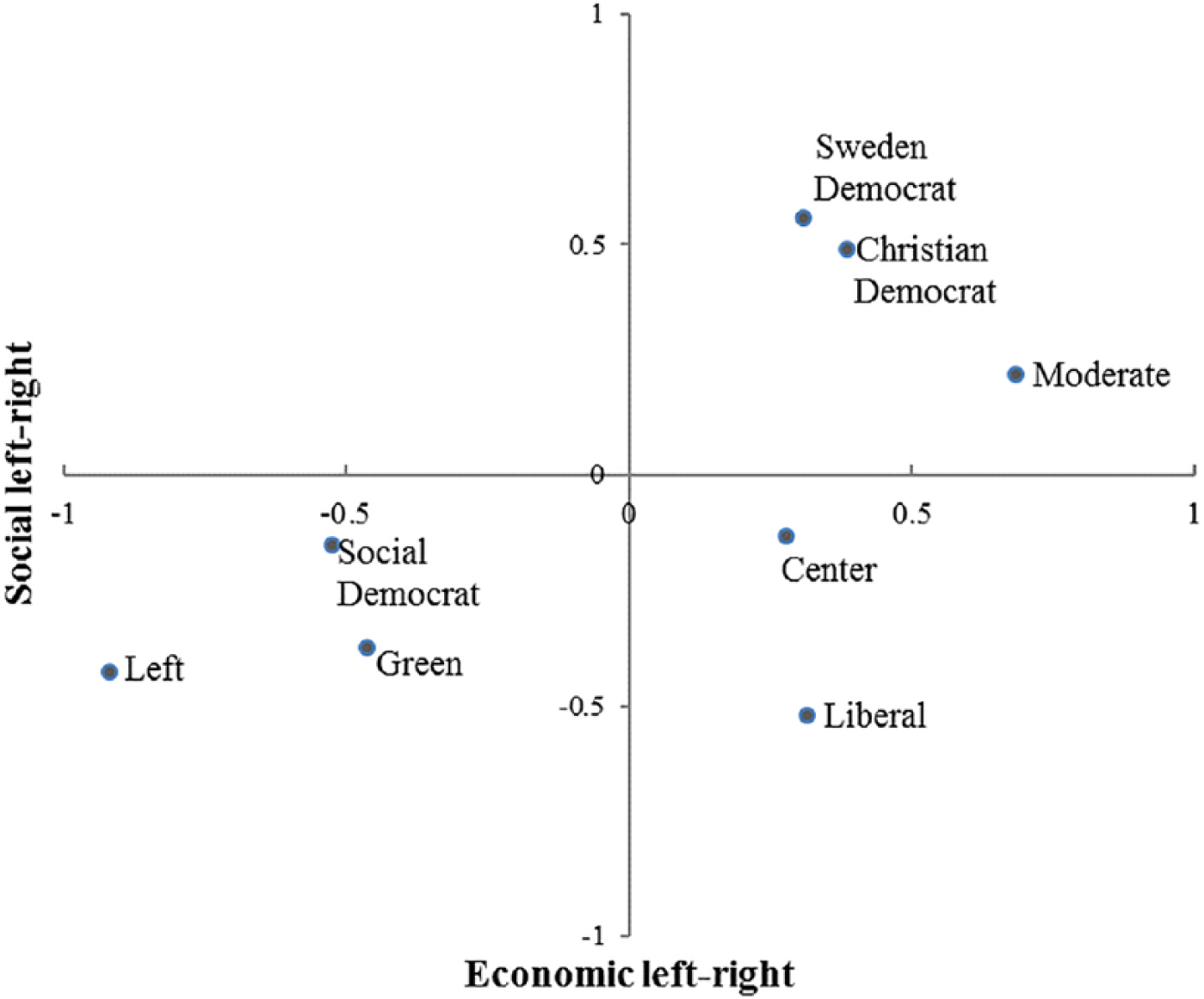
Mean standardized economic and social left–right self-placement by party preference.
The contrast between the two socially conservative parties is also interesting given that one is a nationalist party (the Sweden Democrat party), while the other is not (the Christian Democrat party), and ideological asymmetries in cognitive functioning have been linked both to conservatism and to nationalism (e.g., Zmigrod, Rentfrow, & Robbins, 2018). A large survey of Swedes’ attitudes to science, pseudoscience, conspiracy theories, and paranormal phenomena conducted by the Swedish Skeptics Association (2015) suggested that persons who supported these two parties had the least faith in the scientific method, the theory of evolution, and the reality of global warming of all Swedish voters. Christian Democrat supporters stood out in terms of their belief in a higher power, the soul, reincarnation, creationism, angels, ghosts, telepathy, and energy healing. Sweden Democrat supporters were particularly likely to believe that different human races exist and that attention deficit hyperactivity disorder (ADHD) was made up by the medical industry.
Interestingly, this survey also showed that persons who supported the Green party (which is on the left) stood out in terms of their belief in alternative medicine (including acupuncture, energy healing, and homeopathy), astrology, anthroposophy (Waldorf education and biodynamic growth), electric allergy, paranormal phenomena, and the moon landing conspiracy theory, although they had strong faith in the scientific method, the theory of evolution, and the reality of global warming (similar to most Swedes). Insofar as such beliefs are symptoms of receptivity to bullshit, these findings illuminate the potential existence of bullshit receptivity on the left, conceivably driven by an openness to ideas that is unrestrained by critical thinking. Openness has been linked to the tendency to see meaningful patterns where none exist (DeYoung, Grazioplene, & Peterson, 2012).
Overview of Research
We constructed a Swedish measure of bullshit receptivity on the basis of the Pennycook et al. (2015) research paradigm and administered this measure to a large and heterogeneous sample of Swedish adults, along with measures of ideological self-placement, political preferences, and moral intuitions. We investigated correlations and the potential presence of u-shaped relationships between bullshit receptivity and ideology in the social domain (social liberal–conservative self-placement, resistance to change, and binding moral intuitions) and the economic domain (economic left–right self-placement, preference for equality, and individualizing moral intuitions), and we analyzed differences between persons who voted for eight different parties on bullshit receptivity. We tested whether the results held up when we controlled for (a) profundity ratings of genuinely profound aphorisms, (b) cognitive variables (i.e., cognitive reflection, numeracy, and biased processing of neutral and political information), and (c) religiosity and demographics (i.e., traditional religiosity, spirituality, gender, age, and education). Using education as a proxy for political engagement, we also investigated whether education moderated the relations between ideological variables and bullshit receptivity.
Method
Participants
The participants were Swedish adults (N = 985 1 ; 49.8% women; M age = 49.2 years, SD = 15.2) who were recruited from a nationally representative panel by an independent research firm. The sample was similar to the national averages in terms of gender, age, education, and party preference.
The total sample size was determined by practical considerations. But it was nevertheless roughly 5 times larger than the sample sizes used in the past research on bullshit receptivity and political ideology. Post hoc power analyses conducted in G*Power 3.1.9 (Faul, Erdfelder, Lang, & Buchner, 2007) indicated that the sample gave us more than 90% power to detect weak correlations (|ρ| < .10). However, the analyses involving party preference had lower power, especially in those cases that two small parties were compared with each other (80% power: .15 ≤ f ≤ .31 or .15 ≤ r ≤ .30). Gignac and Szodorai (2016) found that roughly 25% of correlations reported in psychological research are smaller than r = .10, 50% are smaller than r = .20, and 75% are smaller than r = .30 and suggested that these estimates should be used as benchmarks for what is a small, medium-sized, and large correlation.
Materials
The participants completed a battery of questionnaires online (the median time of completion was 28.6 min). Results regarding motivated reasoning (Lind, Erlandsson, Västfjäll, & Tinghög, 2018), the relation between moral foundations and prosociality (Nilsson, Erlandsson, & Västfjäll, 2018), and the relation between bullshit receptivity and prosociality (Erlandsson, Nilsson, Tinghög, & Västfjäll, 2018) have been reported elsewhere. Study materials and data are available in supplementary documentation. Descriptive statistics for all scales are displayed in Table 1.
Mean Values, Standard Deviations, and Reliability Coefficients of Scales.

Note. α = Cronbach’s alpha reliability, ω h = McDonald’s hierarchical omega reliability.
Bullshit and profoundness receptivity
We measured bullshit receptivity and profoundness receptivity by asking participants to rate the meaningfulness and profundity of seven bullshit statements (e.g., “Your movement transforms universal observations”) and seven genuine aphorisms (e.g., “Your teacher can open the door, but you have to step in”), respectively, on a Likert-type response bar ranging from 1 (not at all meaningful) to 6 (very meaningful). The statements were inspired by the ones used by Pennycook et al. (2015).
Confirmatory factor analysis showed that a two-factor model that separated bullshit and profoundness receptivity, χ2(76) = 458.3, p < .001, comparative fit index (CFI) = .932, root mean square error approximation (RMSEA) = .071 (90% confidence interval [CI] = [.065, .078]), was vastly superior to a one-factor model integrating these scales, χ2(77) = 2,057.6, p < .001, CFI = .649, RMSEA = .162 (90% CI = [.156, .168]). Together with the reported omega reliabilities (see Table 1), these results provide evidence of the distinctness and unidimensionality of the bullshit and profoundness receptivity scales.
Cognitive dispositions
We measured numeracy with three questions (e.g., “Imagine we are throwing a five-sided die 50 times. On average, out of these 50 throws how many times would this five-sided die show an odd number—1, 3, or 5?”) drawn from widely employed tests of numeracy (Cokely, Galesic, Schulz, Ghazal, & Garcia-Retamero, 2012; L. M. Schwartz, Woloshin, Black, & Welch, 1997). We measured cognitive reflection with the original cognitive reflection test (Frederick, 2005), which consists of three questions (e.g., “A bat and a ball cost US$1.10 in total. The bat costs US$1.00 more than the ball. How much does the ball cost?”). Scores on both of these variables were computed as the number of correct responses, which varied from 0 to 3.
We measured biased processing of neutral quantitative information (regarding the effectiveness of a skin cream) using a measure of confirmation bias constructed by Kahan, Peters, Dawson, and Slovic (2017). We constructed a modified variant of this instrument to measure biased processing of information also in the political domain (regarding the link between immigration and crime). For both measures, the participants were randomly assigned to one of two conditions: Whether the correct response was that the skin cream increased (52.2% correct responses) or decreased (54.9% correct responses) skin problems and that the crime rate increased (58.6% correct responses) or decreased (51.1% correct responses) in communities that took in immigrants. In the models in which we controlled for cognitive variables, we used the scores of all participants to be able to use all of the data, which means that we controlled for biased information processing in general rather than confirmation bias. But in reports of correlations, we focus on confirmation bias scores (which had stronger correlations with bullshit receptivity and political orientation variables), including only those participants who were in a position to display confirmation bias for neutral information (those for whom the skin cream actually worsened skin conditions; n = 473) and for political information (those for whom the crime rate decreased who were at least half a standard deviation right of center or those for whom the crime rate increased who were at least half a standard deviation left of center; n = 360).
Moral foundations
We measured moral intuitions with the Swedish version (Nilsson & Erlandsson, 2015) of the Moral Foundations Questionnaire (Graham, Haidt, & Nosek, 2009). It measures each foundation with three items addressing the perceived moral relevance of concerns that rest on this foundation (e.g., “Whether or not someone suffered emotionally”) on a Likert-type scale ranging from 0 (not at all relevant) to 5 (extremely relevant) and three items assessing agreement with foundation-based moral judgments (e.g., “Respect for authority is something all children need to learn”) on a Likert-type scale ranging from 1 (completely disagree) to 7 (completely agree). We computed sum scores for individualizing moral intuitions (harm and fairness) and binding moral intuitions (loyalty, authority, and purity). Although the omega (hierarchical) reliabilities were somewhat low, focusing on the specific foundations would not have helped (.33 ≤ ω h ≤ .64).
Political orientation
The participants reported general left–right self-placement (“Do you see yourself as politically to the left or right on this scale?”) on a 9-point Likert-type scale ranging from 1 (very far to the left) to 9 (very far to the right); average self-placement was close to the theoretical midpoint (M = 5.06; SD = 1.74), t(984) = 1.08, p = .28. They also reported whether they think economic equality (“to reduce the economic differences in society even if it leads to a redistribution of resources from those who have a lot to those who have little”) or economic freedom (“each individual has the right to reap the results of his or her financial success even if it leads to economic inequality in society”) is more important on a 7-point Likert-type scale ranging from 1 (I think economic equality is much more important) to 7 (I think economic freedom is much more important; M = 3.69, SD = 1.73). They were also asked whether they lean more toward social conservatism (“people who are socially conservative emphasize the value of societal traditions and of sometimes getting into line and following norms”) or social liberalism (“people who are socially liberal emphasize the value of individual freedom and the right of all individuals to fully be themselves”) on a 7-point Likert-type scale ranging from 1 (I lean much more in the conservative direction) to 7 (I lean much more in the liberal direction); we reversed the scores so that higher values would correspond to right- rather than left-wing ideology, similar to the other scales (M = 3.79, SD = 1.75).
We measured preference for equality with a four-item scale (e.g., “It is a mistake to try to guarantee an equal distribution of resources between rich and poor” reversed) developed by S. H. Schwartz, Caprara, and Vecchione (2010). We measured resistance to change with four items (e.g., “This country would be better off if there were more emphasis on traditional family ties”) selected from previous attempts to isolate this component of ideology (Nilsson & Jost, 2017). Participants responded on 7-point Likert-type scales ranging from 1 (completely disagree) to 7 (completely agree).
The participants reported party preference (“What party would you vote for if there was an election today?”) by selecting one of 10 options: 1 = The Social Democrats (n = 184), 2 = The Moderates (n = 123), 3 = The Sweden Democrats (n = 160), 4 = The Green Party (n = 45), 5 = The Center Party (n = 76), 6 = The Left Party (n = 80), 7 = The Liberal Party (formerly the Liberal People’s Party; n = 63), 8 = The Christian Democrats (n = 25), 9 = Other (n = 33), 10 = do not want to answer/do not know (n = 196). The distribution of responses was similar to results of opinion polls conducted at the time of data collection.
Religiosity
We measured traditional religiosity by aggregating responses (α = .77) to one item assessing religious identity (“Religion is an important part of my life” 1 = completely disagree, 7 = completely agree; M = 2.56, SD = 1.82) and one item measuring religious activity (“How often do you read religious texts, go to church, or pray to God?” 0 = never, 1 = once a year, 2 = a few times a year, 3 = once a month, 4 = once a week, 5 = several times a week, 6 = every day; M = 2.37, SD = 1.66). We measured spirituality with four items (e.g., “There is a higher plane of consciousness or spirituality that binds all people”) from Piedmont’s (1999) scale (translated into Swedish by Nilsson & Strupp-Levitsky, 2016).
Demographics
The participants reported their age, gender, and highest level of education completed (92% had completed high school and 41% had a university degree, which is similar to the national averages).
Statistical Analyses
We used hierarchical regression models to investigate the relations between bullshit receptivity and political orientation. In Model A, we first entered economic left–right self-placement and social liberal–conservative self-placement as predictors; in Model B, we included also resistance to change and preference for equality as predictors; and in Model C, we entered all six predictors, including binding and individualizing moral intuitions. Next, we entered the covariates. In the second step of all three models, we entered profoundness receptivity; in the third step, we entered the cognitive variables (cognitive reflection, numeracy, and information processing bias); and in the fourth step, we entered demographics and religious orientation (gender, age, education, traditional religiosity, and spirituality; tolerance ≥ 49 with all predictors entered). We ran an additional series of regression models (one for each of the six ideology variables) to investigate whether relations between bullshit receptivity and political ideology were moderated by education, entering the two variables and their interaction term as predictors. We report correlations and regression coefficients with 95% bias-corrected bootstrap CIs based on 10,000 resamples. All variables were standardized prior to the analyses. Although there was a degree of skew in scores on religiosity (1.07), education (–0.30), cognitive reflection (0.60), profoundness receptivity (–0.53), and bullshit receptivity (0.46), the findings were robust when we compared parametric and non-parametric correlations and when we ran the regression models without skewed covariates, so we report the results of the original analyses.
To detect possible u-shaped relationships between bullshit receptivity and political orientation, we used Simonsohn’s (2018) Two lines-test version 0.3 (webstimate.org/twolines). This test fits separate linear regression models for low and high values of x and concludes that a u-shape is present if both slopes are significant and of opposite sign. The breakpoint is set through an algorithm designed to maximize statistical power while preserving the nominal false-positive rate. We were able to run this test for resistance to change, preference for equality, binding intuitions, and individualizing intuitions (which had a broader scale range than the self-placement items did).
We used Holm’s (1979) modified Bonferroni procedure, which involves sequentially adjusting the α threshold, to control error rates. We controlled for testing the six primary linear relationships between bullshit receptivity and ideology (social and economic ideology self-placement, resistance to change and preference for equality, binding and individualizing moral intuitions), as well as the four u-shaped relationships we investigated. We treated the tests of interactions as exploratory as they were not part of the original analysis plan.
The reliability coefficients we report are McDonald’s omega (hierarchical) coefficients (ω h ), which represent the general factor saturation of a scale, and Cronbach’s alpha, which does not take factor structure into account. They were computed using the psych package in R 3.2 (Revelle, 2018). The confirmatory factor analysis we report was run in AMOS 23.0 with calculations based on the covariance matrix and maximum likelihood (ML) estimation.
We investigated the relation between party preference and political orientation through ANOVA with pairwise comparisons, quantifying effect sizes in terms of eta squared and differences in standardized scores with 95% CIs. We did not have clear hypotheses about specific differences between parties prior to the study, so we took an exploratory approach, testing all of the 28 contrasts between the eight parties. Due to the exploratory nature of these analyses, we report results without error control (those contrasts with p values ≤ .002 would have remained significant even with strict Holm–Bonferroni corrections). Once again, we added the covariates sequentially: (a) profoundness receptivity, (b) cognitive variables, (c) ideology variables, and (d) demographics and religious orientation.
Results
Ideological Self-Placement, Political Attitudes, and Moral Intuitions
The correlations, which are displayed in Table 2, indicated that bullshit receptivity was strongly positively related to binding moral intuitions (p < .001; adjusted α-threshold = .005), moderately positively related to resistance to change (p < .001; adjusted α-threshold = .006), and weakly positively related to socially conservative (vs. liberal) self-placement (p < .001; adjusted α-threshold = .006). These relations were virtually unaffected when we adjusted for profoundness receptivity (which correlated weakly positively with bullshit receptivity). There was also a weak positive correlation between bullshit receptivity and individualizing intuitions (see Table 2) that did not reach significance when we adjusted for the number of tests (p = .013; adjusted α-threshold: .008) and vanished completely when we controlled for profoundness receptivity (p = .56). Bullshit receptivity did not correlate with general or economic left–right self-placement or preference for equality, consistent with the complexity view, which asserts that a simple and intuitive cognitive style is positively associated with social conservative but not economic aspects of ideology. Profoundness receptivity, on the other hand, had a strong positive correlation with individualizing moral intuitions and weak to medium-sized positive correlations with binding moral intuitions, resistance to change, and preference for equality. In addition to this, bullshit receptivity correlated positively with confirmation bias (political and neutral) and negatively with cognitive reflection and numeracy, while profoundness receptivity was weakly positively correlated with cognitive reflection and numeracy (see Table 2).
Correlations Between Bullshit and Profoundness Receptivity, Cognitive Orientation, and Political Orientation With Bias-Corrected Bootstrap Confidence Intervals.
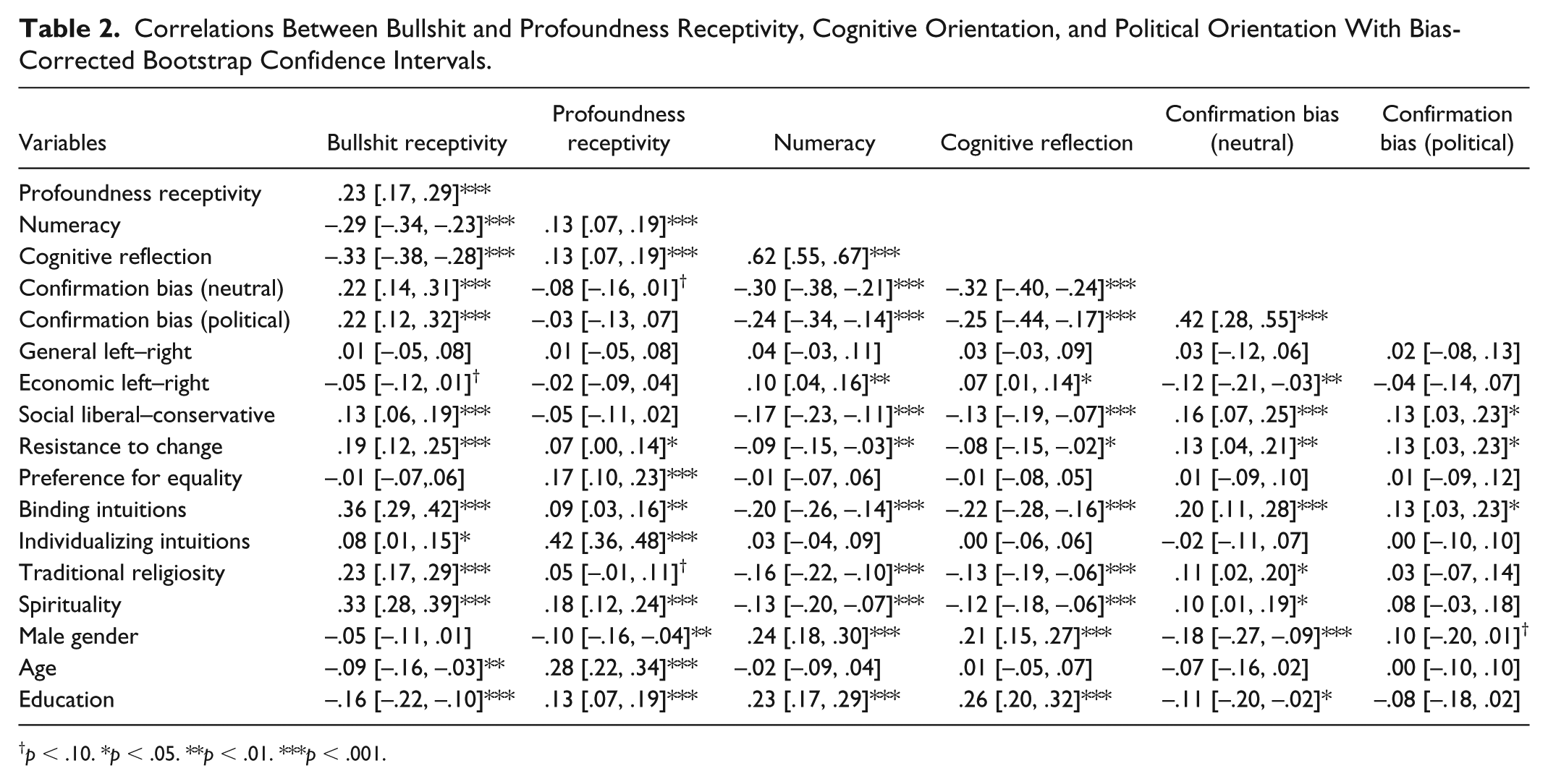
p < .10. *p < .05. **p < .01. ***p < .001.
The results of regression analyses, which are displayed in Table 3, showed that economic right (vs. left) self-placement was in fact negatively associated with bullshit receptivity (rather than unrelated to it) when all other aspects of political orientation were included in the model (Model C: p = .003; adjusted α-threshold = .010). This association held up when we controlled for profoundness receptivity (p < .001), which indicates that economic rightism was associated with slightly higher bullshit detection ability, consistent with the complexity view of ideological asymmetries.
Standardized Beta Coefficients (With Bias-Corrected Bootstrap Confidence Intervals) of Political Orientation Variables Predicting Bullshit Receptivity in Hierarchical Regression Models.
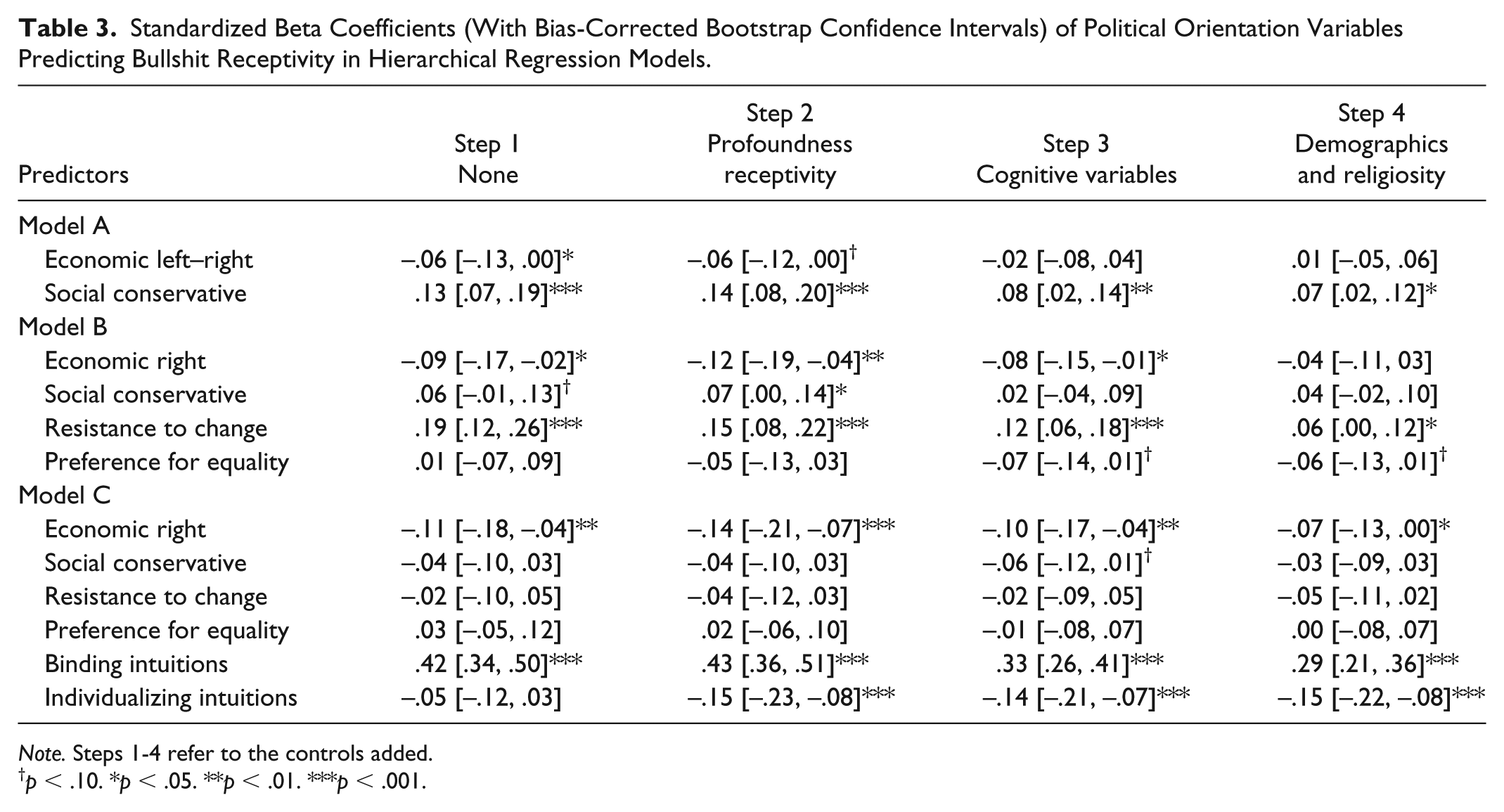
Note. Steps 1-4 refer to the controls added.
p < .10. *p < .05. **p < .01. ***p < .001.
Social conservative (vs. liberal) self-placement, on the other hand, was positively associated with bullshit receptivity (Model A), and this association was robust across controls for profoundness receptivity (p < .001; that is, social conservatives had lower bullshit sensitivity) and cognitive variables (p = .005), and it was marginally above the significance threshold when demographics and religiosity were included as well (p = .012; adjusted α-threshold = .006). It was no longer significant when resistance to change and preference for equality were included in the model (Model B, see Table 3).
When both preference for equality and resistance to change were included as predictors (Model B), preference for equality was still unrelated to bullshit receptivity, and resistance to change was still positively associated with bullshit receptivity (p < .001; adjusted α-threshold = .006). The latter association held up when profoundness receptivity and cognitive variables were included in the model (p < .001), but was no longer significant (adjusting for multiple testing) once demographics and religiosity were added to the model (p = .047), let alone when binding and individualizing moral intuitions were added (Model C, see Table 3).
Binding moral intuitions had a strong positive association with bullshit receptivity even when we controlled for all other aspects of political orientation (Model C), profoundness receptivity, cognitive variables, demographics, and religiosity (p < .001; adjusted α-threshold = .005, see Table 3). Interestingly, individualizing moral intuitions were not associated with bullshit receptivity when the other political orientation variables were included in the model but did have a robust negative association with bullshit receptivity once we controlled for profoundness receptivity (p < .001; adjusted α-threshold = .008). This result suggests that individualizing moral intuitions are associated ceteris paribus with the ability to differentiate bullshit from sense, although they are not related to bullshit receptivity (i.e., persons with strong individualizing intuitions gave the bullshit sentences average profundity ratings and the genuine aphorisms above-average profundity ratings).
We detected a u-shaped relationship only for preference for equality (Line 1: b = .41, z = 4.90, p < .001; Line 2: b = –.14, z = 3.31, p < .001; adjusted α-threshold = .007), indicating that bullshit receptivity was highest among those close to the breakpoint (x = 4.00); this result is consistent with centrism theory (and inconsistent with extremism theory). For resistance to change, bullshit receptivity increased to the breakpoint (x = 5.25) and then leveled out (Line 1: b = .16, z = 4.34, p < .001; Line 2: b = .08, z = 0.44, p = .66). By contrast, bullshit receptivity started weakly increasing after the breakpoint (x = 4.17) of individualizing moral intuitions (Line 1: b = .11, z = 0.85, p = .40; Line 2: b = .25, z = 2.75, p = .006) and increased both before and after the breakpoint (x = 4.44) of binding moral intuitions (Line 1: b = .42, z = 7.72, p < .001; Line 2: b = .71, z = 2.03, p = .043).
We found no indication that education moderated the relations between bullshit receptivity and social conservative ideology. The interaction term had no significant effect on social conservative self-placement, resistance to change, or binding moral intuitions (p ≥ .34). It did not have a significant effect on economic left self-placement (β = .04 [–.02, .11], p = .19) or preference for equality (β = .04 [–.03, .11], p = .23) either, but it did have a significant effect on individualizing moral intuitions (β = .07 [.01, .14], p = .024). The pattern was, if anything, the opposite of that found in research on needs for certainty and security (see Supplementary Figure S1). Among participants who had started or completed higher education, bullshit receptivity correlated positively with individualizing moral intuitions (r = .15 [.07, .24], p < .001) and economic self-placement further to the left (r = .11 [.03, .19], p = .010), albeit not higher preference for equality (r = .04 [–.05, .12], p = .34); among participants who lacked experience of higher education, none of these correlations were significant (–.07 ≤ r ≤ –.01; p ≥ .16).
Party Preference
Differences in bullshit receptivity and bullshit sensitivity by party preference are shown in Table 4 and illustrated in Figure 2. To make the figure easier to read, we reversed bullshit receptivity scores (only in the figure) so that higher scores indicate higher reasoning ability, higher bullshit sensitivity, and lower bullshit receptivity.
Differences in Standardized Scores (With 95% Confidence Intervals) on Bullshit Receptivity (Top Row) and Bullshit Sensitivity (Bottom Row) by Party Preference.

Note. A significant positive value indicates that the party defining the given row has supporters who are less bullshit receptive and more bullshit sensitive than those who support the party defining the given column.
p < .10. *p < .05. **p < .01. ***p < .001.

Mean standardized scores by party preference on bullshit receptivity reversed, bullshit sensitivity (i.e., bullshit receptivity reversed adjusted for profoundness receptivity), and reasoning ability (i.e., the average of numeracy, cognitive reflection, and non-biased information processing) with error bars (±0.5 SE) and tests of the difference from the mean.
Persons who supported one of the two social liberal right-wing parties were the least bullshit receptive and the most bullshit sensitive of all groups of voters. This was particularly true of persons who supported the Liberal party, who were less bullshit receptive than those who supported the three left-wing parties (the Left, Green, and Social Democrat parties; p ≤ .011; .026 ≤ η2 ≤ .102), the large right-wing party (i.e., the Moderate party; p = .020, η2 = .031), and both of the social conservative parties (the Christian Democrat party, p = .032, η2 = .049, and the Sweden Democrat party, p = .002, η2 = .045). The other social liberal party, called the Center party, also had less (or marginally less) bullshit receptive supporters than the left-wing parties (p ≤ .083, .011 ≤ η2 ≤ .063) and the Sweden Democrat party (p = .020, η2 = .024) but not the Christian Democrat or Moderate parties (p ≥ .11, η2 ≤ .025). There were no significant differences between the two social liberal parties (p = .41) or between socialist, social democrat, and conservative parties (p ≥ .38). Green party supporters were significantly above the mean of bullshit receptivity, 2 but none of their differences from the socialist, social democrat, or conservative groups of voters reached significance (p ≥ .12). The differences between the parties in terms of bullshit sensitivity (i.e., controlling for profoundness receptivity) were extremely similar (see Table 4).
As illustrated in Figure 2, persons who supported the social liberal parties were not just less bullshit receptive and more bullshit sensitive but also better at reasoning than the average voter. As could be expected on the basis of this observation, some of the differences between social liberal voters and other groups of voters in bullshit sensitivity disappeared when we controlled for the cognitive variables. Only the differences between Liberal party supporters and Green (p = .001), Left (p = .016), Moderate (p = .021), and Sweden Democrat (p = .015) supporters and between Center and Green party supporters (p = .006) held up with these controls included. Only the differences between the two social liberal parties (the Liberal and Center parties) and the two small parties farthest to the left (the Left and Green parties) remained significant when we controlled for ideology as well (p ≤ .008) and, in the final step, for demographics and religious orientation (p ≤ .018).
When we controlled for cognitive and ideological variables, Green party supporters were less bullshit sensitive than not just social liberal voters, but also Social Democrat (p = .011), Moderate (p = .019), Sweden Democrat (p = .004), and Christian Democrat (p = .019) voters (only the difference to the Christian Democrats remained significant in the final step of the model, p = .029).
Discussion
Although bullshit has probably existed since the dawn of human civilization, it may be more pernicious than ever in today’s age of information. Still, it has just recently begun to attract the attention of researchers interested in human reasoning and decision making. A few previous studies have investigated people’s receptivity to pseudo-profound bullshit—that is, obscure sentences designed for the purpose of sounding impressing rather than conveying meaning or truth—using U.S. convenience samples (Pennycook et al., 2015; Pennycook & Rand, 2018b; Pfattheicher & Schindler, 2016). The study presented in this article was among the first to test this paradigm in a context outside of the United States (Sweden) and the first to use a large sample that adequately represents the general population (see also Erlandsson et al., 2018).
In general, the results corroborate the notion that the degree to which people are receptive to bullshit is a meaningful and robust aspect of their cognitive style. Bullshit receptivity was, consistent with past research, negatively associated with numeracy and cognitive reflection, and positively associated with confirmation bias for both neutral and political information. The results did, furthermore, generally hold up when we controlled for the perceived profundity of genuine aphorisms. This shows that bullshit receptivity is not just the tendency to perceive any kind of statement as meaningful. Rather, bullshit receptivity appears to be associated with a failure to detect bullshit and distinguish it from genuine profundity (i.e., a lack of bullshit sensitivity) for the most part, although some bullshit sensitive persons (e.g., those with strong individualizing moral intuitions) appear to combine high profoundness receptivity with average levels of bullshit receptivity.
In addition to demonstrating the reproducibility of past findings, the present study provided new insight concerning the relation between bullshit receptivity and political ideology. It was the first study to comprehensively map the relation between bullshit receptivity and political ideology with systematically selected measures of the main components of ideology (Jost et al., 2003) and the moral intuitions that underlie them (Haidt & Graham, 2007)—and it did so in an ideologically diverse multiparty setting, which allowed us to get a detailed look at the relation between bullshit receptivity and ideology.
Bullshit Receptivity and Social Ideology
The findings provide further support for the notion of an association between bullshit receptivity and conservatism (Pfattheicher & Schindler, 2016; Sterling et al., 2016), consistent with theories that posit ideological asymmetries in the tendency to engage complex, effortful, analytical thinking versus simple, heuristics-based, intuitive thinking (Adorno et al., 1950; Jost et al., 2003; Jost & Krochik, 2014). Self-placement in terms of social conservatism (vs. liberalism) was indeed robustly positively associated with bullshit receptivity. The association held up when we controlled for numeracy, cognitive reflection, information processing bias, and receptivity to genuinely profound aphorisms, and it was marginally significant when traditional religiosity, spirituality, gender, age, and education were taken into consideration as well. But when we included resistance to change, the association between social conservatism and bullshit receptivity no longer reached significance, and when we included binding moral intuitions (ingroup loyalty, respect for authority, and purity) as well, neither social conservative self-placement nor resistance to change had any significant relation to bullshit receptivity.
Binding moral orientation was by far the strongest and most robust predictor of bullshit receptivity. One possible reason for this is that the binding intuitions (and socially conservative ideology in general) are associated with a desire for social cohesion (Graham et al., 2009; Jost, van der Linden, Panagopoulos, & Hardin, 2018; Malka et al., 2016)—a psychological orientation that should make people disinclined to critically analyze and question the claims of others, particularly if these claims sound authoritative. The motivation to engage in the kind of high-effort thinking required to unmask bullshit, and to risk social discomfort by doing so, may thus be undermined by binding moral intuitions.
Furthermore, the relations between social ideology and bullshit receptivity were similar to those between social ideology and information processing bias and (lack of) cognitive reflection and numeracy found both in our study and in other recent studies (e.g., Pennycook & Rand, 2018a; Yilmaz & Saribay, 2018). This finding supports the notion that bullshit receptivity among social conservatives does indeed stem from a failure to analytically engage with and critically question information, rooted in a lack of motivation or ability required to do so (or a combination thereof, see Ståhl & van Prooijen, 2018).
Interestingly, those who supported a nationalist party (the Sweden Democrat party) had particularly low reasoning ability but were not more bullshit receptive that those who supported a non-nationalist, social conservative party (the Christian Democrat party). This finding suggests that the rigidity-of-the-right account may fit nationalists particularly well in some regards but not others. It is, however, very tentative given the limited power of the analyses.
Bullshit Receptivity and Economic Ideology
While the current research did clearly unveil an association between bullshit receptivity and right-wing ideology in the social domain, it failed to reproduce the association between bullshit receptivity and economic ideology documented by Sterling et al. (2016) in a U.S. sample. We found no correlation at all between bullshit receptivity and right (vs. left) self-placement in terms of economic issues or preference for economic equality. In fact, when other aspects of ideology were included among the predictors, a right-wing placement in the economic sphere was negatively associated with bullshit receptivity. These results are consistent with the complexity view of ideological asymmetries, which suggests that the cognitive antecedents of ideology differ between social and economic domains (Feldman & Johnston, 2014; Malka & Soto, 2015).
This does not necessarily mean that the conclusions of Sterling et al. (2016) are without merit. Recent scholarship (Federico & Malka, 2018) has demonstrated that some of the links between cognitive dispositions and political orientation may be contingent upon cultural factors. A major difference between Sweden and the United States is that the social liberal parties in Sweden are slightly right of center, embracing economic policies that are on the right in the Swedish context—and persons who supported these parties turned out to be the least bullshit receptive of all groups of voters. In the United States, most persons inclined to support a social liberal party would be squarely on the left, which might explain the differences in results between the two countries. But it also possible that a similar finding would be obtained even in the United States with controls for social conservatism and religiosity included. Yet another potential explanation for the discrepancy between the two countries is that Sterling et al. (2016) used a measure that focuses on support for a free-market system while we focused on support for redistribution and preference for equality per se.
Furthermore, although the current findings support the idea that the rigidity-of-the-right is largely confined to the social ideological domain (Feldman & Johnston, 2014; Malka & Soto, 2015), we found no evidence that the combination of low education and bullshit receptivity fosters leftist ideology in the economic domain. If anything, bullshit receptivity was more strongly associated with leftist ideology among the highly educated. This finding illuminates the difference between bullshit receptivity and needs for certainty, order, and simplicity. While it is plausible that the needs in question may attract persons with low education and political engagement to the security and stability of a left-wing economic system (Johnston et al., 2017; Malka et al., 2014), it is less obvious that bullshit receptivity would have this effect. On the contrary, it seems possible that high education and political engagement would make some groups of leftists more receptive to pseudo-profound bullshit by virtue of increasing exposure to discourse containing this sort of bullshit (e.g., New Age or postmodern literature); perceptual fluency caused by prior exposure is one of the theorized mechanisms behind receptivity to fake news (Pennycook & Rand, 2018b). This is, however, a very tentative, serendipitous finding that should be interpreted with caution; we found a significant (and weak) interaction only for one of the variables (individualizing moral intuitions), and we used education as an imperfect proxy for political engagement.
Bullshit Receptivity and Green Ideology
Another finding that further complicates the picture is that analyses of party preferences revealed that the very most bullshit receptive group voted for the Green party, which is on the left. There were in fact no detectable differences between socialist, social democrat, and socially conservative voters on bullshit receptivity; instead, social liberal and green voters stood out on opposite ends of the spectrum. This result is congruent with the finding that Green party supporters commonly endorse a number of unfounded ideas, such as astrology, alternative medicine, the moon landing conspiracy theory, and electric allergy (Swedish Skeptics Association, 2015). Its reproducibility does, however, need to be put to rigorous test, given the exploratory nature and limited power of the analyses. If corroborated, this finding would suggest that bullshit receptivity exists both on the left and on the right, albeit perhaps not in equal measure.
An association between green ideology and bullshit receptivity might stem from an openness to ideas that is not tempered by critical thinking, at least when the ideas are broadly congruent with the person’s ideological outlook (New Age spirituality, alternative philosophies, and conspiracy theories are congruent with left-wing ideology in the sense that they challenge established systems of thought), possibly in combination with prior exposure to pseudo-profound bullshit. It is notable that Green party supporters had average levels of reasoning ability, which suggests that their high bullshit receptivity has less to do with reasoning ability that the low bullshit receptivity of the social liberals does.
Bullshit Receptivity, Centrism, and Extremism
We did find a u-shaped relationship indicating that persons who are centrists in terms of preference for equality were more bullshit receptive than those who were further from the center. This finding is consistent with centrism theory, which states that the less intellectually sophisticated individuals tend to avoid deviating from the mainstream (Sidanius, 1988)—the crucial issue defining the center of gravity in Swedish politics, and perhaps creating a conformist pull toward the middle, is indeed equality (Aspelund et al., 2013). It should, however, be noted that we found a u-shaped effect only for one out of four ideology variables, and other studies have suggested that political extremism is associated with a dogmatic and simple cognitive style, rather than the other way around (e.g., Lammers et al., 2017; Tetlock et al., 1994; van Prooijen & Krouwel, 2017).
The state of the evidence is further complicated by the fact that many studies have relied on quadratic regression tests of the presence of u-shapes, which have a very high false-positive rate (Simonsohn, 2018). A critical research synthesis is therefore needed to evaluate the body of evidence bearing on extremism theory and centrism theory. One possibility is that it is the centrists, many of whom are politically disengaged, who stand out from both moderates and extremists in terms of a lack of analytical thinking (Pennycook & Rand, 2018a). Another possibility is that the curvilinear relations between ideology and cognition vary across different kinds of cognitive variables (e.g., dogmatism, integrative complexity, reflectiveness, bullshit receptivity, and partisan bias), and that this can explain the seemingly divergent findings across studies. It is conceivable that extremists tend to be both reflective and dogmatic in some regards—for example, Kahan (2013) has suggested that numerate persons tend to use their reasoning capacities to engage in motivated reasoning (see also Kahan et al., 2017).
Summary of the Findings
In sum, the current study revealed a complex picture of the relationship between bullshit receptivity and political ideology. Bullshit receptivity was clearly associated with social conservatism, and particularly with moral intuitions pertaining to ingroup loyalty, respect for authority, and purity, but it was associated with centrism or even leftism (when controlling for other aspects of ideology) in the economic domain, and it was highest of all among voters who supported a small green party on the left.
This pattern of results cannot be fully explained by any of the aforementioned accounts of the congruence of ideology and cognition. The existence of both left- and right-wing bullshit receptivity does not necessarily imply that the relation between bullshit receptivity and ideology is symmetrical, nor is this what the present results suggest. On the contrary, bullshit receptivity might emerge only in specific kinds of left and right ideological thought. It may, furthermore, be driven by somewhat different processes in different ideologies—on the left, it may stem from an uncritical openness to ideas that sound ideologically appealing or familiar; on the right, it may stem from a disinclination to critically engage with information and its sources (rather than a need for certainty and security per se).
Directions for Further Research
Further research is needed to rigorously test the proposed explanations for bullshit receptivity among right- and left-wingers. It would be particularly worthwhile to investigate whether the relations between bullshit receptivity and political ideology found in the current research hold up across different kinds of pseudo-profound bullshit with different ideological connotations and in different ideological domains (Conway et al., 2016). Further research is also needed to refine and extend the paradigm introduced by Pennycook et al. (2015) to study bullshit receptivity. This paradigm is undoubtedly a promising methodological innovation, because it employs a kind of behavioral measure that does not seem to be susceptible to social desirability and self-presentation biases, and it addresses a phenomenon that is of paramount importance in today’s information-drenched world. Nevertheless, much remains to be done when it comes to situating bullshit receptivity among the plethora of related constructs in personality and social psychology and all of the various cognitive dispositions that are implicated in the classical rigidity-of-the-right and extremism hypotheses. More research is also needed to understand when and why people engage in bullshitting (Petrocelli, 2018). Understanding the origins and proliferation of bullshit is undoubtedly crucial for understanding how to promote informed decisions both in politics and in our everyday lives and for making the next generation better prepared to navigate life in a digital world.
Supplemental Material
Nilsson_Online_Appendix – Supplemental material for The Complex Relation Between Receptivity to Pseudo-Profound Bullshit and Political Ideology
Supplemental material, Nilsson_Online_Appendix for The Complex Relation Between Receptivity to Pseudo-Profound Bullshit and Political Ideology by Artur Nilsson, Arvid Erlandsson and Daniel Västfjäll in Personality and Social Psychology Bulletin
Supplemental Material
SI_Figure – Supplemental material for The Complex Relation Between Receptivity to Pseudo-Profound Bullshit and Political Ideology
Supplemental material, SI_Figure for The Complex Relation Between Receptivity to Pseudo-Profound Bullshit and Political Ideology by Artur Nilsson, Arvid Erlandsson and Daniel Västfjäll in Personality and Social Psychology Bulletin
Footnotes
Author Contributions
Artur Nilsson planned and performed the analyses, wrote the paper, and revised the paper. Arvid Erlandsson was in charge of the study design and data collection. Arvid Erlandsson and Daniel Västfjäll provided feedback on the article and the revision. All authors contributed to the study design.
Declaration of Conflicting Interests
The author(s) declared no potential conflicts of interest with respect to the research, authorship, and/or publication of this article.
Funding
The author(s) disclosed receipt of the following financial support for the research, authorship, and/or publication of this article: The data collection was sponsored by grants to Daniel Västfjäll from the Swedish Research Council (grant number 2014-1158) and Riksbankens Jubileumsfond (grant number P14-0978:1).
Notes
Supplemental Material
Supplemental material is available online with this article.

References
Supplementary Material
Please find the following supplemental material available below.
For Open Access articles published under a Creative Commons License, all supplemental material carries the same license as the article it is associated with.
For non-Open Access articles published, all supplemental material carries a non-exclusive license, and permission requests for re-use of supplemental material or any part of supplemental material shall be sent directly to the copyright owner as specified in the copyright notice associated with the article.
