




Abstract
History is rife with examples of the dark side of creativity—ingenious weapons, novel torture practices, and creative terrorist attacks—yet its psychological origins are sparsely addressed and poorly understood. Building on work showing that social threat induces focused thinking as well as aggressive cognitions and readiness to fight, we propose that threats lead to more malevolent creativity and less creativity in threat-irrelevant domains. Prisoner’s dilemma games were modified to evoke threat of exploitation. Participants then generated novel brick uses (Study 1, N = 113) or negotiation tactics (Study 2;N = 79). High (vs. low) social threat led to more “malevolent” creativity (e.g., using bricks as weapons; using intimidation as negotiation tactic). Social threat reduced nonthreat-related creative ideation only in Study 1. Study 2 showed that the increase of malevolent creativity was due to the motivation to defend and aggress, and emerged especially among individuals with a high need for cognition.
Creative thinking often benefits the greater good—It allows people to create and enjoy art, has resulted in medical breakthroughs, and is at the roots of new technologies that expand our opportunities to live life to the fullest. However, history is also rife with a much darker side of this creative capacity: People are noteworthy for their ability to generate novel ways to materially, mentally, or physically harm themselves and others (henceforth malevolent creativity; Cropley, Kaufman, & Cropley, 2008; Harris, Reiter-Palmon, & Kaufman, 2013). Examples of malevolent creativity are the wide array of innovative torture practices, weapons that can wipe out entire civilizations, and previously unimaginable terrorist attacks.
The psychology behind malevolent creativity is still poorly understood. From the limited research, we know that people with stronger inclinations toward hostile and aggressive behavior generate more malevolent creative ideas (Hao, Tang, Yang, Wang, & Runco, 2016; Harris & Reiter-Palmon, 2015; Lee & Dow, 2011). Furthermore, unfair and provocative social circumstances evoke malevolent creative responses (Cheng, Baas, & De Dreu, 2018; Harris & Reiter-Palmon, 2015; James, Clark, & Cropanzano, 1999), and people who anticipate hostile negotiations generate more original tactics geared at defeating the other party than those anticipating cooperative negotiations (De Dreu & Nijstad, 2008). Together, these findings suggest that malevolent creativity occurs especially in people with a propensity for aggressiveness and among those facing behavior and intentions from others with impending harmful consequences (Marks & Nesse, 1994; Staw, Sandelands, & Dutton, 1981; Woody & Szechtman, 2011).
Here we further develop the idea that people respond with malevolent creativity to social threats. Our starting point is the dual pathway to creativity model (DPCM; De Dreu, Bass, & Nijstad, 2008; Nijstad, De Dreu, Rietzschel, & Baas, 2010), which posits that creativity can result from associative and flexible thinking, as well as from focused and effortful thinking within a limited range of conceptual categories (Nijstad et al., 2010). We propose that social threat may induce the fearful arousal and avoidance motivation that have been related to focused thinking within a limited number of categories (De Dreu et al., 2008; Nijstad et al., 2010; Roskes, De Dreu, & Nijstad, 2012). Second, work on threat management systems suggests that social threats trigger hostile thoughts (Blanchard, Griebel, Pobbe, & Blanchard, 2011; Gawronski & Cesario, 2013) and inclinations to fight and respond with aggression (Mobbs, Hagan, Dalgleish, Silston, & Prévost, 2015). Combined, these findings imply that social threats lead to malevolent creativity, but not to creativity in benign and neutral areas. This basic proposition, that people generate a larger number of malevolent ideas and a larger number of original malevolent ideas when they experience social threat, was tested in two experiments in which threat of exploitation was evoked with modified Prisoner’s dilemma games, and participants generated novel ideas for brick uses (Study 1, N = 113) or negotiation tactics (Study 2; N = 79).
Social Threats and Two Pathways to Creativity
According to the DPCM, creative outcomes (e.g., a large number of ideas, original problem solutions) can be achieved through two cognitive processes: flexibility and persistence. Cognitive flexibility refers to the ease with which people can switch to a different approach or consider different perspectives (Nijstad et al., 2010). It manifests itself in adaptive switching among conceptual categories, perspectives, and task approaches (Ashby, Isen, & Turken, 1999), divergent thinking (Chermahini & Hommel, 2010), and accessibility of remote knowledge (Friedman & Förster, 2010; Mednick, 1962). For example, when generating possible uses for a brick, a flexible process would result in a large number of responses across many different conceptual categories (e.g., use a brick to build something, to play with, as a weight, as a musical instrument, et cetera). Flexibility results in enhanced creative outcomes because more remote concepts are accessed and combined (Nijstad et al., 2010).
Cognitive persistence is the extent to which people focus their attention and effort on the task at hand (e.g., Nijstad et al., 2010). Persistence manifests itself in longer time spent on tasks (De Dreu et al., 2008; Lucas & Nordgren, 2015) and in the generation of many ideas within a few conceptual categories (Nijstad et al., 2010; Roskes et al., 2012). For example, when generating possible ways to manage an upcoming negotiation, individuals come up with several successive ideas within a single conceptual category through persistence (e.g., within the category “competing strategies,” someone may come up with multiple tactics, such as deceiving the opponent, taking a dominant posture, or making an extreme demand). The ideas within this category become more creative after relatively accessible and common ideas within this category have been discarded (Nijstad et al., 2010).
From the DPCM, it follows that any factor that stimulates flexibility or persistence will increase creativity. Some factors, such as a happy mood, affect creativity primarily through flexibility while other factors, such as anxiety, affect creativity primarily through persistence (De Dreu et al., 2008). Whether people engage in flexible or persistent thinking is largely determined by the individual’s chronic or state-induced approach versus avoidance motivation. An approach motivation is active when people strive to achieve desired goals (e.g., status, monetary rewards) and anticipate rewards (Carver, Sutton, & Scheier, 2000; Elliot, 2008). Approach motivation promotes creativity through increased flexible thinking (Baas, De Dreu, & Nijstad, 2008; Friedman & Förster, 2010; Roskes et al., 2012). An avoidance motivation, in contrast, is active when people strive to guard against negative consequences (e.g., disease, monetary loss), and anticipate punishment (Elliot, 2008). Avoidance motivation is associated with the consideration of only a few perspectives during problem solving (Baas et al., 2008), a reduced ability to shift attention (Derryberry & Reed, 1998), constrained information processing (Baas, De Dreu, & Nijstad, 2012), enhanced executive control (Koch, Holland, Hengstler, & van Knippenberg, 2009), and persistent thinking (Roskes et al., 2012). Indeed, avoidance motivation can promote creativity through persistence (Baas, De Dreu, & Nijstad, 2011; Roskes et al., 2012).
Social threats activate the avoidance system that governs a suite of affective and cognitive processes geared at facilitating adaptive threat-responding (Carver et al., 2000; Neuberg, Kenrick, & Schaller, 2011): avoidance motivation is triggered, fear is aroused, the perceptual scope narrows, and the body is mobilized to escape or neutralize the threat (Dixon, 1998; Elliot, 2008; Ioannou, Mogg, & Bradley, 2004; Woody & Szechtman, 2011). These processes may reduce flexibility but at the same time promote creativity through persistence. Apart from determining the process through which creative ideas will come about, social threat may also determine the content of the ideas people generate. Social threat captures attention (Lipp & Waters, 2007; Ohman, Flykt, & Esteves, 2001), facilitates processing of threat-relevant cues in the environment (Reinecke, Becker, & Rinck, 2009), and threat-relevant information stored in long-term memory becomes highly accessible (Ioannou et al., 2004). In addition, imminent social threats, such as the proximity of hostile conspecifics, trigger fight-related and hostile thoughts (Blanchard et al., 2011; Gawronski & Cesario, 2013), the perception of aggression in threatening others (Anderson & Bushman, 2002; Berkowitz, 1990), as well as aggressive responding and defensive attack (Cheng et al., 2018; Mobbs et al., 2015).
Because imminent social threats lead to enhanced persistence as well as aggressive cognitions, inclinations to fight, and the recruitment of (cognitive) resources to attend to the threat, we propose that the generation of malevolent novel ideas will also prosper under these conditions. For instance, when generating novel uses for a brick (as was done in Study 1) threatened people may more frequently refer to malevolent brick applications, such as using a brick to hit someone or to sink a body in a river. At the same time, because threatened people’s attention and resources focus on dealing with the threat, less attention and processing resources are available for threat-irrelevant stimuli (Chajut & Algom, 2003). Moreover, because avoidance motivation decreases someone’s ability to consider many different perspectives, and imminent social threat increases aggressive and fight-related cognitions, social threat is expected to reduce benevolent and neutral creativity. For example, when people anticipate hostility, they come up with more novel ideas to defeat their opponent but fewer ideas in neutral domains than when they anticipate cooperation (De Dreu & Nijstad, 2008).
The Role of Need for Cognition
Persistent thinking requires executive control and working memory capacity (De Dreu, Nijstad, Baas, Wolsink, & Roskes, 2012; Evans, 2003), associates with high effort and slower operation speed (De Dreu et al., 2008; Evans, 2003), and taxes cognitive resources and energy (Evans, 2003; Koch et al., 2009; Roskes et al., 2012). Engaging in such effortful processing not only requires the ability to do so, but also the motivation (Roskes et al., 2012). Such motivation is typically strong in individuals with high need for cognition—the chronic tendency to engage in, and enjoy, effortful cognitive activity (Cacioppo, Petty, Feinstein, & Jarvis, 1996). When confronted with a threatening situation, by implication, people with high need for cognition may be more motivated to search threat-relevant information, more thoroughly process its implications, and will be more likely to engage in effortful and persistent thinking. If this is the case, people with higher need for cognition may respond to social threats with more (original) malevolent ideas. Accordingly, we predicted that compared with individuals under low social threat, those under high social threat show more malevolent creativity when they have a high rather than low need for cognition.
The Current Study
Here, we focus on imminent social threat and propose that it elicits a defensive aggressive focus on the social threat and ways to regulate it. It is within this focus that malevolent creativity emerges, and this increase in malevolent creativity is predicted to come at the expense of benevolent and neutral creativity. This leads to our hypothesis that there is an interaction between social threat and type of creative ideation (malevolent vs. neutral ideas): Compared with low social threats, high social threats lead to more malevolent creativity and less creativity in threat-irrelevant and neutral domains (Hypothesis 1). In addition, we predict that compared with people under a low social threat, those under a high social threat show more malevolent creativity when they have a high rather than a low need for cognition (Hypothesis 2) because they are more motivated to defend and aggress when exposed to a social threat (Hypothesis 3). We report two experiments that test these hypotheses. In both experiments, participants performed prisoner’s dilemma games in which their financial losses depended more (high threat for exploitation) versus less (low threat for exploitation) on potential noncooperative choices made by their counterpart (Coombs, 1973). After receiving game instructions, participants generated creative uses for a brick in Study 1 (Guilford, 1967; Harris et al., 2013) and creative negotiation tactics in Study 2 (De Dreu & Nijstad, 2008). We look at two indicators of malevolent creativity: Malevolent fluency (number of malevolent ideas) and malevolent originality (number of infrequent malevolent ideas: ideas that 5% or less of the participants came up with).
Study 1: Method
Design and Participants
Students were recruited during the 2 weeks that the experiment was run. In total, 113 students (62% female; Mage = 22.0) participated for course credit and performance-based pay (ranging from €0 to €6). 1 They were randomly assigned to one of two experimental game conditions (high social threat; low social threat). The dependent variables were indicators of malevolent and neutral creativity, negative moods, and avoidance motivation.
Procedure and Manipulation of Threat
Upon arrival in the laboratory, participants provided informed consent and were seated in individual cubicles preventing them from seeing and communicating with others. Cubicles were equipped with computers that displayed instructions and registered responses. Participants were told that the study was about decision making and they learned that they would make decisions affecting their own and some other currently present participant’s outcomes. This other participant would also make decisions affecting their own outcomes as well as those of the participant. Participants were then shown a table depicting four possible choice combinations with ensuing outcomes to themselves and to the participant they were paired with. Those in the high– and low–social threat condition are shown in Figure 1b and Figure 1c, respectively. Participants were explained how to read the respective table and answered six practice questions with feedback to assist them in understanding the consequences of their choices given the choices of the other party.
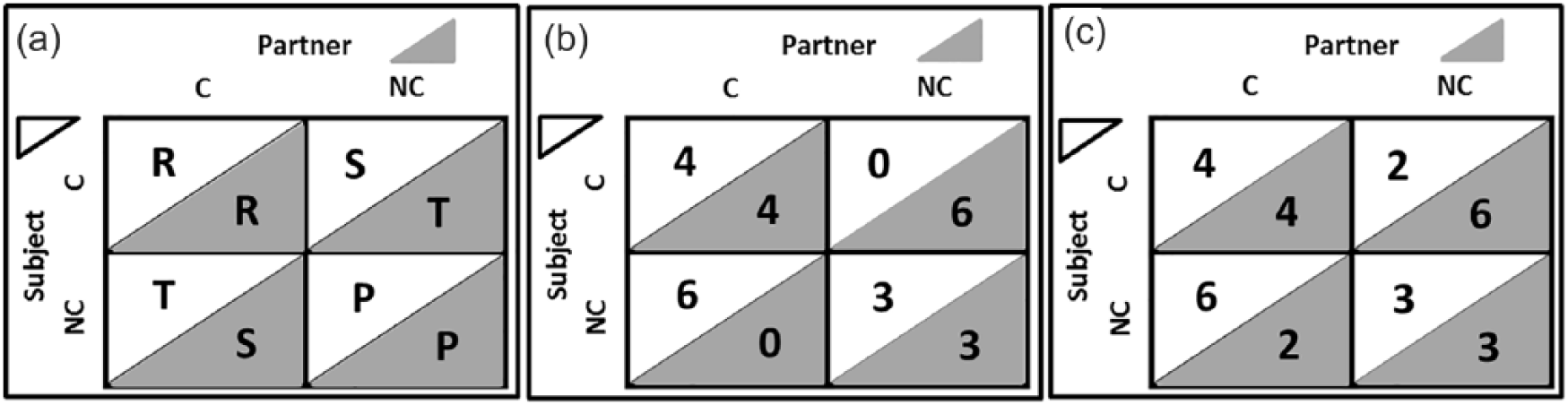
High versus low threat in a prisoner’s dilemma game.
When comparing the middle and right panel of Figure 1, it follows that the participants’ outcomes depended more (Figure 1b) versus less (Figure 1c) on the choices made by the other party. Put differently, in the high-threat game, participants could lose substantially when the other party made a noncooperative choice; this is not the case in the low-threat game. The high-threat game thus presents more threat of loss than the low-threat game (Bruins, Liebrand, & Wilke, 1989; Coombs, 1973; De Dreu et al., 2010). In more formal terms, participants as the row player in Figure 1 were, like the column player, asked to choose between C (cooperation) and D (defection; noncooperation). The participant’s choice combined with the other’s choice yielded four possible payoffs, shown in Figure 1 left of the diagonal for the participant (row player), and right of the diagonal in each cell for the other player (column player): Temptation (T), Reward (R), Punishment (P), and Sucker (S), that are ordered as T > R > P > S (De Dreu et al., 2010). This ordering has several consequences. Figure 1 shows that if both the participant and the other cooperate, they both obtain the Reward payoff of 4, which exceeds the Punishment payoff for mutual noncooperation of 3 (i.e., cooperators’ gain is [R – P] = [4 – 3] = 1). The dilemma occurs because both the participant and the other party obtain even higher payoffs for themselves by noncooperation. Noncooperation may reflect the greedy desire to exploit the other player, and/or the defensive desire to protect oneself against other’s noncooperation. First, if the other were to cooperate, participants would obtain higher outcomes by noncooperation (T) than by cooperation (R; in Figure 1: [T – R] = [6 – 4] = 2; henceforth Greed). Second, if the other were to noncooperate, participants would obtain higher outcomes by noncooperation (P) than by cooperation (S; in Figure 1a: [P – S], henceforth Threat; [3 – 0] = 3 in Figure 1b and [3 – 2] = 1 in Figure 1c). In Experiment 1, we manipulated payoffs to keep the magnitude of Gain and Greed constant across conditions; Threat varied from high (3; Figure 1b) to low (1; Figure 1c), so that any difference in cognition or behavior between conditions can only be a function of threat of exploitation by a noncooperative other.
After participants finished reading the instructions and answered the practice questions, we told them we were interested in the effects of delay on decision making and asked them to complete another task first: to generate as many unusual uses for a brick as possible. Participants were given 3 min to type in their ideas. Following the brick task, participants completed a short questionnaire assessing their avoidance motivation and negative mood. Hereafter, participants were presented with the matrix again and asked to make five consecutive choices between the cooperative and the noncooperative response option, explaining that their payoff will be determined by a randomly drawn pair of choices made by themselves and another participant. There was no feedback about the other’s choices in between decisions. Analyses of decisions showed that compared with those in the low-threat condition, participants in the high-threat condition made more noncooperative choices (M = 3.13 vs. M = 3.40), F(1, 111) = 5.01, p = .027,
Dependent Variables
Creativity
From the ideas participants generated, four indices were computed, two referring to fluency and two referring to originality (cf. De Dreu & Nijstad, 2008). First, two independent coders blind to conditions coded each idea as neutral or as malevolent (Harris et al., 2013). Ideas were coded as “malevolent” when they referred to using a brick as a weapon (e.g., “hitting somebody on the head”) or expressed aggression or hostility (e.g., “throwing at someone,” “smashing a window,” or “sink a body in a lake”). All other ideas were coded as “neutral” (e.g., “build a house,” “use as a musical instrument”). Interrater reliability was excellent (Cohen’s K = .91) and the few discrepancies were solved through discussions.
After classifying all ideas as either neutral or malevolent, we assessed the number of nonredundant ideas. This yielded an index of neutral fluency and of malevolent fluency. For each idea, we also assessed how often it was mentioned by other participants in this experiment and assigned a percentage score to each idea (e.g., if an idea was mentioned by 3% of the participants, it received a percentage score of 3; if it was mentioned by 17%, it received a score of 17). We counted the number of original ideas, with ideas being considered as original when they were mentioned by 5% or less of the participants (Baas et al., 2011; Guilford, 1967). This procedure was used to get a neutral originality score and a malevolent originality score.
Manipulation checks and negative mood
After participants finished reading the instructions regarding the payoff structure, they answered six open practice questions (e.g., “If both parties cooperate, how much does each party get?”) with the answers being coded as incorrect (0) or correct (1). The number of correct answers was summed up.
Following the brick task, participants completed a short questionnaire assessing their fearful, angry, and dejected moods, and avoidance motivation. Participants indicated how much (1: not at all, to 6: very much) they experienced fearful (six items; e.g., fearful, distressed; reverse-coded: calm, at ease; α = .77), angry (three items; e.g., angry, loathing; α = .64), and dejected mood states (nine items; e.g., ashamed, guilty, reverse-coded: happy; α = .73). Avoidance motivation was assessed with five items tapping participants’ avoidance motivation (1: not at all, to 5: very much; α = .72). Sample items are “In the upcoming decision making task I will try to prevent myself from being exploited by the other party” and “I think that the other party will defect.”
Study 1: Results
Manipulation Checks
Participants understood the payoff structure with on average 94% of the open questions being answered correctly and without differences between conditions, F(1, 111) = 0.09,p = .764,
Creative Ideation
We submitted fluency to a 2 (social threat: high vs. low) × 2 (type of ideation: neutral vs. malevolent) ANOVA with the second factor within-subjects. First, we found a main effect of type of ideation, F(1, 111) = 432.66, p < .001,
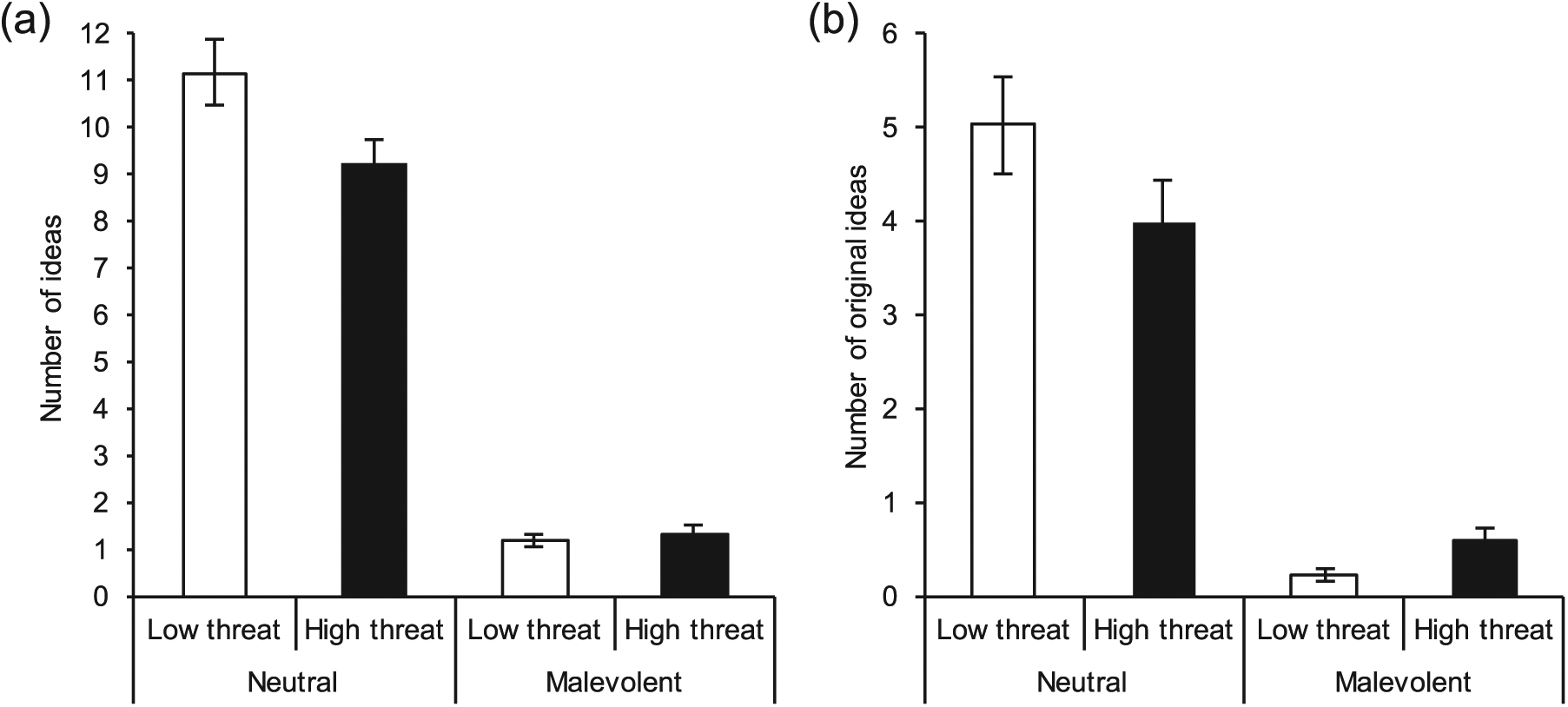
Study 1: (a) Malevolent versus neutral productivity and (b) number of original malevolent versus neutral ideas as a function of social threat (displayed ± SE).
We submitted originality to a 2 (social threat: high vs. low) × 2 (type of ideation: neutral vs. malevolent) ANOVA with the second factor within-subjects. First, we found a main effect of type of ideation, F(1, 111) = 152.36, p < .001,
Discussion and Introduction to Study 2
Experiment 1 confirmed that people under a high threat came up with a larger number of original malevolent, but not neutral, ideas, compared with people under a low threat. High threat also reduced the overall number of neutral ideas that people generated. Although people came up with a higher ratio of malevolent versus neutral ideas under high threat, they did not generate an overall larger number of malevolent ideas. Although the results generally support our hypothesis that social threat increases malevolent creativity and reduces neutral creativity, we would also expect to see a larger number of malevolent ideas under high threat. In this context, it is noteworthy that participants generated very low numbers of malevolent ideas (M = 1.27). Perhaps the brick task did not lend itself to generating malevolent ideas, or people lacked motivation because their ideas were not relevant to dealing with the threat at hand.
Experiment 2 was designed to provide a conceptual replication using a different task with higher ecological validity, in which participants generated ideas that were relevant to dealing with the threat. Following the presentation of the prisoner’s dilemma game, participants were asked to prepare for an upcoming negotiation by generating possible negotiation tactics. The generated tactics could be malevolently competitive (e.g., using violence, verbal aggression, intimidation, and competitive strategies such as misleading and deception), cooperative (e.g., using accommodative, compromising, and cooperative strategies, or creating a positive atmosphere), or neutral (e.g., persuading the other party with arguments, setting procedural rules; De Dreu & Nijstad, 2008). We predicted more malevolent creativity in the high– than in the low–social threat condition, at the cost of fluency and originality of cooperative and neutral ideas.
The second objective of Experiment 2 was to examine whether an increased motivation to defend and aggress in response to social threat can explain the observed increase in malevolent creativity. Moreover, when exposed to a threat, people with a high need for cognition may have a stronger motivation to search threat-relevant information, more thoroughly process the motivational implications of this information, and will be more likely to engage in effortful and persistent thinking. We therefore considered the possibility that the mediation by aggressive defense motivation holds especially for people with a high rather than low need for cognition. Accordingly, we predicted that compared with people under low social threat, those under high social threat show more malevolent creativity when they have a high rather than low need for cognition because they are more motivated to defend and aggress.
Study 2: Method
Participants and Design
Participants were recruited during the 2 weeks that the experiment was run. In total, 89 students (60% female; Mage = 22.2 years) participated for course credit or performance-based pay. 3 They were randomly assigned to one of two conditions (high social threat; low social threat). Need for cognition constituted a second, continuously measured independent variable. The main dependent variables were neutral, cooperative, and competitive ideation (fluency and originality), and aggressive defense motivation.
Procedure, Threat Induction, and Dependent Variables
The procedure followed that of Experiment 1, but prior to the game instructions, participants completed the need for cognition questionnaire and two bogus questionnaires. In addition, after the prisoner’s dilemma game, we replaced the brick task with a negotiation task and asked the participants to brainstorm about negotiation tactics. Specifically, the participants were asked to engage in a computer-mediated negotiation between representatives of the management and the union of an international organization about a new collective employment contract (Giebels, De Dreu, & Van de Vliert, 1998). Participants took the role of the representative of either union or management (role was counterbalanced). They were told that the representative of the other party was the same person whose decisions in the prisoner’s dilemma game affected participants’ payoff. Participants were instructed to reach an agreement with the other representative on four issues: Salary, contract duration of new employees, yearly salary increase, and health insurance coverage. Participants received a payoff schedule (see Giebels et al., 1998) with possible agreements and the value of those agreements in points. Priorities among these issues differed between representatives: The labor representative prioritized salary and health insurance coverage, while the management representative prioritized contract duration and yearly salary increase. The maximum individual outcome per representative was 750 points, the highest possible joint outcome was 540 points for each representative; compromising on each issue would lead to 375 points for each representative. In case of no agreement, each party would earn zero points.
After participants had entered and submitted their opening offer for each issue, we told them that we were interested in the effects of delay on negotiation effectiveness and asked them to first prepare for the upcoming negotiation by generating as many tactics for an effective negotiation as they could think of (cf. De Dreu & Nijstad, 2008). Participants were given 4 min to type in their ideas. Then we measured negative mood, avoidance motivation, aggressive defense motivation, and cooperative motivation (see below). Hereafter, participants were presented with the prisoner’s dilemma matrix again and asked to make five consecutive choices between the cooperative and the noncooperative response option (see Study 1). There were no differences between low– and high–social threat conditions regarding the number of noncooperative choices (M = 3.16 vs. M = 3.34), F(1, 87) = 0.19, p = .662,
Manipulation checks and mood
After reading the instructions regarding the payoff structure in the prisoner’s dilemma game, participants completed the same six open practice questions as in Study 1 with the answers being coded as incorrect (0) or correct (1). The number of correct answers was summed up. Avoidance motivation (α = .75), and fearful (α = .75), angry (α = .66), and dejected mood (α = .75) were measured as before.
Need for cognition
Need for cognition was measured with the 15-item Need for Cognition scale (Cacioppo et al., 1996). Items contain statements about the enjoyment of, and need for, effortful and critical thinking (e.g., “I like to have the responsibility of handling a situation that requires a lot of thinking,” “Thinking is not my idea of fun” [reverse-coded]). Participants rated the extent to which they agreed with statements on a 5-point Likert-type scale from 1 (very strongly disagree) to 5 (very strongly agree). Reliability of the scale was good (α = .85).
Motives
Aggressive defensive motivation combines avoidance motivation with more aggressive and competitive motives. Aggressive defense motivation was therefore measured with eight items, including two core items of our avoidance motivation measure (e.g., “In the upcoming negotiation, I will try to prevent myself from being exploited by the other party”), as well as items measuring more aggressive and competitive motives (e.g., “In the upcoming negotiation . . . I will try to beat the other party,” “. . . I will try to earn more than the other party,” and “. . . I expect hostility”). Our aggressive defense motivation measure was reliable (α = .82) and highly correlated with our measure of avoidance motivation (r = .795, p < .001). We additionally measured cooperative motivation with six items, such as “In the upcoming negotiation I will . . . try to be honest,” “ . . . try to benefit both myself and the other party” (α = .91). 4 For both measures, participants rated the extent to which they agreed with statements on a 5-point Likert-type scale (1: very strongly disagree, to 5: very strongly agree).
Creativity
From the ideas participants typed in, six indices were computed, three referring to fluency and three referring to originality. First, two coders blind to conditions or hypotheses evaluated the generated negotiation tactics and coded each idea as neutral, cooperative, or malevolently competitive (De Dreu & Nijstad, 2008). Ideas were coded as “malevolently competitive” when they referred to negotiation tactics that entailed violence, verbal aggression, intimidation, and highly competitive strategies, such as brinkmanship and highball/lowball strategies (e.g., using ridiculously low opening offers). Ideas were coded as “cooperative” when they referred to negotiation tactics that entailed accommodative, compromising, and cooperative strategies, or were about creating a positive atmosphere and perspective taking. All other ideas were coded as “neutral” (e.g., persuading the other party with arguments, avoidance, setting procedural rules). Interrater reliability was excellent (Cohen’s K = .91) and the few discrepancies were solved through discussions.
Within the neutral, cooperative, and malevolently competitive categories, we assessed the number of nonredundant ideas. This yielded an index of neutral, cooperative, and malevolently competitive ideational fluency. Using procedures from Study 1, we also computed scores for originality of neutral, cooperative, and malevolently competitive ideation.
Study 2: Results
Participants who generated zero ideas (n = 2) or irrelevant responses (e.g., “school,” “ne yazmak”; n = 6) were excluded from analyses. Two participants were identified as outliers (more than 3 standard deviations from the mean for creativity indicators) and removed from further analyses. Analyses were conducted on the remaining 79 participants (60% female; Mage = 22.2 years).
Manipulation Checks
Participants understood the payoff structure with on average 94% of the open questions being answered correctly and without differences between conditions, F(1, 77) = 0.04, p = .845,
Creative Ideation
Given the hierarchical structure of our data, with type of ideation (Level 1) nested in participants (Level 2), we first tested the predicted interaction effect of threat and need for cognition on fluency in malevolent, neutral, and cooperative domains using a mixed model ANOVA with random coefficients. Neither the Type of Ideation × Social Threat interaction, F(2, 150) = 1.36, p = .260, nor the interaction between type of ideation, need for cognition, and social threat was significant, F(2, 150) = 2.62, p = .076. However, compared with the reference category malevolent ideas, we found an interaction of need for cognition and social threat condition for cooperative ideas, B = 2.67, t(150) = 2.27, p = .025, and not for neutral ideas, B = 1.65, t(150) = 1.40, p = .163. We then ran a series of hierarchical regression analyses on total idea production, and separately for neutral, malevolently competitive, and cooperative fluency in which social threat level (low threat = 0; high threat = 1), and mean centered need for cognition were entered in the first step, and their interaction term in the second step. 5 As can be seen in Table 1, no main or interaction effects were observed for total fluency, and neutral and cooperative fluency, ps > .15. However, for malevolently competitive tactics, we observed a main effect of social threat condition with more malevolently competitive tactics in the high than in the low–social threat condition, B = 1.09, t(76) = 2.33, p = .022, Cohen’s d = 0.53, 95% CI for B [0.16, 2.02]. This main effect was further qualified by an interaction between social threat condition and need for cognition, B = 1.83, t(75) = 2.55, p = .013. Simple effects showed no differences between the low– and high–social threat conditions for those scoring low on need for cognition (1 SD below the mean), B = −0.02, t(75) = −0.04, p = .971, Cohen’s d = 0.01, 95% CI for B [−1.28, 1.23], but more malevolently competitive tactics were generated in the high– rather than low–social threat condition by those scoring high on need for cognition (1 SD above the mean), B = 2.23, t(75) = 3.51, p = .001, Cohen’s d = 0.81, 95% CI for B [0.96, 3.49].
Regression of Fluency, Malevolent, Cooperative, and Other Tactics on Condition, Need for Cognition, and Their Interaction (N = 79).

Low social threat = 0; high social threat = 1.
For originality, we also tested the predicted interaction effect of threat and need for cognition in malevolent, neutral, and cooperative domains using a mixed model ANOVA with random coefficients. The Type of Ideation × Social Threat interaction was not significant, F(2, 150) = 1.04, p = .355. We also observed that the Type of Ideation × Need for Cognition × Social Threat interaction was not significant, F(2, 150) = 1.95, p = .147, with more detailed results showing that compared with the reference category original malevolent ideas, the interaction of need for cognition and social threat condition for original cooperative ideas, B = 1.88, t(150) = 1.97, p = .051, and neutral ideas, B = 1.00, t(150) = 1.04, p = .298, was not significant. We then ran the same hierarchical regression analyses as before for total originality, and neutral, malevolently competitive, and cooperative originality. As can be seen in Table 1, no main or interaction effects were observed for total, neutral, and cooperative originality, ps > .33. However, for original malevolently competitive tactics, we saw a main effect of threat condition, B = 0.73, t(76) = 2.04, p = .045, Cohen’s d = 0.47, 95% CI for B [0.02, 1.45], which was qualified by an interaction between social threat condition and need for cognition, B = 1.27, t(75) = 2.28, p = .025. Simple effects showed no differences between the low– and high–social threat condition for those scoring low on need for cognition (1 SD below the mean), B = −0.04, t(75) = −0.08, p = .934, Cohen’s d = 0.02, 95% CI for B [−1.01, 0.93], but more original malevolently competitive tactics were generated in the high– rather than low–social threat condition by those scoring high on need for cognition (1 SD above the mean), B = 1.52, t(75) = 3.09, p = .003, Cohen’s d = 0.71, 95% CI for B [0.54, 2.50].
Mediation by motivation
To test for mediation, we first computed a series of hierarchical regression analyses in which social threat level (low threat = 0; high threat = 1), and mean centered need for cognition were entered in the first step, and their interaction term in the second step. Regarding cooperative motivation, no main or interaction effects were observed, ts < 0.53, ps > .59. For aggressive defense motivation, no main effects were obtained, ps > .20. 6 However, we did observe an interaction between social threat condition and need for cognition, B = 0.71, t(75) = 2.33, p = .023. Simple effects showed no differences between the low– and high–social threat conditions for those scoring low on need for cognition (1 SD below the mean), B = −0.27, t(75) = −1.02, p = .314, Cohen’s d = −0.23, 95% CI for B [−0.80, 0.26], but greater aggressive defensive motivation was reported in the high– rather than low–social threat condition for those scoring high on need for cognition (1 SD above the mean), B = 0.60, t(75) = 2.24, p = .028, Cohen’s d = 0.52, 95% CI for B [0.07, 1.14]. Furthermore, when we regressed malevolently competitive (original) fluency on the interaction term after controlling for aggressive defense motivation, the previously significant effect of the interaction term (B = 1.83, t = 2.55, p = .013 for fluency; B = 1.27, t = 2.28, p = .025 for originality) dropped to nonsignificance (B = 1.35, t = 1.88, p = .064 for fluency; B = 0.96, t = 1.70, p = .093 for originality); the effect of aggressive defense motivation was significant (B = 0.68, t = 2.58, p = .012 for fluency; B = 0.44, t = 2.14, p = .036 for originality). This implies that aggressive defense motivation may play a mediating role. To examine whether this was indeed the case, we tested the indirect effect of the interaction term on malevolently competitive (original) fluency through aggressive defense motivation while controlling for the main effects by generating bootstrap confidence intervals (Model 8; Nboot = 5,000; Preacher & Hayes, 2008). The analyses indicated that the indirect effect was statistically significant at the .05 level for fluency (Bboot = 0.480, SEboot = 0.301; 95% CI = [0.062, 1.298]) and original ideation (Bboot = 0.312, SEboot = 0.208; 95% CI = [0.024, 0.899]).
General Discussion
Throughout history, we see many examples of the dark side of the human capacity for creative thinking: Novel weaponry, ingenious smuggling methods, and creative terrorist attacks. Yet the psychological origins of such “malevolent creativity” are poorly understood. Here we combined insights from research on threat management and the DPCM that social threats (a) evoke aggressive cognitions and readiness to fight and (b) lead to the mobilization of resources to attend to, screen, and manage threats, and therefore stimulate creativity. This led to the prediction that social threat would induce an increase in malevolent and aggressive ideas and a decrease in creativity in threat-irrelevant and neutral domains. This prediction received partial support in two experiments using different tasks to assess malevolent creativity. In both experiments, stronger social threats increased malevolent creativity. In Study 1, social threats did not lead to the generation of a larger number of malevolent brick uses overall, but it did lead to a higher ratio of malevolent versus neutral ideas, and to a larger number of original malevolent brick uses. In Study 2, social threats increased both the overall number of malevolent negotiation tactics and the number of original malevolent negotiation tactics. However, whereas social threats led to fewer neutral ideas in Study 1, the generation of cooperative or neutral tactics was not affected by social threats in Study 2. Supporting a motivational account of our findings, results further show that a high social threat induced malevolent creativity particularly in people with a high need for cognition. Due to their dispositional motivation to process relevant information systematically, these people were more motivated to defend and aggress in response to social threats (Study 2).
Theoretical Implications
Based on the threat-rigidity principle, one would expect that social threats reduce creativity. According to this principle, threat-exposure constricts information processing, depletes attentional resources, and impairs working memory capacity (Broadbent, 1972; Derryberry & Reed, 1998; Easterbrook, 1959), which, overall, results in black-and-white thinking, and decreased flexibility and creativity (Pally, 1955; Staw et al., 1981). Instead, our findings resonate with the idea that threat management systems have adaptive functionality (Mobbs et al., 2015; Neuberg et al., 2011). According to this functional account, dangerous or harmful situations activate the avoidance motivation system, which instigates the recruitment of attentional and physical resources to evaluate and respond to the threat (Elliot, 2008; Woody & Szechtman, 2011). This leads to a selective improvement of the detection and processing of threat-relevant cues and information, including possibilities to escape or resolve the dangerous situation, and reduced processing of threat-irrelevant material (e.g., Chajut & Algom, 2003; De Dreu & Nijstad, 2008; Huguet, Galvaing, Monteil, & Dumas, 1999). Together with a threat-induced increase in defensive aggressive cognitions and readiness to fight, this motivated selective attention results in the generation of creative ideas that are intended to materially, mentally, or physically harm threatening others.
The increased focus on threat-relevant creativity should come at the cost of reduced attention for nonthreat-related information and creativity. However, we did not find a consistent decrease in neutral and benign creativity in threatening situations across our two experiments, and overall people generated many more neutral and benign ideas than malevolent ideas. Possibly, threatened people do not only invest in developing malevolent ideas but also in neutral and benign ideas, because these ideas could likewise assist in resolving the threat. In addition, neutral and benign ideas could help to improve people’s negative affective state. Another possibility is that the current tasks left more room for neutral ideas compared with malevolent ideas (e.g., there may be many more ways to use a brick in a nonaggressive way than in an aggressive way). Interestingly, in Study 2 a higher proportion of malevolent ideas were generated in the threat condition (28%) than in Study 1 (13%). This could be the result of the higher relevance of the negotiation tactic task than of the brick task to the threat at hand. In addition, particularly people with a stronger propensity to process threatening information (i.e., people higher in need for cognition) showed an increase in malevolent idea generation in threatening situations. These findings suggest that people indeed tend to focus more strongly on threat-relevant idea generation than on threat-irrelevant idea generation when they experience social threat and process threat-relevant information more thoroughly. However, to arrive at a more solid answer to the question whether threats (always) reduce neutral idea generation, more research needs to be done, preferably using stronger manipulations of social threat, and assessing idea generation with tasks that (a) are highly relevant to dealing with the threat at hand and (b) leave enough room for variation in both neutral and malevolent ideas.
That social threat would increase malevolent creativity through a motivated focus on the threat at hand was already hinted at in work by De Dreu and Nijstad (2008). In their study, people anticipating a conflictive and hostile negotiation came up with more novel ideas to defeat their opponent and more malevolent brick uses than those anticipating a cooperative and benign negotiation. Although these results were interpreted as reflecting higher conflict-related creativity, they did not observe higher creativity of more constructive and benign ways of conflict handling, such as the use of novel appeasement strategies and integrative bargaining. Together with our results, a more fitting interpretation of these earlier findings is that people facing social threats, including conflictive and hostile negotiations, show more malevolent creativity. In addition, our findings provide the first evidence for the proposed motivational basis of threat-induced malevolent creativity. Indeed, we observed that people under a high social threat displayed more malevolent creativity when they had a stronger motivation to process goal-relevant information (i.e., when they had a higher need for cognition). Moreover, this effect was due to an increased motivation to defend and aggress in response to the threatening situation.
Surprisingly, we found this mediation by defensive and aggressive motivation for the effects of social threat on creativity only for people high in need for cognition. Overall, people in the high-threat condition did not report stronger defensive and aggressive motivation than those in the low-threat condition (Study 2). The number of participants in this study was decided based on previous research (see Footnote 3), but the effect sizes in Study 1 were lower than those of the research we based our power analysis on. Potentially, the lack of mediation by defensive and aggressive motivation is a consequence of a lower than anticipated statistical power in this study. We did find in both studies that the high-threat conditions evoked a stronger avoidance motivation (an aspect of defensive and aggressive motivation) than the low-threat conditions, which, together with the moderating effect of need for cognition, points at a motivational process underlying increases in malevolent creativity in response to social threats.
In addition to motivational processes, emotions may play a role in shaping malevolent creative responses to social threats, particularly fear. In the current studies, we did not find evidence for a mediating role of fear. The phrasing and timing of the mood measures in the current studies were suboptimal for assessing the role of specific emotions. The items were framed in general terms rather than directly related to the threat. In addition, levels of experienced emotions should be strongest directly after the threat induction, but emotions were only measured after the creativity task, so effects of emotions may have worn off. Furthermore, the ideas that people generated during the creativity tasks may have influenced their emotions as well (cf. Hirt, Devers, & McCrea, 2008). In the current studies, we did not want participants to focus on their emotions prior to the creativity tasks because this could have influenced emotion regulation processes and their performance. However, future work aimed at identifying the role of specific emotions could be designed differently to address this specific topic.
Conclusion
The current studies aimed to improve our understanding of when and why people generate creative ideas that are intended to materially, mentally, or physically harm others. Our findings revealed that this “malevolent creativity” emerges in response to social threats. Supporting a motivational account of this relationship, social threats evoked malevolent creativity through a stronger motivation to aggressively defend, particularly in people who are highly motivated to process-relevant (threat-related) information. It appears to be this fatal combination of strong defense motivation along with threat-induced aggressive cognitions that may lead to the devastating consequences of the human capacity for malevolent creativity.
Supplemental Material
Appendix_S1 – Supplemental material for Why Social Threat Motivates Malevolent Creativity
Supplemental material, Appendix_S1 for Why Social Threat Motivates Malevolent Creativity by Matthijs Baas, Marieke Roskes, Severine Koch, Yujie Cheng and Carsten K. W. De Dreu in Personality and Social Psychology Bulletin
Supplemental Material
Baas_Online_Appendix – Supplemental material for Why Social Threat Motivates Malevolent Creativity
Supplemental material, Baas_Online_Appendix for Why Social Threat Motivates Malevolent Creativity by Matthijs Baas, Marieke Roskes, Severine Koch, Yujie Cheng and Carsten K. W. De Dreu in Personality and Social Psychology Bulletin
Footnotes
Authors’ Note
Declaration of Conflicting Interests
The author(s) declared no potential conflicts of interest with respect to the research, authorship, and/or publication of this article.
Funding
The author(s) disclosed receipt of the following financial support for the research, authorship, and/or publication of this article: This work was facilitated by grants from the Netherlands Organization for Scientific Research (NWO-451-12-023) to Matthijs Baas and (NWO-451-15-030) to Marieke Roskes.
Notes
Supplemental Material
Supplemental material is available online with this article.
References
Supplementary Material
Please find the following supplemental material available below.
For Open Access articles published under a Creative Commons License, all supplemental material carries the same license as the article it is associated with.
For non-Open Access articles published, all supplemental material carries a non-exclusive license, and permission requests for re-use of supplemental material or any part of supplemental material shall be sent directly to the copyright owner as specified in the copyright notice associated with the article.
