




Abstract
Reciprocity is a fundamental mechanism for sustained social relationships. Escalation-based theories suggest that reciprocity intensifies over time. In contrast, equity-based theories propose that people reciprocate behaviors in kind. We reconcile these conflicting perspectives by examining social exchanges across different cultural contexts. Using three complementary experiments, we investigate when, how, and why individuals in East Asian settings and those in North American settings differentially reciprocate positive versus negative behaviors over time. Study 1 demonstrated that in positively framed exchanges (i.e., giving) Americans escalated their reciprocity, but Singaporeans reciprocated in kind. However, in negatively framed exchanges (i.e., taking), Singaporeans escalated their reciprocity, but Americans reciprocated in kind. Study 2 replicated the results using Hong Kongers and showed that cultural differences in regulatory focus were associated with specific emotions (i.e., anxiety and happiness), which then escalated reciprocity. To establish causality, Study 3 manipulated regulatory focus within one culture and replicated the pattern of results.
Humans are embedded in social relationships. Social exchange theory, a prominent conceptual model, treats social relationships as a series of transactions between two or more parties (Cropanzano et al., 2017). According to this theory, people’s transactions are shaped by the history of their interactions. Importantly, each transaction casts a long shadow over the future of the continued exchanges between individuals (Baron & Neuman, 1996; Burger, 1986; Charness et al., 2007). Social exchange theory also posits that reciprocity governs interpersonal exchanges, such that each individual reciprocates the behaviors of another (e.g., Gouldner, 1960; Helm et al., 1972).
Past research provides different perspectives on the role of reciprocity in repeated social exchanges. One perspective, homeomorphic reciprocity, holds that individuals reciprocate actions in kind (Lyons & Scott, 2012). This view suggests that the behavior that follows an action should be similar in valence (i.e., positive or negative) and magnitude to the original behavior that instigated the positive or negative reciprocity (Cropanzano et al., 2017; Lyons & Scott, 2012). As a result, reciprocity should remain relatively stable over time. In contrast, an alternative perspective predicts that reciprocity may escalate over time (e.g., Andersson & Pearson, 1999; Hershcovis & Barling, 2010).
In this research, we reconcile these conflicting perspectives by closely examining both positive and negative social exchanges across different cultural contexts. We investigate when and why, in repeated exchange relationships, culture induces homeomorphic reciprocity in some contexts and the escalation of reciprocity in other contexts. We propose that individuals in different cultural settings may perceive equivalent positively and negatively framed exchanges asymmetrically. Specifically, we suggest that, in positive exchanges, individuals in North American settings will escalate reciprocity, but individuals in East Asian settings will reciprocate in kind. Conversely, in negative exchanges, individuals in East Asian settings will escalate their reciprocity, but individuals in North American settings will reciprocate in kind. We also investigate whether these different escalation patterns are driven by culturally induced regulatory focuses and emotions. In particular, we propose that, because individuals in East Asian settings tend to exhibit a prevention focus that heightens anxiety, negative exchanges will likely escalate. Conversely, because individuals in North American settings tend to exhibit a promotion focus that heightens happiness, positive exchanges will likely escalate.
Theoretical Development
Social Exchange
Social exchange theory suggests that human relationships involve continuous exchanges between individuals (Andersson & Pearson, 1999; Baron & Neuman, 1996; Burger, 1986; Charness et al., 2007; Leymann, 1990; McCabe et al., 2003; Rind & Strohmetz, 1999). Individuals calculate the worth of their interpersonal exchanges by considering the rewards and costs of these exchanges in terms of the positive value or negative value they bring (Homan, 1961). Based on these calculations, individuals decide how to act and respond to others within these interpersonal exchanges.
In this article, we examine a specific aspect of social exchange—reciprocity. Reciprocity is not only a taken-for-granted assumption in humans, but it also reinforces other social norms (Fehr & Gächter, 1998). The process of reciprocity is when “one party tends to repay the good (or sometimes bad) deeds of another party” (Cropanzano et al., 2017, p. 1). In essence, because reciprocity dictates that people treat others as they would wish to be treated, it often occurs as a reaction to others’ positive or negative actions (Heider, 2013). For example, Homan (1961) suggests that individuals will take action to remedy a perceived injustice and Blau (1964) argues that people consciously incur costs (e.g., do someone a favor) with an expectation of receiving a reward (e.g., returned favor) in the future.
Although homeomorphic reciprocity suggests that positive or negative behaviors trigger positive or negative reciprocity of similar magnitudes, how individuals choose to reciprocate is often less tidy (Keysar et al., 2008). For instance, how a receiver reciprocates may be influenced by social factors (e.g., assessments of the favor-giver; El-Alayli & Messé, 2004), characteristics of the reciprocator (Bowles & Gintis, 2003; Perugini et al., 2003), societal norms (Blau, 1968; Fehr et al., 2002; Whitson et al., 2015), or the receiver’s own emotions (C. S. Wang et al., 2009). Therefore, individuals’ motivation to reciprocate is greatly shaped by these social meanings rather than merely the cool cognitive calculus of the objective value of the resources exchanged (Brown, 1986).
As such, an alternative framework proposes that reciprocation can intensify over time (e.g., Andersson & Pearson, 1999; Baron & Neuman, 1996; Folger & Skarlicki, 1998; Hershcovis & Barling, 2010; Zand, 1972) and research has found several important factors that can explain the escalation of positive and negative reciprocity. Researchers focusing on the escalation of negative reciprocity have argued that relationships build “interpersonal heat” (Folger & Skarlicki, 1998; Greco et al., 2019) that progressively incites harsher retaliatory behavior. For example, Keysar et al. (2008) demonstrate that, in a four-round dictator game, people escalate negative actions (i.e., in a “taking” game, leaving fewer resources to the target over time) but not positive actions (i.e., in a “giving” game, providing more resources to the target over time). Researchers have also found that when group members differ in their tendencies to trust (Ferguson & Peterson, 2015), or when individuals are viewed as strategic because they are inconsistent with their return rates in a trust game (Bourgeois-Gironde & Corcos, 2011), “downward trust spirals” occur. These findings are consistent with the work that demonstrates negative events influence emotions, cognitions, and behavior more than positive events (for reviews, see Baumeister et al., 2001; Rozin & Royzman, 2001). They are also consistent with economic studies, which demonstrate that individuals perceive and reciprocate negative actions more aggressively than positive actions (e.g., Abbink et al., 2000; Fehr & Gächter, 2000; Keysar et al., 2008; Offerman, 2002).
At the same time, however, researchers have demonstrated that the escalation of positive reciprocity can also occur under certain circumstances. Bourgeois-Gironde and Corcos (2011) find that consistent and high levels of return rates in a trust game motivated trusting behaviors and the escalation of positive reciprocity. Another factor that drives the escalation of positive reciprocity is level of relational capital—that is, the level of trust accumulated from repeated social interactions (Elfenbein & Zenger, 2013). For example, the seminal work on reciprocity by Berg et al. (1995) suggested that positive reciprocity escalated in investment games when participants who played the investor roles exhibited trust.
In this article, we reconcile these conflicting perspectives and propose that the cultural context and the type of exchange are vital in determining the patterns of reciprocity that will emerge over time. Specifically, we investigate how cultural differences in regulatory focus (e.g., Lockwood et al., 2005; Uskul et al., 2009) shape emotional experiences (e.g., Hochschild, 1983; Tsai et al., 2006), which may then subsequently influence whether positive and negative exchanges are reciprocated in a homeomorphic or escalating manner. By invoking both regulatory focus and emotions as two underlying cultural mechanisms for our observed results, our work helps reconcile opposing findings in the extant literature and offers a nuanced understanding of how the social environment influences patterns of social exchange.
Cultural Differences in Regulatory Focus Drive Emotional Experiences
Cultural differences in regulatory focus can have important implications for our theorizing (e.g., Lockwood et al., 2005; Uskul et al., 2009). Regulatory focus theory posits that humans operate via two distinct types of self-regulatory orientations: those with a prevention focus and those with a promotion focus (Higgins, 1997; Higgins et al., 1997). People with a prevention focus pay more attention to losses than to gains, attempt to align their actual self with their “ought self” by fulfilling obligations, are guided by a need for security, and are more likely to focus on negative aspects of the self and situations to prevent future mishaps. In comparison, individuals with a promotion focus are more gain oriented rather than loss oriented, have aspirations to align their actual self with their ideal self, are guided by the need for growth, and are more likely to focus on positive aspects of the self and situations to attain gains (Higgins, 2000; Higgins & Spiegel, 2004).
East Asian settings and prevention focus
Cultural settings can play a critical role in determining one’s self-regulatory orientations, with individuals in East Asian settings often exhibiting more prevention focus than individuals in North American settings (e.g., Lee et al., 2000; Lockwood et al., 2005; Uskul et al., 2009). Individuals in East Asian settings are embedded in intricate webs of close-knit interpersonal relationships (Heine et al., 1999; Kitayama et al., 1997; Markus & Kitayama, 1991) which emphasize the fulfillment of one’s obligation toward others, the maintenance of harmony, and a vigilant outlook to maintain existing connections (Falk et al., 2009; Heine et al., 1999). This careful consideration of social relationships is seen as necessary for the maintenance of everyday well-being (Hamamura & Heine, 2008; Hashimoto & Yamagishi, 2013; Oishi & Kesebir, 2012) and encourages a more cautious undertaking of friendship (Adams & Plaut, 2003) as well as an alertness for attacks by enemies (Adams, 2005). As a result, individuals in East Asian settings often take a more prevention-focused approach toward social relationships (Adams & Plaut, 2003). For example, compared with individuals in North American settings, individuals in East Asian settings are more punitive toward wrongdoers (C. S. Wang & Leung, 2010; Whitson et al., 2015).
North American settings and promotion focus
In contrast to the above, individuals in North American settings are more promotion focused (Lee et al., 2000; Lockwood et al., 2005; Uskul et al., 2009). Compared with individuals in East Asian settings, individuals in North American settings perceive their social networks to be more open and transient (Oishi & Kisling, 2009) and their social world to be more malleable (Chen et al., 2009). Hence, they have more opportunities to meet new people and develop new social relationships (Schug et al., 2009). These structural aspects encourage individuals in North American settings to focus less on vigilantly maintaining existing connections and more on attaining positive achievements (Lee et al., 2000) and developing new positive relationships. Thus, individuals in North American settings are more likely to exhibit a “promotion-oriented relationality” approach by placing an emphasis on finding emotional satisfaction via new social connections (Li et al., 2015). This approach allows for greater self-disclosure in relationships (Schug et al., 2010), more positive behaviors toward trustworthy strangers (C. S. Wang & Leung, 2010), and disengagement from relationships that no longer provide satisfaction (Adams & Plaut, 2003).
Cultural differences in emotions
These cultural differences in regulatory focus are particularly evident in emotional experiences. Positive and negative emotions are managed by two partially distinct self-regulatory systems: the behavioral activation system and the behavioral inhibition system (Carver, 2006). Regulatory focus theory contends that people are motivated to adjust their feelings in a manner that aligns with their self-regulatory system so they can be “trait consistent.” Therefore, as prevention-oriented individuals focus on the “potentially negative aspects of the self and situations in an attempt to avoid future social mishap” (Lee et al., 2000, p. 1123; also see Sato et al., 2014; Zhang & Mittal, 2007), their behavioral inhibition system primarily motivates negative feelings (Carver & Scheier, 1998; Gorman et al., 2012; Gray, 1981, 1990; Higgins, 1987), which help these individuals stay vigilant toward threats in the environment (Friedman & Förster, 2008; Lee et al., 2000; Li & Masuda, 2016). As a result, individuals’ prevention focus in East Asian settings is more likely to motivate prevention-focused emotions such as worry and anxiety.
In contrast, because promotion-focused individuals focus primarily on personal achievement, potential gains, and positive relationships, their behavioral activation system often motivates positive feelings such as happiness, joy, and optimism (Gorman et al., 2012). These feelings allow them to seek more opportunities to strengthen their social interactions (Schug et al., 2010). Thus, individuals’ promotion focus in North American settings (Lee et al., 2000) is more likely to be associated with promotion-focused rather than prevention-focused emotions (Friedman & Förster, 2008; Gorman et al., 2012; Weber & Bauman, 2019).
Escalation of positive versus negative exchange
As the above discussion outlines, cultural differences in regulatory focus appear to be associated with positive (happiness) versus negative emotions (anxiety), which in turn explain different patterns of reciprocity. Emotions influence the reciprocity process (e.g., Lawler & Thye, 1999) by shaping people’s perceptions and interpretations of others’ behaviors and of the situation (Bower, 1991; Isen, 1987). Because positive or negative emotions direct attention to different social meanings (Barrett et al., 2016; Lawler & Thye, 1999), we expect that individuals will be more sensitive to optimistic information when they experience positive emotions and more sensitive to pessimistic information when they experience negative emotions (Fredrickson, 2001).
Indeed, research has found that individuals experiencing positive emotions interpret and perceive neutral events more positively than those experiencing negative emotions (Bower, 1981, 1991; Isen, 1987), overestimating the probability of positive events and underestimating the likelihood of negative events (Wright & Bower, 1992). Because promotion-focused individuals in North American settings are more likely to experience happiness, they may be more attuned to others’ positive actions (e.g., giving), prompting the escalation of reciprocity in positive exchanges. On the other hand, however, this attunement suggests that individuals in North American settings may be less attuned to others’ negative actions (e.g., taking), and, as a result, negative exchanges will likely remain constant over time.
Meanwhile, extant research has demonstrated that people experiencing negative emotions are likely to overestimate the probability of negative events (Wright & Bower, 1992), feel threatened, and perceive the environment as problematic (Schwarz, 1990, 2000; Västfjäll et al., 2001). Consequently, they are more likely to engage in negative reciprocity to enhance their own safety and that of the people around them (Ben-Ari et al., 1999; Keller et al., 2008; Leith & Baumeister, 1996). This logic suggests that because prevention-focused individuals in East Asian settings experience anxiety, they may be more attuned to others’ negative actions (e.g., taking) and more likely to escalate reciprocity in negative exchanges. At the same time, heightened anxiety may make individuals in East Asian settings less attuned to others’ positive actions, resulting in relatively consistent levels of reciprocity in positive exchanges over time.
Importantly, our model is congruent with regulatory fit theory, which holds that an alignment between an individual’s regulatory disposition and situational frame (i.e., regulatory fit; Higgins, 2000; see Johnson et al., 2015, for an organizational review) results in the individual feeling “right” (Camacho et al., 2003). These feelings of fit can have perceptual ramifications, increasing the persuasiveness of the messages that are congruent with a person’s predominant motivational orientation (e.g., Elliot, 1997). Consistent with this logic, Lee and Aaker (2004) demonstrate that gain-framed appeals are more persuasive following promotion-focused messages, but loss-framed appeals are more persuasive following prevention-focused messages.
Regulatory fit theory suggests that individuals’ escalation of reciprocity is influenced by the fit between their culturally driven regulatory orientation and the situational framing. As a novel addition to this theory, we argue that emotions play a central role in the process. On one hand, as anxiety draws attention to loss-related information and increases vigilance over the course of repeated negatively framed exchanges (Bradley et al., 1998), individuals’ feelings of fit in East Asian settings may grow with increasing strength; hence, the escalation of negatively framed exchanges may also increase over time. However, because the feelings of fit do not align the prevention-focused anxiety and the situational gain frame, the escalation of positively framed exchanges may not occur in East Asian settings. On the other hand, because happiness draws attention to gain-related information (Wright & Bower, 1992) and promotes eagerness (Fredrickson, 2001; Klenk et al., 2011), feelings of fit may grow over repeated positively framed exchanges. This approach predicts that the escalation of positively framed exchanges will emerge for individuals in North American settings because the giving frame matches well with their promotion-oriented happiness. However, given the lack of fit between the promotion orientation and a situational loss frame, the escalation of negatively framed exchanges will be less likely to occur in North American settings.
Based on these reasonings, we hypothesize that, within positive exchanges, individuals in North American settings will escalate positive reciprocity, but the positive reciprocity of individuals in East Asian settings will remain stable over time. Conversely, because individuals in East Asian settings are more prevention focused (and therefore more attentive to negative actions), we hypothesize that, within negative exchanges, they will escalate negative reciprocity, but the negative reciprocity of individuals in North American settings will remain stable over time (see Figure 1).

Theoretical model positing that individuals in North American settings (i.e., Americans) escalate positive exchanges because they are more promotion focused and experience more happiness, whereas individuals in East Asian settings (i.e., Singaporeans and Hong Kongers) escalate negative exchanges because they are more prevention focused and experience more anxiety.
Alternative Theoretical Pathways
Our model proposes that cultural differences in regulatory focus will lead to positive (happiness) versus negative emotions (anxiety), which in turn explain different patterns of reciprocity; however, it is important to note that other theoretical frameworks exist. For example, hedonic contingency theory (Wegener & Petty, 1994) suggests that positive emotions lead individuals to attend to positive events in an effort to maintain and enhance their positive moods. Moreover, those in negative moods “do not need to scrutinize hedonic consequences to the same degree because there are many more activities that will maintain or improve their mood” (Hirt et al., 2008, p. 216). Our first prediction—that individuals in North American settings will escalate positive exchanges and not negative exchanges—aligns with predictions from hedonic contingency theory. However, our prediction that individuals in East Asian settings will escalate negative exchanges and not positive exchanges deviates from this theory, which would predict that, because individuals in East Asian settings are more anxious (a negative mood), they would be less likely to escalate exchanges, regardless of whether they were framed in a positive or negative manner.
Our anxiety-related theorizing also differs from another prevalent theory, the negative state relief (NSR) model (Cialdini et al., 1973, 1981). According to this model, negative moods (e.g., sadness or depression) increase positive behaviors such as helping because doing so makes the helper feel better. Thus, this theory would predict that individuals in East Asian settings would de-escalate negative exchanges and escalate positive exchanges. In sum, we consider these alternative theories as we empirically test our model as they provide different predictions about how individuals in East Asian settings respond to negative versus positive reciprocity.
Theoretical Contributions
Our work will contribute to the extant literature on culture and social exchanges in a number of ways. First, by adopting insights from recent theorizing (Morris et al., 2015), we view culture as a critical factor that interacts with the social context of negative versus positive exchanges. In particular, our research helps explicate how and why people escalate versus maintain their levels of reciprocity because of cultural differences; this stands in contrast to past theoretical assumptions that culture produces “a broad tendency to prefer certain states of affairs over others” (Hofstede, 1980, p. 19) and that consistent cross-national differences in reciprocity should emerge regardless of the social context in which these decisions are made. Although some work has suggested that individuals in East Asian settings are generally more punitive and less generous than individuals in North American settings (C. S. Wang & Leung, 2010), our theorizing indicates that people from different cultural settings may respond in similar manners under different social circumstances (i.e., the reciprocity patterns of people in North American settings [when exchange is framed negatively] and people in East Asian settings [when exchange is framed positively] remain constant and equivalent over time). Importantly, by theorizing and exploring regulatory focus and emotions as the underlying cultural mechanisms, our research enhances our understanding of how the social environment influences patterns of social exchange.
Second, this work also contributes to the understanding of social exchange processes. Unlike the normative approach of past work, which extrapolates one-shot interactions to generalized social behavior (Halevy et al., 2012), our research examines behaviors over a longer temporal window. Doing so affords us a dynamic assessment of social exchange over time and sheds light on the temporal implications for how social norms are activated and persist/escalate over time. Moreover, in response to the call to consider emotions in the social exchange process (Cropanzano et al., 2017; Gordon, 1981; Kemper, 1991; Scheff, 1983), we explore how emotions can inform actors’ calculus of social exchange relationships. In this way, our research surpasses the traditional view of reciprocity as an economically calculative process (Lawler & Thye, 1999) by providing an alternative lens through which to view social exchange decisions.
Overview of Studies
We designed three complementary studies to investigate whether individuals in North American settings and those in East Asian settings demonstrate different escalation patterns to negatively framed and positively framed actions because of their differential regulatory focus and emotions. In Study 1, we recruited participants from the United States and Singapore to examine the different escalation patterns using a modified repeated dictator game (i.e., the taking vs. giving game; Keysar et al., 2008). To test the robustness of our effects as well as the cultural mechanism that we contend drives these effects, in Study 2, we employed participants from the United States and Hong Kong to measure their regulatory focus and associated emotions. Finally, to increase our confidence in the underlying mechanism, in Study 3, we manipulated regulatory focus within a single culture to establish causality.
Sample Size Sensitivity Analyses
For our studies, we used a general heuristic of collecting a minimum of 30 data points per between-subject condition (Cohen, 1988; VanVoorhis & Morgan, 2007; dyads in Studies 1 and 2, individuals in Study 3). Because we collected four between-subject conditions, we aimed for at least 120 data points per study. As we had access to a greater number of participants than usual in Study 1, we took advantage of this opportunity to enhance power.
We used the analysis of variance (ANOVA) repeated-measures, within–between interaction function in G*Power to perform sensitivity analyses for the studies (Faul et al., 2007). In Studies 1 to 3, we entered four “groups” because we had four between-subject conditions (Studies 1 and 2: Cultural setting × Exchange type; Study 3: Regulatory focus × Exchange type). In Studies 1 and 3, we entered four “measurements” because the within-subject factor included four rounds. In Study 2, we entered eight “measurements” (eight rounds). Using the standard criteria (X. Wang et al., 2018; α = .05 two-tailed, β = 0.80), the results showed that our sample sizes could detect the minimal effect sizes of f = 0.08 for Study 1 (N = 232 dyads, correlation among repeated measures = .63), f = 0.08 in Study 2 (N = 141 dyads, correlation among repeated measures = .63), and f = 0.09 for Study 3 (N = 159 individuals, correlation among repeated measures = .71).
Study 1
Method
Study 1 had a 2 (Cultural setting: American vs. Singaporean) × 2 (Exchange type: Give vs. Take) × 2 (Player: A vs. B) × 4 (Round: 1–4) mixed design, with the last factor within subjects to track the escalation of reciprocity.
Participants and Procedure
Two hundred and sixty students from a U.S. southwestern university (132 males, 123 females, and five did not report; 1 mean age = 21.07 years, SD = 2.72 2 ) and 204 students from a Singaporean university (82 males, 120 females, and two did not report; mean age = 20.70 years, SD = 1.53) completed the study. In both samples, participants earned extra credit and were compensated in money based on their study responses. American participants were compensated in U.S. dollars (US$), and Singaporean participants were compensated in Singapore dollars (SG$). At the time of the study, US$1 was worth approximately SG$1.30. All instructions were given and written in English.
Upon arrival, participants were randomly assigned to be either Player A or Player B, and these two players were seated in two different rooms. Player As and Player Bs were randomly paired and instructed to complete an interactive game over multiple rounds. Participants were also told that they would be compensated based on their final point allocations at the end of the study.
Depending on their random assignment, each pair of players played either the giving or the taking game (Keysar et al., 2008). In the giving game, Player As were first allocated 100 points (equivalent to $2.00 in the relevant currency) and they decided how many points they would give to Player Bs. Then, the roles were reversed, such that Player Bs were allocated a new set of 100 points and decided how many points to give to Player As. In the taking game, Player Bs were allocated 100 points and Player As decided how many points they would take from Player Bs’ allocation. Player Bs then decided how many points to take from Player As’ allocated 100 points. In both the taking and giving games, these two decisions constituted one round. Each pair of players completed four rounds, with eight individual decisions made in total.
Participants were not informed of the number of rounds to prevent any preplanning to defect on the final round. After completing all four rounds, participants completed a demographic questionnaire. Participants then received both the extra credit and the cash compensation based on their allocation decisions (from $0 to $16, i.e., $4 per round) and were debriefed on the study.
Dependent Measure
Allocation decisions
We measured the amounts Player A and Player B gave (in the giving game) or took (in the taking game) in each round. As higher numbers in the taking game equated to participants removing more resources from the other participant, higher numbers reflected greater negative reciprocity. Similarly, as higher numbers in the giving game translated to participants giving more resources to the other side, higher numbers reflected greater positive reciprocity.
Results
Table 1 outlines the descriptive statistics and correlations. As Player A and Player B came from the same cultural setting in each pairing, we expected that they would have similar psychological experiences based on our theorizing and would therefore exhibit similar escalation patterns. For example, we did not expect an American Player A to escalate their reciprocity in the giving game in a different manner than his or her partner (i.e., an American Player B). To test our assumption, we first conducted a Cultural setting × Exchange type × Player × Round mixed-methods ANOVA, with Allocation decisions as the dependent variable. We entered Round (1–4) as the within-subject factor and Cultural setting, Exchange type, and Player (A or B) as the between-subject factors. A main effect for Round emerged, F(3, 1368) = 17.45, p < .001. A main effect did not emerge for the Cultural setting, F(1, 456) = 0.002, p = .969. Moreover, neither a main effect for the Player factor, F(1, 456) = 0.43, p = .510, nor any interactions with the Player factor emerged (Round × Player, Cultural setting × Round × Player, Cultural setting × Exchange type × Player, Cultural setting × Exchange type × Round × Player), all Fs < 0.001, all ps > .50. These results suggest that the allocation decisions for Player A did not substantively differ from those of Player B.
Descriptive Statistics and Variable Intercorrelations—Study 1.

Note. N = 232 dyads. Cultural setting (0 = U.S. Southwest; 1 = Singapore); Exchange type (0 = Taking; 1 = Giving). Allocation for each round is the points exchanged within a dyad for each round, averaged.
Correlation is significant at p ≤ .05. **Correlation is significant at p ≤ .01.
Therefore, in line with past research (Humphrey et al., 2017; Keysar et al., 2008; Loyd et al., 2013), we used dyads as our unit of analysis for the subsequent analyses by calculating the average amount that each Player A and Player B gave (giving game) or took (taking game) in each round. 3 We further tested the validity of aggregation, all ICC(1) values > .68, all rWG values > .83: The ICC values were acceptable according to the conventionally accepted values (Bliese, 2000; LeBreton & Senter, 2008). 4
We then conducted a Cultural setting × Exchange type × Round mixed-methods ANOVA, with Round as the repeated measure and Allocation decisions as the dependent variable. A significant Cultural setting × Exchange type × Round three-way interaction on Allocation decisions emerged, F(3, 684) = 3.90, p = .009, η2 = .02.
In the giving game, American dyads were more generous over time, F(1, 79) = 33.12, p < .001, η2 = .30, but Singaporean dyads’ reciprocity remained stable over time, F(1, 50) = 2.33, p = .133, η2 = .05. In contrast, in the taking game, Singaporean dyads became more punitive over time, F(1, 50) = 11.91, p = .001, η2 = .19, but American dyads’ reciprocity remained stable over time, F(1, 49) = .00, p = .996, η2 = .00. Taken together, these results suggest that Singaporean dyads escalated their negative exchanges more than American dyads did, whereas American dyads escalated their positive exchanges more than Singaporean dyads did (see Figure 2).

Study 1 allocation decisions as a function of Cultural setting, Exchange type, and Round.
Discussion
Study 1 provided a clear pattern of results: individuals in North American settings escalated positive reciprocity, whereas individuals in East Asian settings escalated negative reciprocity over time. Although Study 1 provides support for our hypotheses, it does not test the mechanisms driving these results. Thus, we designed Study 2 to test the role of regulatory focus and emotions in the escalation of reciprocity. Furthermore, we tested the cultural generalizability of our findings by comparing American participants with another East Asian sample—participants from Hong Kong.
Study 2
Study 2 used similar giving and taking games to replicate the results of Study 1 and to test the underlying mechanisms behind the cultural differences in positive versus negative reciprocity. We predicted that the type of exchange would moderate the relationship between cultural setting and the escalation of reciprocity via regulatory focus and emotions. In the giving game, we predicted that Americans would escalate their generosity because they are more promotion focused and experience greater happiness than Hong Kongers. In contrast, in the taking game, we predicted that Hong Kongers would escalate their punitive actions because they are more prevention focused and experience greater anxiety than Americans. Accordingly, in our analysis, we tested a second-stage serial mediated moderation model to examine whether regulatory focus and emotions can explain the cultural differences in escalation.
Participants and Procedure
A total of 282 students participated in the study. Among them, 154 students were from a U.S. southwestern university (80 men and 74 women; mean age = 21.52, SD = 2.77) and the rest of the 128 students were from a Hong Kong university (36 men and 92 women; mean age = 20.63, SD = 2.30).
As in Study 1, participants in both cultures followed exactly the same procedure and instructions, all of which were given and written in English. Upon arrival, participants were randomly assigned to one of two rooms (Room A or B). Participants completed an 18-item regulatory focus scale, consisting of promotion focus (nine items) and prevention focus (nine items) subscales (Lockwood et al., 2002) that asked them to indicate how well each statement described them (1 = not at all true of me to 9 = very true of me). The sample items were as follows: “Overall, I am more oriented toward achieving success than preventing failure” (promotion focus item; αUS = .90, αHK = .86) and “I am more oriented toward preventing losses than I am toward achieving gains” (prevention focus item; αUS = .86, αHK = .77).
After completing the regulatory focus questions, each participant was randomly assigned to be one of two players (Player A vs. Player B) in one of the two games (giving vs. taking game), and in each round each player was allocated 100 points (equivalent to US$1.00). Each pair of players played the game for eight rounds.
After participants finished the game, they were asked to indicate how much they felt certain emotions on a five-point Likert-type scale (1 = not at all to 5 = extremely). Four questions assessed their feelings of happiness (Lee et al., 2000; e.g., “happy”; αUS = .90, αHK = .91) and five items assessed their anxiety (“nervous”; αUS = .91, αHK = .91).
Finally, participants completed the demographic questions and were debriefed about the study. Both the Hong Kong and American participants were compensated for their game decisions; American participants also received an extra course credit.
Dependent Measure
Allocation decisions
As in Study 1, the amounts that Player As and Player Bs gave or took in each round were averaged to form a scale of allocation, with higher numbers reflecting either more positive (giving game) or negative (taking game) reciprocity.
Results
Table 2 outlines the descriptive statistics and correlations for the variables. Table 3 outlines the means and standard deviations of Promotion focus, Prevention focus, Happiness, and Anxiety by condition. As in Study 1, we first conducted a Cultural setting × Exchange type × Player × Round mixed-methods ANOVA. We entered Round (1–8) as the within-subject factor and Cultural setting, Exchange type, and Player (A or B) as the between-subject factors. A main effect emerged for Round, F(7, 1918) = 4.66, p < .001, but not for Cultural setting, F(1, 274) = 3.41, p = .066, or for Player, F(1, 274) = 0.01, p = .916. As in Study 1, no significant interactions with the Player factor emerged, all Fs < 0.70, ps > .40. We further tested the validity of aggregation and the results supported aggregating to the dyadic level, all ICC(1) values > .80, all rWG values > .80. The ICC values were acceptable according to the conventionally accepted values (Bliese, 2000; LeBreton & Senter, 2008). Thus, as in Study 1, we used dyads as our unit of analysis by calculating the average amount that each Player A and Player B gave (giving game) or took (taking game) in each round. We dropped the Player factor and conducted a three-way mixed-methods ANOVA to understand the effects of Cultural setting, Exchange type, and Round on dyad Allocation decisions. A significant Cultural setting × Exchange type × Round three-way interaction emerged for Allocation decisions, F(7, 959) = 3.57, p = .001, η2 = .03. 5
Descriptive Statistics and Variable Intercorrelations—Study 2.
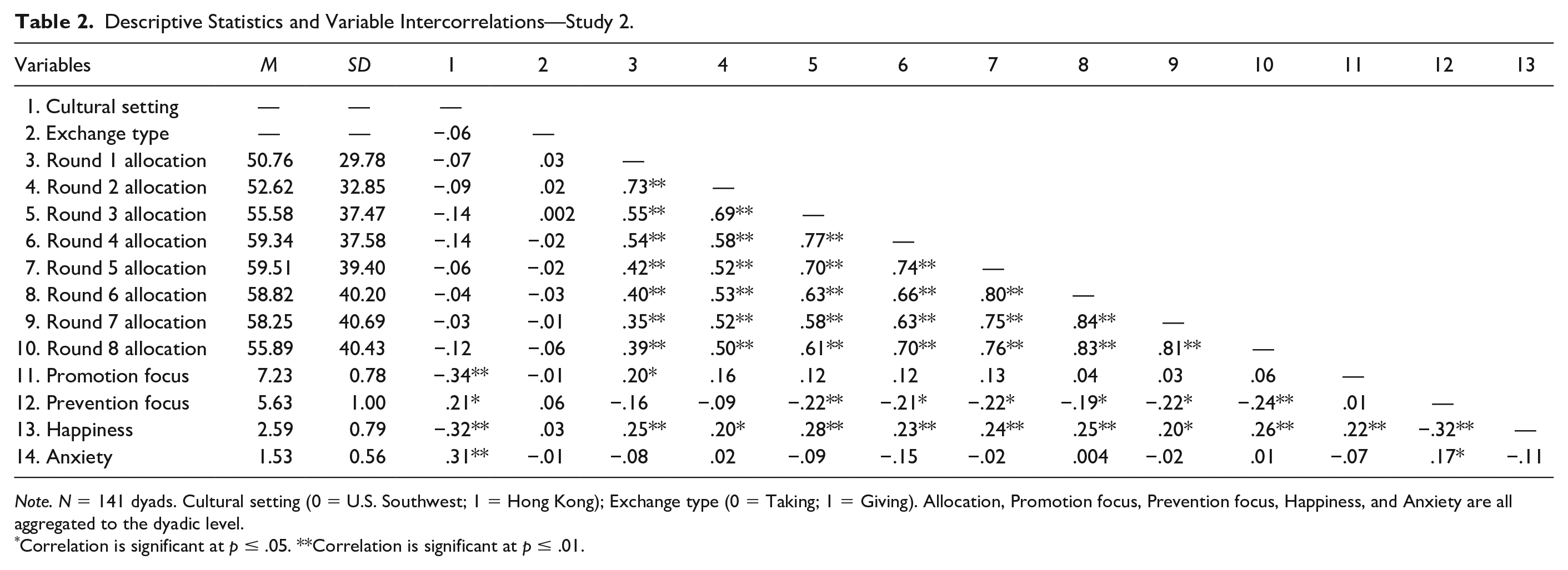
Note. N = 141 dyads. Cultural setting (0 = U.S. Southwest; 1 = Hong Kong); Exchange type (0 = Taking; 1 = Giving). Allocation, Promotion focus, Prevention focus, Happiness, and Anxiety are all aggregated to the dyadic level.
Correlation is significant at p ≤ .05. **Correlation is significant at p ≤ .01.
Means (Standard Deviations in Parentheses) of Promotion Focus, Prevention Focus, Happiness, and Anxiety by Condition—Study 2.
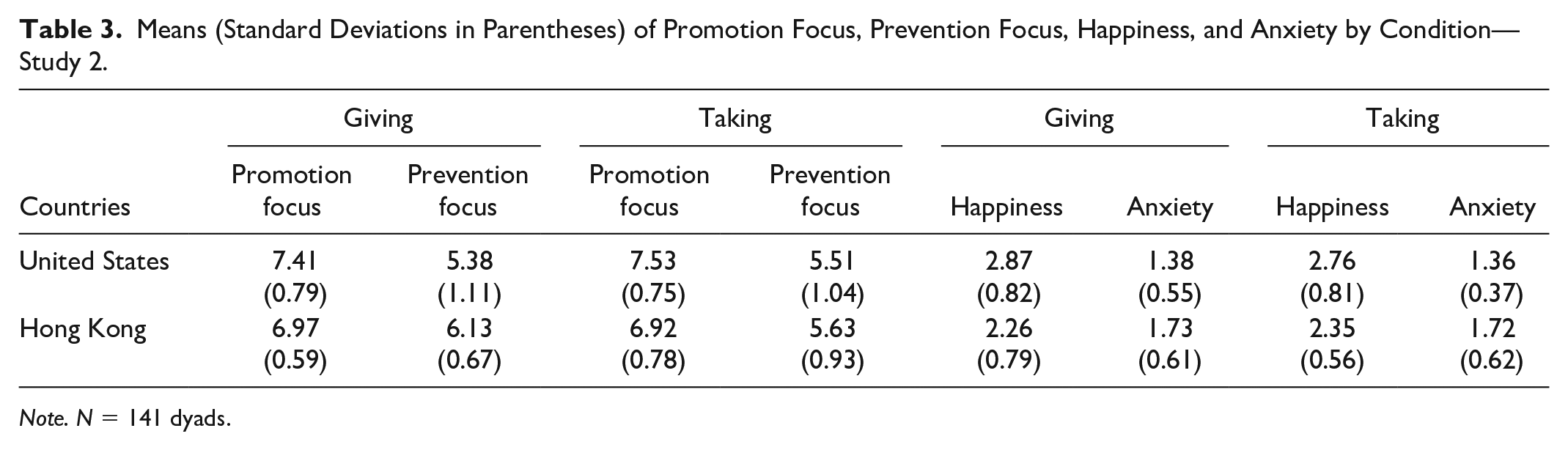
Note. N = 141 dyads.
In the taking game, Hong Kong dyads became marginally more punitive over time, F(1, 33) = 3.84, p = .059, η2 = .10, but American dyads’ allocations remained stable, F(1, 35) = 0.05, p = .829, η2 = .001. In contrast, in the giving game, American dyads became more generous over time, F(1, 40) = 5.43, p = .025, η2 = .12, whereas Hong Kong dyads’ allocations remained stable, F(1, 29) = 0.66, p = .425, η2 = .02. In summary, Study 2 replicated the results of Study 1 by demonstrating that Hong Kong dyads escalated negative behaviors more than American dyads did, whereas American dyads escalated positive behaviors more than Hong Kong dyads did (see Figure 3). 6

Study 2 allocation decisions as a function of the Cultural setting, Exchange type, and Round.
Moderated serial mediation growth model analyses
To test the underlying mechanisms of regulatory focus and emotions, we also tested whether the nature of exchange (i.e., giving vs. taking) would moderate the indirect effect of culture on escalation through regulatory focus and emotions. First, we hypothesized that American dyads would be more promotion focused than Hong Kong dyads and that their promotion focus would be associated with stronger happiness. In turn, we predicted that happiness would help escalate positive reciprocity in the giving game but would not escalate negative reciprocity in the taking game.
Second, we hypothesized that Hong Kong dyads would be more prevention focused than American dyads and that their prevention focus would be associated with stronger anxiety. In turn, anxiety would help escalate negative reciprocity in the taking game but would not escalate positive reciprocity in the giving game.
To test these predictions, we followed the procedure of Chan (1998) to combine lower-level measures into collective constructs and aggregate participants’ regulatory focus and emotions to the dyadic level by calculating the average amount that each of Player A and Player B (Humphrey et al., 2017; Loyd et al., 2013). We also tested the validity of aggregation, Promotion focus: ICC(1) = .12, rWG = .90; Prevention focus: ICC(1) = .10, rWG = .89; Happiness: ICC(1) = .08, rWG = .70; Anxiety: ICC(1) = .15, rWG = .71, and the results supported aggregating to the dyadic level (LeBreton & Senter, 2008).
We then ran a two-factor latent growth model to estimate a latent intercept (i) and a latent slope (s), and followed the path-analytic approach (Preacher et al., 2007; with 5,000 bootstrapped samples and 95% confidence intervals [CIs]) to test the indirect effects of cultural setting on the latent slope through regulatory focus and emotions in each game (taking vs. giving).
Cultural differences in regulatory focus
Americans dyads (M = 7.47, SD = 0.77) were more promotion focused than Hong Kong dyads (M = 6.95, SD = 0.69), t(139) = 4.22, p < .001, d = 0.72, 95% CI = [0.28, 0.77], and Hong Kong dyads (M = 5.86, SD = 0.85) were more prevention focused than American dyads (M = 5.44, SD = 1.07), t(139) = 2.56, p = .012, d = 0.43, 95% CI = [−0.75, −0.09].
Regulatory focus and emotions
Promotion focus was positively associated with happiness (b = 0.23, SE = 0.09, p = .013) and prevention focus was positively associated with anxiety (b = 0.10, SE = 0.04, p = .017).
Latent growth modeling
Latent growth modeling (LGM) enabled us to model mean-level changes in allocations across eight rounds, as well as the differences in changes, while controlling for the effects of measurement error. We constructed a model with two growth factor components: the latent intercept and the latent slope. The latent intercept reflects the average of Round 1 allocation; the latent slope estimates a linear growth trajectory over eight rounds. The variance in the latent intercept reflects differences in the Round 1 allocation; the variance in the slope represents differences in mean-level changes over time. We constructed the model by defining the intercept factor as the Round 1 allocation and setting the loadings of allocations from Round 1 to Round 8 to 1 on the intercept factor and to 0 to 7 on the slope factor. In addition, we correlated residual variables for the allocations over time because the error variances were homoscedastic over time for repeated latent variables (Lance et al., 2000).
To examine whether the Exchange type (taking vs. giving) moderated the indirect effect of Cultural setting on Escalation (slope factor) through Regulatory focus and Emotions, we tested whether (a) a Happiness × Exchange type interaction on Escalation (slope factor) emerged; (b) Promotion focus and Happiness mediated the relationship between Culture and Escalation (slope factor) in the giving game, but not in the taking game; (c) an Anxiety × Exchange type interaction on Escalation (slope factor) emerged; and (d) Prevention focus and Anxiety mediated the relationship between Culture and Escalation (slope factor) in the taking game but not in the giving game. Figure 4 shows the two-factor latent growth model for allocations and the paths between the studied variables (e.g., Culture, Regulatory focus, Emotions, and Exchange type). To test the underlying mechanisms of Regulatory focus and Emotions, we conducted a path analysis using Mplus and a maximum likelihood estimation.

Study 2 path diagram of a two-factor latent growth model for Allocation decisions.
Promotion focus and happiness
We found a significant Happiness × Exchange type effect on Escalation (slope factor) (b = 2.52, SE = 1.12, p = .024). We also found that Exchange type moderated the indirect effect of Culture on Escalation (slope factor) via Promotion focus and Happiness. In the giving game, an indirect effect emerged for the serial mediation (b = −0.15, SE = 0.13, 95% CI = [−0.61, −0.01]), suggesting that the escalation of giving was greater for American dyads than Hong Kong dyads over the eight rounds because Americans were more promotion focused and experienced higher levels of happiness. In contrast, the indirect effect was not significant in the taking game (b = 0.16, SE = 0.16, 95% CI = [−0.03, 0.68]).
Prevention focus and anxiety
Following the same procedures as above and using Prevention focus and Anxiety as the mediators, we found an Anxiety × Exchange type interaction effect on Escalation (slope factor) (b = −3.29, SE = 1.50, p = .028). We also observed that the Exchange type moderated the indirect effect of Culture on the Escalation (slope factor) via Prevention focus and Anxiety. In the taking game, the indirect effect was positive and significant for the serial mediation (b = 0.12, SE = 0.09, 95% CI = [0.02, 0.41]), suggesting that the escalation of taking was greater for Hong Kong dyads than those for American dyads over the eight rounds because Hong Kongers were more prevention focused and experienced higher levels of anxiety. In the giving game, however, the indirect effect was not significant (b = −0.01, SE = 0.05, 95% CI = [−0.15, 0.06]) (see Table 4 for detailed results). 7
Path Analysis Results for Two-Factor Latent Growth Model for Allocations—Study 2.

Note. N = 141 dyads. Bootstrap sample size = 5,000. Cultural setting (0 = U.S. Southwest; 1 = Hong Kong); Exchange type (0 = Taking; 1 = Giving). Allocation, Promotion focus, Prevention focus, Happiness, and Anxiety are all aggregated to the dyadic level. CI = confidence interval.
Discussion
Study 2 replicated the findings of Study 1: Individuals in the North American settings escalated their positive exchange, but positive reciprocity remained stable for individuals in the East Asian settings. Conversely, individuals in the East Asian settings escalated negative exchanges, whereas negative reciprocity remained constant in the North American settings. In addition, Study 2 showed that regulatory focus and emotions were the underlying mechanisms behind these findings.
Study 3
The relationships between regulatory focus and the other measures in Study 2 were correlational, leaving the possibility that an unknown variable may account for the observed effects (Spencer et al., 2005). To establish regulatory focus as a causal mechanism, we followed the past research on cross-cultural studies by manipulating regulatory focus within a single culture to more robustly test the causal effect of regulatory focus in Study 3 (San Martin et al., 2019; C. S. Wang et al., 2011).
Method
Study 3 employed a 2 (Regulatory focus: Prevention vs. Promotion focus) × 2 (Exchange type: Give vs. Take) × 4 (Round: 1–4) mixed design, with the last factor serving as a within-subject factor tracking escalation of behaviors. Participants ostensibly interacted with other participants in the game, but in reality the other “participant” was preprogrammed to make an offer of 50 points (out of 100 points) in the first round. This manipulation ensured that the first move was consistent across conditions, allowing us to measure how our manipulations influenced patterns of reciprocity over time. Moreover, we deliberately ensured that the first move was a 50–50 split (Pillutla & Murnighan, 1996)—that is, an objectively “fair” split. Even with this fair split in place, we predicted that regulatory focus and exchange type would shape the interpretations of the first move and that promotion-manipulated individuals would escalate reciprocity in the giving game, but not in the taking game. We also predicted that prevention-manipulated individuals would escalate reciprocity in the taking game, but not in the giving game.
Participants and Procedure
One hundred and fifty-nine U.S. participants (71 males and 88 females; mean age = 34.00 years, SD = 10.51) were recruited from Amazon Mechanical Turk (MTurk) in exchange for payment. Participants were randomly assigned to a word fragment task (Gilbert & Hixon, 1991; Whitson et al., 2019) to prime regulatory focus (Prevention vs. Promotion focus). In each condition, participants were shown four words with one or two missing letters and asked to write in the missing letters to form the word. For example, the fragment “gro_th” needed a “w” to form the word “growth.” The four words in the promotion focus prime were “growth,” “active,” “eager,” and “accomplish,” whereas those in the prevention focus prime were “calm,” “vigilant,” “safe,” and “secure.”
Upon completion, participants were randomly assigned to either the giving or the taking game. All participants were told that they were assigned as Player B to play against another participant (Player A) who was networked through the internet. As noted, in actuality, Player A’s actions were computer programmed.
In the giving game, the participant (Player B) and the other player (Player A) were each allocated a set of 100 points, and Player A first decided how many points to give to Player B.
Player A was preprogrammed to make an offer of 50 points in the first round. The participant then chose how many points out of their 100-point allocation to give to Player A. These two moves constituted Round 1.
In the subsequent three rounds, Player As move mirrored the participant’s move in the previous round. For example, if the participant gave Player A 60 points in the first round, Player A gave the same amount (60 points) back to the participant in the second round. Participants continued to make giving decisions until they completed four rounds.
In the taking game, the paradigm remained the same as in the giving game except that decisions were described as taking instead of giving. The instructions did not outline the number of rounds that would be played. Participants then completed the demographic questionnaire and were debriefed.
Dependent Measure
Allocation decisions
For each round, we recorded how many points participants gave in the giving game (or took in the taking game) to (or from) Player A, from 0 to 100, with higher numbers reflecting either more generous (giving game) or punitive (taking game) decisions.
Results
Table 5 includes descriptive statistics and correlations for the variables. A Regulatory focus × Exchange type × Round mixed-methods ANOVA, with Round serving as a within-subject factor demonstrated a significant Regulatory focus × Exchange type × Round three-way interaction on Allocation decisions, F(3, 465) = 2.93, p = .033, η2 = .02.
Descriptive Statistics and Variable Intercorrelations—Study 3.

Note. N = 159 individuals. Regulatory focus (0 = Prevention focus; 1 = Promotion focus); Exchange type (0 = Taking; 1 = Giving).
Correlation is significant at p ≤ .05. **Correlation is significant at p ≤ .01.
Ethnicity Information for Studies 1 to 3.

In the taking game, exchanges in the prevention focus condition became more punitive over time, F(1, 41) = 7.20, p = .010, η2 = .15, but the exchanges in the promotion focus condition remained stable over time, F(1, 38) = 0.07, p = .793, η2 = .002. In contrast, in the giving game, exchanges in the promotion focus condition were more generous over time, F(1, 39) = 5.75, p = .021, η2 = .13, but the exchanges in the prevention focus condition remained stable over time, F(1, 37) = 0.34, p = .562, η2 = .01 (see Figure 5).

Study 3 allocation decisions as a function of Regulatory focus, Exchange type, and Round.
Overall, Study 3 supported our argument that cultural differences in regulatory focus may explain patterns of reciprocity by showing that even state-level regulatory focus manipulations shape the escalation of reciprocity. In positive exchanges, individuals in a promotion-oriented state escalated reciprocity, but this escalation did not occur for individuals in a prevention-oriented state. Conversely, in negative exchanges, individuals in a prevention-oriented state escalated reciprocity, but this escalation did not occur for individuals in a promotion-oriented state.
General Discussion
Reciprocity is a basic governing mechanism for sustained social relationships (Fehr & Gächter, 2000). Our research investigated how people escalated different types of reciprocity in different cultures. Study 1 demonstrated that individuals in a North American setting escalated positive and not negative exchanges, whereas individuals in an East Asian setting escalated negative and not positive exchanges. Study 2 conceptually replicated these findings and showed that regulatory focus and emotions were the driving mechanisms behind these cultural differences. Study 3 manipulated regulatory focus and showed that individuals in a promotion-oriented state escalated reciprocity when exchanges were positive (but not negative), whereas individuals in a prevention-oriented state escalated reciprocity when exchanges were negative (but not positive).
Theoretical Implications
Our research contributes to the social exchange theory by exploring how culture influences reciprocity over time. Escalation-based theories suggest that reciprocity may intensify over time, but equity-based theories propose that people reciprocate behaviors in kind. Our work provides evidence for both theoretical perspectives, with the cultural background of reciprocators and the type of the exchange determining patterns of reciprocity. Moreover, our research further demonstrates the meaningful impact of subjective components in individuals’ calculus of reciprocity in social exchanges. In particular, regulatory focus and emotions can color people’s cultural perceptions of social exchange and in turn influence their behaviors. Importantly, cultural differences in regulatory focus and their specific emotional signatures (i.e., promotion focus engenders happiness and prevention focus engenders anxiety) drive patterns of reciprocity. This work begins to answer the recent calls to bring emotions to the foreground when studying social exchange (e.g., Cropanzano et al., 2017; Lawler & Thye, 1999).
By examining a series of exchanges, our study provides a dynamic and realistic lens that allows for a better understanding of how reciprocity works. Although theories of social exchange often assume continuous interactions (Cropanzano et al., 2017; Greco et al., 2019), empirical research almost exclusively employs one-shot decisions (e.g., Aryee et al., 2002; Bishop & Scott, 2000; Cortina & Magley, 2003; Eisenberger et al., 2001; Glomb & Liao, 2003), providing a limited understanding of how people reciprocate over time. By focusing on the dynamic escalation of reciprocity rather than examining one-shot interactions (Halevy et al., 2012), our research gives insight into how and why cultural orientations and societal norms are formed and become reified over time.
Alternative theoretical pathways
We tested our model based on the alternate theories described in the introduction. Hedonic contingency theory suggests that because individuals in East Asian settings are more anxious, they are unlikely to be influenced by whether the exchanges are framed in a positive versus negative manner. Yet we find that, because of this anxiety, individuals in East Asian settings escalated negatively framed exchanges, but not positively framed exchanges. Similarly, our anxiety-related findings were not consistent with the NSR model (Cialdini et al., 1973, 1981), which suggests that negative moods increase positive behaviors such as helping because doing so makes the helper feel better; if this were true, anxiety should have increased giving, which we did not observe in our studies (as shown in the correlation table in Table 2, there is not a positive correlation between anxiety and allocation amounts).
One reason for these different results could be that previous empirical work on both the hedonic contingency (Wegener & Petty, 1994) and NSR (Bless et al., 1992; M. M. Mitchell, 2000; Tiedens & Linton, 2001) theories has focused on sadness rather than on anxiety, the negative emotion we examined. We did not measure sadness because it is associated with withdrawal behavior (Dawson et al., 1992; Harmon-Jones et al., 2009) and is not an emotion associated with prevention focus (which is essential to our cultural theorizing). Nonetheless, it is worth considering how different types of negative emotions may be related to decisions to escalate reciprocity. Therefore, future work might compare sadness and anxiety as precursors to the escalation (or de-escalation) of reciprocity.
Future Directions and Limitations
Interestingly, in Study 2, prevention focus was more strongly related to happiness (negatively) than to anxiety (see Table 2). Although past work provides support for the relationship between prevention focus and both happiness (negative) and anxiety (positive), some authors have suggested that prevention focus has a stronger relationship with anxiety than with happiness (Faddegon et al., 2008; Shah & Higgins, 2001). For example, prevention-focused people become more agitated and anxious after experiencing failure (Higgins et al., 1997), and there is evidence that prevention-focused individuals may be less happy because their vigilance causes them to “forego many momentary pleasures for the sake of achieving higher order long-term goals” (Cheung et al., 2014, p. 2). Future research could investigate this possibility by more deeply examining the nuances of emotions.
In the current studies, we focused on how individuals from the same culture made sequential economic decisions. However, not all interpersonal interactions occur within the same culture (Henderson et al., 2018; Molinsky, 2007; Ott & Michailova, 2018), which could introduce complications. Levitt (2015), for example, outlines how prejudice and ethnocentrism can challenge international team dynamics. Negatively framed exchanges may escalate more quickly when the interactions are cross-cultural because of these underlying prejudices. Future studies might further investigate reciprocity and reciprocal escalation patterns in cross-cultural interactions in an effort to improve these interactions by reducing prejudice and ethnocentrism.
Future work could also explore how repeated interactions within cultures may strengthen norms and social perceptions. The social radar account posited by Morris et al. (2015) suggests that behaving in line with injunctive norms (i.e., perceptions of behaviors that evoke social approval or disapproval) increases social approval and signals to actors that their positions are validated (Belk et al., 1982; Goffman, 1959; Strauss, 1977). In our case, the escalation of the type of reciprocity that fits one’s injunctive norms elucidates the process of cultural transmission and change, suggesting that this may be at least one part of the learning process from which cultural norms are derived. For instance, our findings that culture and the type of exchange interact to trigger escalation may help explain why individuals in East Asian settings are generally more punitive and less rewarding than individuals in North American settings in one-shot interactions (Leung et al., 2011; Singh et al., 2011).
Moreover, the escalation of negative actions (and the lack of escalation of positive actions) by individuals who are more prevention focused may reinforce their vigilance in certain social situations. In contrast, the escalation of positive actions (and the lack of escalation of negative actions) by individuals who are more promotion focused may reinforce their beliefs that people are supportive and dependable, further encouraging the pursuit of positive relationships. Future work should continue to explore how repeated social exchanges may shape cultural norms.
Our work also provides a potential opportunity to diminish—and perhaps even reverse—cycles of harmful retribution. Previous research has discussed how negative forms of reciprocity can be harmful to those within and outside of the social exchange (e.g., Harris et al., 2007; M. S. Mitchell & Ambrose, 2007). For example, negative reciprocity decreases organizational commitment, thereby leading to increased turnover (Porter et al., 1974), decreased motivation (Farrell & Rusbult, 1981), reduced perceived organizational support (Settoon et al., 1996), and fewer organizational citizenship behaviors (Williams & Anderson, 1991). Likewise, retaliation can result in spiraling acts of vengeance, a precursor to violence in societies and, in extreme cases, geopolitical conflict (Davie, 1929; Nisbett & Cohen, 1996; Otterbein, 1970; Tumey-High, 1971). Findings of Study 3 suggest that intervention may be possible—by engendering a promotion orientation among key decision-makers to curtail negative escalation spirals.
At the same time, negative reciprocity is not always detrimental; it may help prevent opportunistic behaviors, sustain social norms (Fehr & Gächter, 1998), and increase cooperation in groups (Rockenbach & Milinski, 2006). For instance, harsh sanctioning increases coordination between members, which helps protect members during times of threat (Gelfand et al., 2011). Future research may benefit from considering the conditions under which the escalation of negative actions can result in positive (vs. destructive) consequences.
Conclusion
Although reciprocity is a universal norm in social relationships (Fehr & Gächter, 2000), people display different patterns of reciprocity in different cultures (Buchan et al., 2002; Cosmides & Tooby, 2005). Our research provides a nuanced understanding of social exchanges by examining how and why individuals in East Asian settings reciprocate negative and positive actions differently from individuals in North American settings. Classic adages and sayings, such as “An eye for an eye” and “If you cooperate with others, others will cooperate with you,” suggest that people generally reciprocate in kind. Our research supports these traditional perspectives but also illustrates when and why they may be limited, thereby taking an initial step toward a more comprehensive understanding of how cultural systems shape reciprocity.
Supplemental Material
Supplementary_Materials_200203 – Supplemental material for Culture and Patterns of Reciprocity: The Role of Exchange Type, Regulatory Focus, and Emotions
Supplemental material, Supplementary_Materials_200203 for Culture and Patterns of Reciprocity: The Role of Exchange Type, Regulatory Focus, and Emotions by Yingli Deng, Cynthia S. Wang, Federico Aime, Long Wang, Niro Sivanathan and Yun Chung (Karina) Kim in Personality and Social Psychology Bulletin
Footnotes
Declaration of Conflicting Interests
The author(s) declared no potential conflicts of interest with respect to the research, authorship, and/or publication of this article.
Funding
The author(s) disclosed receipt of the following financial support for the research, authorship, and/or publication of this article: The work described in this paper was partially supported by a grant from the Research Grants Council of the Hong Kong Special Administrative Region, China (Project No. CityU 11529116).

Supplemental Material
Supplemental material is available online with this article.
Notes
References
Supplementary Material
Please find the following supplemental material available below.
For Open Access articles published under a Creative Commons License, all supplemental material carries the same license as the article it is associated with.
For non-Open Access articles published, all supplemental material carries a non-exclusive license, and permission requests for re-use of supplemental material or any part of supplemental material shall be sent directly to the copyright owner as specified in the copyright notice associated with the article.
