



Abstract
Much attention has focused on the social, institutional, and mobilization factors that influence political participation, with a renewed interest in psychological motivations. One trait that has a deep theoretical connection to participation, but remains underexplored, is narcissism. Relying on three studies in the United States and Denmark, two nationally representative, we find that those scoring higher in narcissism, as measured by the Narcissistic Personality Inventory–40 (NPI-40), participate more in politics, including contacting politicians, signing petitions, joining demonstrations, donating money, and voting in midterm elections. Both agentic and antagonistic components of narcissism were positively and negatively related to different types of political participation when exploring the subfactors independently. Superiority and Authority/Leadership were positively related to participation, while Self Sufficiency was negatively related to participation. In addition, the combined Entitlement/Exploitativeness factor was negatively related to turnout, but only in midterm elections. Overall, the findings support a view of participation that arises in part from instrumental motivations.
Understanding the factors that facilitate or hinder political participation is of great interest to citizens and governments of advanced democracies. It has been widely argued by the media, politicians, intellectuals, and scholars that narcissism and the pursuit of political outcomes appear inseparable (The Economist, 2016; Glasser, 2016; McAdams, 2016; Wolfe, 1976). Jejune descriptions of the current period, such as “the Age of Entitlement” and “the Post-Truth Era,” nevertheless find meaningful empirical support (Campbell et al., 2004; Twenge & Campbell, 2009). Arguably, the public’s sense of entitlement, deservingness, and pursuit of self-promotion without regard to the cost of others has increased (Foster et al., 2003; Twenge, 2006; Twenge et al., 2008). The last several decades have witnessed personal goals shifting toward a greater focus on status, celebrity, and personal wants over the needs of society (Campbell et al., 2005; Spence, 1985; Twenge et al., 2012; Twenge & Foster, 2010; cf. Wetzel et al., 2017).
Yet, how narcissism is being differentially represented in political behavior at the individual level in the mass publics remains relatively unknown. A nascent line of research suggests that individual differences in narcissism have a role in political orientations (Hatemi & Fazekas, 2018) and who people vote for (de Zavala et al., 2017; Federico & de Zavala, 2018). There is a dearth of research, however, dedicated to identifying whether individual differences in narcissism have a role in who gets politically engaged. This is a particularly important phenomenon to explore because higher narcissism leads to a shift in values away from civic responsibility and toward narrow self-interest and gratification (Marchlewska et al., 2018), analogous to the ways in which political parties and candidates mobilize the electorate with populist rhetoric (Carmines et al., 2018). In real and experimental settings, public goods are exploited and common resources depleted more rapidly when individuals higher in narcissism are involved (Campbell et al., 2005; Grijalva et al., 2015; Van Vugt, 2009). Socially expressed narcissism also results in higher levels of out-group derogation, increased retaliation, punishment, and endorsement of violent resolutions (Böckler et al., 2017; Campbell et al., 2002; de Zavala et al., 2013). This is especially true in the face of perceived and real challenges to economic success, identity, or personal insult (Bushman & Baumeister, 1998; Lambe et al., 2018). And such influence appears prevalent regardless of political orientation (Hatemi & Fazekas, 2018); take for example the xenophobia surrounding immigration from the right (Lyons et al., 2010) or the increased prohibition of free speech from the left (Lukianoff & Haidt, 2015).
Relying on three studies, two nationally representative, we address this lacuna and provide some insight into role of narcissism on political participation, including contacting politicians, signing petitions, joining demonstrations, donating money, and turning out to vote.
Narcissism in the General Public
Narcissism is conceptualized as an independent personality trait that varies along a somewhat normal continuum in the general population (Raskin & Terry, 1988). Unlike pathological, or the more “vulnerable” aspects of narcissism that reflect a defensive mechanism against emotional insecurity (Miller et al., 2011; Pincus & Lukowitsky, 2010), the personality trait of narcissism exhibits more of the “grandiose” aspects of narcissism, which includes both agentic and antagonistic features (Crowe et al., 2019). The agentic and extraverted features include high self-esteem, sociability, fantasies of glory, grandiosity, uniqueness, and charisma (Leckelt et al., 2015). The antagonistic features capture the devaluation of others, aggressive, nonempathic, noncompliant, assertive, entitled, manipulative, dominant, superior, and other-derogation behaviors (Back et al., 2013).
One of the most commonly used measures to capture grandiose narcissism in the general population is the Narcissistic Personality Inventory (NPI; Raskin & Hall, 1979). In its original framework, a single overall narcissism score is derived from the multidimensional 40-item NPI questionnaire that combines (a) Leadership/Authority (self-perception of leadership skills and desire for power), (b) Entitlement (the expectation and amount of entitlement a person has, including favorable treatment and compliance with one’s wishes), (c) Exhibitionism (the desire and willingness to be the center of attention), (d) Exploitativeness (how willing one is to exploit others in order to achieve their own desires), (e) Self-Sufficiency (how much one is willing to rely upon on others versus their own abilities to meet their needs and goals), (f) Superiority (how much a person feels they are better than those around them), and (g) Vanity (view of self and desire for others to see one as superior and attractive). The combinations of these traits form a narcissism score that is unimodal with a positive skew.
Empirical and theoretical advances have converged on the importance of distinguishing between the different components of grandiose narcissism (Miller et al., 2017). There are several considerations. The NPI’s dimensions, whether agentic, antagonistic, or other, have unique relationships to traits of interest (Campbell, Foster, & Finkel, 2002; Miller et al., 2011). As such, it is valuable to explore both the composite NPI score that captures the combination of all traits, and the independent facets of narcissism separately. For example, narcissism’s relationship with self-esteem is two-sided; maintaining some level of narcissism is needed for psychological well-being (Barry et al., 2003), but too much leads to failure (Campbell, Rudich, & Sedikides, 2002). And importantly, self-esteem has diverging relationships with some of the NPI’s dimensions, conflating its role when relying upon the NPI sum score (Brummelman et al., 2016). A similar pattern could arise for the public regarding political participation. In order for a society to function as a democracy, the voice of the people must be represented, and in order for this to happen, ideally everyone should believe that their opinion matters and that they are “right,” at least to some degree. Indeed, high levels of participation is seen as a necessary component for the stability of a democracy (Verba et al., 1995). In this way, particular components of narcissism should be beneficial to achieve certain outcomes.
There is an ongoing discussion regarding which factor model best fits the data and theory of the NPI, however. The original seven-factor model offers meaningful and fine-grained hypotheses that theoretically connect political behavior to participation. However, a number of studies have argued and provided empirical support to reduce the seven factors into two, three, or four dimensions (Corry et al., 2008; Emmons, 1984; Kubarych et al., 2004). Among these alternatives is a recent three-factor structure proposed by Ackerman and colleagues (2011) that focuses on internal consistency and generating factors that sort into what they label as “adaptive” and “maladaptive” traits. Using a subset of 25 items, this specification produces the dimensions of Leadership/Authority (self-perceived leadership ability, desire for authority, and social potency), Grandiose Exhibitionism (primarily self-absorption, vanity, and exhibitionism), and Entitlement/Exploitativeness (entitled beliefs/behaviors and manipulativeness). Therefore, to address the theoretical links with the original specification and the potential measurement benefits of a shorter scale, this study explores (a) the combination of all the NPI traits defined as Narcissism, (b) the original seven sub-facets independently, and (c) Ackerman et al.’s 25-item three-factor structure.
Narcissism and Political Participation
A person’s decision to participate, that is contacting politicians, signing petitions, joining demonstrations, donating money, and turning out to vote, is a function of familial influences, social networks, social forces, mobilization efforts, organizational membership, individual characteristics, resources, opportunities, experiences, and skills that are developed throughout one’s life (Verba et al., 1995). However, given the costs of political participation, even with adequate resources, the public is only likely to participate to the extent that they are also motivated (Klandermans & Oegema, 1987).
Recent research has emphasized the role of more deeply rooted individual factors in shaping the extent to which people engage in civic life. Narcissism encapsulates self-interest, ego, benefit-seeking, need for attention and recognition, preservation of self-esteem, status, affiliation, and identity development, all of which are proposed antecedents to political participation (Klofstad, 2010; Verba et al., 1995). If politics is the mechanism to address the problem of balancing the needs and wants of the individual versus the good of society, and narcissism is “a dynamic self-regulatory system where positive self-views are maintained and enhanced in large part by using the social environment”(Campbell et al., 2005, p. 1358), and modern political participation is rooted in agency, a superiority of ideas, personal needs over others and society, combined with perceived deprivation that demands special treatment (Hatemi & Fazekas, 2018), then individual differences in political participation should emerge, in part, as a function of narcissism. At the most fundamental level, those who seek attention, and want their voice heard, who believe their voice matters more than others, who are also more agentic and believe in their ability to effect change, but also believe they are superior to others, and are more focused on their own wants, should be more likely to participate in politics. Accordingly, we hypothesize that those higher in the overall NPI sum score participate more.
This relationship, however, is unlikely to be uniform across all the dimensions of grandiose narcissism, when taken individually. Theoretically, the agentic features of sociality and engagement should be independently related to increased political participation, but those agentic features focused on self-reliance should prove just the opposite. Similarly, some antagonistic features of narcissism, such as the need for the devaluation of others should also be positively related to participatory behaviors, if to accomplish nothing less than to be part of the group that controls others. However, this is also a two-sided coin; the noncompliant and antisocial features of antagonistic narcissism by themselves should be related to avoiding those specific activities that join the crowd. Separating out these features is possible by exploring the NPI’s individual facets.
At the subfactor level, those who perceive themselves as leaders, including belief in their capacity to influence others, and make better decisions, should believe that they should be in the group that sets the rules and be the ones choosing that group. Higher Authority/Leadership features should transpose into more political engagement overall, and seeking out various forms to express and impose one’s views on others, including shaping political outcomes. That is, higher rates of political participation rely to some extent on agency, intrinsic desire and belief in one’s ability to lead, and their authority being acknowledged, which is in line with a view of politics as a potential medium to achieve such recognition through influencing decision makers, media, or fellow citizens. Recall, participation is more than voting. It includes many behaviors that require actions and that others hear “you,” such as contacting your elected leaders, taking part in discussion forums, and public demonstrations. As such, we hypothesize that people who believe they are better at leading other people will occupy a disproportionately larger share of politically active and engaged citizens.
On the other hand, all participatory acts bear with some costs, and it is unlikely the benefits associated with taking an active citizen role are great enough to motivate highly Self-Sufficient individuals to pay those costs and participate in politics. That is, a stronger belief in one’s independence and ability to succeed on their own should make the potential benefits from acts of participation less attractive for these individuals, because they should be more confident in their own means to sustain themselves with less interest in convincing decision makers or the public to give them benefits or support their own goals. As such, we hypothesize that the agentic factor of Self-Sufficiency is negatively related to political participation.
Moving to the antagonistic features, those who believe they are special and superior to others should be more likely to promote their ideas and participate in highly salient activities, such as politics. Superiority is an independent trait in the original seven-factor solution, but is not explicitly measured in Ackerman’s three-factor model. Expectations for the Exploitativeness and Entitlement dimensions, however, are mixed. On one hand, individuals with a strong sense of Exploitativeness assign importance to their own needs, and their satisfaction is conditioned upon getting what they deserve at the cost of others. Only if political participation is seen as something that can fulfill individual-related needs, should Exploitativeness be independently related to participation. Therefore, one would expect a significant relationship between Exploitativeness and participation only under specific circumstances. On the other hand, people who feel entitled often feel that while something should be done for them, others should be the ones who do it. This leads to some expectation that Entitlement is negatively related to certain acts of participation. It would be misleading, however, to simply consider Ackerman’s et al.’s (2011) Entitlement/Exploitativeness three-factor dimension a combination of the two. Rather, the items selected differ (see Tables 2 and 3) and result in a dimension that has a significant relationship with antisocial tendencies. Arguably, this factor reflects a disposition that should lead to less cooperative behaviors and disengagement with social institutions. Thus, we hypothesize that the three-factor Entitlement/Exploitativeness dimension is negatively related to political participation, at least for the most pro-social activities.
Finally, in the three- or seven-factor approach, there is little theoretical reason to expect independent relationships between participation and Vanity, Exhibitionism, or Grandiose Exhibitionism. Casting a vote with millions of other people, for example, does not offer a means to bring individuals closer to being in the spotlight, or showcase their looks or talents.
Data and Method
To test our hypotheses, we collected data through two nationally representative surveys, one in Denmark administered by TNS-Gallup, Denmark (n = 2,450, 2011), and one in the United States through YouGov, United States (n = 500, 2015), alongside a third U.S. web-based study (n = 2,280, 2013). We choose the combination of the United States and Denmark for practical, comparative, and theoretical reasons. Having a research team with expertise in the United States and Danish politics and the languages, previously validated measures and an ongoing research program in each country provided practical incentives. Importantly, the characteristics of the United States and Denmark are quite similar in a global context, even when comparing only to other advanced democracies. For example, at the time of data collection, the gross domestic product (GDP) per capita in Denmark and the United States was 58,900 and 53,100 respectively; controlling for the cost of living, these numbers are almost equivalent, making these two countries the most similar according to the World Bank (2014). The countries were similar in life expectancy (less than half a year difference), birth rates, and unemployment (7.4% and 7.0%) among other factors (Central Intelligence Agency, 2013). As such, we expect the direction and significance of the relationship between overall narcissism and participatory behaviors to be generally consistent. There are, of course, many differences between any two countries. Differences in the type of democracy, domestic culture, and country-specific social and political conditions should be reflected in differences in the magnitude of the relationship between narcissism and political behaviors.
The Danish survey (DK11 from now on) was collected between October and November of 2011 as part of a two-wave panel, which included measures specifically for this project in the second wave. We received 1,972 responses from 2,840 participants active in the panel when our survey was fielded, plus an additional 479 new entrants. The sample was representative of the Danish population in terms of geographical region, education, sex, and age. Furthermore, our data composition in terms of vote choice closely matches the official results of the 2011 Parliamentary Elections (see Supplemental Information SI1).
Chronologically, the second study (US13 from now on) consists of a U.S. survey administered on Mturk. This survey provided a means to pilot questions for our third nationally representative U.S. study, described in the following paragraph. All participants were U.S. citizens or residents. Qualification questions were embedded in the survey to ensure response validity. Two waves were collected on November 19–20, 2013 (n = 968) and December 9–12, 2013 (n = 1,056) including a conservative oversample (n = 256) as previous research indicated there is a higher probability of recruiting more liberal participants.
We fielded a third nationally representative (U.S.) study on July 13–20, 2015 (N = 500). The frame was constructed by stratified sampling from the U.S. Census Bureau’s 2010 American Community Survey with selection within strata by weighted sampling with replacement. Voter registration status and turnout were matched to this frame using the 2010 Current Population Survey, yielding a nationally representative sample in terms of age, sex, ethnicity, education, partisanship, and political ideology (please see Supplemental Information SI2 for more details). For all studies, all participants provided informed consent. All procedures contributing to this work comply with the ethical standards of the relevant national and institutional committees on human subjects and with the Helsinki Declaration of 1968, as revised in 2008.
Political Participation and Turnout (Outcome Variables)
In all studies, participatory behaviors are measured by eight items through the widely used cross-national ISSP Questionnaire on Citizenship (Verba et al., 1995). The measure includes signing a petition, boycotting, or buying products for political reasons, participating in a demonstration, attending political meetings, contacting politicians, donating money, contacting the media, and taking part in political forums and discussion groups, including those online (for details see Supplemental Information SI3). The average across the eight items serves as a full participation index. The overall measurement properties are very good, with Cronbach’s alpha values of .79 (DK11, valid N = 2,188), .85 (US13, valid N = 2,090), and .89 for US15 (valid N = 420). Furthermore, the means across studies are very similar. After rescaling the summed participation index to range from 0 to 1, means and standard deviations are as follows: 0.435 (0.206) in DK11, 0.468 (0.228) in US13, and 0.448 (0.266) in US15.
Turnout in national elections is also a central measure of political participation. In the US13 study, we analyze electoral turnout in the 2012 presidential elections, with 73% of our sample having said that they voted (“I do not remember” and “Rather not say” answers were treated as missing). Similarly, the US15 collected self-reported turnout in the 2012 presidential elections (82% having reported voting, “Don’t remember” and “Rather not say” treated as missing) 1 and also in the 2014 midterm elections (71% having said they voted, “Don’t remember” and “Rather not say” treated as missing). There is far less variation in Denmark. Actual turnout in the 2011 general election was 88%. Considering the usual problems related to overreporting in high-turnout countries (Karp & Brockington, 2005), it is not surprising that self-reported turnout in the Danish 2011 election was above 95%.
Narcissism
In all studies, narcissism was assessed with the NPI (Raskin & Terry, 1988). The NPI’s forced-choice dyads ask respondents to choose one of two opposing statements about themselves (e.g., “I insist upon getting the respect that is due me” vs. “I usually get the respect that I deserve”). The complete NPI-40 was assessed in the US13 and US15 studies, while a subset of 15 items, modeled after the shorter form NPI-16 (Ames et al., 2006), was assessed in the DK11 study. Exact questions are reported in Supplemental Information SI4. NPI items were coded to have values 0 and 1, where 1 represents the endorsement of the statement reflecting the more narcissistic response.
The full NPI measure is the average across all 40 items (15 in DK11), which ranges from 0 to 1. This measurement is preferred to summed scores because of the ease of interpretation (see Ackerman et al., 2011) and also here because the number of items available in Denmark is lower. The measure exhibits good reliability (DK11, .63 Cronbach’s alpha; US13, .90 Cronbach’s alpha; US15, .86 Cronbach’s alpha). The means and variation of narcissism are also almost identical across studies (DK11 0.31 [0.17]; US13 0.32 [0.21]; US15 0.31 [0.17]).
We follow previous work and evaluate sub-facet structure by fitting confirmatory factor analyses (CFAs), using the original seven-factor solution with no main underlying factor (Raskin & Terry, 1988) and the three-factor solution by Ackerman and colleagues (2011). 2 The seven sub-facets are Authority Seeking, Superiority, Exploitativeness, Entitlement, Self-Sufficiency, Vanity, and Exhibitionism. The three sub-facets derived from a total of 25 items are Leadership/Authority, Grandiose Exhibitionism, and Entitlement/Exploitativeness.
For the US13 and US15 studies, these steps are straight-forward as all 40 NPI items were collected. The Danish study does not include an Exhibitionism measure, and Vanity and Superiority are measured by one item only, with other sub-facets using fewer items than in the full 40-item NPI studies. For the three-factor solution, we used the 25-items of the NPI proposed by Ackerman and colleagues (2011) in all U.S. studies. As DK11 only contained a subset of NPI items, this resulted in a total of eight items; Grandiose Exhibitionism was measured by one item, 3 Entitlement/Exploitativeness by two items, and Leadership/Authority by five items.
The fit statistics of our nationally representative samples (Table 1) are comparable or better than those reported in previous research on convenience and student samples. Overall, both models offer an acceptable fit to the data, or good when usual narcissism measurement model benchmarks are considered. The seven-factor model performs marginally better in all samples. While there are some measurement limitations in the Danish study, we replicate important factor structures of the NPI in the larger and nationally representative samples. Furthermore, beyond the similarity in means, we also see similar factor model-fits across the different samples, be that representative or stemming from different countries.
Comparison of Seven- and Three-Factor Models of Narcissism.

Note. CFI = Comparative Fit Index; RMSEA = root mean square error of approximation; SRMR = standardized root mean square residual; TFI = Tucker Lewis Index.
We report the standardized item loadings based on the CFA models in Tables 2 and 3. While the item loadings follow the expected pattern and are acceptable to good, we identified three potentially problematic items that affected both the seven- and three-factor models. Item 14 (“I insist upon getting the respect that is due me/I usually get the respect that I deserve”) had weak loadings in both nationally representative studies (Entitlement related). Item 23 (“Sometimes I tell good stories/Everybody likes to hear my stories”) had a weak loading in DK11, where in terms of prevalence it was much lower (11%) than in the U.S. samples (24% and 25%). Finally, Item 22 (“I sometimes depend on people to get things done / I rarely depend on anyone else to get things done”) performed poor in all three studies and did not differentiate between respondents, as the narcissistic response proportions were 51%, 51%, and 59%. 4
Standardized Loadings, Seven-Factor Model (Standard Errors in Parentheses).

Note. Loadings below 0.3 are italicized.
Standardized Loadings, Three-Factor Model (Standard Errors in Parentheses).

Note. Loadings below 0.3 are italicized.
The US13 and US15 studies were very similar in terms of sub-facet averages (Table 4), with the Mturk pool scoring slightly higher in Vanity and Exploitativeness than the respondents from the nationally representative US15 study. In the Danish study, we find lower Superiority, Entitlement, and slightly lower Self-Sufficiency and Exploitativeness compared with the U.S. samples. Due to differences in the number of items, we refrain from elaborating on the cross-country differences and leave this to be explored in future research. As with the full NPI, we find very high levels of similarity across all three studies for Authority. Regarding the three-factor structure, we also find similar levels of consistency across samples, with the U.S. national sample scoring highest on Leadership/Authority, but lowest for the two other factors, with particularly low prevalence of Entitlement/Exploitativeness. Whether this is a real difference, a measurement issue, a social desirability effect, or other, future research must answer.
Narcissism Descriptive Statistics and Scale Reliability.

Note. All measures rescaled range from 0 (minimum, lowest narcissism) to 1 (maximum, highest narcissism). NPI = Narcissistic Personality Inventory.
For each factor we take the average of responses for each individual and use those as final scores. The reliability scores range from good to acceptable in the U.S. samples which appears mostly a function of the number of items used (also discussed in Ackerman et al., 2011). The measurement properties in terms of the number of items and reliability are weaker in the Danish sample, where the Authority and Leadership/Authority factors are most reliably measured. However, even with limited measurement options, we believe that a nationally representative non-U.S. study is a valuable addition when analyzing the so far unassessed relationship between Political Participation and Narcissism.
Sociodemographic Correlates
Historically, age, income, and educational level are positively correlated with participation, while non-Caucasian is related to lower participation (Verba et al., 1995). In DK11, the average age of the respondents is 52.6 years (range is 18–91) and 47% female. In the US13, the average age is 33 years (18–81) and 41% female; in the US15, the average age is 48 years (18–87) and 53% female. Educational attainment was assessed with a nine-category item in DK11 (modal category: vocational education), a seven-category item in US13 (modal category: bachelor’s degree), and a six-category item in US15 (modal category: completed high school). Research in political engagement emphasizes university education as the most important education difference; thus, we contrast those who completed higher education (1) to those who did not (0). In the U.S. samples we include a variable for ethnicity, coded as dichotomous: 0 for Caucasian (72% in US15 and 73% in US13) and 1 for other ethnicities. Relationships between narcissism and sociodemographic characteristics are reported in Supplemental Information SI5.
Analytical Strategy
Our analysis has two parts. First, we establish the broader relationship between overall narcissism and participation. While we have nationally representative samples and good properties for outcome and narcissism measures, our analyses are between-individual and cross-sectional, with no time component or experimental intervention. Therefore, they remain correlational. Through regressing participation on narcissism, the models imply a causal direction where narcissism influences participatory behaviors but does not test for causality. We return to this point in the “Discussion” section.
In the second part, we zoom in on the subfactors and fit an identical set of models but instead of the overall NPI we use the independent seven- and three-factor measures as main predictors. For participation, we specify linear regressions (ordinary least squares [OLS] estimates); for turnout, we use a logistic regression. All continuous predictor variables were mean centered and divided by two standard deviations. This method is preferred for two reasons (Gelman & Hill, 2007): (a) the two–standard deviation unit reflects a potential difference between one standard deviation below the mean to one standard deviation above the mean area that contains likely values on the predictor; (b) analytically, the effect of a continuous variable associated with a two–standard deviation unit difference is comparable one-to-one to the effect of dichotomous variables, of which this study has several of interest.
Results
Overall Narcissism Positively Related to Participatory Behaviors
Bivariate correlations are reported in Supplemental Information SI5, finding significant and positive correlations for NPI and Political Participation: .16 in DK11, .08 in US13, and .15 in US15. Modest correlations are not unexpected; it is generally difficult to explain variation in participatory behaviors (Verba et al., 1995). Regarding turnout, none of the bivariate correlations are significant. Figure 1 displays the coefficients from the multivariate models for our two main participatory measures. Focusing our attention on Political Participation we note the robustness of our results across samples: The effects for Narcissism found in the two U.S. studies and one Danish study are all positive and statistically significant, with more narcissistic individuals participating more in politics compared with others.
This between-individual difference of two standard deviations—close to 14 (out of 40) more narcissistic answers in US15 for example—is akin to the difference between individuals who completed higher education and those who did not (Kam & Palmer, 2008; Verba et al., 1995). That is, when contextualized, the effect of overall narcissism is comparable to some of the most important predictors of participation.
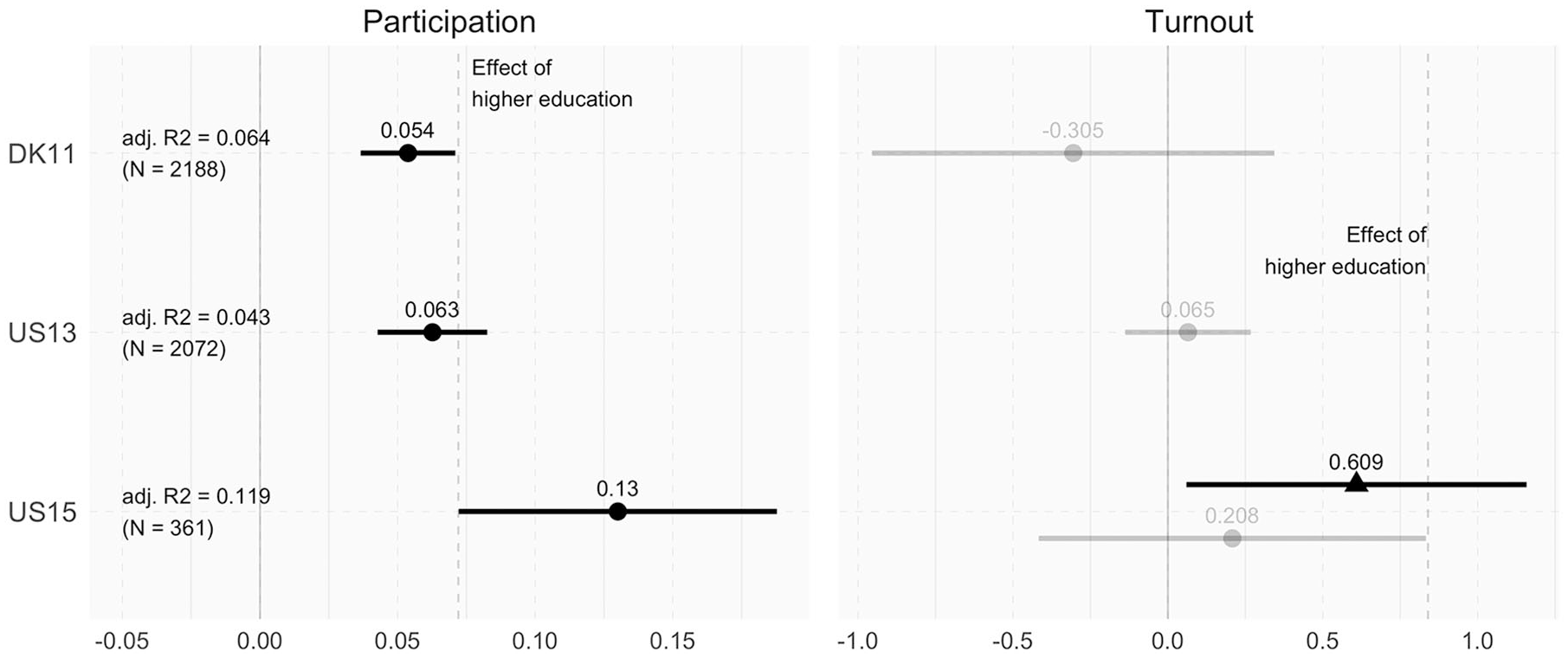
The relationship between overall Narcissism and Political Participation.
The results of our turnout analyses reveal no systematic relationship between overall Narcissism and voting in general elections. Given the higher reported turnout and less variation to explore, this is not unexpected. In midterm elections where we find more variation in turnout, we do find a positive and significant relationship between Narcissism and voter turnout.
The adjusted-R2 displayed in Figure 1 shows that the explanatory power of these models is modest. Our initial goal was to establish whether there is a relationship between narcissism and political participation when sociodemographic differences are accounted for. A more complete explanation (or model) of participation would require measures of mobilization, and a substantial number of familial, social, and individual factors. In this regard, we had available a measure of political interest in all studies. Political interest serves as a reasonable proxy for knowledge and a host of sociodemographic and motivational considerations (Verba et al., 1995). 5 We refitted our models adding this predictor, and the results are summarized in Figure 2; full model results are reported in Supplemental Information SI6.

The relationship between overall Narcissism and Political Participation, Political Interest included as control.
Unsurprisingly, we find a substantial increase in the explained variation, but more importantly, the significance of Narcissism remains. Finally, the positive effect on Midterm turnout is not significant in this specification, contributing to the overall conclusions that while narcissism is systematically related to participation, its relationship with turnout is tenuous.
Both Agentic and Antagonistic Dimensions Predict Participatory Behaviors
So far, we have established a consistent relationship between overall Narcissism and Political Participation, but not Turnout in national elections. Here, we decompose this relationship and present each dimension’s independent relationship with participation. Specifically, we test our hypotheses at the dimension level, where such independent influences have been masked so far by using the NPI sum score. We fitted the same models, but instead of the full NPI score, we included the seven sub-facets as predictors in one set of models, and the three sub-facets in a subsequent step of models (mean centered and divided by two standard deviations). Bivariate correlations are reported in Supplemental Information SI5, and full regression tables are presented in Supplemental Information SI6. Our main results are summarized in Figures 3 and 4 for the seven-factor and three-factor models of narcissism respectively. We find important heterogeneity regarding the narcissism dimensions.
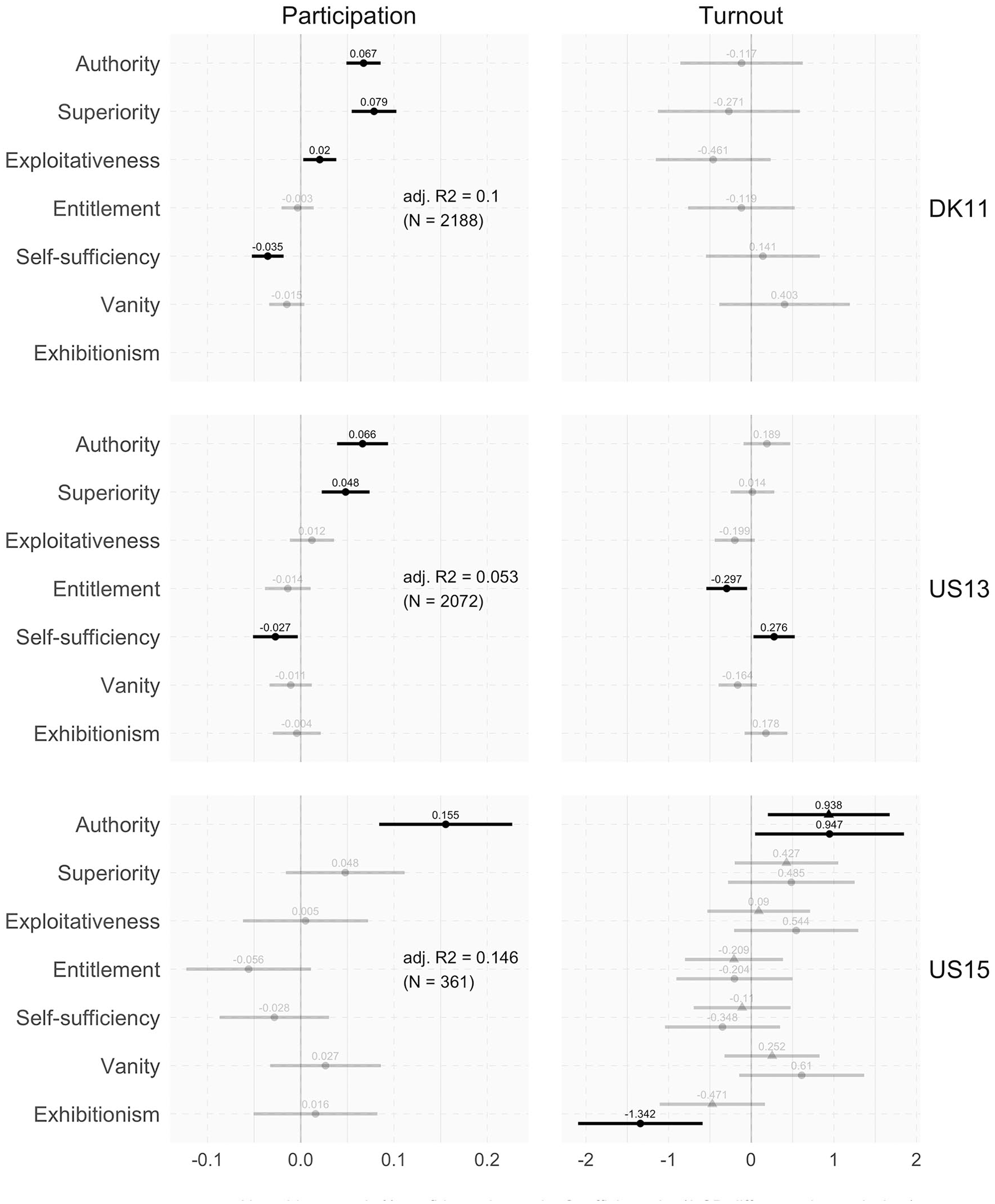
The relationship between overall Narcissism sub-facets (seven factors) and Political Participation.
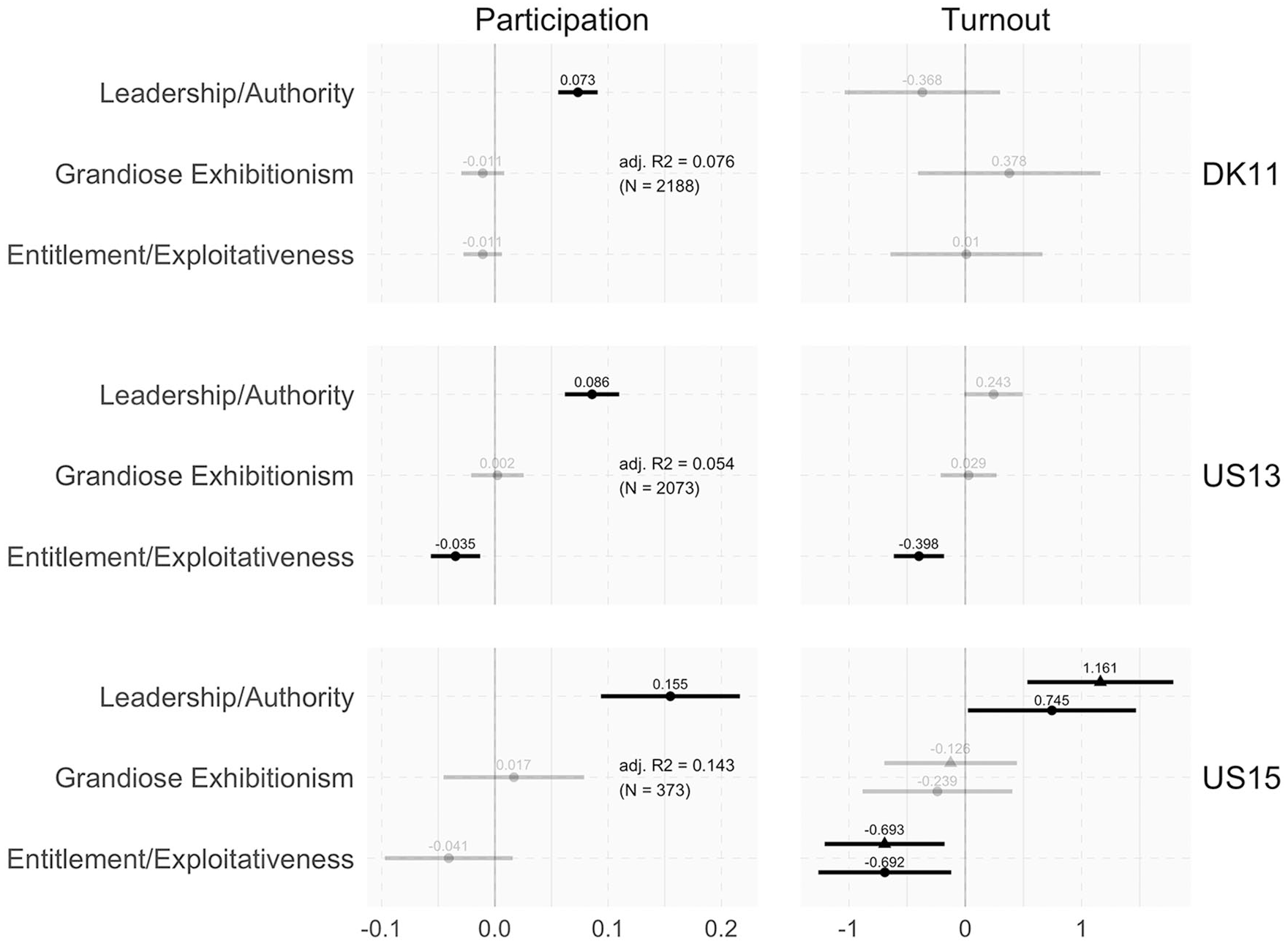
The relationship between overall Narcissism sub-facets (three factors) and Political Participation.
Higher Authority-Seeking and self-perceived leadership ability is consistently associated with Political Participation. As with overall Narcissism, the magnitude of the relationship is substantively important. We also find the hypothesized positive relationship between Superiority and Political Participation in two studies (US13 and DK11), and negative relationship between Self-Sufficiency and Political Participation in the same two studies. The US15 returned the same direction and magnitude of these relationships, but noting that this study was the smallest in sample size, the wider confidence intervals are not surprising. Buttressing this, in all three studies, the zero-order correlations for Superiority were statistically significant: .26 (DK11), .09 (US13), and .12 (US15). Beyond that, other sub-facets exhibit mixed relationships contingent on the study and specification. For example, we find a positive relationship between Exploitativeness and Political Participation in Denmark, but not in the United States.
Turning to the three-factor model of Narcissism (Figure 4), our results further confirm that participatory behaviors are positively related to the combined Leadership/Authority dimension in all three studies. We also find statistically significant relationships for Turnout in general and midterm elections in the US15 study. Ackerman et al.’s Entitlement/Exploitativeness factor was not significantly related to participation in either nationally representative study, but we did find it was significantly related (negatively) to participation in the convenience sample (US13). Similarly, individual differences in voter turnout were not systematically related to the independent Entitlement or Exploitativeness factors in the seven-factor model, but with the three-factor Entitlement/Exploitativeness factor we find a modest negative relationship with Turnout in both U.S. studies.
As with our analysis of the overall NPI, we refitted all models including a Political Interest predictor. Results are displayed in Figures 5 and 6, with full regression tables reported in Supplemental Information SI6. These models with better explanatory power largely reiterate our findings from the models with sociodemographic controls only. There is minor variation in effect-size and statistical significance.
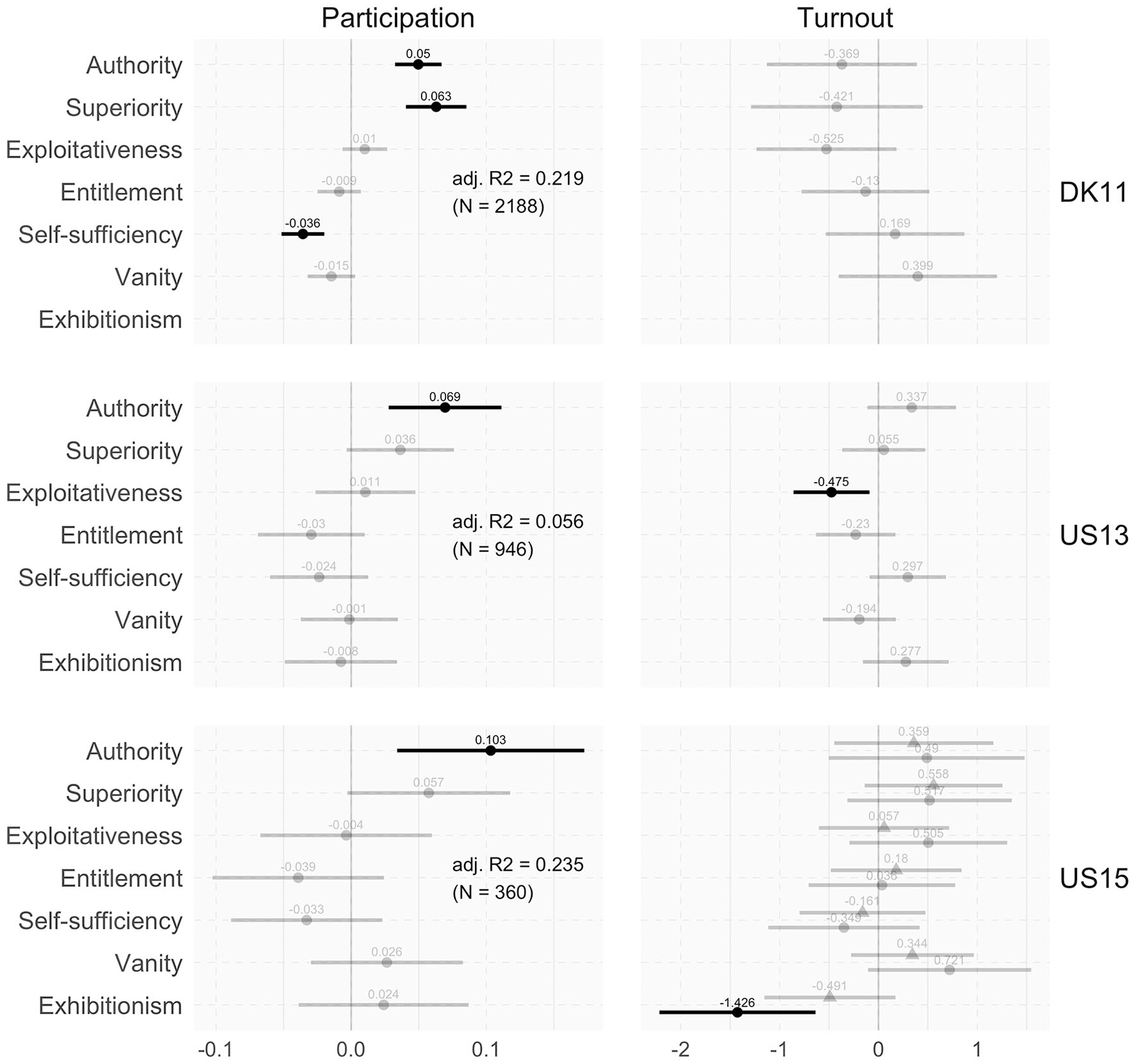
The relationship between overall Narcissism sub-facets (seven factors) and Political Participation, Political Interest included as control.
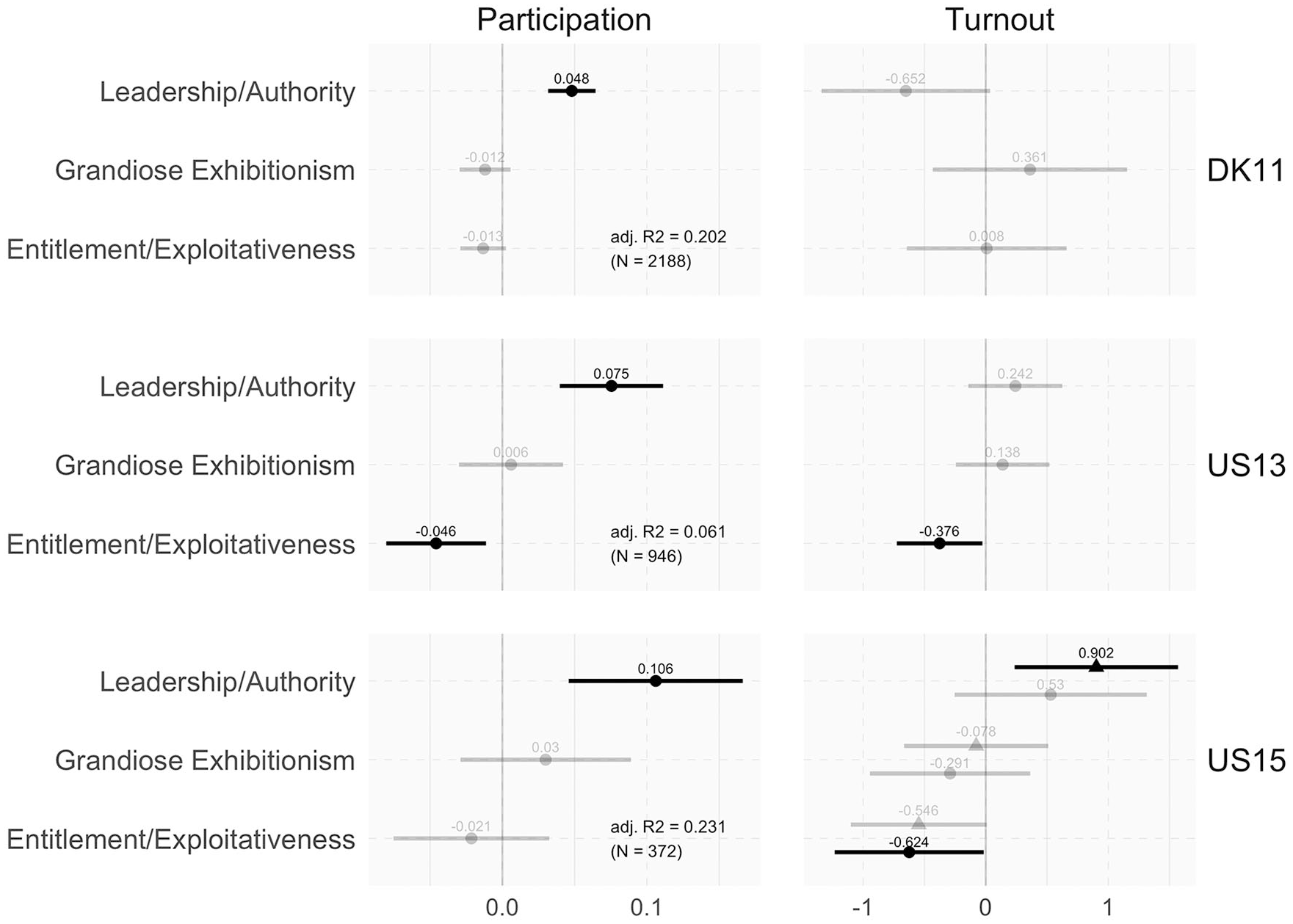
The relationship between overall Narcissism sub-facets (three factors) and Political Participation, Political Interest included as control.
Discussion
Elections and campaigns by their very nature seek to evoke the public’s wants, inspiring candidates to promise and enact policies to feed narcissistic desires. More narcissistic participants presuppose a less civil society, a condition that arguably reflects the modern political climate. Nevertheless, a certain degree of narcissism should be expected for political participation. In many ways, democracy demands this from the public. Democratic societies encourage the public to participate, join groups, invest in community, write civic leaders, take part in elections, and vote; that every voice is important and should be heard. In this view, if everyone acts with constrained self-interest, democratic outcomes should reflect the collective needs of the public. That is, in order for democracy to work, some amount of narcissism appears necessary.
Our results from three studies find that the relationship between narcissism and political participation is complex, with several layers. First and foremost, people who are more narcissistic, as measured by the full NPI, participate more in early politics. They are more likely to contact decision makers, publicize their opinions, put issues on the agenda, and engage in those behaviors that embody the first stage of interaction between the public and institutionalized politics. However, when it comes to voting, those higher in overall narcissism are only more likely to vote in midterm elections as compared to general elections. Given the high turnout in presidential elections, this is not surprising.
On the whole, activity in early politics, versus voting, indicates the first layer of complexity in the relationship between participation and narcissism. In this first layer, it appears even if only to a limited extent decision makers follow the “public’s desires” (Gilens & Page, 2014), it will be the desires of the more narcissistic, as their views will be more often voiced and heard. The implications of those higher in overall narcissism steering public debate, placing issues on the agenda, and shaping the pool of candidates suggest that political outcomes will arise from a more selfish segment of the electorate. This segment prefers to lead and have authority over others with the aim of maximizing personal gain at the cost of others and society. These findings are in line with a participation theory focused on self-interest and instrumental motivations. This potentiates some concern when married with extant narcissism research that finds the traits of self-absorption, arrogance, superiority, and entitlement combine to produce a unique disposition that yields negative outcomes for society (Böckler et al., 2017; Campbell et al., 2005; de Zavala et al., 2013; Lambe et al., 2018; Lyons et al., 2010; Van Vugt, 2009). While the effects of narcissism on participation are not large, they are at least as large as some of the most important predictors of participation, including higher education.
A second layer of complexity emerges through the exploration of participation’s relationships with the individual narcissistic dimensions. To substantiate differences, we relied on two different NPI factor solutions. This approach had three major benefits. First, our results are relevant for the conceptualization and the measurement of narcissism. In our nationally representative data, we find the 40-item NPI seven-factor model-fits at least as good, if not better than the 25-item NPI three-factor model. While reducing the number of items and factor structure can have important benefits, as we collected the full NPI, we believed it was important to consider the measure in its originally proposed structure and not to dismiss the seven factors too soon. Second, we identify unique relationships with participation in both approaches that would have gone unnoticed by using only one specification. Finally, those factors that are comparable or shared across approaches exhibited strong convergence (such as Authority or Leadership/Authority), which provides further confidence in the validity and reliability of our measures and results.
Regarding the independent dimensions, it is not the case that agentic factors are positively related, and antagonistic factors are negatively related to participation or vice versa. Rather, the agentic dimension of Authority/Leadership was positively related to participation, while the agentic dimension of Self-Sufficiency was negatively related. In a similar manner, the antagonistic factor of Superiority was positively related to participation. The individual Entitlement and Exploitativeness factors or the combined Entitlement/Exploitativeness factor did not have consistent or significant independent relationships to participation. Regarding turnout alone, however, Ackerman et al.’s combined Entitlement/Exploitativeness specification was negatively related to voting in midterm elections.
These findings both mitigate and compliment those from the overall NPI. The general picture is that individuals who believe in themselves, and believe that they are better than others, engage in the political process more. This agentic/antagonistic combination echoes parts of the overall NPI findings. At the same time, those individuals who are more self-sufficient are also less likely to take part in the political process. This means that policies and electoral outcomes could increasingly be guided by those who both want more, but give less. It is difficult to not consider these findings in the context of the current political climate where populist candidates are rewarded for promising jobs, tax relief, relief from international trade, debt forgiveness, free education or health care, all at the cost to others. However, simultaneously, at least when explored alone, exploitative motivations and entitlement are not independently related to participation or have a negative influence on voter turnout. This latter finding reinforces the distinction between early participation and turnout. Turnout appears to reflect a more civic and agentic activity versus early participation, which in this context appears to be a vehicle for those seeking to benefit from other people and as an activity for those who want something from others.
This study, as does all empirical work, comes with limitations. Ideally, we would have the full 40-item NPI battery in the Danish sample, allowing for comparison of identical measurements. Although outcome differences were limited, we cannot make direct comparisons across countries because we cannot assess whether differences are contextual or measurement related. In this regard, we have attempted to offer a transparent discussion of the measurement properties to accurately contextualize our findings. The consistency of our results is encouraging, but cross-country differences in narcissism and its correlates should be further explored. This is of special relevance in the case of the positive relationship found between participation and Exploitativeness, which was only significant in Denmark.
The data include nationally representative and large samples and well-validated measures, and the findings are consistent, comparable, and robust across countries. Nonetheless, we cannot definitely answer whether narcissism or its subfactors precede political participation or whether participation incites narcissism. This study takes an empirical approach that assumes rather than tests for causality, and the specific direction assumed here is one that follows the majority of studies which conceptualize narcissism as a personality trait that influences behaviors. However, it is probable that some parts of the relationship are reciprocal. While it appears likely that more narcissistic individuals participate more (selection effect), participatory behaviors may also render individuals more narcissistic (socialization effect). That is, those higher in narcissism may seek out political means in which to express their disposition, and the experiences that follow may also lead to, or reinforce, narcissistic tendencies. Indeed, the last several decades have witnessed an increase in individualism and a global rise of populism fueled by perceived entitlement that has upended the institutional control of established parties and politicians, sending advanced democracies into a state of turmoil (Formisano, 2016; Marchlewska et al., 2018; Zakaria, 2016). Mostly likely narcissism and political participation, and the political climate by extension, interact and have a recursive relationship.
Future directions include disentangling this relationship and identifying the causal pathways in both longitudinal and experimental research. In particular, it is of great interest to know whether narcissism leads to participation or participation leads to narcissism, or whether the role of narcissism on political participation is a function of social forces activating citizens to varying degrees based upon their individual disposition, where such trends might change with the ebb and flow of social conditions. A natural question is, do populist movements activate, evoke, or result from narcissism? Similarly, future research can extend the current inquiry by relying on a different item-set to measure narcissism and various other factor structures to expound upon the nature of the relationship between political participation and narcissism.
Conclusion
We find narcissism is an important characteristic to measure and a useful tool to understand the disposition of the public. That is, measuring narcissism, and its agentic and antagonistic factors, offers important benchmarks to understand and predict electoral activity and further inform the instrumental motivations of political participation. In this way, we bring further evidence for the need to incorporate psychological traits into general theories of political participation. In line with previous work on political ideology, we show that narcissism is a natural candidate in this sense, which is especially important in the context of increasingly populistic political discourse, which likely serves as an external activation. This is of particular interest in the U.S. two-party electoral system, where political outcomes are decided at the margins and influenced by the loudest voices.
Supplemental Material
Hatemi_Online_Appendix – Supplemental material for Narcissism in Political Participation
Supplemental material, Hatemi_Online_Appendix for Narcissism in Political Participation by Zoltán Fazekas and Peter K. Hatemi in Personality and Social Psychology Bulletin
Supplemental Material
SI.Narc.04.27.20 – Supplemental material for Narcissism in Political Participation
Supplemental material, SI.Narc.04.27.20 for Narcissism in Political Participation by Zoltán Fazekas and Peter K. Hatemi in Personality and Social Psychology Bulletin
Footnotes
Acknowledgements
We thank Padi Joseph at YouGov for her assistance in collecting the data. We give special thanks to Keith Campbell; his presentation to the intelligence community laid the groundwork for the inspiration of this study and his valuable comments and suggestions, alongside the anonymous reviewers, have improved this manuscript. We also thank Michelle Behrend and Paul Mandeltort for their thoughts and review of this work.
Declaration of Conflicting Interests
The author(s) declared no potential conflicts of interest with respect to the research, authorship, and/or publication of this article.
Funding
The author(s) disclosed receipt of the following financial support for the research, authorship, and/or publication of this article: Funding for data collection in Denmark was provided by the Velux Foundation, Denmark.

Supplemental Material
Supplemental material is available online with this article.
Notes
References
Supplementary Material
Please find the following supplemental material available below.
For Open Access articles published under a Creative Commons License, all supplemental material carries the same license as the article it is associated with.
For non-Open Access articles published, all supplemental material carries a non-exclusive license, and permission requests for re-use of supplemental material or any part of supplemental material shall be sent directly to the copyright owner as specified in the copyright notice associated with the article.
