




Abstract
This research introduces the construct of couple identity clarity—the extent to which an individual, as one of two partners in a romantic relationship, believes that the two of them know who they are as a couple. Cross-sectional (Studies 1–2), experimental (Study 3), and longitudinal (Study 4) studies supported the hypothesis that couple identity clarity is associated with higher commitment. Moreover, higher couple identity clarity, although related to actual agreement between partners on their identity as a couple, predicted commitment above and beyond agreement (Study 2)—as well as predicted reduced likelihood of relationship dissolution over a 9-month period (Study 4). Exploratory analyses revealed that successful conflict resolution may enhance couple identity clarity, in turn predicting commitment (Study 4). These studies highlight the importance of people’s understanding of who they are as a couple and how this understanding shapes relationship persistence.
“I don’t know who we are anymore.”—Stephen Sondheim, Merrily We Roll Along
People’s understanding of themselves profoundly influences their life outcomes and well-being. Those with high self-concept clarity, who have a clear and coherent sense of self (Campbell, 1990; Campbell et al., 1996), are less stressed, less depressed, and more persistent in pursuing their goals (Fite et al., 2017; Treadgold, 1999). Some work has extended this concept to people’s group identities—that is, whether people feel that they have a clear understanding of their cultural identities (Usborne & Taylor, 2010) or social status (Destin et al., 2017).
What about people’s relationships? Although past work has examined whether people believe they have a clear sense of their partner’s identities (Gurung et al., 2001), no work to our knowledge has investigated the potential importance of whether people understand who they and their partner are as a couple. We propose that couple identity clarity—the extent to which an individual, as a member of a romantic couple, feels like the two of them know who they are as a couple—shapes people’s commitment to their relationships.
Self-Concept Clarity
A person’s sense of self comprises anything that a person might identify as “me” (James, 1890; Swann & Bosson, 2010). People reflect on the various beliefs, goals and values, and personality traits that make up their self-concepts (McConnell, 2011) and form distinct judgments: Do I have a clear understanding of who I am, and do I like who I am? The latter evaluation (liking the self) constitutes self-esteem (MacDonald & Leary, 2012), whereas the former (judging whether the self-concept is clear and coherent) determines self-concept clarity (Campbell, 1990; Campbell et al., 1996). When people believe that they have a clear and coherent understanding of who they are—that the elements of their self-concept make sense and are consistent over time—they experience high self-concept clarity (Campbell, 1990; Campbell et al., 1996). Self-concept clarity is a subjective assessment, independent of whether a person’s self-concept objectively appears coherent. Although self-concept clarity tends to be moderately correlated with self-esteem, the two constructs are distinct (Campbell et al., 1996). People can be certain of who they are but also feel bad about themselves; alternatively, people can generally feel good about themselves but also perceive that specific elements of their self-concepts do not make sense together.
High self-concept clarity is associated with greater well-being, including less stress, less depression, greater emotional stability, and better-quality romantic relationships (Campbell et al., 2003; Lewandowski et al., 2010; Treadgold, 1999). Although less research has examined antecedents of self-concept clarity, entering or exiting social roles is linked to lower self-concept clarity (Light & Visser, 2013). In short, self-concept clarity captures the subjective understanding element of the self, is distinct from self-esteem, and typically predicts higher well-being outcomes.
Couple Identity Clarity
Relationships are closely linked to identity. Close relationships shape people’s individual self-concepts—for example, people in relationships incorporate aspects of their partner in their own self-concepts, for better or worse (Aron et al., 1991; Mattingly et al., 2014; Slotter & Gardner, 2009). Relationships themselves also have distinct “personalities” that capture the dynamic between partners in specific situations (Murray & Holmes, 2009). For example, Hannah might consider her relationship with Hugo to be egalitarian, whereas Charlotte might view her relationship with Christine as fun and outgoing.
We propose that just as people differ in self-concept clarity and collective identity clarity (see Gardner & Garr-Schultz, 2017), people may also vary in couple identity clarity—the extent to which the individual, as one of two partners in a romantic relationship, believes that the two of them know who they are as a couple. This is a subjective reflection on the relationship as a whole. In other words, couple identity captures not only the dynamic between partners but also relationship status (e.g., are they unsure whether the relationship is moving toward marriage?) and how each partner’s individual characteristics fit with each other. Thus, analogous to self-concept clarity, high couple identity clarity captures the subjective perception that the totality of who “we” are is clear and coherent, internally consistent, and stable over time.
However, understanding a couple identity demands an additional layer of complexity compared to understanding an individual identity. Self-concept clarity is an individual’s assessment of his or her self-concept—as such, if a person is considering whether her identity is clear, she needs only to rely on her own subjective evaluation. But couples, of course, involve two people. Indeed, a core principle of relationship science suggests that people’s experiences in their relationships stem from each partner’s individual qualities, but also the context that arises from the ways that the two partner’s qualities interact (Finkel et al., 2017). To revisit our earlier example, “egalitarian” is an emergent property characterizing the relationship between Hugo and Hannah, not an individual trait that they may have possessed prior to starting their relationship. Thus, there are two elements to couple identity clarity. Each person forms their own assessment of whether their identity as a couple makes sense and whether they agree with their partner on who they are as a couple. Both of these considerations feed into each person’s overall assessment of couple identity clarity. Because each member of the couple forms these separate assessments, each person has a separate level of couple identity clarity (just as each person within a culture forms their own cultural identity clarity; Usborne & Taylor, 2010).
To our knowledge, no empirical research has examined couple identity clarity. There is qualitative evidence, however, that couples do think about their identities and that life changes may alter these couple identities. In interviews with cancer survivors and their partners (Miller & Caughlin, 2013), some people discussed how this experience shaped their identity as a couple (e.g., “we’re going to be survivors”; p. 72), whereas other individuals felt it threatened their understanding of who they were (e.g., “we’re different now. That took some figuring out”; p. 75). These examples suggest that couple identity clarity is a psychologically meaningful construct, albeit one that has not yet been quantitatively or theoretically delineated. We examine the key hypothesis that couple identity clarity predicts relationship commitment. Commitment captures a cognitive evaluation of a person’s long-term orientation, intention to persist, and psychological attachment in the relationship and is among the best predictors of relationship persistence (Arriaga & Agnew, 2001; Le & Agnew, 2003; Rusbult, 1980).
Couple identity clarity is distinct from both self-concept clarity (“I know who I am”; Campbell et al., 1996) and significant-other concept-clarity (“I know who my partner is”; Gurung et al., 2001). A person could have a very clear sense of knowing themselves as an individual or feel that they know clearly who their partner is, but still feel that they and their partner are unable to make sense of who they are as a couple. For example, someone could be very certain that she is an introvert and very certain that her partner is an extrovert, but unsure how they fit together as a couple given these differences.
As noted previously, self-concept clarity (“Who am I?”) is distinct from self-esteem (“Do I like who I am?”). Similarly, couple identity clarity does not necessarily reflect whether the person believes that they are compatible with their partner or that they have a good relationship. In this research, we consider relationship satisfaction, an overall emotional appraisal of the good and bad aspects of the relationship (Rusbult, 1980), as a relationship analog to self-esteem. Relationship satisfaction is also strongly linked to commitment (Le & Agnew, 2003). In these studies, we examine whether effects of couple identity clarity on relationship commitment emerge beyond the contribution of relationship satisfaction, as well as other potentially related constructs such as cognitive interdependence (Agnew et al., 1998) and perceived similarity between the self and the partner (see Montoya et al., 2008).
In addition, we also examine situations that might affect couple identity clarity. Research on individuals reveals that experiencing more life changes predicts lower self-concept clarity (Light & Visser, 2013). We hypothesized that when either an individual or their partner has recently experienced upheaval in their lives, that individual may experience lower couple identity clarity. Along these lines, we also explore links between couple identity clarity and conflict resolution. On one hand, it is possible that people with high couple identity clarity are better able to resolve conflicts and disagreements with their partner. Past research has found that people with high self-concept clarity are better able to overcome setbacks when pursuing their goals (Fite et al., 2017). Moreover, because people with high couple identity clarity feel that they and their partner more clearly see how they fit together as a couple, they may be better able to see compromises that work for both of them. On the other hand, just as life upheaval may be linked to lower couple identity clarity, difficulty at resolving conflict may result in people feeling like they do not know who they are as a couple. We explore ways that couple identity clarity may relate to conflict resolution and the implications for commitment.
Hypotheses and Research Overview
Across four studies, we test the primary hypothesis that couple identity clarity predicts relationship commitment. We also test three auxiliary hypotheses. First, because an individual’s own life upheaval is associated with lower self-concept clarity (Light & Visser, 2013), we hypothesized that either member of the couple experiencing upheaval would be associated with lower couple identity clarity. Second, we hypothesized that a person’s feelings of couple identity clarity would be partly linked to some degree of actual agreement between partners on their identity as a couple. Third, we explored possible links between relationship conflict resolution and couple identity clarity.
Study 1 was an initial test of our hypothesis that couple identity clarity would be associated with commitment. Because it was the first test of this hypothesis, we also examined whether this link would hold when controlling for potentially related constructs—relationship satisfaction, self-concept clarity, relationship duration, perceived similarity between the self and the partner, and the three components of cognitive interdependence (inclusion of other in the self [IOS], centrality of the relationship, and using more plural pronouns; Agnew et al., 1998). In addition, we tested the auxiliary hypothesis that more situational upheaval would predict lower couple identity clarity—when the individual or their partner has experienced more life events, that person may report lower couple identity clarity. Study 2 featured a dyadic sample and examined whether couple identity clarity is rooted in some degree of actual agreement between partners on couple identity content. We hypothesized that couple identity clarity would be associated with objective agreement on identity attributes, but that it would predict unique variance in commitment beyond agreement.
In Studies 3 and 4, we examined potential causal links between couple identity clarity and commitment. In Study 3, we experimentally manipulated couple identity clarity and hypothesized that participants whose couple identity clarity was threatened would experience decreased commitment, compared to participants who completed a couple identity clarity affirmation or control prime. In Study 4, we examined whether couple identity clarity predicts commitment longitudinally. Specifically, we examined whether couple identity clarity is associated with changes in commitment over time and likelihood of breakup. We also explored potential links between successful conflict resolution and couple identity clarity.
Study 1
Study 1 was a first test of our hypothesis that couple identity clarity would predict commitment. We examined whether this basic association emerged, and whether it held over and above any potential effects of relationship satisfaction, self-concept clarity, relationship duration, perceived similarity between the self and the partner, and the three components of cognitive interdependence (IOS, centrality of the relationship, and using more plural pronouns). Consistent with previous research suggesting that social role changes can destabilize a person’s self-concept clarity (Light & Visser, 2013), we also hypothesized that either member of the couple experiencing more life events might be associated with lower couple identity clarity.
Participants
We recruited 359 participants (43.5% male, 55.4% female, 0.3% transgender; 1 age M = 34.58 years, SD = 12.10 years) from Amazon’s Mechanical Turk (MTurk). 2 All participants were currently in a romantic relationship (42.9% married or in a committed lifelong partnership; relationship duration M = 7.97 years, SD = 9.63 years; 88.3% heterosexual, 6.4% bisexual, 3.6% gay or lesbian, 0.3% uncertain or questioning, and 1.4% other). All participants completed the study in a single online session.
Measures
Unless indicated otherwise, all measures were assessed on 7-point Likert-type scales (1 = strongly disagree, 7 = strongly agree).
Self-concept clarity
Participants completed the self-concept clarity scale (Campbell et al., 1996; 12 items; e.g., “in general, I have a clear sense of who I am and what I am”; α = .94; M = 4.98; SD = 1.24).
Couple identity clarity
We adapted the self-concept clarity scale to assess couple identity clarity (Campbell et al., 1996; 11 items; α = .95; M = 5.16, SD = 1.31); see Appendix for the full scale.
Commitment
Participants completed the commitment subscale of the Investment Model Scale (Rusbult et al., 1998 seven items; e.g., “I want our relationship to last a very long time”; α = .90; M = 5.94; SD = 1.15).
Satisfaction
Participants completed the satisfaction subscale of the Investment Model Scale (Rusbult et al., 1998; five items; e.g., “I feel satisfied with our relationship”; α = .94; M = 5.48, SD = 1.31).
Perceived similarity
Participants rated similarity to their partners in nine domains, each of which was assessed with three items: goals (α = .82; M = 5.27, SD = 1.24), view of the future (α = .86; M = 5.19, SD = 1.33), view of the past (α = .70; M = 5.06, SD = 1.21), friends (α = .77; M = 4.53, SD = 1.36), interests (α = .79; M = 4.86, SD = 1.25), beliefs (α = .78; M = 4.92, SD = 1.26), values (α = .78; M = 5.18, SD = 1.25), personality (α = .80; M = 4.14, SD = 1.43), and upbringing (α = .84; M = 3.54, SD = 1.57).
Cognitive interdependence
Participants completed measures of the three components of cognitive interdependence—IOS, centrality of the relationship, and plural pronoun use. First, participants completed the IOS scale (Aron et al., 1992) by indicating which of seven pairs of increasingly overlapping circles best described their current relationship with their partner (M = 5.18; SD = 1.49). A higher rating indicates more IOS. Next, participants evaluated the centrality of the relationship in their lives (Agnew et al., 1998; four items; e.g., “among the things that give your life meaning, how important is your relationship with your partner?”; α = .82; M = 6.39, SD = 1.37), assessed on a 9-point scale (1 = other things are of some importance, 9 = nothing else is of any importance). Finally, participants shared up to 14 thoughts about their relationship (Agnew et al., 1998). Following data collection, two coders rated whether each thought contained only plural pronouns (e.g., “we,” “us”), only singular pronouns (e.g., “I,” “me”), both plural and singular pronouns, or no plural or singular pronouns (kappa = .82). We calculated the number of thoughts containing only plural pronouns divided by the overall number of thoughts that each participant listed (M = .29, SD = .31). Given that reliability among these three components was low (α = .52), we did not combine them into a composite measure.
Life upheaval
Participants indicated whether, within the past year, each of 12 different individual life events (e.g., “started college or graduate school”; “left a job”) had occurred to them, their partner, neither of them, or both of them. We added up the number of life events that had occurred to either the individual or the partner. Given that the mean was low (M = 2.69, SD = 2.15), we recoded it into categories (0 = no life events, 1 = one life event, 2 = more than one life event).
Results
Prior to analysis, we standardized all variables (M = 0, SD = 1). See Table 1 for correlations between all variables.
Correlations Between all Variables in Study 1.

Note. IOS = inclusion of other in the self.
*p < .05. **p < .001.
Factor analysis
First, we examined whether our new construct was empirically distinct from potentially related constructs—self-concept clarity and commitment. We conducted an exploratory factor analysis using principal axis as the method of extraction to allow for measurement error and Oblimin rotation to allow the factors to correlate. All couple identity clarity, self-concept clarity, and commitment items each loaded onto separate factors (Table 2).
Exploratory Factor Analysis of Couple Identity Clarity Scale, Commitment Scale, and Self-Concept Clarity Scale in Study 1.
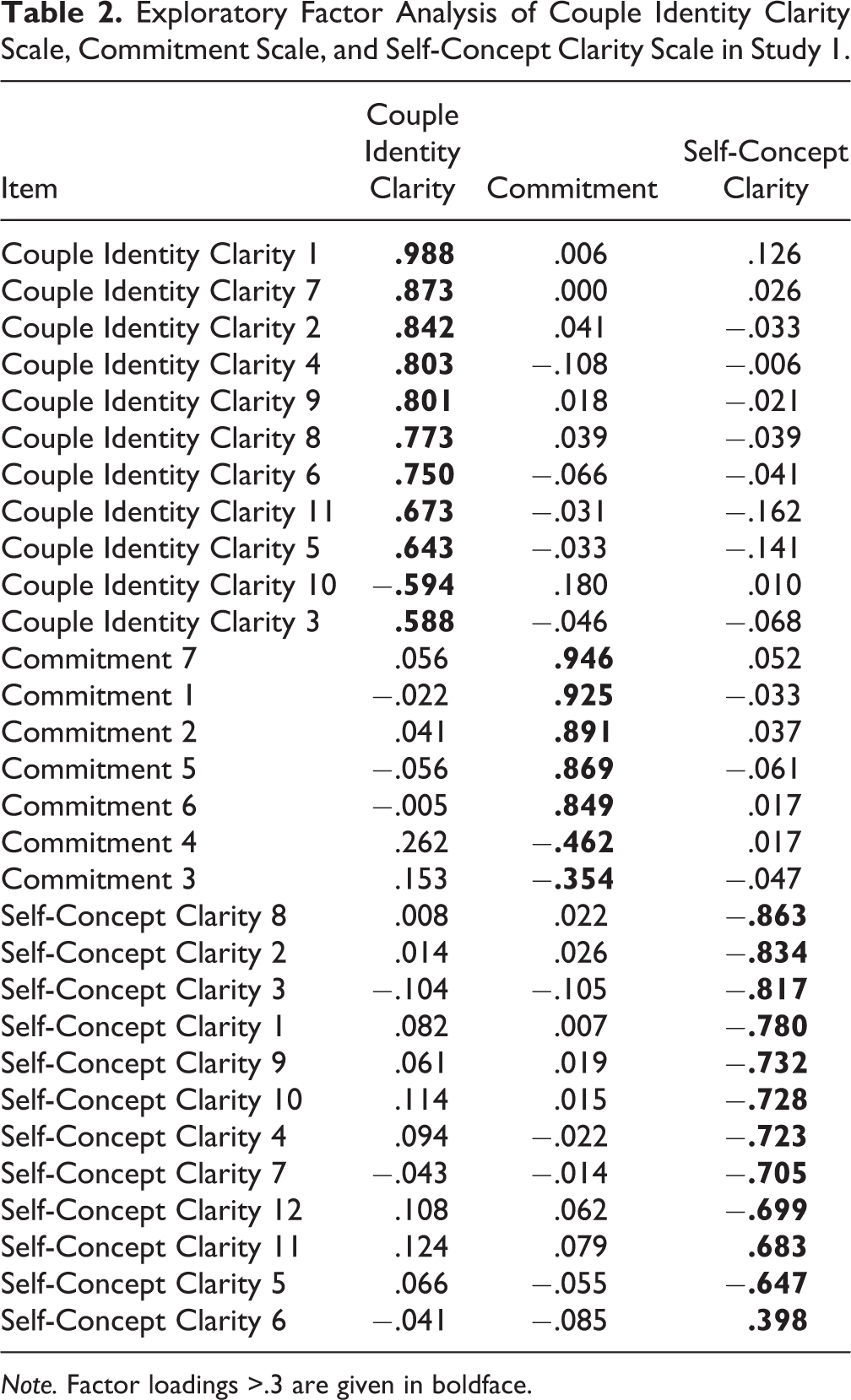
Note. Factor loadings >.3 are given in boldface.
Couple identity clarity and commitment
As predicted, couple identity clarity was associated with commitment (r = .62, p < .001; 95% confidence interval [CI] = 0.55, 0.68). Next, we examined whether this association remained over and above our control variables (Table 3). Couple identity clarity was associated with commitment over and above self-concept clarity, relationship satisfaction, relationship duration, the three indices of cognitive interdependence, and nine forms of perceived similarity. 3
Simultaneous Regression Predicting Commitment From Couple Identity Clarity and Control Variables in Study 1.
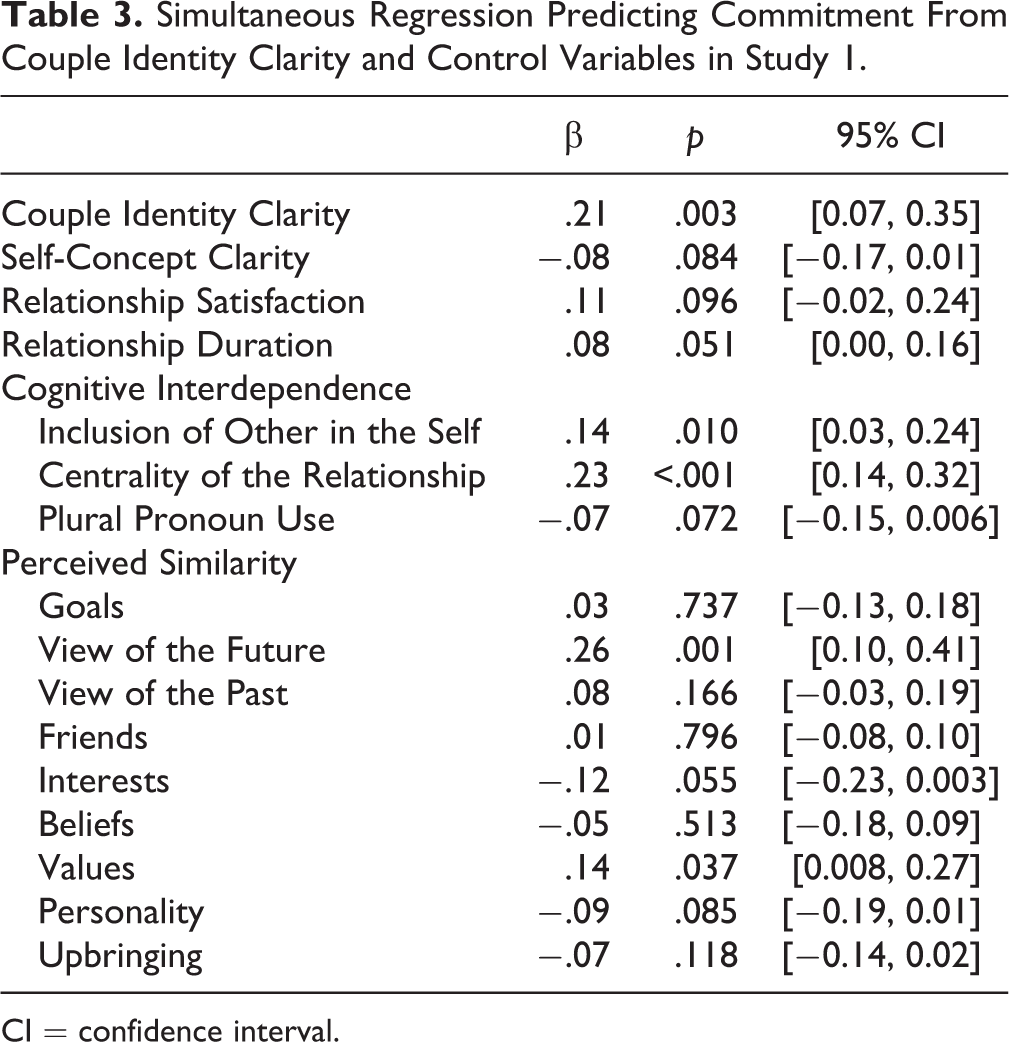
CI = confidence interval.
Life events and couple identity clarity
Recall that life changes tend to be negatively associated with self-concept clarity—as such, we hypothesized that both an individual’s own life changes (e.g., a new job) or changes in a partner’s life might be associated with an individual’s sense of couple identity clarity. First, we examined correlations among couple identity clarity and life upheaval. When people or their partners had experienced more life upheaval, they reported lower couple identity clarity (r = −.18, p = .001; 95% CI = −0.27, −0.07). We then tested whether life upheaval would be associated with lower couple identity clarity, and in turn lower commitment, using the PROCESS macro for SPSS (Hayes, 2013). As predicted, life upheaval was associated with lower couple identity clarity, which in turn was associated with lower commitment (Figure 1). Given the links in previous research between a person’s life events and self-concept clarity, we re-ran the analysis controlling for self-concept clarity; the effect remained (indirect effect = −.08; 95% CI = −0.16, −0.009).

Couple identity clarity mediating the association between life upheaval and commitment in Study 1.
Discussion
Study 1 provided initial support for our primary hypothesis that couple identity clarity would be associated with commitment. Couple identity clarity predicted commitment, and the association remained robust when controlling for satisfaction, self-concept clarity, cognitive interdependence (IOS, plural pronoun use, and centrality of the relationship), and perceived similarity between the self and partner. This suggests that understanding one’s own couple identity predicts commitment, distinct from feeling good about the relationship, understanding one’s own identity, incorporating the relationship into one’s identity, and feeling similar to one’s partner. 4 Moreover, life upheaval appears to be an antecedent to experiencing low couple identity clarity. When people or their partners experienced more changes in their lives in the past year, people reported lower couple identity clarity, which in turn was associated with lower relationship commitment.
Study 2
Study 1 provided initial evidence that couple identity clarity is associated with commitment. In Study 2, we examined whether this finding replicated in a dyadic sample. This sample also enabled us to examine whether couple identity clarity is associated with actual agreement with one’s partner on couple identity content. Recall that couple identity clarity captures whether the individual feels that their identity as a couple makes sense, and whether the individual feels that their partner agrees with what their identity as a couple is in the first place. We hypothesized that couple identity clarity would be associated with actual couple identity agreement, but that couple identity clarity would also predict unique variance in commitment beyond actual couple identity agreement.
Participants and Procedure
We recruited 66 couples (132 individuals; 48.5% male, 51.5% female; age M = 20.30 years, SD = 2.64 years) through the introductory psychology subject pool at a Midwestern university, flyers around campus, postings on paid participant listservs, and postings in student groups on Facebook. 5 All participants were currently in a romantic relationship, and both partners were required to come into the lab to participate (3.0% married or in a committed lifelong partnership; relationship duration M = 1.11 years, SD = 1.25 years; 80.3% heterosexual, 9.1% bisexual, 4.5% gay or lesbian, 1.5% queer, 2.3% pansexual, and 2.3% other).
After consenting to participate, each partner completed an online questionnaire in separate rooms, which included measures of couple identity clarity, self-concept clarity, IOS, relationship quality, and an adapted version of the Twenty Statements Test (Kuhn & McPartland, 1954). Once the study was complete, 6 participants received either course credit or US$10.
Measures
Couple identity clarity
Participants completed the same measure of couple identity clarity as in Study 1 (α = .87; M = 5.36, SD = 0.93).
Self-concept clarity
Participants completed the same measure of self-concept clarity as in Study 1 (α = .91; M = 4.57, SD = 1.25).
Commitment
Participants completed the same measure of commitment as in Study 1 (α = .85; M = 6.16, SD = 0.75).
Satisfaction
Participants completed the same measure of satisfaction (α = .82; M = 6.12, SD = 0.87) as in Study 1.
Couple identity content agreement
Participants completed an adapted version of the Twenty Statements Test (Kuhn & McPartland, 1954). Specifically, they were asked to “please think about who you and your partner are as a couple and write 10 answers to the question ‘who are we’ in the spaces provided.” Common example responses included “supportive of one another,” “equal,” “power couple,” “adventurous,” “cozy,” “nearly opposites of one another,” and “best friends.”
IOS
Participants completed the same measure of IOS as in Study 1 (M = 4.99, SD = 1.24).
Coding
Once data collection was complete, two independent coders assessed agreement between members of the couple on the content of their couple identity. 7 Coders counted the number of attributes the couple listed in common (intraclass correlation [ICC] = .65). After coding was complete, we averaged coders’ ratings.
Results
Prior to analyses, all variables were standardized (M = 0, SD = 1). We conducted Actor–Partner Interdependence Model (APIM) analyses to isolate the actor effect of couple identity clarity on commitment from any partner effects. We did not have any a priori hypotheses related to partner effects. Actor couple identity clarity was associated with actor commitment (b = .37, p < .001; 95% CI = 0.23, 0.52), as was partner couple identity clarity (b = .32, p < .001; 95% CI = 0.17, 0.47). We did not find evidence for an interaction (b = −.03, p = .708; 95% CI = −0.17, 0.12). Both the actor effect (b = .27, p = .002; 95% CI = 0.10, 0.45) and partner effect (b = .22, p = .003; 95% CI = 0.08, 0.37) remained when we controlled for relationship satisfaction (b = .32, p < .001; 95% CI = 0.17, 0.49), self-concept clarity (b = −.11, p = .123; 95% CI = −0.26, 0.03), and IOS (b = .06, p = .388; 95% CI = −0.07, 0.19); the actor–partner couple identity clarity interaction remained nonsignificant (b = −.03, p = .685; 95% CI = −0.16, 0.11).
We then examined whether agreement on couple identity content, as assessed by the coders, was associated with couple identity clarity. Agreement did indeed predict couple identity clarity (b = .26, p = .013; 95% CI = 0.06, 0.46); the effect of agreement held when controlling for the number of attributes each participant listed (b = .28, p = .009; 95% CI = 0.07, 0.48), which was not associated with couple identity clarity (b = −.09, p = .293; 95% CI = −0.26, 0.08). Thus, it appears that high couple identity clarity is rooted in some degree of actual, objectively detectable agreement on couple identity content. 8 However, when entered as simultaneous predictors, only couple identity clarity was significantly associated with a person’s commitment (b = .41, p < .001; 95% CI = 0.25, 0.57); agreement on couple identity content was not (b = .11, p = .214; 95% CI = −0.07, 0.29).
Discussion
Study 2 replicated the association between couple identity clarity and commitment in a dyadic sample. Actual agreement between members of the couple on the content of their couple identity showed a modest but statistically significant association with couple identity clarity, suggesting that couple identity clarity appears to be grounded in some degree of actual agreement. However, couple identity clarity was uniquely associated with commitment even when controlling for agreement on couple identity content.
Study 3
In Studies 1 and 2, we found consistent associations between couple identity clarity and commitment. Study 3 builds on these findings by testing a causal link between couple identity clarity and commitment. To that end, we asked participants to recall a time when they felt especially unclear (low couple identity clarity) or clear (high couple identity clarity) on who they were as a couple. We hypothesized that individuals whose couple identity clarity was experimentally lowered would feel less committed than would those in a control condition, who would feel less committed than would those whose couple identity clarity was increased. Moreover, we coded for objective valence of participants’ responses to determine whether couple identity clarity or negativity of the prime was driving potential effects on commitment.
Participants
We recruited 169 participants from MTurk (37.3% male, 62.1% female, 0.6% transgender; age M = 33.83, SD = 11.53). 9 All participants were currently in a romantic relationship (45.6% married or in a committed lifelong partnership; relationship duration M = 7.47 years, SD = 8.36 years; 87.3% heterosexual, 7.1% bisexual, 4.1% gay or lesbian, and 1.8% other).
Procedure
After completing background survey measures, participants were randomly assigned to one of three conditions. In the low couple identity clarity condition, participants were asked to think about a time when they felt very uncertain about who they and their partner were as a couple, “a time when you would have said, ‘I don’t know who we are as a couple.’” In the high couple identity clarity condition, were asked to think about a time when they felt very certain of who they and their partner were as a couple, “a time when you would have said, ‘I know who we are as a couple.’” In both the low couple identity clarity and high couple identity clarity conditions, participants were instructed to spend at least 3 min writing at least a paragraph “about this time—how it made you feel, and how it influenced your sense of who you and your partner are as a couple.” In the control condition, participants wrote for the same duration about a typical trip to the grocery store. After the couple identity clarity prime, participants completed a manipulation check and measures of relationship quality. All participants were then debriefed and compensated. After data collection was complete, we coded for objective valence of participants’ responses.
Measures
As in previous studies, all measures were assessed on 7-point scales (1 = strongly disagree, 7 = strongly agree) unless otherwise indicated.
Couple identity clarity
Participants completed the couple identity clarity scale used in previous studies (α = .96; M = 5.33, SD = 1.44).
Self-concept clarity
Participants reported their self-concept clarity using the same measure as in previous studies (α = .93; M = 5.08, SD = 1.30).
Commitment
Participants completed the same measure of commitment as in previous studies (α = .93; M = 6.17, SD = 1.15).
Satisfaction
Participants completed the same measure of satisfaction as in previous studies (α = .94; M = 5.64, SD = 1.28).
Coding
After data collection was complete, two independent coders, blind to condition and hypotheses, rated the valence of each participant’s response to the prime on a 5-point scale (−2 = very negative, 2 = very positive). Reliability was adequate (ICC = .90) and the coders’ ratings were averaged.
Results
Manipulation check
A between-subjects analysis of variance (ANOVA) revealed an overall effect of the manipulation on couple identity clarity, F(2, 169) = 7.22, p = .001, partial η2 = .08. A Tukey’s least significant difference (LSD) post hoc test showed that individuals in the low couple identity clarity condition reported lower couple identity clarity (M = 4.78, SE = 0.18; 95% CI = 4.42, 5.13) than did those in the high couple identity clarity condition (M = 5.61, SE = 0.19; 95% CI = 5.61, 5.97), p = .002. Individuals in the low couple identity clarity condition also felt lower couple identity clarity than did those in the control condition (M = 5.65, SE = 0.19; 95% CI = 5.28, 6.03), p = .001. However, the high couple identity clarity condition did not differ from the control condition, p = .86. The manipulation did not affect self-concept clarity, F(2, 168) = 1.71, p = .18, partial η2 = .02.
Commitment
We next examined whether couple identity clarity shapes commitment. As predicted, a between-subjects ANOVA, F(2, 168) = 4.88, p = .009, partial η2 = .06, revealed that individuals in the low couple identity clarity condition felt less committed (M = 5.80, SE = 0.15; 95% CI = 5.51, 6.09) than did those in the high couple identity clarity condition (M = 6.34, SE = 0.15; 95% CI = 6.05, 6.64), p = .01 or in the control condition (M = 6.38, SE = 0.15; 95% CI = 6.08, 5.58), p = .006. There was no difference between the high couple identity clarity and control conditions, p = .859.
Alternative explanations
We then examined a potential confound of this study. It is possible that the low couple identity clarity condition was simply priming participants to feel bad about their relationships. To address this, we first coded for objective valence of participants’ responses. We then tested a mediation model with three competing mediators: couple identity clarity, relationship satisfaction, and coded valence; condition was the independent variable and commitment was the dependent variable. In this mediation model, we coded condition such that .5 = high couple identity clarity, .5 = control, and −1 = low couple identity clarity, because the high couple identity clarity and control conditions did not differ. This analysis enabled us to test whether the manipulation influenced commitment via changes in couple identity clarity rather than valence of what people wrote about or changes in their relationship satisfaction. The indirect effect for couple identity clarity was significant (indirect effect = 0.17; 95% CI = 0.05, 0.33), but the effects for satisfaction (indirect effect = 0.06; 95% CI = −0.01, 0.20) and coded valence (indirect effect = 0.03; 95% CI = −0.10, 0.17) were not (Figure 2). Thus, it appears that the prime affected commitment through changes in couple identity clarity, but not through effects on relationship satisfaction or the valence of participants’ responses.
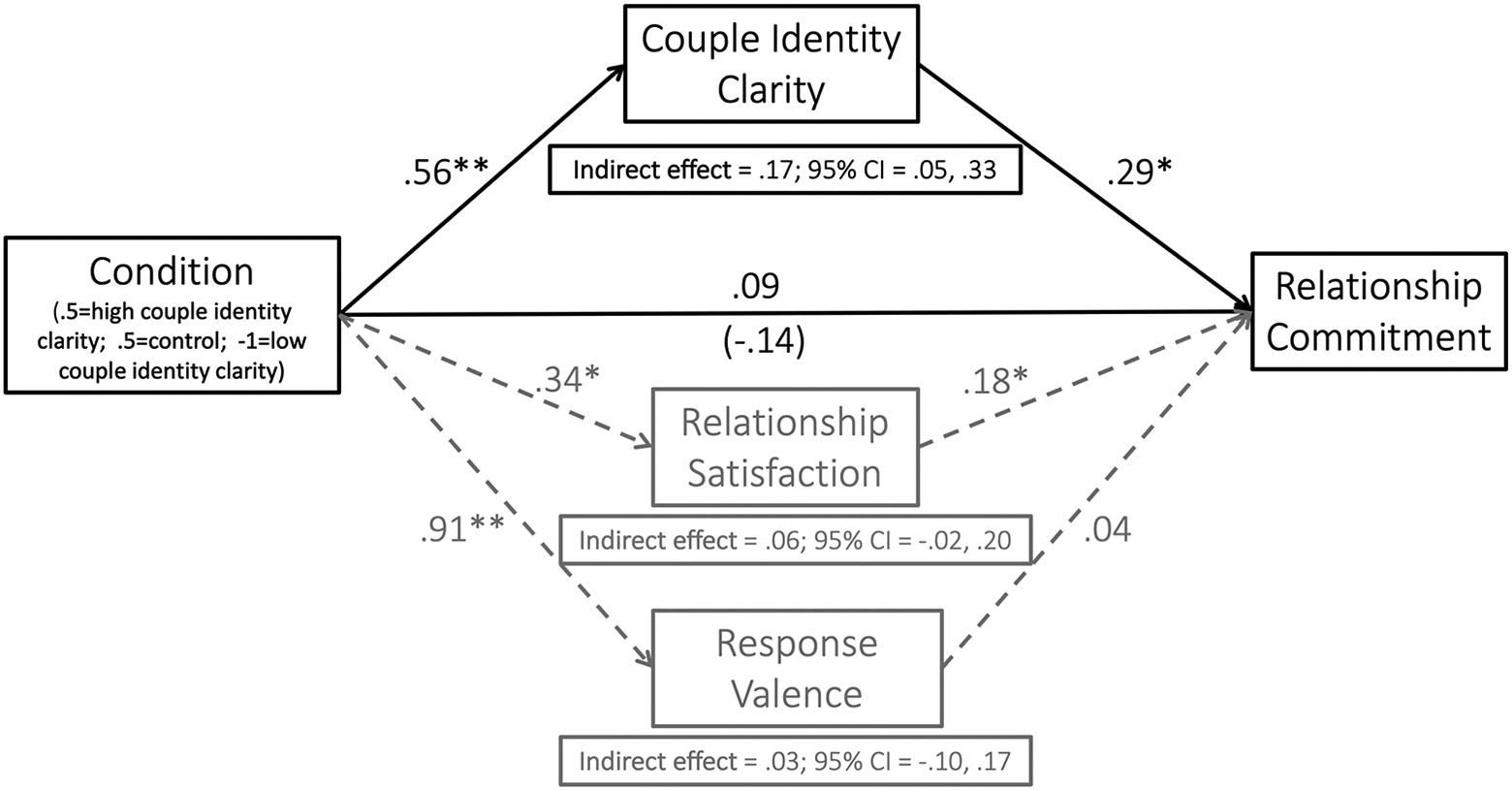
Effects of couple identity clarity manipulation on commitment, driven by changes in self-reported couple identity clarity in Study 3.
Discussion
Study 3 found evidence for a causal link between couple identity clarity and commitment. When individuals’ couple identity clarity was experimentally lowered, they reported less commitment. There was no difference on our manipulation check or in relationship outcomes between individuals who completed a task to affirm their couple identity clarity and those who completed a control task. Mediation analysis revealed that the effect of condition on commitment was driven by changes in couple identity clarity but not relationship satisfaction or objectively coded valence of participants’ responses, suggesting that the effect was not simply due to priming participants to feel negatively about their relationship.
Study 4
In Studies 1 and 2, we found correlational evidence for a link between couple identity clarity and commitment. In Study 3, an experimental prime showed preliminary evidence that couple identity clarity may cause changes in commitment. In Study 4, we employed intensive longitudinal procedures in pursuit of three primary goals. First, we examined a possible causal link between couple identity clarity and commitment more naturalistically, over a 9-month period. Second, we tested whether couple identity clarity predicts likelihood of relationship breakup over 9 months. Third, we explored the possibility that couple identity clarity may relate to conflict resolution. On one hand, people with higher couple identity clarity may be better able to resolve conflicts with their partners. On the other hand, successfully resolving conflict may help to bolster couple identity clarity. We tested both possibilities. Finally, at the suggestion of reviewers, we also explored possible links between couple identity clarity and self-expansion.
Participants
As part of a larger investigation of established romantic relationships, 120 individuals in relationships (25% male, 75% female; age M = 21.94, SD = 4.05; 85% heterosexual, 7.5% bisexual, 5.0% gay or lesbian) were recruited from a Midwestern university. 10 All participants were required to have been in a relationship for at least a year (relationship duration M = 2.45 years, SD = 1.60 years). Of the 120 participants who enrolled in the study, 114 participants completed the Wave 1 follow-up; 111 completed the Wave 2 follow-up; and 110 completed the Wave 3 follow-up, which took place in the lab. By Wave 3, 17 participants had broken up with their partner. 11 Note that all of our analyses except for those predicting breakup exclude participants post-breakup.
Procedure
Participants were recruited through flyers around campus; paid subject pool listservs; classroom-wide and dormitory-wide professor emails; classroom announcements; fraternity and sorority announcements; online, university-affiliated Facebook groups; student newspaper and newsletter advertisements; and university-targeted Facebook advertisements. After completing an initial screening questionnaire, participants received the intake questionnaire and completed it online. 12 They were contacted 3 months later with the Wave 1 questionnaire, which they also completed online. Participants completed the Wave 2 questionnaire online 3 months after completing the Wave 1 questionnaire. Finally, 3 months after completing the Wave 2 questionnaire, participants and their romantic partners came into the lab to complete the Wave 3 questionnaire. Participants received up to US$60 as compensation for their involvement in the full study.
Measures
Unless otherwise noted, all measures were assessed on 7-point Likert-type scales (1 = strongly disagree, 7 = strongly agree).
Couple identity clarity
Participants completed the full couple identity clarity scale at intake (α = .91; M = 5.59, SD = 0.92) and a one-item measure of couple identity clarity at each wave of the study (M = 5.83, SD = 1.04).
Self-concept clarity
Participants completed the full self-concept clarity scale at intake (α = .89; M = 4.45, SD = 1.07) and a one-item measure of self-concept clarity at each wave of the study (M = 5.57; SD = 1.25).
Commitment
Participants reported their commitment at all waves with the same measures as in previous studies (α = .88; M = 6.04, SD = 1.24).
Satisfaction
Participants completed the same measure of satisfaction at all waves as in previous studies (α = .90; M = 5.78, SD = 1.28).
IOS
At each wave, participants completed the same measure of IOS as in previous studies (M = 4.90, SD = 1.24).
Conflict resolution
At each wave, participants described the biggest fight they had had with their partner in the past 3 months. They then rated whether “we were able to resolve the conflict” (M = 5.77, SD = 1.24).
Self-expansion
At Waves 1–3, participants completed the Relational Self-Change Scale (Mattingly et al., 2014), which includes a subscale assessing self-expansion (α = .87; M = 5.99, SD = 0.99).
Results
Unless otherwise indicated, all variables were standardized prior to analysis (M = 0, SD = 1).
Couple identity clarity predicting commitment
First, we examined associations between couple identity clarity and commitment. We used multilevel modeling with wave nested within person, such that each person contributed up to four rows to the dataset. To disaggregate within- and between-person effects, we entered couple identity clarity person-mean centered at Level 1 and the person mean for couple identity clarity at Level 2 predicting commitment (Raudenbush & Bryk, 2002). We found within-person effects of couple identity clarity on commitment (b = .12, p < .001; 95% CI = 0.07, 0.16). At times when people experienced higher levels of couple identity clarity than they typically do, they also felt more committed to their relationship. We also found between-person effects (b = .35, p < .001; 95% CI = 0.28, 0.43). People who, on average, had higher couple identity clarity also felt more committed to their relationships.
We then examined whether couple identity clarity predicted changes in commitment. We entered couple identity clarity at intake and commitment at intake into a model predicting commitment across subsequent waves of the study. Couple identity clarity at intake predicted subsequent commitment (b = .14, p = .002; 95% CI = 0.05, 0.23) controlling for commitment at intake (b = .35, p < .001; 95% CI = 0.26, 0.44). Thus, couple identity clarity at intake positively predicted changes in commitment across time. We then re-ran this analysis controlling for the intake measures of IOS, self-concept clarity, and satisfaction. Couple identity clarity at intake continued to predict residualized changes in commitment across subsequent waves (b = .14, p = .012; 95% CI = 0.03, 0.24), controlling for self-concept clarity (b = −.001, p = .976; 95% CI = −0.08, 0.08), IOS (b = −.05, p = .235; 95% CI = −0.13, 0.03), satisfaction (b = .006, p = .920; 95% CI = −0.11, 0.13), and intake commitment (b = .39, p < .001; 95% CI = 0.29, 0.50).
Couple identity clarity and breakup
We conducted a logistic regression to test whether couple identity clarity predicts relationship persistence. Couple identity clarity at intake predicted a lower likelihood of breakup over the course of the study (odds ratio [OR] = .33, p < .001), such that individuals 1 SD higher on couple identity clarity were approximately one-third as likely to break up with their partner over the course of 9 months. 13 This association between couple identity clarity and less likelihood of breakup remained (OR = .45, p = .022) when we controlled for satisfaction (OR = .70, p = .284), self-concept clarity (OR = .76, p = .418), and IOS (OR = .73, p = .383) at intake.
Couple identity clarity and conflict resolution
We explored two possible mediational pathways among couple identity clarity, conflict resolution, and commitment. Specifically, we tested the competing predictions that (a) conflict resolution mediates the link between couple identity clarity and commitment and (b) couple identity clarity mediates the link between conflict resolution and commitment. We used the MLMED macro for SPSS (Hayes & Rockwood, 2020), which partials out within-person effects (a 1-1-1 mediation) and between-person effects (a 2-2-2 mediation). We did not advance a priori hypotheses distinguishing between possible within-person and between-person results. First, we tested whether conflict resolution mediates the link between couple identity clarity and commitment. Thus, we conducted a lagged mediation analysis, with couple identity clarity at the previous wave predicting success at conflict resolution over the subsequent 3 months, which in turn predicted current commitment. We did not find evidence for either a within-person mediation (indirect effect = −.0003, 95% CI = −0.02, 0.02) or a between-person mediation (indirect effect = −.03, 95% CI = −0.10, 0.06). Next, we examined whether couple identity clarity mediates the link between conflict resolution and commitment. In other words, we tested whether successful conflict resolution over the previous 3 months predicts higher couple identity clarity, which in turn is associated with higher commitment. We found evidence for both within-person mediation (indirect effect = .02, 95% CI = 0.08, 0.03) and between-person mediation (indirect effect = .24, 95% CI = 0.15, 0.35; Figure 3). This suggests that people who are more successful at resolving conflicts with their partner experience higher couple identity clarity, which in turn is associated with higher commitment. It also suggests that at times when people are more successful than they typically are at resolving conflicts with their partners, they experience especially high couple identity clarity, which in turn is associated with higher commitment.
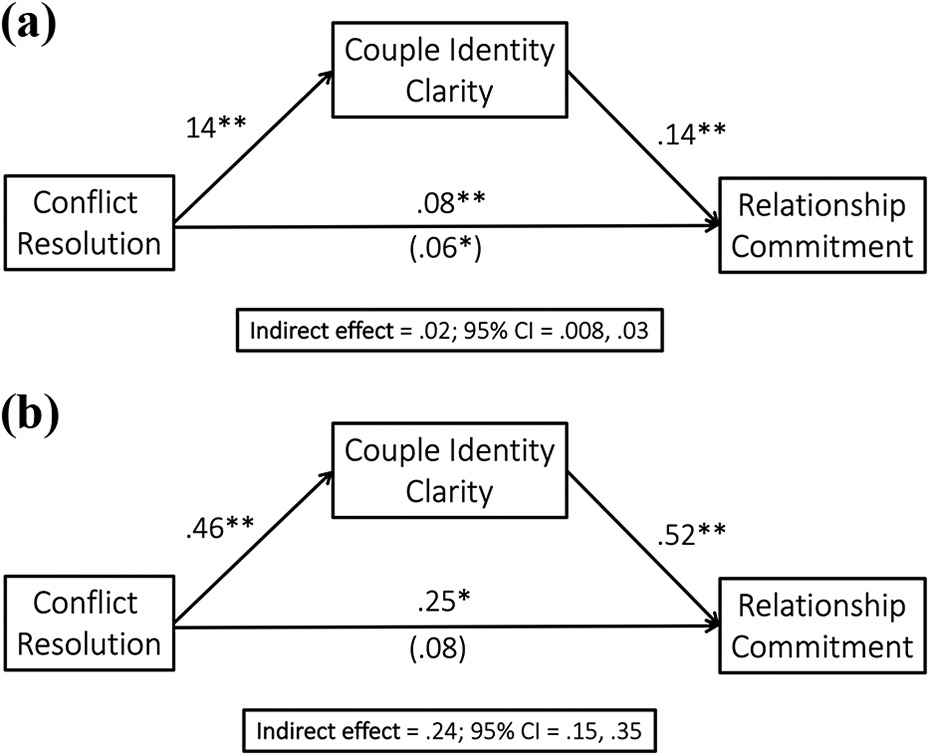
Within-person and between-person analysis of couple identity clarity mediating the link between conflict resolution and relationship commitment across 9 months in Study 4: (a) within-person effects and (b) between-person effects.
Exploratory analyses
Finally, at the suggestion of reviewers, we explored possible links between couple identity clarity and self-expansion. Across Waves 1 to 3, couple identity clarity was associated with self-expansion (b = .22, p < .001; 95% CI = 0.13, 0.31).
Discussion
Study 4 replicated the effects of couple identity clarity on commitment. Over 9 months, couple identity clarity predicted positive changes in commitment, and individuals with higher couple identity initially were less likely to break up with their partners. These effects held when controlling for satisfaction, self-concept clarity, and IOS. Moreover, we explored links between couple identity clarity and commitment. At times when people are especially successful at resolving conflicts, or when people are on average better able to resolve conflict, they experience higher couple identity clarity, which in turn is associated with higher commitment. We also explored possible links between couple identity clarity and self-expansion, and we found that they were positively associated.
General Discussion
Developing a clear understanding of oneself enhances people’s well-being (Campbell et al., 1996). In the present research, we investigated whether clarity also matters in relationships—specifically, couple identity clarity, the extent to which the individual, as a member of a romantic couple, feels like the two of them know who they are as a couple. Across four studies, we found that people with high couple identity clarity are more committed to their relationships and are less likely to experience a breakup.
Study 1 found support for the basic association between couple identity clarity and commitment, a link that held even when controlling for a host of potential confounds: Relationship satisfaction, self-concept clarity, relationship duration, cognitive interdependence (IOS, plural pronoun use, and centrality of the relationship; Agnew et al., 1998), and nine indices of perceived similarity to one’s partner (e.g., similar personality, shared goals, shared values, etc.). We also examined a possible antecedent to couple identity clarity. For individuals, experiencing life changes is linked to lower self-concept clarity (Light & Visser, 2013); thus, we hypothesized that either person in the relationship experiencing life changes might make it more difficult for an individual to maintain couple identity clarity. Indeed, life upheaval for either partner within the past year was associated with lower couple identity clarity, and in turn, lower commitment.
In Study 2, we examined whether couple identity clarity is rooted in some degree of actual agreement between partners on their identity as a couple. Each person’s couple identity clarity comprises (a) their own assessment of whether their identity as a couple makes sense and (b) their own assessment of whether they agree with their partner on who they are as a couple. In a dyadic sample, we found that couple identity clarity was moderately associated with actual agreement between partners on the content of their couple identity. However, couple identity clarity was uniquely associated with commitment when controlling for agreement, suggesting that it captures more than a person’s assessment of agreement.
Studies 3 and 4 examined causal links between couple identity clarity and commitment. In Study 3, people who recalled a time when they experienced low couple identity clarity reported lower commitment than did those who recalled an experience of high couple identity clarity or who completed a control prompt. Mediation analysis revealed that this effect was driven by decreases in couple identity clarity specifically and not by priming participants to write more negatively about their relationship or by decreasing their relationship satisfaction. In Study 4, a 9-month longitudinal study, higher couple identity clarity was associated with increases in commitment over time and less likelihood of experiencing a breakup. We also explored links between couple identity clarity and resolving relationship conflict. When people are especially successful at resolving conflicts with their partners, or among people who tend to be successful at conflict resolution on average, people have high couple identity clarity and, in turn, higher commitment.
Implications and Future Directions
Past theorizing has suggested that people’s identities can be studied at three levels of analysis—individuals, relationships, and groups (Brewer & Gardner, 1996). The literature has established the importance of people’s understanding of their individual identities (self-concept clarity, Campbell et al., 1996) and groups (e.g., cultural identity, Usborne & Taylor, 2010; social status, Destin et al., 2017). This research provides a first step toward examining people’s understanding of their relationships, and these findings suggest that when people feel that they understand who they and their partner are as a couple, they experience more committed, lasting relationships.
We found preliminary evidence that when a person or their partner experiences life upheaval, they report lower couple identity clarity. Future research would benefit from examining whether major relationship events also influence couple identity clarity, such as the transition from dating partners to spouses, from child-free partners to parents, from parents of children at home to empty-nesters, and from working to retirees. At these specific junctures, couples may need to refigure their understanding of who they are together. In fact, there may be times when changing one’s couple identity is better than maintaining the old one. For example, if a couple who have recently become parents attempt to sustain their former identity as an independent power couple, they may experience confusion and dissatisfaction. As a result, if the transition to parenthood destabilizes people’s couple identity clarity, perhaps this is adaptive, as it forces them to change their sense of who they are to cohere with this new stage in their lives.
Although we hypothesized that, on average, couple identity clarity would benefit relationships, there may be situations in which couple identity clarity might actually foreshadow relationship dissolution. If a person has a clear sense of couple identity but believes that the relationship is toxic, then this might indicate an imminent breakup. In other words, a sense of certainty that “we are bad for each other” would predict lower commitment.
Examining couple identity clarity may also help to explain other relationship processes. For example, perhaps one reason why experiencing infidelity is so painful could be that it disrupts couple identity clarity. In addition to a sense of betrayal and questions about the future of the relationship, infidelity signals to a person that “we are not the couple I thought we were.” This disruption in couple identity clarity might be one of several factors contributing to how people respond to infidelity, and whether they decide to forgive their partner. If people are unable to reform their understanding of who they are as a couple, they may be more likely to end the relationship.
Strengths and Limitations
Although past research has examined people’s understanding of their partners (Gurung et al., 2001), this research constitutes the first foray into examining people’s understanding of who they are as a couple. In doing so, it fuses literatures on the self and relationships. Close relationships are a central thread running through the fabric of people’s lives—to understand people, it is crucial to consider both individuals and the relationships that shape them (Berscheid, 1999). As previously noted, the new construct of couple identity clarity complements the already rich literature on self-concept clarity and the growing literature on clarity of group identities. Considering all three adds theoretical nuance to the study of self-beliefs, as well as different levels of identity (Brewer & Gardner, 1996).
Researchers have emphasized the importance of distinguishing between self-concept clarity and self-esteem (see, DeMarree & Lodi-Smith, 2017). The strongest analogue to self-esteem in relationships is relationship satisfaction—if self-esteem captures whether people feel good about themselves (MacDonald & Leary, 2012), satisfaction captures whether they feel good about their relationships (Rusbult, 1980). In all four studies, we found that effects of couple identity clarity on commitment emerged independently from relationship satisfaction. This consistent finding suggests that couple identity clarity does not reflect whether people feel positively or negatively about their relationships—instead, it captures whether they feel that they understand the relationship.
We found robust effects on commitment across correlational, experimental, and longitudinal methodologies, using both adult and student samples with individuals and couples. However, the samples were not representative; as with most MTurk and college student samples, the participants in these studies were primarily White, heterosexual, and among the student samples, from a relatively higher socioeconomic status (SES) background. This lack of diversity limits the generalizability of our findings. It would be valuable for future research to examine whether there are demographic differences in couple identity clarity. For example, self-concept clarity is more strongly linked to well-being among higher-SES individuals (Na et al., 2018). Is the same true of couple identity clarity? We hope that future research will delve into these sorts of questions.
In Study 4, we explored the possible link between couple identity clarity and self-expansion, and we found that they are positively associated. It would be interesting for future research to delve more into understanding the nature of this association. For example, how does self-expansion influence the way that couple identity clarity develops? Are there differences between self-expansion with a partner and personal self-expansion? Moreover, past research has found that low self-concept clarity inhibits self-expansion (Emery et al., 2015) and that people with low self-concept clarity attempt to thwart their partner adding to their own sense of self (Emery et al., 2018). Future research could examine whether couple identity clarity predicts the same sorts of outcomes, or whether it might inhibit self-expansion for different reasons.
These studies focused on couple identity clarity only in established relationships. As such, they do not provide insight into couple identity clarity at the very beginning or end of a relationship. When does couple identity clarity need to emerge for fledgling relationships to thrive? Uncertainty tends to be normative in the beginning stages of a romantic relationship—in fact, the feeling of uncertainty contributes to limerence and is one reason why early-stage relationships are exciting (Tennov, 1998). It would be interesting to determine when clarity needs to develop for a relationship to thrive, as well as whether there are individual differences that moderate how soon people require a sense of clarity. Just as clarity development may influence developing relationships, it may also play a role in deteriorating relationships. Specifically, couple identity clarity may still be pertinent after a relationship ends—perhaps people need to come to an understanding of who they were as a couple to move on after a breakup. Finally, although we focused exclusively on romantic relationships for this initial foray into understanding couple identity clarity, it is entirely plausible that friends, parents and children, work colleagues, and so forth all develop relationship identity clarity as well. We hope that future research examines these possibilities.
Conclusion
Past research has illustrated how people’s understanding of their individual identities and group identities shape well-being. This research fills a crucial gap by examining couple identity clarity—people’s understanding of their relationships. Across four studies, we found that higher couple identity clarity predicts greater relationship commitment and less likelihood of breakup. Moreover, people who are especially successful at resolving conflicts with their partner experience higher couple identity clarity, and in turn, higher commitment. These findings thus suggest that people start to feel that “I don’t know who we are anymore,” it may foreshadow difficult times to come.
Supplemental Material
Couple_Identity_Clarity_Supplemental_Material_R2 - Who are “We”? Couple Identity Clarity and Romantic Relationship Commitment
Couple_Identity_Clarity_Supplemental_Material_R2 for Who are “We”? Couple Identity Clarity and Romantic Relationship Commitment by Lydia F. Emery, Wendi L. Gardner, Kathleen L. Carswell and Eli J. Finkel in Personality and Social Psychology Bulletin
Supplemental Material
Supplemental Material, Emery_Online_Appendix - Who are “We”? Couple Identity Clarity and Romantic Relationship Commitment
Supplemental Material, Emery_Online_Appendix for Who are “We”? Couple Identity Clarity and Romantic Relationship Commitment by Lydia F. Emery, Wendi L. Gardner, Kathleen L. Carswell and Eli J. Finkel in Personality and Social Psychology Bulletin
Footnotes
Appendix
The couple identity clarity scale. All items except for Item 10 are reverse-scored. My beliefs about who we are as couple often conflict with my partner’s beliefs about who we are as a couple. On one day we might have one opinion of who we are as a couple and on another day we might have a different opinion. My partner and I spend a lot of time trying to agree on what kind of couple we really are. Sometimes I feel that we are not really the couple that my partner thinks we are. When my partner and I try to figure out the “story” of us as a couple, how our past led into what we are like today, we don’t seem to have the same sense of what we were like in the past. Sometimes I think other couples share a sense of how they fit together as a couple better than my partner and I do. Our beliefs about who we are as a couple seem to change very frequently. If I were asked to describe how we are as a couple, my description might end up being different from my partner’s. Even if we wanted to, I don’t think we could tell someone what kind of couple we’re really like. In general, my partner and I have a clear sense of who we are as a couple and what we are. It is often hard for us to make up our mind about things because we don’t really know what we want.
Acknowledgments
The authors wish to thank Christopher Petsko for his involvement in Study 2; members of the Northwestern Social Self Lab and the Northwestern Relationships and Motivation Lab for helpful feedback on the ideas in this paper; and the following research assistants for their assistance in data collection and coding: Priscilla Chan, Michaela Choy, Mark Fishman, Tiffany Lai, Morgan McCowan, Elizabeth McLaughlin, Vivian Mu, Maeghan Murphy, Serena Patel, Jamie Ramsey, Alyssa Rodriguez, Sharon Tam, Rachel Traisman, Lindsey Waxman, and Reyna Won.
Declaration of Conflicting Interests
The author(s) declared no potential conflicts of interest with respect to the research, authorship, and/or publication of this article.
Funding
The author(s) disclosed receipt of the following financial support for the research, authorship, and/or publication of this article: This research was supported by a National Science Foundation Graduate Research Fellowship awarded to Lydia F. Emery, a Social Sciences and Humanities Research Council Doctoral Fellowship awarded to Kathleen L. Carswell, and a Northwestern Graduate Research Grant awarded to Kathleen L. Carswell.

Supplemental Material
Supplemental material is available online with this article.
Notes
References
Supplementary Material
Please find the following supplemental material available below.
For Open Access articles published under a Creative Commons License, all supplemental material carries the same license as the article it is associated with.
For non-Open Access articles published, all supplemental material carries a non-exclusive license, and permission requests for re-use of supplemental material or any part of supplemental material shall be sent directly to the copyright owner as specified in the copyright notice associated with the article.
