




Abstract
In attribute conditioning (AC), neutral stimuli (CSs) acquire specific attributes through mere pairings with other stimuli possessing that attribute (USs). For example, if a neutral person “Neal” is paired with athletic “Wade,” participants judge Neal as more athletic compared with when Wade would be unathletic. Building on Evaluative Conditioning research, we introduced relational qualifiers between CS and US to probe the contribution of propositional processes to the AC effect. Concretely, CSs either liked or disliked USs. Four experiments (total n = 1,002) showed that these relations moderate AC effects for athleticism (“athletic” vs. “unathletic”; Experiments 1–3) and relationship status (“single” vs. “in a relationship”; Experiment 4); for example, when Neal disliked athletic Wade, he was judged as unathletic. We discuss how these findings constrain process theories of AC.
Keywords
How do people, consumer goods, or stimuli in general acquire their attributes or traits? How does a brand become elegant, a cereal healthy, or a person athletic? One simple way how stimuli acquire attributes is attribute conditioning (AC; Förderer & Unkelbach, 2015): If people observe a stimulus being paired with another stimulus possessing a specific attribute, their rating of the originally neutral stimulus changes. For example, showing a neutral person (e.g., a picture of a face) together with another athletic person (e.g., a picture of a person playing soccer) makes participants’ assessment of the initially neutral person more athletic (Förderer & Unkelbach, 2011). In conditioning terms, the former is the conditioned stimulus (CS; that is, neutral before the pairing) and the latter is the unconditioned stimulus (US; that is, athletic before the pairing).
Although AC is well-established on an effect level (Staats & Staats, 1957; see Unkelbach & Högden, 2019, for an overview), the mental processes underlying it are not clear yet (see Unkelbach & Förderer, 2018). In particular, Förderer and Unkelbach (2016) proposed that AC effects are due to a link between the CS’s and US’s mental representations (see below). However, they did not specify the nature of the link; for example, it might be a mere associative link (Gawronski & Bodenhausen, 2011) or a propositional link (Mitchell et al., 2009). Using research on relational qualifiers in Evaluative Conditioning (EC) as a template (e.g., Förderer & Unkelbach, 2012; Moran & Bar-Anan, 2013), the present research probes the nature of this link by introducing relational qualifiers of the CS–US pairing; specifically, whether the CS likes or dislikes the US. In more colloquial terms, does disliking an athletic person make you unathletic?
In the remainder, we provide a short overview of AC research up to date, and in particular, how AC relates to evaluative conditioning (EC). Then, we delineate how relational qualifiers may inform the processes underlying AC. Finally, we present four experiments (total n = 1002) investigating if and how relational qualifiers change CS assessments after pairing them with USs that have a certain attribute or not; that is, being athletic or unathletic and being single or in a relationship.
AC Effects
AC is a reliable and versatile phenomenon (Unkelbach & Förderer, 2018; Unkelbach & Högden, 2019). The effects are found on direct measures such as explicit ratings, and more indirect measures such as semantic priming or semantic misattribution (Förderer & Unkelbach, 2011). AC pairings have been shown to change people’s stimulus assessments of “potency” and “activity” (Staats & Staats, 1957); “speed” and “softness” (Kim et al., 1996); “size” (Olson et al., 2009; Experiment 2); or “humor,” “attractiveness,” “intelligence,” and “athleticism” (Förderer & Unkelbach, 2014).
However, all these dimensions have some evaluative connotations; “fast,” “funny,” or “athletic” are typically positive attributes. Thus, it is important to show that AC goes beyond creating overall positive or negative evaluations as in EC. In EC, people’s evaluation of a CS typically changes in the direction of the evaluation of a paired US (Gast et al., 2012). Thus, AC effects may be generalized effects of conditioned valence on the provided rating dimension (i.e., “halo” effects; Gräf & Unkelbach, 2016; Nisbett & Wilson, 1977). To differentiate AC effects from EC, Förderer and Unkelbach (2011) showed that AC effects are still present if one controls statistically for the evaluation of a given CS (see Förderer & Unkelbach, 2014; for an experimental approach). Thus, AC cannot be fully accounted for by general liking or disliking, but is a genuine phenomenon in its own right. Next, we address the possible cognitive processes that may underlie AC.
Potential AC Processes
As AC was first conceptualized as a conditioning phenomenon (Staats & Staats, 1957), a viable hypothesis was that it constitutes a form of signal learning in which the CS creates expectations for the US (Rescorla & Wagner, 1972). From this view, two predictions follow. First, when the CS appears repeatedly without the US, it is not a good signal for the US anymore and AC effects should diminish; an effect called extinction. Similar, when given CS has already been paired with a US, a second CS that is paired with that US should not show AC effects because the first CS signals the US already; an effect called blocking. However, a systematic investigation showed that AC effects are by and large insensitive to experimental extinction and blocking procedures (Förderer & Unkelbach, 2015, Experiments 2–5). Thus, AC effects seem independent of a signaling function.
Building on similar theorizing in EC research (Baeyens et al., 1992), Unkelbach and Förderer (2018) suggested a referential learning process that creates a link between CS and US. This link was experimentally tested by Förderer and Unkelbach (2016) in a revaluation paradigm (e.g., Walther et al., 2009). They paired CSs with athletic or unathletic USs. As expected, participants judged the CSs in accordance with the US attributes (i.e., athletic or unathletic), both on direct and indirect measures. Yet, after the pairings, the USs changed their attributes from athletic to unathletic (e.g., a runner becoming visibly chubby) and vice versa (e.g., a chubby person becoming visibly muscular). Without further pairings, this revaluation influenced CS assessments. That is, a CS that was paired with a formerly athletic US which had then turned unathletic was judged as less athletic than a CS that was paired with a formerly unathletic US which had turned athletic. This implies a CS–US link. Next, we address the nature of this link.
Potential CS–US Links
In EC, two candidates for CS–US links are associations and propositions (Gawronski & Bodenhausen, 2011). In their model of AC effects, Unkelbach and Förderer (2018) used the term referential links. Although there are some historical differences between the terms and their implications, the relevant distinction between referential or associative links and propositions is the same: Referential links are unqualified connections while propositional links carry meaning. They allow information about the CS–US link, they can be true or false, and they can be subject to logical reasoning (Mitchell et al., 2009).
One way to probe the nature of the CS–US link is using relational qualifiers; that is, semantic qualifications of the link. In EC research, a number of such qualifiers have been introduced, such as CSs being friends versus enemies of USs (Fiedler & Unkelbach, 2011), CSs loving or hating USs (Förderer & Unkelbach, 2012), or CSs starting or stopping USs (Moran & Bar-Anan, 2013). If CS–US links are propositional, semantic qualifiers should influence EC effects, while mere referential links should be insensitive to such information (Hu et al., 2017).
Numerous studies showed a moderation of EC by relational information (e.g., Moran & Bar-Anan, 2013; Unkelbach & Fiedler, 2016), with attenuation or complete reversals of EC effects given negative CS–US relations (e.g., “stops,” “hates,” “dislikes”). This is often considered evidence that EC effects involve propositional information. It is important to note, though, that data on relational qualifiers cannot distinguish between propositional models (e.g., Mitchell et al., 2009) and dual-process models of both associations and propositions (e.g., Gawronski & Bodenhausen, 2018). Evidence for the presence of one process does not preclude the existence of another process.
For EC, explaining a moderation by propositional information is straightforward: Participants may infer that stimuli that are in a negative relation to stimuli they like, are unlikable and vice versa. Concretely, the learned proposition “Person X dislikes a friendly person.” informs evaluations: “Therefore, I dislike person X” (e.g., because he or she seems to be a negative person). As the relations (here: liking and disliking) and the evaluative outcomes (here: likes and dislikes) are both evaluative, they may inform each other (i.e., the resulting evaluative proposition may be considered valid). For AC, the situation is more complex. For example, if an initially neutral person Y dislikes an athletic person, person Y should not necessarily become unathletic. Although one may argue that many attributes have evaluative implications, in principle, one may construe an orthogonal relation of specific attributes and evaluations; that is, one may like or dislike both athletic and unathletic people, without implications for one’s own perceived athleticism. This argument leads to the hypothesis that conditioning of attributes such as athleticism should not be moderated by like/dislike relational qualifiers.
Relational qualifiers may nevertheless moderate AC effects. To illustrate these alternative hypotheses, we will use the attribute athleticism and the negative relation “dislikes” as an example. First, attributes also have positive or negative connotations (e.g., being “athletic” is rather good than bad and being “unathletic” is rather bad than good). If Person Y dislikes another athletic person, Person Y is evaluated more negatively, which in turn makes Person Y unathletic (e.g., “Person Y dislikes something good and is therefore bad; hence, Y is unathletic”). Thus, potential moderating influences of relational qualifiers might be a generalized halo effect (Nisbett & Wilson, 1977). Second, if participants observe person Y in a negative relation with an athletic person (e.g., a US person doing sports), participants might infer a negative relation between the CS and the activity (e.g., “Person Y does not like sports; hence, Y is unathletic”). And third, participants might construe a “dislike” relation as a dissimilarity relation (e.g., “Person Y is different from the person doing sports”), due to the subjective link of interpersonal attraction (i.e., “dislike”) and similarity (Alves et al., 2016; Berscheid, 1985).
It is thus an intriguing empirical and theoretical question if and how relational qualifiers between CS and US influence AC effects. The following four experiments tested this influence.
Overview of the Experiments
In Experiments 1 to 3, we used athleticism as the target attribute, based on the materials by Förderer and Unkelbach (2016); that is, participants observed pairings of CSs with either athletic and unathletic USs and assessed CSs’ athleticism, both on direct (Experiments 1–3) and indirect measures (Experiment 1). In Experiment 4, we used relationship status as the target attribute. CSs were paired with US photos that showed a single person or a person in a relationship. We used “like” versus “dislike” as relational qualifiers in all experiments.
Experiment 1 showed that relational qualifiers influence AC effects, both on a direct rating measure controlling for valence and a semantic misattribution procedure, a variant of the affective misattribution procedure (AMP, Payne et al., 2005; SMP, Imhoff et al., 2011). To preclude that participants infer a direct relation of CSs with the attribute (“CS dislikes sports”), Experiments 2 to 4 used a second-order conditioning procedure. That is, we conditioned attributes to a CS_1. Then, participants observed a “like” or “dislike” relation between CS_1 and CS_2; thus, the relevant CS_2 never occurred together with “athletic vs. unathletic” or “in a relationship vs. single” information. Experiment 3 addressed whether participants interpret the like/dislike relation as CS–US similarity or dissimilarity and if this may account for the relational qualifiers’ influence on AC. To generalize our findings, Experiment 4 replicated Experiment 3 with relationship status (i.e., being in a relationship or being single) as the conditioned attribute.
We report four experiments out of eight that we conducted in this research line. We conducted an additional experiment similar to Experiment 1 that showed the effect of relational qualifiers only on a direct rating measure. The results were highly similar to the one reported for Experiment 1’s explicit ratings. The exact procedure and results can be found in the supplemental appendix. We conducted an additional study before Experiment 2 with the same parameters as Experiment 2, but with 12 CS–US pairs instead of four pairs. Although the results descriptively mirrored those reported for Experiment 2, we did not observe any significant effects when analyzing the main DV, potentially due to participant fatigue and resulting high measurement error. Experiment 2 repeated the same study with fewer stimuli to reduce fatigue and memory load and to shorten the duration of the online experiment. A pooled analysis of attribute ratings from the additional study and Experiment 2 showed the same pattern of findings as reported for the data of Experiment 2 alone. We conducted another experiment between Experiments 2 and 3. Similar to Experiment 3, it aimed to test whether participants construe the like/dislike relation between CS and US as (dis)similarity. The experiment had a design flaw, though. The question probing if participants interpret (dis)liking as (dis)similarity used the same stimuli as those presented during conditioning. This confounds the potential similarity-liking interpretation with previous responses (i.e., participants who showed strong AC effects should also show a high similarity-liking relation, as the CS and US became subjectively more similar/dissimilar on the athleticism dimension). The reported Experiment 3 avoids this problem. While the omitted experiment did not allow inferences regarding participants’ interpretation of the relation, it fully replicated the influence of relational qualifiers on AC. An experiment prior to Experiment 4 established a standard AC effect for the “relationship status” attribute without the use of relational qualifiers.
For all reported experiments, we report how we determined our sample size, all data exclusions (if any), all manipulations, and all measures. In all experiments, we routinely asked participants in an open question what they thought the purpose of the study was. We did not analyze this data and do not report it. We aimed to impede possible demand effects using an indirect measure in Experiment 1 and a second-order conditioning procedure in Experiments 2 to 4. Furthermore, we excluded participants who indicated to not have taken part seriously (see Aust et al., 2013).
Our key effect of interest is the relational qualifiers’ influence on the AC effect. This influence translates statistically into an interaction of attribute (i.e., athleticism, relationship status) and relation (i.e., “likes” vs. “dislikes”) in an analysis of variance (ANOVA) on the attribute ratings. The interaction tests whether the AC effect differs significantly between positive and negative relations (see Rosnow & Rosenthal, 1995). As ANOVA interactions are always symmetrical with a single degree of freedom (Rosnow & Rosenthal, 1989, p. 145), we do not report simple effects for this interaction. The simple effects would test the AC effect means nested within each relation condition; however, these would not be the tests of interest for our hypothesis (cf. Nieuwenhuis et al., 2011).
Experiment 1: Relational Qualifiers Influence AC Effects
Experiment 1 tested for the first time whether relational qualifiers between CS and US influence AC effects. We used “likes” and “dislikes” as qualifiers, pictures of men as CSs and USs, and athleticism as the relevant attribute. In addition to participants’ athleticism ratings, we used a semantic variant of the affective misattribution procedure (AMP; Payne et al., 2005) to ensure that AC effects and the relational qualifier influence are not due to strategic responding (SMP, see Förderer & Unkelbach, 2011; Imhoff et al., 2011).
Method
Participants and design
One hundred and one students participated in Experiment 1 (mean age: 22.05 years, excluding two participants who gave nonsensical age information, 56 female, 45 male). We planned the sample size based on AC effect sizes in our lab (e.g., Förderer & Unkelbach, 2011, 2016) and the effect size of relational qualifiers (e.g., Förderer & Unkelbach, 2012). We typically observe significant moderation of EC effects by relational qualifiers (i.e., the interaction) using a within-participants design with around 50 participants in the laboratory. Assuming that the indirect attribute measure is less reliable, we aimed for a sample of around 100 people to yield sufficient power to detect a potential effect of relations on AC. We recruited participants on campus and they participated for course credit or a small monetary reward.
We manipulated within participants whether CSs were paired with athletic or unathletic USs and whether CS and US liked or disliked each other. Participants assessed CS athleticism on an explicit rating scale and rated CS likability after completing an SMP to indirectly assess CS athleticism (see below).
Procedure and material
We conducted the experiment computer-based in the laboratory using OpenSesame (Mathôt et al., 2012). The program displayed information about the experiment and confidentiality of participants’ data and asked participants for their consent to participate. Given they consented, they stated their age and gender and proceeded to the instructions for the learning phase. The instructions informed them that they would see photos and drawings of men who either like or dislike each other and that they should watch the pictures attentively. In the last sentence, the program told participants that they would be asked about the pictures at the end of the experiment.
The learning phase paired 12 black-and-white photos of men (CSs) with six drawings of men performing athletic activities (USs; for example, cycling, running) and six drawings of men performing unathletic activities (e.g., watching TV, eating on the couch). CS men and US men were both displayed with a random male name to facilitate differentiation between the stimuli. Orthogonally, CSs were assigned to “like” or “dislike” the USs. The program randomly created fixed CS–US pairs (“one-to-one” procedure; see Stahl & Unkelbach, 2009) and presented each pair 6 times, resulting in 72 trials. Figure 1 shows an example trial. A trial lasted 4000 ms and the intertrial interval was 500 ms. Presentation order was random.

Example trial of “Neal dislikes Wade on a bicycle” from Experiment 1.
Participants then completed the SMP (Förderer & Unkelbach, 2011, 2016; Imhoff et al., 2011). In the SMP, participants classify neutral Chinese characters (Kanji) as “athletic” or “unathletic.” Every Kanji is primed with a CS and the CSs’ semantic meaning is supposed to bias participants’ responses toward the Kanji. Assuming an AC effect, people should decide that a Kanji following an athletic CSs has an athletic meaning more often, compared with Kanji following a non-athletic CSs. The program instructed participants about the SMP procedure. They were asked to respond spontaneously and to not be distracted by the preceding photos of men that were presented at the beginning of each trial.
An SMP trial looked as follows: A fixation cross appeared in the center of the screen. After 300 ms, the CS replaced the cross. The CS stayed onscreen for 75 ms. Then, a blank screen followed for 125 ms, followed by a Kanji for 100 ms. A black-and-white pixel image masked the Kanji. The mask was displayed until participants gave a response. Participants responded with the keys “A” and “L” on a German keyboard. We counterbalanced key assignment to the categories “athletic” and “unathletic.” Each CS appeared 8 times, resulting in 96 SMP trials. Presentation order was random.
After the SMP, participants completed the athleticism ratings of the CSs. For a given rating, the program showed a CS on the upper half of the screen and a rating scale below, ranging from 1 (“unathletic”) to 9 (“athletic”). All CSs were rated once, resulting in 12 attribute rating trials. CS presentation order was random.
Next, participants completed the likeability ratings which were similar to the athleticism ratings except that the instructions were about “liking” and the labels of the rating scale were “not at all” to “very much.”
Finally, the program asked participants to indicate whether they like to exercise (“not at all” to “very much”) and how athletic they are (“not at all athletic” to “very athletic”). 1 Upon completion, participants were thanked and rewarded.
Results
Semantic misattribution procedure
Figure 2’s upper panel shows the mean proportion of “athletic” responses in each condition. We submitted these to a 2 (attribute: athletic vs. unathletic) × 2 (relation: like vs. dislike) repeated measures ANOVA. We only observed an interaction, F(1, 100) = 5.17, p = .025,

Experiment 1: Proportion of “athletic” responses in the semantic misattribution procedure (upper panel) and attribute ratings (lower panel) of CSs paired with an athletic or unathletic US and that either liked or disliked the US.
Attribute ratings
Figure 2’s lower panel shows CSs’ mean attribute ratings as a function of paired US and CS–US relation. We used the same repeated measures ANOVA as for the SMP data for the athleticism ratings. Overall, we found a standard AC effect: Participants rated CSs paired with athletic USs as more athletic (M = 5.07, SD = 1.10) than CSs paired with unathletic USs (M = 4.70, SD = 1.06), F(1, 100) = 7.80, p = .006,
Liking ratings
We conducted the same ANOVA as described above with liking ratings as the dependent measure. We found an attribute main effect. Overall, CSs paired with athletic USs were rated as more likable (M = 5.09, SD = 1.05) than CSs paired with unathletic USs (M = 4.80, SD = 1.15), F(1, 100) = 6.39, p = .013,
Attribute ratings controlling for liking
To investigate if the interaction in attribute ratings might be due to “evaluative” variance (i.e., accounted for by liking of the CS), we conducted a multi-level regression analysis. We treated CS attribute ratings as the dependent variable and liking rating of the same CSs as predictor and included a random intercept for participants. We used the residuals of this analysis, which statistically correct for evaluations of a given CS, in the same ANOVA as described above (see Förderer & Unkelbach, 2011). The ANOVA of these residuals showed again a main effect of attribute. Participants rated CSs paired with athletic USs more athletic than CSs paired with unathletic USs, F(1, 100) = 5.09, p = .026,
Discussion
Experiment 1 showed that relational qualifiers influence AC effects. We observed this moderation effect on an explicit rating and an indirect measure. As the interaction indicates, the AC effect was significantly different for CSs that liked the USs compared with CSs that disliked the USs.
The SMP measure provides confidence that the results are not due to participants’ strategic responding; on average, participants classified the Kanji within 1,019 ms (SD = 1,383). Within that time, it seems unlikely that participants recognized the CS face, remembered the paired US and the CS–US relation, and that the experiment seems to require a response contingent on US attribute and CS–US relation, despite being instructed to ignore the CS face in the first place. In addition, the residual analysis suggests that the relational qualifiers’ influence does not, at least not fully, depend on the evaluative connotation of the attribute (i.e., a CS disliking something good). The main effect of relation on athleticism indicates that athleticism judgments may have some evaluative component. This is supported by the fact that this main effect was no longer significant when we analyzed the residuals which are corrected for the “liking” variance.
Experiment 1’s learning phase allows an alternative interpretation, though (see Figure 1): We presented pictures of male faces (CSs) together with pictures of men engaging in athletic or unathletic activities (USs). In between, the pictures the word “likes” or “dislikes” appeared. Thus, participants may infer “This CS dislikes this athletic activity.” Concretely, the setup in Figure 1 might imply that “Neal dislikes cycling.” Experiment 2 will address this possibility. In addition, as the observed effects were smaller than expected, the subsequent experiments substantially increase the sample size, which necessitated online experimentation due to insufficient laboratory capacity.
Experiment 2: Relational Qualifiers Influence AC Effects in a Second-Order Conditioning Procedure
Experiment 2 tested if the AC effect’s moderation genuinely depends on the CS–US relation (i.e., “Neal dislikes Wade”) or on the CS-activity relation (i.e., “Neal dislikes cycling” or “Neal dislikes athletic activities”). The latter case would make the results less informative for AC effects. To this end, we separated CS–US pairings and presentation of the relational qualifier in a second-order conditioning procedure. First, we paired CS_1s with athletic and unathletic USs in a standard AC procedure without relational qualifiers. Second, we paired these CS_1s, which were then effectively novel USs, with CS_2s in a second conditioning phase. These pairings then included the relational qualifiers of “likes” and “dislikes.” Importantly, the relevant CSs were now the CS_2s, which were never presented with the athletic activity. Observing a relational qualifier influence in this second-order conditioning procedure would imply that qualifiers indeed moderate AC effects.
Method
Participants and design
Two hundred ninety-four people were recruited on Amazon Mechanical Turk and participated for a small monetary reward (mean age: 37.56 years, 123 female, 169 male, one other, one unspecified). We increased the sample size substantially in comparison to Experiment 1 because we anticipated smaller second-order conditioning effects and we aimed to increase confidence in the observed effects.
We manipulated whether CS_1s were paired with an athletic or unathletic USs and whether CS_2s and CS_1s liked or disliked each other within participants and measured athleticism and liking ratings of all CS_2s and only athleticism ratings of CS_1s.
Procedure and material
We programmed an online experiment with SoSci Survey (Leiner, 2016). It was similar to Experiment 1 with the following changes: First, as we considered the online context less suitable for an indirect measure, we did not assess perceived athleticism via an SMP but only measured explicit athleticism and likability ratings.
Second, participants saw pairings of only four photos of male faces (CS_1s) and four photos of men engaging in athletic or unathletic activities (e.g., playing soccer, reading a book, USs). That is, the overall number of pairings was reduced to four and the US drawings were replaced by photos. Figure 3’s upper panel shows an example trial. CS_1s were shown alone on the screen for 1,000 ms, then the US appeared to its right and they were shown together for another 3,000 ms. The intertrial interval was 500 ms. Every CS_1–US pair was shown 6 times resulting in 24 first-order conditioning trials. Then, as a manipulation check, we assessed attribute ratings of all CS_1s. Next, the second-order conditioning phase paired the four CS_1s with four CS_2s. In those pairings, the CS_2 either “liked” or “disliked” the CS_1. Figure 3’s lower panel illustrates the second phase. CS_2s were presented alone for 1,000 ms, then the relation appeared on its right side and they were shown together for 1,000 ms. Finally, CS_1s appeared on the very right part of the screen and the three elements were shown together for 3,000 ms. The intertrial interval was 500 ms. The CS_1–CS_2 pairs were also presented 6 times each, resulting in 24 trials in the second pairing phase. Finally, we assessed attribute ratings and liking rating of all CS_2s and the control questions at the end of the experiment. We used continuous ratings scales that ranged from 1 to 101. The order of presentation in the two conditioning phases and all measurement phases was random.
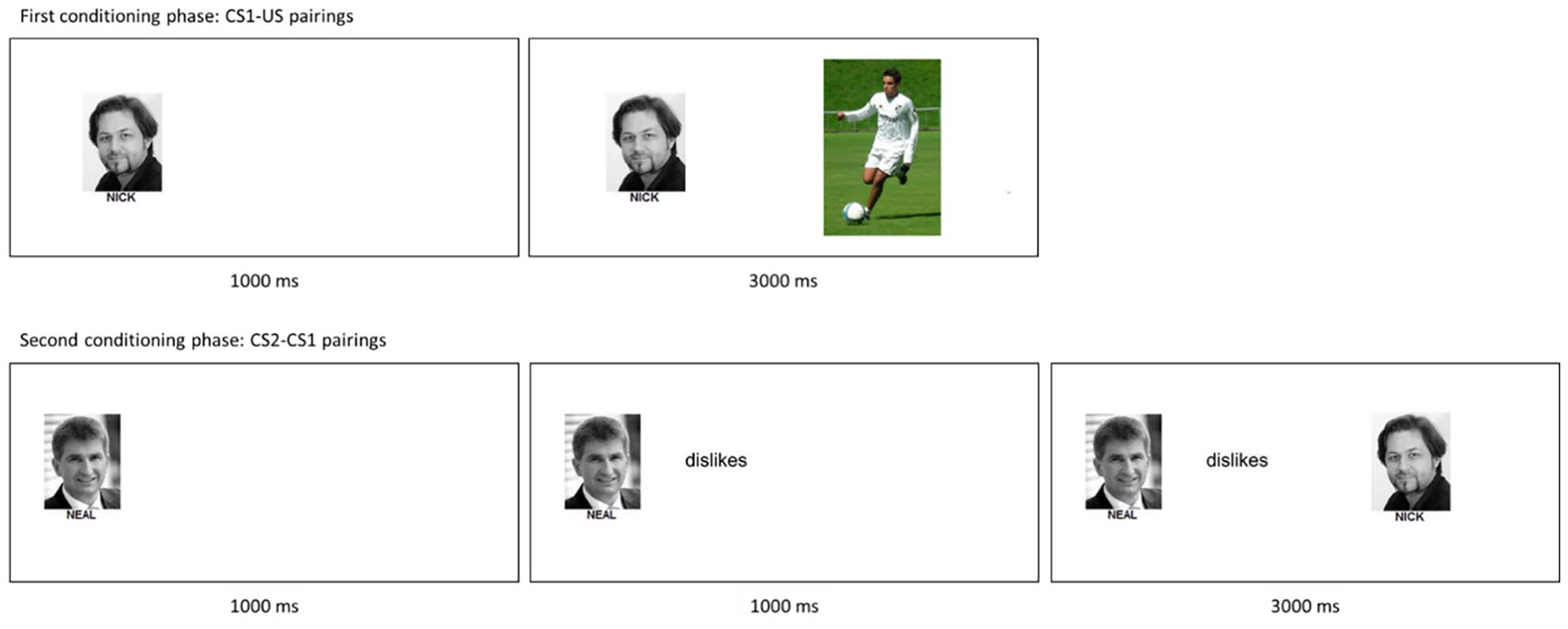
Example trials from Experiment 2 (and 3).
Results
Manipulation check
We analyzed participants’ CS_1s attribute ratings after the first conditioning phase using a t-test. As expected, participants rated athletic-paired CS_1s as more athletic (M = 83.09, SD = 17.61) than unathletic-paired CS_1s (M = 30.18, SD = 20.39), t(293) = 28.34, p < .001, dz = 1.65.
Attribute ratings
Figure 4 shows CS_2 attribute ratings as a function of CS_1-paired attribute (athletic vs. unathletic) and CS_2–CS_1 relation (like vs. dislike). The respective ANOVA showed only an interaction, F(1, 293) = 48.07, p < .001,
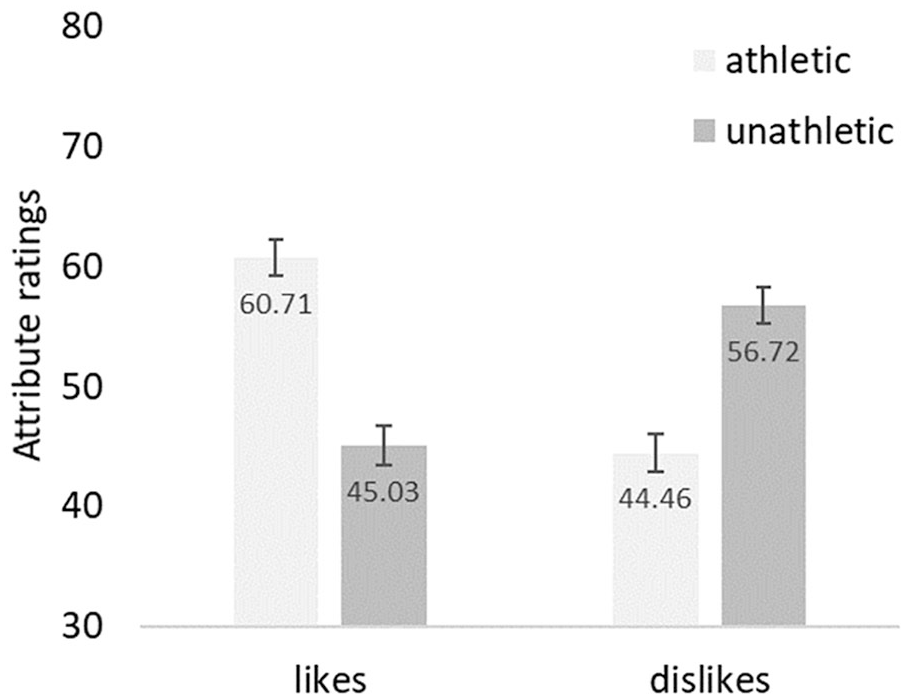
Experiment 2: Attribute ratings of CS_2s that were paired with a CS_1 that had previously either been paired with an athletic or unathletic US.
Liking ratings
The liking ratings showed a main effect of relation. Participants liked CS_2s liking CS_1s more (M = 53.91, SD = 22.12) than CS_2s disliking CS_1s (M = 42.54, SD = 22.94), F(1, 293) = 70.70, p < .001,
Attribute ratings controlling for liking
Similar to Experiment 1, we repeated the main analysis based on the residuals of the multi-level regression predicting attribute ratings from liking ratings. The respective ANOVA of the residuals replicated the interaction between attribute and relation, F(1, 293) = 48.20, p < .001,
Discussion
Experiment 2 replicated the relational qualifiers’ influence on AC using a second-order conditioning setup. This setup has several methodological advantages. Foremost, the clear interaction suggests that the relational qualifiers exert their influence on the link between the paired stimuli, and not a potential link between the CS and the depicted activity or the relevant attribute (e.g., “Neal dislikes cycling”). Rather, the AC effect is moderated by the relation of CS and US, or here, between CS_2 and CS_1 (e.g., “Neal dislikes Wade”). This effect was also independent of CS_2 likeability; the effect sizes for the attribute ratings and the attribute ratings controlled for likeability were virtually identical.
Experiments 1 and 2 thereby showed for the first time the moderating influence of relational qualifiers on AC effects, while precluding our first and second potential explanations. That is, the effect is not based on generalized liking and not based on participants inferring that the CSs (dis)like (un)athletic activities. This effect is insofar puzzling as Neal disliking athletic Wade does not imply that Neal is unathletic, as opposed to rating Neal as unlikable as in EC. A valid inference from the presented information would require substantial additional assumptions (e.g., that participants infer that Neal dislikes Wade because he is athletic, suggesting that he is less athletic than Wade).
Experiment 3 tested the third suggested explanation that the relations of “liking” and “disliking” imply more general relations, namely that people who like each other are also similar (see Alves et al., 2016; Berscheid, 1985). Thus, participants might interpret the relational qualifier as “is similar” versus “is dissimilar”; in other words, participants might read “Neal dislikes Wade” as “Neal is unlike Wade.” Experiment 3 therefore measured the degree to which participants interpret (dis)liking as (dis)similarity.
Experiment 3: Does Liking Imply Similarity?
Experiment 3 replicated Experiment 2 and, in addition, measured to what extent participants interpret the like/dislike relation as implying similarity between CS and US (here: between CS_2 and CS_1) and analyzed this as a mediating variable.
Method
Participants and design
We aimed for a similar sample size as in Experiment 2. Three hundred and two people participated in Experiment 3 (female: 156, male: 143, other: 1, unspecified: 2, mean age: 33.90 years). We recruited the sample on Amazon Mechanical Turk. The design was highly similar to Experiment 2, but included one additional measure: We measured the degree to which participants interpret the like/dislike relation as similarity between two stimuli.
Procedure and material
The program and stimuli were similar to Experiment 2 with one exception. Before participants saw pairings of CS_1s and the USs (i.e., first-order conditioning phase), they indicated in two trials how similar they thought two men were that liked versus disliked each other. A similarity rating trial looked as follows: A black-and-white photo of a male face was shown alone for 1,000 ms, then the relation appeared to its right and they were shown together for another 1,000 ms. Then another photo of a male face appeared on the right and all three elements were shown for 3000 ms before the question “How similar do you think the two men above are?” appeared below. Participants indicated their similarity rating with a slider from “dissimilar” to “similar.” The stimuli were from the same pool as the CSs, but were not used as CSs subsequently. Every relation was rated once, resulting in two similarity rating trials. Whether the like or dislike relation was rated first was determined randomly. Everything else was identical to Experiment 2.
Results
Manipulation check
A t-test showed that participants rated CS_1s paired with athletic USs as more athletic (M = 81.62, SD = 15.70) than CS_1s paired with unathletic USs (M = 33.15, SD = 19.28), t(301) = 28.28, p < .001, dz = 1.63.
Attribute ratings
Figure 5 shows CS_2 attribute ratings as a function of CS_1-paired attribute (athletic vs. unathletic) and CS_2-CS_1 relation (like vs. dislike). The respective ANOVA showed an attribute main effect. Participants rated CS_2s paired with athletic-paired CS_1s as more athletic (M = 52.42, SD = 26.81) than CS_2s paired with unathletic-paired CS_1s (M = 46.70, SD = 25.22), F(1, 301) = 15.26, p < .001,
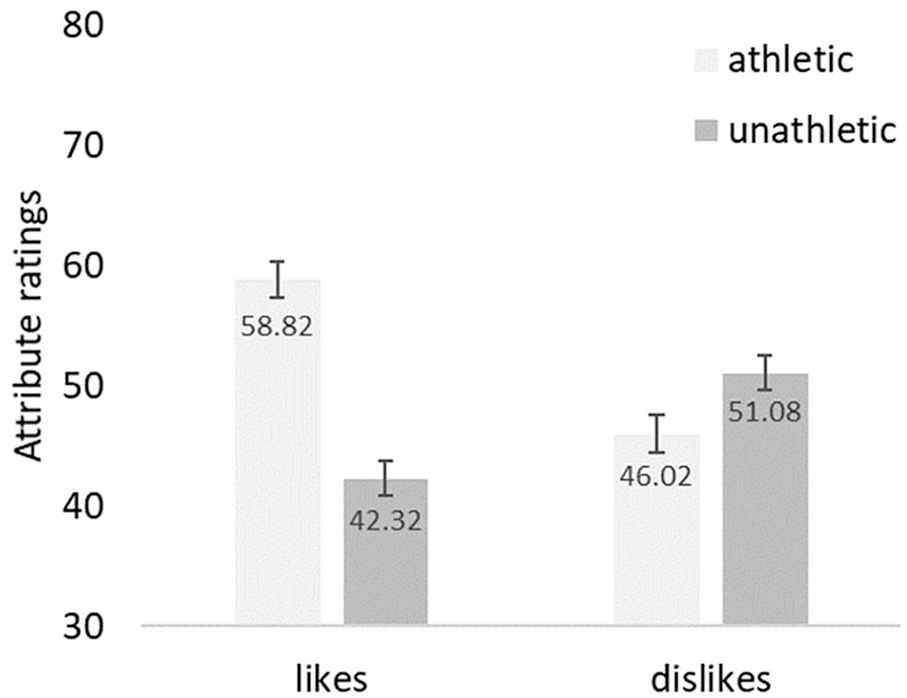
Experiment 3: Attribute ratings of CS_2s paired with a CS_1 that had previously either been paired with an athletic or unathletic US.
Liking ratings
The same ANOVA for liking ratings showed the by now expected relation main effect. CS_2s that liked a CS_1 were rated as more positive (M = 51.48, SD = 22.27) than CS_2s that disliked a CS_1 (M = 40.97, SD = 21.61), F(1, 301) = 66.22, p < .001,
Attribute ratings controlling for liking
We again predicted attribute ratings from liking ratings in a multi-level regression analysis. The ANOVA of these residuals still showed the same attribute main effect: Participants rated CS_2s paired with athletic-paired CS_1s as more athletic, F(1, 301) = 15.27, p < .001,
Similarity ratings
As described, participants’ first two ratings indicated their perceived similarity of two targets that did not appear within the experiment. These ratings serve as an indicator to what extent they interpret a like/dislike relation as a similarity/dissimilarity relation. First, a t-test showed that participants saw two men as more similar (M = 48.97, SD = 27.37) when the first men liked the second man compared with when the first men disliked the second men (M = 37.66, SD = 26.11), t(301) = 5.98, p < .001, dz = 0.34. This suggests that, on average, participants interpreted the like/dislike relation as implying similarity, respectively, dissimilarity between the two stimuli.
To test if this interpretation may explain the relational qualifiers’ influence on AC effects, we conducted regression analyses: First, we predicted AC effects from the categorical variable “relation” which is analogous to the interaction effect of attribute and relation in the ANOVA. To obtain an AC score, we subtracted the ratings of CS_2s paired with unathletic-paired CS_1s from those of CS_2s paired with athletic-paired CS_1s separately for the “like” and the “dislike” condition.
Then, in a second regression model, we included the continuous variable “similarity” to test whether it diminishes or abolishes the influence of relation on AC. That is, in this full model, the AC effect was predicted by the relation between CS_2 and CS_1 and the similarity rating. Specifically, for the AC effect in the “like” condition, the similarity rating from the trial in which two men liked each other was used as a predictor. For the AC effect in the “dislike” condition, the similarity rating from the trial in which two men disliked each other was used. Apart from those fixed factors, the regression model included a random intercept for participants.
Table 1 shows the beta weights, the semi-partial r2s and zero-order correlations (Nakagawa & Schielzeth, 2017) 2 for the predictors (and their interaction) in both regression models. These show that the effect of relation is diminished by including similarity as a predictor. In the full model, both relation and similarity contribute in predicting AC scores in the same direction. That is, the perceived similarity between CS_2 and CS_1 that (dis)liked each other accounts for substantial variance in the AC effect. But the remaining effect of relation on AC shows that the relational qualifier influences AC effects beyond a perceived similarity of CS_2 and CS_1. Given the regression approach, the effects in the full model are the unique and independent contributions of the predictors to the overall AC effect.
Experiment 3’s Descriptive and Test Statistics of the Regression Analyses Predicting AC Scores From the Dichotomous Variable Relation (Like vs. Dislike) and the Continuous Variable Similarity.
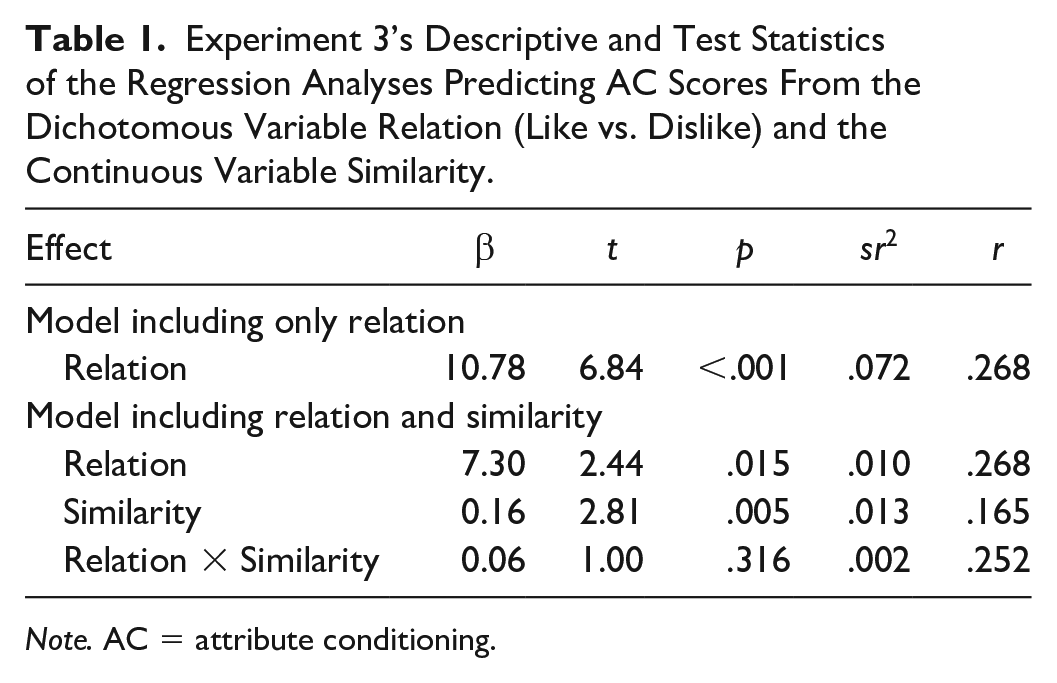
Note. AC = attribute conditioning.
Discussion
Experiment 3 replicated Experiment 2. Relational qualifiers significantly moderated the AC effect in a second-order conditioning setup and controlling for evaluative variance. Going beyond Experiment 2, we measured to what extent participants interpret the like/dislike relation as similarity/dissimilarity. This allowed testing our third potential explanation. On the level of means, we found evidence that participants interpreted the relation as similarity/dissimilarity. On the level of persons, this rating of the relation as similarity/dissimilarity, which was collected at the beginning of the experiment, significantly predicted AC effects. However, even controlling for this similarity interpretation, the like/dislike relation still predicted unique variance in the AC effects. In other words, the interpretation of the relation does not fully explain the relational qualifiers’ influence. We can speculate that it is due to a possible positive connotation of athleticism: Assuming that the majority of people considers being athletic as positive, the residual effect of relation could be similar to a balance effect (cf. Gawronski et al., 2005).
To substantiate the contribution of propositions that we observed in Experiment 3, Experiment 4 aimed to replicate the moderation effect with a different attribute.
Experiment 4: Relational Qualifiers Influence AC of Relationship Status
Experiment 4 tested whether the conditioning of relationship status is also sensitive to a like/dislike relational qualifier, thereby testing the generalizability of the results from Experiments 1 to 3.
Before Experiment 4, we tested AC effects for relationship status in an online sample (n = 60). Showing the breadth of potential AC effects, we found that CSs paired with USs showing couples were considered more likely to be in a relationship (M = 71.47, SD = 18.64, scale from 1 to 101) than CSs paired with USs showing single persons (M = 34.12, SD = 19.00), t(59) = 9.08, p < .001, dz = 1.17. Based on this pretest, we conducted Experiment 4.
Method
Participants and design
We again aimed for 300 participants. Three hundred and five people took part in Experiment 4 on Amazon Mechanical Turk (female: 144, male: 159, other: 1, unspecified: 1, mean age: 33.46 years). The design was highly similar to Experiments 2 and 3, but the conditioned attribute was relationship status as opposed to athleticism.
Procedure and material
The experimental program was very similar to the one in Experiment 3. Instead of the athletic and unathletic pictures in Experiment 3, Experiment 4 used pictures showing single men (in a café, on a couch) or couples as USs. Accordingly, the attribute rating dimension was how likely participants thought the CSs to be single or in a relationship.
Results
Manipulation check
A t-test showed that participants rated CS_1s paired with relationship USs as more likely to be in a relationship (M = 68.65, SD = 20.73) than CS_1s paired with single USs (M = 39.37, SD = 21.62), t(304) = 14.67, p < .001, dz = 0.84.
Attribute ratings
Figure 6 shows participants’ ratings of likeliness to be in a relationship of CS_2s as a function of CS_1-paired attribute (single vs. relationship) and CS_2-CS_1 relation (like vs. dislike). We conducted an ANOVA on those ratings that yielded a main effect of relation. Participants thought CS_2s that liked CS_1s as more likely to be in a relationship (M = 56.61, SD = 26.30) than CS_2s that disliked CS_1s (M = 49.23, SD = 26.69), F(1, 304) = 17.87, p < .001,
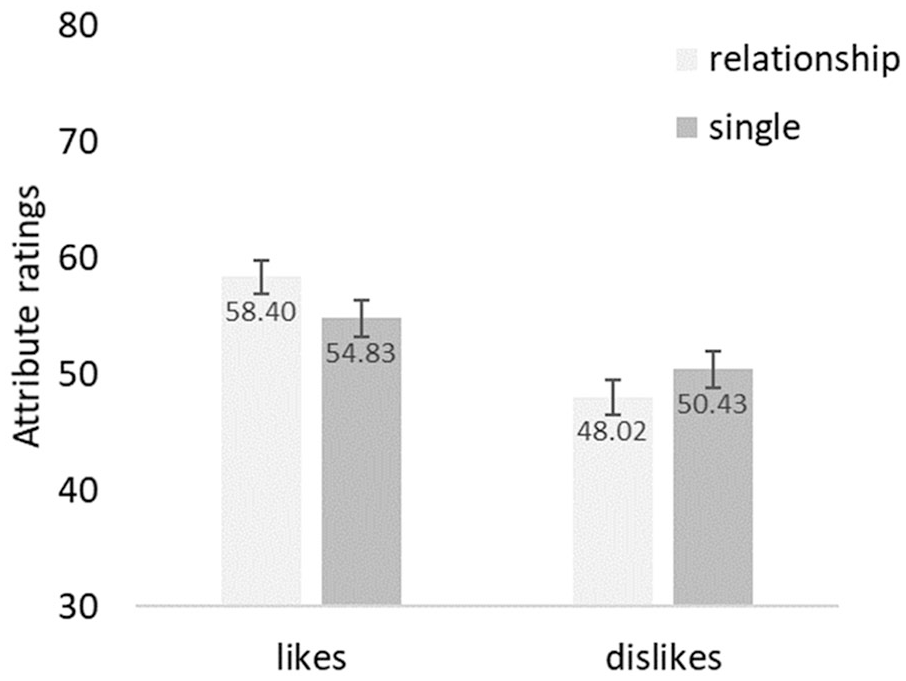
Experiment 4: Attribute (likeliness to be in a relationship) ratings of CS_2s paired with a CS_1 that had previously either been paired with a single or relationship US.
Liking ratings
The ANOVA for liking ratings also showed a main effect of relation. CS_2s that liked a CS_1 were liked more (M = 52.98, SD = 22.77) than CS_2s that disliked a CS_1 (M = 45.16, SD = 22.86), F(1, 304) = 38.12, p < .001,
Attribute ratings controlling for liking
As in the previous experiments, the residuals from a regression analysis predicting attribute ratings from liking ratings were submitted to an ANOVA. We observed a similar pattern as for the uncontrolled attribute ratings. First, participants rated CS_2s that liked CS_1s to be more likely in a relationship than those that disliked CS_1s, F(1, 304) = 6.36, p = .012,
Similarity ratings
As in the previous experiment, a t-test showed that participants perceived two men that like each other as more similar (M = 54.48, SD = 25.84) then two men that dislike each other (M = 41.45, SD = 24.91), t(304) = 6.98, p < .001, dz = 0.40. Thus, for participants, a like/dislike relation between two men implies their similarity/dissimilarity, respectively. We again conducted regression analyses predicting the AC effect from the categorical variable “relation” in one model and including the continuous variable “similarity” in a full model to test whether it reduces or abolishes the influence of relation on AC.
Table 2 shows the beta weights, semi-partial r2s and zero-order correlations for the predictors (and their interaction) of the two regression models They show that the effect of relation on AC is diminished (and no longer significant) when controlling for perceived similarity. In the full model, neither the relation nor similarity predict unique variance in the AC effect of relationship status.
Experiment 4’s Descriptive and Test Statistics of the Regression Analyses Predicting AC Scores From the Dichotomous Variable Relation (Like vs. Dislike) and the Continuous Variable Similarity.

Note. AC = Attribute Conditioning.
Discussion
Experiment 4 generalized the finding that relational qualifiers moderate AC effects beyond athleticism and it replicated Experiment 3’s finding that participants’ interpretation of liking/disliking as similarity (partly) accounts for the moderation. Although there was no main effect of paired attribute, the interaction showed that the AC effect differed for CS_2s that liked CS_1s and those that disliked CS_1s. The interaction was still present when we controlled for liking. However, when we controlled for the interpretation of (dis)liking as (dis)similarity in a regression analysis, the effect of relation on AC was no longer present. In comparison with Experiment 3, though, the like/dislike relation explained less variance overall for the AC effect. Nevertheless, the explained variance was accounted for by the similarity predictor.
There was a strong effect of relation on judged relationship status and likability: Regarding likability, CS_2s who liked CS_1s were liked more than those who disliked CS_1s. This is not surprising and has also been found in Experiments 2 and 3. People who have positive relationships with others are preferred over people who have negative relations with others (see Fiedler & Unkelbach, 2011; Gawronski & Walther, 2008 for similar effects). Regarding relationship status, we also found that participants rated men who liked others to be more likely in a relationship than those who disliked others. A post hoc explanation is that this relationship effect also follows from the observed positive relation. People who have positive relationships with others might also be more likely in a relationship compared with people who have negative relations with others. Although this is not central for our argument, it seems that liking other individuals makes other people believe that one is in a relationship.
General Discussion
On an effect level, AC means that pairing an initially neutral stimulus (CS) with a stimulus possessing a specific attribute (US) changes observers’ rating of the neutral stimulus on this attribute. Concretely, if the initially neutral “Neal” appears together with athletic “Wade,” people rate Neal more athletic compared with when “Wade” would be unathletic. The present studies investigated the influence of relational qualifiers on AC effects and how this potential influence may come about. Concretely, we asked, how athletic do people rate Neal if he dislikes athletic Wade? The questions if and how relational qualifiers influence AC effects constrain the mental processes underlying AC and are also of applied interests.
Across four experiments, we consistently found an interaction of the US attribute and the CS–US relation (i.e., the CS_2-CS_1 relation in Experiments 2–4). Across all experiments in the series that included relational qualifiers, we found the interaction 6 out of 7 times. For example, athleticism ratings of athletic-paired and unathletic-paired CSs differed significantly depending on whether the CS liked or disliked the US (or CS_1, to be precise, in Experiments 2 and 3). In addition, Experiment 1 showed this interaction on an indirect measure and Experiment 4 showed the interaction with the attribute relationship status. The smallest effect size for the interaction we observed was
Effect Sizes (
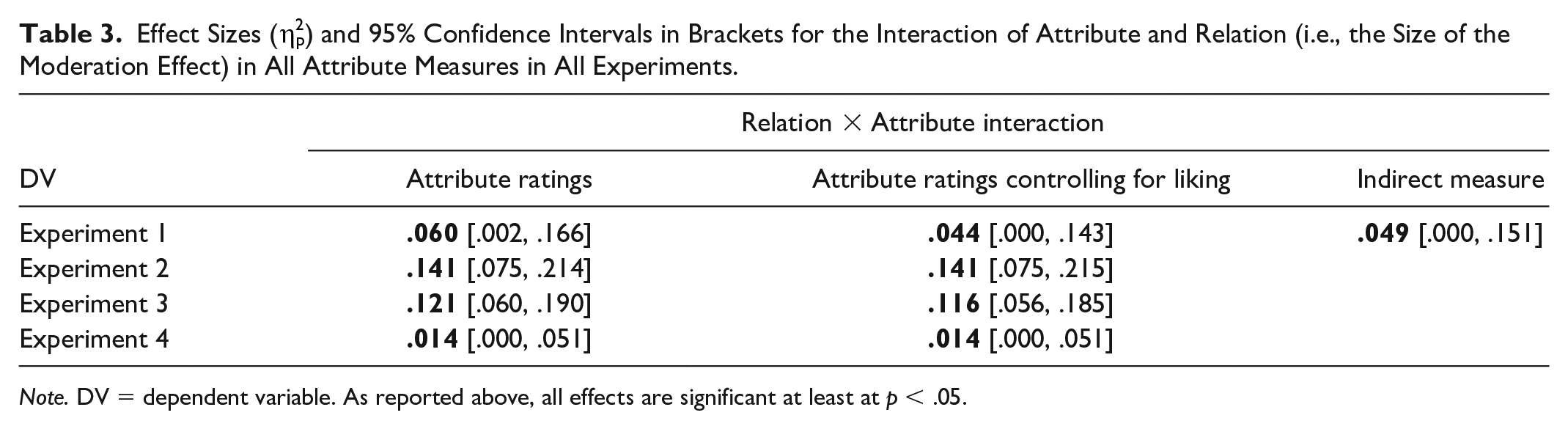
Note. DV = dependent variable. As reported above, all effects are significant at least at p < .05.
The question on the process level has a more differentiated answer. A priori, we considered three potential explanations. First, an evaluative connotation of the attribute, which would be in analogy to relational qualifiers in EC research, resulting in a halo effect on the specific attribute. Second, an impression formation effect in which participants infer a like/dislike relation of the CS with the activity or the attribute itself. And third, an interpretation of the relation as a similarity relation, which would justify propositional influences of the relational qualifiers on AC effects.
The first explanation received little support; particularly Experiments 2 to 4 showed almost no change in effect sizes when we controlled for participants’ evaluative variance in the attribute ratings. We investigated the second explanation using a second-order conditioning procedure (Experiments 2–4). Thereby, the target CS never appeared together with the attribute or the activity, but only with another stimulus that we previously conditioned to athletic or unathletic (or in a relationship or single). If the second explanation would be valid, this setup should substantially reduce the relational qualifiers’ influence. Rather, the opposite was the case: For Experiments 2 and 3, we observed numerically stronger effects in comparison with the direct pairings in Experiment 1, in which target CS and the activity were presented together. The third explanation was supported in Experiments 3 and 4. Participants’ perceived similarity of stimuli (dis)liking each other (partially) accounted for the influence of relational qualifiers on AC. This is in line with a propositional reasoning explanation of the effect along the lines of “Neal dislikes athletic Wade. People who dislike each other are usually dissimilar. Therefore, Neal is unathletic..”
Theoretical Implications for Processes Underlying AC
We have presented some evidence that the moderation of AC by relational qualifiers is (at least partly) based on inferential processes. We, thus, conclude that inferential processes contribute to the AC effect more generally. Specifically, we interpret our findings as evidence for a propositional link between CS and US as anticipated in Unkelbach and Förderer’s (2018) model. This conclusion assumes that the same processes that we demonstrated in the relational qualifier paradigm are also operating in the standard AC paradigm without relational qualifiers. We believe this to be justified, as it seems unlikely that the inclusion of relational qualifiers qualitatively alters the processing of AC pairings. As Hughes and colleagues (2016) explain in their paper on arbitrarily applicable relational responding, humans ubiquitously assign relational meaning. That is, even when they only passively observe AC pairings, they should, from their ecological learning history, construe relations between the paired stimuli (e.g., “they belong together”).
Assuming that propositional reasoning contributes to AC effects, the question remains whether another process that is independent of propositional reasoning contributes to the effect. Apart from the interaction effect in all experiments, we observed a main effect of paired attribute in Experiments 1 and 3’s attribute ratings. This main effect is indicative of an assimilative effect of the CS–US (or CS_1–CS_2) pairings that exists independent of the moderation by the relation. This effect is especially surprising in Experiment 3 where we separated the pairings of to-be-rated CS and US by a second-order conditioning procedure. Although this assimilative effect seems to be relatively fickle in our experiments (see also Moran & Bar-Anan, 2020), it is theoretically important because it is compatible with a dual-process explanation of AC (cf. Heycke & Gawronski, 2020). That is, the assimilative effect might be the result of an unqualified referential link between CS and US (Unkelbach & Förderer, 2018). It is an interesting venue for future research to test the consistency and the mental basis of this assimilative effect, and to experimentally dissociate propositional from potential associative links in AC effects.
Limitations and Open Questions
The patterns observed for liking ratings differed between Experiment 2 to 4, that were conducted online with an US American sample and Experiment 1 that was conducted in the laboratory with a German student sample. Participants in online experiments consistently showed a main effect of relation, that is, they liked CSs that liked others and disliked those that disliked others; this effect was already reported by Fiedler and Unkelbach (2011; see also Gawronski & Walther, 2008). Participants in the laboratory experiment, in contrast, showed that same pattern for liking ratings as for attribute ratings: a main effect of attribute and an interaction. It might be that laboratory participants’ liking ratings were informed by the conditioned attribute because athleticism is considered positive. Our conclusions, however, are unaffected by these differences, as the analysis of attribute ratings that control for liking precludes that attribute ratings were informed by conditioned liking.
Regarding our conclusions about mental processes, there are two important limitations. First, our instructions can be considered memory instructions that could promote propositional reasoning. It would be interesting to test if the same effects emerge under, for example, impression formation instructions (cf. Moran et al., 2015), although we typically do not find differences between memory and impression formation instructions on conditioning effects in our laboratory (see Alves et al., 2020). Second, the proposition that we argue to contribute to the moderation effect (liking indicates similarity) was measured before the pairings were presented. Asking participants what (dis)liking reveals about similarity might have prompted them to infer (dis)similarity from the relational qualifiers in the learning phase. Across studies, it is unlikely though that such a prompt is responsible for the regression results. Experiment 2 did not include this prompt and showed similar effect sizes as Experiment 3 (see Table 3). In addition, Experiment 4 included the prompt and showed the weakest influence of the qualifier, although this might be due to the specific attribute.
Despite these limitations and some caution, we believe that the effect of disliking someone athletic making people appear unathletic partially reflects propositional processes in AC.
Conclusion
Relational qualifiers moderate AC: Empirically, participants rated CS persons disliking an athletic US person as unathletic and CS persons disliking US persons who are in a relationship as to be likely single. Theoretically, the effect seems partially to depend on participants’ construal of the CS–US relation as indicative of similarity; this suggests that the learned CS–US link is not merely associative, but carries meaning. The data, however, do not allow distinguishing between a purely propositional link or a merely associative and a propositional link. Practically, this implies that if someone dislikes Serena Williams or Dirk Nowitzki, the person will be perceived as unathletic despite the fact that the person might dislike them for reasons that have nothing to do with athleticism.
Supplemental Material
Hogden_Online_Appendix – Supplemental material for The Role of Relational Qualifiers in Attribute Conditioning: Does Disliking an Athletic Person Make You Unathletic?
Supplemental material, Hogden_Online_Appendix for The Role of Relational Qualifiers in Attribute Conditioning: Does Disliking an Athletic Person Make You Unathletic? by Fabia Högden and Christian Unkelbach in Personality and Social Psychology Bulletin
Footnotes
Declaration of Conflicting Interests
The author(s) declared no potential conflicts of interest with respect to the research, authorship, and/or publication of this article.
Funding
The author(s) disclosed receipt of the following financial support for the research, authorship, and/or publication of this article: This research was supported by a grant from the Deutsche Forschungsgesellschaft DFG awarded to the second author (UN 273/4-2).

Supplemental Material
Supplemental material is available online with this article.
Notes
References
Supplementary Material
Please find the following supplemental material available below.
For Open Access articles published under a Creative Commons License, all supplemental material carries the same license as the article it is associated with.
For non-Open Access articles published, all supplemental material carries a non-exclusive license, and permission requests for re-use of supplemental material or any part of supplemental material shall be sent directly to the copyright owner as specified in the copyright notice associated with the article.
