




Abstract
People rely on intuitive knowledge about persuasion to cope with persuasion attempts motivated by self-interest. Because this knowledge associates persuasive intent with low trustworthiness, identifying the communicator as an agent with ulterior motives tends to reduce trust in the communicator. Three studies suggest that the extent to which people call on this association to assess a persuasion agent depends on whether the agent’s message challenges or reinforces their prior attitudes. Challenged attitudes motivate people to use the negative association between persuasive intent and trustworthiness, whereas reinforced attitudes lead people to neglect it. However, prior attitudes do not affect people’s capacity to detect cues of ulterior motives and develop an awareness of the persuasive intent. Thus, recipients of persuasive messages that support their prior beliefs trust persuasion agents despite being aware of the agents’ ulterior motives. This seems to be a byproduct of people’s motivation to preserve a sense of self-integrity.
Persuasion is often motivated by ulterior motives of the agent (i.e., the author of the persuasion attempt). Politicians often express opinions and make promises with the purpose of persuading the audience to support them, even when the politicians themselves do not firmly believe their own words. Similarly, because salespeople are rewarded for their sales performance, interactions with potential buyers involve objectives like increasing the chances that they will make a purchase and encouraging the purchase of more expensive products. Research in applied fields indicates that, when ulterior motives are at play, increased awareness of persuasive intent triggers concerns about the trustworthiness of the communicator (e.g., Campbell & Kirmani, 2000; Isaac & Grayson, 2017; Main et al., 2007). Ostensibly, people develop some intuitive knowledge where persuasive intent driven by ulterior motives is associated with low agent trustworthiness. They rely on this intuitive knowledge to avoid becoming victims of a communicator whose primary goal is to influence their behavior for her or his own personal benefit (Darke & Ritchie, 2007; Friestad & Wright, 1994; Guo & Main, 2012; Settle & Golden, 1974).
The current research explores situations where people detect ulterior motives and the persuasive intent of a communicator, but do not downgrade assessments of trustworthiness—that is, situations in which targets of a persuasion attempt abandon their own intuition that communicators with ulterior motives are less worthy of trust. We argue that an important factor determining the extent to which individuals rely on this piece of intuitive knowledge is the attitudinal congeniality of what the persuasion agent tells them (i.e., the extent to which the content of the persuasive message is congruent with their prior beliefs—e.g., Eagly et al., 2001). We propose that when the content of the message challenges prior attitudes, people become highly motivated to rely on the association between persuasive intent and low agent trustworthiness. However, when the content of the message is congruent with prior attitudes, this otherwise accepted association is avoided, giving rise to peculiar settings in which awareness of persuasive intent coexists with trust in the communicator. Moreover, we argue that, although prior attitudes dictate how awareness of persuasive intent informs trustworthiness judgments, attitudes do not affect individuals’ capacity to detect ulterior motives based on contextual cues (e.g., who the communicator is, incentives for her or him to say certain things and not others).
Our predictions build on the notion that humans are motivated to maintain a global sense of self-integrity (vide self-affirmation theory; Sherman & Cohen, 2006; Steele, 1988). The moderating influence of attitudes on the relationship between awareness of persuasive intent and trustworthiness judgments is theorized as a manifestation of defensive responses to threats to self-integrity (self-threats). Although previous research has documented judgmental tendencies driven by self-integrity preservation (e.g., Sherman & Cohen, 2006; Zuwerink & Devine, 1996), studies exploring settings that involve ulterior motives are rare. Researchers have typically explored these tendencies by exposing participants to impersonal arguments that challenged their prior attitudes but would not come from a source who could personally benefit from convincing the audience. Our research helps clarify how reactions to self-threats play out when persuasion is driven by ulterior motives. In addition, our research departs from the traditional focus on what happens when people are faced with counterattitudinal information—which has dominated self-affirmation/prior attitudes research—to highlight responses to proattitudinal information. This is an increasingly relevant facet of persuasion phenomena because of the algorithm-driven ubiquity of information bubbles and echo chambers, where individuals are intensely exposed to information/messages reinforcing their beliefs.
Research Background
We begin by demarcating the type of situation we refer to as a persuasion setting/episode. We focus on situations where the persuasion attempt is related to personal interests of its author that might overshadow the best interest of the audience/targets. Thus, we discuss persuasion as a manipulative effort of the persuasion agent. A similar approach is found in previous research where the accessibility of ulterior motives increased the extent to which participants reported thinking the agent “was trying to persuade” them (Campbell & Kirmani, 2000). Detecting ulterior motives was shown to raise self-reported awareness of the persuasive nature of the agent’s behavior. However, we acknowledge that persuasion is a broader phenomenon and is not necessarily motivated by self-interest. It is beyond the scope of our research, but persuasion may, for instance, be primarily motivated by the societal relevance of the message and focus on the best interest of the targets (e.g., raise engagement with environmental protection).
Next, we outline the basic process through which people incorporate their knowledge about persuasion into assessments of communicator trustworthiness. We then theorize the self-threats that this process entails and people’s reactions to them.
Trustworthiness Judgments in Persuasion Settings
Trust reflects one’s confidence that another party will not direct dishonest and potentially harmful acts, such as mislead or lie, toward her or him for the sake of personal benefits (Main et al., 2007). The process of judging trustworthiness deals with questions like “Is this person interested in taking advantage of me?” and involves contextual analyses aimed at answering such questions (Briñol et al., 2004; Friestad & Wright, 1994; Zuwerink & Devine, 1996). These analyses involve resorting to assumptions/beliefs about the motivations of persuasion agents, persuasion strategies, and the signs that these strategies are being employed. People seem to develop some intuitive knowledge in the form of beliefs and associations involving these themes to cope with persuasion attempts. This knowledge is referred to as persuasion knowledge (Friestad & Wright, 1994).
Persuasion episodes involve a process through which inferences that stem from the interplay of persuasion knowledge with contextual cues are integrated into judgments people make about the persuasion agent. This process starts with the scanning of contextual cues and information provided by the agent. When this initial analysis identifies ulterior motives (or leads to the inference that they exist), resorting to persuasion knowledge leads people to interpret the behavior of the communicator as charged with persuasive intent (Campbell & Kirmani, 2000; Kirmani & Zhu, 2007). The state in which this interpretation of the communicator’s behavior is formed can be regarded as a state of awareness of persuasive intent.
When the state of awareness is reached, people begin to retrieve information from their persuasion knowledge that is relevant to cope with persuasion attempts. Typically, awareness of persuasive intent activated by motive detection decreases trust (Campbell & Kirmani, 2000; Guo & Main, 2012; Main et al., 2007). This negative effect stems from an intuitive notion that is often part of people’s persuasion knowledge and that assumes that the primary objective of a persuasion agent is to convince the audience of something that ultimately leads to personal benefits for herself or himself, even when successfully doing so is detrimental to the audience’s best interest (Fein & Hilton, 1994; Friestad & Wright, 1994; Main et al., 2007; Marchand & Vonk, 2005). Succinctly speaking, people associate persuasive intent with low trustworthiness.
Prior Attitudes and Self-Threats in Persuasion Settings
Self-affirmation theory posits that humans have a fundamental need to maintain a sense of self-integrity (Steele, 1988). People’s need to see themselves as consistent, competent, and good is known to be a pervasive source of processing and judgmental tendencies (Martens et al., 2006; Sherman & Cohen, 2006). Information that threatens self-integrity (e.g., counterattitudinal information) triggers defensive reactions that shape the interpretation of the information itself and of the context in which it is delivered (Sherman & Cohen, 2006). These reactions often involve downgrading the validity of the information, which can be achieved by discounting the quality of its source (Lord et al., 1979; Sherman & Cohen, 2006; Zuwerink & Devine, 1996). Thus, in persuasion episodes, a self-threat arises when the persuasive message challenges prior attitudes of the target. Evidently, this cannot be the case when the persuasive message reinforces prior attitudes. We propose that, in this case, the self-threat resides in the conclusion that the persuasion agent is unreliable.
When persuasive communication challenges prior attitudes
Consider a salesperson presenting a product. Basically, salespeople suggest things along the lines of, “This product is good for you!” If the customer has negative prior attitudes toward the product, this message can be processed as a self-threat. As a consequence, it will elicit responses aimed at self-integrity preservation, like downgrading salesperson trustworthiness. Concomitantly, because people tend to be cognizant of salespeople’s ulterior motives (Campbell & Kirmani, 2000; Rule et al., 1985), the use of persuasion knowledge will encourage depreciative trustworthiness assessments. The additional motivation to downgrade trustworthiness, driven by self-integrity preservation, will stimulate emphasis on the negative association between persuasive intent and agent trustworthiness, thus intensifying the negative effect of awareness of persuasive intent on trust. Note that the association between persuasive intent and low trustworthiness is particularly attractive for individuals with this motivation because it provides a justifiable reason to downgrade the source of the self-threat.
When persuasive communication reinforces prior attitudes
We predict a more complex phenomenon when the persuasive communication supports, rather than threatens, self-integrity. Consider a customer with positive attitudes. There is no threat when the salesperson says positive things about the product. However, given the contextual cues (e.g., the fact that the communicator is a salesperson), the situation will be processed as a persuasion attempt, thus activating awareness of persuasive intent. The customer is then faced with a conflicting scenario where she or he is dealing with a person she or he is compelled to deem unworthy of trust (because awareness activates the association between persuasive intent and low trustworthiness), but who, at the same time, is suggesting something that supports her or his self-integrity. The content of the communication itself is not a self-threat, but the situation is self-threatening because agreeing with someone who has negative attributes (low trustworthiness) is also detrimental to self-integrity. We theorize that to cope with this threat, people will neglect the association between persuasive intent and low trustworthiness. Consequently, people will be in a state where they recognize but also trust the persuasion agent.
Note that the idea of awareness of persuasive intent coexisting with positive trustworthiness assessments implies that self-protective responses only emerge in the process of incorporating persuasion knowledge into trustworthiness judgments after awareness of persuasive intent has been activated. That is, prior attitudes moderate the influence of awareness on trust, but not the influence of contextual cues of ulterior motives on motive detection and awareness activation.
Indeed, we do not expect the moderating role of attitudes to come into play before awareness of persuasive intent has been elicited. We make the assumption of a necessary primacy of the state of awareness relative to the integration of input informed by knowledge about persuasion agents into trustworthiness judgments. In persuasion episodes, before awareness of persuasive intent has been activated, it has not been established if the individual’s intuitive knowledge about persuasion agents is applicable to the communicator. To the extent that this is the set of information from persuasion knowledge that informs trustworthiness assessments, a moderating influence of attitudes anteceding awareness activation would intervene in parts of the process of integrating persuasion knowledge into agent assessment where the relevant beliefs and associations that are called on do not yet refer to characteristics of persuasion agents. When ulterior motives are detected, an association between ulterior motives and intent to persuade is activated. This association triggers awareness of persuasive intent, but includes no information about the trustworthiness of persuasion agents. It is awareness that then activates associations involving characteristics of persuasion agents, including expected trustworthiness. These associations can then be taken advantage of when one is motivated to degrade communicator credibility (the case of uncongenial attitudes) or need to be suppressed to preserve acceptable levels of self-integrity (the case of congenial attitudes).
Overview of Studies
We present three studies involving persuasion episodes where we manipulated contextual cues to make ulterior motives of the communicator salient (vs. not/less salient). Following the episodes, awareness of persuasive intent and trust in the communicator were measured (Study 1 also measured motive detection). We were therefore able to examine the process through which persuasion knowledge is incorporated into trustworthiness assessments using mediation models where the detection of ulterior motives predicts awareness of persuasive intent, which, in turn, predicts perceived trustworthiness. We examined moderating effects of prior attitudes across the paths of this process. Studies 1 and 2 highlight the tendency of individuals dealing with attitudinally congenial persuasive messages to reconcile high persuasion awareness with favorable trustworthiness judgments. Study 3 examines the mechanism (i.e., self-integrity preservation). All manipulations and relevant measures are reported in the article. Data sets are available at the Open Science Framework (OSF; DOI: 10.17605/OSF.IO/CWRJ8).
Study 1
In 2018, Brazil was the stage of a polarizing presidential race that led to the victory of far-right candidate Jair Bolsonaro. A main theme of Bolsonaro’s first weeks in office was the formation of the administration team. Public figures interested in a position in the government would express their admiration for the president and his ideas on social media and in interviews. We used this scenario to test our hypotheses.
Brazilians were invited to complete a “survey about Brazil and its political landscape.” The first part of the study asked their opinion about Bolsonaro’s economic policy. In the second part, they read positive comments that an economist made about Bolsonaro’s economic plan. We manipulated contextual cues by assigning participants to receive background information about the economist suggesting that s/he was interested (vs. not interested) in a position in the government. Participants then completed a questionnaire asking the extent to which they (a) detected ulterior motives in the economist’s flattering comments about Bolsonaro (motive detection), (b) perceived the comments as a persuasion attempt (awareness of persuasive intent), and (c) trusted the economist (trustworthiness judgments).
Procedure and Measures
Participants (N = 156) were recruited for a two-phase experiment. Measures and instructions were translated to Brazilian Portuguese. Data were collected through a social media snowball initiated by researchers based in Brazil who agreed to help the authors, starting on January 12, 2019 and lasting until participation rates dropped to one participant per week (38 days later).
Phase 1
Prior attitudes toward the economic policy
Participants expressed their opinion about 10 political issues (slider scale, −50 = Extremely unfavorable, 50 = Extremely favorable). Three issues were relevant to the study (the others served to avoid suspicion about the purpose of the study): (a) Bolsonaro’s government, (b) Bolsonaro’s economic plan and team, and (c) Paulo Guedes (the well-known leader of Bolsonaro’s economic team). The experiment was set up so that positive (negative) attitudes reflect agreement (disagreement) with the persuasive message. The three items were averaged into an “attitudes score” (α = .96). Before proceeding to Phase 2, participants completed a distraction task.
Phase 2
Contextual cues
Participants were told they would read part of an interview where an economist talks about Bolsonaro’s policies. They were told that, because the economist’s identity was not relevant for the study, we would call her or him “the economist.” A paragraph with background information about the economist provided contextual cues that we manipulated to make ulterior motives to flatter the President salient (vs. not salient). Participants were randomly assigned to read that either the economist now lives in another country and does not expect to return to Brazil (i.e., no salient ulterior motive) or that she or he has demonstrated interest in returning to the country and becoming part of the government’s economic team (i.e., salient ulterior motive). Participants then read a made-up part of the interview where the economist made positive comments about Bolsonaro’s economic plan (see the Supplemental Material). They then completed a questionnaire with the measures described next (responses were recorded on 7-point scales, 1 = Strongly disagree, 7 = Strongly agree).
Motive detection
One item measured the extent to which participants detected ulterior motives: “It seems to me that what the economist said was related to her or his interest in becoming part of Bolsonaro’s economic team.” This variable was mean-centered when used as a predictor in our analysis.
Awareness of persuasive intent
One item measured the extent to which the comments by the economist were perceived as a persuasion effort: “After reading the comments, I thought it was obvious that the economist was trying to persuade the audience” (Campbell & Kirmani, 2000; Guo & Main, 2012). This variable was mean-centered whenever used as a predictor (applies to all studies).
Trustworthiness judgment
Three items were adapted from Main et al. (2007): “The economist seemed sincere/honest/trustworthy” (averaged into a single variable, α = .94).
Analysis and Results
Our analysis was guided by a serial mediation model reflecting the theorized process through which contextual cues of ulterior motives affect trust (Figure 1 1 ): salient cues facilitate motive detection (Path a1), which activates awareness of persuasive intent (Path d), and awareness decreases trust (Path b2). The focus of the analysis was the moderating influence of prior attitudes on these paths. Our theorization predicts a moderating influence of attitudes on the effect of awareness of persuasive intent on trust (b2), but no moderation is expected in the paths that precede this relationship.

Serial mediation model.
As predicted (in Path a1), motive detection was higher when the contextual information suggested that the economist was interested in joining the President’s economic team (M = 3.61 vs. M = 4.22), b = 0.81, SE = 0.31, 95% confidence interval [CI] = [0.20, 1.41], t(152) = 2.64, p = .009, β = .19 2 . This effect was not moderated by attitudes, b = −0.01, SE = 0.01, 95% CI = [−0.03, 0.01], t(152) = 1.21, p = .227, β = −.09. Motive detection increased awareness of persuasive intent (Path d), b = 0.56, SE = 0.06, 95% CI = [0.44, 0.69], t(152) = 8.71, p < .001, β = .61, and mediated the effect of the contextual cues on awareness (a1 × d), bindirect effect = 0.48, 95% bootstrap CI = [0.12, 0.81]. 3 The effect of motive detection on awareness was not moderated by attitudes, b = 0.001, SE = 0.002, 95% CI = [−0.002, 0.004], t(152) = 0.64, p = .523, β = .04.
As expected, attitudes moderated the effect of awareness of persuasive intent on trust (Path b2), b = 0.005, SE = 0.002, 95% CI = [0.001, 0.008], t(152) = 2.71, p = .008, β = .19. A floodlight analysis revealed a Johnson–Neyman (JN) significance region where awareness exerted negative effects on trust at attitudes < −31.45—effects were nonsignificant otherwise (Figure 2A). This JN region covers 38.46% of the total sample. Figure 2B shows trust as a function of awareness at different levels of attitudes based on a spotlight analysis. 4 In Study 1, negative attitudes seemed to be necessary for awareness to diminish trust—effects of awareness were nonsignificant when attitudes were close to zero (i.e., neutral).
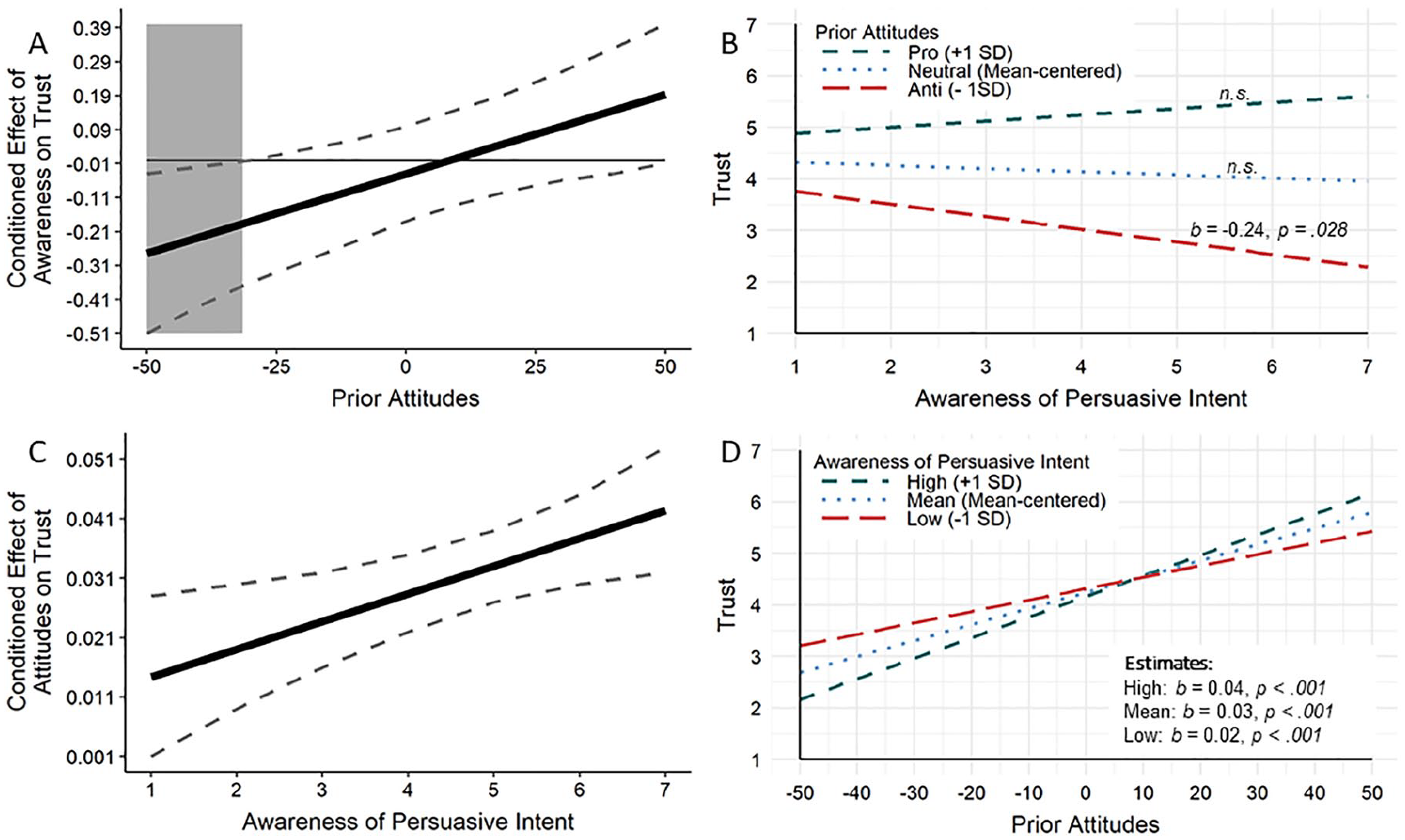
(A) Conditioned effects of awareness on trust (unstandardized estimates obtained from a floodlight analysis) as a function of prior attitudes. (B) Predicted values of trust as a function of awareness of persuasion intent at three focal levels prior attitudes (based on estimates obtained from a spotlight analysis). (C) Conditioned effects of prior attitudes on trust (unstandardized estimates obtained from a floodlight analysis) as a function of awareness. (D) Predicted values of trust as a function of prior attitudes at three focal levels of awareness of persuasive intent (based on estimates obtained from a spotlight analysis). In (A), the shaded area represents the Johnson–Neyman region of significance (Study 1).
The Attitudes × Awareness interaction determined the indirect effects of motive detection on trust mediated by awareness (d × b2). We observed a negative indirect effect of motive detection on trust at 1 SD below the mean of attitudes, bindirect effect = −0.13, 95% bootstrap CI = [−0.25, −0.02]. However, at the mean level and 1 SD above the mean, the indirect effects were nonsignificant, bindirect effect = −0.03, 95% bootstrap CI = [−0.13, 0.05] and bindirect effect = 0.07, 95% bootstrap CI = [−0.10, 0.18], respectively. We further observed the influence of this interaction in indirect effects of contextual cues on trust through serial mediation (a1 × d × b2). Attitudes at 1 SD below the mean yielded a significant indirect effect serially mediated by motive detection and awareness: bindirect effect = −0.16, 95% bootstrap CI = [−0.40, −0.03]. At the mean level and 1 SD above the mean, these effects were not significant, bindirect effect = −0.03, 95% bootstrap CI = [−0.13, 0.05] and bindirect effect = 0.03, 95% bootstrap CI = [−0.03, 0.26], respectively.
Because the Attitudes × Awareness interaction can also reflect changes in effects of attitudes as a function of awareness, we conducted another floodlight analysis assessing conditioned effects of attitudes on trust (Figure 2C). Effects were significant across all levels of awareness of persuasive intent. The greater the awareness, the more trustworthiness judgments were hurt by negative and benefited from positive prior attitudes (Figure 2D).
In essence, results suggest that people whose attitudes are reinforced by the persuasive message tend to trust the communicator even when they are aware of her or his persuasive intent. An additional graphical exploration of the coexistence of trust and awareness of persuasive intent is available in the Supplemental Material.
While the data support the theorized process of the influence of contextual cues of persuasion on trust, the Attitudes × Awareness interaction did not dictate the total effect of the Attitudes × Motive Detection interaction on trust when not accounting for awareness as a mediator, b < 0.001, SE = 0.001, 95% CI = [−0.003, 0.003], t(152) = 0.07, p = .948, β = .004. Similar results were obtained for the total effect of the Attitudes × Contextual Cues interaction on trust, b = −0.004, SE = 0.006, 95% CI = [−0.02, 0.007], t(152) = 0.73, p = .469, β = −.04. Ostensibly, the contextual cues of persuasion triggered parallel processes that counterbalanced the moderating effect of attitudes on the process mediated by awareness of persuasive intent. These unidentified processes and the process mapped by our study might have canceled each other out, producing nonsignificant total effects of the Attitudes × Contextual Cues and Attitudes × Motive Detection interactions on trust (Zhao et al., 2010).
Discussion
We broke down a process where contextual cues of ulterior motives affect trustworthiness judgments through the activation of persuasion awareness. The influence of prior attitudes at each stage of the process was examined. Results supported the idea that this process can be disrupted by attitudes people bring into the persuasion setting, but this interference occurs only after people concluded that the message is charged with persuasive intent. When attitudes agree with the content of the message, they give rise to a situation where people neglect the intuitive idea that persuasion agents are unreliable. Concomitantly, increased awareness of persuasive intent intensifies the effects of prior attitudes on trust. Thus, persuasion agents presenting proattitudinal messages may even benefit from having the audience aware of their ulterior motives. Relatedly, results supported the notion that, as an outcome of the dynamics between attitudes and persuasion awareness, when people hold an initial position that agrees with the persuasive message, relatively high levels of awareness of persuasive intent can coexist with relatively high levels of trust in the communicator. In contrast, when people are faced with counterattitudinal persuasive messages, attitudes and awareness reinforce each other’s negative influence on trust.
Oddly, we did not observe negative effects of awareness of persuasive intent at neutral levels of prior attitudes. This finding challenges the idea that the congruence between beliefs and message content obliviates the intuition that persuasive intent signals low trustworthiness. Instead, it suggests that this intuition is activated by attitudinal incongruence. However, we speculate that the observed null effects of awareness at neutral levels of attitudes are explained by the configuration of the persuasion setting in Study 1. The primary target the economist had to persuade was the President; the audience was a secondary target. It is possible that the sensation of being a target was not strong enough among participants with neutral attitudes for the recognition of the persuasive nature of the economist’s comments to influence their trustworthiness evaluations. These participants might have not perceived the persuasive intent to be directed to them and, therefore, did not make strong conclusions that the economist would act dishonestly toward them.
Study 2
Study 2 had two main purposes. One was to address key limitations of Study 1. As discussed above, participants of Study 1 might have perceived themselves as secondary targets of the agent. Study 2 overcomes this issue by assigning participants to the role of a customer interacting with a salesperson. A second limitation was that prior attitudes were collected within the same study session as the outcome measures. Study 2 introduces a 1-week window between the attitudes measure and the rest of the procedure.
The second purpose was to explore a different context, where different cues of ulterior motives are at play. Participants engaged in a role-playing experiment where they found themselves in an electronics store looking for a laptop for their own personal use. We examined moderating effects of prior attitudes toward the brand of the laptop. Because the salesperson in the scenario presents the laptop in a favorable light (as salespeople normally do when trying to sell a product), (negative)positive attitudes reflect (in)congruence between attitudes and the content of the persuasive message.
Study 2 adopts a different approach to manipulate ulterior motives cues: communication sidedness. Participants were exposed to a one- versus two-sided product presentation. In product presentations by a salesperson, one- and two-sided communication make the salesperson’s self-interest motive salient and not/less salient, respectively. The salience-attenuating property of two-sided communication is related to the idea that, when interacting with a salesperson, people start off with high persuasion awareness. The job of the salesperson itself is interpreted as a cue of ulterior motives because of the notion that salespeople are rewarded for their sales performance. This assumption induces the expectation that the salesperson will make one-sided, positive product presentations. When she or he makes a two-sided presentation instead (i.e., she mentions at least one positive and one negative remark about the product), she or he subverts this expectation. The product presentation then signals low motivation to persuade consumers and encourages individuals to lower their guard while assessing the salesperson (Crowley & Hoyer, 1994). Thus, two-sided communication makes ulterior motives less evident and, as a consequence, reduces persuasion awareness.
Finally, because Study 1 indicated that attitudes moderate neither the relationship between contextual cues and motive detection nor the relationship between motive detection and awareness of persuasive intent, we simplified the model guiding Study 2 by not assessing motive detection directly. We assume that an influence of the contextual cue manipulation on awareness of persuasive intent implies different levels of motive detection across conditions. Thus, Study 2 works with a simple mediation model predicting that a one-(vs. two-) sided product presentation will increase awareness, which will exert a negative effect on trust in the salesperson. We predict that the effect of awareness on trust will be moderated by attitudes toward the laptop brand such that awareness will reduce trust when attitudes are negative or neutral, but will have no influence when attitudes are positive. Attitudes are not expected to moderate the relationship between communication sidedness and awareness of persuasive intent.
Procedure and Measures
Participants (N = 137 5 ) were recruited on Amazon’s Mechanical Turk (MTurk). They initially completed a study about laptops (Phase 1). About 1 week later, we invited them to participate in an allegedly new and unrelated study, which, in reality, was the continuation of Study 2 (Phase 2).
Phase 1
Prior attitudes toward Lenovo laptops
Participants completed a questionnaire with several questions about laptops. Four items (5-point semantic differential scales ranging from −2 to 2) asked about their attitudes toward Lenovo laptops—unfavorable/favorable, negative/positive, dislike/like, bad/good (α = .97). These items were averaged into a single “attitudes score.”
Phase 2
Contextual cues
One week later, participants were randomly assigned to be exposed to either a one- or a two-sided product presentation. They read a role-playing vignette where they found themselves in a store and a salesperson approached them and presented a Lenovo laptop (see Supplemental Material). In the one-sided condition, the salesperson described five attributes of the laptop in a positive light (i.e., salient ulterior motive). In the two-sided condition, the salesperson made positive remarks about four of the same attributes, but mentioned that the laptop did not perform very well on the fifth attribute (i.e., no salient ulterior motive). 6 Thus, even the two-sided presentation was generally favorable to the product.
Awareness of manipulative intent and trustworthiness judgment
Same measures as in Study 1, except that responses were recorded on 5-point scales.
Analysis and Results
The analysis was again guided by a mediation model for the process in which persuasion awareness mediates an effect of contextual cues of ulterior motives on trust (Figure 3 7 ). Again, our analysis focused on moderating effects of prior attitudes.
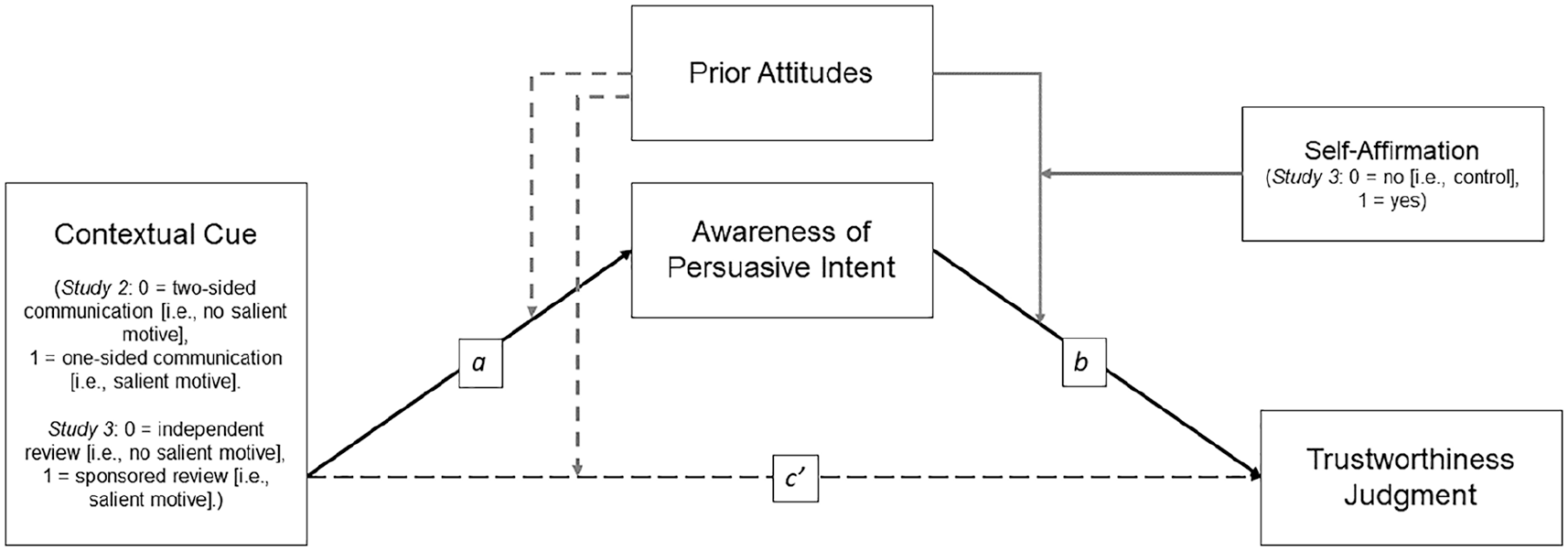
Mediation model.
Communication sidedness influenced awareness (Path a) such that awareness was higher when participants were exposed to a one-sided product presentation compared with its two-sided version (M = 2.64 vs. M = 4.06), b = 1.42, SE = 0.21, 95% CI = [1.01, 1.82], t(133) = 6.85, p < .001, β = .53. This effect was not moderated by attitudes, b = 0.24, SE = 0.22, 95% CI = [−0.19, 0.67], t(133) = 1.10, p = .272, β = .12.
In Path b, we found an interaction between attitudes and awareness of persuasive intent, b = 0.21, SE = 0.08, 95% CI = [0.06, 0.37], t(131) = 2.73, p = .007, β = .29. A floodlight analysis revealed a JN region of significant negative effects of awareness on trust (attitudes < .98—Figure 4A). This region includes 66.42% of the sample. Figure 4B displays trust in the salesperson as a function of awareness using a spotlight analysis. 8
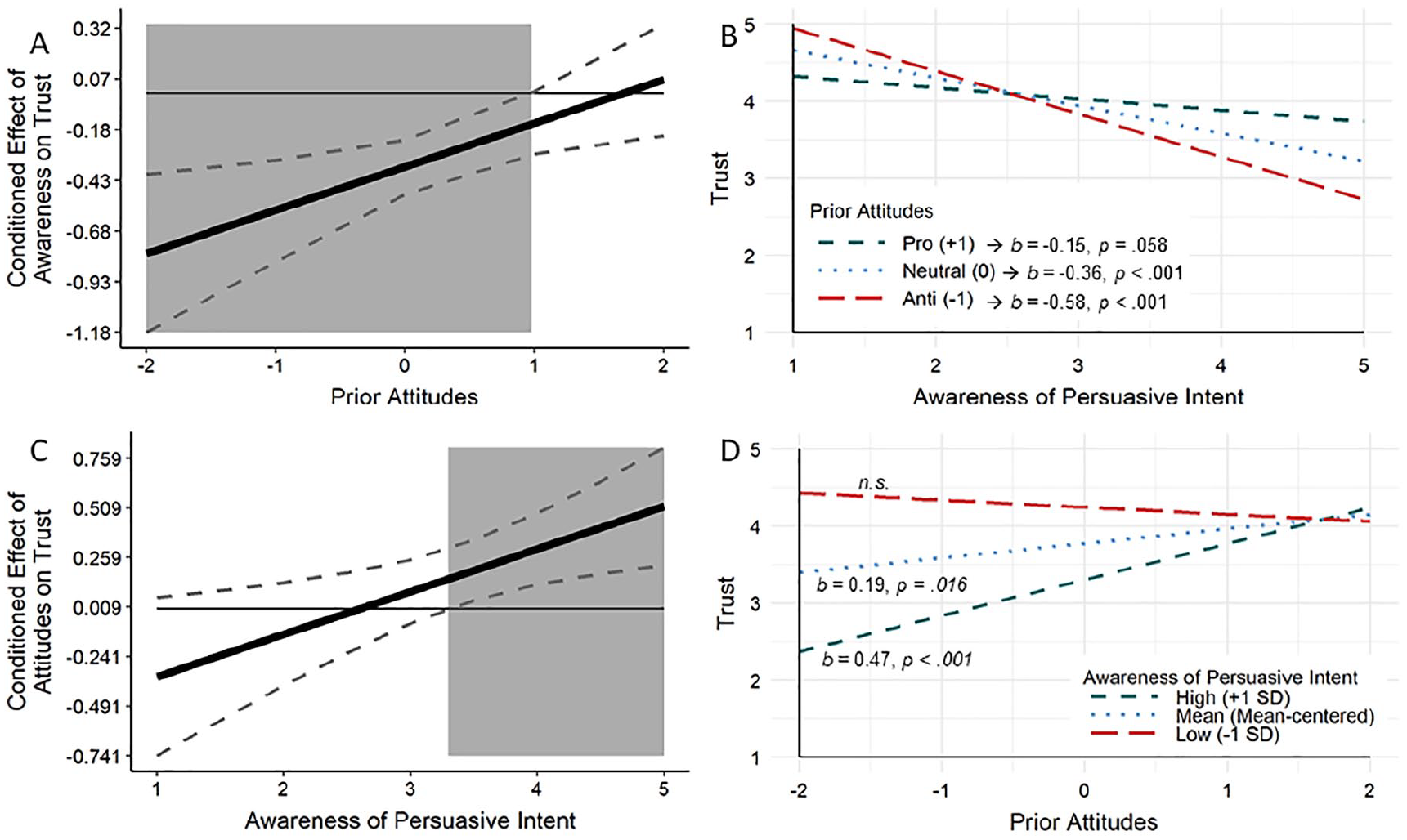
(A) Conditioned effects of awareness on trust (unstandardized estimates obtained from a floodlight analysis) as a function of prior attitudes. (B) Predicted values of trust as a function of awareness of persuasion intent at three focal levels prior attitudes (based on estimates obtained from a spotlight analysis). (C) Conditioned effects of prior attitudes on trust (unstandardized estimates obtained from a floodlight analysis) as a function of awareness. (D) Predicted values of trust as a function of prior attitudes at three focal levels of awareness of persuasive intent (based on estimates obtained from a spotlight analysis). In (A) and (C), the shaded area represents the Johnson–Neyman region of significance (Study 2).
When we examined effects of attitudes on trust conditioned on awareness, we found a JN region at awareness > 3.30 (which covers 51.82% of the total sample—Figure 4C). High awareness combined with negative attitudes yielded the most detrimental assessments of trustworthiness, but high awareness combined with positive attitudes yielded assessments as generous as those made by individuals with low awareness (Figure 4D—an additional graphical representation of the coexistence of awareness and trust is available in the Supplemental Material).
Probing indirect effects of communication sidedness on trust mediated by awareness of persuasive intent (a × b), we again observed the influence of the Attitudes × Awareness interaction. Negative and neutral attitudes (focal points: attitudes = −1 and attitudes = 0, respectively) yielded negative indirect effects of the one-sided presentation on trust, bindirect effect = −0.68, 95% bootstrap CI = [−1.29, −0.29] and bindirect effect = −0.51, 95% bootstrap CI = [−0.83, −0.32], respectively. When prior attitudes were positive (attitudes = 1), the indirect effect of communication sidedness was nonsignificant, bindirect effect = −0.24, 95% bootstrap CI = [−0.58, 0.04]. As in Study 1, the total effect of the Attitudes × Contextual Cues interaction on trust was nonsignificant, b = 0.26, SE = 0.17, 95% CI = [−0.06, 0.59], t(133) = 1.60, p = .113, β = .14.
Discussion
Measured 1 week before the persuasion episode, attitudes again predicted reliance (or lack thereof) on the notion that persuasive intent signals low trustworthiness. Moreover, as theorized, awareness reduced trust at rather neutral levels of prior attitudes. Study 2 also extends Study 1 by evidencing similar outcomes in a more subtle context. Study 1 had participants dealing with a situation involving a consequential and controversial topic. Study 2 suggests that the phenomenon may arise in rather mundane contexts as well, such as dealing with information about brands in a store.
Study 3
We propose that the interaction between awareness of persuasive intent and attitudes is rooted in the fundamental human motivation to preserve a sense of self-integrity. We interpret both the intensified negative influence of awareness on trust when individuals are faced with attitudinally uncongenial persuasive messages and the null effect of this awareness when messages are attitudinally congenial as consequences of defensive responses to self-threats that arise in persuasion episodes. Importantly, these reactions act directly on the sources of the threat: the communicator (when the message challenges prior attitudes) or the association between persuasive intent and low agent trustworthiness (when it reinforces prior attitudes). However, self-affirmation theorists suggest that people are wired to preserve a global sense of self-integrity, as opposed to such sense being compartmentalized into specific, independent domains (Steele, 1988). This tenet implies that there is a degree of “fungibility in the sources of self-integrity” (Cohen & Sherman, 2007, p. 788). Thus, affirming self-integrity (i.e., self-affirmation) in one domain strengthens the capacity to tolerate threats originated in another domain (Cohen & Sherman, 2007). As a consequence, exercising self-affirmation suppresses defensive reactions against subsequent threats (Cohen et al., 2000; Sherman et al., 2000). Relatedly, exercising self-affirmation has been described as “buffering” oneself against self-threats (Cohen et al., 2000). Study 3 exploits this property of self-affirmation to verify the role of self-integrity preservation in the way prior attitudes shape the relationship between awareness of persuasive intent and trust in persuasion agents.
Procedure and Measures
Undergraduate students (N = 186) participated in a three-phase computer-based study. The study was conducted in a laboratory session where they were told they would complete several unrelated studies. Each phase of the experiment was framed as a separate study.
Phase 1
Prior attitudes toward Dell laptops
Participants filled out a questionnaire with one-item measures of attitudes toward several brands, including Dell. Responses were recorded using slider scales (−5 = Extremely unfavorable, 5 = Extremely favorable). As in the previous studies, (negative)positive attitudes reflect (in)congruence between attitudes and the content of the persuasive communication.
Phase 2
Self-affirmation
A well-established self-affirmation procedure was used (e.g., Cohen et al., 2000; Sherman et al., 2000—see the Supplemental Material). Participants first ranked characteristics and values from a list in order of personal relevance. They were then randomly assigned to a self-affirmation condition (no [control] vs. yes [self-affirmation]). To induce self-affirmation, participants wrote about personal experiences where their highest ranked characteristic or value was important and made them feel good about themselves. The control group wrote about why the characteristic or value they ranked as least important could be relevant to other people.
Phase 3
Contextual cues
Participants were provided with a banner ad from MaGear.com—a fictitious website presented as a real website with reviews of electronic products. The banner ad showed the review of a Dell laptop that received positive ratings. Half the participants were randomly assigned to the sponsored review condition, where MaGear.com was described as a website sponsored by big brands, including Dell (i.e., salient ulterior motives). In the independent review condition, MaGear.com was described as ran by a nonprofit organization that would not accept sponsorship as a means to assure readers that their reviews were unbiased (i.e., no salient ulterior motives). Materials and manipulation check tests are available in the Supplemental Material.
Awareness of persuasive intent
We supplemented the one-item measure used in the previous studies with an item adapted from previous research (e.g., Feiler et al., 2012): “I could tell that MaGear.com was attempting to influence consumers” (1 = Strongly disagree, 7 = Strongly agree). The two items were averaged into a single “awareness score” (α = .79).
Trustworthiness judgment
Same measure as before (responses were recorded on 7-point scales).
Analysis and Results
The analysis was guided by a mediation model similar to the one used in Study 2 (Figure 3 9 ). However, in Study 3, we introduced a three-way interaction affecting Path b. In Studies 1 and 2, this path was influenced by a significant moderating effect of prior attitudes. We predict that this moderating effect will be attenuated by self-affirmation. Thus, the focal aspect of our analysis in Study 3 is the effect of the Attitudes × Self-Affirmation × Awareness interaction on trustworthiness judgments.
Results regarding the effect of contextual cues on awareness of persuasive intent (Path a) replicated our previous findings. Awareness was higher when participants read that the website was sponsored (M = 5.84 vs. M = 5.31), b = 0.53, SE = 0.27, 95% CI = [0.003, 1.05], t(182) = 1.98, p = .049, β = .22. This effect was not influenced by an interaction between contextual cues and attitudes, b = −0.07, SE = 0.08, 95% CI = [−0.24, 0.09], t(182) = 0.90, p = .370, β = −.10.
Regarding the effect of awareness of persuasive intent on trust (Path b), the previous studies revealed a moderating influence of attitudes. Our theorization predicts that exercising self-affirmation before dealing with the persuasion attempt will diminish this influence. This prediction was supported by the relationship of the three-way interaction (Attitudes × Self-Affirmation × Awareness) with trust, b = −0.18, SE = 0.07, 95% CI = [−0.32, −0.03], t(176) = 2.44, p = .016, β = −.40. In essence, whether the effect of awareness of persuasive intent on trust was moderated by attitudes or not was determined by the self-affirmation manipulation.
Figure 5 shows the influence of attitudes on the relationship between awareness and trust across self-affirmation conditions (control vs. self-affirmation). 10 A moderating influence of attitudes was observed among unaffirmed participants (i.e., the control group), b = 0.21, SE = 0.06, 95% CI = [0.09, 0.33], t(176) = 3.45, p < .001, β = .71. A floodlight analysis showed that favorable prior attitudes weakened the negative effect of awareness on trust 11 (JN region: attitudes < 3.03, which included 58% of participants in the control group). The indirect effects of contextual cues (sponsored vs. independent website) on trust mediated by awareness of persuasive intent (a × b) followed the pattern established by the Attitudes × Awareness interaction. The negative indirect effect of the sponsored website on trust was weakened by positive prior attitudes: at 1 SD below the mean, the mean level, and 1 SD above the mean of attitudes, we obtained bindirect effect = −0.42, 95% bootstrap CI = [−1.00, −0.03], bindirect effect = −0.12, 95% bootstrap CI = [−0.31, −0.004], and bindirect effect = 0.02, 95% bootstrap CI = [−0.04, 0.31], respectively.
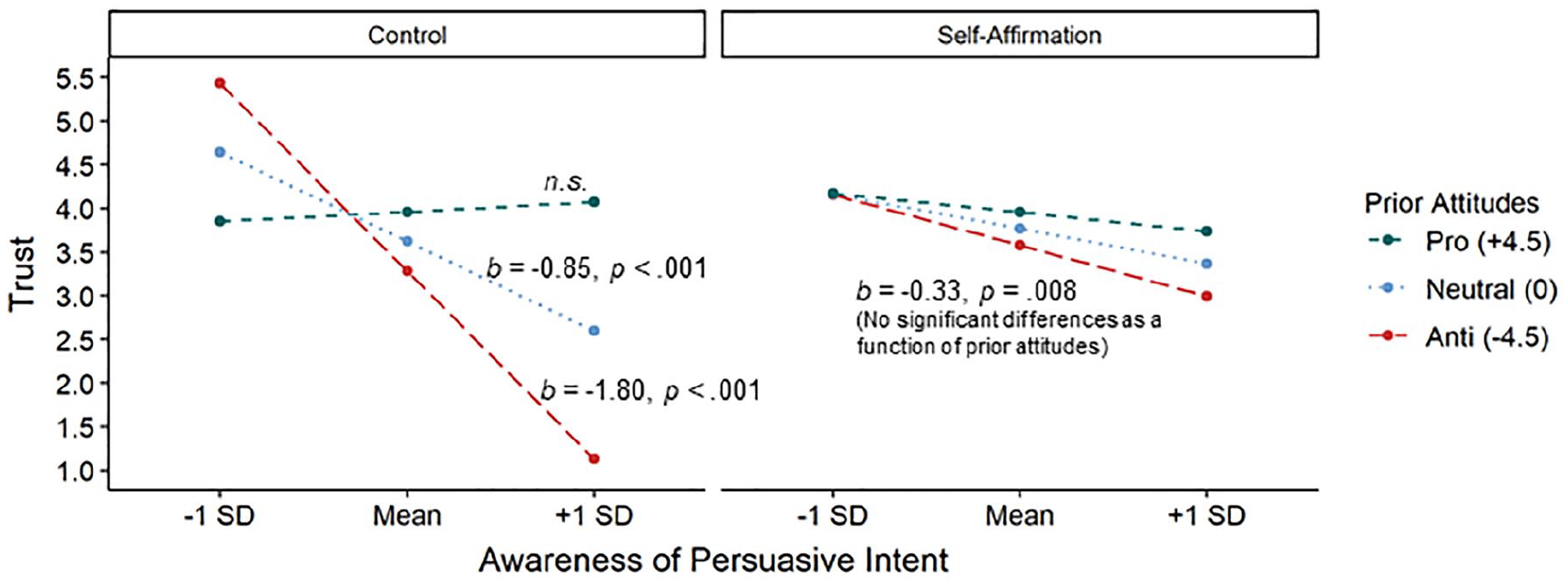
Trust as a function of awareness of persuasive intent, prior attitudes, and self-affirmation (estimates obtained from a spotlight analysis; Study 3).
Effects of attitudes on trust conditioned on awareness of persuasive intent also mirrored our previous studies: awareness of persuasive intent intensified effects of attitudes up to b = 0.41 when awareness = 7 (JN region: awareness > 5.68, 52% of participants in the control group). Results also revealed a JN region with negative effects of attitudes on trust (awareness < 3.63), but it included only six participants of the control group.
Probing the three-way interaction for effects on trust among self-affirmed participants, we found no influence of the Attitudes × Awareness interaction, b = 0.03, SE = 0.04, 95% CI = [−0.06, 0.16], t(176) = 0.85, p = .395, β = .12. Instead, independently of participants’ attitudes, awareness of persuasive intent had a negative effect on trust, b = −0.33, SE = 0.12, 95% CI = [−0.59, −0.09], t(176) = 2.67, p = .008, β = −.35. Moreover, awareness mediated a negative effect of the sponsored website condition on trust (a × b), bindirect effect = −0.18, 95% bootstrap CI = [−0.57, −0.01].
When examining total effects of contextual cues on trust (without accounting for awareness as the mediator), we found a significant Attitudes × Self-Affirmation × Contextual Cues interaction, b = −0.46, SE = 0.22, 95% CI = [−0.89, −0.03], t(178) = 2.12, p = .035, β = −.32. In the control condition (i.e., no self-affirmation), the negative total effect of the sponsored website was shaped by a Attitudes × Contextual Cues interaction, b = 0.54, SE = 0.19, 95% CI = [0.15, 0.92], t(178) = 2.75, p = .007, β = .75. The effect of the sponsored website was stronger at negative levels of prior attitudes (when attitudes = −5, bSponsored = −4.78), but nonsignificant at the most positive levels of attitudes (JN region: attitudes < 3.04). In the self-affirmation condition, trustworthiness judgments were not influenced by the Attitudes × Contextual Cues interaction, b = 0.08,SE = 0.10, 95% CI = [−0.11, 0.26], t(178) = 0.79, p = .432, β = .11.
Study 3: Replication
We recruited 590 participants on MTurk for a replication of Study 3. After excluding six participants who took less than 2 min and 30 participants who took longer than 16.84 min (i.e., 2 SD above the mean) to complete the study, the final sample consisted of 554 participants. The larger sample size (compared to the original study) and the exclusion criteria were adopted in an effort to circumvent MTurk participants’ typical low engagement with high-focus/attention tasks (Goodman et al., 2013; Permut et al., 2019), which can undermine the effectiveness of the writing task used in the self-affirmation manipulation.
The analysis used the same model as Study 3. Results revealed that contextual cues increased persuasion awareness when participants read that the website was sponsored by big brands (Path a). This effect was not moderated by attitudes. A significant Attitudes × Self-Affirmation × Awareness interaction predicted trust (Path b). 12 The control condition of the self-affirmation manipulation replicated Studies 1 and 2, as well as the control condition of Study 3: favorable attitudes toward the product suppressed the negative effect of awareness of persuasive intent on trust. Replicating Study 3, attitudes did not moderate the negative effect of awareness on trustworthiness judgments in the self-affirmation condition. Instead, awareness of persuasive intent reduced trust regardless of participants’ prior attitudes. Indirect effects of contextual cues on trust mediated by awareness of persuasive intent reflected the influences of prior attitudes and self-affirmation described above. In the original study, the total effects of contextual cues on trust (without accounting for awareness as the mediator) were dictated by the Attitudes × Self-Affirmation × Contextual Cues interaction and mirrored the indirect effects (mediated by awareness of persuasive intent). However, we did not find a significant total effect of the Attitudes × Self-Affirmation × Contextual Cues interaction on trust in the MTurk replication. The results of this replication study are reported in greater detail (including p values obtained with the full sample) in the Supplemental Material.
Discussion
When self-affirmation preceded the persuasive communication, participants formed communicator trustworthiness judgments based on their awareness of persuasive intent regardless of the extent to which the communicator challenged or reinforced their opinion about the product. Considering that self-affirmation theory postulates that affirming self-integrity in one domain increases tolerance to subsequent threats in another domain, this finding seems to support the notion that the influences of prior attitudes on the use of intuitive knowledge about the trustworthiness of persuasion agents (observed in the control group and in the previous studies) reflect reactions to self-threats imposed by the persuasion episode.
General Discussion
Previous research has unveiled beliefs and associations that people develop and rely upon to cope with persuasion episodes (e.g., Friestad & Wright, 1994). Another group of researchers has explored instances in which information is processed as a threat to self-integrity and ways in which individuals respond to this type of threat (e.g., Cohen et al., 2000; Lord et al., 1979). We combined insights from both lines of work to identify self-threats in persuasion settings where communication is charged with ulterior motives. These settings are particularly interesting because both the use of intuitive knowledge about persuasion and reactions to self-threats are implicated in assessments individuals make about information/message sources. A message that antagonizes the recipients’ attitudes and is associated with ulterior motives is not only processed as a self-threat, but seems to boost the negative influence of attitudinal incongruence on such assessments. This boost might occur because attributing the message to persuasive intentions provides the recipient with an exogenous justification to the threat-induced urge to downgrade communicator credibility. A different self-threat seems to arise when the persuasive message reinforces prior beliefs. Perceiving the communicator as unreliable is a typical consequence of calling on persuasion knowledge during persuasion episodes. At the same time, it is self-threatening to have an unreliable communicator supporting one’s beliefs. The individual then finds herself or himself agreeing with information provided by someone who has the negative attribute of being unworthy of trust. Our findings suggest that, to preserve self-integrity, the individual disregards the part of her or his knowledge about persuasion agents that suggests that these agents are unreliable. S/he can still recognize the communicator’s persuasive intent, but avoids letting the awareness of such intent influence her/his evaluation of the agent.
Alternative Views on the Role of Self-Affirmation
We have discussed the results where self-affirmation prevented moderating effects of prior attitudes in terms of resistance against self-threats. We note, however, that self-affirmation may influence persuasion without necessarily shielding individuals against self-threats. Self-confidence boosts can be induced by self-affirmation and can decrease elaboration when individuals process persuasive messages (Briñol et al., 2007). The activation of positive mood states (which may also result from self-affirmation) can have a similar effect (Mackie & Worth, 1989). It is possible that decreased elaboration while processing the persuasive stimulus impairs the detection of self-threats in the persuasion episode, facilitating the use of persuasion knowledge while forming trustworthiness judgments. Similarly, self-affirmation-induced elaboration deficits might lead people to use more peripheral cues of the persuasion episode (i.e., contextual cues) compared with central cues (e.g., message content), thus inflating the weight of ulterior motives cues related to the communicator’s background in their judgments about the communicator. Although these perspectives are not part of our framework, they provide plausible alternative or complementary explanations for the findings of Study 3.
Total Effects of Persuasion Cues on Trust
Our theoretical framework strictly focused on the process through which awareness of persuasive intent mediates the influence of cues of ulterior motives on trustworthiness judgments. However, we obtained mixed results when assessing the total effects of contextual cues on trust without accounting for persuasion awareness as the mediator. To further explore these total effects, we conducted an internal meta-analysis using all our studies (including the MTurk replication of Study 3). Because we used different types of participants (Brazilian social media users, MTurk workers, and students from an American university), contexts (politics, in-store experiences, and online reviews), and manipulation methods (background information and communication sidedness), we used a random effects model with a maximum-likelihood estimator. Partial correlations were used input. 13 The analysis revealed a positive and marginally significant estimate for the total effect of the Attitudes × Contextual Cues interaction on trust, r = .25, 90% CI = [.003, .50] (for more details and the forest plot, see the Supplemental Material). The analysis also revealed high heterogeneity across studies, Q(3) = 191.16, p < .001. Although varying the type of participant and the context of the studies contributes to the generalizability of the results regarding the influence of prior attitudes on how persuasion awareness affects trustworthiness judgments, it may have introduced unobserved heterogeneity to the total effects of contextual cues. Ostensibly, different populations, contexts, and experimental manipulations involve idiosyncratic variables that shape the total effect of contextual cues on trust above and beyond the interaction between prior attitudes and persuasion awareness.
We also obtained inconclusive results when examining the total effect of the three-way interaction (Attitudes × Self-Affirmation × Contextual Cues) on trust. We tested this interaction in Study 3 and in the MTurk replication. The effect was directionally consistent across studies, but was not statistically significant in the MTurk replication. Using a random effects model, the meta-analysis of these studies revealed a significant influence of the total effect of the three-way interaction on trust, r = −.18, 95% CI = [−.36, −.003] (for more details and the forest plot, see the Supplemental Material).
Overall, our analyses suggest that parallel processes triggered by cues of ulterior motives influence trustworthiness assessments alongside the process driven by persuasion awareness. In our studies, the differences in indirect effects conditioned on attitudes revealed ways in which prior beliefs govern the process mediated by awareness of persuasive intent. The influence of these beliefs on other processes that determine individuals’ evaluations of persuasion agents remains an area that calls for more research.
Persuasion Knowledge Avoidance
We did not explore here how individuals whose self-integrity is threatened by the unreliability of the persuasion agent (because they agree with the agent) avoid incorporating the association of persuasive intent with low trustworthiness into their judgments. One possibility is that they selectively fail to retrieve this association from their memory. Another possibility involves the reinterpretation of persuasive intent. As mentioned earlier, persuasion can also be driven by less egoistic or more noble reasons than self-interest. This notion might be part of people’s persuasion knowledge, but might be initially inactive in contexts where persuasion awareness is induced by the detection of ulterior motives (i.e., the contexts of our studies). It is possible that individuals whose attitudes are reinforced by the persuasive message resignify persuasive intent to signal something more desirable (e.g., “the intent to help people who do not know better”). Associating persuasive intent with seemingly noble purposes could facilitate deeming the persuasion agent worthy of trust.
Other Variables and Theories
Nuances regarding how persuasion knowledge and self-integrity preservation affect the outcomes of persuasion attempts are worth exploring in future research. For instance, our research did not explore the potential roles of different dimensions of attitudes, such as certainty and personal relevance. To a limited extent, these dimensions are embedded in our measures (i.e, more extreme attitudes are likely to be held with greater certainty), but thinking of and operationalizing them as different variables could inspire new insights angles and reveal nuances that our approach does not contemplate. Moreover, prior attitudes people hold toward other elements of the persuasion episode (e.g., the communicator) might interfere.
We also encourage researchers to explore how other theories can help deepen the understanding of the interplay between persuasion knowledge and self-integrity. Self-awareness theory (Wicklund, 1975), for instance, could be useful. An insight from this theory is that certain events can force attention inward, thus emphasizing the self, and other events force attention outward, and emphasize the environment. It is possible that an inward orientation will make individuals more sensitive to self-threats and intensify the influence of prior attitudes on the use of persuasion knowledge. An outward orientation might reduce this sensitivity and stimulate the processing of contextual cues in the environment, thus intensifying the tendency to detect and respond to these cues.
Supplemental Material
Grillo_Online_Appendix – Supplemental material for Recognizing and Trusting Persuasion Agents: Attitudes Bias Trustworthiness Judgments, but not Persuasion Detection
Supplemental material, Grillo_Online_Appendix for Recognizing and Trusting Persuasion Agents: Attitudes Bias Trustworthiness Judgments, but not Persuasion Detection by Tito L. H. Grillo and Cristiane Pizzutti in Personality and Social Psychology Bulletin
Footnotes
Declaration of Conflicting Interests
The author(s) declared no potential conflicts of interest with respect to the research, authorship, and/or publication of this article.
Funding
The author(s) disclosed receipt of the following financial support for the research, authorship, and/or publication of this article: Funding for this research was received from the National Council for Scientific and Technological Development (CNPq), Brazil.

Supplemental Material
Supplemental material is available online with this article.
Notes
References
Supplementary Material
Please find the following supplemental material available below.
For Open Access articles published under a Creative Commons License, all supplemental material carries the same license as the article it is associated with.
For non-Open Access articles published, all supplemental material carries a non-exclusive license, and permission requests for re-use of supplemental material or any part of supplemental material shall be sent directly to the copyright owner as specified in the copyright notice associated with the article.
