




Abstract
Although couples’ support exchanges are especially important during times of stress, coping with stress often taxes individuals’ energy and resources and may render it more difficult for partners to provide support to one another. In a daily diary study of 121 married couples, we examined whether spouses’ chronic and daily non-marital stressors were associated with their capacity to accurately perceive their partner’s support needs and to provide support when needed. Consistent with the notion that stress may be linked to reduced perspective-taking, husbands experiencing greater chronic stress were less accurate in their assessments of their partner’s support needs across the diary days. Moreover, even when husbands did notice that their partner desired support, they were less likely to provide support if they were coping with their own stress that day. Thus, the findings highlight the multiple pathways through which stress can undermine support provision within relationships.
The demands couples encounter in their lives, such as unexpected financial problems, difficulties at work, or transportation issues, can change couples’ relationship dynamics, a phenomenon known as stress spillover (Randall & Bodenmann, 2009). Essentially, when managing more stressors outside the home, individuals often experience increases in their anxiety, irritability, and/or exhaustion, and the residue of these negative states can carry over into their exchanges with their partner inside the home (Buck & Neff, 2012; Story & Repetti, 2006). For example, individuals’ attempts to regulate their negative arousal following a stressful day can leave them less interested in social interaction; on days of greater stress, individuals generally report being more distracted and detached from their partner (Repetti, 1989; Schulz et al., 2004). Moreover, when individuals do engage with their partners, those interactions are often characterized by greater levels of conflict and negativity. Managing the negative emotions and arousal that result from stress tends to drain individuals’ energy and cognitive resources (Hammond, 2000), leaving them with a diminished capacity to effectively navigate their interactions with a partner. Consequently, when individuals are experiencing greater stress, they are more likely to express criticism, anger, or impatience toward their partner compared with when they experience less stress (Buck & Neff, 2012; Story & Repetti, 2006; Williamson et al., 2013). Thus, stressors can have insidious effects on relationships, by increasing maladaptive behaviors and chipping away at relationship quality over time (Randall & Bodenmann, 2009).
Given the harmful consequences of external life stressors on relationship well-being, successfully weathering stressful periods likely requires that partners learn to provide sensitive support to one another during these difficult times. Indeed, support from a partner can alleviate distress and facilitate coping efforts, thereby mitigating the spillover of stress into the relationship (Cutrona et al., 2018). Unfortunately, a closer look at the literature on support and stress spillover reveals a rather ironic possibility; although couples’ support exchanges are especially important during times of stress, coping with stress may render it more difficult for partners to provide effective support to one another. Few individuals lead stress-free lives, and thus throughout a relationship, partners are often called upon to provide support at times when they are grappling with their own challenges and difficulties (Timmons et al., 2015). Yet, if managing their own stress taxes individuals’ energy and resources, then experiences of stress are likely to undermine individuals’ efforts to offer support to their partner. Some recent evidence supports this notion (Bodenmann et al., 2015); however, still missing from the literature is a consideration of the multiple pathways through which stress may hinder support provision. To this end, the aim of the current study was to more precisely identify how stress may be linked to support provision by drawing upon theoretical frameworks which suggest that the act of providing effective support is a complex, multi-step process. Specifically, we examined whether individuals’ stress may be associated with a reduced capacity to (a) accurately perceive and (b) appropriately respond to their partner’s support needs. Moreover, given prior work identifying the unique effects of chronic versus daily stress on individuals’ psychological distress (Serido et al., 2004), we examined whether these two types of stress may play distinct roles in shaping couples’ support exchanges.
Individuals’ Stress and Their Capacity to Provide Support
Partners’ capacity to effectively support each other is essential for preserving relationship quality over time (Bradbury & Karney, 2004). Yet, although support exchanges are a vital part of healthy relationship functioning, providing support is a difficult and complex process. According to numerous theoretical frameworks, successful support transactions require the support provider to successfully navigate several sequential stages (Pearlin & McCall, 1990; Verhofstadt et al., 2008). First, the support provider must notice that their partner is experiencing a problem and needs support. Once the partner’s support needs are noticed, the provider must assess the situation, consider the partner’s coping resources, and attempt to enact support that might be helpful in those circumstances. Finally, in order for support to be beneficial, the support offered by the provider must be provided in a skillful and responsive manner. In other words, the process of successfully providing support necessitates not just giving support but giving support that the recipient regards as satisfying and responsive to their needs (Rafaeli & Gleason, 2009). Unfortunately, the capacity to provide support may be compromised at any of these stages, resulting in unsuccessful support transactions.
To date, most prior research examining stress and support provision has focused on the last stage of this multi-step process, assessing whether providers experiencing greater stress offer poorer quality support. For instance, in an observational study, experimentally stressed husbands provided lower quality support (i.e., support that was less warm, affectionate, and empathetic) to their wives compared with unstressed husbands (Bodenmann et al., 2015). Similarly, men experiencing higher chronic financial strain have been observed to provide lower quality support to their partners during lab discussion tasks (Clavél et al., 2017). Other research suggests that chronic stress also is associated with another aspect of poor support giving: providing an inappropriate amount of support relative to the recipients’ desires. Specifically, husbands who experienced higher levels of stress were more likely to engage in the overprovision of support (Brock & Lawrence, 2014). Together, these results are consistent with the idea that providers’ stress may render their support provision less responsive to the needs of the recipient. Furthermore, and consistent with the tend-and-befriend model of biobehavioral stress responses (Taylor et al., 2000), which argues that women have evolved to enact more prosocial, affiliative, and nurturing behaviors when managing stressful circumstances, whereas men are predisposed toward a fight-or-flight stress response, the harmful effects of stress appear to be particularly potent if the providers are men.
By focusing on the last stage of the support process, however, prior work fails to consider whether stress may have even more insidious effects on couples’ support exchanges. Unlike controlled laboratory settings, which engage couples in interactions specifically designed to elicit support behaviors, couples’ day-to-day lives are often chaotic, and support needs and expectations are unlikely to be as clear. Consequently, in everyday life, stress may interfere with earlier stages of the support process; rather than simply providing less responsive support, individuals under greater stress may fail to notice their partner’s support needs in the first place or have difficulty harnessing the energy and resources to provide any support at all. Below we consider how support providers’ own stress may interfere with these two earlier stages, and thus undermine effective support transactions within the relationship. We also consider whether there may be gender differences in the extent to which stress may interfere with these earlier stages.
Is Individuals’ Stress Associated With Noticing a Partner’s Support Needs?
As mentioned, the first stage of effective support provision is noticing that a partner needs support. To notice that a partner needs support, individuals must be able to pick up on their partner’s distress, which may be difficult as partners often do not openly express their support needs (Pierce et al., 1997). Instead, partners frequently communicate their support desires in indirect and ambiguous ways, such as sighing or hinting (Barbee et al., 1996). Consequently, individuals not only must be attentive to their partner’s subtle cues of support seeking, but also must interpret those cues correctly. In other words, support providers must discern the underlying meaning of those subtle cues and determine whether and what support is actually desired in that moment. Accomplishing this feat generally requires empathic accuracy, which is defined as the ability to accurately understand others’ internal states (Ickes, 1993; Verhofstadt et al., 2008). Unfortunately, converging lines of research indicate that stress is likely to hinder individuals’ empathic accuracy capabilities. For example, stress can interfere with the ability to differentiate emotions (Erbas et al., 2018), which may make it difficult to accurately assess a partner’s feelings. Moreover, experimentally manipulated stress has been linked to increases in egocentricity and reduced perspective-taking abilities when judging the feelings of hypothetical others, particularly in men (Negd et al., 2011; Tomova et al., 2014). Thus, at times when individuals are facing greater stress, they may be more concerned with managing their own negative emotional states and less attuned to their partner’s distress. To date, however, no research has examined whether providers’ own stress may be linked to their assessment of their partner’s support needs. The current study was the first to examine whether individuals experiencing greater stress are less likely to accurately assess their partner’s support needs, as well as whether this effect may be especially pronounced in men.
Is Individuals’ Stress Associated With Enacting Support?
Although stress may be linked to a reduced likelihood of noticing a partner’s support needs, at times partners may be more direct in their support-seeking behaviors and unambiguously indicate their needs to the provider. However, even if individuals do notice that their partner desires support, it is not clear whether individuals may be able to act on that knowledge if they are coping with their own stress. To our knowledge, only two studies have examined the link between individuals’ stress and whether they provide support to their partner at all. Although one study found that individuals experiencing chronic financial stress reported greater depressive symptoms, which in turn led them to provide less support to their partner (Vinokur et al., 1996), another more recent daily diary study found that providers’ daily stress was not significantly associated with whether or not they gave support on that day (Iida et al., 2008). Notably, the conclusions that can be drawn from these studies are limited by the fact that neither study untangled the effects of stress on providing support from the effects of stress on noticing a partner’s support needs. By confounding these two stages of the support process, prior work is unable to elucidate which stage(s) of the support process may be linked to stress. Thus, we aimed to build on prior work by examining whether individuals’ stress is associated with their support provision when they report noticing their partner’s support needs.
Theoretically, the prior literature points to two possibilities regarding whether stressed individuals will provide support to their partner once the partner’s support needs are noticed. On one hand, coping with stress may interfere with the likelihood of support provision as it tends to drain individuals of their energy and resources (Shields et al., 2016). In other words, to enact supportive behaviors, individuals must have the intention to provide support, as well as the ability to implement those intentions (Pearlin & McCall, 1990). Consider an individual who has experienced a stressful work day and wants to relax when they get home, but comes home to a partner who is clearly in distress. Although the individual may want to support their partner, doing so may be difficult as relationally oriented behaviors are often more difficult and taxing to enact compared with more self-centered behaviors (Burnette et al., 2014; Yovetich & Rusbult, 1994). That is, relationally oriented behavior often requires a transformation of motivation, in which individuals must first inhibit their more automatic, selfish inclinations (i.e., to withdraw from their partner and relax) before exerting additional effort to behave in a more relationship-promotive manner (i.e., provide support to their partner; Rusbult et al., 1996). Overriding these selfish impulses, however, is likely to be especially difficult under conditions of stress, as research indicates that individuals tend to rely on less effortful, more automatic responses when experiencing stress (Epley et al., 2004; Starcke & Brand, 2012). Thus, when stressed, individuals’ capacity to inhibit selfish behaviors and provide support to their partner may be compromised.
On the other hand, other perspectives suggest that stress may not interfere with the enactment of supportive behaviors. For example, several theories within the stress literature propose that stress may increase prosocial behavior (Yu, 2016), particularly for women (Taylor et al., 2000), although the empirical research testing this assertion has yielded mixed results (e.g., Takahashi et al., 2007; Vinkers et al., 2013). Furthermore, some research indicates that everyday positive acts of kindness can become habitual in relationships. Given that romantic relationships are often characterized by a strong communal orientation (Clark & Mills, 1979), responsive behaviors, such as a willingness to sacrifice one’s own self-interest for the sake of the partner, can become more reflexive and require fewer resources to enact, particularly as the relationship matures over time (e.g., Kammrath et al., 2015; Righetti et al., 2013). Thus, if support provision becomes habitual over time, and given that individuals are more likely to enact less effortful, more habitual behaviors when under stress (Epley et al., 2004; Yu, 2016), stress may actually serve to increase the likelihood of performing supportive behaviors in established relationships. Given conflicting theories regarding whether stress will increase or decrease relationally oriented behaviors such as support, we explored whether individuals’ stress may be associated with their tendency to provide support to their partner at times when individuals believe their partner needs more support, and again based on the tend-and-befriend model of biobehavioral stress responses (Taylor et al., 2000), whether there are gender differences in this effect.
Does the Type of Stress Matter? The Potential Effects of Chronic Versus Daily Stress
The differing theoretical perspectives regarding whether stress may overwhelm individuals’ capacity to provide support raise questions about whether the magnitude of stress experienced may also matter. Indeed, a wealth of research demonstrates that chronic and daily stress are distinct constructs that can exert unique effects on individuals’ well-being. Whereas chronic stress captures prolonged challenges that persistently drain individuals’ energy and resources, daily stress captures everyday disruptions to daily life that tend to have immediate, but not necessarily lasting, effects on individuals’ arousal and functioning (e.g., Serido et al., 2004). As such, each type of stress may be differentially implicated in couples’ support exchanges. For example, previous research demonstrates that acute and daily stressors can temporarily induce more self-focus and social withdrawal (Story & Repetti, 2006; Tomova et al., 2014); thus, daily stress may be sufficient to interfere with individuals’ capacity to notice a partner’s support needs. However, if support provision is a responsive behavior that can become less effortful to enact over time (e.g., Kammrath et al., 2015), daily stressors may not be taxing enough to disrupt support provision once a partner’s support needs are noticed. Rather, the continuous strain of ongoing chronic stressors may be necessary to interfere with the capacity to respond to a partner’s support needs. Consistent with this possibility, the previously reviewed work linking stress to support enactment showed that whereas chronic stress was associated with a reduced likelihood of providing support (Vinokur et al., 1996), daily stress was not (Iida et al., 2008). In other words, the type of stress assessed may at least partially account for the inconsistencies in prior work. Consequently, although it was expected that both chronic and daily stress may be linked to the capacity to notice a partner’s support needs, the current study explored whether individuals’ chronic and daily stress may be differentially associated with their capacity to provide support when needs are noticed.
Overview of the Current Study
Previous research linking stress and support provision is limited in that it tends to focus on identifying whether stress is associated with poorer quality support, while overlooking earlier stages of the support provision process that may also be affected by stress. To better understand how stress may undermine effective support exchanges within relationships, the present study examined whether individuals’ external stress is associated with their capacity to accurately perceive their partner’s support needs and to provide support when needed using data collected from a sample of newlywed couples participating in a broader study of marital development. Spouses completed a background survey assessing their chronic stress, as well as a 2-week daily diary task assessing their daily stress, their own need for support, their perceptions of their partner’s need for support, and their support provision. Using these data, we addressed two hypotheses.
First, drawing from research suggesting that individuals, particularly men, become more self-focused when stressed (Tomova et al., 2014), we examined whether individuals’ experiences of chronic and daily stress may be associated with less accuracy in noticing their partner’s support needs. To examine the effects of stress on accuracy, individuals’ daily perceptions of their partner’s support needs were estimated as a function of their partner’s actual support needs that day, individuals’ daily stress, individuals’ chronic stress, and the interaction of each of these stress variables with the partner’s actual support needs. To adjust for the possibility that individuals’ perceptions of their partner’s support needs may be linked to their own desire for support (i.e., an assumed similarity bias), individuals’ own daily support needs were also included in the model. It was expected that individuals experiencing greater chronic stress would be less accurate in their perceptions of their partner’s support needs across the diary days compared with individuals experiencing lower chronic stress. Likewise, on days when individuals report greater daily stress, it was expected that they would be less accurate in their perceptions of their partner’s support needs compared with days when they report lower daily stress. Additional analyses examined whether the effects of stress may be stronger for men.
Second, in light of conflicting evidence regarding whether stress may interfere with the enactment of relationally oriented behaviors (e.g., Shields et al., 2016; Yu, 2016) we explored whether individuals’ chronic and daily stress may be associated with their tendency to provide support to their partner when individuals believe their partner needs more support. Specifically, individuals’ reports of their daily support provision were estimated as a function of their perceptions of their partner’s needs, their own daily stress, their own chronic stress, and the interaction of each of these stress variables with perceptions of the partner’s needs. This interaction allows us to untangle the effects of stress on noticing partner’s support needs and providing support once support needs are noticed. Again, given the mixed literature, this question was exploratory such that when individuals perceive their partner desires support, those individuals experiencing greater stress may provide more or less support compared with individuals experiencing lower stress. As before, additional analyses examined potential gender differences in the effects of stress.
Method
Participants
Newlywed couples (N = 171) were recruited for a longitudinal study of marital development through advertisements placed in community newspapers, premarital counseling offices, local wedding vendors, and online websites (e.g., Facebook, The Knot) beginning in January 2010. Eligibility requirements were as follows: It had to be the first marriage for each partner, they must be married less than 6 months, and neither partner had children. Given that the daily support measures of interest for the current study were only administered as part of a daily diary task occurring at a 2-year follow-up assessment (described below), this study included data from the 121 couples who participated in this wave of data collection.
At the beginning of the study, the demographic information for the sample of 121 couples used in the current study was as follows: Husbands were 29.0 (SD = 5.0) years old and wives were 27.2 (SD = 4.8) years old on average. For husbands, 78.4% identified as White, 3.0% as Hispanic/Latino, 2.2% as African American, 13.4% as Asian American, and 3.0% as Other; for wives, 75.4% identified as White, 3.0% as Hispanic/Latina, 1.5% as African American, 14.9% as Asian American, and 5.2% as Other. In terms of the highest educational degree for husbands, 25.0% reported having a high school diploma, 11.4% reported an associate’s/vocational degree, 51.5% reported a bachelor’s degree, 9.1% reported a master’s degree, and 3.0% reported a PhD, MD, or DDS. For wives’ educational attainment, 16.4% reported a high school diploma, 10.4% reported an associate’s/vocational degree, 56.7% reported a bachelor’s degree, 14.2% reported a master’s degree, and 2.2% reported a PhD, MD, DDS. A majority of husbands and wives were employed full-time (77.6% and 70.1%, respectively). Husbands and wives reported a median annual income of US$30,000 to US$35,000 and US$25,000 to US$30,000, respectively. Responses ranged from less than US$5,000 to more than US$50,000 (i.e., the top category) for both spouses.
Procedure
Within the first 6 months of their marriage, eligible couples completed a questionnaire packet at home prior to attending a laboratory session, where they completed several additional questionnaires and engaged in a series of videotaped discussions not relevant to the current hypotheses. After the lab session, couples were asked to complete a 14-day daily diary survey. The entire procedure outlined above was repeated 1 and 2 years after the initial assessment. Couples were paid US$80 (US$40 per person) every time they completed the questionnaire and attended the lab session and US$30 (US$15 per person) every time they completed the daily diary task. For a full overview of the protocol and measures used in the broader study, visit https://osf.io/wtdsg/.
As noted above, the current study utilized data collected as part of the 2-year follow-up assessment because the key measures of interest were only collected at this wave of data collection. Relevant measures administered at this assessment are provided in the supplementary materials. Spouses were given the option of completing the diaries online or on paper and were instructed to complete one diary each night before going to bed. At the time of the 2-year follow-up assessment, 13 couples were divorced or separated and 37 couples were still married but chose not to participate in the diary task, leaving a sample of 121 couples who provided data. Spouses who were married but did not participate in the diary task did not differ from spouses who provided diary data in their initial marital satisfaction (assessed via the 16-item Couples Satisfaction Index; Funk & Rogge, 2007), race, income, or employment. However, the groups did differ in their highest degree earned such that those who did not participate were more likely to report a high school degree as their highest degree compared with those who did participate (see Table S1 in the supplementary materials).
On average, individuals provided 12 daily surveys. Overall, 76.0% of husbands and 76.9% of wives completed all 14 daily surveys, and 97.5% of husbands and 95.9% of wives completed at least three daily surveys. Most spouses completed their dairies online (88.4% of husbands and 87.6% of wives). Independent samples t tests revealed that the average number of diaries completed did not differ based on method of completion, that is, online versus paper; husbands: t(119) = 1.026, p = .307; wives: t(119)= 1.118, p = .280. As data were examined using multilevel modeling techniques, participants who provided fewer than 14 days could be included in the analyses. Thus, results are based on data from all couples who participated in the diary task.
Questionnaire Packet Measures
Chronic stress
Prior to completing the diary task, individuals completed a questionnaire packet which included a modified version of the UCLA Life Stress Interview (Hammen et al., 1987). Individuals were presented with 13 life domains (e.g., work experience, living conditions, financial status) and asked to rate “How stressful is this area of your life?” over the past 7 months on a 9-point scale (1 = not at all and 9 = extremely). One item assessing “your relationship with your spouse” was omitted as this item captures marital, rather than non-marital, stress. Composites scores were calculated by averaging the remaining 12 items, with higher scores indicating greater stress.
Daily Diary Measures
Daily stress
To assess individuals’ own daily stress, participants responded to the item “Overall, how stressful was your day today?” on a 5-point scale (1 = not at all, 5 = extremely). This item appeared in a diary section about external stressors; thus, participants were expected to reflect on their non-marital stressors when responding to the item, and not on their marital stressors, which appeared in a different section. 1
Perceptions of partners’ support needs
To assess individuals’ perceptions of their partner’s support needs each day, spouses responded to the item “My spouse needed support today” on a 7-point scale (1= I didn’t feel this way at all, 7 = I felt this way a lot).
Own support needs
One item measured individuals’ own daily support needs: “I needed support today.” Participants also responded to this item on a 7-point scale (1= I didn’t feel this way at all, 7 = I felt this way a lot).
Own support provision
One item assessed whether individuals provided support to their partner that day. Participants responded on a 7-point scale (1= I didn’t feel this way at all, 7 = I felt this way a lot) to the following item: “I gave my spouse support today.”
Analytic Plan
Multilevel modeling analyses were conducted using Hierarchical Linear Modeling v. 7.03 (Raudenbush et al., 2013). Interdependence within couples was accounted for using procedures described by Bolger and colleagues (Bolger & Laurenceau, 2013) for analyzing dyadic diary data. Specifically, husbands’ and wives’ effects were estimated simultaneously and separately for all analyses using a dual-intercept model. This approach allowed for straightforward tests of gender differences in coefficients of interest (a 1 df χ2 test).
Results
Descriptive Statistics
Means and standard deviations for study variables are presented in Table 1. Table 2 presents the within-person and between-person correlations for all variables. Notably, spouses’ own daily support needs were positively associated with their perceptions of their partners’ support needs (husbands: r = .52, p < .001; wives: r = .48, p < .001), highlighting the necessity of adjusting for an assumed similarity bias when examining the effects of stress on perceptions of partner’s support needs. Moreover, and consistent with the notion that chronic and daily stress are distinct types of stressors (Serido et al., 2004), the correlation between chronic stress and average daily stress across the diary days was low to moderate for both spouses (husbands: r = .53,p < .001; wives: r = .35, p < .001).
Descriptive Statistics.

Note. n = 121 couples. Means for daily variables represent participants’ mean across all days of the diary period.
Within-Partner and Between-Partner Correlations.
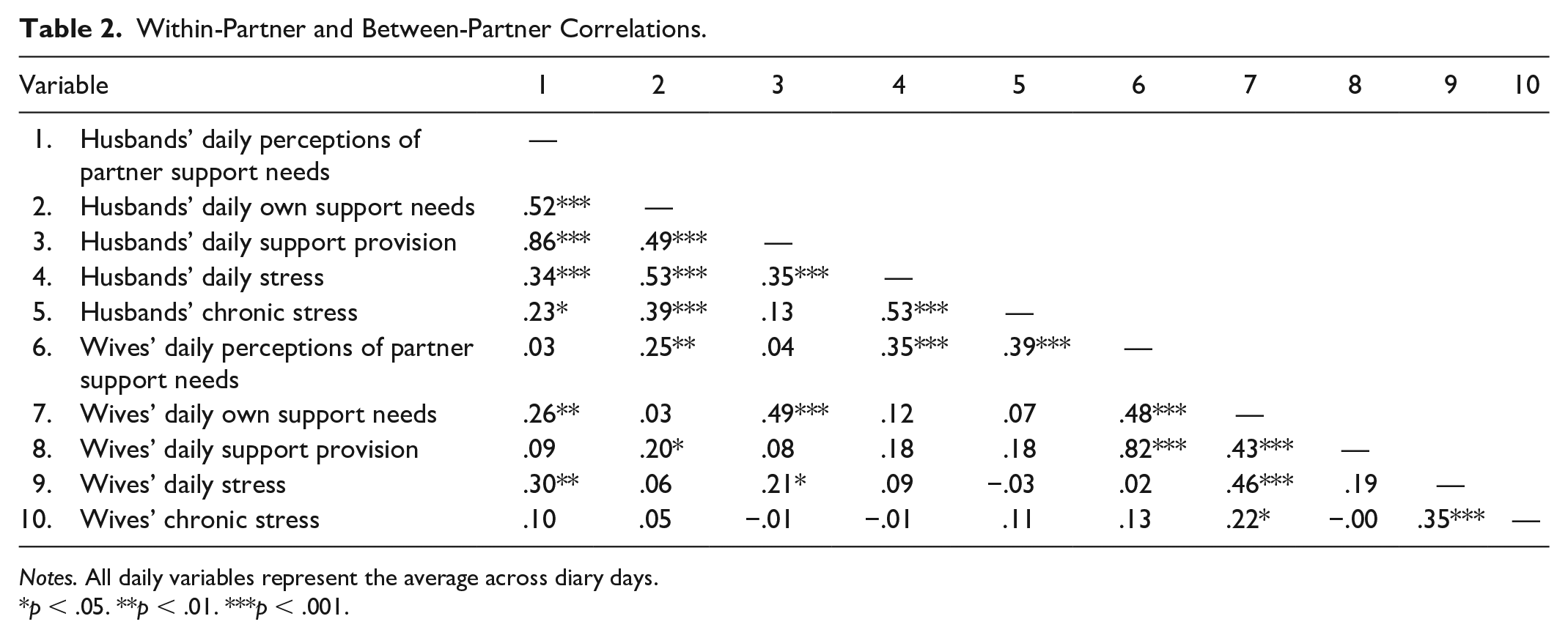
Notes. All daily variables represent the average across diary days.
p < .05. **p < .01. ***p < .001.
Are Chronic and Daily Stress Associated With Perceptions of a Partner’s Support Needs?
The first goal of the study was to examine whether higher levels of individuals’ chronic and daily stress were associated with less accurate perceptions of their partner’s support needs. To examine this hypothesis, we estimated the following multilevel model:
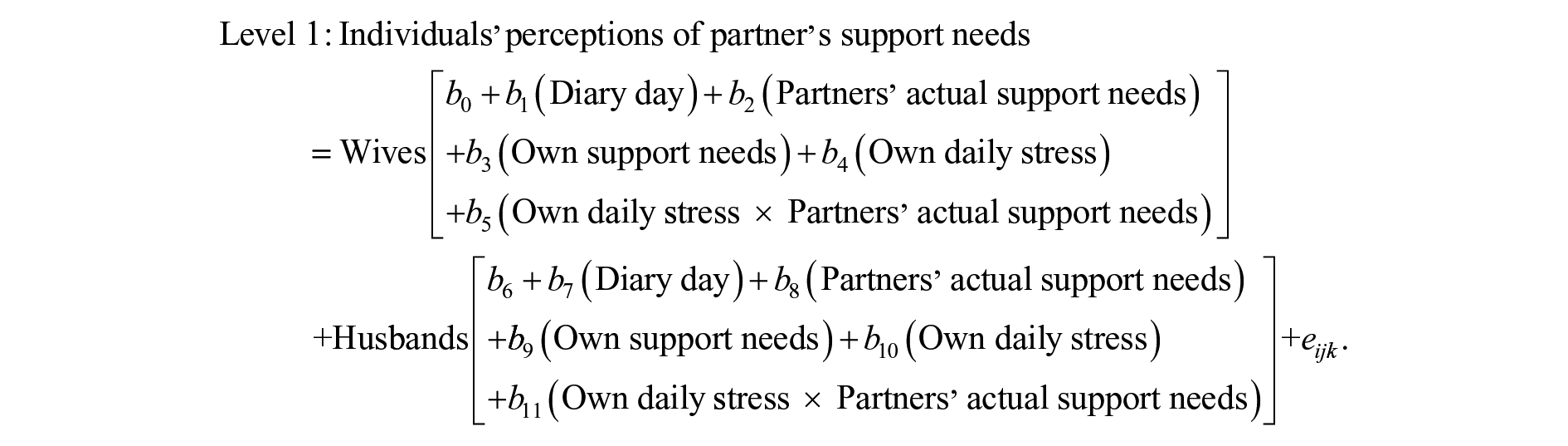

As seen in this model, the within-person level of the analysis (Level 1) estimated each individual’s daily perception of their partner’s support needs as a function of individuals’ own daily stress, their partner’s actual (i.e., self-reported) support needs, and the interaction of the two. Both daily stress and daily partner support needs were centered within persons. Including diary day in the model adjusted for the possibility that factors such as habituation can influence how individuals complete diary materials over time (Bolger et al., 2003). Including individuals’ own daily support needs adjusted for the possibility that individuals’ perceptions of their partner’s support needs may be linked to their own desire for support (i.e., an assumed similarity bias; West & Kenny, 2011). Average reported stress across the diary days and average support needs across the diary days were grand mean centered and included at the between-subjects level of the analysis (i.e., Level 2) to fully disentangle the within-person and between-person effects of these variables (Bolger & Laurenceau, 2013; Curran & Bauer, 2011). Adjusting for these variables allowed us to examine whether fluctuations in daily stress and daily partner support needs were associated with individuals’ perceptions of their partner’s support needs while taking into account the fact that some individuals generally experience greater levels of daily stress and have partners who report greater support needs than do others. In other words, average daily stress across the diary period was not a theoretical construct of interest, but rather was included for the statistical purpose of properly isolating the within-person effect of daily stress. 2 The main effect of chronic stress (i.e., our prolonged stress variable of interest), as well as the interaction of chronic stress with daily partners support needs, were also included at the between-subjects level (i.e., Level 2) of the model. Chronic stress was centered on the grand mean. The between-person equations for each coefficient included a random effect.
As seen in Table 3, husbands’ and wives’ perceptions of their partner’s support needs were positively and significantly associated with their partner’s actual support needs (husbands: b = .31, p < .001; wives: b = .31, p < .001), indicating that individuals were relatively accurate in perceiving day-to-day changes in their partner’s support needs across the diary days. Notably, husbands and wives exhibited significant accuracy in their perceptions of their partner’s needs even when adjusting for their own support needs; in other words, although there was evidence for an assumed similarity bias (husbands: b = .21, p < .001; wives: b = .18, p < .001), individuals nonetheless were attuned to the unique support needs of their partner on average. Turning to the primary parameters of interest, daily stress did not moderate accuracy for either spouse (husbands: b = −.01, p = .859; wives: b = .01, p = .792). However, chronic stress was a significant moderator for husbands, but not for wives (husbands: b = −.05, p < .001; wives: b = .02, p = .573). Further analyses indicated that this gender difference was approaching, but did not reach significance (χ2 = 3.34, p = .06). 3
Is Stress Associated With Less Accurate Perceptions of a Partner’s Support Needs?
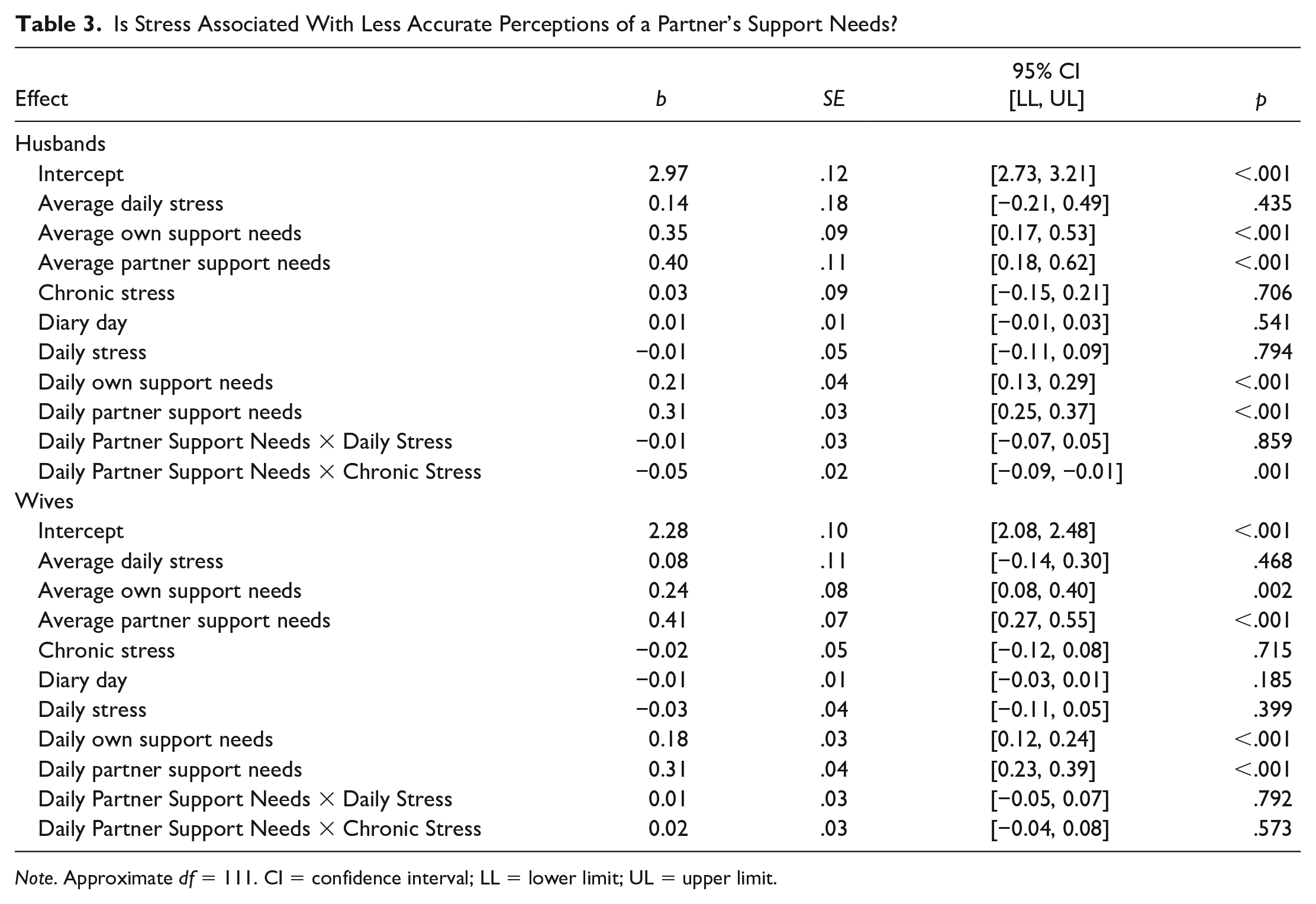
Note. Approximate df = 111. CI = confidence interval; LL = lower limit; UL = upper limit.
The interaction between husbands’ chronic stress and their partner’s daily support needs was decomposed into simple slopes at ±1 SD from the mean. As shown in Figure 1, the overall pattern of results was generally consistent with predictions. As expected, simple slope analyses revealed that the effect of wives’ actual support needs on husbands’ perceptions of wives’ support needs was attenuated, although still significant, among husbands experiencing greater chronic stress, indicated by the solid line; b = .24, SE = .03, t(111) = 6.95, p < .001, 95% confidence interval (CI) [.18, .30], compared with husbands experiencing lower chronic stress, indicated by the dashed line; b = .38, SE = .04, t(111) = 9.18,p < .001, 95% CI [.30, .46]. In other words, husbands under greater chronic stress were less accurate in discerning their partner’s support needs across the diary days. Additional simple slope analyses indicated that the effect of chronic stress on perceptions of a partner’s support needs was not significant at either low, left side of graph; b = .12, SE = .09, t(106) = 1.30, p = .20, 95% CI [−.06, .30], or high levels of partner’s actual support needs, right side of graph; b = −.02, SE = .10, t(106) = −0.23, p = .82, 95% CI [−.22, .18].

Moderating effect of husbands’ chronic stress on husbands’ perceptions of their partner’s support needs.
Are Chronic and Daily Stress Associated With the Provision of Support?
The second goal of the study was to explore whether individuals who perceive their partner as needing more support will be less likely to provide that support if they are experiencing greater levels of chronic and daily stress. In light of competing theories regarding whether stress may interfere with the enactment of relationally oriented behaviors (e.g., Kammrath et al., 2015; Yu, 2016), this question was exploratory. We estimated the following multilevel model:


As seen in this model, the within-person level of the analysis (Level 1) estimated each individual’s daily support provision as a function of their own daily stress, their perceptions of their partner’s support needs, and the interaction of the two. Daily stress and daily perceptions of a partner’s support needs were centered within persons. Including diary day in the model adjusted for the possibility that factors such as habituation can influence how individuals complete diary materials over time (Bolger et al., 2003). Average daily stress and average perceptions of a partner’s support needs across the diary days were grand mean centered and included at the between-subjects level of the analysis (i.e., Level 2) to fully disentangle the within-person and between-person effects of these variables on daily support provision (Bolger & Laurenceau, 2013; Curran & Bauer, 2011). Adjusting for these variables allowed us to examine whether fluctuations in daily stress and perceptions of a partner’s support needs were associated with individuals’ support provision while taking into account the fact that some individuals generally report experiencing greater levels of stress and believe their partner desires more support than do others. Again, average daily stress across the diary days was included in the model solely for the statistical purpose of isolating the within-person effect of daily stress. The main effect of chronic stress (i.e., our prolonged stress variable of interest), as well as the interaction of chronic stress and daily perceptions of a partner’s support needs, was also included at the between-subjects level (i.e., Level 2) of the model. Chronic stress was centered on the grand mean. The between-person equations for each coefficient included a random effect.
As seen in Table 4, individuals’ perceptions of their partners’ support needs were positively and significantly associated with their reports of giving support (husbands: b = .77, p < .001; wives: b = .84, p < .001), such that individuals were more likely to provide support on days when they felt their partner needed more support. Although individuals experiencing greater chronic stress generally reported providing less support to their partners on average across the diary days (husbands: b = −.14, p = .002; wives: b = −.10, p = .055; test of gender difference: χ2 = .26, p > .50), chronic stress did not moderate the link between perceptions of partner’s support needs and support giving on a given day for either spouse (husbands: b = −.03, p =.100; wives: b = .01, p = .601). Daily stress, however, did moderate this link for husbands (b = −.05, p = .011), though not for wives (b = −.001, p = .972). Again, additional analyses indicated that this gender difference was approaching, but did not reach significance (χ2 = 2.91, p = .08).
Is Stress Associated With Support Provision When Spouses Perceive Their Partner Needs Support?
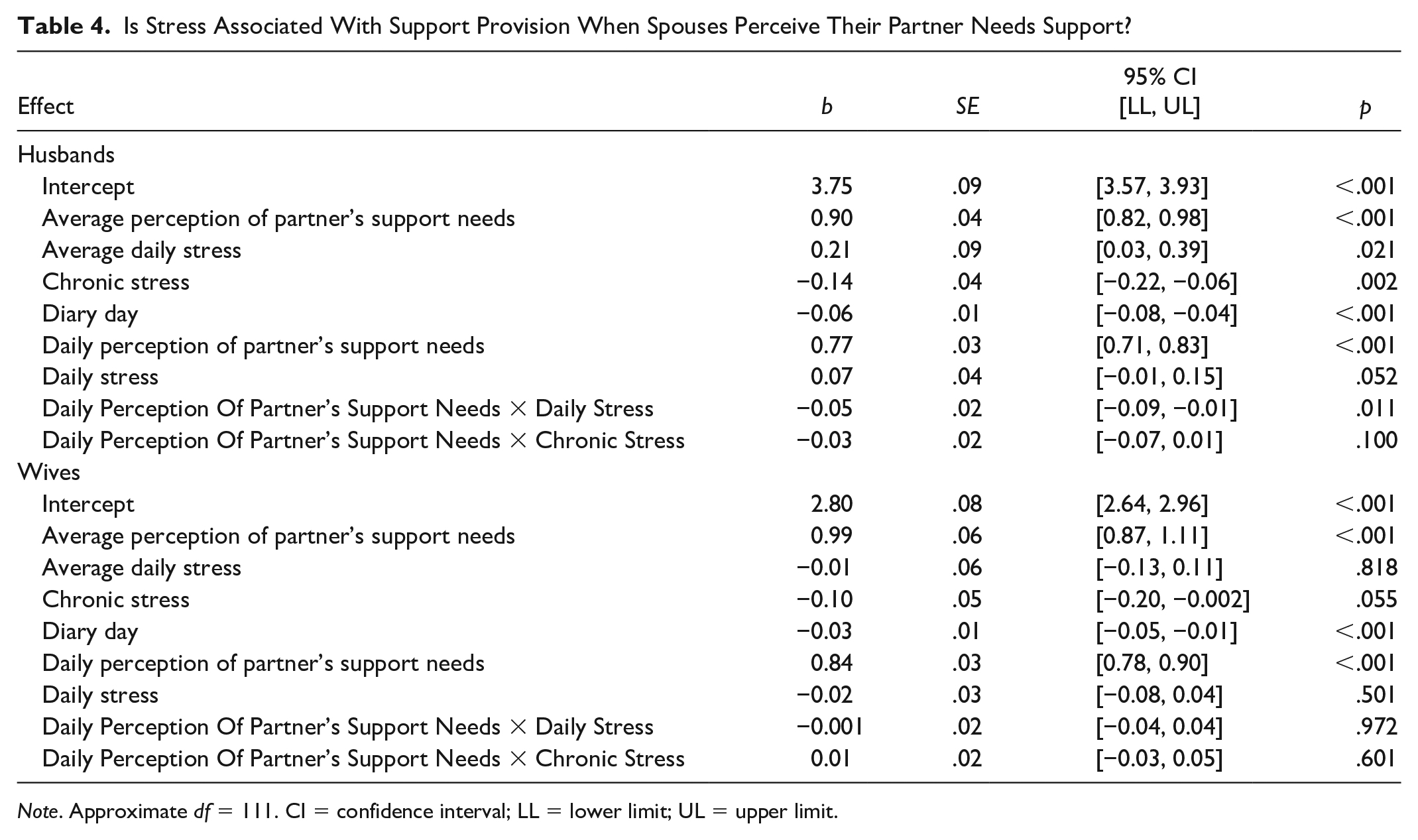
Note. Approximate df = 111. CI = confidence interval; LL = lower limit; UL = upper limit.
The interaction between husbands’ daily stress and their perceptions of their partner’s daily support needs was decomposed into simple slopes at ±1 SD from the mean. The overall pattern of results was consistent with the notion that stress may hinder the provision of support (see Figure 2). Simple slope analyses revealed that on days when husbands perceived their partner needed more support, they provided less support if they were experiencing greater stress that day, right side of graph, b = −.15, SE = .04, t(112) = −4.22, p < .001, 95% CI [−.23, −.07]. Daily stress was not associated with support provision on days when husbands perceived their partner needed less support, left side of graph, b = .01, SE = .06, t(112) = 0.14, p = .890, 95% CI [−.11, .13]. Additional analyses indicated that the effect of husbands’ perceptions of their wives’ support needs on their support provision was attenuated, although still significant, for husbands experiencing greater daily stress, indicated by the solid line; b = .72, SE = .03, t(111) = 22.67, p < .001, 95% CI [.66, .78], compared with husbands experiencing lower daily stress, indicated by the dotted line; b = .81, SE = .03, t(111) = 25.29, p < .001, 95% CI [.75, .87].

Moderating effect of husbands’ daily stress on husbands’ support provision.
Discussion
Perhaps one of the most important tasks that partners face within their relationships is learning how to provide responsive support to one another for everyday challenges (Bradbury & Karney, 2004). Unfortunately, effectively providing support is a complicated process, in which partners must first carefully attend to their partner’s cues of support needs, decide to give support, and finally enact support in a way that is sensitive to the partner’s desires (Pearlin & McCall, 1990; Rafaeli & Gleason, 2009). Although some research suggests that being responsive to a partner’s support needs may be especially difficult at times when support providers are faced with their own stressors, to date these studies have mostly focused on examining whether partners experiencing greater stress provide lower quality support during observed discussion tasks (e.g., Bodenmann et al., 2015; Clavél et al., 2017). By examining the links between stress and support provision in daily life, the current findings expand our understanding of how chronic and daily stress may interfere with multiple stages of the support provision process.
Stress as a Risk Factor for Inadequate Support Provision
Before spouses can decide to provide support, they must first recognize their partner’s particular support needs at the moment. Consistent with prior work demonstrating that experimentally induced stress renders individuals, particularly men, less attuned to the emotional states of others (Negd et al., 2011; Tomova et al., 2014), results indicated that husbands coping with greater chronic stress were less accurate in perceiving day-to-day changes in their partner’s support needs across the diary period. Thus, the current study is the first to demonstrate that, rather than simply enacting poor quality support behaviors, individuals under greater stress may have trouble discerning whether their partner even needs support in the first place. Given that accurate perceptions of a partner’s emotional state are critical for responsive support giving (Gregory et al., 2020; Howland, 2016), this difficulty is liable to undermine relationship satisfaction over time, particularly for partners (i.e., support recipients) whose support needs are unlikely to be fulfilled.
Notably, although chronic stress moderated husbands’ perceptions of their partner’s support needs, daily stress unexpectedly did not. However, in contrast to prior research linking acute stress to reduced perspective-taking in hypothetical scenarios with unfamiliar others, the current study examined this link within close, well-established relationships. As relationships become closer, partners develop more detailed knowledge of each other’s lives, which facilitates their ability to make accurate inferences of each other’s thoughts and feelings (Stinson & Ickes, 1992). As a result, spouses’ judgments of their partner’s current feelings tend to be more accurate than would be expected by chance, even when spouses are physically separated and thus are unable to perceive verbal and non-verbal cues of those emotional states (Wilhelm & Perrez, 2004). In light of the power of shared knowledge structures for enhancing empathic accuracy, the distraction of daily hassles may not be sufficient for spouses to lose perspective on their partner’s unique support needs. Rather, only when spouses’ energy and resources are continuously exhausted by long periods of persistent stress will the ability to accurately read a partner’s needs be sufficiently disrupted. Indeed, prolonged adverse conditions often are linked to increases in depression (Hammen, 2005), which has been shown to predict lowered empathic accuracy in couples (Papp et al., 2010). Clearly, additional research replicating these findings is warranted. Nonetheless, the current results highlight a potential, and previously unexplored, reason why couples residing in more difficult life contexts often have difficulty sustaining their relationships (e.g., Neff & Karney, 2017). Although support exchanges are especially important for these couples, they may be at greater risk of misunderstanding each other’s support needs.
Of course, effective support provision requires not only correctly identifying a partner’s support needs, but also mustering the energy to act on that knowledge and engage in supportive behaviors. Results indicated that stress may interfere with this stage of the support process as well. Regardless of their assessments of their partner’s support needs, husbands experiencing greater chronic stress reported providing less support to their partner on average across the diary days. Moreover, daily stress moderated the association between perceptions of a partner’s support needs and support provision for husbands only, such that on days when husbands perceived their partner needed more support, they provided less support if they were experiencing greater levels of their own stress that day. In other words, even though it may require prolonged periods of stress to upend spouses’ assessments of their partner’s support needs, once those needs are recognized, even acute daily stress seems sufficient to stifle the enactment of supportive behaviors.
The current findings, then, are consistent with the notion that support provision is an effortful behavior that may be more difficult to enact under conditions of stress and thus provide an important extension of the stress spillover literature. To date, most research examining the effects of stress on relationship functioning has focused on the link between stress and increases in the expression of negative relational behaviors (e.g., anger, blaming), with few studies exploring the potential of stress to inhibit the expression of positive relational behavior (cf. Buck & Neff, 2012; Lewandowski et al., 2014). Although several theories suggest that positive relational behaviors can become more reflexive as relationships develop, and thus may not be affected when partners’ energy and resources are drained (e.g., Kammrath et al., 2015), these findings raise the possibility that whether stress undermines positive relational behaviors may depend on the complexity of the behavior itself. For instance, although simple, everyday acts of kindness, such as statements of love, may become so routine as to be impervious to the effects of stress, more difficult and situation-specific behaviors, such as providing responsive support, may break down under conditions of stress. Thus, an important future direction will be to untangle potential limits of the harmful effects of stress on both positive and negative relational behaviors.
Finally, it is worth noting that when significant effects of stress emerged, those effects consistently were present for husbands, but not for wives. This pattern is not entirely surprising, as the prior literature frequently indicates that stress undermines empathic responding to a greater degree in men than in women (Bodenmann et al., 2015; Tomova et al., 2014). In fact, according to the tend-and-befriend model of biobehavioral stress responses (Taylor et al., 2000), women should be especially capable of providing support when regulating their own stress. Importantly, however, the current study found no evidence that women’s support provision increased under conditions of stress; moreover, direct tests of gender differences were not significant. Consequently, any inferences regarding potential gender differences in the effects of stress on support provision must be drawn with caution.
Limitations and Caveats
The current study expands our understanding of couples’ stress and support exchanges by using a naturalistic daily diary design to untangle whether providers’ stress may hinder multiple stages of the support provision process. Nonetheless, the contribution of these findings should be evaluated in the context of several limitations of the sample and methodology. First, data were drawn from a sample of relatively happy couples in the early years of marriage. In fact, as the measures of interest for the study were only included as part of a 2-year follow-up assessment, some of the most distressed couples in the sample had divorced or dropped out of the study before data were collected. In light of prior research demonstrating that partners in higher quality relationships are more likely to provide support at lower levels of recipient need (Birditt et al., 2012), the current study represents a conservative test of the effects of stress on support provision. Notably, however, this limitation makes the fact that we found evidence for the harmful effects of provider stress all the more striking. Even within this relatively homogeneous sample of happy couples, stress seemed to hinder effective support exchanges.
Second, as is common in daily diary research, the constructs of interests were assessed using single items, to reduce participant burden. As such, we do not have information regarding how partners (i.e., support recipients) indicated their need for support (e.g., direct vs. indirect strategies) and whether certain cues may be more difficult for support providers to detect when stressed. Likewise, it is possible that once a partner’s needs are noticed, some types of support behaviors may be more difficult to enact than others. Additional research is needed to clarify whether stress may similarly hinder the expression of emotional and instrumental support, for example. Thus, more detailed diary tasks, perhaps coupled with at-home daily observations, would provide greater insight into these processes.
Finally, and on a related note, the item assessing whether individuals gave support to their partner was presented immediately following the item assessing whether individuals believed their partner needed support. This placement may have created a demand characteristic, such that partners were likely to indicate giving support if they reported their partner needed support. However, there was significant variability across individuals in the strength of the association between these items (husbands: χ2 = 198.5, p < .001; wives: χ2 = 178.9, p < .001). Moreover, this potential demand characteristic should render it more difficult to find moderating effects, again suggesting that the study represents a conservative test of the hypotheses.
Conclusions and Implications
Although successfully weathering stressful periods depends on the adequacy of couples’ support exchanges, this study underscores the rather ironic possibility that spouses can simply be too stressed to effectively support one another. Extending prior research demonstrating that stress is detrimental to the quality of support provided (e.g., Bodenmann et al., 2015), these results indicate that stress may erode support provision much earlier in the process. Individuals experiencing stress have difficulty identifying when their partner is in need of support, and even when they are able to do so, they are less likely to act on that information and attempt to provide support. If successful support provision breaks down before an attempt to provide support is even made, then communication-based relationship interventions which focus on improving couples’ communication skills, such as provision of support, will be limited in their effectiveness. Instead, more attention must be given to the early stages of the support process, how to identify when one’s partner is in need of support, and how to navigate the need to provide support for one’s partner while experiencing stress of one’s own.
Supplemental Material
sj-docx-1-psp-10.1177_0146167220974490 – Supplemental material for Too Stressed to Help? The Effects of Stress on Noticing Partner Needs and Enacting Support
Supplemental material, sj-docx-1-psp-10.1177_0146167220974490 for Too Stressed to Help? The Effects of Stress on Noticing Partner Needs and Enacting Support by Lisa A. Neff, Thao T. T. Nguyen and Hannah C. Williamson in Personality and Social Psychology Bulletin
Footnotes
Authors’ Note
Any opinion, findings, and conclusions or recommendations expressed in this material are those of the authors and do not necessarily reflect the views of the National Science Foundation.
Declaration of Conflicting Interests
The author(s) declared no potential conflicts of interest with respect to the research, authorship, and/or publication of this article.
Funding
The author(s) disclosed receipt of the following financial support for the research, authorship, and/or publication of this article: Preparation of this article was supported by a grant from the National Science Foundation (BCS-0921896) awarded to the first author, as well as funding from the National Science Foundation Graduate Research Fellowship Program (DGE-1610403) awarded to the second author.

Supplemental Material
Supplemental material is available online with this article.
Notes
References
Supplementary Material
Please find the following supplemental material available below.
For Open Access articles published under a Creative Commons License, all supplemental material carries the same license as the article it is associated with.
For non-Open Access articles published, all supplemental material carries a non-exclusive license, and permission requests for re-use of supplemental material or any part of supplemental material shall be sent directly to the copyright owner as specified in the copyright notice associated with the article.
