




Abstract
We tested the novel hypothesis that men lower in status-linked variables—that is, subjective social status and perceived mate value—are relatively disinclined to offset their high hostile sexism with high benevolent sexism. Findings revealed that mate value, but not social status, moderates the hostile–benevolent sexism link among men: Whereas men high in perceived mate value endorse hostile and benevolent sexism linearly across the attitude range, men low in mate value show curvilinear sexism, characterized by declining benevolence as hostility increases above the midpoint. Study 1 (N = 15,205) establishes the curvilinear sexism effect and shows that it is stronger among men than women. Studies 2 (N = 328) and 3 (N = 471) show that the curve is stronger among men low versus high in perceived mate value, and especially if they lack a serious relationship partner (Study 3). Discussion considers the relevance of these findings for understanding misogyny.
Across cultures, hostile (insulting, dominative) sexism and benevolent (flattering, paternalistic) sexism are positively correlated, a pattern presumed essential to maintaining the gender hierarchy (Glick et al., 2000). However, not all individuals endorse hostile and benevolent sexism linearly across the attitude range. Here, we test the novel hypothesis that men lower in status-linked variables—that is, social status and mate value—are relatively disinclined to offset their high hostile sexism with corresponding high benevolent sexism. As such, low-status men who are high in hostile sexism may display relatively unambivalent hostility, reflected in a curvilinear (inverted U) hostile–benevolent association. The goals of this project are to (a) demonstrate, in a large, heterogeneous dataset (N = 15,205) that hostile and benevolent sexism are curvilinearly associated, particularly among men, and (b) test the roles of men’s social status and mate value in moderating their curvilinear sexism. This work advances ambivalent sexism theory by addressing how individual differences may predispose some men to endorse unambivalent hostile sexism, or misogyny.
Ambivalent Sexism and the Importance of Conjoint Endorsement
Ambivalent sexism theory posits that gender relations are usually characterized by two complementary ideologies: hostile sexism—comprising overtly insulting views of women as deceptive, manipulative, and needful of dominative control—and benevolent sexism, comprising flattering but patronizing views of women as moral, essential to men’s happiness, and needful of protection (Glick & Fiske, 1996, 2001). Despite differing in valence, hostile and benevolent sexism correlate positively (rs = .40–.50 in U.S. samples; Glick & Fiske, 1996), reflecting the ambivalence that gives the theory its name.
This ambivalence presumably emerges from and reflects the gender structures of male dominance (i.e., patriarchy) and heterosexual interdependence. Patriarchy—the social system in which men as a group have more access to power and resources than women—is a near-universal feature of human societies (Brown, 1991). And yet, while women and men have unequal status at the group level, the universality of human pair-bonding ensures that most members of these gender groups depend on one another for heterosexual intimacy, mating, and co-parenting (Miller & Fishkin, 1997). Hostile sexism arises from men’s patriarchal dominance over women, while benevolent sexism arises from the gender groups’ mutual interdependence.
The conjoint occurrence of hostile and benevolent sexism, as indexed by their positive linear correlation, is presumably key to the gender hierarchy’s stability (Glick & Fiske, 2001). To maintain the combination of tense inequality and affectionate interdependence underlying the gender hierarchy, hostile and benevolent sexism work together: Hostile sexism supports men’s dominance over women via ideologies of male superiority and (when needed) intimidation tactics, and benevolent sexism mollifies women by portraying them as warm caretakers who deserve men’s protection and provision. Thus, the adoration and chivalry of benevolent sexism are essential counterparts to hostile sexism because they encourage women’s complicity in a system that subordinates them, while promising them protection against hostility (Becker & Wright, 2011; Jackman, 1994). Were high hostility not offset by high benevolence, it would likely elicit more collective and interpersonal resistance among women (Glick & Fiske, 2001; Overall et al., 2011). Accordingly, a 19-nation study found positive correlations between hostile and benevolent sexism among men and women in most nations (Glick et al., 2000).
Differences in Men’s Social Status and Mate Value
Despite men’s group-level dominance over women, individual men differ widely in status, or attributes that elicit respect and esteem within hierarchies (Hasty & Maner, 2020; Ridgeway & Nakagawa, 2015). The male gender role is more hierarchical than the female gender role, meaning that men experience relatively more within-sex stratification of status (Baumeister, 2007; Sidanius & Pratto, 1999). Thus, while high-status men enjoy priority access to goods, resources, and mates, low-status men may lack access to these desirables (Cheng et al., 2013; Wilson & Daly, 1992).
Individual differences in men’s status may predict their outcomes in both domains undergirding ambivalent sexism: patriarchy and heterosexual interdependence. Thus, we considered two related but distinct forms of status reflecting these two domains. First, men differ in social status, or attributes that afford respect and prominence within patriarchies. Such attributes include socioeconomic variables such as wealth, good education, and occupational prestige (Cundiff & Matthews, 2017). Second, men differ in mate value, or partner attributes that women esteem cross-culturally. These include desirable personality traits, attractiveness, and earning potential (Buss & Barnes, 1986). Although overlapping—and especially regarding men’s economic resources—social status and mate value are not synonymous: Men low in social status may possess qualities that garner respect within intimate pairings, and men low in mate value may possess qualities that earn respect within patriarchal structures (Guttentag & Secord, 1983; Lee et al., 2011). Picture, respectively, the uneducated, low-wage worker who is nonetheless a beloved husband and father, and the unlikable, romantically unsuccessful man who heads a Fortune 500 company.
Here, we ask whether individual differences in men’s social status and mate value moderate their curvilinear sexism. Men low in subjective social status rank themselves low on the societal hierarchy in wealth, education, and occupational prestige (Adler et al., 2000), and such perceptions predict lower personal control (Kraus et al., 2009) and more pessimism about the future (Robb et al., 2009). Men low in perceived mate value believe they lack qualities that women value (Fisher et al., 2008), and these perceptions predict lower self-esteem (Goodwin et al., 2012) and more pessimism about attracting suitable marriage partners (Bredow et al., 2011). Thus, men low in social status and mate value view themselves, respectively, as relatively subordinate within the patriarchy and the heterosexual partner pool.
As noted, hostile and benevolent sexism work together so that patriarchy and heterosexual interdependence can coexist. At lower levels of hostile sexism, little benevolence is needed; at moderate to high levels of hostility, higher benevolence becomes increasingly necessary to offset the punishment of hostility, cast men as noble protectors and providers, and reduce women’s resistance to patriarchal control (Becker & Wright, 2011; Hammond & Overall, 2017; Jackman, 1994). Note that we focus here on the correspondence between hostile and benevolent sexism, not on their mean levels. We posit that men who benefit more consistently from patriarchy and heterosexual interdependence—that is, those higher in social status and mate value—should be more inclined to soften their hostile sexism with corresponding benevolent sexism. For such men, hostile and benevolent sexism should be linearly associated. Conversely, men lower in social status and mate value, lacking the advantages that higher status men enjoy, may not buttress their high hostility with comparably high benevolence. Such men may offset hostile sexism with comparable benevolence to a point, because doing so can rationalize inequality (Jost & Hunyady, 2003); beyond that point, however, these men may show waning benevolence as their hostility increases. For instance, if low-status men perceive themselves as unable to uphold the promises of protection and provision that high benevolent sexism implies, they may see diminishing returns from embracing high benevolence to offset their high hostility. As such, these men might display curvilinear (inverted U) sexism.
Women’s Conjoint Sexism Endorsement
As members of the subordinate gender group within patriarchy, women likely endorse hostile and benevolent sexism more conjointly (i.e., linearly) across the attitude range than men. Note, again, our focus on the correspondence between women’s hostile and benevolent sexism, not on mean sexism levels. Women score lower in hostile sexism than men on average (Glick et al., 2000; Hammond et al., 2018), but some women are quite high in hostility toward women (Sibley & Becker, 2012). Notwithstanding the reasons why some women endorse high hostile sexism, we expect that women high in hostility are generally high in benevolence because the latter offers protective and psychological benefits that may soften the sting of high hostility (Hammond et al., 2016; Sibley et al., 2007). Conversely, when low in hostile sexism, women likely recognize benevolent sexism as patronizing and thereby reject it (Glick & Fiske, 2001). Thus, women should display a linear hostile–benevolent association compared with men’s (and especially low-status men’s) more curvilinear sexism.
Overview of Studies
We examined the curvilinear nature of hostile–benevolent sexism (Studies 1–3) and linked it to individual differences in men’s social status and perceived mate value (Studies 2–3). We view this research as an important extension of ambivalent sexism theory, which does not systematically address individual differences in men’s status-linked attributes and their roles in men’s sexism.
Study 1 (N = 15,205) established co-occurring linear and curvilinear hostile–benevolent associations in 23 datasets and showed that men, versus women, display stronger curvilinear sexism (a curvilinear moderation effect). Whereas researchers have reported weaker linear hostile–benevolent associations among people high versus low in hostile sexism, and among men versus women (Glick et al., 2000; Hammond et al., 2018), they have not scrutinized these patterns by testing for nonlinear hostile–benevolent associations. Doing so is important because weak linear associations may obscure complex underlying patterns that are only detectable by fitting nonlinear terms (Li, 2018). For instance, testing our theorized pattern—in which some individuals endorse hostile and benevolent sexism linearly, whereas others endorse them curvilinearly—requires fitting both linear and quadratic terms to the data.
Study 2, which is preregistered in Open Science Framework (OSF; https://osf.io/d3up6), included men only and tested the novel hypotheses that men low (versus high) in social status and mate value display stronger curvilinear sexism (curvilinear moderation effects). We expected both status-linked individual difference variables independently to moderate the hostile–benevolent curve. Forecasting our findings, men’s perceived mate value moderated their curvilinear sexism in the expected manner, but social status did not.
Given that mate value was the only significant moderator in Study 2, we conducted Study 3 (preregistered in OSF; https://osf.io/np8a7) to replicate this curvilinear moderation effect and explore several potential mechanisms behind it. Curvilinear sexism emerged primarily among men not in serious relationships, and the most promising explanation for it was a perceived inability to protect and provide for female partners. In Studies 2 and 3, given our reliance on subjective measures of social status and perceived mate value as moderators, we measured and controlled for more objective indices of these variables (i.e., socioeconomic status [SES] and relationship history, respectively). We also pooled and analyzed data across Studies 2 and 3, to identify overarching patterns. Focused hypotheses and exploratory questions appear under separate study headings.
Study 1
In Study 1, we tested the following preregistered hypotheses in a large dataset comprising 23 studies: Hostile and benevolent sexism will be both linearly (Hypothesis 1) and curvilinearly (Hypothesis 2) associated. Sex should moderate the hostile–benevolent association, such that men’s scores should show a stronger curve than women’s (Hypothesis 3).
Furthermore, the large sample size afforded sufficient power to examine if non-White and non-Asian men display more curvilinear sexism than White and Asian men. We did not expect race to moderate the hostile–benevolent curve, because race is a poor proxy for subjective social status (Wolff et al., 2010). Nonetheless, because non-White and non-Asian people in the United States have lower mean SES than White and Asian people (Noël, 2018), we included this analysis for the sake of thoroughness. Finally, we explored several other demographic and sample-related curvilinear moderators.
Method
Participants and Study Characteristics
Participants were 15,205 adults who participated in 23 studies for course credit (student samples), payment (MTurk samples), or no compensation (Project Implicit volunteers). Table 1 summarizes participant and study variables.
Participant and Study / Dataset Characteristics for Study 1.

Note. HS = hostile sexism; BS = benevolent sexism; ASI = Ambivalent Sexism Inventory (coded: Short form = 0, Long form = 1); Lab = location of data collection (coded: Not first author’s lab = 0, First author’s lab = 1). Sample is coded: MTurk = 0, Student = 1, Volunteer = 2. Design is coded: Experimental = 0, Correlational = 1. Dashes indicate variables absent from datasets.
Dataset from Colbow et al. (2016).
p < .05. **p < .01. ***p < .001.
Procedure
We compiled datasets from the first author’s and a colleague’s (Colbow et al., 2016) lab, and the Project Implicit (https://implicit.harvard.edu/implicit/) and OSF websites. The only criterion for inclusion was that the dataset contained the Ambivalent Sexism Inventory (Glick & Fiske, 1996). All data were collected as part of institutional review board (IRB)-approved studies.
Ambivalent Sexism Inventory
All datasets contained either the long form (22 items; Glick & Fiske, 1996) or the short form (12 items; Glick & Whitehead, 2010) of the Ambivalent Sexism Inventory (ASI), which measures hostile sexism (e.g., “Women exaggerate problems they have at work”), and benevolent sexism (e.g., “Women should be cherished and protected by men”). Participants rate their agreement with statements and scores are averaged (after reverse-coding relevant items). See Table 1 for coefficient alphas. Because the ASI was administered with different rating scale ranges and endpoint labels across datasets, we converted responses to Percentage of Maximum Possible (POMP) scores (Cohen et al., 1999) using the formula:

This resulted in hostile and benevolent sexism scores ranging from 0 to 100.
Moderators
Primary moderators were binary sex (female, male) and race (White and Asian vs. not White or Asian). We also explored moderating roles of other study characteristics (e.g., ASI version, study design, sample; see online supplement for analyses).
Results
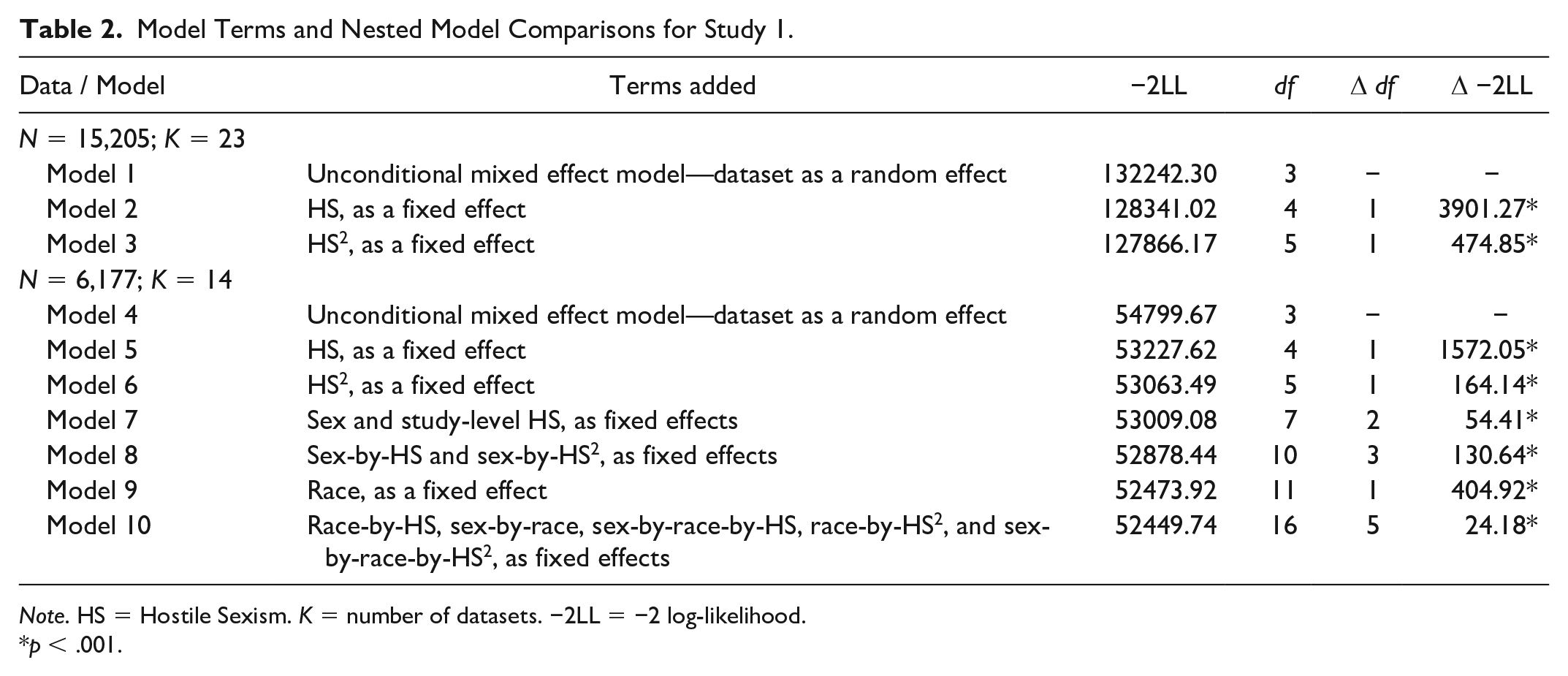
As Table 1 shows, the linear hostile–benevolent effect was significant in all datasets, and the curvilinear effect was significant in 20 of 23 datasets. To estimate the size of the linear and curvilinear hostile–benevolent effects, and test for moderation by participant sex and race, we used integrative data analysis (IDA; Curran & Hussong, 2009), which allows effects to be estimated both within and between studies. We used one-stage IDA models, which employ a multilevel framework that treats dataset as a grouping variable (Debray et al., 2013). Because only a subset of participants (n = 6,177) had data for sex and race, we ran two sets of analyses. The first set tested whether the models with hostile sexism and hostile sexism2 demonstrated improved fit for the whole sample (Table 2, Models 1–3). The second set replicated these models on a subset of participants and examined moderation by sex and race (Table 2, Models 4–10).
Model Terms and Nested Model Comparisons for Study 1.
Note. HS = Hostile Sexism. K = number of datasets. −2LL = −2 log-likelihood.
p < .001.
We used linear mixed model procedures with maximum likelihood estimation to estimate Level 1 and Level 2 effects. Hostile sexism scores were mean-centered on their sample means. Dataset was entered as the grouping variable at Level 2 to account for the non-independence of observations across studies. The remaining Level 2 variable (sample mean hostile sexism) and all Level 1 variables (hostile sexism, hostile sexism2, sex, race) were entered as fixed effects (see online supplement for additional details). Models were tested against each other by comparing the −2 Log-Likelihood (−2LL) values of each model to the prior one using chi-square tests (West et al., 2007).
The first analyses were unconditional mixed effects models to determine the amount of variance in benevolent sexism accounted for by dataset, the grouping variable (Table 2, Models 1 and 4). Dataset accounted for significant variance in benevolent sexism in the full (intraclass correlation coefficient [ICC] = .07) and restricted (ICC = .06) datasets, indicating that a multilevel framework was appropriate (Pituch & Stevens, 2016). Furthermore, the significant residual from the variance components estimate (Wald’s Z = 87.27, p < .001) indicates that within-study effects (Level 1 variables) should be added to improve fit. We therefore entered hostile sexism as a fixed effect in Models 2 and 5, which improved fit over Models 1 and 4. Next, as shown in Table 2, adding hostile sexism2 in Models 3 and 6 improved fit over Models 2 and 5, β = −0.01, SE = 0.0002, t(15200.05) = −21.96, p < .001; β = −0.005, SE = 0.0004, t(6200) = −12.90, p < .001. Figure 1 shows the linear and curvilinear effects in the full dataset. Supporting Hypotheses 1 and 2, the linear and curvilinear hostile–benevolent associations were robust across heterogeneous samples.
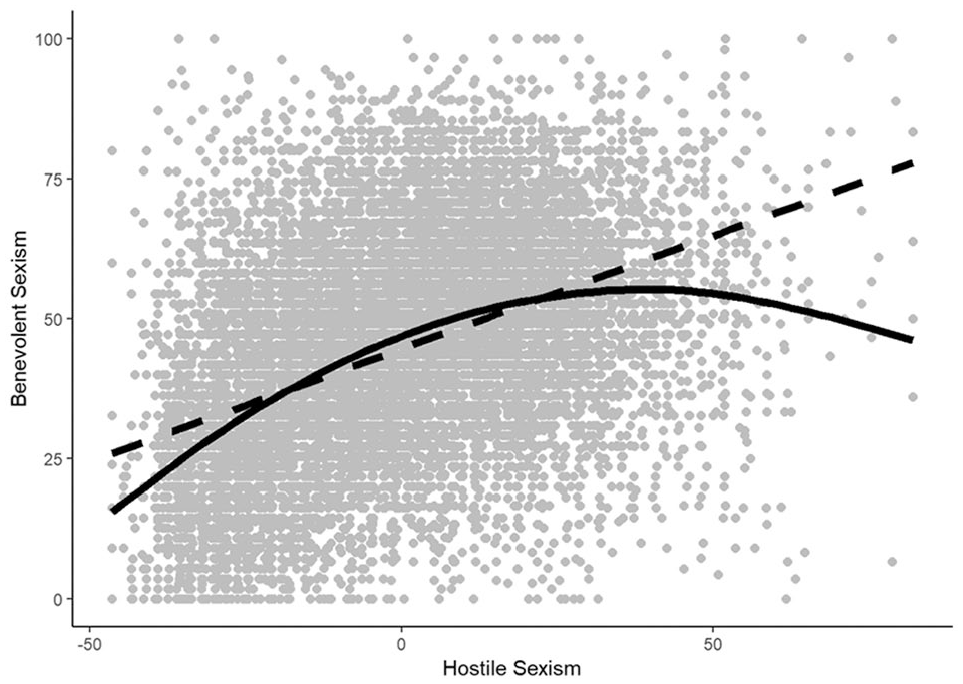
Scatterplot of linear and curvilinear hostile–benevolent sexism effects from Model 3 (Study 1).
Next, using only the restricted dataset, we tested Model 7, in which participant sex and study-level hostile sexism were entered as fixed effects. This model fit the data better than Model 6 (see Table 2). Participant sex predicted benevolent sexism, β = 3.28, SE = 0.51, t(4924.94) = 6.84, p < .001, such that men endorsed benevolent sexism more strongly than women. Moreover, adding the sex-by-hostile sexism and sex-by-hostile sexism2 terms in Model 8 improved fit and, consistent with Hypothesis 3, the sex-by-hostile sexism2 interaction was significant, β = 0.002, SE = 0.001, t(6195) = 2.45, p = .014.
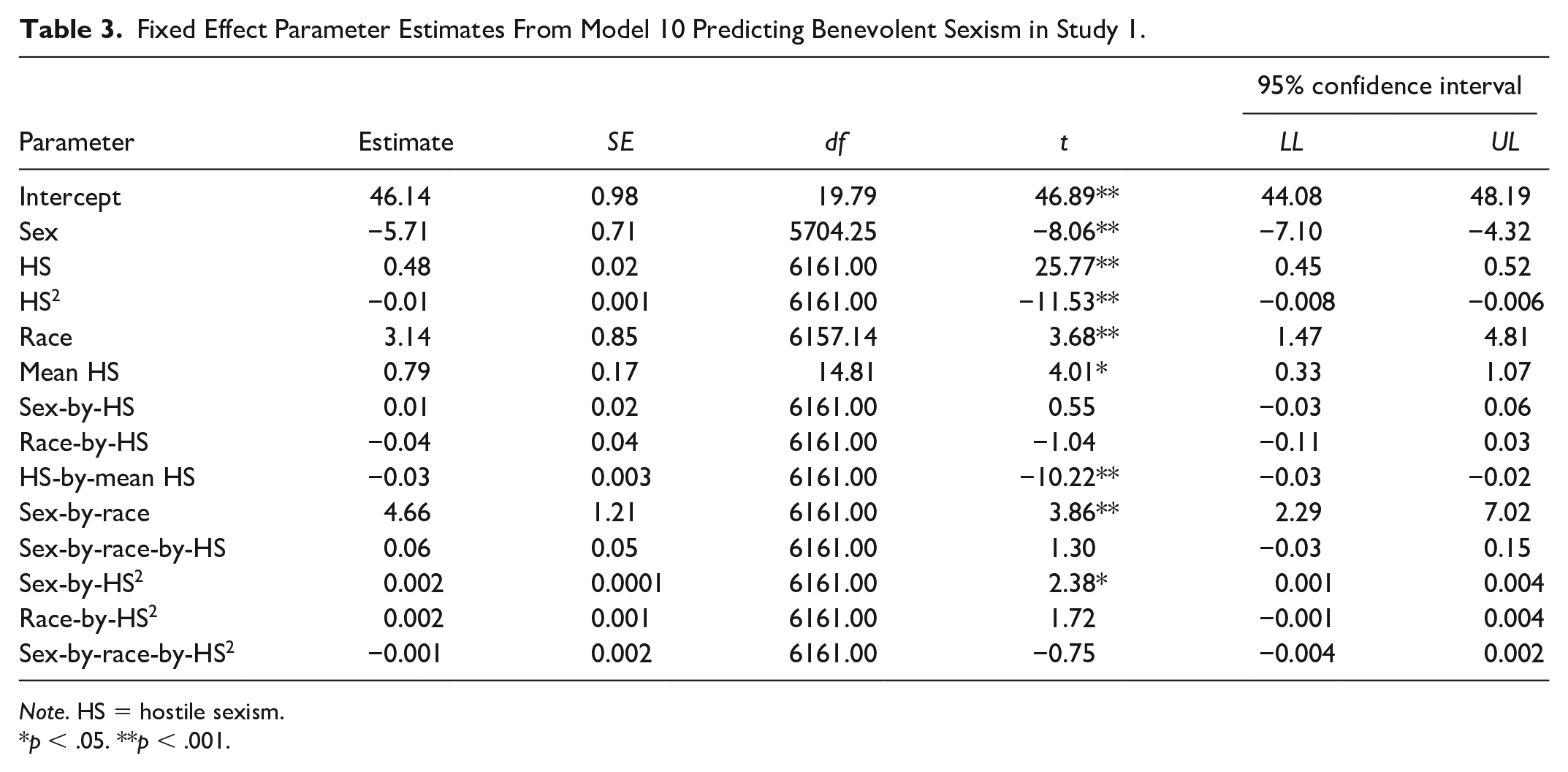
We next explored the role of race. Adding race to Model 9 as a fixed effect improved fit, and race predicted benevolent sexism, β = −6.16, SE = 0.49, t(6142.27) = −12.67, p < .001, with White and Asian people reporting lower benevolent sexism than non-White and non-Asian people. Adding all race-related interaction terms in Model 10 also improved model fit (see Table 3). However, as shown in Table 3, race did not moderate the hostile sexism2 effect or the sex-by-hostile sexism2 effect, ps > .09. In the final model, only the hypothesized sex-by-hostile sexism2 interaction (p = .018), and an unpredicted sex-by-race interaction (p < .001), were significant. Figure 2 depicts the sex-by-hostile sexism2 interaction from Model 10 (see online supplement for the sex-by-race interaction). Consistent with Hypothesis 3, men showed more curvilinear sexism than women.
Fixed Effect Parameter Estimates From Model 10 Predicting Benevolent Sexism in Study 1.
Note. HS = hostile sexism.
p < .05. **p < .001.
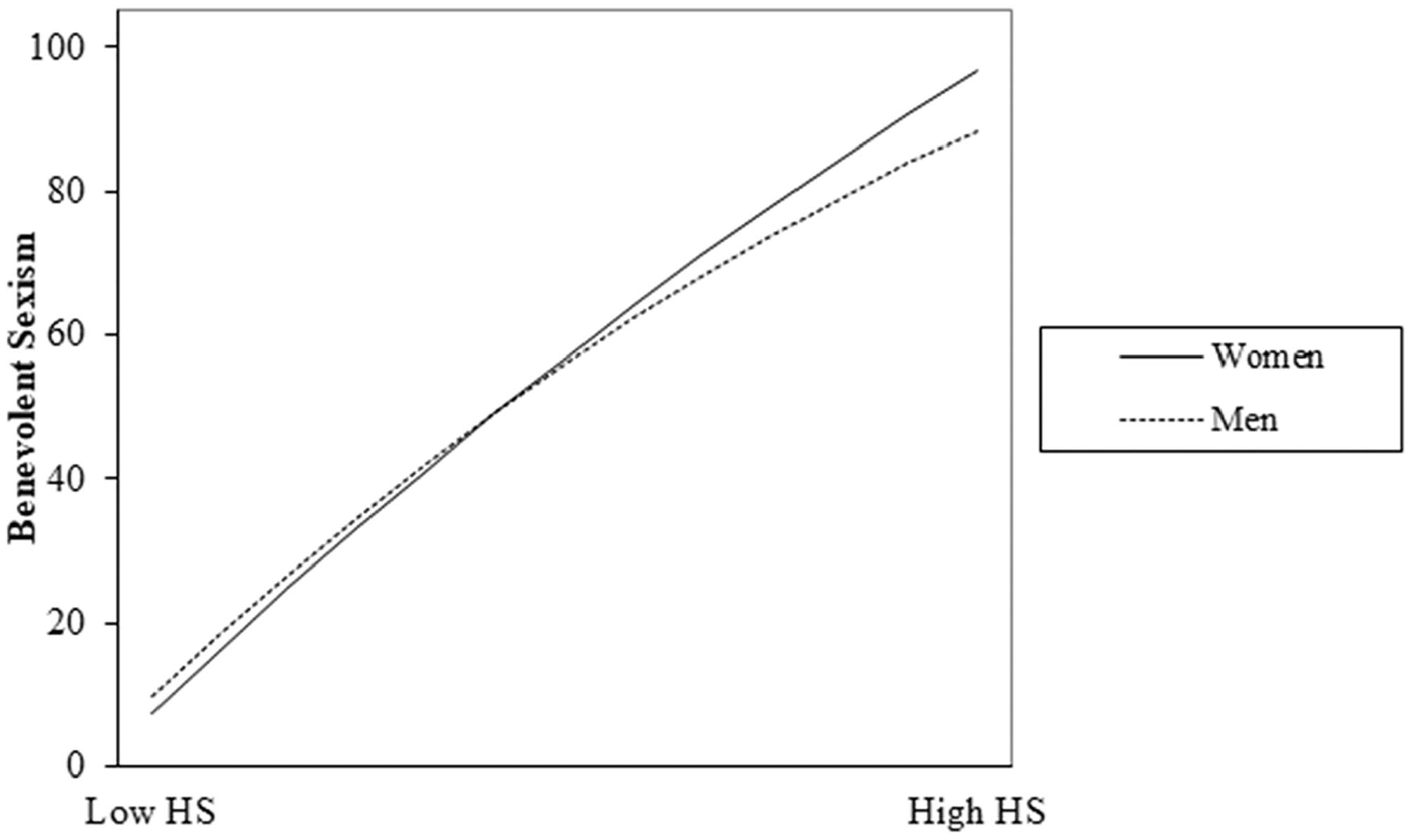
Moderation of the curvilinear sexism effect by participant sex from Model 10 (Study 1).
Summary
In a large dataset combining 23 heterogeneous studies, hostile and benevolent sexism were both linearly and curvilinearly associated. At moderate-to-high levels of hostile sexism, the hostile–benevolent slope weakened and began to reverse. This effect was moderated by sex such that men showed a stronger curve than women. Race did not moderate, nor interact with sex to moderate, curvilinear sexism.
Although curvilinear sexism was stronger among men than women as predicted, the interaction effect was quite small (d = .06) and visual inspection of the curve among men (Figure 2) suggests a weak slope. In Study 2, we asked whether this slope was especially strong among men low (versus high) in status-linked variables, as our theorizing suggests.
Study 2
Having demonstrated that men display more curvilinear sexism than women, we focused exclusively on men in Study 2. Hypotheses for this study were preregistered in OSF (https://osf.io/d3up6) as follows. Hostile and benevolent sexism will be linearly (Hypothesis 1) and curvilinearly (Hypothesis 2) associated. Men’s subjective social status (Hypothesis 3a) and perceived mate value (Hypothesis 4a) should moderate the hostile–benevolent association, such that men low (versus high) on each variable should show more curvilinear sexism. Among men high in hostile sexism, those low versus high in social status (Hypothesis 3b) and mate value (Hypothesis 4b) should report lower benevolent sexism. Men’s subjective social status and perceived mate value should correlate, respectively, with SES and relationship history (Hypotheses 5 and 6), and all effects should emerge when controlling for these variables (and other relevant covariates). Because wealth is a component of both social status and mate value for men, we minimized overlap in these constructs by using a mate value scale that deemphasizes wealth (Fisher et al., 2008). See the online supplement for additional analyses.
Method
Participants
We estimated needing 325 participants to detect a small interaction effect (f2 = 0.03) with an alpha of .05 and power of .80 (Faul et al., 2009). Participants were recruited through MTurk and compensated them with $1.30. Eligible MTurk workers were self-identified men, ages 18 to 50, who were U.S. residents with 100 or more approved MTurk jobs and an MTurk approval rating ≥95%. We blocked suspicious geocode locations and automatically filtered out respondents who failed any of three attention checks. The final sample contained 328 men (Mdage = 30) who identified as White (69.5%), Black (22.3%), Asian (6.7%), Native American (4.0%), and Other (1.2%). Most identified as non-Latino (74.7%) and heterosexual (75.6%). 1
Measures
Ambivalent Sexism Inventory
We used the long form of the ASI (Glick & Fiske, 1996). Items are rated on scales of 1 (disagree strongly) to 6 (agree strongly) and we averaged them to create hostile (α = .87) and benevolent (α = .85) sexism scales.
Social status
The Status Ladder Scale (Singh-Manoux et al., 2003) depicts a 10-rung ladder representing people’s standing in society from the bottom (“those with the least money, least education, and worst or no jobs”) to the top (“those with the most money, most education, and best jobs”). Participants selected the rung representing their own social status, then completed a modified ladder in which they compared their status to that of “other men.” The Self-Perceived Status Scale (modified from Dixson & Vasey, 2012) defines social status as “a person’s social ranking and ability to command respect within their community.” Using this definition, participants rated their social status in general, and then compared “to that of other men,” on scales of 1 (I have very low social status) to 5 (I have very high social status). We standardized and averaged these four items to create an index of subjective social status (SSS; α = .86).
We followed best practices (Diemer et al., 2013) to measure socioeconomic status (SES) by combining highest education level, primary caregiver’s education, household income, and financial resources (e.g., assets, debt). After standardizing these items, we averaged them (α = .64). We also measured occupational prestige, but it reduced Cronbach’s alpha to .59 so we excluded it. 2
Mate value
Men completed the 22-item Perceived Mate Value scale (Fisher et al., 2008), which measures attractiveness (“Members of the other sex are attracted to me”), sociality (“I have a large network of friends”), parenting ability (“I would make a good parent”), and relationship success (“After I date someone they often want to date me again”). Items are rated on scales of 1 (strongly disagree) to 7 (strongly agree). We excluded two items that assess displays of wealth, then averaged the remaining 20 items to create an index of perceived mate value (PMV; α = .87).
To validate this subjective index, we assessed the numbers of people whom men went on dates with, dated casually, dated seriously, had sex with (lifetime), and had sex with (last 3 months). Items were answered on sliding scales ranging from 0 to 100, and we averaged them to yield an index of relationship history (α = .96).
Demographics
Participants indicated their age, race, ethnicity, sexual orientation (on a scale of 1 = exclusively straight to 7 = exclusively gay), relationship history, relationship status (in a serious relationship vs. not in a serious relationship; see online supplement for details), the SES indicators, and several other items.
Procedure
All study procedures were approved by the IRB. Interested MTurk account holders were invited to take the survey. After giving informed consent, participants completed the scales described above. We counterbalanced the order of administration of the ASI and the moderator scales (the SSS and PMV); within the block of moderator scales, order of scale presentation was randomized. Order of items was randomized within scale. Next, participants completed several exploratory measures in randomized order (see https://osf.io/d3up6 for all materials). Finally, participants provided demographic information, received study information, and were paid.
Results
Preliminary Analyses
Outliers were examined with several tests (Tabachnick & Fidell, 2007); Mahalanobi’s Distance (D2) and DFBETAS detected two outliers, which we removed. Correlations among and descriptive statistics for all variables appear in Table 4. Consistent with Hypotheses 5 and 6, SSS correlated moderately with SES, and PMV correlated moderately with relationship history. SSS and PMV also correlated moderately, indicating that they measure overlapping, but distinct, status-linked constructs.
Correlations and Descriptive Statistics for Study 2.

Note. BS = benevolent sexism; HS = hostile sexism; SSS = subjective social status; SES = socioeconomic status; PMV = perceived mate value; RH = relationship history; SO = sexual orientation; RS = relationship status (coded: Not in a serious relationship = 0, In a serious relationship = 1). Race is coded: non-White = 0, White = 1. Ethnicity is coded: 0 = non-Latinx, 1 = Latinx. Sexual orientation was rated on a 7-point sliding scale (1 = exclusively straight, 7 = exclusively gay). Skew and kurtosis data are not provided for binary variables (race, ethnicity, relationship status).
p < .05. **p < .01. ***p < .001.
As shown in Table 4, race, ethnicity, sexual orientation, and relationship status all correlated weakly (rs ≤ .25) with benevolent sexism, so we examined the appropriateness of covarying them by testing whether they interacted with the predictors. Race, ethnicity, and relationship status were not significant moderators, ts < 1, ps > .53, so we covaried them. Sexual orientation moderated higher-order interactions of interest, ts > 2.23, ps < .027, so we did not covary it (see online supplement for moderation effects). Final covariates were race, ethnicity, relationship status, SES, and relationship history.
Primary Analyses
We expected linear (Hypothesis 1) and curvilinear (Hypothesis 2) hostile–benevolent associations, the latter of which should be moderated by subjective social status (Hypothesis 3a) and perceived mate value (Hypothesis 4a). In a hierarchical linear regression analysis, we regressed benevolent sexism onto the covariates on Step 1; mean-centered hostile sexism, SSS, and PMV on Step 2; hostile sexism2, SSS-by-hostile sexism, PMV-by-hostile sexism, and SSS-by-PMV on Step 3; SSS-by-hostile sexism2, PMV-by-hostile sexism2, and SSS-by-PMV-by-hostile sexism on Step 4; and SSS-by-PMV-by-hostile sexism2 on Step 5. See Table 5 for output from Steps 2 to 5.
Output of Regression Analyses Predicting Benevolent Sexism in Study 2.

Note. RH = relationship history; SES = socioeconomic status; RS = relationship status (coded: Not in a serious relationship = 0, In a serious relationship = 1); SSS = subjective social status; PMV = perceived mate value; HS = hostile sexism. Race is coded: non-White = 0, White = 1. Ethnicity is coded: 0 = non-Latinx, 1 = Latinx.
p < .05. **p < .01. ***p < .001.
The main effect terms entered at Step 2 accounted for significant variance in benevolent sexism beyond the covariates, ΔF(3, 319) = 15.04, ΔR2 = 0.10, p < .001, and supporting Hypothesis 1, hostile sexism predicted benevolent sexism (t = 4.43, p < .001; see Table 5). PMV also predicted benevolent sexism at Step 2 (t = 3.01, p = .003). Supporting Hypothesis 2, adding the two-way interaction terms on Step 3 accounted for significant variance, ΔF(4, 315) = 4.62, ΔR2 = 0.04, p = .001, and the hostile sexism2 term was significant, t = −3.61, p < .001. As shown in Figure 3, the curvilinear sexism effect mimics the inverted U pattern in Study 1.

Scatterplot of linear and curvilinear hostile–benevolent sexism effects (Study 2).
We verified the curvilinear sexism effect using the “two-lines” approach (Simonsohn, 2018), which applies more stringent criteria than regression and provides two slope estimates and a data-driven inflection point at which the linear relationship between two variables changes. The output from this analysis (see online supplement) parallels the regression output, and establishes an inflection point of 4.18 on the 6-point hostile sexism scale.
Next, the interaction terms entered on Step 4 explained additional variance in benevolent sexism, ΔF(3, 312) = 3.00, ΔR2 = 0.02, p = .031 (see Table 5). However, Hypothesis 3a was not supported: the SSS-by-hostile sexism2 term was not significant, t = −1.33, p = .185 (therefore, we did not test Hypothesis 3b). Supporting Hypothesis 4a, a significant PMV-by-hostile sexism2 interaction emerged, t = 2.82, p = .005. As shown in Figure 4 (created with a tool by Dawson, 2014), men low in PMV displayed more curvilinear sexism than men high in PMV. Moreover, Johnson–Neyman tests for use with curvilinear effects (Miller et al., 2013) revealed that men low (vs. high) in PMV, with hostile sexism scores ≥ 4.13 (which falls at the 75th percentile), reported significantly lower benevolent sexism (t = 1.97, p = .048). This supports Hypothesis 4b. Above the hostile sexism value of 4.13, each one unit decrease in PMV corresponds to a 0.17 increase in the concave curvature of the hostile–benevolent association. Finally, adding the PMV-by-SSS-by-hostile sexism2 interaction term to the model did not explain additional variance, ΔF(1, 311) < 1, ΔR2 < .001, p = .710, indicating that social status and mate value do not interactively predict men’s curvilinear sexism.

Moderation of the curvilinear sexism effect by men’s perceived mate value (Study 2).
Summary
As hypothesized, men’s hostile and benevolent sexism were linearly and curvilinearly associated, and men lower in perceived mate value displayed a stronger curve than men higher in mate value. Among men high in hostile sexism, those low (versus high) in mate value reported lower benevolent sexism. These effects emerged when controlling for SES and relationship history, both of which correlated as expected with social status and mate value, respectively.
Counter to hypotheses, men’s subjective social status did not moderate their curvilinear sexism. Thus, we found no evidence that men high in hostile sexism reject benevolent sexism when they view themselves as lacking wealth, good education, and occupational prestige. Instead, only men who view themselves as undesirable relationship partners begin to reject benevolence as their hostility increases above the scale midpoint.
Study 3
Study 3 had three goals. First, we sought to replicate Study 2’s findings. Second, because our theorizing describes men who seek interdependent relationships with women, we restricted eligibility to heterosexual men (see Note 1). Third, we explored possible mechanisms behind the curvilinear sexism effect.
We preregistered the following confirmatory hypotheses (https://osf.io/np8a7): Hostile and benevolent sexism will be linearly (Hypothesis 1) and curvilinearly (Hypothesis 2) associated. Mate value will moderate the hostile–benevolent association, with low-mate value men showing more curvilinear sexism than high-mate value men (Hypothesis 3a). Among men high in hostile sexism, those low versus high in mate value should report lower benevolent sexism (Hypothesis 3b). All effects should emerge when controlling for covariates.
Regarding mechanisms, our logic suggests that men low (versus high) in mate value lack motivation to offset their high hostility with high benevolence. However, this lowered motivation may reflect the operation of several distinct cognitive-affective processes. Men low in mate value may view themselves as unable to protect and provide for female partners (Glick & Fiske, 1996; Penke & Denissen, 2008), in which case they may see little benefit to endorsing higher benevolence as their hostility increases. After all, benevolent sexism promises protection and provision to women, and men low in mate value may lack confidence that they can uphold these promises. By similar logic, men low in mate value may reject high benevolence as their hostility increases if they are cynical about their chances of attaining a satisfying romantic relationship (Bredow et al., 2011; Hart et al., 2012). Finally, low-mate value men who are high in hostile sexism may harbor resentment about women and dating (e.g., Rudman & Goodwin, 2004), which may undermine their benevolence toward women. Any of these mechanisms might—independently or together—indirectly drive curvilinear sexism among men high in hostile sexism and low in mate value. Because this was our first test of a mechanism and we had no a priori expectations about which mechanism would prove superior, these analyses were exploratory.
Method
Participants
A power analysis using the simsem package (Jorgensen et al., 2018) in R indicated that 800 participants were needed to detect a moderated curvilinear mediation effect. Although we collected enough data to be scientifically useful, we did not meet this preregistered target sample size. 3 We recruited participants through MTurk and compensated them with $1.00. Eligibility, exclusion, blocking, and filtering criteria were identical to those in Study 2, with the exception that we added “heterosexual-identified” as an eligibility criterion. The final sample contained 471 heterosexual men (Mdage = 30) who identified as White (69.8%), Black (20.0%), Asian (5.1%), Native American (2.3%), and Other (2.7%). Most identified as non-Latino (75.1%). Table 6 shows descriptive statistics.
Correlations and Descriptive Statistics for Study 3.
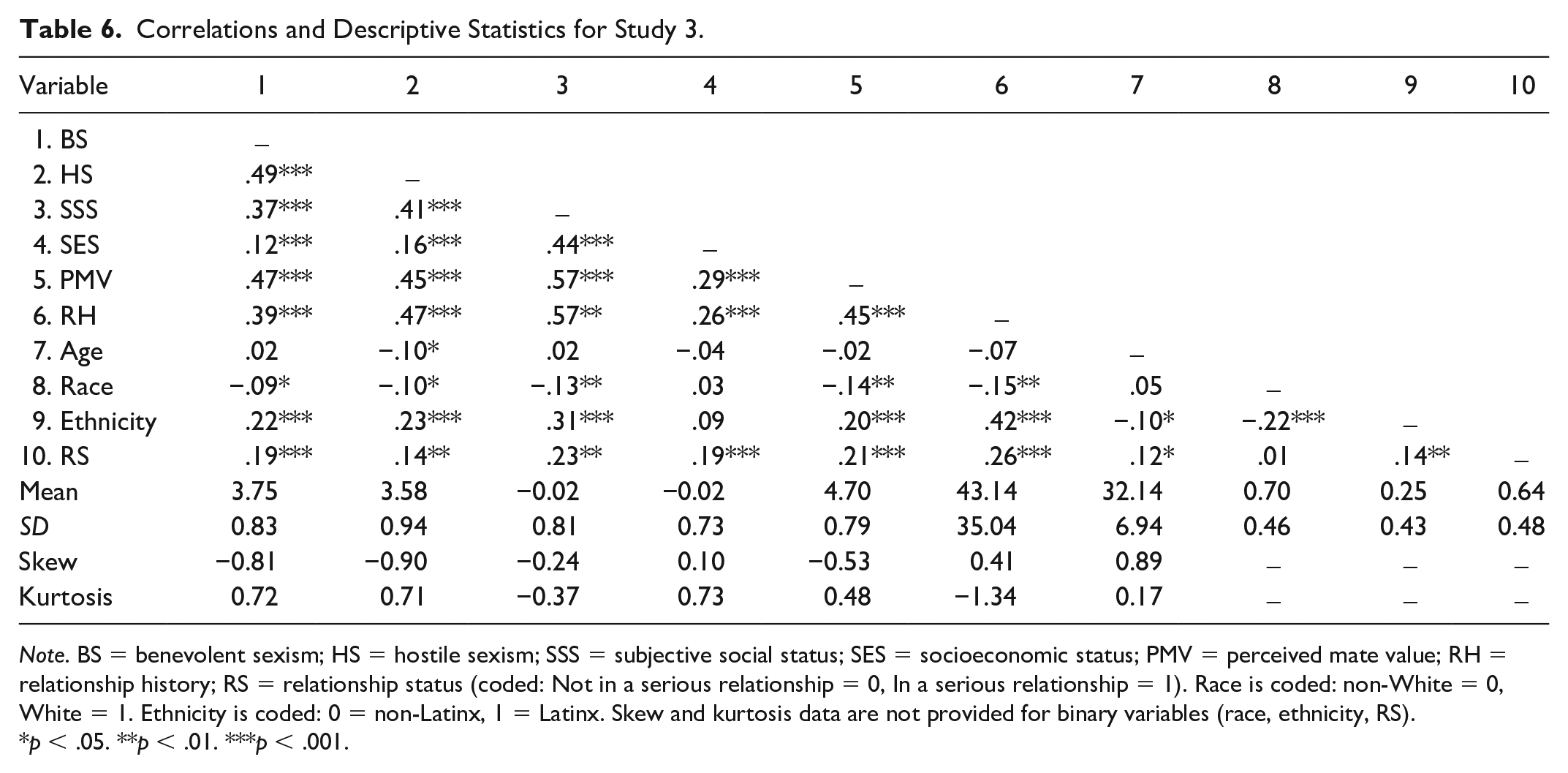
Note. BS = benevolent sexism; HS = hostile sexism; SSS = subjective social status; SES = socioeconomic status; PMV = perceived mate value; RH = relationship history; RS = relationship status (coded: Not in a serious relationship = 0, In a serious relationship = 1). Race is coded: non-White = 0, White = 1. Ethnicity is coded: 0 = non-Latinx, 1 = Latinx. Skew and kurtosis data are not provided for binary variables (race, ethnicity, RS).
p < .05. **p < .01. ***p < .001.
Measures
Ambivalent sexism and status scales
We measured and scored hostile (α = .85) and benevolent (α = .81) sexism, SSS (α = .82) and SES (α = .68), and PMV (α = .84) and relationship history (α = .97), exactly as in Study 2.
Exploratory mechanisms
We wrote four items assessing protect–provide beliefs (e.g., “I could provide financially for a wife / girlfriend”; “I could offer physical protection to a wife / girlfriend”; α = .80). Three items modified from Bredow et al. (2011) assessed the likelihood of finding love (e.g., “How likely is it that you will find mutual love and attraction with a desirable romantic partner?”; α = .81). Seven items modified from Rudman and Goodwin (2004) and Watkins et al. (2003) assessed resentful beliefs about dating and women (e.g., “I basically feel like life has ‘ripped me off’ when it comes to dating and romantic love”; “It feels unfair when women refuse to date me”; α = .94). Items assessing protect–provide and resentful beliefs were rated on scales of 1 (strongly disagree) to 7 (strongly agree), and items assessing likelihood were rated on scales of 1 (no chance) to 5 (an almost certain chance). A principal axis factor analysis on these 14 items with promax rotation revealed a three-factor solution (eigenvalues > 1.00, cumulative variance = 62.83%), and all items loaded on their target factors at > .58. Composites were created by averaging items.
Demographics
Participants provided the same demographic information as in Study 2.
Procedure
All procedures were IRB-approved. Interested MTurk account holders gave informed consent and then completed the scales described above. We used the same counterbalancing procedures as in Study 2 for the sexism and status scales. Exploratory items then appeared in a randomized order, followed by demographic items. Finally, participants received information about the study, and were paid.
Results
Preliminary Analyses
Univariate outliers were those with z-scores ±3 standard deviations from the mean. Multivariate outliers were detected with Mahalanobi’s Distance (D2) and Cook’s Distance. Based on these tests, we deleted 16 outliers. Correlations and descriptive statistics appear in Table 6. As in Study 2, race, ethnicity, and relationship status correlated weakly (rs ≤ .22) with benevolent sexism. Race and ethnicity were not significant moderators, ts < 1, ps > .55, so we covaried them. Unlike in Study 2, relationship status moderated an interaction of interest so we included it in primary analyses. Covariates were race, ethnicity, and relationship history.
Primary Analyses
We predicted linear (Hypothesis 1) and curvilinear (Hypothesis 2) hostile–benevolent associations, and moderation of the curvilinear sexism effect by men’s mate value (Hypothesis 3a). Because relationship status (RS; not in a serious relationship = 0; in a serious relationship = 1) moderated the curvilinear effect, we included it in the model. We regressed benevolent sexism onto the covariates on Step 1; RS and mean-centered hostile sexism and PMV on Step 2; hostile sexism2, PMV-by-hostile sexism, RS-by-hostile sexism, and RS-by-PMV on Step 3; PMV-by-hostile sexism2, RS-by-hostile sexism2, and RS-by-PMV-by-hostile sexism on Step 4; and RS-by-PMV-by-hostile sexism2 on Step 5. See Table 7 for output from Steps 2 to 5.
Output of Regression Analyses Predicting Benevolent Sexism in Study 3.

Note. HS = hostile sexism; PMV = perceived mate value; RS = relationship status (coded: Not in a serious relationship = 0, In a serious relationship = 1); RH = relationship history. Race is coded: non-White = 0, White = 1. Ethnicity is coded: 0 = non-Latinx, 1 = Latinx.
p < .05. **p < .01. ***p < .001.
The main effect terms entered at Step 2 accounted for significant variance in benevolent sexism beyond the covariates, ΔF(3, 441) = 43.86, ΔR2 = 0.19, p < .001, and supporting Hypothesis 1, hostile sexism predicted benevolent sexism (t = 7.05, p < .001; see Table 7). PMV also predicted benevolent sexism at Step 2 (t = 6.32, p < .001), whereas RS did not (t = 1.58, p = .11). Adding the two-way interaction terms to the model on Step 3 explained additional variance, ΔF(4, 437) = 18.52, ΔR2 = 0.09, p < .001, and supporting Hypothesis 2, the hostile sexism2 term was significant, t = −7.09, p < .001. The curvilinear effect mimicked that obtained in Studies 1 and 2, and results of the “two-lines” approach paralleled these findings and identified the inflection point (hostile sexism = 4.18) at which the linear hostile–benevolent relationship changed direction (see online supplement).
The interaction terms entered on Step 4 explained additional variance in benevolent sexism, ΔF(3, 434) = 6.53, ΔR2 = 0.02, p < .001 (see Table 7). However, Hypothesis 3a was not supported: the PMV-by-hostile sexism2 term was not significant, t = 1.11, p = .269. Instead, the RS-by-PMV-by-hostile sexism2 term entered on Step 5 was significant, t = −3.27, p = .001, ΔF(1, 433) = 10.72, ΔR2 = 0.01, p = .001. Unexpectedly, relationship status moderated the interaction of PMV-by-hostile sexism2: For men not in serious relationships, the hypothesized PMV-by-hostile sexism2 interaction emerged, t = 3.22 p = .001; for men in serious relationships, the PMV-by-hostile sexism2 interaction was not significant, t < 1, p = .78. As Figure 5 shows, men lacking a serious relationship who were low (versus high) in PMV displayed more curvilinear sexism. Supporting Hypothesis 3b, a Johnson–Neyman test revealed that men not in serious relationships who were low (vs. high) in PMV, with hostile sexism scores at or above 3.08 (which fell at the 24th percentile), reported significantly lower benevolent sexism (t = 1.99, p = .047). Above this hostile sexism value, each one unit decrease in PMV corresponds to a 0.127 increase in the concave curvature of the hostile–benevolent association. Thus, as mate value decreases, men lacking serious relationships who are high in hostile sexism report increasingly lower benevolent sexism.
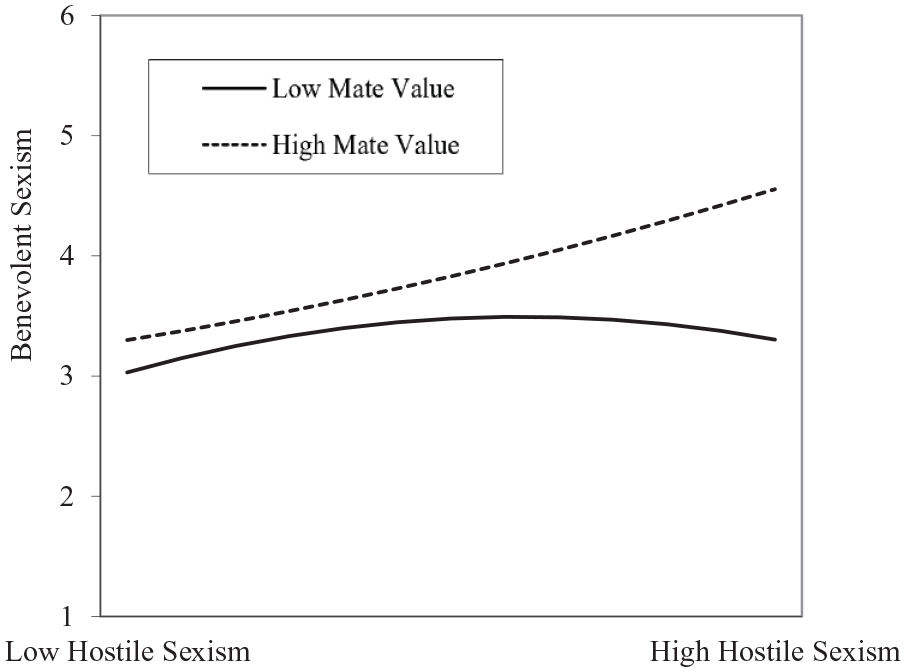
Moderation of the curvilinear sexism effect by men’s perceived mate value, among men not in a serious relationship (Study 3).
We re-ran this analysis, treating men’s subjective social status (SSS) as the moderator (and controlling for SES). As in Study 2, SSS did not moderate men’s curvilinear sexism, t = 1.19, p = .234.
Exploratory Analyses
A goal of this study was to seek evidence of a mechanism driving curvilinear sexism among men low in mate value. Because this effect (PMV-by-HS2) only reached significance among men not in serious relationships, we restricted exploratory mechanism analyses to these men (n = 162). Specifically, we explored the roles of three intervening variables in the links between mate value and benevolent sexism, at high and low hostile sexism, among unpartnered men. To simplify the model by obviating the need for a quadratic term, we dichotomized hostile sexism at its inflection point (0 = below 4.18, 1 = at or above 4.18). We used PROCESS (Hayes, 2017) with 10,000 bootstrapped samples to test a moderated mediation model treating mate value as the independent variable, dummy-coded hostile sexism as the moderator, and the three intervening variables (protect–provide, likelihood, resentment) as parallel mediators.
In models predicting the intervening variables, PMV positively predicted protect–provide beliefs and likelihood of finding love (Bs > .79, ts > 8.46, ps < .001), but not resentment (B = −.17, t = 1.36, p = .177). Output from the final model predicting benevolent sexism, as well as indirect effects and moderated mediation indices, appears in Table 8. Significant predictors of benevolent sexism included PMV, resentment, and the interactions of hostile sexism with protect–provide and resentment beliefs (top of Table 8). Most importantly, PMV indirectly predicted benevolent sexism via protect–provide beliefs among men above, but not below, the inflection point in hostile sexism (bottom of Table 8). The index of moderated mediation was significant for protect–provide beliefs, indicating that the indirect path through this variable was significantly stronger among men high, versus low, in hostile sexism. No indirect paths from PMV to benevolent sexism via likelihood or resentment were significant. Finally, all of these results were virtually identical when controlling for men’s subjective social status and SES. See the online supplement for additional analyses.
Output of Model Predicting Benevolent Sexism From Mate Value, Hostile Sexism, and Exploratory Mediators, Study 3 (n = 162).
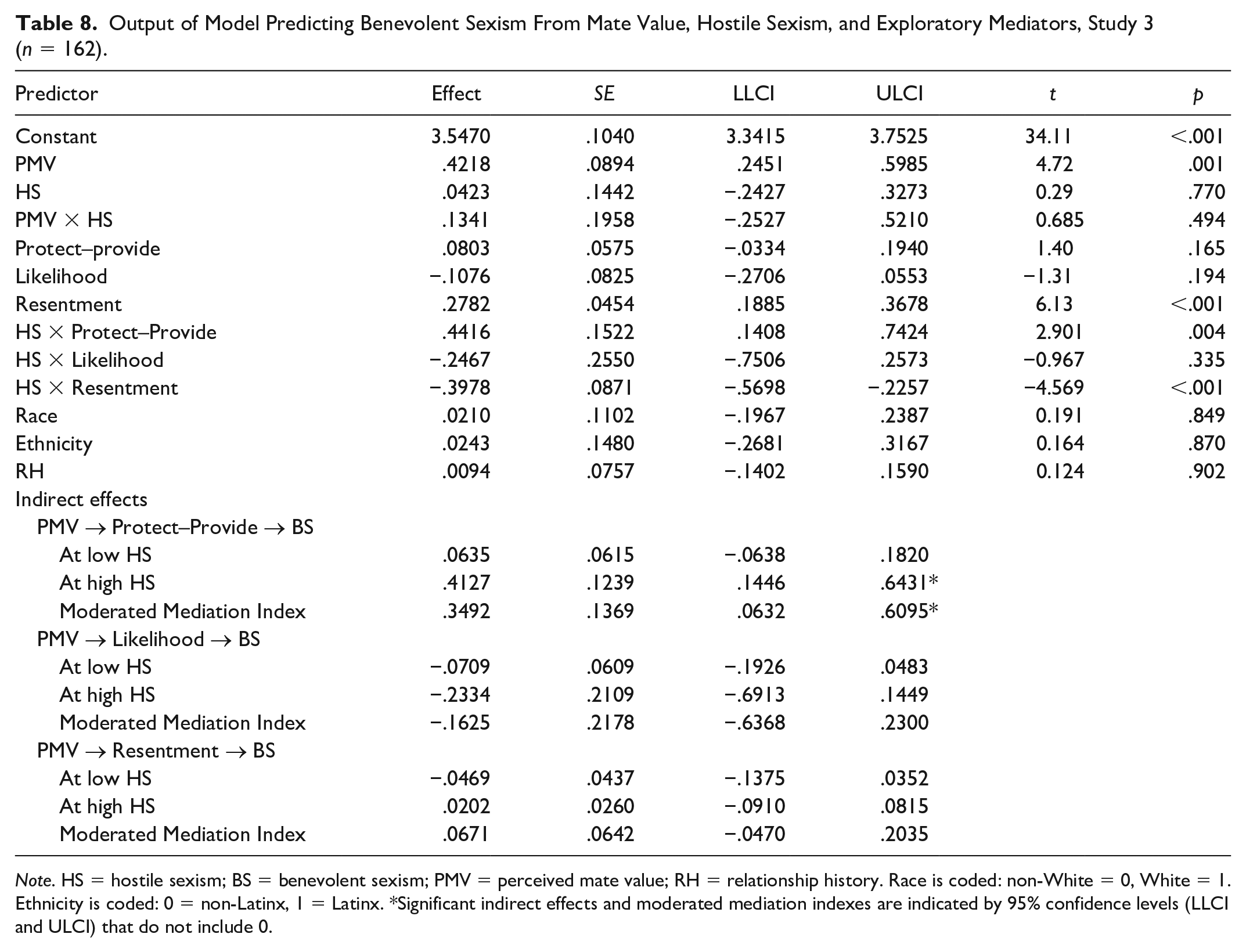
Note. HS = hostile sexism; BS = benevolent sexism; PMV = perceived mate value; RH = relationship history. Race is coded: non-White = 0, White = 1. Ethnicity is coded: 0 = non-Latinx, 1 = Latinx. *Significant indirect effects and moderated mediation indexes are indicated by 95% confidence levels (LLCI and ULCI) that do not include 0.
Summary
As in Study 2, men low in perceived mate value displayed more curvilinear sexism than those high in mate value, but this effect was unexpectedly moderated by men’s serious relationship status: Only among unpartnered men did the interaction effect (mate value-by-hostile sexism2) reach statistical significance. Exploratory analyses on unpartnered men revealed that their perceived inability to protect and provide for female partners was a significant intervening variable in the link between mate value and benevolent sexism among those high (but not low) in hostile sexism.
Pooled Analysis and Meta-Analysis of Studies 2 and 3
Men’s perceived mate value moderated their curvilinear sexism as predicted in Study 2, but not in Study 3. In Study 3 (but not Study 2), men’s serious relationship status (RS) was a significant moderator, and mate value only moderated curvilinear sexism among men not in serious relationships. To pool findings and identify overarching patterns, we first combined the data from Studies 2 and 3 (n = 776) and conducted a regression analysis treating PMV, RS, Study (2 vs. 3), hostile sexism, hostile sexism2, and all possible higher-order interaction terms as predictors of benevolent sexism. In this analysis, the pooled PMV-by-hostile sexism2 effect was significant (b = .139, t = 2.598, p = .010), and it did not differ significantly across the two studies (b = −.018, t <|1|, p = .816). Moreover, although the pooled PMV-by-hostile sexism2 effect did not differ significantly by serious relationship status (b = −.101, t <|1|, p = .191), this effect was evident among men not in a serious relationship (b = .214, t = 2.917, p = .004), but not among men in serious relationships (b = .017, t < 1, p = .839). Second, a meta-analysis of Studies 2 and 3 yielded a mean effect size of z = .207, p < .001, for the PMV-by-hostile sexism2 effect, and a mean effect size of z = .334, p < .001, for the PMV-by-hostile sexism2 effect among men not in serious relationships (see online supplement for details). Thus, the hypothesized curvilinear sexism effect among men low in perceived mate value was robust across studies, but it was especially evident among men without serious relationship partners.
Discussion
Ambivalent sexism theory offers a powerful framework for understanding how hostile and benevolent ideologies about women work together to justify and maintain patriarchal structures (Glick & Fiske, 1996). According to the logic, women and men are both motivated to offset high hostile sexism with comparably high benevolent sexism, because doing so facilitates heterosexual interdependence. And yet, men display a weaker linear hostile–benevolent association than women (Glick et al., 2000; Hammond et al., 2018). Here, we demonstrate that the relatively weak linear hostile–benevolent sexism association among men obscures an underlying curvilinear pattern that differs by mate value and relationship status.
Across three correlational studies, we found systematic evidence that the typical linear hostile–benevolent association plateaus and begins to reverse at moderate-to-high levels of hostile sexism. Study 1 demonstrated curvilinear sexism in a large dataset of 23 samples, and Studies 2 and 3 replicated this effect in all-male samples. Collectively, the studies pinpoint those individuals most likely to display curvilinear sexism: Men show a stronger curve than women (Study 1), particularly if they are low in perceived mate value (Studies 2 to 3) and lack serious relationship partners (Study 3). These findings illuminate the antecedents of misogyny by revealing a subset of men who do not offset their high hostile sexism with comparably high benevolent sexism. Thus, if a main takeaway from ambivalent sexism theory is that hostility and benevolence often coexist, a main takeaway from the current studies is that this ambivalence systematically wanes, and begins to curve toward misogyny, among some subsets of high-hostile sexism individuals.
Although largely consistent with predictions, the findings necessitate two important updates to our theorizing. First, we anticipated that curvilinear sexism would be especially pronounced among men low in both subjective social status and perceived mate value, but only mate value uniquely predicted men’s curvilinear sexism. Thus, men’s low status in interpersonal (romantic) domains may underlie misogyny, whereas their status in socioeconomic domains appears to play little role in curvilinear sexism. Along with literature on the links between adult attachment and ambivalent sexism (e.g., Fisher & Hammond, 2019), these findings underscore the potential importance of relational needs in shaping men’s sexism endorsement.
Second, we did not theorize a role of men’s serious relationship status in our model. We initially conceptualized mate value as a relatively enduring individual difference that might shape men’s sexism endorsement independently of their current romantic status. However, results from Study 3, as well as the pooled analysis and the meta-analysis of Studies 2 and 3, all suggest that curvilinear sexism is most robust among low-mate value men who lack a serious relationship partner. Thus, heterosexual men may be most inclined toward misogyny (high hostility without high benevolence) when they lack the security of a serious relationship and doubt their appeal to female partners. We are reminded here of male incels (“involuntary celibates”), who assert that their physical unattractiveness blocks their access to female romantic and sexual partners (Jaki et al., 2019). Accordingly, some of these men espouse misogynistic views including violence toward women.
Adding to these findings, exploratory analyses on men without serious relationships (Study 3) may begin to illuminate why such men tend toward misogyny. When high in hostile sexism, men who rated themselves lower in mate value also reported less ability to protect and provide for a female partner, which in turn predicted lower benevolent sexism. In contrast, neither pessimism about securing a desirable partner, nor resentful attitudes regarding women and dating, indirectly predicted benevolent sexism from mate value. This suggests that men’s curvilinear sexism is associated uniquely with their perceived inability to uphold the promises that benevolent sexism offers. If low-mate value men doubt their protector and provider abilities, they may find little motivation to embrace the chivalrous ideology of benevolent sexism that can offset high hostility and facilitate romantic interdependence. Note that these patterns remained when controlling for indices of men’s social status and wealth, indicating that low perceived mate value may override men’s actual provision abilities in shaping their self-views. That is, even relatively resource-rich men expressed doubts that they could financially support a female partner if they lacked a serious relationship and viewed themselves as unappealing to women.
Limitations and Future Directions
The cross-sectional nature of our data is a limitation. Our theorizing suggests that being low in mate value causes men to withdraw support for benevolent sexism as their hostile sexism increases, but it is also possible that men who are high in hostile sexism and low in benevolent sexism make unappealing romantic partners, and thus over time develop negative views of their mate value. Similarly, because cross-sectional designs are inadequate for testing causal mediation (Pek & Hoyle, 2016), the indirect effect findings from Study 3 should be interpreted cautiously. To increase confidence in our theoretical logic and address possible bidirectional links, future research should use longitudinal designs to track fluctuations in men’s mate value and protect–provide beliefs, and link these to changes in sexism. Furthermore, experimental designs can allow conclusions regarding the effects of positive or negative “mate appeal” feedback on men’s benevolent sexism as a function of their hostile sexism: Among men high in hostile sexism, threats to mate value should cause temporary decreases in benevolent sexism. Conversely, mate value feedback may have little effect on momentary benevolent sexism among men low in hostile sexism.
Another limitation is that Study 3 was underpowered to test for mediation of the moderated curvilinear effect (see Note 3). Thus, we view the indirect effect results in Study 3 as preliminary and encourage readers to interpret them cautiously. These findings offer, at most, a tentative starting point on which future research can build. It will be important to test for moderated curvilinear mediation, that is, indirect effects of the quadratic hostile sexism term on men’s benevolent sexism via protect–provide beliefs (among other possible mediators), moderated by mate value. Experimental-causal-chain designs (Spencer et al., 2005) may also be used to detect causal mediation by manipulating men’s protect–provide beliefs and examining changes in their benevolent sexism as a function of hostile sexism and mate value.
Importantly, future research should pinpoint the role of men’s serious relationship status in their curvilinear sexism. Here, relationship status significantly moderated the curvilinear sexism effect in Study 3, but not in Study 2. Because this variable was not central to our initial theorizing, we did not give its measurement as much consideration as we might have otherwise. In retrospect, we wonder whether a more nuanced measure of relationship status might yield more consistent effects across samples. We categorized men as in “a serious relationship” if they selected certain descriptors (e.g., “dating one person seriously,” “married”; see online supplement), but such descriptors may obscure important relationship dynamics. After all, not all married men experience their relationship status identically: Consider a man in a 20-year, stable marriage, and a man divorcing his estranged spouse after 1 year of marriage. It is possible that inconsistent moderation effects across Studies 2 and 3 owe to the bluntness of our serious relationship measure. And while results of the pooled analysis and the meta-analysis suggest that curvilinear sexism is most pronounced among low-mate value men who lack serious relationships, this effect bears replication and additional scrutiny. In future research, it may prove useful to measure serious relationship status by asking men directly how stable, committed, and enduring their relationships are. Based on the current results, we expect men in relationships that they characterize as serious to show less curvilinear sexism than men not in such relationships.
Finally, although our focus here was primarily on men’s curvilinear sexism, it is possible that women also display waning benevolent sexism at moderate-to-high hostile sexism. Research should thus examine curvilinear sexism and its moderators among women. Just as intriguing, some women may endorse curvilinear hostile–benevolent attitudes toward men that mirror men’s curvilinear sexism. Hostile and benevolent attitudes toward men are complementary ideologies about men and the male gender role that work in tandem with ambivalent sexism to sustain gender hierarchies (Glick & Fiske, 1999). It will be interesting in future research to examine whether some women are disinclined to offset high hostility toward men with comparably high benevolence toward men.
Conclusion
We report the first evidence of curvilinear sexism and identify those individuals most inclined to display it: men who rate themselves low in mate value, especially if they lack a serious relationship partner. These findings extend ambivalent sexism theory by (a) explicitly addressing men’s status within domains of patriarchy and heterosexual relationships, (b) adding to research on individual difference predictors of men’s sexism endorsement (e.g., Fisher & Hammond, 2019; Hart et al., 2012), and (c) identifying men who may be at risk of misogyny. While true misogyny may be statistically rare (Sibley & Becker, 2012), ambivalent sexism theory is nonetheless strengthened by an understanding of factors that can give rise to it.
Supplemental Material
sj-docx-1-psp-10.1177_01461672211009726 – Supplemental material for Curvilinear Sexism and Its Links to Men’s Perceived Mate Value
Supplemental material, sj-docx-1-psp-10.1177_01461672211009726 for Curvilinear Sexism and Its Links to Men’s Perceived Mate Value by Jennifer K. Bosson, Gregory J. Rousis and Roxanne N. Felig in Personality and Social Psychology Bulletin
Footnotes
Acknowledgements
We thank Dr. Brenton Wiernik for statistical guidance, and Dr. Jamie Goldenberg, Dr. Elizabeth Pinel, and members of the first author’s research lab for their helpful feedback.
Authors’ Note
Study 2 was preregistered in Open Science Framework at https://osf.io/d3up6, and Study 3 was preregistered at  .
.
Declaration of Conflicting Interests
The author(s) declared no potential conflicts of interest with respect to the research, authorship, and/or publication of this article.
Funding
The author(s) received no financial support for the research, authorship, and/or publication of this article.
Supplemental Material
Supplemental material is available online with this article.
Notes
References
Supplementary Material
Please find the following supplemental material available below.
For Open Access articles published under a Creative Commons License, all supplemental material carries the same license as the article it is associated with.
For non-Open Access articles published, all supplemental material carries a non-exclusive license, and permission requests for re-use of supplemental material or any part of supplemental material shall be sent directly to the copyright owner as specified in the copyright notice associated with the article.
