



Abstract
Guided by projection bias perspectives, this article sought to advance understanding of the associations between body image and relationship and sexual satisfaction within heterosexual romantic relationships. Across two studies, both members of heterosexual dating and/or married couples reported on their body image, perceptions of partner’s attraction to the self, own attraction toward the partner, and relationship satisfaction. Study 2 also incorporated measures of participants’ body mass index (BMI) and sexual satisfaction. Across both studies, women with poorer body image perceived their partner to be less attracted to them (irrespective of their partner’s actual attraction to them, or how attracted they were to their partner), which in turn was associated with lower relationship and sexual satisfaction. For men, attraction to their partner was consistently associated with their own relationship satisfaction. Results demonstrate that projection biases are a possible mechanism through which body image is associated with romantic relationship and sexual satisfaction, and hint at the particular relevance of appearance-related projection biases for women’s relationship and sexual satisfaction.
Body Image Projection Bias in Romantic Relationships: A Dyadic Investigation
We live in a world that valorizes physical beauty, usually narrowly defined by youthfulness, symmetrical features, and thinness (Harper & Tiggemann, 2008). Physically “attractive” people are more likely to be seen as kind and clever (Maestripieri et al., 2017), whereas failing to match societal ideals of beauty is associated with being seen as lazy and unpopular (Tiggemann & Rothblum, 1988). Consequently, the way that we feel about our bodies plays a central role in the way that we feel about ourselves (Cash et al., 2004; Cash & Pruzinsky, 2002). People who have poor (relative to positive) body image typically report being less happy in relationships (Meltzer & McNulty, 2010). In this article, we make the case that poor body image may be associated with relationship dissatisfaction in part because people project their own body image insecurities onto partners. In particular, we propose that over and above partner’s actual attraction to the self, greater body dissatisfaction will be associated with more negative assessments of how much partners are attracted to the self, which in turn will be associated with reduced sexual and relationship satisfaction. We test this prediction in two studies, drawing on samples of heterosexual couples.
Body Image and Romantic Relationships
Body image issues have been increasing over the past 40 years, with some findings suggesting that poor body image is the number one concern for young women (Mission Australia, 2007). Poor body image is associated with low self-esteem (Webster & Tiggemann, 2003), depression, and negative affect (Stice, 2002; Thompson & Stice, 2001). In perhaps no other domain, however, is physical appearance more important than in romantic relationships, where it is a core driver of mate selection (Maestripieri et al., 2017). Even in established relationships, the more that people see their partner as physically attractive, the happier they are in the relationship (Swami et al., 2009). Furthermore, poor body image itself (irrespective of markers of “attractiveness” such as body mass) is associated with a decreased likelihood of acquiring and maintaining romantic relationships and lower levels of relationship satisfaction for both men and women (Meltzer & McNulty, 2010). For example, in a study of heterosexual married couples, wives who perceived themselves to be sexually unattractive tended to report low levels of relationship satisfaction, as did their husbands (Meltzer & McNulty, 2010). Other work shows that the more that undergraduate students are self-conscious about and objectify their bodies, the less satisfied they are in relationships (Zurbriggen et al., 2011).
There is also evidence to suggest that body image concerns are vitally implicated in the sexual satisfaction of people in romantic relationships. In most romantic relationships, sexual intercourse represents a core part of the relationship, tied to pleasure, reproduction, comfort, and commitment (Muise et al., 2016; Sprecher & Cate, 2004). Not all sexual encounters are equal, however, and people vary in the extent to which they report sexual satisfaction within established relationships (Muise et al., 2013). Given that sex often involves being nude, and displaying the body, researchers have looked at how body dissatisfaction might be associated with sexual inhibitions and, ultimately, dissatisfaction. Past work shows that women with higher body esteem and lower appearance-related distracting thoughts report higher sexual satisfaction, relative to women with lower body esteem and higher distracting thoughts (Pujols et al., 2010). Other work shows that, for both men and women, a drive for thinness is negatively associated with sexual assertiveness and body exposure during sex (Alperin & Barlow, 2018). So why is it the case that poor body image is associated with decreased relationship and sexual satisfaction? One answer, put forward within this article, is found in projection biases.
Body Image and Relationship Dissatisfaction: The Role of Projection Biases
Freud coined the term “projection” to refer to a clinical pattern he observed whereby a client assumes their therapist shares the feelings and thoughts of clients themselves (Maner et al., 2005). Decades of research confirm that people often incorrectly assume that others’ thoughts and feelings mirror their own internal states (i.e., display a “projection bias,” Fletcher & Kerr, 2010; Kenny & Acitelli, 2001). In the realm of romantic relationships, early work by Kenny and Acitelli (2001) found that, although both accuracy and projection bias were commonplace in heterosexual partners’ perceptions of one another (e.g., about families, relationships, and jobs), bias effects were notably stronger.
Later work shows that the more people experience negative emotions during relationship interactions, the more they perceive their partners to experience those same negative emotions and, consequently, the less satisfied they feel in their relationship (e.g., Campbell et al., 2013; Lemay & Neal, 2014; Overall et al., 2015). Projection biases seem to be pervasive across judgment domains. For example, people use their own use of emotional suppression (i.e., attempts to hide their emotional experiences from others) to inform judgments about how much their partner engages in suppression (Peters & Overall, 2019; for other work on emotions, see Clark et al., 2017).
Such work aligns with research investigating meta-perceptions, which are individuals’ beliefs about how other people perceive them (Carlson, 2016). Work from this perspective demonstrates that individuals typically enjoy relationships more when they perceive their significant other to view them positively (Carlson, 2016). Despite individuals’ meta-perceptions frequently being accurate, research suggests that they are typically tightly linked to individuals’ own self-perceptions, rather than the feedback that they receive from others (Carlson & Kenny, 2012; Kenny & DePaulo, 1993).
Across prior investigations, assessments of projection biases involved modeling both accuracy and projection paths (see Figure 1). Accuracy reflects the association between how Partner B actually feels (e.g., Partner B loves Partner A) and what Partner A thinks Partner B feels. Controlling for this accuracy path, projection bias reflects the association between Partner A’s own feelings toward Partner B (e.g., Partner A is uncertain about Partner B) and what Partner A thinks Partner B feels. Using this framework in this research context, accuracy and projection bias in how much Partner A thinks partner B is attracted to Partner A can be calculated by modeling the extent to which Partner B reports being actually attracted to Partner A (accuracy) and the extent to which Partner A is attracted to Partner B (projection bias).
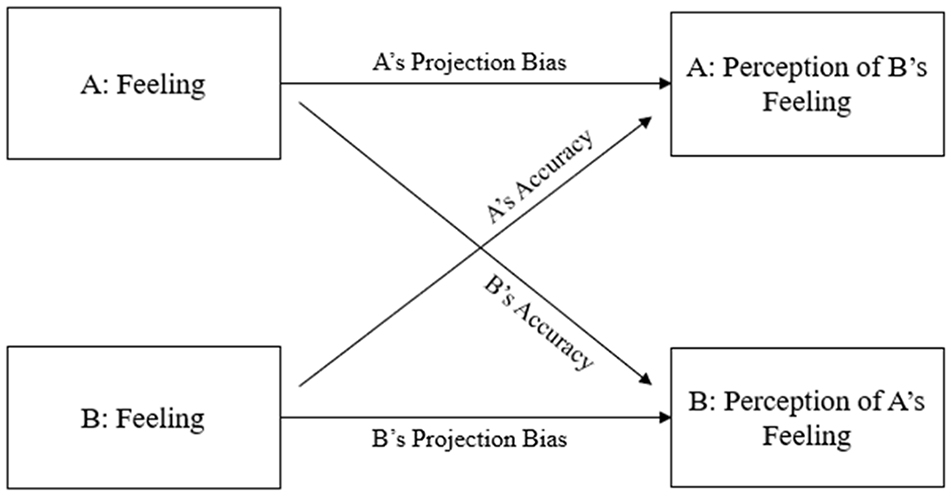
Original conceptual model of projection biases within intimate relationships based on Kenny and Acitelli (2001).
We extend this model, and the investigation of accuracy and projection bias in relationships, to examine how participants’ feelings about themselves (i.e., their own body image) predict how they think their partner feels about them (self-related projection) over and above how their partner actually views them (accuracy) and how they view their partner (partner-related projection). We do this in recognition of the fact that personal body image is central to individuals’ self-concept (Cash & Pruzinsky, 2002), and thus may have a role to play within romantic relationships over and above attraction to one’s partner (the typical projection bias shown in prior research; see Campbell et al., 2013). Figure 2 demonstrates how such projection processes examined in this research extend the original examination of projection.
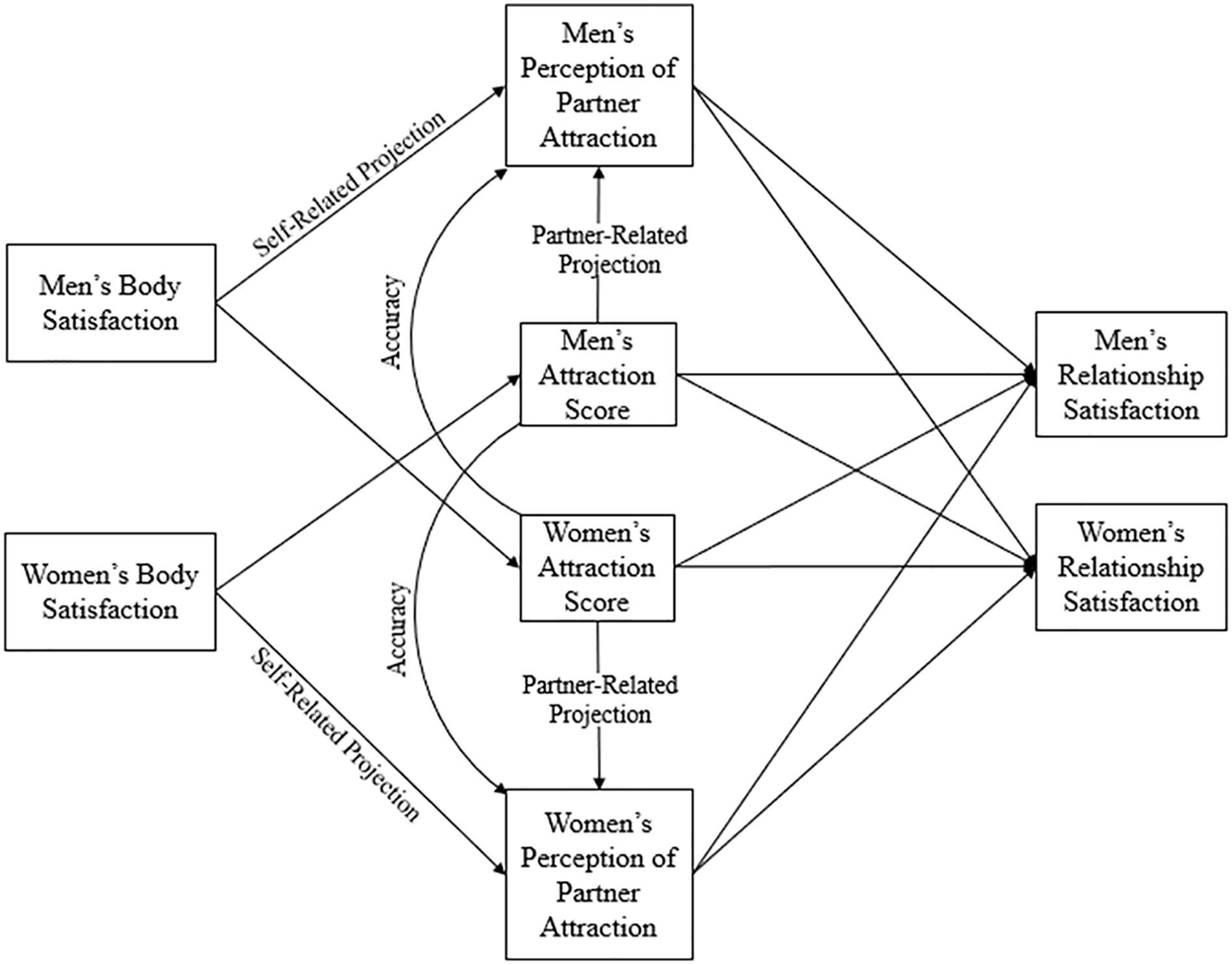
Hypothesized conceptual model of projection biases and relationship satisfaction.
Projection bias and body image
There is preliminary evidence to suggest that there are body image–related projection biases: People who view their own body negatively are more likely to perceive that others also view their body negatively. Muller et al. (2002) found that normal-weight women, preoccupied with body weight and shape, overestimated general others’ agreement with their body shape concerns. Similarly, Dijkstra and Barelds (2011) found that women with poor body image generally had negative meta-perceptions about how attractive their partner, family, and friends perceived them to be. Preliminary support has also been established for the presence of body image projection biases within dyadic studies.
In an investigation of race and body image, Miller (2001) assessed women’s perceptions of their partner’s satisfaction with their (women’s) weight. Women who were more dissatisfied with their weight tended to assume that their partners were also dissatisfied with their weight, and these assumptions held when accounting for actual ratings of their partner’s attraction to them. Furthermore, in an investigation of women’s body image and their marital relationships, Meltzer and McNulty (2010) found that women who perceived themselves to be less sexually attractive were likely to think that their husbands also found them less sexually attractive. Markey and Markey (2006) found that young women were more dissatisfied with their bodies than they perceived their partners to be, and their partners actually were.
More recently, Campbell et al. (2013) examined how ideal discrepancies held by one partner were related to the perceptions and relationship satisfaction of the other partner. Applying the standard accuracy and projection bias model shown in Figure 1, Campbell et al. found that individuals were relatively accurate in assessing how much they matched their partner’s ideal standards, but these judgments were also associated with how much they felt their partner matched their own ideal standards (partner-related projection bias). Campbell et al. (2013) found the projection pattern across different domains, including attractiveness/vitality, which included items related to body image (“nice body,” “attractive appearance”). This finding provides support for the standard partner-related projection bias in the domain of body image (see Figure 1), albeit using a broader index capturing other qualities (e.g., outgoing, adventurous). However, Campbell et al. (2013) did not test the self-related projection bias that we predict will play an important role in judgments of partner’s attractiveness toward the self. In particular, as outlined in Figure 2, independent of these standard projection biases, we predict that people’s own dissatisfaction with their body will be associated with negative assumptions that partners are less attracted to the self (self-related projection bias), independent of how much partners are actually attracted to the self (accuracy), and how attractive people find their partner (partner-related projection bias).
Body Image Projection Bias and Relationship Satisfaction
Another novel contribution of this article is the examination of how body image projection biases are related to relationship (Studies 1 and 2) and sexual (Study 2) satisfaction. Past work reveals that individuals’ expectations and insecurities have the potential to influence relationship-related perceptions, which in turn undermine relationships themselves (McNulty & Swann, 1994). Furthermore, individuals who perceive themselves as matching their partner’s ideal have been found to have better relationship satisfaction (e.g., Campbell et al., 2013; Overall et al., 2006). While we cannot establish causality in our article, we propose a relationship consistent with past work on projection biases (Campbell et al., 2013; McNulty & Swann, 1994; Overall et al., 2006) in which people’s own body image will be associated with their assumptions about how their partner feels about their body, which in turn will predict their own, and potentially their partner’s, relationship and sexual satisfaction. We note, however, that, irrespective of causal relationships, understanding how personal body image, attraction, assumptions about partner attraction, and relationship satisfaction are related in romantic relationships may help us to better understand how body image concerns function for men and women, and, further, how relationship satisfaction is related to personal evaluations.
Current Research
Within this article, we focus on heterosexual relationships and thus distinguishable dyads. This focus was deliberate, as considerable evidence suggests that body image is a gendered construct and one that differs depending on sexual orientation (Basabas et al., 2019). For example, evidence suggests that gay men’s body image is qualitatively distinct from heterosexual men’s body image (e.g., Tiggemann et al., 2007). Furthermore, lesbian women have frequently demonstrated less body dissatisfaction than heterosexual women (e.g., Alvy, 2013), with research suggesting that heterosexual women may be more socialized to take on observer’s perspectives of their bodies (Kozee & Tylka, 2006). Thus, this research suggests that heterosexual men and women’s body image is bound to unique heterosexual dynamics, and therefore this work may serve as a helpful starting point in understanding the role of body image within romantic relationships. However, it is hoped that this research will expand the current investigations into broader populations in the future.
Within this article, dyadic data from couples in two separate studies will be used to create completely parallel models (i.e., where all variables assessed in one partner are concurrently assessed in the other). First, projection bias will be investigated by modeling body image as a predictor of participants’ perceptions of their partner’s attraction to them (self-related projection). Participants’ own attraction to their significant other will also be modeled as a predictor of their perceptions of their partner’s attraction to them (partner-related projection). Finally, each participant’s actual attraction to their significant other will also be modeled as a predictor of their perceptions of their partner’s attraction to them (accuracy). In turn, participants’ attraction to their partners, and perceptions of whether their partners are attracted to them, will each be modeled as predictors of relationship satisfaction (Studies 1 and 2) and sexual satisfaction (Study 2).
As an additional contribution, we systematically investigate our proposed pattern for both women and men within heterosexual dyads, as prefaced above. The extant literature on body image within romantic partnerships overwhelmingly focuses on women’s body image. This is perhaps unsurprising, given the high rates of appearance-related concerns for women (Tiggemann & Lynch, 2001). Yet substantive body dissatisfaction in women does not indicate an absence of body image concerns in men. Recent research has demonstrated increasing body image disturbances among men (Tager et al., 2006). Thus, there is reason to investigate both partners’ experiences of body image within heterosexual romantic dyads. Given the centrality of appearance to evaluations of women, and women’s evaluation of themselves (Tiggemann & Lynch, 2001), we might expect patterns to be stronger for women. However, given past lack of gender effects in projection biases (Kenny & Acitelli, 2001), and increasing appearance based pressures on men, we do not make firm predictions.
Study 1
Overview
Study 1 seeks to assess the presence and potential role of projection biases in relation to body image and romantic relationship satisfaction in heterosexual dyads. Specifically, we assess whether participants’ dissatisfaction with their own bodies is associated with their perceptions of their partner’s satisfaction with their bodies, irrespective of how their partners actually feel (self-related projection) and whether this assumption is further associated with relationship satisfaction. We examine the proposed projection bias from personal body dissatisfaction (in this study operationalized as participants’ self-perceived attractiveness) through to assumptions about partners’ attraction to self (in this study operationalized as the extent to which participants believed that their partner thinks they meet their ideal levels of attractiveness), while looking at the more commonly studied bias whereby participants’ own attraction to their partner (in this study operationalized as the extent to which participants rate their partner as matching their ideals) is modeled as a predictor of how much they think their partner is attracted to them (partner-related projection). The association between each participant’s attraction to their partner and their perception of their partner’s attraction to them (accuracy) is also assessed within Study 1 (see “Method” file in the online supplemental material).
Method
Participants
Participants consisted of 197 heterosexual couples, recruited through paper and electronic announcements posted across a New Zealand university and student-based organizations (e.g., health centers). Participant’ age ranged from 18 to 45 years (M = 22.99, SD = 4.14), and couples had an average relationship length of 2.88 years (SD = 2.08), with 61% of couples either living together or married. In terms of ethnicity, participants were primarily Caucasian (52.3% and 53.8%, respectively), followed by Asian (12.7% and 19.8%, respectively), Pacific Nations (11.2% and 7.6%, respectively), Indian (7.1% and 6.6%, respectively), and Māori (5.6% and 4.1%, respectively), with the remainder of participants identifying as “other” (9.6% of men and 8.1% of women). Means, standard deviations, and intercorrelations are presented in Tables 1 and 2. This sample was drawn from Campbell et al. (2013) described above, which only examined partner-related projection biases (not the self-related projection bias focused on here) in more global domains (also see Fletcher et al., 2020).
Study 1 Participants’ Means, Standard Deviations, and Intercorrelations.
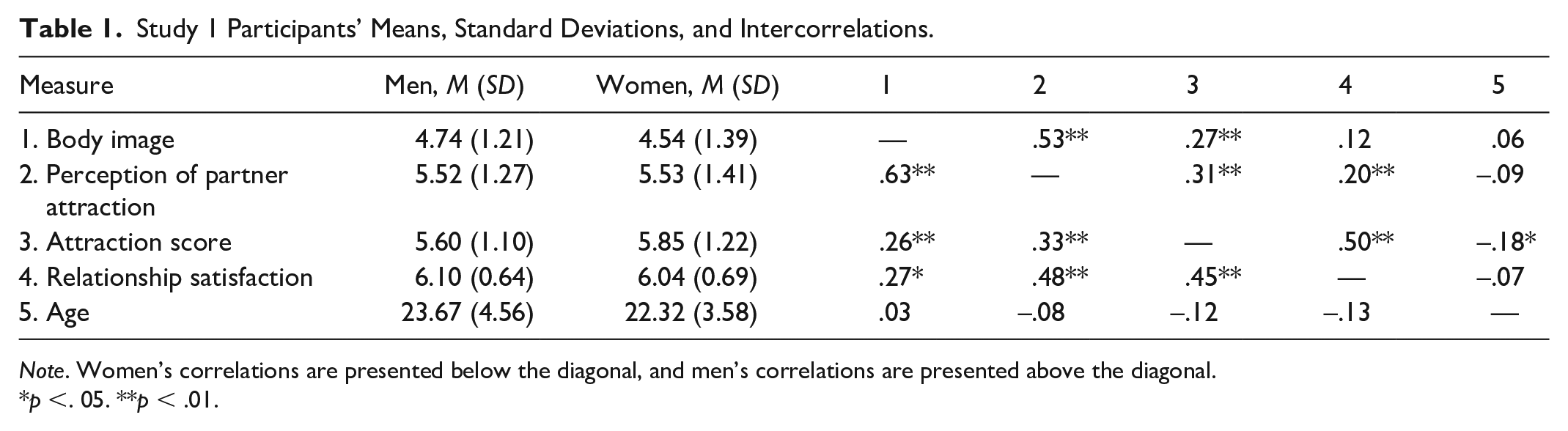
Note. Women’s correlations are presented below the diagonal, and men’s correlations are presented above the diagonal.
p <. 05. **p < .01.
Study 1 Correlations Between Women’s and Men’s Responses.

p < .05. **p < .01.
Study 1 involved both members of mixed couples attending an in-person research session to complete a range of questionnaires assessing self- and partner perceptions, and behavioral observations of couples’ conflict discussion that were not relevant to the focus of this investigation. The target sample size balanced funding limitations with the power needed to detect small-medium actor and partner effects (r = .20) when controlling for typical dependence across couple members. The final sample of 197 couples who completed the assessments for this study provided adequate power to detect partial rs smaller than the magnitude of the principal effects in this study. To illustrate, power analyses, using the actor–partner interdependence model (APIM) power module (Ackerman et al., 2016), indicates that this sample provides the power (.99) needed to detect a partial r of .20 when both actor and partner effects are present and independent and dependent variables are correlated at typical levels across partners (r = .30). The partial effect sizes of the significant associations that we detected (reported in the “Results” section) are .20 and higher (see Figure 3), with the exception of the links between attraction and perception of partner attraction, which were necessary control paths rather than the central psychological process under investigation. Thus, although we did not conduct a priori analyses for the overall structural equation modeling (SEM) mediation model shown in Figure 1, and null effects should not be overinterpreted, the sample size provided adequate power to detect the size of targeted effects while accounting for other correlated factors.
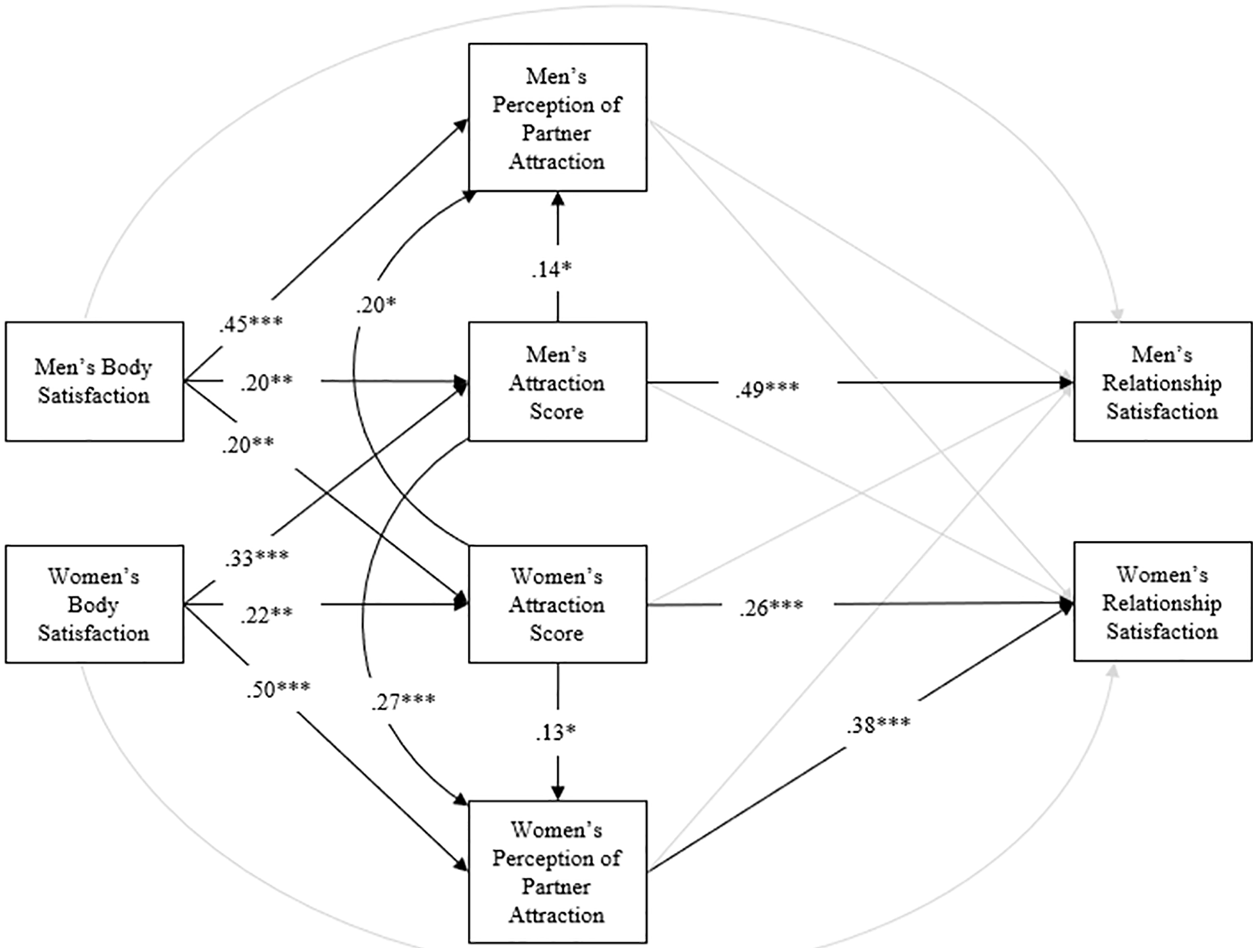
Study 1 full, predicted structural equation modeling for the effects of body image on relationship satisfaction.
Procedure
Ethical approval was obtained by the university, and measures pertaining to the main hypotheses were provided through matching paper questionnaires during laboratory sessions attended by both relationship partners. Participants completed the questionnaires independently and privately, and were assured that their data would not be shared with their partners and would be stored confidentially. The couples were paid NZ$70.
Measures
Body satisfaction
Two items from the Attractiveness/Vitality domain of the self-perceptions subscale of the Short-Form Partner Ideal Scales (Fletcher et al., 1999) were used as indicators of body image. Participants were required to rate the extent to which they believed they had a “nice body” and an “attractive appearance” (1 = not at all like me, 7 = very much like me). Items were averaged with a high score, indicating high body satisfaction for both men (r = .85) and women (r = .85).
Perceptions of partner attraction
Participants rated the extent to which they felt they matched their partner’s ideals pertaining to having a “nice body” and “attractive appearance” (e.g., 1 = I do not match his or her ideal at all, 7 = I completely match his or her ideal; Fletcher et al., 1999). Higher scores reflected higher attraction perceptions and items were averaged for both men (r = .89) and women (r = .92).
Attraction
Two questions assessed the extent to which participants rated their partner as having a “nice body” and “attractive appearance” (1 = not at all like my partner, 7 = very much like my partner). High scores were indicative of greater attraction to one’s partner and items were averaged to form a scale for both men (r = .91) and women (r = .85).
Relationship satisfaction
The short version of the Perceived Relationship Quality Components Inventory (Fletcher et al., 1999) was used as a measure of relationship satisfaction. This scale includes seven items assessing satisfaction, commitment, intimacy, trust, passion, love, and romance. Items were measured on a 7-point scale (e.g., “How satisfied are you with your relationship?” 1 = not at all, 7 = extremely) and were averaged (men α = .80, women α = .79), with high scores indicating high satisfaction.
Results
Descriptive Statistics
Tables 1 and 2 display women’s and men’s intercorrelations and descriptive statistics (N = 197). Less than 5% of data were missing, and listwise deletion was employed.
SEM
SEM (AMOS 26) was employed to test the proposed theoretical model. Consistent with the APIM (Kenny et al., 2006), a dyadic model was constructed that simultaneously predicted both partners’ responses while also allowing the residual of each variable for each partner dyad to covary (N = 197). Dependent variables and error terms of matched variables at the same model stage were allowed to correlate. The model was assessed using the χ2, χ2/degrees of freedom ratio, the comparative fit index (CFI), the root mean square error of approximation (RMSEA), and the standardized root mean square residual (SRMR). Indications of a model with a satisfactory fit include a nonsignificant χ2, or a χ2/df ratio ≤ 3, a CFI ≥ .95, values of RMSEA less than .06 to .08 (for continuous data) and SRMR less than .08 (Hu & Bentler, 1999; Schreiber et al., 2006).
Given that we were looking at distinguishable dyads, we wanted to test whether a model that allowed both members of the couple to differ fit the data better than a model in which the relationships between variables for men were equated to be the same as the relationships between variables for women. The fit statistics of the fully unconstrained model, χ2(6, N = 197) = 35.73, p < .001, were compared with those of the fully constrained model in which associations between variables for men and women were constrained to be equivalent, χ2(15, N = 197) = 53.99, p < .001. The test of difference was significant, with the constrained model showing a worse fit to the data, χ2(9, N = 197) = 18.26, p = .032. Given that we were interested in the possibility of differing associations for men and women, we proceeded with the unconstrained model.
Indicators revealed average model fit statistics for the full, unconstrained predicted model (χ2/df = 5.96; CFI = .93, RMSEA = .16, and SRMR = .07). Modification indices suggested two additional paths between own body dissatisfaction and own attraction scores for men and women. Inclusion of these resulted in improved model fit statistics, χ2(4, N = 197) = 16.36, p = < .003, χ2/df = 4.09; CFI = .97, RMSEA = .13, and SRMR = .04. Of the 20 proposed paths, seven were nonsignificant. Figure 3 displays the full, predicted model with all significant and nonsignificant paths included. After inspecting this model, we removed the nonsignificant paths. Indicators revealed improved model fit statistics for the final significant model (with the inclusion of paths, suggested by the modification indices, and nonsignificant paths removed), χ2(11, N = 197) = 21.80, p = < .026, χ2/df = 1.98; CFI = .98, RMSEA = .07, and SRMR = .05. Given the improved fit and preference for a parsimonious model, we proceeded with the pared down model.
As can be seen in Figure 3 and Table 3, the more that women and men were dissatisfied with their bodies, the more they assumed that their partner was also dissatisfied (or not attracted to them: a self-related projection bias). In addition, there was an association between how participants thought their partner felt about them, and how their partner actually felt about them (accuracy). Interestingly, the association between personal body image and whether participants felt that their partner found them attractive (self-related projection bias) was approximately twice the absolute size as the association between whether participants felt that their partner found them attractive and what partners actually reported feeling (accuracy). Furthermore, both men and women who were dissatisfied with their bodies had partners who rated them as less attractive and also tended to rate their partners as less attractive. For both men and women, the more attracted they were to their partner, the more they assumed their partner was attracted to them (partner-related projection bias). Beyond the accuracy and projection bias paths, the association between participant beliefs about whether or not their partner was attracted to them and relationship satisfaction differed for men and women. For men, these appraisals were not associated with their relationship satisfaction and, instead, the extent to which men were attracted to their partner was the best predictor of men’s own relationship satisfaction.
Study 1 Standardized Direct, Indirect, and Total Effects From the Final Significant Model.
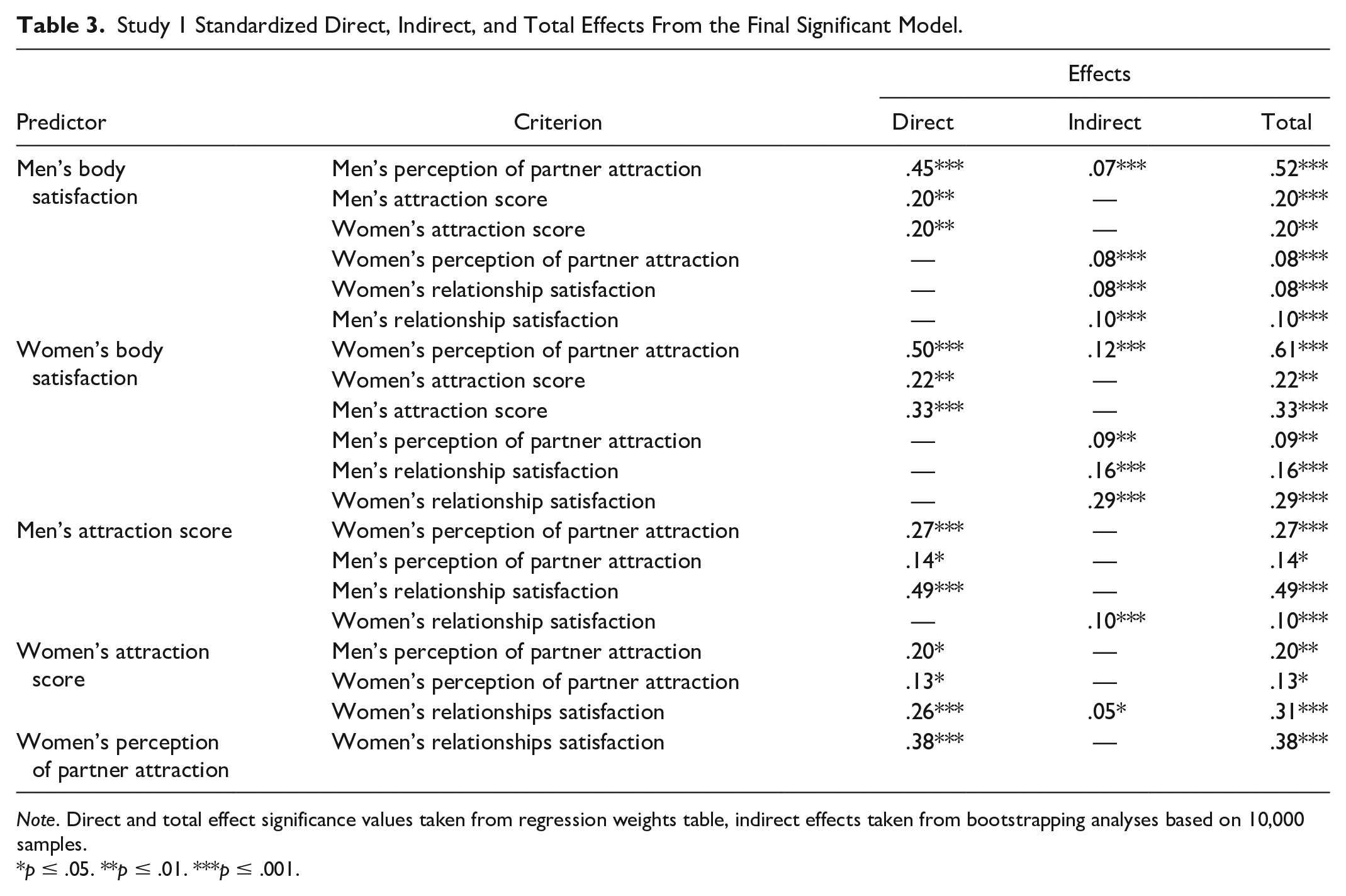
Note. Direct and total effect significance values taken from regression weights table, indirect effects taken from bootstrapping analyses based on 10,000 samples.
p ≤ .05. **p ≤ .01. ***p ≤ .001.
To probe this potential gender difference, follow-up t-tests were conducted, comparing the strength of the association between perception of partner attraction and relationship satisfaction for men and women. Results revealed that the association between the degree to which people thought their partner was attracted them and the extent to which they were satisfied in the relationship was stronger for women, b = .17 (.03), p < .001, than for men, when reentering this path into the model, b = .02 (.03), p = .416; t = 3.79, p < .001. In contrast, men and women showed similar associations between their own evaluations of their body and the extent to which they perceived their partner to be attracted to them; men b = .47 (.06), p < .001 and women b = .51 (.06), p < .001; t = 0.47, p = .640.
Turning to indirect effects, a small indirect effect of men’s body image on their own relationship satisfaction was identified through their own attraction to their partner. By contrast, women who assumed their partner was attracted to them were more satisfied in their relationship, and this effect emerged independently of whether or not women themselves were attracted to their partner. Thus, body dissatisfaction was indirectly associated with women’s relationship dissatisfaction through the assumption that their partner was also dissatisfied with their body and vice versa. Finally, women who were more satisfied with their appearance had partners who were more attracted to them, which in turn was associated with partner relationship satisfaction.
A number of indirect effects less relevant to our research questions also emerged (see Figure 3 and Table 3). Men who were more satisfied with their bodies had partners who were more attracted to them, which in turn went on to predict increased relationship satisfaction and increased perception of partner attraction for women. This same pattern of results emerged for women, with indirect relationships between women’s body satisfaction and men’s relationship satisfaction, and men’s perceptions of partner attraction explained by men’s attraction to their partner. Finally, men’s attraction to their partner and women’s attraction to their partner predicted women’s perceptions of partner attraction and, through this, women’s relationship satisfaction.
Discussion
The results of Study 1 provide initial support for the role of body image–related projection biases within romantic relationships. Consistent with past research, for both men and women, a lack of attraction to their partner was associated with the assumption that their partner was also less attracted to them (partner-related projection bias). However, in line with our core thesis, a second type of body image projection bias also emerged, whereby men and women who disliked their own appearance were more likely to think that their partners were also dissatisfied with their appearance (self-related projection bias). Notably, each of these projection biases emerged independent of the degree to which participants were accurate in their assessments of their partner’s attraction to them. Moreover, the association between participants’ own body satisfaction and the way that they thought their partner felt about them (self-related projection bias) was about twice the size of the association between these assumptions and how their partner actually felt about them (accuracy). The comparison in strength of projection versus accuracy paths hints at the power our own internal world (at least with regard to how we feel about our body) has over how we perceive others’ beliefs although it must be noted that the projection effect may be inflated because both reports for projection come from the same person, whereas the accuracy ones do not.
For women (but not men), the more they assumed their partner was attracted to them, the more likely they were to be satisfied in their relationship. The observed pattern in Study 1 suggests that self-related projection bias processes, with regard to body image, might be more marked in women. This finding in particular, regardless of the causal process, gives us insight into women’s experiences of romantic relationships and how tied they are to body image and meta-perceptions/projection biases.
The results of Study 1, however, do not take into account participants’ body weight, which affects body image and satisfaction. In Western cultures, individuals with larger bodies are generally perceived as less attractive by others and also view themselves as less attractive (Klaczynski et al., 2004; Myers & Crowther, 2007). It is possible that larger men and women have poorer body image, and that body size, rather than body image, is actually accounting for the projection biases and relationship satisfaction findings observed within Study 1. Thus, in Study 2, we examine our proposed patterns while also accounting for body mass index (BMI). In addition, in Study 2, we included a measure of sexual satisfaction to sit alongside relationship satisfaction. Sexual satisfaction, as outlined earlier, is important in relationships (Muise et al., 2016), and associated with body image (Pujols et al., 2010), and we wanted to test whether our model might help to explain the association between body image and sexual satisfaction.
Study 2
Overview
In Study 2, we measured BMI to account for participant weight. BMI is a common measure of body fat based on an individual’s weight relative to their height (Prentice & Jebb, 2001). Furthermore, within Study 1, variables pertaining to body dissatisfaction, perceptions of partner’s attraction, and own attraction to partner were each assessed with reference to self- or partner ideals. In Study 2, each of these measures were refined by utilizing direct measures relating to each construct (although note that these were necessarily short). Finally, as stated above, we broadened our relationship variables to include a measure of sexual satisfaction—an important and often overlooked component of relationship health (Litzinger & Gordon, 2005). In sum, each participant’s BMI was modeled as a predictor of their own body image and the extent to which their partner was attracted to them; thus, the indirect effects of BMI on perceptions of partner’s attraction to self, relationship satisfaction, and sexual satisfaction could be assessed. Figure 4 demonstrates the model for Study 2.
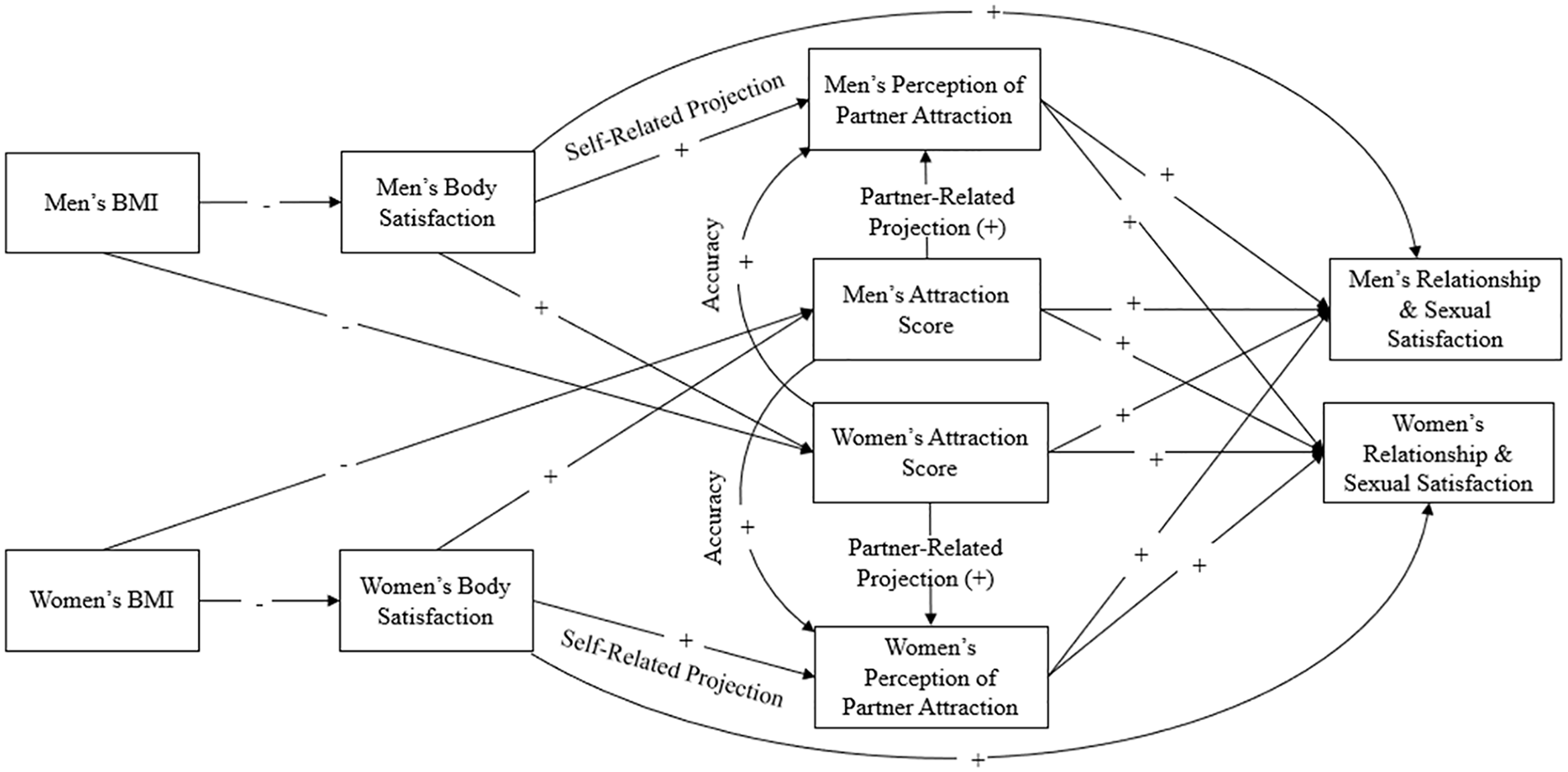
Study 2 hypothesized structural equation modeling for the effects of projection biases on relationship satisfaction.
Method
Participants
Participants were 97 Australian heterosexual couples (ages 18 to 56 years; M = 25.36, SD = 6.44), who were recruited through social media. Participants had an average relationship length of 3.91 years (SD = 5.03) and 72.5% of the couples were living together. The sample was largely ethnically homogeneous: 89.9% of women identified as Caucasian, 8.2% as Asian, and two as “other” (one of whom identified as Pacific Islander, and the other as Eurasian). For men, 90.8% identified as Caucasian, 5.1% identified as Asian, 2% as Aboriginal or Torres Strait Islander, and two as “other” (one of whom identified as Māori, and the other as Eurasian). See Tables 4 and 5 for item means, standard deviations, and intercorrelations.
Study 2 Participants’ Means, Standard Deviations, and Intercorrelations.

Note. Women’s correlations are presented below the diagonal and men’s correlations are presented above the diagonal. BMI = body mass index.
p ≤ .05. **p ≤ .01.
Study 2 Correlations Between Women’s and Men’s Responses.

Note. BMI = body mass index.
p ≤ .05. **p ≤ .01. ***p ≤ .001.
In Study 2, we had a limited budget to recruit couples (who, as stated, are substantially more difficult to recruit than single members of couples). In Study 2, we adopted a similar logic to that explained in Study 1 to identify a reasonable number of couples to test small actor and partner effects. For example, adopting the APIM power analyses above (Ackerman et al., 2016), 100 couples provides adequate power (.85) to detect partial r of .20 when both actor and partner effects are present, and independent and dependent variables are correlated at typical levels across partners (r = .30). Note, however, that these estimates are for associations in a basic model and care should be taken not to overinterpret null results. We discuss these issues further in the “General Discussion” section.
Procedure
Ethical approval was obtained from the university ethics committee and participants took part in an online survey (a unique code was used to match couple responses). Surveys were broadcast on social media platforms and participants were only able to proceed with questionnaires once consent was obtained. Participants were instructed to complete the questionnaires independently and privately, and assured that their data would not be shared with their partners and would be stored confidentially. Individuals were reimbursed AU$10 each for their time.
Measures
Demographic information
Participants were asked to report their age, gender, relationship status, and duration of relationship.
Body mass index (BMI)
Participants were asked to report their weight (in kilograms) and height (in centimeters). Each participant’s BMI was calculated as weight in kilograms divided by height in meters squared (Prentice & Jebb, 2001).
Body satisfaction
An eight-item body image scale was adapted from Hopwood et al.’s (2001) original 10-item Body Image Scale. The scale comprised behavioral items (e.g., “Do you find it difficult to look at yourself naked?”), affective items (e.g., “To what extent do you generally feel attractive?”), and cognitive items (e.g., “To what extent do you feel satisfied with your body?”). Responses ranged from 1 (never) to 5 (always). Items were coded such that higher scores reflected greater body satisfaction, and then averaged (men α = .89, women α = .92).
Perceptions of partner attraction
A single novel item asked, “How attractive do you think your partner thinks you are?” Responses ranged from 1 (very unattractive) to 7 (very attractive), and thus higher scores were indicative of greater perceptions of partner’s attraction to oneself.
Attraction
A single item was created as an indicator of participants’ subjective attraction to their romantic partner to match (as closely as possible) the perceptions of partner’s attraction item. The item simply asked, “How attractive do you think your partner is?” Responses ranged from 1 (very unattractive) to 7 (very attractive), thus higher scores reflected greater ratings of attraction to one’s partner. Research has supported the reliability of single-item measures within empirical research (Bergkvist & Rossiter, 2007).
Relationship satisfaction
Funk and Rogge’s (2007) 16-item couple satisfaction index (CSI-16) was used to measure participants’ relationship satisfaction. Participants were required to evaluate their relationship on 6- and 7-point Likert-type scales and to describe their relationship on a bipolar adjective scale for six different characteristics, such as 5 = interesting to 0 = boring. Responses were summed to produce a score between 0 and 81, where higher scores were indicative of greater relationship satisfaction (men α = .95, women α = .96).
Sexual satisfaction
Sprecher’s (2002) two-item self-report measure of sexual satisfaction was employed as a measure of men’s and women’s sexual satisfaction. The two items asked, “How sexually satisfying is the relationship to you?” and “How rewarding or unrewarding is your partner’s contribution during sex?” Response scales ranged from 1 (not at all rewarding/satisfying) to 7 (extremely rewarding/satisfying). The items were found to be highly related to one another for both men (r = .66) and women (r = .72).
Results
Descriptive Statistics
Tables 4 and 5 display participants’ descriptive statistics and intercorrelations (N = 98). Fewer than 5% of participants had missing data and listwise deletion was employed.
SEM
The fit statistics of the unconstrained model, χ2(24, N = 98) = 31.34, p = .144, were compared with those of the fully constrained model in which associations between variables for men and women were constrained to be equivalent, χ2(43, N = 98) = 89.42, p < .001. The test of difference indicated that the unconstrained model fit the data better, χ2(19, N = 98) = 58.08, p < .001; therefore, we proceed with the unconstrained model.
Indicators revealed good model fit statistics for the full, predicted model, χ2(24, N = 98) = 31.34, p = .144, χ2/df = 1.31; CFI = .97, RMSEA = .06, and SRMR = .06. Of the 32 proposed paths, 19 were nonsignificant. We therefore removed these paths from the model. The final significant model (with nonsignificant paths removed) also had good model fit statistics, χ2(43, N = 98) = 52.43, p = .153, χ2/df = 1.21; CFI = .97, RMSEA = .05, and SRMR = .09. The pared down model fit the data as well as the full model, χ2(19, N = 98) = 21.09, p = .332. Thus, in the interests of a parsimonious model, and as we lost no information, we proceeded with the pared down model. Figure 4 displays the full, predicted model. Figure 5 presents the final model and Table 6 displays the statistics for this model.
Study 2 Standardized Direct, Indirect, and Total Effects From the Final, Significant Model.

Note. Direct and total effect significance values taken from regression weights table; indirect effects taken from bootstrapping analyses based on 10,000 samples. BMI = body mass index.
p ≤ .05. **p ≤ .01. ***p ≤ .001.
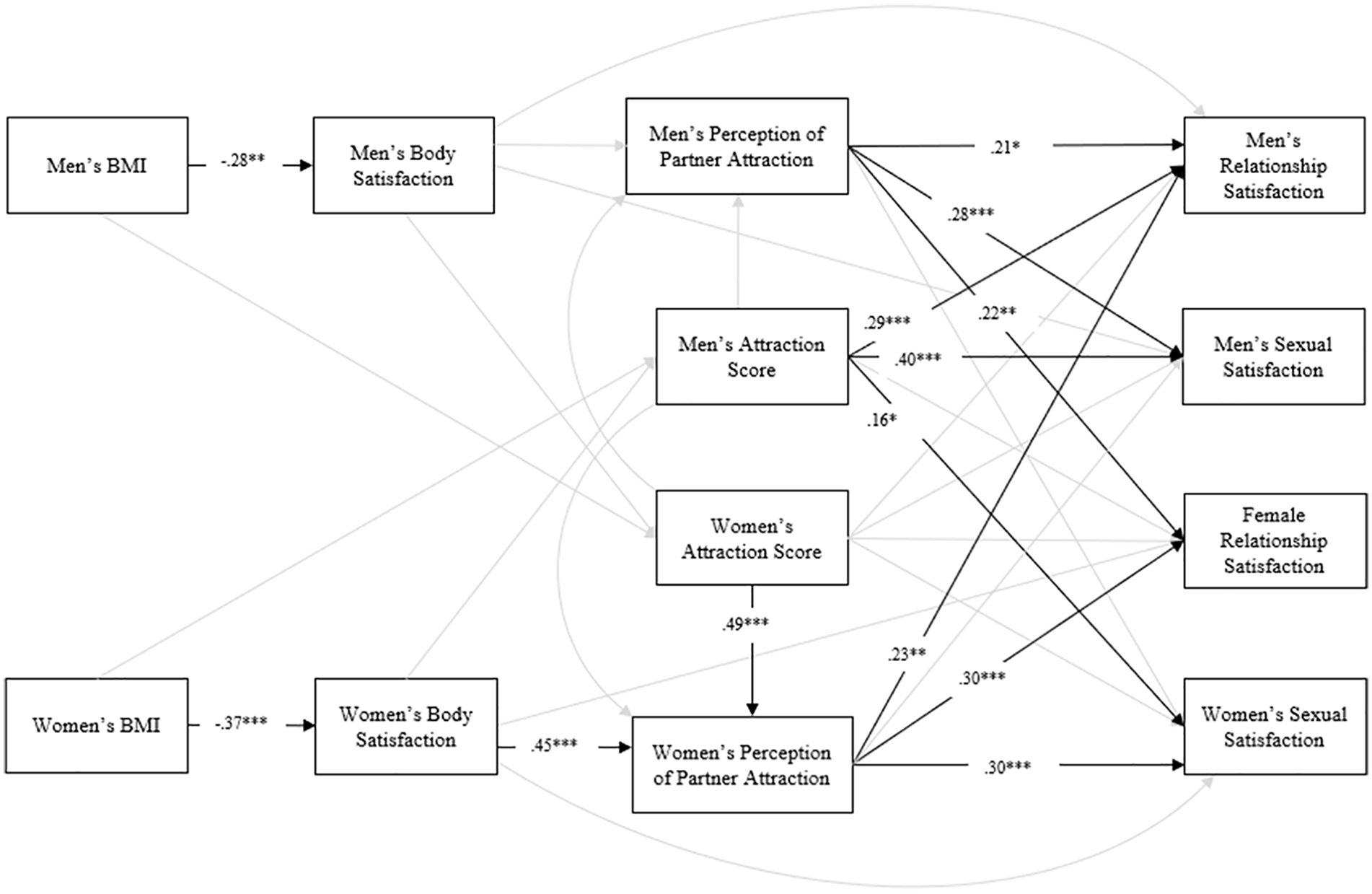
Full, predicted structural equation modeling for the effects of poor body image on relationship and sexual satisfaction.
As can be seen from Figure 5 and Table 6, women with a lower BMI were more satisfied with their own appearance. In turn, women who were satisfied with their appearance were also more likely to believe that their partners were attracted to them (self-related projection). Furthermore, women’s belief that their partner was attracted to them was associated with their relationship and sexual satisfaction, as well as greater levels of relationship satisfaction for men. Despite larger women assuming that their partner was less attracted to them, there was no zero-order correlation between women’s BMI and partner’s reported attraction, suggesting that women’s weight was not central to their partner’s attraction to them. However, effects indicated an indirect association between women’s BMI and their perceptions of men’s attraction through women’s body satisfaction. Similarly, women’s BMI was indirectly associated with sexual satisfaction for women and lower relationship satisfaction for women and men through women’s perception of partner attraction.
For men, those with a higher BMI were less satisfied with their own bodies. Beyond this, men’s body (dis)satisfaction was unrelated to men’s or women’s relationship or sexual satisfaction. However, whereas men’s body dissatisfaction was not associated with their own beliefs about their partner’s attraction to them (self-related projection), higher levels of these beliefs (i.e., that their partner was attracted to them) were still positively associated with men’s own relationship and sexual satisfaction, as well as women’s relationship satisfaction. Furthermore, men who were more attracted to their partners were also found to have greater relationship and sexual satisfaction, as well as having partners with higher ratings of sexual satisfaction. However, women’s “true” ratings of attraction to their partner were not associated with either their own or their partner’s relationship or sexual satisfaction, yet women who were more attracted to their partners were also more likely to assume that their partners were attracted to them (partner-related projection). Finally, although women’s attraction to their partners was not directly associated with relationship or sexual satisfaction, indirect effects emerged. Specifically, women’s attraction to their partners was indirectly associated with their own sexual satisfaction, as well as their own and their partner’s relationship satisfaction through their perceptions of their partner’s attraction to them.
To probe targeted potential gender differences, follow-up t-tests were again conducted, comparing the strength of key associations for men and women. Results revealed a significant association between body satisfaction and perception of partner attraction for women, b = .09 (.02), p < .001, but not men, b = .03 (.02), p = .187, and these slopes were significantly different from one another (t = 2.49, p = .014). However, no significant differences emerged for paths between men’s and women’s perception of partner attraction and their own relationship satisfaction, men b = 2.37 (1.01), p = .019, women b = 2.88 (.89), p = .001; t = 0.38, p = .704, or men’s and women’s perception of partner attraction and their own sexual satisfaction, men b = .62 (.19), p = .001, women b = .51 (.16), p = .001; t = 0.44, p = .658, or men’s and women’s perception of partner attraction to their partner’s relationship satisfaction, men b = 2.56 (.90), p = .005, women b = 2.15 (.76), p = .004; t = 0.35, p = .727.
Discussion
Study 2 replicated the core finding of Study 1. Women who were more dissatisfied with their body assumed that their partner was dissatisfied too (self-related projection bias); women’s negative beliefs about how their partner felt about their appearance were associated with reduced relationship and sexual satisfaction for them, as well as reduced relationship satisfaction for their partners (and, of course, the converse pattern). We also extended on Study 1 by showing the same pattern for women’s sexual satisfaction. For women, these findings lend further support for the role of body image–related projection biases within romantic relationships. While there were small indirect effects of higher BMI on both relationship and sexual (dis)satisfaction, they were fully explained by women’s own body dissatisfaction and their assumptions about how their partner felt about them. It would seem that, although larger women did not have partners who were less attracted to them (at the zero-order level), they assumed they did, and this assumption was associated with lower relationship and sexual satisfaction. In Study 2 (unlike Study 1), men’s and women’s assumptions about how their partner felt about their significant other’s appearance was not related to their partner’s actual attraction to them (although note that we had a smaller sample size in Study 2). Furthermore, for women, consistent with the results of Study 1, a second projection bias was apparent (partner-related projection); people who were less attracted to their partner tended to assume that their partner was also less attracted to them.
As in Study 1, the extent to which men were attracted to their partner emerged as a key predictor of their own relationship and sexual satisfaction. In contrast to Study 1, however, men’s body dissatisfaction in Study 2 was not associated with men’s assumptions about whether their partner found them attractive or not (self-related projection), nor was men’s attraction to their partner associated with their assumptions about their partner’s attraction to them (partner-related projection). As another point of difference, in Study 2, men’s assumptions about their partners’ level of attraction to them was associated with their own relationship and sexual satisfaction, and their partners’ relationship satisfaction.
General Discussion
People with poor body image are less likely to establish romantic relationships and also less likely to be satisfied in relationships they do have (Meltzer & McNulty, 2010). To date, however, few studies have addressed the potential mechanisms through which poor body image is associated with reduced sexual and relationship satisfaction. Across two separate studies, this article drew on projection bias perspectives to test the proposal that people who dislike their bodies assume their partner does too (i.e., a self-related projection bias). The article concurrently assessed whether those who are attracted to their significant other also perceive attraction from their partner (i.e., a partner-related projection) and, in turn, whether it is these assumptions (rather than poor body image itself) that predict relationship satisfaction. Study 1 aimed to assess the presence and potential role of projection biases in relation to body image and heterosexual romantic relationship satisfaction. Study 2 aimed to replicate and extend on Study 1 by accounting for BMI, including a comprehensive measure of body image, and extending the model to include sexual satisfaction.
Across both studies, robust findings emerged for women’s self-related projection biases: Women’s own feelings about their bodies strongly predicted their assumptions about the degree to which they met their partner’s physical attractiveness ideal standards (Study 1) and the degree to which their partner was attracted to them (Study 2). This projection bias emerged even after taking into account the extent to which they accurately gauged their partner’s attraction to them and the extent to which they projected their own attraction to their partner onto beliefs about whether their partner was attracted to them (partner-related projection). Body image concerns for women were not directly related to relationship (dis)satisfaction after accounting for other variables in the model. Instead, women’s beliefs about the degree to which their partner was attracted to them acted as a core mediator of the links between body image and relationship and sexual satisfaction. Specifically, women with poorer body image tended to assume that their partner was less attracted to them, which predicted lower relationship satisfaction (Studies 1 and 2) and sexual satisfaction (Study 2). In Study 2, women’s assumptions about their partners’ attraction also predicted relationship satisfaction in their partners although this pattern did not emerge in Study 1.
Across both studies, and in line with past research (e.g., Campbell et al., 2013; Kenny & Acitelli, 2001), a second partner-related projection bias path was also supported for women, whereby women who were more attracted to their partners also assumed that their partners were more attracted to them. Collectively, these findings lend support to the presence of two important and distinct forms of body image projection biases for women in romantic relationships and suggests the power of women’s body image in their perceptions and relationships (in line with Markey & Markey, 2006; Miller, 2001; Muller et al., 2002).
For men, the results of this research were less conclusive. Within Study 1, both self-related and partner-related projection biases were demonstrated for men. That is, men projected their dissatisfaction with their own appearance, as well as their partner’s appearance, onto perceptions of their partner’s attraction to the self. In contrast, Study 2 suggests that neither of these projection biases were evident for men (although these null effects should be interpreted with caution, given the small sample size in Study 2).
For men, the most consistent findings pertained to attraction to their partner. The extent to which men were attracted to their partner was consistently and positively associated with their relationship satisfaction (Studies 1 and 2) and sexual satisfaction (Study 2). Furthermore, the findings of Study 2 suggest that men’s attraction to their partner is positively associated with their partner reporting higher levels of sexual satisfaction within the relationship. In contrast, women’s attraction to their partner was inconsistently associated with their relationship satisfaction (positively associated in Study 1, but not associated in Study 2) and not associated with their sexual satisfaction (Study 2). Together, these results suggest that women’s attraction to their partner is potentially of less importance to their relationship and sexual satisfaction than how they feel about their own body, whereas for men, attraction to their partner is central to relationship and sexual satisfaction. Such findings are in line with evolutionary research positing that physical attraction is particularly important for men in the context of intimate relationships (e.g., Thornhill & Gangestad, 1996).
Contrary to the work of previous authors (e.g., Klaczynski et al., 2004; Myers & Crowther, 2007), BMI (as a proxy of body size) was not associated (at the zero-order) with attraction for either men or women. At face value, these results might suggest that body size predicts relationship and sexual satisfaction only to the extent that it creates body dissatisfaction and associated projection biases. However, participants in our studies were in established relationships (2.88 years and 3.91 years, respectively). It has been found previously that superficial characteristics (such as weight and physical attractiveness) are important in the early stages of relationship formation, but often become less important in established relationships where the focus shifts to more personality and values-based characteristics (Regan et al., 2000). Indeed, relationship duration has previously been demonstrated to moderate the relationship between partner-objectification and relationship commitment (Mahar et al., 2020), with longer relationships less vulnerable to the damaging effects of objectification. Accordingly, future research with larger sample sizes should assess whether relationship duration moderates the relationship between BMI and attraction to one’s romantic partner.
In previous investigations of bias and accuracy within relationships, notable accuracy patterns have emerged. For example, Campbell et al. (2013) demonstrated that couples had accurate insight into the extent to which they match their partner’s ideal standards. Similarly, meta-perception research suggests that individuals are typically largely accurate in their perceptions of others’ judgments about them (Carlson & Kenny, 2012). In our studies, however, participants were remarkably inaccurate in judging whether or not their partner thought they met their ideals (Study 1) or were attractive (Study 2). While further work is required to better understand the inaccurate judgments made by individuals within this research, it is possible that body image is of central significance. Evidence suggests that people rely on self-perceptions when forming meta-perceptions (Carlson & Kenny, 2012). Although these self-perceptions typically enhance accuracy (Carlson & Kenny, 2012), body image research frequently demonstrates negative distortions in the individual’s subjective evaluations of their bodies, particularly for women (Hosseini & Padhy, 2020). Thus, it is possible that the typically sound judgments that contribute to accurate perceptions may become less accurate when body image is central to the judgments in question.
Overall, however, in relationships where people presumably take information in from compliments, insults, physical intimacy, and physical avoidance, the lack of accuracy is perhaps surprising. While for women their personal body image appears tightly linked to judgment of their partner’s attraction to them, further work is needed to understand how men come to determine whether or not their partner finds them attractive.
Limitations and Future Directions
Results from this study offer insights into body image within the context of romantic relationships. However, there are limitations that require noting. The primary limitation concerns the correlational and cross-sectional nature of the current studies. On the basis of past projection bias literature, we proposed that people’s own body image may carry forward to shape their views of their partner’s attraction to the self (a projection bias), which in turn would shape relationship and sexual satisfaction. Although our mediational models were largely consistent with such a proposition, it is important to note that statistical mediation analyses cannot provide information about causal mediation and may in fact be biased (Bullock et al., 2010; MacKinnon et al., 2000). Experimental work gets around some but not all of these problems, and thus multiple methods are required for future research. We recognize that it is entirely possible that alternate paths exist; for example, lower levels of relationship satisfaction may influence negative perceptions of partner attraction, which in turn might result in higher levels of body dissatisfaction. Future work should investigate whether temporarily decreasing women’s body image (e.g., through media comparisons, as in past work; Hargreaves & Tiggemann, 2004) is associated with state assessments of whether their partner is attracted to them, and state feelings of relationship satisfaction. Longitudinal and experience sampling work may also provide information about the temporal nature of the relationships between variables.
It is important to note, however, that, regardless of the cross-sectional nature of this research, important information may be gleaned from the associations established within Studies 1 and 2. For example, we find that women’s (but not men’s) assumptions about their bodies are linked to how they think their partner perceives them. These findings indicate a partially other-focused orientation for women’s body image development. Similarly, women’s (but not men’s) relationship satisfaction is strongly associated with their perceptions of their partner’s attraction to them, again, showing that women’s relationship quality is perhaps inextricably linked to a focus on partner evaluations. Thus, despite being unable to speak to which variable precedes another, the nature of the associations may provide interesting and helpful insights with regard to body image, meta-perceptions, and romantic relationships.
Another limitation to note is the sample size, particularly for Study 2. Given the number of associations tested, Study 2 was underpowered. Given the inherently difficult nature of gathering dyadic data and the current global pandemic, however, it was not feasible to expand the data set at this time. Accordingly, it is suggested that Studies 1 and 2 should be viewed in conjunction with one another, with particular attention paid to the effects stable across both studies. Power issues are especially relevant for the (sometimes inconsistent) null effects across both studies. For example, it is possible that the sample sizes were not sufficient to detect smaller effects between men’s perception of partner attraction and relationship satisfaction (Study 1) or men’s body satisfaction and men’s perceptions of partner’s attraction (Study 2). Yet these effects were very small (r = .05 and .12, respectively) and significantly different across men and women, and so are likely to be a much less salient and meaningful psychological process for men compared with women. Nonetheless, this research should be replicated with larger samples sizes to further test the proposed model.
Another limitation within Study 2 is the use of single-item measures for perceptions of partner attraction and attraction to one’s partner. Although support exists for the use of single-items measures in research as they can minimize survey length and improve response rates (Fisher et al., 2016), multi-item measures have been demonstrated to be psychometrically superior (Fisher et al., 2016). Furthermore, the diversity of measures across both studies increases confidence in our consistent results for women, yet makes it difficult to make direct comparisons between the two studies. Future studies may benefit from employing clear, multi-item measures of the constructs tested. Similarly, consideration of measures that may address alternative explanations for findings may also be of interest to future research. For example, measures of neuroticism may be included to assess whether high neuroticism is linked to both body dissatisfaction and projection biases, and in turn relationship (dis)satisfaction.
The populations recruited also limit the Generalizability of our findings. In Study 2, the bulk of participants identified as Caucasian/White. Past work shows that people from different ethnic backgrounds often experience body image concerns differently (Craddock, 2016). For example, similar to White women, Black women face body size concerns. Unlike White women, however, they also often face substantive colorism, or discrimination based on skin shade (Craddock, 2016). Future work might simultaneously examine the roles of body image and colorism in informing women of color’s perceptions of the extent to which their partner is attracted to them. More broadly, future research would benefit from inclusion of participants from diverse ethnic backgrounds. In addition, couples assessed within this research typically demonstrated satisfaction within their relationships. Thus, it may be of interest to recruit less satisfied couple to assess whether current findings hold (or potentially are even stronger) for those less fulfilled within their relationship. As a final note about sampling, as made clear throughout, we purposefully recruited heterosexual couples within this work. It will be important, however, to see whether the same dynamics are evident in romantic relationships with people of diverse sexual orientations and gender identities.
Across Studies 1 and 2, men’s assumptions about how their partners felt about them, and which relational factors are associated with men’s body image, remain unclear. Future research may benefit from utilizing exploratory and qualitative research to elucidate common themes associated with body image and projection biases in men. There is evidence in our studies that this work may be valuable—within both studies, men’s substantive body dissatisfaction. This finding dovetails with recent research (e.g., Cash et al., 2004) and highlights the importance of including men in investigations of body image.
Finally, in this article, we have also talked about accuracy, but have not specifically probed the direction of inaccuracies. In line with the theorizing in this article, it is possible that people with poor body image underestimate the degree to which their partner is attracted to them, with ramifications for relationship satisfaction. It is possible, however, that people who are satisfied with their bodies overestimate their partner’s attraction to them and this, in turn, is associated with increased relationship satisfaction. The truth and bias model (West & Kenny, 2011) allows for estimates of both over- and underestimation, and accuracy. Future research may benefit from the inclusion of this model.
Practical Implications
The results of these studies have several practical implications. The findings may be used within clinical practice to challenge commonly held assumptions of women who are convinced that their partner finds them unattractive by discussing the possibility that women may simply be reacting to their own body image concerns. Some presenting problems that appear to be best treated by couple-based therapy may be augmented by individual therapy, targeting inaccurate and potentially harmful projection biases. Furthermore, no association was found between women’s BMI and men’s ratings of women’s attractiveness. When paired, these findings may be used by health professionals to challenge commonly held cultural beliefs, such as the pervasive and damaging thin-ideal upheld in Western societies. Indeed, clinicians may also use the findings of this research within their case formulations. For example, rather than solely focusing on individual schemas or attachment histories for clients with repetitive negative relationship patterns, negative body-related perceptions may also need to be addressed. Finally, for those engaged with weight loss interventions specifically to improve body image or relationships, individual therapy targeting damaging cognitions may be more important for positive prognoses.
Conclusion
This article aimed to provide insights into how body image–related projection biases may operate in romantic relationships. Overall, the results of this article provide support for body image projection biases as a mechanism through which body image is associated with women’s romantic relationships. This research suggests that women who are dissatisfied with their bodies assume that their partner is too, and, through this assumption, report less satisfaction within relationships. Conversely, when men are attracted to their partners, both men and women appear happier within the relationship. Future research is required to better understand the complex way in which men’s body image, perceptions of partner’s attraction, and romantic relationship satisfaction function.
Supplemental Material
sj-docx-1-psp-10.1177_01461672211025202 – Supplemental material for Body Image Projection Bias in Heterosexual Romantic Relationships: A Dyadic Investigation
Supplemental material, sj-docx-1-psp-10.1177_01461672211025202 for Body Image Projection Bias in Heterosexual Romantic Relationships: A Dyadic Investigation by Allanah Hockey, Caroline L. Donovan, Nickola Christine Overall and Fiona Kate Barlow in Personality and Social Psychology Bulletin
Footnotes
Data Availability Statement
Data are not available due to ethical restriction. Due to the nature of this research, participants of this study did not agree for their data to be shared publicly, so supporting data are not available.
Declaration of Conflicting Interests
The author(s) declared no potential conflicts of interest with respect to the research, authorship, and/or publication of this article.
Funding
The author(s) received no financial support for the research, authorship, and/or publication of this article.

Supplemental Material
Supplemental material is available online with this article.
References
Supplementary Material
Please find the following supplemental material available below.
For Open Access articles published under a Creative Commons License, all supplemental material carries the same license as the article it is associated with.
For non-Open Access articles published, all supplemental material carries a non-exclusive license, and permission requests for re-use of supplemental material or any part of supplemental material shall be sent directly to the copyright owner as specified in the copyright notice associated with the article.
