




Abstract
Despite much prior research on matching appeals to the affective–cognitive orientation of attitudes, little attention has focused on the consequences of affect–cognition (mis)matching when individuals resist persuasion. We propose that unlike a matched attack, an attack that is mismatched to the affective–cognitive orientation of attitudes would result in low defensive confidence individuals holding onto their unchanged attitudes with less certainty than high defensive confidence individuals. As hypothesized, low defensive confidence participants were less certain after an affective than a cognitive attack for a cognitive issue (Study 1), and the opposite was true for an affective issue (Study 2). Both patterns occurred again when the affective–cognitive orientation of attitudes was manipulated (Study 3) or measured as an individual difference (Study 4). Moreover, perceived knowledge mediated the effects on attitude certainty (Study 4). We end by discussing implications for our understanding of affect–cognition matching and attitude certainty.
Persuaders often use tailoring as a way to maximize the effectiveness of a message. Indeed, researchers have examined message matching effects by tailoring the content, frame, format, or source of a message to various psychological characteristics in the message recipient ranging from specific processing preferences (e.g., Jensen et al., 2012; See, Petty, & Fabrigar, 2013) to political orientation (e.g., Feinberg & Willer, 2013) and broad personality traits (e.g., Hirsh et al., 2012; Wheeler et al., 2005). Typically, the tailored message has been found to be more successful than the nontailored message in impacting a variety of persuasive outcomes such as attitudes and behavioral intentions, across a wide range of domains such as health decisions (e.g., Kreuter & Wray, 2003; Rothman et al., 2006), consumer behavior (e.g., Wheeler et al., 2005; see Teeny et al., 2020), and sociopolitical choice (e.g., Kim et al., 2009; Mazzocco et al., 2010).
Among the various types of matching, one that has been conceptually replicated across various labs is affect–cognition matching. Within such research, one approach has been to tailor the message to the affective–cognitive orientation of the attitude. Furthermore, the affective–cognitive orientation of an attitude has been examined in different ways. First, it can exist spontaneously as a function of the object across individuals (e.g., Crites et al., 1994; Drolet & Aaker, 2002; Eagly et al., 1994; See & Khoo, 2011), due to certain properties of the topic, such as the extent to which the topic involves instrumental behaviors (i.e., a means to an end) or consummatory behaviors (Millar & Tesser, 1986, or the extent to which the attitude for the topic serves utilitarian or self-expression needs (Maio & Olson, 2000; Shavitt, 1990). Second, the affective–cognitive orientation of an attitude can also be situationally induced by having participants focus on their emotions or beliefs (e.g., Millar & Tesser, 1989) or by having participants first read about emotions or beliefs related to the topic (e.g., Clarkson et al., 2011; Fabrigar & Petty, 1999). Finally, prior research has also examined the affective orientation of attitudes as an individual difference, with some studies assessing general differences in Need for Affect (NA; Maio & Esses, 2001) and Need for Cognition (NC; Cacioppo & Petty, 1982), and other studies assessing more directly the extent to which individuals’ emotions or beliefs are consistent with overall evaluations across a variety of attitude objects (e.g., Aquino et al., 2016; Huskinson & Haddock, 2004; See et al., 2008; Wolf et al., 2017).
Despite these advances in understanding affect–cognition matching effects on attitudes and other related consequences such as memory (Haddock et al., 2008), processing fluency (Mayer & Tormala, 2010), and the activation of the ventromedial prefrontal cortex (Aquino et al., 2020), there remain unanswered questions. Of relevance, it is unclear whether and how affect–cognition matching impacts attitude certainty when people face a message that attacks their attitudes. Yet, much research has shown that when facing a counter-attitudinal message, people’s resistance to the message may leave their attitudes intact but reduce the certainty with which they hold these unchanged attitudes (e.g., Tormala & Petty, 2002; see Tormala & Petty, 2004). As demonstrated in such prior research, this means that a message can be ineffective at changing the attitude itself, but still impact other outcomes. One such outcome is the focus of the current research: attitude certainty.
Attitude certainty is an important outcome of resisting an attack because it is an aspect of attitude strength (see Petty & Krosnick, 1995). That is, attitudes held with greater certainty show stronger influence on behavior (i.e., greater attitude-behavior consistency; e.g., Fazio & Zanna, 1978; Sawicki & Wegener, 2018, see also Cheatham & Tormala, 2015), are more stable over time (e.g., Abelson, 1988; Bassili, 1996), and better resist subsequent persuasion (e.g., Petrocelli et al., 2007; Tormala & Petty, 2002). Given the many consequences of attitude certainty, much research has also investigated the antecedents to attitude certainty itself. More recently, such research has been guided by a meta-cognitive framework (see Petty et al., 2004), which refers to attitude certainty as a meta-cognitive tag that reflects a secondary assessment (e.g., “Is my attitude valid?”) of a primary cognition (e.g., “Do I oppose or support this?”). Importantly, after exposure to persuasion, people can form appraisals regarding the information underlying their attitudes, with more positive (or negative) appraisals leading to more (or less) certainty about their attitudes (see Rucker et al., 2014; see also Gross et al., 1995). For instance, if resisting an attack makes people think that their attitude is based on incomplete information, then their certainty would decrease. In the current research, we propose that the lower one’s defensive confidence (DC), the more a mismatched attack will undermine the certainty with which one holds onto unchanged attitudes. This is because low DC individuals (i.e., low DCs) should be more prone to forming negative appraisals regarding difficulties in resisting the mismatched attack than high DC individuals (i.e., high DCs). Before we consider the role of DC, we discuss resistance against mismatched versus matched attacks below.
Resisting Matched or Mismatched Attacks
The affective–cognitive orientation of an attitude can depend on the different extents to which attitude objects and overall evaluations are linked to emotions and beliefs in one’s mental architecture (see Chaiken et al., 1995; Fabrigar & Wegener, 2010, see also Monroe & Read, 2008; Van Overwalle & Siebler, 2005). Moreover, the strength of these links can be manifest in the accessibility of emotions and beliefs when an attitude object is salient. For instance, beliefs are more accessible for cognitive attitudes, whereas emotions are more accessible for objects’ affective attitudes (Giner-Sorolla, 2004). This suggests that, when receiving a mismatched attack, the message recipient might struggle to generate convincing counter-arguments because their emotions or beliefs are less readily available to directly address the attack. Such difficulty might lead to the recipient generating lower quality of counter-arguments within a given amount of time or taking longer to generate the same number and quality of counter-arguments (e.g., See, Petty, & Fabrigar, 2013a; See, Valenti, Ho, et al., 2013). Mismatched persuasion might also engender other processing difficulties such as poorer memory for the persuasive message (Haddock et al., 2008).
Importantly, it is possible that when facing an attack, neither the matched nor mismatched message would lead to any change in attitude, but the processing difficulties involved in resisting the mismatched message would still impact the certainty with which the unchanged attitude is held. Furthermore, as discussed below, difficulty in counter-arguing the mismatched attack can lead to different appraisals regarding one’s existing attitude, and consequently, attitude certainty, depending on one’s DC.
Defensive Confidence (DC)
DC refers to an individual difference that reflects the extent to which people believe that they have the ability to resist counter-attitudinal persuasion successfully and is assessed by items such as “I have many resources to defend my point of view when I feel my ideas are under attack” (Albarracín & Mitchell, 2004). The modest correlation between DC and other variables such as verbal intelligence, political participation, and NC (rs = .22–.25) suggests that DC is distinguishable from these other variables. There are other ways in which DC is different from these other variables. For instance, NC captures one’s perceived motivation for processing messages that serve as mental challenges, regardless of whether these messages are pro- or counter-attitudinal (Cacioppo et al., 1996). However, DC captures one’s perceived ability to process counter-attitudinal messages, regardless of their complexity. In addition, NC can influence the actual processing of mental challenges (See et al., 2009). However, DC does not necessarily mean having the actual ability to resist an attack, as suggested by the finding that high DCs end up changing their attitudes more because they do not avoid counter-attitudinal arguments that are cogent and likely to overwhelm their attitudes (Albarracín & Mitchell, 2004).
Of particular relevance to the current research, although prior research has shown that DC predicts selective exposure to pro- versus counter-attitudinal messages, the previous findings also suggest that low and high DCs would be similar in their actual ability to generate counter-arguments and resist the attack (i.e., exhibit no attitude change) when exposure to counter-attitudinal persuasion is held constant. That said, given the same attack on their attitudes, low and high DCs could still differ in their appraisals about their resistance. For instance, especially when given a mismatched attack, high DCs might attribute their difficulty in counter-arguing the message as indicative of their ability to recognize the complexities of an issue (e.g., Briñol et al., 2006), or their ability to consider both sides of an issue (e.g., Rucker & Petty, 2004). Conversely, low DCs might exhibit the same difficulty in counter-arguing the mismatched message, but infer that they have insufficient knowledge or have not thought about attitude-relevant information (Barden & Petty, 2008; Smith et al., 2008; Wan et al., 2010). Therefore, the difficulty that arises from resisting a mismatched attack might be objectively similar for both low and high DCs, thus leading to no differences in post-message attitudes, but still resulting in less attitude certainty for low DCs than high DCs (see Gross et al., 1995; Rucker et al., 2014; Smith et al., 2008).
Current Research
To test our hypothesis that the lower one’s DC, the more a mismatched attack will undermine attitude certainty, participants in four studies read either a matched or mismatched attack. In Study 1, they read criticism about the university’s online learning management system Integrated Virtual Learning Environment (IVLE), which prior research has found to be a primarily cognitive topic in the same population (See, Valenti, Ho, et al., 2013). That is, prior pilot testing had shown that compared with emotions, beliefs predicted a greater amount of unique variance in attitudes (see Crites et al., 1994; Eagly et al., 1994 for same approach for determining whether attitudes are affective or cognitive for a topic). Thus, a cognitive appeal would be considered a matched attack, whereas an affective appeal would be a mismatched attack. The opposite was true in Study 2, where participants read about increasing tuition, which prior research has found to be a primarily affective topic in the same population (See, Valenti, Ho, et al., 2013). That is, prior pilot testing had shown that emotions predicted a greater amount of variance in attitudes than beliefs for this topic. Thus, an affective appeal would be considered a matched attack, whereas a cognitive appeal would be considered a mismatched attack. While Studies 1 and 2 followed prior approaches that identified the affective–cognitive orientation of attitudes as a function of the topic (e.g., Crites et al., 1994; Eagly et al., 1994; See, Valenti, Ho, et al., 2013), Study 3 manipulated attitude orientation (e.g., Clarkson et al., 2011; Fabrigar & Petty, 1999) and Study 4 measured general individual differences in attitude orientation (e.g., Huskinson & Haddock, 2004; see Haddock & Maio, 2019). Moreover, to ensure that the persuasion was personally and not just normatively counter-attitudinal, Studies 3 and 4 asked participants to report their stance toward immigration before presenting them with either an affective or cognitive message that advocated for the opposite of their reported stance. Finally, Study 4 also established perceived knowledge as the mediator for the effects on attitude certainty.
Study 1
Method
Participants and design
Because as far as we knew, this was the first time a DC × Message hypothesis was tested, we adopted a time-based rule to collect data from as many participants as possible within one semester, and then used the effect size obtained to determine the sample size for Study 2. Participants were 153 undergraduates (Mage = 21.54, SD = 1.86, 108 females) studying at National University of Singapore (NUS) who completed the study for partial course credit or US$4. Seventy-seven participants were randomly assigned to the cognitive/matched message condition and 76 participants to the affective/mismatched message condition. In this and all subsequent studies, DC was measured as a continuous variable. The materials, analysis code, code book, and data for the current research are all available here: https://osf.io/n6h3f/
Procedure
In Studies 1 to 4, participants were told that they would be participating in various separate studies, and they indicated their consent before beginning the session. Upon arrival at a computer laboratory, the first study was described as a collaborative project with the university’s Centre for Instructional Technology. The second study was described as a pilot test for a newly developed personality questionnaire. After indicating their consent to participate in the study, participants read either a cognitive or an affective attack on IVLE. Information on the pilot testing of affective and cognitive messages in Study 1 is in Footnote 1 in the Methodology File. The pilot data revealed that messages differed only in cognitive–affective qualities, but not in message position or message strength. In general, we intended for the messages to be similar in the extent to which they advocate against participants’ positions, and for the message strength to be, at best, moderate so that participants would resist the message successfully, and thus hold on to their initial attitudes (e.g., McGuire & Papageorgis, 1961; Tormala & Petty, 2002).
After reading the message, participants indicated their attitudes and attitude certainty for IVLE. In the ostensibly separate study, participants completed the DC scale (Albarracín & Mitchell, 2004). Because DC is conceptualized as a stable individual difference, the DC scale was presented after the message and dependent measures to demonstrate that the hypothesized results occur even when their level of DC had not just been made salient. Finally, in this and all subsequent studies, all participants were debriefed and thanked for their participation.
Predictors
Defensive confidence
In all studies in the current research, the same 12-item DC scale (Albarracín & Mitchell, 2004) was used. Examples of items are: “During discussions of issues I care about, I can successfully defend my ideas,” and “When I pay attention to the arguments proposed by people who disagree with me, I feel confused and cannot think (reverse-scored).” Responses were made on a 5-point scale (1 = not at all characteristic of me, 5 = extremely characteristic of me). Reponses were averaged (M = 3.18, SD = 0.63, α = .85), with higher values reflecting higher DC.
Message
Participants read either a cognitive message or an affective message that criticized IVLE. The cognitive/matched message described the ineffectiveness of IVLE due to difficulties in customization. The affective/mismatched message described the anxiety that students feel when missing a deadline due to missing information on IVLE (see Methodology File for all messages used in Studies 1–4).
Covariate: Post-message attitudes
After the message, attitudes were assessed using the following items (e.g., Crites et al., 1994): “My attitude toward IVLE is __________.” “Overall, I ___________ IVLE.” “My opinion is that IVLE is a __________ thing.” “From my point of view, IVLE is __________.” (1 = negative/dislike/bad/undesirable, 11 = positive/like/good/desirable). Responses to these items were averaged (M = 7.32, SD = 1.93, α = .96). 1 Overall, participants were in favor of IVLE even after the message.
Dependent variable: Attitude certainty
In all studies in the current research, participants were presented with the same certainty items that were taken from prior research (e.g., Barden & Petty, 2008; Fazio & Zanna, 1978): “How certain/confident/sure are you of your opinion about IVLE?” (1 = not certain/confident/sure at all, 9 = very certain/confident/sure). Responses for these items were averaged (M = 6.20, SD = 1.68, α = .96), with higher scores reflecting more certainty.
Results and Discussion
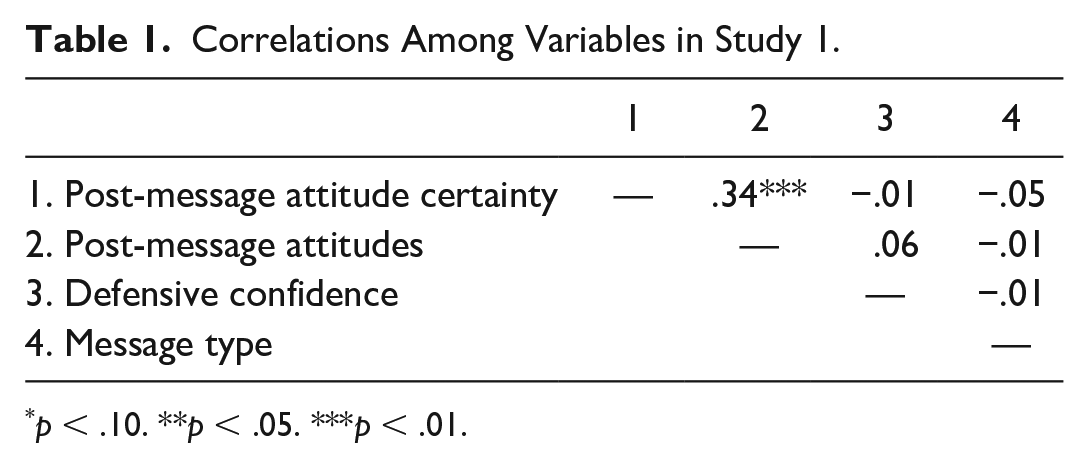
Table 1 presents the zero-order correlations among the variables. Notably, participants’ DC did not correlate with the type of message they read, which suggests that first, DC is indeed a stable individual difference that was not influenced by the message type manipulation. Post-message attitudes were positively correlated with attitude certainty, and thus were included as a covariate in the analyses for attitude certainty.
Correlations Among Variables in Study 1.
p < .10. **p < .05. ***p < .01.
Post-message attitudes
Recall that because all participants were hypothesized to resist the counter-attitudinal message, no differences in post-message attitudes were predicted (e.g., Tormala & Petty, 2002). Thus, a hierarchical regression analysis was conducted using message (coded 0 = cognitive, 1 = affective), DC and the DC × Message interaction as predictor variables, with post-message attitudes as the criterion variable. There was no significant main effect of DC or message, ps > .39. Importantly, the DC × Message interaction was not significant, p = .60.
Post-message attitude certainty
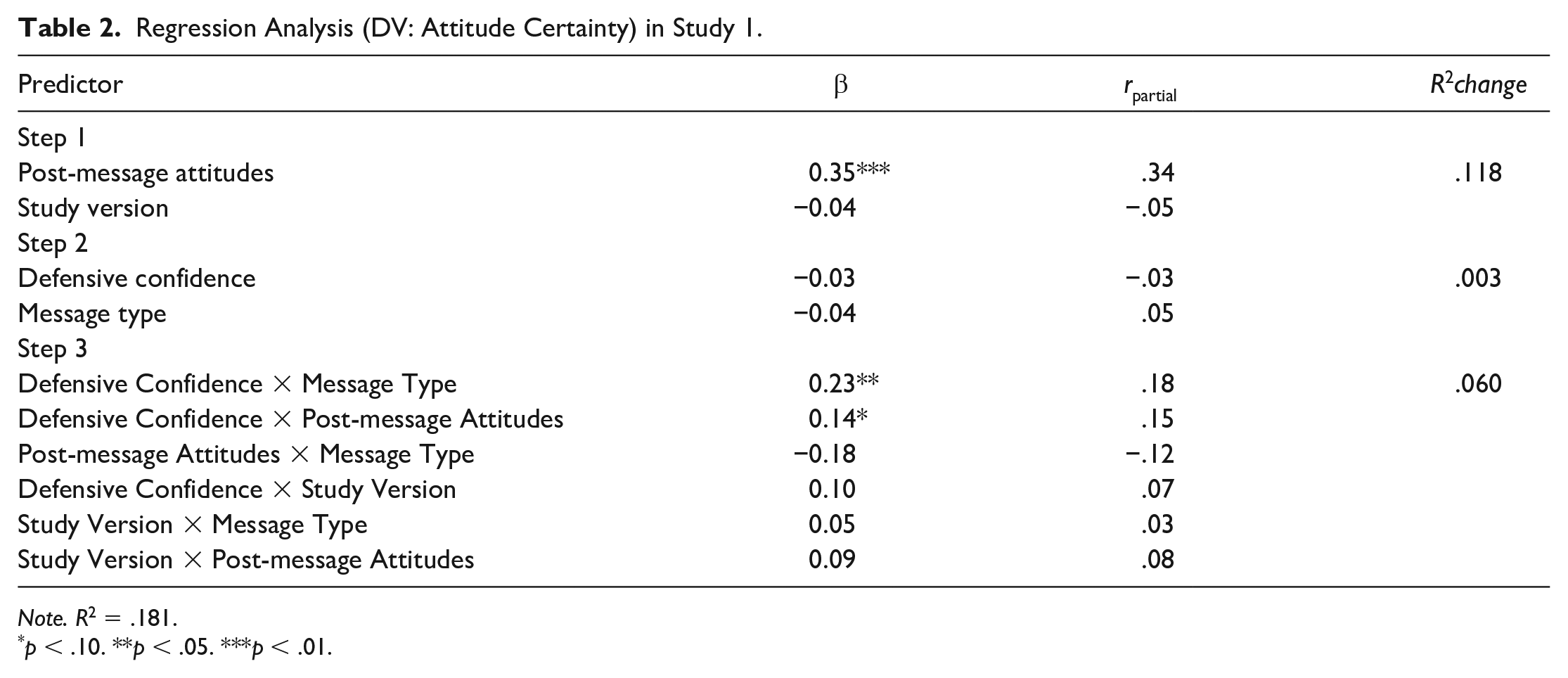
Of most relevance, a hierarchical regression analysis was conducted with post-message attitude certainty as the criterion variable. Post-message attitudes and study version (coded 0 = first, 1 = second) were entered in the first step as covariates, DC and message type (coded 0 = cognitive, 1 = affective) in the second step, and all possible two-way interactions in the third step (see Table 2). In this and all subsequent regression analyses, effects were interpreted in the first model that they appear (see Cohen et al., 2003). Also, all continuous predictor variables were centered, and low and highs DCs were at one standard deviation below and above the mean, respectively.
Regression Analysis (DV: Attitude Certainty) in Study 1.
Note. R2 = .181.
p < .10. **p < .05. ***p < .01.
Results showed that post-message attitudes positively predicted post-message attitude certainty, β = 0.35, t(150) = 4.46, p < .001, 95% confidence interval (CI) = [0.17, 0.44], rpartial = .34, whereas study version did not, p = .58. There was no significant main effect of DC or message type, ps > .56.
Of most importance, there was a significant DC × Message interaction, β= 0.23, t(142) = 2.13, p = .035, 95% CI = [0.06, 1.71], rpartial = .18 (see Figure 1). Consistent with our hypothesis that the mismatched message would lead to less attitude certainty than the matched message especially among low DCs, post-message attitude certainty tended to be lower after the affective message than the cognitive message for these individuals, β = −0.24, t(142) = −1.68, p = .095, 95% CI = [−1.72, 0.14], rpartial = −.14. The type of attack did not matter among high DCs, p = .46. Moreover, in this and subsequent studies, results were consistent regardless if attitude was controlled for or not. Details of these analyses can be found in the Supplementary File.

Attitude certainty as a function of defensive confidence and message type (Study 1).
Study 2
The main goal was to determine whether our hypothesis would be supported for an issue that is primarily affective instead of cognitive. Put differently, we wanted to rule out the alternative explanation for Study 1 that the affective attack undermined certainty among low DCs because of other qualities (e.g., affective information is more overwhelming than cognitive information). If the observed pattern in Study 1 occurred due to the affective attack always leading to less attitude certainty than an affective attack because of some inherent quality of affective information, then Study 2 should show an interaction pattern that is similar to that in Study 1. However, if the observed pattern in Study 1 was due to matching the message to the attitude orientation as hypothesized, then Study 2 should show an interaction where, among low DCs, the cognitive attack leads to less attitude certainty. Thus, in Study 2, participants read a matched or mismatched attack on the affective topic of tuition increases. Information on the pilot testing of affective and cognitive messages in Study 2 is in Footnote 2 in the Methodology File. Participants also indicated their attitude certainty before the attack, and not just after the attack, thus the findings would provide evidence for our hypothesis even when participants’ pre-existing attitude certainty was salient.
Method
Participants and design
Based on Study 1’s effect size, a priori power analyses suggested that N = 187 would provide more than 80% power to detect a similar effect size (Faul et al., 2009). We aimed to recruit as close to 187 as possible and ended up with 184 undergraduates (Mage = 21.34, SD = 1.68, 129 females) at NUS who completed the study for partial course credit or US$4. Participants were equally randomly assigned to receive a cognitive/mismatched or an affective/matched message.
Procedure
Participants were told that they were completing two ostensibly separate studies, with the first study being a collaborative project with the Registrar’s Office to gather students’ opinions on tuition increases, during which participants reported their attitudes and attitude certainty before and after they were presented with the counter-attitudinal message on increasing tuition. The supposedly separate study was presented as a pilot test for newly developed questionnaires, during which participants completed the DC scale and filler questionnaires including the Big Five Inventory, Need for Closure, and Schwartz Values Survey. 2
Predictors
Defensive confidence
As before, higher scores reflected higher DC (M = 3.20, SD = 0.69, α = .89).
Message
Participants read either an affective/matched or a cognitive/mismatched message that advocated for increasing tuition. The affective message discussed positive feelings such as students having more enjoyable experiences at lectures. The cognitive message discussed benefits such as lectures being delivered more efficiently.
Covariates
Post-message attitudes
The same items as before were used to evaluate participants’ favorability (M = 2.97, SD = 1.72, α = .94). Overall, participants remained negative toward tuition increases even after the message.
Pre-message attitude certainty
As before, responses were averaged (M = 6.57, SD = 1.86, α = .95).
Dependent variable: Post-message attitude certainty
Responses were reliable (α = .93) and scores on the items were averaged (M = 6.20, SD = 1.93).
Results
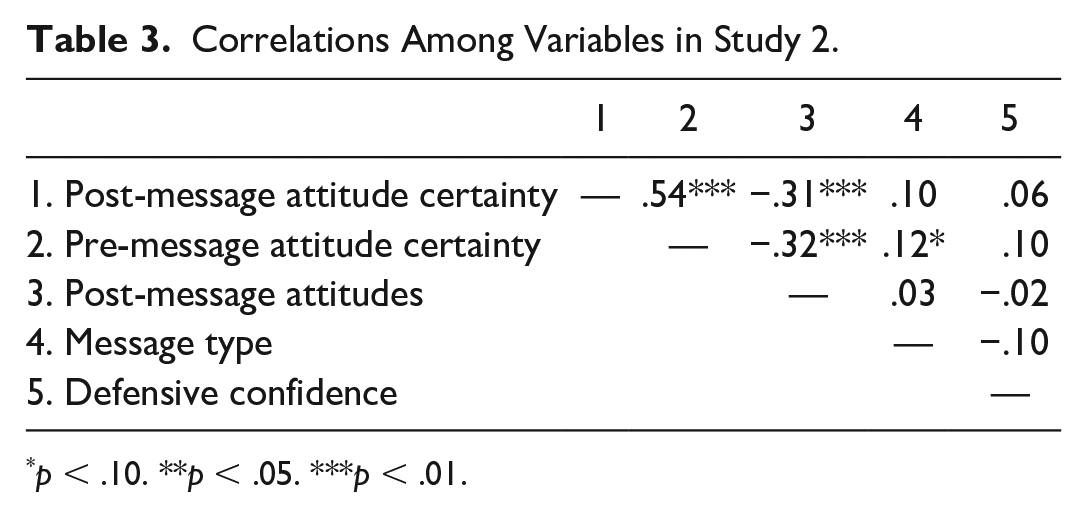
Table 3 presents the zero-order correlations among the variables. As before, participants’ DC did not correlate with the type of message they read. In addition, pre-message attitude certainty and post-message attitudes were correlated with post-message attitude certainty, so they were included as covariates.
Correlations Among Variables in Study 2.
p < .10. **p < .05. ***p < .01.
Post-message attitudes
As before, there was no significant main effect of DC or message, ps > .67. Importantly, the DC × message interaction was again not significant, p = .18.
Post-message attitude certainty
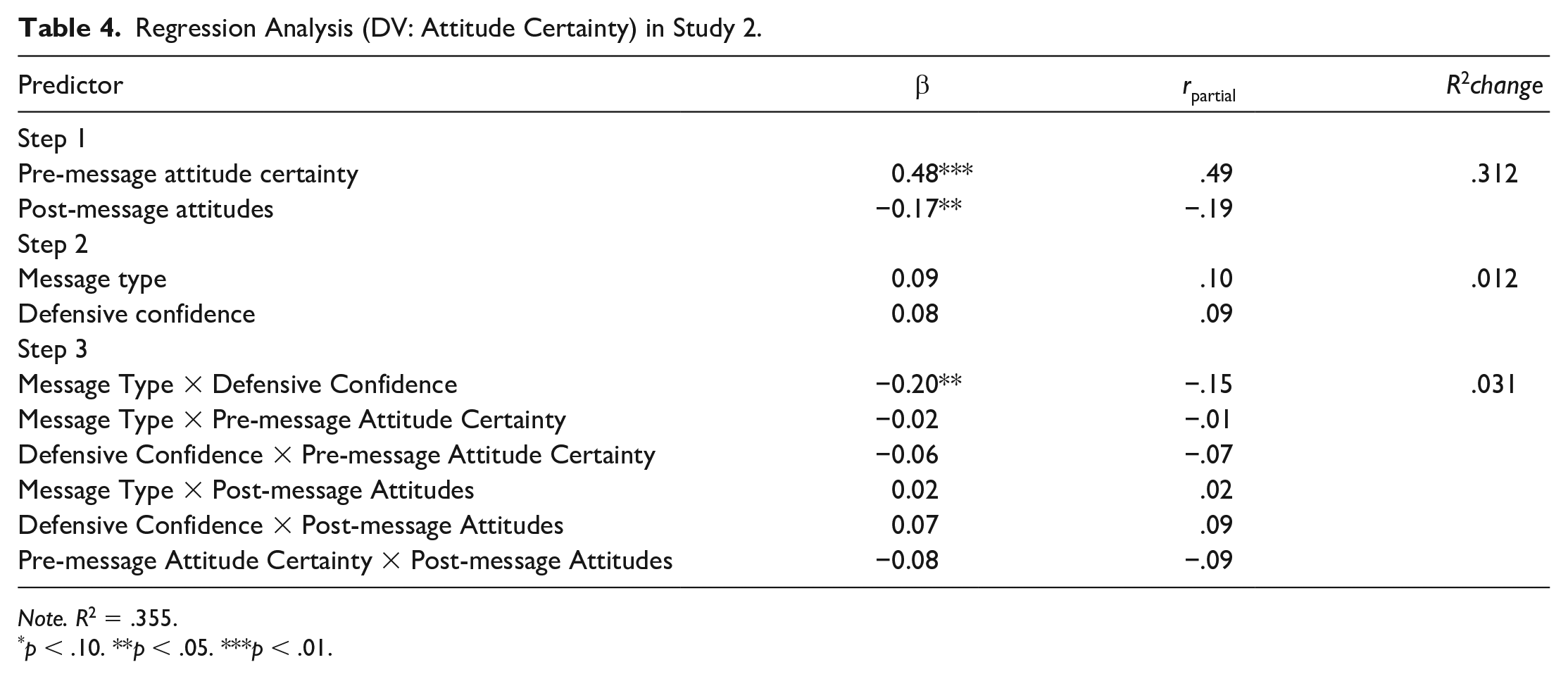
Similar to Study 1, a hierarchical regression was conducted using message (coded 0 = cognitive, 1 = affective), DC and their interaction as predictor variables, and post-message attitude certainty as the criterion variable, controlling for the covariates described above (see Table 4). Results showed that post-message attitude certainty was predicted by pre-message attitude certainty, β = 0.48, t(181) = 7.46, p < .001, 95% CI = [0.37, 0.63], rpartial = 0.49, and post-message attitudes, β = −0.17, t(181) = −2.57, p = .011, 95% CI = [−0.33, −0.04], rpartial = −.19. There was no significant main effect of DC or message type, ps > .16. All interactions involving pre-message attitude certainty or post-message attitudes were not significant, ps ≥ .23.
Regression Analysis (DV: Attitude Certainty) in Study 2.
Note. R2 = .355.
p < .10. **p < .05. ***p < .01.
Of most importance, there was a significant DC × Message interaction, β = −0.20, t(173) = −2.06, p = .04, 95% CI = [−1.42, −0.03], rpartial = −.15. Consistent with our hypothesis that the mismatched message would lead to less attitude certainty than the matched message especially among low DCs, post-message attitude certainty was lower after the cognitive message than the affective message, β = 0.21, t(173) = 2.33, p = .02, 95% CI = [0.12, 1.48], rpartial = .18. Among high DCs, the type of message did not matter, p = .55 (see Figure 2).
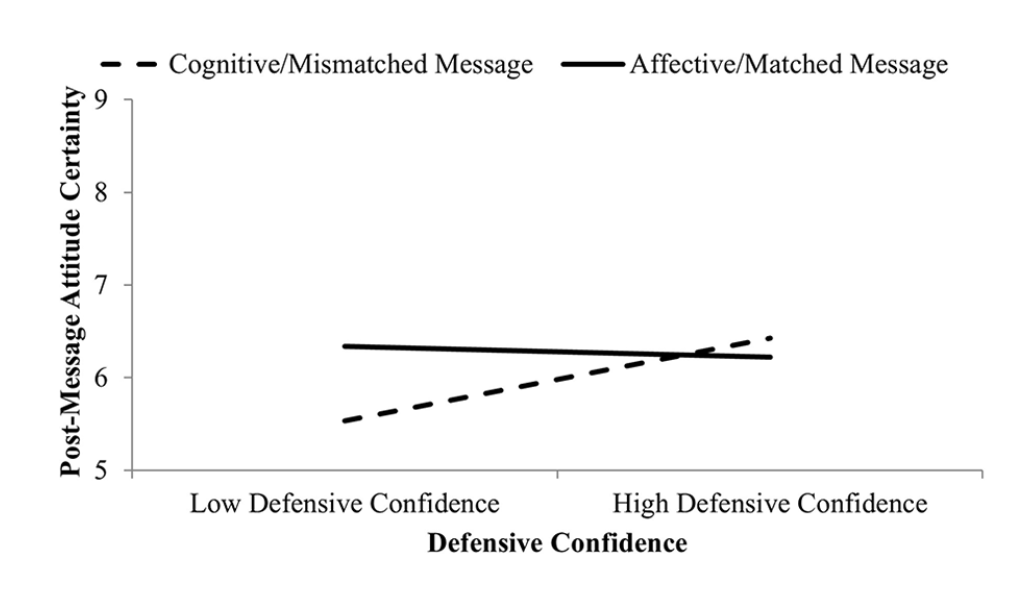
Attitude certainty as a function of defensive confidence and message type (Study 2).
Discussion
As noted earlier, post-message attitudes remained positive for IVLE and negative for tuition increases, thus suggesting that participants in Studies 1 to 2 counter-argued or resisted the messages. Instead of changing attitudes, the messages impacted attitude certainty such that low DCs were less certain about their attitudes after an attack that is mismatched to the affective–cognitive orientation of the attitude.
Study 3
One limitation in Studies 1 to 2 is that there might be other differences besides affective–cognitive orientation that led to the different patterns for tuition increases and IVLE. Thus, Study 3 examined the effects for both cognitive attitudes and affective attitudes within the same study, by manipulating the affective–cognitive orientation of the attitude (e.g., Clarkson et al., 2011; Fabrigar & Petty, 1999).
Following previous studies (e.g., Clarkson et al., 2011; Fabrigar & Petty, 1999), the manipulation of attitude orientation involved asking participants to read about emotions or beliefs about the topic. In this pilot study (N = 64; reimbursed with US$4), participants were presented with the attitude orientation manipulation for the topic of immigration, and then they reported their own emotions, beliefs, and overall attitudes for immigration. The results revealed that as intended, the manipulation did not influence the attitude itself. That is, there was no main effect of the manipulation on attitudes, p = .47. Instead, the manipulation influenced the affective–cognitive orientation of the attitude. That is, the relationship between emotions and attitudes differed across the attitude orientation conditions, as demonstrated by an Emotions × Affective–Cognitive Orientation interaction effect on attitudes, β= 0.30, t(58) = 2.62, p = .011, 95% CI = [0.17, 1.25], rpartial = .33 (see Figure 3a). Importantly, decomposing the interaction effect revealed that as intended, more positive emotions predicted more favorable attitudes in the affective attitude orientation condition, β= 0.46, t(58) = 2.90, p = .005, 95% CI = [0.19, 1.04], rpartial = .36, but emotions did not predict attitudes in the cognitive attitude orientation condition, p = .59. Similarly, as intended, there was a Beliefs × Affective−Cognitive Orientation interaction effect on attitudes, β= −0.27, t(58) = −2.13, p = .04, 95% CI = [−0.99, 0.03], rpartial = −.27 (Figure 3b), which suggests that the relationship between beliefs and attitude varies across the attitude orientation conditions. Importantly, decomposing this interaction revealed that more positive beliefs predicted more favorable attitudes in the cognitive attitude orientation condition, β= 0.99, t(58) = 7.28, p < .001, 95% CI = [0.88, 1.55], rpartial = .69, to a greater extent than in the affective attitude orientation condition, β= 0.57, t(54) = 4.13, p < .001, 95% CI = [0.36, 1.05], rpartial = .48.
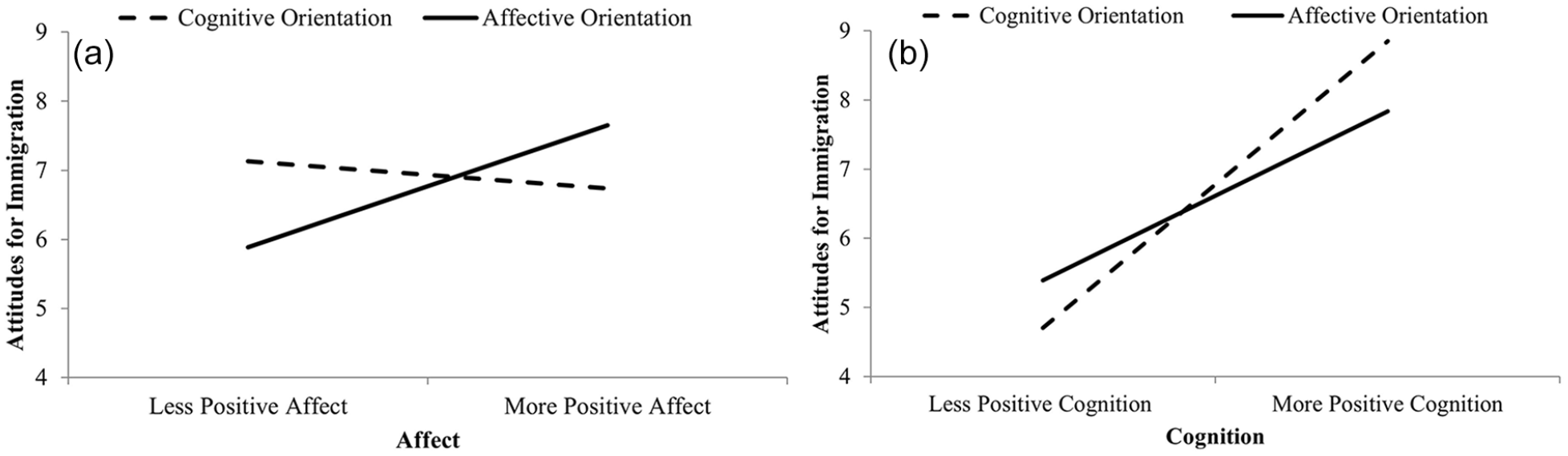
(a) Affective orientation but not cognitive orientation resulted in more positive affect predicting more positive attitudes. (b) Cognitive orientation resulted in a stronger relationship between cognition and attitudes relative to affective orientation manipulation.
Another difference in Study 3 was that the message was personally counter-attitudinal for the individual participant. Thus, if participants supported increasing immigration (N = 208), they were presented with an anti-immigration message. If they opposed increasing immigration (N = 95), they were given a pro-immigration message. Moreover, all participants were also given 1 min to report their counter-arguments against the message. As before, we predicted that lower DC would mean lower attitude certainty after a mismatched attack but not a matched attack. This means that to test our predictions, we relied on an Affective–Cognitive Orientation × Affective–Cognitive Attack × DC design, or viewed more simply, a Matched-Mismatched Attack × DC design.
Method
Participants and design
Based on the effect sizes obtained in Studies 1 to 2, we sought to obtain between 271 and 311 participants for a minimum of 80% power to detect similar effect sizes in our hypothesized DC × Affective–Cognitive Attitudes × Affective–Cognitive Message design (Faul et al., 2009). By ending data collection at the end of the semester, we ended up with 303 undergraduates (Mage = 20.35, SD = 2.45, 212 females and 91 males) at NUS who completed the study online for partial course credit and were randomly assigned to a received either an attack that matched or mismatched the manipulated affective–cognitive orientation of the attitude.
Procedure
The procedure was similar to Studies 1 to 2, with the main difference being that participants received the manipulation of attitude orientation prior to the affective or cognitive attack.
Predictors
Defensive confidence
Higher scores mean higher DC (M = 3.27, SD = 0.62, α = .87).
Attitude orientation
Following prior research (e.g., Clarkson et al., 2011; Fabrigar & Petty, 1999), we presented participants with affective or cognitive adjectives and information (see Crites et al., 1994) that were evaluatively congruent with their attitudes. That is, if they indicated that they supported immigration, they would be presented with positive affective (e.g., immigration increases happiness and emotional well-being) or cognitive information (e.g., immigration is useful . . . beneficial). If they indicated that they opposed immigration, they would be presented with negative affective (e.g., heightens anxiety) or cognitive (e.g., counterproductive and harmful) information.
Matched or mismatched attack
All participants were randomly assigned to receive a matched or mismatched attack on their attitudes. In the matched attack condition, participants received either a cognitive attack on cognitive attitudes or an affective attack on affective attitudes. In the mismatched attack condition, they received either an affective attack on cognitive attitudes or a cognitive attack on affective attitudes.
Outcome measures
Counter-arguments
Participants were given 1 min to generate counter-arguments. Examples of anti-immigration counter-arguments from participants are “. . . more foreign immigrants . . . more competition for a spot in universities,” and “tension between Singaporeans and immigrants may arise.” Examples of pro-immigration counter-arguments from participants are “Immigrants are essential to Singapore if we are to continue to grow . . .” and “Immigrants are needed for the development of Singapore.” In addition to counting the number of counter-arguments that each participant generated, a coder who was blind to the conditions of the participants also rated how convincing each counter-argument was (1 = not at all convincing; 9 = totally convincing).
Attitudes
Participants reported post-message attitudes using the same items as before (M = 6.28, SD = 2.17, α = .98).
Attitude certainty
As before, scores on the items were averaged (M = 5.48, SD = 1.77; α = .96).
Results and discussion
The zero-order correlations among the variables are shown in Table 5.
Correlations Among Variables in Study 3.
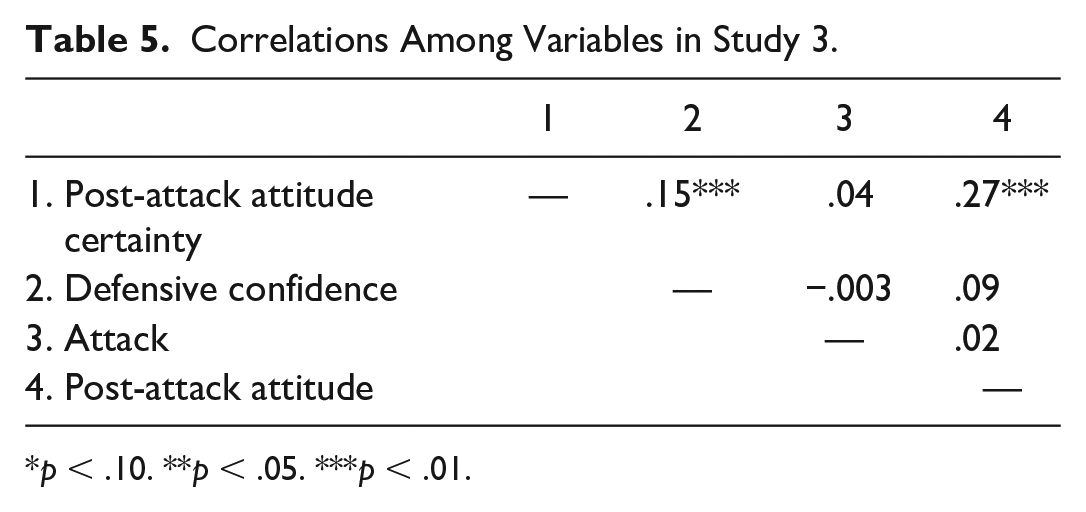
p < .10. **p < .05. ***p < .01.
Post-attack attitudes
Similar to the previous studies, there was no significant main effect of DC or attack, ps > .11. Importantly, the DC × Matched–Mismatched Attack interaction was not significant, p = .32.
Post-attack attitude certainty
With participants’ post-message attitude certainty as the outcome, a hierarchical multiple regression controlling for post-message attitudes was conducted (see Table 6). Post-message attitudes were first entered before DC and whether the attack was matched or mismatched (coded as matched = 0, mismatched = 1) to the attitude orientation.
Regression Analysis (DV: Attitude Certainty) in Study 3.
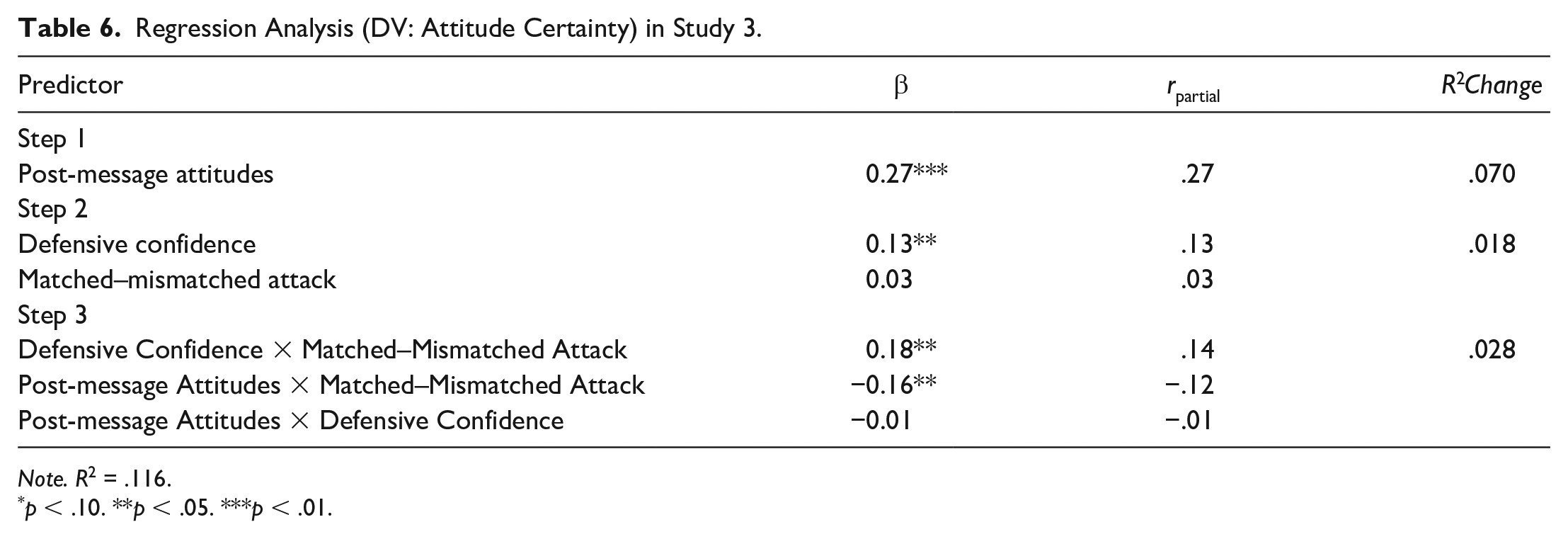
Note. R2 = .116.
p < .10. **p < .05. ***p < .01.
Post-message attitudes positively predicted attitude certainty, β = 0.27, t(301) = 4.76, p < .001, 95% CI = [0.13, 0.31], rpartial = .27. Higher DC also predicted more attitude certainty, β = 0.13, t(299) = 2.33, p = .02, 95% CI = [0.06, 0.68], rpartial = .13. Receiving a matched or mismatched attack did not matter, p = .58.
Of most importance, there was a significant DC × Matched–Mismatched Attack interaction, β = 0.18, t(296) = 2.41, p = .02, 95% CI = [0.14, 1.38], rpartial = .14. As hypothesized, given a mismatched attack, lower DC meant lower attitude certainty, β = 0.28, t(296) = 3.29, p = .001, 95% CI = [0.32, 1.26], rpartial = .19. However, given a matched attack, DC did not matter, p = .90 (see Figure 4).
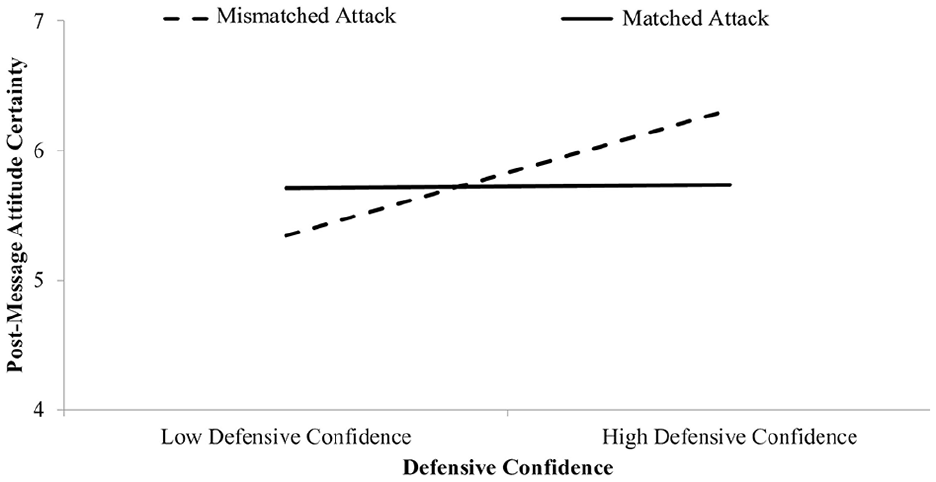
Attitude certainty as a function of defensive confidence and matched–mismatched attack (Study 3).
We also examined the Affective–Cognitive Attitudes × Affective–Cognitive Attack × DC interaction, to ensure that the DC × Matched–Mismatched Attack interaction pattern described above occurred for both affective and cognitive attitudes. As hypothesized, there was a significant three-way interaction, β = −0.34, t(288) = −2.64, p = .009, 95% CI = [−2.91, −0.43], rpartial = −.15. Importantly, among participants induced with cognitive attitudes who received an affective (i.e., mismatched) attack, lower DC meant lower attitude certainty, β = 0.36, t(288) = 2.98, p = .003, 95% CI = [0.35, 1.71], rpartial = .17. Similarly, among those induced with affective attitudes who received a cognitive (i.e., mismatched) attack, lower DCs tended to predict lower certainty, β = 0.20, t(288) = 1.77, p = .077, 95% CI = [−0.06, 1.21], rpartial = .10. In comparison, among those who faced attacks that matched their attitudes, DC did not matter, ps > .17.
Thus, findings in Study 3 were consistent with the patterns in Studies 1 to 2, as the mismatched attack caused low DCs to have less certainty in their attitudes toward immigration than their DC counterparts, whereas the matched attack led to similar levels of certainty in both low and high DCs.
Counter-arguments
We examined the number and quality of counterarguments generated by participants. There was a tendency for participants in the mismatched message condition to generate less convincing counter-arguments than in the matched message condition, β = −.19, t(88) = −1.80, p = .076, 95% CI = [−1.24, 0.06], rpartial =.−.19, thus suggesting that overall, the mismatched attack was more difficult to counter-argue than the matched attack. As expected, there was no difference in the number or quality in the number as a function of the DC × Matched–Mismatched Attack interaction, ps > .59, thus suggesting that low and high DCs did not differ in their actual ability to counter-argue the matched or mismatched attack.
Study 4
Although Study 3’s findings suggest that the effects on attitude certainty could not be attributed to the number or quality of counterarguments that participants generated, the question remains as to what the underlying mechanism was. Thus, Study 4 explored two indicators of appraisals for attitude certainty as potential mediators (Rucker et al., 2014). That is, Study 4 measured perceived knowledge, which is an appraisal of the completeness of information underlying one’s attitude, and perceived inconsistency, which is an appraisal of the accuracy of the underlying information. Finally, Study 4 also differed from Study 3 by examining attitude orientation as a general individual difference.
Method
Participants and design
We aimed for a sample size that was similar as in Study 3. Because we stopped data collection at the end of the academic year, we ended up with 360 participants (Mage = 21.54, SD = 2.21, 257 females) from NUS who participated for either US$8 reimbursement or for partial course credit. Participants were equally and randomly assigned to the affective and cognitive message condition.
Procedure
As in prior studies, participants were informed that they were participating in various experiments. First, they completed the measure of DC. Then, in an ostensibly separate study, they reported their attitudes, affect, and cognition toward various attitude objects so that their responses across these objects could be used to compute the general affective–cognitive orientation of their attitudes. That is, unlike in Study 3, where attitude orientation was manipulated, Study 4 assessed attitude orientation as an individual difference (e.g., Huskinson & Haddock, 2004; See et al., 2008). In another ostensibly separate study, participants were asked to provide their opinions on the topic of immigration. As in Study 3, participants first reported their initial stance on immigration (i.e., oppose or support). They were then given either a cognitive or an affective message that is counter-attitudinal to their stance. Finally, participants reported their perceived knowledge, inconsistency, and attitude certainty.
Predictors
Defensive confidence
Higher scores mean higher DC (M = 3.26, SD = 0.60, α = .87).
Attitude orientation
To compute individual differences in affective–cognitive attitudes, we used the same approach as in prior research (e.g., Huskinson & Haddock, 2004; See et al., 2008). Participants reported their affective, cognitive, and attitude responses toward seven objects (e.g., Crites et al., 1994; Fabrigar & Petty, 1999). All items were measured on an 11-point Likert-type scale. Participants responded to eight affective semantic-differential items (e.g., sad-delighted, αs > .92) and seven cognitive semantic-differential items (e.g., useless-useful, αs > .87) for each object that were counter-balanced across object. These items measured the extent participants have positive feelings/beliefs toward the objects. Participants also reported their attitudes for each object on four items (e.g., negative–positive, αs > .84). A new object was presented after participants completed the affect, cognition, and attitude measures for one object.
The presentation of the seven objects was in a random order. The objects were using birth control, blood donation, eating chocolates, snakes, spiders, freedom of speech, and going to the gym. These objects were selected such that some objects generally elicited affective attitudes (e.g., eating chocolates) or cognitive attitudes (e.g., going to the gym).
Two correlations were computed to inform the individuals’ affective–cognitive attitudes. The two correlations reflect the average affect and attitude relationship (raff-att = .83) and the average cognition and attitude relationship (rcog-att = .78) for the seven objects. The correlations were first transformed to Fisher’s z values, before the cognition–attitude correlation was subtracted from the affect–attitude correlation, with larger positive values suggesting that participants focused more on affect than on cognition across the objects (rFisher’s Z = .17; e.g., Haddock & Zanna, 1994).
Affective or cognitive attack
As in Study 3, if participants had indicated that they opposed immigration, then they would receive a pro-immigration message that was either cognitive or affective. The cognitive version described the economic benefits from immigration (e.g., job opportunities), whereas the affective version emphasized the positive well-being resulting from immigration policies (e.g., increased happiness). If participants had reported that they supported immigration, then they would receive an anti-immigration message. The cognitive version highlighted the inadequacies of immigration policies (e.g., increased job competition), whereas the affective version emphasized the emotional frustration that might arise from increased immigration (e.g., congested public transport).
Covariate: Post-message attitudes
The same items as before were used, with higher scores reflecting more positive attitudes (M = 5.73, SD = 1.74, α = .94).
Outcome variables
Perceived knowledge
Participants responded to three items ranging from 1(not at all knowledgeable/completely uninformed/very little information) to 9 (very knowledgeable/completely informed/a great deal of information) regarding the topic of immigration (e.g., Smith et al., 2008). Responses were averaged, with higher scores suggesting greater knowledge (M = 5.17, SD = 1.39, α = .84).
Perceived inconsistency
Participants responded to three items ranging from 0 (completely one-sided/no conflict at all/no indecision at all) to 10 (completely mixed reactions/maximum conflict/maximum indecision) regarding the topic of immigration (Smith et al., 2008). Responses were averaged, with higher scores suggesting more inconsistencies (M = 6.54, SD = 1.97, α = .78).
Attitude certainty
The same items as before were used, with higher scores reflecting more certainty (M = 5.37, SD = 1.67, α = .87).
Results and Discussion
Table 7 presents the zero-order correlations among the variables.
Correlations Among Variables in Study 4.
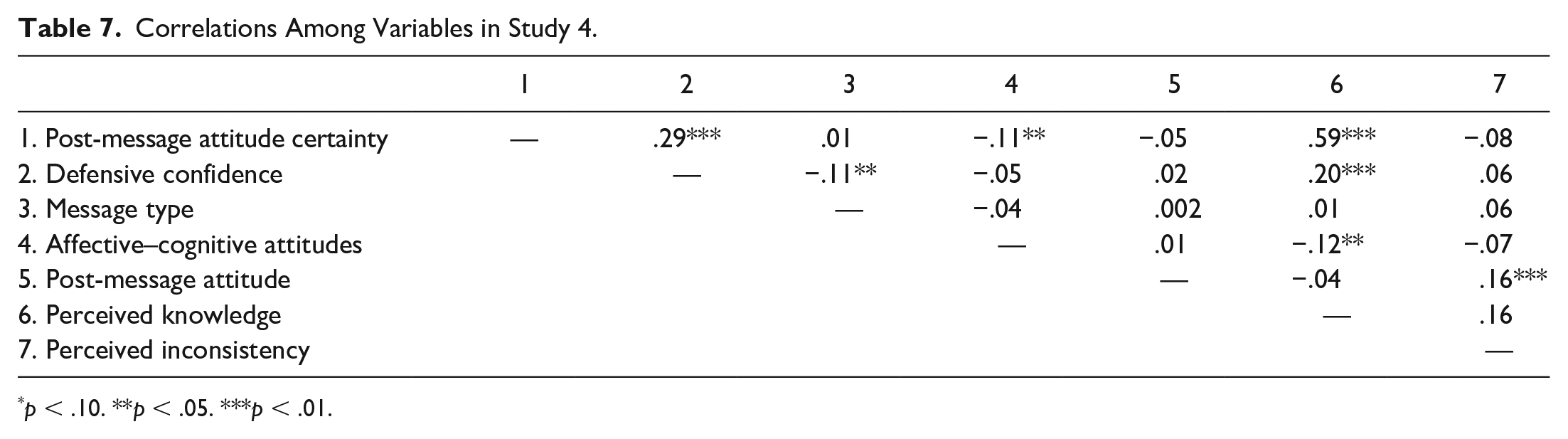
p < .10. **p < .05. ***p < .01.
Post-message attitudes
As before, there were no significant main effects, ps > .76. Of most importance, the three-way interaction was not significant, p = .37, suggesting no effects on post-message attitudes.
Post-message attitude certainty
A hierarchical regression was conducted with participants’ attitude certainty toward immigration as the criterion variable, controlling for post-message attitudes (Table 8). That is, post-message attitudes were entered first, before DC, affective–cognitive attitudes, and affective–cognitive message (coded 0 = cognitive, 1 = affective).
Regression Analysis (DV: Attitude Certainty) in Study 4.
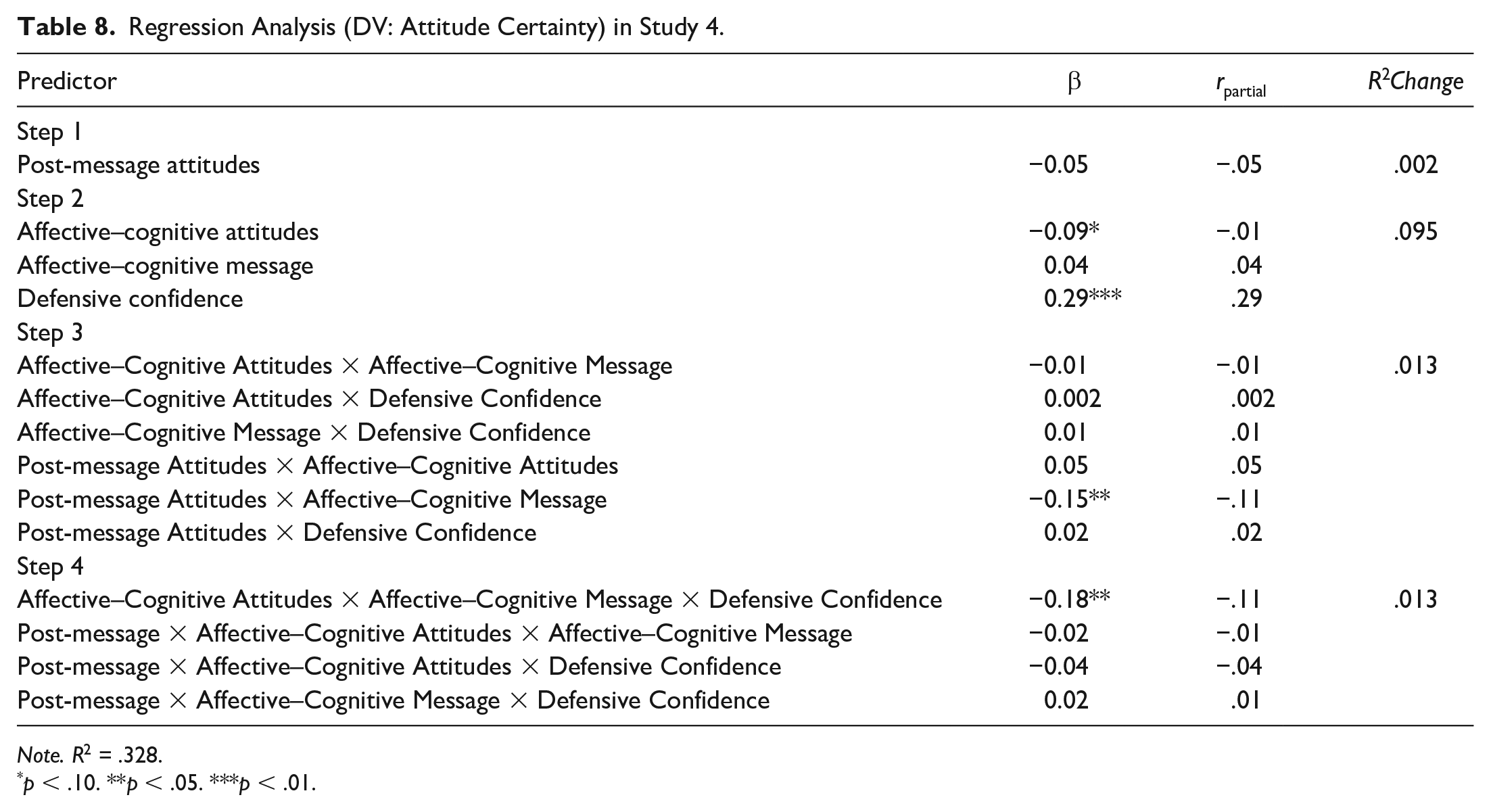
Note. R2 = .328.
p < .10. **p < .05. ***p < .01.
Results revealed that DC positively predicted attitude certainty, β = 0.29, t(355) = 5.74, p < .001, 95% CI = [0.54, 1.10], rpartial = .29. Also, cognitive attitudes tended to predict more certainty than affective attitudes, β = −0.09, t(355) = −1.82, p = .071, 95% CI = [−0.44, 0.02], rpartial = −.10. Neither post-message attitudes nor message type predicted attitude certainty, ps > .38. There were also no significant two-way interactions, ps > .89.
Of most relevance, a significant three-way interaction emerged, β = −0.18, t(345) = −2.07, p = .04, 95% CI = [−1.94, −0.05], rpartial = −.11 (see Figure 5a and 5b). To test the prediction that the mismatched message leads to less certainty for low DCs, we first examined cognitive attitudes–affective message participants and affective–attitudes–cognitive message participants. Among the cognitive attitudes individuals (1 SD below mean) who received the affective message, certainty was lower as DC decreased, β = 0.41, t(345) = 3.90, p < .001, 95% CI = [0.56, 1.71], rpartial = .21. The same was true for affective attitudes individuals (1 SD above the mean) who received the cognitive message, β = 0.45, t(345) = 3.63, p < .001, 95% CI = [0.57, 1.93], rpartial = .19.

(a) Attitude certainty as a function of defensive confidence and message type for participants with cognitive attitudes (Study 4). (b) Attitude certainty as a function of defensive confidence and message type for participants with affective attitudes (Study 4).
We then examined participants who received the matched message. As expected, among cognitive attitudes–cognitive message individuals, DC did not matter, p = .33. Unexpectedly, among affective attitudes–affective message individuals, DC positively predicted certainty β = 0.22, t(345) = 2.06, p = .04, 95% CI = [0.03, 1.18], rpartial = .11, although this effect was smaller compared with that participants who received a mismatched message.
Taken together, the findings suggest that the lower certainty among low DCs occurred reliably among participants who received attacks that were mismatched to their attitude orientation, but not reliably among others who received attacks that were matched to their attitude orientation.
Perceived knowledge
The previous analysis was repeated with perceived knowledge as the dependent variable. Results revealed that DC positively predicted knowledge, β = 0.20, t(355) = 3.81, p < .001, 95% CI = [0.22, 0.70], rpartial = .20. Also, cognitive attitudes predicted more knowledge than affective attitudes, β = −0.11, t(355) = −2.15, p = .03, 95% CI = [−0.41, −0.02], rpartial = −.11. Neither post-message attitudes nor message type predicted knowledge, ps = .44. No two-way interactions emerged, ps > .31.
Of most importance, a significant three-way interaction emerged, β = −0.20, t(345) = −2.26, p = .02, 95% CI = [−1.69, −0.12], rpartial = −.12 (see Figure 6a and 6b). Similar to the results for certainty, among cognitive attitudes participants who received an affective attack, lower DC meant less knowledge, β = 0.39, t(345) = 3.71, p < .001, 95% CI = [0.42, 1.38], rpartial = .20. The same was true for affective attitudes individuals who received a cognitive attack, β = 0.28, t(345) = 2.24, p = .03, 95% CI = [0.08, 1.21], rpartial = .12. Thus, as hypothesized, low DCs perceived less knowledge than high DCs, when the message that mismatches individuals’ attitude orientation.

(a) Perceived knowledge as a function of defensive confidence and message type for participants with cognitive attitudes (Study 4). (b) Perceived knowledge as a function of defensive confidence and message type for participants with affective attitudes (Study 4).
As expected, the patterns above did not occur among participants who received matched attacks, ps > .66.
Perceived inconsistency
We repeated the same analysis as above, but with perceived inconsistency as the dependent variable. Post-message attitudes positively predicted perceived inconsistency, β = 0.16, t(358) = 3.08, p = .002, 95% CI = [0.07, 0.30], rpartial = .16. However, there were no main effects of DC, affective–cognitive attitudes, or message type, ps > .17. There were also no significant two-way interactions, ps > .15. Of most importance, unlike for perceived knowledge, there was no three-way interaction effect, p = .24. Thus, perceived inconsistency was not a mediator for the effects of DC and matching on post-message certainty. 3
Mediational analyses
Given that the three-way interaction effect on knowledge was similar to the hypothesized three-way interaction on attitude certainty, we examined the role of knowledge as a mediator. That is, we conducted mediation analyses using 5,000 bootstrapped samples, facilitated by the PROCESS macro version 3.4 (Hayes, 2017). We expected that the mediation would occur for those who received the mismatched attacks but not others who received the matched attacks. For those who received the mismatched attacks, such that individuals either hold cognitive attitudes but received affective attacks or hold affective attitudes but received cognitive attacks, knowledge mediated the influence of DC on attitude certainty, β = 0.15, 95% CI = [0.05, 0.24] (Figure 7a), However, for those who received the matched attacks, where they hold cognitive attitudes and received cognitive attacks or hold affective attitudes and received affective attacks, knowledge did not mediate the effects, β = 0.07, 95% CI = [−0.02, 0.17] (Figure 7b). 4

(a) Perceived knowledge as a mediator for those who faced mismatched attacks. (b) Perceived knowledge as a nonmediator for those who faced matched attacks.
General Discussion
Summary of Findings
Across four studies, an attack that was mismatched to the recipient’s attitude orientation led to lower attitude certainty among low DC than high DCs. However, given a matched attack, similar levels of attitude certainty occurred for low and high DCs. This pattern occurred regardless of whether attitude orientation was examined as an issue (Studies 1–2), or manipulated (Study 3), or measured as an individual difference (Study 4). Study 3’s findings also suggest that the effects on attitude certainty were not due to differences in the actual ability of low and high DCs to counter-argue the attack. Finally, Study 4 demonstrated that the mismatched attack led to less certainty among low DCs because the former perceived less knowledge after the attack.
Mini Meta-Analysis
To examine whether the differences between low and high DCs occurred due to the undermining effect of the mismatched attack on attitude certainty among low DCs, or the bolstering effect of the mismatched attack on certainty among high DCs, we conducted a mini meta-analysis for the studies in the current research, where we examined the effects of message type for each attitude orientation for low versus high DCs (see Cheung, 2015; Goh et al., 2016; Rosenthal & Rosnow, 2008).
Effect sizes were computed such that a negative correlation meant that a mismatched message led to lower attitude certainty (Cheung, 2015; Rosenthal & Rosnow, 2008). The analyses and illustrations were conducted in the R (version 4.0.2) statistical platform using the metaSEM (Cheung, 2020) and metafor package (Viechtbauer, 2020). A random-effects model was used since some of the studies’ procedures differed (e.g., recruitment pools, examined topics), and more importantly, this would allow generalization of the current findings beyond the included studies (Borenstein et al., 2009; Hunter & Schmidt, 2000). Of importance, the meta-analysis, Q(df = 5) = 4.28, p = .51, revealed that among low DCs, a mismatched attack led to less certainty than a matched attack, r = −.07, p < .001, 95% CI = [−0.11, −0.04]. In contrast, among high DCs, the meta-analysis, Q(df = 5) = 8.02, p = .16, revealed that a mismatched attack led to higher attitude certainty than a matched attack, r = .06, p = .03, 95% CI = [0.01, 0.12]. As shown in Figure 8a and 8b, relative to the matched attack, the mismatched attack was both undermining for low DCs and bolstering for high DCs.

(a) Forest plots for participants with low defensive confidence. The overall negative correlation means that the mismatched attack led to less certainty than the matched attack for these individuals. (b) Forest plots for participants with high defensive confidence. The overall positive correlation means that the mismatched attack led to more certainty than the matched attack for these individuals.
Implications
The current studies identify attitude certainty as a novel consequence that is impacted by affect–cognition (mis)matching when people face an attack. That is, the current research demonstrates that the mismatched attack can be the more consequential strategy, in particular, among low DCs. This is noteworthy because even though the greater success of matched messages is well-established in the extant literature, with significant efforts put into examining when and how such matching effects occur for attitude change (e.g., Clarkson et al., 2011; Haddock et al., 2008), very little attention has been paid to when or how mismatched messages might be consequential when other outcomes such as attitude certainty are considered. The present research addresses this gap not only by identifying among whom the mismatched attack is especially consequential but also by establishing perceived knowledge as an underlying mechanism.
As suggested above, the present research demonstrates the relevance of a meta-cognitive framework for understanding (mis)matching effects. It also suggests that the extant theorizing and research on attitude certainty can be extended through the lens of affect–cognition (mis)matching. For instance, it has been proposed that meta-cognitive assessments and appraisals are more impactful on attitude certainty when individuals are motivated and able to process information (e.g., Rucker et al., 2014; Tormala & Petty, 2004), or when individuals have naïve theories about attitudes such as their inherent malleability (Petrocelli et al., 2010; see also Briñol et al., 2006). The present findings suggest that mismatched persuasion can lead people to assess the validity of their attitudes to a greater extent than matched persuasion, such that they are more impacted by appraisals of their knowledge in their certainty. In addition, individuals might also have naïve theories about the affective–cognitive orientation of their attitudes, with implications for attitude certainty. For instance, high DCs might expect the affective–cognitive orientation of their attitudes to be more malleable, or be more likely to see mismatched information as an opportunity for bolstering their attitudes.
Finally, the present findings also have implications for our understanding of DC. The present research is consistent with prior research that demonstrates that low DCs can behave as if they are certain in their specific attitudes (e.g., Albarracín & Mitchell, 2004; Albarracín et al., 2012). While prior studies suggest that this can occur due to low DCs’ avoidance of strong counter-attitudinal information, the present findings demonstrate that even when selective exposure is restrained, and everybody faces the same amount of counter-attitudinal information, low DCs can remain certain in their attitudes after an attack, as long as the attack is matched to the affective–cognitive orientation of the attitude. Future research can examine whether and how such attitude certainty serves different functions, such as being a cue for attitude-correspondent behavior or signaling a reduced need for attitude strength (Sawicki & Wegener, 2018), for low and high DCs when they face various attacks on their attitudes.
Limitations and Future Directions
In the current research, we only examined perceived knowledge as an indicator of information completeness and perceived inconsistency as an indicator of information accuracy. Although we did not find evidence of perceived inconsistency as a mediator for the effects on attitude certainty, there are other constructs that are related to accuracy such as perceived social consensus (e.g., Petrocelli et al., 2007). There are also other types of appraisals that can be examined in future research, including the importance of the underlying information and the legitimacy of information (see Rucker et al., 2014).
In addition, in the present research, the attack was not a particularly strong one, which likely contributed to people’s successful resistance against the attack, as indicated by the finding that attitudes remained unchanged after the attack (e.g., McGuire & Papageorgis, 1961; Tormala & Petty, 2002). Yet, facing counter-attitudinal persuasion can sometimes cause people to change their attitudes instead of holding onto their initial attitudes (see Clark & Wegener, 2013; Dal Cin et al., 2004). It is possible that given a strong attack, attitude change, as well as the certainty in the changed attitude, would be influenced by affect–cognition matching and DC. Furthermore, this could be due to individuals’ meta-cognitive awareness that they had failed to resist the attack (Rucker & Petty, 2004).
Finally, although the current research focused on the affective–cognitive orientation of an attitude, there are other types of affective and cognitive differences that a message can be matched to. Examples include affective–cognitive meta-bases (See et al., 2008), NC (Cacioppo & Petty, 1982), and NA (Maio & Esses, 2001). Although these other affective–cognitive differences seem to overlap with the affective–cognitive orientation of an attitude, they are also distinguishable, for instance, in how they assess motivation or ability for processing emotions and beliefs (see See, 2020). Furthermore, it would also be useful to investigate other forms of matching, such as matching to the recipient’s political orientation (e.g., Feinberg & Willer, 2013) or personality (e.g., Hirsh et al., 2012; Wheeler et al., 2005). We expect that some forms of matching would lead to similar results as the current research. For instance, extraverted individuals who are low in DC might be less certain in their unchanged attitudes after resisting a message that is tailored for introverted recipients because they perceive themselves to be less knowledgeable.
Conclusion
The present research demonstrates that attitude certainty among low DC individuals is undermined after a counter-attitudinal attack when the attack is mismatched to the affective–cognitive orientation of attitudes, and this is due to lower perceptions of knowledge that an individual has. These findings are important in advancing our understanding of affect–cognition matching as well as DC. We look forward to further examination of various mechanisms for which affect–cognition matching and DC influence attitude certainty, and for an even wider range of consequences.
Supplemental Material
sj-docx-1-psp-10.1177_01461672221074102 – Supplemental material for Defensive Confidence and Certainty in Unchanged Attitudes: The Role of Affect–Cognition Matching
Supplemental material, sj-docx-1-psp-10.1177_01461672221074102 for Defensive Confidence and Certainty in Unchanged Attitudes: The Role of Affect–Cognition Matching by Wei Jie Reiner Ng, Chi Bu and Ya Hui Michelle See in Personality and Social Psychology Bulletin
Footnotes
Declaration of Conflicting Interests
The author(s) declared no potential conflicts of interest with respect to the research, authorship, and/or publication of this article.
Funding
The author(s) disclosed receipt of the following financial support for the research, authorship, and/or publication of this article: Portions of this research were supported by Singapore Ministry of Education Academic Research Fund (AcRF) Tier 1 WBS R581-000-254-115.

Supplemental Material
Supplemental material is available online with this article.
Notes
References
Supplementary Material
Please find the following supplemental material available below.
For Open Access articles published under a Creative Commons License, all supplemental material carries the same license as the article it is associated with.
For non-Open Access articles published, all supplemental material carries a non-exclusive license, and permission requests for re-use of supplemental material or any part of supplemental material shall be sent directly to the copyright owner as specified in the copyright notice associated with the article.
