



Abstract
How does implicit bias contribute to explicit prejudice? Prior experiments show that concept knowledge about fear versus sympathy determines whether negative affect (captured as implicit bias) predicts antisocial outcomes (Lee et al.). Concept knowledge (i.e., beliefs) about groups may similarly moderate the link between implicitly measured negative affect (implicit negative affect) and explicit prejudice. We tested this hypothesis using data from the American National Election Studies (ANES) 2008 Time Series Study (Study 1) and Project Implicit (Study 2). In both studies, participants high in implicit negative affect reported more explicit prejudice if they possessed negative beliefs about Black Americans. Yet, participants high in implicit negative affect reported less explicit prejudice if they possessed fewer negative beliefs about Black Americans. The results are consistent with psychological constructionist and dynamic models of evaluation and offer a more ecologically valid extension of our past laboratory work.
Implicit bias has garnered both widespread scientific interest (e.g., Dovidio et al., 2002; Fazio et al., 1995; Lai et al., 2014, 2016; McConnell & Leibold, 2001) and public concern (e.g., Haugh, 2016; Park, 2018; The BBC, 2017; Zarya, 2015). In contrast to explicit prejudice that is overtly expressed on survey measures, implicit bias refers to automatically activated associations, which may result in discriminatory behavior without intent (e.g., Devine, 1989; Dovidio et al., 2002; Fazio et al., 1995). Although explicit expressions of prejudice have gradually decreased over many decades, implicit bias remains prevalent (Charlesworth & Banaji, 2019; Nosek et al., 2007; Payne et al., 2010; Sniderman & Carmines, 1997).
The discrepancy between implicit and explicit bias is often thought to be explained by meta-cognitive judgments about implicitly activated attitudes. These judgments may include self-presentation concerns (Greenwald et al., 2009; Nosek & Smyth, 2007), motivations to be unprejudiced (Plant & Devine, 1998), and judgments of validity (Gawronski & Bodenhausen, 2006; Petty, 2006). In addition to these metacognitions, our laboratory research suggests that explicit prejudice may occur when people make meaning of their affective states as feelings of explicit prejudice toward outgroup members.
Negative affect toward outgroups may be captured as implicit bias on indirect measures. Our experimental work suggests that this negative affect can form the basis for explicit prejudice (Lee et al., 2018). We found that outcomes related to prejudice (e.g., fear of Black Americans) may arise when this (implicitly measured) negative affect toward an outgroup is interpreted as instances of explicit prejudice toward a social group (e.g., explicitly reported emotion, perceptions, and attitudes) using concept knowledge. For the sake of brevity, we will use the term “implicit negative affect.” The “implicit” in the name refers to the fact that this affect is captured using implicit measures. Concept knowledge is the set of stored, learned representations related to any category (Barsalou et al., 2003; Lindquist et al., 2015; Vigliocco et al., 2009). For instance, people possess concept knowledge about the category of fear, including what it feels like to experience fear, behaviors associated with fear, and also who and what they should fear.
We found that making concept knowledge about fear versus sympathy toward Black Americans more accessible to White participants altered how those participants made meaning of implicit negative affect toward Black Americans (Lee et al., 2018). Specifically, we first measured implicit negative affect toward Black Americans using the affect misattribution procedure (AMP; Payne et al., 2005). Then we primed fear or sympathy by asking participants to think about reasons why their “gut feelings” might be indicative of fear versus sympathy toward Black Americans. Finally, we asked participants to rate the extent to which they explicitly endorsed fear toward Black Americans. We found that implicit negative affect predicted greater self-reported fear of Black Americans, but this was only true for participants encouraged to interpret their negative affect as fear. For participants encouraged to interpret their negative affect as sympathy, the relationship between implicit negative affect and fear was nonsignificant. We found the same pattern of results for a more indirect measure of fear: Participants perceived Black faces as more aggressive, but only when they were in high implicit negative affect and had interpreted that negative affect as fear but not sympathy.
Although these findings demonstrate the mechanism by which implicit negative affect can translate into explicit prejudice, they do not demonstrate whether this happens in the real world. In the present paper, we do so by using large datasets from (a) a large sample of the U.S. population from the American National Election Studies and (b) Project Implicit, a website that allows the general public to take implicit bias measures. Each of these large datasets included implicit measures of negative affect, as well as self-report measures of concept knowledge and explicit prejudice toward Black Americans. These datasets also afford at least three benefits: First, the large samples increase power and reduce both false positives and false negatives, as well as improve the replicability of research findings. In addition, student samples and online convenience samples used in previous research tend to be younger, more educated, more liberal, and less likely to endorse explicit prejudice than the general population. Thus, our prior work may have overestimated the extent to which implicit negative affect contributes to explicit prejudice (see Henry, 2008 for a discussion). As such, the present research shines a light on how implicitly measured affect and prejudice are related for most Americans.
In Study 1, we drew on data from the American National Election Studies (ANES; electionstudies.org). The ANES is a long-standing project established in 1977 to regularly measure voting behavior and political and racial attitudes in the U.S. population. As with our experimental study, we used responses on the AMP to index participants’ negative affective responses to Black and White Americans. We measured explicit prejudice as unfavorability toward Black Americans as rated on a feeling thermometer. We measured concept knowledge as endorsement of statements on scales measuring common negative stereotypes toward Black Americans and symbolic racism.
Although measures of stereotyping and symbolic racism are often considered explicit measures that examine prejudice, they also capture beliefs that participants are likely to bring online when interpreting their interactions with Black Americans. This concept knowledge may play a role in how people interpret their own internal affective responses to Black Americans, when they arise. For example, one item states that “It’s really a matter of some people not trying hard enough; if Blacks would only try harder, they could be just as well off as Whites.” A person who possesses this concept knowledge may be more likely to interpret any general negative affect that they feel toward Black Americans as antipathy, rather than another negatively valenced emotion, such as uncertainty, discomfort, or even sympathy
It is relatively uncontroversial to view stereotypes as part of concept knowledge (e.g., Bian & Cimpian, 2017; Bless et al., 1996; Hamilton, 1979; Lippmann, 1922; Vinacke, 1957). Measures that capture stereotypes about a group can be thought of as measures of which features participants tend to associate with members of a group. Much research has focused on how this kind of concept knowledge is learned and stored as autobiographical and semantic knowledge (Bellezza & Bower, 1981; Sherman, 1996; Wyer & Srull, 1986). For instance, a person’s representation of an outgroup member might include assumptions about their mental traits, situations where that outgroup member might be encountered, the behaviors that the group member might engage in, and one’s own reactions to that person, and so on. To this end, the stereotypes that participants endorse about Black Americans can be used as proxies for the store of concept knowledge that is “at hand” when individuals conceptualize negative affect toward Black Americans. We predicted that participants who believe that Black Americans are “lazy” and “unintelligent” would be more likely to conceptualize negative affect toward Black Americans as explicit unfavorability.
As with negative stereotyping, measures of symbolic racism can be used as an index of participants’ concept knowledge about Black Americans. Symbolic racism is traditionally conceived of as mix of anti-Black affect and beliefs about whether Black Americans conform to traditional American ideals such as self-reliance, individualism, and having a Protestant work ethic (Kinder & Sears, 1981; Sears, 1988; Sears & Henry, 2003). We, therefore, used symbolic racism as a measure of concept knowledge because it captures beliefs about Black Americans. We predicted that participants who believe that Black Americans are not “self-reliant” or “hardworking” would be more likely to conceptualize negative affect toward Black Americans as explicit unfavorability.
Study 2 replicated the key findings of Study 1 using data from Project Implicit. We predicted that negative affect as measured by the Implicit Association Test (IAT) would interact with stereotypes and symbolic racism to predict unfavorability toward Black Americans. The IAT examines evaluations of Black versus White Americans on a good-bad spectrum and so we used IAT scores as an index for negative affect associated with Black relative to White Americans. Although researchers have debated whether the attitudes captured by implicit and explicit measures are separate, rather than overlapping, constructs (Cunningham et al., 2004; Cunningham & Zelazo, 2007; De Houwer, 2019; Moors & De Houwer, 2006; Nosek et al., 2005; see also Amodio, 2019) our findings nonetheless suggest that concept knowledge moderates the relationship between the two across two distinct samples.
Study 1
Method
Participants
We used data from the 2008 ANES Time Series Study (dataset accessible here: https://electionstudies.org/data-center/2008-time-series-study/), which was the most recent ANES dataset with our implicit measure of interest, the AMP. The ANES 2008 Time Series Study sampled thousands of Americans through an address-based sampling method. First, interviewers sampled counties. Next, they sampled from census tracts within each county, and subsequently census blocks within each census tract. Finally, interviewers randomly selected individual households within each census block to participate in the study. Data from this sample were weighted to reflect the demographics of the U.S. population on age, gender, race, and education.
We analyzed data from 1,511 1 White participants in the post-election ANES 2008 Time Series Study, which was collected between November 5 and December 21, 2008 (syntax for all analyses available here: https://osf.io/vsdq2/). We used data from the post-election ANES 2008 Time Series study because this survey included the negative stereotyping and symbolic racism items that were critical to our hypotheses. Furthermore, because racial attitude measures may mean different things to different racial groups, we focused specifically on White participants. Compared with majority groups, members of marginalized groups evaluate members of other marginalized groups more favorably (Burson & Godfrey, 2018; Craig & Richeson, 2016) and are more likely to engage in cooperation with other marginalized groups (Enos & Gidron, 2016).
Of the included 1,511 participants (55% female, 45% male), ages ranged from 18 to above 90 years (M = 46.86, SD = 17.90).In addition, 3.5% of the included participants reported the ability to read Chinese. Often these participants are dropped from studies using the AMP as the ability to read Chinese is thought to reduce the ambiguity of the pictographs used in the AMP. However, we conducted our main analyses including and excluding these participants. Excluding these participants did not affect the direction or significance of the predicted interactions. We, thus, chose to include these participants (see also Payne et al., 2010, who made a similar decision to include these participants in their analyses of AMP data in this dataset). Information about the materials used in Study 1 can be found in Appendix A.
Measures
Implicit negative affect
Our implicit measure of negative affect was the AMP. The AMP used in the ANES Time Series Study included 48 trials, with 12 Black and 12 White primes each repeated twice. The primes were presented for 125 ms followed by a Chinese pictograph presented for 200 ms. Finally, a black and white–patterned mask appeared on the screen until participants responded. Participants were instructed to judge whether they found a neutral target pleasant or unpleasant. Furthermore, participants were warned that the “real-life image” (i.e., prime) might bias their judgments of the pictographs, and, therefore, they should do their best not to be biased. Thus, the AMP measured participants’ unintentional tendency to be biased by their affective response to the prime in their judgments of the pictograph. To compute a score for the AMP, we took the proportion of “unpleasant” responses to White primes and subtracted them from the proportion of “unpleasant” responses to Black primes (Cronbach’s α = .85). Thus, the AMP score reflects implicit negative affect toward Black relative to White individuals.
Explicit prejudice
As an assessment of explicit prejudice toward Black and White Americans, participants completed feeling thermometer ratings for each group. Participants rated how favorable they felt toward each group on a 0 to 100 scale. Ratings above 50° indicated favorability toward the group, whereas ratings below 50° indicated unfavorability. A rating of 50° indicated that participants felt neither favorable nor unfavorable. We reverse scored the feeling thermometer ratings such that higher ratings indicated greater unfavorability. To compute a score reflecting explicit prejudice, we then took participants’ unfavorability ratings of White Americans and subtracted them from unfavorability ratings of Black Americans. Thus, higher numbers indicate greater unfavorability toward Black, compared with White, Americans.
Negative stereotyping
In the stereotyping measure, participants rated whether they thought Black Americans were “lazy” using a 1 (Hard-working) to 7 (Lazy) scale. Using the same scale, participants made ratings about “laziness” for White Americans. The second item asked participants whether they thought Black Americans were “unintelligent” using a 1 (Intelligent) to 7 (Unintelligent) scale. Participants also made the same ratings about “intelligence” for White Americans. To compute a score for stereotyping, we computed separate stereotyping scores for Black and White Americans by averaging the respective items. We then created a difference score by subtracting stereotyping scores for White Americans from stereotyping scores for Black Americans (Cronbach’s α = .83). Thus, higher numbers reflect more negative stereotypes of Black relative to White Americans.
Symbolic racism
Participants also answered four items drawn from Kinder and Sears’s (1981) symbolic racism scale. The items asked whether participants thought that (a) Black Americans should work their way up without special favors, (b) a history of slavery and discrimination make it difficult for Black Americans to advance socially and economically, (c) Black Americans got less than they deserved, and (d) Black Americans just needed to work harder to get ahead. Participants responded using a 1 (strongly agree) to 5 (strongly disagree) scale. All items were rescored such that higher numbers reflected greater symbolic racism and an overall score for symbolic racism was computed by averaging these items together (Cronbach’s α = .78).
Results
All variables were z-scored prior to analysis. First, we computed zero-order correlations for all variables of interest (see Table 1). In accordance with past work, we found small to medium correlations between our variables of interest. The relationship between implicit negative affect and explicit unfavorability was r = .35, p < .001. The size of this relationship is consistent with prior research examining the relationship between implicit and explicit measures of intergroup bias (e.g., Cameron et al., 2012; Nosek et al., 2007; Payne et al., 2005). Next, we examined whether the strength of this relationship between implicit negative affect and explicit unfavorability would be moderated by concept knowledge.
Zero-Order Correlations Among the Primary Variables of Interest.
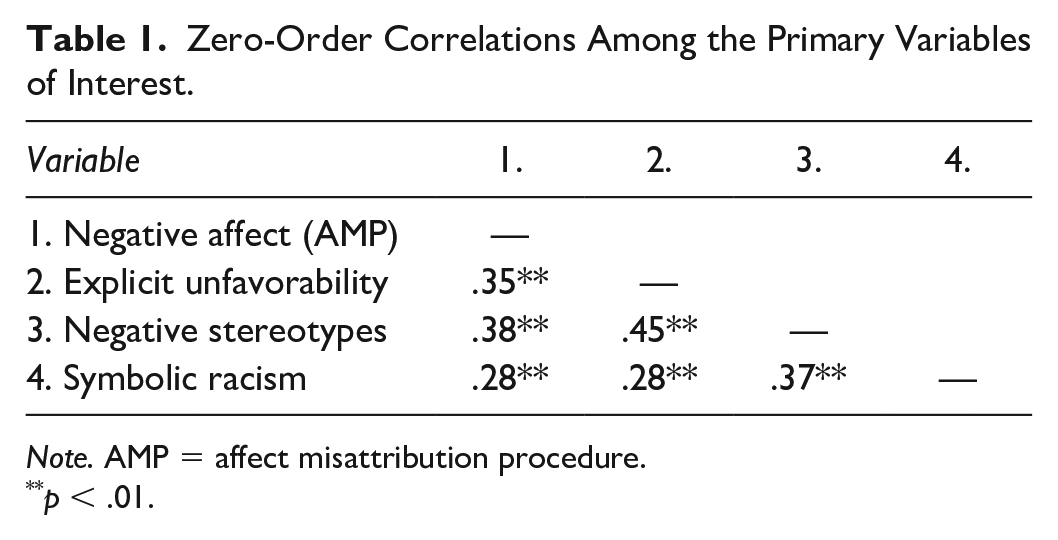
Note. AMP = affect misattribution procedure.
p < .01.
Negative stereotypes
We predicted that concept knowledge in the form of negative stereotypes about Black Americans would moderate the effect of implicit negative affect on explicit unfavorability. To test this prediction, we predicted unfavorability ratings from implicit negative affect, negative stereotypes, and their interaction (see Table 2; adjusted R2 = .26). Replicating past results (Payne et al., 2005), we found that greater implicit negative affect was related to greater explicit unfavorability, b = .20, t (1,461) = 8.45, p < .001, 95% confidence interval (CI) = [.15, .24]. Participants who endorsed more negative stereotypes about Black versus White Americans also expressed greater unfavorability, b = .38, t (1,461) = 15.25, p < .001, 95% CI = [.33, .43]. Critical to our hypothesis, however, there was a significant interaction between implicit negative affect and negative stereotypes about Black versus White Americans, b = .08, t (1,460) = 4.23, p < .001, 95% CI = [.04, .12], adjusted R2 = .27, ΔR2 = .01.
Regression Analysis Predicting Feeling Thermometer Ratings From Negative Affect on the AMP, Negative Stereotypes, and Their Interaction.

Note. All variables were z-scored prior to analysis. VIF = variance inflation factor; AMP = affect misattribution procedure.
Simple slopes analyses (see Figure 1) demonstrated that participants higher in implicit negative affect endorsed greater unfavorability; this was especially the case if they had more negative stereotyped beliefs about Black versus White Americans, b = .26, t (1,460) = 9.47, p < .001, 95% CI = [.20, .31], adjusted R2 = .27. For participants who had fewer negative stereotyped beliefs, the relationship between implicit negative affect and explicit unfavorability was significantly weaker, b = .10, t (1,460) = 2.95, p < .01, 95% CI = [.03, .16], adjusted R2 = .27. Thus, participants who held negative stereotyped beliefs that Black Americans are lazy and unintelligent were more likely to express their negative affect toward Black Americans as explicit unfavorability toward Black relative to White Americans. In contrast, implicit negative affect less strongly predicted explicit unfavorability for those individuals who did not hold these beliefs.
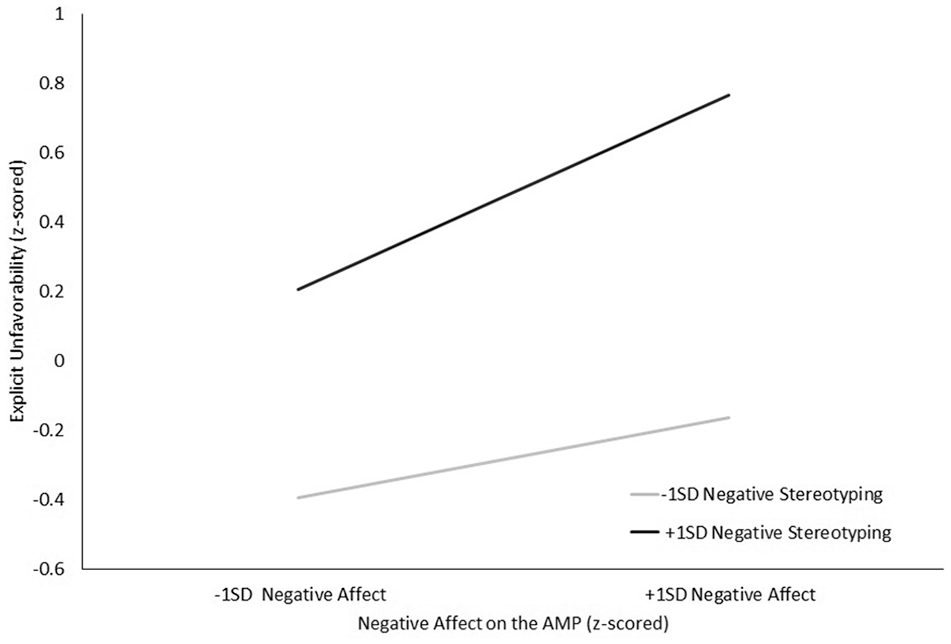
Negative stereotypes of Black Americans moderate the relationship between negative affect on the AMP and unfavorability ratings.
One alternative explanation for the significant two-way interaction between implicit negative affect and negative stereotyping is that the regression coefficient for the interaction was inflated by multicollinearity between our variables of interest. This possibility might exist because implicit negative affect, explicit unfavorability, and negative stereotypes are typically intercorrelated and thought to measure related, if not the same, constructs. Although this possibility is unlikely given that the zero-order correlations between our measures are small to moderate (r’s ≤ .45; see Table 1), we nonetheless estimated the variance inflation factor (VIF) for our regressor variables to examine multicollinearity (see Table 2). VIF values of predictor variables were 1.49 or below. This means that the estimated coefficient for the predictor variable is 49% greater than what would be expected assuming no multicollinearity. For context, VIF values of <10 (or conservatively <5) are commonly interpreted as evidence that multicollinearity is not of serious concern for a model (Thompson et al., 2017). Thus, it is unlikely that multicollinearity between our variables accounts for the significant interaction between implicit negative affect and negative stereotypes.
Another possibility is that self-presentation bias might account for our results. That is, participants high in self-presentation bias are less likely to endorse negative stereotypes and explicit prejudice. Consequently, these participants would also have a weaker relationship between implicit negative affect and explicit prejudice, while also being low in negative stereotyping. However, we believe this interpretation is unlikely. In our experimental work (Lee et al., 2018), concept knowledge determined whether implicit negative affect was related to outcomes related to prejudice (e.g., fear) even when controlling for motivation to conceal prejudice.
In addition, we can further examine whether self-presentation bias is a likely alternative hypothesis for our findings using the pre-election 2008 ANES data. One important difference between the pre- and post-election surveys is that the pre-election 2008 ANES was administered via telephone whereas the post-election 2008 ANES was administered in person. Prior work has shown that participants endorse more explicit stereotypes on surveys administered remotely over the phone versus in person by an interviewer (Stark et al., 2019). This allowed us to examine social desirability by comparing whether the interaction between implicit negative affect and negative stereotyping holds depending on whether the stereotypes were measured remotely (pre-election data) versus in person (post-election data). We note that we were only able to do this comparison for negative stereotyping, because symbolic racism was not measured during the pre-election ANES survey.
To examine whether social desirability could account for our findings, we tested a three-way interaction between negative stereotyping measured remotely (pre-election), negative stereotyping measured in person (post-election), and implicit negative affect (post-election). Because the AMP was measured post-election and our primary analyses used the post-election data, we used the post-election feeling thermometers as our predicted variable. If social desirability accounts for our results, we would expect a significant three-way interaction such that the relationship between implicit negative affect and explicit unfavorability depends on whether negative stereotyping was measured remotely (less pressure for social desirability) versus in person (more pressure for social desirability).
Contrary to what would be expected by the social desirability hypothesis, the three-way interaction was not significant, b = .02, t (1,428) = 1.06, p = .29, 95% CI = [−.02, .05], adjusted R2 = .28. However, as with stereotyping measured post-election, the interaction between implicit negative affect and negative stereotyping measured pre-election was significant, b = .06, t (1,438) = 2.77, p = .01, 95% CI = [.02, .10], adjusted R2 = .28. Thus, it is unlikely that self-presentation bias accounts for our findings that concept knowledge moderates the relationship between implicit negative affect and explicit prejudice against Black Americans.
Symbolic racism
As a robustness check, we also tested whether symbolic racism would similarly moderate the relationship between implicit negative affect and explicit unfavorability. Because symbolic racism is correlated with conservativism (Sears & Henry, 2003), we ran analyses with and without controlling for conservative ideology more generally. Controlling for conservatism did not appreciably change our results (see Supplementary Table S1). In our analysis, we predicted unfavorability from implicit negative affect, symbolic racism, and their interaction, adjusted R2 = .18. Again, participants higher in implicit negative affect also endorsed greater unfavorability toward Black relative to White Americans, b = .28, t (1,470) = 11.73, p < .001, 95% CI = [.23, .33]. We also found that participants higher in symbolic racism endorsed greater unfavorability, b = .20, t (1,470) = 7.90, p < .001, 95% CI = [.15, .24]. Importantly, as predicted, we found a significant interaction between implicit negative affect and symbolic racism, b = .12, t (1,469) = 5.29, p < .001, 95% CI = [.08, .17], adjusted R2 = .19, ΔR2 = .01.
Simple slopes analyses (see Figure 2) revealed that participants high in implicit negative affect tended to endorse greater unfavorability if they were also high in symbolic racism, b = .35, t (1,469) = 12.89, p < .001, 95% CI = [.30, .41], adjusted R2 = .19. However, this relationship was weaker for participants lower in symbolic racism, b = .12, t (1,469) = 2.98, p < .01, 95% CI = [.04, .19], adjusted R2 = .19. Thus, participants who believed that Black Americans are not hardworking and are responsible for their disadvantaged status in America were also more likely to express their negative affect as explicit unfavorability toward Black relative to White Americans. In contrast, implicit negative affect less strongly predicted explicit unfavorability for those individuals who did not hold these beliefs.

Symbolic racism moderates the relationship between negative affect on the AMP and unfavorability ratings.
Again, to rule out multicollinearity as an alternative explanation for the significant two-way interaction between implicit negative affect and symbolic racism, we estimated the VIF for our regressor variables to (see Table 3). The estimated VIF values for our regressors (VIF’s ≤ 1.22) were well below commonly applied cutoffs of 5 or 10. Thus, it is unlikely that multicollinearity between our regressors accounts for the interaction between implicit negative affect and symbolic racism.
Regression Analysis Predicting Feeling Thermometer Ratings From Negative Affect on the AMP, Symbolic Racism, and Their Interaction.

Note. All variables were z-scored prior to analysis. VIF = variance inflation factor; AMP = affect misattribution procedure.
Discussion
Our results showed that concept knowledge about Black Americans moderates the relationship between implicit negative affect and explicit prejudice. Specifically, participants high in implicit negative affect and in unfavorable concept knowledge about Black Americans showed greater explicit prejudice toward Black Americans. However, for participants low in unfavorable concept knowledge, there was a weaker relationship between implicit negative affect and explicit prejudice. These findings conceptually replicate our past experimental work (Lee et al., 2018) and show that concept knowledge moderates negative affect—often captured by implicit measures—into explicit prejudice outside of the laboratory.
In Study 2, we offer a conceptual replication of our effects in Study 1 by using data from Project Implicit (https://implicit.harvard.edu/implicit/). Project Implicit was started in 2002 to teach the public about implicit bias. Project Implicit enables the general public to take the IAT and collects data on implicit bias and explicit attitudes toward various groups (e.g., Black and White Americans, young and old people). To the extent that the IAT captures valenced associations with White and Black Americans, we treated IAT scores as a measure of negative affect. We, thus, examined whether concept knowledge (unfavorable stereotypes, symbolic racism) would moderate the relationship between the IAT and explicit prejudice on feeling thermometers.
Study 2
Method
Participants
We used IAT data from Project Implicit that were collected between January 2015 and December 2019, which is when our moderator variables of interest (negative stereotyping, symbolic racism) were added (dataset available here: https://osf.io/52qxl/). We included White participants from the United States if they indicated that they had not previously taken the IAT. We specifically examined participants from the United States because the sample in Study 1 was drawn from the United States. We also exclude participants above the age of 99. We calculated age by subtracting participants’ self-report year of birth from the year they participated in the study. A large number of participants had an age of 100 or older (N = 162). Of participants with a calculated age of 100 or greater, 90% of those had a calculated age of 107 or greater (N = 146). For this to be true, participants would have to be born in 1908 or earlier as of 2015. Given that 1910 is the earliest birth year participants can select (i.e., at the bottom of the list of possible birth years), the implausibly high number of centenarians in the sample might better be explained by participants scrolling to the bottom of the list. We similarly excluded participants below the age of 18 because of similar concerns (2009 was the earliest available option for birth year). After exclusions, the sample size was N = 541,862.
Not all participants completed our concept knowledge measures of stereotyping and symbolic racism. Other than the IAT and feeling thermometers, participants were administered only one or two additional measures. Therefore, only a subset of participants were included in each analysis (all syntax files for analyses are available here: https://osf.io/vsdq2/). For our analysis examining stereotyping as a moderator between IAT score and feeling thermometer judgments, the sample size was N = 11,477 (59.3% female, 39.6% male, 1.1% nonbinary, <.1% missing; mean age = 30.8 years, SD = 13.7 years). For our analysis examining symbolic racism as the moderator, the sample size was N = 12,046 (59.8% female, 39.0% male, 1.2 % nonbinary, <.1% missing; mean age = 30.8 years, SD = 13.7 years). Information about materials used in Study 2 can be found in Appendix B.
Measures
Implicit negative affect
Implicit negative affect was measured using the IAT (Greenwald et al., 1998). In the IAT, participants are asked to categorize words as positive (e.g., Terrific) or negative (e.g., Detest) and faces as White or Black. In the “compatible” block, one key (e.g., “I”) was used to categorize both a word as positive and a face as White, whereas another key (e.g., “E”) was used to categorize a word as negative and a face as Black. In the “incompatible” block, the associations were switched. Participants’ reaction times to each judgment are recorded. The mean difference of reaction times for correct responses in the incompatible versus compatible trials is converted into a D-score. D-scores >0 reflect anti-Black bias (Greenwald et al., 2003) as incompatible blocks examine the association between Black people and positive words and the compatible blocks examine associate Black people with negative words. To examine the reliability of the IAT, we computed difference scores for the mean reaction times of correct responses of Block 6 and Block 3, and of Block 7 and Block 4 (see Schnabel et al., 2008). We then computed the split-half reliability (Spearman-Brown’s ρ = .79).
Negative stereotyping
Stereotyping was measured by asking the extent to which participants judged Black and White people to be lazy/hardworking, prone to violence/not prone to violence, unintelligent/intelligent, reliant on welfare/self-sufficient, and unpatriotic/patriotic. One set of items measured stereotyping of Blacks whereas the other measured stereotyping of Whites. Participants responded on a 1 to 7 scale. We recoded the items such that high numbers reflect more unfavorable stereotypes. We computed difference scores for each item by subtracting unfavorable stereotype items about White people from the corresponding unfavorable stereotype item about Black people. Higher numbers reflect more unfavorable stereotypes about Black, relative to White, people.
Next, we conducted an exploratory factor analysis on the difference scores for the stereotyping items to evaluate the extent to which these items should be treated independently or as a part of a single scale. The results of the factor analysis showed that the stereotyping items loaded onto a single component. The items about laziness (.73), proneness to violence (.74), and reliance on welfare (.74) loaded strongly onto this component. The item about intelligence loaded moderately onto this component (.56), whereas the item about patriotism loaded weakly onto this component (.30). Consequently, we did not include the patriotism item when computing an overall unfavorable stereotyping score. We computed an overall stereotyping score by averaging together the difference scores for laziness, violence, welfare, and intelligence (Cronbach’s α = .65). Higher numbers reflect more unfavorable stereotypes for Black, relative to White, people.
Symbolic racism
Symbolic racism was measured using the eight-item Symbolic Racism 2000 Scale (Henry & Sears, 2002). All items were recoded such that higher numbers reflected greater symbolic racism (Cronbach’s α = 65). Because the items used a different amount of scale points, we z-scored all items before averaging them together to compute a summary score for symbolic racism.
Explicit prejudice
Explicit prejudice was measured using two feeling thermometer items. One item asked how warm or cold participants felt toward Black Americans while the other item asked about feelings toward White Americans. Participants responded using a 0 (Coldest feelings) to 10 (Warmest feelings) scale. We recoded both feeling thermometer items such that higher numbers reflected less favorable (i.e., colder) feelings. We then computed a difference score by subtracting feeling thermometer ratings about White Americans from feeling thermometer ratings about Black Americans. Higher numbers reflect more unfavorable evaluations of Black, relative to White, Americans.
Procedure
On the Project Implicit website, participants are given an overview of the IAT and explicit questionnaires. If they choose to continue, participants complete either the IAT or a set of explicit questionnaires first (e.g., demographics and feeling thermometer ratings, negative stereotyping items, or the Symbolic Racism 2000 questionnaire). Afterward, participants complete a different set of explicit questionnaires. Participants always are administered the IAT, feeling thermometer items, and demographics items including age, gender, race, nationality, and number of prior IATs completed. Participants also complete one or two additional sets of questionnaires (e.g., a stereotyping questionnaire, the Symbolic Racism 2000 Scale). This means that, other than feeling thermometer ratings and demographics items, very few participants (if any at all) are likely to have completed more than one set of questionnaires. For example, none of the participants included in our analyses completed both the stereotyping items and the symbolic racism scale.
Results
Negative stereotypes
Zero-order correlations between variables of interest for analysis are reported in Table 4. As in Study 1, we hypothesized that concept knowledge in the form of negative stereotypes about Black Americans would moderate the relationship between implicit negative affect and explicit unfavorability. To test this hypothesis, we predicted unfavorability ratings from implicit negative affect, negative stereotyping, and their interaction (see Table 5; adjusted R2 = .21). All variables were z-scored prior to analyses. Replicating our results from Study 1, we found that greater implicit negative affect was associated with greater unfavorability, b = .09, t (11,474) = 12.83, p < .001, 95% CI = [.08, .10]. Similarly, participants who endorsed more negative stereotypes about Black versus White Americans also expressed greater unfavorability, b = .38, t (11,474) = 50.60, p < .001, 95% CI = [.37, .39]. Importantly, we replicated the significant interaction between implicitly measured negative affect and negative stereotyping, b = .04, t (11,473) = 5.69, p < .001, 95% CI = [.03, .06].
Zero-Order Correlations Between Variables of Interest in Analysis 1 (Negative Stereotyping as Moderator), N = 11,477.

Note. IAT = Implicit Association Test.
p < .01.
Regression Analysis Predicting Feeling Thermometer Ratings From Negative Affect on the IAT (D-Score), Negative Stereotypes, and Their Interaction.
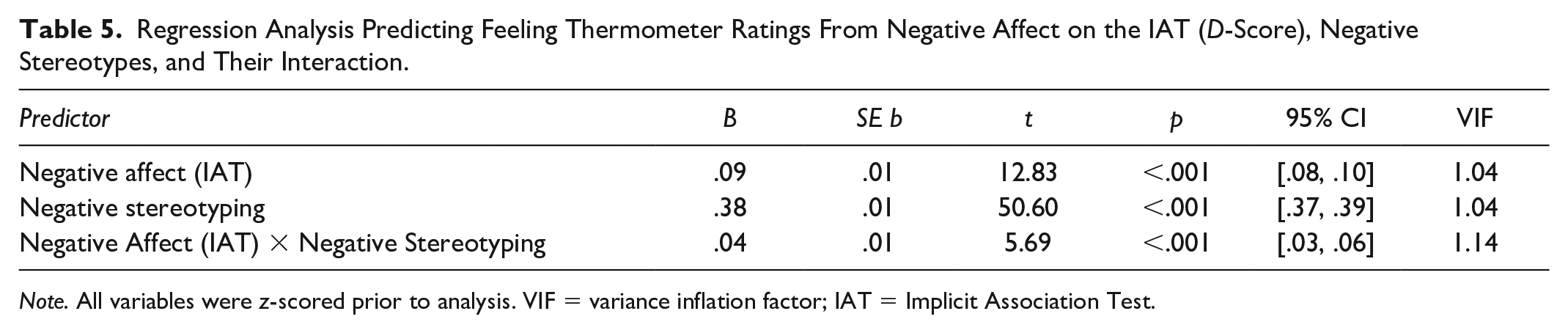
Note. All variables were z-scored prior to analysis. VIF = variance inflation factor; IAT = Implicit Association Test.
Simple slopes analyses (see Figure 3) revealed that participants higher in implicit negative affect endorsed greater unfavorability; this was especially the case if they had more negative stereotypes about Black versus White Americans, b = .13, t (11,473) = 13.28, p < .001, 95% CI = [.11, .15], adjusted R2 = .27. In contrast, for participants with fewer negative stereotypes about Black Americans, there was a weaker link between implicit negative affect and explicit unfavorability, b = .05, t (11,473) = 5.44, p < .001, 95% CI = [.03, .07], adjusted R2 = .27. Thus, replicating the pattern of results in Study 1, we find that participants high in stereotyped beliefs that Black Americans are lazy and unintelligent were more likely to express their negative affect as explicit unfavorability toward Black (relative to White) Americans. In contrast, participants were less likely to express their negative affect as explicit prejudice if they held fewer of these stereotyped beliefs.

Negative stereotypes of Black Americans moderate the relationship between negative affect on the IAT and explicit unfavorability.
Finally, as in Study 1, we estimated VIF to rule out the possibility that multicollinearity accounts for the significant two-way interaction between implicit negative affect and negative stereotyping. VIF values were 1.14 or less (see Table 5), well below commonly used cutoffs of 10 or 5. Thus, multicollinearity is unlikely to account for the significant interaction between implicit negative affect and negative stereotypes.
Symbolic racism
Zero-order correlations for variables in this analysis are reported in Table 6. As in Study 1, we predicted that concept knowledge in the form of symbolic racism would moderate the relationship between implicit negative affect and explicit unfavorability, adjusted R2 = .26. In a regression analysis, we predicted explicit unfavorability from implicit negative affect, symbolic racism, and their interaction (see Table 7). As in Study 1, controlling for conservatism did not meaningfully change our results (see Supplementary Table S2). As with our results for negative stereotyping, implicit negative affect predicted greater explicit unfavorability, b = .12, t (12,043) = 15.68, p < .001, 95% CI = [.10, .13]. Similarly, greater symbolic racism predicted greater explicit unfavorability, b = .35, t (12,043) = 34.82, p < .001, 95% CI = [.33, .37]. Importantly, we also replicated the interaction between implicit negative affect and symbolic racism from Study 1, b = .03, t (12,042) = 2.39, p = .02, 95% CI = [<.01, .05], adjusted R2 = .26, ΔR2 < .01.
Zero-Order Correlations Between Variables of Interest in Analysis 1 (Negative Stereotyping as Moderator), N = 12,046.
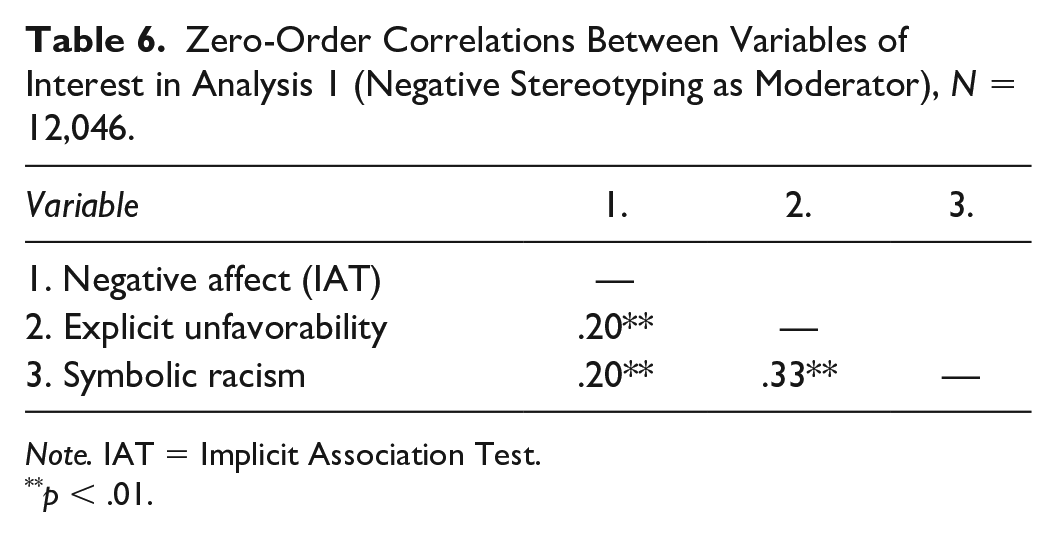
Note. IAT = Implicit Association Test.
p < .01.
Regression Analysis Predicting Feeling Thermometer Ratings From Negative Affect on the IAT (D-Score), Symbolic Racism, and Their Interaction.

Note. All variables were z-scored prior to analysis. VIF = variance inflation factor; IAT = Implicit Association Test.
Simple slopes analyses (see Figure 4) demonstrated that participants higher in implicit negative affect endorsed greater unfavorability, but that this effect was pronounced for participants who were also high in symbolic racism, b = .14, t (12,042) = 12.67, p < .001, 95% CI = [.12, .16], adjusted R2 = .19. In contrast, participants who were high in implicit negative affect, but low in symbolic racism showed a weaker link between implicit negative affect and explicit unfavorability, b = .10, t (12,042) = 10.02, p < .001, 95% CI = [.08, .12], adjusted R2 = .19. As in Study 1, participants who believed that Black Americans are not hardworking and responsible for their own disadvantaged status in America were also more likely to express their negative affect as explicit unfavorability toward Black (relative to White) Americans.
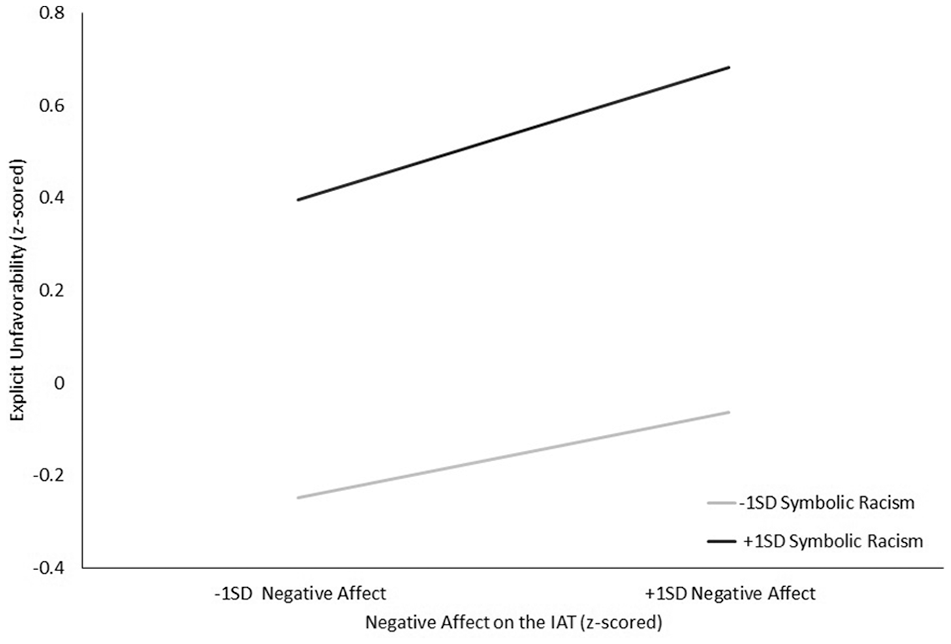
Symbolic racism moderates the relationship between negative affect on the IAT and explicit unfavorability.
In addition, we estimated VIF to rule out the possibility that multicollinearity accounts for the significant two-way interaction between implicit negative affect and symbolic racism. VIF values were 1.12 or less (see Table 7). Thus, multicollinearity is unlikely to account for the significant interaction between implicit negative affect and symbolic racism.
Discussion
These results extend our results from Study 1 by showing evidence that concept knowledge in the form of unfavorable stereotypes and symbolic racism moderates the relationship between explicit prejudice and a different measure of implicit negative affect (IAT). However, one caveat is that the effect sizes in Study 2 are smaller than in Study 1. This might be accounted for by the differences in the implicit measures used in the studies. The AMP, used in Study 1, specifically examines automatic evaluative judgments in the moment that may better reflect affect toward Black Americans. In contrast, the IAT, used in Study 2, uses response congruency scores computed from reaction time as a measure of bias and thus may be a noisier measure.
General Discussion
Across two studies, we offer evidence that concept knowledge about Black Americans moderates the relationship between negative affect as measured by implicit measures and self-reports of explicit prejudice. These studies extend our previous experimental findings that access to concept knowledge about emotions determines whether negative affect toward Black Americans (captured on implicit measures) leads to antisocial outcomes (fear) or not (Lee et al., 2018). The present studies extend our prior experimental work outside of the laboratory to more ecologically valid settings. Moreover, the present studies also offer evidence that concept knowledge can play a moderating role between more general experiences of affect and more specific outcomes. For example, general feelings of displeasure toward an outgroup might reflect antipathy, discomfort, fear, or even sympathy. Our results suggest that whether or not these feelings of displeasure are related to a more specific outcome, such as explicit prejudice, may depend on concept knowledge about that outgroup. It is important to note that our findings do not necessarily suggest that measures of implicit and explicit bias capture wholly distinct constructs. If our constructionist approach is correct, then explicit bias may be a product of implicit negative affect and concept knowledge about racialized groups. Indeed, our results suggest that the interaction between affect and concept knowledge may be an important avenue for understanding when people explicitly report prejudice.
Our psychological constructionist approach is broadly consistent with dynamic models of attitudes and evaluation such as the associative-propositional model (APE) of attitudes (Gawronski & Bodenhausen, 2006, 2011), the iterative reprocessing model (Cunningham & Zelazo, 2007; Cunningham et al., 2007), and the situated inference model (Loersch & Payne, 2011, 2014). For example, in the APE model, negative affect toward an outgroup (e.g., Black Americans) might form the basis of an explicit evaluation (i.e., prejudice) if that explicit evaluation is consistent with other explicit attitudes and beliefs (Gawronski & Bodenhausen, 2006, 2011; Gawronski et al., 2008). Similarly, work from our lab has found that participants high in implicit negative affect toward gay men will endorse more explicit prejudice against gay men if they are led to believe that their negative affect reflects (vs. does not reflect) their attitudes toward gay men or that their negative affect arose intentionally (vs. unintentionally; Cooley et al., 2014, 2015). Like psychological constructionist models, these dynamic models posit that evaluations and attitudes are dynamically shaped by interpretation of basic affective states.
Of course, because the present work is correlational in nature there exists the possibility that measures of concept knowledge and implicit negative affect in our sample merely assessed the same underlying construct (i.e., negativity). There is also the possibility that our results may have arisen due to differences in the design of measures of implicit negative affect and explicit prejudice. Prior work has found that responses on implicit and explicit measures may diverge because they require participants to complete two different types of tasks (Payne et al., 2008; for a discussion see Gawronski, 2019). Whereas an implicit attitude measure (e.g., the AMP) may require that participants make a binary judgment of an exemplar from a group (e.g., an image of a Black American), an explicit attitude measure typically asks participants to make ratings about a group in the aggregate (e.g., “Black Americans”) on a Likert-type or numerical scale. Thus, implicit negative affect and explicit prejudice might diverge not because they capture different attitudes toward an outgroup, but because they involve different judgments.
We cannot fully rule out these alternative hypotheses given the correlational nature of the current study. However, our interpretation that concept knowledge moderates the relationship between implicit negative affect and explicit prejudice is supported by our prior experimental work (Lee et al., 2018). In a series of studies, we manipulated concept knowledge and found that it determined the relationship between implicit negative affect and a variety of measures of prejudice against Black Americans (self-reported fear, perceived threat from Black vs. White Americans). Thus, we believe that it is unlikely that these alternative hypotheses accounted for our results.
Moreover, other studies have similarly shown that affect and conceptual knowledge can be manipulated separately to affect explicit prejudice (e.g., Cooley et al., 2014, 2015). Our work not only has precedence in dynamic models of attitudes (e.g., Cunningham & Zelazo, 2007; Cunningham et al., 2007; Gawronski & Bodenhausen, 2006, 2011; Loersch & Payne, 2011, 2014), but also in affective science. Research in this domain has shown that general affect can form the basis for more complex psychological states, such as discrete emotions. Relevant work includes research on misattribution of arousal (Dutton & Aron, 1974; Schachter & Singer, 1962), affect as information theory (Schwarz & Clore, 1983), and psychological constructionist models of emotion (Barrett, 2009; Lindquist, 2013). Finally, our research dovetails with prior work that suggests that prejudice consists of both affective responses and beliefs about outgroups (Stangor et al., 1991; Tropp & Pettigrew, 2005).
Our findings have potentially sweeping implications for the mechanisms by which implicit negative affect can transform into expressions of prejudice. Often, when implicit and explicit measures of bias diverge, researchers attribute this difference to a failure of controlled processing (e.g., Devine et al., 2002) or social desirability bias (e.g., Greenwald et al., 2009; Nosek, 2005). From this perspective, implicit negative affect may be expressed as explicit prejudice when people are tired or distracted, or when social desirability is not a concern. Our research suggests an additional possibility: concept knowledge about outgroup members may be used by people to automatically or intentionally make meaning of implicit negative affect as explicit prejudice (see also Cooley et al., 2014, 2015; Lee et al., 2018). In this account, people may experience generalized negative implicit affect toward outgroup members for a number of reasons including antipathy but also neophobia, guilt, or discomfort. Our work suggests that one way to disrupt the relationship between implicit negative affect and explicit prejudice is to target the concept knowledge about an outgroup that is most readily activated.
The malleable relationship between implicit negative affect and explicit prejudice can also help explain present day concerns about an uptick in explicit prejudice in American society. In a recent survey from the Pew Research Center, 65% of Americans surveyed believed that since the 2016 presidential election the expression of explicit prejudice is now more common (Horowitz et al., 2019). Furthermore, 45% of these respondents believed that since the 2016 election the expression of explicit prejudice is now more acceptable. These survey results stand in contrast to work showing a slow, but steady decline in explicit prejudice over the latter half of the 20th century (Charlesworth & Banaji, 2019; Sniderman & Carmines, 1997). The rapid nature of this change is surprising because racial attitudes are often considered deep-rooted and slow to change (Baron & Banaji, 2006; Devine, 1989; Kinder & Rhodebeck, 1982; Kinder & Sears, 1981; Rothbart & John, 1993). However, our research suggests that the concepts people use to make sense of their affective reactions can have important effects on the expression of prejudice. The concepts people apply might change quickly when environmental contexts and social norms change. For example, when negative stereotypes become more accessible due to partisan politics, individuals who previously experienced implicit negative affect toward outgroups as relatively innocuous feelings (e.g., as discomfort) might come to experience that same bias as more overt prejudice (e.g., dislike).
Conclusion
Our prior experimental work suggests that concept knowledge may shape negative affect, measured as implicit bias, into outcomes related to prejudice (e.g., fear) or not (Lee et al., 2018). In this article, we extend these laboratory findings to large samples of the Americans by showing that concept knowledge similarly moderates the relationship between implicit negative affect and explicit prejudice in a large sample of White Americans (Study 1) and by replicating this effect in a much larger dataset collected outside of the laboratory (Study 2). As concept knowledge reflecting prejudice against Black Americans becomes more prevalent in the public domain, our psychological constructionist model suggests that one danger is that this concept knowledge may combine with existing negative affect and give rise to explicit prejudice. This is one mechanism by which prejudice that is “in the air” might get transformed into feelings that are “under the skin.”
Supplemental Material
sj-docx-1-psp-10.1177_01461672221075926 – Supplemental material for Constructing Explicit Prejudice: Evidence From Large Sample Datasets
Supplemental material, sj-docx-1-psp-10.1177_01461672221075926 for Constructing Explicit Prejudice: Evidence From Large Sample Datasets by Kent M. Lee, Kristen A. Lindquist and B. Keith Payne in Personality and Social Psychology Bulletin
Footnotes
Declaration of Conflicting Interests
The author(s) declared no potential conflicts of interest with respect to the research, authorship, and/or publication of this article.
Funding
The author(s) disclosed receipt of the following financial support for the research, authorship, and/or publication of this article: Research reported in this publication was supported in part by the National Institute of Mental Health under award number F32MH122062-01A1.

Supplemental Material
Supplemental material is available online with this article.
Notes
References
Supplementary Material
Please find the following supplemental material available below.
For Open Access articles published under a Creative Commons License, all supplemental material carries the same license as the article it is associated with.
For non-Open Access articles published, all supplemental material carries a non-exclusive license, and permission requests for re-use of supplemental material or any part of supplemental material shall be sent directly to the copyright owner as specified in the copyright notice associated with the article.
