



Abstract
Previous research has argued that a growing multiracial population will blur boundaries between racial groups, reducing racism and improving interracial relations. However, this is unlikely to happen if multiracial groups are judged according to their proximity to Whiteness. We examined how having White ancestry shapes status perceptions of multiracial groups. Studies 1 and 2 showed that multiracial groups with White ancestry (e.g., Black/White) are considered higher status than dual minority multiracial (e.g., Black/Latinx) and monoracial minority (e.g., Black) groups. Study 3 revealed that multiracial groups with White ancestry are perceived as more competent and warmer than monoracial minority and dual minority multiracial groups, leading to higher status perceptions for multiracial groups with White ancestry. Thus, multiracial people, like other racial minorities, may be judged according to White, Eurocentric standards. The results imply that, without anti-racist intervention, the treatment of multiracial people will reinforce, rather than challenge, the existing racial hierarchy.
Research has examined whether the increasing visibility of multiracial individuals—individuals who identify with two or more racial backgrounds—will shift White people’s cognition and social behaviors in the United States. Some researchers argue that the mere presence of multiracial people makes White individuals less colorblind or more willing to discuss race (e.g., Gaither et al., 2019). Other work suggests that living in contexts with large multiracial populations decreases racial stereotyping among White U.S. children (Pauker et al., 2016) and reduces White adults’ race essentialism, or the tendency to believe racial categories are biologically based (Pauker et al., 2018; Young et al., 2013). These findings suggest that there may be positive downstream consequences for White individuals who are “exposed” to multiracial people, leading to the assumption that such exposure will promote racial progress (Spencer, 2014; Squires, 2007). Studying multiracialism is essential for understanding race relations and how they may change in the future. However, overly optimistic predictions may neglect to consider how multiracial people can be “absorbed” into existing systems of racial inequality in the United States, leading to the maintenance, rather than the resolution, of such inequality (Rockquemore et al., 2009).
To understand how the presence of multiracial people may shape future race relations in the United States, it is important to understand the current state of race relations. White individuals have more power and status than, and are perceived as superior to, people of color (Hartigan, 1997; Zou & Cheryan, 2017). The confluence of systems (e.g., financial, legal, educational, and political) that enable White individuals to hold power over others and maintain control over resources is called Whiteness. Importantly, Whiteness is adaptative and responsive to changing racial landscapes (such as increased racial diversity and multiracialism), ensuring that the White group remains dominant even as the racial environment changes (Bonilla-Silva, 2004; Gans, 2012; Squires, 2007). As the multiracial population grows, scholars have postulated that multiracial individuals with White ancestry (specifically Asian/White and Latinx/White individuals) will gain proximity to Whiteness (Bonilla-Silva, 2004).
Consequently, some multiracial groups may be granted some social, political, and economic privileges (Squires, 2007). Thus, multiracial people may be incorporated into an adapted hierarchy in ways that maintain the position of White individuals—and multiracial individuals with proximity to Whiteness—closer to the top. Such adaptations to the racial hierarchy render Whiteness invisible, such that the privileges afforded to some non-White groups legitimize Whiteness and create an illusion that such privileges are available to everyone (Kim, 1999). We suggest that a multiracial person’s White ancestry may cue their proximity to Whiteness and shape how they are perceived within the racial hierarchy. We focus on how ancestry shapes status perceptions of multiracial people, given that the primary function of a racial hierarchy is to imbue race with status.
Whiteness, Racial Hierarchies, and Malleability
As a racial category, White describes a group of people who share similar appearance (e.g., skin tone, hair texture, facial features) or genealogical ancestry (e.g., European ancestry). In contrast, Whiteness, as a system, describes how a White racial identity becomes inextricably linked to power, status, privilege, and racial dominance (Gallagher, 2007). This link between race and power functions to place White people in dominant positions, granting them privilege (e.g., perceived status) and access to resources (e.g., jobs; Gallagher, 2007; Green et al., 2007). For example, people who are perceived as White or having a light skin tone are less likely to be stereotyped as criminals than people perceived as Black or as having a dark skin tone (Dixon & Maddox, 2005). Such cognitive associations between race, skin tone, and criminality in the United States have roots in the slave patrols of the 17th and 18th centuries (Reichel, 1988) and police enforcement of Jim Crow laws (Bass, 2001). White people designed both systems to deny Black people the right to vote, hold jobs, and get an education. Deriving from this historical context, the present-day racial hierarchy in the United States reflects the same system of Whiteness, such that White individuals are perceived as superior to people of color (Zou & Cheryan, 2017). Perceptions of superiority translate to greater respect, recognition, and prestige, correlating with power and control over valued resources that may be physical (e.g., space), economic (e.g., income), or social (e.g., acceptance; Fiske, 2010).
A racial hierarchy is a system in which socially constructed racial categories are used as the basis for allocating resources to a dominant group, thereby oppressing nondominant groups (Sidanius & Pratto, 1999). Omi and Winant’s (1994) racial formation theory states that race is fully capable of transformation because it is socially constructed. For example, Irish, Italian, Greek, and Jewish Americans were once viewed as non-White, but are now perceived as White. Similarly, Asian Americans were once perceived as perpetual foreigners and scapegoated for the economic shortcomings in the United States (also known as Yellow Peril; Kawai, 2005; Kim, 1999). However, Asian Americans are now perceived as Model Minorities who are academically and economically successful (Osajima, 2005). In contrast, Arab Americans were viewed as White until the New York City terrorist attacks on September 11, 2001, reinforced their status as “the other” (Richeson & Sommers, 2016). Thus, Whiteness is malleable in that it shifts to extend or deny some “perks” of Whiteness to/from racial minority groups. Critically, extending some, but not all, of the perks of Whiteness to some non-White people maintains the hierarchy by placating non-White people who value White privilege (e.g., Asian Americans who endorse the Model Minority image). Appeasing some groups justifies the subordination of negatively stereotyped groups (e.g., Black Americans who are derogated for not achieving the same level of success as Asian Americans) and ultimately protecting the dominance of White Americans by pitting minority groups against one another (Kim, 1999).
Thus, in contrast to the notion that multiracial people blur racial boundaries, reducing racism and inequality, we may expect Whiteness to shift to protect White dominance in the face of a growing multiracial population. Indeed, many scholars project that the racial hierarchy will once again shift to protect Whiteness as the multiracial population grows (Bonilla-Silva, 2004; Gans, 2012). Racial groups outside the Black–White binary, who occupy a “racial middle,” will experience a shuffling in status, contingent on how well they embody stereotypically White traits (e.g., high income, education, light skin; Matsuda, 1996). In other words, in response to a changing racial landscape, Whiteness is likely to expand to incorporate groups into its conception, rather than dissolving or ceasing to exist (Squires, 2007). Accordingly, certain multiracial people may be granted more access to resources and status than others if they have White ancestry or “pass,” phenotypically, as White (Bonilla-Silva, 2004). As a result, other multiracial groups with no White ancestry, or who do not pass as White, may be subordinated.
Proximity to Whiteness and Racial Ancestry
Non-White people who have access to some privileges of Whiteness may be described as having proximity to Whiteness. Proximity to Whiteness explains how those who are not White may still be perceived as higher in status than other people of color (but not equal in status to White people) because of identities or traits they hold that allow them to access some perks of White privilege (Bouchard, 2020). For example, appearance may cue proximity to Whiteness. Indeed, anti-Black stereotypes and discrimination are most likely to target Black individuals with dark skin tone (Eberhardt et al., 2006; Maddox, 2004). Conversely, research shows that people with light skin tone are perceived as similar to the White majority group. For example, White individuals assume that immigrants who have assimilated to “mainstream” U.S. culture are more phenotypically White than immigrants who have not assimilated (Kunst et al., 2018). Other cues may also indicate proximity to Whiteness; for example, in one study, job applicants with stereotypical White names (e.g., Emily or Alison) were perceived as more employable than those with names stereotypically associated with people of color (e.g., Lakisha or Priyanka; Bertrand & Mullainathan, 2004; Oreopoulos, 2011).
Multiracial individuals may gain proximity to Whiteness through a unique mechanism not available to monoracial minorities—that is, through a White parent or White ancestry. Given this, we hypothesize that the presence or absence White ancestry shapes how people perceive the status of multiracial people and consequently, their position in the racial hierarchy. Indeed, research shows that ancestry cues shape judgments of multiracial people. For example, Black/White people who were described as 50% versus 25% White were assumed to be lighter in skin tone and were stereotyped to a lesser extent (Sanchez et al., 2011). In another study, participants mentally represented a person with one Black and one White parent as less Afrocentric than a person with two Black parents (Vinluan et al., in preparation).
Although research shows that multiracial people are often categorized in line with hypodescent, or as members of their lower status or minority group (e.g., racially ambiguous faces created by morphing Black and White racial stimuli are more likely to be categorized as Black than White; Ho et al., 2011), such categorical distinctions do not preclude the impact of Whiteness within racial categories. Indeed, targets low in Afrocentricity who were categorized as Black were, nevertheless, stereotyped less negatively than highly Afrocentric targets (Hinzman & Maddox, 2017). Therefore, individuals may gain proximity to Whiteness via multiple mechanisms; however, ancestry may be a unique cue for multiracial people, which translates to increased perceived status and higher positionality in the racial hierarchy.
Maintenance of the Racial Hierarchy
It is helpful to study status perceptions to understand the racial hierarchy because privilege is associated with a White identity through evaluations of status (Gallagher, 2007). As a result, we expected multiracial people with White ancestry to be perceived as higher in status than both multiracial people with dual minority ancestry and monoracial minorities. In addition, we expected status perceptions to be driven by racial stereotypes. Racial stereotypes are traits applied across racial group members (e.g., all group members are incompetent). Such traits are attributed to race (e.g., incompetence is due to race) and maintain racial hierarchies by justifying inequality. Stereotypes provide trait-based (rather than prejudiced-based) reasons for group disparities (e.g., it is justifiable that group members earn low pay because they are incompetent; Fiske et al., 2016; Oldmeadow & Fiske, 2007). Research shows that many racial stereotypes are captured by the dimensions of competence and warmth (cf. Abele et al., 2008; Cuddy et al., 2008; Fiske et al., 2002). For example, White individuals stereotype Black and Latinx individuals as low in competence (Saenz & Ponjuan, 2009; Steele & Aronson, 1995), but also as warm, as they are perceived as posing a minor threat to White dominance (Fiske et al., 1999). However, Asian Americans are stereotyped as competent, in line with the Model Minority Myth (Bell et al., 1997; Sue et al., 2007). Asian Americans are also judged as cold, as they are perceived as economically successful and as posing a threat to White status (Fiske et al., 1999). In line with this research, we examined whether status perceptions of multiracial groups are driven by competence and warmth stereotypes. We expected multiracial groups with White ancestry to be perceived as more competent and warmer than multiracial people with dual minority ancestry and monoracial minorities. In addition, we expected racial stereotypes to predict higher status perceptions of groups with proximity to Whiteness.
White individuals may be motivated to use racial stereotypes to maintain the racial hierarchy to protect White dominance. In addition, White individuals may be motivated to perceive their racial group in a positive light. The latter prediction stems from Social Identity Theory (SIT), which proposes that people divide their social worlds into in-groups and out-groups (Tajfel et al., 1979). SIT suggests that people are motivated to think positively about their groups and may achieve this by admiring in-groups and derogating out-groups (Brewer, 1979). Notably, both hierarchy- and identity-based motivations may help to explain how and why White individuals use racial stereotypes. Although all people may be motivated to perceive in-groups positively and out-groups negatively, those with power stand to gain more psychologically, materially, and socially than those with less power from doing so.
Thus, we maintain that White people’s motivation to perceive their in-group as high status is inherently linked to their motivation to maintain and preserve Whiteness. White individuals may perceive those with whom they share similar traits, appearance cues, or ancestry more positively than those with whom they do not share traits. However, White individuals sometimes exclude multiracial people from the in-group (Gaither et al., 2016). Considering White participants’ power and hierarchy-based motivations may best explain why this is the case. As previously explained, racial stereotypes preserve White dominance when some privileges of Whiteness are extended to people with proximity to Whiteness, legitimizing the subordination of those who are not adjacent to Whiteness. Similarly, we predict multiracial people with White ancestry will be perceived as higher in status than dual minority multiracial people and monoracial minorities, but lower in status than White individuals.
Overview of Studies
In sum, one way Whiteness preserves the dominance of White people is by extending some privileges of a White identity to people who have proximity to Whiteness. Given that racial ancestry cues shape perceptions of multiracial people, we expect multiracial individuals with White ancestry to be perceived as having more status than multiracial individuals with dual minority ancestry. Studies 1 and 2 examined whether multiracial groups with White ancestry are perceived as having higher status than multiracial groups with dual minority ancestry and monoracial minority groups. Study 3 investigated whether competence and warmth stereotypes underlie the higher perceived status of multiracial people with White ancestry.
Study 1
In Study 1 we tested the following hypotheses, which we preregistered on the Open Science Framework (OSF) prior to data collection (https://osf.io/yhuws):
Method
Participants
Participants were U.S. undergraduates who received course credit. We aimed to collect data from 278 participants based on an a priori, preregistered, power analysis for multiple paired-sample t tests with anticipated effect size of d = 0.30 and obtained power of 80%. In total, we recruited 375 participants, and the final sample (after excluding people according to predetermined exclusions) included 308 participants (White = 185, Asian = 71, Black = 11, Latinx = 9, Multiracial = 46; women = 187, men = 115, nonbinary = 6). 2 Data from 94 participants were removed because they failed attention checks 3 (n = 21), skipped more than 15 items in the survey (n = 22), and/or indicated post-debriefing that they were no longer comfortable with their data being included 4 (n = 35).
A sensitivity analysis using G*Power (Faul et al., 2007) found that our final sample could detect effects of f = .16 (
Materials
Manipulation
Participants were randomly assigned to consider multiracial groups with White ancestry or multiracial groups with dual minority ancestry. Within each condition participants saw three group labels; in the part-White condition (n = 162) participants saw: Asian/White, Black/White, and Latinx/White, and in the dual minority condition (n = 146) participants saw: Black/Latinx, Black/Asian, and Asian/Latinx.
Measures
Social status
Participants were shown a prompt adapted from the MacArthur Scale of Subjective Status (see Table 1; Adler & Stewart, 2007). The MacArthur Scale of Subjective Status has been shown to have good construct validity, and thus, to be a reliable measure of subjective status (see Cundiff et al., 2013; Giatti et al., 2012; Goodman et al., 2001; Zell et al., 2018). Participants viewed a ladder in which each rung was numbered and selected a number from 1 (lowest social standing) to 10 (highest social standing) 5 for each group. We asked participants to think about what society’s view of the group in question, rather than their own view, as revealing one’s own stereotypes or prejudices is considered taboo. All materials and data files are available on the OSF: https://osf.io/h4smj/.
Study 1 Prompt.

Results
Our preregistered data analysis plan specified that we would test our hypotheses using paired-sample t tests. However, conducting multiple paired t tests with more than two groups are present increases the risk of Type I Error (Kao & Green, 2008). Thus, we deviated from this plan by instead reporting results from multiple ANOVAs, as also recommended by reviewers. Post hoc comparisons were evaluated according to Bonferroni-adjusted p values for all studies unless otherwise stated.
Racial composition
To examine whether perceptions of status differed by Racial Composition, we averaged status ratings across the three groups within each composition condition (part-White: Asian/White, Black/White, Latinx/White; dual minority: Asian/Latinx, Black/Asian, Black/Latinx) to create two composite scores, one for part-White and one for dual minority, groups. A one-way ANOVA revealed a significant effect of Racial Composition, F(1, 306) = 132.57, p < .001,
Racial group
Part-White groups
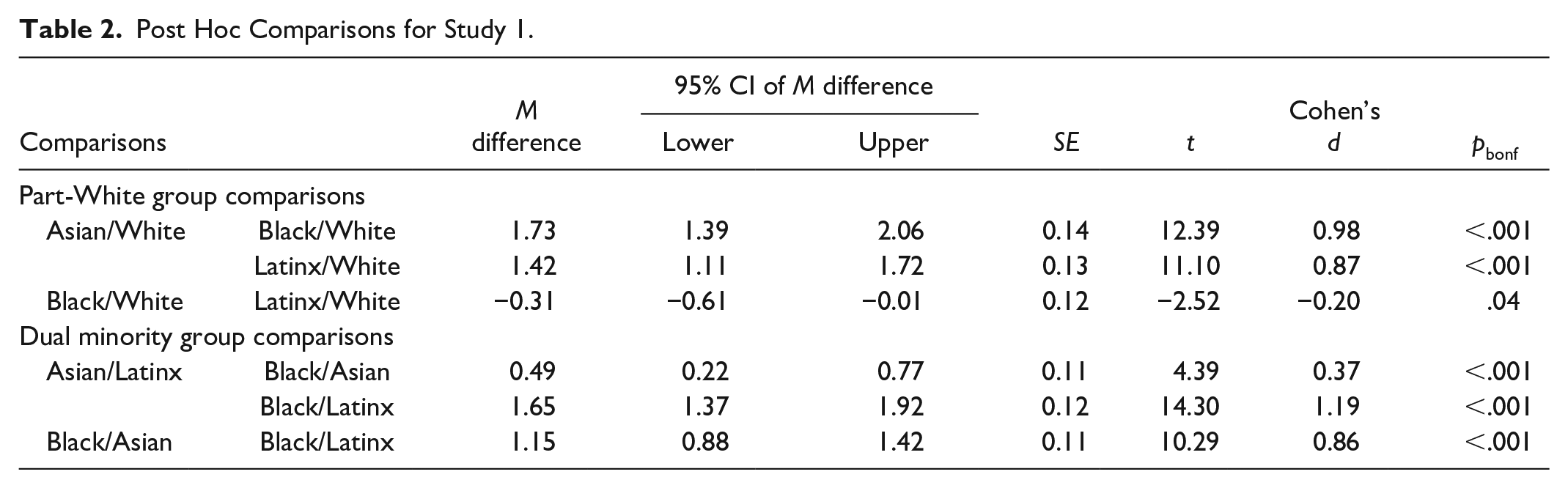
A repeated measures ANOVA involving part-White groups (Asian/White, Black/White, Latinx/White) was significant, F(2, 320) = 99.99, p < .001,
Post Hoc Comparisons for Study 1.
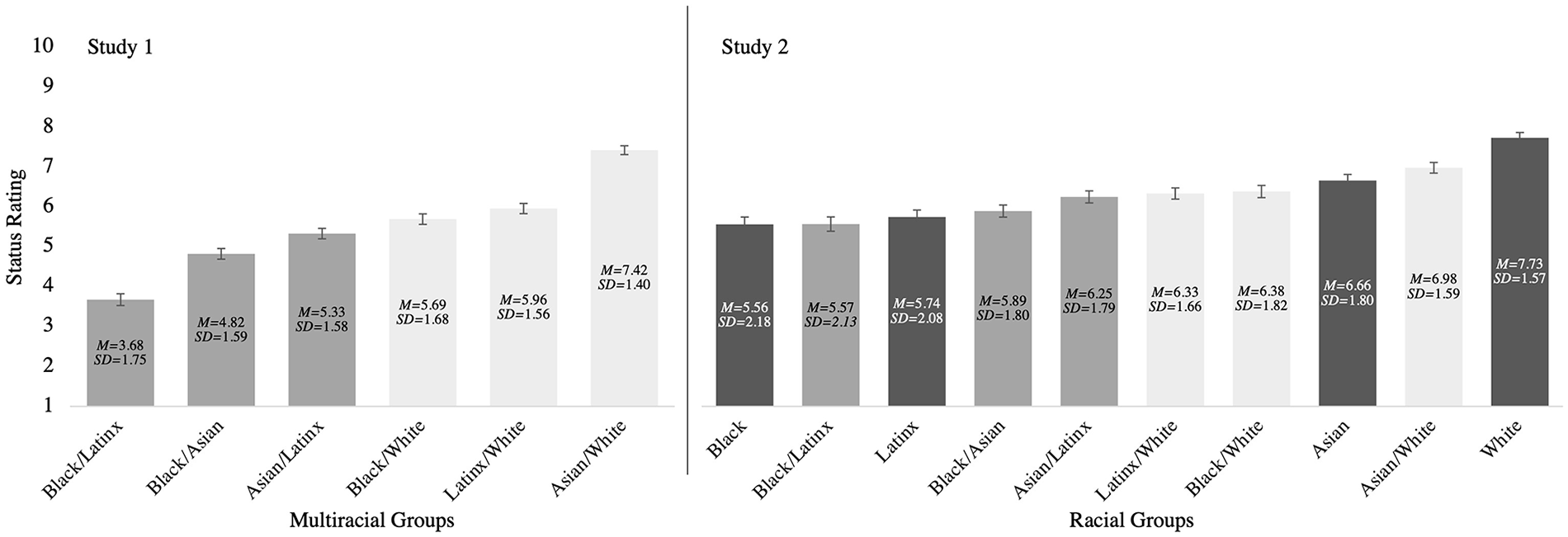
Study 1 and Study 2 status ratings across all multiracial and monoracial groups from lowest rated (left) to highest rated (right).
Dual minority groups
A repeated measures ANOVA involving dual minority groups (Black/Asian, Black/Latinx, Asian/Latinx) was significant, F(2, 286) = 111.36, p < .001,
Discussion
The results of Study 1 showed that multiracial groups vary in perceived status. Overall, multiracial groups with White ancestry were perceived as higher in status than dual minority multiracial groups. In addition, multiracial groups with Asian ancestry were perceived as higher in status than multiracial groups with Black and Latinx ancestry. 6 However, Study 1 was limited in that we did not investigate how multiracial groups are perceived compared to the respective monoracial groups. Study 2 investigated this question. We expected White individuals to be perceived as having the most status, followed by Asian Americans, and then by Black and Latinx Americans. Moreover, because we expected multiracial groups with White ancestry to benefit from their proximity to Whiteness, we predicted that part-White groups would be perceived as higher in status than their monoracial minority counterparts.
Study 2
In Study 2, we tested the following hypotheses, which we preregistered on OSF prior to the start of data collection: https://osf.io/njp3k. First, we expected to replicate the results from Study 1 (to see the results of the replication, see Supplemental Material). Second, we tested the following novel hypotheses (see Figure 2 for an illustration of hypotheses):
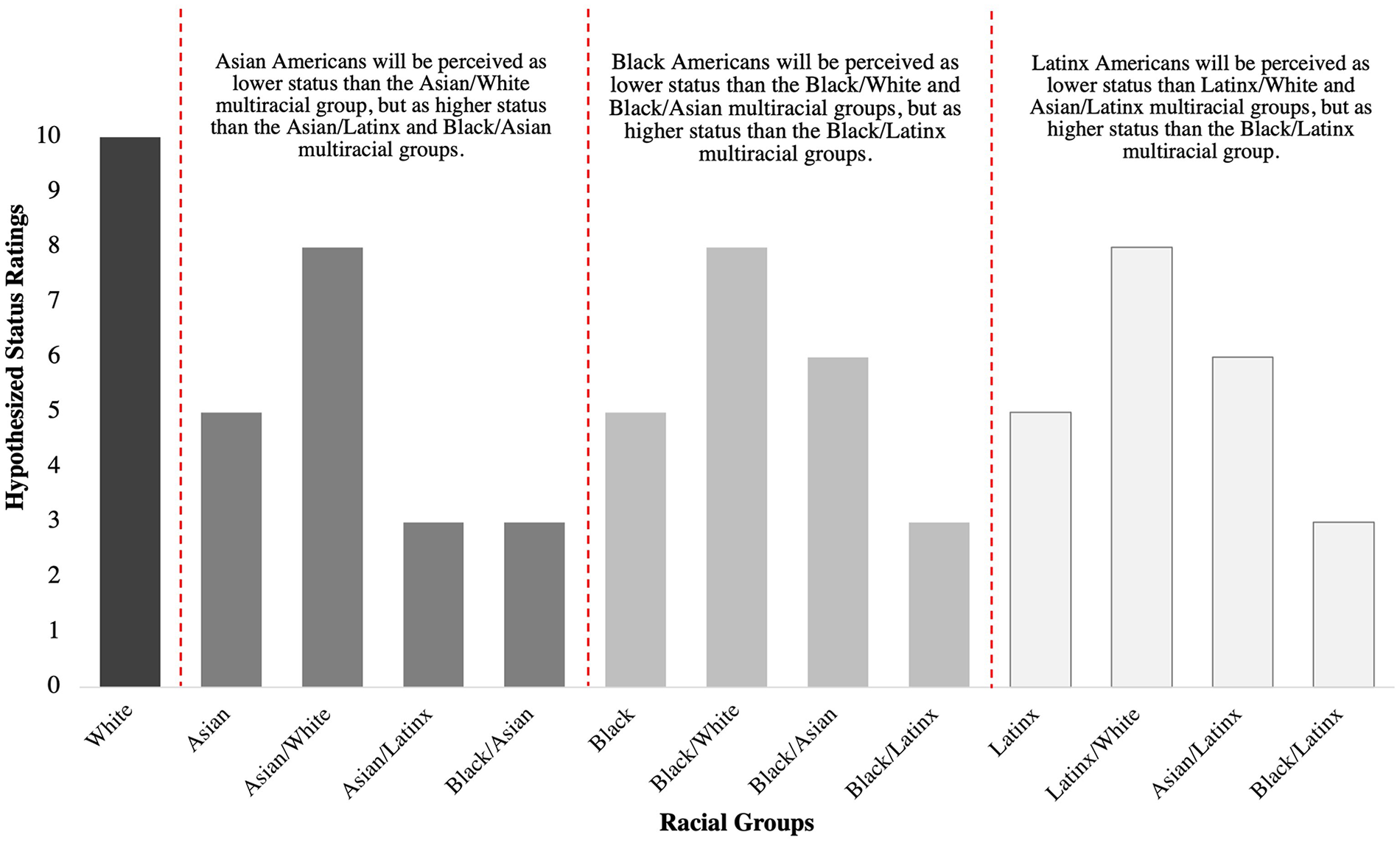
Hypothesized relationships for Study 2.
Although our primary interest was in whether privileges are extended to multiracial groups with White ancestry, we have discussed how rewarding proximity to Whiteness maintains the racial hierarchy by justifying the subordination of non-White groups. Thus, we further hypothesized that multiracial groups with Latinx and Black ancestry would be perceived as low in status (H2 and H3). We reasoned that, because Black and Latinx groups are associated with stereotypes that position them as lower status, such stereotypes may be incorporated into judgments of multiracial groups with Black or Latinx ancestry.
Method
Participants
Participants were U.S. adults recruited from Mechanical Turk and compensated 50 cents. We aimed to collect data from at least 134 participants based on an a priori, preregistered, power analysis for multiple paired-sample t tests with an anticipated effect size of d = 0.30 and obtained power of 80%. The total sample was N = 178, and the final sample (after excluding participants based on preregistered criteria) was 141 participants (White = 88, Asian = 7, Black = 20, Latinx = 13, Native American = 3, Multiracial = 10; Women = 58, Men = 81, Not specified = 2; Mage = 36.04, SDage = 12.09). Forty-seven participants were removed because they either failed attention checks (n = 5), took two standard deviations above or below the average time to complete the study (n = 3), or indicated after participating in the study that they were no longer comfortable with their data being analyzed (n = 40). A sensitivity analysis using G*Power (Faul et al., 2007) found that our final sample could detect effects of f = .11 (
Materials
Manipulation
Participants were presented with prompts about the following multiracial groups in random order: Asian, Black, Latinx, White, Asian/White, Black/White, Latinx/White, Black/Latinx, Black/Asian, and Asian/Latinx. For each group, participants saw the same prompt as in Study 1 with the same accompanying image of a ladder. All materials and data files are available on the OSF: https://osf.io/9u8mn/.
Results
Our preregistered data analysis plan specified that we would test our hypotheses using paired-sample t tests. However, similar to Study 1, we report results from a repeated measure ANOVA. We conducted a Racial Group (White, Asian, Black, Latinx, Asian/White, Latinx/White, Black/White, Asian/Latinx, Black/Asian, Black/Latinx) repeated measures ANOVA to test our hypotheses. The effect of Racial Group was significant, FGreenhouse-Geisser(5.53,773.66) = 35.31, p < .001,
Post Hoc Comparisons for Study 2.

Asian groups
The Asian monoracial group was rated as significantly higher in status than the Black/Asian multiracial group, p < .05. However, there was not a significant difference in status ratings between the Asian monoracial and Asian/White and Asian/Latinx multiracial groups, ps > 0.70. Therefore, H1 was partially supported. Although we did not preregister hypotheses focused on multiracial group comparisons, an exploratory analysis revealed that Asian/White multiracial group was also rated as significantly higher in status than the Black/Asian and Asian/Latinx multiracial groups, ps < .001.
Black groups
The Black monoracial group was rated as significantly lower in status than the Black/White multiracial group, p < .01. However, there were no significant differences in status ratings between the Black monoracial and Black/Latinx and Black/Asian multiracial groups, ps = 1.00. Therefore, H2 was partially supported. In addition, an exploratory analysis revealed that the Black/White multiracial group was rated as significantly higher in status than the Black/Latinx multiracial group (p < .001), but not the Black/Asian multiracial group, p = .05.
Latinx groups
The Latinx monoracial group was rated as significantly lower in status than the Latinx/White multiracial group, p = .01. There were no significant differences in status ratings between the Latinx monoracial group and the Asian/Latinx and Black/Latinx multiracial groups, ps > .08. Therefore, H3 was partially supported. In addition, an exploratory analysis revealed that the Latinx/White multiracial group was rated as significantly higher in status than the Black/Latinx multiracial group (p < .001), but not the Asian/Latinx multiracial group, p = 1.00.
White versus all racial groups
The White monoracial group was rated as significantly higher in status than all other racial groups, ps < .001. Therefore, H4 was supported.
Discussion
Study 2 revealed that multiracial groups with White ancestry are perceived as higher in status than monoracial minority and dual minority groups, with a few exceptions (i.e., the Asian and Asian/White groups did not differ significantly in status). However, we did not observe that groups with dual minority ancestry were perceived as lower status than their monoracial counterparts (with the exception that the Asian monoracial group was perceived higher in status than the Black/Asian multiracial group). In addition, unlike Study 1, multiracial groups with Asian ancestry were not always perceived as higher in status than multiracial groups with Black or Latinx ancestry. Overall, the results support our claim that proximity to Whiteness, demonstrated through White ancestry, may privilege multiracial groups with White ancestry and result in the subordination of monoracial minority and dual minority multiracial groups.
Although Studies 1 and 2 established that multiracial groups with White ancestry are perceived as higher in status than dual minority multiracial and monoracial minority groups, we have not yet tested whether racial stereotypes underlie judgments of status. 7 Therefore, in Study 3, we examined the perceived competence and warmth of multiracial and monoracial groups (Fiske et al., 2002), and whether stereotypes give rise to status perceptions.
Study 3
We hypothesized that competence and warmth stereotypes underlie status perceptions of multiracial and monoracial people. We preregistered our hypotheses on the OSF (https://osf.io/k7fbu) prior to the start of data collection 8 :
Method
Participants
Participants were U.S. adults who identified as White and who were recruited from Amazon’s Mechanical Turk and compensated 50 cents. We aimed to collect at least 200 White participants based on a preregistered multilevel Monte Carlo simulation specified to achieve 80% power to detect parameter estimates of .25 for two-way interactions in a moderation analysis. We collected data from a total of 257 participants, and the final sample was N = 200 (Mage = 35.75, SDage = 12.10). We excluded participants following preregistered exclusion criteria. We limited recruitment to White participants to better align with our theoretical approach, in which we have posited that White individuals are motivated to maintain the racial hierarchy from which they benefit. Fifty-seven participants were removed because they either failed attention checks (n = 8), took two standard deviations above or below the average time to complete the study (n = 8), indicated after participating in the study that they were no longer comfortable with their data being analyzed (n = 35), or did not provide a proper mTurk identification number (n = 17).
We conducted a multilevel mediation via structural equation modeling (see Preacher et al., 2010, 2011) using robust maximum likelihood estimation (MLR) in MPlus (Muthén & Muthén, 2017). 9 Approximately 100 clusters are recommended for multilevel structural equation models using MLR (Hox & Maas, 2001; McNeish, 2017); therefore, our final sample size of 200 participants remained appropriate.
Materials
Manipulation
Whereas Studies 1 and 2 incorporated a wide range of multiracial and monoracial groups, in Study 3, we reduced the number of groups to simplify interpretation of the results, maximize statistical power, and focus on the overall effect of proximity to Whiteness on status perceptions. We tested a model in which we averaged over two “base” race groups (Asian and Black) and examined how people of color are perceived depending on their ancestry: monoracial, White multiracial, or dual minority multiracial. We operationalized the dual minority identity as Latinx. Thus, participants saw survey items about the following racial groups in random order: Asian, Asian/White, Asian/Latinx, Black, Black/White, and Black/Latinx. Participants answered survey items about status, competence, and warmth for each group (adapted from Fiske et al., 2002). The study adopted a within-subjects design with one three-level factor, ancestry: (monoracial, part-White multiracial, dual minority multiracial).
Dependent variables
In the present study, we used a status measure that differed from the measure employed in Studies 1 and 2. In doing so, we aimed to establish whether the effects found in Studies 1 or 2 would replicate with a slightly different operationalization of status. The status measure examined how “educated,” “economically successful,” and “prestigious” of a job group member is likely to have (M = 3.36, SD = 0.42, α = .90). The competence measure asked participants, “as viewed by society, how [competent, confident, capable, efficient, intelligent, skillful] are members of this group?” (M = 3.53, SD = 0.34, α = .99). The warmth measure asked participants, “as viewed by society, how [friendly, well-intentioned, trustworthy, warm, good-natured, sincere] are members of this group?” (M = 3.35, SD = 0.71, α = .97). 10 All survey items were rated on a scale of 1 (not at all) to 5 (extremely). Averages were computed for multi-item measures. All materials and data files are available on the OSF: https://osf.io/24j7w/.
Results
Competence and warmth stereotypes
To examine differences in status, competence, and warmth ratings between racial groups, we first conducted a 2 (Base Race: Asian, Black) × 3 (Ancestry: Monoracial, Part-White, Dual Minority) repeated measures ANOVA (following our preregistered data analysis plan) for each dependent variable. Overall, multiracial groups with White ancestry were rated as more competent, warmer, and higher in status than multiracial groups with dual minority ancestry and monoracial groups (see Supplemental Material for full results and Table 4 for mean differences).
Descriptive Statistics for Study 3.

Note. Mean values that share a letter down the columns did not differ significantly from each other.
Expected mean of status if each ancestry group was equal on each mediator (competence and warmth) at the sample mean.
Do competence and warmth underlie status perceptions?
We conducted a 1-1-1 multiple multilevel mediation with fixed slopes via structural equation modeling using MLR estimation in MPlus (Preacher et al., 2010, 2011). We followed recommendations by Rucker et al. (2011) for testing and evaluating indirect effects, as well as the procedure outlined in Hayes and Preacher (2014) for conducting a mediation with a multicategorical independent variable. As a three-level categorical variable, ancestry was represented as two separate dummy-coded variables, with the part-White category designated as the reference group. Because all variables were measured at the within-person level, we focus here on the Level 1 effects of ancestry on status via perceptions of competence and warmth. Competence and warmth were cluster mean-centered. See Figure 3 for the path diagram of the model estimated at the within-person level (see also Table 4). To account for Type 1 error inflation, we adjusted our alpha for multiple comparisons using Bonferroni correction, resulting in .05 / 4 = .0125 to account for the two tests required for a three-level independent variable, and the two mediators, which acted as both predictor and outcome variables in the model.
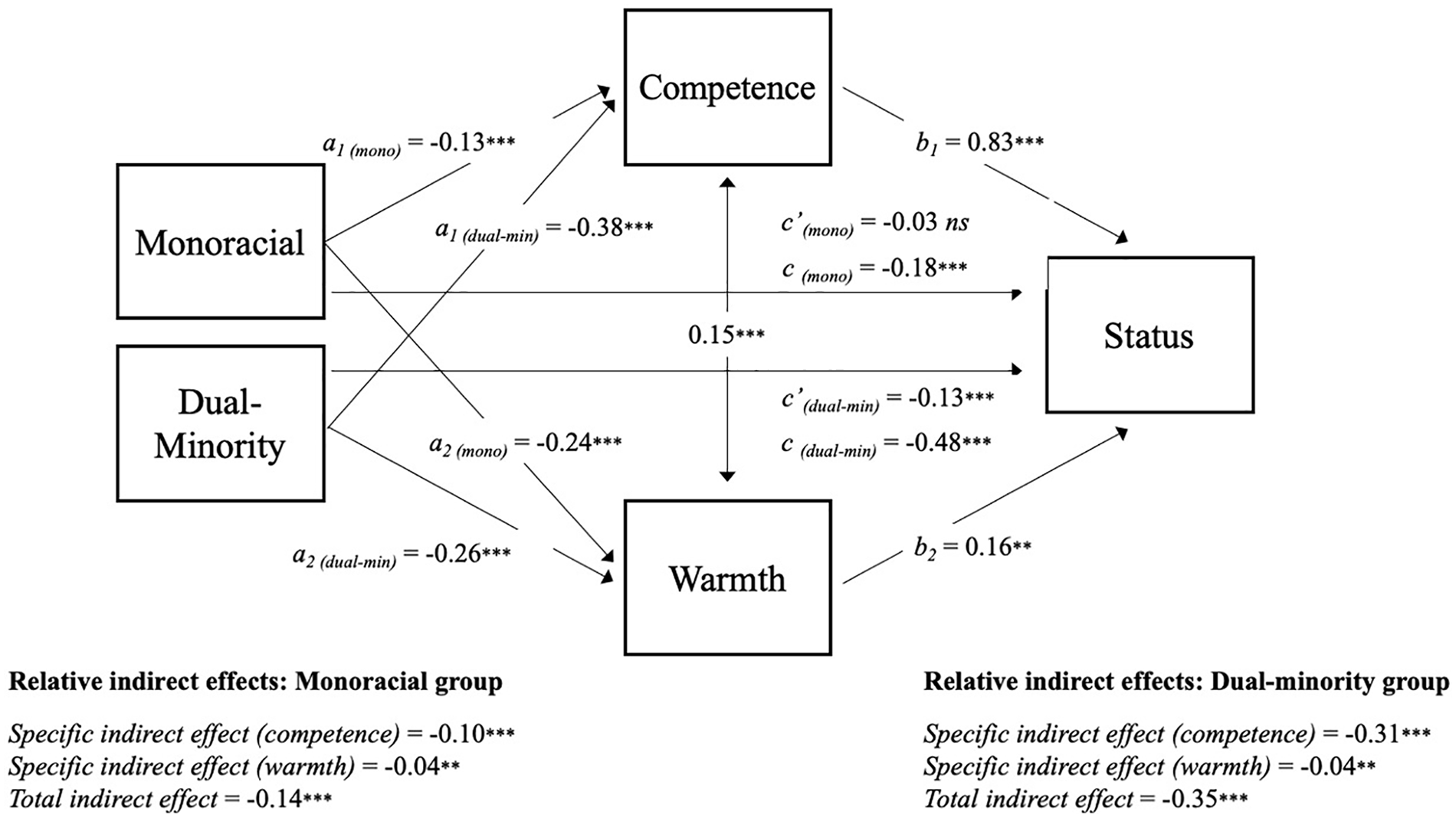
Study 3 multilevel mediation of the effect of racial stereotypes (warmth and competence) on status perceptions of multiracial people.
Relative direct effects
Multiracial people with White ancestry were rated as more competent than both the monoracial minority group, a1mono = −.13, SE = .03, p < .001, 95% CI = [−.18, −.07], and the dual minority group, a1dual-min = −.38, SE = .04, p < .001, 95% CI = [−.45, −.30]. The part-White group was also rated as warmer than the monoracial group, a2mono = −.24, SE = .04, p < .001, 95% CI = [−.32, −.17], and the dual minority group, a2dual-min = −.26, SE = .04, p < .001, 95% CI = [−.33, −.19]. Holding ancestry constant, competence, and warmth were positively correlated, r = .15, p < .001; competence was also positively associated with status, b1 = .83, SE = .05, p < .001, 95% CI = [.73, .92]. Warmth was positively associated with status, but to a smaller degree than competence, b2 = .16, SE = .06, p = .003, 95% CI = [.05, .27]. Finally, holding warmth and competence constant, the dual minority group was rated as lower in status relative to the part-White group,
Relative specific indirect effects
Relative to the part-White group, both the monoracial, a1b1mono = −.10, SE = .03, p < .001, 95% CI = [−.15, −.06], and dual minority groups, a1b1dual-min = −.31, SE = .04, p < .001, 95% CI = [−.40, −.23], were rated as lower in status a result of being rated lower in competence. In addition, both the monoracial, a2b2mono = −.04, SE = .01, p = .005, 95% CI = [−.07, −.01], and dual minority groups, a2b2dual-min = −.04, SE = .01, p = .003, 95% CI = [−.07, −.01], were rated lower in status compared to the part-White group, as a result of being rated as lower in warmth.
Relative total indirect effects
Compared to the part-White group, and as expected, both the monoracial, a1b1 + a2b2mono = −.14, SE = .03, p < .001, 95% CI = [−.20, −.08], and dual minority groups, a1b1 + a2b2dual-min = −.35, SE = .04, p < .001, 95% CI = [−.43, −.28], were rated as lower in status after accounting for the effects of both warmth and competence.
Relative total effects
The relative total effects are calculated by summing all the corresponding relative direct and indirect effects for each multiracial group. The relative total effects are equivalent to the mean differences in status for the monoracial and dual minority groups, relative to the part-White group. After including all indirect and direct effects and as expected, both the monoracial group, cmono = −.18, SE = .03, p < .001, 95% CI = [−.24, −.11], and the dual minority group, cdual-min = −.48, SE = .05, p < .001, 95% CI = [−.58, −.39], were rated as lower in status compared to the part-White group.
Discussion
Overall, the results of Study 3 support the hypothesis that status perceptions of multiracial groups of different ancestries are influenced by the extent to which they are perceived as competent and warm. As expected, multiracial people with White ancestry were perceived as more competent and as warmer than both monoracial groups and multiracial groups with dual minority ancestry. The significant positive association between competence and status, as well as the moderate, but also significant, positive association between warmth and status, related to status perceptions. As predicted, because multiracial groups with White ancestry were perceived as more competent and as warmer than monoracial and dual minority groups, they were ultimately also perceived as higher in status than both groups.
General Discussion
The current studies examined stereotypical dimensions critical to racial hierarchy formation and maintenance—status, competence, and warmth—to highlight how multiracial groups are located on and become incorporated into a racial hierarchy. Previous research has suggested that, because exposure to multiracial people shifts White people’s cognition and social behaviors in the United States, a large, visible multiracial population will reduce racism and inequality. In part due to these claims, it is now a common narrative that a multiracial population will propel the United States into a hierarchy-less future (Squires, 2007). However, findings from three studies show that multiracial groups are judged according to White, Eurocentric standards. Because multiracial people with White ancestry appear to be rewarded for their proximity to Whiteness, the results imply that the treatment of multiracial people may reinforce, rather than challenge, the existing racial hierarchy.
Study 1 showed that multiracial groups with White ancestry and multiracial groups with Asian ancestry (a racial group stereotyped as the Model Minority) are perceived as higher in status than multiracial groups who do not have White or Asian ancestry (e.g., Black/Latinx groups). Study 2 replicated these findings and further showed that multiracial groups with White ancestry were perceived as having higher status than their respective monoracial minority counterparts (this pattern held, except for the Asian versus Asian/White comparison). Finally, since competence and warmth stereotypes underlie status perceptions and function to maintain the racial hierarchy, we examined these stereotypes in Study 3. We found that, indeed, competence and warmth perceptions mediated the relationship between ancestry and status. Specifically, multiracial groups with White ancestry were perceived as more competent and warmer than monoracial and dual minority groups. Perceptions of higher competence and warmth for multiracial groups with White ancestry resulted in higher perceived status than monoracial and dual minority groups.
However, there are several ways that future research could improve the model in Study 3. For example, our model could have been improved by experimentally manipulating competence and warmth, a critical step toward justifying causal claims of the effect of racial stereotypes on status perceptions (e.g., Bullock et al., 2010). In addition, future work might examine racial groups separately instead of collapsing across multiracial groups as we did for the Asian and Black multiracial groups. We collapsed across groups to focus on the role of proximity to Whiteness. Doing so also allowed us to maximize statistical power.
Overall, the results reveal that White Americans perceive multiracial groups with White ancestry as having higher status than monoracial minority groups and multiracial groups with dual minority ancestry. As a result, White ancestry may cue proximity to Whiteness that allows multiracial people with White ancestry to access some racial privilege. Such privileges may extend beyond perceived status and associated stereotypes. For example, multiracial groups may be perceived as culturally assimilated to White U.S. culture when they have White ancestry. Thus, they are perceived as possessing traits stereotypically attributed to White people (e.g., education, high income, lighter skin tone). Indeed, research has shown that when participants are asked to recall an image of a Black man, they are more likely to recall an image of a Black man with a light skin tone if they are primed with cues that this man is educated (Ben-Zeev et al., 2014). However, in Study 2, the monoracial White group was perceived as higher in status than all other groups; multiracial people with White ancestry are unlikely to be perceived as having all the traits associated with Whiteness. Their proximity falls short of an actual White identity.
It is possible our results may be interpreted as showing support for the possibility that multiracial groups challenge White dominance and the racial hierarchy. For instance, if more groups occupy the “racial middle,” then gaps in status and privilege are minimized, resulting in a flattened hierarchy. Indeed, the White American population is decreasing, whereas racial minority and multiracial populations are increasing (U.S. Census Bureau, 2021). Thus, those who occupy this “racial middle” may eventually out-number White Americans. However, in contexts with White-minority or large multiracial populations still have racial inequality and racial hierarchies that maintain Whiteness. Hawai’i, a White-minority U.S. state with a large multiracial population, White individuals are privileged and hold power on a social and systemic level (Trask, 1999). In Brazil, a multiracial-majority country, hierarchies that privilege Whiteness still exist (de Santana Pinho, 2009). Thus, a White population, even a minority one, may be expected to retain power in a society that values Whiteness and proximity to Whiteness.
Future Directions
The current studies may be expanded to consider all the components of intergroup bias—cognition (i.e., stereotypes), affect (i.e., prejudice), and behavior (i.e., discrimination)—because these components function in synchrony (Dovidio et al., 2010; Fiske, 1998; Plous, 2003). We examined the cognitive aspects of bias; although our results are consistent with the idea that people treat multiracial individuals of different backgrounds in ways that reinforce Whiteness, we cannot conclude that is the case. Stereotypes reinforce existing hierarchies by shaping the behaviors of perceivers and legitimizing the institutional barriers that exist for minority groups. The data presented here suggest that the same process may apply to multiracial groups. Therefore, it is important to conduct future research to address whether and how stereotypes (specifically around status, competence, and warmth) impact behavior directed toward multiracial people.
For example, data from the Pew Research Center (2015) suggest that multiracial individuals face various types of discrimination. For example, Native American/Black and Black/White multiracial individuals are subjected to slurs, poor service and are stopped by the police more often than Asian/White and Native American/White multiracial individuals. The data also suggest that individuals with dual minority ancestry experience more discrimination than multiracial individuals with White ancestry. Moreover, we may not expect perceivers to differentiate between monoracial minorities and multiracial people in some contexts. For example, most multiracial Black complainants face the same discrimination faced by monoracial Black complainants in court settings, such as a more extended sentencing period or harsher sentencing (Hernández, 2017). Thus, in some cases and contexts, multiracial individuals are subjected to discrimination that monoracial groups experience. However, there are also advantages conveyed to multiracial individuals with White ancestry, who may be treated more positively due to their proximity to Whiteness.
In addition, the current study examined group perceptions; however, appearance shapes the way people within groups are treated. For example, someone whose appearance is more prototypical of a racial group is likely to be perceived as having more traits and behavior stereotypical of that racial group, and vice versa (Blair et al., 2004; Osborne & Davies, 2013; Wilkins et al., 2010). Thus, skin tone bias, or the association of lighter skin with more positive traits and darker skin tone with more negative traits, may apply to multiracial individuals as well (Levinson & Young, 2009; Maddox, 2004). Beliefs about skin tone and mental representations of prototypical group members within the multiracial groups may have shaped judgments of status in these studies. For instance, multiracial groups with White ancestry may be perceived as higher in status than multiracial groups with dual minority ancestry because perceivers imagine multiracial individuals with White ancestry to have lighter skin. Future work can investigate this claim.
Here, we examined group perceptions instead of individual perceptions as this is the level of analysis consistent with theories about racial hierarchy formation (see Omi & Winant, 1994; Sidanius & Pratto, 1999). Examining reactions to images of multiracial individuals changes the level of analysis, re-focusing the research question from how social groups are stereotyped to how stereotypes are applied to particular individuals. Thus, both the group- and individual-level analyses are needed to study multiracial groups because stereotypes, prejudice, and discrimination work across both levels, and the interaction between these two processes shapes how people are treated (Stangor & Jost, 1997).
Conclusion
Previous work has gestured to the idea that an increasing multiracial population will blur the boundaries between race and reduce racism, leading to a racially egalitarian future (Squires, 2007). However, in three studies, we show that multiracial groups may be privileged or subordinated due to their proximity to Whiteness. The results imply that, in the future, even as the U.S. multiracial population becomes increasingly visible, the racial hierarchy will remain in place. White individuals will continue to occupy a position of racial dominance, while multiracial groups with White ancestry are extended some privileges of Whiteness. Such privileges may be weaponized to subordinate multiracial groups with dual minority ancestry and reinforce cultural values in which proximity to Whiteness is rewarded, and distance from Whiteness is punished. Thus, researchers who study multiracial identity by centering multiracial groups with White ancestry should avoid concluding how all multiracial groups are perceived and treated (Garay & Remedios, 2021).
Overall, the results reveal that the existing racial hierarchy will be reinforced even as the multiracial population becomes increasingly visible through the privileging of multiracial groups with proximity to Whiteness to justify the subordination of multiracial groups with dual minority ancestry. To challenge racial hierarchies and promote a more just social reality, active support and advocacy for anti-racist initiatives, interventions, and policies that dismantle racism and White Supremacy are needed (Crenshaw et al., 1995). In contrast, assuming that exposure to racially diverse or multiracial populations will naturally resolve racism (Garay & Remedios, 2021), or may change those in power to—on their own benevolence—become less racist (Bell, 1980), is unlikely to reshape the hierarchy.
Supplemental Material
sj-docx-1-psp-10.1177_01461672221086175 – Supplemental material for The Maintenance of the U.S. Racial Hierarchy Through Judgments of Multiracial People Based on Proximity to Whiteness
Supplemental material, sj-docx-1-psp-10.1177_01461672221086175 for The Maintenance of the U.S. Racial Hierarchy Through Judgments of Multiracial People Based on Proximity to Whiteness by Maria M. Garay, Jennifer M. Perry and Jessica D. Remedios in Personality and Social Psychology Bulletin
Footnotes
Declaration of Conflicting Interests
The author(s) declared no potential conflicts of interest with respect to the research, authorship, and/or publication of this article.
Funding
The author(s) disclosed receipt of the following financial support for the research, authorship, and/or publication of this article: Studies 2 and 3 were funded by the Association for Psychological Sciences Student Grant Competition.
Open Practices
All materials have been made publicly available via the Open Science Framework and can be accessed through links within the manuscript.

Supplemental Material
Supplemental material is available online with this article.
Notes
References
Supplementary Material
Please find the following supplemental material available below.
For Open Access articles published under a Creative Commons License, all supplemental material carries the same license as the article it is associated with.
For non-Open Access articles published, all supplemental material carries a non-exclusive license, and permission requests for re-use of supplemental material or any part of supplemental material shall be sent directly to the copyright owner as specified in the copyright notice associated with the article.
