



Abstract
This research takes a new perspective on the long-standing mystery of personality in negotiation, which has seen decades of null and inconsistent findings. Grounded in interactionist theories defining personality as consistency in behaviors when placed multiple times in the same situation, the investigation examines consistency in individuals’ behavioral profiles across negotiation partners. Such consistency supports efforts to identify enduring dispositions that can predict objective and subjective outcomes. A comprehensive set of behaviors related to negotiation was coded in a round-robin study using groups of four negotiators who each took turns working with each other person. Analysis using Kenny’s Social Relations Model revealed evidence for extensive actor effects (indicating consistency in negotiators’ behavior), as well as moderate partner effects (indicating consistency in counterparts’ behavior) and dyadic reciprocity (indicating similarity in the behavior of negotiators and counterparts). We conclude with optimism for investigating the effects of personality in negotiation.
The field of negotiation—a term that has been defined as “back-and-forth communication designed to reach an agreement when [parties] have some interests that are shared and others that are opposed” (Fisher et al., 1991, p. xvii)—has been a uniquely interdisciplinary pursuit, eagerly incorporating perspectives not only from psychology but also from economics, law, organizational behavior, and sociology. A long-standing mystery within this field has been the influence of individual differences on negotiation performance. On one hand, conventional wisdom suggests that some people seem to be more successful and more comfortable with the art of negotiation. On the other hand, demonstrating this intuitive notion empirically has been elusive. Indeed, for decades, large-scale reviews have concluded that individual differences are not reliable predictors of negotiation effectiveness (Neale & Northcraft, 1991; Pruitt & Carnevale, 1993; Terhune, 1970; for a review, see Sharma et al., 2013). Early reviews of the topic were based largely on studies of game-theoretic outcomes (e.g., Rubin & Brown, 1975), and the pessimism expressed in these reviews had chilling effects on further investigation.
Despite the dismissive nature of this early writing, researchers continued to pursue the topic of individual differences in negotiation. More recently, there have been important advances showing that certain dispositional tendencies do predict conflict and negotiation behaviors (e.g., Amanatullah et al., 2008; Antonioni, 2008; Dimotakis et al., 2012; Foo et al., 2004; Moberg, 2001; Mueller & Curhan, 2006). Notwithstanding these notable advances, the topic more generally suffers from inconsistent and often contradictory findings, and it has been challenging to integrate the body of work on main effects for individual differences (Elfenbein, 2015). Scholars have long critiqued research on personality in negotiation as a disparate collection of predictions in the absence of theoretical grounding (Lewicki & Litterer, 1985; Thompson, 1990). Our research takes a new approach to this old question, by grounding the investigation in interactionist theories of personality.
The novel angle in our work is to examine a comprehensive set of negotiation-related behaviors in a round-robin study using groups of four negotiators in which each person took turns working with each other person. Analyses using the Social Relations Model (SRM; Kenny, 1994) examine evidence of actor effects in the form of negotiators acting with behavioral consistency across multiple encounters. Analyses also examine partner effects in the form of counterparts acting with behavioral consistency when interacting with the focal negotiator. Finally, we examine systematic departures from individual-level consistency in the form of dyadic reciprocity between counterparts, which indicates to what extent the behavior of the two parties tends to be similar versus different. Below, we discuss the theoretical foundations of this approach and our hypothesis development.
Interactionist Personality Theory
We take as our starting point the theoretical foundation that conceptualizes personality as consistency over time in an individual’s behaviors when that individual is placed multiple times in the same situation (Fleeson, 2004; Magnusson & Endler, 1977; Mischel & Shoda, 1995). Personality involves preferred ways of being, which are neither right nor wrong, and describes a person’s generalized behaviors and thoughts. Theorists converge on the broad idea that “a personality trait can be defined as the average or expected value of personality-relevant behaviors” (Augustine & Larsen, 2012, p. 131). Likewise, Fleeson’s (2004) influential writing characterizes traits as density distributions of states. Average levels of behavior are “essential expressions or behavioral signatures of the same underlying personality system” (Mischel & Shoda, 1995, p. 246)—such that individuals are characterized by stable individual differences in their overall levels of behavior (Mischel, 2004). As such, modern personality theory focuses on behavioral consistency, as we do in the current investigation.
Consistency in behavior is a trademark of personality theory because, without coherence, there would be little point in focusing on individuals (Diener & Larsen, 1984). Although people vary in their behavior over time and situations, stability becomes apparent when observing individuals across an increasing number of events (Epstein, 1979). Although behaviors fluctuate across individuals’ momentary reports, their aggregate levels tend to be highly stable and consistent, and correlate with traditional questionnaire assessments of personality traits (Augustine & Larsen, 2012; Buss & Craik, 1983a, 1983b; Côté & Moskowitz, 1998; Diener & Larsen, 1984; Epstein, 1979; Fleeson & Gallagher, 2009). This article, grounded in personality theory, seeks to examine consistency in the average behavioral tendencies of negotiators.
In grounding this investigation in personality theory, we argue that individuals are consistent in at least some of their behavioral signatures during negotiations. Research has not yet provided evidence that any relevant behavioral profiles in negotiation are consistent. Instead, perhaps negotiators vary in their behavior from encounter to encounter, based on the context and without commonalities across interactions. There is supporting evidence, however, for consistency in the outcomes that people achieve—if not necessarily the behaviors to get there. Elfenbein et al. (2008) found that consistent individual differences explained nearly half of the variance in outcomes when individuals engaged in interactions with multiple partners. To the issue of consistency, we ask: Are negotiators consistent across interactions in behaviors?
Hypothesis Development
What it means for us to ground our investigation in personality theory is to take the theoretical definition of personality as consistency in behavior and examine the extent to which negotiation behaviors are consistent. This is a different approach than past research on personality in negotiation. Rather than taking a list of traits and examining whether they correlate with negotiation outcomes, we deconstruct the theoretical definition of personality: Do individuals tend to act consistently when faced with the same environmental factors? It is a relatively rare but worthwhile feature in personality research to examine behavior itself versus self-reported tendencies (Funder, 2009; Mischel, 1968).
We acknowledge the alternate prediction, namely, that key negotiation-related behaviors may be deliberately inconsistent from one encounter to the next. Given that both cooperative and competitive tactics tend to be reciprocated and complemented (Weingart et al., 1990), it is not obvious that consistently excellent negotiators would differ from one other in their average behavioral profiles. Perhaps, instead, they are better at matching their behaviors to what is appropriate for the situation at hand. Neale and Northcraft (1991) detailed a Behavioral Negotiation Theory, which suggests that negotiated outcomes result from properties of the static negotiation context as well as from the cognitions and dynamic interplay of the negotiators themselves. Each negotiation could unfold as an idiosyncratic chain of interpersonal events, which would limit consistency from one to the next. As such, it is possible that the situations vary so much that this variance swamps any meaningful effects of the person. Research on Person × Situation interaction effects has emphasized the role that each unique setting plays on how individual differences show themselves (DeRue et al., 2009; Dimotakis et al., 2012; Funder, 2008; Pervin, 1989). Indeed, given the relatively meager early empirical findings for main effects of individual difference variables on negotiation performance, research on Person × Situation effects became more prominently featured in the literature.
To address the issue of Person × Situation interactions, we note that the empirical work to be described below attempts to keep the objective features of the situation as constant as possible, while allowing each individual the chance to interact with multiple partners to observe negotiator consistency from one encounter to the next. People may change their behavior to such an extent across their interaction partners, as they craft their style for different counterparts, that a search for person-level behaviors would be fruitless. We approach this question as a hypothesis. Our argument to expect substantial behavioral consistency is grounded in interactionist theories (e.g., Mischel & Shoda, 1995), which posit that personality shows itself in consistent reactions to being in the same situation multiple times.
When considering the role of individuals in the context of dyadic interaction, the SRM (Kenny, 1994; Kenny & La Voie, 1984) has been a popular conceptual and statistical model from the psychology of interpersonal relations. It is a multilevel model that accounts for dyadically independent data and was developed for studying any kind of individual difference that is generated via an inherently dyadic process, such as two-party negotiations. This article employs the SRM using a round-robin design, in which each person in a group has a one-on-one interaction with each other person in their group—akin to a sports conference in which each team plays against each other team. During each round, participants engaged in multi-issue negotiation simulations that were different on their surface and yet were identical in their underlying numerical incentive structure.
The SRM takes the result of each dyadic encounter and conducts variance partitioning to understand—in this case—negotiator behavior as the combined result of four different factors: (a) actor effects, or consistency in a negotiator’s behavior from one partner to the next; (b) partner effects, or consistency in the behavior of various partners when interacting with the focal negotiator; (c) relationship effects, or consistency in the behavior when two specific negotiators interact, even controlling for their tendencies when interacting with other people; and (d) measurement error. Due to our design, in which individuals negotiate with each other only one time, the SRM cannot distinguish relationship effects from measurement error (for a study of relationship effects in negotiation, see Elfenbein et al., 2018). The SRM also examines reciprocity in behavior between partners. We discuss each of these below. 1
Actor Effects: Negotiator Consistency
In the SRM, actor effects represent behavioral consistency. Consistent with interactionist theories of personality, we predict that individuals maintain at least some degree of unique behavioral signatures across their interactions with various partners. For example, negotiators who stand firm and indicate that they are willing to walk away may be generally likely to do this across their multiple partners. This is not to say that their behavior is identical across encounters, but rather that there is a degree of consistency that shines through. Outside of the negotiations domain, Leikas et al. (2012) had confederates enact a wide range of behaviors and found that individuals who interacted with these confederates were still rank-order consistent in spite of their partners’ differing interaction style.
Partner Effects: Partner Consistency
Although personality is partly defined by what an individual regularly does, personality is also characterized by what an individual regularly elicits other people to do (Buss, 1987; Kenny, 1994; Mischel, 2004). Intuitively, many common adjectives for describing people are less about the people themselves than about the effect the people have on others, for example, boring, annoying, and amusing. In the realm of emotion, Eisenkraft and Elfenbein (2010) found evidence for trait affective presence, or the tendency of individuals to elicit consistent emotions in their interaction partners, even apart from the emotions they themselves tended internally to feel. In the negotiations domain, we hypothesize that individuals’ counterparts may behave consistently as well. In the SRM, these tendencies are called partner effects. For example, some negotiators might tend to have partners who stand firm against them, regardless of their own tendency to stand firm.
At the same time that we hypothesize the existence of behavioral consistency among the various counterparts of a given focal negotiator, we acknowledge that past evidence is relatively weak for partner effects in behavior more generally. Kenny and Malloy’s (1988) review concluded that partner effects are small and sometimes elusive. They speculated that such effects are difficult to uncover due to the typical methodology in which strangers engage in unstructured social context outside of a context in which the measured variables would be expected to emerge. We maintain that the negotiations context may hold more promise for finding partner effects than past studies. In the present work, participants are goal-directed and focused on accomplishing a specific task that is engaging and has substantially greater length, and the measured behaviors directly relate to this negotiation task. As such, we are optimistic to find rare evidence for partner effects.
Dyadic Reciprocity: Behavioral Similarity
As mentioned above, one reason to expect systematic departures from behavioral consistency is the tendency of negotiators to reciprocate and complement their partners’ tactics (Weingart et al., 1990). As such, in addition to focusing on consistency, we also examine the dynamic behavioral interplay between the two parties. In particular, we hypothesize that negotiators tend to exhibit behavioral similarity rather than dissimilarity (i.e., complementarity) and rather than a lack of association. That is, parties reciprocate the behavior of the other. In the SRM, this is called dyadic reciprocity. Past work provides examples of negotiation partners imitating each other’s behavior (Axelrod, 1984; Deutsch, 1973; Lawler & Yoon, 1996; Putnam & Jones, 1982; Weingart et al., 1990). For example, they tend to reciprocate seeking and providing information (Thompson & Hastie, 1990; Weingart et al., 1993), and even reciprocate conflict situations that cause unproductive negative spirals when nonreciprocity would be more productive to fix the situation (Brett et al., 1998). Our current study offers two extensions to this past work. First, we expand greatly the range of behaviors examined for potential reciprocity. Second, we examine behaviors that are related to cooperation and competition in the context of a new transaction versus existing dispute. That is, the research on conflict spirals has taken place in the context of conflicts that already have a history of negative relationships, whereas this study examines deal making within a new relationship without problematic history.
Behaviors in the Negotiation Context
Below, we discuss specifically the behaviors considered in the present study. The first set consists of negotiation-specific acts that attempt to move forward the bargaining process. The second set consists of nonverbal behaviors indicating interpersonal relationship quality. The third set relates to language use, with frameworks that map onto personal and interpersonal functioning. Our goal in generating these lists was to be as comprehensive as possible, and so—rather than limit analyses to behaviors that map onto specific theory—we apply the three hypotheses above to a very wide range of behaviors with potential relevance to negotiation.
Negotiation Behaviors
Consistent with Neale and Northcraft’s (1991) Behavioral Negotiation Theory, researchers have examined the tactics and behaviors that characterize more effective negotiation outcomes relative to less effective outcomes (e.g., Adair & Brett, 2005; Weingart et al., 1990). We include as many behaviors as possible that the existing literature has established as important for the negotiation context (Adair & Brett, 2005; Pruitt & Lewis, 1975; Weingart et al., 1990, 1993).
Communication behaviors
Among the processes outlined by Neale and Northcraft (1991), communication behaviors loom large. Communication is “at the heart of the negotiation process” (Lewicki & Litterer, 1985, p. 157) and functions both as a vehicle for learning about the counterparts’ interests and for persuading the other party to agree to a settlement. Learning about the counterpart’s interests, preferences, needs, and priorities is important for both creating and claiming value. It uncovers potential ground for logrolling and for identifying hidden compatibilities, and it is also critical in uncovering the other party’s limits (Adair & Brett, 2005; Pruitt & Lewis, 1975; Walton & McKersie, 1965; Weingart et al., 1990, 1993). Negotiators exchange information by providing information about their own interests, asking questions about the other party’s interests, and reacting to others’ information. Moreover, both seeking information and providing information tend to be reciprocated, which creates a spiral of free information flow (Thompson & Hastie, 1990; Weingart et al., 1993).
The communication behaviors we test in this study are asking questions of the other party (Pruitt & Lewis, 1975; Weingart et al., 1993), making statements about priorities (Adair & Brett, 2005; Pruitt & Lewis, 1975; Weingart et al., 1993), providing a reaction to an offer made by the counterpart (Adair & Brett, 2005; Weingart et al., 1993), and providing reasoning to substantiate one’s position (Adair & Brett, 2005).
Procedural behaviors
One of the main purposes of communication is to transmit information about what settlements would be acceptable as potential outcomes to the negotiation (Neale & Northcraft, 1991). The provision of offers provides direct information about a negotiator’s preferences and limits (Weingart et al., 1990), and it also serves as an indirect exchange of information about a counterpart’s underlying interests and priorities (Adair & Brett, 2005). As such, a trial-and-error process of offers can serve as a strategy to reach joint gains, in that negotiators tend to create more value if they exchange a greater number of different proposals (Pruitt & Lewis, 1975). More successful negotiators tend to make more offers, and they react explicitly to others’ offers (Donohue, 1981).
The procedural behaviors we test are the number of offers each negotiator made, both single-issue offers and multiple-issue offers (Adair & Brett, 2005; Weingart et al., 1993); procedural comments (Fisher & Ury, 1981; Pruitt & Lewis, 1975; Weingart et al., 1993); and referring to fairness (Adair & Brett, 2005; Fisher & Ury, 1981; Raiffa, 1982).
Competitive behaviors
Parties attempt to establish their position in the interaction and encourage the other party to concede (Adair & Brett, 2005). As such, dominance-related behaviors help negotiators to claim more value both because they indicate potency and because they have the potential to be complemented by the counterpart with submission-related interpersonal behaviors (Wiggins, 1979). On a tactical level, such dominant behaviors include referring to one’s alternatives outside of the negotiation, or BATNA (“Best Alternative to a Negotiated Agreement”); referring to one’s status with others; and referring to relationships with the counterpart’s competitors. These behaviors convey a sense of dominance because they signal that the negotiator does not need to rely on reaching a settlement to fulfill his or her needs (Emerson, 1962; Neale & Northcraft, 1991). Examining manipulation, Pruitt and Lewis (1975) argued that providing false or misleading information to the other party limits the ability to create value by reducing accurate understanding of the other party’s utility structure. Indeed, Thompson and Hastie (1990) found marginally lower accuracy about the negotiation setting for those who attempted to deceive the other party. Finally, asking for sympathy from the other party, like misleading, is a form of manipulation.
The competitive behaviors we test are referring to one’s alternatives, in terms of the BATNA (Neale & Northcraft, 1991) outside of the negotiation (Adair & Brett, 2005), and relatedly referring to the counterpart’s competitors and referring to one’s own status as a desirable negotiation partner; misleading the other party (Neale & Northcraft, 1991; Pruitt & Lewis, 1975), which included both technically false statements and statements that imply something false; and finally asking for sympathy from the other party.
Relationship Quality
In addition to negotiation-specific behaviors, we examined negotiation partners’ nonverbal behavior. Given the value of relationship building, we measured the appearance of interpersonal rapport between the two counterparts, using Bernieri et al.’s (1996) validated technique. We also measured interpersonal synchrony, alternately called interpersonal coordination or behavioral entrainment. Synchrony has been implicated in many important phenomena of social interaction (Bernieri & Rosenthal, 1991), including negotiation (Curhan & Pentland, 2007). Synchrony occurs when an individual coordinates their rhythms and movements to those of an interaction partner and, together, the interaction creates a perception of physical unity and coordination (Bernieri et al., 1994; Condon & Ogston, 1966). Synchrony has multiple functions in the service of interpersonal affiliation. First, it helps to regulate interactions to keep them running smoothly (Bernieri et al., 1988). Second, it serves a communication function, signifying the interest or approval of an interaction partner (Kendon, 1970). Synchrony correlates with self-reported rapport between individuals (Bernieri et al., 1988; Tickle-Degnen & Rosenthal, 1990). In this study, we code for both synchrony and perceived rapport.
Language Use
How people use words is an established indicator of personal functioning. Based on a wide range of categories, word count serves as a proxy for content analysis and evidence demonstrates that it reveals information about an individual’s psychological functioning. This information includes attitudes, cognitive styles, relationships, and even physical and mental health (Pennebaker et al., 2003; Pennebaker & Graybeal, 2001; Pennebaker & King, 1999). The dictionary developed by Pennebaker and Graybeal (2001), called the Linguistic Inquiry Word Count (LIWC), has been extensively validated as a comprehensive tool. The LIWC system provides a “fingerprint” of an individual’s word usage and, in doing so, can serve as a marker of individual functioning (Pennebaker & Graybeal, 2001). Many of the items in LIWC are relevant to the negotiation setting. For example, the use of pronouns can serve as an indication of self-focus (I + self), other-focus (you), and relational-focus (we). Cognitive process words—such as the use of causal language—can indicate how negotiators think about their activities in terms of the framing of their deals. Verb tense (past, present, future) can also give a sense of negotiator focus. Communication style can give a sense of negotiators’ state of mind, for example, the extent to which they are tentative or certain, and based on their level of fluency in communication. Communication quantity can serve as an indicator of comfort and/or dominance in the interaction. Some words in the LIWC system relate to conversational flow, such as negations and assent. In this study, we make use of core components of the LIWC dictionary (Pennebaker & Francis, 1999) with a focus on concepts with potential relevance to negotiation, while excluding the list of specific topics such as time, family, and music. Given our overarching interest in comprehensiveness, our approach was to identify a long list of LIWC dictionary terms with prima facie relevance to negotiation rather than making specific predictions for every item on the list.
Method
The data that support the findings of this study are openly available via the Center for Open Science at https://osf.io/7vzdt/?view_only=1c7c7daad0df45a19ac220451a79e339.
Participants
Data were collected from full-time MBA students at a large public university in the United States in the context of their elective course on negotiations. Procedures were monitored by the university’s Institutional Review Board (IRB), approved on the basis of pedagogical value and with participants completing documents of informed consent. A total of N = 103 people completed all measures below (72 male, 31 female; age M = 30.1 years, SD = 3.7), as one of their first classroom assignments. Although the SRM does not have formal power tests, we note that the design yielded 153 unique negotiations completed by the 103 participants, which is the equivalent statistical power of a sample of N = 306 participants doing a single negotiation working in pairs. They were assigned to 25 four-person groups and one three-person group. Given that SRM analyses require data from a minimum of four participants in each group, the group of three was discarded and a final N = 100 participants were included in the analyses below. From the unique 150 negotiations that resulted from these 100 individuals, data on outcomes (but not behavior) are excluded from eight of the negotiations—six due to impasses and two in which the counterparts reported discrepant outcomes. Although the participants were students, they had an average of 6 to 7 years of full-time work experience before returning to graduate school in management.
Round-Robin Interactions
In each group of four, members took turns engaging in one-on-one interactions with each other member of the group, using a round-robin format. As such, individuals are nested in varying dyads that are themselves fully nested within one group. For data analysis, we used the algorithms of the SRM, which are listed in Appendix B of Kenny (1994) and implemented in the R programming language. 2 First, to test Hypothesis 1, the SRM allows us to measure actor effects, that is, how consistent individuals are in their signature of behaviors from one interaction to the next. This is similar to calculating an intraclass correlation to measure consistency. Statistically, the SRM calculates how much of a negotiator’s behavior in each separate interaction can be explained by their average behavior across all interactions. The SRM accounts for the interdependent nature of the data by subtracting person-level effects of partners to isolate the person-level effects attributable to each negotiator (i.e., the algorithms account for the missing data in that people do not negotiate with themselves). The actor effect can be interpreted akin to an R 2 for individual-level effects. That is, if each negotiation encounter were in a single row, there would be 12 rows per round-robin of four people (six dyads and each dyad is represented twice, once for each partner), and the actor effects would be the random effect for each negotiator. Second, to test Hypothesis 2, the SRM allows us to measure partner effects, that is, how consistently an individual’s partners behave. That is, with the same format of data set in which each negotiation encounter was in a single row, the partner effects would be the random effect for the negotiation partner. Finally, to test Hypothesis 3, the SRM measures dyadic reciprocity between partners, that is, how much similarity there tends to be in behavior between the negotiator and counterpart. This is the intraclass correlation between the behavioral measures of each member of the dyad. Note that it is possible to apply the SRM to fully symmetric data such as rapport or synchrony, which do not differ across the two partners. That is, if A has high rapport with B, then B has equally high rapport with A. In such cases, actor and partner effects are still defined, but there is no output for dyadic reciprocity because it is a perfect value by design.
For supplemental analyses, we examine the associations between actor effects and negotiation performance. To do this, we outputted individual-level effects from the SRM. These are the equivalent of the average value of an individual’s behavior across their three separate encounters. As such, the values can be used in further analysis as a strictly individual-level variable.
Negotiation Simulations
As discussed above, personality theory emphasizes that the construct of personality involves consistency in an individual’s behavior when placed in the same situation. Along these lines, in attempting to reconcile decades of research showing relatively modest findings for behavioral consistency, Mischel and Shoda (1995) attributed this to unmeasured differences in the situations in which behavior has been assessed. Likewise, within negotiation in particular, Thompson (1990) argued that inconsistencies in past findings on personality can be attributed in part to methodological variations across studies. Different types of negotiations vary in their demands (Bazerman et al., 2000; DeRue et al., 2009; Walton & McKersie, 1965), and the extensive literature on Person × Situation interactions emphasizes the need to pay attention to situational consistency in attempting to draw out consistent individual-level effects. Accordingly, our participants engaged in a series of negotiation tasks that were as identical as possible in their objective structural characteristics. This feature of our design minimized the extent to which tasks differed in their situational constraints on behavior.
Accordingly, we created three negotiation scenarios that were all exactly parallel in the type of issues included and had the same underlying scoring system. They were adapted from the popular New Recruit exercise (Neale, 1997; Pinkley et al., 1994). Because Thompson (1990; Thompson et al., 2000) found that negotiators undergeneralize their learning from one negotiation setting to another, we kept the structure consistent while using three overtly different topics: the merger of two hotel chains, the purchase of a luxury car, and the rental of a home. Each case included five issues: two distributive issues (in which negotiators’ interests are fully opposed), one compatible issue (in which negotiators’ interest are fully aligned; Thompson & Hrebec, 1996), and two logrolling or trade-off issues (which vary in importance, so that there is opportunity to create value by trading off those of lower priority; Froman & Cohen, 1970; Pruitt, 1983). For each issue, the negotiators were given five options, a point value for each option, and a brief explanation to provide logic for the negotiator’s preference. A number of rules ensured that the three cases were identical: (a) all point values increased linearly, (b) every negotiation had the same maximum and minimum for distributive potential (4,700 and –200 points, respectively), (c) every negotiation had the same maximum and minimum for integrative potential (6,200 and 2,800 points, respectively), (d) the compatible issue was assigned smaller total values and values increased by smaller intervals, and (e) to provide as flexible as possible a benchmark for performance, an impasse was worth zero points. Note that all participants completed these three exercises in the same order, and any main effects for order were accounted for because the data were standardized within each role, as described below.
This task was assigned on the third meeting of the course and was the students’ first mixed-motive exercise of the semester. Each group took part in the study during a 90-min scheduled appointment, after all materials were available to prepare in advance. The 90-min session was split into three 30-min sessions. Within the four-person round-robin, pairs of partners interacted and then switched partners until, after the third session, each person had interacted with every other person. During the 30-min session, negotiators interacted for up to 15 min in a private room for each dyad, spent 10 min alone recording outcomes, and then had 5 min to take a break and switch rooms for the next interaction.
Outcome Measures
Participants reported their outcomes via survey immediately following each negotiation.
Objective outcomes
Students filled out a postnegotiation questionnaire for each exercise as soon as they completed the transaction or reached the time limit. They recorded the objective terms of their settlement if a deal was reached, and recorded an impasse otherwise. As previously mentioned, these bargaining scenarios were multifaceted in that they involved a balance between creating value for the pair and claiming value for oneself. Therefore, several different scores measured the objective outcome. Creating value was defined as the total dyadic points earned by the pair. This reflected the extent to which members of the pair were successful in logrolling and uncovering their hidden compatibilities. Claiming value was defined as the proportion of the total points earned by the negotiator, which reflected the extent to which that individual was able to command resources for themselves.
Subjective outcomes
As a further perspective on negotiation performance, participants reported their satisfaction using the Subjective Value Inventory (SVI; Curhan et al., 2006). The SVI corresponds to Curhan et al.’s (2006) four-factor model of social-psychological outcomes in negotiation, which includes (a) feelings about the instrumental outcome (i.e., the terms of the deal), including subjective perceptions about whether the economic outcome was desirable, balanced, and consistent with principles of legitimacy and precedent; (b) feelings about the self, including losing face versus feeling competent and satisfied that one has behaved appropriately; (c) feelings about the negotiation process, including the perception that one has been heard and treated fairly; and (d) feelings about the relationship among the negotiators, including positive impressions, trust, and a solid foundation for working together in the future.
Coding Negotiation Frameworks
All negotiation exercises were video recorded, using a single camera fixed on the dyad. An external microphone increased the quality of the audio recordings. The recordings were transcribed into text and coded separately for each speaking utterance.
Negotiation behaviors
Transcripts were coded to determine the number of times each participant engaged in negotiation activities. The strategy was to train coders in two stages. During the training stage, coders evaluated a set of common transcripts and met to calibrate themselves by discussing their judgments and reconciling disagreements. During the subsequent stage, they worked independently to assign codes for each speaking turn in a transcript. Speaking turns could be assigned multiple codes if they were applicable or no codes if none were applicable. Each transcript was examined by three independent coders, and disagreements were resolved through discussion. Total reliability is listed below using the Spearman–Brown formula (Rosenthal & Rosnow, 1991). Participants were assigned a total score for each behavior summed across all of their speaking turns.
Communication behaviors included asking questions of the other party (R = .76; Pruitt & Lewis, 1975; Weingart et al., 1993), making statements about his or her priorities (R = .71; Adair & Brett, 2005; Pruitt & Lewis, 1975; Weingart et al., 1993), providing a reaction to an offer made by the counterpart (R=.84; Adair & Brett, 2005; Weingart et al., 1993), and providing reasoning (R = .77) to substantiate one’s position (Adair & Brett, 2005). Procedural behaviors included the number of offers each negotiator made, both single-issue offers (R = .90) and multiple-issue offers (R = .90) (Adair & Brett, 2005; Weingart et al., 1993); procedural comments (R = .84; Fisher & Ury, 1981; Pruitt & Lewis, 1975; Weingart et al., 1993); and referring to fairness 3 (Adair & Brett, 2005; Fisher & Ury, 1981; Raiffa, 1982). Competitive behaviors included referring to one’s alternatives, in terms of the BATNA (R = .68; Neale & Northcraft, 1991) outside of the negotiation (Adair & Brett, 2005), and relatedly referring to the counterpart’s competitors (R = .85) and referring to one’s own status (R = .83) as a desirable negotiation partner; misleading the other party (R = .57; Neale & Northcraft, 1991; Pruitt & Lewis, 1975), which included both technically false statements and statements that imply something false; and finally asking for sympathy (R = .64) from the other party.
Relationship quality
Relationship quality was measured via nonverbal behavior coding. Coders first trained and calibrated with each other and subsequently coded each negotiation independently. Because Murphy (2005) found that the coding of three 1-min segments from a 15-min interaction yielded estimates of nonverbal behaviors that correlated at .84 with coding based on the full 15 min, for the purpose of economy raters viewed three 1-min segments instead of the full exercise. Consistent with Murphy (2005), we used the second minute, the second-to-last minute, and the middle minute of the interaction. Rapport (R = .72) was measured in terms of the appearance of interpersonal warmth between the two negotiation counterparts, using Bernieri et al.’s (1996) validated technique. Using a scale from 1 to 9, coders rated their perception of “the interactants’ general attitude toward each other (i.e., Do they like each other?).” Interpersonal synchrony (R = .65) was measured using Bernieri et al.’s (1988) validated technique to assess relative levels of interpersonal coordination occurring in face-to-face interactions. Rather than ask raters to assess the physical movement of each individual and examine whether such movements are related, Bernieri et al. (1988) found that raters could rate the gestalt impression of coordinated movement validly from silent video clips, and that such impressions correlated with the micro-coding of simultaneous movement. Using a scale from 1 to 9, coders responded to the question: “Assume you are viewing a choreographed dance rather than a social interaction. How smoothly does the interactants’ flow of behavior intertwine, or mesh evenly and smoothly?”
Language use
Transcripts were content analyzed using the LIWC (Pennebaker & Francis, 1999) system described above, for the following items that were identified by the authors as having potential relevance to negotiation: talkativeness, in terms of total word count; words that referred to explicit confrontation (labeled “optimism” in the LIWC system, but including words such as advantage, certain, confront, and convince); bona fide words that appear in the dictionary, as opposed to nonfluencies or jargon; words that indicate assents (e.g., yes, okay, mmhmm, agree) and negations (e.g., no, never, not); words that indicate positive emotion and negative emotion; words that indicate causation (“cognitive mechanisms” in the LIWC inventory and including, for example, because, effect, hence); words that indicate insight (e.g., think, know, consider); language that is tentative (e.g., maybe, perhaps, guess); possessive words, as indicated by the use of an apostrophe; words that indicate discrepancies (e.g., should, would could); words that indicate certainty (e.g., always, never); nonfluencies, which were nonwords or filler words (e.g., er, hmm, and umm); pronoun usage words: the first-person singular (I + self), first-person plural (we), and third-person (you); and, finally, the verb tense words of past, present, and future. Consistent with Pennebaker and Francis (1999), all categories except for word count are expressed in terms of proportions of total word usage.
Results
Table 1 summarizes the negotiation outcome variables, with descriptive statistics as well as variance partitioning statistics and reciprocity calculated using the SRM (Kenny, 1994). Note that the variance partitioning of subjective and objective outcomes largely replicates the results of Elfenbein et al. (2008). The focus of the this article is, by contrast, about the variance partitioning of negotiator behavior.
Descriptive Statistics and Variance Partitioning of Negotiator Consistency, Partner Consistency, and Reciprocity of Negotiation Outcomes (N = 150 dyads).

p < .10. *p < .05. **p < .01. ***p < .001.
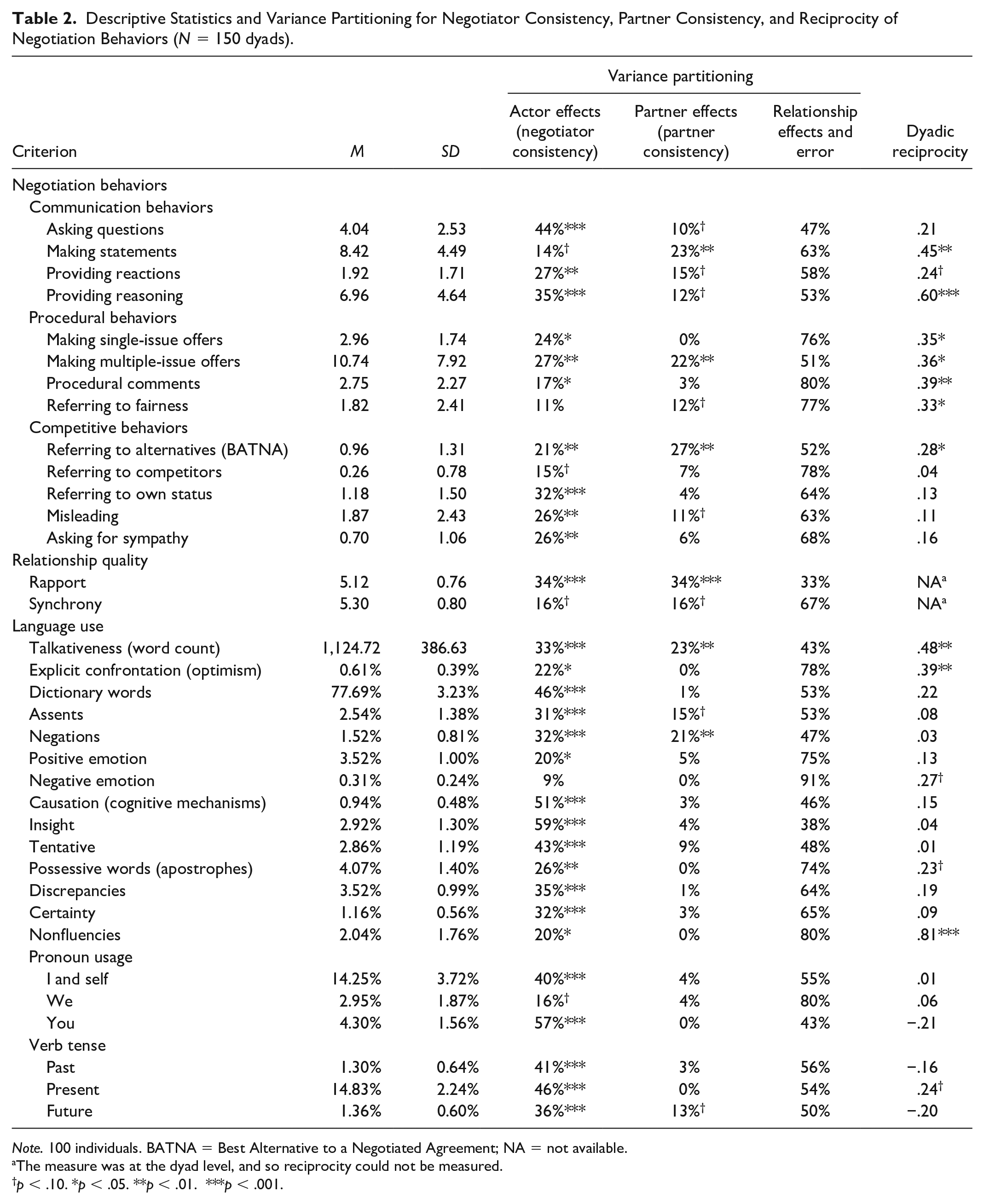
Table 2 contains descriptive statistics, variance partitioning, and reciprocity for behavioral variables. For illustration, we report the average count of each behavior per person per negotiation. For analysis, however, these variables were standardized within role. We did this standardization because some scenarios may bring out scripts for normative behavior, and each participant played only one role in these two-party exercises. As mentioned above, all participants completed the three exercises in the same order. This means that there should be no main effects for order in value claiming, and any main effects for order in value creating should be accounted for by the standardization process.
Descriptive Statistics and Variance Partitioning for Negotiator Consistency, Partner Consistency, and Reciprocity of Negotiation Behaviors (N = 150 dyads).
Note. 100 individuals. BATNA = Best Alternative to a Negotiated Agreement; NA = not available.
The measure was at the dyad level, and so reciprocity could not be measured.
p < .10. *p < .05. **p < .01. ***p < .001.
Supplemental Tables 1 and 2 include correlation matrices for outcome variables and behavioral variables, respectively.
Negotiator Consistency (i.e., Actor Effects)
Hypothesis 1 examined the actor effects listed in Table 2. It is noteworthy that almost all behaviors showed significant or marginally significant consistency across the three interactions. As such, negotiators tended to act similarly in their micro-level behaviors from one encounter to the next. According to Kenny (1994), beyond statistical significance there is a benchmark of 5% to consider an effect meaningful, and by this benchmark many of the effects for behavioral consistency are substantial. For example, individual consistency from one encounter to the next explains 44% of the variance in asking questions, 35% of the variance in providing reasoning, and 26% of the variance in misleading.
Partner Consistency (i.e., Partner Effects)
In addition to negotiator behavioral consistency, Table 2 demonstrates evidence for partner behavioral consistency in the form of partner effects—albeit to a smaller degree. In support of Hypothesis 2, negotiators’ partners were consistent in terms of their development of rapport (34%) and their frequency of referring to alternatives (27%), making statements (23%), talkativeness (23%), making multiple-issue offers (22%), and making negations (21%).
Dyadic Reciprocity
Finally, we report the results for reciprocity. What the SRM model labels as dyadic reciprocity indicates the extent to which members of dyads uniquely reciprocate each other’s behavior. Consistent with Hypothesis 3, a number of behaviors were reciprocated. These include the use of nonfluencies (r = .81), providing reasoning (r = .60), talkativeness (r = .48), and making offers (multiple issue, r = .36 and single issue, r = .35), among others. Although this was not formally tested, by visual inspection the communication and procedural behaviors appeared to be reciprocated to a greater extent than did the competitive behaviors.
Associations With Negotiation Outcomes
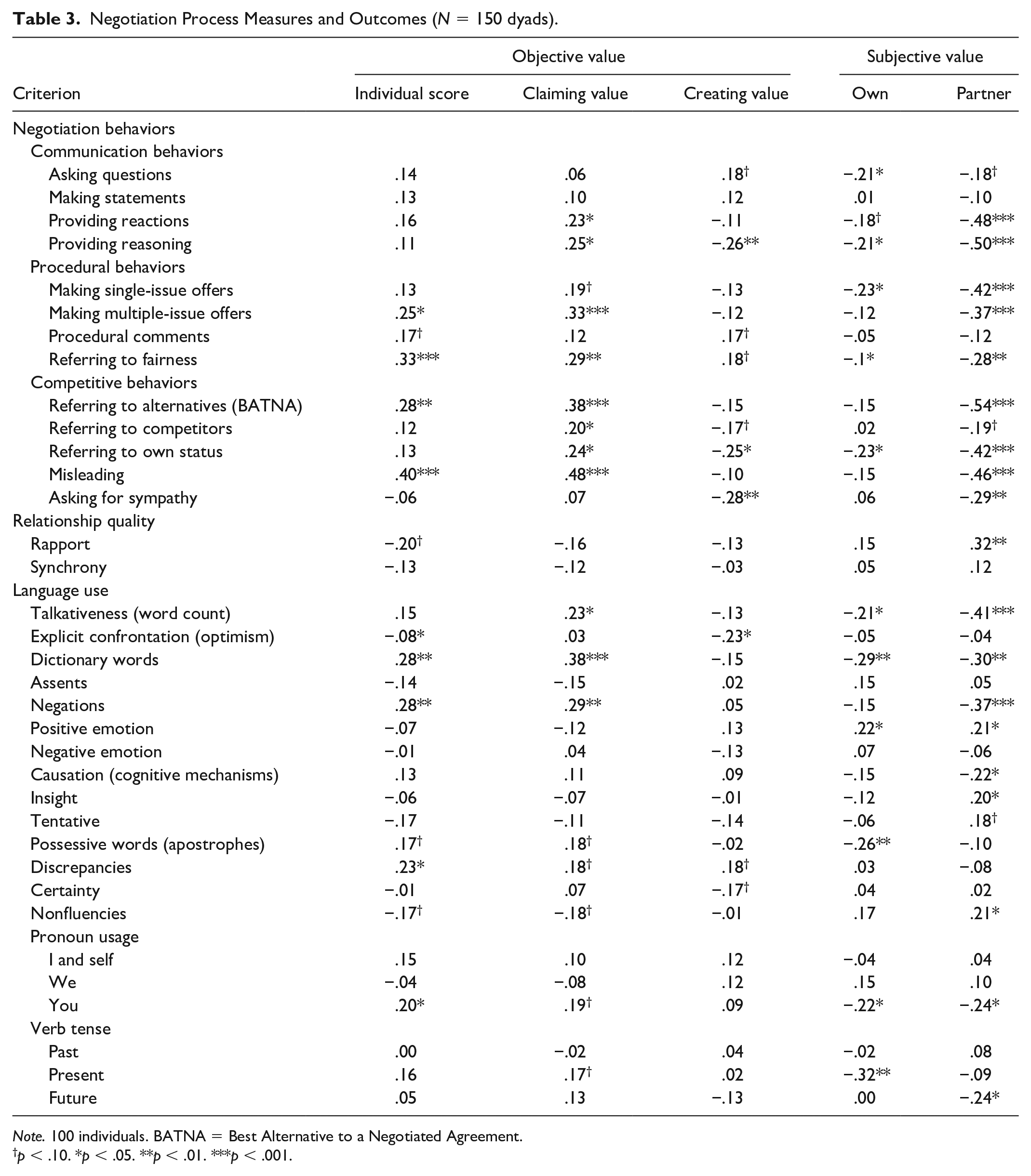
As a supplementary analysis, we report the associations of the behavioral variables with negotiation outcomes. Table 3 presents correlations between each behavior and both objective value (total score, claiming value, and creating value) and subjective value (the negotiator’s own reports and partner reports). To conduct these analyses, we made use of individual-level variables that the SRM constructs. These variables reflect each participant’s personal average across their various partners, while accounting for interdependence of data points. A number of behaviors predicted objective scores, namely, misleading (r = .40), referring to fairness (r = .33), referring to alternatives (r = .28), using dictionary words (r = .28), using negations (r = .28), making multiple-issue offers (r = .25), and using the second-person pronoun you (r = .20). A number of behaviors also predicted subjective value, particularly for the subjective value of the partner. Most negotiation behaviors that correlated highly with claiming value also predicted lower subjective value for one’s partner.
Negotiation Process Measures and Outcomes (N = 150 dyads).
Note. 100 individuals. BATNA = Best Alternative to a Negotiated Agreement.
p < .10. *p < .05. **p < .01. ***p < .001.
Discussion
This research took a new perspective on the long-standing mystery of personality in negotiation, which for the most part has been met with decades of null and inconsistent findings. Grounded in interactionist theories that define personality as consistency in behaviors when placed multiple times in the same situation (Mischel & Shoda, 1995), the investigation examined consistency across negotiation partners in their behavioral signatures. We examined a wide diversity of behavioral variables, including communication behaviors, procedural behaviors, competitive behaviors, relationship quality, and language use. The list was meant to be exhaustive and comprehensive to allow for greater generalizability. Even across these varied behaviors, consistency was significant or marginally significant for almost all variables. Drawing from past research on negotiator behavior (e.g., Adair & Brett, 2005; Weingart et al., 1990), what was unique in this investigation was moving from the level of one-shot interactions to person-level consistency across interactions. It could not be taken for granted that negotiators would behave consistently across their interactions with multiple partners: An alternative hypothesis could be that negotiators would not so much differ from others in their typical behavioral profiles, but rather could vary the way they adapt their behaviors as each negotiation unfolds through an idiosyncratic chain of actions and reactions.
There was also evidence—albeit less consistent—for consistency in the behaviors across each negotiator’s multiple partners. This suggests the possibility that some negotiators elicit certain behaviors in their counterparts, regardless of their own personal behavior. We found, for example, that some individuals have negations said to them more often than others, some individuals have more words spoken to them than others, and some individuals have others tell them more often about their alternatives. We speculate that the negotiator is doing something systematic to elicit such behaviors, and they are likely doing so through their own consistent behavior. In this sense, it is possible that negotiators display a kind of behavioral presence, whereby they create a signature not just of their own behavior but also the behavior of others. We did not see a particular pattern in which variables elicited versus did not elicit partner effects.
Finally, there was evidence for reciprocity within dyads, which demonstrates behavioral similarity between partners. Many negotiation behaviors appear to be similar between the two parties, notably those behaviors related to communication and procedures. This finding suggests a spiral of action and reaction among counterparts. Behaviors such as questioning, reasoning, making offers, and discussing procedures tend to converge between partners. Interestingly, however, there was little evidence for reciprocity for those behaviors related to competition. In attempting to make sense of these results, we note the potential role of the classic psychological model of interpersonal theory (Asch, 1946; Leary, 1957; Wiggins, 1979). According to this theory, interpersonal behaviors can be characterized along the two orthogonal axes of affiliation and dominance. During interpersonal interactions, affiliation-related behaviors tend to be reciprocated and dominance-related behaviors tend to be complemented. As such, with a strict prediction from interpersonal theory, we would have expected to see negative reciprocity for the competitive behaviors. However, interpersonal theory was developed in the context of settings that are primarily social and cooperative, whereas competitive settings may elicit a spiral of increasing dominance-related behaviors (Brett et al., 1998). In that case, one might expect a positive correlation for competitive behaviors. We speculate that these competing predictions may each be veridical for certain people or certain interactions, and could have canceled out each other for an overall null effect for reciprocity in competitive behaviors.
Behaviors and Negotiation Performance
Analyses included the associations between all of the behavioral variables tested along with negotiation performance. Rather than make predictions for each of the 35 variables crossed with five factors of performance, we treated this as a supplemental analysis. Without formally testing hypotheses and controlling for the possibility of capitalizing on chance with this large number of coefficients, we note several broad trends post hoc based on visual inspection. In particular, there are a number of behaviors that predict higher scores—primarily through greater value claiming—and these behaviors appear to have a key attribute in common. Notably, they are all a matter of taking initiative and remaining actively engaged in the negotiation process. These include being more talkative, making more offers, referring to fairness, providing reasoning, and providing reactions. These also include competitive behaviors such as misleading and referring to one’s BATNA.
However, these highly activated behaviors tended in general to predict lower value creation. It is possible that the focus of these tactics on improving one’s own performance had the effect of crowding out room to engage in integrative discussion. We note that not all past findings regarding value creation are replicated in this study; notably, the negative effect of providing false or misleading information to the other party on value creation did not reach statistical significance. That said, as we discuss in the “Limitations” section, the distributive component of this exercise may have swamped the integrative component, in which case tests of coefficients for creating value may be underpowered.
Another trend is that many of the behaviors positively associated with value claiming—particularly the competitive behaviors—also are negatively associated with subjective value, especially the subjective value of the counterpart. This suggests caution for implementing “hardball” negotiation tactics. Such tactics may work in the short term, but backfire in the long term. We note that our research protocol does not test for the long-term quality of implementation or future interactions, both of which rely on goodwill to the extent that there is discretion involved, and so it may overestimate the potential value of highly competitive tactics.
Some smaller trends are also worth noting. For example, positivity (i.e., positive emotion) predicts greater subjective value, whereas negativity (i.e., negations) predicts lower subjective value. Talkativeness is evidently particularly disliked in the form of reducing counterparts’ subjective value considerably. This suggests the potential value for negotiators of being quiet enough to be an effective listener.
Individual Differences in Negotiation
These results suggest optimism for the study of individual differences in negotiation. The larger number of null and often inconsistent findings long associated with this question has led many theorists to speculate whether the pursuit itself should be abandoned (Terhune, 1970; Thompson, 1990)—in spite of strong intuitions by the general public that personality should matter. We drew upon theoretical traditions that consider individual differences to be consistent over time in an individual’s behaviors when placed in the same situation (e.g., Mischel & Shoda, 1995), and we took a different approach to this question than using personality questionnaires. In doing so, we find strong evidence that consistency over time exists, which is the very definition of personality. Such consistency suggests the potential for enduring dispositions to predict objective and subjective outcomes, 4 and so our study can be interpreted as contributing to the justification for continued interest in the topic. The results of this research suggest promising directions for future work.
New personality measures worth studying in the negotiations context could start with the list of behaviors that were highly consistent and that predicted differences in outcomes. This is a matter of coming “full circle” and letting the most relevant behaviors drive the choice of traits to feature in future work. On a post hoc basis, we note that there was an overarching theme among such behaviors of asserting oneself. As discussed in the section immediately above, the behaviors that appeared to improve objective performance were largely a matter of taking initiative and remaining actively engaged. A next frontier might be to map the behaviors from this study that proved to be behaviorally consistent onto granular-level personality traits that can be tested using questionnaires. This would mean moving beyond the higher level Big Five traits (Costa & McCrae, 1992), which have been extensively studied in the negotiations domain and which yield effect sizes that are close to zero for associations with performance variables (Sharma et al., 2013). Granular-level measures could be developed specifically for the negotiations domain (see, for example, negotiation self-efficacy; Sullivan et al., 2006), to supplement research that imports preexisting traits from general personality psychology. Given the theme of asserting oneself, some candidates of granular individual differences to feature may be along the lines of behavioral activation (Carver & White, 1994), assertiveness (Costa & McCrae, 1992), dominance (Wiggins, 1979), competing (Thomas & Kilmann, 1974), and unmitigated agency (Bakan, 1966; Helgeson & Fritz, 1999).
Limitations
This study has important limitations that need to be acknowledged. One limitation is the study’s laboratory nature using simulations, which is in keeping with the bulk of negotiations research. Scholars who study negotiation have tended to treat negotiations as decontextualized events, which is a choice reflected in the use of experimental designs (Barley, 1991). In addition, we attempted to be comprehensive in our selection of behaviors, but do not claim that this investigation exhausts all possible behaviors that are important in a negotiation framework. Another limitation is the sample size. Although the repeated nature of the round-robin design provided as much data as N = 300 participants in a standard design, and was more than sufficiently powered to test the study hypotheses using the SRM, for the supplemental analyses in which the individual was the unit-of-analysis, the sample was only N = 100 individuals. Another limitation is that the exercises had relatively low integrative potential for a mixed-motive scenario. Each contained one compatible issue and two issues that could be traded off against each other. The typical mixed-motive study uses eight issues (e.g., Neale, 1997), which offers more combinations that afford room for logrolling. Accordingly, the correlation between parties’ scores was r = –.70, which is largely distributive. As such, analyses of creating value could be underpowered.
Implications and Conclusion
We hope that the current study invigorates the further pursuit of personality effects in negotiation. In light of the meager findings for main effects in the body of past research, it was worthwhile to step back from this question. As much as our results suggest a strong role for individual differences in negotiation—given individual-level consistency in negotiators’ behavior—they also suggest the power of training. Systematic negotiation training has been demonstrated to be effective (Nadler et al., 2003), particularly using techniques of observational learning and analogical learning via comparative case studies (Loewenstein et al., 1999). We note that the behaviors that were the most predictive of negotiation effectiveness are within anyone’s grasp, such as making more multiple-issue offers, saying no more often, and referring to one’s alternatives or fairness principles when needed. Our focus on behavioral processes leaves open the door for negotiators to add effective tactics to their own repertoires without necessarily transforming the fundamentals of their personality.
Supplemental Material
sj-xlsx-1-psp-10.1177_01461672221086197 – Supplemental material for Negotiator Consistency, Counterpart Consistency, and Reciprocity in Behavior Across Partners: A Round-Robin Study
Supplemental material, sj-xlsx-1-psp-10.1177_01461672221086197 for Negotiator Consistency, Counterpart Consistency, and Reciprocity in Behavior Across Partners: A Round-Robin Study by Hillary Anger Elfenbein, Jared R. Curhan and Noah Eisenkraft in Personality and Social Psychology Bulletin
Footnotes
Declaration of Conflicting Interests
The author(s) declared no potential conflicts of interest with respect to the research, authorship, and/or publication of this article.
Funding
The author(s) received no external financial support for the research, authorship, and/or publication of this article.

Supplemental Material
Supplemental material is available online with this article.
Notes
References
Supplementary Material
Please find the following supplemental material available below.
For Open Access articles published under a Creative Commons License, all supplemental material carries the same license as the article it is associated with.
For non-Open Access articles published, all supplemental material carries a non-exclusive license, and permission requests for re-use of supplemental material or any part of supplemental material shall be sent directly to the copyright owner as specified in the copyright notice associated with the article.
