




Abstract
As the online world plays an increasing role in young peoples’ lives, research on compulsive internet use (CIU) is receiving growing attention. Given the social richness of the online world, there is a need to better understand how CIU influences adolescents’ social support and vice versa. Drawing on ecological systems theory, we examined the longitudinal links between adolescents’ CIU and perceived social support from three sources (parents, teachers, and friends) across 4 critical years of adolescence (Grades 8–11). Using random intercept cross-lagged modeling, we found that CIU consistently preceded reduced social support from teachers, whereas social support from parents preceded increases in CIU over time. We discuss the implications of our findings for parents and schools seeking to support young people experiencing CIU.
The internet and social media are radically changing the way young people interact with their social environment. Recent surveys have found that U.S. adolescents spend approximately 7 hr of nonschool or study time per day online (Rideout, 2016, 2019), with a large portion of this time spent in social interaction. In this context, it is of critical importance to understand the impact of extensive online activity on young peoples’ ability to access social support from different sources. Do high levels of online activity strengthen or erode young peoples’ social support? Or does online activity have differing effects on different types of social support (e.g., support from adults vs. peers)? In this study, we examined the issue of compulsive internet use (CIU) and its impact on adolescents’ perceived social support—from parents, teachers, and close friends—across 4 crucial years of adolescence.
Extensive online activity has been shown to precipitate the compulsive use of the internet (van den Eijnden et al., 2008; Van Der Aa et al., 2009). CIU, also referred to as problematic internet use, refers to difficulty regulating one’s internet use and often involves compulsive symptoms, withdrawal symptoms, rumination about being online when not online, and disengagement from daily activities (Hsieh et al., 2021; Király & Demetrovics, 2021; Meerkerk et al., 2009). There has been an ongoing debate about whether or not CIU represents a disorder (for a discussion, see Moretta et al., 2022). Although not officially recognized as such in the Diagnostic and Statistical Manual of Mental Disorders, Fifth Edition (DSM-5), CIU shares many similarities with other addictive disorders, such as internet gaming disorder (which has recently been included in the DSM-5). Common markers include withdrawal, loss of control, preoccupation, conflict, and using the internet as a coping mechanism (Luo et al., 2021; Meerkerk et al., 2009). As such, CIU has been the subject of extensive research over the past decade.
CIU has been linked to alcohol usage (Lanthier-Labonté et al., 2020), problems with sleep (Alimoradi et al., 2019), poor mental health (Ciarrochi et al., 2016; Zhou et al., 2020), difficulties with emotion regulation (Donald et al., 2020), and worse self-concept (Donald et al., 2019). CIU can be specific, when it relates to the compulsive use of specific online activity (e.g., social media use, gaming, messaging, listening to music, accessing movies and shows), or general, when a person reports a general dependence on online activity, typically covering a range of specific uses (Caplan, 2003; Ciarrochi et al., 2016; Rideout, 2019). In this investigation, we examined the links between general CIU and adolescents’ social support.
Although multiple studies have now shown that CIU precedes intrapersonal problems (e.g., Ciarrochi et al., 2016; Donald et al., 2019, 2020; Muusses et al., 2014; van den Eijnden et al., 2008), relatively less research has examined the social causes and consequences of CIU in a longitudinal context. Numerous theoretical frameworks suggest that developmental outcomes are not solely driven by the individual, but result from a transaction between the individual and the social context (Bronfenbrenner, 1977, 1992; Fiese & Sameroff, 1989; Leve & Cicchetti, 2016; Sameroff & Mackenzie, 2003). For example, Bronfrenbrenner’s ecological systems theory (Bronfenbrenner, 1977, 1992) describes social context as a nested arrangement of structures, each contained within the next, such that, for example, family is nested within an extended family that is nested within culture (Bronfenbrenner, 1977, 1992). This study focused on the first level of Bronfenbrenner’s model, the “microsystem” or social environment that has direct contact with the young person. We focused on the longitudinal interaction between support from parents, teachers, and close friends, and compulsive CIU. Do social support and CIU mutually influence each other, as Bronfenbrenner’s model suggests? Specifically, does a lack of support, especially from adults (i.e., parents and teachers), lead to the development of CIU? Does CIU, in turn, lead to diminished social support and thus contribute to a vicious cycle of CIU and increasing isolation? In this article, we examined these possibilities, drawing on a large sample of adolescents in Grades 8 to 11.
The Adolescent Social Context
This article focuses on perceived social support, which is defined as an individual’s subjective appraisal that people in their social network care for them and are willing to provide assistance when needed (Lakey & Scoboria, 2005). Feeling supported is an inherently subjective judgment and there may be a discrepancy between the extent that others think that they are being supportive and the extent to which adolescents perceive others’ support. Perceived support is more strongly linked to well-being than other indices of support (Chu et al., 2010), making perceived social support a valuable phenomenon of study in relation to CIU and adolescent development.
Perceived social support has been linked to a broad array of well-being indices (Hawkley & Cacioppo, 2010; Heinrich & Gullone, 2006). For example, the health benefits of having strong social relationships are similar to the benefits of quitting smoking, having a healthy weight, and engaging in physical activity (Holt-Lunstad et al., 2010). It may be particularly important for young people to receive support from trusted adults. Ciarrochi et al. (2017) found that having high support from parents and teachers was more strongly associated with well-being and mental health than having support from peers. In general, they found that having strong support from adults was associated with having strong support for peers, but the reverse was not true.
There are two principal explanations for the benefits of social support for young people. The indirect, “stress buffering” hypothesis suggests that emotional, informational, and resource support help young people to manage stressful life events and it is the management of such events that promotes well-being (Cohen & Wills, 1985). In contrast, the “direct” hypothesis suggests that social support provides benefits during both stressful and non-stressful times, as when support provides a sense of belonging. Both indirect and direct perspectives have found support, with social support being a crucial and central ingredient in adolescent development (Taylor, 2012; Thoits, 1995).
Sources of Adolescent Social Support
Most adolescents obtain support from multiple sources (Chu et al., 2010). Adolescents spend the large majority of their time with family, friends, and teachers (Pössel et al., 2018). However, these three sources of support are only moderately related (Burke et al., 2017; Ciarrochi et al., 2017; Pössel et al., 2018). For example, youth can have support from family and teachers, but not peers, and vice versa (Ciarrochi et al., 2017). The benefit of social support appears to depend on the source (Chu et al., 2010). Adults appear to provide better emotional support than peers. One meta-analysis involving hundreds of studies found that teacher and parental social support explained about 4% of the variance in well-being, whereas support from friends explained about 1% (Chu et al., 2010). One important distinction between adult and peer social context is that youth choose which friends they associate with. This choice may be based more on perceived similarity and attractiveness than supportiveness (noting that perceived and actual similarity often vary; Selfhout et al., 2009; van Zalk & Denissen, 2015). For example, adolescents are similar to their friends in hope (Parker et al., 2015), academic achievement (Cook et al., 2007), and aggression (Espelage et al., 2003). Thus, although young people choose their friends, this may not always produce the social support they need to thrive (Ciarrochi et al., 2017).
In addition to the distinction between adult and peer social support, there are important differences between parental and teacher support. Early in life, social support comes from the family as parents teach children the extent that others can be trusted (Bowlby, 1969) and help them to develop hope and emotion regulation skills (Heaven & Ciarrochi, 2008; Williams et al., 2012). As children develop, relationships outside of the family, such as those involving teachers, become increasingly important. Young people learn to engage in new social roles, cooperate with others, and build new relationships with peers and adults (Eccles, 1999; Hayes & Ciarrochi, 2015).
Research suggests that parents and teachers each provide distinctive forms of support for adolescents. Parents provide more emotional and instrumental support (e.g., helping with homework) than teachers. In contrast, teachers provide similar levels of informational support as parents (e.g., providing direction and tips in completing school work; Hombrados-Mendieta et al., 2012). Parental support may be more important than teacher social support for predicting engagement in extracurricular activities (Wang & Eccles, 2012). Longitudinal research suggests that both teachers and parents uniquely contribute to students’ subjective value of learning (Wang & Eccles, 2012). Teacher support is often implemented through school-based social and emotional learning programs. Such supportive programs can provide substantial benefit to academic success and well-being (Durlak et al., 2011). One meta-analysis suggests that teacher support may even have slightly stronger links to student well-being than support from family (Chu et al., 2010).
The Development of Social Support and CIU
The family provides a primary source of social support for young people even into adulthood (Parker et al., 2012). In contrast, friendship groups may be a less important source of support in early childhood, but become increasingly important during adolescence (Furman & Buhrmester, 1992; Selfhout et al., 2010). The quality of support can change over time and this can take different forms. Changes may occur within a person, for example, when an individual experiences increasing social support relative to their own baseline. Changes can also occur between individuals, for example, when someone ranked in the 50th percentile on social support in a population drops to the 25th percentile over time. Research and theory has pointed to the need to separate these different sources of variance, and, for example, not make within-person conclusions based on between-person analyses (Hamaker et al., 2015; Núñez-Regueiro et al., 2022). For example, it is possible for a person to lose social support relative to their peer group, but still experience increases in social support relative to their own baseline.
In this study, we utilized random intercept modeling to separate out these distinct between-person and the within-person components. Both are important for understanding adolescent development. The between-person component reflects causal processes that were present prior to the study and do not appear to change during the study. The within-person component reflects how individuals changed during the course of the study. In this study, we have temporal ordering information (i.e., through longitudinal data) for the within-person component and thus focus on this in evaluating how social support influences CIU and vice versa.
The Reciprocal Influence Model of CIU and Social Support
Drawing on ecological systems theory (Bronfenbrenner, 1977, 1992), we anticipated that adolescents’ CIU and their social support context will be mutually reinforcing. We term this the “reciprocal influence” model. The reciprocal influence model suggests that diminished social support leads to increased CIU, and that CIU, in turn, diminishes social support, setting in motion a vicious cycle. This model can be decomposed into two smaller models, which we will term the “antecedent” and “consequence” models. The antecedent model proposes that low levels of social support are an antecedent to CIU. The consequence model claims that CIU inhibits adolescent social support over time. The reciprocal influence model is supported when both the antecedent and consequence models are supported.
Past research provides support for the antecedent model, at least for adult social support. For example, research suggests that if a parent has a positive relationship with their child, and uses productive parenting practices, the child is less likely to develop compulsive internet usage (Miltuze et al., 2021). Although this study provides preliminary evidence, it did not separate the between-person and within-person variance elements, as discussed above. Another study focused on the longitudinal link between internet-specific parenting practices (such as high-quality communication and internet-specific rules) and symptoms of social media disorder (Koning et al., 2018). They found that more frequent parent–adolescent communication predicted more internet gaming disorder. Furthermore, more internet gaming disorder predicted poorer quality parenting behavior in the form of reactive rules and lower quality communication. These findings suggest that there will be a bidirectional influence between CIU and parental support, and not necessarily the positive effects of parenting that we might expect. However, Koning et al. (2018) did not separate the between- and within-person variance, so it is unclear whether the bidirectional effects were due to within-person changes. In addition, the study did not consider other aspects of adolescents’ social world, including the school context (i.e., teachers and friends).
In a study that did include a focus on both family and the school context, Hsieh et al. (2021) found that young people who experienced lower child neglect and more positive school experience reported lower levels of internet addiction at baseline, but faster increases in internet addiction across time. This finding again highlights that parental support may not always be associated with reductions in CIU. This study also highlights the difference between within-person and between-person effects, in that the between-person effects were in the expected directions, with a positive social environment linked to lower addiction at baseline, but within-person effects suggested that positive social environment was unexpectedly linked to worsening internet outcomes. This study suggests that social factors will act as antecedents to the development of CIU. However, Hsieh did not include social support and CIU at multiple time points and so could not test the reciprocal influence model. Past research has thus provided ambiguous results about the role of parents and teachers in CIU, and we intend to add to this research literature. In general, we expected that supportive parents and teachers help young people to manage emotions and stay engaged in school (Gutiérrez et al., 2017; Morris et al., 2017) and this should protect them from CIU.
Regarding the consequence model, CIU has been shown to lead to a range of undesirable outcomes for adolescents, including emotional dysregulation (Donald et al., 2020), loss of hope (Donald et al., 2019), and mental health problems (Ciarrochi et al., 2016). Consistent with these intrapersonal findings, we expected that CIU would also precipitate interpersonal problems, specifically, depleted relationships with adults. We anticipated that CIU will disrupt the quality and amount of time, and hence support, that young people receive from trusted adults (i.e., parents and teachers), displacing these opportunities for (mainly offline) support with online activity. Preliminary evidence supports these predictions. For example, Miltuze et al. (2021) found that CIU among young people was linked with inconsistent parenting and disrupted relationships with parents. In a 2-year longitudinal study, Koning et al. (2018) found that adolescents with internet gaming disorder reported worse quality communication and more reactive parental rules the following year. Based on these preliminary findings, we expect general CIU to negatively affect social support received from adults over time.
We did not make predictions as to the effect of close friendship support on CIU and vice versa. On one hand, supportive friendships are linked to well-being (Chu et al., 2010), which suggests that close friends might be a protective factor against the development of CIU. On the other hand, CIU is likely to involve close friends, in the form of gaming and social media (Ciarrochi et al., 2016), and “supportive” peers may compete with parents’ attempts to regulate internet use (Soh et al., 2018). Thus, if youth experience CIU, this is likely to be with friends and may not undermine the perceived supportiveness of these friends. This leads us to a research question rather than a hypothesis.
Given the research reviewed above shows that parent and teacher support is distinctive, we examined these sources of support separately to see whether they relate in unique ways to CIU. There was too little longitudinal research that contrasted parental and teacher social support to make an empirically driven prediction, but we speculate that the burden of adolescent CIU may fall more heavily on parents than on teachers. Ultimately, the parent has the difficult task of regulating the adolescent’s internet behavior outside of school hours and in environments that are, relative to school, unstructured and difficult to monitor. For example, schools can ban phone use during class time and students, confined to a single classroom, can be monitored in a way that is much more difficult at home. In addition, access to devices such as video game consoles is generally greater at home than at school (Rideout, 2016). Given these speculations, we sought to explore distinctions between parent and teacher support and their impact on CIU development, leading to our second research question:
Method
Participants and Procedure
The present investigation was a part of a multiyear research project, the Australian Character Study (ACS; Australian Research Council grant number DP140103874), which explored Australian adolescents’ behaviors, relationships, beliefs, aspirations, and self-evaluations. The specific research questions and hypotheses of this study were not pre-registered although they were included more generally as a part of the research aims of the ACS. Participants for this study were drawn from 17 Catholic high schools in two Australian states: New South Wales and Queensland. In Australia, Catholic schools make up 19.4% of secondary schools (Australian Bureau of Statistics, 2020). The schools included in this study were mainly in cities—Wollongong (in New South Wales) and Cairns (in Queensland). However, the study included a number of schools in rural locations, thereby enhancing the socioeconomic and geographic diversity of study participants. The Australian Government’s Index of Community Socio-Educational Advantage (ICSEA) provides an indication of the level of a school’s social and educational advantage relative to other schools (https://docs.acara.edu.au/resources/Guide_to_understanding_icsea_values.pdf). The schools in this study had an average ICSEA ranking of 1,025 (SD = 43), which is slightly above the Australian average of 1,000, making this study broadly representative of the Australian population. This study’s materials, analysis code, and the study data file can be found here: https://osf.io/697kt/.
Study participants completed a survey three quarters of the way through the school year (i.e., in Term 3) in each of Grade 8 to Grade 11. Participants were recruited to the study through their school and completed paper-and-pencil questionnaires in the classroom in each year of the study (2010–2014). Informed consent for each student’s participation was provided by parents or primary caregivers per the ethics board requirements of the third author’s institution. In Grade 8, the average participant age was 13.7 years (SD = 0.45). A total of 2,809 students participated in the study (1,395 or 49.7% male, 1,399 or 49.8% female, and 15 unknown). We conducted power calculations to detect the minimum sample size needed to detect effects, based on a 95% power level. Based on recent longitudinal studies of CIU (e.g., Donald et al., 2019, 2020; Muuses et al., 2014; van den Eijnden et al., 2008), we assumed an effect size of 0.05. Power analysis indicated that a sample size of N = 262 was needed to detect this sized-effects with 95% power, indicating that this study was very well powered to detect effects. We received ethics approval for the study from the second author’s institution and all study participants completed consent forms prior to participating.
Measures
CIU
CIU was measured with the Compulsive Internet Use Scale (CIUS; Meerkerk et al., 2009). The CIUS was designed to capture the central features of addictive behavior (per the DSM-IV and elsewhere), including elements, such as withdrawal symptoms, loss of control, preoccupation, conflict with other activities, and lying to hide addictive behavior (see Meerkerk et al., 2009, for a discussion). Due to constraints from the schools included in this study on the length of the survey, the CIUS was shortened from 14 items to 10 items, by dropping Items 11 to 14 of the CIUS (Meerkerk et al., 2009). The 10-item version of the CIUS has demonstrated acceptable psychometric properties, including factorial stability across time and good convergent validity (Ciarrochi et al., 2016; Donald et al., 2018, 2020). Cronbach’s alphas for this measure in among this sample were acceptable (Grade 8, α = .88; Grade 9, α = .89; Grade 10, α = .89; and Grade 11, α = .89). Scale responses range from 0 (never) to 4 (very often). Sample items include “Do you find it difficult to stop using the internet when you are not online?” and “Do you feel restless, frustrated, or irritated when you cannot use the internet?”
Social support
Three sources of social support were measured in this study: social support from parents, from teachers, and from friends. To measure each of these sources of adolescent social support, we drew on three subscales of the Student Social Support Scale (Malecki & Elliot, 1999; Nolten, 1994). Due to space constraints, we used seven items from each of these subscales. The seven items we selected for each subscale (i.e., social support from parents, teachers, and peers) were the highest loading items on to each subscale factor (see Malecki & Elliot, 1999). Participants responded to a 6-point Likert-type scale from 1 (never) to 6 (always) to rate social support received from parents (α = .93 in Grade 8 and .94 in Grade 11; seven items, for example, “Praise me when I do a good job”), close friends (α = .93 in Grade 8 and .94 in Grade 11; seven items, for example, “Understands my feelings”), and teachers (α = .93 in Grade 8 and .95 in Grade 11; seven items, for example, “Cares about me”). The full list of items used in this study to measure both CIU and social support can be found here: https://osf.io/697kt/.
Statistical Analyses
Random intercept cross-lagged panel modeling (RI-CLPM)
Historically, longitudinal research questions were explored using manifest variables from panel data (e.g., Kenny, 1975; Rogosa, 1980). Over recent decades, these approaches have been superseded by structural equation models (SEMs) using latent variables (e.g., Marsh et al., 2019). Advantages of SEM-based approaches are that they enable the measurement error to be explicitly estimated, thus providing more precise estimates of effects (Weston & Gore, 2006). Within the SEM-based approach to examining longitudinal research questions, CLPMs have been a widely used modeling approach (Usami, 2021). However, scholars have flagged several limitations with CLPMs, perhaps the most significant of which is the conflation of within-person and between-person effects (see Hamaker et al., 2015; Mund & Nestler, 2019; Usami, 2021, for discussions). The concern is that cross-lagged effects in CLPMs are confounded as they not only reflect within-person change, but also include unmeasured between-person (or trait) effects (for a fuller discussion, see Hamaker et al., 2015). As a solution, the RI-CLPM has been proposed (Hamaker, 2015; Mulder & Hamaker, 2021), attracting widespread use in recent years (Usami, 2021). This approach explicitly models a between-person, time-invariant portion of each modeled variable, meaning within-person longitudinal effects, which are generally the focus of longitudinal research and more accurately reflect within-person change (Hamaker et al., 2015). 1 Most recently, a fully latent version of the RI-CLPM has been proposed (see Mulder & Hamaker, 2021). This approach combines the advantages of a SEM-based approach to longitudinal modeling, with the benefits of explicitly modeling within-person change over time (Hamaker et al., 2015). In this study, we used this latent RI-CLPM approach, as shown in Figure 1.

The random intercept cross-lagged panel model (RI-CLPM).
Specifically, we assessed the degree to which, for a given individual in the sample, CIU in one year predicts reductions in social support in the subsequent year, and whether social support in one year precedes within-person reductions in CIU in the next. Figure 1 shows the layout of the latent RI-CLP model. A key innovation of RI-CLP models is the explicit modeling of time-invariant, trait-levels of each study variable (see CIU(B) and SS(B) in Figure 1), thereby isolating time-varying, state levels of each study variable (see CIU(W) and SS(W) in Figure 1). This enables within-person, temporal changes in state variables to be measured (i.e., autoregressive effects; see paths “a” and “b” in Figure 1) as well as within-person effects of one state variable on another (i.e., cross-lagged effects; see paths “c” and “d” in Figure 1). By explicitly modeling within-person, within-variable change over time (i.e., the autoregressive component of the model), RI-CLP models provide a conservative test of temporal precedence of one variable predicting change in another (Mulder & Hamaker, 2021).
We ran separate RI-CLP models for the longitudinal links between CIU and each of the three forms of social support (i.e., social support from parents, teachers, and friends). In running each of these sets of RI-CLP models, we first needed to establish that each model displayed an acceptable fit to the study’s data. To do this, for each RI-CLP model, we tested the fit of a series of six progressively more constrained models, which we describe next.
First, we ran a configural confirmatory factor analytic (CFA 1) model, in which the latent structure of the CIU and social support variables were modeled across the four waves of the study, with each latent factor loading onto multiple items (see the yellow section in Figure 1). If this unconstrained model displays acceptable fit to the data (see below discussion on fit thresholds), models with constraints can be tested (Bollen, 1989). Second, we ran a CFA model where factor loadings were constrained to be equal across time-waves (a “weak” time-invariance model; CFA 2). Third, we ran a CFA model with both factor loadings and intercepts constrained to equality across time-waves (a “strong” time-invariance model; CFA 3). Support for CFAs 2 and 3 indicates that the constructs being measured (i.e., CIU and social support) tap the same phenomenon at each time point (i.e., time-invariance) and is a central assumption of all CLPMs (Bollen, 1989).
We then ran three increasingly restrictive SEM models, which included both the random intercept (the blue section of Figure 1) and within-person fixed effect components of the RI-CLPM (the pink section of Figure 1). The first SEM (i.e., “SEM 1”) was a “fully forward” model wherein regression coefficients for all paths (i.e., autoregressive and cross-lagged) were estimated, including lags across multiple time points (i.e., Time 1 to Time 2, Time 1 to Time 3, and Time 1 to Time 4; not displayed in Figure 1). In the second SEM (i.e., “SEM 2”), lags greater than one time-interval were removed from the model and only single-lag regression coefficients were estimated (depicted in Figure 1). In the third SEM, within-person regression coefficients across single-year lags (i.e., both autoregressive and cross-lagged paths) were set to be equal across time, known as a “developmental equilibrium” model (these constraints are depicted in Figure 1, as “a,” “b,” “c,” and “d”). In each of the SEMs, we included gender as a covariate, given established gender differences in the development of CIU (Ciarrochi et al., 2016) and in adolescent social support seeking (Burke et al., 2017; Ciarrochi et al., 2017; Pössel et al., 2018).
Missing data
Given its longitudinal design and use of a high school student sample, participant attrition was a potential issue in this study. Of the 2,809 participants, 966 provided data for all four waves of the study (50.2% female), 837 provided data for three waves (49.2% female), 532 provided data for two waves (49.5% female), and 470 provided data for only one wave of the study (52.0% female). Where participant attrition is not due to random factors, this can result in biased parameter estimates if ad hoc methods for handling missing data are used, such as pair- or list-wise deletion (Baraldi & Enders, 2010). To avoid this problem, in this study, we used full information maximum likelihood estimation (FIML) methods for handling missing data in all models. The FIML approach uses all the available information for parameter estimation—both complete and incomplete cases—and generates parameter values with the greatest likelihood of reproducing the sample data (Baraldi & Enders, 2010).
Fit statistics
Accepted criteria for a statistical model displaying good fit include parameter estimates being consistent with the theory proposed, the solution being well-defined, and model fit indices being acceptable (McDonald & Marsh, 1990). In this study, we used three commonly used fit indices, in addition to the χ2 statistic: the Tucker–Lewis index (TLI), the comparative fit index (CFI), and the root mean square error of approximation (RMSEA). The TLI, CFI, and RMSEA have the advantage of not being sensitive to sample size in the same way the χ2 statistic is (Cheung & Rensvold, 2002). For TLI and CFI, generally accepted minimum fit thresholds are .90, whereas for RMSEA the maximum generally accepted threshold is .08 (Chen, 2007; Cheung & Rensvold, 2002). In comparing the deterioration in fit of successively more restrictive models (i.e., the two CFAs and three SEMs, across both the RI-CLP and CLP modeling approaches), we used the criteria provided by Cheung and Rensvold (2002), who suggest that invariance exists between nested models if changes in CFI is <.01 (we used the same criteria for the TLI). For RMSEA, we used criteria provided by Chen (2007), who suggests invariance between nested models exists if changes in RMSEA is ≤ .015.
Results
Preliminary Analyses
We first examined means and standard deviations for both CIU and the three social support variables, across the 4 years of the study. As Table 1 shows, mean levels of CIU moderately increased over the course of the 4 years of the study (from M = 1.37 in Grade 8, to M = 1.58 in Grade 11). This trend is consistent with findings from other studies and the tendency for adolescents to engage with the internet more intensively as they progress through high school (e.g., Ciarrochi et al., 2016; Muuses et al., 2014; van den Eijnden et al., 2008). For the social support variables, we note that support from friends was consistently higher than support from parents and teachers, across the 4 years of the study. Whereas support from both friends and teachers was relatively stable across the 4 years of the study, parental social support marginally declined over the course of Grades 8 to 11 (M = 4.73 in Grade 8 to M = 4.46 in Grade 11), perhaps reflecting greater independence from parents as adolescents mature.
Latent Means and Standard Deviations for Study Variables Across the 4 Study Years.

We next examined correlations between the four study variables over the course of the study. In Table 2, we report correlations within each variable across the 4 years of the study (indicated by gray-shaded coefficients in Table 2) and between each study variable (indicated by unshaded coefficients in Table 2). Test–retest correlations for each of the four study variables (shaded gray) were medium-sized, and with larger correlations for more temporally proximal variables, as expected (e.g., r = .60*** for CIU 8 and CIU 9, whereas r = .40*** for CIU 8 and CIU 11). Correlations between each of the three sources of social support were generally small-to-medium in magnitude, underscoring the value of examining these three distinct sources of social support in relation to CIU. Parents and teacher support had modest relationships with CIU, whereas friendship support tended to be unrelated to CIU.
Bivariate Correlations Between Study Variables, Within and Across the 4 Years of the Study.
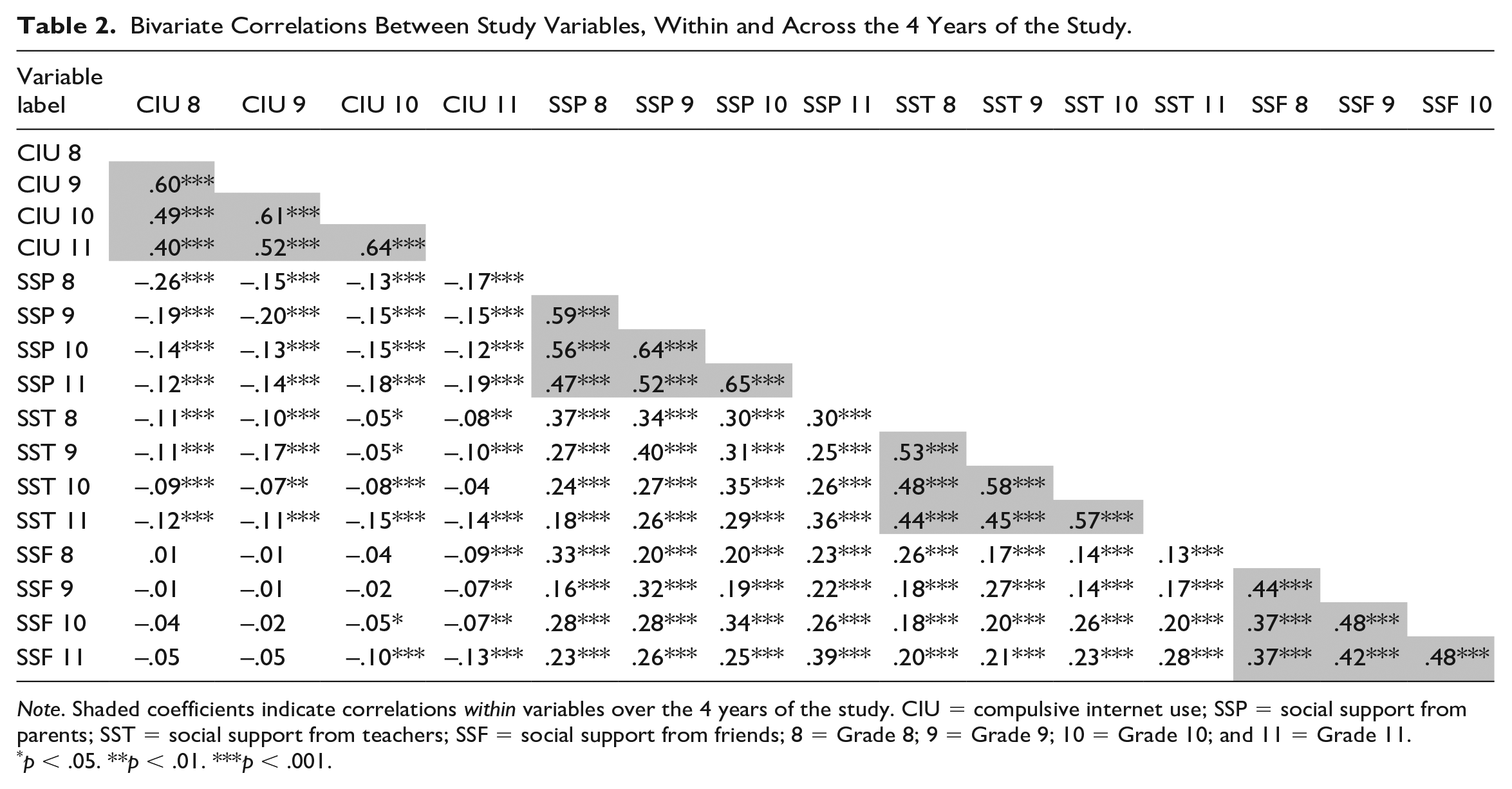
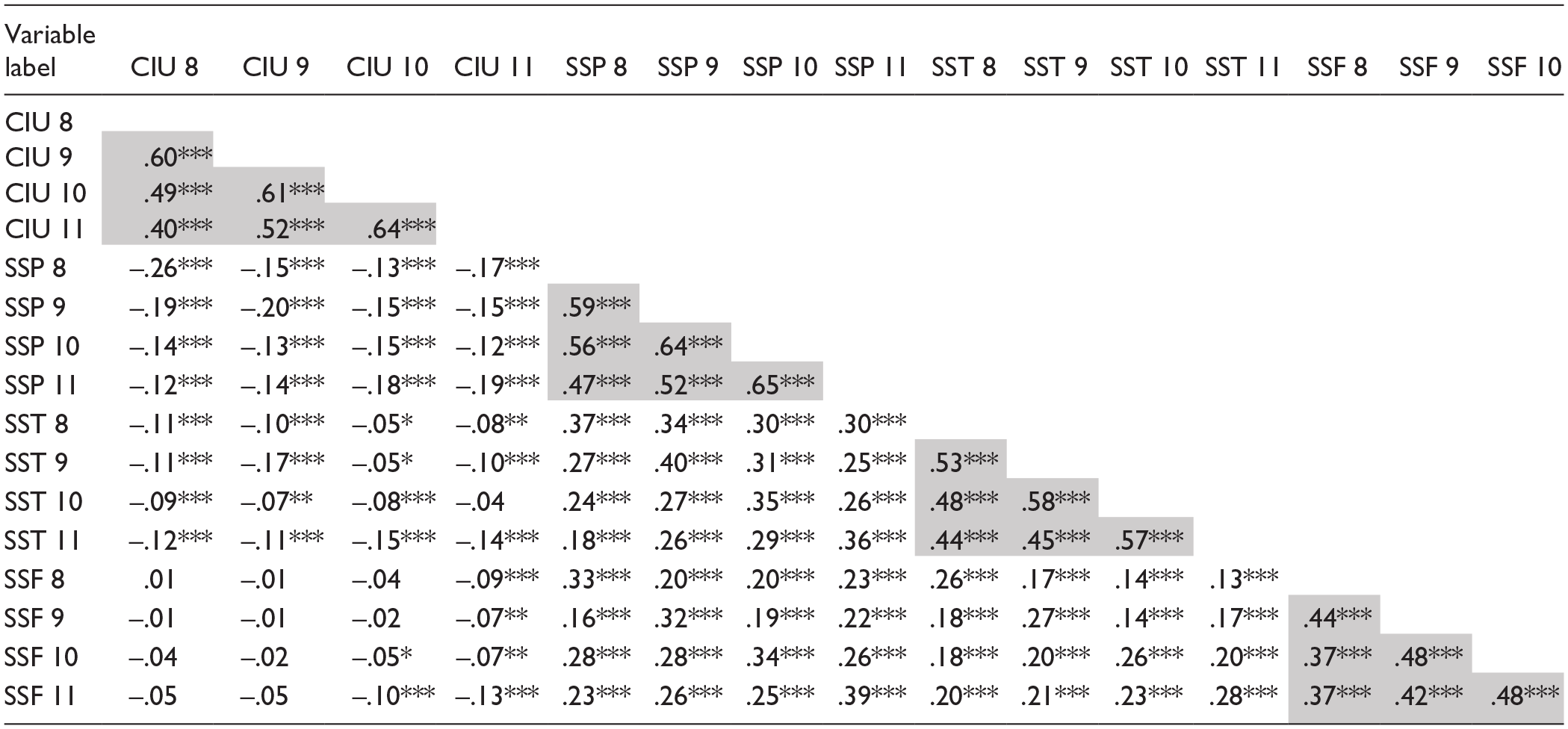
Note. Shaded coefficients indicate correlations within variables over the 4 years of the study. CIU = compulsive internet use; SSP = social support from parents; SST = social support from teachers; SSF = social support from friends; 8 = Grade 8; 9 = Grade 9; 10 = Grade 10; and 11 = Grade 11.
p < .05. **p < .01. ***p < .001.
Model Fit
To test our hypotheses and research questions, we ran a series of six increasingly restrictive, nested models for each RI-CLP model. As Table 3 shows, for all three RI-CLP models (i.e., longitudinal links between CIU and each of the three forms of social support), the measurement structure of each model displayed acceptable fit (CFA 1), per the thresholds for fit statistics outlined above (i.e., CFI and TLI >.90; and RMSEA <.08). Furthermore, the measurement structure of each model displayed time-invariance (both “weak” in CFA 2 and “strong” in CFA 3). The fit statistics for each of the four sets of SEMs we ran also showed acceptable fit and also a deterioration in fit that was within accepted thresholds (i.e., <.01 for CFI and TLI; and <.015 for RMSEA). Together, these results provide support for using SEM 3, the “developmental equilibrium” model, to test the magnitude of stable, within-person links between CIU and social support across the 4 years of the study.
Fit Statistics for Nested Confirmatory Factor Analytic (CFA) and Structural Equation Models (SEM) Within the RI-CLP Modeling Approach.
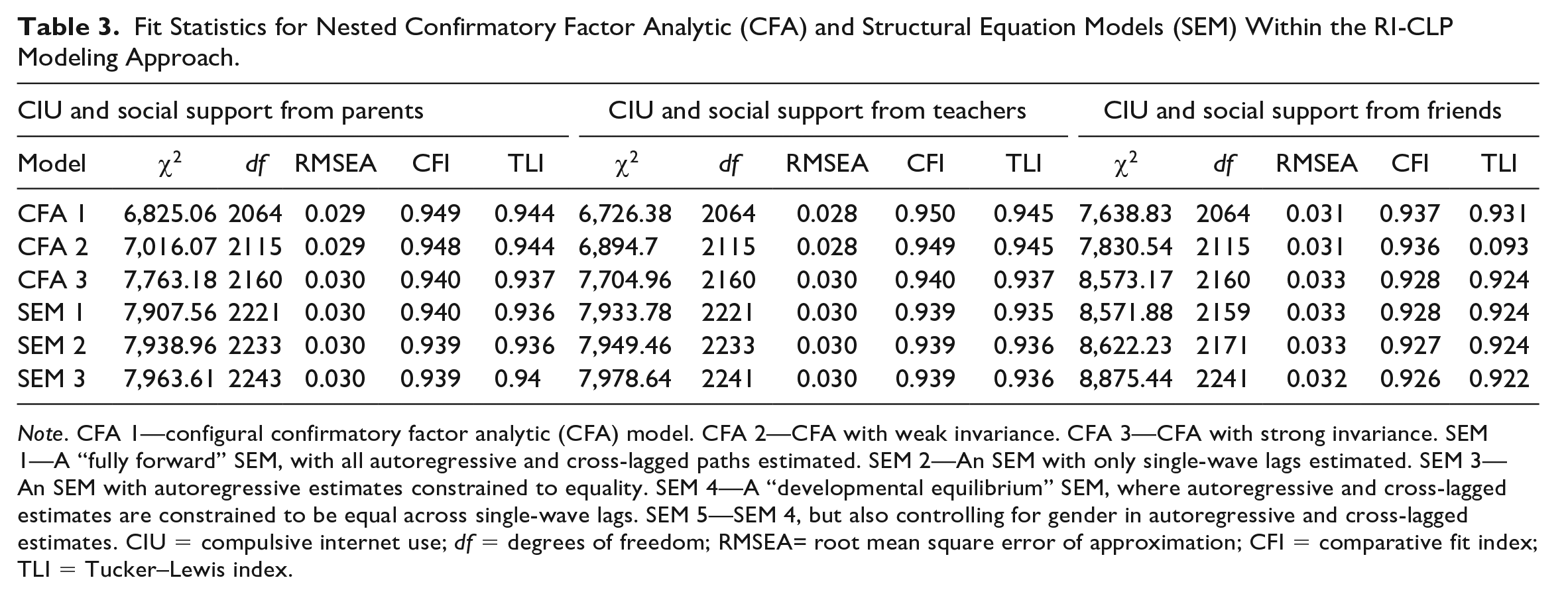
Note. CFA 1—configural confirmatory factor analytic (CFA) model. CFA 2—CFA with weak invariance. CFA 3—CFA with strong invariance. SEM 1—A “fully forward” SEM, with all autoregressive and cross-lagged paths estimated. SEM 2—An SEM with only single-wave lags estimated. SEM 3—An SEM with autoregressive estimates constrained to equality. SEM 4—A “developmental equilibrium” SEM, where autoregressive and cross-lagged estimates are constrained to be equal across single-wave lags. SEM 5—SEM 4, but also controlling for gender in autoregressive and cross-lagged estimates. CIU = compulsive internet use; df = degrees of freedom; RMSEA= root mean square error of approximation; CFI = comparative fit index; TLI = Tucker–Lewis index.
Main Analyses
We next tested our main hypotheses, examining whether social support from parents (H1a), teachers (H1b), and friends (RQ1) are antecedent to less CIU over time (the antecedent model), or conversely, whether CIU precedes reductions in social support from parents (H2a), teachers (H2b), and friends (RQ1) over adolescence (the consequence model). Table 4 shows the standardized autoregressive and cross-lagged effects from the “developmental equilibrium” RI-CLP models (i.e., SEM 3). The cross-lagged effects, which pertain to each hypothesis and research question, are highlighted in gray. We also display these cross-lagged effects in Figure 2, for ease of access.
RI-CLPM Effects Between CIU and the Three Forms of Social Support, Over the 4 Years of the Study, Controlling for Gender.
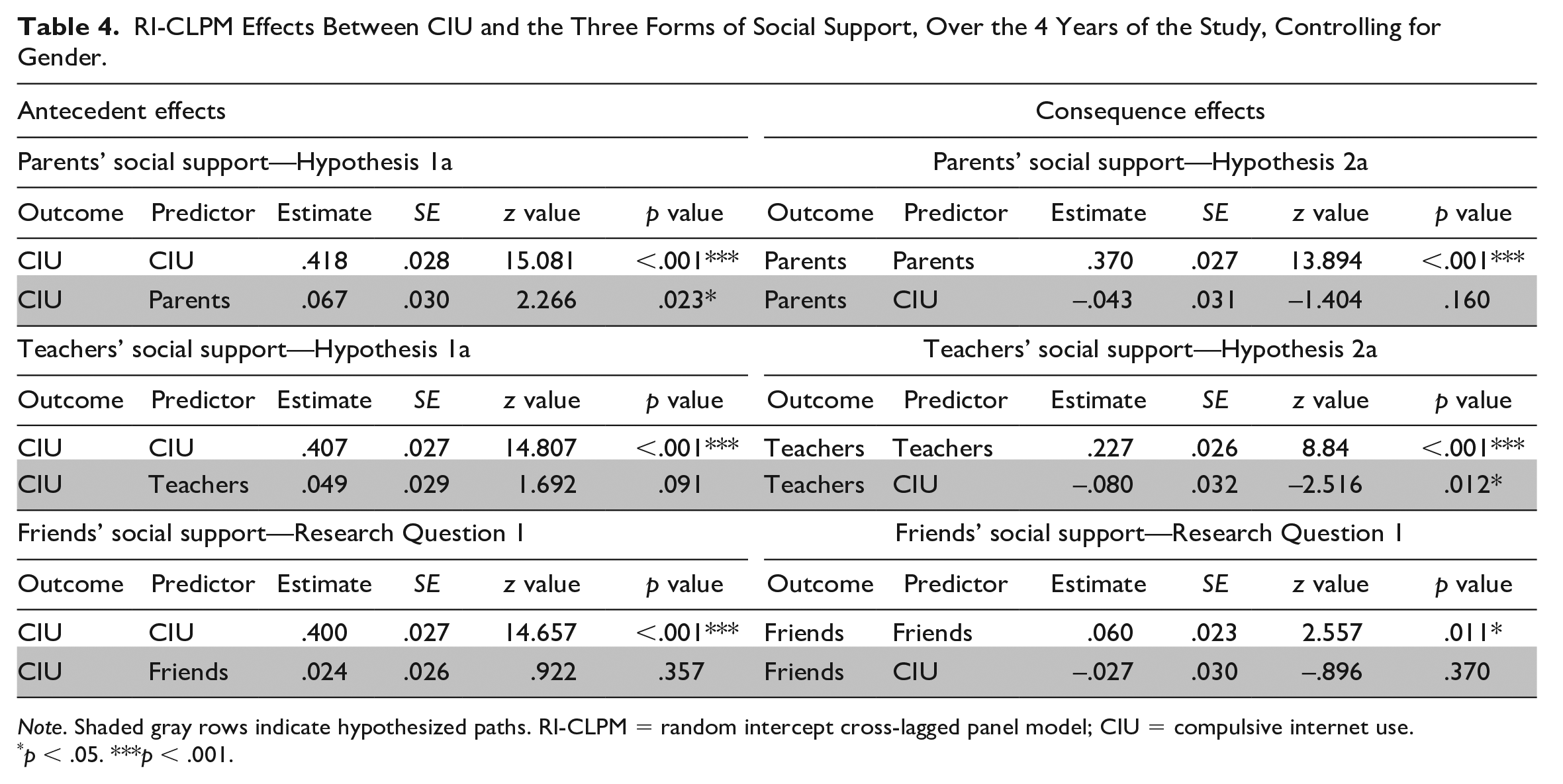
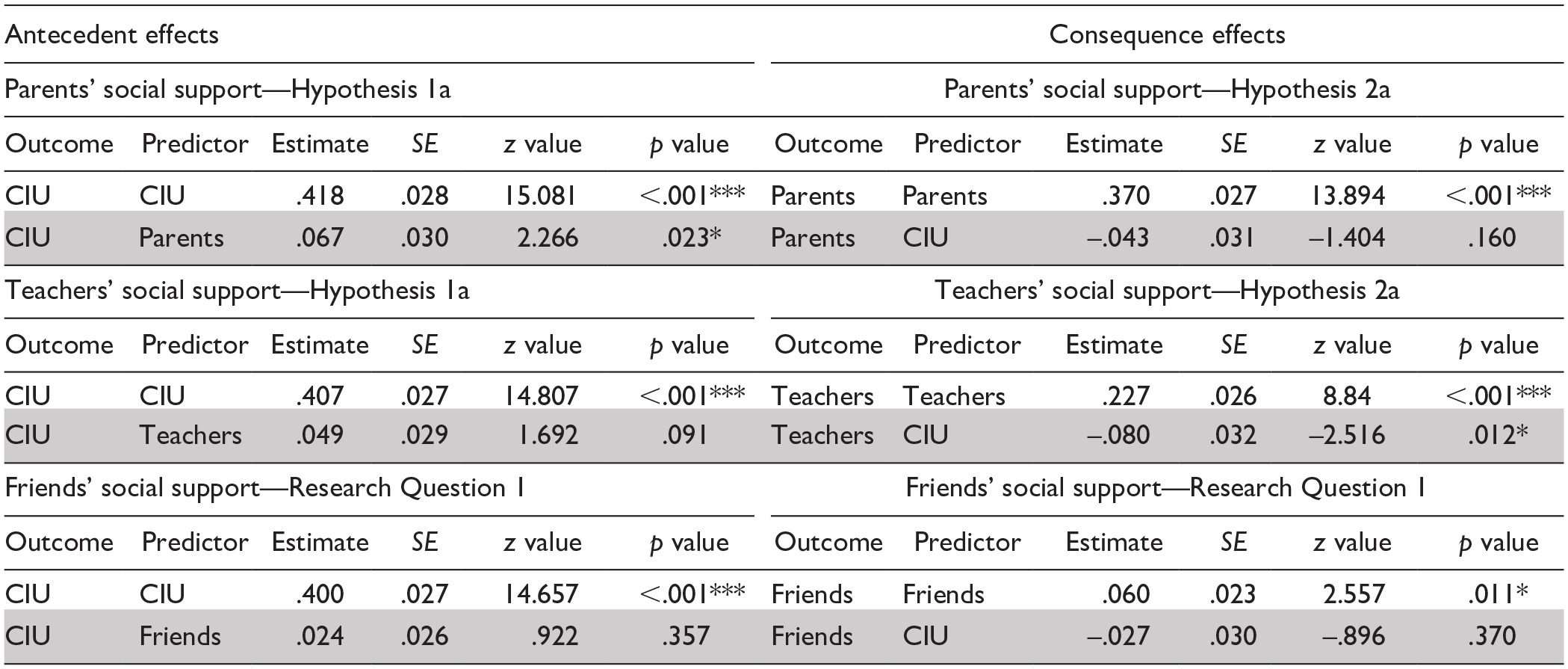
Note. Shaded gray rows indicate hypothesized paths. RI-CLPM = random intercept cross-lagged panel model; CIU = compulsive internet use.
p < .05. ***p < .001.
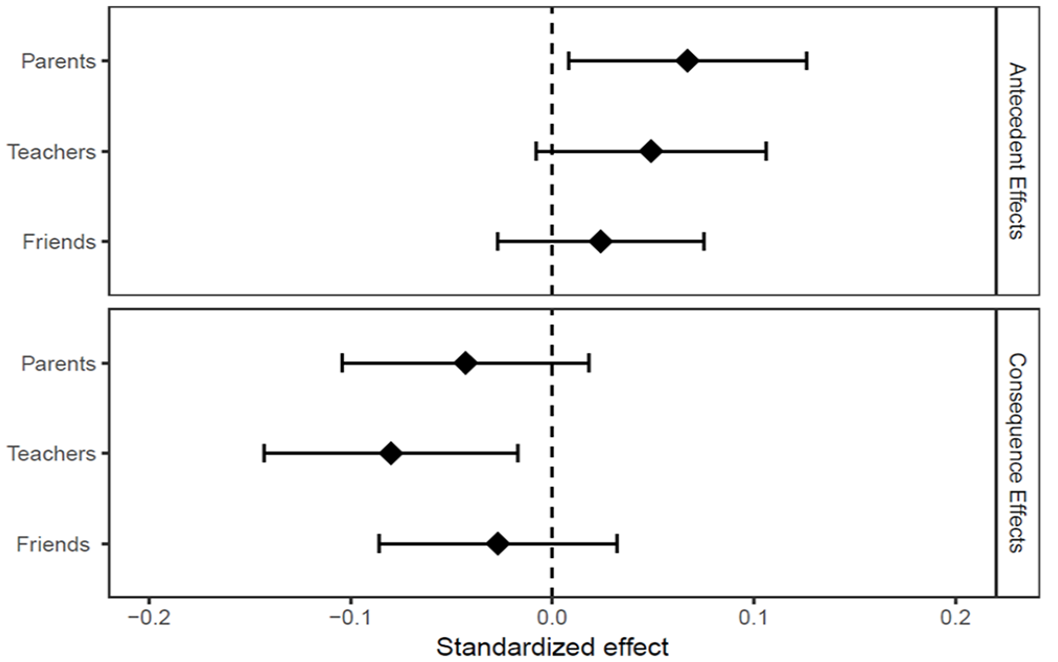
Forest plots showing standardized estimates of cross-lagged effects and their 95% confidence intervals for the developmental equilibrium model (i.e., with all cross-lags constrained to equality), for both antecedents and consequences of CIU.
As Table 4 shows, we found some support for the antecedent model among parents (H1a), with parental social support leading adolescents to experience greater CIU over Grades 8 to 11 (b = .067, p = .023). This within-person longitudinal effect contrasts with a between-person covariation among CIU and parents’ social support of b = –.271, p < .001. Effects of support from teachers leading to CIU (H1b) were not significant (b = .049, p = .091), whereas the between-person covariation among CIU and teachers’ social support was statistically significant (b = –.160, p = .001). Furthermore, we did not find evidence that social support from friends predicted changes in CIU over time (RQ1), whereas between-person covariation among CIU and friends’ social support was b = –.112, p = .011.
Concerning the consequence model, CIU consistently preceded small, within-person reductions in adolescents’ social support from their teachers across the 4 years of the study, H2b; b = –.080, p = .012. However, we did not find that CIU preceded changes in social support from parents (H2a or peers (RQ1; see right side of Table 4). Finally, regarding RQ2, the parenting antecedent and teacher consequence confidence intervals were nonoverlapping (see Figure 2), suggesting a significant difference between parents and teachers in their links with CIU.
Discussion
Adolescence is a time of major social and emotional transition for young people. At this time, the quality and range of social support is a critical factor in shaping young peoples’ development. Over the past decade, the impact of online activity, and in particular CIU, among young people has received growing research attention. Despite this interest, this study is the first we are aware of to examine the longitudinal links between adolescent CIU and different sources of social support, using a multiyear study. Drawing on ecological systems theory (Bronfenbrenner, 1977, 1992), we anticipated that young peoples’ key sources of social support (i.e., from parents, teachers, and friends) play an important role in inhibiting the development of CIU (the antecedent model). Furthermore, we anticipated that CIU would disrupt young people’s social support from adults, although perhaps it may have more mixed effects among peers (i.e., the consequence model). We examined the development of CIU and social support over a 4-year period (Grades 8–11). Using state-of-the-art RI-CLPM, we found that the longitudinal link between social support and CIU depended upon whether the support came from peers, teachers, or parents.
We found that teacher support was consistently and negatively correlated with CIU (i.e., at the between-person level). Longitudinally, we found no evidence that support from teachers preceded reduced CIU (the antecedent model; H1b), but we did find that CIU preceded diminished teacher social support (the consequence model; H2b). This finding is consistent with prior work showing the downstream negative effects of CIU on intraindividual outcomes, such as mental health (Ciarrochi et al., 2016), emotion regulation capacities (Donald et al., 2022), and hope (Donald et al., 2020), but extends these findings to show interpersonal consequences of CIU (i.e., social support from teachers). CIU has been linked to low academic motivation and procrastination (Demir & Kutlu, 2018), hostility and sensation seeking (Fumero et al., 2018), and fatigue (Bener et al., 2019), all of which may interfere with school behavior and lead to conflict with teachers.
Parental support was also consistently linked to lower CIU at the between-person level. However, the longitudinal, within-person effects were contrary to what we predicted (H1a). When youth saw their parents as being relatively supportive (compared with the parent’s own average during the study), they reported more CIU in the following year. Although not what we predicted, this finding is consistent with two previous studies suggesting that, when youth perceive their parents as unsupportive, they may be less inclined to CIU. For example, Koning et al. (2018) found that parental communication predicted greater levels of internet gaming disorder. Similarly, children who reported low levels of neglect by their parents were more likely to increase in internet addiction over time (Hsieh et al., 2021). As with our study, this study should be placed in the context of average levels of CIU: On average, supportive parenting is associated with less CIU, but when predicting change within an adolescent over time, supportive parenting may predict worse CIU.
We can only speculate about this pattern of results, absent further data. There are several ways parents can manage the threat of internet addiction (Fumero et al., 2018; Nielsen et al., 2019): They can refrain from mediation (take no action), co-use or joint access of the internet, actively mediate (discuss usage in positive way), monitor, and/or engage in restrictive mediation (set rules and limits, and can involve punishment). We speculate that refraining from mediation may be popular with youth and even lead them to perceive their parents as being more supportive. However, parental refraining is associated with increased CIU (Nielsen et al., 2019). This “popular parents, compulsive youth” explanation appears consistent with our results, wherein greater parental social support preceded greater CIU. However, we emphasize that this explanation is speculative. The design of this study did not allow us to include third variables that may explain the link between CIU and parental social support (e.g., parental boundary setting around internet use). Future research is needed to explicitly explore this possibility. It will be important for these studies to separate out between-person effects, where we expect parental support to be linked with lower CIU, and within person change, where relatively high parental support has been linked to the development of higher CIU.
Concerning friendship support, we found little evidence that such support was either correlated with, or predicted the development of, CIU. This finding is consistent with several other studies showing that adolescents’ relationships with parents and teachers are key to their mental health, and that relationships with peers play a secondary role (e.g., Chu et al., 2010; Ciarrochi et al., 2017). Soh et al. (2018) suggest that parent- and peer attachment compete with each other, such that closer relationships with parents lessens the role of relationships with friends in providing social support. Whereas this is consistent with our findings, the Soh et al. (2018) effects are cross-sectional and between-person, and, unlike our findings, do not reflect within-person development over time.
Strengths and Limitations
In the context of the rapid increases in online activity among contemporary adolescents, this study makes a significant contribution to understanding the antecedents and consequences of CIU among adolescents. This is the first study, we are aware of, to examine the links between three key sources of adolescents’ social support and CIU, using a multiyear longitudinal design. We adopted a state-of-the-art modeling approach (Mulder & Hamaker, 2021) wherein we isolated within-person reciprocal effects between social support and CIU over a 4-year period, enabling strong conclusions regarding both the stability and the temporal ordering of observed effects. Notwithstanding these strengths, this study has several limitations.
First, it is possible that additional, unmeasured variables explain the longitudinal association between CIU and social support. A strength of the RI-CLP models we used in this study is that they control for trait-levels of both CIU and social support, and also control for within-person autoregressive effects over time (Hamaker et al., 2015; Usami, 2021). Given the well-documented role of gender in predicting both adolescent CIU (e.g., Ciarrochi et al., 2016), and social support receipt (e.g., Burke et al., 2017; Ciarrochi et al., 2017; Pössel et al., 2018), we included gender in our models as a time-invariant covariate. However, we cannot rule out the possibility that other unmeasured, time-invariant variables—for example, other demographic or genetic factors—caused the effects observed in this study. Future longitudinal research on CIU could include additional time-invariant covariates to further test the robustness of these findings.
Second, this study was confined to 4 years of adolescence (i.e., Grades 8–11) and did not examine the links between social support and CIU in preadolescence. Although experiences in adolescence are crucial to the development of healthy habits into early adulthood and beyond (O’Connor et al., 2017), CIU appears to commonly develop in preadolescence (Lan & Lee, 2013; Vondráčková & Gabrhelík, 2016). Thus, it may be that the associations between “trait” CIU and social support that we report in this study are caused by developmental processes occurring preadolescence. This may also explain the relatively modest within-person effect sizes observed in this study. Future research should examine these processes in preadolescence. Relatedly, we note that all schools in this study were Catholic and future studies could include government and other independent schools to extend the generalizability of these findings.
Third, there is a need to unpack specific forms of parental and teacher support, and how these link to adolescent CIU over time. Our findings indicate that parental support may have mixed (and divergent) effects on the development of CIU. In particular, perceptions by adolescents of parental support appear to not ensure healthy internet use outcomes and our findings suggest that the way such support is provided may be key. For example, a large body of evidence based in self-determination theory (Ryan & Deci, 2000) has shown that parental approaches that support the autonomy of young people are more likely to precipitate healthy online behavior than overly controlled or, at the other end of the spectrum, “hands-off” parenting (Lubans et al., 2013; Ryan & Deci, 2017). The items we used to measure parental social support do not explicitly measure autonomy support (e.g., “helps make decisions” or “helps find answers to my problems”). These supports could be provided in a way that is autonomy-supportive, or not, and our items do not explicitly capture this. As another possibility, our finding that parental support leads to greater CIU may have been driven by the presence of underlying problems the young person faces (e.g., feeling uncertain or angry, which is reflected in the social support items “makes suggestions when I’m uncertain,” and “listens to me when I’m mad”), rather than the actual support the parent provides. As a final possibility, it may be that unmeasured parental behaviors that are linked to social support are driving greater CIU. For example, it may be that socially supportive parents are less effective at setting boundaries around their childrens’ internet use, which in turn drives CIU. Further research is needed to explore these possibilities to better understand specific forms of parental support that are most effective in managing young people’s online activity.
Fourth, although the CIU Scale (Meerkerk et al., 2009) shares many of the criteria of other related disorders such as gaming disorder (e.g., withdrawal, loss of control, preoccupation, and conflict; Luo et al., 2021), there are some criteria that the CIUS does not cover (e.g., tolerance, or risk-taking in other areas of life). As another limitation, we used an abbreviated, 10-item version of the CIUS in this study, arguably making this a brief screening of CIU. Further research on this topic using more comprehensive versions of the CIUS would be of value. In addition, future studies could examine specific forms of CIU, such as compulsive gaming, social media use, and accessing music and videos, and the links between these specific online activities and various sources of social support. Although recent studies have begun to examine these issues (e.g., Karaer & Akdemir, 2019), high-quality longitudinal studies are needed.
Fifth, in this study, the items we drew on to measure social support from parents, teachers, and friends were based on a coherent conceptualization of social support, namely, positive attitudes or behaviors from others, which include emotional, instrumental, informational, and appraisal support (Malecki & Elliott, 1999; Nolten, 1994). Nonetheless, it is possible that there are some differences in the nomological network between different sources of support, which we acknowledge. For example, systematically adding items focused on “life guidance” or “emotional support” might lead to identifying specific subfactors within each source of support. Future research should examine these possibilities. As another consideration, none of the items measuring social support in this study were negatively valenced, raising the risk of common method bias. Future studies of social support should consider using measures with a combination of positively and negatively worded items to address this issue.
Finally, there is a need to focus on ways to most effectively prevent CIU among adolescents. Reviews of CIU interventions for young people have proposed a range of areas to be targeted in CIU interventions, including training young people in self-regulatory skills, teaching skills in coping with stress, developing face-to-face interpersonal skills, and teaching skills in managing daily routine (Vondráčková & Gabrhelík, 2016). Our findings suggest that interventions targeting CIU are likely to enhance adolescent support from teachers, with a similar (albeit nonsignificant) trend observed for the effects of CIU on support from parents. Teachers play a critical role in the day-to-day development of young people, and our findings indicate that interventions that help adolescents to regulate their use of the internet are likely to boost students’ connection with, and sense of support from, their teachers. More research is needed to understand the most effective CIU interventions and their impact on adolescent receipt of social support.
Conclusion
This is the first study we are aware of to examine the longitudinal effects of CIU on adolescents’ social support from parents, teachers, and friends, and vice versa. Stable and high-quality social support is crucial for healthy adolescent development. Our findings suggest that CIU has distinctive effects on teacher social support, in contrast to parental social support, and has no clear effects on or from friends’ social support. Whereas CIU preceded decrements in social support from teachers, as expected, our finding that parental social support leads to increases in CIU suggests that the way in which parents provide social support may be critical to the development of CIU. It appears that parents who are perceived by their children as being supportive are, perhaps unwittingly, driving increases in their children’s CIU over time. Further research is needed to unpack these possibilities and the impact of different forms of parental social support on CIU.
Footnotes
Declaration of Conflicting Interests
The author(s) declared no potential conflicts of interest with respect to the research, authorship, and/or publication of this article.
Funding
The author(s) disclosed receipt of the following financial support for the research, authorship, and/or publication of this article: The data collection for this article was funded by the Australian Research Council, Grant/Award Number: DP140103874.
