




Abstract
The “selfie” phenomenon shaped the past two decades, yet there is inconsistent evidence concerning the relationship between selfie behaviors and self-evaluations. This meta-analysis investigates the relationship between selfie taking, editing, and posting behavior and general and appearance-specific self-evaluations. The results reveal that selfie taking and posting are related to positive appearance-specific self-evaluations. In contrast, selfie editing is related to negative self-evaluations both generally and specific to appearance. Gender and age did not moderate these relationships, but methodological factors did, suggesting these relationships depend on factors, such as how selfie behaviors are measured and study design. We interpret these findings through the lens of prominent social psychological theories and conclude with suggestions to guide future research.
The past two decades witnessed the birth of social networking sites, which allow individuals to consume, create, and share content with a broad audience. Although the earliest platforms primarily enabled users to communicate with their social networks via writing (e.g., Twitter “tweets”; Facebook status updates), they have evolved to encourage users to connect by sharing photos and visual media (e.g., Twitter “fleets,” Facebook “stories”; Harris & Haveson, 2020). Younger generations, particularly those under 30, gravitate toward uniquely photo-based sites such as Instagram and Snapchat over other types of social networking sites (Auxier & Anderson, 2021). The growing popularity of these platforms, coupled with the rise of “the selfie” (i.e., photos of the self; Taylor, 2014), has jointly contributed to the increased presence of photo-related behaviors—not just taking selfies, but also editing, and sharing selfies.
As the popularity of social media and social networking sites has rapidly increased, so has research investigating online behaviors, including research dedicated to selfies. One goal of this research has been understanding the relationship between selfie behaviors and self-evaluations. Given that selfies constitute an online representation of the self and act as a form of self-presentation (Faimau, 2020), they should relate to how individuals understand and evaluate themselves. There is empirical support for this, but conclusions are inconsistent. Selfie behaviors have been found to relate to positive self-evaluations (e.g., Wang, Wang, et al., 2020), negative self-evaluations (e.g., Fox et al., 2021), or not at all (e.g., Veldhuis et al., 2020). These discrepancies may reflect distinct selfie behaviors (i.e., taking vs. editing vs. posting a selfie), the type of self-evaluation (general vs. appearance), individual differences (e.g., participant gender and age), and methodological decisions (e.g., study design).
Due to heterogeneity within the existing literature, it is difficult to cohesively interpret the body of research. To more clearly delineate the relationship between selfie behavior and self-evaluations, we conducted a meta-analysis. Although there have been a handful of meta-analyses targeting social media use (Liu et al., 2019; Petre, 2021; Zhang et al., 2021), and some examining the relationship with self-evaluations, including appearance focused (de Valle et al., 2021) and general self-worth (Liu & Baumeister, 2016), there are no meta-analyses specific to selfie behaviors. In the current investigation, we are clear to differentiate selfie taking, editing, and posting, and consider how relevant social psychological theories can inform the relationship between selfie behavior and both general and appearance-specific self-evaluations. To conclude, we outline key considerations to guide future selfie-related research.
Selfies, Selfie Behaviors, and Self-Evaluations
Although self-photography has existed for centuries, the modern understanding of the selfie is relatively new; in 2011, the first selfie was posted on Instagram (using the hashtag “selfie”), and in 2013 “selfie” was named Oxford Dictionary’s word of the year (Killingsworth, 2013). As of 2018, 62% of adults report having ever taken a selfie, with that percentage jumping to 82% for adults between the ages of 18 and 34 (Statista, 2018).
The Oxford English Dictionary defines a selfie as “a photograph that one has taken of oneself, especially one taken with a smartphone or webcam and shared via social media” (2018). Deviating from this lay definition, researchers tend to be more general in their definition, and use the term “selfie” to refer simply to a photo taken of the self (e.g., McLean et al., 2015). Broadly operationalizing a selfie as a self-image allows researchers to investigate different selfie behaviors, and unique measures have been designed to investigate frequency of taking, editing, and posting selfies (McLean et al., 2015). Considering these stages of the selfie process are distinct from one another, expectations for unique relationships with self-evaluations can be expected and informed by social psychological theory.
Selfie Behaviors and Self-Evaluations
While taking a selfie should make appearance salient (especially with the use of a front-facing camera), this should be relatively less so than editing a selfie. In the process of editing, the self is reduced to a two-dimensional viewer-perspective image, a condition that self-objectification theory (Fredrickson & Roberts, 1997) suggests would be harmful to self-evaluations (see Kahalon et al., 2018). Supporting this, selfie editing (both self-reported, as well as experimentally manipulated) is associated with increased attention to one’s appearance (Xiao et al., 2021), which is associated with a negative evaluation of the self (e.g., Lamp et al., 2019).
Valkenburg and Peter (2011) posited that by crafting different personas on social media, an individual’s sense of self may become “fragmented” (see also, Gergen, 1991). From this perspective, editing one’s appearance may create a disrupted sense of self. This fits with findings that selfie manipulation predicts feelings of disingenuousness (Lamp et al., 2019), and that low self-concept clarity is related to engaging in appearance management, including using beautifying filters (J. Wang & Yu, 2022). There is also evidence that selfie editing can cause a reduction in self-concept clarity (Felig, 2020). These findings, considered along with the strong positive association between self-concept clarity and self-esteem (Campbell, 1990), suggest that selfie editing may be associated with negative self-views.
As an alternative to the fragmentation hypothesis, Valkenburg and Peter (2011) considered the self-concept unity hypothesis, which suggests that when individuals have the opportunity to receive feedback from others in their social network this may allow for healthy and stable identity development. From this perspective, selfie posting may offer opportunities for validation, which would result in a more unified, coherent self-concept, and presumably more positive self-evaluations. Also, from the perspective of self-affirmation theory (Steele, 1988), posting a selfie may allow one to affirm the self. At least one study showed that selfie posting reduced the negative effects of taking a selfie on self-evaluations. Shin and colleagues (2017) found that selfie taking led to a decrease in self-esteem, which was ameliorated when participants were subsequently asked to publicly share their selfie.
From these perspectives and more, taking, editing, and posting selfies may differentially relate to self-evaluations. Conclusions are limited, however, because few studies have investigated multiple selfie behaviors in the context of the same study or do so in a way that makes it hard to attribute self-evaluations to specific selfie behaviors (e.g., investigating selfie taking in conjunction with selfie posting). When research does isolate these behaviors, the findings often diverge (see Table 1 for an overview of current research), highlighting the importance of this meta-analysis.
Overview of Included Studies.
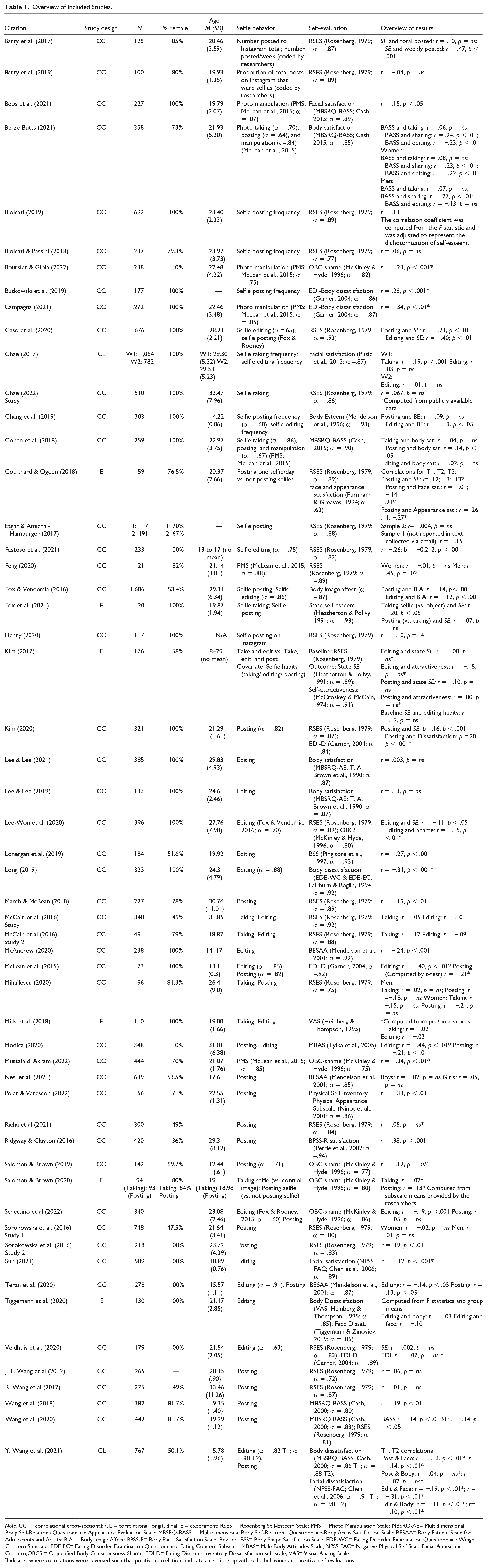
Note. CC = correlational cross-sectional; CL = correlational longitudinal; E = experiment; RSES = Rosenberg Self-Esteem Scale; PMS = Photo Manipulation Scale; MBSRQ-AE= Multidimensional Body Self-Relations Questionnaire Appearance Evaluation Scale; MBSRQ-BASS = Multidimensional Body Self-Relations Questionnaire-Body Areas Satisfaction Scale; BESAA= Body Esteem Scale for Adolescents and Adults; BIA = Body Image Affect; BPSS-R= Body Parts Satisfaction Scale–Revised; BSS= Body Shape Satisfaction Scale; EDE-WC= Eating Disorder Examination Questionnaire Weight Concern Subscale; EDE-EC= Eating Disorder Examination Questionnaire Eating Concern Subscale; MBAS= Male Body Attitudes Scale; NPSS-FAC= Negative Physical Self Scale Facial Appearance Concern;OBCS = Objectified Body Consciousness-Shame; EDI-D= Eating Disorder Inventory Dissatisfaction sub-scale; VAS= Visual Analog Scale.
Indicates where correlations were reversed such that positive correlations indicate a relationship with selfie behaviors and positive self-evaluations.
General Versus Appearance Self-Evaluations
When considering self-evaluations, the research is also heterogeneous, with some measuring satisfaction with physical appearance, and other research measuring evaluations of the self generally (e.g., self-esteem). Most obviously, the aspect of the self that is evaluated when a person takes, edits, or posts a selfie, is physical appearance. Research on self-objectification provides a basis for this prediction; a focus on one’s appearance predicts negative body evaluations, including body dissatisfaction and body shame (Fredrickson et al., 1998; Noll & Fredrickson, 1998; Schaefer et al., 2018). Selfie behaviors are entrenched with self-objectification (Salomon & Brown, 2020), offering an explanation as to why they often result in negative appearance evaluations (Mills et al., 2018; Tiggemann et al., 2020).
However, when appearance evaluations are relevant, there is reason to expect general self-evaluations are as well. Self-objectification does not just predict appearance evaluations, but also self-esteem (e.g., Choma et al., 2010). Moreover, some selfie behaviors may implicate the self directly, not through an evaluation of appearance. Valkenburg and Peter’s (2011) fragmentation and self-unity hypotheses concern the self-concept, and therefore are more relevant to general self-evaluations than appearance-specific evaluations. Also, from the perspective of self-affirmation theory (Steele, 1988), when individuals are threatened and experience dissatisfaction in one domain, they are motivated to restore their self-worth by affirming other aspects of the self (e.g., Bergstrom et al., 2009). From these perspectives, there may be instances where general self-evaluations are affected by selfie behavior in addition to, and even independent from, appearance-specific evaluations. But again, few studies have examined both types of self-evaluations (see Table 1), so conclusions are not yet warranted.
Gender
Though women and men use social media at similar rates (Perrin, 2015), women use more photo-based social media (Auxier & Anderson, 2021), and women are more likely to take, edit, and post selfies compared with men (Dhir et al., 2016). These gender differences may extend to the ways in which selfie behaviors relate to self-evaluations. The cultural emphasis placed on women’s appearance has been theorized (Fredrickson & Roberts, 1997) and demonstrated (Frederick et al., 2007; Roberts & Gettman, 2004) to disproportionately influence the extent to which women, compared with men, internalize cultural appearance values. Given that the standards many women compare themselves against are idealized and hard to achieve, coupled with the fact that girls are more likely to internalize appearance standards than boys (e.g., Lawler & Nixon, 2011), suggests that their self-evaluations may be affected to a greater extent than men’s when engaging in selfie behavior. Although gender differences are theoretically expected, the majority of studies include no or few men (see Table 1), making conclusions based on existing research hard to draw.
Age
Younger people gravitate toward photo-based social media platforms (Auxier & Anderson, 2021), and also take, post, and edit selfies more than older adults (Dhir et al., 2016). In addition, younger individuals have a less-clear self-concept (Lodi-Smith & Roberts, 2010) and, among adolescents, low self-concept clarity predicts experimenting with online self-presentation and presenting an “ideal self” rather than a true self (Fullwood et al., 2016).
Considering self-concept clarity mediates the relationship between using social network sites and well-being (Lin et al., 2021), it follows that younger people’s self-evaluations may relate to selfie behaviors more so than for older adults. This may be especially true for young girls, for whom there is a “perfect storm” of concerns about both social relations and sociocultural emphasis on appearance (Choukas-Bradley et al., 2022).
Current Study
The existing literature paints an inconsistent picture of the relationship between selfie behavior and self-evaluations. As highlighted, these inconsistencies may reflect which selfie behaviors are being studied (i.e., taking vs. editing vs. posting a selfie), the type of self-evaluation in question (i.e., general versus appearance), or individual differences (i.e., gender and age). This meta-analysis investigates the relationship between selfie behaviors and self-evaluations, with consideration of these potential moderators.
Furthermore, we examine how methodological decisions influence the relationship.
Researchers often investigate questions related to selfie behaviors by asking participants to self-report their selfie behaviors (e.g., McLean et al., 2015). However, people sometimes inaccurately self-report their behaviors, particularly in the context of social media behaviors (Burnell et al., 2021; Deng et al., 2019; Guess et al., 2019), and therefore, self-report measures may yield different results than when selfie behaviors are objectively measured (i.e., by screening an individual’s Instagram). In addition, study design is critical when interpreting the relationship between selfie behaviors and self-evaluations because correlational and experimental studies answer different questions. Only experimental designs can determine how selfie behaviors affect self-evaluations, or how self-evaluations affect selfie behaviors. As such, selfie behavior measurement and study design will be considered as moderators in our analysis.
Our hypotheses are broad and informed by the current body of literature and corresponding theories. Overall, we expect to find a negative relationship between selfie behaviors and self-evaluations (consistent with meta-analyses on social media use in general, e.g., de Valle et al., 2021), such that more frequent engagement in selfie behaviors will be related to negative evaluations of the body and the self. Although we anticipate differences between distinct selfie behaviors, we approached this meta-analysis with no a priori hypotheses about how taking, editing, and posting selfies will differentially related to self-evaluations. We expect gender and age to moderate the effects such that the relationship between selfie behaviors and self-evaluations is stronger among women and young people.
This meta-analysis was conducted following the Non-Interventional, Reproducible, and Open (NIRO; Topor et al., 2020) systematic reviews guidelines in conjunction with the Preferred Reporting Items for Systematic Reviews and Meta-Analyses (PRISMA; Page et al., 2021). The protocol was prepared in accordance with NIRO and the protocol, search strategy, inclusion and exclusion criteria, and proposed analyses were pre-registered to the Open Science Framework. 1 Figure 1 presents the PRISMA flow diagram of the literature search.

PRISMA Search Diagram for Primary Search.
Method
Search Method
The lead author conducted a keyword search among the following databases and registers: PsycInfo, Web of Science Core Collection (all editions), Scopus, Science Direct, ProQuest Dissertation and Theses Global, PsyArticles, and PsyArXiv, which began on October 6, 2021 and concluded on October 12, 2021. Relevant search terms were selected by the researchers, academic advisors, and an academic librarian. In instances where searches produced unusually high numbers of results, a date limiter was included to only search articles published after 2010 (corresponding with the launch of Instagram, and the “beginning” of modern selfie behaviors). For databases that were not specific to psychology, keyword limiters were used only when search results were unusually high. 2 Past conference programs from major psychological societies were searched, and a call for unpublished research was sent through a public email forum for the Society for Personality and Social Psychology. Ten researchers were contacted for data from previous conferences, but none responded. In all, the search yielded 4,022 possible articles. An electronic search within Microsoft Excel to remove duplicates based on title resulted in 2,038 unique results.
Inclusion Criteria
Each source was evaluated for inclusion by the lead author and one undergraduate research assistant. The intra-class correlation coefficient (ICC) for inter-rater reliability was acceptable (.72, 95% confidence interval (CI) = [.69, .74]) and any discrepancies were reviewed jointly to determine whether the article met the inclusion criteria. First, studies needed to include a measure or manipulation of selfie behavior. Unfortunately, many researchers do not provide a clear operationalization of what constitutes a “selfie” (e.g., whether it must be self-taken at arm’s length, be of the face only, etc.). However, we were clear to screen measures to ensure that they did not measure “groupies” (selfies with other people). We aimed to include studies that assessed only self-photography. Second, studies needed to include a measure of general or appearance-related self-evaluation (see Table 2). Third, they need to report sample size or statistics needed to compute a standard error. Non-English studies were not excluded; any relevant studies would be translated. Qualitative studies, review articles, or articles that included clinical samples were excluded. A keyword and abstract screening was conducted independently by the lead author and one undergraduate research assistant based on the above criteria, resulting in the removal of 1,983 articles (97%) for the following reasons: 1,883 did not meet the first two criteria; 60 were duplicates not originally identified during the duplication removal process; 1 was an unpublished master’s thesis which reported the same data used in a published article; 35 were qualitative; and 4 included a clinical sample. This resulted in 55 unique articles to be further screened.
Construct Definitions and Example Scales for Meta-Analyzed Constructs.
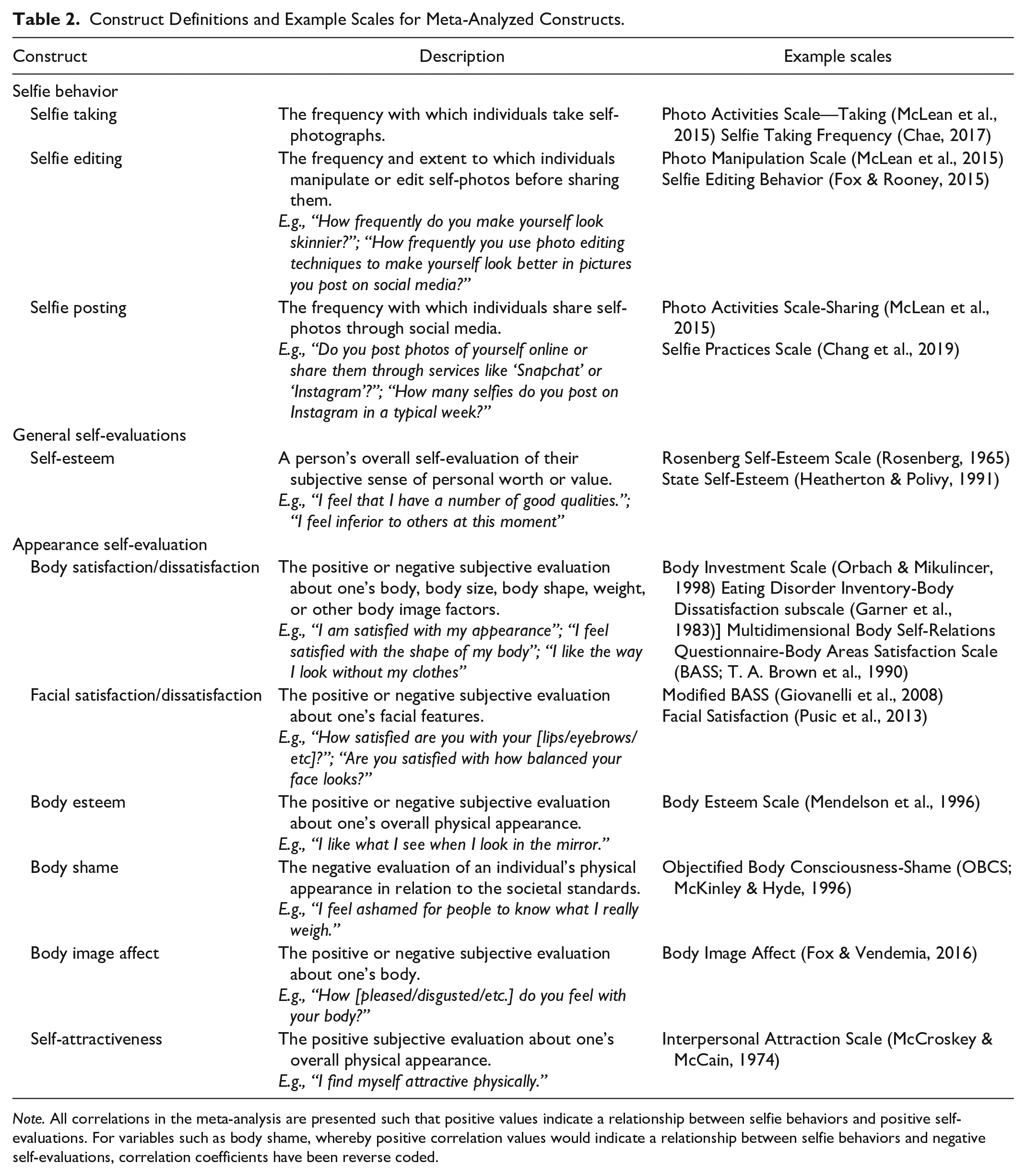
Note. All correlations in the meta-analysis are presented such that positive values indicate a relationship between selfie behaviors and positive self-evaluations. For variables such as body shame, whereby positive correlation values would indicate a relationship between selfie behaviors and negative self-evaluations, correlation coefficients have been reverse coded.
Bias Assessment
The 55 unique articles contained a total of 57 studies which were independently assessed by the lead author and a research assistant for potential bias, as suggested by the PRISMA updated guidelines (Page et al., 2021). Given that 51 out of the 57 identified studies presented cross-sectional data, the Appraisal Tool for Cross-Sectional Studies (AXIS; Downes et al., 2016) was used. The remaining six experiments were also screened with AXIS for consistency. Bias assessments began and were completed in January 2022. Kappa scores were calculated for bias assessments of each study, which produced values ranging from 0.83 to 1.00, indicating agreement that ranges from “strong” to “almost perfect” (McHugh, 2012). Bias ratings ranged from 0 to 13 (out of possible 40), and five studies which fell in the upper 10% of bias ratings were reviewed by the lead author (Fastoso et al., 2021; Kim, 2020; McCain et al., 2016 [Studies 1 and 2]; Wang et al., 2012). Despite their scores, the articles were included because they were lacking the same criteria (e.g., failure to report funding, discuss the response rate, or justify sample size), which many of the other studies were also lacking. The potential bias did not appear any more or less concerning than other studies, and these articles diversified the overall sample.
Nine additional studies not originally flagged for potential bias were removed. The thesis by Alblooshi (2015) did not clearly report correlations or the necessary statistics. Boursier and colleagues (2020) used an averaged measure of selfie behavior which did not align with our operationalization. Kolcz (2018) administered a measure of general self-concept, rather than self-esteem, which we could not access to review. McComb and colleagues (2021) assessed photo editing tendencies after administering a selfie-viewing manipulation and also did not report effect sizes, or data needed to compute effect sizes, for the relationship between baseline editing tendencies and body dissatisfaction. Pantic and colleagues (2017) did not report effect sizes, or data needed to compute them, and did not respond to a request for data. Shin and colleauges (2017) relied on an embodied cognition measure to assess state self-esteem, via signature size, which was not similar enough to other measures to meaningfully average across effects.
Vendemia and DeAndrea (2021) introduced a second manipulation beyond photo editing (receiving appearance commentary), which confounded the results. Wang (2019) controlled for age and gender, and therefore could not be included in the gender or age moderation analyses. Finally, Wu and colleagues’ (2022) measure of photo behaviors extended beyond behaviors related to the self, such as viewing others’ selfies. A total of 48 studies remained for the meta-analysis.
Secondary Search
An updated search following the same search strategy was conducted by the lead author on November 13, 2022, to account for any research published from October 2021 onward. This search yielded 2,852 possible articles, which was reduced to 1,316 after an electronic search in Microsoft Excel removed duplicates. Keyword and abstract screenings were conducted independently by both authors, resulting in the removal of 1,589 articles (98.6%) for not meeting the criteria; inter-rater reliability was excellent (ICC= .89, 95% CI = [.81, .94]). The remaining 22 were assessed for eligibility and 15 were removed for the following reasons: the article was included in the original meta-analytic sample (n = 10), the article was missing necessary statistics and the authors did not respond to a request for statistics (n = 2), or the key variables were not operationalized in a manner consistent with our pre-registration (n = 2). In all, seven additional articles contributing nine effect sizes were included.
We conducted a bias assessment of these seven articles, which were independently coded by each author. Kappa scores were calculated for bias assessments of each study, which produced values ranging from 0.72 to 1.00, indicating agreement that ranges from “good” to “almost perfect” (McHugh, 2012). Bias ratings ranged from 4 to 13 (out of 40, and no higher than in the original sample). All studies were included in the final sample.
Meta-Analytic Sample
A total of 55 studies, with 66 unique samples, were analyzed. As some studies measured multiple variables of interest, a total of 112 effect sizes were included in the meta-analyses, which reflected data from 20,135 individuals. The samples came from 12 countries, primarily the United States (k = 37), followed by Canada (k = 14), China (k = 13), and Australia (k = 10), with other countries contributing fewer than 10 effect sizes each. The majority of samples were collected among undergraduates (k = 55), adults in the general population (k = 28), school-aged adolescents (k = 21), and a mix of undergraduates and non-student adults (k = 7). The average age across samples was 21.99 years (SD= 3.67), and on average, samples were 57.89% White.
Of the 112 effect sizes, 56 came from samples of only women, and 17 came from samples of only men. Only 22 effect sizes came from samples of more than 50% men. Studies were primarily cross-sectional (76%), contributing 86 effect sizes to the meta-analysis. Experiments and longitudinal studies contributed 15 and 11 effect sizes, respectively.
Coding Procedure and Construct Classification
To identify effect size statistics for each article, both researchers read each article, reported the necessary values, and any discrepancies were resolved through discussion. For each study, the following data were coded: sample size; percent of participants who were women; sample age mean and standard deviation; percent of participants who were white; population sampled (undergraduate, school-aged adolescents, or general adult population); country of data collection; study design (cross-sectional, longitudinal, experimental); type of selfie behavior data (self-report or observational/behavioral); selfie behavior (taking, editing, posting); type of self-evaluation (general, appearance); selfie measure; self-evaluation measure; correlation coefficient; and reliability coefficients. All correlations were recorded such that positive correlations indicate a relationship between selfie behaviors and positive self-evaluations. As such, a small portion of the correlations were reverse-coded. For some studies, correlation coefficients were computed using other reported statistics ( see Table 1). Table 2 lists construct names, definitions, and example scales.
Multiple Dependent Results From a Single Study
Psychometric meta-analysis assumes that each effect size comes from an independent sample, but in some instances, our sample contributed multiple effect sizes (e.g., an effect size for selfie taking and for selfie editing). As including multiple effect sizes from dependent samples can result in false positives (Cooper et al., 2009), multiple effect sizes from the same sample were consolidated as composites. For example, Y. Wang and colleagues (2021) contributed four effect sizes reflecting the relationship between selfie editing and appearance evaluations which were aggregated into one effect. Furthermore, when a study reported correlations between the same self-evaluation and multiple selfie behaviors, those selfie behaviors were independently investigated meta-analytically, thus lessening the issue of dependence. This was also the case when we tested differences between types of self-evaluations, which were investigated in sub-group and moderation analyses. This method of handling dependency is informed by previous meta-analyses investigating social media use (e.g., Liu & Baumeister, 2016; Liu et al., 2019).
Analyses
A barebones meta-analysis was conducted using the psychmeta package (Dahlke & Wiernik, 2019) in R (R Core Team, 2022, version 4.1.2), which pools correlations across studies and tests for continuous and categorical moderators. Mean observed correlations (r–), mean corrected correlations
Results
Assessment of Studies
A forest plot of the relationship between selfie behaviors and self-evaluations across samples, grouped by selfie behavior (Figure 2), a contoured funnel plot (Figure 3), and a random effects funnel plot (Figure 4) were generated to visualize the effect sizes and observe potential publication bias. The results of the contoured funnel plot show no obvious clustering, and the effect sizes are plotted symmetrically, suggesting a lack of publication bias. To further investigate publication bias, an Egger’s test was conducted (Lin & Chu, 2018). The regression estimate was not significantly different from zero, β = −0.08, t = 0.88, p = .38, indicating no evidence of publication bias.
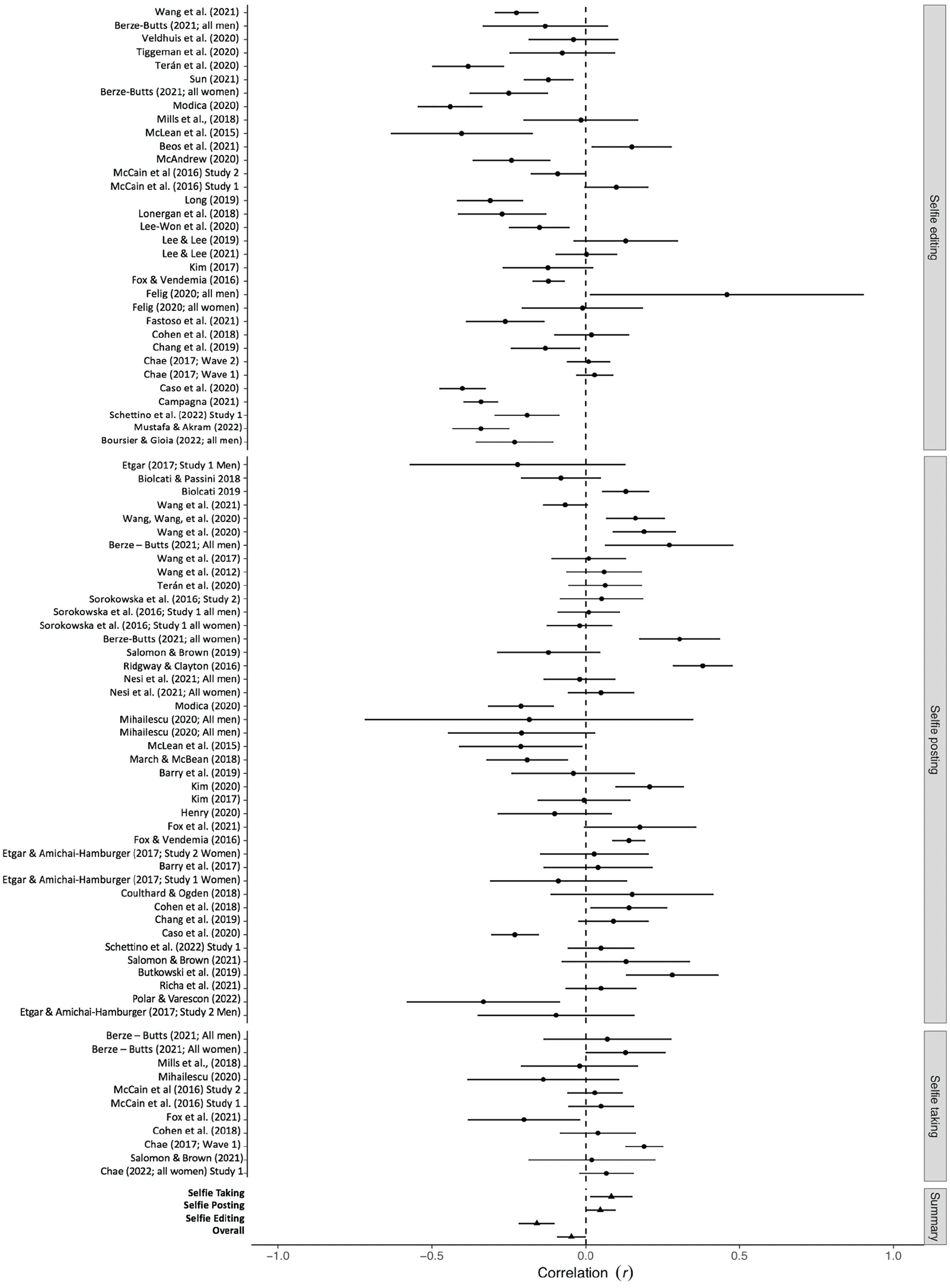
Forest Plot of the Overall Relationship Collapsed Across Selfie Behaviors and Grouped by Selfie Behaviors.

Contoured Funnel Plot.

Random Effects Funnel Plot.
The forest plot shows the overall effect for all selfie behaviors, as well as the overall effect for selfie taking, editing, and posting. The random effects funnel plot (Figure 4) accounts for heterogeneity, whereby the outer bands reflect the prediction interval. All effect sizes with the exception of six are within the prediction intervals; the six outlier samples come from Modica (2020; selfie editing and appearance; r = −.44); Caso and colleagues (2020; selfie editing and self-esteem; r = −.40), Campagna (2021; selfie editing and body dissatisfaction; r = −.34), McLean et al. (2015; selfie editing and body dissatisfaction; r = −.40), Terán and colleagues (2020; selfie editing and appearance; r = −.52), and Ridgway and Clayton (2016; selfie posting and appearance; r = .38). As this plot collapses across selfie behaviors and five of the six studies flagged as outliers measure editing behavior (which the forest plot suggests has a different pattern of results than other selfie behaviors), this likely reflects an anticipated distinction between selfie behaviors rather than outliers.
Relationship Among Selfie Behaviors and Self-Evaluations
Artifact corrections were applied to correct for measurement error in the predictor and outcome variables (Dahlke & Wiernik, 2020), and mean observed correlations (
Results of Overall Meta-Analyses.
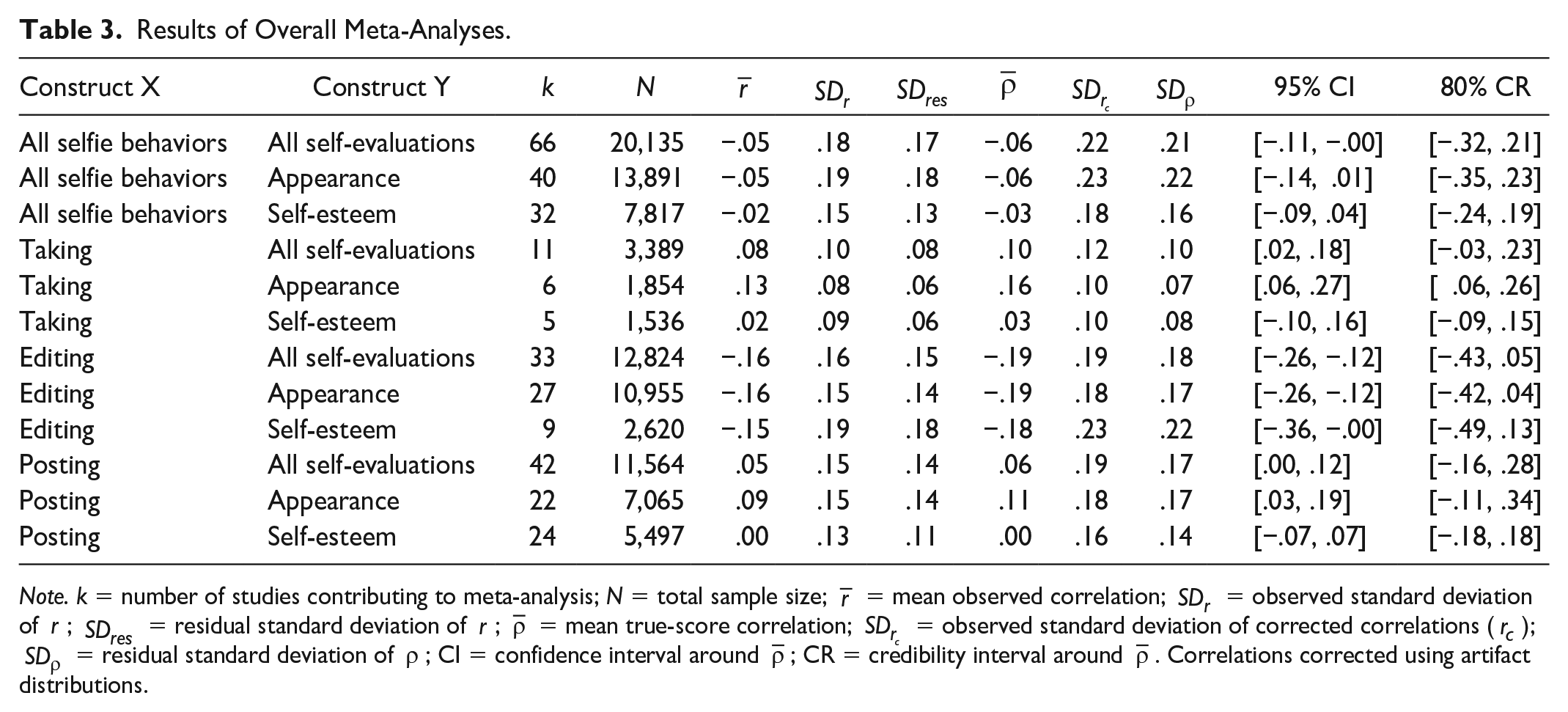
Note. k = number of studies contributing to meta-analysis; N = total sample size;
Moderators
Selfie Behavior
The first moderator tested was type of selfie behavior, coded categorically. The moderator was significant, QM = 20.57, p = .002, accounting for 26.24% of the observed variance. A significant difference was observed between selfie editing and selfie posting, which had mean effects of β =−.16 and β =.05, respectively, and the difference of −.21 was significant, 95% CI = [−0.28, −0.13]. A significant difference was also observed between selfie editing and selfie taking, which had mean effects of β = −.16 and β =.08, respectively, and the difference of −.24 was significant, 95% CI = [−0.35, −0.16]. The mean regression estimate for the relationship between selfie editing and self-evaluations was β = −0.15, SE = 0.02, 95% CI = [−0.19, −0.10], the estimate for selfie taking was β = 0.04, SE = 0.05, 95% CI = [−0.07, 0.14], and the estimate for selfie posting was β = 0.04, SE = 0.07, 95% CI = [−0.07, 0.18]. Meta-analytic results for each selfie behavior were further investigated.
Selfie Taking
Selfie taking was the least studied of the selfie behaviors, with 11 samples contributing to the meta-analysis. The corrected correlation between selfie taking and self-evaluations was
Selfie Editing
Selfie editing, a more frequently studied construct, contributed 33 samples to the meta-analysis. The corrected correlation between selfie editing and self-evaluations was
Selfie Posting
Selfie posting was the most commonly investigated selfie behavior, with 42 samples contributing to the meta-analysis. The corrected correlation between selfie posting and self-evaluations was
In all, these results suggest that selfie behaviors differ in their relationship to self-evaluations. Selfie taking and selfie posting are related to positive self-evaluations, but only in the domain of appearance. In contrast, selfie editing is related to negative self-evaluations both generally and specific to appearance. Given these findings, all subsequent analyses look at distinct selfie behaviors, rather than collapsing across them.
Individual Differences
Although type of selfie behavior was a significant moderator, the Q statistic, which tests for residual heterogeneity, was large and significant, Q (df = 104) = 393.71, p < .0001, indicating the presence of additional moderators. We examined individual difference next in relation to each selfie behavior. Specifically, we examined whether the selfie behaviors and self-evaluations differ as a function of gender and age.
Gender
Gender was coded in two ways. First, the proportion of participants in each sample who were women was recorded and tested as a continuous moderator ranging from 0 to 1, with 0 indicating a sample of all men and 1 all women, and a value in between indicating the percentage of the sample that was women. In addition, samples were divided into all women, all men, and mixed gender samples to be tested as a categorical variable. To test for moderation by gender specific to each type of selfie behavior, we tested taking selfies (k = 11), editing selfies (k = 32), and posting selfies (k = 42) separately. Gender was not a moderator of taking selfies and self-evaluations, with gender coded continuously, QM = 0.002, p = .97, R 2 = 0.00%, or categorically, QM = 0.06, p = .99, R 2 = 0.00%. Results were similar for selfie editing, with gender coded continuously, QM = 0.35, p = .56, R 2 = 0.00%, and categorically, QM = 0.75, p =.86, R 2 = 0.00%, and selfie posting, coded continuously, QM = 0.31, p = .58, R 2 = 0.00%, and categorically, QM = 3.14, p = .37, R 2 = 0.09%. In sum, there was no evidence for gender moderating the relationship between any selfie behavior and self-evaluations.
Consistent with prior analyses, we also wanted to investigate appearance-focused and general self-evaluations separately. However, breaking down the samples by selfie type, type of self-evaluation, and gender resulted in small numbers of effect sizes in each group. For example, only one effect size represented men’s general self-evaluations for selfie taking, and only one for men’s general self-evaluations in relation to selfie editing, with other sub-groups having small numbers as well. We are, therefore, hesitant to draw conclusions about these relationships, but include these additional analyses in a supplemental file.
Age
Age was tested as a continuous moderator using the mean age reported in the studies. Mean sample age did not significantly moderate the relationship between selfie taking and self-evaluations, QM = 1.58, p = .21, R 2 = 10.47%, nor did mean age moderate the relationship between selfie editing and self-evaluations, QM = 0.79, p = .37, R 2 = 0.00%, nor selfie posting and self-evaluations, QM = 0.23, p = .63, R 2 = 0.00%. To assist interpretation, age was also categorically coded as adolescents (samples with a mean age under 18), young adults (samples with a mean age between 18 and 25), and samples with a mean age over 25. Additional analyses comparing the samples by selfie type, type of self-evaluation, and age group can be found in our supplemental results. In all, age does not appear to moderate the relationship between any selfie behavior and self-evaluations.
Methodological Decisions
Finally, we examined methodological moderators in relation to each selfie behavior. We examined whether the relationship between selfie behavior activities and self-evaluations varied as a function of methodological decisions, including whether selfies were measured objectively or with self-report, as well as study design. 3
Selfie Behavior Measurement
Selfie behavior measurement was measured as a categorical measure with two levels: objective or self-report. Measurement of selfie behavior significantly moderated the relationship between selfie taking and self-evaluations, QM = 3.89, p = .048, R 2 = 41.33%. A significant difference was observed between self-reported and objective selfie taking, which had mean effects of β = .11 and β = −.08 respectively, and the difference of −.18 was significant, 95% CI = [−0.36, −0.01]. When people self-reported selfie taking frequency (k = 8), it was positively associated with self-evaluations. However, when selfie taking was assessed through objective means or directed in a lab setting (k = 3), it related to negative self-evaluations. Although significant, the small number of studies objectively measuring selfie taking should be noted. Measurement of selfie behavior did not moderate the relationship between selfie editing and self-evaluations, QM = 0.45, p = .50, R 2 = 0.00%, nor the relationship between selfie posting and self-evaluations, QM = 0.41, p = .52, R 2 = 0.00%.
Despite the small number of studies that objectively measured selfie behavior, we further investigated the results differentiating between type of self-evaluation. Selfie editing was negatively related to appearance and general self-evaluations both when assessed objectively (
Study Design
Study design was tested as a categorical moderator with three levels: cross-sectional, longitudinal, and experimental. Study design was a significant moderator of the relationship between taking selfies and self-evaluations, accounting for nearly all of the observed variance, QM = 22.42, p < .0001, R
2
= 99.96%. The mean regression estimate for cross-sectional designs is β = 0.05, SE = 0.02, 95% CI = [0.01, 0.10], for longitudinal designs is β = 0.19, SE = 0.03, 95% CI = [0.13, 0.25], and for experimental designs is β = −0.08, SE = 0.07, 95% CI = [−0.24, 0.01]. A meta-analysis of the relationship between taking selfies and self-evaluations shows that the mean corrected correlation is
Study design did not significantly moderate the relationship between editing selfies and self-evaluations, QM = 1.63, p = .44, R 2 = 0.00%, or the relationship between posting selfies and self-evaluations, QM = 1.25, p = .54, R 2 = 0.00%. The relationship between selfie editing and self-evaluations remains negative across type of self-evaluation and across study design. Selfie posting differentially relates to appearance and general self-evaluations as a function of study design, and too few studies investigate selfie taking to look at these differences. Full analyses are available in our supplemental files.
Discussion
In 2010, front-facing cameras were introduced on cell phones, and Instagram launched with a game-changing feature: people could add filters to photos of themselves before sharing them. The increased popularity of “selfies,” coupled with the newness of photo-based social networking sites, led to millennials being dubbed “the selfie generation” (Gibbs, 2018). In response, researchers, as well as the general public, have sought to better understand the relationship between selfie behaviors and self-image (Djudjic, 2018; Moses, 2018).
The current research presents a systematic and meta-analytical review of selfie behaviors and self-evaluations and clarifies the relationship. Specifically, this work emphasizes differences between taking, editing, and posting selfies and the need to investigate their relationship with self-evaluations both individually and interactively. The results reveal that selfie taking and selfie posting are related to positive self-evaluations, but only in the domain of appearance. In contrast, selfie editing is related to negative self-evaluations both generally and appearance-specific. Contrary to our expectations, neither gender nor age moderated these relationships.
One key finding is that methodological choices made by researchers complicate the understanding of this relationship. When people self-report selfie taking frequency, and when selfie taking is measured in cross-sectional research, it is positively associated with self-evaluations. However, when selfie taking is assessed objectively or in experimental research, it relates to negative self-evaluations. This finding requires further validation, since selfie taking is the least frequently studied of selfie behaviors, and only three studies measured selfie taking objectively in an experiment.
Due to the overwhelming presence of cross-sectional data, mapping results onto social psychological theories is difficult, as we cannot be certain the direction of these relationships. Still, the findings can be considered in light of social psychological theory. Selfie taking and posting both showed small positive relationships with self-evaluations, particularly appearance-related self-evaluations. Interestingly, the association between selfie taking and positive appearance evaluations was only found for correlational research; in the three experiments manipulating selfie taking, an association with negative self-evaluations was observed. This may suggest that people who feel good about their appearance are more inclined to take selfies, but this behavior has harmful effects among randomly assigned participants. This may be because taking a selfie increases self-objectification (regardless of whether the photo is posted, Salomon & Brown, 2020), and self-objectification increases body shame and dissatisfaction (e.g., Fredrickson et al., 1998).
Posting selfies was associated with positive evaluations of appearance across methodologies, which aligns with self-affirmation theory (Steele, 1988), whereby posting selfies may serve a threat reduction strategy. The possibility of validation offered by selfie positing is also consistent with the self-concept unity hypothesis (Valkenburg & Peter, 2011), which suggests that presentations of the self can result in a more unified, coherent self-concept.
However, the association between selfie positing and positive self-evaluations was limited to appearance, suggesting that posting may be of limited utility for general evaluations of the self.
Editing, in contrast, showed a negative relationship with self-evaluations (both appearance and self in general) across all methodological variables. This is consistent with several theoretical perspectives. Editing may be especially likely to induce self-objectification, in a very literal sense (Kahalon et al., 2018), as it involves looking at and modifying a two-dimensional image of the self. This literal deconstruction of the body is associated with particularly dehumanizing and destructive cognitions (e.g., Bernard et al., 2015; see also Heflick & Goldenberg, 2014). From the perspective of social comparison theory (Festinger, 1954), if selfie editing is motivated by upward social comparison, it should worsen self-esteem. The fragmentation hypothesis (Valkenburg & Peter, 2011) also offers a framework for understanding how and why selfie editing relates to negative self-evaluations. Presenting the self in a disingenuous manner, which editing can be construed as doing, should have negative implications for self-evaluations. These different frameworks implicate the evaluations of both appearance and the self, and therefore it is not surprising that editing was associated with negative evaluations in both domains.
In sum, our findings converge with, but offer caveats to, concerns of researchers and the general public about the relationship between selfie behaviors and overall self-image (Djudjic, 2018; Moses, 2018). This discussion recently resurfaced when internal research from Instagram was leaked in September of 2021. Among the data were findings that the photo-based application worsened body image concerns among teenage girls and related to negative self-perceptions (Gayle, 2021). Our meta-analysis adds to this discussion: while people who more frequently take and post selfies on these applications generally have more positive evaluations of appearance, selfie editing is uniquely related to—and may cause—negative evaluations of self and appearance. As these platforms encourage editing with filters built into the user experience, this may be one reason for the rise in body image and self-esteem concerns.
Suggestions to Guide Future Research
This meta-analysis makes apparent several aspects of selfie-related research that should be improved. Of the 55 studies included in this meta-analysis, only 6 experimentally investigated the relationship between selfie behaviors and self-evaluations, all of which treated self-evaluations as the outcome. Therefore, whether self-evaluations precede or follow selfie behaviors, or if the relationship is symbiotic, is unclear. In addition, given that the vast majority of the studies included in this review relied on self-report, retrospective data, these findings primarily reflect the relationship between recalling selfie behaviors and self-evaluations, rather than the relationship between engaging in selfie behaviors and self-evaluations. Our findings emphasize the need to directly study individuals’ selfie behaviors in experiments, while doing so in ways that are grounded in theory.
Notably, many studies rely on theoretical frameworks that are not actually tested in their research. For example, some studies are contextualized within social comparison theory (e.g., Wang et al., 2017) but do not include any social comparison manipulation or direct measure, rendering the results difficult to interpret in the context of the theory. The same is true for objectification theory, which many researchers rely on to frame their selfie-related research without introducing any situational objectifying pressure (e.g., Caso et al., 2020; Cohen et al., 2018; Veldhuis et al., 2020). Of the six experiments contributing to this meta-analysis, four relied on objectification theory as the framework, indicating the need to explicitly investigate other mechanisms. Future research should be careful to specify hypotheses that align with theories, which their study design should further reflect.
Perhaps most critically, this review highlights the need to distinguish between selfie taking, selfie editing, and selfie posting as unique behaviors with unique motivations and outcomes. Although experiments approach this more thoroughly than correlational studies, there is often still the challenge of attributing changes in self-evaluations to specific selfie behaviors. If a study compares selfie taking to taking and editing a selfie, we still only know how selfie editing in conjunction with selfie taking differs from just selfie taking (e.g., Mills et al., 2018). It is possible (and likely) that selfie behaviors have additive or interactive effects on self-evaluations, which are different than their unique effects on self-evaluations.
These findings suggest that evaluations of one’s appearance may not always extend to evaluations of the self generally. As such, it would be useful to include both types of evaluations in studies to better understand the limits of negative or positive evaluations. This would also be helpful for theory testing, since some theoretical perspectives are more applicable to evaluations of the self. For example, if self-objectification is a relevant mechanism, then we would certainly expect effects on evaluations of the physical self. But if the fragmentation hypothesis is the mechanism for negative self-evaluations, then we might find negative evaluations of the self in the absence of appearance dissatisfaction. Of course, more than one mechanism may be relevant; still, measuring appearance-specific and general self-evaluations in the same study would be helpful in the effort to pinpoint social psychological mechanism(s).
Our findings do suggest that selfie editing uniquely predicts negative general self-evaluations, perhaps because it disrupts structural self-knowledge (i.e., self-concept clarity). Individuals low in self-concept clarity typically have low self-esteem too (e.g., Campbell, 1990; Campbell et al., 1996), and therefore, if selfie editing destabilizes the self-concept, worsened self-evaluations would be expected. Among a sample of adolescents, individuals with lower self-concept clarity reported experimenting with online self-presentation more regularly than their peers with high self-concept clarity, and they more frequently presented idealized versions of their self online (Fullwood et al., 2016), which can easily apply to selfie editing. In the only direct test of self-concept clarity in relation to selfie editing, a master’s thesis identified low self-concept clarity as a predictor of time spent editing a selfie, and further identified time spent editing a selfie as a predicter of reduced state self-concept clarity (Felig, 2020). It appears that self-concept clarity plays an important, yet understudied role, in the outcomes of selfie editing, and researchers should investigate the construct in future research.
Another limitation of the existing body of research is the overwhelming focus on young women. This makes sense considering women and young people engage in more selfie behavior (Auxier & Anderson, 2021) and are theoretically more at risk of associating their self-evaluations with selfie behavior. However, this focused approach in the literature makes it difficult to draw conclusions about meaningful differences, and indeed our meta-analysis revealed no significant moderation effects. Interestingly, among the few studies using samples of all men, the relationships between selfie behaviors and self-evaluations appeared strong.
Whether this reflects small samples, publication bias, or meaningful differences in men’s and women’s experiences with selfies, it could be addressed with more research including equal numbers of men and women. Relatedly, although this literature has done a relatively good job of including younger individuals, to more clearly understand the effects of age, it would be useful to include more older adults in future research.
In addition to the limitations of existing research highlighted here, there are limitations of the present meta-analysis to note. First, while this meta-analysis included unpublished theses and dissertations, a call for other unpublished data was unsuccessful. Thus, there are probably dozens of unpublished studies investigating selfie behaviors and self-evaluations, which were unfortunately not included. Another limitation is that all appearance evaluations were considered equivalent. As selfies usually involve just the face and upper body, future research should investigate whether the relationship between selfie behaviors and appearance-related evaluations differ depending on whether the face or body is being evaluated. Finally, the effect sizes reported in this meta-analysis cannot summarize an entire field of research. If this review highlighted anything, it is that there is vast heterogeneity between selfie behaviors, and between existing studies. Therefore, this review presents an overview of current research and should serve as the starting point for future research, rather than the end point of existing research.
Conclusion
Selfies are a phenomenon that shows no signs of disappearing, as people are using selfie social networking sites and editing applications more than ever before (Dixon, 2022; Smith, 2022). This meta-analysis investigated the relationship between selfie behaviors and self-evaluations, revealing that the concerns about harmful effects may be specific to when people engage in editing behavior. But, because so few studies employ experiments, and the experiments often do not test mechanisms, there are still many questions about the how exactly selfie behaviors are related to self-evaluations. We proposed suggestions to guide future research, and hope that researchers heed our call to continue examining “selfie-evaluations.”
Supplemental Material
sj-docx-1-psp-10.1177_01461672231158252 – Supplemental material for Selfie-Evaluation: A Meta-Analysis of the Relationship Between Selfie Behaviors and Self-Evaluations
Supplemental material, sj-docx-1-psp-10.1177_01461672231158252 for Selfie-Evaluation: A Meta-Analysis of the Relationship Between Selfie Behaviors and Self-Evaluations by Roxanne N. Felig and Jamie L. Goldenberg in Personality and Social Psychology Bulletin
Supplemental Material
sj-docx-2-psp-10.1177_01461672231158252 – Supplemental material for Selfie-Evaluation: A Meta-Analysis of the Relationship Between Selfie Behaviors and Self-Evaluations
Supplemental material, sj-docx-2-psp-10.1177_01461672231158252 for Selfie-Evaluation: A Meta-Analysis of the Relationship Between Selfie Behaviors and Self-Evaluations by Roxanne N. Felig and Jamie L. Goldenberg in Personality and Social Psychology Bulletin
Footnotes
Data Availability

Declaration of Conflicting Interests
The author(s) declared no potential conflicts of interest with respect to the research, authorship, and/or publication of this article.
Funding
The author(s) received no financial support for the research, authorship, and/or publication of this article.
Supplemental Material
Supplemental material is available online with this article.
Notes
References
Supplementary Material
Please find the following supplemental material available below.
For Open Access articles published under a Creative Commons License, all supplemental material carries the same license as the article it is associated with.
For non-Open Access articles published, all supplemental material carries a non-exclusive license, and permission requests for re-use of supplemental material or any part of supplemental material shall be sent directly to the copyright owner as specified in the copyright notice associated with the article.
