




Abstract
While it is well-established that educational attainment and Right-Wing Authoritarianism (RWA) are negatively correlated, it remains unclear why, as causal effects are hard to distinguish from the effects of confounders. Here, we use an adaptation of the discordant twin design in a structural equation framework (ACE-β models) with 1264 Norwegian monozygotic and dizygotic twins, to investigate whether education and RWA remain associated after controlling for confounders from genes and environmental influences shared by twins. Our model estimates that 25% of the covariance between education and RWA reflects genetic confounders, 47% reflects shared-environmental confounders, and 28% of the covariance remains unaccounted for. This remaining covariance then reflects causal effects and/or environmental confounders not shared by twins. Perceived socioeconomic status (SES) in childhood accounted for about one-third of the shared-environmental confounding. We did not find evidence that effects of education on RWA are mediated by perceived SES in adulthood.
Introduction
In the aftermath of the Holocaust, a foundational concern for psychology and social science was understanding which factors lead people to support authoritarian leaders and regimes (e.g., Adorno et al., 1950). Recent years have seen yet another wave of autocratization continuously progressing world-wide (for global review see e.g., Angiolillo et al., 2024; Lührmann & Lindberg, 2019), and so understanding why some but not others support authoritarian ideology remains a “matter of the greatest practical importance” (Adorno et al., 1950, p. 4). Then, as now, key explanatory variables are family environments, socioeconomic status (SES), education, and genes, all of which are subjects of analysis here.
Right-Wing Authoritarianism (RWA) is characterized by a willingness to defer to authorities, a desire that others should also be made to defer, and a preference for authorities that are well-established in the traditions and history of one’s cultural group (Altemeyer, 1981, 1988). People who are high in RWA thus favor authoritarian enforcement of traditional, socially conservative morals and values. Following its origins in Adorno’s seminal work on the Authoritarian Personality (Adorno et al., 1950), RWA was proposed to consist of three components: Authoritarian submission—submissiveness to established authorities; Authoritarian aggression—punitiveness toward perceived deviants and outgroups; and Conventionalism—adherence to traditions and established norms (Altemeyer, 1988). Subsequent work has similarly differentiated the authoritarian submissive aspects of the trait from conservatism and traditionalism (Duckitt & Bizumic, 2013).
For decades, RWA has been prominent in research on social and political psychology. Attitudinal correlates of the scale have been investigated in a variety of populations and countries. For instance, RWA has been found to predict political affiliation, fundamentalist religiosity, aggression towards nonconformity and deviance, ethnocentrism, and generalized prejudice (e.g., Altemeyer, 1981, 1988; Duckitt & Sibley, 2009; McFarland & Adelson, 1996). The potency of authoritarian preferences in shaping political attitudes and willingness to participate in ethnic and political persecution of outgroups is particularly strong under threats of a social, cultural, and normative nature (e.g., Cohrs & Stelzl, 2010; Cohrs et al., 2005; Guimond et al., 2010; Stenner, 2005; Thomsen et al., 2008). It has been proposed that authoritarianism originates in viewing the world as threatening and dangerous (Duckitt & Sibley, 2009; Sales, 1973), a proposal which is supported by extensive experimental (Petersen & Laustsen, 2020), meta-analytic (Perry et al., 2013), longitudinal (Mirisola et al., 2014), and archival (Sales, 1973) evidence. Given the current prevalence of societal threats ranging from mass migration and economic inequality to global pandemics, it is important to understand the origins of individual differences in authoritarian predispositions (Adorno et al., 1950).
A strong negative predictor of attitudes and values associated with RWA is the amount of time spent in school and university. The more years of education someone has completed, the less likely they are to hold authoritarian and socially conservative attitudes and views (e.g., Adorno et al., 1950; Lipset, 1959; Stephens & Long, 1970; Pascarella & Terenzini, 2005). Empirical support for this association between educational attainment and authoritarianism is particularly strong in Western Europe and North America, but is also found in other cultures (see e.g., Weakliem, 2002). Substantial divergences between the most and least educated have been found for attitudes in areas such as gender roles, social conventions, hierarchy, sexuality, and childrearing practices (e.g., Rowatt et al., 2009; Henningham, 1996), as well as for policy support regarding, for instance, reproductive rights, drug legalization, and same-sex marriage (Pew Research Center, 2016), all of which correlate robustly with political orientation and RWA (Altemeyer, 1988). Among college professors in the United States, the ratio of self-identified liberals versus conservatives on social issues is at 8:1 or more across most fields of study (Rothman et al., 2005).
Many explanations have been proposed for these associations between education and socio-political attitudes (e.g., Adorno et al., 1950; Lipset, 1959; Clyde et al., 1978; see Stubager, 2008, for a review), including causal mechanisms in one or both directions as well as confounding factors affecting both education and attitudes. Early work showed that the association between education and socio-political attitudes remained after controlling for many of the plausible confounders, such as socioeconomic background and cognitive ability, as well as attitudes measured before enrollment in higher education (e.g., Dey, 1996). However, as pointed out by Westfall and Yarkoni (2016), among others, such findings do not constitute strong evidence of causality because of the possibility of residual confounding. Indeed, recent studies using more sophisticated approaches such as longitudinal mixed effects designs (Lancee & Sarrasin, 2015; Scott, 2024), sibling fixed effects designs (Campbell & Horowitz, 2016; Simon, 2022), and discordant twin designs (Rasmussen et al., 2023; Ahlskog, 2024), tend to leave less room for causal effects, though often not ruling them out completely. Surprisingly however, while these studies cover a wide range of socio-political outcome variables, the construct of RWA is not yet among them.
Here, we investigate the relationship between educational attainment and RWA using an adaptation of the discordant twin design into a structural equation modeling framework (see Kohler et al., 2011). While we cannot randomly assign people to receiving an education or not, the discordant twin design allows us to control for all the influences that are shared by twins, both genetic and environmental. Monozygotic (MZ) twins are genetically identical, and they typically grow up together in the same household: If there is still a connection between education and RWA within pairs of MZ twins who are discordant on education, such that the one with longer education tends to also be the one with lower RWA, then this must be due to causal effects and/or confounders that are not shared by twins within a pair. Furthermore, by also studying dizygotic (DZ) twin pairs, who are only half as genetically similar as monozygotes, we can partition the covariance between education and RWA that is due to factors shared by twins into genetic and environmental components, to gain insight into the sources of any such confounding. Finally, by incorporating measures of perceived SES, in both childhood and adulthood, into our analyses, we can assess whether childhood SES is a source of confounding, associated with both education and RWA in adulthood, and whether adult SES mediates the association between education and RWA. Below, we detail prior accounts for the relationship between higher education and lower authoritarianism which we then empirically address using this discordant twin design.
RWA, Education, and SES
There are many proposed mechanisms through which education could causally affect authoritarian attitudes (Stubager, 2008), few of which are mutually exclusive. For example, Clyde et al. (1978, p.61) suggested that the effect from education comes via learning; education provides an “increased awareness of the varieties of human experience that legitimize wide variation in beliefs, values, and behavior.” Lipset (1959) argued that the key mediating variable is the sense of security and mastery that can arise from education, which reduces the need for stability from other sources, such as traditional authorities and strict enforcement of norms. Consistent with this, Sinn and Hayes (2018) remarked that social conservatism can have a stabilizing function so that perceived threats from environmental instability, which would be reduced among the highly educated, may make the enforcement of traditional moral rules more attractive. Yet another alternative, which has recently received quasi-experimental evidence (Strother et al., 2021), is socialization: over time, university students could become more similar to the kinds of people who study in universities, who are predominantly those lower in RWA. Such a socialization account would then require an additional explanation for why these other people are low in RWA, highlighting how causality could also go in the other direction, as those low in RWA could be more likely to enter and/or stay in academia (Zakrisson & Ekehammar, 1998; Woessner & Kelly-Woessner, 2009).
Notably, many such causal explanations are consistent with the idea that the effect of education on RWA could be mediated by SES: A sense of stability and mastery gained through education could come about via an increase in actual and/or perceived SES. So, too, could one’s degree of socialization into progressive elite environments. However, Lipsitz (1965) found that after controlling for education, working class individuals were no more authoritarian than middle-class individuals, and since then several authors have suggested that education, rather than SES, is the key predictor of authoritarianism (e.g., Grabb, 1980; Dekker & Ester, 1987; Houtman, 2003).
The relation between education and RWA could also be affected by confounding factors. Perhaps most saliently, several psychological traits may affect both education and RWA. Examples of such traits include intelligence and cognitive style, as well as personality traits such as openness to experience. Some studies indicate that education can causally affect such traits (e.g., Ritchie & Tucker-Drob, 2018). To the extent that traits such as intelligence, cognitive style, and openness to experience causally affect RWA, education could then have an indirect causal effect on RWA via these traits. But it is also well-established that intelligence and personality may influence a person’s decision to pursue higher education in the first place (e.g., Johnson et al., 2006), and indeed to themselves have direct causal effects on political attitudes (Onraet et al., 2015). Edwards et al. (2024) presented particularly compelling evidence for causal effects of intelligence on political attitudes, using both polygenic scores and IQ measures in a within-family design, while also controlling for socioeconomic variables. Such effects of intelligence could then constitute non-causal sources of covariation between education and RWA.
Covariance between education and RWA could also come about if separate influences on the two traits tend to co-occur. In the present study, we investigate if the perceived SES of one’s childhood environment predicts this type of confounding. Growing up in a high SES environment could affect both RWA and education, in opposite directions. First, childhood-SES might decrease RWA by increasing perceived security and stability in similar ways to the accounts for the effects of education on RWA described above: Growing up in secure environments could reduce one’s perception that authorities are needed to restrain behavior (Lipset, 1959). High SES environments plausibly could also cultivate the kinds of beliefs and mental habits that lead to reduced RWA, as emphasized by Clyde et al. (1978), and they could provide the kinds of social environment whereby low-RWA type values are internalized through socialization with caregivers and peers who themselves benefit from stable and secure conditions (Hyman, 1959). High SES environments likely also encourage higher education, for instance through quality primary schooling, norms and expectations (as those around you will tend to be highly educated), and cultivation of traits that lead to increased propensity to take higher education, such as openness to experience (e.g., McCrae, 1996) and academic aptitude and intelligence (e.g., Strenze, 2007).
Heritabilities of RWA and Education
In prior behavioral genetic studies, both education (e.g., Heath et al., 1985; Branigan et al., 2013; Wang et al., 2021) and RWA have been found to be substantially heritable (e.g., Ludeke et al., 2013), meaning that part of the variation we see between individuals on these traits is due to genetic variation (typically over 30%, for both traits). However, both education and authoritarian-related attitudes have been found to also have substantially more variance from the shared environment than what is typically found for most other traits. The shared environment is all things except genes that makes relatives more similar to each other, from parenting styles to household socioeconomic conditions. Polderman et al. (2015) meta-analyzed the heritability of human traits and found that heritabilities are typically in the range from ~0.30 to ~0.60 while shared-environmental variance is typically at ~.10 or lower. Nevertheless, evidence from both twin studies (Heath et al., 1985; Branigan et al., 2013) and molecular genetic studies (Wang et al., 2021) suggests that educational attainment typically has a shared-environmental component above 0.30. Eaves et al. (1999) similarly remarked that conservative versus liberal social attitudes have a markedly higher shared-environmental component than personality traits tend to have (see also Kleppestø, Czajkowski, Sheehy-Skeffington et al., 2024, Kleppestø, Czajkowski, Vassend, et al., 2024 for shared-environmental effects on RWA). Willoughby et al. (2021) provided further support for this, finding that adoptees remain similar to their non-biological family on some political attitudes well into their adult years.
This raises the possibility that the shared-environmental variance components of education and RWA may overlap. Truett et al. (1992) explored this question for social conservatism with twin data and found that both the genetic and shared-environmental components for education are partly overlapping with the corresponding components for social conservatism. Such correlated variance components can come about both through causal effects and through confounding variables. The predicted patterns of such correlations, across genetic, shared-environmental and unique-environmental components, differ between these hypotheses, however. Our discordant twin design allows us to distinguish covariance that is due to a “direct path” from educational attainment to RWA, from covariance due to confounding from any third variables. Furthermore, we will investigate whether or not this path from education to RWA goes via SES in adulthood as a mediator, and also the extent to which any confounding influences are associated with SES in childhood.
Materials and Methods
Participants
The twins in our sample were recruited from the Norwegian Twin Registry (NTR), which consists of several cohorts of twins. Our cohort consisted only of same-sex twins. A random sample from the cohort born between 1945 and 1960 were mailed a questionnaire in 2016. We received 708 complete twin pair responses and 571 additional single responses, constituting a response rate of 63%. The mean age among responding twins was 63.19 (SD = 4.52). For complete pairs with valid education and RWA scores, our sample consisted of 124 male MZ twin pairs, 126 male DZ pairs, 206 female MZ pairs, and 186 female DZ pairs. This yielded a total of 642 twin pairs, or 1284 subjects. Zygosity was determined by a questionnaire shown to correctly classify >97% of twins (Magnus et al., 1983).
It should here be noted that our sample, like all voluntary samples, is subject to participation biases. A recent study on participation in the UK BioBank (Schoeler et al., 2023) found that participants were more healthy, more affluent, more educated, and more likely to be female, than the general population. Such participation bias can affect research findings, for example, via range restriction effects and collider biases, which typically attenuate observed associations. These effects are particularly relevant to our study, which explicitly concerns education and SES, the very variables on which selection effects operate.
Our data and materials are not publicly available, but access can be attained by submitting an application to NTR, at https://helsedata.no/en/forvaltere/norwegian-institute-of-public-health/norwegian-twin-registry/.
Measures
Right-Wing Authoritarianism
Participants filled out the 15-item version of the RWA scale from Zakrisson (2005). Items are all statements with which participants rate agreement on 1-to-7-point Likert scales from “Strongly Disagree” to “Strongly Agree,” such as “The ‘old-fashioned ways’ and ‘old-fashioned values’ still show the best way to live” and “Our country needs free thinkers, who will have the courage to stand up against traditional ways, even if this upsets many people” (reverse-scored). Participants with missing responses to half or more of the items were excluded from further analyses. Cronbach’s α for this scale was at .75 in our sample.
A confirmatory factor analysis on the RWA scale (see the Supplemental Material, Section 2) produced poor fit for a one-factor model (CFI = 0.697; RMSEA = 0.104). This aligns with work suggesting that RWA has three dimensions: Authoritarian Aggression, Authoritarian Submission, and Conventionalism (Funke, 2005; Mavor et al., 2010). The short-form RWA scale we are using was made with a main goal of retaining items from Altemeyer’s 30-item version (1998) that had low correlations with the related SDO-construct (Pratto et al., 1994) while still being predictive of prejudicial attitudes, rather than making an internally consistent scale that captures a single core RWA factor. By Zakrisson’s classification, the 15 retained items comprised 4 items from the Aggression dimension, 6 from the Conventionalism dimension, and 5 from the Submission dimension (see Supplemental Table S4).
To best keep our outcome variable as a reflection of all aspects of RWA, we follow the recommendation in Zakrisson (2005) to model RWA as an unweighted sum of all 15 items. For a defense of sumscores in situations such as ours, where the goal is to capture an overall construct that reflects a multi-faceted phenomenon, see for example, Sijtsma et al. (2024). In the Supplemental Material, Section 3, we report results from our full model when RWA is instead modeled as a latent factor, showing that they are similar to those we get when using the sumscores. Additionally, we present analyses on sumscores for each of the three subdimensions of RWA (Supplemental Material, Section 4).
Education
Educational level was measured by having participants indicate their highest completed level of education from the following alternatives: Elementary school; High School; College/university less than 4 years; College/university more than 4 years; and Doctorate. Responses were then coded with a number from 1 to 5, with higher numbers for higher levels of education.
Perceived SES in Childhood and Adulthood
Perceived SES was measured using the MacArthur scales of subjective social status (Adler & Stewart, 2007), which are pictures of ladders with 10 steps each. Participants were told that the step on top represented the people “who came out the best – they had the most money, the highest education, and the jobs that gave the most respect,” while the bottom step represented those who “came out the worst” in the same respects. And they were asked to place themselves on the ladders, as compared to the Norwegian population. There were two such ladders, one for the participants’ household in their childhood, and one for their current household.
Analyses
The classical twin design allows partitioning the variation of a trait into three components: A, C, and E. A is additive genetic influences, C is shared-environmental influences fostering similarities within twin pairs, and E is unique-environmental influences serving to make individuals within a twin pair less similar. Genetic effects are inferred when MZ twins are more similar than DZ twins; shared-environmental effects are inferred when the correlation between DZ twins is more than half that of MZ twins. Unique-environmental effects are inferred when MZ twins are less than perfectly correlated for a given trait. The unique environment thus also contains measurement error and variability in gene expression. While these heuristics provide an instructive guide to the pattern of relative genetic and environmental effects, modern approaches typically involve multi-group structural equation modeling, which permit tests of parameter significance, as well as the estimation of parameters in multivariate models (Neale & Cardon, 2013). The models in this study were fitted by full-information maximum likelihood using OpenMx (Boker et al., 2011). To control for sex differences, sex was regressed out of the scores on all variables, and standardized residuals were used in subsequent analyses (cf. McGue & Bouchard, 1984).
Our analytic approach builds from ACE- β models, as introduced by Kohler et al. (2011). ACE- β models (Figure 1) are reformulations of standard discordant twin analyses (see e.g., McGue et al., 2010) into a structural equation framework. Discordant twin models take advantage of how twins are matched on rearing environments (regardless of zygosity) and segregating genes (100% for MZ twins, 50% on average for DZ twins) to estimate the extent to which the relationship between two variables is due to shared-environmental and/or genetic confounding, as opposed to a causal relationship. If a correlation between two variables is fully due to causal effects, this implies that twins who differ on the causal variable also differ on the causally affected variable. If the relationship is rather substantially diminished or completely removed after applying this co-twin control, this suggests that the relationship is due to confounding. See section “Discussion” for the foundations and limits of causal inference using this design.

Illustrations of models.
ACE-β models reformulate the discordant twin logic into an SEM framework through simple alterations of standard Cholesky models (Figure 1a). In a standard Cholesky, the A, C, and E components of the first trait are allowed to also have paths onto the second trait. ACE-β models build from this by having an additional direct path from the first trait to the second. For ACE-β models to still be identifiable, the path from the E-component of the first trait onto the second trait is set to zero. In other words, to interpret the direct path as a purely causal path, one must assume that unique environmental influences on the first trait do not also have effects on the second trait, except through the direct path. This formalizes the assumption inherent in causal interpretations of results from discordant twin designs, which is that there is no unique-environmental confounding.
Our initial model (Figure 1b) is a bivariate ACE-β model with a direct path from education to RWA. Building on from the initial model, we estimate a mediation model wherein the relationship between education and RWA can be mediated by perceived SES in adulthood, as described in Figure 1c. Importantly, as education is a component of SES, this variable should be understood to only represent aspects of perceived adulthood SES that can vary when education is controlled for, such as financial and cultural capital. Our full model further builds from this mediation model, by allowing perceived SES in childhood to represent a potential confounder to all the direct paths in the previous model.
Thus, our full model (Figure 1d) is a mediation model where the effect of education on RWA can be mediated through SES in adulthood, and where we estimate and control for confounding from both genes and the shared environment. Furthermore, we investigate the extent to which confounding between these variables is captured by variance in childhood-SES.
Results
Descriptives
See Table 1 for an overview of descriptive statistics. In our sample of 1284 individuals, 136 have elementary school as their highest completed level of education; 515 have high school; 401 have a degree from college or university of less than 4 years; 215 have a degree that lasted more than 4 years; and 17 have a PhD. About 37.3% of the MZ pairs and 53.9% of DZ pairs were discordant on education level. There was no significant gender difference in mean RWA-scores (men = 3.70, women = 3.73; t(1282) = 0.72, p = .47).
Descriptives.
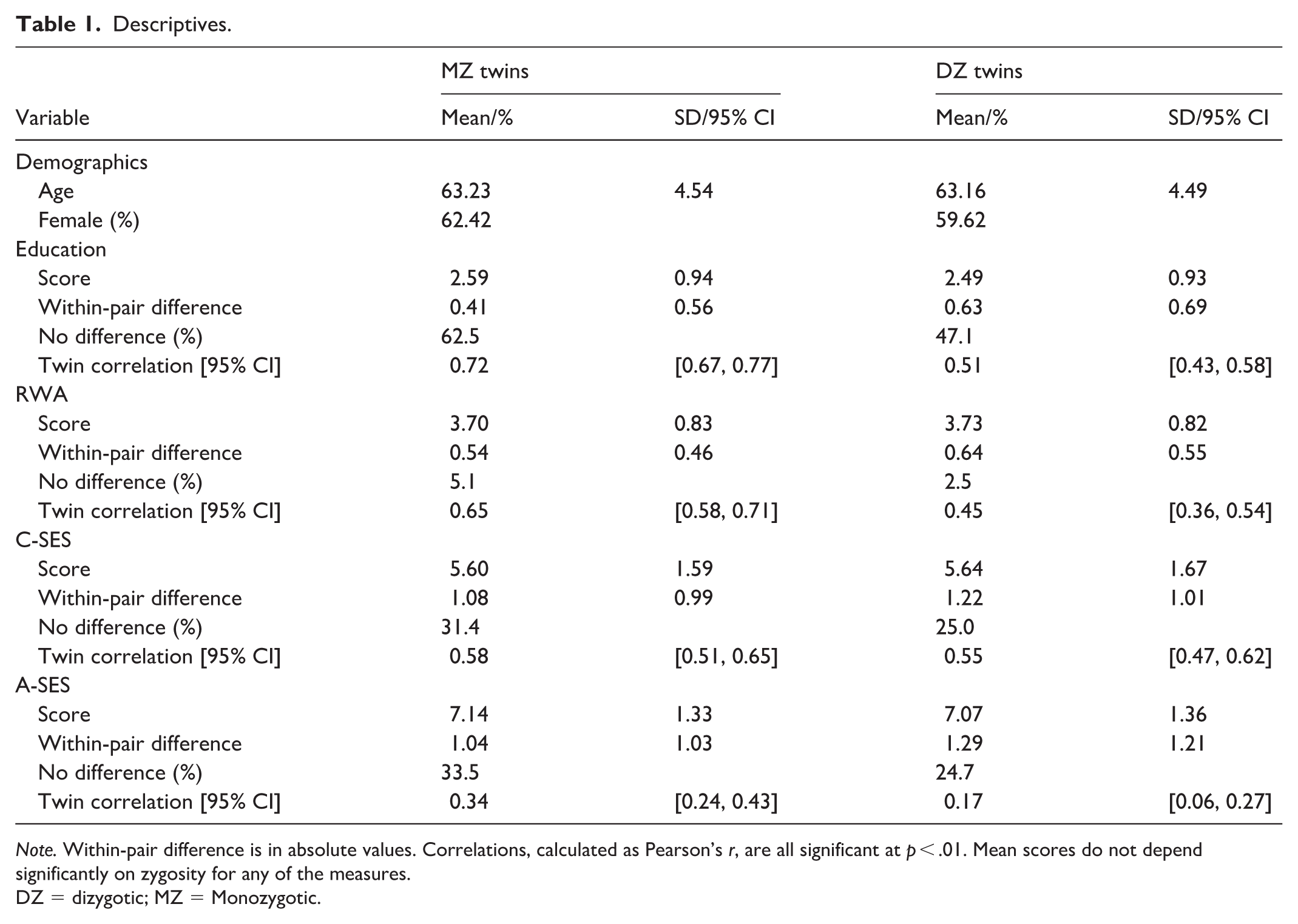
Note. Within-pair difference is in absolute values. Correlations, calculated as Pearson’s r, are all significant at p < .01. Mean scores do not depend significantly on zygosity for any of the measures.
DZ = dizygotic; MZ = Monozygotic.
To investigate participation bias, we compare educational attainment between the 63% who responded to our survey and those who did not, finding that responders (M = 12.01) had, on average, longer educations than non-responders (M = 11.01, t(735) = 4.28, p < .001). While we do not have measures of SES or RWA for non-responders, we can investigate participation biases on these variables by comparing singleton twins with people in pairs were both twins participated. Here, we do not see any significant differences on any of our variables (including education).
Correlations
Table 2 shows within-person correlations, calculated as Pearson’s r, for all our variables, and Figure 2 visualizes the relationship between education and RWA. Consistent with prior work (e.g., Pascarella & Terenzini, 2005), we find that educational attainment and RWA had a pronounced negative phenotypic correlation, at r = −.46 (95% CI [−0.50, −0.43], p < .001).
Phenotypic correlations between Educational attainment, RWA, and perceived SES in childhood and adulthood, with 95% CIs.

Note. RWA: Right-Wing Authoritarianism; SES: socioeconomic status.
C-SES and A-SES are perceived SES in childhood and adulthood, respectively.
All correlations are significant at p < .001.
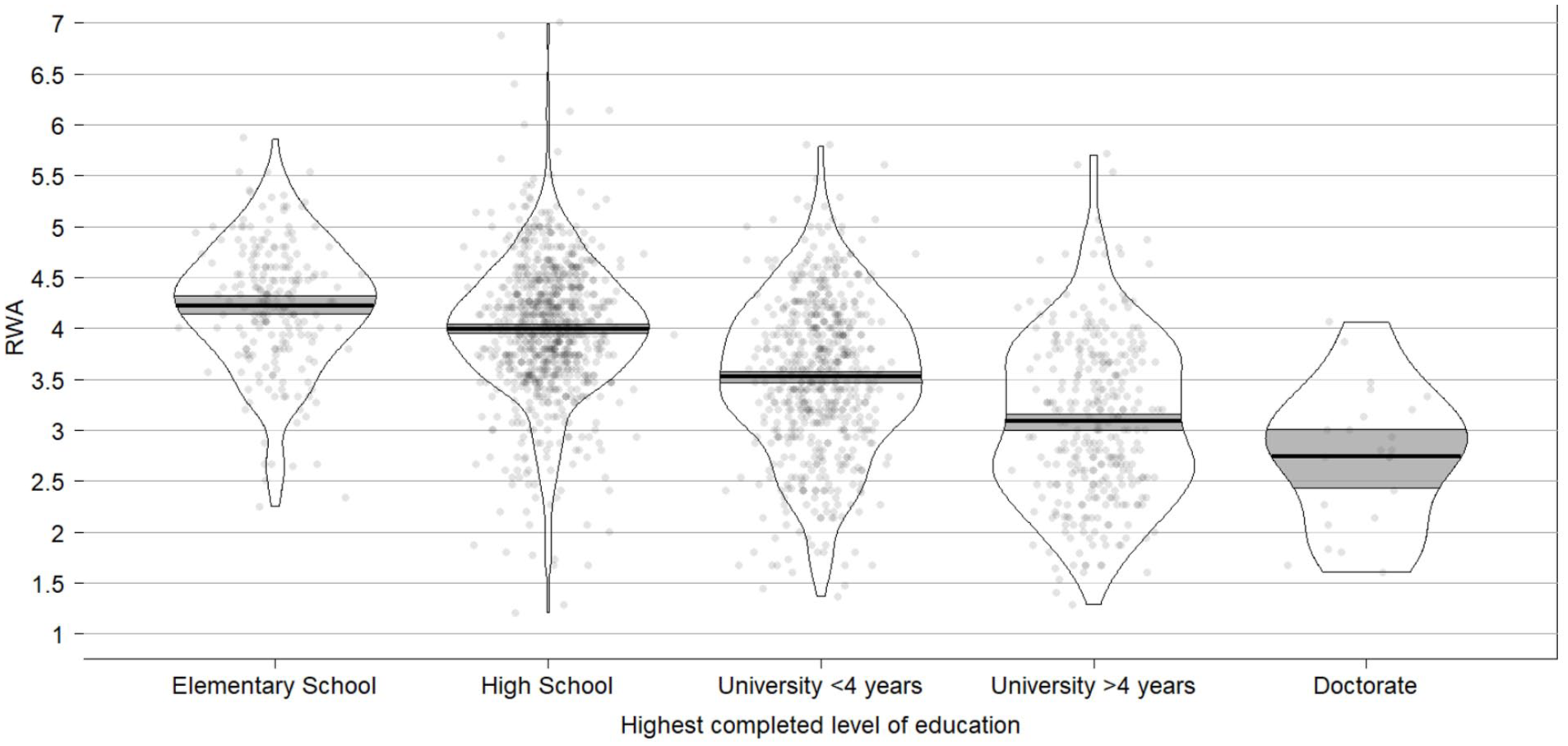
Relationship between educational attainment and RWA.
Biometric Modeling
Variance Decompositions
The parameter estimates in our model can be translated to simple univariate variance decompositions for all the variables in the model, as presented in Table 3.
Variance Components of Our Variables.
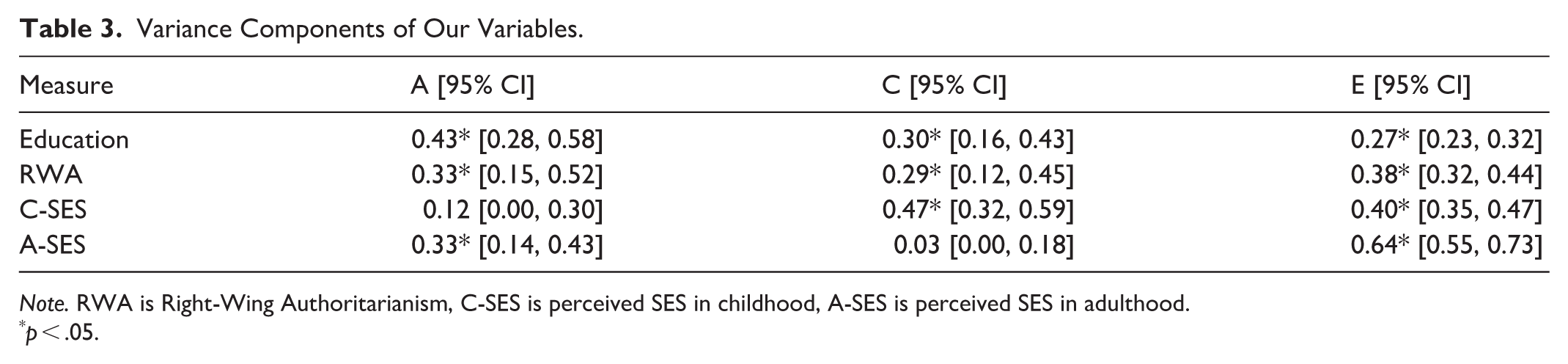
Note. RWA is Right-Wing Authoritarianism, C-SES is perceived SES in childhood, A-SES is perceived SES in adulthood.
p < .05.
Both education and RWA had substantial shared-environmental variance components, at 0.30 and 0.29, respectively, and genetic components, at 0.43 and 0.33. For perceived SES in childhood, the shared-environmental component was at 0.47, which aligns with how this variable reflects an aspect of the shared environment. The remaining variance in this variable, which was 12% genetic and 40% unique-environmental, we interpret as genetic and non-genetic influences on how SES is perceived. The unique-environmental component also contains measurement error. SES in adulthood had a larger genetic component than SES in childhood (at 0.33) and, surprisingly, did not have any significant shared-environmental variance component in our sample.
ACE-β Modeling
As a preliminary step in our analytic approach, we constructed a bivariate ACE-β model with only education and RWA (Figure 1b). Here, we found a significantly negative direct path from education onto RWA, and we also found significant shared-environmental confounding. Genetic confounding between the two variables was not significant.
In the second model (Figure 1c), where we investigated if this direct path was mediated through SES in adulthood (A-SES), we found that this was not the case (see the Supplemental Material, Section 1, for more details on the preliminary models).
Parameter estimates for the full model (shown in Figure 1d) are in Table 4 and Figure 3. Model fit statistics for all our models are in Supplemental Table S11. Our main parameter of interest, the direct path from education to RWA, was significantly negative in our model. Additionally, there was significant shared-environmental confounding. Education had a significant shared-environmental component, which loaded negatively on RWA. And the shared-environmental component of SES in childhood (C-SES) had a positive loading on Education and a negative loading on RWA, further contributing to the negative correlation between these two variables.
Parameter Estimates in the Full Model.
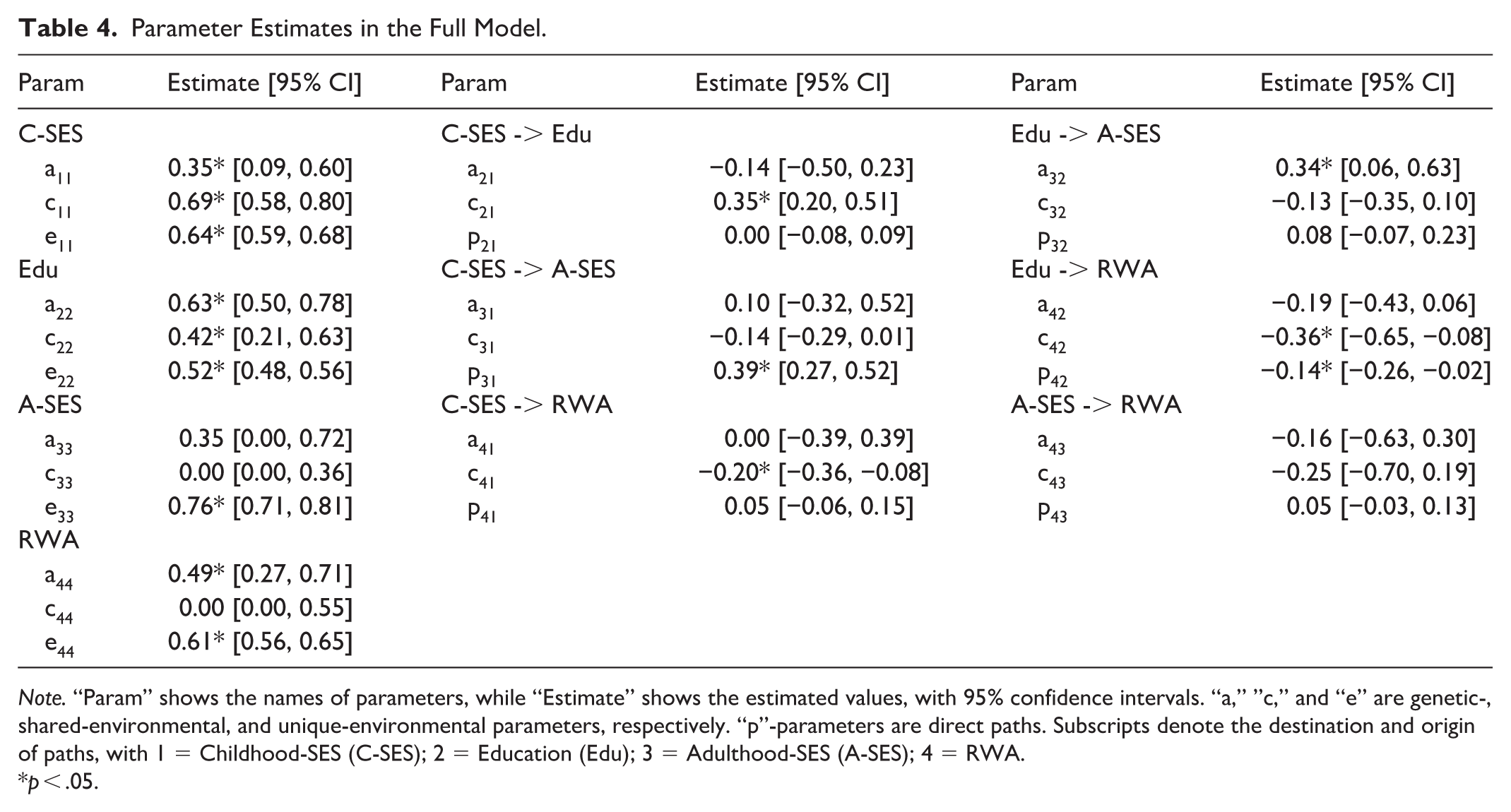
Note. “Param” shows the names of parameters, while “Estimate” shows the estimated values, with 95% confidence intervals. “a,” ”c,” and “e” are genetic-, shared-environmental, and unique-environmental parameters, respectively. “p”-parameters are direct paths. Subscripts denote the destination and origin of paths, with 1 = Childhood-SES (C-SES); 2 = Education (Edu); 3 = Adulthood-SES (A-SES); 4 = RWA.
p < .05.
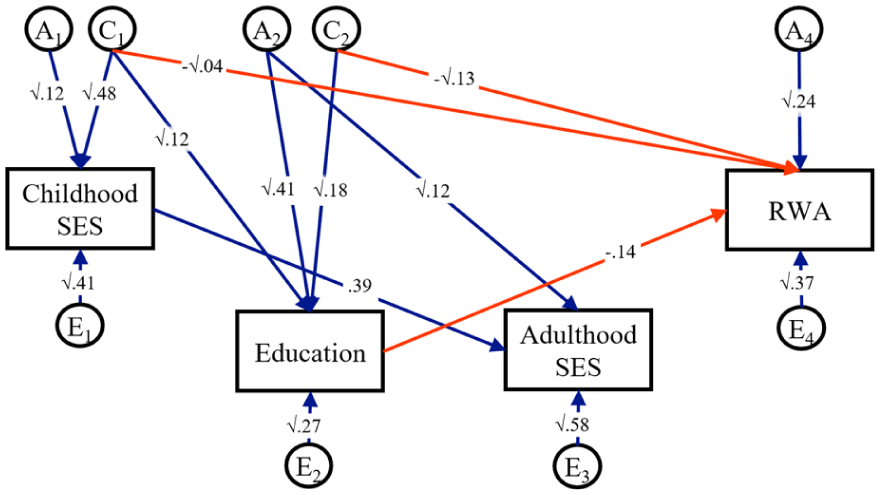
Parameter estimates in full model.
Figure 4 details how our results suggest that the covariance between education and RWA is to be explained. The total expected covariance between education and RWA in our model is the sum of all the valid paths from one to the other: Figure 4 shows how each path contributes to this covariance. As seen here, 28% of the covariance is from the direct path from education onto RWA (which represents causal effects and/or unique-environmental confounding). The remaining covariance is largely explained by how the A and C components of education (after C-SES is accounted for) have negative paths onto RWA (significantly so only for the C component). About 15% of the covariance is due to confounding from shared-environmental influences related to perceived childhood-SES.
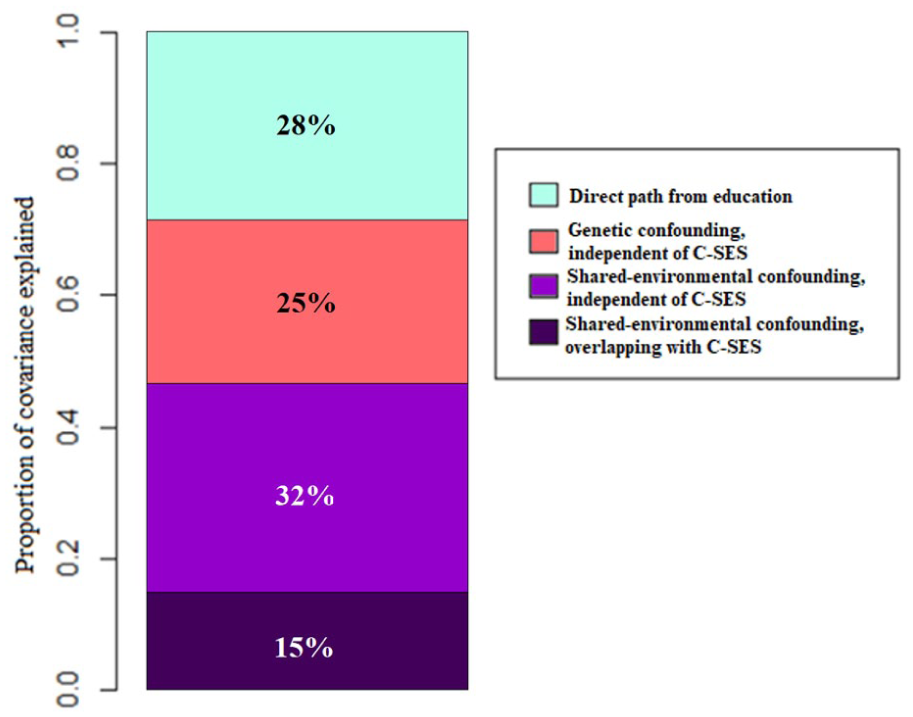
Model-estimated sources of covariance between educational attainment and RWA.
Neither the direct path from education onto A-SES, nor the direct path from A-SES to RWA were significant. In any case, these paths did not form part of the explanation for why education and RWA are negatively correlated, since they were both positive and thus contributed to bringing the correlation closer to zero. About 61% of the variance in RWA was unaccounted for by the other variables in the model.
Discussion
Our findings in this exploration of the relationship between educational attainment and RWA are consistent with the following seven claims:
(1) Both education and RWA are influenced by environmental factors shared by twins in a pair, in addition to genes.
(2) Education and RWA are substantially negatively correlated.
(3) The largest proportion of this negative covariance is due to environmental confounders that are shared between twins.
(4) There could also be genetic confounding between education and RWA.
(5) A small proportion of the environmental confounds between education and RWA are specifically related to perceived SES in childhood.
(6) More than one-quarter (28%) of the covariance between education and RWA remains unaccounted for after controlling for the sum of all genetic and shared-environmental confounders, consistent with causal effects.
(7) We do not find any evidence that the connection between education and RWA is mediated by perceived SES in adulthood.
Genetic and Environmental Influences on Educational Attainment, RWA, and SES
Consistent with prior research (e.g., Eaves et al., 1999; Heath et al., 1985; Truett et al., 1992), we find that both education and RWA have substantial variance components from the shared environment, at 0.30 and 0.29, respectively. For perceived SES in childhood, the shared-environmental component was at 0.47, aligning with the fact that this variable measures an aspect of the shared rearing environment of twins. The remaining variance in childhood SES, 12% genetic and 40% unique-environmental, we interpret to represent heritable and environmental influences on how SES is perceived and also, in the case of the unique environment, measurement error. Perceived SES in adulthood did not have any significant shared-environmental variance. Education, RWA, and adulthood-SES all had substantial genetic variance components, at around 0.40, which aligns well with the typical level of heritability found for most psychological and social traits (Polderman et al., 2015).
Relationship Between Educational Attainment and RWA
Genetic and Shared-Environmental Confounding
Educational attainment and RWA had a substantial negative correlation, at r = −.46. Our analysis suggests that at least 72% of this covariance is due to the influence of confounders, both in the shared environment (47%) and in genes (25%). Notably, though, an inference of genetic confounding relies on assuming that the non-significant coefficient for the path from the genetic component of education onto RWA (a42) is in fact negative. Confounding could represent shared-environmental and/or genetic effects on traits that causally influence both education and attitudes. Examples of such traits include cognitive ability and openness to experience. Shared-environmental confounding could also reflect cultural influences on educational attainment tending to come together with cultural influences on RWA: that the same kinds of cultural environments that bolster educational attainment also attenuate RWA. This could be correlations in patterns of parenting practices, or correlations between other influences from the broader cultural environments. Similarly, genetic confounding can reflect genetic effects on the two traits simply tending to come together, for example, through linkage disequilibrium or pleiotropy (Solovieff et al., 2013).
Here, it is also important to consider the impacts of assortative mating on correlations between twins. Educational attainment and political attitudes are both among the traits correlating most strongly between pairs having children together, typically above r = .40 (Horwitz et al., 2023). The impact of such assortment on heritable traits is to increase the genotypic similarity of DZ twins relative to MZ twins (who cannot get any more genetically similar). This in turn may inflate estimates of shared-environmental variance components, and potentially also cross-trait correlations of shared-environmental components, insofar as there is also cross-trait assortment (as evidence suggests there could be, Border et al., 2022).
Our analysis estimated the extent to which confounding between education and RWA was captured by SES in childhood. We found that 15% of the total covariance between education and RWA was explained by variance in childhood-SES. This then suggests that growing up in an environment with high SES by itself can work both to increase educational attainment and to reduce RWA. However, the majority of the shared-environmental covariance between education and RWA appears to be independent of perceived childhood SES.
Other Sources of Covariance
The remaining 28% of the covariance between education and RWA not reflecting genetic or shared-environmental confounding effects must be due to causal effects (in one or both directions) and/or unique-environmental confounding. If there are indeed traits affecting both education and RWA (such as cognitive ability or openness), this would imply unique-environmental correlations between education and RWA, as these traits, like most traits, are affected by the unique environment. Unique-environmental effects on confounding traits would indirectly affect both education and RWA, through the causal paths from the confounding trait. Unique-environmental confounding could also occur in other ways, such as if twins in the same pair can vary in their exposure to cultural environments that influence both education and RWA (in opposite directions). Amin et al. (2015) argued that discordant twin models therefore can be viewed as estimating an upper bound of the extent to which a relationship is causal.
While the direct paths in our model could then plausibly be overestimates of causal effects, it is also possible that they are underestimates. Specifically, this can happen when there is random error in measurements (Frisell et al., 2012), as there almost always is. Both education and RWA appear to be measured reasonably well in our sample. Both had high phenotypic correlations for MZ twins, at ~0.70, even though twins should not correlate on random error. But as Gustavson et al. (2024) demonstrated, even small amounts of error can substantially bias discordant twin analyses against causal hypotheses. It is then notable that our results remain consistent with a causal hypothesis even though we are using an approach that has been criticized for almost always ruling them out.
We were interested in the role adulthood SES could have as a mediator to causal effects. Education is a core component of SES, but there are also other components, such as financial and cultural capital. Education might causally influence RWA via its effects on such other aspects of SES. Following Lipset (1959), high SES can give an increased sense of security and mastery that leads to reduced authoritarianism. SES could also influence RWA via socialization, if it leads to exposure to social environments that encourage low authoritarianism. The fact that we did not find any evidence of such causal mediation by SES then counts against both these hypotheses. We do not claim to have fully ruled them out, however, as our single-item self-report measure of SES is unlikely to be a perfect reflection of actual SES.
Limitations and Future Directions
Our study is limited in that our sample consists solely of Norwegian citizens between 55 and 70 years old. Norms and parental practices might have been different in the 1960s and 1970s, in ways that influence our findings, and so we advise caution in generalizing our results to other age groups. Additionally, the nature of educational institutions, both socially and academically, might also have been different when our participants were students, in ways that may be relevant to our results. Similarly, generalizability of our results is limited in terms of culture and ethnicity, since our sample is almost exclusively ethnically and culturally Norwegian.
Another limitation of our study is that we do not have data on the kinds of education taken by our participants. There is support for the idea that authoritarian attitudes have a stronger negative relation to education in the social sciences or the humanities, for example, than in other fields, such as law and finance (e.g., Dambrun et al., 2009), but the nature of our data did not allow us to study such distinctions here. The collection and analysis of data on the specific types of education completed, in conjunction with RWA, would then be an interesting potential future direction.
Furthermore, our study is limited in that we are unable to properly study how education might relate differently to the different dimensions within the RWA construct. Future studies could utilize more recent versions of the RWA scale which are better suited for distinguishing these dimensions (e.g., Mavor et al., 2010).
It would also be informative to do discordant twin studies with data from not just twins, but also from their spouses, children, and extended families. Models to study such data are becoming increasingly sophisticated (e.g., Keller et al., 2009; McAdams et al., 2021), allowing separate estimates of several modes of environmental and cultural transmission, accounting for gene-environment interplay, and, perhaps most importantly in this context, allowing proper control for the influences of assortative mating.
Finally, future studies could utilize more objective measures of SES, and separately measure the different aspects of SES, such as income, education, wealth, and social and cultural capital, to be better able to investigate the influences both of SES as a whole and of its subcomponents.
Conclusion
Understanding the factors that compel some people, but not others, toward authoritarian ideology remains a matter of great practical importance in light of recent political and cultural events across the world. One prominent factor found by decades of research to be negatively associated with authoritarianism is educational attainment, but given that experiments cannot randomly assign people to receiving an education or not, the nature of this empirical relationship has remained unknown. Using an adaptation of the discordant twin design in a structural equation framework, we find that the largest proportion of the (negative) covariance between education and RWA is due to environmental confounders shared by twins, and genetic confounders could also have an influence. The fact that almost a quarter of the covariation remains unaccounted for by these confounders leaves the door open for causal effects between education and RWA. Furthermore, unlike the results of most twin studies on other psychological traits, our results point to the importance not only of genes, but also of environmental factors shared by family members in understanding the roots of authoritarian outlooks, of educational outcomes, and of the relationship between the two.
Supplemental Material
sj-docx-1-psp-10.1177_01461672251407779 – Supplemental material for The Relationship Between Educational Attainment and Right-Wing Authoritarianism: A Discordant Twin Study
Supplemental material, sj-docx-1-psp-10.1177_01461672251407779 for The Relationship Between Educational Attainment and Right-Wing Authoritarianism: A Discordant Twin Study by Nikolai Haahjem Eftedal, Thomas Haarklau Kleppestø, Nikolai Olavi Czajkowski, Espen Moen Eilertsen, Espen Røysamb, Olav Vassend, Jennifer Sheehy-Skeffington and Lotte Thomsen in Personality and Social Psychology Bulletin
Footnotes

Author Contributions
N.H.E., L.T., E.R., O.V., and N.O.C. designed research; E.R. and O.V. performed research; N.H.E., E.M.E., T.H.K., and N.O.C. analyzed data; N.H.E., L.T., and J.S.S. wrote the manuscript; all authors commented on and edited the manuscript.
Funding
The authors disclosed receipt of the following financial support for the research, authorship, and/or publication of this article: The research was funded by grants 0602-01839B and 231157/F10 from the Danish and Norwegian Research Councils, respectively (to L.T.).
Declaration of Conflicting Interests
The authors declared no potential conflicts of interest with respect to the research, authorship, and/or publication of this article.
Data Availability Statement
The data and materials used in this study are unavailable due to ethical and legal constraints given by the NTR.
Supplemental Material
Supplemental material is available online with this article.
References
Supplementary Material
Please find the following supplemental material available below.
For Open Access articles published under a Creative Commons License, all supplemental material carries the same license as the article it is associated with.
For non-Open Access articles published, all supplemental material carries a non-exclusive license, and permission requests for re-use of supplemental material or any part of supplemental material shall be sent directly to the copyright owner as specified in the copyright notice associated with the article.
