




Abstract
Moral disagreement across politics revolves around the key question, “Who is a victim?” Twelve studies explain moral conflict with assumptions of vulnerability (AoVs): liberals and conservatives disagree about who is especially vulnerable to victimization, harm, and mistreatment. AoVs predict moral judgments, implicit attitudes, and charitable behavior—and explain the link between ideology and moral judgment (usually better than moral foundations). Four clusters of targets—the Environment, the Othered, the Powerful, and the Divine—explain many political debates, from immigration and policing to religion and racism. In general, liberals see vulnerability as group-based, dividing the moral world into groups of vulnerable victims and invulnerable oppressors. Conservatives downplay group-based differences, seeing vulnerability as more individual and evenly distributed. AoVs can be experimentally manipulated and causally impact moral evaluations. These results support a universal harm-based moral mind (Theory of Dyadic Morality): moral disagreement reflects different understandings of harm, not different foundations.
Introduction
Moral disagreement across politics is obvious, but the drivers of this disagreement are less clear. Although some suggest liberals and conservatives have different moral minds (e.g., Haidt & Joseph, 2004), more recent research suggests that all moral judgments revolve around concerns about harm and victimization (e.g., Ochoa, 2022; Schein & Gray, 2015). Everyone cares about protecting vulnerable entities from harm, but people make different assumptions about who is especially vulnerable to victimization. Here, we explore how these different assumptions of vulnerability (AoVs) explain moral disagreement and political divides.
Explaining Moral Differences Across Politics
Liberals and conservatives disagree on many issues, from climate change to transgender rights. Many of these disagreements stem naturally from the core of each ideology—competing perspectives on the value of change and stability (Claessens et al., 2020; Tuschman, 2013; see also Brandt et al., 2014). By definition, liberals (i.e., progressives) seek social change while conservatives value tradition (Jost et al., 2008), and so liberals are more likely to favor perspectives related to reform (e.g., new ways of understanding gender, sexuality), whereas conservatives are more likely to defend existing social arrangements (e.g., traditional ways of understanding gender, sexuality). There are other straightforward connections from the core elements of political ideology to morality: conservative’s higher tolerance for inequality aligns with support for lower taxes on the wealthy (Bartels, 2005), and their emphasis on firmer in-group boundaries explains their support for immigration restrictions (Gries, 2016).
But beyond the definitional overlap between ideology and morality (Skitka et al., 2005), what psychologically predicts moral judgments across politics? One popular theory, Moral Foundations Theory (MFT; Graham et al., 2013), proposes that moral judgments arise from a small set of distinct mental mechanisms, or “foundations.” According to this account, conservatives rely on five foundations—care, fairness, loyalty, authority, and purity—whereas liberals rely primarily on care and fairness (Haidt, 2012). However, MFT has both empirical and theoretical problems.
Although liberals and conservatives sometimes respond differently to moral scenarios framed around various values, these differences are overstated and depend on the specific issues assessed (Frimer et al., 2013; Schein & Gray, 2015). When the content of these scenarios is tweaked, “foundational” differences between liberals and conservatives are eliminated. Conservatives might care about the purity of sexuality, but liberals express strong purity concerns when it comes to environmental degradation (Frimer et al., 2013). Conservatives might worry about loyalty toward the military, but liberals worry about loyalty toward progressive causes such as labor unions (Frimer et al., 2014).
That the conservative versus liberal preference for foundations can be easily flipped suggests that the differences revealed by the moral foundation questionnaire (MFQ; Graham et al., 2009) are not “foundational” but hinge on the specific issues and questions selected by researchers. As another example, MFT argues that “justice” and “fairness” are mostly liberal causes (e.g., “social justice”), but conservatives also appeal to fairness when opposing affirmative action or taxation. Likewise, conservatives argue for “respecting authority” when thinking about conservative pastors and Republican presidents—but are happy to challenge the authority of progressive pastors or Democratic presidents (e.g., Biden; Frimer et al., 2013).
To be explicit: findings that conservatives care more about loyalty, authority, and purity do not result from deep cognitive differences between left- and right-leaning people, but instead because the Moral Foundations Questionnaire has conservativism “baked-in” when assessing loyalty (loyalty to America), authority (to preachers), and purity (like chastity)—all causes long known to be championed by conservatives.
Rather than timeless cognitive modules, MFT categories should be understood as more transient ad hoc groupings, created (and re-created) by researchers to capture particular moments in American politics (e.g., the culture wars of the early 2000s; Koleva et al., 2012). If there were obvious foundations that cut the mind at its joints, then their number and content should be more evident and timeless. We would certainly not expect the list of foundations to change so easily, from three (Rozin et al., 1999), to four (Haidt & Joseph, 2004) to five (Graham et al., 2009) to six (Atari et al., 2023) to—it is argued by MFT proponents—eventually “74, or perhaps 122, or 27” (Graham et al., 2012, p. 5).
MFT might describe American moral rhetoric from recent history (e.g., anti-gay rights arguments from the early 2000s), but researchers question its ability to make sense of moral disagreement across space (Iurino & Saucier, 2020) and time (Smith et al., 2017). For instance, the MFQ, and particularly the purity foundation, show problematic validity in non-WEIRD cultural contexts (Winkelkotte et al., 2025). The measurement of moral foundations is also highly variable within people—that is, it lacks reliability—and changes in moral foundations fail to account for changes in political ideology (Smith et al., 2017).
Another issue with moral foundations is that they are not useful for understanding the most important moral questions. These foundations fail to capture people’s everyday moral concerns (Yudkin et al., 2025) and moral debates surrounding current political debates about abortion, immigration, systemic racism, COVID-19, or guns. For example, COVID-19 should, a priori, clearly be a “purity” issue, because purity concerns disease and the body, yet purity failed to predict effective health behaviors and intentions that would prevent the spread of the virus (Pizza et al., 2023). Of course, one could construct a story about COVID-19 as being really about authority (Edsall, 2020). Still, post hoc stories linking foundations to issues provide many research degrees of freedom and are difficult to falsify.
Despite its limitations, MFT gives people language to describe disagreement on some issues—but should be appreciated for what it actually taxonomizes: discourse rather than cognition. With its focus on explicit judgments (Graham et al., 2011) and moral rhetoric found in highly public and performative settings, such as religious sermons (Graham et al., 2009) and social media (Hopp et al., 2021), the MFT taxonomy better describes reasoned rationalization rather than intuitive moral judgments—what people are arguing rather than how people think. After all, there are no implicit cognition studies that clearly reveal distinct foundations—whether 5 or 27—which is perhaps unsurprising, given the lack of distinctness in explicit judgments (e.g., loyalty and authority correlate r = .88; Graham et al., 2013).
MFT is perhaps most useful in describing the moral “keywords” used by different groups at certain moments in American politics. These keywords are connected to specific moral issues but are also arbitrary markers that affirm social identity. Consider “liberty,” proposed as a sixth foundation (Atari et al., 2023). It is true that conservatives frequently invoke the word “liberty” in political discourse, as with the right-leaning “Liberty Caucus” in Congress, or “Liberty Fund” to support right-wing ideals. But just because the left does not use the term “liberty,” does not make it uniquely conservative. Liberals care deeply about the liberty of LGBTQ people and women seeking reproductive rights (e.g., Barrón-López & Schmitz, 2024).
Understanding “liberty,” “purity,” and “social justice” and other words as semi-arbitrary group markers or coalitional symbols (Cosmides & Tooby, 2010; DeScioli & Kurzban, 2013) connects them to other social-identity keywords or phrases. When conservatives rallied around the phrase “Let’s Go Brandon” in 2022, it was not because Brandon is a timeless moral value. Instead, it represented an in-group phrase or password (a “shibboleth”) that allowed people to both reinforce their group boundaries and mock president Biden. Interestingly, these keywords and phrases can also be co-opted by the outgroup like a trojan horse. For example, using “purity” keywords in environmental messaging better persuades conservatives (Feinberg & Willer, 2013), perhaps because these seem like arguments coming from “inside the house”—from the ingroup of fellow conservatives.
Importantly, when it comes to cognition, the idea of moral foundations also forgets that all forms of judgment—including moral judgment—is a process of categorization (McHugh et al., 2022). When people wonder whether an act is immoral, they are questioning how well it belongs in the category of “immorality.” For 50 years, we have known that categorization judgments involve the process of template comparison, where our minds compare a potential example to an underlying mental template—also called a concept, prototype, or schema (Rosch, 1978). The closer the match between the example and the template, the more it is judged as belonging to that category (Murphy, 2004). With morality, the more an act matches our template of the concept “immorality” the more it is judged as “immoral.”
The Universal Moral Template of Perceived Harm
More than a decade of research suggests our template of the concept “immorality” is rooted in perceptions of (interpersonal) harm (Gray et al., 2012)—also known as victimization (Gray & Kubin, 2024). Harm/victimization is prototypically dyadic, involving an intentional agent causing damage to a vulnerable victim (or patient), explaining why people become more morally outraged when a Chief Executive Officer (CEO) harms a baby (very intentional agent harming a very vulnerable victim), versus when a baby harms a CEO (less intentional agent harming a less vulnerable victim; Schein & Gray, 2018). Even if people discuss many different values in moral rhetoric, studies show that—for both liberals and conservatives—perceptions of dyadic harm predict moral judgment across scenarios tapping each “foundation” (Ochoa, 2022).
A harm-based moral template suggests that the more someone sees an act as victimizing, the more they should condemn it—regardless of the specific value(s) an act might violate. Importantly, the claims of harm-based morality are descriptive and psychological, not definitional nor philosophical. We are not arguing that everything in morality is functionally reducible to physical harm, nor that all morality should be “defined” merely as harm. Across the moral world, people obviously hold many different values and concerns, from filial duty (Hwang, 1999) to emotional control (Rozin et al., 1999) to honor (Nisbett & Cohen, 1996) to bravery (Franco et al., 2011). It is also clear that acts like murder, drug use, and flag burning differ in content and meaning—and these differences can be usefully organized by various taxonomies.
Despite this descriptive variety, studies in moral psychology—exploring cognition—reliably support the idea of a common cognitive template (Ochoa, 2022): no matter the value, the more an act seems to involve dyadic harm—an agent causing harm to a victim—the more it seems to be immoral. Another way of thinking about it is that people worry about different values—and especially condemn violations of these values—based on how much they involve victimization. In a moral landscape of hundreds of different values, which values people prioritize seems to hinge on whether they guard against some kind of victimization (Gray & Kubin, 2024; Ochoa, 2022). See Figure 1.
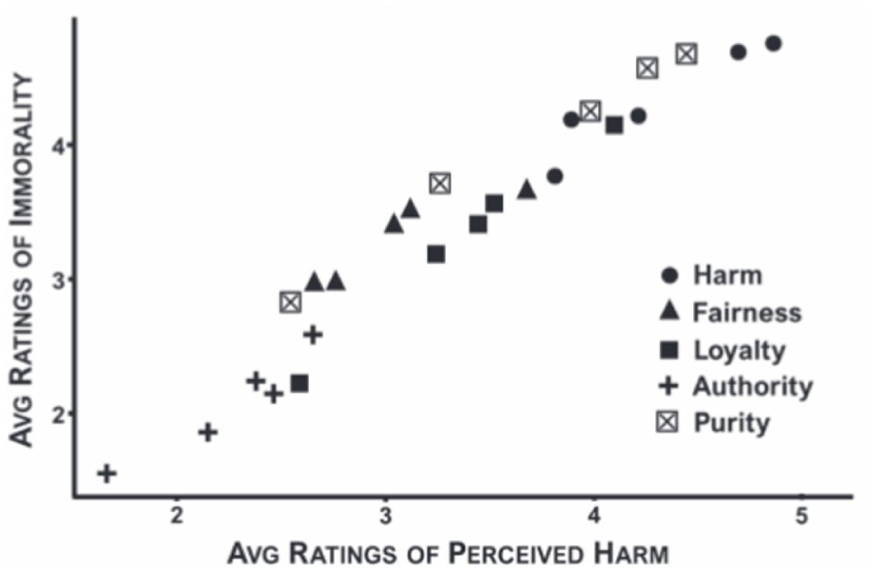
Perceptions of harm predict people’s perceptions of immorality across all kids of moral acts or values.
Consistent with a harm-based template, studies also show that perceptions of victimization explain patterns of reaction times in moral judgment across diverse moral values and accurately predict moral judgment in naturalistic settings (Ochoa, 2022). For example, the amount of “dyadic harm” inherent in news pieces—how much the author writes about an agent victimizing a patient—predicts moral condemnation across thousands of articles on both left-leaning (e.g., Vox) and right-leaning (e.g., Breitbart) sites (Ochoa, 2022).
These and other studies of intuitive moral cognition (Gray, MacCormack, et al., 2022; Pratt et al., 2025; Schein & Gray, 2015, 2018) make clear that people share a harm-based mind, relying on the simple process of template matching. And yet, morality is complex, with different people making starkly different moral judgments. How can such complexity arise from the simplicity of the harm-based mind? The answer is that perceived harm is surprisingly complex, when properly considered.
The Diverse Pluralism of Perceived Harm
Across time, cultures, and politics, people’s subjective understanding of “harm” varies greatly. These subjective perceptions of victimization are much broader and nuanced than moral foundations’ concept of direct physical or emotional violence (Gray & Pratt, 2025). Just as the human concept of “sex” is much richer than heterosexual relations within a marriage, concepts of harm and victimhood can connect to many acts and issues. We all innately care about preventing harm (Gray, 2025), but our families, societies, churches, and schools teach us that some things (but not others) cause harm. This harm-based instruction underlies our moral values (Rottman et al., 2015), where children learn to morally condemn what seems harmful (Gray, DiMaggio, et al., 2022). However, people do not always agree about what is most harmful or who is most vulnerable to victimization.
People disagree about morality because they disagree on how much different things cause harm, whether judicial unfairness (Gray et al., 2026), spiritual decay (Vigdel et al., 2024), the illegality of drugs (Erickson, 1982), or the acceptability of censorship (Kubin et al., 2025). People also disagree about who exactly suffers from harm and how. Someone raised to believe that gay marriage leads to burning for eternity in a lake of fire will have different moral opinions about homosexuality than someone taught that gay marriage is merely an expression of love.
Morality is obviously plural (many); harm is also plural. A harm-based mind is pluralistic and not monistic (one) because there are many ways that harm is perceived. Perceived dyadic harm is the flexible “moral grammar” through which cultures elaborate their varieties of moral values (Mikhail, 2007). Even instances of “impurity,” which have been argued to be distinct from harm (Frimer et al., 2013), are easily connected to perceptions of harm (Gray, 2025). For example, anthropological accounts reveal how Brahmin Indians ground their moral concerns about the impurity of death in cultural understandings of harm—failing to perform correct death rites causes souls to suffer (Shweder, 2012). Likewise, analyses across cultures and throughout history reveal how concerns about temperance and sexual chastity reflect the desire to control impulses that are perceived as harmful to society (Fitouchi et al., 2022). One review documents how condemnation of nine varieties of “harmless” impurity are all grounded in cultural constructions of harm (Gray, DiMaggio, et al., 2022). If you want to understand someone’s moral convictions, understand how they see harm (Gray, MacCormack, et al., 2022).
Of course, there may be an objective truth about whether someone has the capacity to intend harm, or whether someone is susceptible to victimization, but this objective truth is inaccessible to others because of the problem of other minds (Leudar & Costall, 2004). We can never directly experience another person’s thoughts and feelings—especially the capacity to suffer—and this inaccessibility requires that people make assumptions about another’s ability to intend or experience victimization. Although questions of intentionality are important (Ames & Fiske, 2013), here we focus specifically on subjective perceptions of how much different entities can experience mistreatment: people’s “assumptions of vulnerability.” We suggest that different AoVs are an important driver of political differences in moral judgment.
Assumptions of Vulnerability
The core thesis of this paper is that moral judgments are powerfully explained by different assumptions about who (or what) is especially vulnerable to harm, mistreatment, and victimization. There are many obvious connections between AoVs and moral disagreement. For example, positions on abortion hinge on whether people see fetuses as merely an insensate clump of cells, or as tiny human beings vulnerable to harm (Lee et al., 2005). With immigration, progressives often frame undocumented immigrants as vulnerable victims of oppression seeking a better life, while conservatives paint them as invulnerable hardened criminals who threaten innocent citizens (Hogan & Haltinner, 2015). Climate change debates revolve around disagreements about the suffering of ecosystems (Hoffman, 2020) versus the suffering of people harmed by climate change protections (e.g., job loss; Karamidehkordi & Naderi, 2025). Debates about transgender athletes in girl’s and women’s sports center around harm caused to competitors vs. the transgender person (Barrón-López & Lane, 2025).
AoVs are “informational assumptions:” beliefs about the nature of the world that shape differences in moral judgments (Turiel et al., 1987, p. 189). Because they are informational assumptions, AoVs—while being crucial to morality—are not intrinsically moral constructs. Instead they are beliefs about “ontology” (how the world works; Koltko-Rivera, 2004). The informational assumption that “cats can feel pain” might contribute to a moral view but is not itself a moral view. In other words, informational assumptions are beliefs about “is” not “ought.” Even though informational assumptions about vulnerability feed naturally into moral questions, they are intrinsically descriptive rather than normative. The separation between descriptive AoVs and normative morality is important for the scientific quest to explain moral differences because it helps escape the tautology of “morality = morality” that plagues moral foundations.
MFT currently provides the most popular explanation of political differences in moral judgment. It argues that liberals and conservatives differ in morality because they rely on different moral foundations (Graham et al., 2018). Unfortunately, this explanation is circular: “differences in morality across politics” come from “differences in morality across politics”—a tautology (see Schein & Gray, 2018, p. 47).
To make this tautology explicit, consider the MFT explanation for why conservatives condemn promiscuity: Promiscuity is impure, and conservatives condemn impurity (Haidt, 2012). But how do we know that conservatives condemn impurity? Because conservatives score higher on the MFQ purity sub-scale, which asks whether “Chastity is an important and valuable virtue” (Atari et al., 2023). Dictionaries describe “chastity” as the opposite of promiscuity, and also “virtue” as the opposite of immorality, which means that the MFQ item “Chastity is an important and valuable virtue” can be rewritten as “Promiscuity is immoral.” Therefore, the MFT’s answer to the question of “Why do conservatives condemn promiscuity?” is because “Conservatives rate promiscuity as immoral.”
To move beyond the tautology of explaining morality with morality, the study of political disagreement must connect moral differences to people’s understanding of how the world is (descriptive), not about how the world ought to be (normative). AoVs are one set of descriptive assumptions that people make about the world (other descriptive ontologies include whether inequality “trickles down” or whether God has a plan for America). If liberals and conservatives make different informational assumptions about who or what is especially vulnerable to victimization and mistreatment, and perceptions of victimization and mistreatment drive moral judgment, then AoVs can be said to explain moral differences.
Although people likely hold AoVs about many different targets, it seems like some of the most divisive moral debates may connect to four clusters of targets, or themes, of AoVs: The Environment, The Othered, The Powerful, and The Divine. We are not suggesting these are the only clusters of AoVs, or that these themes represent separate domains or mechanisms. Not only is the mind not carved up into distinct mental mechanisms (Barrett, 2013; Barrett & Russell, 2014), but the pluralistic richness of morality cannot be captured with an easy whole number (Gray, 2014). Rather, we are suggesting that four ad hoc themes can help make sense of some of today’s most divisive disagreements between liberals and conservatives in the United States—all within the framework of our shared harm-based moral minds.
The Environment
Environmental protection is rated as a top governmental priority by 85% of Democrats but only 39% of Republicans (Pew Research Center, 2020). This difference may be partially explained by AoVs, with liberals seeing environmental entities like rainforests as more vulnerable. Of course, the Environment may not be as vulnerable as human beings, but liberals seem especially likely to include environmental targets as worthy of moral concern (Waytz et al., 2019).
The Othered
Sociology understands social identities as relational (i.e., groups define themselves in relation to other groups) and as connected to power structures (Callero, 2003; Okolie, 2009). Critical theorists argue that, in America, the dominant group against which others are defined and judged is White cis-gendered Christian men, and those who do not belong in this group are “othered” (e.g., Devos & Banaji, 2005). AoVs about The Othered could include the perceived vulnerability of groups like Muslims or transgender people. Liberals seem to emphasize the vulnerability of the Othered, whereas conservatives are more likely to emphasize how the Othered are less like victims and more like perpetrators (Prestigiacomo, 2016).
The Powerful
People in positions of power, like corporate leaders and state troopers, are unlikely to be seen as highly vulnerable. However, many—especially conservatives—emphasize some vulnerability for people in power. While everyone might recognize the power of institutional leaders and those with historically privileged identities, staunch conservatives might also believe that the powerful can be disadvantaged (Takahashi & Jefferson, 2021).
The Divine
For some, God and Jesus are merely cultural ideals. For others, they are living beings with rich mental lives (Altemeyer & Hunsberger, 1992). For instance, some Christian traditions teach that sinning hurts God (Ephesians 4:30). Although it seems harder to victimize supernatural entities as compared to people, many see the Bible as a living document and view God as capable of suffering mistreatment. Given links between politics and religion (Womick et al., 2021), we suggest conservatives see The Divine as more vulnerable than liberals.
Although we have suggested broad ideological differences in how people might perceive the Environment, the Othered, the Powerful, and the Divine, we acknowledge there may be exceptions to these overall expected patterns. Liberals and conservatives can be similarly intolerant toward some marginalized groups, particularly when intersectional identities are considered (e.g., religious African Americans; Takahashi & Jefferson, 2021), and also similarly supportive of the status quo (e.g., when their party is in power; Valdes et al., 2024). Despite these nuances, we expect to find reliable political differences in AoVs across these clusters.
Ideological Patterns in AoVs
Beyond specific clusters of targets, liberals and conservatives may also be divided in how they understand the overall distribution of vulnerability in society. Conservatives often emphasize that, fundamentally, vulnerability to harm is shared by all people (e.g., “all men are born equal”). Regardless of group membership, anyone can be victimized. This view may help explain conservative support for the All Lives Matter movement, which argues that suffering harm and injustice are not confined to particular social groups but are risks faced by all individuals (Capatides, 2020). From this perspective, emphasizing group-specific vulnerability can seem divisive, obscuring the innate and universal capacity for suffering (Huntington, 1957). After all, even rich healthcare CEOs can be murdered and leave bereft family members behind (News, 2024).
Liberals, in contrast, more often emphasize that vulnerability is unevenly distributed across social groups, with history and institutions leaving some social groups systematically more exposed to violence and deprivation (Du Bois, 2022). This view may help explain strong liberal support for the Black Lives Matter movement (Horowitz et al., 2023), which highlights how Black Americans face disproportionate risks of violence, discrimination, and structural harm. Rather than treating vulnerability as evenly shared, this perspective foregrounds historical and institutional forces that systematically expose some groups to greater harm than others.
Taken together, these differences suggest a broader ideological pattern. Liberals may generally amplify differences in perceived vulnerability, dividing the moral world into those who are especially vulnerable to harm and those who are relatively protected—often framed as oppressed versus oppressors (Young, 2020). Conservatives, by contrast, may dampen differences in perceived vulnerability, viewing people as more similar in their exposure to harm and moral standing (Huntington, 1957). Said another way, liberals tend to focus on group-based vulnerability—how social categories shape the likelihood of victimization—whereas conservatives tend to focus on individual-based vulnerability, the idea that any person, regardless of group membership, can suffer harm (Gray & Kubin, 2024).
Importantly, political disagreement is not about greater or lesser concern for victimization, but instead about divergent AoVs of (at least) three levels: the micro-level of individual entities (e.g., fetuses), the meso-level of clusters (e.g., the Environment), and the macro-level (i.e., how vulnerability is distributed across groups). A landscape of different AoVs allows for moral disagreement even though we all share a universal harm-based mind.
Current Research
Twelve studies (nine detailed here, two in the supplement, plus an initial pilot) examine AoVs and their connection to differences in moral judgment, both in general and above and beyond moral foundations (Graham et al., 2009). In Section 1 (Moral Judgment), we evaluate the link between AoVs and moral judgments toward micro-level entities (Supplemental Study A), divisive issues (Study 1), and sacred objects (Supplemental Study B). In Section 2 (AoV Themes), we explore whether meso-level AoVs about the Environment, the Othered, the Powerful, and the Divine help make sense of political disagreement (Studies 2a, b). For divergent and convergent validity, we also test how these AoV themes relate to other relevant constructs (Study 3) and help predict hot-button moral issues (Study 4). We also test whether these themes generalize beyond specific politicized targets (Study 5). In Section 2, we additionally test the macro-level prediction that liberals and conservatives will differ in how they see vulnerability distributed across these four AoV clusters. In Section 3 (AoV Applications), we explore whether AoV themes—unlike moral foundations—are revealed by implicit measurement (Study 6), whether AoVs predict charity behaviors (Study 7), and whether AoVs can be experimentally manipulated to impact moral judgment (Study 8).
Across studies, we find that AoVs are a significant predictor of liberal and conservative political disagreement over and beyond moral foundations. Ultimately, these studies provide an initial outline of how moral differences across politics can be consistent with a universal harm-centric moral mind. The universal and innate human concern about victimization can manifest rich moral differences when visions of what really counts as victimization change across space and time.
Our design, hypotheses, analyses, and preregistrations are available at: https://osf.io/gubsv/overview?view_only=b22df7778a5a4d738bea216c4a212fb3. Ethics approval was provided by the University of North Carolina at Chapel Hill (“Judgment of Mind and Moral Decision Making,” Protocol 12-11585). Sample size was determined a priori for all studies based on power analyses (Studies 1 and 2 used G*Power; Faul et al., 2007) and resource constraints (Studies 3–8). We report all manipulations, measures, and exclusions. Demographics across all studies are listed in Table 1.
Demographics Across Studies.
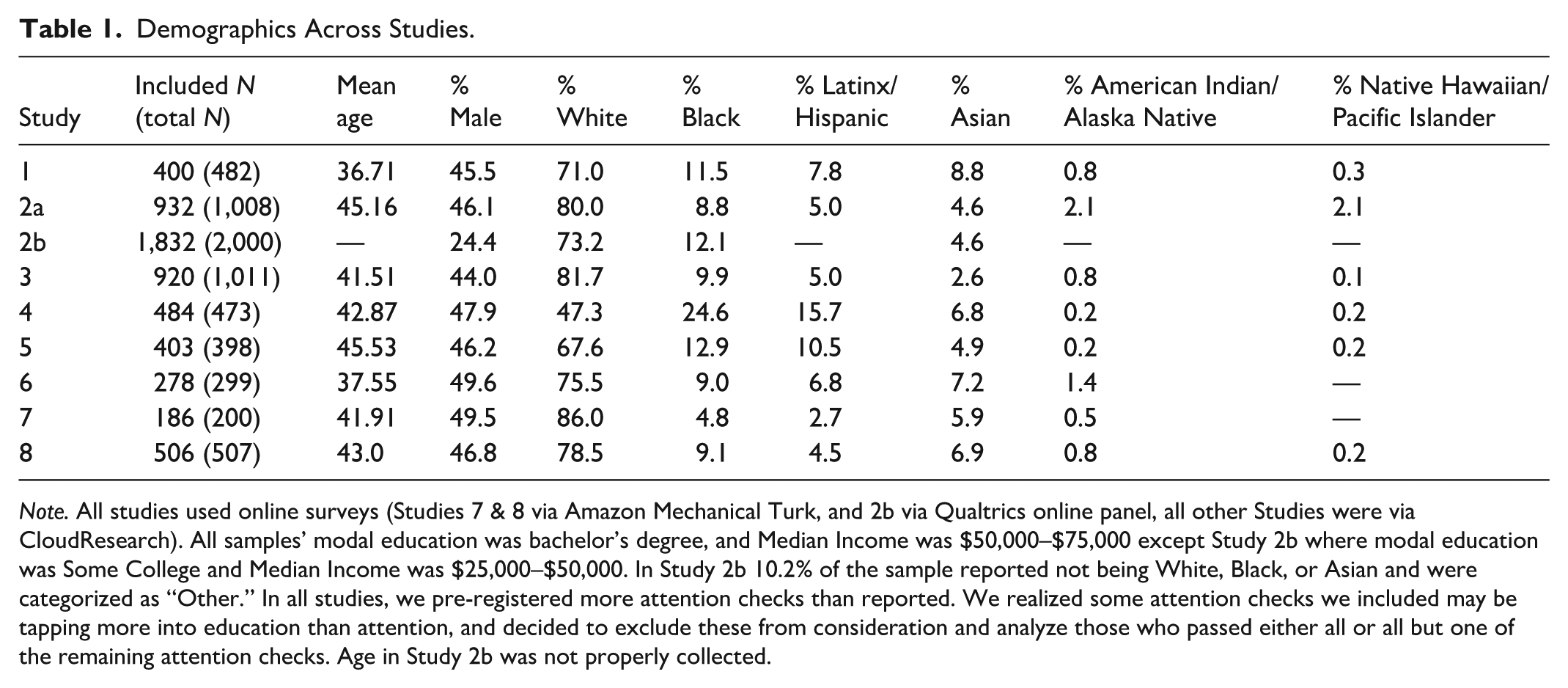
Note. All studies used online surveys (Studies 7 & 8 via Amazon Mechanical Turk, and 2b via Qualtrics online panel, all other Studies were via CloudResearch). All samples’ modal education was bachelor’s degree, and Median Income was $50,000–$75,000 except Study 2b where modal education was Some College and Median Income was $25,000–$50,000. In Study 2b 10.2% of the sample reported not being White, Black, or Asian and were categorized as “Other.” In all studies, we pre-registered more attention checks than reported. We realized some attention checks we included may be tapping more into education than attention, and decided to exclude these from consideration and analyze those who passed either all or all but one of the remaining attention checks. Age in Study 2b was not properly collected.
Measuring AoVs
We adopted a face-valid approach to measuring AoVs that are theoretically consistent with the past decade of work on dyadic morality and our harm-based moral minds (Schein & Gray, 2018). For all targets, participants respond on a scale from 1 (not at all vulnerable) to 5 (completely vulnerable) to the following 3 items: 1.I believe that the following are especially vulnerable to being harmed 2.I think that the following are especially vulnerable to mistreatment 3.I feel that the following are especially vulnerable to victimization
These items asked about whether targets were “especially” vulnerable to avoid ceiling effects observed in other work on ratings of mind and vulnerability (Frimer et al., 2013).
In Section 1, we measure AoVs towards a wide variety of targets, then in Section 2, we focus on four themes or clusters of targets (the Environment, Othered, Powerful, and Divine) to better understand political disagreements. Although we largely use self-report to measure AoVs at the explicit level, consistent with the intuitive way harm is typically perceived (e.g., Waytz et al., 2010), in Study 6, we also developed an implicit measure of these. We note that researchers can measure AoVs of any entity they wish (e.g., dogs, corporations, LLMs, public figures), making AoV measurement a simple and adaptable tool for understanding how moral complexity (in this case, political divides) emerges from a universal harm-based mind.
Section 1: Moral Judgment
These studies investigated whether AoVs predict moral judgments toward diverse targets. Due to space constraints, two of these studies (Supplemental Study A and B) and a pilot are presented fully in the Supplemental material (pp. 2–16) and summarized here.
An initial Pilot Study showed that AoVs reflect face-valid differences in vulnerability. For instance, participants rated orphans as more vulnerable than professional wrestlers (Supplemental material p. 3). Supplemental Study A built off the findings of the pilot study and showed that, across a wide variety of targets, those perceived as more vulnerable to victimization and mistreatment were also granted greater moral status. For example, children were seen as more vulnerable to harm than professional wrestlers and were granted more moral status. This is important because it demonstrates that AoVs help explain variance in moral judgment. This study also found systematic differences in AoVs across the political spectrum (Supplemental material p. 9). For example, conservatives were more likely than liberals to see fetuses as especially vulnerable to harm and worthy of moral concern.
Supplemental Study B showed that targets assumed to be more vulnerable—including inanimate objects—are viewed as more alive (Supplemental material p. 16), explaining how AoVs can help explain the moral condemnation of apparently “harmless wrongs” (but see Gray et al., 2014 for the ubiquity of perceived harm). Consider the moral condemnation of flag burning and the Bible. Although flags and the Bible are not alive in the same sense as human beings, our data reveal that many conservative and/or religious people perceive these symbolic objects as alive (after all, the United States Flag Code literally says the American flag “is itself considered a living thing”).
Having now established that AoVs can help explain both overall moral judgments and political disagreement with morality, we turn to our first study, which examined links between AoVs, politics, and judgments of divisive issues (e.g., immigration, gay rights; Study 1).
Study 1: AoVs Predict Moral Judgments on Divisive Issues
Study 1 examined whether AoVs helped explain political differences in moral judgments toward six controversial issues. We measured AoVs for 6 different targets and assessed whether these predicted moral judgments on issues relevant to each, above and beyond political orientation. We expected that the partisan tendency to condemn certain actions (e.g., flag-burning for conservatives, refusing services to gay couples for liberals) would be explained by perceiving targets at the center of those scenarios (e.g., the U.S. flag, gay people) as more vulnerable to harm.
Method
Moral Scenarios
Participants read six scenarios, three we anticipated would be condemned more by liberals, and three we anticipated would be condemned more by conservatives (see Table 2).
Moral Scenarios Used in Study 1.
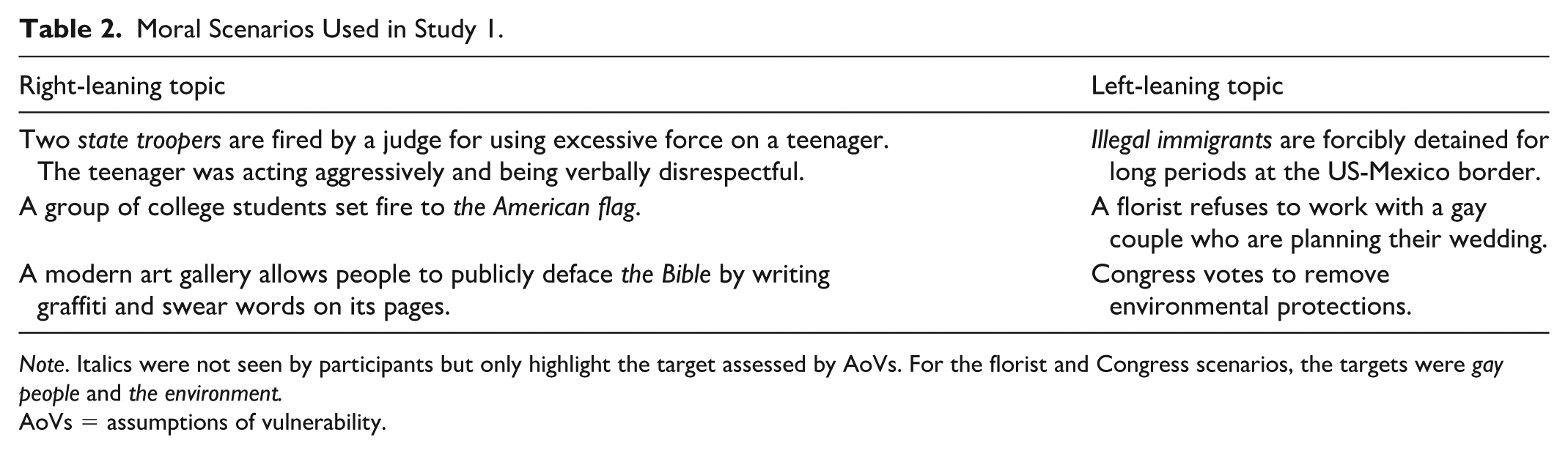
Note. Italics were not seen by participants but only highlight the target assessed by AoVs. For the florist and Congress scenarios, the targets were gay people and the environment.
AoVs = assumptions of vulnerability.
Assumptions of Vulnerability
Participants rated the perceived vulnerability of each target (see Table 2) using the AoV measure outlined above. Descriptives and reliabilities are available in the Supplemental material (p. 17).
Moral Judgments
Participants evaluated the immorality of each scenario (see Table 2) on a 5-point scale, ranging from 1 (Not at all immoral) to 5 (Extremely immoral). These topics were chosen because of real political debates/events in the United States. For example, there are real-life examples of florists who refused to work on the weddings of same-sex couples (Lavietes, 2021) and college students who burned the American flag (NBC4 Washington, 2016). We also wanted to include targets that might connect to MFT themes, like authority figures (e.g., the police; Aitalieva & Harding, 2025) and sacred objects (Cuevas & Dawson, 2020).
Results and Discussion
As expected, political orientation predicted moral judgments. Those who leaned further left more strongly condemned the left-leaning scenarios (β = −.47, R2 = .31, p < .001), and those who leaned right more strongly condemned right-leaning scenarios (β = .39, R2 = .21, p < .001). See Figure 2.
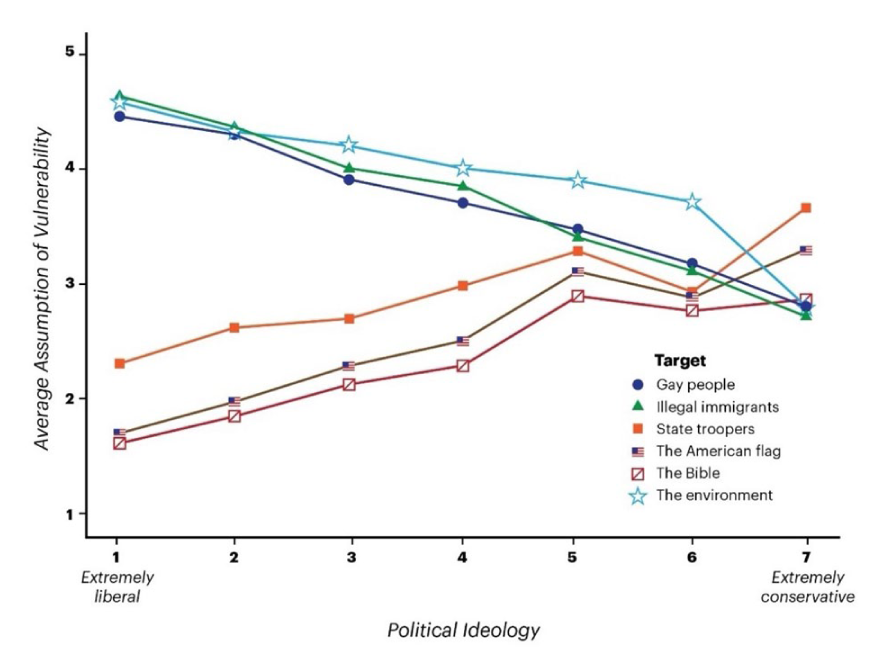
Relationship between political orientation and AoVs for different targets (Study 1).
Importantly, AoVs strongly predicted moral judgments even when controlling for political orientation for both left-leaning (β = .51, p < .001) and right-leaning scenarios (β = .41, p < .001). Mediation analyses using the PROCESS Macro (Model 4; Hayes, 2018) found a significant indirect effect of political orientation on moral judgment through AoVs for both left-leaning (b(SE) = −0.18(0.02), 95% CI [−0.23, −0.14]) and right-leaning (b(SE) = 0.13(0.02), 95% CI [0.09, 0.17]) scenarios, suggesting that individual differences in informational assumptions surrounding harm helped explain the link between politics and moral judgments on divisive issues. See Supplemental material (p. 18) for full models.
Together with the three supplemental studies, these results suggest AoVs help explain moral differences across politics—they vary meaningfully with political orientation and help explain the impact of orientation upon moral judgments. Left- and right-leaning people see different entities (e.g., gay people; the American flag) as more vulnerable to victimization, and this explains differences in the moral condemnation of acts that could harm these targets (i.e., discrimination toward gay people; flag-burning).
Section 2: Four Themes of AoV Help Explain Moral Differences Across Politics
The first section revealed that AoVs helped explain political differences in moral judgment. Section 2 explores whether some contemporary political debates are explained (in part) by four ad hoc clusters or AoV themes: The Environment (e.g., coral reefs), The Othered (e.g., illegal immigrants), The Powerful (e.g., business leaders), and The Divine (e.g., God). As described in the introduction, we selected these four themes because they seem to exist at the crux of modern political divisions in the United States.
Study 2 developed a measure of these AoV themes using exploratory (2a) and confirmatory (2b) factor analysis. We also assessed the validity of these AoV themes in predicting ideological differences in moral judgments above and beyond moral foundations (Graham et al., 2013). Study 3 replicated these findings, situating AoVs within a broad net of other constructs, and explored the stability of AoVs through test-retest reliability. Study 4 directly pitted AoVs against moral foundations to predict moral disagreement for a broad set of hot-button issues. Finally, Study 5 tested whether connections between politics and AoVs generalize beyond specific politicized targets.
Study 2a: Exploring Four Themes of AoV Targets
Study 2 developed a measure of AoVs for four ad-hoc themes—the Environment, the Othered, the Powerful, the Divine—and tested political differences in AoVs across these four themes. We predicted that liberals would view the Environment and the Othered as more vulnerable than conservatives, and conservatives would view the Powerful and Divine as more vulnerable than liberals. We also tested whether these AoVs explained moral judgments above and beyond moral foundations.
Method
Measures
AoV Themes
Participants rated the three AoV questions described above (“especially vulnerable” to harm, mistreatment, victimization) for three targets in each of four themes, for a total of 36 items. Targets (see Table 4) were chosen as face-valid representations of each theme, but we acknowledge that they do not capture the full scope of these themes. Moving forward, clusters of AoVs can be defined and measured in whatever way is most useful to researchers. We averaged the 3-items for each target, creating a composite variable representing AoVs for each target, which were then averaged within-theme to create a composite for the Environment (α = .95), the Othered (α = .93), the Powerful (α = .87), and the Divine (α = .93).
Moral Judgments
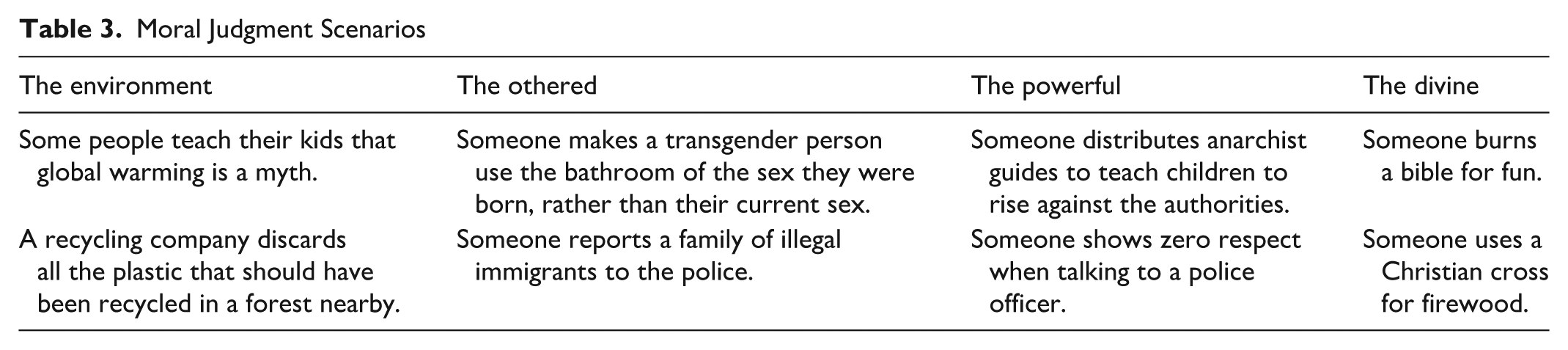
For each AoV theme, we also created two scenarios (Table 3) to reflect plausible real-world situations in which targets from each theme might be seen as victimized. Respondents rated the immorality of each using a scale from 1 (Not at all immoral) to 5 (Extremely immoral), and these ratings were averaged within each theme. See Supplemental material (pp. 19–20) for descriptive statistics.
Moral Judgment Scenarios
Moral Foundations
To assess whether AoVs predicted moral judgments above and beyond moral foundations, participants completed the 20-item MFQ (Graham et al., 2008). Consistent with past work finding two broad clusters of these items (Graham et al., 2013), we aggregated all items related to care and fairness, M(SD) = 4.83(0.70), α = .77 and all items related to loyalty, authority, and purity, M(SD) = 3.51(1.02), α = .90, a high enough reliability to suggest a single construct.
A sensitivity power analysis using G*Power (Faul et al., 2007) showed we had 95% power to detect significant effects as small as r = .14. Correlations among all measures can be found in the Supplemental material, p. 22.
Results
Factor Analyses
Factor analyses of the AoV items supported the predicted four-factor solution. Figure 3 shows the fit measures and BIC for exploratory analyses ranging from one to six factors, all of which provide evidence for a four-factor solution. Only the first four factors had eigenvalues > 1.00 (range from 1.27 to 4.08), explaining 80% of variance. RMSEA and TLI only reach adequate levels at four factors, suggesting simpler solutions are not acceptable, and the BIC value improves up to four factors. Primary and cross-loadings from the four-factor solution can be found in the Supplemental material (p. 21). All primary loadings were above 0.73, and no cross-loadings were above 0.10.
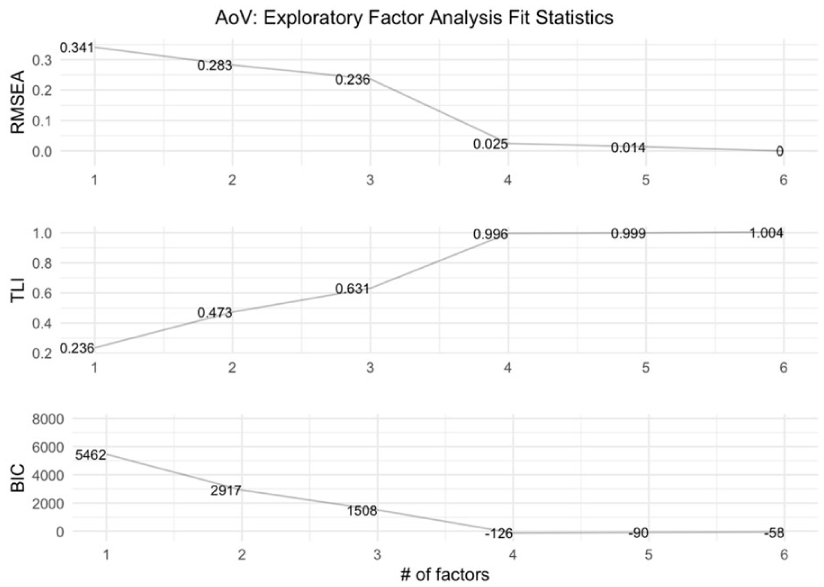
Exploring fit for 1 to 6 factor solutions (study 2a).
Correlations with Political Orientation
As expected, liberals had higher AoVs for the Environment (r = −.47), and the Othered (r = −.36) and conservatives had higher AoVs for the Powerful (r = .29) and the Divine (r = .26), all p’s < .001. More extreme liberals saw the Environment and the Othered as especially vulnerable and the Powerful and the Divine as especially invulnerable, whereas more extreme conservatives saw all four themes as more similarly vulnerable (Figure 4).
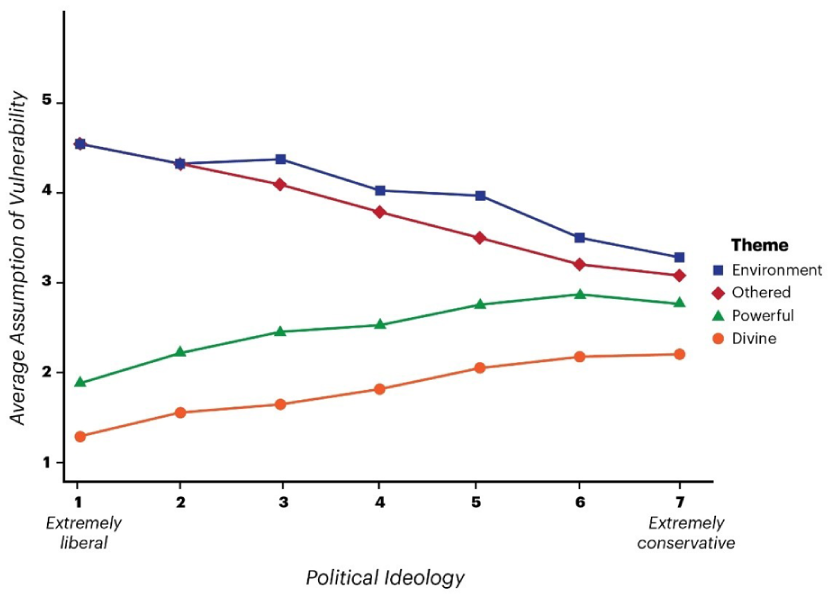
Assumptions of vulnerability across the political spectrum (study 2a).
Moral Scenarios
Using hierarchical regression, we found AoVs predicted moral judgments for the respective AoV scenarios, controlling for political orientation and moral foundations on the first step: Environment, β = .35, ∆R2 = .10, p < .001; Othered, β = .28, ∆R2 = .05, p < .001; Powerful, β = .15, ∆R2 = .02, p < .001; Divine, β = .20, ∆R2 = .04, p < .001. Not only are AoVs predictive of moral judgments, but they also explain unique variance in them above and beyond moral foundations. Political ideology significantly contributed to moral judgments indirectly through AoVs. Full results available in the Supplemental material, pp. 22–25.
Discussion
This study provided support for the usefulness of considering these four ad hoc AoV themes when explaining political differences in moral judgment. Liberals were more likely to rate AoVs higher for the Environment and the Othered, and conservatives were more likely to rate AoVs higher for the Powerful and the Divine. Although rank order vulnerability was the same on the far left and right—the Environment & the Othered, then the Powerful, then the Divine—liberals amplified group differences in vulnerability while conservatives diminished these differences. These different ratings in AoVs explained moral judgments independently from MFQ, and they mediated the link between political ideology and moral judgments. Thus, AoVs are important for understanding political differences in morality, and they explain variance over and above moral foundations.
Study 2b: Four AoV Themes with a Unique National Sample
Study 2b allowed us to assess the structure of our AoV measure using confirmatory factor analysis. We also sought to replicate key findings from Study 2a using a high-quality quasi-representative national sample of religious Americans (See Table 1)—thereby increasing the robustness of our findings. This sample also allowed for an interesting test across samples: whether AoVs for the Divine are higher than with the less religious sample in Study 2a. Methods were similar to Study 2a: participants rated the three AoVs items for 3 targets in each of four themes, and then reported their political orientation on a 9-point scale from 1 (Very Liberal) to 9 (Very Conservative), M(SD) = 5.41(2.21). Participants also completed other measures as part of another study. A sensitivity power analysis using G*Power (Faul et al., 2007) showed we had 95% power to detect significant effects as small as r = .10.
Confirmatory factor analysis revealed that the four-factor solution showed acceptable model fit, with fit statistics surpassing typical thresholds, χ2(48) = 449.53, p < .001, SRMR = 0.05, RMSEA = 0.07, TLI = 0.96, CFI = 0.97. Correlations among the factors were similar to Study 2a (see the Supplemental material, p. 28), and political orientation was related negatively to the Environment, r = −.25, and the Othered, r = −.41, and was positively related to the Powerful, r = .15, and Divine, r = .08, all p’s < .001 (this lower correlation is likely due to reduced variation in religiosity in this religious sample). As before, liberals amplified and conservatives diminished differences in AoV between targets (see Figure 5).
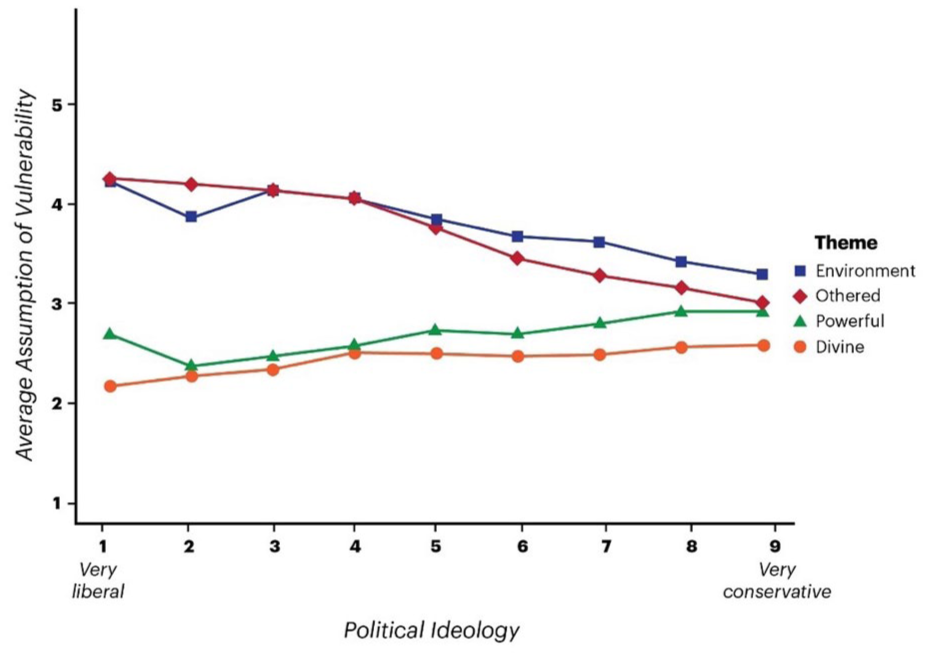
Assumptions of vulnerability across the political spectrum (study 2b).
Compared to the convenience sample in Study 2a, this more religious (and conservative) sample had lower AoVs for the Environment (mDiff = 0.29), and the Othered (mDiff = 0.23), and higher for the Powerful (mDiff = 0.27), and—especially—the Divine (mDiff = 0.68), all ts > 5.93, all ps < .001.
Discussion
In two samples, we found similar patterns of AoVs across political orientation. Although both liberals and conservatives had a similar ranking of targets—the Environment and the Othered, followed by the Powerful and then the Divine—extreme liberals amplified the differences in vulnerability between groups, whereas extreme conservatives dampened the differences between groups. AoVs also provided unique explanatory value in understanding moral judgments independently of moral foundations and mediated the link between political ideology and moral judgment.
Study 3: AoVs in the Nomological Net
In Study 3, we collected data over two time points to assess test-retest reliability and also explore the nomological net surrounding AoVs to better situate this construct. We included measures expected to relate to each AoV theme to provide convergent validity and sought to replicate Study 2 results (confirmatory factor analysis, AoV differences across politics, and predicting moral judgments independently from moral foundations). Below, we describe the set of constructs we expected to be related to each AoV theme:
The Environment
We predicted that AoVs for the Environment would be associated with endorsing the view that animals, plants, and the environment have moral status in the moral expansiveness scale (Crimston et al., 2016).
The Othered
These AoVs were expected to correlate with seeing the stigmatized as having high moral status, measured via the moral expansiveness scale (Crimston et al., 2016). Because universalism values are about tolerance, appreciation of differences, and supporting welfare for all (Schwartz, 2012), we also anticipated finding a positive relationship between universalism and AoVs for the Othered.
The Powerful
We expected that AoVs for the Powerful would be positively associated with right-wing authoritarianism, due to its association with submission to authorities (Manganelli Rattazzi et al., 2007). We also predicted these AoVs would correlate with valuing power (status, prestige, control, dominance) as a guiding life principle (Schwarz value scale; Schwarz, 2012), and morally endorsing deference to authorities (Morality As Cooperation scale; Curry et al., 2019). Because submitting to the powerful and authorities also requires a degree of conformity (Steiner & Johnson, 1963), AoVs for the Powerful may also relate to this value.
The Divine
Due to their overlap with religious views, AoVs for the Divine should be associated with endorsement of supernatural beliefs (Jong et al., 2013).
Uncorrelated Measures
We did not expect AoVs would be significantly associated with openness to experience (Gosling et al., 2003) or need for cognitive closure (Roets & Van Hiel, 2011a) outside of their mutual overlap with political orientation.
A sensitivity power analysis using G*Power showed we had 95% power to detect significant effects as small as r = .17.
Method
Procedure
Participants completed two surveys with a 1-week gap in between. At both waves, participants completed the same AoV and political orientation scales as in Study 2a. During the first wave only, participants completed all other measures, including moral foundations, moral concern for the stigmatized, animals, and the environment (using the Moral Expansiveness scale, Crimston et al., 2016), and the deference to authority subscale of the Morality-as-Cooperation Questionnaire (Curry et al., 2019). To measure universalism, power, and conformity, we administered the Schwarz Value Survey (Lindeman & Verkasalo, 2005). We measured right-wing authoritarianism using a 15-item scale (Manganelli Rattazzi et al., 2007). Participants also completed the Supernatural Belief Scale (Jong et al., 2013), and openness to experience was measured using the 10-item Personality Inventory (Gosling et al., 2003). Participants also responded to the Need for Cognitive Closure Scale (Roets & Van Hiel, 2011b). Full information about the measures can be found in the Supplemental material (p. 29).
Results
Replications and Test Re-Test Reliability
Factor analyses indicated the four-factor solution for the AoV scale was most appropriate (First wave: RMSEA = 0.066, CFI = 0.978, TLI = 0.969; Second wave: RMSEA = 0.061, CFI = 0.984, TLI = 0.977). The mean within-person reliability across time was 0.88, indicating a good degree of stability. Test-retest reliability was similarly high for each theme: Environment = 0.85; Othered = 0.83; Powerful = 0.91, and Divine = 0.93.
These data replicated Study 2 for patterns of AoVs across politics, their ability to predict moral differences (independently of moral foundations), and mediation analyses (Supplemental material pp. 32–35).
Nomological Net
For all models, we hierarchically regressed each outcome on mean-centered political orientation on a first step, and the four AoV factors (mean-centered) on a second step. See results below (full results in Supplemental material, pp. 37–39). AoVs for the Environment significantly predicted moral concern for plants, β = .34, animals, β = .34, and the environment, β = .44, all ps < .001. AoVs for the Othered significantly predicted the stigma facet of the moral expansiveness scale, β = .24, and universalism values, β = .14, ps < .001. AoVs for the Powerful significantly predicted higher endorsement of right-wing authoritarianism, β = .14, viewing deference as a moral requirement, β = .24, ps < .001, and basic values for power, β = .14, and conformity, β = .09, ps < .03. AoVs for the Divine significantly predicted supernatural beliefs, β = .31, p < .001.
In contrast to pre-registered predictions, AoVs for the Environment predicted openness to experience, and AoVs for the Divine predicted the need for cognitive closure, both interesting relationships that should be considered in future research.
Discussion
Study 3 provided further support for the construct of AoVs by demonstrating test-retest reliability, replicating patterns for political differences in AoVs, and their unique relevance to everyday moral judgments. AoV themes also showed convergent validity with other moral constructs, values, beliefs, and cognition, even when controlling for political orientation and the other three (non-focal) AoV themes.
Study 4: Direct Comparison of AoVs to Moral Foundations
In Studies 2 and 3, AoVs predict a number of important constructs even when controlling for moral foundations. Study 4 more directly tested the contribution of AoVs and moral foundations in explaining political differences of moral judgment on hot-button social, political, economic, and religious issues. We expected political ideology to shape which targets people see as more or less vulnerable to harm, and that these perceptions would help explain stances on issues from censorship to tax breaks.
Moral foundations measure explicit moral values—and morality should predict morality—and so we expected the MFQ to significantly predict moral judgments. AoVs capture ontological assumptions about vulnerability rather than morality per se, but given that perceptions of harm are central to moral cognition (Gray & Pratt, 2025), we expected AoVs to explain unique variance in moral stances and their link to political ideology. We also directly contrasted the predictive power of AoVs and moral foundations to predict these outcomes. Study 4 was pre-registered (see: https://osf.io/4xnyj/?view_only=7db97feb99754836ba18c6e906a62387).
Method
To measure political orientation, we used a 3-item measure that assesses how much participants identify as 1 (extremely liberal) to 7 (extremely conservative) overall, on social issues, and on economic issues (Liu & Latané, 1998), M(SD) = 3.40(1.79), α = .96. AoVs for the Othered, M(SD) = 5.33(1.42), α = .95, the Environment, M(SD) = 5.65(1.20), α = .92, the Powerful, M(SD) = 3.35(1.49), α = .94, and the Divine, M(SD) = 2.66(1.77), α = .97; and moral foundations for harm/fairness, M(SD) = 5.77(0.82), α = .79, and purity/authority/loyalty, M(SD) = 4.23(1.26), α = .88, were measured using the same scales from Study 3.
To measure stances on modern hot-button issues, we brainstormed a list of 8 face-valid statements featuring real-world tradeoffs. Participants responded to them on a scale from 1 (strongly disagree) to 7 (strongly agree). For the Othered (sample item, “Transgender individuals should be legally protected from discrimination, even if it requires changing traditional definitions of gender.”), M(SD) = 4.26(1.62), α = .91; the Environment (sample item, “Wetlands should be preserved to prevent flooding and protect biodiversity, even if it reduces land available for housing.”), M(SD) = 5.48(1.22), α = .91; the Powerful (sample item, “Health insurance companies should be free from government regulation, even if it results in less coverage for sick patients.”), M(SD) = 1.87(1.02), α = .88; and the Divine (sample item “Religious belief should guide public policy decisions, even if it undermines the separation of church and state.”), M(SD) = 2.29(1.39), α = .92. Participants who failed one of two attention checks (n = 11) were excluded from analyses.
Results
We began by examining how ideology, AoVs, moral foundations, and hot-button stances were related (full results in Supplemental material, pp. 42–44). The bivariate correlations showed the expected patterns: conservatism, AoVs, and moral foundations aligned with previous findings. Conservatives favored more protections for the Powerful and Divine, whereas liberals favored more protections for the Othered and Environment. Each AoV theme was strongly correlated with its corresponding hot button stance. As expected, harm/fairness foundations were positively associated with issues connected to the Othered and the Environment, while purity/authority/loyalty foundations were associated with issues connected to the Powerful and Divine. Effect sizes were medium to large.
Multiple regressions showed that AoVs explained additional variance in hot button stances beyond moral foundations (ΔR² = .05 to .42, all ps < .001). For issues related to the Othered and the Environment, AoVs had much larger explanatory power than moral foundations; for the Powerful and the Divine, the effects of AoVs and foundations were similar. In other words, AoVs endorsed by the left better explained corresponding stances than moral foundations, whereas AoVs endorsed by the right explained their stances about as well as moral foundations. Both constructs accounted for unique variance.
We then tested our central prediction: AoVs would mediate the link between ideology and hot button stances, independently of moral foundations. Using four separate PROCESS models (Model 4; Hayes, 2018); one per theme; Figure 6), all total effects were significant. For the Othered and the Powerful, ideology predicted stances only indirectly through AoVs—Othered: b(SE) = −0.26(0.03), 95% CI [−0.32, −0.22]; Powerful: b(SE) = 0.04(0.01), 95% CI [0.02, 0.07]—and not through moral foundations (harm/fairness: b(SE) = −0.02(0.01), 95% CI [−0.01, 0.04]; purity/authority/loyalty: b(SE) = 0.03(0.02), 95% CI [−0.01, 0.07]). For the Environment, both AoVs (b(SE) = −0.13(0.03), 95% CI [−0.17, −0.09]) and harm/fairness (b(SE) = −0.03(0.01), 95% CI [−0.05, −0.01]) mediated the link, but non-overlapping CIs indicated a stronger AoV effect. For the Divine, AoVs (b(SE)) = 0.09(0.02), 95% CI [0.05, 0.13]) and purity/authority/loyalty (b(SE) = 0.12(0.02), 95% CI [0.08, 0.17]) both mediated significantly, with overlapping CIs indicating no difference in predictive strength.
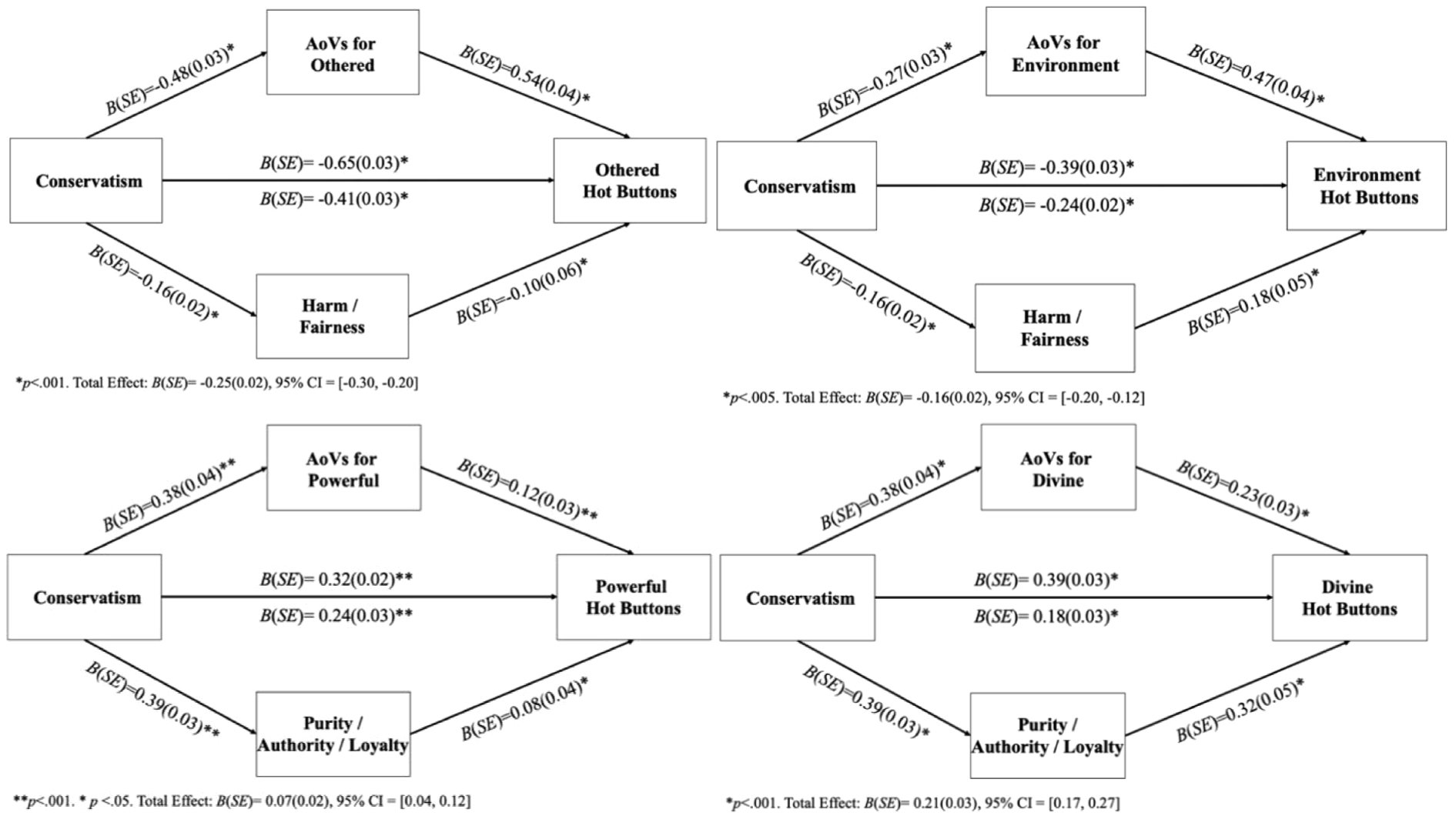
AoVs and moral foundations mediate the links between political ideology and hot-button stances (study 4).
Discussion
These data shows that AoVs play a central role in linking ideology to stances on hot-button issues. Both AoVs and moral foundations explained unique variance, but AoVs were often stronger predictors, especially for protecting the Environment, the Othered, and the Powerful. This suggests that informational assumptions about harm are a uniquely important explanation behind political, social, economic, and religious debates. For issues involving the Divine, AoVs and moral foundations were equally strong, each mediating the link between ideology and stance. These findings show that AoVs are far from redundant with moral foundations and help us understand how ideology shapes political conflict via common concerns with harm and victimization.
Study 5: Ideological Patterns Generalize Beyond Politicized Targets
Study 5 tested whether political differences in AoV themes generalize beyond specific politicized targets. In earlier studies, themes were represented with examples (e.g., immigrants, trans individuals) that might carry their own ideological baggage. To eliminate this potential confound, we revised AoV measures to present only the definition of each theme, with no exemplars. This allowed a cleaner test of whether ideological patterns persist without overtly politicized content. We predicted the same pattern as before: liberals would rate the Othered and the Environment as more vulnerable, and conservatives would rate the Powerful and the Divine as more vulnerable (pre-registration: https://osf.io/4xnyj/?view_only=7db97feb99754836ba18c6e906a62387). We also predicted that liberals would amplify differences between the Othered/Environment and the Powerful/Divine while conservatives would dampen these differences.
Method
We recruited participants using CloudResearch and selected census match filters on age, gender, and race/ethnicity. We measured political orientation using the same scale from Study 4, M(SD) = 3.55(1.82), α = .96. To measure AoVs, we used the same statements as in the previous studies (assessing perceived vulnerability to harm, victimization, and mistreatment) but asked people to rate each category without listing specific targets. Participants were provided the following definitions:
Results and Discussion
Consistent with our predictions and previous studies, political orientation (i.e., conservativism) was negatively correlated with AoVs of the Othered (r = −.50) and the Environment (r = −.45) and positively correlated with AoVs of the Powerful (r = .35) and the Divine (r = .41) as vulnerable, all ps < .001 (full correlation matrix in Supplemental material, p. 45). These results show that differences between liberals and conservatives in their AoVs also replicate when participants are not asked about specific targets and instead asked about abstract themes. As can be seen in Figure 7, there was overall agreement across politics that the Othered and the Environment were more vulnerable to harm than the Powerful and the Divine; however, liberals again amplified group differences in AoVs while conservatives dampened them.
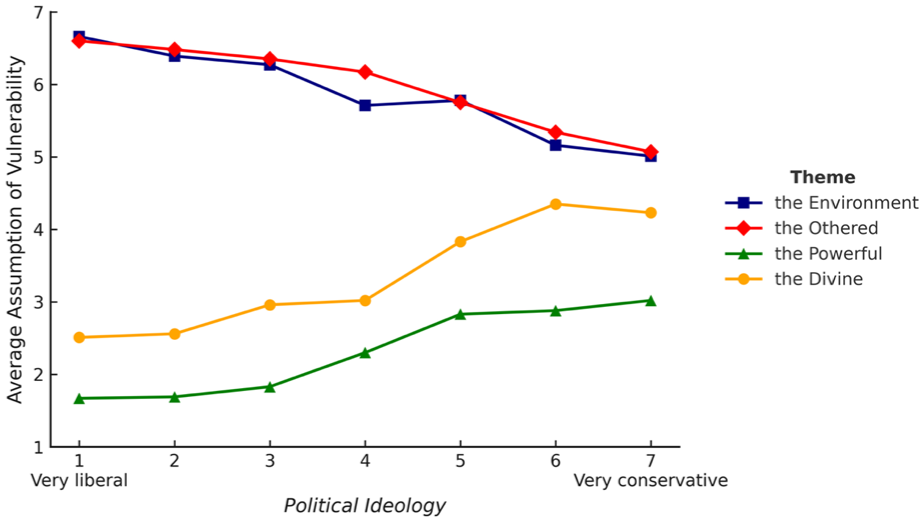
Assumptions of vulnerability across the political spectrum (study 5).
Section 3: Extending AoVs
Having established the unique role of AoVs in explaining moral disagreement, Section 3 expanded the study of AoVs to implicit cognition (Study 6) and behavioral consequences (Study 7) and tested whether AoVs can be experimentally manipulated (Study 8).
Study 6: Assessing AoVs with Implicit Measures
Our harm-based moral mind can be clearly observed with implicit tests (Gray et al., 2014; Ochoa, 2022); therefore, we hypothesized AoVs would be revealed with implicit measures. We used the Affect Misattribution Procedure (AMP) to investigate whether self-reported explicit AoVs were associated with implicit AoVs across all four AoV themes.
Method
Participants completed the same measures of AoV as in Studies 2 to 4. See Supplemental material (p. 46) for descriptives.
We adapted the AMP (Payne et al., 2005) to measure implicit perceptions of vulnerability by having people ascribe meaning to ambiguous stimuli (see Figure 8). The AMP has been validated by over a decade of research as a measure of implicit attitudes (Payne & Lundberg, 2014). It predicts both explicit attitudes (including racial attitudes and political preferences; Payne et al., 2005) and behaviors (Cameron et al., 2012). Participants saw two images in quick succession: a primed stimulus (one of twelve AoV words; e.g., The Rainforest) followed by an ambiguous target stimulus (a Chinese symbol).
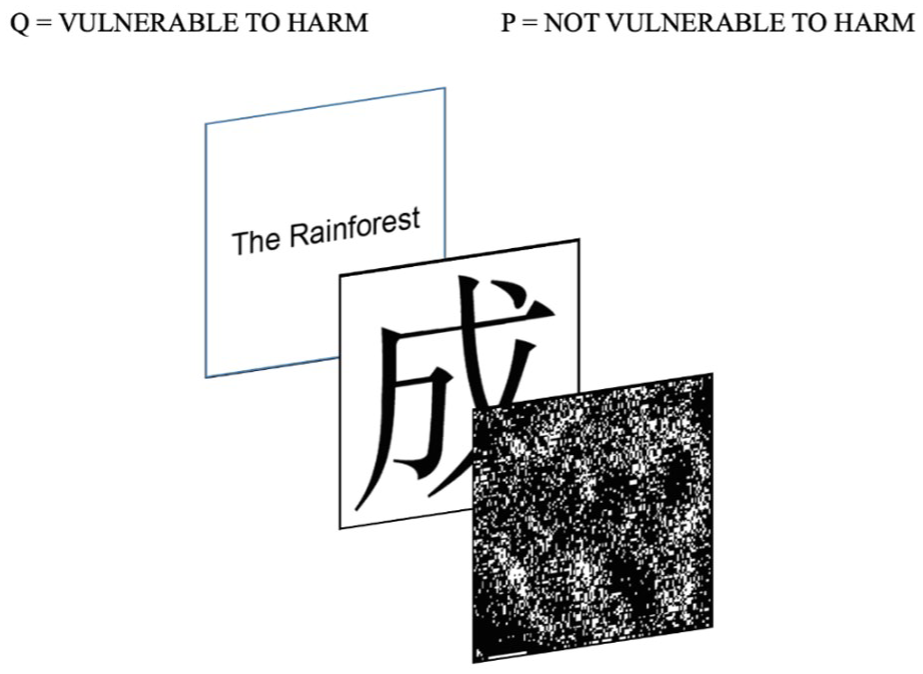
Schematic diagram of the affect misattribution procedure (study 6).
Following the target stimulus, participants were shown a visual mask image to prevent them from viewing the Chinese symbol while they made an evaluative judgment about it (see Figure 8). Participants then reported whether the Chinese symbol referred to something vulnerable (coded as 1) or not vulnerable (coded as 0). The extent to which the Chinese symbol is influenced positively or negatively by the AoV prime allows us to determine the extent to which the AoV prime is implicitly seen as vulnerable. For a full description of the procedure, see Supplemental material pp. 46–47.
Participants completed three blocks of trials. In each block, they evaluated all twelve AoV targets (3 from each of four themes) on vulnerability to harm, mistreatment, and victimization in a randomized order. We generated AMP scores by averaging across these 36 ratings: the Environment, M(SD) = 0.60 (0.24); the Othered, M(SD) = 0.59 (0.25); the Powerful, M(SD) = 0.45 (0.23); and the Divine, M(SD) = 0.39 (0.24).
A sensitivity power analysis using G*Power showed we had 95% power to detect significant effects as small as r = .21.
Results
Correlational analyses (Table 4) revealed that explicit and implicit measures were highly correlated for all four dimensions. These relationships indicate responses to the AoV scale robustly connect to implicit cognition.
Correlations Between Scores on AOV and AMP for the Environment, Othered, Powerful, and Divine in Study 6.
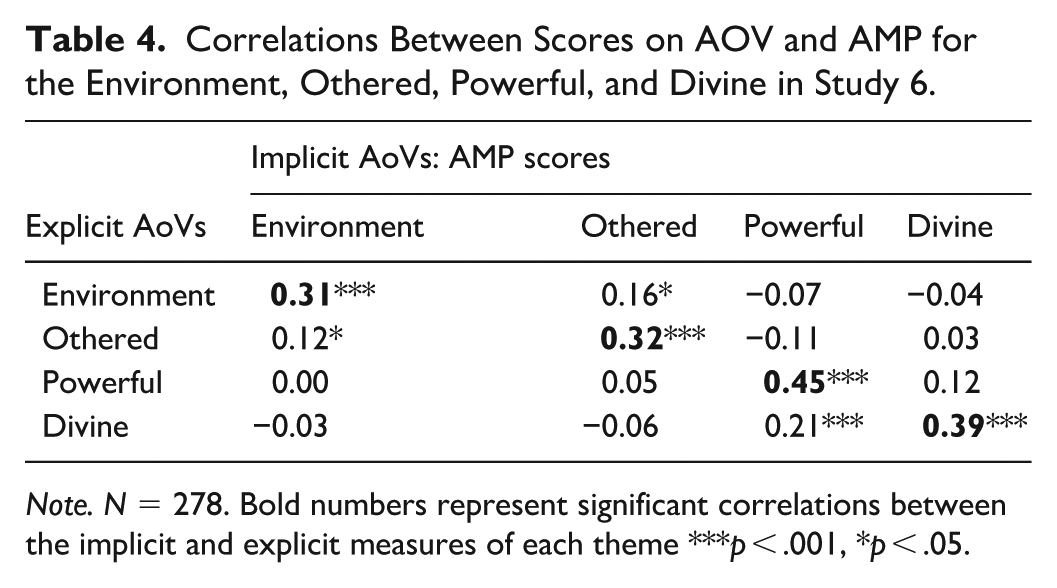
Note. N = 278. Bold numbers represent significant correlations between the implicit and explicit measures of each theme ***p < .001, *p < .05.
For explicit AoV ratings, results replicated previous studies, with political orientation (i.e., conservativism) negatively associated with AoVs of the Environment (r = −.36) and the Othered (r = −.43), and positively associated with AoVs of the Powerful (r = .25) and the Divine (r = .39, all p’s < .001). The same pattern emerged for implicit AoVs, although the magnitude of these relationships was expectedly weaker, given that political orientation was assessed at the explicit level and AoVs were assessed implicitly (Dovidio et al., 2001). Political orientation was negatively associated with AMP scores for the Environment (r = −.12, p = .049) and the Othered (r = −.15, p = .01) and positively associated with AMP for the Powerful (r = .18, p = .002). It was not significantly associated with AMP for the Divine (r = .09, p = .15), but the relationship was in the expected direction.
Discussion
Study 6 provided more evidence of the construct validity of AoVs. Not only were explicit and implicit measures of AoVs correlated, but they also showed similar patterns of relationships with political orientation. This suggests that AoVs, like victimhood or harm-based morality (Schein & Gray, 2018), is grounded in implicit cognition.
Study 7: AoVs Predict Charity Donations
Study 7 tested whether AoVs predict behavior. Adopting methodology from previous research (Goenka & Van Osselaer, 2019), participants chose whether to donate to a charity relevant to one theme (e.g., the NAACP for the Othered) vs. another (e.g., Law Enforcement Charitable Foundation for the Powerful). We chose real charities that exemplified one of the four AoV themes (see method for details) and expected that those who perceive relatively high vulnerability in an AoV theme would be more likely to donate to its relevant charity.
Method
We measured AoVs and political ideology as in Study 2. Participants were shown pairs of real-life charities (8 charities in total) that we believed supported victims associated with each AoV theme (see Table 5). For example, one charity for Powerful (which included state troopers as a target), was an organization that supported families of deceased police officers). Participants made a binary choice for which charity they would be more willing to donate money to and were presented with all possible theme pairs (six total). Participants were made aware that we would actually be donating the money to the chosen charity after the study (which we did).
Examples of Forced-Choice Donation Pairings (Study 7).
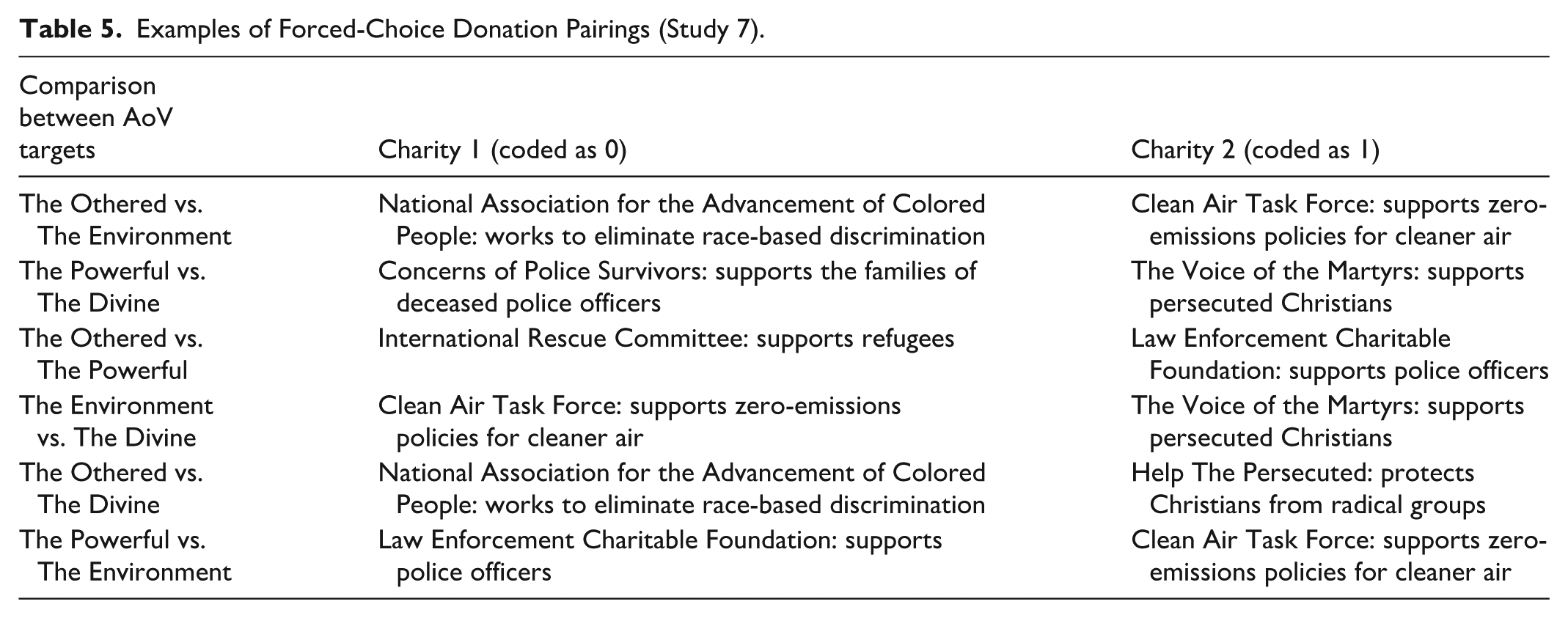
A sensitivity power analysis using G*Power (Faul et al., 2007) showed we had 95% power to detect significant effects as small as OR = 0.50 or as large as OR = 1.97.
Results
Correlation analyses again showed the expected relationships between political orientation and AoVs (see Supplemental material, p. 50). To test whether AoVs predicted charity choices, we ran separate regressions for each binary charity variable using the stringent control of controlling for political orientation and the four AoV themes as predictors. Full results are provided in the Supplemental material (pp. 48–50). As can be seen in Table 6, AoVs were associated with a greater likelihood of donating to the corresponding charity vs. unrelated charities, supporting our predictions. The odd-ratios for all charity donation comparisons are significant except for three, whose confidence intervals overlapped with 1. Although these three comparisons are in the expected direction, future work should confirm the robustness of these associations.
Logistic Regressions Predicting Donation Choice from Assumptions of Vulnerability, Controlling for Conservatism, Study 7
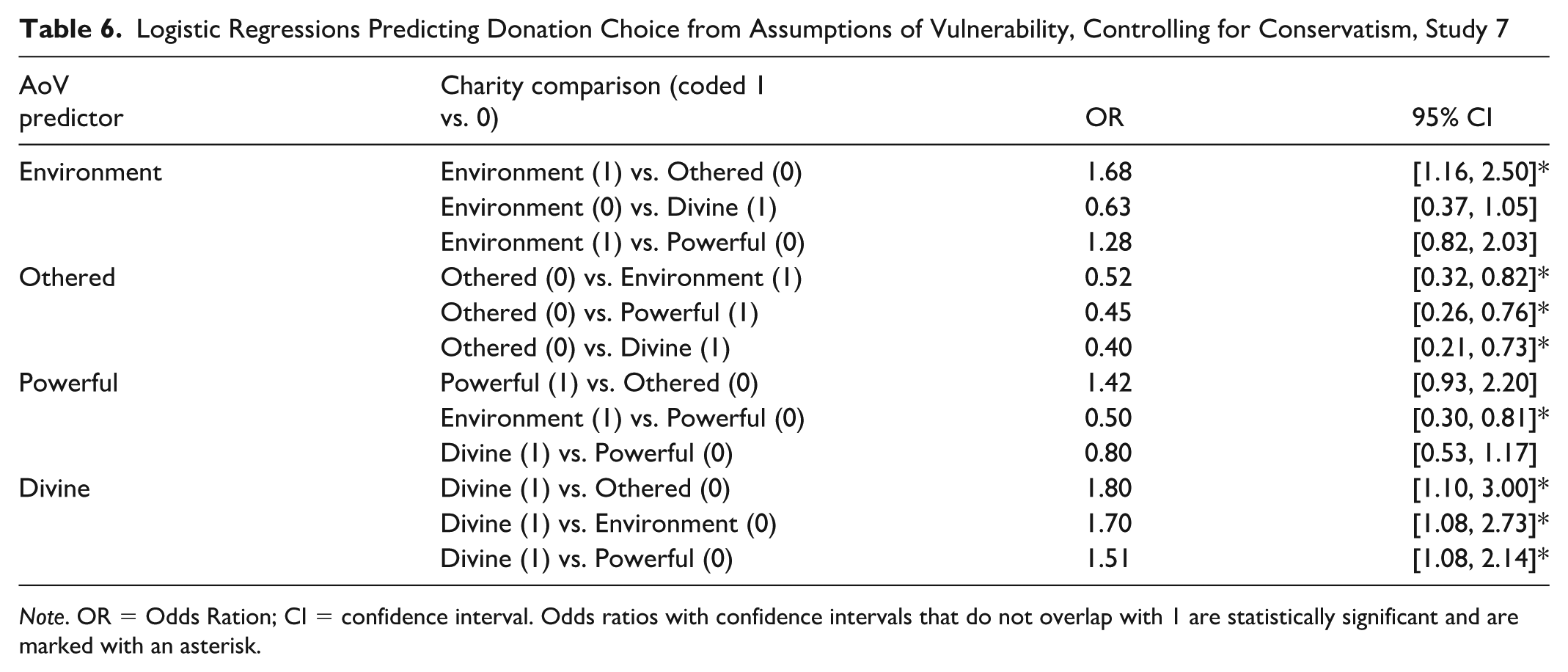
Note. OR = Odds Ration; CI = confidence interval. Odds ratios with confidence intervals that do not overlap with 1 are statistically significant and are marked with an asterisk.
Discussion
Providing more construct validity, Study 7 revealed that self-reported AoVs largely predicted charitable behavior.
Study 8: Experimentally Manipulating AoVs
AoVs predict links between political ideology and moral judgment, but mediational analyses can only tell us so much (Rohrer et al., 2022). Truly showing the causal effects of AoVs on moral judgment requires manipulating AoVs and finding that these manipulations impact moral judgment.
Study 8 attempted to manipulate AoVs toward two targets within a “moral dyad”: a CEO and a homeless person. Participants read about a CEO who refused to donate money to a homeless person and then either elaborated on the vulnerability of the CEO or the homeless person (or neither). Consistent with the idea of moral typecasting (Gray & Wegner, 2009), we expected that this manipulation would either make the CEO’s behavior seem less immoral (because the CEO seems more easily victimized) or more immoral (because the homeless person seems more easily victimized).
Method
Design
Participants read that James Smith (a homeless person) asked Nicole French (a CEO) for money, with Nicole hurrying past James despite having a lot of money. Participants were randomly assigned to one of three conditions. In the Control condition (n = 183), participants simply responded to the measures (outlined below). In the CEO Vulnerable condition (n = 166), participants wrote about ways the CEO could be vulnerable to harm. In the Homeless Vulnerable condition (n = 157), participants wrote about ways the homeless person could be vulnerable to harm. All participants completed the same measures.
Measures
AoVs
Participants completed the AoV items for the CEO and the homeless person. CEO AoVs, M(SD) = 2.45(0.96), α = .82; and for homeless AoVs, M(SD) = 4.11(0.84), α = .82. On a scale from 1 (Not at all) to 7 (Very much), participants also provided moral judgments of the CEO (e.g., “I believe that the CEO’s behavior was wrong). M(SD) = 4.19(1.51), α = .90. Finally, participants reported their political orientation, M(SD) = 3.76(1.83).
A sensitivity power analysis using G*Power (Faul et al., 2007) showed we had 95% power to detect significant effects as small as r = .19 (and d = 0.40).
Results
As predicted, we successfully manipulated AoVs—the CEO was seen as more vulnerable in the CEO Vulnerable condition than in the Homeless Vulnerable condition (and vice versa for AoVs toward the homeless person). Also, as predicted, the CEO’s behavior seemed more wrong when the vulnerability of the homeless person (Homeless Vulnerable) was emphasized compared to when the vulnerability of the CEO was emphasized (CEO Vulnerable), suggesting that AoVs causally impacted moral judgment. See Table 7.
Manipulation Check and Dependent Variables by Condition for Study 8.
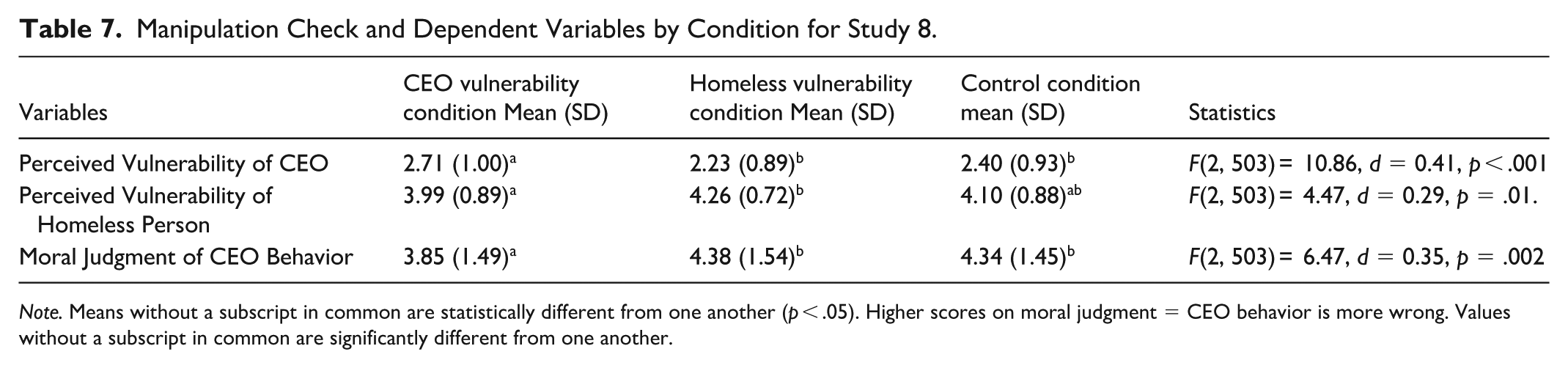
Note. Means without a subscript in common are statistically different from one another (p < .05). Higher scores on moral judgment = CEO behavior is more wrong. Values without a subscript in common are significantly different from one another.
We note that the Control condition was not significantly different from the Homeless Vulnerable condition for either AoVs or moral judgments, suggesting people’s default is to see homeless people as more vulnerable than CEOs. See Table 7.
Mediational analyses (controlling for political orientation) showed a significant indirect effect of condition (Homeless Vulnerability vs. CEO Vulnerability condition) on perceived wrongfulness of the CEO’s behavior through AoVs for the CEO, b(SE) = 0.17(0.06), 95% CI [0.08, 0.30], and a significant indirect effect via AoVs for the homeless person, b(SE) = 0.08(0.04), [0.01, 0.17].
Discussion
Study 8 further supported the construct validity of AoVs. AoVs can be experimentally manipulated and causally impact moral judgments.
General Discussion
Social and moral psychology has been plagued by an apparent paradox: How can there be so much moral disagreement despite people sharing universal concerns about harm and victimization? The resolution to this puzzle lies in a deceptively simple fact: victimhood is a matter of perception (Gray & Kubin, 2024). People disagree about who or what is especially vulnerable to harm and victimization. This paper used a multi-method approach to reveal how AoVs explain ideological disagreement in moral judgments.
Section 1 revealed AoVs predicted judgments of moral status across diverse targets (Study 1) and helped explain moral disagreement between liberals and conservatives for divisive issues like immigration (Supplemental Study A) and sacred objects like the Bible (Supplemental Study B).
Section 2 provided support for the usefulness of 4 ad-hoc AoV themes (The Environment, The Othered, The Powerful, and The Divine) for understanding ongoing political debates. We found that liberals (compared to conservatives) view the Environment and the Othered as more vulnerable to harm, while conservatives (compared to liberals) view the Powerful and the Divine as more vulnerable to harm. We also found a general pattern across these themes: liberals see vulnerability as group-based, viewing some sets of entities as especially vulnerable, and others as especially invulnerable. On the other hand, conservatives view vulnerability as more individual-based, dampening differences in vulnerability between groups and seeing everyone as similarly vulnerable to harm regardless of their social status (Study 2).
Supporting the construct validity of AoVs, studies found that AoV ratings remained stable over time (Study 3) and demonstrated sensible convergent and divergent validity with other constructs. Crucially, AoVs explained the links between politics and moral judgments independently of—and often better than—moral foundations (Study 4)—this is an especially important finding because AoVs (as informational assumptions) are conceptually separate from morality, unlike moral foundations. Thus, AoVs help escape the tautology of explaining moral differences with moral differences. Further, AoVs remained connected to political differences in moral judgment even beyond specific politicized targets (Study 5).
Our final set of studies (Section 3) revealed that AoVs can be detected with implicit measures (Study 6), that AoVs predict behavior (charitable donations; Study 7), and that manipulations of AoVs shape moral judgment (Study 8). Taken together, this work highlights the importance of AoVs as one key reason for why liberals and conservatives can disagree on moral judgments despite having a common harm-based moral mind.
Theoretical Implications for Moral Psychology
These results further support the idea of a universal harm-based mind (Schein & Gray, 2015; Ochoa, 2022)—one focused on victimhood—while also explaining important moral disagreement. A key reason why the left and right disagree about immigration, abortion, taxes, Black/Blue Lives Matter, environmental reforms, protections for the flag, and affirmative action is because they make different assumptions about who or what is especially vulnerable to victimization.
The current work provides crucial evidence to challenge the popular argument that you need different moral “foundations”—separate moral mechanisms—to explain moral pluralism. Our results align with a growing body of research contradicting the key claims of MFT (D’Amore et al., 2022; Gray & Kubin, 2024; Gray & Pratt, 2025; Nilsson, 2023; Schein & Gray, 2018; Smith et al., 2017; Yudkin et al., 2025), and support the idea that all people share a common harm-based mind. Importantly, this current paper fills a key gap in the literature. Even fans of a harm-based mind might feel like the Theory of Dyadic Morality is too deflationary, robbing nuance from the moral world as it unites moral cognition under a common mechanism. AoVs provide a crucial—but parsimonious—construct that supports diversity and facilitates moral pluralism.
We note that this same “deflationary” objection has been raised against other simplifying theories, such as when opponents of evolution argued that evolution robbed the specialness of different God-created species (Ruse, 1979). But the truth of evolution does not deny the incredible richness of the biological world. Instead, it asks us to consider what different contexts and circumstances lead the same process to create tigers, squids, and slime molds. The same is true of victim-centered moral cognition. Rather than trying to tally the exact number of moral values—which is like trying to count the number of colors in the sky, or ways of expressing love—moral psychologists might better study how various perceived harms and threats shape our moral beliefs. Some work has already started down this path. Work on the tightness and looseness of societies shows that cultures facing more threats—more harms—moralize more concerns (Gelfand & Lorente, 2021). Other work shows how new parents—those confronted with a vulnerable person needing protection—are more morally condemning (Eibach et al., 2009). Yet other work shows that individuals who are more sensitive to pain perceive harm more broadly, and this expanded harm perception leads both liberals and conservatives to extend moral concern to a wider range of people and actions (Lee & Ma, 2023).
Despite the explanatory power of AoVs, we acknowledge that moral foundations—assessed via moral judgments—remain a significant predictor of many moral judgments. This makes sense: moral judgments should predict moral judgments, just as a person’s foot size should predict their shoe size, and their love for horror movies should predict how much they stream horror movies. But truly explaining a phenomenon (rather than describing it) requires rejecting tautologies and finding something more fundamental beneath it. Just as you cannot truly explain a bird’s ability to fly by merely saying they possess a “flying foundation” you cannot explain moral judgments with moral foundations. Instead, you must reference non-moral cognitions. Here, we do so by exploring one ontological assumption (among many others): who or what is especially vulnerable to harm.
The current findings align with the view that moral foundations are better understood as post-hoc groupings of moral rhetoric rather than as basic cognitive building blocks. Foundations summarize patterns in how some groups—at one specific time and place—justify moral positions and signal social identity, but they do not appear to describe how moral judgments are generated in the mind (Graham et al., 2011). Our results extend this critique by showing that the same moral judgments attributed to different foundations can be parsimoniously explained by differences in the perceived vulnerability of the relevant targets, consistent with evidence that foundations lack distinctness (Graham et al., 2013; Ochoa, 2022).
A central finding of this work is that liberals and conservatives differ in how they allocate moral concern. Liberals tend to see some targets as especially vulnerable to harm and others as relatively invulnerable, whereas conservatives tend to see vulnerability as more evenly distributed. When plotted, this pattern closely resembles classic figures from the MFT literature depicting ideological differences in moral judgment (e.g., Graham et al., 2009)—with a larger gap for liberals between harm/fairness and loyalty/authority/purity, and a smaller gap between these clusters for conservatives. This graphical similarity is not accidental: both approaches seek to describe the same moral divide, but AoVs do so parsimoniously.
The real moral disagreement among people today is not about who really cares about authority or loyalty—or who invokes these keywords in speeches (Hopp et al., 2021). Instead, moral disagreements arise from differences in who people perceive as especially vulnerable in society—who seems most vulnerable to victimhood (Gray & Kubin, 2024), and who is a legitimate recipient of harm (Schein & Gray, 2018). Importantly, embracing AoVs and a harm-based mind does not require rejecting moral pluralism. Both morality and harm are plural (Mikhail, 2007; Shweder, 2012): the current paper reveals many different potential victims—and clusters of victims—that people disagree about.
The Big Remaining Question
AoVs underlie moral differences, but there lurks a deeper question: where do these differences in AoV come from? Of course, one can endlessly ask questions about ever-deeper levels of analysis (underneath psychology is neuroscience, then biochemistry, then physics), but it is still worth addressing this question at the psychological level. Based on the evidence provided in this current work, and in-line with theoretical insights (Schein & Gray, 2018), AoVs seem to be a key part of the formation of belief systems and thus may be connected to many fundamental parts of human psychology.
First, some political differences in AoVs are intrinsically connected to ideology and these may play a role in shaping their link. These include factors such as demographics and identity (Hogg, 2007), attitudes about systems and power (Jost et al., 2003), motivational concerns (Greenberg et al., 1990), personality traits (e.g., Hirsh et al., 2010), cognitive dispositions (Choma et al., 2014; Womick & King, 2021), interpersonal orientation (Morris, 2020), worldviews (Koltko-Rivera, 2004), and even genetics (Lewis & Bates, 2014). For instance, the majority of people who belong to marginalized groups in the United States tend to identify with left-wing ideologies (Pew Research Center, 2018), potentially driving the link between liberalism and AoVs for the othered. Those on the right tend to be more averse to uncertainty (Womick & King, 2021), are more agreeable (Hirsh, et al., 2010) and are lower on openness to experience (Choma et al., 2014), which may shape the way they distribute moral concern across different targets.
Certainly, AoVs have developmental roots and are reinforced by socialization. One could argue that although we all have innate concerns about protecting the vulnerable from harm (Blair et al., 2001), our (sub)cultures and information networks tell us who is especially vulnerable to harm and what exactly causes suffering. If you are raised to believe that guns are the best way to protect your vulnerable children from harm (e.g., by a home intruder) and consume information from networks that continually reinforce this view, you will have very different opinions on the United States. Second Amendment than someone who was raised to believe that guns are primarily a way of harming children (e.g., by school shootings).
Further, AoVs are most obviously socialized during the early stages of life, there may be other critical stages of belief formation, especially at stages when people develop new ontologies (e.g., attending college, joining a religious group, moving to a new society, or suffering misfortune). Indeed, much of the culture wars surrounding the “brainwashing” of college students focus on ideas of victimization (and victimizers). Is America—and subsequent American progress—built on victimization (Hannah-Jones, 2021)? Are men inherently victimizers or also capable of being victimized (Synnott, 2024)? Or are all of us similarly likely to be victimized and victimizers (Lee, 2019)?
Future work should not only explore the cultural and developmental roots of AoVs but also explore the scope of the macro-level patterns revealed here, with liberals amplifying difference of AoVs and conservatives dampening them. Are these AoVs both cause and consequence of the progressive tendency to divide the world into the vulnerable oppressed and the invulnerable oppressors and to focus on group-based disparities in suffering (e.g., Freire, 2005)? Likewise, are conservative patterns of AoVs cause and consequence of their tendency to focus on individual rights and freedoms, and to focus more on personal agency than group-based differences. Despite these differences in macro-level AoVs, it’s worth emphasizing that the rank order vulnerability of themes was similar across the political spectrum, suggesting an intervention point where common ground could be leveraged to bridge political divides.
Belief Endorsement vs. Perceived Vulnerability
One alternative explanation is that AoVs might track basic beliefs rather than perceived vulnerability. Perhaps people direct moral concern toward targets simply because they believe in them (or because they are generally worthy of concern), not because they see them as especially vulnerable to harm. Importantly, this concern does not apply equally across targets. For concrete entities—such as police officers, immigrants, or rainforests—there is broad agreement that the targets exist and should generally not be harmed, at least not without competing tradeoffs (e.g., Brazilian farmers can burn the rainforest to prevent their family from starving). It makes sense that disagreements in these cases revolves around vulnerability, not whether they are real or generally worthy of consideration.
The concern about general beliefs is most relevant for abstract or contested targets—especially the Divine. Unlike individuals or social groups, not everyone believes in God or in the holiness of the Bible. If someone does not believe in God, they may not see God as vulnerable. While belief in the existence of the Divine may be a necessary precondition to worrying about protecting it, believers hold very different views of what God is like. Some see God as omnipotent and invulnerable; others see God as relational, emotionally responsive, and capable of being hurt or offended (Johnson et al., 2015). These different perceptions allow for variation in perceived vulnerability, and therefore moral judgments, even when belief is shared. Study 2b strongly addresses this belief-only concern. Because all participants were religious, baseline belief in the Divine was high and varied little. If AoVs simply reflected belief, they should have little predictive power in this sample, but instead, AoVs of the Divine varied and predicted moral judgment, even though effect sizes were smaller under restricted variance.
Evidence from other studies also points to the importance of AoVs beyond general belief endorsement. AoVs appeared in implicit vulnerability judgments (Study 6), predicted real charitable donation choices (Study 7), and could be experimentally manipulated to causally shift moral judgments (Study 8). That said, beliefs exist in an interconnected web—one set of ontological assumptions should impact others—and so future work should measure and control for baseline beliefs (e.g., religiosity) to more cleanly separate AoVs from assumptions about other things.
Limitations and Future Directions
This research synthesized many methods using cross-sectional and multi-wave data, self-report and implicit measures, convenience sampling and nationally representative data, and combined correlational with experimental research. This methodological variety balances strengths and weaknesses across studies and provides a rich set of consistent and replicable evidence for hypotheses. However, one key limitation is our focus on moral conflicts within the United States. Although it is fruitful to understand conflict even in one society, it is important to consider whether AoVs shape moral judgments (and conflict) cross-culturally. We expect the content of political differences to be country-specific, but the general connection between perceived vulnerability and moral judgments to be found across cultures. Additionally, it is important to note that our samples were predominately White, and the racial backgrounds of study participants were not representative of the U.S. population (except the quasi-representative sample in Study 2b). Because ideology and race are closely intertwined (Nadeem, 2024), this is a limitation of our research. We encourage future research to examine these processes in more diverse and representative samples.
Based on our theoretical framework, we focused on how perceptions of the vulnerability of moral patients (i.e., victims) help us understand moral judgment and political differences. Yet patients are only one part of the equation of morality. The Theory of Dyadic Morality (Schein & Gray, 2018) posits that harm is perceived when (a) an intentional agent (b) causes damage to (c) a vulnerable patient. We expect that moral disagreement is not just driven by AoVs, but also by understandings of moral agents (e.g., can teenagers intend evil; Allen et al., 2012) and perceptions of the damage caused by different acts (e.g., is speech violence; Kubin et al., 2025; Matsuda, 2018). Exploring the role of these other parts of dyadic morality may further enlighten how moral differences in politics and other domains can emerge from a common harm-based template.
It also matters which targets we choose to represent each AoV theme. One possibility is that liberals and conservatives really do differ in how much they emphasize the vulnerability of certain kinds of groups, consistent with work showing ideological differences in attitudes toward marginalized groups and the status quo (Conway et al., 2020; Jost, 2012; Jost et al., 2003). Another possibility is simpler: liberals and conservatives may care about vulnerable groups to a similar degree but disagree about which groups count as vulnerable (e.g., LGBTQ people versus religious African Americans; Brandt et al., 2014; Conway et al., 2023). We tried to address this concern in two ways. First, we sampled a range of targets within each theme. Second, in Study 5 we measured AoV themes without asking about any specific targets. Together, these results suggest that the effects are not driven by a single group or scenario. Still, future work should test a wider and more ideologically mixed set of targets—for example, Othered targets such as Jewish people who support Israel, or Powerful targets such as Democratic politicians. Because this is the first systematic study of AoVs, these questions go beyond the scope of the present work, but they are important for future research.
More broadly, the AoV themes we focus on—the Environment, the Othered, the Powerful, and the Divine—were chosen to make sense of some of today’s most polarizing moral debates. We do not claim that these are the only relevant clusters, or that they reflect separate psychological systems. A benefit of AoVs is that they are easy to measure and easy to adapt to new issues and targets, and so researchers should feel empowered to assess AoVs in ways that best fit their research questions. Future work should certainly examine additional targets and themes, and more closely track how ideological differences emerge across them.
Finally, AoVs may help explain how political disagreement turns into intolerance and dehumanization. When people see a target as relatively invulnerable to harm, they also tend to see that target as less alive, less mentally rich, and less worthy of moral concern (Gray & Wegner, 2009). Connecting AoVs to work on prejudice, discrimination, and dehumanization may therefore offer a useful direction for future research—and potentially foster intervention development.
Conclusion
Across twelve studies, we show that moral disagreement is closely tied to differences in who people see as especially vulnerable to harm. Liberals and conservatives all care about victimization but disagree about who is most at risk of being victimized. AoVs predict moral judgment across issues, appear in implicit cognition, guide real behavior, and can be experimentally shifted to change moral evaluations. These findings support the idea of a common harm-based moral mind and suggest that people’s moral judgments are deeply tied to who they see as vulnerable victims.
Supplemental Material
sj-docx-1-psp-10.1177_01461672261422957 – Supplemental material for Liberals and Conservatives See Different Victims: Moral Disagreement Is Explained by Different Assumptions of Vulnerability
Supplemental material, sj-docx-1-psp-10.1177_01461672261422957 for Liberals and Conservatives See Different Victims: Moral Disagreement Is Explained by Different Assumptions of Vulnerability by Jake Womick, Emily Kubin, Daniela Goya-Tocchetto, Nicolas Restrepo Ochoa, Carlos Rebollar, Kyra Kapsaskis, Samuel Pratt, Helen Devine, B. Keith Payne, Stephen Vaisey and Kurt Gray in Personality and Social Psychology Bulletin
Footnotes
Acknowledgements
The authors would like to thank Dylan Jenkins for his thoughtful feedback on this manuscript.
ORCID iDs

Ethical Considerations
Ethics approval was provided by University of North Carolina at Chapel Hill (“Judgment of Mind and Moral Decision Making,” Protocol 12-11585).
Consent to Participate
Written consent was waived by the IRB.
Author Contributions
Jake Womick contributed to conceptualization, data analysis, and writing. Emily Kubin contributed writing and data analysis. Daniela Goya-Tocchetto contributed to conceptualization, design, data collection, data analysis, and writing. Nicolas Restrepo Ochoa contributed to design and data analysis. Carlos Rebollar contributed to data analysis. Kyra Kapsaskis contributed to design and data collection. Samuel Pratt contributed to writing. Helen Devine contributed to methodology and data collection. B. Keith Payne contributed to conceptualization and writing. Stephen Vaisey contributed to conceptualization and writing. Kurt Gray contributed to conceptualization, design, funding, supervision, and writing.
Funding
The authors disclosed receipt of the following financial support for the research, authorship, and/or publication of this article: For funding support, the thank Templeton World Charity Foundation (TWCF-2022-31340) and the Center for the Science of Moral Understanding via Stand Together.
Declaration of Conflicting Interests
The authors declared no potential conflicts of interest with respect to the research, authorship, and/or publication of this article.
Supplemental Material
Supplemental material is available online with this article.
References
Supplementary Material
Please find the following supplemental material available below.
For Open Access articles published under a Creative Commons License, all supplemental material carries the same license as the article it is associated with.
For non-Open Access articles published, all supplemental material carries a non-exclusive license, and permission requests for re-use of supplemental material or any part of supplemental material shall be sent directly to the copyright owner as specified in the copyright notice associated with the article.
