




Abstract
Interpersonal invisibility is a consequential form of stigmatization but is not well-understood. Existing work has largely focused on who feels invisible (between-person effects) rather than when people feel invisible (within-person effects). Five studies (N = 3,575) examine when people feel invisible. In Studies 1 and 2, Black, East Asian, and White American men and women report how invisible they feel to men and women motivated to protect themselves or to seek a romantic partner. Studies 3, 4, and 5 additionally explore invisibility to same- and other-race people. Results show that invisibility is dynamic: Participants report that they are invisible to some people and not to others, depending on the combination of their own race and gender with the race, gender, and goals of the other person. These findings speak to theories of invisibility and constitute a critical development in our understanding of when and why people feel invisible to others.
Introduction
A woman is talked over in a meeting, an East Asian man has few matches on his dating app for the second week in a row, a janitor is passed unnoticed in a hall. These are all examples of interpersonal invisibility, which occurs when a person (the target) is treated indifferently, ignored, or neglected by another person (the perceiver), and is a common form of stigmatization (Dovidio et al., 2000; Goffman, 1963; Neel & Lassetter, 2019). Unlike bigoted statements, hate crimes, and other “active” forms of discrimination and stigmatization, invisibility manifests as inattention and indifference. Yet, invisibility impacts targets: they may be overlooked for a promotion, have trouble finding a romantic partner, or fail to receive assistance and respect. When treated as invisible, targets may find it hard to achieve their own goals and meet their own needs. Invisibility is often experienced negatively, leading targets to feel shame, fear, and stress (e.g., Franklin et al., 2012; Rabelo & Mahalingam, 2019). As a form of stigmatization, certain groups – such as those perceived as having little power – may be especially likely to experience invisibility (Neel & Lassetter, 2019). For example, older adults (Rodin, 1987), Asian people (Sue et al., 2007), Native Americans (Fryberg & Eason, 2017), and Black people (Franklin et al., 2012; Goff et al., 2008) have been documented to frequently experience invisibility. Thus, invisibility is a common, potentially detrimental experience that often affects stigmatized groups.
Despite this, we know comparatively little about invisibility, and many questions remain about how members of different groups may experience invisibility. Fully understanding stigmatization and prejudice requires treating targets as active participants in social interactions, rather than as passive recipients of others’ actions, and studying their perspectives (Major & Vick, 2005; Shelton, 2000). We therefore focus in the current work on targets’ feelings of invisibility.
So far, the psychological literature on invisibility has largely focused on understanding who experiences invisibility (Purdie-Vaughns & Eibach, 2008; Remedios & Snyder, 2018; Sesko & Biernat, 2010). We argue that research also needs to explore when they may experience invisibility. It is likely that even for groups who frequently experience invisibility, there are situations and people with whom they do not feel invisible. Relatedly, even groups who do not generally experience invisibility may feel invisible at some times, to some people. How, then, can we predict when invisibility will occur? A theory that only predicts between-group differences in invisibility will necessarily be moot on this question and thus, incomplete. To fully anticipate and ameliorate the negative effects of invisibility on individuals, we need to look for and understand variability in a person’s experiences of invisibility, and construct theories of invisibility that can account for and predict these nuances. However, little quantitative work explores whether invisibility may be a dynamic experience, and if so, what factors affect when people feel invisible. To our knowledge, the present work is the first to empirically test, using racially diverse samples, the hypothesis that targets experience interpersonal invisibility as dynamic. By doing so, this work allows us to compare and synthesize multiple theories of invisibility, shedding light not just on who feels invisible but also when and to whom they feel invisible.
Intersectional Invisibility
The study of invisibility in psychology has largely grown from theories of intersectional invisibility (see also Fryberg & Townsend, 2008). For example, Purdie-Vaughns and Eibach (2008) argue that invisibility emerges from non-prototypicality: People will be invisible if they are perceived as non-prototypical for more than one of their identities, and posit that ideologies designate certain groups as the default or prototypical person: androcentrism (men are prototypical), ethnocentrism (white people are prototypical), and heterosexism (straight people are prototypical). Because of these ideologies, a Black woman in North America is considered to be prototypical of neither Black people (because that category’s prototype is a Black man) nor women (because that category’s prototype is a White woman; Goff et al., 2008). Thus, Purdie-Vaughns and Eibach’s theory of intersectional invisibility suggests that women of any racial group that is not White, and others who possess multiply non-prototypical identities (e.g., gay Asian men) are not as well-represented and therefore more invisible in culture, history, politics, and the law as are people with one or no non-prototypical identities (e.g., straight Asian men).
Gendered race theory expands the possible predictions of intersectional invisibility: Because racial groups are associated with gender, the prototype of different ethnic minority groups may not always be male (Galinsky et al., 2013; Hall et al., 2019; Johnson et al., 2012). Indeed, for the category “Asian,” women may in fact be the prototype, rather than men (Schug et al., 2015, 2017). Together, these perspectives generate multiple plausible predictions about who will be especially likely to feel invisible. For example, intersectional invisibility as originally described by Purdie-Vaughns and Eibach (2008) would predict that Asian women are less prototypical and thus feel more invisible than Asian men, while gendered race suggests that Asian women are more prototypical and thus feel less invisible than Asian men. The current work can test these predictions about who feels most invisible.
Intersectional invisibility has been applied to understand invisibility in representations (one’s group not appearing in cultural products), and in interpersonal interactions (being ignored and overlooked by another person; see Neel & Lassetter, 2019). Here, we focus on the interpersonal level, and in particular, the feeling of being invisible to others. Some evidence suggests that multiply non-prototypical groups are indeed remembered and noticed less than singularly non-prototypical groups (e.g., Sesko & Biernat, 2010, 2018) and people who hold more than one non-prototypical identity are more likely to report feeling invisible (Remedios & Snyder, 2018). This focus on prototypes has clearly been generative. However, because a person’s identities are usually static across time and context (i.e., a Black woman’s race and gender are consistent across situations), this initial theorizing does not clearly tell us when people will be invisible at the interpersonal level. On one hand, it is entirely possible that people of a certain race or gender may always experience more invisibility than a more prototypical person (e.g., Black women always feel more invisible than White women). Certainly, much of the existing quantitative work on invisibility documents between-group differences in invisibility. However, it is also possible that the same person may feel invisible sometimes but visible at other times (e.g., Black women may feel invisible to East Asian men looking for a romantic partner, but not to a White man worried about his physical safety). Indeed, newer work has shown that experiences of intersectional invisibility may be more nuanced than previously theorized, as people who have the same number of non-prototypical identities may have different experiences of invisibility (e.g., Bhattacharyya & Berdahl, 2023; Sternberg et al., 2023, 2024). In addition, which identities are considered prototypical, relevant, or salient can vary across situations (e.g., Hall et al., 2019; Petsko et al., 2022), rather than simply being a function of one’s static identities, suggesting that invisibility may be dynamic. Our study is the first to quantitatively examine the extent to which targets’ feelings of invisibility are dynamic.
Dynamic Invisibility
Interpersonal invisibility is an inherently relational phenomenon: People are invisible to others. This suggests that the same target will be invisible to some people, at some times, and not to others or at other times. In other words, targets’ feelings of invisibility are likely to be dynamic across perceivers. An affordance-management perspective on interpersonal invisibility explicitly anticipates this (Neel & Lassetter, 2019; Neel et al., 2023). According to affordance-management, which was initially developed from a perceiver perspective, perceivers appraise which targets will be helpful for their goals (i.e., pose an opportunity) and separately, which targets will hinder or harm progress towards their goals (i.e., pose a threat; Lassetter et al., 2021). Targets who are seen to pose neither goal-relevant opportunities nor threats are considered goal-irrelevant, and as a result, are treated with indifference and ignored – they are interpersonally invisible (Brown-Iannuzzi et al. 2014; Lassetter et al., 2021; though see Brown-Iannuzzi et al., 2023). Consider a White man perceiving a Black woman. If he wants to find a romantic partner, he may ignore the Black woman because of stereotypes that Black women are less feminine than women from other racial groups (Ghavami & Peplau, 2013), whereas if he wants to avoid danger, he may see that same Black woman as a potential threat because of stereotypes about Black people as dangerous (Thiem et al., 2019). From the Black woman’s perspective, she may feel invisible to White men who seek a romantic partner, but not to White men worried about self-protection. Thus, targets’ feelings of invisibility can be dynamic across perceivers, depending on whether or not the perceiver sees the target as irrelevant to their current goals.
How, specifically, does an affordance-management approach to invisibility help us to answer the question of when targets feel invisible? The theory does not itself generate all possible predictions about the patterns of invisibility that will emerge, but rather makes the overarching prediction that feelings of invisibility will be dynamic across perceivers, based on perceived goal-irrelevance. Thus, simply observing that a particular target group’s feelings of invisibility do vary across perceivers will be consistent with this theory. At the same time, affordance management suggests that factors affecting goal-relevance will be candidates for producing variability in targets’ invisibility. Because perceiver goals are at the heart of relevance appraisals, targets may be differently invisible to perceivers who hold different goals. Here, we focus on two goals that are common, salient, and have been studied extensively in literatures on both goals and stigmatization (Schaller et al., 2017): protecting oneself from harm and finding a romantic partner.
We begin our investigation by contrasting who feels invisible to others with these two goals. If we observe different patterns per goal, that would support the hypothesis that invisibility is dynamic across perceiver goals. The affordance-management approach also expects that gender and race of both perceivers and targets will matter for perceived relevance to these goals, because these identities are seen to cue different affordances to safety and romance (Neuberg et al., 2020). Indeed, different goals may activate or suppress different perceiver stereotypes for the same identity (Petsko et al., 2022).
Race and gender each elicit stereotypes in a self-protection context to inform relevance. Black people are stereotypically associated with threat or danger in the American context, while East Asians are stereotyped as submissive and weak (Devine, 1989; Ghavami & Peplau, 2013). Unlike women, men are associated with threat and danger (e.g., Ghavami & Peplau, 2013; Navarrete et al., 2010). When considering two or more identities at once, compounding stereotypes may strengthen perceptions and expectations (Hall et al., 2019). Thus, Black men may feel least invisible in a self-protection context, as both Black and man signal threat, while East Asian women may feel most invisible. Black women and East Asian men may feel moderately invisible in a self-protection context, given that their race and gender stereotypes of threat are different.
Stereotypes of race and gender inform mate-seeking relevance as well. Black people are perceived as masculine, whereas East Asians are perceived as feminine (Ghavami & Peplau, 2013; Johnson et al., 2012), and these perceptions contribute to a romantic preference among straight men for East Asian women (compared to Black women), and romantic preference among straight women for Black men (compared to East Asian men; Galinsky et al., 2013). This suggests that Black women and East Asian men may feel invisible in a mate-seeking context, whereas Black men and East Asian women may feel visible. At the same time, specific racialized stereotypes sexualize both Black women (West, 1995) and East Asian women (Uchida, 1998), which may lead both Black and East Asian women to feel visible in this context. Finally, people commonly express preferences for same-race partners (Song, 2023), which suggests that people may feel invisible to other racial groups, but not to their own group in a mate-seeking context. We thus did not have strong predictions about the expected pattern of results for mate-seeking invisibility.
By varying the perceiver’s goals, gender, and race, as well as the participant’s gender and race, our studies provide a rich set of data for testing and refining theories of invisibility. We can examine the overall effects of group identity on who feels invisible, as well as when and to whom targets feel invisible, revealing whether invisibility is dynamic. The results will speak to predictions derived from intersectional invisibility and gendered race theory by examining between-participant differences in invisibility (e.g., do Asian men or Asian women report feeling more invisible), as well as refining our understanding of invisibility’s dynamics within a person, setting the stage for more integrated and comprehensive theories of invisibility.
The current work is particularly valuable for understanding whether invisibility is dynamic in that it adopts a quantitative approach to describing and comparing target groups’ experiences. Much of the work that does focus on targets’ feelings of invisibility has been qualitative (e.g., Franklin et al., 2012; Rabelo & Mahalingam, 2019; Sue et al., 2007). Our work addresses this gap by focusing on the target perspective and taking a quantitative approach with well-powered samples from multiple demographic groups (e.g., Remedios & Snyder, 2018), allowing us to test whether and how findings generalize. Understanding the extent to which, and when, invisibility is dynamic will set a foundation for identifying and addressing the negative effects of this form of stigmatization, as well as understanding how invisibility is experienced and managed by targets.
Outline of the Present Research
We conducted five studies. Studies 1 and 2 explore dynamic invisibility by asking participants to report how invisible they feel to men and women who have the goal of either finding a romantic partner or self-protection from danger. Studies 3 to 5 focus on one goal at a time (Studies 3–4: mate-seeking; Study 5: self-protection), and explore the additional variable of perceiver race. Over five studies, we not only sample across race and gender groups but also vary the perceiver’s gender, race, and goals.
This design allows us to simultaneously examine within- and between-participant effects on invisibility. Whereas some versions of intersectional invisibility generate predictions about between-participant effects, affordance management theory and situation-specific prototype theories add predictions about within-participant effects, because they anticipate that invisibility varies across perceiver characteristics – and in particular, highlight the role of perceivers’ goals in shaping targets’ feelings of invisibility. Dynamic invisibility could manifest either as general effects of perceiver factors (e.g., all participants feel more invisible to women than men), or as interactions of perceiver factors with participant factors (e.g., Black women feel more invisible to White men seeking a romantic partner than to Black men seeking a romantic partner). We hypothesize that invisibility will be dynamic across perceivers, but given the many potential nuances that a dynamic pattern could take, are agnostic towards precisely who will feel invisible to whom.
Transparency and Openness
We report all studies conducted on this topic, and all sample size decisions, data exclusions, and data analysis procedures. All studies modified the same base measures, producing a similar data structure across studies, so we summarize our analytical approach here. Only measures included in the analysis are reported in the text, but all materials, data, and analyses are available on OSF (https://osf.io/kabyj/overview). Only Study 2 is preregistered. All studies received ethics approval from the University of Toronto’s Office of the Vice-President, Research and Innovation, Office of Research Ethics, Social Sciences, Humanities and Education Research Ethics Board (#37684, “Motivation, beliefs, and social judgment”).
We used a heuristic of sampling at least 100 participants per between-subjects participant group (e.g., East Asian women) in all studies because we were unsure what effect sizes to expect and relied primarily on Mixed Effects Models, for which the calculation of power is not straightforward. Participants were excluded from analysis for voluntarily indicating poor quality data, failing attention or data checks, completing less than 90% of the survey, not reporting one of the target genders (i.e., man or woman), or reporting a race that was not one of the target groups or multiple race groups. Sensitivity analyses for each study and model used the pwr package in R (Version 1.3-0; Champely, 2020) given alpha = .05 at 80% power for the obtained sample size. Due to the ambiguity in conducting appropriate sensitivity analysis for mixed effects models, we report the detectable effect size for a comparable multiple regression model.
Data analysis used R Version 4.2.1 (R Core Team, 2022) with basic functions and lme4 (Bates et al., 2015), lmerTest (Kuznetsova et al., 2017), emmeans (Version 1.7.3; Lenth, 2022), and effectsize (Ben-Shachar et al., 2020) packages. Multi-level modeling and pairwise comparison (Tukey adjustment) examined relationships between variables. For analyses that included multiple participant ratings, we modeled a random intercept per participant in a 2-level multilevel model (unstructured covariance matrix and Satterthwaite df). Intraclass correlations for all models revealed that invisibility was at least mildly clustered within individuals (0.10–0.57), supporting multilevel modeling. The base R “anova” function summarized multilevel model results. For between-subjects analyses lacking repeated measures, we used linear regression. Given the large number of effects examined, for all studies we focus on the written text on results that speak to theories’ predictions. All results can be found either in the relevant tables or in text. We interpret simple effects with caution and in an exploratory manner, because simple effects within interactions can require exponentially more power to test (Blake & Gangestad, 2020; Sommet et al., 2023). Given the tradeoffs inherent in sampling multiple participant groups and perceiver characteristics, and given our goal to detect whether invisibility may be dynamic, this research prioritized the ability to detect patterns of variability in invisibility, rather than precision in estimating which effects are significantly different from one another.
Studies 1 and 2
Studies 1 (Mturk) and 2 (Prolific) examine when targets feel invisible to men and women who have different goals: self-protection or seeking a romantic partner. Study 2 is a preregistered replication of Study 1 (https://osf.io/8kjq9/overview). We would see evidence that invisibility is dynamic if perceiver factors – for these studies, perceiver goal or perceiver gender – produced any main effects or interactions with any other variable. Thus, although directional predictions of invisibility are listed in the preregistration, we treat any perceiver effects as evidence that invisibility is dynamic.
Method
Participants
Study 1 (Mturk)
One thousand one hundred and fifty-four U.S. Asian, 1 Black, and White men and women participated for 1 USD. Total sample size after exclusions is 868 (Age = 18–94, M = 36.5, SD = 12.0; 425 women, 443 men; 280 Asian, 282 Black, 306 White; 789 Straight, 39 Bisexual, 30 Gay/Lesbian, 6 “Other sexual orientation,” 4 declined to respond). Given our obtained sample size, participant-level sensitivity ranged from f2 = 0.013 (R2 = .012) to f2 = 0.022 (R2 = .022) for the most simple (3 terms) to complex (15 terms) analysis, and from f2 = 0.013 (R2 = .012) to f2 = 0.005 (R2 = .005) on an observation level.
Study 2 (Prolific)
Seven hundred and seventy-two U.S. East Asian, Black, and White women and men in each of 6 age brackets from age 18 to 61+ participated for 1.25 GBP. (We originally intended to treat age as a factor, but to minimize analysis complexity we collapse across age groups). Total sample size after exclusions is 641 (Age = 18–83, M = 38.7, SD = 14.3; 368 women, 273 men; 162 East Asian, 230 Black, 249 White; 550 Straight, 49 Bisexual, 26 Gay/Lesbian, 15 “Other sexual orientation”). Given our obtained sample size, participant-level sensitivity ranged from f2 = 0.017 (R2 = .017) for our simplest analysis (3 terms) to f2 = 0.030 (R2 = .029) for our most complex analysis (15 terms), and from f2 = 0.017 (R2 = .017) to f2 = 0.007 (R2 = .007) on an observation level.
Measures
Participants reported felt invisibility on a six-item measure in this and all future studies (see Table 1 for all items). We expanded on items from Torres-Harding et al. (2012), to describe the attentional aspects of interpersonal invisibility (Neel & Lassetter, 2019). Versions of each item were tailored to two types of perceivers (men, women) and two goals (self-protection, mate-seeking). For mate-seeking items, the perceiver was described as “straight.” Thus, each participant completed the measure four times, once for each perceiver/goal combination, for example, “I feel invisible to [straight] [women/men] who are [worried about their physical safety/interested in finding a new romantic partner]” (Study 1 average α = .86 [range: 0.80–0.92], Study 2 average α = .90 [range: 0.85–0.94]). Items were anchored at strongly disagree (1), neither agree nor disagree (4), and strongly agree (7), and scored so larger numbers indicate feeling more invisible; numbers significantly below the midpoint indicate not feeling invisible. Next, participants reported their gender and race.
Felt Invisibility Items.

Note. Participants are instructed: “Please indicate the extent to which you agree or disagree with the following statements” on a 7-point scale: strongly disagree (1), disagree (2), slightly disagree (3), neither agree nor disagree (4), slightly agree (5), agree (6), strongly agree (7). Composites are calculated by reversing items 4 to 6 (R) and averaging across all 6 items.
Results
Is Target Invisibility Dynamic Across Perceiver Goals?
To test whether invisibility is dynamic across perceivers, we first ran a multi-level model with perceiver goal, perceiver gender, participant race, participant gender, and their interactions as fixed factors predicting feelings of invisibility, with random intercepts for participant. Numerous interactions involving perceiver goal in both studies, including a four-way interaction in Study 2: F(2, 1,904) = 3.85, p = .021, R2 = .004, provide initial evidence that invisibility is dynamic across perceivers, and indicate that the patterns are complex. To understand these patterns, we conducted further analysis by testing the effects of perceiver gender, participant gender, and participant race within each goal condition. 2 The following text focuses on findings that speak directly to predictions, but interested readers can find the full results of the overall model in Tables A1 and A2.
Self-Protection
We examined invisibility to perceivers concerned with self-protection with a multi-level model including participant race, participant gender, perceiver gender, and their interactions as fixed factors with random intercepts for each participant (Figure 1). See Tables 2 and A3 (Study 1) and Tables 3 and A4 (Study 2) for details including statistics for specific group comparisons. We summarize the effects here.
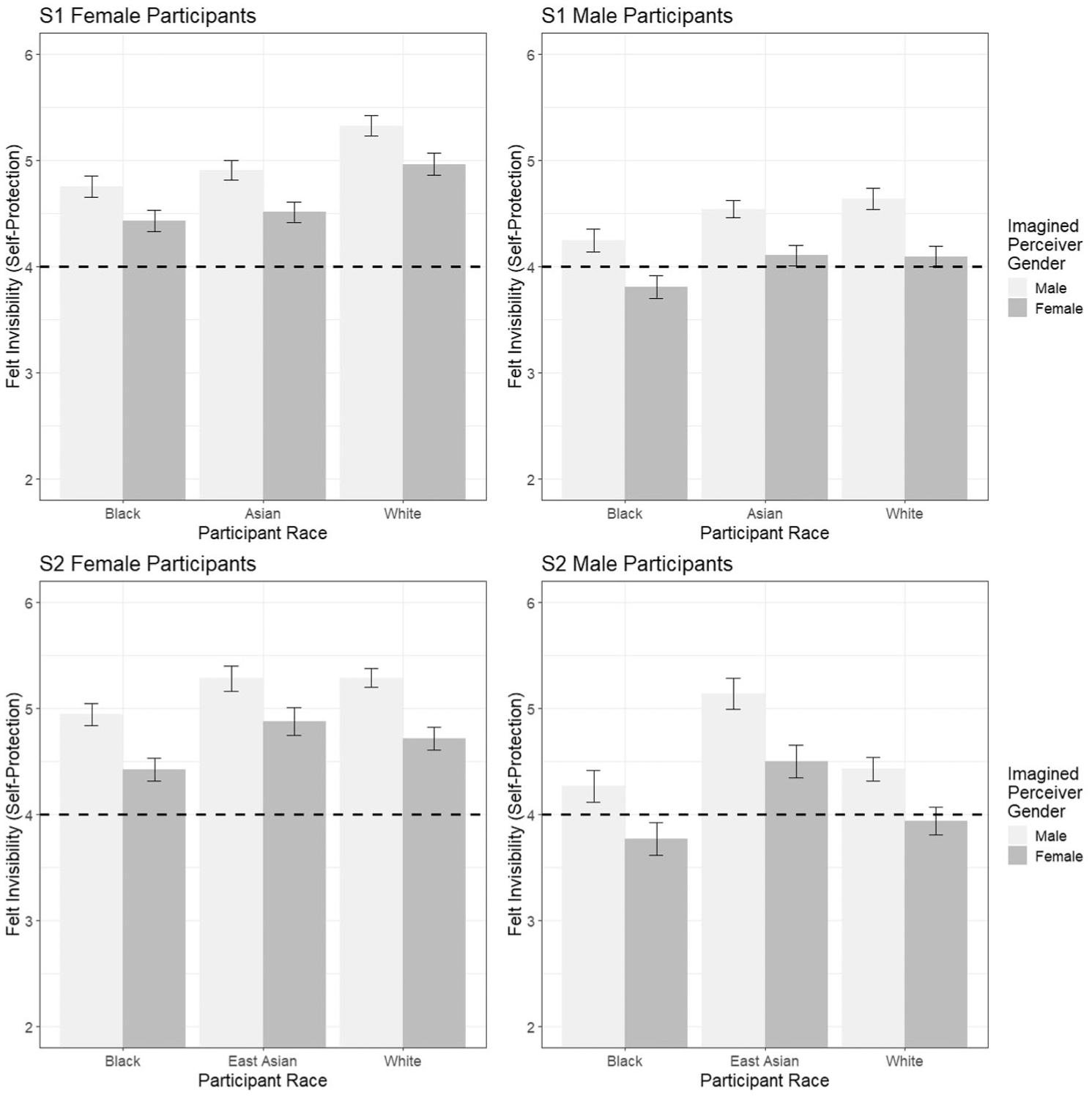
Studies 1 and 2: Self-Protection Invisibility by Participant Gender and Race and Perceiver Gender.
Study 1 Self-Protection Results: The Effect of Participant Gender, Participant Race, and Perceiver Gender on Target Invisibility to Perceivers Worried About Physical Safety.
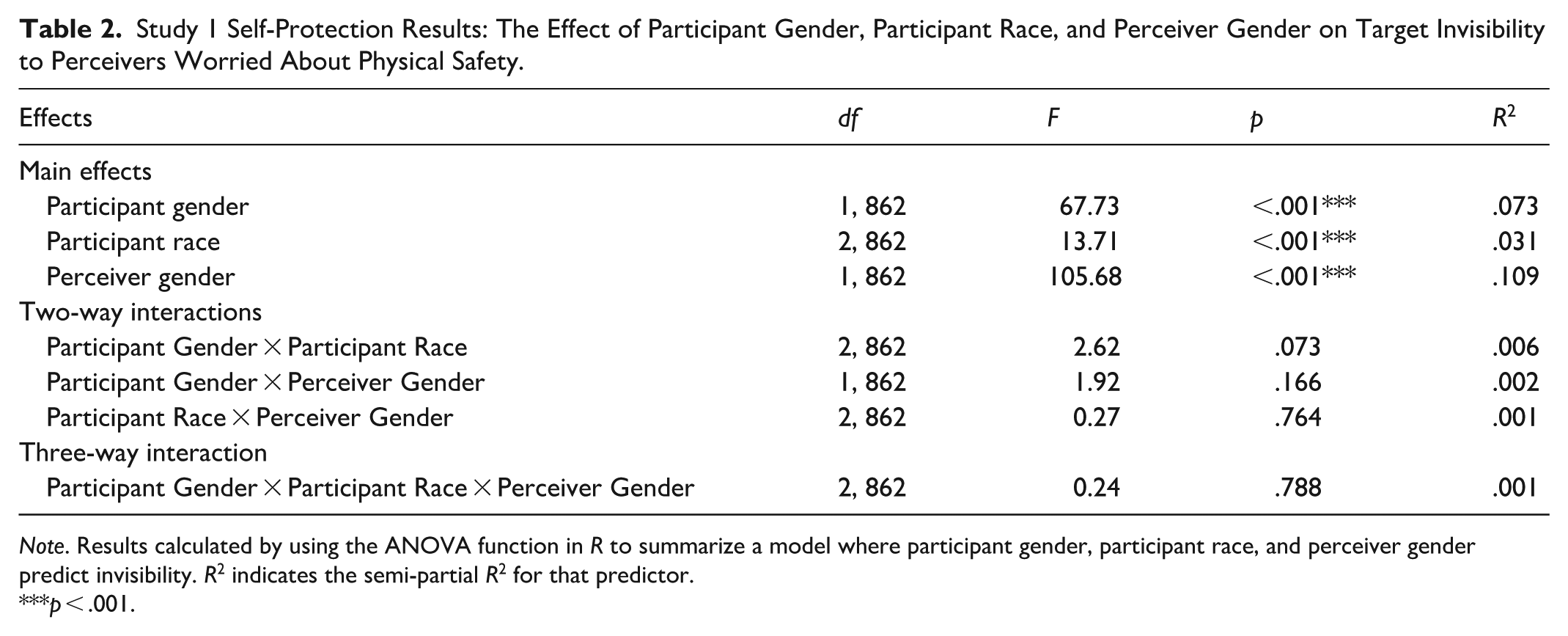
Note. Results calculated by using the ANOVA function in R to summarize a model where participant gender, participant race, and perceiver gender predict invisibility. R2 indicates the semi-partial R2 for that predictor.
p < .001.
Study 2 Self-Protection Results: The Effect of Participant Gender, Participant Race, and Perceiver Gender on Target Invisibility to Perceivers Worried About Physical Safety.
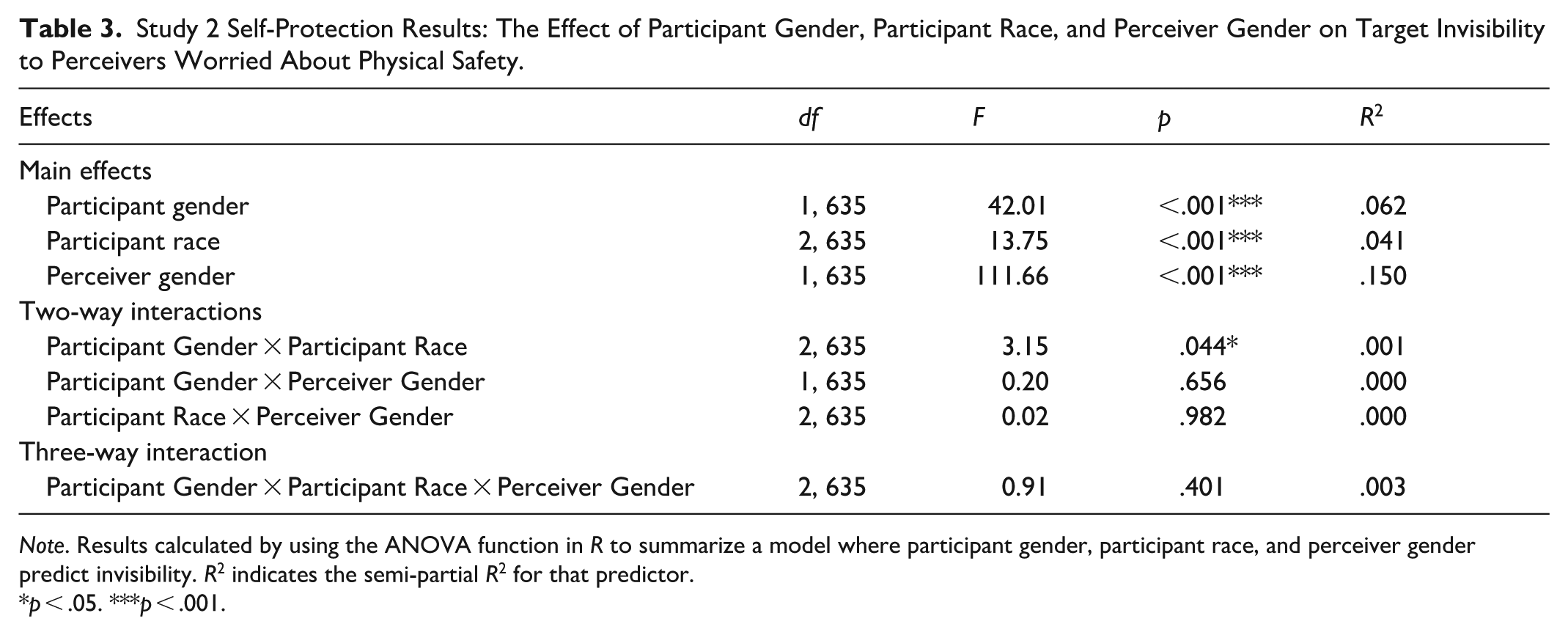
Note. Results calculated by using the ANOVA function in R to summarize a model where participant gender, participant race, and perceiver gender predict invisibility. R2 indicates the semi-partial R2 for that predictor.
p < .05. ***p < .001.
Is Target Invisibility Dynamic Across Perceiver Identity?
Perceiver effects indicate differences in when targets feel invisible (i.e., whether invisibility is dynamic across perceivers). In Studies 1 and 2, perceiver gender was the only perceiver variable within each goal. Participants felt more invisible to men than to women concerned with self-protection, Study 1: F(1, 862) = 105.68, p < .001, R2 = .109; Study 2: F(1, 635) = 111.66, p < .001, R2 = .150, demonstrating that invisibility to people concerned with self-protection is dynamic across perceivers’ gender. No other perceiver identities were varied as factors in these studies.
Does Invisibility Differ by Target Identity?
Target effects indicate overall group differences in feeling invisible to perceivers concerned with self-protection (i.e., who feels invisible). In Study 1, participant race and participant gender both had significant main effects and no interaction. Women felt more invisible than men, F(1, 862) = 67.73, p < .001, R2 = .073. White participants felt more invisible than Asian participants, and both groups felt more invisible than Black participants (Race main effect: F(2, 862) = 13.71, p < .001, R2 = .031). In Study 2, women again felt more invisible than men, F(1, 635) = 42.01, p < .001, R2 = .062. Here, East Asian participants felt the most invisible of any group, but Black participants felt no more invisible than White participants, (Race main effect: F(2, 635) = 13.75, p < .001, R2 = .041). In addition, in Study 2, there was also a significant interaction between participant gender and participant race, F(2, 635) = 3.15, p = .044, R2 = .001. Black women felt significantly more invisible than Black men, and White women felt significantly more invisible than White men, but East Asian men and women did not differ.
Mate-Seeking
To capture whether people feel invisible as potential mates to straight people, we focused our analyses on participants’ ratings of invisibility to perceivers of the other gender. Specifically, because a straight perceiver looking for a mate is by definition not interested in a same-gender partner, we would expect invisibility to same-gender straight perceivers to be very high (see Figure 2) and not particularly informative about when people feel invisible to straight people concerned with mate seeking in everyday life.

Studies 1 and 2: Mate-seeking invisibility by participant gender and race and perceiver gender.
We used linear modeling to analyze these between-subjects data, where invisibility was regressed on participant race, participant gender, and their interaction. 3 These results speak to who feels more or less invisible overall to people seeking mates, and does not address whether invisibility is dynamic across perceivers. See Tables A5 and A6 for additional Study 1 and 2 results.
Does Invisibility Differ by Target Identity?
In Study 1, analyses revealed main effects of participant gender, F(1, 862) = 3.96, p = .047, η2 = .005, and participant race, F(2, 862) = 8.69, p < .001, η2 = .020, on invisibility to perceivers interested in finding a romantic partner. Men felt more invisible than women, and Black participants felt less invisible than both White and Asian participants. There was also an interaction between participant race and participant gender, F(2, 862) = 4.03, p = .018, η2 = .009. Black women felt less invisible than Black men, Asian women, and White women, and there were no significant differences between the men. In Study 2, unlike Study 1, analyses revealed only a main effect of participant race, F(2, 635) = 8.59, p < .001, η2 = .030, and no effect of participant gender, F(1, 635) = 0.37, p = .543, η2 = .001. Black participants again felt less invisible than both White and East Asian participants. Like Study 1, there was an interaction between participant race and participant gender, F(2, 635) = 4.98, p = .007, η2 = .020, although the pattern differed from Study 1. Here, East Asian men felt more invisible than both East Asian women and White men. Black men felt less invisible than both East Asian and White men. However, Black women felt less invisible than White women (as in Study 1), but felt similarly as invisible as East Asian women.
Study 1 and 2 Discussion
Studies 1 and 2 support the hypothesis that targets’ feelings of invisibility are dynamic across perceivers. The patterns of invisibility differed depending on the perceiver’s goal: Women felt more invisible than men to perceivers worried about self-protection and men felt more invisible than women to other-gender perceivers looking for a romantic partner. Participants also felt significantly more invisible to men worried about self-protection than to women worried about self-protection. These findings provide initial evidence that interpersonal invisibility is not only a function of who feels invisible, but to whom and when they may feel invisible.
The participant race and gender results reveal some between-participant variability in invisibility, but do not paint a straightforward picture. For example, some interpretations of intersectional invisibility expect that Black women feel more invisible than Black men (Purdie-Vaughns & Eibach, 2008), but this pattern emerged only for the self-protection goal, and not for the mate-seeking goal (where Black women reported among the lowest feelings of invisibility). Likewise, Asian women felt more invisible than Asian men only for the self-protection goal, as Asian women felt less invisible than Asian men for the mate-seeking goal.
The results clearly show that invisibility can be dynamic: People feel differently invisible to perceivers with different genders and goals, and who feels most invisible depends on the perceiver’s goal. Yet the patterns of participant gender and participant race are somewhat puzzling given prior work. One possibility is that in a mate-seeking context, Black and East Asian women may feel less invisible overall due to increased attention from objectification or fetishization (Sue et al., 2007; Uchida, 1998; West, 1995). Participants may also be imagining perceivers of a particular race, such as White men or women. Romantic preference by race is a well-known phenomenon in dating (e.g., Chappetta & Barth, 2022). Because we did not specify the race of the perceiver, participants may have imagined perceivers of various races, possibly swaying reports of felt invisibility (e.g., a Black woman imagining an East Asian may feel invisible, but a Black woman imagining a Black man may not). In Studies 3 and 4, we attempted to help solve this puzzle by focusing only on the mate-seeking goal and examining another potentially dynamic perceiver factor: Perceiver race.
Studies 3 and 4
Studies 3 and 4 focus on the mate-seeking goal and introduce a new variable: Perceiver race. Studies 1 and 2 revealed some unexpected effects, for example, Black women reported feeling less invisible than Asian and White women in the mating domain. As mentioned, it is possible that when thinking about their own feelings of invisibility, people of different racial groups tended to picture other-gender perceivers of their own racial group, rather than a generic other-gender person. This could account for some of the surprising between-person effects observed in Studies 1 and 2: For example, perhaps Black women feel invisible to East Asian and White straight men, but not Black straight men. We therefore sought to test whether mate-seeking invisibility is dynamic across perceiver race.
Method
Studies 3 and 4 sample women and men, respectively, from Prolific, and tailor items to refer to the other gender, but otherwise are identical. Pay rates differ due to shifts in Prolific base rates from when Studies 3 and 4 were conducted.
Participants
Study 3
Four hundred and seventy-eight U.S. East Asian, Black, and White women participated for 1.25 GBP. The final sample size after exclusions was 392 (Age = 18–70, M = 32.3, SD = 11.3; 123 East Asian, 125 Black, and 144 White; 289 Straight, 76 Bisexual, 12 Gay/Lesbian, 15 “Other sexual orientation”), providing power to detect a small effect size at the participant level (f2 = 0.028, R2 = .027) and smaller effect size at the observation level (f2 = 0.009, R2 = .009).
Study 4
Four hundred and sixty-three U.S. East Asian, Black, and White men participated for 1.50 GBP. The final sample size after exclusions was 393 (Age = 18–79, M = 33.1, SD = 10.5; 129 East Asian, 132 Black, and 132 White; 359 Straight, 20 Bisexual, 13 Gay/Lesbian, 1 “Other sexual orientation”), providing power to detect a small effect size at the participant level (f2 = 0.028, R2 = .027) and smaller effect size at the observation level (f2 = 0.009, R2 = .009).
Measures
Women reported invisibility to straight men, and men reported invisibility to straight women, who were Black, East Asian, and White. Thus, the measure was administered a total of three times to each participant, Study 3 average α = .92 (range: .91–.93), Study 4 average α = .94 (range: .93–.94). Next, participants reported their own gender and race.
Results
See Tables A7 and A8 for all specific group comparisons for Studies 3 and 4. We summarize effects here.
Is Target Invisibility Dynamic Across Perceiver Identity?
In Study 3, we observed a main effect of perceiver race on women’s reported invisibility to men interested in finding a romantic partner, F(2, 777) = 41.32, p < .001, R2 = .096, with women reporting feeling more invisible to Asian men, overall, than to Black or White men. This was qualified by an interaction of perceiver race and participant race, F(4, 777) = 106.48, p < .001, R2 = .354. Supporting the dynamic invisibility hypothesis, women felt least invisible to male perceivers of their own racial ingroup (Figure 3). In fact, because each of the ingroup invisibility means is significantly below the scale midpoint of neutrality, women reported feeling not invisible to racial ingroup perceivers. In contrast, they were at or above the midpoint for all racial outgroups, indicating invisibility. Black and White women felt most invisible to East Asian men, and East Asian women felt most invisible to Black men. This finding is a strong indication that perceiver race matters for feeling invisible, in support of the dynamic invisibility hypothesis: rather than feeling a certain amount of invisibility to all men seeking a romantic partner, women report feeling invisible to some men (racial outgroup members), and not to others (racial ingroup members).

Study 3: Women’s invisibility to straight men seeking a mate, by participant and perceiver race.
In Study 4, we observed a main effect of perceiver race on men’s reported invisibility to women interested in finding a romantic partner, F(2, 780) = 9.24, p < .001, R2 = .023. Men felt significantly less invisible to White women than to either Black women or East Asian women. This was qualified by an interaction between perceiver race and participant race, F(4, 780) = 83.72, p < .001, R2 = .300. Men felt least invisible to women of their racial ingroup, and the means are below the midpoint indicating disagreement that they are invisible to racial ingroup women (Figure 4). East Asian and White men felt most invisible to Black women, and Black men felt most invisible to East Asian women.
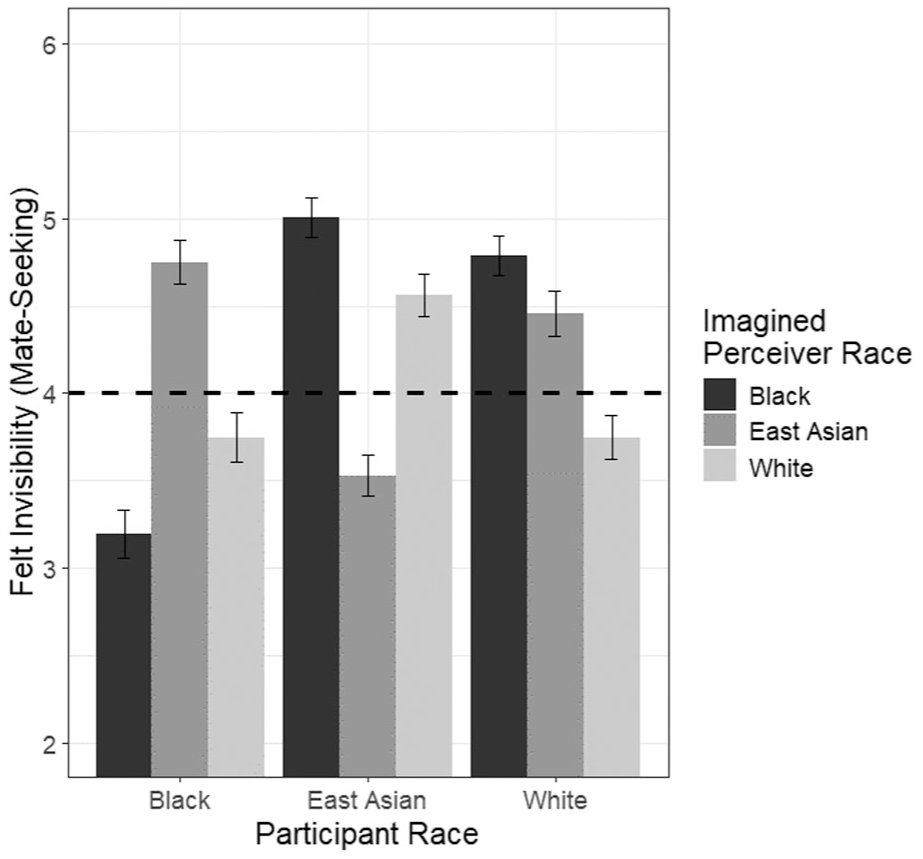
Study 4: Men’s invisibility to straight women seeking a mate, by participant and perceiver race.
Does Invisibility Differ by Target Identity?
We tested whether participant race predicted different overall levels of invisibility. There was a main effect of participant race for both Study 3, F(2, 389) = 3.13, p = .045, R2 = .016, and Study 4, F(2, 390) = 6.74, p = .001, R2 = .033. In Study 3, East Asian women felt significantly less invisible than Black women (unlike Studies 1 and 2). In Study 4, Black men felt significantly less invisible than both East Asian and White men (like Study 2), and East Asian and White men felt equally invisible (unlike Study 2).
Studies 3 and 4 Discussion
Studies 3 and 4 show that considering perceiver race reveals key nuances in who feels invisible in a mating context. When analyzing between-participant effects and collapsing across perceiver race, some small differences in overall group means emerged. Yet strikingly, in addition to these average differences, participants felt very little invisibility to other-gender people of their own race. In fact, participants only reported feeling invisible to other-gender people if they were from racial outgroups. Invisibility in a mate-seeking domain thus appears to be highly dynamic across perceiver race, with participants feeling invisible to people from some racial groups and not others.
Study 5
Like Studies 3 and 4, Study 5 examines whether invisibility varies depending on perceiver race, but now focuses on invisibility to people worried about self-protection, the other goal explored in Study 1.
Method
Participants
One thousand eight hundred and seventy-two U.S. East Asian, Black, and White women and men participated via Prolific for 1.50 GBP. The final sample size after exclusions was 1,280 (age = 18–79, M = 33.1, SD = 11.8; 645 women, 635 men; 384 East Asian, 415 Black, and 481 White; 1,033 Straight, 158 Bisexual, 47 Gay/Lesbian, 41 “Other sexual orientation”). Our obtained sample size provided power to detect a small effect size at the participant level (f2 = 0.015, R2 = .015) and smaller effect size at the observation level (f2 = 0.005, R2 = .005).
Measures
Participants reported felt invisibility to Black, East Asian, and White (perceiver race randomized within-subjects) women or men (perceiver gender randomized between-subjects) worried about self-protection. The average reliability for the invisibility measures was α = .82 (0.80–0.85). Invisibility to others with a disease avoidance goal was also measured, but participant confusion about items and poor overall reliability, α = .63 (0.60–0.66), indicate that the measure had poor construct validity, so we excluded that data from analyses and do not discuss it further. Next, participants reported their gender and race.
Results
See Tables 4 and A9 for all Study 5 results, including statistics for specific group comparisons. We summarize the effects here.
Study 5 Results: The Effect of Participant Gender, Participant Race, Perceiver Gender, and Perceiver Race on Target Invisibility.

Note. Results from a model where participant gender, participant race, perceiver gender, and perceiver race predict invisibility. R2 indicates the semi-partial R2 for that predictor.
p < .05. **p < .01. ***p < .001.
Is Target Invisibility Dynamic Across Perceiver Identity?
Perceiver Race
People felt most invisible to Black perceivers, less invisible to East Asian perceivers, and least invisible to White perceivers (perceiver race main effect, F(2, 2,535) = 97.72, p < .001, R2 = .072). This was qualified by an interaction of perceiver race with participant race, F(4, 2,535) = 53.47, p < .001, R2 = .078. Black participants reported large differences in invisibility depending on the race of the perceiver, F(2, 822) = 110.51, p < .001, R2 = .212. In fact, looking at the means compared to the midpoint of the scale, Black participants felt invisible only to Black perceivers, and not invisible to East Asian or White perceivers (Figure 5). East Asian participants felt invisible to all groups, and slightly more invisible to Black perceivers than to East Asian and White perceivers, F(2, 760) = 17.96, p < .001, R2 = .045. In contrast, White participants felt similarly invisible to perceivers from all racial groups, p = .154. Invisibility was thus highly dynamic across perceiver race for Black participants, less dynamic across perceiver race for East Asian participants, and not dynamic across perceiver race for White participants.

Study 5: Invisibility to perceivers concerned with self-protection, by participant and perceiver race.
Perceiver Gender
Participants felt more invisible to men than to women concerned with self-protection (i.e., perceiver gender main effect: F(1, 1,268) = 9.51, p = .002, R2 = .007). This was qualified by an interaction between perceiver gender and participant race, F(2, 1,268) = 3.17, p = .042, R2 = .005. White participants felt more invisible to men than to women, F(1, 477) = 15.31, p < .001, R2 = .031, and there was no such perceiver gender difference for Black or East Asian participants, ps > .16 (Figure 6). Invisibility was thus dynamic across perceiver gender only for White participants.
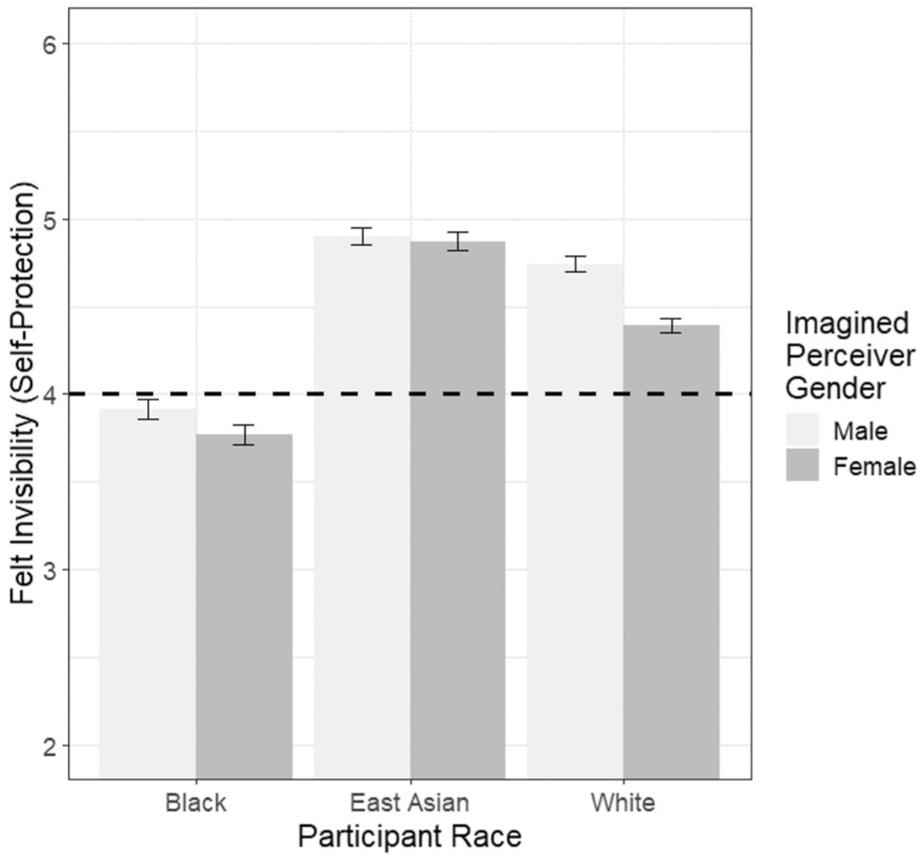
Study 5: Invisibility to perceivers concerned with self-protection, by participant race and perceiver gender.
Other Perceiver Effects
No other two- or three-way interactions involving perceiver race or gender were significant, all ps > .09. The four-way interaction of perceiver gender and race with participant gender and race was significant, F(4, 2,535) = 3.43, p = .008, R2 = .005, indicating that the patterns described above vary across participant groups. Four-way interactions are difficult both to adequately power for and to interpret. Looking at the means within this four-way interaction reveals some additional nuances involving perceiver factors, but the overall patterns as well as our conclusion that invisibility is dynamic across perceivers remain unchanged, so we do not discuss this interaction further. We have illustrated the patterns and listed simple effects in the Supplemental Material for the interested reader (see Tables S1–S4 and Figures S1 and S2).
Does Invisibility Differ by Target Identity?
Women felt more invisible than men, F(1, 1,268) = 120.71, p < .001, R2 = .087, and there was a main effect of participant race, F(2, 1,268) = 122.54, p < .001, R2 = .162, whereby Black participants reported feeling the least invisible, and East Asian participants reported feeling the most invisible. The Participant Gender × Participant Race interaction was not significant, p = .577.
Study 5 Discussion
Study 5 illustrates yet again that invisibility can be highly dynamic across perceivers. Here, we found that different people feel invisible to different others concerned with self-protection. For Black and East Asian participants, the other person’s race mattered, as both groups felt most invisible to Black perceivers. Indeed, Black participants felt invisible only to Black perceivers. The other person’s gender, however, did not matter: Black and East Asian participants felt similarly invisible to men and women. In contrast, for White participants, only the other person’s gender mattered, as they felt more invisible to men than to women with no consistent effects of the perceiver’s race. The between-participant effects showed that women felt more invisible than men, and Black participants felt the least invisible. Importantly, we would not have been able to observe nuances in different groups’ feelings of invisibility had we not both sampled participants from multiple gender-by-race groups and specified the perceiver’s goal, gender, and race.
General Discussion
Five studies, sampling six gender-by-race participant groups, explored targets’ feelings of invisibility to perceivers with different goals, genders, and racial groups. Studies 1 and 2 examined how invisible Asian, Black, and White women and men feel to women and men who have the goal to protect themselves or to find a romantic partner. Studies 3 through 5 focused on one goal each (mate-seeking or self-protection), and examined whether people feel differently invisible to East Asian, Black, and White people who have that goal. Supporting the dynamic invisibility hypothesis, all studies clearly show that invisibility is not a general experience, but that targets feel invisible to some people more than others. These findings demonstrate that to fully understand who feels invisible, we must consider not only who may feel invisible, but to whom they may feel invisible.
Implications for Invisibility Theory
Our results speak to multiple theoretical perspectives on invisibility, including intersectional invisibility and the affordance management theory of invisibility. Intersectionality, including intersectional invisibility, is a broad, nuanced theoretical perspective that has numerous implications for how and when people experience marginalization, lack of representation, and devaluation, and has received broad empirical support across numerous domains (e.g., Bhattacharyya & Berdahl, 2023; Crenshaw, 1989; Paluch & Shum, 2024; Sternberg et al., 2023), yet specific theories and perspectives within this broad framework make somewhat different predictions. Intersectional invisibility as posited by Purdie-Vaughns and Eibach (2008) suggests that people with multiple subordinate identities (e.g., Black women, East Asian women) will feel more invisible (Remedios & Snyder, 2018). The current studies’ results did not clearly support this prediction. For example, there are several instances where Black women report the least invisibility among women (in Studies 1 and 2 for a mate-seeking goal, and across studies for a self-protection goal). More generally, when we examined perceiver race, we saw stark differences in Black women’s reported invisibility (i.e., feeling invisible to East Asian and White men seeking a mate, but not to Black men), and these differences by perceiver race often dwarfed the small main effects of participant race. The results for East Asian women likewise cannot easily be accounted for by this perspective on intersectional invisibility. When others have self-protection goals, East Asian women do report feeling invisible, but when straight men seek romantic partners, East Asian women feel invisible only to Black men. In sum, predictions from intersectional invisibility as articulated by Purdie-Vaughns and Eibach (2008), which defines prototypes by ideologies of group supremacy (e.g., ethnocentrism), and was developed to describe representational invisibility at the larger cultural, historical, legal, and/or political level, does not readily account for the nuanced patterns across perceiver characteristics that we observed at the interpersonal level.
Integrating a gendered race prototype (e.g., Galinsky et al., 2013; Hall et al., 2019; Johnson et al., 2012) to this perspective on intersectional invisibility anticipates somewhat different patterns. This perspective identifies Black women and East Asian men as the least prototypical and therefore, the most invisible. Some of our findings for Black and East Asian men and women align with predictions from this perspective. For example, in Studies 3 and 4, which examined invisibility to people with a mate-seeking goal, East Asian men reported feeling more invisible overall than East Asian women and Black women reported feeling more invisible overall than Black men. However, this perspective does not account for our findings that East Asian men and Black women do not feel invisible to same-race others who are interested in finding a romantic partner.
Our findings are more consistent with conceptualizations of intersectionality that explicitly anticipate variability across situations. For example, the dimensions of identity that are most salient to perceivers (and thus, how targets feel they are treated by perceivers) can change depending on the situation and their goals (Petsko et al., 2022), and which group is seen as prototypical can depend on context (e.g., Paluch & Shum, 2024).
The affordance management theory of interpersonal invisibility also explicitly anticipates that invisibility will be dynamic. It argues that cues (e.g., gender, race) and their associated stereotypes (e.g., of competence, femininity, aggression) can signal different opportunities and threats across goals (Neel & Lassetter, 2019). The affordance management approach thus suggests that invisibility will often depend on the goals and characteristics of both perceivers and targets, simultaneously. And indeed, what emerged in our data across all studies is a complex pattern of invisibility that we could only see by examining target and perceiver factors together. For example, for invisibility in a romantic context, we observed a notable ingroup effect: participants felt much less invisible to other-gender perceivers of their own racial ingroup than those of their racial outgroups. Although this was perhaps a surprising finding, racial ingroup preference in a dating context is a well-documented phenomenon called racial homogamy (Chappetta & Barth, 2022). Likewise, in Study 5, we observed that racial groups showed different patterns of invisibility in a self-protection context. For East Asian and Black participants, ratings of invisibility were substantially driven by perceiver race, whereas for White participants, ratings of invisibility were substantially driven by perceiver gender. Thus, including potentially relevant cues for both targets and perceivers can reveal powerful and nuanced patterns of invisibility.
A particularly intriguing finding is the pattern from Study 5 whereby invisibility in a self-protection context was driven by different factors depending on the race of the participant. For Black participants, race cues guided who they would feel invisible to. Because Black people are stereotypically associated with threat or danger in the American context (Devine, 1989; Ghavami & Peplau, 2013), they may be frequently judged as potentially dangerous by people from other racial groups, but not from their own racial group. As such, Black targets may focus on race to appraise and differentiate who will or will not pay extra attention to them in a safety context. In addition to race, gender is also a salient cue for danger, with men more strongly associated with threat and danger than women (e.g., Ghavami & Peplau, 2013; Navarrete et al., 2010). This was reflected in our results for White participants, who relied on gender cues, but not race cues, regarding who they would feel invisible to in a self-protection context. However, we are unsure why White participants only use gender cues. Perhaps a colorblind ideology (e.g., Plaut et al., 2018) led these White participants not to rely on race as a cue, but then it’s unclear why they used race as a cue in a mate-seeking context (though we note that race is seen as normatively acceptable to use in a dating context, but not other contexts; Song, 2023). Lastly, East Asian participants felt differently invisible based on the other person’s gender and race, though the magnitude of these differences was small and overall, they reported high mean levels of invisibility to all others who were concerned with self-protection. As noted, East Asian and feminine stereotypes overlap, with both groups stereotyped as weak and unlikely to cause physical harm. As a result, East Asians may expect to be seen as weak and unlikely to be dangerous by all other perceivers. Future research should explore the exact mechanisms behind these different patterns. One possibility is that different racial groups tend to rely on different “lenses” when experiencing the world and predicting others’ behavior (at least in the contexts of invisibility to those with self-protection goals), with Black people using a race lens, White people using a gender lens, and East Asian people using an intersectional lens (Petsko et al., 2022). Overall, simultaneously assessing target and perceiver factors provides a more holistic and complete view of invisibility than a purely target-focused framework.
Limitations and Future Directions
The current work provides evidence for a dynamic approach to invisibility, but is constrained by some limitations. Our studies only sampled U.S. participants, limiting generalizability. We expect invisibility to be dynamic in other cultural settings, but this should be tested. Furthermore, we expect that the exact patterns of invisibility will differ depending on the specific culture’s affordance cues and stereotypes. In addition, our studies were designed to show that experiences of invisibility can be dynamic, rather than examining what processes are driving these differences in invisibility. Future research should explore potential mechanisms. Finally, the current data offer only one slice of participants’ experiences of invisibility, for two specific perceiver goals: motivation to find a mate and protecting oneself from harm. We chose these goals because of the empirical precedent for examining these motivations and because they are universally important domains. But targets may feel that invisibility in other contexts (e.g., the workplace, education), and with other motivations (e.g., achievement, maintaining relationships) are even more important. Future research should examine invisibility in other contexts and with other motivations.
Dynamic invisibility opens the door for a variety of research questions. Our findings suggest that people may expect to be invisible to others depending on how their own and the other person’s race and gender indicate relevance for a particular goal. However, more work should be done to test the precise mechanisms driving feelings of invisibility. Some findings indicate that who is seen as prototypical varies across situations and perceivers (Goh & McCue, 2021; Paluch & Shum, 2024), suggesting that situationally-variable prototypicality may also contribute to feelings of invisibility. Yet it is also possible that who is seen as prototypical in a situation is in fact informed by their perceived relevance in a particular situation. Further work is needed to test whether relevance drives situation-based prototypes, and to examine the relative contributions of and interrelations among situation-specific relevance, stereotypes, and prototypicality.
Relatedly, when do people perceive being invisible in a particular context to be a positive or negative experience? We suggest that this may depend on the function of invisibility, and whether being invisible facilitates or hinders the target’s own goal pursuit (Neel et al., 2023). For example, invisibility may be a negative experience for a woman who wants to be credited by her boss for her ideas, but invisibility may be less negative if it provides relief from unwanted romantic attention from her boss. People may thus seek to manage when and to whom they feel invisible, where possible. For example, some research has shown that people may conceal or reveal their sexual orientation in order to seek or avoid invisibility (Schwartzman & Neel, 2025), or react to invisibility in a strategic way (Bhattacharyya & Berdahl, 2023). When and to what extent targets strategically seek or avoid invisibility deserves further attention.
Finally, time is also a factor to consider. While we have shown that invisibility can be dynamic, people likely differ in how invisible they are across situations and across time, with some people frequently being invisible and others rarely so. For example, there is some evidence that temporary invisibility is perceived more positively than chronic invisibility (Bradley, 2021). How frequency and duration of invisibility affect targets’ well-being and goal pursuit will be an important direction to pursue.
Conclusion
Five studies show that targets’ experiences of invisibility are dynamic. Fully understanding experiences of invisibility requires us to examine not only who feels invisible, but when and to whom they feel invisible. Adopting an affordance management approach recognizes that interpersonal invisibility is inherently relational, highlights the importance of goals, and helps us to look for and understand the nuances of this common and consequential experience.
Supplemental Material
sj-docx-1-psp-10.1177_01461672261437440 – Supplemental material for Invisibility Is Dynamic
Supplemental material, sj-docx-1-psp-10.1177_01461672261437440 for Invisibility Is Dynamic by Elia Q. Y. Lam and Rebecca Neel in Personality and Social Psychology Bulletin
Footnotes
Appendix A
Acknowledgements
The authors wish to thank Alice D. Choe, Eric Hehman, James C.-Y. Lai, Spike W. S. Lee, Zi Ting You, and the anonymous reviewers for their feedback on this manuscript.
Ethical Considerations
All studies received ethics approval from the University of Toronto’s Office of the Vice-President, Research and Innovation, Office of Research Ethics, Social Sciences, Humanities and Education Research Ethics Board (# 37684, “Motivation, beliefs, and social judgment”).
Consent to Participate
In all studies, participants gave written consent to participate before starting the study.
Consent for Publication
In all studies, participants gave written informed consent for anonymous data to be published.
Author Contributions
Elia Q. Y. Lam played a lead role in data curation, formal analysis, investigation, visualization, and writing–original draft and an equal role in conceptualization, methodology, and writing–review and editing. Rebecca Neel played a lead role in funding acquisition and supervision, a supporting role in writing–original draft, and an equal role in conceptualization, methodology, and writing–review and editing.
Funding
The authors disclosed receipt of the following financial support for the research, authorship, and/or publication of this article: The authors disclosed receipt of the following financial support for the research, authorship, and/or publication of this article. This research was supported by grants from the Social Science and Humanities Research Council of Canada [435-2020-0758], [752-2022-2460]; and the U.S. National Science Foundation [SBE-1625401].
Declaration of Conflicting Interests
The authors declared no potential conflicts of interest with respect to the research, authorship, and/or publication of this article.
Data Availability Statement
OSF Repository: OSF (https://osf.io/kabyj/overview). Study 2 Preregistration: 
Supplemental Material
Supplemental material is available online with this article.
Notes
References
Supplementary Material
Please find the following supplemental material available below.
For Open Access articles published under a Creative Commons License, all supplemental material carries the same license as the article it is associated with.
For non-Open Access articles published, all supplemental material carries a non-exclusive license, and permission requests for re-use of supplemental material or any part of supplemental material shall be sent directly to the copyright owner as specified in the copyright notice associated with the article.
